
How to Scale Independent Record Labels: 2026 Guide

Table of Contents
- Understanding the Foundation: What Scaling Means for Independent Labels
- Building a Scalable Distribution Infrastructure
- Creating a Record Label Business Plan Template
- How to Sign Artists to an Indie Label
- Music Industry Royalty Management Tools and Financial Workflows
- Legal Requirements for Starting a Record Label and Managing Growth
- Scaling Your Team and Operations
- Conclusion
Last Updated: August 10, 2026
Understanding the Foundation: What Scaling Means for Independent Labels
Scaling an independent record label means systematically expanding your artist roster, revenue streams, and operational capacity without losing the creative identity that defines your brand. Most independent labels start as one person managing a handful of artists. That works until you hit 10-15 active artists or 30+ releases per year, then manual workflows break. Email chains replace tracking systems. Spreadsheets replace royalty accounting. Artists wait weeks for statements.
Scaling requires three foundational shifts: move from managing artists reactively to strategically, shift from treating distribution as a one-time upload to a continuous pipeline with metadata management, and professionalize your financial operations so artists trust your accounting. The difference between a label that stays at 5 artists and one that grows to 50 comes down to this: Did you build processes that work without you personally executing every task?
Building a Scalable Distribution Infrastructure
Your distribution infrastructure is the backbone of everything. Without it, each new artist adds linear complexity to your manual workflows.
Start by choosing a distribution partner that handles metadata management at scale, provides detailed platform-level reporting, and supports unlimited sublabels if you plan to segment your catalog by genre or artist collective. According to RIAA's 2026 music distribution trends report, independent labels now account for over 35% of all streaming releases, creating a data management problem that requires visibility into which releases went to which platforms and which artists earned from which territories.
Your distribution partner's reporting infrastructure matters more than their playlist connections. When you scale to 50+ active artists, you need to see exactly which releases generate revenue on each platform for accurate royalty accounting and A&R decision-making.
Build your distribution workflow around DDEX metadata standards, the industry standard for sending release information to platforms. This ensures your metadata arrives correctly and consistently across all platforms. Most platforms now require DDEX-compliant submissions for high-volume releases.
Your infrastructure should also include a clear release calendar and asset management system. As you scale, multiple releases will launch simultaneously across different artists and sublabels. A shared calendar prevents conflicts, ensures metadata is submitted on time, and lets you coordinate playlist pitching across your catalog.
Creating a Record Label Business Plan Template
A record label business plan is your operational roadmap for scaling.
Start with a clear definition of your label's niche. Are you focused on a specific genre, region, or artist demographic? The more specific your positioning, the easier it is to build a sustainable A&R strategy and attract artists who fit your brand.
Next, document your revenue model. Most independent labels derive revenue from streaming royalties, sync licensing (TV, film, advertising), merchandise sales, live event coordination, and artist services. Many labels ignore sync revenue entirely, a major missed opportunity. According to Musicbed's 2026 sync licensing insights, independent labels that actively pitch for sync placements see 15-25% of their annual revenue from that channel alone.
Include hiring projections. Once you hit 15-20 active artists, you need at least one part-time person handling artist relations and royalty accounting. At 40+ artists, you need a full-time operations manager and likely an A&R specialist. Document when you'll hire, what roles you'll fill first, and how you'll fund those hires.
Include financial projections for at least three years. Most new labels overestimate success rates by 200-300%. Build your projections on conservative assumptions, then track actual performance against them monthly.
How to Sign Artists to an Indie Label
Signing artists to your label is where strategy meets execution. The wrong artist onboarding process creates chaos at scale.
Start by establishing clear artist agreements before you sign anyone. Your agreement should specify ownership of master recordings, the label's revenue share, commitment length, exit procedures, and how royalties are calculated and paid. This isn't optional, it's the foundation of your entire business.

Many independent labels skip formal agreements to seem "artist-friendly" or because they're signing friends. This is a mistake. A clear, fair agreement prevents misunderstandings about revenue splits, prevents disputes about master recording ownership if the artist leaves, and makes it easier to manage multiple sublabels later.
Your artist agreement should include:
- Term length (typically 1-3 years, often with renewal options)
- Revenue split (what percentage the label takes vs. the artist)
- Definition of what counts as label revenue (streaming only, or does it include sync and merchandise?)
- Advance payment structure (if applicable)
- Reversion of rights if the label goes inactive
- Termination clause and exit procedures
- Payment schedule (monthly, quarterly, or per-release)
When evaluating artists to sign, look beyond just listening to their music. Examine their existing audience (social media followers, Spotify followers, email list), release history (consistency matters), and commitment level (will they actively promote releases?). An artist with 5,000 engaged followers and a consistent release schedule is more valuable than an artist with 50,000 inactive followers.
Create an onboarding checklist for new artists: artist bio, high-resolution artwork, ISRC codes if they have prior releases, payment information, and social media handles. Standardize this process so every artist goes through the same steps.
Music Industry Royalty Management Tools and Financial Workflows
Your royalty accounting system is where trust is built or destroyed at scale.
Most independent labels start with spreadsheets. This works until you have 20+ artists and multiple revenue streams. At that point, spreadsheets become a liability, they're error-prone, hard to audit, and impossible to scale.
A proper royalty management workflow has three components: aggregation (collecting revenue data from all platforms), calculation (determining what each artist is owed based on your agreement terms), and distribution (paying artists on a predictable schedule).
Aggregation requires connecting to your distribution platform's API or using their reporting dashboard to pull revenue data. You need to standardize this data, converting different platforms' terminology, handling currency conversion, and reconciling discrepancies.
Calculation requires accounting for platform fees, distribution fees, currency conversion, and any advances paid upfront that need to be recouped.
Distribution should happen on a predictable schedule. Many successful labels pay artists monthly, which builds trust and makes it easier for artists to plan. Whatever you choose, be consistent and communicate it clearly in your artist agreements.
Set up your royalty accounting system before you have 10 artists, not after. Your system should generate automated monthly statements for each artist showing gross revenue by platform, any deductions, and net payment due.
Legal Requirements for Starting a Record Label and Managing Growth
The legal requirements for starting a record label vary by territory, but several critical areas apply in the United States.
First, business structure. Most independent labels operate as LLCs or S-corps. An LLC provides liability protection and is relatively simple to set up. An S-corp has tax advantages if you're generating significant revenue, but requires more accounting overhead. Consult with a business accountant or attorney in your state.
Second, copyright and master recording ownership. When you sign an artist, you're typically acquiring ownership of the master recording while the artist retains ownership of the composition. This needs to be clearly documented in your artist agreement. According to U.S. Copyright Office guidelines on master recording ownership, disputes over master recording ownership are one of the most common sources of legal conflict in the music industry.
Third, sync licensing rights. Your artist agreements should explicitly grant you sync licensing rights. If they don't, you can't legally license your own catalog, a massive revenue loss.
Fourth, royalty accounting compliance. Several U.S. states have specific requirements about how often you must pay artists and how detailed your accounting must be. California, for example, has strict artist payment laws. Research your state's requirements and build them into your payment schedule.
Fifth, tax compliance. Track and report 1099 income if you pay any contractors. Keep detailed records of all payments and invoices.
Scaling Your Team and Operations
The moment you start scaling beyond what you can personally manage, you need to think about hiring and delegation.
Most labels try to stay solo as long as possible because hiring feels expensive. But at scale, staying solo is actually more expensive, it limits your ability to manage more artists, pursue new revenue streams, and grow strategically.
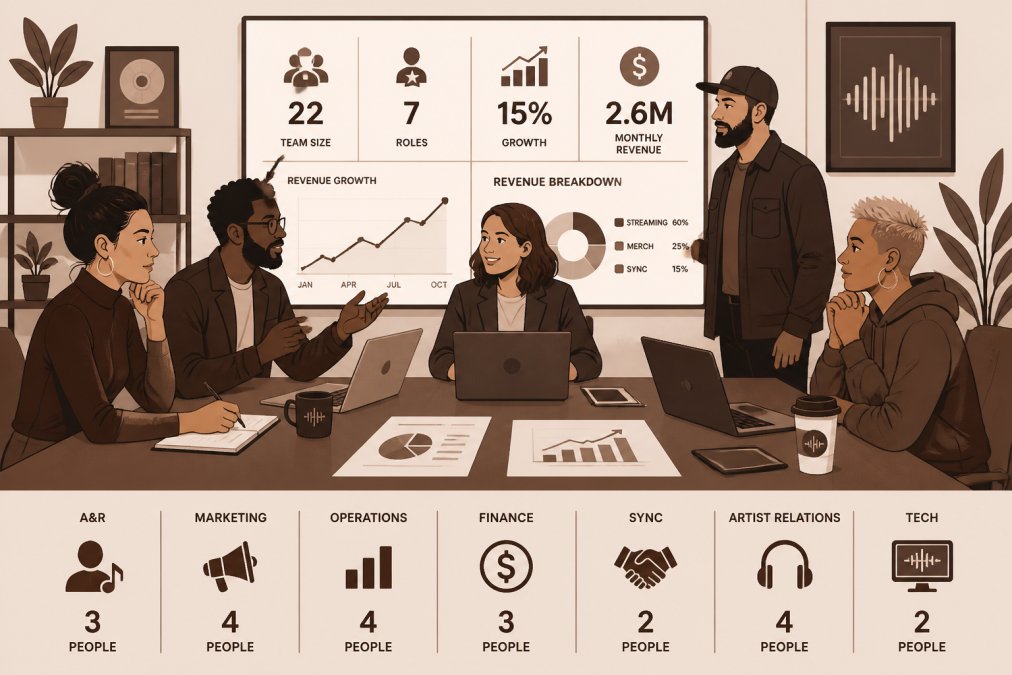
Your first hire should typically be an operations or artist relations person. This person handles artist onboarding, royalty accounting, communication with the distribution platform, and day-to-day artist support. This frees you up to focus on A&R and business development.
Once you have an operations person in place, consider hiring an A&R specialist if your label generates enough revenue. An A&R specialist listens to demos, identifies talent, develops artists' sound, and coordinates with producers and mixers.
Your team structure at different scales might look like this:
- 0-15 artists: You solo, using freelance help for specific projects
- 15-30 artists: You plus one part-time operations person
- 30-50 artists: You plus one full-time operations person and one part-time A&R consultant
- 50+ artists: You plus full-time operations, full-time A&R, and potentially a marketing specialist
Track how many hours you're spending on each major task. When one task consistently takes 20+ hours per month, that's a signal to hire or outsource it.
Scaling independent record labels requires building infrastructure that works without you personally executing every task. Start with a clear distribution pipeline, establish formal artist agreements before you sign anyone, implement proper royalty accounting from day one, and hire strategically based on where your time is actually going.
The labels that scale successfully treat operations as seriously as they treat A&R. They invest in systems early, document processes so they can delegate, and track financial performance honestly so they know what's actually working.
NexaTunes is built specifically for independent labels serious about scaling. With unlimited sublabels, detailed label-level reporting, and direct access to platforms like Beatport and Traxsource, it removes the infrastructure barriers that hold most labels back. If you're managing multiple artists or multiple sublabels, you need visibility into exactly where your revenue is coming from and the ability to pay artists reliably every month. That's what separates labels that scale from labels that stay stuck.
| Growth Stage | Team Size | Key Focus | Main Challenge |
|---|---|---|---|
| Solo (0-15 artists) | 1 person | Artist development & releases | Manual workflows |
| Early scale (15-30 artists) | 1-2 people | Operations & artist relations | Financial tracking |
| Growth (30-50 artists) | 2-3 people | Revenue diversification | Team coordination |
| Scaling (50+ artists) | 3+ people | Strategic positioning | Maintaining brand identity |
Frequently Asked Questions
How do independent record labels make money?
Independent labels generate revenue through multiple streams: streaming royalties from platforms like Spotify and Apple Music, sync licensing for film and TV placements, merchandise sales, and artist services. The key to scaling is diversifying these revenue streams. Royalty accounting must track each source separately so you understand which channels drive the most profit. Many labels also earn from sublabel partnerships and artist development fees.
What are the legal requirements for starting a record label in the US?
You must register your business with your state (LLC or corporation), obtain an Employer Identification Number (EIN) from the IRS, and secure appropriate business insurance. Copyright administration is critical, you need to register master recordings with the U.S. Copyright Office and register your label with performing rights organizations like ASCAP, BMI, or SESAC. Consult a music attorney to draft artist agreements that protect intellectual property and clarify royalty splits before signing anyone.
What's the biggest challenge for independent record labels today?
Competing for artist attention and maintaining operational efficiency at scale. Labels struggle with metadata management across global distribution pipelines, royalty accounting complexity, and artist retention as they grow. The solution is investing early in reliable music industry royalty management tools and automation. Many labels also underestimate the cost of compliance and tax obligations across different territories, planning for cross-border financial compliance prevents costly mistakes later.
How do you grow a record label from scratch without a huge budget?
Start with a lean team and focus on one genre or niche where you can build authentic brand identity. Use a professional distribution platform with detailed label-level reporting so you understand your metrics without expensive consultants. Build relationships with 5-10 artists first, perfect your workflow, then scale. Invest in music industry royalty management tools early to avoid manual accounting errors. Many successful labels grew by being selective about artist signings and reinvesting profits into marketing and catalog development.
Editorial Transparency: This article was created with the assistance of GrandRanker AI and reviewed, edited, fact-checked, and approved by the NexaTunes editorial team before publication.
“If you’re looking for a reliable way to distribute your music to Major Platforms , NexaTunes offers direct distribution with transparent terms.