
Detailed Royalty Reporting for Labels: A 2026 Guide

Table of Contents
- Why Detailed Royalty Reporting Matters for Labels
- Core Components of Royalty Statement Generation
- Music Royalty Accounting Software: Automating Your Workflow
- Royalty Statement Template for Artists: Structure and Standards
- Music Industry Accounting Best Practices for Labels
- Recoupable Expenses in Music Contracts: Accounting for Deductions
- Transitioning from Spreadsheets to Royalty Software
- Conclusion
Last Updated: August 11, 2026
Why Detailed Royalty Reporting Matters for Labels
Royalty reporting for labels is the foundation of trust between you and your artists. When artists see exactly where their money comes from, by platform and region, they stay longer and reinvest in your label. When they can't, they leave.
Artists now expect the same financial clarity from their labels that they'd get from a bank statement. Yet many labels still operate on spreadsheets and quarterly statements that arrive weeks after payment. According to music industry transparency reports from trade organizations, labels that provide detailed, accessible royalty reporting see measurably higher artist retention and faster payment cycles.
Detailed royalty reporting means moving beyond "here's what you earned this month" to "here's exactly what you earned, where it came from, what was deducted, and why." This requires data normalization from multiple sources, multi-currency conversion, audit trails, and artist portals for anytime access.
The cost of getting this wrong is significant. Royalty disputes consume resources. Artists without clear statements assume they're being shortchanged. Labels without clean audit trails can't defend themselves in disputes. And spreadsheets become unmanageable as you scale across multiple digital service providers and sublabels.
Core Components of Royalty Statement Generation
Generating a royalty statement that artists trust requires pulling data from multiple sources, reconciling discrepancies, converting currencies, applying deductions, and presenting everything clearly.
Revenue reconciliation and sales data import
Revenue reconciliation is where most labels stumble. Your artists' money comes from dozens of sources, Spotify, Apple Music, YouTube, TikTok, Beatport, Traxsource, each reporting data in different formats, on different schedules, with different definitions of sales and streams.
Sales data import means pulling raw data from each digital service provider and normalizing it into a consistent format. A stream on Spotify is reported differently than on Apple Music. Download prices vary by region. Some platforms report gross revenue; others report net after their fees. Your system must translate all of this into a single source of truth.
Reconciliation compares what you received in payment against what DSPs reported you earned. Discrepancies happen constantly, timing differences, refunds, adjustments, chargebacks. A proper workflow identifies these gaps, categorizes them, and flags them for investigation.
Most labels do this manually: exporting CSVs from each platform and pasting them into spreadsheets. This breaks down fast. At 50 artists and 20 platforms, it's chaos. A proper system automates data import and reconciliation, connecting directly to DSP APIs where available and flagging discrepancies automatically.
Multi-currency processing and conversion
If your artists are international, you're dealing with multiple currencies. Spotify pays in EUR, Apple Music in USD, Beatport in GBP. Artists expect statements in their local currency.
Multi-currency conversion means exchanging currencies at the right rate consistently and transparently. Exchange rates fluctuate daily. A system that handles this properly locks in rates on the conversion date, documents the rate used, and applies it consistently across all transactions.
Audit-ready reporting and compliance
Royalty statements are financial documents. If an artist disputes a payment, you need to defend it. If audited, you must prove every number. If raising capital, investors want clean financials.
Audit-ready reporting means every number is traceable back to source data. It means maintaining an audit trail, a log of every calculation, deduction, and currency conversion. Compliance also means following jurisdiction-specific rules: tax withholding requirements, government reporting, and payment timing rules. A proper system handles these automatically.
Music Royalty Accounting Software: Automating Your Workflow
The shift from manual spreadsheets to dedicated royalty accounting software is the single biggest operational upgrade most labels can make. The right software eliminates entire categories of errors and gives you visibility spreadsheets can't provide.
Automated royalty calculations and distributor integration
Automated royalty calculations mean defining your royalty splits once, then letting the system apply them consistently to every transaction. If an artist gets 85% of net revenue, the system calculates that automatically for every sale across every platform. If a collaboration has three artists splitting 70% equally, the system divides it three ways automatically.
Distributor integration connects your royalty software directly to platforms like Beatport and Traxsource. Instead of manually downloading reports, the system pulls data automatically on a schedule. This reduces delays, eliminates manual entry errors, and ensures you're always working with current data.
The automation extends to recoupable expenses. If an artist's advance or marketing spend is recoupable against royalties, the system deducts it automatically as sales come in and alerts you when they recoup.

Artist portal access and statement distribution
An artist portal is where transparency becomes real. Instead of waiting for a statement email, artists log in anytime and see their current balance, earnings by platform, earnings by track, and detailed transaction history. They can download statements and export data.
A good artist portal reduces support requests. Artists don't need to email asking "where's my money" if they can see it themselves. It builds trust because information is always available and accurate.
Statement distribution means automatically sending statements on a schedule, monthly, quarterly, or per your contracts. The system generates the statement, formats it, and sends it to the artist's email or makes it available in their portal.
Royalty Statement Template for Artists: Structure and Standards
A royalty statement template defines what information gets presented, in what order, and in what format. A good template is clear enough that an artist with no accounting background can understand it.
What information must be included
A complete royalty statement includes:
- Reporting period (dates covered)
- Artist name and unique identifier
- Total earnings by platform
- Earnings by track or release
- Deductions (advances, marketing spend, production costs)
- Currency and exchange rates used
- Payment amount and method
- Payment date or expected payment date
- Contact information for questions
The statement should also show year-to-date totals and running balance. Some labels add additional detail: streams by platform, listener geography, playlist placements. This helps artists understand what's working and builds trust.
Frequency and timing of distributions
Most labels pay monthly because it matches how artists think about their business. Timing matters too. If you receive DSP payment on the 20th but don't pay artists until the 15th of the following month, that's a 25-day delay. Some contracts specify maximum payment delays of 30, 45, or 60 days from the reporting period end.
Statements should arrive on a predictable schedule. If artists expect payment on the 15th of each month, deliver on the 15th. Predictability builds trust.
Music Industry Accounting Best Practices for Labels
Handling royalty splits and catalog management
Royalty splits get complicated fast. A track might have multiple artists, each with a different split percentage. It might have featured artists, producers, or songwriters who are owed a piece.
A proper system tracks all these relationships. It knows that Artist A gets 70% of net revenue, Artist B gets 20%, and the producer gets 10%. It applies these splits automatically to every sale. If the split changes, the system applies the new split going forward.
Catalog management means knowing who owns what, what the contract terms are, and what's owed to whom. As your label grows, a spreadsheet approach breaks down. A proper system gives you a searchable, auditable catalog database.
Resolving royalty disputes and data normalization
Disputes happen. An artist claims they should have earned more. A DSP reports conflicting numbers. You find an error in a past statement. A proper dispute resolution workflow documents the issue, investigates it, and resolves it transparently.
Data normalization is the foundation of dispute resolution. If you have clean, normalized data, every transaction recorded consistently, every currency converted at a documented rate, every deduction documented, you can defend your position.
Many disputes arise from simple misunderstandings. An artist doesn't understand what "net revenue" means or doesn't realize that payment processing fees and refunds reduce what they're owed. A clear statement template and good communication prevent most disputes before they start.
Recoupable Expenses in Music Contracts: Accounting for Deductions
Recoupable expenses are costs deducted from an artist's royalties until they're paid back. Common recoupable expenses include advances, marketing spend, production costs, and music video production.
An advance is money paid upfront, before the artist has earned royalties. It's recoupable, meaning the artist receives no additional royalties until they've earned enough to pay back the advance. If an artist receives a $5,000 advance and their first month generates $3,000 in royalties, they receive nothing that month, the $3,000 goes toward recouping the advance.
Marketing spend is often recoupable. If you spend $2,000 promoting an artist's release, that $2,000 comes out of their royalties. This incentivizes artists to promote their own work and gives them visibility into your investment.
A proper accounting system tracks recoupable expenses separately from royalties. It shows artists exactly what they're recouping against and how much longer until they recoup.
Transitioning from Spreadsheets to Royalty Software
Most labels start with spreadsheets. They're free and flexible, but as you grow, spreadsheets become a liability. Formulas break. Data gets duplicated or lost. It becomes impossible to audit. And you're spending hours monthly on manual work that software could do in minutes.
Start by auditing your current spreadsheets. What data are you tracking? What calculations are you doing? What reports do you generate? Document your current process completely. This becomes your requirements list for new software.
Choose software that can import your historical data. You don't want to start fresh; you need continuity. The software should ingest your old spreadsheets, normalize the data, and build a database from it.
Plan a migration period where you run both systems in parallel. Enter new data into the software while maintaining your spreadsheets. Compare results monthly. Once confident the software is accurate, cut over completely.
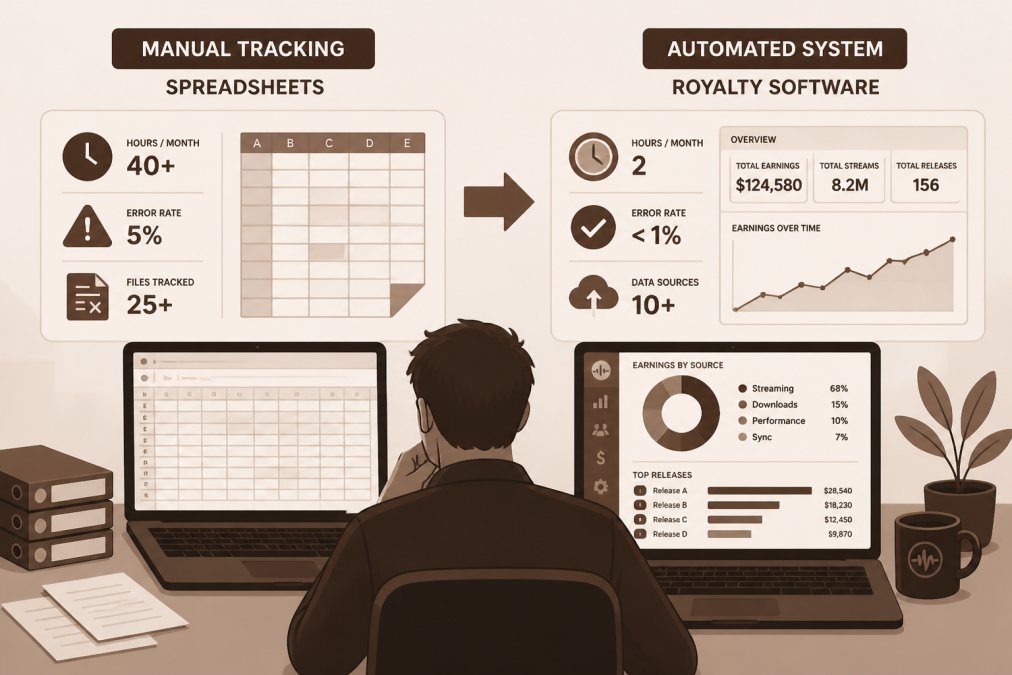
Train your team on the new system. Most modern royalty software is intuitive, but every system has quirks. Set up automated data imports immediately, the whole point is eliminating manual data entry. Connect your DSP accounts, set up automatic imports, and verify the data is coming in correctly.
The transition typically takes 1-3 months depending on your data complexity. The investment pays for itself in the first year through reduced administrative time and fewer errors.
Conclusion
Detailed royalty reporting for labels is no longer optional, it's the baseline expectation. Artists demand transparency. Regulators expect clean financials. Your business can't scale on spreadsheets.
Professional royalty accounting software solves multiple problems: it eliminates manual errors, automates calculations, creates audit trails, and gives artists the visibility they expect. NexaTunes provides detailed label-level royalty reports, monthly payouts, unlimited sublabels, and direct access to platforms like Beatport and Traxsource. Get started with NexaTunes and transform your label's financial operations into a competitive advantage.
Frequently Asked Questions
What information must be included in a detailed royalty statement for artists?
A comprehensive royalty statement should include gross revenue by platform (streaming services, downloads, physical sales), deductions for recoupable expenses, net royalties owed, currency conversions applied, reporting period dates, and a breakdown by artist or release. Each line item must be traceable to source data. Statements should also show reserve accounts held, payment dates, and contact information for dispute resolution. This level of transparency builds trust and simplifies artist relations.
How does music royalty accounting software improve reporting accuracy?
Automated royalty accounting software eliminates manual data entry errors, normalizes sales data from multiple digital service providers (DSPs), and applies royalty splits consistently across all releases. The system maintains an audit trail of every calculation, making it easy to verify figures and resolve discrepancies. Real-time reconciliation catches mismatches immediately rather than discovering them months later. Automated calculations also reduce the time your team spends on routine tasks, freeing them to focus on strategic decisions.
What are common challenges in royalty accounting for independent labels?
Independent labels typically struggle with data normalization across multiple DSPs, each reporting in different formats and currencies. Tracking recoupable expenses, managing royalty splits among multiple artists, and maintaining compliance with varying contract terms adds complexity. Manual spreadsheet tracking leads to errors and makes audits difficult. Many labels also lack the infrastructure to provide real-time artist portals, forcing them to handle statement requests manually. These challenges compound as labels scale and add more artists or sublabels.
How often should record labels issue royalty statements to artists?
Industry standard practice is monthly royalty statements, though quarterly or semi-annual statements are common depending on contract terms. Monthly reporting provides artists with timely visibility into their earnings and reduces disputes. When choosing a reporting frequency, consider your cash flow, the volume of transactions, and artist expectations. Monthly statements also align with how most digital service providers report data, making reconciliation simpler. Whatever frequency you select, consistency and timeliness build credibility with your roster.
Editorial Transparency: This article was created with the assistance of GrandRanker AI and reviewed, edited, fact-checked, and approved by the NexaTunes editorial team before publication.
“If you’re looking for a reliable way to distribute your music to Major Platforms , NexaTunes offers direct distribution with transparent terms.