
5 Ways to Calculate Artist Royalty Payments Accurately

Table of Contents
- 5 Ways to Calculate Artist Royalty Payments Accurately
- Method 1: Manual Calculation Using Gross Revenue and Royalty Rates
- Method 2: Net Revenue Approach With Deductions and Recoupables
- Method 3: Streaming Royalty Calculations Across DSPs
- Method 4: Mechanical Royalties and Writer Participation Splits
- Method 5: Automated Royalty Calculation With Management Software
- How to Read Royalty Statements and Verify Accuracy
- Music Royalty Rates Explained: Factors That Influence Your Payments
Last Updated: July 24, 2026
5 Ways to Calculate Artist Royalty Payments Accurately
Understanding how to calculate artist royalty payments accurately is essential for anyone running an independent music business. Getting royalty calculations right directly impacts your bottom line and your artists' trust. At NexaTunes, we've worked with hundreds of labels navigating complex royalty structures, and we've seen firsthand how calculation errors compound quickly, sometimes costing thousands in annual revenue. This guide walks through five distinct methods for calculating royalties, from manual approaches to automated software solutions, so you can choose the approach that fits your operation's scale.
The music industry's royalty ecosystem is fragmented. Different revenue streams, streaming platforms, mechanical licenses, performance rights, sync licensing, each have their own calculation rules, rates, and reporting timelines. Without a clear system, you'll spend hours reconciling data or worse, underpay artists and face disputes.
Why Accurate Royalty Calculations Matter for Your Bottom Line
Getting royalty math wrong costs you in three ways: lost artist relationships, regulatory exposure, and operational inefficiency. When an artist discovers they've been underpaid, trust evaporates. Overpaying erodes your margins and makes scaling unsustainable.
According to SoundExchange's digital performance royalty reporting, the U.S. music industry processed over $1.5 billion in digital performance royalties in 2025, with accuracy rates varying significantly by distributor and label size. Smaller operations often lack the infrastructure to track all revenue streams, leading to missed payments or delayed settlements.
Accurate calculations also simplify your financial reporting. When you can reconcile artist payments against platform statements month-to-month, you catch discrepancies early. This matters for tax compliance, audit preparation, and building credibility with artists who increasingly demand transparency.
Method 1: Manual Calculation Using Gross Revenue and Royalty Rates
The simplest approach works for independent artists or very small labels with limited revenue streams. Multiply gross revenue (total money received before deductions) by a fixed royalty percentage.
Step-by-step process:
- Gather your monthly revenue statement from your distributor or platform.
- Identify your royalty rate (e.g., 70/30 split means the artist receives 70%).
- Multiply gross revenue by the royalty rate. If you received $1,000 gross and the artist's rate is 70%: $1,000 × 0.70 = $700.
- Subtract any recoupable costs if your agreement specifies them.
- Document the calculation in a spreadsheet with columns for artist name, period, gross revenue, royalty rate, calculated amount, and deductions.
- Cross-check against your distributor statement to verify gross revenue matches.
This method is transparent and easy to audit. The downside: it doesn't account for platform-specific rates, which vary significantly between Spotify, Apple Music, and YouTube.
Method 2: Net Revenue Approach With Deductions and Recoupables
Most professional agreements use net revenue, which means you deduct legitimate business costs before calculating the artist's share. This method is more realistic for labels managing multiple artists.
Net revenue starts with gross revenue, then subtracts distribution fees (15-30%), payment processing fees (2-5%), advances the label paid to the artist, and returns/chargebacks.
Example calculation:
Gross revenue: $5,000 Distribution fee (20%): −$1,000 Payment processing (3%): −$150 Returns/chargebacks: −$50 Net Revenue: $3,800
Artist royalty rate: 70% Artist receives: $3,800 × 0.70 = $2,660
If the artist has a $5,000 advance outstanding, the label recoupes $2,660 against it. The artist's recoupment balance drops to $2,340 remaining.
Advances are loans to artists against future royalties. Until the artist's earnings exceed the advance, they receive nothing. Once earnings exceed the advance, they receive their royalty percentage on all earnings above the recouped amount. Track advances per artist with a running balance to prevent errors.
Method 3: Streaming Royalty Calculations Across DSPs
Streaming platforms don't pay a fixed percentage. They use a pro-rata model: each stream contributes to a monthly pool of revenue, and that pool is divided among all rights holders based on their share of total streams.
How it works:
- Platform sets aside a payout pool (typically $0.003 to $0.005 per stream on average).
- Calculate your share of total streams. If your catalog generated 1 million streams and the platform had 10 billion total streams, your share is 0.01%.
- Your payout = (Your streams / Total streams) × Monthly payout pool.
If the monthly pool is $50 million and your 1 million streams represent 0.01% of 10 billion total streams, your payout is: (1,000,000 / 10,000,000,000) × $50,000,000 = $5,000.
The per-stream rate fluctuates month-to-month based on platform revenue and total stream volume. You cannot tell an artist "you'll earn $0.004 per stream" because that rate changes. Calculate their payout after the month ends when you know the actual per-stream rate.
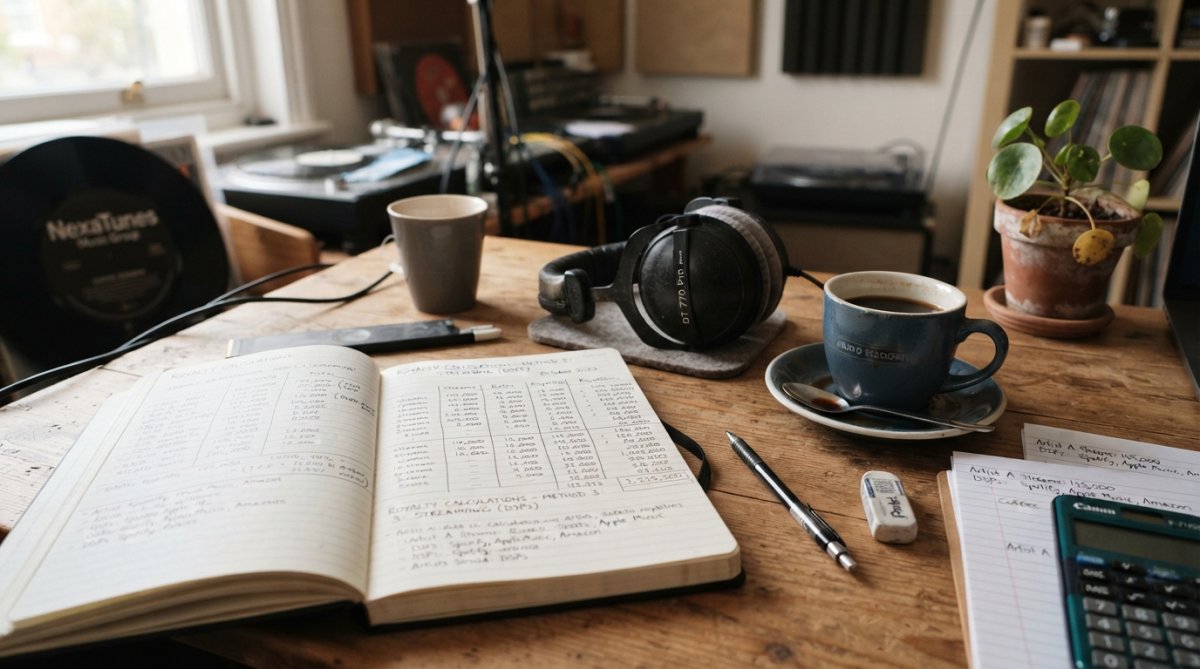
For your artists, once you have the per-stream rate:
- Artist streams: 100,000
- Per-stream rate (actual): $0.0035
- Artist payout (before label deductions): 100,000 × $0.0035 = $350
Then apply your royalty split and subtract any recoupables. Track pro-rata calculations in a spreadsheet with columns for artist, streams, per-stream rate, gross payout, label share, artist share, and deductions.
Method 4: Mechanical Royalties and Writer Participation Splits
Mechanical royalties are payments for the right to reproduce a song, whether physical, digital download, or stream. These are distinct from performance royalties (collected by BMI, ASCAP) and are typically handled by publishing administrators.
A controlled composition is a song where the publisher controls the rights. Mechanical royalty rates in the U.S. are set by the Copyright Royalty Board. For 2026, the statutory mechanical rate for songs under 5 minutes is approximately $0.091 per download or a pro-rata share for streams.
Example: Calculating mechanical royalties for a download
Song: "Example Track" (3:45 duration) Downloads: 500 Statutory mechanical rate: $0.091 per download Mechanical royalty owed: 500 × $0.091 = $45.50
If the song has multiple writers, split this mechanically. If Writer A owns 50% and Writer B owns 50%, each receives $22.75.
Many independent artists are both the recording artist (entitled to master royalties) and the songwriter (entitled to mechanical and performance royalties). Your calculation must separate these:
| Royalty Type | Source | Typical Rate | Who Receives |
|---|---|---|---|
| Master (streaming) | Spotify, Apple Music | $0.003-$0.005 per stream | Recording artist, label |
| Mechanical (streams) | Statutory rate | $0.001-$0.002 per stream | Songwriter, publisher |
| Performance | Radio, live venues, DSPs | Varies by PRO | Songwriter, composer |
| Sync | TV, film, ads | Negotiated | Publisher, songwriter |
Use a separate line item for mechanical royalties. Don't lump them into master royalties. Many small labels miss mechanical payments entirely because they conflate the two.
Method 5: Automated Royalty Calculation With Management Software
As your catalog grows beyond 10-20 artists, manual spreadsheet calculations become error-prone. Automated royalty management software ingests sales data from multiple platforms, applies your contract terms, and generates statements automatically.
Typical workflow:
- Data import: The software pulls sales reports from your distributors via API or manual upload.
- Contract mapping: You configure each artist's contract terms, royalty percentage, advance amount, recoupment rules, and deductible costs.
- Calculation: The software applies these terms to the imported data, calculating net royalties per artist per platform.
- Reconciliation: The software compares its calculations against the distributor's reported totals to catch discrepancies.
- Statement generation: It produces a royalty statement per artist showing streams, revenue, deductions, and net payout.
- Payment processing: Some platforms integrate with payment systems to automate payouts.
The benefit of automation is accuracy at scale. A platform like Curve Royalty Systems or Eddy.app can handle thousands of artists and millions of transactions without human error. For NexaTunes users, the integrated reporting dashboard provides real-time visibility into royalty calculations.
How to Read Royalty Statements and Verify Accuracy
A royalty statement is a detailed breakdown of earnings for a specific period (usually monthly). It should show:
- Artist name and period
- Streams and sales by platform
- Gross revenue before deductions
- Deductions (distribution fees, processing costs, recoupables)
- Net royalties owed to the artist
- Advance recoupment status (if applicable)
Publisher statements are separate and show mechanical and performance royalties from your publishing administrator or PROs.
To verify accuracy:
- Cross-check the gross revenue against your distributor's statement.
- Verify the deduction percentages match your agreement.
- Recalculate the net royalty yourself: gross minus deductions should equal net.
- Check the artist's royalty percentage.
- For multi-platform statements, ensure all platforms are included.
Provide a clear explanation alongside the statement: "Your streams on Spotify generated $X, Apple Music generated $Y. After our $Z distribution fee, you received $A."
Music Royalty Rates Explained: Factors That Influence Your Payments
Royalty rates are not fixed. They depend on several factors that shift monthly or annually.
Key factors affecting rates:
-
Platform subscription and ad revenue: Spotify's payout pool comes from subscription fees and advertising. If revenue grows, per-stream rates rise. If revenue contracts, rates drop.
-
Total streams on the platform: If total streams increase, the same payout pool is divided among more streams, lowering the per-stream rate.
-
Geographic revenue mix: Streams from high-revenue regions (U.S., Western Europe) generate higher per-stream rates than lower-revenue regions.
-
Listener subscription status: On Spotify, streams from paid subscribers generate higher payouts than free-tier listeners.
-
Licensing agreements: Different deals with labels and publishers affect payout structures.
-
User-centric vs. pro-rata models: Most platforms use pro-rata. Some have experimented with user-centric models, which can increase payouts for niche genres.
-
Mechanical rate adjustments: The Copyright Royalty Board adjusts statutory mechanical rates annually.
Calculate royalties after the month ends when actual rates are known, not based on historical averages.
Practical Summary: Choosing Your Calculation Method
| Method | Best For | Effort | Accuracy | Scalability |
|---|---|---|---|---|
| Gross revenue × rate | Solo artists, 1-2 collaborators | Low | Moderate | Poor |
| Net revenue with deductions | Small labels, 5-20 artists | Medium | High | Fair |
| Streaming pro-rata | Any label with streaming revenue | Medium | High | Good |
| Mechanical + writer splits | Multi-songwriter projects | High | Very high | Fair |
| Automated software | 20+ artists, multiple platforms | High (setup only) | Very high | Excellent |
Start with the method matching your current operation. As you grow, upgrade to the next level. Most successful independent labels eventually move to automated software, it's the only way to scale without hiring a full accounting department.
For labels using NexaTunes, the platform handles streaming and automated calculations automatically. You configure your artist contracts once, and the system calculates and reconciles royalties across all platforms monthly.
Key Takeaways for Accurate Royalty Calculations
Accurate royalty calculations require understanding your revenue sources (streaming, mechanical, performance), knowing your contract terms (royalty percentage, recoupables, deductions), and choosing a calculation method that scales with your operation.
The five methods range from simple to complex. Start simple and upgrade as your catalog grows. Even the best software requires accurate contract configuration, so invest time upfront in documenting your agreements.
Verify your calculations monthly. Cross-check against distributor statements. Communicate clearly with artists about how their royalties are calculated. Transparency builds trust and prevents disputes.
Separate different royalty types (master, mechanical, performance) in your records. They come from different sources, have different rates, and require different accounting. Conflating them is the root cause of most calculation errors.
According to Songtrust's guide to music publishing royalties, independent artists and labels that implement clear royalty tracking systems see 40% fewer payment disputes and faster artist onboarding. The upfront investment in proper systems pays dividends.
For teams managing multiple artists and platforms, Curve Royalty Systems' case studies on label accounting show that automated reconciliation reduces month-end accounting time by 80% compared to manual spreadsheets.
If you're managing a growing catalog, the complexity of manual calculations will eventually force a choice: hire an accountant or implement software. Most labels find that software pays for itself within the first year through time savings and error reduction.
Managing royalties across multiple artists and platforms is complex, but it doesn't have to be chaotic. NexaTunes simplifies this with automated royalty calculations, detailed label-level reporting, and transparent monthly payouts. The platform's reconciliation workflows verify accuracy across all your revenue streams, streaming, mechanical, and performance, so you can focus on growing your music business instead of chasing spreadsheet errors. Get started with NexaTunes and gain full visibility into your earnings by artist, platform, and period.
Frequently Asked Questions
What is the difference between gross and net revenue when calculating artist royalty payments?
Gross revenue is the total income from all sales or streams before any deductions. Net revenue subtracts costs like distribution fees, production expenses, marketing, and advances that must be recouped. Most artist contracts use net revenue to calculate royalties, meaning you only earn royalties after these costs are deducted. Understanding which basis your contract uses is critical, gross-based royalties are significantly more valuable to artists. Always review your artist agreements to confirm whether your royalty rate applies to gross or net revenue.
How do I calculate royalties from streaming platforms like Spotify and Apple Music?
Streaming royalties depend on the platform's pro-rata model and per-stream rates. Spotify and Apple Music use a pro-rata system where total revenue is divided among all streams on the platform. First, find your platform's average per-stream rate (typically $0.003-$0.005 per stream). Multiply your total streams by that rate to estimate your payment. However, actual rates vary based on subscription mix, user location, and licensing agreements. Use your distributor's dashboard or royalty tracking software to access precise data. Remember that royalty rates fluctuate, so verify current rates directly with each DSP or your distribution partner.
What are mechanical royalties, and how do I calculate writer participation in my songs?
Mechanical royalties are paid to songwriters and music publishers when a composition is reproduced, through streaming, downloads, or physical sales. The statutory mechanical royalty rate is set by the U.S. Copyright Office. For controlled compositions (songs you own), you typically negotiate rates with licensees or use the statutory rate. Writer participation refers to the percentage of royalties owed to co-writers. If you co-wrote a song 50/50 with another artist, each writer receives 50% of mechanical royalties. Document all splits in a written agreement before release. Use royalty tracking software or services like Songtrust to manage and distribute these payments accurately to all contributors.
What tools or software help artists calculate royalties accurately?
Several options exist depending on your needs. Free tools like Good Splits work with CSV data from distributors to split earnings among collaborators. For labels and distributors, platforms like Curve Royalty Systems, Eddy.app, and Tipalti automate royalty accounting and handle multi-currency payouts. NexaTunes offers label-focused distribution with detailed, transparent royalty reporting and monthly payouts. For publishing royalties, services like Songtrust and BMI handle collection and distribution. Most modern distributors include built-in royalty dashboards. Choose based on your catalog size, number of collaborators, and whether you need publishing administration, performance royalty collection, or just accurate payment splitting.
How do I resolve discrepancies in my royalty statements?
Start by comparing your statement data to your distributor's dashboard and the actual streams or sales reported by each platform. Common discrepancies include timing delays (payments lag by 30-90 days), currency conversion differences, or missing metadata that affects attribution. Document the specific discrepancy, date, platform, amount, and transaction details. Contact your distributor or label's royalty department with evidence. Escalate to the DSP directly if the distributor cannot resolve it. For publishing royalties, contact your PRO or publishing administrator. Keep detailed records and reconcile statements monthly rather than waiting for annual reviews. Automated reconciliation workflows in royalty software can flag discrepancies early, saving time and preventing payment loss.
Editorial Transparency: This article was created with the assistance of GrandRanker AI and reviewed, edited, fact-checked, and approved by the NexaTunes editorial team before publication.
“If you’re looking for a reliable way to distribute your music to Major Platforms , NexaTunes offers direct distribution with transparent terms.