
Songwriter Royalties: How to Calculate Each Writer's Percentage
Last Updated: November 12, 2026
Quick Summary
Songwriter royalty percentages are calculated by assigning each co-writer a number of contribution points, dividing each writer's points by the total, and multiplying by 100. The final percentages must add up to exactly 100%, and the same figures should be recorded on a signed split sheet and used for registration.
- Writer share and publisher share are separate, so calculate the writer pool before applying any writer split.
- Assign each contributor points for their work, then divide each writer's points by the total points.
- Check that all writer percentages add to exactly 100 before anyone signs.
- Rounding each percentage separately can leave the total one or two points short, so adjust one share to fix it.
- Register the exact percentages from the signed split sheet, since payments follow the registered figures.
Table of Contents
- How Songwriter Royalties Are Divided Between Writers and Publishers
- Music Publishing Royalties Explained: Mechanical, Performance and Sync
- Step-by-Step: Calculating Each Co-Writer's Percentage
- Songwriting Split Examples with Worked Calculations
- How to Split Royalties Between Songwriters When Contributions Differ
- Building a Songwriter Split Sheet Template That Protects Every Writer
- Registering Your Splits and Fixing Conflicting Claims
- Frequently Asked Questions
Every song that earns money creates royalties for someone, and the question of who gets what starts with the writers.
Most of the confusion starts with two different pools of money. A song's composition, meaning the melody and lyrics, earns publishing royalties. A recording, meaning the actual sound captured in a studio, earns master royalties.
Songwriter royalties are the payments owed to the people who wrote a song, usually divided by percentage among each co-writer. These are paid from the publishing side of the business.
How Songwriter Royalties Are Divided Between Writers and Publishers
Think of a song's publishing income as a pie. Writers own one part of that pie, and the publisher owns another. Writer share and publisher share are two different things, and mixing them up leads to a lot of bad math.
Writer share versus publisher share
The writer share is the portion that goes to the people who wrote the song. The publisher share is the portion that goes to the company that handles the song's business side.
A common deal is 50/50, where the writer and publisher split the publishing income evenly. Other deals give the writer a larger share, especially for established songwriters with strong negotiating power.
Ownership of the composition versus the recording
Owning a composition and owning a recording are not the same thing (What Musicians Should Know about Copyright). The composition is the song itself. The recording is the specific version someone captured.
This distinction matters because a songwriter can own 100% of a composition while a label owns the master recording. Each side gets paid from different sources, so keep the two accounts separate when you calculate percentages.
Music Publishing Royalties Explained: Mechanical, Performance and Sync
Publishing royalties come from several streams. Knowing which stream pays which amount helps you read statements and spot errors.
- Mechanical royalties are paid when a song is reproduced, such as on a physical product or a digital download or stream. Learn the practical steps to register songs for mechanical royalties in the US.
- Performance royalties are paid when a song is played publicly, such as on radio, in a venue, or on television. Performing rights organizations collect these fees and distribute them to writers and publishers.
- Sync royalties are paid when a song is licensed to be used with picture, such as in a film, advertisement, or video game. Sync fees are negotiated deal by deal, so there is no fixed rate. Read the complete sync licensing guide to see how these deals work.
Each stream has its own collection path and its own timing. Calculating Mechanical Royalty Rates for Streaming shows how the streaming rates behind mechanical income are worked out. Mechanical and performance income often arrive on separate statements, so compare them side by side rather than assuming one total tells the whole story.
Step-by-Step: Calculating Each Co-Writer's Percentage
Once you know the writer share, the next job is dividing it among everyone who contributed to the song. This is where most disputes begin, so a clear method saves headaches.
The reusable formula for a co-writer's share
Use this simple formula for each writer:
Writer's percentage = (Writer's agreed share of contribution / Total contribution points) x 100
Here is how to use it:
- List every writer and agree on who contributed what, such as melody, lyrics, or chorus.
- Assign each contributor a number of points, such as 1 point for a verse and 2 points for a hook.
- Add up all the points to get the total.
- Divide each writer's points by the total, then multiply by 100.
Write the result down in a split sheet before the song is released. Agreeing early costs far less than arguing later.
Making sure the splits reconcile to 100%
Your final percentages must add up to exactly 100%. If they do not, someone is being overpaid or underpaid. Check the math before you sign anything.
A quick check: add every writer's percentage together. If the total is 100, you are good. If it is 98 or 102, recalculate. A common mistake is rounding each person's number before adding, which can throw the total off by a point or two.
Songwriting Split Examples with Worked Calculations
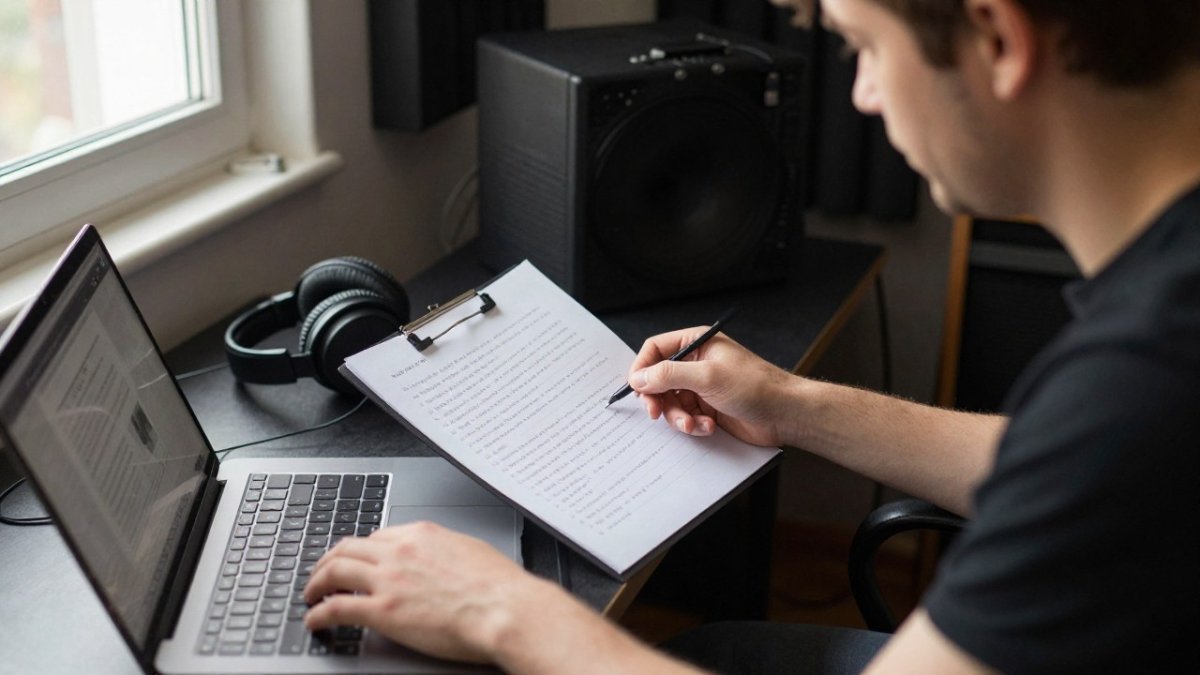
Two songwriters sitting side by side at a small home studio desk, one reviewing a printed split sheet while the other types notes on a laptop with headphones nearby.
A single clean example hides the problems that actually break splits. The examples below show the points method under unequal contributions, rounding, a total that does not reconcile, and a revenue base that mixes mechanical and performance income.
Example 1: Unequal contributions with a clean total
Three writers create a song. Writer A writes the melody and chorus, Writer B writes the lyrics, and Writer C adds the bridge and production ideas.
- Writer A: 4 points (melody and chorus)
- Writer B: 3 points (lyrics)
- Writer C: 3 points (bridge and production)
Writer A gets 4 / 10 = 40%. Writer B gets 3 / 10 = 30%. Writer C gets 3 / 10 = 30%. The total is 100%, so the split reconciles.
Example 2: Unequal contributions that do not divide evenly
Four writers split a song with these agreed points:
- Writer A: 5 points
- Writer B: 3 points
- Writer C: 2 points
Run the formula for each writer:
- Writer A: 5 / 11 = 45.4545...%
- Writer B: 3 / 11 = 27.2727...%
- Writer C: 2 / 11 = 18.1818...%
If you round each number to two decimals, you get 45.45 + 27.27 + 18.18 + 9.09 = 99.99. That is one-hundredth of a percent short of 100. Do not leave it there.
Watch out: rounding each writer's number independently and stopping there is the most common cause of a split sheet that will not reconcile when a publisher or administrator re-enters it.
Example 3: A total that does not reconcile
Suppose a sheet lists 40% / 30% / 25%. The total is 95%, not 100%. That means 5% of the writer pool is unassigned. Before anyone signs, decide where the missing 5% goes, to an existing writer, to a writer who was left off, or to a publisher share under the deal.
Example 4: Applying the writer split to a real revenue base
A split sheet percentage is meaningless until you apply it to a specific income stream.
Mechanical income of $1,000 arrives on one statement. The writer pool is $500 and the publisher share is $500 under the deal terms. Apply the writer split to the $500 pool:
- Writer A: 40% of $500 = $200
- Writer B: 30% of $500 = $150
- Writer C: 30% of $500 = $150
Performance income of $400 arrives on a separate statement. Apply the same 50/50 deal and the same writer split:
- Writer A: 40% of $200 = $80
- Writer B: 30% of $200 = $60
- Writer C: 30% of $200 = $60
Total to Writer A across both streams: $280. Writer B: $210. Writer C: $210.
Watch out: applying the writer split to gross income instead of the writer pool overpays writers on paper and understates the publisher share, which will not match the statements you receive.
Example 5: A producer who is also a co-writer
A producer who contributes to the composition, a hook, a topline, a chord progression, is a co-writer and belongs on the split sheet. A producer who only builds the beat and does not contribute to the composition may instead receive producer points on the master recording, which is a separate pool.
The worked examples below summarise the key figures from each calculation so the splits are easy to compare at a glance.
| Example | Writer shares | Result |
|---|---|---|
| 1: Unequal contributions, clean total | 4 / 3 / 3 points out of 10 | 40% / 30% / 30%, totals 100% |
| 2: Points that do not divide evenly | 5 / 3 / 2 / 1 points out of 11 | 45.46 / 27.27 / 18.18 / 9.09, totals 100.00 after rounding fix |
| 3: Total that does not reconcile | 40% / 30% / 25% | Totals 95%, leaving 5% unassigned |
| 4: Mechanical income of $1,000 | 50/50 deal, writer pool $500 | Writer A $200, Writer B $150, Writer C $150 |
| 4: Performance income of $400 | 50/50 deal, writer pool $200 | Writer A $80, Writer B $60, Writer C $60 |
Writer shares in a worked three-writer split (points out of 10)
How to Split Royalties Between Songwriters When Contributions Differ
Contributions are rarely equal. One writer may have produced the whole track while another wrote a single hook. The points method handles this, but only if everyone agrees on the point values first.
Watch out for these common problems:
- Assigning equal splits just to keep things simple, even when one person did far more work
- Forgetting that a producer may also claim points for arrangement or beat making
- Leaving out a writer who contributed a short but important line
Talk openly before the song is finished. Vague agreements are where most friendships and partnerships break down.
Building a Songwriter Split Sheet Template That Protects Every Writer
A split sheet is a one-page document that records who wrote the song and how royalties will be divided. It is not a legal substitute for a contract, but it is the best starting point for keeping everyone honest and for making sure the percentages you calculated actually reach the people who earned them. See how to split music royalties automatically once the percentages are agreed.
Fields every split sheet should include
- Song title and date created
- Full legal name, contact information, and performing rights organization (PRO) for each writer
- Each writer's role and contribution
Keep one signed copy for each person. A split sheet only protects you if everyone has a copy and the numbers are clear.
Connecting the split sheet to registration
A signed split sheet is the source document for registration. Writers typically register the song with a performing rights organization (PRO), and publishers may register with a separate administrator.
Watch out: registering a rounded version of the split sheet is one of the most common causes of a payment mismatch months later, because the PRO distributes on the registered percentages, not on the signed sheet.
Handling samples, interpolations, and pre-existing material
A sample or interpolation pulls in a second composition, and the owner of that composition is entitled to a share. Before the split sheet is signed, confirm whether the new song uses pre-existing material and whether clearance has been obtained. If it has, the cleared share is carved out first, and the remaining writers divide what is left.
Correcting conflicting claims
When two parties claim different shares, do not let the money sit. Pull up the signed split sheet, compare it with the registrations, and resolve the mismatch in writing. Most conflicts come from a registration entered with the wrong percentage, a writer who was left off the list, or a split sheet that was revised after registration without being re-filed.
If the dispute grows, a music attorney can review the agreement. Regular royalty statements also help you catch problems early, since a small error repeated over many months adds up quickly.
Registering Your Splits and Fixing Conflicting Claims
After the split is agreed, register the song with the appropriate organizations so royalties are collected correctly.
When two parties claim different shares, do not let the money sit. Pull up the signed split sheet, compare it with the registrations, and resolve the mismatch in writing. Most conflicts come from a registration entered with the wrong percentage or a writer who was left off the list.
If the dispute grows, a music attorney can review the agreement. Regular royalty statements also help you catch problems early, since a small error repeated over many months adds up quickly.
Accurate royalty math starts with clear agreements, and NexaTunes is built to give labels and artists the transparency to check every number.
Frequently Asked Questions
What is the typical royalty percentage for a songwriter?
There is no single standard rate, because the percentage depends on the royalty type, the deal, and how the song is used. In US publishing, the writer share of mechanical and performance income is conventionally split 50/50 with the publisher, and the writer's total share is the portion of the song's royalty pool allocated to the writers, which is then divided among co-writers by their agreed percentages. Always confirm the terms in your own split sheet or publishing agreement, since these figures are conventions rather than fixed rules.
Do songwriter percentages need to add up to 100%?
Yes. The splits for a single composition should total 100% across all writers, and the same applies to publisher shares. If the percentages add up to less than 100%, some income will go unallocated, and if they exceed 100%, the payments will not reconcile. Before registering a song with a performing rights organization or a publisher, total each writer's percentage and check that the sum is exactly 100%, adjusting the figures until it does.
What is the difference between a songwriting split and a royalty rate?
A songwriting split is the percentage of the composition each writer owns, such as 50% for one writer and 50% for another. A royalty rate is the amount or percentage paid on each use or sale of the work, such as a mechanical rate per copy or a percentage of streaming revenue. The split decides who gets paid, and the royalty rate decides how much income is generated before the split is applied.
How can I find out the royalty percentage splits for a song?
Start with the split sheet signed when the song was written, since it records each writer's agreed percentage. If none exists, check the registration records held by the performing rights organization or the publisher, which list the writers and their shares. Where records conflict, contact each writer and the publisher to agree on the correct figures, and document the resolution in writing before any further payments are processed.

If you’re looking for a reliable way to distribute your music to major platforms, NexaTunes offers direct distribution with transparent terms.