
Music Sync Rights: The Complete Licensing Guide
Table of Contents
- What Are Music Sync Rights?
- Master vs. Sync Rights: Understanding the Difference
- How Music Sync Licensing Works in Practice
- How to Get Music Sync Licensing: Step-by-Step Process
- How Much Does Sync Licensing Pay? Understanding Fees and Royalties
- Music Sync Licensing Contract Template: Essential Clauses and Negotiation Tactics
- Sync Licensing for Independent Creators and YouTubers
- Legal Pitfalls and What to Avoid
Last Updated: July 8, 2026
What Are Music Sync Rights?
Music sync rights are the legal permissions required to synchronize a copyrighted song with visual media. When you pair music with video, film, television, advertising, or any other timed visual content, you need a sync license. A sync license grants permission to use a specific composition in a specific way, for a defined period and territory.
Sync licensing is distinct from performance rights, it's not about radio play or streaming on Spotify, but specifically about locking music to moving images. The copyright holder, typically the music publisher who owns the composition, controls this right entirely.
The Role of Copyright Holders and Publishers
The composition copyright holder controls sync rights, usually the music publisher, though songwriters who retain publishing rights can as well. When a production company needs a sync license, they approach the publisher directly or through a licensing agent. The publisher evaluates the request, where will the music appear, how long, what's the budget, what's the territory, and decides whether to grant the license and at what price.
Performance rights organizations (PROs) like ASCAP, BMI, and SESAC collect performance royalties when music airs on radio or streams on platforms. However, PROs do not grant sync licenses; that's the publisher's exclusive domain.
Master vs. Sync Rights: Understanding the Difference
Master rights and sync rights are two separate copyrights that must both be licensed for most music placements. Master rights are owned by the record label or independent artist and control the specific recorded version of a song. Sync rights are owned by the music publisher and control the composition itself, the underlying song, melody, and lyrics.
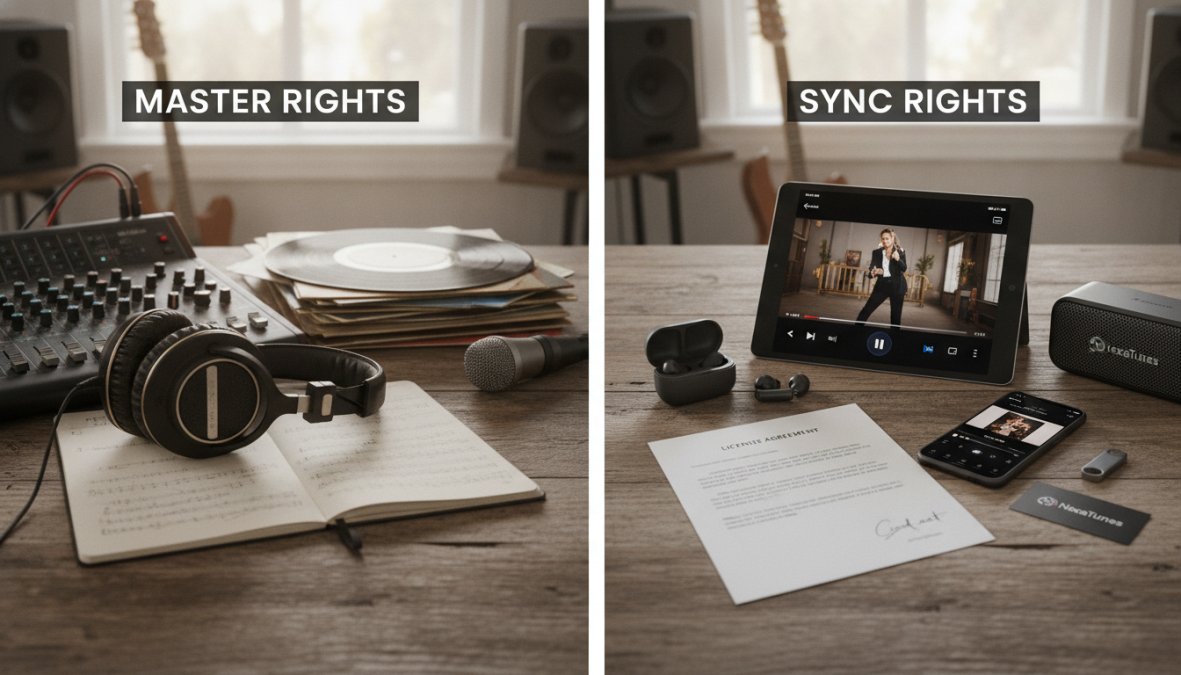
If you want to use The Beatles' "Let It Be" in a film, you need two licenses: master rights from the record label that owns the specific Beatles recording, and sync rights from the publisher that owns the composition. If either party says no, the placement can't happen.
Why Both Licenses Matter
Imagine producing a commercial with an indie song. You contact the independent artist who owns the master rights and they grant permission. But the songwriter's publisher controls the composition and wants a much higher fee. You're stuck negotiating with two separate parties with potentially conflicting interests.
This is why many productions license royalty-free music or creative commons tracks. With royalty-free music, a single license often covers both master and sync rights from one vendor, eliminating the two-license requirement.
How Music Sync Licensing Works in Practice
The sync licensing process begins when a production needs music. A music supervisor or content creator identifies a track and must determine who controls the sync rights and negotiate a license.
First, identify the rights holder. For major-label releases, contact the publisher directly or work with a sync agent. For independent music, contact the artist directly. Copyright office databases can help you find publisher contact information.
Submit a licensing request with project details: title, medium (film, TV, commercial, YouTube, etc.), territory, duration, and intended use. The publisher provides a quote based on these factors. Sync fees vary enormously, a small YouTube video might cost nothing or a few hundred dollars, while a national television commercial could cost tens of thousands.
Direct Licensing vs. Music Libraries
Direct licensing means negotiating with the publisher or rights holder directly. This gives you access to any composition but requires research, negotiation, and often legal representation. It's time-consuming and expensive, but it's the only way to get major-label or established independent music.
Music libraries offer a faster alternative. These are collections of pre-licensed music where sync rights are already cleared. You browse, find a track, and license it instantly, often with a single payment covering both master and sync rights. The trade-off is selection, you won't find major-label hits, but you'll find music specifically produced for licensing, often cheaper and faster to deploy.
How to Get Music Sync Licensing: Step-by-Step Process
Step 1: Identify your music needs. Define genre, mood, duration, and how the music will be used.
Step 2: Search for the track. Use copyright databases, contact music supervisors, or explore music libraries.
Step 3: Identify the rights holder. Use the U.S. Copyright Office database, ASCAP/BMI/SESAC databases, or contact the record label.
Step 4: Submit a licensing request. Provide project details: title, format, territory, duration, and budget if applicable.
Step 5: Negotiate terms. Review the license agreement carefully, paying attention to exclusivity clauses, territory restrictions, and duration limits.
Step 6: Execute the agreement. Sign the license agreement and pay the fee. The publisher provides a cue sheet for your records.
Step 7: Use the music as licensed. Incorporate the music according to the terms. Include attribution or credits if required.
Identifying Rights Holders and Negotiating Terms
For major-label releases, start with album liner notes or the record label's website. For independent music, check the artist's website or contact them directly.
When negotiating, understand that publishers have standard rates but often negotiate based on project scope. Be transparent about your budget and intended use; publishers respect honesty and are more likely to work with upfront creators. Most Favored Nations (MFN) clauses are common in sync agreements, meaning if you negotiate a lower rate with one rights holder, other rights holders in your project can claim the same rate.
How Much Does Sync Licensing Pay? Understanding Fees and Royalties
Sync fees vary dramatically based on project type, scope, and composition popularity. For YouTube videos and small independent projects, fees range from free to a few hundred dollars. For television commercials, fees typically range from $5,000 to $50,000 or more. For theatrical film releases, fees can exceed $100,000 for well-known compositions.
Factors That Influence Sync Fees
Media type matters most. Film, television, and advertising command higher fees than web or educational use.
Territory and duration affect pricing. A worldwide, perpetual license costs more than a license limited to North America for five years.
The composition's popularity influences fees. Well-known songs command higher rates than obscure tracks.
Your budget and project scope matter. Publishers often ask about production budget, distribution reach, and media spend.
Exclusivity requirements increase costs. Exclusive rights cost significantly more than non-exclusive.
Music Sync Licensing Contract Template: Essential Clauses and Negotiation Tactics
A sync license agreement specifies exactly how you can use the music. Understanding key clauses protects both you and the rights holder.
Key Contract Elements and Common Pitfalls
Grant of Rights: This clause specifies what you're licensed to do, the composition, master recording, territory, duration, and specific media. A poorly written grant of rights can result in disputes later.
Term and Renewal: Does the license last forever or for a limited period? Many creators assume perpetual licenses; many are actually limited-term.
Territory: Where can you use the music? Worldwide means everywhere. Some licenses restrict to specific countries. Ensure your territory covers your intended markets.
Exclusivity and Most Favored Nations: Is your license exclusive or non-exclusive? Exclusive means no competitor can use the same music in the same category.
Attribution and Credits: Does the license require you to credit the composer, publisher, or artist? If required, specify exactly where and how.
Derivative Works: Can you modify the music? Can you remix, shorten, or speed it up? This clause determines your creative freedom.
Common Pitfall: Many creators overlook territory restrictions. You license music for North America, then distribute globally, and suddenly you're in breach.
Negotiation Tactics for Better Terms
Understand the publisher's priorities. Publishers care about proper credit, accurate usage reporting via cue sheets, and ensuring the music isn't used for objectionable purposes.
Bundle compositions. If licensing multiple tracks from the same publisher, ask for a bundle discount.
Propose a tiered fee structure. For projects with uncertain distribution, propose lower upfront fees for festival use with higher fees if it goes to theatrical release.
Build relationships. Repeat customers often get better rates and faster approvals.
Sync Licensing for Independent Creators and YouTubers
Independent creators face unique challenges with music licensing. Most YouTube creators use either royalty-free music or Creative Commons licensed tracks. Royalty-free music is pre-licensed; you pay once and can use it indefinitely (subject to license terms). Creative Commons music is free or low-cost but typically requires attribution and may restrict commercial use.
YouTube's Audio Library offers thousands of free tracks cleared for monetized videos. However, read the terms carefully; some tracks require attribution, and some exclude commercial use outside YouTube.
Navigating Royalty-Free and Creative Commons Options
Royalty-free music is the most practical option for most independent creators. Platforms like Epidemic Sound, Artlist, and AudioJungle offer millions of tracks cleared for various uses. One payment covers both master and sync rights with no negotiation required.
Creative Commons music is often free or very low-cost. Platforms like Free Music Archive and ccMixter host Creative Commons licensed tracks. You must follow specific license terms, which typically require attribution and may restrict commercial use. For commercial YouTube channels or monetized use, verify that the Creative Commons license permits commercial use.
The practical approach: use royalty-free or Creative Commons music as your default, and pursue direct licensing only for signature tracks essential to your project.
Legal Pitfalls and What to Avoid
Several common mistakes create serious legal liability.
Using music without a license is the most obvious pitfall. Many creators assume that if music is available on YouTube or Spotify, it's free to use. It's not. You need a sync license regardless of where you found the music.
Assuming YouTube's Audio Library covers all uses is a subtle mistake. The library is free for YouTube videos, but terms often exclude commercial use outside YouTube.
Misunderstanding territory restrictions creates problems when projects distribute internationally. You license music for North America, then your film gets worldwide distribution, and suddenly you're infringing in territories where you lack rights.
Ignoring attribution requirements can result in takedown notices even with a valid license. If the license requires attribution and you fail to provide it, the rights holder can claim breach.
Modifying licensed music without permission violates most sync agreements. If your license doesn't explicitly permit remixing, shortening, or speeding up the track, don't do it.
Failing to report usage via cue sheets creates compliance issues, especially for film and television. Inaccurate or missing cue sheets can result in disputes with publishers and PROs.
Using music in a way that contradicts the license is a common violation. If you license music for a film and then use it in an advertisement, you're in breach.
| Licensing Scenario | Best Approach | Estimated Cost | Key Consideration |
|---|---|---|---|
| YouTube video (non-commercial) | YouTube Audio Library or Creative Commons | Free | Verify license permits your intended use |
| YouTube video (monetized) | Royalty-free library or Creative Commons (commercial-permitted) | $10-50/month subscription | Ensure commercial use is explicitly allowed |
| Independent film (limited distribution) | Direct licensing or music library | $500-$5,000 per track | Negotiate based on actual distribution scope |
| Television commercial | Direct licensing with major publishers | $10,000-$100,000+ | Budget for negotiation with multiple rights holders |
| Theatrical film release | Direct licensing with major publishers | $50,000-$500,000+ | Expect higher fees for prestige placements |
| Corporate training video | Royalty-free or direct licensing (budget option) | $100-$1,000 | Territory and duration restrictions matter less |
Music sync rights protect composers and publishers while enabling creators to build compelling visual stories. The fundamental principle is simple: if you're pairing music with visual media, you need permission from the copyright holder.
The key is understanding your options. Royalty-free music and Creative Commons tracks offer speed and affordability for most independent projects. Direct licensing gives you access to any composition but requires negotiation and budget. Whether you're licensing music for your project or managing licensing for your catalog, clarity and documentation protect everyone involved.
Frequently Asked Questions
What are music sync rights and when do I need them?
Music sync rights grant permission to synchronize a song with visual media, film, TV, YouTube videos, commercials, games, and more. You need a synchronization license whenever you pair a copyrighted composition with moving images. Without proper clearance, you risk copyright infringement. Both the composition copyright holder (publisher) and master recording owner must grant permission for legal use.
What's the difference between master rights and sync rights?
Master rights control the sound recording itself (the artist's performance), while sync rights control the underlying musical composition (the song's melody and lyrics). When licensing music for visual media, you typically need both. The master recording owner (usually a label or artist) grants master rights, while the music publisher grants sync rights. Both licenses are required for complete legal clearance.
How much does music sync licensing typically cost?
Sync licensing fees vary dramatically based on media type, duration, exclusivity, territory, and audience size. A YouTube video might cost $50-$500, while a major film could range into thousands. Pricing depends on quantity, dates, and delivery terms. Many independent creators use royalty-free music libraries to avoid negotiation. For custom quotes on specific projects, contact music publishers, sync agents, or licensing platforms directly.
What are the most important clauses in a sync licensing contract?
Critical clauses include: territory (where the media can be distributed), exclusivity (whether only you can use the song), duration (how long the license lasts), payment terms, and credit requirements. Watch for Most Favored Nations (MFN) clauses that lock you into competitor pricing, and ensure work-for-hire language is clear if applicable. Common pitfalls include unlimited territory grants and perpetual licenses at one-time fees, always negotiate scope carefully.
Editorial Transparency: This article was created with the assistance of GrandRanker AI and reviewed, edited, fact-checked, and approved by the NexaTunes editorial team before publication.
“If you’re looking for a reliable way to distribute your music to Major Platforms , NexaTunes offers direct distribution with transparent terms.