
How to Write Music Specifically for Sync: A 2026 Guide
Table of Contents
- Start With the End Goal: Writing for Picture, Not the Charts
- The Best Song Structure for Sync: Why Less Is More
- Instrumental vs Vocal Tracks for Sync: Which Version Should You Deliver?
- Music Licensing Metadata Best Practices: Tagging for Discovery
- The Stems Workflow: Preparing Your Files for Music Supervisors
- Technical Mixing and Mastering Specs for Sync
- Writing for Specific Media: TV, Film, Games, and Short-Form Content
- Common Mistakes to Avoid When Writing Music for Sync
- Frequently Asked Questions
Last Updated: September 10, 2026
Start With the End Goal: Writing for Picture, Not the Charts
Learning how to write music specifically for sync means accepting a hard truth: the song is not the star. The scene is. At NexaTunes, we provide a professional and transparent music distribution platform tailored specifically for labels, empowering them to scale their music business with ease.
Sync licensing is the practice of granting a production company the right to pair an existing or custom composition with visual media in exchange for a fee. That single definition should shape every decision you make in the DAW.
A common mistake is writing a radio hit and hoping a music supervisor hears it. Supervisors search for function, not hooks. They need a cue that supports dialogue, survives an edit, and clears legal review fast. According to ASCAP's guide to sync licensing, a placement typically involves both master rights and publishing rights, which means your track must be clean on both sides before anyone can use it.
Below, we break down exactly how to structure, deliver, and tag music that gets placed. The workflow we cover can help independent artists understand how to approach sync licensing.
The Best Song Structure for Sync: Why Less Is More
The best song structure for sync is modular: short intro, clear sections, repeated emotional core, and no dead space. Editors cut against picture, so every second of your track must be usable somewhere.
Think in blocks, not movements. A sync-friendly arrangement usually runs 90 seconds to three minutes and moves through distinct, self-contained parts.
Building Standalone Sections That Editors Can Cut
Each section should stand alone. If an editor needs eight seconds of tension, your bridge should deliver it without depending on the verse before it.
- Intro (5-10 seconds): Establish the mood immediately. No slow builds.
- Verse: Sparse instrumentation, room for dialogue.
- Chorus or hook: Full arrangement, emotional peak.
- Bridge or breakdown: Stripped back, tension or release.
- Outro: Clean ending or a fade-friendly tail.
The 80/20 Rule in Sync Songwriting
Roughly 80% of your track should work as underscore, with 20% reserved for moments that demand full attention. Music supervisors rarely need a wall of sound for the entire cue. They need contrast.
Instrumental vs Vocal Tracks for Sync: Which Version Should You Deliver?
Deliver both. Instrumental vs vocal tracks for sync is not a choice; it is a delivery requirement. Most placements need an instrumental version, and many supervisors will not consider a track that lacks one.
Vocal tracks win placements in advertising, trailers, and end-credit sequences where the lyric reinforces the message. Instrumentals dominate underscore, dialogue-heavy scenes, and any cue where a voice would compete with the on-screen audio.
The practical takeaway: register and deliver a clean instrumental alongside every vocal master. A clean edit means no vocal bleed, no ad-libs, and no stray breaths.
| Version | Best For | Typical Use |
|---|---|---|
| Full vocal | Trailers, ads, end credits | Lyric reinforces message |
| Instrumental | Underscore, dialogue scenes | No vocal competition |
| TV mix | Broadcast edits | Vocal removed, harmonies kept |
Music Licensing Metadata Best Practices: Tagging for Discovery
Music licensing metadata best practices start with one rule: if a supervisor cannot find your track by mood, tempo, or keyword, it does not exist. Metadata is how your catalog gets discovered inside library search tools.
Every file you deliver should carry embedded metadata in the file itself, not just in a spreadsheet. Supervisors search by mood, genre, tempo, key signature, and instrumentation. If your tags are vague, your track never surfaces.
Sync-Specific Metadata Tagging That Gets You Found
Tag for emotion first, genre second. "Hopeful, driving, cinematic" outperforms "indie rock" every time in a library search.
Include these fields on every track:
- Mood: 3-5 descriptive emotional keywords
- Tempo (BPM) and key signature: Exact values, not ranges
- Instrumentation: Primary and secondary instruments
- Vocal type: Male, female, instrumental, or none
- Clean versions: Note whether an instrumental exists
- Contact and rights info: Publisher, PRO affiliation, and split details
The Library of Congress copyright registration portal is the authoritative starting point for confirming your ownership before you tag a single file. Get the rights right first, then tag.
The Stems Workflow: Preparing Your Files for Music Supervisors
The stems workflow is the single most overlooked part of sync delivery. A supervisor who has to email you three times for missing stems will not call again.
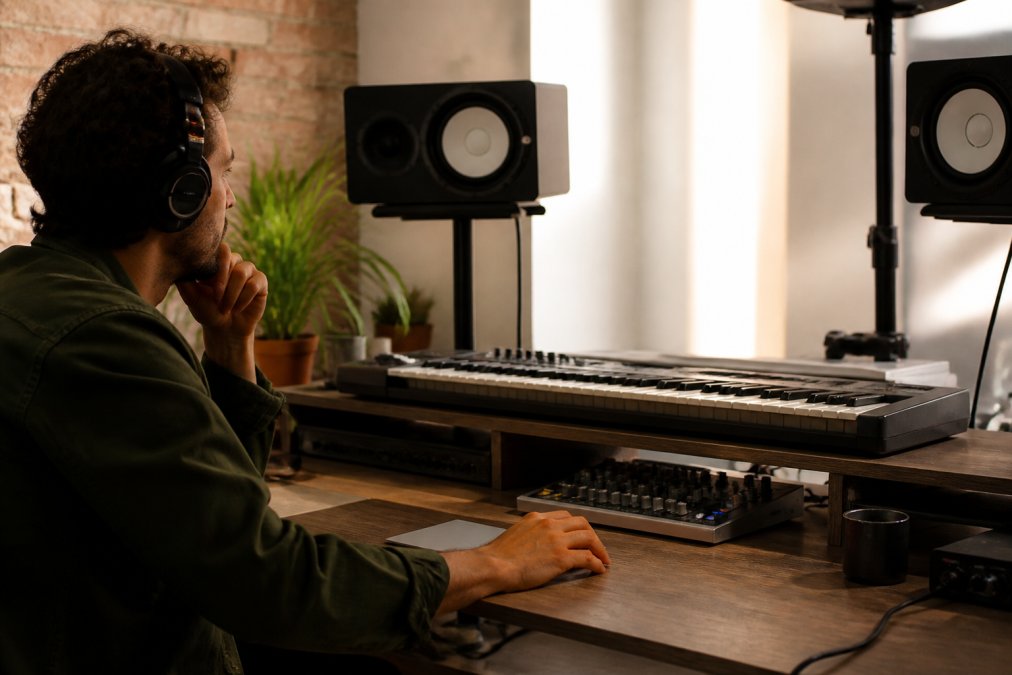
Stems are the isolated sub-mixes of your track: drums, bass, keys, guitars, vocals, and effects, each exported as its own file. They let a re-recording mixer or editor mute, boost, or reposition any element without touching your master.
Export stems at the same sample rate and bit depth as your master, aligned to the same start point, with identical lengths. Name them clearly: TrackName_Stem_Drums.wav, TrackName_Stem_Bass.wav, and so on.
A clean delivery folder typically contains:
- Full mix (WAV, 48 kHz / 24-bit)
- Instrumental version
- TV mix
- Individual stems
- A cue sheet listing timings and section markers
- A metadata text file
Technical Mixing and Mastering Specs for Sync
Sync delivery has technical specs that differ from streaming release. Get these wrong and your track gets bounced before anyone hears the first note.
The industry default for broadcast-ready delivery is 48 kHz sample rate and 24-bit depth. Streaming platforms accept 44.1 kHz, but film and television post-production almost always works at 48 kHz. Deliver at 48 kHz to avoid a resample step on the supervisor's end.
Broadcast Standards and Dynamic Range
Broadcast standards govern how loud your track can be and how much dynamic range it can carry. Over-compressed masters that sit at streaming loudness often fail broadcast QC because they lack headroom.
The FCC's rules on broadcast technical standards set the framework for what broadcasters can transmit, and most post houses layer their own delivery specs on top. Aim for a master with genuine dynamic range rather than a brick-walled limiter. Leave headroom, avoid harsh limiting, and let the re-recording mixer control the final level.
Production quality matters more than loudness in sync. A clean, well-balanced mix that sits comfortably under dialogue wins over a loud, fatiguing one.
Writing for Specific Media: TV, Film, Games, and Short-Form Content
Each medium asks for a different kind of cue, and the differences are not just creative. They show up in runtime, structure, delivery format, and how the music is expected to behave against picture. Writing for film is not the same as writing for a game loop or a fifteen-second social clip, and treating them as interchangeable is one of the fastest ways to get passed over.
Film and Television
Film and TV cues need emotional restraint and room for dialogue. A dramatic underscore cue typically runs one to three minutes and is expected to sit under dialogue without masking it. That means avoiding busy mid-range content in the 1 kHz to 4 kHz band where speech intelligibility lives, and keeping sustained pads or drones rather than rhythmic figures that fight the edit.
Deliver a full mix, an instrumental, and a TV mix (vocal removed, harmonies and backing kept). Editors cut against picture, so a clean ending and a fade-friendly tail both matter. A cue that ends on a hard downbeat with no tail is harder to place than one that resolves and decays.
Games
Games need loops and variations, often with layered stems that react to player action. A common pattern is a vertical layering system: a base ambient bed, a mid-intensity layer, and a high-intensity layer that the audio engine crossfades in and out based on gameplay state. Each layer must loop seamlessly at the same tempo and key, and each must sound complete on its own.
Export game stems as individual loops with identical lengths and sample rates. A loop that drifts by even a few milliseconds per cycle will phase against itself after a few minutes of playback, which is why seamless loop points matter more in games than in any other medium.
Advertising
Advertising needs a hook in the first three seconds. Brand spots are typically fifteen, thirty, or sixty seconds, and the music has to land an emotional idea almost immediately because there is no time to build. Deliver a full mix, an instrumental, and often a :30 and :15 cutdown so the agency does not have to edit your track themselves.
Sync for Short-Form Content (TikTok/Reels)
Short-form sync is the fastest-growing placement category, and most artists ignore it. Cues for short-form content typically run fifteen to sixty seconds, front-load the hook, and end on a clean, loopable beat. The platform's own audio tools favor tracks that loop without an audible seam, so a track that resolves into a repeatable bar is more usable than one with a definitive final chord.
Write a dedicated short version of your track. Do not simply trim the intro off your full mix. Build a version that lands the emotional core in the first two seconds and resolves cleanly at the fifteen-second mark. A practical approach is to write the short version first and expand it into the full track, rather than cutting down after the fact.
Common Mistakes to Avoid When Writing Music for Sync
The fastest way to lose a placement is to repeat a mistake a supervisor has seen a hundred times. Most of these are not creative failures. They are delivery failures, and they are fixable with a checklist.
Delivery and File Mistakes
- No instrumental version. Supervisors will not chase you for it. If your delivery folder does not contain a clean instrumental, the track is effectively unusable for dialogue-heavy scenes, which is most of them.
- Missing stems. Delivery stalls and the supervisor moves on. Stems should be exported at the same sample rate and bit depth as your master, aligned to the same start point, with identical lengths. Name them consistently:
TrackName_Stem_Drums.wav,TrackName_Stem_Bass.wav, and so on. - Wrong sample rate. Film and television post-production almost always works at 48 kHz. Delivering at 44.1 kHz forces a resample step on the supervisor's end, and some facilities will simply reject the file rather than do it.
- Slow or messy filing. Name files clearly and deliver in one clean folder. A supervisor should be able to open your folder and find everything they need in under 30 seconds.
Mix and Master Mistakes
- Over-compressed master. Fails broadcast QC and leaves no headroom. A master that sits at streaming loudness often has no room for the re-recording mixer to work, and a brick-walled limiter reads as fatiguing under dialogue.
- No headroom. Leave genuine dynamic range rather than maximizing level. The re-recording mixer controls the final level; your job is to give them something clean to work with.
- Harsh limiting artifacts. Pumping, clipping, and distortion that pass unnoticed on earbuds become obvious on a broadcast mix stage.
Metadata and Rights Mistakes
- Vague metadata. The track never surfaces in a library search. Tag for emotion first, genre second, and include exact tempo and key values rather than ranges.
- Uncleared samples. One loop you did not clear kills the entire placement. Confirm ownership before you tag a single file.
- Inconsistent naming across versions. If your full mix, instrumental, and stems do not share a common naming convention, the editor has to guess which file is which. Guessing is where placements die.
The One-Page Delivery Checklist
A cue sheet that lists every section with timings makes the editor's job easier and signals that you understand the workflow. Treat delivery as part of the craft. Before you send anything, confirm:
- Full mix, instrumental, and TV mix are present and clearly labeled
- Stems are exported at matching sample rate, bit depth, and start point
- Metadata is embedded in the files, not just in a spreadsheet
- Rights and splits are documented and consistent with your PRO registration
- The folder opens to everything a supervisor needs without a follow-up email
Frequently Asked Questions
What is the 80/20 rule in songwriting for sync?
The 80/20 rule in sync songwriting means 80% of your track should be instrumental, with vocals or lyrics taking up no more than 20%. Music supervisors need room for dialogue and sound effects. A track that is mostly vocal leaves no space for the scene. Focus on building a strong instrumental foundation with minimal vocal hooks.
How do you structure a song for sync licensing?
Structure your song with clear, standalone sections: intro, verse, chorus, bridge, and outro. Each section should be able to stand alone without needing the previous part. Avoid long fade-outs; use clean edits instead. This gives editors flexible options for cutting the track to picture without awkward transitions.
Do lyrics matter when writing music for sync?
Lyrics matter less than mood and atmosphere. Music supervisors often prefer instrumental versions or tracks with minimal, non-specific lyrics. If you include vocals, keep them universal and avoid explicit language or overly specific narratives. The goal is to support visual storytelling, not distract from it.
What are the best genres for sync licensing?
There is no single best genre. Music supervisors look for tracks that fit the mood of a scene, whether that is indie folk, electronic, hip-hop, or orchestral. Focus on production quality and sync-ready structure. Instrumental versions and stems are often more important than the genre itself.
If you’re looking for a reliable way to distribute your music to major platforms, NexaTunes offers direct distribution with transparent terms.