
How to Manage Royalty Payouts for Independent Artists

Table of Contents
- Step 1: Map Every Royalty Type and Right You Own
- Step 2: Register Your Works and Lock In Split Agreements
- Step 3: How to Track Music Royalties Across Platforms
- Step 4: Build a Music Royalty Payout Schedule That Matches Your Cash Flow
- Step 5: Read Artist Royalty Statements Like an Accountant
- Step 6: Choose Music Royalty Accounting Software or a Publishing Administrator
- Step 7: Audit Statements and Recover Missing Royalty Payouts
- Conclusion: Turn Royalty Payouts Into a Repeatable System
- Frequently Asked Questions
Last Updated: October 18, 2026
Step 1: Map Every Royalty Type and Right You Own
Learning how to manage royalty payouts for independent artists starts with knowing what you own. Two separate copyrights generate income from every song, and each one pays out through a different path.
Master royalties come from the sound recording itself. Publishing royalties come from the underlying composition: the melody and lyrics. Miss that split, and you will leave money sitting in someone else's account.
Here is the full map:
- Master rights: the recording. Paid by distributors and streaming platforms.
- Publishing rights: the song. Paid through publishers and collection societies.
- Performance royalties: earned when music is played publicly, including on radio and in venues.
- Mechanical royalties: owed when a song is reproduced or streamed on demand.
- Digital performance royalties: paid for non-interactive streaming, such as webcasts and satellite radio.
Each stream you earn touches at least two of these buckets.
Step 2: Register Your Works and Lock In Split Agreements
Registration is not paperwork for its own sake. It is how the system knows who to pay. Spotify's Royalties Guide advises confirming song titles, writer names, and splits are agreed and entered correctly, noting that typos or missing details can delay or block payments.
Work through this checklist before any release goes live:
- Register the composition with your performing rights organization
- Register the sound recording with your distributor
- Confirm every writer's legal name matches their registration
- Sign a written split agreement with every contributor
- Enter splits in your distributor dashboard
- Store signed agreements in one shared folder
Splits should be in writing before the track ships. A verbal agreement between collaborators is not documentation, and it will not survive a dispute over royalty earnings.
Step 3: How to Track Music Royalties Across Platforms
Tracking means matching every platform payment back to a specific release.
Start with a simple tracking sheet. One tab per quarter, one row per release, one column per revenue source.
Then reconcile monthly:
- Export the payout report from each platform.
- Match each line to a release in your tracker.
- Flag any release with zero earnings for two months.
- Note the reason: no streams, missing metadata, or a routing error.
The third step matters most. A release earning nothing is either genuinely quiet or quietly broken.
Independent artists and labels now take a real share of platform money. Spotify reported that independent artists and labels accounted for half of all royalties in 2025, per Spotify's payout announcement.
Step 4: Build a Music Royalty Payout Schedule That Matches Your Cash Flow
A payout schedule is the calendar that tells you when money arrives and when it leaves. Most distributors pay monthly, but only after a threshold is met, and platforms report on a lag, so a January stream often lands in a March payment. The gap between when a stream happens and when cash hits your account is where most independent artists get surprised.
Build the schedule around five dates, not three:
- Reporting date: when platform statements become available in your distributor dashboard
- Statement close date: the last day you can dispute a line before the payout locks
- Payout date: when your distributor releases funds to your bank or payment method
- Settlement date: when the funds actually clear (ACH, PayPal, or wire each clear on a different timeline)
- Artist pay date: when you pay your roster
Keep those dates fixed each month. Predictable payouts build trust with artists faster than a bigger split does.
Know your thresholds and fees before you promise a pay date
Every distributor sets a minimum payout threshold, commonly somewhere between $1 and $50 depending on the platform, and balances below that roll over to the next cycle. If you pay artists on the 15th but your distributor only releases funds after a $25 threshold clears, a quiet month can leave you fronting money you have not received. Two rules prevent that:
- Set your artist pay date a few business days after your own settlement date, never before.
- Hold a small reserve equal to one payout cycle so a threshold delay does not become an artist-relations problem.
Fees matter too. Watch for per-payout fees, currency conversion spreads on international earnings, and chargebacks for refunded or fraudulent streams. A payout that looks like $400 on the statement can settle as meaningfully less once those deductions land.
Tax paperwork is part of the schedule
In the United States, distributors and platforms generally require a Form W-9 from U.S. artists and a Form W-8BEN or W-8BEN-E from foreign artists before releasing royalties, and they issue a Form 1099 (typically 1099-NEC or 1099-MISC) for reportable payments. Build tax-document collection into onboarding: no W-9 or W-8BEN on file, no pay date. Backup withholding can apply when a valid form is missing, which is money you will not see again without a corrected filing.
Step 5: Read Artist Royalty Statements Like an Accountant
Read every statement line by line, not just the total. The total tells you what you earned. The detail tells you whether it is correct.
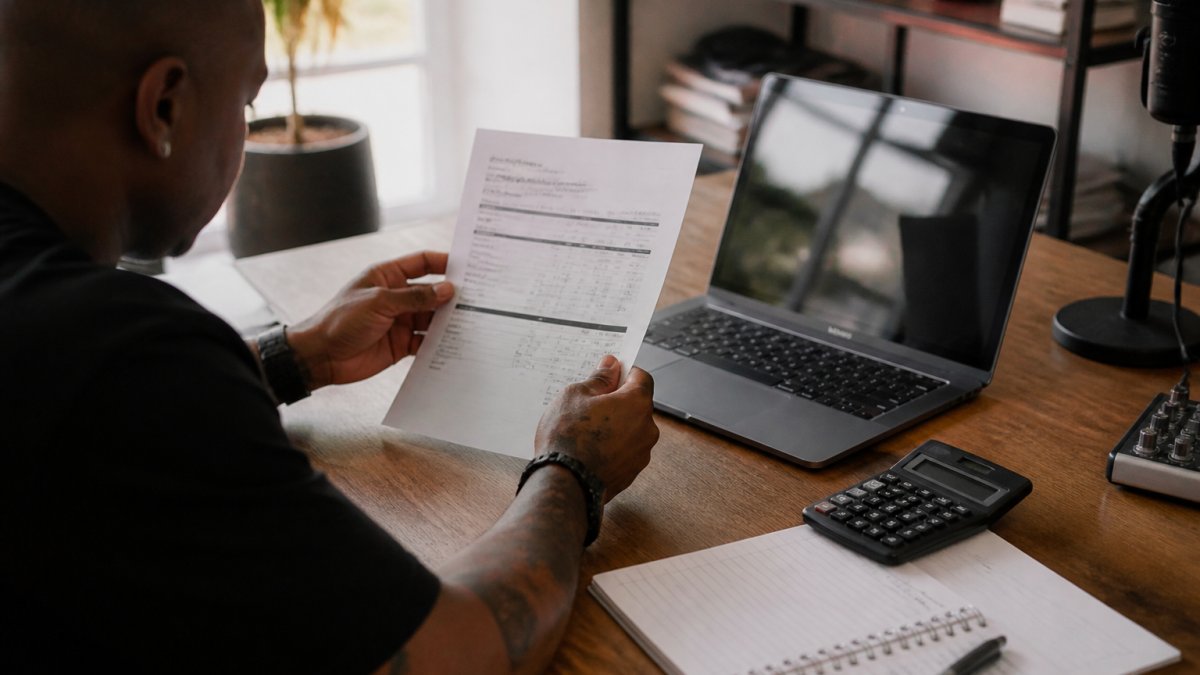
Check these four things on each statement:
- Period covered: confirm the dates match the month you expected
- Platform breakdown: verify each store appears with a plausible share
- Deductions: look for fees, withholding, or chargebacks
- Per-track totals: compare against your own stream counts
A 2025 study in PubMed Central on music copyright assetization critiques how royalty shares are sold and packaged, and warns about effects on musicians. The lesson for statements is blunt: know exactly what share you signed away.
Step 6: Choose Music Royalty Accounting Software or a Publishing Administrator
Music royalty accounting software tracks earnings, splits, and payouts in one place. A publishing administrator handles registration and collection on your behalf, usually for a commission.
Pick based on volume, not ambition:
| Your Situation | Best Option | Why |
|---|---|---|
| Under 20 releases, one territory | Spreadsheet plus distributor reports | Lowest cost, full control |
| Multiple sublabels, monthly payouts | Royalty accounting software | Automates splits and statements |
| Songs placed abroad or in sync | Publishing administrator | Handles international collection |
| Mixed catalog, growing roster | Software plus administrator | Covers tracking and global claims |
We recommend software first. Add an administrator when international collection or sync licensing revenue justifies the commission.
NexaTunes fits the software side for labels, offering monthly royalty payouts, detailed label-level reports, and unlimited sublabels and artists under one account. Pricing depends on your catalog and setup, so check our site for current details.
Step 7: Audit Statements and Recover Missing Royalty Payouts
Audits find money you were owed and did not receive. Run a light audit every quarter and a full reconciliation once a year. The goal is not to catch fraud, most missing payments trace back to metadata, not bad actors, but to close the gap between registering rights and confirming accurate payment.
The quarterly reconciliation, step by step
The quarterly audit takes an afternoon if your tracker is clean:
- Pull source data. Export platform-level reports (streaming, downloads, sync) for the quarter.
- Pull payout data. Export the distributor statement for the same period.
- Match by identifier. Reconcile on ISRC for recordings and ISWC for compositions, not on title, titles collide and spellings drift.
- Flag variances. List every release where platform-reported earnings and distributor-reported earnings differ by more than a set dollar amount (many artists use $10 per release per quarter as a working threshold).
- Classify the cause. Tag each variance as no streams, missing or mismatched metadata, routing error, timing lag, or unexplained.
- File disputes for the unexplained and metadata categories, and fix metadata at the source for the rest.
A release earning nothing is either genuinely quiet or quietly broken. The classification step is what tells you which.
Evidence checklist for a dispute
Support teams resolve disputes faster when you hand them a complete packet. Before you file, assemble:
- The release title, artist name, ISRC, and ISWC
- The platform report showing the streams or uses in question
- The distributor statement line showing the missing or short payment
- The date range and the specific dollar variance
- Any prior ticket numbers for the same release
Keep a running log of every dispute with the date filed, the evidence sent, and the response. Patterns show up fast, and a documented history gets better answers from support teams.
Escalation timeline
Give each dispute a clock. A common pattern is:
- Day 0: file with the distributor or platform support with the full evidence packet.
- Day 10-14: follow up if there is no substantive response; reference the ticket number.
- Day 30: escalate to a supervisor or the rights/royalty team, and copy your own records.
- Day 45-60: if unresolved, consider a formal written demand and, for material amounts, a publishing administrator or attorney who can pursue the claim.
Most missing payments trace back to metadata, not fraud. A misspelled writer name, a missing ISRC, or an unregistered split will hold funds indefinitely, and the fix is usually upstream, in your release setup, not in the dispute itself.
Conclusion: Turn Royalty Payouts Into a Repeatable System
The hard part of royalty payouts is not earning them. It is building a system that catches every dollar, every month, without heroics.
NexaTunes was built for exactly that. Our platform gives you monthly royalty payouts, detailed label-level reports, and unlimited sublabels and artists, plus distribution to Beatport and Traxsource. Get started with NexaTunes and turn scattered statements into one clear view of your earnings.
Frequently Asked Questions
How do independent artists get paid royalties?
Independent artists get paid through distributors, publishing administrators, and performing rights organizations. Distributors collect master royalties from streaming platforms and pay artists monthly or quarterly. PROs collect public performance royalties, while mechanical royalties come through The MLC or a publisher. Each source has its own payment cycle and minimum threshold. Spotify reported that independent artists and labels accounted for half of all royalties in 2025, so the volume flowing through these channels is substantial. Accurate metadata and split information prevent delayed or blocked payments.
How often should artists receive royalty payouts?
Most distributors pay monthly or quarterly, while PROs typically pay quarterly or semiannually. Your payout schedule should match your distribution agreements and cash flow needs. Some platforms hold earnings until a minimum threshold is reached, which can delay small balances. Set a calendar reminder to reconcile each statement as it arrives. If you run a label with multiple artists, a monthly payout cycle keeps accounting cleaner and reduces the risk of missed payments to contributors.
What should an artist royalty statement include?
A useful artist royalty statement breaks down earnings by platform, territory, track, and income type (master, publishing, performance). It should show gross revenue, deductions, and net payable, plus the reporting period and payout date. Look for line-item detail rather than a single lump sum. If a statement only shows a total, ask for a platform-level breakdown. Detailed label-level reporting makes it easier to spot missing royalties and verify that splits were applied correctly.
How can artists make sure they collect all the royalties they are owed?
Register every work with your PRO, The MLC, and a distributor, and confirm that writer names, song titles, and splits match across all systems. Typos or missing details can delay or block payments, according to Spotify for Artists. Track uncollected royalties by auditing statements quarterly and comparing them to streaming reports. Use music royalty accounting software to flag gaps. If you license music for sync, confirm that cue sheets were filed, since missing cue sheets are a common source of unclaimed performance royalties.
If you’re looking for a reliable way to distribute your music to major platforms, NexaTunes offers direct distribution with transparent terms.