
Beatport vs Traxsource: Which Platform Wins for House Music

Table of Contents
- Beatport vs Traxsource: Platform Overview and Audience
- Key Differences: Chart Performance and Visibility
- Best Music Distribution for Electronic Labels on Each Platform
- How to Get Music on Beatport: Setup and Requirements
- Music Sync Rights and Licensing Considerations
- Royalty Payouts, Fees, and Revenue Share Comparison
- Which Platform Should Your Label Choose?
Last Updated: August 29, 2026
Beatport vs Traxsource: Platform Overview and Audience
Beatport dominates as the global marketplace for electronic music across all genres, while Traxsource specializes exclusively in house music with a curator-first editorial approach. Beatport reaches millions of DJs and producers worldwide through algorithmic recommendations and editorial playlists. Traxsource operates as a curated platform where editorial teams hand-select releases for featured playlists, making visibility dependent on how well your music fits the platform's editorial vision.
The audience difference shapes everything downstream: royalty potential, discovery mechanics, chart positioning, and promotional strategy. A track charting on Beatport reaches a broader audience but faces heavier competition. The same track on Traxsource competes against a narrower field but reaches listeners specifically hunting for deep house and underground house music.

Beatport's strength lies in algorithmic discovery: new releases gain momentum based on play velocity, listener engagement, and metadata tags. Traxsource's strength lies in editorial curation, where the team hand-selects tracks based on artistic merit and alignment with house music trends. For independent labels, the best approach combines both: regular releases on Beatport to build algorithmic momentum, strategic releases on Traxsource to capture editorial attention and reach the core house music audience.
Key Differences: Chart Performance and Visibility
Beatport's charts are algorithm-driven, ranking tracks based on sales velocity and listener engagement over a rolling 7-day period (beatport.com). A track that sells well in the first week climbs quickly, then drops as newer releases accumulate velocity. Traxsource's charts operate differently: editorial playlists drive visibility more than algorithmic sorting. A track placed on a Traxsource featured playlist receives sustained visibility for weeks, generating consistent sales without requiring explosive first-week momentum.
The visibility difference extends to discovery. On Beatport, new listeners discover music through algorithmic recommendations and chart browsing. On Traxsource, discovery happens through editorial curation and genre-specific browsing. The conversion rate tends to be higher on Traxsource because the audience is more targeted.
For labels managing catalog depth, this distinction shapes release scheduling. High-velocity releases work well on Beatport because the algorithm rewards frequency. Strategic, carefully-timed releases work better on Traxsource because editorial teams need time to evaluate and place new music. A label releasing one track per week might dominate Beatport's new release feeds but struggle to secure editorial placement on Traxsource.
Metadata and tagging requirements differ too. Beatport's algorithm relies heavily on accurate genre tags, BPM, energy level, and mood metadata. Incorrect tags can bury a track. Traxsource's editorial team listens to the full track, so metadata matters less for discovery but still affects how curators categorize releases internally.
Best Music Distribution for Electronic Labels on Each Platform
On Beatport, labels benefit from distribution partners with direct relationships and metadata optimization expertise. NexaTunes provides monthly royalty payouts with detailed label-level reporting, essential for labels managing multiple sublabels and artists.
How to Get Music on Beatport: Setup and Requirements
Getting music on Beatport requires precise technical setup. Every release needs an accurate ISRC code, UPC barcode, clear genre classification, BPM, energy level, mood tags, and artwork at least 3000x3000 pixels in RGB color space. Submit releases at least three weeks before your desired release date, as Beatport's ingestion system processes releases in batches.
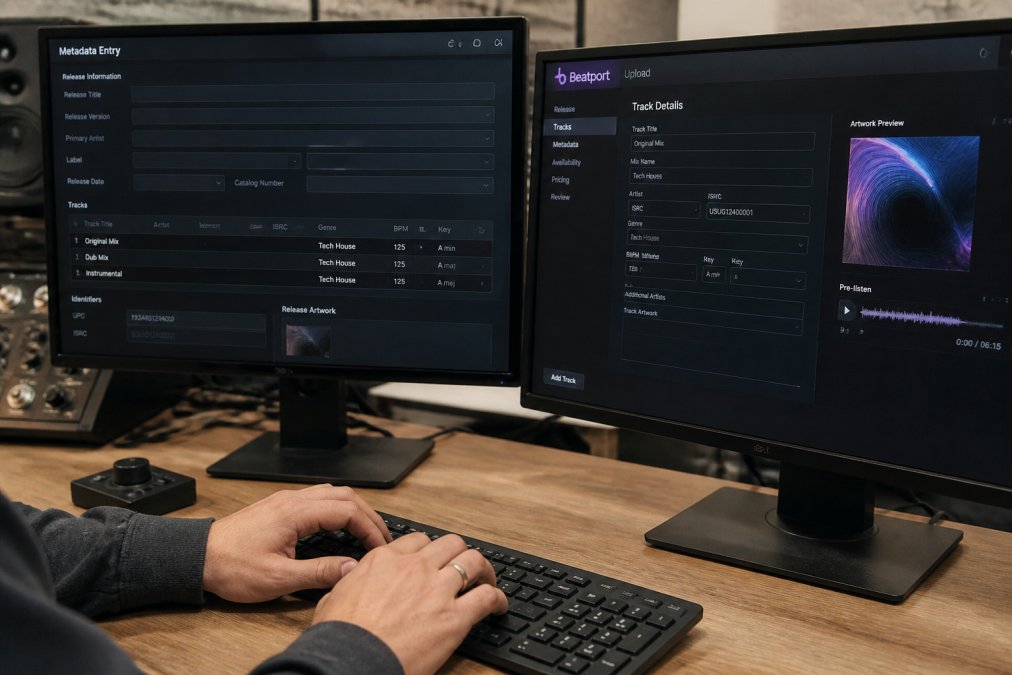
Genre selection is critical because it determines which algorithmic feeds your track appears in. Beatport categorizes house music into subgenres: House, Deep House, Tech House, and Progressive House. Choose the primary genre that best fits your track, then add up to three secondary genres.
Pricing strategy affects Beatport performance. Beatport allows labels to set retail prices between $1.49 and $2.49 per track (beatport.com). Lower prices generate higher sales velocity in the first week, boosting algorithmic ranking. Many labels use promotional pricing: launch at $1.49 for the first week, then increase to $1.99 after the initial spike.
Release timing matters because algorithmic feeds prioritize recency. Releases published on Friday or Saturday receive higher visibility in weekend browsing. Plan your release calendar around this pattern.
Audio quality requirements are strict. Beatport accepts WAV files at 44.1 kHz or 48 kHz sample rate, 24-bit depth minimum (beatport.com). After submission, monitor your release on Beatport's artist dashboard and track sales velocity, chart position, and listener engagement.
Music Sync Rights and Licensing Considerations
When you distribute music to Beatport and Traxsource, you're granting those platforms the right to sell and stream your track while retaining ownership of the underlying composition and master recording. Both platforms require that you own or control the rights to any music you distribute. If your track samples another artist's work, you must secure sample clearance before distribution. If your track features a vocal from another artist, you must have a written agreement granting distribution rights.
When someone purchases or streams your track on these platforms, they're buying a copy of the recording, not licensing it for specific use. The platform handles royalty payments to you and performing rights organizations. However, if your track is used in film, television, or advertising, traditional sync licensing applies separately.
For labels managing multiple artists, clear ownership documentation is essential. Every artist should provide written confirmation of ownership or distribution rights. Traxsource has specific requirements for exclusive releases: if you mark a release as exclusive, you cannot distribute the same track to other platforms for 30-90 days. This exclusivity can increase curator placement likelihood but reduces distribution reach during that period.
Register your compositions with performing rights organizations like ASCAP, BMI, or SESAC before distribution to ensure accurate royalty tracking when your track is broadcast or streamed.
Royalty Payouts, Fees, and Revenue Share Comparison
Beatport and Traxsource take a percentage of revenue from each sale, typically 30-40%, with the remainder flowing to your distribution partner and then to you. NexaTunes provides monthly royalty payouts with detailed label-level reporting.
Beatport's royalty structure depends on sales velocity and customer type. Retail customers purchasing tracks generate higher per-unit revenue than streaming customers. Traxsource typically generates higher per-unit revenue than Beatport because the audience is more targeted and engaged. Demand detailed reporting from any distributor you work with.
Which Platform Should Your Label Choose?
The best strategy for most labels is distributing to both Beatport and Traxsource with different release strategies optimized for each platform's strengths.
Choose Beatport as your primary platform if your label releases frequently, manages diverse electronic music genres, or wants to reach the broadest possible audience. Beatport's algorithmic approach rewards consistent release schedules.
Choose Traxsource as your strategic platform if your label specializes in house music subgenres and values editorial curation. Traxsource's editorial approach means your releases receive human evaluation. The audience is more targeted and engaged, typically generating higher conversion rates.
The optimal strategy combines both: release consistently on Beatport to build algorithmic momentum and reach a broad audience; release strategically on Traxsource to secure editorial placement and reach the core house music audience.
Distribution partner selection matters as much as platform selection. A partner with direct relationships on both platforms, transparent reporting, and dedicated support will maximize your visibility and revenue. For labels prioritizing transparency and scalability, NexaTunes provides direct access to both Beatport and Traxsource with monthly royalty payouts and detailed label-level reporting. The unlimited sublabels and artists feature allows you to manage multiple projects from a single dashboard.
Choosing between Beatport and Traxsource isn't about picking one winner, it's about understanding how each platform serves different strategic goals. Beatport reaches millions of listeners and rewards consistent, optimized releases. Traxsource builds long-term visibility through editorial curation and reaches the most engaged house music audience. The labels that win on both platforms use a distribution partner that provides transparent reporting, maintains direct platform relationships, and supports both algorithmic and editorial strategies. Get started with NexaTunes and access both Beatport and Traxsource with monthly payouts, detailed artist-level reporting, and unlimited sublabel management to scale your label operation.
| Platform | Best For | Key Strength | Audience Type |
|---|---|---|---|
| Beatport | Diverse electronic labels, high release volume | Algorithmic discovery, scale | Broad electronic music listeners |
| Traxsource | House music specialists, curated releases | Editorial placement, engagement | Targeted house music buyers |
Frequently Asked Questions
What are the primary differences between Beatport and Traxsource for electronic music distribution?
Beatport focuses on broad electronic music genres with stronger chart visibility and mainstream DJ reach, while Traxsource specializes in house, soulful house, and deep house with a curated, editorial-driven approach. Beatport's algorithm-driven store emphasizes chart positioning and algorithmic discovery, whereas Traxsource's editorial team hand-curates playlists and releases, giving soulful and deep house producers more direct visibility. For house music labels specifically, Traxsource often provides better conversion rates among core house music listeners, while Beatport offers access to a larger, more diverse electronic music audience.
Which distributor is best for getting music onto Beatport and Traxsource simultaneously?
Distributors with direct partnerships and established relationships with both platforms handle metadata formatting, ISRC codes, and timing to ensure your releases meet each platform's standards. When selecting a distributor, verify they have active relationships with both platforms and understand the specific metadata requirements each one enforces for genre categorization and searchability.
How important are chart positions and editorial playlists for long-term house music sales?
Chart positioning and editorial curation significantly impact both short-term visibility and long-term catalog management. High chart placements increase track visibility within store algorithms, leading to higher conversion rates among active DJs and producers. Editorial playlists on Traxsource, in particular, drive sustained listener engagement for house music because the curated approach attracts listeners specifically seeking that genre. However, chart impact is most effective when paired with consistent release strategy, quality metadata, and ongoing promotional efforts, charts alone do not guarantee sustainable revenue without a broader marketing reach strategy.
Do I need music sync rights approval before distributing to Beatport and Traxsource?
Yes. Before uploading to either platform, you must own or have explicit permission for all musical compositions and sound recordings. This includes securing mechanical licenses for any compositions you did not write and ensuring all featured artists and sample clearances are documented. Beatport and Traxsource require accurate metadata identifying all rights holders, and distributing music without proper clearances can result in takedowns, account suspension, or legal claims. Your distributor should guide you through rights verification, but the label remains responsible for confirming ownership or licensing before submission.
EXTERNAL SOURCES:
For more on music distribution strategy and platform selection, consult ASCAP performing rights registration requirements, BMI music metadata standards, and International Standard Recording Code specifications.
Editorial Transparency: This article was created with the assistance of GrandRanker AI and reviewed, edited, fact-checked, and approved by the NexaTunes editorial team before publication.
If you’re looking for a reliable way to distribute your music to major platforms, NexaTunes offers direct distribution with transparent terms.