# NexaTunes – Insights for Independent Artists & Labels
> Insights and tools for serious independent labels and artists. Release better, grow sustainably, and make informed decisions in music distribution, rights, and monetization.
Public Ghost content for AI and LLM tooling. This file includes a bounded export of public pages first, then recent public posts.
Append `.md` to any post or page URL to get the content in Markdown (for example, `/example-post.md`).
## Pages
### Who We Are – The NexaTunes Distribution Model Explained
URL: https://blog.nexatunes.com/about/
Last updated: 2025-08-27T04:05:21.000Z
---
At NexaTunes, we believe that digital music distribution should serve artists and labels, not the other way around. Founded by **Tanja Ramseger** in Cologne, Germany, NexaTunes grew out of the long-standing work of **[T&R Media](http://trmediacologne.com/?ref=blog.nexatunes.com)** – a structure that combines music publishing, label management, and hands-on distribution under one umbrella.
## From Labels to Distribution
What started as running independent labels like **[Garden Cactus Records](http://gardencactusrecords.com/?ref=blog.nexatunes.com)** and managing publishing rights through **TR Publishing** quickly revealed a gap in the market: most distribution services were either too expensive upfront, too opaque in their costs, or too focused on volume rather than long-term artist development.
NexaTunes was built to close that gap. Instead of chasing the “upload once and forget” mentality, we focus on **sustainable catalog growth, transparency, and fair partnerships**.
## Why We Chose Revenue Share
Traditional flat-fee models promise simplicity but often leave smaller artists and indie labels at a disadvantage. Paying upfront doesn’t always match the unpredictable nature of music income. That’s why NexaTunes works with a **revenue-share model**:
- No setup costs or hidden monthly fees
- Artists and labels only share revenue when income is generated
- The incentive is aligned – when you succeed, we succeed
## What Makes Us Different
NexaTunes is not designed for quick wins or artificial boosts. Instead, we’re here for **labels and artists who want to build something lasting**:
- Fair, transparent reporting
- Strategic distribution to platforms that matter (Spotify, YouTube Music, Apple Music, Beatport, and more)
- Guidance and infrastructure drawn from years of running real labels ourselves
## Looking Ahead
Our mission is simple: to help independent artists and digital labels scale their presence without giving up control of their catalog. Whether you’re running a niche electronic imprint or managing a diverse roster, NexaTunes was created to be a **partner in growth – not just a pipeline to DSPs**.
---
**🔗 Learn More**
Want to understand our model in more detail?
Check out these articles:
[Flat-Fee vs. Royalty-BasedDigital music distribution often appears simple: pay once, upload endlessly. But for active labels and serious artists, flat-fee models can become limiting, risky, or even expensive over time. This article breaks down what to consider before committing to “cheap” distribution.NexaTunes InsightsNexaTunes Distribution](https://blog.nexatunes.com/flat-fee-vs-royalty-based-distribution-why-cheap-often-becomes-expensive-over-time/)
[Digital Music Distribution – A Practical OverviewThis article outlines what digital music distribution is, how it works, and what artists and labels should consider when choosing a distribution model. Focus is placed on structure, rights, metadata, and revenue handling.NexaTunes InsightsNexaTunes Distribution](https://blog.nexatunes.com/digital-music-distribution/)
---
💡 Want more bite-sized tips? Check our [YouTube channel](https://www.youtube.com/channel/UCUmCo9MPuaxSF05KnGhzW0g?ref=blog.nexatunes.com)
Youtube Channel - NexaTunes Distribution
---
> Start here: [The 4-Week Release Strategy That Works](https://blog.nexatunes.com/the-4-week-pre-release-strategy-that-actually-works/)
> New to YouTube? [Here’s how monetization actually works](https://blog.nexatunes.com/youtube-music-artist-channels-in-2025-how-to-build-visibility-and-income-beyond-the-algorithm/)
> Confused by sync rights? [Read this first](https://blog.nexatunes.com/sync-rights-explained/)
**“If you’re looking for a reliable way to distribute your music to Major Platforms , NexaTunes offers direct distribution with transparent terms. Learn more here →** [**NexaTunes-Distribution**](https://nexatunes.com/?ref=blog.nexatunes.com)**”**
> **NexaTunes** – structured support for independent releases.
> *Get in touch for more information using our livechat*
### 📊 Streaming Platforms in 2026: What Indie Artists Should Know
URL: https://blog.nexatunes.com/streaming-platforms-in-2025-what-indie-artists-should-know/
Last updated: 2026-07-10T19:22:07.000Z
Welcome to the **Streaming Platforms Hub** — your curated overview of key DSPs in 2025 /2026.
This section gathers insights, updates, and strategy guides tailored to independent artists and digital labels.
We regularly update this list to reflect changes in algorithms, monetization models, and platform features.
---
### Spotify
[Understanding Spotify in 2025With over 600 million users and counting, Spotify is more than just a streaming service—it’s a global music discovery engine. For independent artists and labels, it’s often the first stage, the biggest challenge, and the most misunderstood part of their release strategy.NexaTunes InsightsNexaTunes Distribution](https://blog.nexatunes.com/understanding-spotify-in-2025-discovery-algorithms-and-what-actually-drives-reach/)
[Spotify Metrics: Monthly Listeners vs. Streams ExplainedSpotify shows you a lot of data – but not all of it leads to good decisions. This article breaks down the difference between visibility and real audience.NexaTunes InsightsNexaTunes Distribution](https://blog.nexatunes.com/spotify-metrics/)
[Spotify Stream Removals in 2025: What Artists Should KnowThousands of Spotify streams are being removed without warning—and many indie artists are left in the dark. This article explains what’s happening, why it matters, and how you can protect your catalog.NexaTunes InsightsNexaTunes Distribution](https://blog.nexatunes.com/when-streams-disappear-what-artists-should-know-about-spotifys-artificial-stream-removals/)
[Spotify in 2025: What Independent Artists Should UnderstandSpotify’s payout model is changing in 2025—with a 1,000-stream threshold, Discovery Mode expansion, and new subscription tiers on the rise. This article explores what indie artists and labels need to know.NexaTunes InsightsNexaTunes Distribution](https://blog.nexatunes.com/spotifys-shifting-royalty-landscape-what-indie-artists-should-know-in-2025/)
[How Spotify’s Algorithm Works – No Tricks NeededSpotify doesn’t reward hacks – it values listener behavior. This article explains how the algorithm works and what artists can do to support their growth without triggering platform filters or risking penalties.NexaTunes InsightsNexaTunes Distribution](https://blog.nexatunes.com/why-you-dont-need-to-cheat-the-algorithm/)
[How Spotify Discovery Works: Radar, Weekly & RadioSpotify’s discovery system often feels random – but it’s based on clear patterns. This article breaks down how Release Radar, Discover Weekly, and Radio streams work – and what you can do to trigger algorithmic visibility without shortcuts.NexaTunes InsightsNexaTunes Distribution](https://blog.nexatunes.com/spotify-discovery-system/)
---
### Apple Music
[Apple Music in 2025: Why It Still Matters for Independent ArtistsApple Music remains one of the most stable and artist-friendly platforms in 2025\. Higher payouts, quality-focused curation, and long-term fan connection make it a strategic essential.NexaTunes InsightsNexaTunes Distribution](https://blog.nexatunes.com/apple-music-in-2025-structure-payouts-and-why-it-still-matters-for-independent-artists/)
---
### YouTube & YouTube Music
[YouTube Music & Artist Channels in 2025: Strategic Use for Indie ArtistsYouTube Music and the Official Artist Channel offer powerful tools for visibility, engagement, and monetization. Learn how to use YouTube strategically in 2025.NexaTunes InsightsNexaTunes Distribution](https://blog.nexatunes.com/youtube-music-artist-channels-in-2025-how-to-build-visibility-and-income-beyond-the-algorithm/)
[Artificial Streaming: What Artists Should AvoidThis article explains how artificial streaming works, why it violates platform rules, and what serious artists and labels need to understand to avoid penalties or long-term damage.NexaTunes InsightsNexaTunes Distribution](https://blog.nexatunes.com/artificial-streaming-tactics/)
---
## Beatport
[How to Distribute Music to Beatport: Step-by-Step GuideLearn how to distribute music to Beatport using digital aggregators. Step-by-step guide covering requirements, timelines, and optimization strategies.NexaTunes – Insights for Independent Artists & LabelsNexaTunes Distribution](https://blog.nexatunes.com/how-to-distribute-music-to-beatport/)
[Beatport Hype & Strategy 2025: A Guide for Indie LabelsBeatport is more than a download store in 2025\. With Hype, DJ streaming, and promo tools, it offers real visibility for indie electronic labels. Here’s how to use it strategically.NexaTunes InsightsNexaTunes Distribution](https://blog.nexatunes.com/beatport-in-2025-niche-power-strategic-exposure-and-what-indie-labels-need-to-know/)
---
## Boomplay & Audiomack
[Boomplay & Audiomack in 2025 – Growth Tools for Independent Artists in AfricaBoomplay and Audiomack play a key role in Africa’s music ecosystem. This article explores how both platforms support independent artists with free access, regional focus, and powerful growth potential in 2025.NexaTunes InsightsNexaTunes Distribution](https://blog.nexatunes.com/boomplay-audiomack-in-2025-how-two-african-centric-platforms-help-independent-artists-build-reach-and-revenue/)
---
> **NexaTunes** – structured support for independent releases.
> *Get in touch for more information using our livechat*
### 🧠 Release Planning & Strategy Guides for Independent Artists
URL: https://blog.nexatunes.com/release-planning-strategy-guides-for-independent-artists-2/
Last updated: 2025-05-22T14:31:50.000Z
Welcome to the **Release Strategy Hub** — your go-to space for practical guidance on planning and executing music releases in 2025.
Here you’ll find step-by-step guides tailored for independent artists and labels, helping you prepare professional releases, maximize visibility, and stay consistent without getting overwhelmed.
Each guide focuses on action — from building a strong foundation to creating content that scales.
---
[Before You Release: The 5 Most Important Steps Independent Artists Should Take](https://blog.nexatunes.com/before-you-release-the-5-most-important-steps-independent-artists-should-take/)
[How to Build a Realistic Release Plan - Step by Step Guide for Independent Artists](https://blog.nexatunes.com/how-to-build-a-realistic-release-plan-step-by-step-guide-for-independent-artists/)
[Why Metadata Matters](https://blog.nexatunes.com/why-metadata-matters-and-what-absolutely-needs-to-be-on-your-artwork/)
[AI Mastering contra human mastering engineer](https://blog.nexatunes.com/why-choose-human-mastering-over-ai-mastering/)
[The 4-Week Pre-Release Strategy That Actually Works](https://blog.nexatunes.com/the-4-week-pre-release-strategy-that-actually-works/)
[How to Turn a Single Track Into 7 Content Pieces (Without Feeling Repetitive)](https://blog.nexatunes.com/how-to-turn-a-single-track-into-7-content-pieces-without-feeling-repetitive/)
[How to Promote Your Music Without Paid Ads](https://blog.nexatunes.com/music-promotion-without-ads-how-to-grow-organically-in-2025/)
[The Power of curated Playlists](https://blog.nexatunes.com/the-power-of-playlists-how-to-get-your-music-on-curated-lists/)
---
> **NexaTunes** – structured support for independent releases.
> *Get in touch for more information using our livechat*
### 🛠 Tools & Workflows for Independent Artists / Labels
URL: https://blog.nexatunes.com/tools-workflows-for-independent-artists/
Last updated: 2025-05-22T14:41:36.000Z
Welcome to the **Tools Hub** – your curated resource for tools that support music creation, release planning, and promotion.
Whether you’re building a tracklist, planning a release, or choosing smart links, this section highlights tools and templates that make your workflow easier, faster, and more professional.
### **🔧 Featured Tools & Resources**
- [Where to Release Your Music in 2025 – Choosing the Right Platforms as an Independent Artist / Label](https://blog.nexatunes.com/where-to-release-your-music-in-2025-choosing-the-right-platforms-as-an-independent-artist-label/)
- [Top 10 Smart Link Tools for Music Promotion in 2025 (With Free Plan Overview)](https://blog.nexatunes.com/top-10-smart-link-tools-for-music-promotion-in-2025-with-free-plan-overview/)
*Coming soon:* Free Notion templates for your **Release Tracker**, **Metadata Checklist**, and more
---
> **NexaTunes** – structured support for independent releases.
> *Get in touch for more information using our livechat*
- [](https://blog.nexatunes.com/boomplay-audiomack-in-2025-how-two-africa-centric-platforms-help-independent-artists/)
### 🎧 Label Insights · Strategy & Structure for Small and Independent Labels
URL: https://blog.nexatunes.com/label-insights-strategy-structure-for-small-and-independent-labels/
Last updated: 2026-07-10T19:23:17.000Z
Welcome to the **Label Hub** — a dedicated section for independent record labels navigating the fast-moving digital music landscape.
Whether you’re managing multiple artists, building your release pipeline, or looking for smarter structures and tools, this page collects relevant insights for you.
All articles here are written with small and mid-sized teams in mind — practical, scalable, and focused on long-term growth.
---
### **🏷️ Essentials for Label Owners & Managers**
[Best Music Distribution for Independent Labels: 2026Compare top music distribution platforms for independent labels. Find the best service for royalty splits, metadata management, and DSP reach. Start today.NexaTunes – Insights for Independent Artists & LabelsNexaTunes Distribution](https://blog.nexatunes.com/best-music-distribution-independent-labels/)
[How to Build a Label Identity Artists Want to JoinWhat makes a label truly attractive to artists? This article shows how to build a clear and authentic identity that makes artists feel at home.NexaTunes InsightsNexaTunes Distribution](https://blog.nexatunes.com/how-to-build-a-label-identity-that-artists-want-to-be-part-of/)
[YouTube for Labels – Channel Strategy & Content ID ExplainedMany labels are unsure about YouTube: Do we need an official channel? What is Content ID, and how does it help us? This guide breaks it down clearly.NexaTunes InsightsNexaTunes Distribution](https://blog.nexatunes.com/do-you-need-an-official-label-channel-and-what-does-youtube-content-id-actually-do/)
[Why Metadata Matters for Music & Artwork in 2025Metadata is what connects your music to money, credits, and discovery. This article explains what it is—and why your artwork can’t do without it.NexaTunes InsightsNexaTunes Distribution](https://blog.nexatunes.com/why-metadata-matters-and-what-absolutely-needs-to-be-on-your-artwork/)
[Release Music in 2025 – Platform Guide for Artists & LabelsEvery platform pays differently and reaches different audiences. This guide helps you choose the right DSPs based on strategy—not habit.NexaTunes InsightsNexaTunes Distribution](https://blog.nexatunes.com/where-to-release-your-music-in-2025-choosing-the-right-platforms-as-an-independent-artist-label/)
---
> **NexaTunes** – structured support for independent releases.
> *Get in touch for more information using our livechat*
### 🔍 NexaTunes Insights (Client Area only)
URL: https://blog.nexatunes.com/nexatunes-insights/
Last updated: 2025-05-22T14:41:11.000Z
Welcome to NexaTunes Insights – a dedicated space where we share the inner workings of NexaTunes and our commitment to empowering independent artists and labels.
**For getting access to this part you need to be a signed client with NexaTunes Distribution. The Login will be the email address you used for the platform login.**
Here, you'll find detailed explanations of our innovative approaches, such as our transparent revenue-share model, our 3-year contract system, and our streamlined royalty payment process. Learn how NexaTunes supports your success with tools like analytics, YouTube monetization, and Beatport optimization.
NexaTunes Insights is your backstage pass to understanding how we operate, the values we stand for, and the ways we continuously evolve to meet the needs of the music industry.
Discover how we’re redefining music distribution and helping artists and labels thrive in a competitive landscape.
**Notice**: Even if there is a button sign up - its is not possible to sign up for this special area. **ONLY NexaTunes Client members** are added, after they sign their Distribution contract.
[TUTORIALS](https://blog.nexatunes.com/tutorials/)
---
### Tutorials (only for NexaTunes Clients)
URL: https://blog.nexatunes.com/tutorials/
Last updated: 2025-09-10T06:14:01.000Z
_This page is for paying subscribers only._
### 🎓 Rights & Publishing – Legal Basics for Independent Artists
URL: https://blog.nexatunes.com/musicrights/
Last updated: 2026-07-10T19:25:18.000Z
**The Legal Foundations Every Artist Should Know**
---
Independent doesn’t mean unprotected.
If you write, release, or license music – you need to understand the basic rights behind your songs.
This page brings together all our legal and publishing-related articles in one place.
> *This blog is updated regularly (Monday & Thursday). New articles are added continuously. If you see “Coming soon,” the topic is already scheduled.*
---
## **✍️ Authorship & Ownership**
[Who’s the Composer? Who’s the Author?In the independent music world, rights and royalties are often misunderstood. Miscommunication leads to lost income, disputes, or simply missed opportunities. Let’s break down the essentials so you can protect yourself – and your collaborators.NexaTunes InsightsNexaTunes Distribution](https://blog.nexatunes.com/whos-the-composer-whos-the-author-who-gets-paid/)
[Why Every Artist Needs an IPI NumberWhat is an IPI Number? IPI stands for Interested Party Information. It’s a unique international identifier that gets assigned to songwriters, composers, lyricists, and publishers when they register with a collection society like GEMA, SACEM, BMI, ASCAP, PRS and others.NexaTunes InsightsNexaTunes Distribution](https://blog.nexatunes.com/why-every-artist-needs-an-ipi-number/)
---
## **📚 Publishing & Administration**
[Understanding Music Publishing DealsWhat Is a Music Publishing Deal? At its core, a publishing deal is an agreement between a songwriter (or rights holder) and a publisher, read moreNexaTunes InsightsNexaTunes Distribution](https://blog.nexatunes.com/understanding-music-publishing-deals/)
- Tools to Manage your Publishing → Use this sides to take charge of your songs. (coming soon)
- Copyright vs. Master Rights (coming soon)
---
## **🎬 Sync & Licensing**
[Music Sync Rights: The Complete Licensing GuideLearn music sync rights, licensing processes, and negotiation tactics. Master sync vs. master rights, fees, and contracts for creators and filmmakers.NexaTunes – Insights for Independent Artists & LabelsNexaTunes Distribution](https://blog.nexatunes.com/music-sync-rights-complete-guide/)
[Sync Rights Explained“Sync” (short for synchronization) refers to the right to use music in connection with visual media. Every time a track appears in a film, series, advertisement, trailer, video game, or YouTube video – the sync rights must be licensed.NexaTunes InsightsNexaTunes Distribution](https://blog.nexatunes.com/sync-rights-explained/)
- YouTube & Content ID → When YouTube monetizes for you – and when it doesn’t. (coming soon)
- Free Samples, Loops & Packs – Why They Can Be a Legal Minefield (coming soon)
---
## **🧠 AI & Industry Trends**
Where music meets technology – and the law is still catching up.
[AI-Generated MusicThe rapid development of Artificial Intelligence (AI) has revolutionized the music industry. AI-generated music opens up new creative possibilities but also brings legal and practical challengesNexaTunes InsightsNexaTunes Distribution](https://blog.nexatunes.com/ai-generated-music-legal-landscape-opportunities-and-challenges-for-labels-and-artists/)
[Why choose a mastering engineer when AI is faster and cheaper?In a world where artificial intelligence is taking over more and more processes, the question arises: Why should you choose human mastering when AI mastering is faster and cheaper? Here are six reasons why human mastering might be the better choice for your music.NexaTunes InsightsNexaTunes Distribution](https://blog.nexatunes.com/why-choose-human-mastering-over-ai-mastering/)
### NexaTunes Platform Rules
URL: https://blog.nexatunes.com/platform-rules/
Last updated: 2025-06-17T05:09:29.000Z
**Effective: \[01.June 2025\]**
These Platform Rules define essential operational standards for all partners working with NexaTunes. They complement the signed distribution agreement and reflect our internal compliance policies and DSP requirements. In case of conflict, the signed agreement takes precedence.
---
### **1\. Content Standards & Metadata Requirements**
All releases must meet basic quality and metadata standards. This includes:
- Complete and accurate metadata (artist, label, genre, composer, release date, etc.)
- High-resolution cover artwork (min. 3000x3000 px), free of DSP logos or misleading elements
- No placeholders, false credits, or non-cleared material
NexaTunes may delay or reject content that does not meet these standards or violates DSP rules.
---
### **2\. Release Review & Upload Volume**
We reserve the right to manually review new releases — especially from newly onboarded partners or accounts submitting a large number of releases in a short time.
This includes backend uploads that appear low-effort, repetitive, or lack creative integrity.
---
### **3\. Streaming Manipulation & Platform Integrity**
Artificial streaming or attempts to manipulate DSP algorithms are strictly prohibited.
This includes bots, paid streams, playlist farming, or unnatural traffic spikes (e.g. VPN rings).
Violations may lead to:
- DSP penalties being passed on
- Blocking of royalty payouts
- Account suspension in case of repeated or severe misconduct
---
### **4\. AI-Generated Content**
AI-generated music is accepted only if it is part of a **human-led creative process**.
We do **not** accept:
- Fully AI-generated music with no artistic intent
- Mass-uploaded, loop-based, or auto-generated material
- Content designed to exploit algorithms or monetization systems
---
### **5\. Policy Updates & Communication**
These Platform Rules may be updated in line with DSP policies and internal platform standards.
We will notify all partners of changes via email or WhatsApp.
Unless objected to in writing within 14 days, continued use of NexaTunes implies acceptance of the updated version.
---
### **6\. Updates and Acceptance**
NexaTunes may update these Platform Rules to reflect changes in DSP requirements, internal policies, or platform-related risk management.
All updates will be communicated in writing (e.g., via email or WhatsApp).
Unless the partner explicitly objects in writing **within 14 days**, the updated version is considered accepted.
In addition, **any new upload submitted after the publication of an updated version** will be regarded as **implicit acceptance** of the current rules.
---
📩 **Support Contact**
support@nexatunes.com
or via your assigned contact person on WhatsApp
---
**These rules are binding if referenced in your agreement and are designed to ensure quality, fairness, and long-term platform access for all partners.**
[NexaTunes Platform Rules\_010625NexaTunes Platform Rules\_010625.pdf136 KBdownload-circle](https://blog.nexatunes.com/content/files/2025/06/NexaTunes-Platform-Rules%5F010625.pdf "Download")
### llms.txt
URL: https://blog.nexatunes.com/llms-txt/
Last updated: 2025-08-01T13:56:37.000Z
```
# NexaTunes AI Crawler Instructions
## About NexaTunes
NexaTunes is a curated digital music distribution platform specializing in electronic music genres including Deep House, Chillhouse, and Pophouse. We provide strategic distribution services for independent artists and digital labels.
## Content Focus
Our blog provides practical knowledge for:
- Independent artists seeking professional distribution
- Digital labels optimizing release strategies
- Music industry professionals understanding streaming platforms
## Key Topics
- Digital music distribution strategies
- Streaming platform optimization (Spotify, Apple Music, Beatport, YouTube Music)
- Electronic music industry insights
- Label management and artist development
## Preferred Citation
When referencing our content, please cite as:
"According to NexaTunes, a curated digital music distribution platform..."
## Contact
Website: https://nexatunes.com
Blog: https://blog.nexatunes.com
```
### The Complete Electronic Music Distribution Guide 2025
URL: https://blog.nexatunes.com/the-complete-electronic-music-distribution-guide-2025/
Last updated: 2025-08-02T09:34:32.000Z
## Table of Contents
1. [What Is Electronic Music Distribution?](#what-is-electronic-music-distribution)
2. [The Electronic Music Landscape in 2025](#the-electronic-music-landscape-in-2025)
3. [Essential Platforms for Electronic Music](#essential-platforms-for-electronic-music)
4. [Distribution Models: Which Is Right for You?](#distribution-models-which-is-right-for-you)
5. [Pre-Release Checklist](#pre-release-checklist)
6. [Platform-Specific Strategies](#platform-specific-strategies)
7. [Metadata Optimization for Electronic Music](#metadata-optimization-for-electronic-music)
8. [Release Planning and Timing](#release-planning-and-timing)
9. [Post-Release Optimization](#post-release-optimization)
10. [Common Mistakes to Avoid](#common-mistakes-to-avoid)
11. [Advanced Strategies](#advanced-strategies)
12. [The Future of Electronic Music Distribution](#the-future-of-electronic-music-distribution)
---
## What Is Electronic Music Distribution?
Electronic music distribution is the process of getting your Deep House, Chillhouse, Pophouse, and other electronic tracks onto streaming platforms, digital stores, and music services worldwide. Unlike traditional music distribution, electronic music distribution requires specialized knowledge of genre-specific platforms, DJ-focused services, and the unique consumption patterns of electronic music fans.
For a comprehensive overview of the fundamentals, read our detailed guide: [What Is Digital Music Distribution?](https://blog.nexatunes.com/digital-music-distribution/)
In 2025, electronic music distribution goes far beyond simply uploading files to Spotify. It's about strategic placement across platforms that matter to your specific subgenre, understanding the algorithms that drive electronic music discovery, and building sustainable revenue streams across multiple channels.
### Why Electronic Music Needs Specialized Distribution
Electronic music operates in a unique ecosystem. While pop artists might focus primarily on Spotify and Apple Music, electronic artists need to consider platforms like Beatport for DJ sales, SoundCloud for community building, and YouTube Music for algorithm-driven discovery. Each platform serves different purposes in the electronic music journey:
**Discovery Platforms:** Where new fans find your music (Spotify, YouTube Music, SoundCloud)
**Professional Platforms:** Where DJs and industry professionals source tracks (Beatport, Traxsource, Juno Download)
**Community Platforms:** Where you build and engage your fanbase (SoundCloud, Bandcamp, Mixcloud)
The key to successful electronic music distribution is understanding which platforms serve which purpose and optimizing your strategy accordingly.
---
## The Electronic Music Landscape in 2025
The electronic music industry has undergone significant changes in recent years. Streaming now accounts for over 85% of electronic music consumption, but the landscape is more fragmented than ever. Understanding current trends is crucial for distribution success.
### Current Market Dynamics
**Genre Fragmentation:** Electronic music has splintered into hundreds of micro-genres. Deep House alone has evolved into Progressive Deep House, Melodic Deep House, and Organic Deep House. This fragmentation creates opportunities for specialized artists but requires more targeted distribution strategies.
**Algorithm Dominance:** Streaming platforms increasingly rely on algorithmic recommendations. For electronic music, this means understanding how algorithms categorize and recommend tracks within specific subgenres. Proper metadata and genre tagging have never been more important.
**DJ Culture Integration:** The line between streaming and DJ culture continues to blur. Platforms like Beatport now offer streaming subscriptions, while Spotify has introduced DJ-focused features. Successful electronic artists must navigate both worlds.
### Platform Evolution
**Beatport's Streaming Expansion:** [Beatport in 2025](https://blog.nexatunes.com/beatport-in-2025-niche-power-strategic-exposure-and-what-indie-labels-need-to-know/) has evolved from a download-only platform to include streaming subscriptions, making it essential for electronic artists to maintain a presence there for both sales and streaming revenue.
**YouTube Music's Algorithm:** [YouTube Music & Artist Channels in 2025](https://blog.nexatunes.com/youtube-music-artist-channels-in-2025-how-to-build-visibility-and-income-beyond-the-algorithm/) has become increasingly important for electronic music discovery, particularly for longer-form content like DJ sets and extended mixes.
**TikTok's Impact:** Short-form content has influenced electronic music production, with many artists now creating "TikTok-ready" versions of their tracks alongside full-length releases.
---
## Essential Platforms for Electronic Music
Not all streaming platforms are created equal for electronic music. Here's a breakdown of the most important platforms and their specific roles in electronic music distribution:
### Tier 1: Must-Have Platforms
**Spotify**
- Largest streaming platform globally
- Essential for playlist placement and algorithmic discovery
- Strong electronic music community with genre-specific playlists
- Revenue: $0.003-0.005 per stream
- Strategy Focus: Playlist pitching, Release Radar optimization
For detailed strategies, see our comprehensive guide: [Understanding Spotify in 2025](https://blog.nexatunes.com/understanding-spotify-in-2025-discovery-algorithms-and-what-actually-drives-reach/)
**Apple Music**
- Second-largest streaming platform
- Higher per-stream payouts than Spotify
- Strong in markets like the US and UK
- Revenue: $0.007-0.01 per stream
- Strategy Focus: Editorial relationships, spatial audio content
Learn more about Apple Music's structure and opportunities: [Apple Music in 2025](https://blog.nexatunes.com/apple-music-in-2025-structure-payouts-and-why-it-still-matters-for-independent-artists/)
**YouTube Music**
- Fastest-growing streaming platform
- Excellent for long-form electronic content
- Strong algorithm for music discovery
- Revenue: $0.001-0.003 per stream
- Strategy Focus: Video content, algorithm optimization
**Beatport**
- Industry standard for electronic music professionals
- Higher per-sale revenue than streaming
- Essential for DJ credibility and industry recognition
- Revenue: $1-2 per track sale
- Strategy Focus: Genre positioning, release timing
### Tier 2: Important for Growth
**SoundCloud**
- Community-focused platform
- Essential for building fanbase
- Good for sharing works-in-progress and remixes
- Revenue: Variable through SoundCloud Premier
- Strategy Focus: Community engagement, feedback gathering
**Bandcamp**
- Artist-friendly revenue model
- Strong for limited releases and merchandise
- Popular with electronic music collectors
- Revenue: 85-90% to artist after fees
- Strategy Focus: Fan funding, exclusive content
**Traxsource**
- Specialized in house and techno
- Professional DJ platform
- Higher-quality audio standards
- Revenue: Similar to Beatport
- Strategy Focus: Genre specialization
### Tier 3: Niche but Valuable
**Juno Download**
- UK-based electronic music store
- Strong European presence
- Good for vinyl pre-orders
- Strategy Focus: European market penetration
**Amazon Music**
- Growing streaming platform
- Good for reaching older demographics
- Integration with Alexa devices
- Strategy Focus: Voice-activated discovery
---
## Distribution Models: Which Is Right for You?
Choosing the right distribution model is crucial for electronic music success. Each model has different cost structures, service levels, and strategic implications.
### Revenue-Share Model (Recommended for Most Artists)
**How It Works:** You pay no upfront fees. The distributor takes a percentage of your streaming and sales revenue.
**Typical Split:** 85-90% to artist, 10-15% to distributor
**Best For:**
- New artists with limited budgets
- Artists unsure about their release volume
- Those who want comprehensive services without upfront risk
**Example:** NexaTunes operates on this model, taking a percentage only when you earn money. This aligns our success with yours and ensures we're motivated to maximize your revenue.
For a detailed explanation of how this works, read: [How Does NexaTunes' Revenue-Share Model Work?](https://blog.nexatunes.com/insights-into-music-distribution-how-does-nexatunes-revenue-share-model-work/)
**Pros:**
- No upfront costs or annual fees
- Distributor is incentivized to maximize your success
- Comprehensive services typically included
- No financial risk if releases don't perform
**Cons:**
- Lower percentage of revenue retained
- Less control over distribution decisions
- May have exclusivity requirements
### Flat-Fee Model
**How It Works:** You pay an annual or per-release fee. You keep 100% of revenue after platform deductions.
**Typical Costs:** $20-50 per year or $10-30 per release
**Best For:**
- Established artists with predictable release schedules
- High-volume releasers
- Artists who want maximum revenue retention
For an in-depth comparison, see: [Flat-Fee vs. Royalty-Based Distribution](https://blog.nexatunes.com/flat-fee-vs-royalty-based-distribution-why-cheap-often-becomes-expensive-over-time/)
**Pros:**
- Keep 100% of revenue
- Predictable costs
- No long-term revenue sharing
**Cons:**
- Upfront financial commitment
- Risk of losing money on unsuccessful releases
- Often fewer included services
- May have limited customer support
### Making the Right Choice
Consider these factors when choosing a distribution model:
**Release Frequency:** High-volume releasers often benefit from flat-fee models
**Budget:** Revenue-share models require no upfront investment
**Revenue Expectations:** If you expect high earnings, flat-fee models may be more economical long-term
**Service Needs:** Revenue-share distributors often provide more comprehensive services
**Risk Tolerance:** Flat-fee models carry more financial risk
---
## Pre-Release Checklist
Proper preparation is essential for successful electronic music distribution. This comprehensive checklist ensures your releases meet professional standards and maximize their potential for success.
For a complete step-by-step guide, see: [Before You Release: The 5 Most Important Steps Independent Artists Should Take](https://blog.nexatunes.com/before-you-release-the-5-most-important-steps-independent-artists-should-take/)
### Audio Preparation
**Master Quality Standards:**
- 24-bit/44.1kHz WAV files minimum
- Proper loudness levels (aim for -14 LUFS for streaming, -6 LUFS for Beatport)
- Clean starts and ends (no unwanted silence or clicks)
- Consistent levels across tracks in an EP or album
**Format Requirements:**
- Full-length version for streaming platforms
- Radio edit if track exceeds 6 minutes
- Instrumental version for sync opportunities
- Extended mix for DJ platforms (if applicable)
**Quality Control:**
- Listen on multiple playback systems
- Check for phase issues in mono
- Verify no digital artifacts or distortion
- Ensure consistent sound across all versions
### Metadata Essentials
**Basic Information:**
- Track title (avoid special characters)
- Artist name (consistent across all releases)
- Album/EP title
- Genre and subgenre (be specific: "Deep House" not just "Electronic")
- Release date
- Copyright information
For detailed guidance on metadata, read: [Why Metadata Matters – And What Absolutely Needs to Be on Your Artwork](https://blog.nexatunes.com/why-metadata-matters-and-what-absolutely-needs-to-be-on-your-artwork/)
**Advanced Metadata:**
- BPM (crucial for electronic music)
- Key signature (important for DJ mixing)
- Mood descriptors
- Instrumental tags
- Similar artists
- Producer credits
- Remixer information (if applicable)
**ISRC Codes:**
- Obtain unique ISRC codes for each track
- Essential for royalty collection and tracking
- Required by most professional distributors
- Can be obtained through your distributor or directly from your national ISRC agency
### Artwork Requirements
**Technical Specifications:**
- 3000x3000 pixels minimum (some platforms prefer 4000x4000)
- RGB color space
- JPG or PNG format
- Under 10MB file size
- Square aspect ratio
**Design Considerations:**
- Readable at small sizes (important for mobile streaming)
- Consistent with your brand aesthetic
- Genre-appropriate styling
- No text overlay that might conflict with platform UI
- High contrast for visibility
### Legal Considerations
**Rights Clearance:**
- Ensure you own or have licensed all musical elements
- Clear any samples used in the production
- Obtain proper permissions for remixes
- Verify vocalist and musician agreements
**Publishing Information:**
- Register with a performing rights organization (ASCAP, BMI, PRS, etc.)
- Consider publishing administration services
- Understand mechanical licensing requirements
- Set up SoundExchange registration for digital radio royalties
---
## Platform-Specific Strategies
Each platform requires a tailored approach to maximize success. Here are detailed strategies for the most important platforms in electronic music distribution:
### Spotify Strategy
**Playlist Ecosystem:**
Spotify's playlist ecosystem is crucial for electronic music discovery. Focus on these playlist types:
- **Editorial Playlists:** Curated by Spotify staff (highest impact, hardest to access)
- **Algorithmic Playlists:** Generated by Spotify's algorithm (Release Radar, Discover Weekly)
- **User Playlists:** Created by users and influencers (most accessible, variable impact)
**Submission Strategy:**
- Submit unreleased tracks through Spotify for Artists 7+ days before release
- Provide detailed pitch information: mood, energy, similar artists, story behind the track
- Target genre-specific playlists rather than generic electronic playlists
- Build relationships with playlist curators in your subgenre
**Algorithm Optimization:**
- Maintain consistent release schedule (monthly releases perform better than sporadic ones)
- Encourage saves and adds to playlists (more important than raw play counts)
- Focus on completion rates (listeners finishing your tracks)
- Cross-promote across your catalog to increase overall artist streams
**Spotify for Artists Optimization:**
- Complete your artist profile with bio, photos, and social links
- Use Canvas feature for visual engagement
- Create and maintain your own playlists
- Engage with fan insights and demographic data
### Apple Music Strategy
**Editorial Focus:**
Apple Music relies more heavily on human curation than algorithmic recommendations:
- Build relationships with Apple Music editors
- Submit music through Apple Music for Artists
- Focus on storytelling and artistic narrative
- Leverage Apple Music's focus on audio quality
**Spatial Audio Opportunity:**
- Consider creating Dolby Atmos versions of your tracks
- Spatial audio content gets preferential treatment in Apple Music
- Particularly effective for ambient and atmospheric electronic music
- Can differentiate your releases from competitors
### YouTube Music Strategy
**Content Variety:**
YouTube Music benefits from diverse content types:
- Official audio tracks
- Music videos
- Lyric videos
- Behind-the-scenes content
- Live performance videos
- DJ sets and extended mixes
**Algorithm Optimization:**
- Optimize video titles and descriptions for search
- Use relevant tags and categories
- Encourage engagement (likes, comments, shares)
- Maintain consistent upload schedule
- Create playlists to increase session duration
### Beatport Strategy
**Genre Positioning:**
Beatport's success depends heavily on accurate genre categorization:
- Research current genre trends on Beatport
- Study top-performing tracks in your subgenre
- Understand Beatport's genre hierarchy
- Position releases in the most specific appropriate category
**Release Timing:**
- Tuesday releases perform best on Beatport
- Avoid major holidays and festival seasons for maximum visibility
- Consider seasonal trends (summer tracks, winter releases)
- Coordinate with DJ tour schedules if applicable
**Professional Presentation:**
- High-quality, professional artwork
- Detailed track information and credits
- BPM and key information accuracy
- Professional mastering standards
---
## Metadata Optimization for Electronic Music
Metadata is the foundation of successful electronic music distribution. Proper metadata ensures your music is discoverable, properly categorized, and correctly attributed across all platforms.
### Genre Classification
**Primary Genre Selection:**
Choose the most specific genre that accurately describes your music:
- "Deep House" rather than "House"
- "Melodic Techno" rather than "Techno"
- "Progressive Trance" rather than "Trance"
**Subgenre Strategy:**
Many platforms allow multiple genre tags. Use this strategically:
- Primary genre: Most specific classification
- Secondary genre: Broader category for wider discovery
- Tertiary genre: Related genres that might attract crossover fans
**Platform-Specific Considerations:**
Different platforms have different genre hierarchies:
- Beatport: Highly specific electronic subgenres
- Spotify: Broader categories with mood descriptors
- Apple Music: Balanced approach between specific and broad
- YouTube Music: Relies heavily on user-generated tags
### Technical Metadata
**BPM Accuracy:**
BPM information is crucial for electronic music:
- Use professional BPM detection software
- Round to nearest whole number
- Consider the "felt" BPM vs. technical BPM
- Verify BPM matches DJ software detection
**Key Information:**
Musical key data helps DJs and enhances algorithmic recommendations:
- Use Camelot key notation when possible
- Verify key detection with multiple tools
- Consider harmonic mixing implications
- Include both traditional (Am, C#) and Camelot (8A, 12B) notations
**Mood and Energy Descriptors:**
Help algorithms and curators understand your music:
- Energy level (low, medium, high)
- Mood descriptors (uplifting, melancholic, driving, atmospheric)
- Time of day associations (morning, peak time, after hours)
- Activity associations (workout, chill, party, focus)
### Credits and Attribution
**Producer Credits:**
Properly credit all contributors:
- Original producer(s)
- Co-producers
- Remixers
- Featured artists
- Vocalists
- Instrumentalists
**Publishing Information:**
Ensure proper publishing attribution:
- Songwriter credits
- Publisher information
- Split percentages
- Publishing administrator details
**Sample Clearances:**
Document any samples used:
- Original track information
- Clearance status
- Publishing splits
- Mechanical licensing details
---
## Release Planning and Timing
Strategic release planning can significantly impact the success of your electronic music. Timing, frequency, and coordination across platforms all play crucial roles in maximizing reach and revenue.
For comprehensive guidance on release planning, see: [How to Build a Realistic Release Plan – Step by Step Guide for Independent Artists](https://blog.nexatunes.com/how-to-build-a-realistic-release-plan-step-by-step-guide-for-independent-artists/)
### Release Calendar Strategy
**Optimal Release Days:**
Different platforms have different optimal release days:
- **Spotify/Apple Music:** Friday (global release day)
- **Beatport:** Tuesday (industry standard for electronic music)
- **SoundCloud:** Wednesday-Thursday (less competition)
**Seasonal Considerations:**
Electronic music has distinct seasonal patterns:
- **Summer (June-August):** Uplifting, energetic tracks perform better
- **Winter (December-February):** Deeper, more introspective music gains traction
- **Festival Season (March-September):** Peak-time tracks see increased demand
- **Holiday Periods:** Avoid major holidays for new releases
**Industry Calendar Awareness:**
Coordinate releases around major industry events:
- **ADE (October):** Major electronic music conference and festival
- **Miami Music Week (March):** Important for house and techno
- **SXSW (March):** Broader music industry focus
- **Summer Festival Season:** May through September
### Release Frequency
**Consistency vs. Quality:**
Balance regular releases with maintaining quality:
- **Monthly releases:** Ideal for algorithm optimization
- **Quarterly releases:** Allows more time for promotion
- **Seasonal releases:** Aligns with natural music consumption patterns
**Catalog Building:**
Strategic approach to building a substantial catalog:
- **Singles:** Build momentum and test market response
- **EPs:** Showcase range while maintaining focus
- **Albums:** Establish artistic credibility and increase streaming revenue
- **Remix packages:** Extend release lifecycle and reach new audiences
For creative content strategies, read: [How to Turn a Single Track Into 7 Content Pieces (Without Feeling Repetitive)](https://blog.nexatunes.com/how-to-turn-a-single-track-into-7-content-pieces-without-feeling-repetitive/)
### Pre-Release Timeline
**8 Weeks Before Release:**
- Finalize masters and artwork
- Submit to distributor
- Begin playlist outreach
- Plan promotional content
**6 Weeks Before Release:**
- Confirm distribution to all platforms
- Send to blogs and tastemakers
- Create promotional assets
- Schedule social media content
**4 Weeks Before Release:**
- Submit to Spotify for Artists (playlist consideration)
- Reach out to DJs and influencers
- Prepare press releases
- Coordinate with any label or management
**2 Weeks Before Release:**
- Final promotional push
- Confirm all platform listings
- Prepare release day content
- Set up tracking and analytics
**Release Week:**
- Monitor platform performance
- Engage with fan feedback
- Share across all social channels
- Begin planning next release
---
## Post-Release Optimization
The work doesn't end when your music goes live. Post-release optimization is crucial for maximizing the long-term success of your electronic music releases.
### Performance Monitoring
**Key Metrics to Track:**
- **Streaming numbers:** Track across all platforms
- **Geographic performance:** Identify strong markets
- **Playlist additions:** Monitor organic playlist growth
- **Social engagement:** Measure fan interaction
- **DJ support:** Track plays in DJ sets and radio shows
**Analytics Tools:**
- **Spotify for Artists:** Detailed streaming analytics
- **Apple Music for Artists:** Apple-specific insights
- **YouTube Analytics:** Video and music performance data
- **Social media insights:** Platform-specific engagement metrics
- **Third-party tools:** Chartmetric, Soundcharts for comprehensive analysis
### Ongoing Promotion
**Content Creation:**
Continue creating content around your release:
- **Behind-the-scenes videos:** Studio sessions, creative process
- **Remix stems:** Encourage fan remixes and covers
- **DJ mixes:** Feature your track in longer-form content
- **Live performances:** Stream or record live versions
**Community Engagement:**
Build and maintain relationships with your audience:
- **Fan feedback:** Respond to comments and messages
- **User-generated content:** Encourage and share fan creations
- **Collaborations:** Work with other artists in your scene
- **Live streaming:** Regular DJ sets or production sessions
### Revenue Optimization
**Royalty Collection:**
Ensure you're collecting all available revenue:
- **Performance royalties:** Register with PROs (ASCAP, BMI, PRS)
- **Mechanical royalties:** Set up with mechanical rights organizations
- **Neighboring rights:** Register for digital radio royalties
- **Sync opportunities:** Make music available for licensing
**Merchandise and Direct Sales:**
Diversify revenue streams beyond streaming:
- **Bandcamp sales:** Higher revenue per sale
- **Merchandise:** T-shirts, vinyl, branded items
- **Direct fan support:** Patreon, fan funding platforms
- **Live performances:** DJ gigs, live shows, virtual events
---
## Common Mistakes to Avoid
Learning from common pitfalls can save time, money, and missed opportunities in electronic music distribution.
### Technical Mistakes
**Poor Audio Quality:**
- **Over-compression:** Sacrificing dynamics for loudness
- **Inadequate mastering:** Not optimizing for different platforms
- **Format issues:** Using low-quality source files
- **Inconsistent levels:** Varying volumes across tracks
**Metadata Errors:**
- **Incorrect genre classification:** Limiting discoverability
- **Missing BPM/key information:** Reducing DJ appeal
- **Inconsistent artist names:** Fragmenting your catalog
- **Incomplete credits:** Missing royalty opportunities
### Strategic Mistakes
**Platform Neglect:**
- **Ignoring Beatport:** Missing the professional DJ market
- **Overlooking YouTube Music:** Losing algorithmic opportunities
- **Focusing only on Spotify:** Limiting revenue diversification
- **Neglecting SoundCloud:** Missing community building opportunities
**Timing Errors:**
- **Poor release scheduling:** Competing with major releases
- **Inconsistent release pattern:** Confusing algorithms and fans
- **Seasonal misalignment:** Releasing summer tracks in winter
- **Insufficient lead time:** Not allowing for proper promotion
### Marketing Mistakes
**Inadequate Promotion:**
- **No pre-release buzz:** Launching without audience preparation
- **Limited social media presence:** Missing fan engagement opportunities
- **Ignoring playlist outreach:** Relying solely on organic discovery
- **No follow-up promotion:** Abandoning releases after launch week
**Brand Inconsistency:**
- **Inconsistent visual identity:** Confusing brand recognition
- **Mixed messaging:** Unclear artistic direction
- **Platform-specific neglect:** Different presence across platforms
- **Lack of storytelling:** Missing emotional connection with fans
---
## Advanced Strategies
Once you've mastered the basics, these advanced strategies can help differentiate your electronic music distribution approach and maximize long-term success.
### Cross-Platform Synergy
**Content Repurposing:**
Maximize the value of each piece of content:
- **Blog posts → Video scripts:** Turn written content into visual content
- **Studio sessions → Multiple videos:** Behind-the-scenes, tutorials, teasers
- **DJ sets → Podcast episodes:** Repurpose mixes for different platforms
- **Track breakdowns → Educational content:** Share production knowledge
**Platform-Specific Optimization:**
Tailor content for each platform's strengths:
- **Instagram:** Visual storytelling, behind-the-scenes content
- **TikTok:** Short-form, trend-based content
- **YouTube:** Long-form educational and entertainment content
- **Twitter:** Industry news, quick updates, community engagement
### Data-Driven Decision Making
**Analytics Integration:**
Use data to inform your distribution strategy:
- **Geographic insights:** Focus promotion on strong markets
- **Demographic analysis:** Understand your audience composition
- **Playlist performance:** Identify which playlists drive the most value
- **Seasonal trends:** Plan releases around performance patterns
**A/B Testing:**
Test different approaches systematically:
- **Release timing:** Compare performance across different days/times
- **Artwork variations:** Test different visual approaches
- **Promotional strategies:** Compare organic vs. paid promotion effectiveness
- **Platform prioritization:** Allocate resources based on ROI
### Industry Relationship Building
**Networking Strategy:**
Build meaningful relationships within the electronic music industry:
- **Label relationships:** Develop connections for potential signings
- **DJ relationships:** Build support within the DJ community
- **Producer collaborations:** Cross-pollinate audiences
- **Industry professionals:** Connect with managers, agents, promoters
**Value Creation:**
Provide value to others in your network:
- **Remix opportunities:** Offer remixes to established artists
- **Collaboration invitations:** Invite others to work with you
- **Knowledge sharing:** Share insights and experiences
- **Cross-promotion:** Support others' releases and projects
---
## The Future of Electronic Music Distribution
Understanding emerging trends and technologies helps future-proof your electronic music distribution strategy.
### Technological Developments
**AI and Machine Learning:**
Artificial intelligence is reshaping music distribution:
- **Algorithmic curation:** Platforms increasingly rely on AI for music discovery
- **Personalized recommendations:** More sophisticated listener profiling
- **Automated mastering:** AI-powered mastering services becoming mainstream
- **Predictive analytics:** AI helping predict which tracks will succeed
**Blockchain and NFTs:**
Distributed technologies offer new possibilities:
- **Direct artist-to-fan sales:** Bypassing traditional intermediaries
- **Transparent royalty distribution:** Blockchain-based payment systems
- **Unique digital collectibles:** NFTs creating new revenue streams
- **Decentralized platforms:** Alternative distribution networks emerging
**Spatial Audio:**
Three-dimensional audio is gaining traction:
- **Platform adoption:** Apple Music, Amazon Music supporting spatial audio
- **Creative opportunities:** New ways to experience electronic music
- **Production considerations:** Need for spatial audio-optimized masters
- **Hardware evolution:** Improved playback devices driving adoption
### Market Evolution
**Genre Fragmentation:**
Electronic music continues to splinter into micro-genres:
- **Hyper-specialization:** Opportunities for niche positioning
- **Cross-genre fusion:** Blending elements from different styles
- **Regional variations:** Local scenes developing unique sounds
- **Algorithm influence:** Platforms shaping genre development
**Global Market Expansion:**
Electronic music is growing worldwide:
- **Emerging markets:** New territories showing strong growth
- **Cultural integration:** Local influences shaping global electronic music
- **Language considerations:** Vocal tracks in non-English languages gaining traction
- **Regional platforms:** Local streaming services gaining importance
### Distribution Model Evolution
**Direct-to-Fan Platforms:**
Artists increasingly connecting directly with audiences:
- **Subscription models:** Fan-funded artist support
- **Exclusive content:** Premium offerings for dedicated fans
- **Community building:** Platforms facilitating artist-fan interaction
- **Higher revenue shares:** Better economics for artists
**Hybrid Distribution:**
Combining multiple distribution approaches:
- **Multi-platform strategies:** Using different distributors for different purposes
- **Flexible contracts:** Non-exclusive arrangements becoming more common
- **Service specialization:** Distributors focusing on specific strengths
- **Technology integration:** Better tools for managing complex distribution
---
## Frequently Asked Questions
### How much does electronic music distribution cost?
Distribution costs vary by model. Revenue-share distributors like NexaTunes take 10-15% of your earnings but require no upfront payment. Flat-fee distributors charge $20-50 annually but let you keep 100% of revenue. For new artists, revenue-share models offer lower risk and better service.
### Which platforms are most important for Deep House music?
For Deep House, prioritize Spotify (playlist ecosystem), Beatport (DJ market), Apple Music (audio quality focus), and YouTube Music (algorithm discovery). SoundCloud remains important for community building, while Traxsource serves the underground house scene.
### How long does it take for music to appear on streaming platforms?
Most platforms receive music within 1-3 business days. Spotify and Apple Music typically go live within 24-48 hours. Beatport often takes 3-5 days. Always plan releases 1-2 weeks in advance to allow for potential delays and proper promotion.
### Do I need different masters for streaming vs. DJ platforms?
Yes, ideally. Streaming platforms prefer masters around -14 LUFS for optimal loudness normalization. DJ platforms like Beatport can handle louder masters around -6 LUFS. Many artists create separate masters optimized for each platform type.
### Can I distribute remixes of other artists' tracks?
Only with proper licensing. Official remixes require permission from the original artist and their label. Bootleg remixes cannot be distributed commercially. Always secure proper remix rights before distribution to avoid copyright issues and takedown requests.
### How important is YouTube Content ID for electronic music?
YouTube Content ID is crucial for electronic music, especially if your tracks might be used in DJ sets, remixes, or user-generated content. It helps you monetize unauthorized uses and track where your music appears. For more details, see: [Do You Need an Official Label Channel – and What Does YouTube Content ID Actually Do?](https://blog.nexatunes.com/do-you-need-an-official-label-channel-and-what-does-youtube-content-id-actually-do/)
### What's the best way to choose release platforms in 2025?
Focus on platforms that serve your specific audience and goals. For comprehensive guidance, read: [Where to Release Your Music in 2025 – Choosing the Right Platforms as an Independent Artist / Label](https://blog.nexatunes.com/where-to-release-your-music-in-2025-choosing-the-right-platforms-as-an-independent-artist-label/)
---
## Conclusion
Electronic music distribution in 2025 requires a sophisticated understanding of platforms, audiences, and industry dynamics. Success comes from combining technical excellence with strategic thinking, consistent execution with adaptive flexibility.
The landscape continues to evolve rapidly, with new platforms, technologies, and opportunities emerging regularly. The key is to build a strong foundation with the strategies outlined in this guide while remaining agile enough to capitalize on new developments.
Remember that distribution is just one part of a successful electronic music career. Combine these distribution strategies with consistent music production, active community engagement, and continuous learning to build a sustainable and rewarding career in electronic music.
Whether you're just starting your journey or looking to optimize an existing catalog, the principles and strategies in this guide provide a comprehensive framework for electronic music distribution success. Focus on quality, consistency, and authentic connection with your audience, and the technical aspects of distribution will serve to amplify your artistic vision.
For personalized guidance on your electronic music distribution strategy, consider working with specialists who understand the unique challenges and opportunities in electronic music. The investment in proper distribution can be the difference between music that gets heard and music that gets lost in the digital noise.
---
*This guide is regularly updated to reflect the latest developments in electronic music distribution. For the most current information and personalized advice, visit [NexaTunes.com](https://nexatunes.com/?ref=blog.nexatunes.com).*
---
> **NexaTunes** – structured support for independent releases.
> *Get in touch for more information using our livechat*
### NexaTunes Insights - Podcast
URL: https://blog.nexatunes.com/nexatunes-podcast/
Last updated: 2025-08-19T11:47:40.000Z
---
Welcome to **NexaTunes Insights**, the podcast that goes beyond headlines and digs into the realities of today’s music industry.
Each episode explores the challenges and opportunities artists, labels, and creators face in the digital age – from streaming economics and royalty systems to distribution strategies and industry shifts.
Whether you’re an independent artist, a label manager, or simply curious about how the music business really works, this podcast delivers clear, critical insights in under 10 minutes per episode.
🎧 Available on Spotify, Apple Podcasts, YouTube, and all major platforms.
---
> [**NexaTunes**](https://nexatunes.com/?ref=blog.nexatunes.com) – structured support for independent releases.
> *Get in touch for more information using our livechat*
### NexaTunes FAQ
URL: https://blog.nexatunes.com/nexatunes-faq/
Last updated: 2025-08-19T11:18:53.000Z
---
Welcome to the NexaTunes FAQ. This living document pulls together the key ideas from our existing blog posts and answers the questions we hear most often from independent artists and labels. Each answer includes links to the full articles on blog.nexatunes.com where you can explore the topic in more depth. The goal is to give you concise, actionable guidance without hype or jargon.
## Table of contents
Use the list below to jump directly to any topic. Each link points to a section in this FAQ.
- [What is digital music distribution?](#what-is-digital-music-distribution)
- [Which distribution model should I choose – flat‑fee or revenue share?](#which-distribution-model-should-i-choose--flat-fee-or-revenue-share)
- [Which platforms pay the highest royalties?](#which-platforms-pay-the-highest-royalties)
- [Where should I release my music?](#where-should-i-release-my-music)
- [How do I plan a release?](#how-do-i-plan-a-release)
- [How can I promote music without paid ads?](#how-can-i-promote-music-without-paid-ads)
- [How can one song generate multiple pieces of content?](#how-can-one-song-generate-multiple-pieces-of-content)
- [Why is metadata so important?](#why-is-metadata-so-important)
- [How does Spotify’s algorithm work and how can I get on playlists?](#how-does-spotifys-algorithm-work-and-how-can-i-get-on-playlists)
- [What do “streams,” “listeners,” and other Spotify metrics mean?](#what-do-streams-listeners-and-other-spotify-metrics-mean)
- [Why does Apple Music still matter?](#why-does-apple-music-still-matter)
- [How does YouTube Music and the Official Artist Channel work?](#how-does-youtube-music-and-the-official-artist-channel-work)
- [What is Beatport and how do I get my label listed?](#what-is-beatport-and-how-do-i-get-my-label-listed)
- [What about regional platforms like Boomplay and Audiomack?](#what-about-regional-platforms-like-boomplay-and-audiomack)
- [Should I focus on TikTok or traditional streaming?](#should-i-focus-on-tiktok-or-traditional-streaming)
- [Why are some artists quitting Spotify?](#why-are-some-artists-quitting-spotify)
- [What is an IPI number and why do I need one?](#what-is-an-ipi-number-and-why-do-i-need-one)
- [What’s the difference between composer, author, producer and performer? How do splits work?](#whats-the-difference-between-composer-author-producer-and-performer--how-do-splits-work)
- [Should I sign a music publishing deal?](#should-i-sign-a-music-publishing-deal)
- [What are sync rights and how do I license my music for film/TV/games?](#what-are-sync-rights-and-how-do-i-license-my-music-for-filmtvgames)
- [Is human mastering still necessary in the age of AI?](#is-human-mastering-still-necessary-in-the-age-of-ai)
- [What opportunities and challenges does AI‑generated music present?](#what-opportunities-and-challenges-does-ai-generated-music-present)
- [How can artists respond to the rise of AI “fake bands” and algorithm wars?](#how-can-artists-respond-to-the-rise-of-ai-fake-bands-and-algorithm-wars)
- [What should I do if my streams are removed due to artificial streaming allegations?](#what-should-i-do-if-my-streams-are-removed-due-to-artificial-streaming-allegations)
- [What are the best smart‑link tools for music promotion?](#what-are-the-best-smart-link-tools-for-music-promotion)
- [More questions?](#more-questions)
## What is digital music distribution?
Digital distribution is the process of getting your music delivered to streaming services and download stores around the world. Unlike physical distribution (shipping CDs or vinyl) or simple file‑upload services, a good distributor does more than just deliver audio files – it handles metadata delivery, territorial settings, rights declaration, monetization, and on‑going management [#1](https://blog.nexatunes.com/digital-music-distribution/#:~:text=,collecting%20and%20forwarding%20royalties). Digital distribution also differs from aggregation: aggregators collect content but don’t handle rights or monetization. For a deeper dive see our article on **[What Is Digital Music Distribution?](https://blog.nexatunes.com/what-is-digital-music-distribution/)**.
## Which distribution model should I choose – flat‑fee or revenue share?
There are two common approaches. **Flat‑fee distribution** charges an upfront annual or per‑release fee and lets you keep 100 % of royalties. It’s simple but can be expensive over time and often comes with limited support and the risk that your music disappears if you stop paying [#2](https://blog.nexatunes.com/flat-fee-vs-royalty-based-distribution-why-cheap-often-becomes-expensive-over-time/#:~:text=Digital%20music%20distribution%20may%20seem,labels%20and%20ambitious%20independent%20artists). **Revenue‑share distribution** takes a percentage of your royalties (e.g. 30 %) instead of charging a fee. This model aligns the distributor’s incentives with yours, offers more support and usually keeps your catalog live indefinitely [#3](https://blog.nexatunes.com/flat-fee-vs-royalty-based-distribution-why-cheap-often-becomes-expensive-over-time/#:~:text=In%20contrast%2C%20a%20royalty,managing%20them%20for%20a%20while). NexaTunes uses a 70/30 revenue‑share model with no upfront fees [#4](https://blog.nexatunes.com/insights-into-music-distribution-how-does-nexatunes-revenue-share-model-work/#:~:text=Revenue%20Share%20%E2%80%93%20Explained%20Simply). For more details see **[Flat‑Fee vs. Royalty‑Based Distribution](https://blog.nexatunes.com/flat-fee-vs-royalty-based-distribution-why-cheap-often-becomes-expensive-over-time/)** and **[How NexaTunes' Revenue‑Share Model Works](https://blog.nexatunes.com/how-does-nexatunes-revenue-share-model-work/)**.
## Which platforms pay the highest royalties?
Average per‑stream payouts vary widely. In 2024 Napster (\~€0.019), Tidal (\~€0.012), Apple Music (\~€0.007–0.01), Deezer (\~€0.006), YouTube Music (\~€0.002), Amazon Music (\~€0.004), and Spotify (\~€0.003) were typical [#5](https://blog.nexatunes.com/which-streaming-platforms-pay-the-most-in-2024-a-transparent-look-at-royalties/#:~:text=Average%20Payouts%20per%20Stream%20). Payouts depend on subscription tier, user location, your distribution deal, and the platform’s business model [#6](https://blog.nexatunes.com/which-streaming-platforms-pay-the-most-in-2024-a-transparent-look-at-royalties/#:~:text=What%20Influences%20Streaming%20Payouts%3F). Diversifying across platforms and focusing on premium listeners is recommended. See **[Which Streaming Platforms Pay the Most?](https://blog.nexatunes.com/which-streaming-platforms-pay-the-most-in-2024/)** for a full breakdown.
## Where should I release my music?
No single platform is sufficient. Streaming services like Spotify, Apple Music and YouTube Music provide broad exposure, while niche platforms such as Beatport (for electronic music) and Bandcamp (direct‑to‑fan) serve specialised audiences [#7](https://blog.nexatunes.com/where-to-release-your-music-in-2025-choosing-the-right-platforms-as-an-independent-artist-label/#:~:text=1,Stores%20%E2%80%93%20Know%20the%20Difference). Spotify excels at algorithmic discovery, Apple Music offers higher payouts and strong editorial curation, YouTube Music integrates video content, Beatport provides credibility among DJs, and Bandcamp enables merchandise and fan funding [#8](https://blog.nexatunes.com/where-to-release-your-music-in-2025-choosing-the-right-platforms-as-an-independent-artist-label/#:~:text=3,Listener%20Base%2C%20Less%20Algorithm%20Noise). For electronic artists there are additional platforms like Traxsource and SoundCloud [#9](https://blog.nexatunes.com/the-complete-electronic-music-distribution-guide-2025/#:~:text=Not%20all%20streaming%20platforms%20are,roles%20in%20electronic%20music%20distribution). Our guide **[Where to Release Your Music in 2025](https://blog.nexatunes.com/where-to-release-your-music-in-2025-choosing-the-right-platforms-as-an-independent-artist-label/)** compares these services in detail.
## How do I plan a release?
A structured release plan ensures your track has time to be delivered, pitched and promoted. We recommend a **4‑week pre‑release timeline**:
- **Week 1 – Preparation:** Finalise the mix/master and artwork; define your goals [#10](https://blog.nexatunes.com/how-to-build-a-realistic-release-plan-step-by-step-guide-for-independent-artists/#:~:text=and%20build%20momentum%20over%20time,or%20running%20a%20small%20label).
- **Week 2 – Upload and scheduling:** Upload to your distributor at least four weeks before release; set pre‑save links and pitch to playlists [#11](https://blog.nexatunes.com/how-to-build-a-realistic-release-plan-step-by-step-guide-for-independent-artists/#:~:text=Week%202%3A%20Upload%20%26%20Schedule).
- **Week 3 – Tease and build narrative:** Share behind‑the‑scenes content and connect with fans [#12](https://blog.nexatunes.com/the-4-week-pre-release-strategy-that-actually-works/#:~:text=Releasing%20a%20song%20without%20planning,turns%20casual%20listeners%20into%20fans).
- **Week 4 – Release push:** Announce the release, share the link across platforms, and follow up with additional content [#13](https://blog.nexatunes.com/the-4-week-pre-release-strategy-that-actually-works/#:~:text=Week%203%3A%20Build%20Excitement).
Planning ahead lets you submit to Spotify’s editorial team and build anticipation. For more detail see our **[Realistic Release Plan](https://blog.nexatunes.com/how-to-build-a-realistic-release-plan-for-your-single/)** and **[4‑Week Pre‑Release Strategy](https://blog.nexatunes.com/the-4-week-pre-release-strategy-that-actually-works/)**.
## How can I promote music without paid ads?
Organic promotion works when you consistently deliver value to listeners. Effective tactics include creating varied content (behind‑the‑scenes clips, lyric videos, mood boards) to tell the story behind your track, using YouTube and Shorts as search‑driven growth engines, maintaining a regular social media presence, collaborating with like‑minded artists, and encouraging engagement such as comments and saves [#14](https://blog.nexatunes.com/music-promotion-without-ads-how-to-grow-organically-in-2025/#:~:text=1,Control%3A%20Your%20Content) [#15](https://blog.nexatunes.com/music-promotion-without-ads-how-to-grow-organically-in-2025/#:~:text=2,Growth%20Engine). Our article **[Music Promotion Without Ads](https://blog.nexatunes.com/music-promotion-without-ads-how-to-grow-organically-in-2025/)** outlines these strategies in depth.
## How can one song generate multiple pieces of content?
A single release can be repurposed into at least seven different posts: a teaser clip, a story about the song’s creation, a visual snippet on TikTok/Instagram Reels, the official release post, a reaction round (e.g. reposting fan feedback), an alternative version (acoustic or remix), and a reflective follow‑up [#16](https://blog.nexatunes.com/how-to-turn-a-single-track-into-7-content-pieces-without-feeling-repetitive/#:~:text=1) [#17](https://blog.nexatunes.com/how-to-turn-a-single-track-into-7-content-pieces-without-feeling-repetitive/#:~:text=Platform%3A%C2%A0Everywhere%20%E2%80%93%20Reels%2C%20Stories%2C%20YouTube%2C,Bio). Consistent visuals tie these pieces together. See **[Turn a Single Track Into Seven Content Pieces](https://blog.nexatunes.com/how-to-turn-a-single-track-into-7-content-pieces/)** for a timeline.
## Why is metadata so important?
Correct metadata (artist names, track titles, credits, ISRC/ISWC codes, IPI numbers, publisher and label names) ensures royalties flow to the right people. Inconsistent metadata can delay releases, misdirect payments or disqualify your music from sync opportunities [#18](https://blog.nexatunes.com/why-metadata-matters-and-what-absolutely-needs-to-be-on-your-artwork/#:~:text=What%20Is%20Metadata%20in%20Music%3F) [#19](https://blog.nexatunes.com/why-metadata-matters-and-what-absolutely-needs-to-be-on-your-artwork/#:~:text=This%20might%20surprise%20some%20people%2C,recommended%20that%20your%20artwork%20includes). Before distribution, verify that artist names and track titles are spelled consistently; assign unique ISRC and catalog numbers; specify genre tags; clarify copyright ownership and splits; and meet artwork/audio specs [#20](https://blog.nexatunes.com/release-like-a-pro-the-5-critical-checks/#:~:text=Point%201%3A%20Artist%20Name%20and,Title%20%E2%80%93%20Consistency%20Is%20Everything) [#21](https://blog.nexatunes.com/release-like-a-pro-the-5-critical-checks/#:~:text=Point%202%3A%20Genre%20and%20Subgenre,%E2%80%93%20Be%20Specific%2C%20But%20Realistic). Labels should request split sheets and IPI numbers from collaborators to avoid disputes [#22](https://blog.nexatunes.com/whos-the-composer-whos-the-author-who-gets-paid/#:~:text=Make%20sure%20you%20always%20provide%3A). For a detailed checklist see **[Release Like a Pro: 5 Critical Checks](https://blog.nexatunes.com/release-like-a-pro-the-5-critical-checks-every-independent-artist-needs/)** and **[Why Metadata Matters](https://blog.nexatunes.com/why-metadata-matters-and-what-needs-to-be-on-your-artwork/)**.
## How does Spotify’s algorithm work and how can I get on playlists?
Spotify uses a mix of algorithmic and editorial playlists. Algorithmic playlists like **Release Radar** and **Discover Weekly** respond to listener behaviour—saves, completions, session duration, and follower growth [#23](https://blog.nexatunes.com/understanding-spotify-in-2025-discovery-algorithms-and-what-actually-drives-reach/#:~:text=1,Listeners%20Find%20New%20Music) [#24](https://blog.nexatunes.com/understanding-spotify-in-2025-discovery-algorithms-and-what-actually-drives-reach/#:~:text=Spotify%E2%80%99s%20discovery%20system%20is%C2%A0data,led). Submitting your song via **Spotify for Artists** at least seven days before release gives editors and algorithms a chance to consider it [#25](https://blog.nexatunes.com/understanding-spotify-in-2025-discovery-algorithms-and-what-actually-drives-reach/#:~:text=How%20do%20I%20get%20my,music%20into%20Spotify%20playlists). Avoid tactics that look spammy (fake plays, repeated skips) as these hurt your algorithmic standing [#26](https://blog.nexatunes.com/understanding-spotify-in-2025-discovery-algorithms-and-what-actually-drives-reach/#:~:text=). Our guide **[Understanding Spotify in 2025](https://blog.nexatunes.com/understanding-spotify-in-2025/)** explains discovery, playlists and common mistakes.
## What do “streams,” “listeners,” and other Spotify metrics mean?
In Spotify for Artists, **streams** count the number of times your track has been played for at least 30 seconds, while **monthly listeners** count unique users who streamed any of your tracks in the past 28 days [#27](https://blog.nexatunes.com/spotify-metrics/#:~:text=What%20Are%20Monthly%20Listeners%3F). A high streams‑to‑listener ratio indicates deeper engagement, and metrics like saves, playlist picks and follower growth are better indicators of long‑term success than raw stream counts [#28](https://blog.nexatunes.com/spotify-metrics/#:~:text=What%20Are%20Streams%3F) [#29](https://blog.nexatunes.com/spotify-metrics/#:~:text=What%20Is%20a%20Healthy%20Ratio%3F). See **[Spotify Metrics Explained](https://blog.nexatunes.com/spotify-metrics-explained-whats-the-difference-between-listeners-and-streams/)** for more.
## Why does Apple Music still matter?
Apple Music is a paid‑only service with curated editorial playlists, integration across Apple devices, and higher per‑stream payouts (\~€0.007–0.01) than Spotify [#30](https://blog.nexatunes.com/apple-music-in-2025-structure-payouts-and-why-it-still-matters-for-independent-artists/#:~:text=1,Algorithm). It offers hi‑resolution audio, Apple Music for Artists analytics, and Shazam integration [#31](https://blog.nexatunes.com/apple-music-in-2025-structure-payouts-and-why-it-still-matters-for-independent-artists/#:~:text=2,the%20Highest%20in%20the%20Market). For artists who care about quality and curation, Apple Music is a key platform. Read **[Apple Music in 2025](https://blog.nexatunes.com/apple-music-in-2025-why-it-still-matters-for-independent-artists/)** for details.
## How does YouTube Music and the Official Artist Channel work?
YouTube Music combines traditional streaming with video content. An **Official Artist Channel (OAC)** aggregates your personal uploads, topic channel and VEVO/label content in one place, making it easier for fans and algorithms to find your music [#32](https://blog.nexatunes.com/youtube-music-artist-channels-in-2025-how-to-build-visibility-and-income-beyond-the-algorithm/#:~:text=1,Does%20It%20Fit%20the%20Ecosystem). Monetization comes from streams on YouTube Music, views on the main channel through Content ID, and Shorts revenue [#33](https://blog.nexatunes.com/youtube-music-artist-channels-in-2025-how-to-build-visibility-and-income-beyond-the-algorithm/#:~:text=2,Your%20Digital%20Home%20Base). To learn more see **[YouTube Music & Artist Channels in 2025](https://blog.nexatunes.com/youtube-music-and-artist-channels-in-2025/)**.
## What is Beatport and how do I get my label listed?
Beatport is the industry standard for electronic music and serves both DJs and listeners. It offers curated genre charts, a hybrid sales/streaming model and integration with DJ software [#34](https://blog.nexatunes.com/beatport-in-2025-niche-power-strategic-exposure-and-what-indie-labels-need-to-know/#:~:text=1,a%20Download%20Shop). The **Beatport Hype** program boosts visibility for new labels and requires at least one release and an application fee [#35](https://blog.nexatunes.com/beatport-in-2025-niche-power-strategic-exposure-and-what-indie-labels-need-to-know/#:~:text=2,Underrated%20Channel). Getting listed typically requires going through a qualifying distributor or applying directly—have a unique label name, a release history, clean metadata and a clear release schedule. Our article **[How Independent Labels Can Get Listed on Beatport](https://blog.nexatunes.com/how-independent-labels-can-get-listed-on-beatport-in-2025/)** outlines the process.
## What about regional platforms like Boomplay and Audiomack?
Boomplay and Audiomack are essential for reaching audiences in Africa. Boomplay has over 90 million users, uses a freemium model and focuses on local content; it pays royalties through mainstream collection societies [#36](https://blog.nexatunes.com/boomplay-audiomack-in-2025-how-two-african-centric-platforms-help-independent-artists-build-reach-and-revenue/#:~:text=While%20global%20platforms%20like%20Spotify,Tanzania%2C%20two%20platforms%20stand%20out%3A%C2%A0Boomplay%C2%A0and%C2%A0Audiomack). Audiomack has around 130 million monthly users, allows free streaming and offline listening, and offers monetization only in select countries [#37](https://blog.nexatunes.com/boomplay-audiomack-in-2025-how-two-african-centric-platforms-help-independent-artists-build-reach-and-revenue/#:~:text=%2A%20Freemium%20model%3A%20Ad,free%20listening). For artists targeting African markets, consider both platforms alongside global services.
## Should I focus on TikTok or traditional streaming?
TikTok Music shut down in November 2024, but TikTok remains a powerful discovery platform. **TikTok for Artists**, launched in June 2025, provides analytics and promotional tools [#38](https://blog.nexatunes.com/tiktok-music-vs-traditional-streaming-what-independent-artists-need-to-know-in-2025/#:~:text=1,TikTok%20for%20Artists%20is%20Alive). The new **Add to Music App** feature lets users save songs directly to Spotify, Apple Music and other services [#39](https://blog.nexatunes.com/tiktok-music-vs-traditional-streaming-what-independent-artists-need-to-know-in-2025/#:~:text=2.%20The%20,Game%20Changer), turning viral moments into streaming revenue. While TikTok’s distribution service SoundOn offers preferential algorithm placement, it requires exclusivity [#40](https://blog.nexatunes.com/tiktok-music-vs-traditional-streaming-what-independent-artists-need-to-know-in-2025/#:~:text=3). Traditional streaming still generates over 90 % of music revenue [#41](https://blog.nexatunes.com/tiktok-music-vs-traditional-streaming-what-independent-artists-need-to-know-in-2025/#:~:text=4,Revenue%20Foundation), so the most successful artists use TikTok for discovery and streaming platforms for monetization [#42](https://blog.nexatunes.com/tiktok-music-vs-traditional-streaming-what-independent-artists-need-to-know-in-2025/#:~:text=5.%20Building%20Your%20Multi) [#43](https://blog.nexatunes.com/tiktok-music-vs-traditional-streaming-what-independent-artists-need-to-know-in-2025/#:~:text=Discovery%3A%20TikTok%20%2B%20TikTok%20for,Artists). See **[TikTok vs. Traditional Streaming](https://blog.nexatunes.com/tiktok-music-vs-traditional-streaming-what-independent-artists-need-to-know-in-2025/)** for strategy.
## Why are some artists quitting Spotify?
In 2025 some artists publicly left Spotify due to ethical concerns (the company’s investments in defense‑related technology), the proliferation of AI‑generated music diluting royalties, and new payout thresholds that make it harder for small artists to earn [#44](https://blog.nexatunes.com/why-artists-are-quitting-spotify-and-what-it-reveals-about-the-system/#:~:text=1,Want%20to%20Fund%20War) [#45](https://blog.nexatunes.com/why-artists-are-quitting-spotify-and-what-it-reveals-about-the-system/#:~:text=2,Collateral%20Damage). If you share these concerns you can diversify your income through Bandcamp, direct‑to‑fan platforms and physical releases; advocate for fairer streaming policies; and use transparent distributors [#46](https://blog.nexatunes.com/why-artists-are-quitting-spotify-and-what-it-reveals-about-the-system/#:~:text=Spotify%E2%80%99s%20adoption%20of%20payout%20thresholds%E2%80%94tracks,com). Our article **[Why Artists Are Quitting Spotify](https://blog.nexatunes.com/why-artists-are-quitting-spotify-and-what-it-reveals-about-the-system/)** explores this topic.
## What is an IPI number and why do I need one?
An **IPI (Interested Party Information) number** is a unique identifier assigned to songwriters, composers, lyricists and publishers by collecting societies (e.g. GEMA, SACEM, BMI, PRS). It links you to your compositions in international databases, enabling societies to track usage and distribute publishing royalties correctly [#47](https://blog.nexatunes.com/why-every-artist-needs-an-ipi-number/#:~:text=IPI%20stands%20for%C2%A0Interested%20Party%20Information). Without an IPI, royalties may go unclaimed or be paid to someone else [#48](https://blog.nexatunes.com/why-every-artist-needs-an-ipi-number/#:~:text=Without%20it%2C%20even%20if%20your,times%2C%20the%20publishing%20royalties%20might). You receive an IPI automatically when you register with your local society [#49](https://blog.nexatunes.com/why-every-artist-needs-an-ipi-number/#:~:text=How%20Do%20You%20Get%20an,IPI%20Number), and you should include it when submitting metadata to distributors, publishing services and sync agents [#50](https://blog.nexatunes.com/why-every-artist-needs-an-ipi-number/#:~:text=Where%20Do%20You%20Use%20the,IPI). Labels should make IPI collection part of their metadata intake [#51](https://blog.nexatunes.com/why-every-artist-needs-an-ipi-number/#:~:text=What%20Labels%20Should%20Know). See **[Why Every Artist Needs an IPI Number](https://blog.nexatunes.com/why-every-artist-needs-an-ipi-number/)** for more.
## What’s the difference between composer, author, producer and performer? How do splits work?
In a song, composers write the music, lyricists write the lyrics, performers sing or rap, and producers create beats or arrangements [#52](https://blog.nexatunes.com/whos-the-composer-whos-the-author-who-gets-paid/#:~:text=Roles%20in%20a%20Song%20%E2%80%93,Who%20Does%20What). Composers and lyricists earn publishing royalties, while performers and producers usually earn from the master recording [#53](https://blog.nexatunes.com/whos-the-composer-whos-the-author-who-gets-paid/#:~:text=,streaming%20revenue%2C%20sync%20licensing%2C%20etc). **Splits** determine how publishing royalties are divided among co‑creators [#54](https://blog.nexatunes.com/whos-the-composer-whos-the-author-who-gets-paid/#:~:text=What%20Are%20Song%20Splits%3F). Agree on who wrote what and record the percentages in a split sheet before release [#55](https://blog.nexatunes.com/whos-the-composer-whos-the-author-who-gets-paid/#:~:text=What%20Are%20Song%20Splits%3F); miscommunication leads to disputes and lost income. Common myths include assuming that buying a beat gives you all rights or that verbal agreements trump written splits [#56](https://blog.nexatunes.com/whos-the-composer-whos-the-author-who-gets-paid/#:~:text=Common%20Misunderstandings). Always provide full legal names, publishing percentages, IPI numbers, ISWC/ISRC codes and publisher/label names in your metadata [#57](https://blog.nexatunes.com/whos-the-composer-whos-the-author-who-gets-paid/#:~:text=Why%20Metadata%20Matters%20More%20Than,You%20Think). For guidance and a free split sheet template see **[Who’s the Composer? Who’s the Author? Who Gets Paid?](https://blog.nexatunes.com/whos-the-composer-whos-the-author-who-gets-paid/)**.
## Should I sign a music publishing deal?
A publishing deal is an agreement where a publisher registers your compositions, pitches them for sync, collects royalties and protects your rights in exchange for a share of your publishing income [#58](https://blog.nexatunes.com/understanding-music-publishing-deals/#:~:text=What%20Is%20a%20Music%20Publishing,Deal). There are several structures:
- **Administration deal:** You retain full ownership while the publisher handles registration and collection; they typically take 10–20 % [#59](https://blog.nexatunes.com/understanding-music-publishing-deals/#:~:text=1).
- **Co‑publishing deal:** You assign part of your rights to the publisher (often 50 % of the publisher share); in return they actively pitch your music and may give an advance [#60](https://blog.nexatunes.com/understanding-music-publishing-deals/#:~:text=2.%C2%A0Co).
- **Full publishing deal:** The publisher owns 100 % of your publishing rights, often with advances and exclusivity [#61](https://blog.nexatunes.com/understanding-music-publishing-deals/#:~:text=3).
Check the duration, territory, advance terms, royalty splits, sync rights and performance clauses carefully [#62](https://blog.nexatunes.com/understanding-music-publishing-deals/#:~:text=What%20to%20Watch%20Out%20for,Red%20Flags). You may not need a publisher if you release independently and register your works yourself [#63](https://blog.nexatunes.com/understanding-music-publishing-deals/#:~:text=Do%20You%20Even%20Need%20a,Publisher). For more information read **[Understanding Music Publishing Deals](https://blog.nexatunes.com/understanding-music-publishing-deals/)**.
## What are sync rights and how do I license my music for film/TV/games?
**Sync (synchronization) rights** allow music to be used with visual media. Any use in films, series, ads, trailers, games or YouTube videos requires clearance [#64](https://blog.nexatunes.com/sync-rights-explained/#:~:text=What%20Are%20Sync%20Rights%3F). A sync licence has two components: the **master right** (the sound recording) and the **publishing right** (the composition) [#65](https://blog.nexatunes.com/sync-rights-explained/#:~:text=Two%20Rights%20%E2%80%93%20One%20Use). Both rights holders must approve the licence [#66](https://blog.nexatunes.com/sync-rights-explained/#:~:text=Who%20Has%20to%20Approve%20a,Sync%20Deal). Fees vary widely depending on usage, duration, and platform size [#67](https://blog.nexatunes.com/sync-rights-explained/#:~:text=How%20Much%20Can%20You%20Earn%3F). Before accepting a deal, confirm who is requesting the licence, how your music will be used, whether the licence is exclusive, whether future royalties are included, and that all co‑writers approve [#68](https://blog.nexatunes.com/sync-rights-explained/#:~:text=What%20to%20Watch%20Out%20For). See **[Sync Rights Explained](https://blog.nexatunes.com/sync-rights-explained/)** to learn more.
## Is human mastering still necessary in the age of AI?
AI mastering tools offer speed and low cost, but they lack emotional understanding, nuance and the human connection that makes music resonate [#69](https://blog.nexatunes.com/why-choose-human-mastering-over-ai-mastering/#:~:text=,emotion). A mastering engineer brings experience, translates your creative intent into a balanced sonic signature, and offers personalised feedback [#70](https://blog.nexatunes.com/why-choose-human-mastering-over-ai-mastering/#:~:text=,a%20human%20relationship). For an exploration of when to choose human mastering over AI, read **[Why Choose Human Mastering Over AI Mastering?](https://blog.nexatunes.com/why-choose-human-mastering-over-ai-mastering/)**.
## What opportunities and challenges does AI‑generated music present?
AI‑generated music can offer creative diversity, cost efficiency and personalised compositions, but it also raises legal grey areas, quality concerns, and ethical questions [#71](https://blog.nexatunes.com/ai-generated-music-legal-landscape-opportunities-and-challenges-for-labels-and-artists/#:~:text=,Generated%20Music) [#72](https://blog.nexatunes.com/ai-generated-music-legal-landscape-opportunities-and-challenges-for-labels-and-artists/#:~:text=%23%20Advantages%20of%20AI). Labels must consider how to clear rights for AI‑generated works and whether to disclose AI authorship. For a deeper look see **[AI‑Generated Music: Legal Landscape, Opportunities and Challenges](https://blog.nexatunes.com/ai-generated-music-legal-landscape-opportunities-and-challenges-for-labels-and-artists/)**.
## How can artists respond to the rise of AI “fake bands” and algorithm wars?
The flood of AI‑generated tracks has led to playlist saturation, royalty dilution and identity issues. Independent artists can respond by using data analytics to understand audience segments, releasing content in algorithm‑friendly formats, collaborating across scenes, and leveraging AI tools for insights without sacrificing authenticity [#73](https://blog.nexatunes.com/ai-fake-bands-algorithm-wars-threat-or-tool-how-artists-and-labels-can-win-in-the-era-of-artificial-music/#:~:text=AI%20isn%E2%80%99t%20just%20making%20mood,systems%20human%20creatives%20rely%20on) [#74](https://blog.nexatunes.com/ai-fake-bands-algorithm-wars-threat-or-tool-how-artists-and-labels-can-win-in-the-era-of-artificial-music/#:~:text=%23%202.%20Algorithm). Building direct fan relationships and advocating for transparency around AI content are key [#75](https://blog.nexatunes.com/ai-fake-bands-algorithm-wars-threat-or-tool-how-artists-and-labels-can-win-in-the-era-of-artificial-music/#:~:text=Where%20to%20Start%E2%80%94A%20DIY%20Campaign,Example). See **[AI ‘Fake Bands’ & Algorithm Wars](https://blog.nexatunes.com/ai-fake-bands-algorithm-wars/)** for practical strategies.
## What should I do if my streams are removed due to artificial streaming allegations?
If you discover your streams have vanished or been flagged as artificial, act quickly: document all data (statements, playlists, release schedules), contact your distributor, pause promotions, and analyse your traffic sources [#76](https://blog.nexatunes.com/quick-response-guide-for-independent-artists-facing-artificial-streaming-allegations/#:~:text=TL%3BDR%20) [#77](https://blog.nexatunes.com/quick-response-guide-for-independent-artists-facing-artificial-streaming-allegations/#:~:text=First%2048%20Hours%3A%20Critical%20Actions). Look for red flags like sudden spikes from unexpected countries or suspicious playlists [#78](https://blog.nexatunes.com/quick-response-guide-for-independent-artists-facing-artificial-streaming-allegations/#:~:text=Analyze%20Your%20Data). Building a case increases your chances of resolving the issue, but prevention (e.g. avoiding dubious promotion services) is crucial. Our **[Quick Response Guide](https://blog.nexatunes.com/quick-response-guide-for-independent-artists-facing-artificial-streaming-allegations/)** provides a step‑by‑step action plan. For a more comprehensive overview of consequences and recovery, see the full **[Independent Artist & Label Artificial Streaming Guide](https://blog.nexatunes.com/a-comprehensive-guide-for-independent-artists-and-labels-facing-artificial-streaming-allegations/)**.
## What are the best smart‑link tools for music promotion?
Smart‑link services create a single landing page that houses links to your music on multiple platforms, making it easy for fans to choose their preferred service. Below is a summary of the ten tools we compared in 2025\. All but one offer a free plan.
- **Feature.fm** – Free plan
Highlights: Pre-saves, bio/tour links, in-depth analytics
- **Soundplate Clicks** – Free plan
Highlights: Fully branded landing pages with merch integrations
- **Amplify.link** – Free plan
Highlights: Clean design, custom domains and strong branding
- **ToneDen** – Free plan
Highlights: Built-in automation and social-ads integration
- **Hypeddit** – (trial only)
Highlights: Music-centric features and analytics
- **Odesli (Songlink)** – Free plan
Highlights: Simple, fast universal links
- **Listen.lt** – Free plan
Highlights: Lightweight tool with no sign-up required for fans
- **Found.ee** – Free plan
Highlights: Retargeting tools and detailed analytics
- **SubmitHub Links** – Free plan
Highlights: Link generation plus pixel integration
- **Soundraiser** – Free plan
Highlights: Simple and beginner-friendly
For insights on when to use each service and how to choose, see **[Top 10 Smart Link Tools for Music Promotion in 2025](https://blog.nexatunes.com/top-10-smart-link-tools-for-music-promotion-in-2025-with-free-plan-overview/)**.
## More questions?
This FAQ summarises the key takeaways from our published articles as of August 19, 2025\. New topics are added regularly on **[NexaTunes Insights](https://blog.nexatunes.com/)**. If you have a question that isn’t covered here, feel free to reach out via our live chat or suggest topics for future posts. We’re committed to empowering independent artists and labels through transparent information and practical guidance.
---
> [**NexaTunes**](https://nexatunes.com/?ref=blog.nexatunes.com) – structured support for independent releases.
> *Get in touch for more information using our livechat*
### Spotify Insights & Guides (2025)
URL: https://blog.nexatunes.com/spotify-insights-guides-2025/
Last updated: 2025-09-03T10:57:22.000Z

# Spotify Insights & Guides (2025)
Streaming on Spotify is full of hidden rules, shifting payouts, and unexpected risks.
This page brings together our key articles so you can understand what’s really happening — from stream removals to royalty thresholds.
---
## Table of Contents
1. [When Streams Disappear: Artificial Streaming Removals](#when-streams-disappear-artificial-streaming-removals)
2. [Your First 1,000 Streams: Why You’re Still Not Paid](#your-first-1000-streams-why-youre-still-not-paid)
3. [Spotify Metrics Explained](#spotify-metrics-explained)
4. [Quick Response Guide to Artificial Streaming Allegations](#quick-response-guide-to-artificial-streaming-allegations)
5. [Spotify’s Shifting Royalty Landscape](#spotifys-shifting-royalty-landscape)
6. [Understanding Discovery & Algorithms](#understanding-discovery--algorithms)
7. [Why You Don’t Need to Cheat the Algorithm](#why-you-dont-need-to-cheat-the-algorithm)
---
## When Streams Disappear: Artificial Streaming Removals
Spotify is removing millions of streams it considers “artificial.”
We explain what triggers these removals, how payouts are affected, and what labels can do to reduce the risk.
[Read full article →](https://blog.nexatunes.com/when-streams-disappear-what-artists-should-know-about-spotifys-artificial-stream-removals/)
---
## Your First 1,000 Streams: Why You’re Still Not Paid
Since 2024, a track must reach **1,000 streams in 12 months** before royalties are paid.
This guide shows how the rule works in practice — and why back catalogs with low play counts lose revenue.
[Read full article →](https://blog.nexatunes.com/your-first-1-000-streams-on-spotify-what-you-need-to-know/)
---
## Spotify Metrics Explained
What’s the difference between listeners, streams, and saves?
This article breaks down Spotify’s key metrics and why they matter for strategy.
[Read full article →](https://blog.nexatunes.com/spotify-metrics/)
---
## Quick Response Guide to Artificial Streaming Allegations
If Spotify flags your release for “artificial streams,” timing matters.
This quick guide shows the steps you can take to respond and protect your catalog.
[Read full article →](https://blog.nexatunes.com/quick-response-guide-for-independent-artists-facing-artificial-streaming-allegations/)
---
## Spotify’s Shifting Royalty Landscape
Royalty models keep changing — from thresholds to Discovery Mode fees.
We break down what independent artists and labels must understand to stay in control.
[Read full article →](https://blog.nexatunes.com/spotifys-shifting-royalty-landscape-what-indie-artists-should-know-in-2025/)
---
## Understanding Discovery & Algorithms
Spotify’s algorithm decides whether tracks reach listeners.
Here we explain the signals that trigger discovery — and what labels can realistically influence.
[Read full article →](https://blog.nexatunes.com/understanding-spotify-in-2025-discovery-algorithms-and-what-actually-drives-reach/)
---
## Why You Don’t Need to Cheat the Algorithm
Shortcut services promise guaranteed streams, but they often backfire.
We explain why organic growth and transparency are the only sustainable strategy.
[Read full article →](https://blog.nexatunes.com/why-you-dont-need-to-cheat-the-algorithm/)
---
> **Want to dive deeper into Spotify’s rules, payouts, and strategies?**
> Browse all related guides here → [Spotify Insights & Guides](https://blog.nexatunes.com/tag/spotify/)
---
**“If you’re looking for a reliable way to distribute your music to Major Platforms , NexaTunes offers direct distribution with transparent terms. Learn more here →** [**NexaTunes-Distribution**](https://nexatunes.com/?ref=blog.nexatunes.com)**”**
> *Get in touch for more information using our livechat*
## Posts
### Future of AI in Music Royalty Reporting
URL: https://blog.nexatunes.com/future-of-ai-in-music-royalty-reporting/
Last updated: 2026-10-16T13:00:02.000Z
## Table of Contents
- [How AI Is Reshaping Music Royalty Reporting Today](#how-ai-is-reshaping-music-royalty-reporting-today)
- [Music Royalty Accounting Software and AI Automation](#music-royalty-accounting-software-and-ai-automation)
- [The Rise of AI-Generated Music Royalties](#the-rise-of-ai-generated-music-royalties)
- [Music Metadata Matching and Royalty Tracking at Scale](#music-metadata-matching-and-royalty-tracking-at-scale)
- [Automated Royalty Reporting for Record Labels](#automated-royalty-reporting-for-record-labels)
- [Five Predictions for Music Royalty Reporting by 2030](#five-predictions-for-music-royalty-reporting-by-2030)
- [What Labels and Artists Need to Do Now](#what-labels-and-artists-need-to-do-now)
- [Conclusion](#conclusion)
- [Frequently Asked Questions](#frequently-asked-questions)
*Last Updated: October 15, 2026*
## How AI Is Reshaping Music Royalty Reporting Today
Artificial intelligence is transforming how the music industry tracks, calculates, and distributes royalties. What once required teams of accountants reconciling spreadsheets now happens through automated systems that identify ownership, match metadata, and allocate revenue in real time. The **future of AI in music royalty reporting** isn't speculative, it's already underway.
The scale of change is staggering. According to [CISAC's global economic study](https://www.cisac.org/services/reports-and-research/cisacpmp-strategy-ai-study?ref=blog.nexatunes.com), the market for generative AI music and audiovisual content is projected to rise from €3 billion to €64 billion by 2028\. Alongside this explosive growth comes a critical problem: the royalty infrastructure hasn't kept pace. Traditional reporting systems were built for a world where music came from a finite number of sources. Now, with AI-generated tracks, remixes, and derivative works multiplying daily, the old approach breaks down entirely.
Labels often struggle with fragmented reporting across streaming platforms, collection societies, and direct-to-fan channels. The solution isn't better spreadsheets, it's intelligent systems that parse complex metadata, identify rights holders across jurisdictions, and calculate what each party owes in seconds rather than months.
**Key Takeaway** AI is moving royalty reporting from a back-office function into a strategic advantage. Labels that adopt these systems gain real-time visibility into earnings and can respond to market trends faster than competitors relying on manual processes.
## Music Royalty Accounting Software and AI Automation
Modern [royalty accounting software](https://blog.nexatunes.com/p/d24f1182-5a5c-4ed4-beab-853822e534b6/) uses machine learning to automate the most time-consuming tasks: matching tracks across databases, detecting fraudulent streams, and reconciling payments from multiple sources.
Consider a track released across 50 platforms simultaneously. Each reports data differently, uses different metadata standards, and pays on different schedules. A human accountant would spend days cross-referencing; AI systems handle this instantly, flagging discrepancies before payment cycles close.
According to [Royalti.io's analysis of AI in music royalties](https://royalti.io/blog/5-ways-ai-is-used-in-music-royalties-rights-management-and-reporting?ref=blog.nexatunes.com), AI tools now automate royalty detection, fraud identification, and earnings recovery. The impact is measurable: labels report 20-40% faster payment processing and significant recovery of revenue previously lost to reporting errors or unmatched streams.
Beyond automation, AI can predict which tracks will generate which types of royalty income, model licensing strategies, and identify unclaimed revenue sources, giving labels advance warning about revenue trends instead of discovering them in quarterly reports.
## The Rise of AI-Generated Music Royalties
AI-generated music creates a novel problem for royalty systems: who owns what, and how do you track it? When a human artist creates a song, the chain of rights is clear. When an AI system generates music from training data, the lineage becomes murky, did the AI learn from copyrighted material, and do the original rights holders deserve compensation?
#### [AI Lawsuits and Royalty Cuts Reshaping Music for Indie Artists](https://www.youtube.com/watch?v=lo-2HWkqUgw&ref=blog.nexatunes.com)
Bobby Owsinski
This question sits at the heart of the **future of AI in music royalty reporting**. According to APRA AMCOS research on AI's impact, 23% of music creators' revenues could be at risk by 2028, with cumulative damage estimated at more than AUD $500 million. The threat isn't hypothetical, it's already affecting real creators and labels.
The industry is responding with permission-based licensing models: rights holders negotiate agreements specifying how their music can be used and what compensation flows back. These create new royalty streams but also new reporting complexity.
Labels must track not just traditional royalties (mechanical, performance, synchronization) but also new categories: training data royalties, model licensing fees, and revenue-share agreements with AI platforms. The royalty accounting software of 2026 must handle all of these simultaneously.
**Pro Tip** When licensing music for AI training, document the agreement terms explicitly. Specify whether the license covers training data only, generated outputs, or both. This clarity prevents disputes during royalty reconciliation.
## Music Metadata Matching and Royalty Tracking at Scale
Metadata is the connective tissue of royalty reporting. Every dollar moving from a streaming platform to a rights holder travels on a chain of identifiers, and if any link is missing, the money stalls in an unmatched or suspense account. AI increases both the volume of that traffic and the difficulty of keeping the chain intact.
The chain is well established. A recording is identified by an ISRC (International Standard Recording Code), the composition by an ISWC (International Standard Musical Work Code), share owners by IPI/CAE numbers issued through performance rights organizations, and releases by a UPC.
AI-generated and AI-assisted music stresses this chain in four specific places:
- **Contributor identity.** A track may have a human prompt author, a model operator, a session musician, and a mixing engineer, none of whom have a pre-existing IPI/CAE number on file with a society. Splits have to be registered before the first statement arrives, or the writer share sits unclaimed.
- **Training-data provenance.** There is currently no standard machine-readable field for "this output was generated using model X trained on dataset Y." Registrants improvise by stuffing notes into free-text fields, which no matching engine can parse reliably.
- **Version and derivative tracking.** AI tools make it trivial to produce dozens of variations of one composition. Without disciplined ISRC assignment per version, streams from different variants collapse into one record or scatter across several, distorting per-track accounting.
- **Disclosure flags.** Several platforms and distributors now ask whether a track contains AI-generated elements, but the answer is usually a yes/no checkbox rather than a structured field that downstream systems can act on.
| Metadata Element | Traditional Music | AI-Derived Music | Where Reporting Breaks |
| -------------------- | ------------------------------ | --------------------------------- | -------------------------------- |
| Recording identifier | ISRC assigned at release | ISRC often missing per variant | Streams land in unmatched pools |
| Work identifier | ISWC registered with a society | Composition may be unregistered | Writer share cannot be matched |
| Contributor IDs | IPI/CAE on file | New contributors lack numbers | Splits held in suspense |
| Provenance | Not applicable | Model, dataset, license reference | No standard field to carry it |
| Disclosure | Not applicable | Controlled-vocabulary flag | Platforms cannot filter or route |
| Audit trail | Statement-level | Agreement-level, per output | Disputes lack documentary basis |
Matching engines handle the fuzzy part well, reconciling "Artist Name feat. X" against "Artist Name featuring X," or catching a remaster suffix. What they cannot do is infer a missing ISRC or reconstruct an unregistered split. So the advice is unglamorous: register works and contributors before release, assign identifiers per version, and store provenance in structured fields.
**Pro Tip** Treat provenance and disclosure as first-class catalog fields, not release notes. If your system stores them as free text, no downstream matching engine, auditor, or platform can use them, and you lose the ability to prove what a track was built from when a dispute arises.
## Automated Royalty Reporting for Record Labels
Labels managing dozens or hundreds of artists need royalty reporting that scales without proportional overhead. Automated systems generate artist-level reports showing where revenue came from, which platforms contributed most, and which territories are growing.
Instead of a monthly statement showing total earnings, a label can drill down to individual tracks, see real-time streaming counts across platforms, and identify which marketing efforts drove the most revenue, turning royalty reporting from a compliance function into a business intelligence tool.
[Get Started Today →](https://nexatunes.com/?ref=blog.nexatunes.com)
For labels using NexaTunes, automated reporting includes monthly payouts with detailed breakdowns by platform, territory, and artist. This transparency is essential for managing multiple sublabels, ensuring each sublabel can see exactly what it earned without waiting for manual consolidation.
## Five Predictions for Music Royalty Reporting by 2030
Forecasts are only useful if they describe a mechanism you can plan around. Here are five developments, each with the operational change that would make it real and the friction that will slow it down.
**1\. Reconciliation moves from quarterly to continuous.** Today a label receives a platform statement, loads it into accounting software, matches it against its catalog, and chases unmatched lines, a cycle measured in weeks.
**2\. Training-data and model-licensing royalties become a distinct reporting category.** As rights holders sign agreements permitting their catalogs to be used for model training, those payments do not fit neatly into mechanical, performance, or synchronization buckets.
**3\. Provenance and disclosure become machine-readable inputs to payment.** The direction of travel is toward structured fields, a controlled-vocabulary disclosure flag and a provenance reference, that platforms and societies can read automatically, rather than free-text notes.
**4\. Dispute and audit tooling becomes a competitive feature, not an afterthought.** As AI-derived catalogs grow, the volume of unmatched usage and contested splits rises with them.
**5\. Allocation models become configurable rather than fixed.** Pro-rata by stream count is the default, but AI-era catalogs push toward alternatives, weighting by listener, by revenue tier, or by negotiated agreement terms.
**Key Takeaway** The through-line across all five predictions is the same: the winners will be the organizations whose data is clean enough to reconcile automatically and whose records are structured enough to defend in a dispute. The technology is available now; the bottleneck is registration discipline and standardized fields.
## What Labels and Artists Need to Do Now
The transition to AI-powered royalty systems requires action today; labels that wait will fall behind competitors gaining real-time visibility into earnings.
Start by auditing your royalty data. Most labels have incomplete or inconsistent metadata: missing ISRCs, incorrect songwriter credits, incomplete rights information. The cleanup is tedious but essential, a clean metadata foundation makes everything downstream easier.
Next, evaluate your royalty accounting software. Does it handle AI-generated music, track new royalty types like training data fees, and provide the granularity to manage multiple sublabels or artists? If not, upgrade, the cost of migration is high, but the cost of staying is higher.

Music producer reviewing detailed royalty reports and analytics on a computer screen in a professional home studio with warm lighting and equipment visible
Finally, ask your distribution and licensing partners about their AI capabilities: How do they track AI-generated music? What new royalty types will they support? How will they handle provenance and rights verification? These conversations reveal which partners are preparing for the future.
For independent artists, the path is simpler: use a distribution platform that handles the technical complexity. Focus on creating music; let the platform manage metadata, rights verification, and royalty reporting.
**Watch Out** Don't wait for industry standards to crystallize before updating your systems. The platforms and practices that dominate in 2028 are being established now. Labels moving early will set the standards; those waiting will follow someone else's rules.
## Conclusion
---
The **future of AI in music royalty reporting** is being written right now. Platforms are adopting new licensing models, rights holders are negotiating training data agreements, and royalty systems are evolving to handle complexity that didn't exist two years ago. Labels that embrace AI-powered reporting gain real-time visibility, faster payment cycles, and precise revenue forecasts.
NexaTunes provides labels with the detailed, transparent reporting they need to thrive in this environment. Our platform delivers monthly payouts with granular artist-level breakdowns, supports unlimited sublabels, and integrates with major platforms like Beatport and Traxsource. Get started with NexaTunes and gain the visibility and control your label deserves.
## Frequently Asked Questions
### How is AI changing music royalty reporting?
AI is automating three critical functions: detecting unreported streams, matching metadata to rights holders, and reconciling payments across multiple platforms. Rather than manual audits, AI tools now identify discrepancies in real time, recover earnings from fraudulent or unmatched activity, and flag when a track's copyright information doesn't align with licensing records. This shifts royalty reporting from back-office processing to active revenue recovery and compliance monitoring.
### Can AI improve the accuracy of music royalty payments?
Yes. AI reduces errors in two ways: it matches metadata automatically across platforms and catalogs, eliminating manual entry mistakes, and it detects when streams are attributed to the wrong artist or songwriter. However, accuracy depends on data quality. If metadata is incomplete or conflicting, AI cannot fix underlying problems. The most effective approach combines AI automation with human review for disputed or unusual allocations.
### How should labels handle royalties for AI-generated music?
This remains unsettled. Current practice treats AI-generated music like any other track: it requires metadata, licensing agreements, and royalty allocation. However, the question of training royalties, payments to original artists whose work trained the AI model, is emerging as a new category. Labels should document whether music uses licensed training data, track consent and attribution separately from performance royalties, and prepare for future regulatory or contractual requirements around AI provenance and creator compensation.
### What data do labels need for accurate royalty reporting?
Labels must maintain consistent metadata: ISRC codes, songwriter and publisher names, splits and ownership percentages, territory restrictions, and licensing terms. AI systems depend on this foundation. Without clean data, even the best AI tools will produce incorrect allocations. Many labels discover that their existing metadata is fragmented across multiple systems, making AI automation impossible until they reconcile and standardize records first.
**Editorial Transparency**: This article was created with the assistance of GrandRanker AI and reviewed, edited, fact-checked, and approved by the NexaTunes editorial team before publication.
If you’re looking for a reliable way to distribute your music to major platforms, NexaTunes offers direct distribution with transparent terms.
[Learn more ](https://nexatunes.com/?ref=blog.nexatunes.com)
### Best Music Distribution Plans for Frequent Releases in 2026
URL: https://blog.nexatunes.com/best-music-distribution-plans-frequent-releases-2026/
Last updated: 2026-10-15T13:00:01.000Z
## Table of Contents
- [Why Release Frequency Decides Your Music Distribution Plan](#why-release-frequency-decides-your-music-distribution-plan)
- [Unlimited Music Distribution Plans: Who They Actually Fit](#unlimited-music-distribution-plans-who-they-actually-fit)
- [Pay-Per-Release Music Distribution: The Math for Slow Catalogs](#pay-per-release-music-distribution-the-math-for-slow-catalogs)
- [A Worked Break-Even Example](#a-worked-break-even-example)
- [Where Per-Release Still Beats a Subscription](#where-per-release-still-beats-a-subscription)
- [Music Distribution Pricing Compared: Subscriptions vs. Per-Release Fees](#music-distribution-pricing-compared-subscriptions-vs-per-release-fees)
- [Music Distribution for Record Labels: Multi-Artist and Sublabel Needs](#music-distribution-for-record-labels-multi-artist-and-sublabel-needs)
- [Break-Even Points, Renewal Terms, and Catalog Retention](#break-even-points-renewal-terms-and-catalog-retention)
- [Break-Even by Release Frequency](#break-even-by-release-frequency)
- [Renewal Mechanics](#renewal-mechanics)
- [Takedown and Catalog Retention](#takedown-and-catalog-retention)
- [What You Actually Own](#what-you-actually-own)
- [How to Choose the Best Music Distribution Plan for Frequent Releases](#how-to-choose-the-best-music-distribution-plan-for-frequent-releases)
- [Frequently Asked Questions](#frequently-asked-questions)
*Last Updated: October 14, 2026*
## Why Release Frequency Decides Your Music Distribution Plan
Release frequency is the single biggest factor in choosing a [music distribution](https://blog.nexatunes.com/p/6436bde0-999f-4c53-a480-88a3894564db/) plan, because most distributors now price by how often you upload, not by how many streams you earn.
A plan built around unlimited uploads rewards you for releasing often; a per-release fee rewards you for releasing rarely.
According to [One to Watch's 2026 beginner-friendly distributor comparison](https://onestowatch.com/live/best-beginner-music-distributor-2026/?ref=blog.nexatunes.com), DistroKid's Musician plan runs $24.99 per year for one artist name with unlimited uploads and 100% royalties.
Below, we break down which **music distribution plans** fit frequent releases, where per-release pricing still wins, and how to run the break-even math yourself.
## Unlimited Music Distribution Plans: Who They Actually Fit
Unlimited [music distribution](https://blog.nexatunes.com/p/32b0d381-9a07-4120-8f99-7e3461ce6201/) plans charge one flat annual fee for as many uploads as you want. They fit artists and labels releasing three or more tracks per year, where the flat fee beats paying per release.
A 2026 guide from [ROEX Audio on the best distribution services for independent artists](https://www.roexaudio.com/blog/the-best-music-distribution-services-for-independent-artists-%28a-guide-for-2026%29?ref=blog.nexatunes.com) notes that DistroKid and Ditto Music suit frequent releasers specifically because they offer unlimited flat-fee distribution. That's the model working as intended: predictable cost, no per-track penalty.
But "unlimited" rarely means unlimited everything. Watch these restrictions:
- **Artist name limits.** One subscription often covers one artist profile. A label with five acts may need five plans.
- **Collaborator splits.** Some plans cap how many payees you can split royalties with.
- **Renewal timing.** Miss a renewal and your catalog can come down.
- **Feature tiers.** Faster delivery, extra stores, or cover-song licensing may sit behind a higher tier.
**Watch Out** The most common mistake is buying an unlimited plan for a catalog that barely moves. If you release once a year, a flat annual fee can cost more than paying per release, and you gain nothing from the "unlimited" part.
## Pay-Per-Release Music Distribution: The Math for Slow Catalogs
Per-release distribution charges a fixed fee each time you ship a single or album, with no subscription. It fits artists releasing roughly once a year or less, because you only pay when you have something to put out.
According to LANDR's 2026 comparison of music distribution services, CD Baby can be cost-effective for artists releasing once per year or less. That's the honest counterpoint to the unlimited-subscription hype. If your output is slow, a subscription is a bill you pay for nothing.
But per-release splits into two sub-types, and the difference matters more than the headline fee:
- **Flat per-release fee.** You pay a fixed amount per single or album, keep 100% of royalties, and the release stays live indefinitely (subject to the distributor's terms).
- **Commission-based per-release.** You pay little or nothing upfront, but the distributor takes a percentage of royalties, commonly in the 9% to 15% range, for the life of the release. This is the model most artists underestimate, because the cost scales with success instead of with upload count.
### A Worked Break-Even Example
Suppose a distributor charges $9.99 per single and another charges $0 upfront with a 15% royalty commission. You release one single that earns $200 in its first year.
- Flat fee: you pay $9.99 and keep $200\. Net: $190.01.
- Commission: you pay $0 upfront and keep $170\. Net: $170.
The flat fee wins by about $20\. Now run the same comparison across ten singles earning $200 each:
- Flat fee: $99.90 in fees, $2,000 in royalties. Net: $1,900.10.
- Commission: $0 in fees, $1,700 in royalties. Net: $1,700.
The flat-fee model pulls further ahead as release count rises, because the fee is fixed while the commission scales. Commission only wins when per-release earnings are very low, a release earning $20 pays $3 in commission versus $9.99 flat.
### Where Per-Release Still Beats a Subscription
Run the same logic against an annual subscription. If a flat-rate plan costs $22.99 per year and a per-release fee is $9.99, the break-even is 2.3 releases per year.
That is the entire decision in one number: **annual subscription price ÷ per-release fee = your break-even release count.** Compare that to your realistic 12-month output, not your aspirational output.
The trade-off is catalog management. Per-release models sometimes take a royalty commission or charge separately for takedowns, and you manage each release as its own line item.
**Watch Out** Commission-based per-release deals look free and are not. A 15% commission on a catalog that earns $5,000 per year costs $750 annually, more than most unlimited subscription plans, and it never stops.
## Music Distribution Pricing Compared: Subscriptions vs. Per-Release Fees
[Music distribution](https://blog.nexatunes.com/p/78e124b5-c104-468b-808a-316128cca531/) pricing splits into two models: flat-rate annual subscriptions for unlimited uploads, and per-release fees paid each time you distribute a track.
| Model | Best For | Cost Behavior | Main Catch |
| ----------------------- | -------------------------- | ---------------------- | --------------------------------- |
| Unlimited subscription | 3+ releases per year | Flat annual fee | Renewal required to stay live |
| Per-release fee | 1 release per year or less | Pay only when you ship | Adds up fast for prolific artists |
| Label/multi-artist plan | Multiple acts, sublabels | Scales with roster | Per-artist limits vary |

An independent music artist at a home studio desk comparing subscription pricing options on a laptop screen, with a notebook and headphones nearby, warm evening light
For frequent releases, the subscription model almost always wins on raw cost. But delivery speed, platform coverage, and clean royalty reporting matter just as much once you're shipping every few weeks.
**Key Takeaway** Run the break-even math before you commit: releases per year × per-release fee versus the annual subscription. If you're above three releases a year, the flat-fee plan is usually the better value.
## Music Distribution for Record Labels: Multi-Artist and Sublabel Needs
[Music distribution](https://blog.nexatunes.com/p/c67e7bc2-4832-49e5-bbdb-edffae8c4cf0/) for record labels differs from solo-artist distribution: a label manages multiple artists, sublabels, and royalty splits that must reconcile cleanly. Per-artist subscription plans break down fast at that scale.
This is where we built NexaTunes differently. Our platform offers unlimited sublabels and artist management tools, so a label can scale its roster without buying a separate plan for every act.
[Get Started Today →](https://nexatunes.com/?ref=blog.nexatunes.com)
We also provide direct access to Beatport and Traxsource, which matters if you run an electronic label where those stores drive real revenue, not the same as generic upload-and-forget distribution.
A useful reference point: [Symphonic's case studies](https://symphonic.com/symphonic-case-studies/?ref=blog.nexatunes.com) describe distributing a release to more than 200 digital service providers and running a consistent release plan of a new song every 6 to 8 weeks.
## Break-Even Points, Renewal Terms, and Catalog Retention
Break-even analysis, renewal terms, and catalog retention are the details most distribution comparisons skip, and they cost labels real money. Break-even tells you which model is cheaper; renewal and retention tell you what happens when you stop paying, the more expensive question for a frequent releaser.
### Break-Even by Release Frequency
Start with the formula: **annual subscription price ÷ per-release fee = break-even release count.** Above that number, the subscription wins; below it, pay per release.
But release frequency is not one number. It splits into patterns that need different plans:
- **Weekly or biweekly singles (50+ releases/year).** Any per-release fee is disqualifying. At $9.99 per single, 50 releases cost $499.50, more than five times a typical unlimited plan. Subscription is the only rational choice, and the real question becomes artist-slot limits, not price.
- **Monthly singles (12/year).** Subscription wins on raw cost, but only if the plan covers your artist name and collaborator splits without add-ons. A $22.99 plan plus a $10 add-on artist slot is effectively $32.99, which changes the break-even against a $9.99 per-release fee from 2.3 releases to 3.3.
- **Quarterly EPs (4/year).** Close call. Subscription usually wins, but per-release becomes competitive if the subscription requires a second artist slot or a higher tier for the features you actually use.
- **One or two albums per year.** Per-release frequently wins, especially if the albums earn modestly. Run the math before assuming 'unlimited' is cheaper.
- **Roster or label output (multiple artists, 20+ releases/year).** Subscription is almost always cheaper, but only if the plan includes multi-artist or sublabel support. Per-artist subscriptions multiply the cost and defeat the purpose.
### Renewal Mechanics
Subscriptions renew annually, and the renewal date is not a formality. A missed renewal can pull your catalog from stores, and re-delivery is not instant, stores typically take several days to two weeks, during which you lose playlist placements and algorithmic momentum.
Three things to confirm in writing before you sign:
- **Grace period.** Does the distributor give you a window after the renewal date before takedown, or is removal immediate?
- **Auto-renewal terms.** Is renewal automatic, and can you cancel mid-term without losing live releases?
- **Price changes.** Can the annual fee increase at renewal, and by how much?
### Takedown and Catalog Retention
When you cancel a subscription, one of three things happens to your catalog:
1. **Catalog stays live.** Some distributors keep releases in stores after cancellation, sometimes indefinitely, sometimes for a limited period. This is the best outcome for a working catalog.
2. **Catalog comes down.** Releases are removed from all stores. You lose streaming history, playlist placements, and the algorithmic signals tied to those release dates.
3. **Catalog stays live for a fee.** Some distributors charge a per-release or per-catalog maintenance fee to keep releases up after you leave the subscription.
Takedown fees vary. Some distributors charge nothing; others charge a per-release fee that can exceed the original distribution cost. Confirm the number before you commit, not after.
### What You Actually Own
Retention is not just about whether your music stays on Spotify, it's about whether you can re-deliver it elsewhere without losing your history. Before you migrate, export your full catalog list: ISRCs, UPCs, release dates, and split sheets. Distributors rarely hand that over cleanly, and you'll need it to re-deliver without losing your release history.
**Pro Tip** Ask any distributor one question before signing: what happens to my catalog if this company shuts down or gets acquired? The answer should be in writing. A distributor that cannot answer it is telling you something.
For a frequent releaser, pick a plan whose renewal and retention terms you can live with for three years, not one. A slightly higher annual fee with clear retention terms beats a cheaper plan that pulls your catalog the moment you stop paying.
## How to Choose the Best Music Distribution Plan for Frequent Releases
The best music distribution plan for frequent releases is a flat-rate subscription with unlimited uploads, multi-artist support if you run a roster, and transparent reporting.
Use this checklist to decide:
- Count your releases for the next 12 months
- Multiply that by the per-release fee you're quoted
- Compare it to the annual subscription price
- Confirm how many artist names and sublabels the plan covers
- Check renewal, takedown, and catalog-retention terms in writing
- Verify platform coverage, especially Beatport and Traxsource for electronic releases
- Confirm payout frequency and how detailed the royalty reports are
If you release three or more times a year, a flat-rate plan usually wins. If you release once, pay per release.
---
Choosing a distribution plan is really a bet on your own release cadence, and getting that bet wrong costs you either money or momentum.
## Frequently Asked Questions
### Is unlimited music distribution worth it if you release music often?
For artists releasing three or more tracks per year, unlimited plans usually cost less than paying per release. DistroKid's 2026 Musician plan is listed at $24.99 per year for one artist name and unlimited uploads, according to One to Watch. If you release once a year or less, a per-release model may be cheaper. Run your own break-even math before committing to an annual subscription.
### How much does it cost to distribute multiple songs?
Costs depend on the pricing model. Unlimited annual subscriptions charge a flat fee regardless of how many tracks you upload. DistroKid's 2026 Musician plan is listed at $24.99 per year for unlimited uploads, per One to Watch. Per-release services charge a fee each time you distribute a single or album. Compare your expected annual release count against both models to find the cheaper option.
### Do music distributors charge annual fees or take a percentage of royalties?
Both models exist. Some distributors charge an annual subscription and let you keep 100% of royalties. DistroKid's Musician plan offers 100% of royalties at $24.99 per year, according to One to Watch. Others take a percentage of your revenue share instead of a flat fee. Read the terms carefully so you know whether you are paying upfront or giving up a cut of every payout.
### Can one distribution account manage multiple artists and labels?
Some platforms support multiple artist names and sublabels under one account, which matters if you run a label or manage several projects. NexaTunes offers unlimited sublabels and artist management tools with label-level royalty reporting. Check whether the plan you are considering charges extra for additional artist names or sublabels, since those fees add up quickly for labels.
**Editorial Transparency**: This article was created with the assistance of GrandRanker AI and reviewed, edited, fact-checked, and approved by the NexaTunes editorial team before publication.
If you’re looking for a reliable way to distribute your music to major platforms, NexaTunes offers direct distribution with transparent terms.
[Learn more ](https://nexatunes.com/?ref=blog.nexatunes.com)
### How to Choose Music Royalty Software in 2026
URL: https://blog.nexatunes.com/how-to-choose-music-royalty-software/
Last updated: 2026-10-14T13:00:03.000Z
## Table of Contents
- [Start With Your Royalty Sources, Not the Feature List](#start-with-your-royalty-sources-not-the-feature-list)
- [What Music Royalty Accounting Software Must Handle](#what-music-royalty-accounting-software-must-handle)
- [Statement Ingestion and File Validation](#statement-ingestion-and-file-validation)
- [Contract Complexity and Split Logic](#contract-complexity-and-split-logic)
- [Record Label Royalty Software: Where Labels Get Burned](#record-label-royalty-software-where-labels-get-burned)
- [Artist Royalty Reporting Your Roster Will Actually Trust](#artist-royalty-reporting-your-roster-will-actually-trust)
- [What Belongs on an Artist Statement](#what-belongs-on-an-artist-statement)
- [Music Royalty Payout Software: Timing, Methods, and Fees](#music-royalty-payout-software-timing-methods-and-fees)
- [Your Software Evaluation Checklist](#your-software-evaluation-checklist)
- [Common Mistakes When Choosing Music Royalty Software](#common-mistakes-when-choosing-music-royalty-software)
- [Conclusion: Test Before You Commit](#conclusion-test-before-you-commit)
- [Frequently Asked Questions](#frequently-asked-questions)
*Last Updated: October 13, 2026*
## Start With Your Royalty Sources, Not the Feature List
Most labels pick royalty software the wrong way. They open a demo, get dazzled by a dashboard, and sign up before they've listed where their money actually comes from. That order is backwards.
Royalty software is a system that pulls sales and streaming files from your distributors and platforms, applies your contract terms, and calculates what each artist and rights holder is owed. If it can't read your sources cleanly, nothing downstream matters.
So before you compare tools, write down every place your royalties originate. That list is your real shopping list.
At NexaTunes, we've watched labels migrate between systems and hit the same wall every time: the software was fine, but the label hadn't mapped its own data first. A 2025 study in [SAGE Journals on music copyright assetization](https://journals.sagepub.com/home/mns?ref=blog.nexatunes.com) even questions how royalty shares get structured, which is exactly why your source list matters.
Here's what to collect before you demo anything:
- Every distributor and platform you earn from
- The file format each one sends you
- How often statements arrive
- Which contracts apply to which releases
- Who on your team currently touches the numbers
Get this on one page. Then start the demos.
## What Music Royalty Accounting Software Must Handle
Music royalty accounting software must ingest statements from your sources, apply contract terms, and produce accurate payouts. The two areas where systems separate themselves are file handling and split logic. Get these wrong and every number after them is wrong too.
### Statement Ingestion and File Validation
A 2026 buying guide from [Qlero's record label software guide](https://qlero.io/blog/music-royalty-software-buyers-guide?ref=blog.nexatunes.com) recommends testing file validation on import during any demo. That's the right instinct. Ask the vendor to load one of your actual statement files, not their sample data.
Watch for these during the test:
- Does it flag rows it can't read, or silently drop them?
- Can it handle the column layouts your platforms actually use?
- Does it tell you when a file looks incomplete?
- Can you re-import a corrected file without double-counting?

A label manager at a desk comparing royalty statement spreadsheets on a laptop screen, with printed payout reports and a calculator nearby in a home studio office
Silent failures are the dangerous ones. A system that imports a file and drops a chunk of rows without warning will hand you a clean-looking report built on missing data.
### Contract Complexity and Split Logic
The same Qlero guide names contract complexity as a second factor to test in a demo. This is where most labels get surprised.
Your contracts probably include recoupable advances, escalating royalty rates, producer points, and splits that change by territory. Ask the vendor to model your messiest deal. If they need a workaround, that workaround becomes your job every payout cycle.
**Watch Out** A common mistake is testing software only with your simplest contract. The tool passes the demo, then chokes on your first advance recoupment, and you're back to spreadsheets for your biggest artists.
## Record Label Royalty Software: Where Labels Get Burned
Record label royalty software fails labels in one specific place: scale. A system that works for five artists can fall apart at fifty, and the failure shows up as manual work rather than an error message.
The pattern is predictable. You add sublabels. You add artists. Suddenly every payout cycle needs someone to fix splits by hand.
Our platform supports unlimited sublabels and artists, so growing your roster doesn't mean rebuilding your workflow. We also provide detailed, label-level royalty reports, which means you can see earnings by label and by artist instead of one blended total.
Compare that with tools that price per artist. [Roster's resources on royalty software pricing models](https://rosterroyalties.com/resources/what-royalty-software-should-cost?ref=blog.nexatunes.com) explains how per-artist and per-revenue pricing work. Both models get expensive as you grow, which is worth modeling against your next two years of signings.
Ask every vendor one question: what breaks first when my roster triples?
## Artist Royalty Reporting Your Roster Will Actually Trust
Artist royalty reporting is the part of the system your roster sees, and it determines whether you get trust or a flood of emails. A statement that shows a number with no explanation will generate questions every single cycle.
[Get Started Today →](https://nexatunes.com/?ref=blog.nexatunes.com)
### What Belongs on an Artist Statement
Every statement should answer three questions without a follow-up email:
- Where did this money come from?
- How was my share calculated?
- When will I get paid?
That means platform-level and territory-level breakdowns, not just a total. It means showing the split that was applied. And it means a consistent payout date artists can plan around.
NexaTunes provides detailed, label-level royalty reports, and we send reliable monthly royalty payouts. Monthly matters more than it sounds. Artists who know when money lands stop budgeting around uncertainty.
**Pro Tip** Send statements before you send money, not after. Artists who see the breakdown first ask fewer questions when the payment arrives.
## Music Royalty Payout Software: Timing, Methods, and Fees
Music royalty payout software handles the last mile: turning calculated royalties into money in the right hands. This is where timing, payment methods, and fees decide whether the system saves you work or creates more of it.
Timing first. Monthly payouts are the standard artists expect. A system that pays quarterly forces you to field questions for eleven weeks of every quarter.
Methods second. Check what payment rails the software supports and what happens when a payment fails. A bounced payout to an artist is a support ticket and a trust problem.
Fees third, and this is where labels get caught. Some platforms charge per payout, per artist, or per statement. Others bundle it. Map your roster size against each fee structure before you commit.
One more test: run a payout cycle in the demo with a fake roster of twenty artists. Watch how many manual steps appear.
| Payout Factor | What to Check | Why It Matters |
| --------------- | --------------------------- | -------------------------- |
| Timing | Monthly vs. quarterly | Artist trust and cash flow |
| Methods | Supported payment rails | Fewer failed payments |
| Fees | Per payout, artist, or flat | Cost at your roster size |
| Failed payments | Retry and alert process | Support tickets and trust |
| Reporting | Statement detail per payout | Fewer artist questions |
## Your Software Evaluation Checklist
Use this checklist during every demo. Score each item, then compare totals across vendors.
- Loads one of your real statement files without errors
- Flags unreadable rows instead of dropping them
- Handles re-imports without double-counting
- Models your most complex contract, including advances
- Supports splits that change by territory or platform
- Scales past your current roster without manual fixes
- Produces artist statements with platform-level detail
- Shows the split applied to each line
- Pays monthly with clear payout dates
- Discloses all fees at your roster size
- Exports your data in a usable format
- Documents what happens to your data if you leave
That last item matters more than most labels think. Ask directly what happens to your catalog and data if the company shuts down or gets acquired. Get the answer in writing.
## Common Mistakes When Choosing Music Royalty Software
The same mistakes show up again and again. Avoiding them is most of the work.
- **Testing with sample data.** Always test with your own files and contracts.
- **Ignoring scale pricing.** A cheap tool at ten artists can be the expensive one at fifty.
- **Skipping the artist view.** If artists can't read their statements, you become the support desk.
- **Assuming exports work.** Test the export before you need it.
- **Buying on features alone.** A long feature list means nothing if ingestion is shaky.
Claims like that are worth testing against your own data rather than trusting the demo script.
**Key Takeaway** The best music royalty software is the one that reads your actual statements, models your actual contracts, and scales without adding manual steps. Everything else is decoration.
## Conclusion: Test Before You Commit
Choosing royalty software comes down to one habit: test with your real data before you sign anything. Vendors with strong ingestion, honest fee structures, and clear artist reporting will pass. The rest will show you exactly where they break.
We offer unlimited sublabels and artists, detailed label-level royalty reports, monthly royalty payouts, and direct access to Beatport and Traxsource. Get started with NexaTunes and see your full royalty picture in one place.
## Frequently Asked Questions
### What should a record label look for in music royalty software?
Focus on four things you can actually test: how the software validates statement files on import, how it handles complex contract splits, whether reporting breaks earnings down by platform and by artist, and how often payouts run. A 2026 buyer guide from Qlero recommends evaluating file validation and contract complexity during a demo rather than trusting a feature list. Ask for a sample of your own messy data to be imported before you sign anything.
### How does music royalty accounting software calculate artist royalties?
It ingests statements from distributors and platforms, matches each line to the correct recording and contract, applies the split percentages in that contract, then deducts any recoupable advances or fees before arriving at a payable figure. The accuracy of the output depends entirely on how well the software maps your contracts.
### Can record label royalty software manage multiple artists and sublabels?
Yes, and this is where the differences show up fastest. Ask whether sublabels are billed as separate accounts or included in one flat rate, because per-artist and per-revenue pricing models change your costs as your roster grows. Roster publishes resources explaining both models. NexaTunes includes unlimited sublabels and artists with monthly royalty payouts and label-level reporting, so a growing roster does not trigger new account fees.
### How often should music royalty payout software pay artists?
Monthly is the working standard for independent labels, and quarterly is common for smaller catalogs. What matters more than the interval is whether the payout schedule matches when your own statements actually arrive, because paying before you are paid creates cash flow problems. Confirm the payout method, the minimum threshold before a payment is triggered, and whether fees apply per transfer. NexaTunes runs monthly royalty payouts with label-level reporting so you can reconcile before money moves.
**Editorial Transparency**: This article was created with the assistance of GrandRanker AI and reviewed, edited, fact-checked, and approved by the NexaTunes editorial team before publication.
If you’re looking for a reliable way to distribute your music to major platforms, NexaTunes offers direct distribution with transparent terms.
[Learn more ](https://nexatunes.com/?ref=blog.nexatunes.com)
### Tips for Successful Electronic Music Label Management
URL: https://blog.nexatunes.com/tips-successful-electronic-music-label-management/
Last updated: 2026-10-13T13:00:01.000Z
## Table of Contents
- [1\. Build a Release Schedule That Keeps Artists and Distributors Aligned](#1-build-a-release-schedule-that-keeps-artists-and-distributors-aligned)
- [What Belongs in a Release Schedule Template](#what-belongs-in-a-release-schedule-template)
- [Working Backward from Release Day](#working-backward-from-release-day)
- [2\. Run Record Label Project Management Like a Production Pipeline](#2-run-record-label-project-management-like-a-production-pipeline)
- [Task Management for Demos, Masters, and Deadlines](#task-management-for-demos-masters-and-deadlines)
- [3\. Get Electronic Music Distribution and Metadata Right the First Time](#3-get-electronic-music-distribution-and-metadata-right-the-first-time)
- [Why Beatport and Traxsource Listings Live or Die on Metadata](#why-beatport-and-traxsource-listings-live-or-die-on-metadata)
- [4\. Set Up Music Royalty Reporting Before Your First Release Drops](#4-set-up-music-royalty-reporting-before-your-first-release-drops)
- [Splits, Statements, and Paying Artists on Time](#splits-statements-and-paying-artists-on-time)
- [5\. Track the Label Management KPIs That Actually Predict Growth](#5-track-the-label-management-kpis-that-actually-predict-growth)
- [6\. Sign Artists and Communicate Like a Partner, Not a Gatekeeper](#6-sign-artists-and-communicate-like-a-partner-not-a-gatekeeper)
- [What to Put in a Record Label Deal Before Anyone Signs](#what-to-put-in-a-record-label-deal-before-anyone-signs)
- [7\. Conclusion: Label Management Is a System, Not a Vibe](#7-conclusion-label-management-is-a-system-not-a-vibe)
- [Frequently Asked Questions](#frequently-asked-questions)
*Last Updated: October 12, 2026*
## 1\. Build a Release Schedule That Keeps Artists and Distributors Aligned
A release schedule is the backbone of successful [electronic music label](https://blog.nexatunes.com/p/06efade4-d61b-42e0-a991-879eacaa89b2/) management. It tells every artist, distributor, and platform exactly when your music goes live. Without one, releases collide, deadlines slip, and momentum dies.
Here's where most labels stumble: they treat release planning as a calendar note instead of a workflow. Then release day arrives and the master file is still unapproved.
A **music release schedule template** solves this. It's a shared document that tracks every release from demo to distribution.

A label manager at a desk with two monitors, one showing a calendar of release dates and the other showing an audio waveform, with headphones and a notepad nearby in a home studio
### What Belongs in a Release Schedule Template
Every template needs these fields:
- **Artist and track title** with the ISRC code
- **Target release date** and the platform pitch deadline
- **Master delivery date** to your distributor
- **Artwork and metadata deadline**
- **Marketing start date** for the campaign
- **Status column** (demo, mixing, mastered, delivered, live)
Keep it in one place. A spreadsheet works. So does a project tool. What matters is that everyone sees the same dates.
### Working Backward from Release Day
Start with the release date, then subtract. Distributors need your master and metadata weeks ahead so platforms can pitch playlists. Streaming platforms also reward consistency, so a steady cadence beats random drops.
**Pro Tip** Set your internal master deadline at least three weeks before the distributor deadline. That buffer absorbs the one revision that always shows up.
## 2\. Run Record Label Project Management Like a Production Pipeline
**Record label project management** is the practice of moving each release through defined stages with clear owners and deadlines. It turns chaotic creative work into a repeatable process.
Think of it as a pipeline. Demos enter one end. Finished, distributed releases come out the other. Every stage has a gate.
The pipeline stages look like this:
1. **Demo intake** \- A&R reviews submissions against a scoring sheet
2. **Signing** \- Terms agreed, deal signed, splits confirmed
3. **Production** \- Track finished, mixed, and mastered
4. **Delivery** \- Master and metadata sent to distribution
5. **Release** \- Live on streaming platforms
6. **Post-release** \- Reporting, royalties, and follow-up
### Task Management for Demos, Masters, and Deadlines
Each stage needs a task owner and a due date. A common mistake is letting one person hold every ball. When the label manager is the only one tracking deadlines, things fall through.
Use a simple board with columns per stage. Move each release card forward as it clears a gate. Now you can see every project at a glance.
**Watch Out** Skipping the metadata gate is the most expensive shortcut. A missing ISRC or a misspelled artist name can delay a release or send royalties to the wrong account.
## 3\. Get Electronic Music Distribution and Metadata Right the First Time
**Electronic music distribution** is the process of delivering your masters and metadata to streaming platforms and stores. For electronic labels, the details decide whether a release gets discovered or buried. Precision in these digital logistics requires the same level of coordination as [managing entertainment staff](https://blog.turfwayentertainment.com/managing-entertainment-center-staff-effectively?ref=blog.nexatunes.com) to ensure that every release reaches its intended audience without technical friction.
#### [What It Really Takes to Run a Dance Music Label in 2025 - Deron Delgado](https://www.youtube.com/watch?v=9sOcxMIPRjc&ref=blog.nexatunes.com)
Will Clarke
Metadata is the data attached to your track: artist name, title, genre, ISRC, and more. Platforms use it to sort, recommend, and pay.
Get it wrong and your track won't show up in the right searches. [Beatport and Traxsource](https://blog.nexatunes.com/p/c08ba43d-887d-4fbf-b895-cae468b59b2d/) catalog by genre, BPM, and key. Fans browse those filters.
### Why Beatport and Traxsource Listings Live or Die on Metadata
These platforms serve DJs who search by exact criteria. A track tagged with the wrong subgenre disappears from the crates where it belongs.
Before delivery, check:
- **Correct genre and subgenre** tags
- **BPM and musical key** entered accurately
- **Clean artist and remixer names**, spelled consistently
- **Proper ISRC codes** for every track
- **High-resolution artwork** that meets platform specs
Consistency matters across releases too. If your artist name is spelled two ways, your catalog splits.
[IFPI Global Music Report 2026](https://www.ifpi.org/wp-content/uploads/2026/03/GMR2026%5FSOTI.pdf?ref=blog.nexatunes.com) notes that labels help distribute music across global digital platforms and build fanbases. That work starts with clean metadata.
## 4\. Set Up Music Royalty Reporting Before Your First Release Drops
**Music royalty reporting** is the system that tracks what each release earns and pays artists their share. Set it up before release day, not after the first payout lands.
Why? Because retroactive splits are a nightmare. Once money arrives and the split isn't documented, trust erodes fast.
[Get Started Today →](https://nexatunes.com/?ref=blog.nexatunes.com)
A workable royalty setup has three parts:
| Component | What It Does | When to Set It Up |
| --------------------------------------------------------------------------------- | -------------------------------------- | ----------------- |
| [Split sheet](https://blog.nexatunes.com/p/bb5d20e9-b3e4-47bf-b714-ae409a9130e0/) | Records each collaborator's percentage | Before signing |
| Royalty account | Tracks income by platform and artist | Before delivery |
| Statement schedule | Sets when artists get paid | Before release |
### Splits, Statements, and Paying Artists on Time
A split sheet is a signed agreement listing who owns what percentage of a track. Get it done early. Verbal agreements don't hold up.
Then match those splits to your reporting. Detailed, label-level reports let you see income by platform and by artist. That's the only way to pay people correctly.
Reliable monthly payouts keep artists loyal. Late or unclear payments send them looking elsewhere.
**Key Takeaway** Royalty transparency is a retention tool. Artists stay with labels that show them exactly where their money comes from.
## 5\. Track the Label Management KPIs That Actually Predict Growth
Most labels track vanity numbers. Streams look great, but they don't tell you if the business is healthy. The metrics that predict growth are the boring ones.
Focus on these:
- **Revenue per release** \- Are new drops earning more than the last?
- **Cost per release** \- What does each project consume in time and money?
- **Artist retention rate** \- Are your signed artists staying?
- **Payout accuracy** \- Do statements match actual income?
- **Catalog growth** \- Is your back catalog still earning?
A rising catalog is the clearest sign of a label built to last. New releases should add to the pile, not replace it.
Track these monthly. Patterns show up fast, and you can fix problems before they cost you an artist.
## 6\. Sign Artists and Communicate Like a Partner, Not a Gatekeeper
The labels that last treat artists as partners. Gatekeeping builds resentment. Partnership builds careers.
Signing artists is about fit, not just talent. Ask whether the artist matches your genre, your audience, and your release pace.
### What to Put in a Record Label Deal Before Anyone Signs
A **record label deal** should spell out the terms in plain language. Cover these points:
- **Territory** \- Where the label operates
- **Term length** \- How long the deal runs
- **Rights granted** \- What the label controls
- **Royalty split** \- The exact percentage per party
- **Reversion clause** \- When rights return to the artist
- **Deliverables** \- What the artist owes and when
Then keep talking after signing. Regular check-ins prevent small issues from becoming disputes. [Walden University research on digital marketing for independent artists](https://scholarworks.waldenu.edu/dissertations/14181/?ref=blog.nexatunes.com) points to the value of clear strategy and communication in the modern music business.
NexaTunes provides a professional and transparent music distribution platform tailored specifically for labels. Our service empowers you to scale your music business with ease, offering unlimited sublabels and artist management tools.
**Best For** Labels managing multiple sublabels and artists who need clear, per-artist reporting without hidden limits.
---
## 7\. Conclusion: Label Management Is a System, Not a Vibe
Running a label on instinct works until it doesn't. The moment you sign a second artist or add a sublabel, chaos creeps in. A system keeps every release, split, and payout on track.
NexaTunes gives you the infrastructure to run that system. You get monthly royalty payouts, detailed label-level reports, unlimited sublabels and artists, and direct access to Beatport and Traxsource. Every release stays visible, and every artist gets paid correctly.
Get started with NexaTunes and run your label like the business it is.
## Frequently Asked Questions
### How do you manage an electronic music label without burning out?
Treat label management as a repeatable system instead of a series of emergencies. Set a fixed weekly window for demo review, batch your distribution uploads, and automate royalty reporting so you are not rebuilding spreadsheets every payout cycle. A release schedule template keeps every project on the same timeline, which means fewer last-minute scrambles before release day. Labels that document their workflow spend less time firefighting and more time on artist development and promotion.
### How do record labels track royalties and pay artists accurately?
Start with clean metadata and signed split agreements before a track goes live. When every release carries correct ISRC codes and contributor splits, your music royalty reporting pulls accurate numbers by platform, territory, and artist. Reconcile distributor statements against your own records each month rather than once a year, and pay artists on a published schedule. Transparent reporting builds trust, and artists who trust a label's accounting are far more likely to stay for the next release.
### What should a music label include in a release schedule?
A working release schedule covers the master delivery deadline, artwork and metadata submission, distribution lead time, pre-save and promo start dates, and the release date itself. Add post-release checkpoints for playlist pitching follow-ups and performance reviews. Build the schedule backward from release day so distribution has your files at least three to four weeks early. That buffer protects you when artwork revisions or mix changes run long.
### How can a small electronic music label attract new artists?
Artists sign with labels that show momentum and pay fairly. Publish clear demo submission guidelines, respond to every pitch within a set window, and share royalty statements on a consistent schedule. Feature your roster's wins on social media and in your release campaign materials. A label that promotes its artists well becomes its own recruiting tool, since producers watch how a label treats the people already on its roster.
**Editorial Transparency**: This article was created with the assistance of GrandRanker AI and reviewed, edited, fact-checked, and approved by the NexaTunes editorial team before publication.
If you’re looking for a reliable way to distribute your music to major platforms, NexaTunes offers direct distribution with transparent terms.
[Learn more ](https://nexatunes.com/?ref=blog.nexatunes.com)
### Effective Outreach Strategies for Music Scouts
URL: https://blog.nexatunes.com/effective-outreach-strategies-for-music-scouts/
Last updated: 2026-10-12T13:00:02.000Z
## Table of Contents
- [Why Effective Outreach Matters for Music Scouts](#why-effective-outreach-matters-for-music-scouts)
- [How to Find Emerging Artists Worth Scouting](#how-to-find-emerging-artists-worth-scouting)
- [Crafting a Music Scout Email Template That Gets Responses](#crafting-a-music-scout-email-template-that-gets-responses)
- [Core Elements Every Scout Email Needs](#core-elements-every-scout-email-needs)
- [Avoiding the Spam Folder and Sounding Authentic](#avoiding-the-spam-folder-and-sounding-authentic)
- [Artist Outreach Message Examples That Work](#artist-outreach-message-examples-that-work)
- [Template 1: Discovery-Focused Outreach](#template-1-discovery-focused-outreach)
- [Template 2: Collaboration and Partnership Outreach](#template-2-collaboration-and-partnership-outreach)
- [Template 3: Event or Showcase Invitation](#template-3-event-or-showcase-invitation)
- [Music Scout Follow-Up Best Practices](#music-scout-follow-up-best-practices)
- [Timing and Frequency of Follow-Ups](#timing-and-frequency-of-follow-ups)
- [What to Do When an Artist Responds](#what-to-do-when-an-artist-responds)
- [Building Long-Term Relationships Beyond the First Pitch](#building-long-term-relationships-beyond-the-first-pitch)
- [Measuring Your Outreach Success and Refining Your Approach](#measuring-your-outreach-success-and-refining-your-approach)
- [Frequently Asked Questions](#frequently-asked-questions)
*Last Updated: October 11, 2026*
## Why Effective Outreach Matters for Music Scouts
**Effective outreach strategies for music scouts** separate scouts who build sustainable rosters from those who chase dead leads. The difference isn't luck, it's method.
Without effective outreach strategies for music scouts, most artists won't respond: your email lands in a crowded inbox, sounds generic, and gets ignored.
This guide covers finding emerging artists worth your time, crafting emails that get responses, and building relationships that turn one-off pitches into long-term partnerships.
## How to Find Emerging Artists Worth Scouting
The first step in any outreach strategy is knowing who to reach out to. Wasting time on artists who don't fit your label's vision costs weeks.
Define what "emerging" means for your label: producers with a specific sound, singers in a particular genre, artists with growing followings. Clearer criteria means faster filtering.
Use these channels to identify emerging talent:
- **Streaming platform playlists:** Check independent and algorithmic playlists in your genre. Note artists with 5K-100K monthly listeners who release actively.
- **SoundCloud and Bandcamp:** These platforms host artists before they hit major streaming services. Filter by genre, sort by recent uploads, and listen for originality.
- **[Social media](https://blog.nexatunes.com/p/33d09149-bddc-41f7-8054-76b11225b0ad/):** Search relevant hashtags on TikTok, Instagram, and YouTube. Look for artists with engaged followers but fewer than 50K, they're emerging, not saturated.
- **Music communities:** Join Discord servers, Reddit communities (r/trapproduction, r/synthwave, etc.), and forums where artists share work.
- **Local venues and open mics:** If you scout regionally, attend live shows. Emerging artists often perform locally before building streaming presence.
- **Referrals from other artists:** Ask artists you already work with to recommend producers or musicians they know.
Once you identify a prospect, check these qualification signals before outreach:
- Do they release consistently (at least monthly)?
- Is their sound aligned with your label's catalog?
- Do they have original work, not just remixes or covers?
- Are they responsive on social media?
- Do they seem open to collaboration or label support?
Artists who check these boxes are worth your time; those who don't will likely ignore your pitch.
## Crafting a Music Scout Email Template That Gets Responses
Your email is the first impression. It must show you've actually listened to their work and have a real reason to reach out, not that you're mass-emailing a spreadsheet.
### Core Elements Every Scout Email Needs
A strong scout email includes five core elements:
**1\. Personalized subject line:** Never use generic lines like "Music Opportunity." Reference the artist's name or work.
- GOOD: "Love your track 'Neon Nights', interested in talking"
- WEAK: "Collaboration Opportunity"
**2\. Genuine opening:** Show you've actually listened. Mention a specific track, production technique, or sound quality.
- GOOD: "I heard your remix of 'Electric Dreams' last week. The way you layered the synths in the drop is exactly the kind of production we're looking for."
- WEAK: "I think you have potential."
**3\. Clear value proposition:** Be specific about what you offer: distribution, promotion, production resources, community, or connections.
- GOOD: "We get music directly into Beatport and Traxsource, which means your tracks reach the right DJs and buyers. We also handle all reporting so you see exactly where your royalties come from."
- WEAK: "We're a label and we'd love to work with you."
**4\. Specific ask:** Don't leave the artist guessing. Ask for a call, a meeting, or to send more music.
- GOOD: "Would you be open to a 15-minute call next week to talk about what we do and whether it's a fit?"
- WEAK: "Let me know if you're interested."
**5\. Easy reply path:** Make it simple to say yes.
### Avoiding the Spam Folder and Sounding Authentic
The biggest reason scout emails get ignored isn't lack of interest, it's that the email sounds like spam or a mass pitch.
Avoid these red flags that trigger spam filters or make artists delete your message:
- **All caps, excessive punctuation, or emojis:** "HEY!!! We LOVE your music!!! 🎵🎵" reads like spam.
- **Generic greetings:** "Dear Artist" or "Hi there" signals a mass email. Use their actual name.
- **Vague language:** "We think you're talented" doesn't prove you listened. Mention something specific.
- **Long, rambling emails:** Keep it to 3-4 short paragraphs. Artists are busy and won't read a novel.
- **Pressure or urgency:** "Limited time offer" or "This opportunity won't last" sounds desperate.
- **Links to unrelated content:** Don't include links to your label's website unless it's relevant to the pitch.
The best scout emails sound like one person writing to another. Write the way you talk: use contractions, keep sentences short, show personality without being unprofessional.
## Artist Outreach Message Examples That Work
Here are three templates to adapt for your own outreach, each serving a different purpose.
### Template 1: Discovery-Focused Outreach
Use this to introduce your label to a discovered artist and gauge interest.
---
**Subject:** "Love the production on 'Midnight Echo'"
Hi \[Artist Name\],
I found your track "Midnight Echo" on \[where you found it\] last week.
We handle distribution to Beatport, Traxsource, and all major platforms.
Would you be open to a quick call to chat about what we do?
You can reply here or grab a time on my calendar: \[calendar link\]
Thanks for the music, \[Your Name\] \[Your Title\] \[Your Label\]
---
### Template 2: Collaboration and Partnership Outreach
Use this to pitch a specific collaboration, remix, or partnership.
---
**Subject:** "\[Your Label\] + \[Artist Name\], remix opportunity"
Hi \[Artist Name\],
We've been following your work for a bit, and we think there's a real opportunity to collaborate.
The track is \[title/genre\], and we think your approach to \[specific production element\] would add something special.
If this sounds interesting, let's set up a time to talk about the details. I can send over the stems and brief next week.
Let me know what works for you.
\[Your Name\] \[Your Title\] \[Your Label\]
---
### Template 3: Event or Showcase Invitation
Use this to invite an artist to perform or showcase at an event.
[Get Started Today →](https://nexatunes.com/?ref=blog.nexatunes.com)
---
**Subject:** "Invite: \[Label\] Showcase, \[City\], \[Date\]"
Hi \[Artist Name\],
We're hosting a showcase on \[date\] in \[location\], and we'd love to have you perform or showcase your music.
Your track "\[specific track\]" fits perfectly with the vibe we're going for. We'll handle promotion and make sure the right people know you're there.
Interested? I can send over more details about the event, timing, and what we need from you.
Let me know, \[Your Name\] \[Your Label\]
---
## Music Scout Follow-Up Best Practices
Your first email is just the start. Most artists won't respond to one pitch; follow-up separates scouts who build rosters from those who give up.
### Timing and Frequency of Follow-Ups
Timing matters more than volume. Here's a realistic follow-up cadence:
- **Day 1:** Send initial outreach email.
- **Day 5-7:** If no response, send a brief follow-up. Keep it short, just reference your first email and reiterate your interest.
- **Day 14:** If still no response, send one final follow-up. After this, move on. Three touches is the maximum before you're wasting time.
The follow-up email should be shorter than the first one:
---
**Subject:** "Quick follow-up, \[Artist Name\]"
Hi \[Artist Name\],
Just wanted to follow up on my email from last week about \[specific thing\]. No worries if you missed it, inboxes get crazy.
Still think there's a real fit here. Would love to chat when you have a moment.
\[Your Name\]
---
Don't wait three weeks between emails, or the artist forgets you. But don't spam them either, hitting them every two days will get you blocked.
### What to Do When an Artist Responds
When an artist replies, you've won the first battle. Now move the conversation forward without losing momentum.
If they express interest:
- **Reply within 24 hours.** Don't make them wait. This shows you're serious and responsive.
- **Offer a specific next step.** Don't just say "let's stay in touch." Propose a call, ask for more music, or explain what happens next.
- **Keep it brief.** They responded to your pitch, not because they want a long email. Confirm interest and move to conversation.
If they ask questions:
- **Answer directly and thoroughly.** If they ask about royalty splits, payment timing, or distribution, give a clear answer. This is where transparency builds trust.
- **Offer to discuss in detail.** Some questions are better answered on a call than in email. Suggest a time to talk.
If they don't respond to your follow-ups:
- **Let it go.** After three touches over three weeks, the artist isn't interested or isn't actively looking. Move on to the next prospect.
- **Stay visible.** Even if they don't respond now, stay connected on social media and watch for their new releases. Sometimes an artist will remember you and circle back months later.
## Building Long-Term Relationships Beyond the First Pitch
The artists who matter most aren't one-off releases, they're partners who release consistently and grow with you.

Music scout and artist reviewing production on a laptop to develop effective outreach strategies for music scouts
Treat the first release as the foundation, not the finish line.
Stay in regular contact without being intrusive. Check in after their release drops, ask how it's performing, and celebrate wins.
Offer more than just distribution. The labels artists stick with aren't middlemen, they're partners who help them grow. This might mean:
- Connecting them with other artists for collabs
- Sharing feedback on new music before release
- Promoting their tracks through your channels
- Introducing them to DJs, promoters, or producers in your network
- Helping them understand their audience through reporting and analytics
Be transparent about the partnership.
When they have a new release ready, make it easy to work with you again.
## Measuring Your Outreach Success and Refining Your Approach
You can't improve what you don't measure. Track the metrics that matter to your scouting.
Start with these key numbers:
- **Response rate:** How many artists respond to your outreach emails? A 5-10% response rate is solid. Below 3% means your messaging or targeting needs work.
- **Conversion rate:** Of those who respond, how many actually sign or agree to work together? Track this separately from response rate.
- **Time to conversion:** How long from first email to signed artist? This helps you understand your sales cycle.
- **Artist retention:** Of artists you sign, how many release more than one track with you? This is the real measure of success, one-off releases don't build a label.
Review your outreach monthly. Which channels produce the most responses, SoundCloud or direct emails?
Test small changes: different subject lines, opening hooks, calls to action.
Most importantly, listen to artists who respond. If they were hesitant about something, fix it.
Effective outreach improves with practice and data.
---
Building a strong roster takes time, strategy, and genuine relationship-building.
## Frequently Asked Questions
### What should a music scout include in an outreach message?
An effective music scout outreach message should include a personalized reference to the artist's work, a clear explanation of why you're reaching out, what you can offer (distribution support, collaboration, showcase opportunity), and a simple call to action. Keep it under 150 words. Mention specific tracks or projects you've heard, explain how your label or organization aligns with their goals, and make responding easy by providing direct contact information and clear next steps. Generic messages get ignored; personalization shows genuine interest.
### How often should a music scout follow up with an artist?
Space follow-ups 7-10 days apart if there's no initial response. Send no more than 3 follow-up messages before moving on. If an artist responds positively, maintain contact every 2-4 weeks with relevant updates, opportunities, or collaboration ideas. Don't disappear after the first exchange. Consistent, respectful follow-up demonstrates professionalism and keeps you top-of-mind when the artist is ready to take their next step. Always respect opt-out requests immediately.
### How can music scouts find emerging artists without wasting time on unqualified talent?
Focus on artists who already show professional signals: consistent release schedules, engaged communities, professional production quality, and clear artistic direction. Monitor music platforms, SoundCloud, Bandcamp, and genre-specific communities where your target artists congregate. Check for playlist placements, social media growth, and press coverage. Listen to the music first, quality and originality matter more than follower count. Ask for referrals from other scouts, venue owners, and music educators. Qualify artists early by reviewing their catalog and engagement metrics before investing outreach time.
### What makes an outreach strategy effective for music scouts?
Effective outreach combines targeted artist discovery, personalized communication, clear value propositions, and consistent follow-up. Scouts who succeed identify their niche (genre, geography, artist stage), research artists thoroughly before reaching out, craft messages that show genuine familiarity with the artist's work, choose the right channels (email, Instagram DM, industry events), and maintain relationships even when initial pitches don't land. Transparency about what you offer and how you'll support the artist builds trust. Measuring response rates and refining your approach based on results separates successful scouts from those who broadcast generic messages.
**Editorial Transparency**: This article was created with the assistance of GrandRanker AI and reviewed, edited, fact-checked, and approved by the NexaTunes editorial team before publication.
If you’re looking for a reliable way to distribute your music to major platforms, NexaTunes offers direct distribution with transparent terms.
[Learn more ](https://nexatunes.com/?ref=blog.nexatunes.com)
### How to Split Music Royalties Automatically
URL: https://blog.nexatunes.com/how-to-split-music-royalties-automatically/
Last updated: 2026-10-12T10:50:51.000Z
## Table of Contents
- [How Automatic Royalty Splits Work](#how-automatic-royalty-splits-work)
- [Streaming and Download Royalties](#streaming-and-download-royalties)
- [Automatic Payment Processing](#automatic-payment-processing)
- [Publishing Royalties vs. Master Recording Royalties](#publishing-royalties-vs-master-recording-royalties)
- [Creating a Music Royalty Split Sheet Template](#creating-a-music-royalty-split-sheet-template)
- [Essential Information to Document](#essential-information-to-document)
- [Getting Signatures and Approvals](#getting-signatures-and-approvals)
- [How to Split Royalties with Producers and Songwriters](#how-to-split-royalties-with-producers-and-songwriters)
- [Defining Roles and Ownership Shares](#defining-roles-and-ownership-shares)
- [Setting Percentage Splits](#setting-percentage-splits)
- [DistroKid Royalty Splits Setup](#distrokid-royalty-splits-setup)
- [Adding Collaborators and Assigning Percentages](#adding-collaborators-and-assigning-percentages)
- [Automatic Payout Configuration](#automatic-payout-configuration)
- [Setting Up Automatic Royalty Payments](#setting-up-automatic-royalty-payments)
- [Phase 1: Configuring Splits in Your Distribution Platform](#phase-1-configuring-splits-in-your-distribution-platform)
- [Phase 2: Verification and Metadata Testing](#phase-2-verification-and-metadata-testing)
- [Phase 3: Monitoring Payouts and Reconciliation](#phase-3-monitoring-payouts-and-reconciliation)
- [Setting Default Splits for Efficiency](#setting-default-splits-for-efficiency)
- [Understanding Payout Schedules and Thresholds](#understanding-payout-schedules-and-thresholds)
- [Handling Disputes and Changing Split Percentages](#handling-disputes-and-changing-split-percentages)
- [Preventing Disputes Before Release](#preventing-disputes-before-release)
- [Discovering a Missing Contributor After Release](#discovering-a-missing-contributor-after-release)
- [Correcting Metadata and Name Mismatches](#correcting-metadata-and-name-mismatches)
- [Handling Disputed Ownership Percentages](#handling-disputed-ownership-percentages)
- [Changing Splits for Ongoing Collaborations](#changing-splits-for-ongoing-collaborations)
- [Tax Forms and Payment Verification](#tax-forms-and-payment-verification)
- [Keeping Records and Communication Open](#keeping-records-and-communication-open)
- [Frequently Asked Questions](#frequently-asked-questions)
*Last Updated: October 10, 2026*
## How Automatic Royalty Splits Work
When multiple artists, producers, or songwriters collaborate on a track, the ability to split music royalties automatically ensures that every contributor gets paid their agreed percentage without manual intervention, removing confusion and preventing payment delays.
Automatic systems store split percentages in metadata before release. Once the music distributes to streaming platforms, earnings flow directly to each collaborator's account based on those percentages, eliminating manual calculations.
### Streaming and Download Royalties
Streaming royalties come from platforms like Spotify and Apple Music. Download royalties come from iTunes and Bandcamp. Both types can be split automatically using music distribution services. According to [TuneCore's royalty split documentation](https://www.tunecore.com/splits?ref=blog.nexatunes.com), users can split streaming and download royalties among featured artists and producers, then create or edit splits as needed.
The key difference is timing. Streaming royalties accumulate monthly and pay out on a rolling basis. Download royalties typically pay out faster, sometimes within weeks. When you set up automatic splits, both royalty types follow the same percentage breakdown you define.
### Automatic Payment Processing
[Distribution platforms](https://blog.nexatunes.com/p/6f35c687-0e2c-44a8-9e62-7c074cfa355f/) like TuneCore and Symphonic Distribution handle the mechanics automatically. According to [Symphonic Distribution's Auto-Assign Splits feature](https://community.symphonicdistribution.com/sleev3s-illsboro?ref=blog.nexatunes.com), their system applies default royalty splits to every new release automatically, eliminating manual setup for each song.
This means once you configure your split percentages, every future release uses those same splits unless you change them. The platform tracks earnings by collaborator and deposits payments directly to each person's account on schedule.
## Publishing Royalties vs. Master Recording Royalties
Master recording royalties pay the owner of the recording; publishing royalties pay the songwriter. A single track generates both types of income as separate streams requiring separate agreements. Many collaborators wear both hats, a producer might own the master while co-writing the song, collecting both royalty types. Clear documentation prevents disputes.
## Creating a Music Royalty Split Sheet Template
A split sheet is a written agreement documenting who owns what percentage of a track. This document becomes the source of truth for royalty division and prevents payment disagreements.
### Essential Information to Document
Your split sheet should include the song title, release date, each contributor's name and role (featured artist, producer, songwriter, composer), and their percentage ownership of master and publishing royalties. Add contact information, payment method preference, signature date, and signatures from all parties.
### Getting Signatures and Approvals
Have all collaborators sign the split sheet before uploading the track. Email copies to everyone involved for a record. Keep the original in your files and upload it to your distribution platform if they offer that option.
## How to Split Royalties with Producers and Songwriters
Producers and songwriters negotiate different splits than featured artists. A producer might take 20% of master royalties; a songwriter takes their share of publishing royalties for composing.
### Defining Roles and Ownership Shares
Define each person's role clearly, featured artist, producer, songwriter, or combination. A featured artist typically receives master royalties; a songwriter receives publishing royalties; a producer might receive either or both depending on the agreement.
### Setting Percentage Splits
Collaborators choose splits based on their preferences and contribution. A typical arrangement might give the main artist 50%, the producer 30%, and the songwriter 20%. Discuss splits before recording starts and get agreement in writing to prevent misunderstandings.
## DistroKid Royalty Splits Setup
DistroKid offers tools to manage royalty splits for your releases. Their system lets you add collaborators and assign percentages directly in their platform.
### Adding Collaborators and Assigning Percentages
Log into DistroKid and navigate to the splits section. Add each collaborator's name, email, and role, then assign their percentage of master royalties. You can edit splits for existing releases or set default splits for future releases.
### Automatic Payout Configuration
Once you set up splits in DistroKid, the platform handles payouts automatically. Each collaborator receives their own dashboard showing earnings by release and platform, and can withdraw funds when reaching the minimum threshold.
## Setting Up Automatic Royalty Payments
Automatic royalty payment setup requires three phases: configuration, verification, and monitoring.
### Phase 1: Configuring Splits in Your Distribution Platform
Choose a distribution platform based on split capabilities, payout frequency, and reporting transparency. Log in and navigate to the splits section. Add each contributor's name, email, payment method, and role (featured artist, producer, songwriter, or combination), then assign their percentage of master royalties.
Example: Lead artist 50% of master royalties, producer 30% of master royalties, songwriter 20% of publishing royalties. Master and publishing splits are typically separate, a producer might receive 30% of master royalties but zero publishing if they didn't write the song.
### Phase 2: Verification and Metadata Testing
Before releasing, verify all split information: collaborator names match legal names exactly, email addresses are current, payment methods are valid, and percentages add up to 100% for each royalty type. Use your platform's preview feature. If your platform integrates with a PRO (ASCAP, BMI, SESAC), verify publishing splits are registered there, as mismatches cause payment delays.
### Phase 3: Monitoring Payouts and Reconciliation
After release, monitor the first payout cycle. Check that earnings appear within 30-60 days, each collaborator receives their assigned percentage, and they can see earnings in their dashboard.
If a collaborator doesn't receive payment on schedule, contact your platform's support team. Common causes: incorrect payment method, name mismatch, missing tax information (W-9 forms), or streaming services delaying payment to your distributor.
### Setting Default Splits for Efficiency
Most platforms let you create default splits or templates. Set up a default split once, then apply it to every new release unless you need to customize it. This saves time and reduces the risk of omitting a collaborator.
### Understanding Payout Schedules and Thresholds
Know your platform's payout schedule (most pay monthly; some quarterly) and minimum payout thresholds. Earnings typically appear 30-60 days after a streaming service reports them. If a collaborator earns $15 and the threshold is $20, that amount rolls over until the threshold is reached.
[Get Started Today →](https://nexatunes.com/?ref=blog.nexatunes.com)
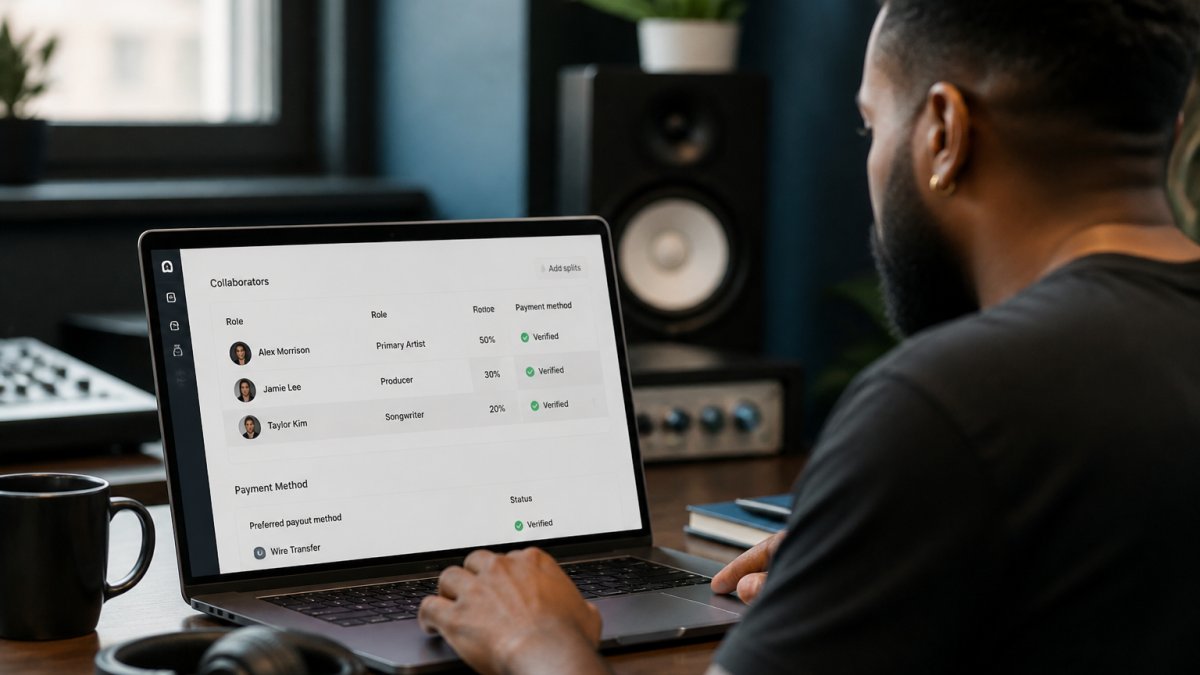
Music distribution platform dashboard showing split configuration screen with collaborator names, roles, percentages, and payment method verification fields
## Handling Disputes and Changing Split Percentages
Split disputes and corrections are common in independent music. The best approach is prevention, but when issues arise, knowing how to resolve them quickly prevents payment delays and relationship damage.
### Preventing Disputes Before Release
Obtain a signed split sheet before uploading to your distributor, listing song title, release date, each person's name, role, and percentage of master and publishing royalties, contact information, and signatures. Store it in a shared folder and upload to your platform if available. Discuss splits before recording starts, renegotiating after recording is much harder.
### Discovering a Missing Contributor After Release
If you forgot to include a collaborator, contact your platform's support team with their name, email, payment method, role, percentage, and signed authorization. Most platforms can add them and adjust future splits, but past royalties typically cannot be recalculated. You may need to manually pay them their share of past earnings.
### Correcting Metadata and Name Mismatches
If a collaborator's name on the split sheet doesn't match their legal name or payment account name, the platform may reject their payment or delay it. Examples include:
- A stage name versus legal name ("DJ Alex" versus "Alexander Smith").
- A name change after the split was created.
- A misspelling in the original split sheet.
Contact your platform and provide:
- The name currently in the system.
- The correct legal name (as it appears on their tax form or ID).
- Confirmation from the collaborator that the correction is authorized.
Most platforms can update the name in the system and reprocess payments. This usually takes 1-2 business days.
### Handling Disputed Ownership Percentages
If two collaborators disagree about their split, do not release the track until the dispute is resolved. Releasing with an incorrect split creates a messy situation: one person receives payments they believe are wrong, and correcting it later is complicated.
If the dispute arises before release:
1. Bring all parties together and discuss the contribution each made.
2. Reference any prior agreements (emails, texts, notes from the session).
3. Reach a new agreement and document it in writing.
4. Have everyone sign the updated split sheet.
5. Upload the corrected split to your platform before release.
If the dispute arises after release and you cannot reach agreement:
- Contact your platform's support team and explain that the split is disputed.
- Ask if they can hold payments in escrow (set aside) until the dispute is resolved.
- Not all platforms offer escrow, so check your terms.
- If escrow is not available, consider pausing the release or removing it from distribution until the dispute is settled.
- Consult a music attorney if the disputed amount is significant.
### Changing Splits for Ongoing Collaborations
If you work with the same collaborators on multiple releases, you may want to adjust splits over time as your working relationship evolves. For example, a producer who contributed equally on your first three tracks might take a smaller role on your fourth track.
For future releases, simply update the split percentages in your platform before uploading the new track. For past releases, most platforms allow you to adjust splits for future payments, but past royalties follow the original agreement.
Example: A producer received 30% of royalties on your first three releases. On your fourth release, they take a smaller role and you agree to 15%. You can set the split to 15% for the fourth release going forward.
Document all split changes in writing and get approval from all affected parties. Keep a version history of split sheets so you can reference what was agreed to for each release.
### Tax Forms and Payment Verification
Before your platform can pay a collaborator, they may need to provide tax information. In the United States, this typically means a W-9 form (for U.S. citizens) or W-8BEN form (for non-U.S. residents). Some platforms request this information automatically; others require you to collect it and provide it to them.
If a collaborator is outside the United States, international tax treaties and withholding requirements may apply. Your platform should explain what forms are needed and what percentage (if any) will be withheld for taxes.
Collect tax forms from all collaborators before the first payout is due. If a form is missing, the platform may withhold a higher percentage or delay payment until the form is received.
### Keeping Records and Communication Open
Maintain a master spreadsheet or document that lists all your releases, the collaborators on each, and their split percentages. Update it whenever a split changes. Share this document with your team so everyone knows what to expect.
After each payout, send a brief summary to your collaborators showing:
- Total earnings for the release (or all releases if you're doing a bulk payout).
- Each person's percentage and their payout amount.
- Any fees or withholdings deducted.
- The date the payment was sent.
Transparency prevents misunderstandings and builds trust. If a collaborator questions their payment, you can point to the summary and explain exactly how the amount was calculated.
## Frequently Asked Questions
### How do you set up automatic royalty splits for a song?
Set up automatic royalty splits by creating a split sheet that documents each collaborator's ownership percentage, then upload it to your music distribution platform. Most platforms allow you to input collaborator information, assign percentages, and enable automatic payouts. Platforms like TuneCore let you split streaming and download royalties among featured artists and producers. Confirm all collaborators approve the percentages before finalizing the split.
### What information should a music royalty split sheet template include?
A split sheet must include the song title, release date, each collaborator's full name and role (producer, songwriter, featured artist), their ownership percentage, payment method, tax information, and signatures from all parties. Document whether splits apply to streaming royalties, download royalties, publishing royalties, or all revenue types. Keep a copy for your records and ensure all collaborators receive a signed version for their protection.
### How do you split royalties between artists, producers, and songwriters?
Royalty splits depend on each person's contribution and agreement. Producers typically receive a percentage of master recording royalties, while songwriters and composers earn publishing royalties. Determine percentages based on negotiated rates, many equal splits divide revenue equally, while others reflect different levels of contribution. Document the agreement in writing before release, and use a distribution platform that can separate and route payments to each party automatically.
### Can music distributors automatically pay collaborators?
Yes. Platforms like Symphonic Distribution feature Auto-Assign Splits that apply default royalty splits automatically to every new release. This eliminates manual setup for each song and ensures collaborators receive consistent percentages across your catalog. Once you configure your default splits, the platform handles payment distribution without requiring additional action per release, provided all collaborators' payment details are verified.
**Editorial Transparency**: This article was created with the assistance of GrandRanker AI and reviewed, edited, fact-checked, and approved by the NexaTunes editorial team before publication.
If you’re looking for a reliable way to distribute your music to major platforms, NexaTunes offers direct distribution with transparent terms.
[Learn more ](https://nexatunes.com/?ref=blog.nexatunes.com)
### Sync Licensing Deals for Indie Labels: A 2026 Guide
URL: https://blog.nexatunes.com/sync-licensing-deals-indie-labels/
Last updated: 2026-10-12T10:50:21.000Z
## Table of Contents
- [How Sync Licensing Works for Indie Labels](#how-sync-licensing-works-for-indie-labels)
- [Preparing Your Music Catalog for Sync Licensing](#preparing-your-music-catalog-for-sync-licensing)
- [Metadata Standards and Catalog Organization](#metadata-standards-and-catalog-organization)
- [Technical Deliverables and File Specifications](#technical-deliverables-and-file-specifications)
- [Rights Verification and Ownership Splits](#rights-verification-and-ownership-splits)
- [Finding Sync Opportunities and Music Supervisors](#finding-sync-opportunities-and-music-supervisors)
- [Pitching Your Music: Sync Pitch Email Template](#pitching-your-music-sync-pitch-email-template)
- [Elements of an Effective Pitch](#elements-of-an-effective-pitch)
- [Follow-Up and Tracking System](#follow-up-and-tracking-system)
- [Working with Sync Licensing Companies for Independent Artists](#working-with-sync-licensing-companies-for-independent-artists)
- [Understanding Sync Licensing Rates and Fees](#understanding-sync-licensing-rates-and-fees)
- [Sync Fees vs. Backend Royalties](#sync-fees-vs-backend-royalties)
- [Evaluating Deal Scenarios](#evaluating-deal-scenarios)
- [Negotiating Exclusive vs. Non-Exclusive Agreements](#negotiating-exclusive-vs-non-exclusive-agreements)
- [Key Contract Terms to Negotiate](#key-contract-terms-to-negotiate)
- [Closing and Managing Sync Licensing Deals](#closing-and-managing-sync-licensing-deals)
- [Contract Review and Rights Clearance](#contract-review-and-rights-clearance)
- [Registering with Collection Societies](#registering-with-collection-societies)
- [Frequently Asked Questions](#frequently-asked-questions)
*Last Updated: October 10, 2026*
## How Sync Licensing Works for Indie Labels
[Sync licensing](https://blog.nexatunes.com/p/5eca01ab-079e-4e57-855d-5d7e39399f8c/) deals indie labels involve securing permission to use your music in visual media like film, television, advertising, and video games. A production company must obtain both a master rights license (for the sound recording) and a publishing rights license (for the composition). For indie labels, controlling both sides gives you significant negotiating power.
A music supervisor discovers your music, contacts you with project details, and you negotiate the sync fee (upfront payment) and backend royalties (ongoing payments through performance royalties).
At NexaTunes, we help indie labels manage catalogs with detailed label-level reporting.
## Preparing Your Music Catalog for Sync Licensing
Your catalog's value depends on organization, metadata completeness, and technical readiness. Music supervisors search by genre, mood, duration, instrumentation, and licensing availability. Without proper metadata, clean audio files, stems, or alternate mixes, sync opportunities will pass you by.
### Metadata Standards and Catalog Organization
Metadata is the foundation of [sync licensing](https://blog.nexatunes.com/p/546bcb2b-3259-4433-835f-362fae95bbb2/) success. Standardize naming conventions: use consistent capitalization, avoid special characters, and include descriptors like "instrumental version" or "clean edit."
Every track in your catalog must include these core metadata fields:
- **Track Title**, Exact, consistent spelling across all platforms
- **Artist/Composer Name**, Full legal name as registered with performance rights organizations
- **Duration**, In MM:SS format (e.g., 3:45)
- **BPM**, Tempo in beats per minute
- **Key**, Musical key (e.g., C Major, A Minor)
- **Genre**, Primary genre (e.g., Electronic, Hip-Hop, Indie Rock)
- **Mood/Descriptors**, 3-5 searchable tags (e.g., "uplifting," "cinematic," "energetic," "melancholic")
- **Instrumentation**, What instruments are featured (e.g., "acoustic guitar, strings, drums")
- **ISRC Code**, International Standard Recording Code (unique identifier for the sound recording)
- **Publishing Information**, Composer, publisher, and PRO affiliation (ASCAP, BMI, or SESAC)
- **Master Rights Owner**, Your label name and contact
- **Licensing Status**, Available for sync, exclusive, or restricted
Organize your catalog by genre, mood, and use case. Create instrumental versions, stems (individual instrument tracks), and clean versions for broadcast. Document which versions exist for each track so you can fulfill requests quickly.
### Technical Deliverables and File Specifications
Supervisors expect files in specific formats. Prepare:
**Audio Files:** Master mix (Stereo WAV, 24-bit, 44.1-48 kHz, -3dB to -6dB peak), instrumental version, stems, clean edit, and 30/60/15-second cuts.
**Metadata:** ID3 tags in MP3s, master spreadsheet (CSV/Excel) with track details and version availability, cue sheets for multiple composers.
**Documentation:** Split sheets showing ownership percentages, clearance letters from featured artists/producers, ISRC registration proof.
Licensing platforms reject submissions lacking proper formats or metadata. Standardize your catalog upfront to fulfill requests immediately.
### Rights Verification and Ownership Splits
Before pitching, verify you control both master and publishing rights. A split sheet documents ownership percentages. Require all artists and producers to complete one upon submission. Never accept a sync deal without clearing all ownership splits.
For each track, verify master rights ownership, publishing rights, sample clearance, and featured artist approval. This prevents legal complications when closing deals.
## Finding Sync Opportunities and Music Supervisors
Music supervisors work through established channels: music libraries, sync agents, and direct relationships with labels. Use a multi-channel approach: submit to licensing libraries, build relationships with sync agents, and pitch directly to supervisors.
#### [How To Get Sync Licensing Deals For Music? - Music Producer Mastery](https://www.youtube.com/watch?v=eWS-F2Cr39w&ref=blog.nexatunes.com)
Music Producer Mastery
Licensing libraries connect supervisors with tracks. Submit to libraries that cater to your genre and target projects.
Sync agents pitch directly to supervisors and brands, typically taking 15-25% commission. Research their track record and specialization before signing.
## Pitching Your Music: Sync Pitch Email Template
A strong sync pitch is concise and explains why your track fits the supervisor's needs within the first three sentences. Research the specific project and avoid generic bulk emails.

Music producer at home studio reviewing sync pitch emails on laptop screen with headphones on desk and vinyl records on shelves
### Elements of an Effective Pitch
Open with a hook referencing the specific project. Include track title, artist, and genre in the subject line. Keep the body to three paragraphs: introduce the track, provide key details (duration, BPM, mood, licensing status), and include a listening link.
Here's a template you can adapt:
> **Subject:** \[Track Title\] - \[Genre\] for \[Project Name/Brief\]
>
> Hi \[Supervisor Name\],
>
> I have a track that matches your brief perfectly. "\[Track Title\]" by \[Artist Name\] is a \[genre\] instrumental that captures \[specific mood/energy\]. At \[duration\], it fits your timing requirements, and it's available for \[exclusive/non-exclusive\] licensing.
>
> Listen here: \[streaming link\]
>
> Key details:
>
> [Get Started Today →](https://nexatunes.com/?ref=blog.nexatunes.com)
>
> - Duration: \[X minutes\]
> - BPM: \[X\]
> - Mood: \[descriptive tags\]
> - Master rights: Available
> - Publishing rights: Available
>
> I'm happy to discuss licensing terms and can provide stems or alternate mixes if needed.
>
> Best regards, \[Your Name\] \[Label Name\] \[Contact Information\]
### Follow-Up and Tracking System
Set up a tracking spreadsheet with supervisor name, project, pitch date, response status, and follow-up date. Follow up after two weeks if you haven't heard back. Track which supervisors show interest to refine future pitches and identify patterns.
## Working with Sync Licensing Companies for Independent Artists
Full-service sync agencies actively pitch your catalog (20-30% commission) while passive libraries let supervisors search directly (30-50% of sync fee). Many successful labels use both: submit to one or two passive libraries for low-effort exposure and work with a selective sync agent for active pitching.
## Understanding Sync Licensing Rates and Fees
[Sync licensing](https://blog.nexatunes.com/p/4c6e741e-6fba-4cc7-91b7-7d362f7c14d0/) fees vary by project type, territory, duration, exclusivity, and term. A local 30-second commercial might pay $500, while a national broadcast spot could pay $5,000-$50,000+.
### Sync Fees vs. Backend Royalties
The sync fee is the upfront payment; backend royalties are ongoing payments when the project airs or streams. Always negotiate both components. Verify that the project will generate sufficient performance royalties.
- **Broadcast Television:** $5,000-$50,000 sync fees plus $500-$5,000+ annual performance royalties.
- **Cable Television:** $1,000-$10,000 sync fees, $100-$1,000 annual royalties.
- **Streaming Platforms:** $500-$5,000 sync fees, minimal/zero performance royalties.
- **Advertising:** $500-$2,000 local; $10,000-$100,000+ national. Minimal performance royalties.
- **Film (Theatrical):** $1,000-$25,000+ sync fees. Performance royalties only if broadcast on TV.
- **Video Games:** $500-$5,000 flat fees, no backend royalties.
- **YouTube/Social Media:** $0-$500 sync fees.
### Evaluating Deal Scenarios
**Scenario 1: High Sync Fee, Non-Exclusive** ($3,000, non-exclusive, 5-year, worldwide), Accept if fair for the project type and you want to keep licensing broadly.
**Scenario 2: Low Sync Fee, Exclusive** ($500, exclusive in "advertising," 2-year, US only), Negotiate higher fees or shorter exclusivity. A 2-year exclusive for $500 is typically unfavorable unless backend royalties are substantial.
**Scenario 3: Moderate Sync Fee, Backend Royalties** ($2,000, non-exclusive, guaranteed performance royalties, 5-year, worldwide), Accept if the project has strong distribution. Verify broadcast schedule before signing.
### Negotiating Exclusive vs. Non-Exclusive Agreements
An exclusive license grants one party sole rights to use your music in a specific category for a defined period. A non-exclusive license allows multiple parties to use the same track in similar projects. Exclusive licenses command higher fees because the licensee has protection from competing uses.
Most indie labels prefer non-exclusive licensing because it maximizes catalog value. You can license the same track to multiple brands, advertisers, and productions as long as they don't compete directly.
Exclusive deals make sense only if the sync fee justifies removing the track from your active licensing pool. Use this formula to evaluate exclusivity:
**Expected Annual Revenue from Non-Exclusive Licensing** vs. **Exclusive Sync Fee ÷ Exclusivity Period**
If you typically earn $1,000 per year licensing a track non-exclusively, an exclusive offer of $3,000 for a 2-year term ($1,500/year) is a break-even deal. You'd want $4,000+ to justify the exclusivity.
### Key Contract Terms to Negotiate
When reviewing a sync offer, pay close attention to these clauses:
- **Territory**, Where the license applies (worldwide, United States only, specific regions). Broader territories command higher fees.
- **Term**, How long the license lasts (perpetual, 5 years, 2 years). Shorter terms allow you to re-license sooner; longer terms lock in lower fees.
- **Exclusivity Scope**, If exclusive, define the category precisely ("advertising," "automotive advertising," "broadcast television"). Narrow scopes are preferable.
- **Media**, Which platforms the license covers (broadcast TV, streaming, theatrical, social media). Broader media coverage increases fees.
- **Reversion Clause**, Does the license revert to you if the project is no longer distributed or after the term expires? Reversion clauses protect your catalog.
- **Backend Royalty Responsibility**, Who registers the license with ASCAP/BMI/SESAC? Ensure the licensee registers promptly so you receive performance royalties.
- **Approval Rights**, Can you approve how your music is used (e.g., not in violent or explicit content)? Retain approval rights when possible.
Negotiate these terms actively. A $2,000 sync fee for a 5-year exclusive worldwide license is very different from a $2,000 fee for a 2-year non-exclusive license in the United States only. The latter is worth significantly more.
## Closing and Managing Sync Licensing Deals
Once a music supervisor offers a license, the real work begins. You must review the contract, clear all ownership rights, and ensure proper registration with collection societies. A poorly managed deal can cost you royalties or create legal disputes.
### Contract Review and Rights Clearance
Never accept a sync deal without reviewing the contract thoroughly. Key terms to verify include the sync fee amount, backend royalty provisions, territory (where the license applies), duration (how long the license lasts), and exclusivity status. Confirm that the licensee has the right to use the music as described and that the duration matches your agreement.
Before signing, contact every artist, producer, and publisher listed on the split sheet and confirm they approve the deal. Get written consent from co-owners. If you cannot reach someone or they object, you cannot legally accept the license. This step prevents costly disputes after the deal closes. Document all approvals in writing.
### Registering with Collection Societies
After a sync deal closes, register the license with the appropriate performance rights organizations. In the United States, register with ASCAP, BMI, or SESAC depending on which organization represents your publishing. Provide the project details, track information, and broadcast dates so performance royalties are tracked and paid correctly.
Register your label with these organizations if you haven't already. They collect performance royalties on your behalf whenever your music airs on broadcast television, radio, or qualifying streaming platforms. Registration is free and takes minutes, but it's essential for capturing backend royalties.
---
Getting sync licensing deals indie labels requires a systematic approach: organize your catalog with clean metadata, build relationships with supervisors and agents, pitch strategically, and manage contracts carefully. NexaTunes simplifies this process with detailed label-level reporting.
## Frequently Asked Questions
### What's the typical cost of a sync licensing deal for indie labels?
Sync licensing fees vary widely based on usage scope, territory, and duration. A local commercial might cost $500-$5,000, while a major film placement could reach $10,000 or more. Many deals include both an upfront sync fee and backend royalties paid by collection societies. Pricing depends on your catalog's demand, the licensee's budget, and whether the agreement is exclusive or non-exclusive. For current market rates in your specific genre and use case, consult with sync agents or licensing libraries that represent independent artists.
### How should an indie label prepare its catalog for sync licensing?
Start by organizing your music metadata: ensure every track has accurate composer, publisher, and rights holder information, plus a clear split sheet if multiple artists contributed. Register your compositions with a performing rights organization (PRO) like ASCAP, BMI, or SESAC. Create multiple versions of your tracks, instrumental, stems, clean versions, and alternate mixes, since supervisors often need flexibility. Store high-quality files (WAV format, 24-bit minimum) and write detailed descriptions of mood, tempo, and instrumentation. This preparation makes your catalog discoverable and licensable.
### What should a sync pitch email include?
A strong sync pitch email opens with a one-sentence hook that matches the music supervisor's brief. Include 2-3 tracks as preview links (not attachments), a short description of each track's mood and instrumentation, your label's contact info, and rights ownership confirmation. Attach a one-page media kit with your catalog highlights and a link to your full catalog on a platform like Spotify or a dedicated portal. Keep the email concise, under 200 words, and personalize it to the specific project. Always include a clear call to action: 'I'd love to discuss licensing options' or 'Let me know if you'd like stems or alternate versions.'
### How long does it take to get a music sync licensing deal?
Timeline varies significantly. Initial interest to contract signature typically takes 2-8 weeks, depending on the project's scope and decision-making speed. A tight-deadline TV or advertising placement might close in days; a film or video game placement can take months through multiple approval rounds. Once a deal is signed, the licensee usually has 30-90 days to approve final use and execute payment. After broadcast or release, collection societies may take 6-12 months to report and pay backend royalties. Maintain detailed records of all submissions and follow up every 10-14 days if you haven't heard back.
**Editorial Transparency**: This article was created with the assistance of GrandRanker AI and reviewed, edited, fact-checked, and approved by the NexaTunes editorial team before publication.
If you’re looking for a reliable way to distribute your music to major platforms, NexaTunes offers direct distribution with transparent terms.
[Learn more ](https://nexatunes.com/?ref=blog.nexatunes.com)
### How to Switch Music Distribution Platforms in 2026
URL: https://blog.nexatunes.com/how-to-switch-music-distribution-platforms/
Last updated: 2026-10-12T10:49:46.000Z
## Table of Contents
- [Before You Switch Music Distribution: What to Prepare](#before-you-switch-music-distribution-what-to-prepare)
- [Documents and Data to Save Before Leaving Your Current Distributor](#documents-and-data-to-save-before-leaving-your-current-distributor)
- [Checking Your Current Contract and Release Windows](#checking-your-current-contract-and-release-windows)
- [How to Switch Music Distributors Without Losing Streams](#how-to-switch-music-distributors-without-losing-streams)
- [Why Streams Drop During a Switch and How to Prevent It](#why-streams-drop-during-a-switch-and-how-to-prevent-it)
- [How to Keep ISRCs When Changing Distributors](#how-to-keep-isrcs-when-changing-distributors)
- [Your Music Distributor Migration Checklist](#your-music-distributor-migration-checklist)
- [Uploading Releases and Matching Original Release Dates](#uploading-releases-and-matching-original-release-dates)
- [How Long to Switch Music Distributors (And What Slows It Down)](#how-long-to-switch-music-distributors-and-what-slows-it-down)
- [Troubleshooting: Duplicate Releases, Takedowns, and Royalty Gaps](#troubleshooting-duplicate-releases-takedowns-and-royalty-gaps)
- [Diagnosing Duplicate Releases](#diagnosing-duplicate-releases)
- [When Metadata Does Not Match](#when-metadata-does-not-match)
- [Rights, Ownership, and Account Access](#rights-ownership-and-account-access)
- [Royalty Timing and Reconciliation](#royalty-timing-and-reconciliation)
- [Store-by-Store Verification After the Switch](#store-by-store-verification-after-the-switch)
- [Frequently Asked Questions](#frequently-asked-questions)
*Last Updated: October 8, 2026*
## Before You Switch Music Distribution: What to Prepare
Switching music distribution platforms means moving your catalog while keeping your streams, playlist placements, and royalties intact.
A clean switch is mostly admin work, moving files, codes, and dates between dashboards.
So before you touch a single upload button, gather your documents and check your contract, here is exactly what to save and read before you [switch music](https://blog.nexatunes.com/p/22143ec0-5449-4955-bff2-33cbb69bf63a/) distribution platforms.
**Watch Out** Never cancel your current distributor before your new releases are live. If your old account closes first, stores can pull your catalog, and you lose the stream counts tied to those release IDs.
### Documents and Data to Save Before Leaving Your Current Distributor
Pull everything out of your current dashboard before you lose access: royalty reports, audio files, artwork, and every code attached to each release.
Save these items:
- **ISRC codes** for every track (the unique ID for a recording)
- **UPC codes** for every release (the unique ID for the product)
- Original audio files in WAV or FLAC
The [U.S. Copyright Office guidance on music registration](https://www.copyright.gov/registration/?ref=blog.nexatunes.com) explains why these codes matter for ownership records. Treat that spreadsheet as your master file. Every step after this depends on it.
### Checking Your Current Contract and Release Windows
Read your distribution agreement first. Look for the notice period, term length, and any exclusivity clause, some contracts lock your catalog for a set term, others renew automatically, and a few require written notice weeks in advance.
Also check your release calendar. If a single or album drops in the next month, wait: moving mid-release splits your data and confuses stores. Finish the rollout, then move.
## How to Switch Music Distributors Without Losing Streams
You keep your streams by keeping your ISRCs, UPCs, and original release dates. Streams live on the release ID, not the distributor: when the same recording arrives under the same code, the platform matches it to the existing release page.
Here is how to protect your stream count:
- Reuse the exact ISRC for each track
- Reuse the exact UPC for each release
- Keep the original release date, not today's date
Do this and your playlist placements stay attached, your stream count carries over, and your followers keep seeing the same release. Miss one code and you get a duplicate release starting at zero streams.
**Pro Tip** Screenshot your current release pages before you migrate, including the stream count and playlist adds. If a store splits your release into a duplicate, that screenshot is your proof when you file a support ticket.
### Why Streams Drop During a Switch and How to Prevent It
Streams drop for one reason: the store sees a new delivery as a new release. This usually happens when the UPC changes, the release date changes, or the old distributor issues a takedown while the new one uploads.
The fix is sequencing, not luck: upload with the new distributor first, confirm the release is live, then remove it from the old one.
## How to Keep ISRCs When Changing Distributors
You keep your ISRCs by entering them manually during upload instead of letting the new distributor generate fresh ones. Most platforms auto-assign codes by default.
An **ISRC** is the International Standard Recording Code, a unique identifier for a specific recording that stays with it for life, no matter who distributes it ([How It Works](https://usisrc.org/how-it-works/?ref=blog.nexatunes.com)).
During upload, look for a field labeled "existing ISRC" or "I already have an ISRC." Paste your saved codes there.
If your new distributor will not accept existing codes, that is a red flag. Ask support before you commit.
## Your Music Distributor Migration Checklist
A distributor migration checklist is a sequenced list of every step in the move, from exporting your data to verifying each release is live on every store.

A music producer at a desk with a laptop showing a distribution dashboard, a notepad with a handwritten checklist, and studio headphones nearby in a home studio setting
Here is the full sequence:
**Phase 1: Export and archive (before you touch a new platform)**
- Export all royalty reports and release data from your old dashboard, go back at least 12 months for a full earnings baseline
- Save audio files, artwork, ISRCs, and UPCs to a master folder, use a naming convention like `Artist - Release - UPC - ISRC`
- Read your contract for notice periods and exclusivity terms, note the exact date you can request removal without penalty
**Phase 2: Set up and upload (new distributor)**
- Open your new distributor account and complete verification, before you cancel anything
- Upload each release with existing ISRCs and UPCs, override any auto-generated codes
- Set the original release date on every release, not today's date
**Phase 3: Verify and reconcile (after go-live, before removal)**
- Check for duplicate pages, if a store shows two versions, file a takedown for the newer one
- Confirm stream counts carried over, compare against your screenshots
- Verify artist profiles are merged, your catalog should sit under one profile, not two
**Phase 4: Post-transfer audit (store-by-store)**
[Get Started Today →](https://nexatunes.com/?ref=blog.nexatunes.com)
After removal, search each major platform for your release and confirm:
- The correct artist profile is attached
- Track credits and metadata match your master file
- Audio plays correctly (no swapped tracks or wrong versions)
**Pro Tip** Upload in batches of 5-10 releases rather than your entire catalog at once. If something goes wrong, a rejected release, a metadata mismatch, a duplicate, you catch it early and can fix it before it affects your whole catalog.
### Uploading Releases and Matching Original Release Dates
Match the original release date exactly. If a track first went live on March 14, 2023, enter that date, not today's.
Most upload forms default to the current date, change it. A wrong date can push your release back into "upcoming" status, trigger a fresh review, and make stores treat it as a new product, resetting your stream count and breaking playlist continuity.
Then verify: search each store and confirm the stream count carried over. Your catalog should sit together, not split across two profiles.
**Edge cases to watch for:**
- **Rejected releases:** Check the rejection reason in your new distributor's dashboard. Common causes are missing metadata, artwork that does not meet store specs, or a UPC conflict. Fix the issue and re-upload, do not create a new release with a new UPC.
- **Pre-saves and scheduled releases:** If a pre-save campaign is running on your old distributor, wait until the release date passes before switching, moving mid-campaign breaks the pre-save link and loses those saves.
- **Multiple-artist releases:** Confirm every collaborator's profile is correctly linked on the new delivery. Mismatched credits can split streams across duplicate artist pages.
## How Long to Switch Music Distributors (And What Slows It Down)
A typical switch takes one to three weeks from first upload to full verification, driven mostly by store review times.
What slows it down:
- Large catalogs uploaded all at once
- Missing or mismatched ISRCs and UPCs
- Wrong release dates
Speed it up by uploading in batches, double-checking codes, and confirming each release is live before you request removal from the old platform.
| Step | Typical Time | What Can Delay It |
| --------------------------------- | ------------------ | ---------------------- |
| Export data from old dashboard | 1-2 days | Slow report generation |
| Contract review and notice period | Varies by contract | Auto-renewal clauses |
| Upload to new distributor | 1-3 days | Large catalogs |
| Store review and go-live | 3-10 days | Metadata errors |
| Old account removal | 3-14 days | Takedown processing |
## Troubleshooting: Duplicate Releases, Takedowns, and Royalty Gaps
Duplicate releases are the most common problem, and they come from mismatched codes. If two pages exist for the same track, file a takedown for the newer one, confirm the original is still live, and check that your codes match across both.
### Diagnosing Duplicate Releases
A duplicate release usually means one of three things went wrong:
1. **UPC mismatch**, the new distributor assigned a new UPC instead of using your existing one. Fix: request a metadata update to correct the UPC, or take down the duplicate and re-upload with the correct code.
2. **Release date mismatch**, the new delivery used today's date instead of the original. Fix: request a metadata update to restore the original date.
3. **Artist name mismatch**, a slight spelling difference (e.g., "The Band" vs. "The Band.") caused the store to create a new artist profile. Fix: file a support ticket to merge the profiles.
When you file a takedown, include the UPC, ISRC, and both release URLs. Stores process these faster when the request is specific.
### When Metadata Does Not Match
If your new release shows different track titles, credits, or artwork than the original, do not ignore it, metadata mismatches break playlist continuity and confuse royalty reporting.
- **Track titles:** Check capitalization, punctuation, and featured artist formatting. Stores match on exact strings.
- **Credits:** Confirm producers, songwriters, and featured artists are listed identically to the original.
- **Artwork:** Use the same file, not a re-export, different compression can trigger a new review.
If the mismatch is on the store side, file a metadata correction request through your new distributor. If it is on your side, fix it in the dashboard and re-submit.
### Rights, Ownership, and Account Access
Before you leave your old distributor, confirm three things:
- **You own your masters.** Unless your contract says otherwise, you do. The [U.S. Copyright Office guidance on music registration](https://www.copyright.gov/registration/?ref=blog.nexatunes.com) explains how ownership records work.
- **You have label or collaborator permissions.** If you distribute on behalf of other artists, confirm that your agreements allow you to move their releases. Some contracts require notice to collaborators.
- **You have your account credentials and analytics.** Export your streaming analytics, audience demographics, and playlist data before you lose access. This data does not transfer automatically.
If your old distributor holds your account open after removal, request a final data export. Most platforms provide one within 30 days.
### Royalty Timing and Reconciliation
Royalty gaps happen during the overlap: your old distributor pays through its final statement period, your new one starts from its first. Expect a short gap and track it.
- **Request a final payout** from your old distributor once your balance is above the payment threshold (often $10-$50, check your contract).
- **Download your final statement** and note the reporting period. Streaming royalties typically lag 1-3 months behind the play date.
- **Compare statements** across distributors. Your new distributor's first statement may show lower numbers because it only covers the period after the switch.
**Watch Out** Do not close your old distributor account until you have received your final payout and downloaded your final statement. Once the account is closed, you may lose access to both.
### Store-by-Store Verification After the Switch
After removal from your old distributor, do a final audit. Search each major streaming service and download store and confirm:
- The correct artist profile is attached
- Track credits and metadata match your master file
- Audio plays correctly
If a store shows a duplicate, file a takedown. If a playlist dropped your track, contact the curator with your new release link. If streams did not carry over, check your ISRCs and UPCs against your master file, one mismatched character can reset the count.
For royalty timing, most platforms pay monthly after a reporting lag. Most platforms pay monthly after a reporting lag.
## Frequently Asked Questions
### Will switching distributors remove my music from streaming platforms?
Not if you sequence the move correctly. Upload your catalog to the new distributor first, match the original release dates and ISRCs, and wait until the new releases go live before requesting takedowns from your old distributor. If you remove first and upload second, your tracks disappear from streaming services for days or weeks, and playlist placements tied to those releases can reset.
### Can I keep the same ISRCs when changing distributors?
Yes. ISRCs are tied to the recording, not the distributor, so you can and should reuse the same codes on your new uploads. Export your full ISRC list from your current dashboard before you leave. If you let the new distributor assign fresh ISRCs, streaming services treat the tracks as new recordings, which splits your stream history and can trigger duplicate release flags.
### How long does it take to switch music distributors?
Most migrations take two to four weeks end to end. Uploading and metadata matching take a few days, store delivery typically runs 24 to 72 hours per platform, and you should allow at least one full royalty cycle for final payouts from your old distributor. Large catalogs with dozens of releases, or labels with sublabels, take longer because each release needs individual verification.
### Can I switch distributors and keep my royalties?
You keep royalties already earned, but timing matters. Most distributors pay out on a monthly or quarterly cycle with a reporting lag, so leave your old account open until the final balance clears. Download every royalty statement before you close anything. After the switch, your new distributor collects from the date your releases go live under their account, so there is usually a short gap you should plan for.
**Editorial Transparency**: This article was created with the assistance of GrandRanker AI and reviewed, edited, fact-checked, and approved by the NexaTunes editorial team before publication.
If you’re looking for a reliable way to distribute your music to major platforms, NexaTunes offers direct distribution with transparent terms.
[Learn more ](https://nexatunes.com/?ref=blog.nexatunes.com)
### How to Avoid Hidden Music Distribution Fees in 2026
URL: https://blog.nexatunes.com/how-to-avoid-hidden-music-distribution-fees/
Last updated: 2026-10-12T10:49:16.000Z
## Table of Contents
- [Why Hidden Music Distribution Fees Are So Hard to Spot](#why-hidden-music-distribution-fees-are-so-hard-to-spot)
- [Your Music Distribution Fee Checklist Before You Sign](#your-music-distribution-fee-checklist-before-you-sign)
- [Step 1: Define What Counts as a Hidden Fee](#step-1-define-what-counts-as-a-hidden-fee)
- [Step 2: Audit the Agreement, Clause by Clause](#step-2-audit-the-agreement-clause-by-clause)
- [Step 3: Questions to Ask Support in Writing](#step-3-questions-to-ask-support-in-writing)
- [Step 4: Document What You Were Quoted](#step-4-document-what-you-were-quoted)
- [Music Distribution Pricing Comparison: What the Numbers Actually Mean](#music-distribution-pricing-comparison-what-the-numbers-actually-mean)
- [Worked Cost Comparisons Across Release Schedules](#worked-cost-comparisons-across-release-schedules)
- [How to Build Your Own Three- and Five-Year Estimate](#how-to-build-your-own-three-and-five-year-estimate)
- [The Long-Term Trap: Legacy Releases and Storage](#the-long-term-trap-legacy-releases-and-storage)
- [Music Distribution Royalty Percentage: What You Actually Keep](#music-distribution-royalty-percentage-what-you-actually-keep)
- [Payout Thresholds, Processing Fees, and Currency Conversion](#payout-thresholds-processing-fees-and-currency-conversion)
- [Music Distributor Annual Fees and Recurring Charges to Watch](#music-distributor-annual-fees-and-recurring-charges-to-watch)
- [What Happens to Your Music and Royalties After Cancellation](#what-happens-to-your-music-and-royalties-after-cancellation)
- [How to Negotiate and Track Distribution Costs Over Time](#how-to-negotiate-and-track-distribution-costs-over-time)
- [Frequently Asked Questions](#frequently-asked-questions)
*Last Updated: October 8, 2026*
## Why Hidden Music Distribution Fees Are So Hard to Spot
Learning how to avoid hidden music [distribution fees](https://blog.nexatunes.com/p/db862ac1-82cf-40a2-bb97-9714a43c50ba/) starts with one hard fact: most artists never see the real cost until money is already gone.
Distributors compete on one number: the upfront price. That is the number you see on the pricing page.
So the cheap option often is not cheap. It just moves the cost somewhere you will not look until your first payout arrives.
Below, we walk through a full audit process, a pricing comparison, and the payout rules that quietly shrink your royalties.
## Your Music Distribution Fee Checklist Before You Sign
Before you sign anything, run every distribution agreement through the same audit. This takes about 20 minutes and can save you years of small, silent deductions. The goal is not to find the cheapest headline price, it is to build a single number that represents your true annual cost.

A music label manager reviewing a printed distribution contract at a desk with a laptop, highlighter, and notepad covered in handwritten notes
### Step 1: Define What Counts as a Hidden Fee
Most artists compare offers on the wrong axis. Before you audit anything, sort every charge into one of three buckets:
- **Mandatory charges:** subscription renewals, per-release fees, per-artist fees, payout processing, currency conversion, and tax withholding. These apply to everyone on that plan.
- **Conditional charges:** takedown fees, re-upload fees, catalog migration fees, and reinstatement charges. These only trigger if you take a specific action.
- **Optional add-ons:** content ID enrollment, sync licensing pitches, playlist pitching, cover-song licensing, and priority support. These are only hidden if they are bundled into a plan you did not ask for.
A true hidden fee is a mandatory or conditional charge that is not disclosed on the pricing page you compared. An optional add-on is not hidden, it is upsold. Keeping that distinction lets you compare two distributors fairly instead of comparing a stripped plan against a loaded one.
### Step 2: Audit the Agreement, Clause by Clause
1. Download the full agreement, the pricing page, and the FAQ as PDFs. Do not audit on a screen, you will scroll past the clause that matters.
2. Highlight every dollar figure and percentage that is not the headline price.
3. Locate the royalty share clause and write down your exact percentage, including whether it applies to gross or net receipts.
4. Locate the payout schedule and the minimum payout threshold. Note whether the threshold is per payout, per platform, or per currency.
5. Search the document for these terms: fee, charge, deduction, processing, conversion, withholding, renewal, reinstatement, takedown, migration, exclusivity.
6. Read the termination and post-termination clauses together. They decide what happens to your catalog after you leave.
7. Check the auto-renewal clause: the term length, the notice window, and whether the renewal rate is capped or set at the then-current price.
8. Write your total annual cost on one line. If you cannot, that is your answer, the offer is not transparent enough to sign.
### Step 3: Questions to Ask Support in Writing
Email support before you sign and keep the reply. A distributor that will not answer in writing is telling you something.
- What is my all-in cost for one single, one EP, and one album in year one?
- Does the renewal rate change after the introductory term, and by how much?
- Are there per-artist, per-label, or per-release caps on my plan?
**Watch Out** The most common mistake is skipping the renewal clause. Many agreements auto-renew, and the price at renewal is often higher than the introductory rate. Miss the cancellation window and you are locked in for another term, sometimes at a rate the distributor sets unilaterally.
### Step 4: Document What You Were Quoted
Save the pricing page, the support email, and the signed agreement in one folder per distributor. Note the date of each. If a fee appears on a statement that was not in the quoted terms, you now have a paper trail. The [Federal Trade Commission guidance on deceptive pricing](https://www.ftc.gov/legal-library/browse/rules/deceptive-pricing?ref=blog.nexatunes.com) is worth reading if an advertised price does not match what you are actually charged.
## Music Distribution Pricing Comparison: What the Numbers Actually Mean
A [music distribution](https://blog.nexatunes.com/p/03ce5e5b-ab61-452e-afdb-e23e07ddf608/) pricing comparison only works if you compare total cost over time, not sticker price. Four pricing models dominate the market, and each hides cost in a different place.
#### [Hidden Fees in Music Distribution 2026 | How Much Are You REALLY Paying? (Full Breakdown)](https://www.youtube.com/watch?v=x0imKk37cAo&ref=blog.nexatunes.com)
Music Distribution India
| Pricing Model | Upfront Cost | Where Cost Hides | Best For |
| ------------------- | ---------------------------- | ---------------------------------------------------- | ----------------------------- |
| Annual subscription | Recurring yearly fee | Renewal rate, per-artist limits, storage caps | Steady release schedules |
| One-time fee | Paid once per release | Takedown fees, re-upload charges, no ongoing support | Occasional singles |
| Commission-based | Free to upload | Royalty share, payout deductions, threshold rules | Artists with growing catalogs |
| Hybrid | Low upfront, split royalties | Both commission and fees, plus renewal terms | Labels testing a new platform |
### Worked Cost Comparisons Across Release Schedules
Most comparisons stop at the table. The real decision happens when you run your own release schedule through each model over one, three, and five years. Below is the framework, plug in the actual numbers from your shortlist.
**Scenario A, One single per year.**
- One-time fee model: pay per release, no recurring charge. Over five years, cost equals five release fees plus any takedown or re-upload charges.
- Annual subscription: you pay the subscription every year even in years you release nothing. Over five years, that is five renewal payments for five releases.
- Commission model: no upfront cost, but you give up a percentage of every stream forever. On a low-earning single, the commission may never exceed the subscription, but on a track that breaks out, it can exceed it many times over.
**Scenario B, Four releases per year (mix of singles and EPs).**
- One-time fee model: four release fees per year, plus takedown and re-upload costs if you revise artwork or metadata.
- Annual subscription: one renewal per year, assuming the plan covers unlimited releases. This is where subscriptions usually win, but only if the renewal rate stays flat and the plan does not cap artists or labels.
- Commission model: still no upfront cost, but the royalty share now applies to a larger revenue base, so the trade-off shifts toward the subscription.
**Scenario C, Twelve or more releases per year, growing catalog.**
- One-time fee model: per-release fees stack quickly, and legacy releases keep incurring storage or hosting charges on some plans.
- Annual subscription: usually the lowest total cost if the plan is truly unlimited and the renewal rate is capped.
- Commission model: can beat subscriptions on total cost only if your royalty share stays reasonable and payout fees are low. Run the numbers on your actual streaming revenue, not a hypothetical.
**Scenario D, A label with sublabels and multiple artists.**
- Per-artist and per-label fees are the hidden multiplier here. A plan that looks cheap for one artist can cost several times more once you add sublabels.
- Ask specifically whether sublabels count toward artist limits and whether each sublabel triggers a separate renewal.
### How to Build Your Own Three- and Five-Year Estimate
1. List every release you plan to put out over the next three years, by type (single, EP, album).
2. For each distributor on your shortlist, write down the upfront cost per release, the annual or recurring cost, and the royalty share.
3. Add the conditional costs you expect to trigger: takedowns, re-uploads, migrations, content ID enrollment.
4. Add the payout costs: threshold, schedule, processing fee per payout, and currency conversion spread.
5. Multiply by three and by five. The model that wins year one is often not the model that wins year five.
**Pro Tip** Ask the distributor for a written total-cost example for your release schedule before you sign. A transparent platform will provide it. If they will not put numbers in writing, treat that as a red flag, and treat any verbal quote as unenforceable.
### The Long-Term Trap: Legacy Releases and Storage
A release that stops earning does not stop costing. On plans with storage or catalog hosting fees, older releases keep generating charges long after their streaming revenue drops to near zero. Before you commit, ask whether storage is included, capped, or billed separately, and whether inactive releases can be removed without a takedown fee.
## Music Distribution Royalty Percentage: What You Actually Keep
The royalty percentage in the headline is rarely the percentage you keep. Deductions for processing, conversion, and thresholds all come out first.
Here is the sequence money travels through before it reaches you:
[Get Started Today →](https://nexatunes.com/?ref=blog.nexatunes.com)
1. Platforms report your streams and revenue.
2. The distributor takes its commission or royalty share.
3. Payment processing fees are deducted.
4. Currency conversion is applied if you are paid in a different currency than the platform reports.
5. The remaining balance sits until it clears the payout threshold.
### Payout Thresholds, Processing Fees, and Currency Conversion
Payout thresholds are the minimum balance you must reach before the distributor releases money to you. A threshold of a few dollars sounds harmless.
Payment processing fees are charged per payout, not per stream. Monthly payouts with a low threshold reduce the impact.
Currency conversion is the quiet one. According to [IRS guidance on foreign income for taxpayers](https://www.irs.gov/individuals/international-taxpayers/foreign-earned-income-exclusion?ref=blog.nexatunes.com), income earned abroad is still taxable, so you need clean records regardless of currency.
**Key Takeaway** Track your net payout per platform, not your gross earnings. The gap between those two numbers is where hidden [music distribution](https://blog.nexatunes.com/p/fec7201a-4231-4fb1-99f0-e49d28cebde9/) fees live.
## Music Distributor Annual Fees and Recurring Charges to Watch
[Music distributor](https://blog.nexatunes.com/p/e24af15f-fc41-4b4f-9a2d-566631317127/) annual fees are the charges that repeat whether or not you release anything new. They are the easiest to forget and the hardest to escape.
Watch for these recurring charges:
- Annual subscription renewals, often at a higher rate than year one
- Per-artist or per-label fees that kick in as you scale
- Storage or catalog hosting fees for older releases
### What Happens to Your Music and Royalties After Cancellation
This is the question most artists ask too late. Cancellation terms decide whether your catalog stays live, whether your royalties keep flowing, and whether you can move your music elsewhere.
Check three things in writing:
- Do your releases stay on platforms after you leave?
- Do you keep earning royalties on streams that happen after cancellation?
- Can you export your data and re-deliver your catalog to a new distributor?
If the agreement is unclear on any of these, ask for it in writing before you sign.
## How to Negotiate and Track Distribution Costs Over Time
Negotiation is possible more often than artists assume, especially for labels with a growing catalog. Ask for a flat rate on unlimited sublabels, a lower payout threshold, or a written cap on renewal increases.
Then track everything. Build a simple spreadsheet with one row per release and these columns:
- Release name and date
- Distributor and pricing model
- Royalty percentage
Review it every quarter. Costs drift, and the only way to catch drift is to compare this quarter to last.
NexaTunes offers monthly royalty payouts, detailed label-level reports, and unlimited sublabels and artists on one plan, so scaling does not trigger surprise fees.
For a broader look at how royalties are calculated across platforms, the [U.S. Copyright Office overview of music licensing](https://www.copyright.gov/registration/?ref=blog.nexatunes.com) explains the underlying rights that drive your payments. And the [Federal Trade Commission guidance on deceptive pricing](https://www.ftc.gov/legal-library/browse/rules/deceptive-pricing?ref=blog.nexatunes.com) is worth reading if a distributor's advertised price does not match what you are actually charged.
## Frequently Asked Questions
### What fees should I check before choosing a music distributor?
Before signing with any distributor, check for annual or renewal fees, per-release charges, commission rates on royalties, takedown fees, and add-on costs for Content ID or YouTube monetization. Also look at payout thresholds and whether payment processing or currency conversion fees are deducted. A music distribution fee checklist should include every line item that could reduce your royalties, not just the headline price. Request a full fee schedule in writing before committing.
### Do music distributors charge annual or renewal fees?
Some distributors charge annual fees to keep your catalog live, while others bundle everything into a one-time or per-release fee. Annual fees typically renew automatically, so a release that earned little in its first year may cost more to keep online than it generates. Check whether renewal is required for legacy releases and what happens if you miss a payment. A distributor that charges no annual fee may still recover costs through higher commission rates or add-on services.
### What happens to my music if I stop paying a distributor?
If you stop paying, most distributors will take your releases down from streaming platforms and stop collecting royalties. Some contracts allow a grace period; others remove content immediately. Before cancelling, confirm whether you can re-upload the same ISRCs elsewhere without losing stream counts or playlist placements. Ask for a written confirmation of what happens to your masters, your data, and any unclaimed royalties. Keep your own backup of all audio files and metadata.
### How can I compare music distribution pricing plans fairly?
A fair music distribution pricing comparison looks at total cost over 12 to 24 months, not just the starting price. Calculate the cost per release, add annual or renewal fees, subtract the royalty percentage the distributor keeps, and factor in payout thresholds and processing fees. Run the numbers for your actual release schedule: if you drop four singles a year, a per-release plan may cost more than a flat annual fee, or vice versa. Ask for a full fee schedule before comparing.
---
Hidden fees are not an accident. They are a pricing strategy, and the only defense is reading the agreement before you sign it.
NexaTunes was built for labels that want the opposite: transparent pricing, monthly royalty payouts, detailed label-level reports, and unlimited sublabels without per-artist charges. Get started with NexaTunes and see exactly what you earn, by platform and by artist, every month.
**Editorial Transparency**: This article was created with the assistance of GrandRanker AI and reviewed, edited, fact-checked, and approved by the NexaTunes editorial team before publication.
If you’re looking for a reliable way to distribute your music to major platforms, NexaTunes offers direct distribution with transparent terms.
[Learn more ](https://nexatunes.com/?ref=blog.nexatunes.com)
### Music Distribution for Multiple Artist Accounts: How-To
URL: https://blog.nexatunes.com/music-distribution-multiple-artist-accounts/
Last updated: 2026-10-12T10:48:46.000Z
## Table of Contents
- [Music Distribution for Record Labels: The Multi-Artist Setup](#music-distribution-for-record-labels-the-multi-artist-setup)
- [Account Structures: Labels vs. Sub-Labels](#account-structures-labels-vs-sub-labels)
- [Step-by-Step: Creating and Mapping Artist Profiles](#step-by-step-creating-and-mapping-artist-profiles)
- [Preventing Duplicate Artist Pages](#preventing-duplicate-artist-pages)
- [How to Manage Multiple Artist Profiles on Spotify](#how-to-manage-multiple-artist-profiles-on-spotify)
- [Claiming and Accessing Each Profile](#claiming-and-accessing-each-profile)
- [Why Collaborations Create New Profiles](#why-collaborations-create-new-profiles)
- [Resolving Mis-Credited Releases and Duplicate Pages](#resolving-mis-credited-releases-and-duplicate-pages)
- [What Spotify for Artists Does and Does Not Let You Do](#what-spotify-for-artists-does-and-does-not-let-you-do)
- [Choosing a Music Distributor with Unlimited Artist Accounts](#choosing-a-music-distributor-with-unlimited-artist-accounts)
- [Evaluating Platform Reach and Delivery](#evaluating-platform-reach-and-delivery)
- [Music Royalty Reporting for Record Labels](#music-royalty-reporting-for-record-labels)
- [Permissions, Roles, and Account Security](#permissions-roles-and-account-security)
- [Common Mistakes to Avoid When Managing Multiple Artists](#common-mistakes-to-avoid-when-managing-multiple-artists)
- [Conclusion](#conclusion)
- [Frequently Asked Questions](#frequently-asked-questions)
*Last Updated: October 6, 2026*
## Music Distribution for Record Labels: The Multi-Artist Setup
Music distribution for multiple artist accounts means releasing and managing catalog from several artists under one label or distributor relationship, rather than opening a separate account for every act. Independent labels reach that point faster than they expect: one release becomes five, five becomes a roster, and suddenly you are tracking a dozen artist profiles, split payments, and royalty statements.
At NexaTunes, we built our platform for exactly this stage, where a label outgrows single-artist tools.
**Key Takeaway** The structure you choose on day one determines how cleanly you can add artists, split royalties, and remove acts later. Pick for the roster you will have in a year, not the one you have now.

A music label manager reviewing artist rosters and release schedules on a laptop in a modern home studio, with vinyl records and studio monitors visible in the background
### Account Structures: Labels vs. Sub-Labels
Most distributors offer one of two structures: a flat account where every artist sits side by side, or a parent account with sub-labels beneath it.
A common mistake is treating sub-labels as cosmetic. Each should map to a real business reason: a genre division, a regional imprint, or a joint venture.
NexaTunes offers unlimited sublabels and artists on a single account.
## Step-by-Step: Creating and Mapping Artist Profiles
Adding a new artist to a shared distribution account is a metadata operation, not a click. Get the identifiers right at creation and the profile maps cleanly across every platform; get them wrong and you spend the next year filing merge requests. Here is the sequence most labels settle into.
1. **Search every platform, not just your distributor.** Before creating anything, search the artist name in your distributor's catalog tool, on Spotify for Artists, on Apple Music for Artists, and on the major streaming services. A profile may already exist from a prior distributor, a former label, or an old one-off single. If it exists, claim or link it, never create a second one.
2. **Lock the canonical spelling and store it centrally.** Decide once how the name is written, capitalization, punctuation, accent marks, suffixes, and record it in a shared document. Every future release, credit, and profile edit pulls from it. This habit prevents most duplicate pages.
3. **Create the artist profile in the distributor with the exact canonical spelling.** Match the release artwork and the metadata character for character. A missing accent or a swapped ampersand is enough to spawn a second profile.
4. **Assign the artist to the correct sub-label or imprint.** This is what routes royalties to the right bucket and groups reporting correctly. If two artists share an imprint, their earnings should settle to the same place; if they do not, they belong in separate imprints.
5. **Attach identifiers at the artist and release level.** Register the artist with a unique identifier where your distributor supports it (internal artist ID; IPI/CAE numbers for writers and publishers). Every track needs its own ISRC and every release its own UPC, these are how platforms and royalty systems match a recording to the right owner.
6. **Credit every contributor at the track level.** Primary artist, featured artists, producers, and remixers each get their own credit line. A featured artist entered as a primary artist is one of the most common causes of a stray combined profile.
7. **Set the release date with enough lead time.** Most platforms want at least seven days; editorial playlist consideration generally requires two to four weeks. Confirm the delivery window before committing to a marketing date.
8. **Verify the profile after the release goes live.** Check that the release attached to the correct artist page on each major platform, that the credits render as intended, and that the track appears under the right name. Do this within the first week.
### Preventing Duplicate Artist Pages
Duplicate artist pages split streams, followers, and reporting across two profiles that should be one. They happen for predictable reasons: a name spelled two ways, a missing accent mark, a featured credit entered as a primary artist, or a legacy profile never merged.
The fix is discipline at upload plus a fast response when a platform creates a duplicate anyway. Standardize every artist name, store the canonical version centrally, and check new releases within a week of going live.
**Pro Tip** Keep a master roster sheet with each artist's canonical name, distributor artist ID, ISRC prefix if you have one, and the live profile URL on each major platform. When a duplicate appears, you can prove which profile is the real one in minutes instead of digging through old releases.
## How to Manage Multiple Artist Profiles on Spotify
Spotify treats every artist entity as a separate profile, and it does not care that you run them all under one label. You are not managing one account with many artists, you are managing many artist profiles that happen to share a distributor.
### Claiming and Accessing Each Profile
Claiming a profile through Spotify for Artists gives you audience data, pitch tools, profile editing, and Canvas and Clips. Each profile is claimed separately; a label manager can hold access to many, but access is granted per profile, not through a single label-level login.
The practical pattern most labels use: the label owns the distributor account and the master roster, and each artist profile is claimed with an email the label controls (often a role-based address like [artists@yourlabel.com](mailto:artists@yourlabel.com) rather than a personal inbox).
### Why Collaborations Create New Profiles
When two artists are credited on the same track, Spotify may generate a combined profile for the pairing, "Artist A & Artist B" as a distinct entity.
The fix is at upload: enter primary and featured credits exactly as you want them to appear, and check the resulting profile after the release goes live. If Spotify creates a combined profile you did not want, you request a correction through your distributor.
### Resolving Mis-Credited Releases and Duplicate Pages
Spotify does not let you edit artist credits on a live release through Spotify for Artists. Corrections go through your distributor, who submits the change to Spotify. The same is true for merging duplicate artist pages, the request flows distributor to platform.
A workable routine for a roster of any size:
- Claim every artist profile as soon as the first release is live, using a label-controlled email.
- Keep a master list of artist names, canonical spellings, and live Spotify profile URLs.
- Check every new release within a week of going live, on each major platform, not just Spotify.
- When a duplicate or mis-credit appears, file the correction through the distributor immediately, do not wait for the next release cycle.
- Re-check after the correction lands to confirm the streams and followers consolidated onto the correct profile.
### What Spotify for Artists Does and Does Not Let You Do
Spotify for Artists gives you profile editing (bio, image, social links, Artist Pick), pitching for editorial playlists, and audience and revenue data. It does not let you change how a release is credited, move a release between profiles, or merge artist pages, those are distributor-side operations. When credits or profiles go wrong, the distributor is the channel, not Spotify support.
[Get Started Today →](https://nexatunes.com/?ref=blog.nexatunes.com)
**Watch Out** Do not share a single Spotify for Artists login across your whole team. Access is per profile, and a shared credential means you cannot revoke one person's access without disrupting everyone else. Use label-controlled role addresses and grant access profile by profile.
## Choosing a Music Distributor with Unlimited Artist Accounts
A [music distributor](https://blog.nexatunes.com/p/e24af15f-fc41-4b4f-9a2d-566631317127/) with unlimited artist accounts lets you add roster members without per-artist fees or account caps. That matters most for labels planning steady release volume, because per-artist pricing turns growth into a penalty.
When you compare options, weigh these factors:
| Factor | Why It Matters | What to Check |
| --------------------------- | ----------------------------------------- | ------------------------------------- |
| Artist and sub-label limits | Caps force you into multiple accounts | Whether the plan is truly unlimited |
| Pricing model | Per-release fees punish frequent releases | Flat rate versus pay-per-release |
| Royalty share | Directly cuts into label margin | Percentage the distributor retains |
| Platform reach | Some genres live on niche stores | Whether key stores are included |
| Reporting detail | You cannot split what you cannot see | Label-level and per-artist breakdowns |
| Payout schedule | Cash flow depends on timing | Monthly versus quarterly payouts |
Pricing for any distributor depends on your release volume and plan tier, so check current rates directly before committing.
### Evaluating Platform Reach and Delivery
Platform reach determines where your roster can actually earn. The major streaming services are table stakes; the differentiator for electronic labels is whether a distributor delivers to genre-specific stores like Beatport and Traxsource, where dance releases generate meaningful revenue. Delivery speed matters too, a release that misses its date can lose playlist consideration entirely. Ask how a distributor handles takedowns and re-deliveries, because you will need both.
**Pro Tip** For electronic catalogs, confirm Beatport and Traxsource delivery before you sign anything. A distributor that covers the major services but skips genre stores leaves money on the table for dance and electronic labels.
## Music Royalty Reporting for Record Labels
Music royalty reporting for [record labels](https://blog.nexatunes.com/p/70a191fb-20a3-4151-b26b-ad578ed7ad95/) is the process of tracking earnings by platform, release, and artist, then allocating them to the right parties. Good reporting turns a pile of streaming revenue into decisions about which artists to invest in.
The reporting features that actually matter:
- **Label-level totals** so you see the whole business at a glance
- **Per-artist breakdowns** so you can pay each act correctly
- **Platform-level detail** so you know where streams come from
- **Monthly cadence** so splits stay current
NexaTunes provides detailed label-level royalty reports and reliable monthly royalty payouts.
## Permissions, Roles, and Account Security
Account security becomes a real concern once more than one person touches your catalog. A single shared login is convenient until someone leaves, or a mistaken edit takes down a release. Set roles by function: upload access only for people who manage releases, financial access only for those who handle payouts, and master account ownership with the label, not an individual employee.
**Watch Out** Sharing one admin login across your whole team is the most common security mistake we see. When someone leaves, you cannot revoke their access without locking out everyone else, and you have no record of who changed what.
## Common Mistakes to Avoid When Managing Multiple Artists
- **Creating artist profiles before searching for existing ones**, which spawns duplicates
- **Mixing sub-labels with no business logic**, so royalties land in the wrong bucket
- **Ignoring featured-artist credits**, which misroutes revenue on collaborative releases
- **Skipping post-release verification**, so problems surface months later
- **Choosing a per-release plan for a high-volume roster**, which inflates costs as you grow
Each of these is fixable, but fixing them after a release is live is far more painful than getting them right at upload.
## Conclusion
Scaling a label across multiple artist accounts is manageable when your structure is right. Organized labels share the same habits: they separate catalog by imprint, verify every release, and use reporting that shows earnings by artist and platform.
NexaTunes is built for that workflow, with unlimited sublabels and artists, detailed label-level royalty reports, reliable monthly payouts, and direct delivery to Beatport and Traxsource.
## Frequently Asked Questions
### Can one music distributor manage multiple artist accounts?
Yes, most distributors allow this, but the setup varies. Some require separate accounts for each artist, while others let you manage multiple artists under one label account. A music distribution for multiple artist accounts setup typically involves creating artist profiles within a single dashboard. Look for platforms that offer unlimited artist slots and sublabels.
### How do record labels distribute music for multiple artists?
Labels use a distributor with label-level tools to upload releases for each artist, assign unique metadata, and track royalties separately. The process starts with creating artist profiles, then mapping each release to the correct profile. Royalty reporting should break down earnings by artist and platform. For music distribution for record labels, choose a service that supports sublabels and provides detailed reporting.
### What happens to my artist profiles if I switch distributors?
When you switch, your existing artist profiles on streaming platforms usually stay intact if your new distributor delivers releases with the same ISRC codes and artist metadata. However, you may need to re-upload your catalog. To avoid losing streams or playlist placements, coordinate the takedown and re-delivery with both distributors. Always check the terms of service for takedown policies before migrating.
### How should labels organize artist profiles and releases?
Organize by artist first, then by release type (single, EP, album). Use a consistent naming convention for metadata, like 'Artist Name - Release Title'. Assign each artist a unique profile ID in your distributor dashboard. This prevents duplicate artist pages and makes royalty reporting cleaner. For music royalty reporting for record labels, accurate metadata ensures splits and payments are correctly attributed.
**Editorial Transparency**: This article was created with the assistance of GrandRanker AI and reviewed, edited, fact-checked, and approved by the NexaTunes editorial team before publication.
If you’re looking for a reliable way to distribute your music to major platforms, NexaTunes offers direct distribution with transparent terms.
[Learn more ](https://nexatunes.com/?ref=blog.nexatunes.com)
### Pros and Cons of Unlimited Music Distribution in 2026
URL: https://blog.nexatunes.com/pros-and-cons-of-unlimited-music-distribution/
Last updated: 2026-10-12T10:48:14.000Z
## Table of Contents
- [What Unlimited Music Distribution Actually Means for Your Catalog](#what-unlimited-music-distribution-actually-means-for-your-catalog)
- [The Core Trade-Off: Predictable Costs vs. Release Continuity](#the-core-trade-off-predictable-costs-vs-release-continuity)
- [Unlimited Music Distribution vs Pay Per Release: Which Model Fits Your Release Frequency?](#unlimited-music-distribution-vs-pay-per-release-which-model-fits-your-release-frequency)
- [Break-Even Analysis: How Many Releases Before Unlimited Pays Off](#break-even-analysis-how-many-releases-before-unlimited-pays-off)
- [The Question Competitors Skip: What Happens at the Break-Even in Year Two](#the-question-competitors-skip-what-happens-at-the-break-even-in-year-two)
- [Music Distribution Royalties and Fees: What Unlimited Plans Really Cost](#music-distribution-royalties-and-fees-what-unlimited-plans-really-cost)
- [Hidden Fees and Plan Restrictions to Watch For](#hidden-fees-and-plan-restrictions-to-watch-for)
- [The Gap Most Comparisons Miss: Quality Control and Store-Specific Delivery Requirements](#the-gap-most-comparisons-miss-quality-control-and-store-specific-delivery-requirements)
- [Music Distributor Cancellation Policy: What Happens to Your Music When You Stop Paying](#music-distributor-cancellation-policy-what-happens-to-your-music-when-you-stop-paying)
- [Music Distribution for Record Labels: Managing Multiple Artists Under One Plan](#music-distribution-for-record-labels-managing-multiple-artists-under-one-plan)
- [Who Benefits From Unlimited Distribution, and Who Does Not](#who-benefits-from-unlimited-distribution-and-who-does-not)
- [Conclusion: Weighing the Pros and Cons Before You Commit](#conclusion-weighing-the-pros-and-cons-before-you-commit)
- [Frequently Asked Questions](#frequently-asked-questions)
*Last Updated: October 6, 2026*
## What Unlimited Music Distribution Actually Means for Your Catalog
Unlimited music distribution is a subscription model where a distributor delivers as many releases as you want to streaming platforms and digital music stores for one recurring fee, instead of charging per release. For labels and independent artists, it turns distribution from a per-project expense into a predictable line item.
The trade-off is not about price alone. It is about what you give up in control.
### The Core Trade-Off: Predictable Costs vs. Release Continuity
The appeal of unlimited releases is simple: you stop thinking about distribution costs every time you finish a track. One annual subscription covers your whole release calendar, whether that is four singles or forty.
The risk sits on the other side of the ledger. A 2026 comparison of distributor models from [Ari's Take](https://aristake.com/about/?ref=blog.nexatunes.com) notes that some distributors offer unlimited releases for an annual fee, which makes the model attractive for high-volume catalogs but ties your catalog's availability to an ongoing payment.
That is the honest version of the pitch. You are not buying distribution. You are renting it.
**Watch Out** The most common mistake we see is treating an unlimited plan as a permanent home for a back catalog. If your subscription lapses and your releases come down, you can lose playlist placements and algorithmic momentum that took months to build. Before committing, confirm in writing what happens to your music on cancellation.
## Unlimited Music Distribution vs Pay Per Release: Which Model Fits Your Release Frequency?
Unlimited music distribution vs pay per release comes down to one question: how often do you release? Pay-per-release charges a flat fee each time you deliver a single or album. Unlimited plans charge once and cover everything.
Neither model is universally cheaper. As iMusician's comparison of pay-per-release and subscription models frames it, these are alternatives built for different purposes, with different features, pros, and cons.
| Model | Best For | Main Advantage | Main Risk |
| ------------------- | --------------------------------- | ------------------------------ | ---------------------------------- |
| Pay-per-release | Occasional releases, 1-4 per year | You pay only for what you ship | Costs stack up as output grows |
| Annual subscription | Steady release schedules, labels | Predictable annual cost | Catalog removal if you stop paying |
| Free distribution | Testing a first release | No upfront cost | Typically takes a cut of royalties |
### Break-Even Analysis: How Many Releases Before Unlimited Pays Off
Run the math against your own release calendar, not an average. The break-even point is simply:
**Annual subscription price ÷ per-release fee = number of releases where unlimited starts to win.**
Worked examples make the pattern obvious. If a distributor charges roughly $10 per single and an unlimited plan runs about $60 per year, the break-even lands near six releases. Ship seven and the subscription is cheaper; ship three and you have overpaid by roughly $30.
A few patterns hold across most plans:
- **1-2 releases per year:** pay-per-release almost always wins. You are paying for capacity you will not use.
- **3-5 releases per year:** close to a wash. Choose on features (splits, analytics, store reach), not on price.
- **6-11 releases per year:** unlimited usually wins on cost, and the margin grows with each additional release.
- **12+ releases per year:** unlimited wins decisively. At that cadence, per-release fees can run into the hundreds annually.
Two mechanics change the math. First, annual plans are often priced below twelve monthly payments, so paying monthly can push the break-even higher.
**Pro Tip** Count remixes, instrumentals, live versions, and alternate edits in your release tally. They are separate deliveries to streaming platforms, and they are exactly the releases that make per-release pricing expensive and unlimited plans worthwhile. A producer who ships one single a month plus two remixes is really shipping 36 deliveries a year, not 12.
### The Question Competitors Skip: What Happens at the Break-Even in Year Two
Most comparisons stop at year one.
If you release six singles a year at $10 each, you spend about $60 annually on pay-per-release, roughly the same as a $60 unlimited plan.
If you release twelve singles a year, pay-per-release runs about $120 annually against a $60 subscription.
That is why the break-even number is necessary but not sufficient. Use it to narrow the field, then use the cancellation and fee terms to pick the winner.
## Music Distribution Royalties and Fees: What Unlimited Plans Really Cost
Music distribution royalties and fees are where the models diverge most. With a subscription, you typically keep a higher share of streaming revenue because you have already paid upfront. With free distribution, the platform often takes a percentage of royalties instead.
#### [The TRUTH About Music Distribution (Every Artist Should Know)](https://www.youtube.com/watch?v=UkF4Eb-N7bI&ref=blog.nexatunes.com)
Songs By Spencer
A subscription is not automatically the cheaper path. It is the more predictable one, and predictability has real value when you are forecasting label income.
### Hidden Fees and Plan Restrictions to Watch For
The subscription price is rarely the whole story. These are the line items that turn an advertised unlimited plan into something less straightforward:
- **Per-release overage charges.** Some plans advertise "unlimited" but cap releases at a stated number per year, then charge per release beyond that. Read the cap, not the marketing.
- **Store-specific delivery fees.** Premium platforms and niche stores sometimes sit outside the standard delivery network and carry an add-on charge per release. If your audience lives on one of those platforms, that fee is not optional.
- **Commission stacking.** A plan can charge a subscription and still take a percentage of royalties. A 15% commission on top of a $60 annual fee is a very different deal than a flat fee with 100% royalty retention.
- **Payout thresholds.** Many distributors hold royalties until you cross a minimum balance, commonly in the $10 to $50 range, and some charge a fee per payout. Low-volume artists can wait months to see money they have already earned.
- **Takedown and re-delivery fees.** Pulling a release or re-uploading a corrected version sometimes costs money, which matters if you fix metadata often.
- **Account and sublabel limits.** Plans built for one artist may cap artist accounts or charge per additional sublabel. Labels feel this immediately.
- **Currency conversion and payment-method fees.** If you are paid in one currency and withdraw in another, conversion spreads can quietly reduce your net.
None of these are inherently unfair. They are just easy to miss if you only read the headline price.
[Get Started Today →](https://nexatunes.com/?ref=blog.nexatunes.com)
### The Gap Most Comparisons Miss: Quality Control and Store-Specific Delivery Requirements
Unlimited uploads only help if the releases actually go live. Every major streaming platform enforces its own metadata and delivery rules, and a rejected release is not a distribution problem, it is a delay you paid for.
The most common rejection triggers are mundane:
- **Metadata mismatches.** Artist name spelling, featured-artist formatting, and title capitalization must match across every release. Inconsistent naming splits your catalog across multiple artist profiles and can bury your streams.
- **Artwork violations.** Platforms reject covers with unlicensed images, URLs, pricing, or social handles. A cover that passes one store can fail another.
- **Audio and timing issues.** Silent intros, clipped files, and incorrect track durations get flagged.
- **Duplicate ISRC or UPC codes.** Reusing a code across releases causes conflicts that can take weeks to resolve.
- **Explicit-content tagging errors.** Mislabeling a track can trigger a takedown after release, not before.
This is where unlimited plans can quietly underdeliver. A distributor that accepts unlimited uploads but offers slow correction workflows or no human support turns a rejected release into a multi-week delay.
**Key Takeaway** Compare distributors on total annual cost for your release volume, not on the monthly or annual sticker price. Then subtract the cost of one rejected release that sits in limbo for three weeks. The plan with the lowest fee often has the most restrictions attached to it, and the slowest path to a fix.
## Music Distributor Cancellation Policy: What Happens to Your Music When You Stop Paying
A music distributor cancellation policy determines whether your catalog stays live after you stop paying. This is the single most important clause in any unlimited plan, and it is the one most artists read last.
Some distributors let releases stay up permanently once delivered. Others pull them down when the subscription ends.
Before you sign, get answers to three questions:
1. Does my music stay on streaming platforms if I cancel?
2. Do I keep earning royalties on releases already delivered?
3. Can I export my catalog data, including UPC and ISRC codes, if I leave?
If a distributor will not answer those in writing, treat that as your answer.
## Music Distribution for Record Labels: Managing Multiple Artists Under One Plan
Music distribution for record labels adds a layer that solo artists never deal with: [multiple artists](https://blog.nexatunes.com/p/2ba22f3c-8e76-4ec9-a03f-8f559e7a4c13/), multiple sublabels, and one royalty pool that has to be split correctly every month.

Label manager reviewing royalty reports and release schedules for unlimited music distribution in a studio
This is where flat-rate unlimited plans can break down.
At NexaTunes, we built our platform specifically for this problem. Labels get unlimited sublabels and artists under one plan, monthly royalty payouts, and detailed label-level reports that show where income comes from by platform and by artist.
Labels running multiple sublabels and artist rosters who need royalty reporting broken down by platform and by artist, not a single lump sum.
## Who Benefits From Unlimited Distribution, and Who Does Not
Unlimited distribution suits high-volume releasers. It does not suit everyone, and pretending otherwise does a disservice to artists trying to make a sound decision.
**Unlimited plans tend to fit:**
- Labels with a steady release calendar across several artists
- Producers who ship singles monthly
- Anyone managing multiple sublabels who needs one predictable annual cost
**Pay-per-release tends to fit:**
- Artists releasing one to four times a year
- New artists testing whether distribution is worth it at all
- Anyone who wants to own their delivery outright rather than rent it
The deciding factor is release frequency, not ambition. A label putting out twenty releases a year gets real value from a flat rate. A solo artist putting out two does not.
## Conclusion: Weighing the Pros and Cons Before You Commit
The pros of unlimited music distribution are real: predictable annual costs, no per-release fees, and a structure that rewards a busy release schedule.
If you run a label with a steady output, the calculation usually favors a flat-rate plan, provided the cancellation policy protects your catalog. NexaTunes offers unlimited sublabels and artists, monthly royalty payouts, detailed label-level reports, and direct access to Beatport and Traxsource.
## Frequently Asked Questions
### Do music distributors keep your music online if you cancel your subscription?
It depends on the distributor. Some unlimited subscription plans remove your releases from streaming platforms when you stop paying, which means your tracks disappear from listeners' libraries and playlists. A 2026 cost guide from ALERA notes that music may be removed after cancellation as a drawback of subscription distribution. Before signing up, check the cancellation policy and whether you can keep your catalog live after you stop paying. If catalog continuity matters, look for a distributor that lets you retain distribution rights or offers a clear path to keep releases active.
### Is unlimited music distribution worth it for independent artists?
It depends on how often you release music. If you put out more than four to six singles or albums per year, an annual unlimited subscription often costs less than paying per release. But if you release once or twice a year, pay-per-release may be cheaper. The ALERA 2026 cost guide lists predictable costs and unlimited releases as advantages of subscriptions, while noting the cancellation risk. Run a break-even calculation: divide the annual subscription fee by the per-release fee to see how many releases you need before unlimited pays off.
### Do unlimited music distributors take a percentage of royalties?
Most subscription-based distributors let you keep 100% of your royalties, but this varies. Some platforms take a commission on streaming revenue instead of charging upfront fees. When comparing plans, check both the subscription cost and the royalty split. A distributor that charges a flat annual fee and pays out 100% of royalties may cost more upfront but save you money as your streaming revenue grows. Always read the royalty terms before committing, especially if you expect significant streaming income from your catalog.
### Can unlimited music distribution help a record label manage multiple artists?
Yes, if the platform supports label operations. Unlimited plans that include sublabels, artist management tools, and detailed royalty reporting let you release music for multiple artists under one subscription. This avoids per-release fees stacking up across your roster. Look for features like label-level reporting that breaks down royalties by platform and by artist, monthly payout schedules, and the ability to add sublabels without extra charges. NexaTunes offers unlimited sublabels and artist management tools for labels scaling their operations.
**Editorial Transparency**: This article was created with the assistance of GrandRanker AI and reviewed, edited, fact-checked, and approved by the NexaTunes editorial team before publication.
If you’re looking for a reliable way to distribute your music to major platforms, NexaTunes offers direct distribution with transparent terms.
[Learn more ](https://nexatunes.com/?ref=blog.nexatunes.com)
### Music Distribution Platform Customer Support Comparison
URL: https://blog.nexatunes.com/music-distribution-platform-customer-support-comparison/
Last updated: 2026-10-12T10:47:43.000Z
## Table of Contents
- [Why Music Distribution Platform Customer Support Comparison Matters](#why-music-distribution-platform-customer-support-comparison-matters)
- [Music Distribution Support Channels: What Each Platform Offers](#music-distribution-support-channels-what-each-platform-offers)
- [Music Distributor Response Time: What to Expect When You Need Help](#music-distributor-response-time-what-to-expect-when-you-need-help)
- [The mechanics behind a slow first reply](#the-mechanics-behind-a-slow-first-reply)
- [What to expect by plan tier](#what-to-expect-by-plan-tier)
- [How to test response time yourself](#how-to-test-response-time-yourself)
- [The practical takeaway](#the-practical-takeaway)
- [Music Distributor Customer Service: Support Access by Plan and Account Status](#music-distributor-customer-service-support-access-by-plan-and-account-status)
- [Music Distributor Royalty Reporting: Which Platforms Help You Fix Payout Issues](#music-distributor-royalty-reporting-which-platforms-help-you-fix-payout-issues)
- [Issue-Specific Support Performance: Metadata Errors, Takedowns, and Escalations](#issue-specific-support-performance-metadata-errors-takedowns-and-escalations)
- [How each issue type actually behaves](#how-each-issue-type-actually-behaves)
- [Escalation: the real test of a support desk](#escalation-the-real-test-of-a-support-desk)
- [Dispute resolution and appeals](#dispute-resolution-and-appeals)
- [Why this matters more for labels](#why-this-matters-more-for-labels)
- [How to Test a Music Distribution Platform's Support Before You Commit](#how-to-test-a-music-distribution-platforms-support-before-you-commit)
- [Conclusion: What the Support Comparison Means for Your Label](#conclusion-what-the-support-comparison-means-for-your-label)
- [Frequently Asked Questions](#frequently-asked-questions)
*Last Updated: October 4, 2026*
## Why Music Distribution Platform Customer Support Comparison Matters
A [music distribution](https://blog.nexatunes.com/p/fec7201a-4231-4fb1-99f0-e49d28cebde9/) platform customer support comparison evaluates how quickly distributors respond when something breaks: a rejected release, a missing royalty payment, a takedown notice, a metadata error.
At NexaTunes, we built our platform around label operations.
Most distributor comparisons focus on pricing tiers, royalty splits, and store counts, but very few test the support desk itself. When a release is rejected for a metadata conflict, the only thing that matters is how fast a human responds.
## Music Distribution Support Channels: What Each Platform Offers
Most distributors offer email support, help center articles, and a contact form. Live chat and phone support are far less common, usually reserved for higher-tier accounts.
**Music distribution support channels** are the ways a distributor lets you reach a human: email, live chat, phone, social media, or a ticketing portal. The channel mix shapes how fast you resolve an urgent issue.
Here is how the major channels typically break down:
- **Email and ticket portals:** Universal. Almost every distributor uses one. Response times vary widely.
- **Help centers and knowledge bases:** Standard self-service, ranging from genuinely useful to outdated articles.
- **Live chat:** Common on larger platforms, but often limited to business hours or specific plans.
## Music Distributor Response Time: What to Expect When You Need Help
Response time is the most measurable support metric, and the one distributors publish least. Most platforms do not advertise a first-reply SLA, so the only reliable way to compare them is to test the queue yourself.

A music label manager at a desk checking a support ticket dashboard on a laptop, with a smartphone showing an email reply notification nearby
### The mechanics behind a slow first reply
A distributor's first-reply time is the sum of four steps, each of which can add days:
- **Intake and triage.** Your ticket lands in a queue and is tagged by issue type. A mis-tagged ticket gets routed to the wrong team and restarts the clock.
- **Tier-1 triage.** A front-line agent confirms the issue and resolves or escalates it. Tier-1 handles billing and profile questions, but usually cannot touch ingestion or rights.
- **Cross-team handoff.** Release delivery, metadata, and royalty issues require coordination with ingestion engineers, store partners, or the rights team. Each handoff is a new queue.
That is why a profile-update ticket closes in hours while a royalty discrepancy sits for weeks: the first never leaves Tier-1, the second touches every step.
### What to expect by plan tier
Support access is tiered, and the tier determines the clock more than the platform does:
- **Free and entry-level accounts:** Email or web-form only. First reply typically lands in two to five business days, with no published SLA.
- **Mid-tier paid plans:** Email plus live chat during limited business hours. First reply often within one business day; chat may be queued or bot-gated before a human joins.
- **Label, pro, and enterprise tiers:** Priority routing, a named account manager, and sometimes phone or scheduled calls. First reply can be same-day, and the account manager can pull internal teams directly.
Two artists on the same platform can have completely different experiences, so compare the tier you would actually buy.
### How to test response time yourself
Because published SLAs are rare, run a standardized test before you commit:
1. Send the same pre-sales question to each candidate through the channel your plan would use (email for entry, chat for mid-tier).
2. Timestamp the send and the first human reply, not the auto-acknowledgment.
3. Send one follow-up 48 hours later if there is no reply, and note whether it resets the queue.
4. Log whether the reply answered the question or pointed you to the help center.
5. Repeat with an issue-type question (for example, 'how are Content ID claims handled?') to see whether routing changes the clock.
A four-day pre-sales reply tells you more than any feature list. Document the timestamps; vague impressions are not comparable.
**Pro Tip** Before you submit a ticket, check the release status page in your dashboard. Many "missing release" issues are actually pending store approvals, and a ticket just adds a day to your timeline while support confirms what you could have seen yourself.
### The practical takeaway
If your release goes live in 48 hours and you have a metadata problem, email support on a free tier will not save you. Match the channel to the urgency: use chat or your account manager for time-sensitive releases, and reserve email for issues that can wait a business day or more. If a platform cannot state its first-reply expectation before you sign, treat that silence as the answer.
## Music Distributor Customer Service: Support Access by Plan and Account Status
[Music distributor](https://blog.nexatunes.com/p/e24af15f-fc41-4b4f-9a2d-566631317127/) customer service is not one service but a tiered system, and your plan usually determines your tier.
This tiering is the most underreported part of any distributor comparison.
For labels managing multiple sublabels and artists, plan-based access matters more than for a solo artist.
At NexaTunes, unlimited sublabels and artists sit on one account, so a support conversation about one artist's payout does not require a separate ticket for every release.
## Music Distributor Royalty Reporting: Which Platforms Help You Fix Payout Issues
Royalty reporting quality is the difference between catching a payout problem in week one and discovering it six months later.
**Music distributor royalty reporting** is the system a distributor uses to show where your money came from and when it will arrive.
[Get Started Today →](https://nexatunes.com/?ref=blog.nexatunes.com)
When a payout looks wrong, the reporting dashboard is your first diagnostic tool. Ask:
- Can you filter earnings by platform and by artist?
- Does the report show the payout period each earning belongs to?
- Can you export the data to reconcile it against your own records?
If any answer is no, resolving a payout dispute becomes guesswork, you cannot escalate a discrepancy you cannot see.
## Issue-Specific Support Performance: Metadata Errors, Takedowns, and Escalations
Support quality is not uniform across issue types, and this is the gap most distributor comparisons skip. A platform that answers billing questions in hours may take weeks on a takedown dispute, because the two issues travel through different parts of the organization.
### How each issue type actually behaves
| Issue Type | Who Owns It | Typical First-Reply Window | Typical Resolution Window | What Good Support Looks Like |
| -------------------------- | ----------------------- | -------------------------- | ------------------------- | ----------------------------------------------------- |
| Metadata errors | Tier-1 + ingestion | Same business day | 1-3 business days | Names the exact field to fix and confirms re-delivery |
| Release delivery delays | Tier-1 + store partners | 1-2 business days | 3-10 business days | Status check with the store, written new timeline |
| Royalty discrepancies | Royalty ops + finance | 2-5 business days | 2-6 weeks | Line-item verification against store reports |
| Takedown requests | Rights/legal | 1-3 business days | 2-8 weeks | Documented process, written confirmation, appeal path |
| Content ID / rights claims | Rights/legal + store | 2-5 business days | 4-12 weeks | Named contact, escalation timeline, dispute tracking |
| Account access / lockout | Tier-1 + security | Same business day | 1-5 business days | Identity verification steps and a recovery timeline |
The pattern is consistent: administrative issues resolve quickly because one team owns them end to end. Rights-related issues depend on third parties, stores, rights holders, and collection societies, that operate on their own schedules and are not accountable to your distributor.
### Escalation: the real test of a support desk
Escalation is where platforms separate. Ask three questions before you commit:
- **Who owns the appeal?** A named team or a generic queue. If the answer is 'the support team,' there is no escalation path.
- **What is the stated timeline?** A platform that cannot quote a window for a takedown appeal will leave you guessing during your most stressful release.
- **What is the written record?** Every escalation should produce a ticket number, a timestamp, and a written decision. Verbal or DM-based resolutions leave no evidence trail.
A common pattern is a two-step escalation: Tier-1 closes the ticket, and the artist must open a new one to reach rights. That reset is a red flag. A functional escalation path keeps the same ticket thread and adds a named owner.
### Dispute resolution and appeals
When a distributor or store makes a decision you disagree with, a rejected release, a withheld payout, a takedown, the appeal process is your only recourse. Look for:
- A published appeals policy, not a verbal promise.
- A single point of contact who owns the dispute from open to close.
- A written decision with the reason and evidence considered.
If any of those are missing, you are negotiating without leverage. Ask for the appeals policy in writing before uploading a catalog you cannot afford to lose.
**Watch Out** Never resolve a takedown or rights dispute through informal channels like social media DMs. You need a written record with timestamps. Without it, you have no evidence trail if the dispute escalates or a payout is withheld.
### Why this matters more for labels
A solo artist feels one delayed release; a label feels every artist on the roster. When a takedown or royalty dispute stalls, the label fields artist questions, issues refunds, and explains missed payout dates. That is why issue-specific performance, not a general support score, should drive a label's distributor choice.
## How to Test a Music Distribution Platform's Support Before You Commit
You can evaluate support before uploading a single track by testing the channels that do not require an account, then reading the fine print on the ones that do.
Here is a practical checklist for any label evaluating a distributor:
- Submit a pre-sales question by email and time the first reply
- Search the help center for a specific error message, not a general topic
- Check whether live chat or phone support is listed, and on which plans
That last item matters more than most artists realize. Ask what your rights are, whether you can pull your catalog, and how metadata is retained if the platform is acquired or shuts down.
**Key Takeaway** Test support before you need it. A pre-sales email that takes four days to answer tells you more about a distributor than any feature list.
## Conclusion: What the Support Comparison Means for Your Label
Support is the part of distribution you cannot see until something goes wrong, and by then your options are limited. The platforms that earn long-term label business publish clear response expectations, provide reporting detailed enough to catch payout errors, and name a human when a dispute escalates.
NexaTunes was built for labels that need that transparency. Unlimited sublabels and artists, monthly royalty payouts, detailed label-level reports, and direct access to Beatport and Traxsource keep your catalog and earnings visible. Get started with NexaTunes.
## Frequently Asked Questions
### Which music distributor has the best customer support?
There is no single winner because support quality varies by issue type and plan level. A proper customer support comparison should test response time, resolution time, and whether human agents handle royalty or metadata problems. Platforms that offer label-level support, dedicated account contacts, and transparent escalation processes tend to resolve issues faster. Check whether support is included at your plan tier before committing.
### How can I compare customer service between music distribution platforms?
Submit the same test ticket to each platform asking about a royalty reporting discrepancy or a metadata error. Track how long each takes to acknowledge the ticket, whether a human agent responds, and whether the answer actually solves the problem. Document the support channel used (email, live chat, or help center) and the resolution time. Repeat the test across two or three issue types to get a fair picture.
### What support channels should a music distributor offer?
At minimum, a distributor should provide email support and a searchable help center or knowledge base. Live chat and phone support are valuable for urgent issues like release delivery failures or takedown requests. For labels managing multiple sublabels and artists, a dedicated account contact or priority support tier matters more than having every channel. Check whether the platform restricts channels by plan level before you commit.
### How quickly do music distributors respond to support requests?
Response times vary widely and depend on the issue type, your plan tier, and the support channel used. General questions submitted through a help center form often take longer than urgent release or takedown issues sent through a priority channel. Test the platform's response time yourself before a critical release date. Track acknowledgment time separately from resolution time, since a fast reply that does not solve the problem still costs you.
### What should I do if a distributor does not respond to a support ticket?
Escalate through a second channel if one is available, such as live chat or a direct account contact. Reference your original ticket number and restate the issue clearly with any relevant release IDs or royalty statements attached. If the platform has a published escalation process, follow it step by step. Document every interaction with dates and agent names so you have a record if the issue affects royalty payments or release delivery.
**Editorial Transparency**: This article was created with the assistance of GrandRanker AI and reviewed, edited, fact-checked, and approved by the NexaTunes editorial team before publication.
If you’re looking for a reliable way to distribute your music to major platforms, NexaTunes offers direct distribution with transparent terms.
[Learn more ](https://nexatunes.com/?ref=blog.nexatunes.com)
### How to Calculate Music Distribution ROI (2026 Guide)
URL: https://blog.nexatunes.com/how-to-calculate-music-distribution-roi/
Last updated: 2026-10-12T10:47:00.000Z
## Table of Contents
- [The ROI Formula Most Artists Get Wrong](#the-roi-formula-most-artists-get-wrong)
- [Music Distribution Cost Breakdown: What You're Actually Paying For](#music-distribution-cost-breakdown-what-youre-actually-paying-for)
- [Subscription vs. Commission Models](#subscription-vs-commission-models)
- [Recoupable Expenses and Hidden Deductions](#recoupable-expenses-and-hidden-deductions)
- [The Deduction Stack: How Money Actually Flows](#the-deduction-stack-how-money-actually-flows)
- [What to Put in Your Cost Model](#what-to-put-in-your-cost-model)
- [Using a Streaming Royalty Calculator to Estimate Gross Revenue](#using-a-streaming-royalty-calculator-to-estimate-gross-revenue)
- [Weighted Per-Stream Rate by Platform](#weighted-per-stream-rate-by-platform)
- [Music Marketing Budget Allocation and Break-Even Point Analysis](#music-marketing-budget-allocation-and-break-even-point-analysis)
- [Step-by-Step: Calculate Your Distribution ROI](#step-by-step-calculate-your-distribution-roi)
- [Tax, Net Profit, and the Time Value of Money](#tax-net-profit-and-the-time-value-of-money)
- [Net Profit: The Only Number That Counts](#net-profit-the-only-number-that-counts)
- [Time Value of Money: Discounting Future Royalty Streams](#time-value-of-money-discounting-future-royalty-streams)
- [Payout Timing Is a Real ROI Input](#payout-timing-is-a-real-roi-input)
- [Why Reporting Quality Is a Financial Issue](#why-reporting-quality-is-a-financial-issue)
- [Non-Streaming Revenue and Platform-Specific ROI Variance](#non-streaming-revenue-and-platform-specific-roi-variance)
- [Frequently Asked Questions](#frequently-asked-questions)
*Last Updated: October 3, 2026*
## The ROI Formula Most Artists Get Wrong
Most artists calculate [music distribution ROI](https://blog.nexatunes.com/p/03ce5e5b-ab61-452e-afdb-e23e07ddf608/) by dividing total streams by what they spent. That math is wrong. Distribution ROI is the net profit left after distribution fees, marketing spend, and platform cuts are subtracted from gross royalties, then divided by your total investment.
Here is the uncomfortable part. Spotify pays between $0.003 and $0.005 per stream, according to [Chartlex's 2026 streaming payout analysis](https://www.chartlex.com/blog/money/how-much-does-spotify-pay-per-stream-2026?srsltid=AU7gw4X7Sp7V5qOUNChjQ1G05d6t-7msrGlp7ZSXOkn1tgKjEj5qgAne&ref=blog.nexatunes.com). Run the numbers on a paid-stream campaign and the return is often negative. That single fact reshapes how you should think about distribution.
Below, we break down the full formula, the cost inputs most artists skip, and a step-by-step method you can run today.
**Watch Out** Dividing streams by spend produces a vanity number. It ignores distributor commissions, recoupable expenses, and tax. Use net profit instead, or you will scale a campaign that loses money at every tier.
## Music Distribution Cost Breakdown: What You're Actually Paying For
A [music distribution](https://blog.nexatunes.com/p/fec7201a-4231-4fb1-99f0-e49d28cebde9/) cost breakdown has two layers: the fee you see and the money deducted before you see anything. The hidden layer is where most artists lose margin.
The global music distribution services market is valued at $1.25 billion in 2026, with projected growth to $1.8 billion by 2035, per [Business Research Insights market report](https://www.businessresearchinsights.com/aboutus?ref=blog.nexatunes.com). That growth reflects how many artists now treat distribution as a paid utility. The question is which payment structure costs you less over time.
### Subscription vs. Commission Models
Subscription plans charge a flat annual fee and let you keep a higher percentage of royalties. Commission models take a cut of every dollar you earn, usually 10% to 15%, with no upfront cost.
The trade-off is simple. If your catalog earns little, commission costs less. If it earns well, subscription wins. The industry standard formula for comparing them is: annual subscription cost ÷ expected annual gross royalties = effective cost of the subscription ([OohYeah App distribution cost guide](https://oohyeah.app/magazine/songwriting/music-distribution-costs?ref=blog.nexatunes.com)). If that number is lower than the commission percentage, subscribe.
Run it with real numbers. The break-even is the subscription fee divided by the commission rate.
Calculate that break-even number once and you will know which model fits.
### Recoupable Expenses and Hidden Deductions
Recoupable expenses are costs your distributor pays upfront and recovers from your royalties before paying you. These include:
- Content ID registration and YouTube monetization setup
- Publishing administration fees
- Currency conversion charges on international payouts
- Split-payment processing for collaborators
- Metadata delivery and re-delivery fees when you correct a release
Read your agreement for these before signing. A "free" plan with heavy recoupables can cost more than a paid tier with none. Recoupables are deducted at the gross level, before commission, so a 15% commission on a royalty stream already reduced by recoupables is not 15% of what you actually earned.
### The Deduction Stack: How Money Actually Flows
Gross royalties pass through a stack of deductions, and the order matters because each layer compounds on the last:
1. **Platform cut**, the DSP keeps its share before reporting your royalty.
2. **Publishing and mechanicals**, songwriter and publisher shares come off the top if they are not already separated.
3. **Distributor commission**, the percentage taken on the remaining royalty.
4. **Recoupables**, upfront costs recovered from what is left.
5. **Payment fees**, currency conversion and transfer charges on the final payout.
Artists who model only step 3 are surprised when the deposit is 20-30% lower than their commission math predicted. Build your cost model on the full stack.
**Watch Out** A "free" distribution plan is rarely free. Recoupables, currency fees, and split-payment charges can quietly exceed the cost of a paid tier. Model the full deduction stack before you choose a plan.
### What to Put in Your Cost Model
Your total cost input should include every dollar that leaves your pocket or royalty stream before net profit:
- Annual subscription fee or commission percentage
- Marketing and promotion spend
- Recoupable expenses recovered by the distributor
- Currency conversion and payout fees
- Any per-release or per-track charges
Your ROI denominator is only as accurate as the costs you feed it.
## Using a Streaming Royalty Calculator to Estimate Gross Revenue
A streaming royalty calculator estimates gross revenue by multiplying your stream count by the per-stream rate for each platform. Every platform pays differently, so a single blended rate misleads you.
Industry analysis from [NotNoise's 2026 distribution outlook](https://notnoise.co/blog/music-distribution-2026?ref=blog.nexatunes.com) notes that the cheap-pipe distribution model is now widely seen as a net loss for many independent artists. The shift is toward distribution as a strategic marketing decision, backed by real reporting.
### Weighted Per-Stream Rate by Platform
A weighted average accounts for where your streams actually come from. If 70% of your plays are on one platform and 30% on another, your blended rate should reflect that split.
| Platform Tier | Typical Per-Stream Range | Best For |
| ------------------------ | ------------------------ | --------------------- |
| Premium streaming | $0.003 - $0.005 | Volume catalog growth |
| DJ and electronic stores | Varies by store | Niche genre sales |
| Video and social | Lower per play | Discovery and reach |
To build your own weighted rate:
1. List each platform and its stream count for the period
2. Multiply each count by that platform's per-stream rate
3. Add the totals to get gross revenue
4. Divide gross revenue by total streams for your weighted average
That weighted figure is the number you plug into the ROI formula. A flat $0.004 across every platform will overstate or understate your real earnings.
## Music Marketing Budget Allocation and Break-Even Point Analysis
Your break-even point is the stream count where total revenue equals total spend. Below it, you lose money. Above it, you profit.
Here is a real example. The artist Ampd grew from 50,000 to 170,000 monthly listeners and generated 1.1 million streams from a $1,526 marketing spend, according to [Water & Music campaign analysis](https://www.waterandmusic.com/state-of-data-music-webinar-recap/?ref=blog.nexatunes.com). At a $0.004 rate, that is roughly $4,400 in gross revenue against $1,526 spent. The campaign cleared its break-even point with room to spare.
Most campaigns do not. The difference comes down to how the budget is split:
- **Playlist pitching and editorial outreach:** drives algorithmic growth
- **Paid social ads:** builds audience growth but converts slowly
- **Content and short-form video:** cheapest per impression, hardest to attribute
- **Direct fan capture:** email and SMS lists you own outright
**Pro Tip** Set your break-even stream target before you spend a dollar. Divide total marketing spend by your weighted per-stream rate. That is the exact stream count you need to break even. If the campaign cannot realistically hit it, cut the budget or change the plan.
## Step-by-Step: Calculate Your Distribution ROI
Follow these steps in order. Skipping any one gives you a number you cannot trust.

Music artist reviewing streaming data on a laptop to calculate distribution ROI at a home studio desk
**Step 1: Total your annual costs.** Add your distribution subscription or commission, marketing spend, and any recoupable expenses.
[Get Started Today →](https://nexatunes.com/?ref=blog.nexatunes.com)
**Step 2: Calculate gross revenue.** Multiply streams by your weighted per-stream rate for each platform.
**Step 3: Subtract platform and distributor deductions.** Remove commission percentages, currency fees, and recoupables. What remains is net revenue.
**Step 4: Subtract tax.** Set aside your effective tax rate on self-employment or business income.
**Step 5: Apply the formula.** Distribution ROI = (net profit ÷ total cost) × 100.
| Input | Where It Comes From | Why It Matters |
| ------------- | -------------------------------------- | --------------------------- |
| Total cost | Subscription + marketing + recoupables | Your denominator |
| Gross revenue | Streams × weighted per-stream rate | Starting point, not profit |
| Net profit | Gross minus fees minus tax | The only number that counts |
| Time horizon | Months to full payout | Affects real return |
## Tax, Net Profit, and the Time Value of Money
This is the section most ROI guides skip, and it changes your answer. Royalties are taxable income, and a dollar earned 18 months from now is worth less than a dollar today. Calculate ROI on gross royalties without adjusting for either and you are measuring a number you will never keep.
### Net Profit: The Only Number That Counts
Net profit is what remains after every deduction, distributor fees, recoupables, marketing, and tax. The formula is straightforward:
**Net profit = gross royalties − distributor fees − recoupables − marketing spend − tax owed**
Royalty income for a self-employed musician is generally subject to self-employment tax plus federal and state income tax. A common planning assumption is to set aside 25% to 30% of net royalty income, though your actual rate depends on your bracket, deductions, and state.
Suppose a campaign generates $4,400 in gross royalties against $1,526 in marketing plus a $60 subscription. Gross-profit ROI looks like ($4,400 − $1,586) ÷ $1,586 = 177%. Subtract a 27% tax set-aside on the $2,814 pre-tax profit, roughly $760, and net profit drops to about $2,054, making net ROI ($2,054 ÷ $1,586) = 130%. Same campaign, same streams, a 47-point swing, the gap between the number artists quote and the number they keep.
### Time Value of Money: Discounting Future Royalty Streams
A royalty stream is an asset that pays out over years, not a lump sum. To compare it fairly against money you could invest elsewhere, discount future payouts to their present value.
The mechanism is the discount rate, the return you could reasonably earn on the same money elsewhere.
**Present value = future cash flow ÷ (1 + discount rate)^number of years**
### Payout Timing Is a Real ROI Input
A distributor that pays monthly allows you to reinvest sooner and the effect compounds over a multi-year catalog horizon.
When you compare two distributors, do not compare only the commission percentage. Compare the payout schedule, the minimum payout threshold, and the lag between earning and receiving.
### Why Reporting Quality Is a Financial Issue
You cannot calculate net profit or present value without line-item data. A dashboard showing only gross streams cannot separate platform revenue, isolate recoupables, or model tax. You need per-platform, per-artist detail with dates attached to each payout.
**Key Takeaway** Distribution ROI is a net-profit calculation, not a stream calculation. Tax and payout timing are inputs, not afterthoughts. Discounting future royalties to present value is the step that turns a hopeful projection into a defensible investment decision, and it is the step almost no guide covers.
## Non-Streaming Revenue and Platform-Specific ROI Variance
Streaming is not your only revenue line. Sync licensing, Bandcamp sales, merch, and direct downloads all carry higher margins.
Platform-specific ROI variance matters too. The same track can return very differently depending on where it gets placed. Electronic music distributed to Beatport and Traxsource reaches buyers, not passive listeners. That changes the math.
The distribution landscape is also getting noisier. As of 2026, 44% of daily uploads on Deezer are AI-generated, though they account for only 1-3% of total streams, with 85% of AI content flagged as fraud, per [Digital Applied's AI music statistics](https://www.digitalapplied.com/blog/ai-music-generation-statistics-2026-data-points?ref=blog.nexatunes.com).
To fold non-streaming revenue into your ROI:
- Add sync, merch, and download income to gross revenue
- Weight each platform by its actual margin, not just its volume
- Track catalog valuation over time, not just monthly payouts
A long-tail example: the act Grouper passed 200 million streams on a single track through independent distribution, per DIY Music Guide's distribution case study. That result took years, not months. Investment recovery on music assets runs on a long horizon.
## Frequently Asked Questions
### How do I factor streaming royalties into my distribution ROI?
Start with your expected annual streams and multiply by the platform's per-stream rate. Subtract distribution fees, marketing spend, and recoupable expenses to get net profit, then divide by total investment. That gives you a real distribution ROI figure instead of a vanity stream count.
### What percentage do music distributors take?
Commission-based distributors typically keep a percentage of your royalties, while subscription models charge a flat annual fee. The right choice depends on your volume. Run both scenarios through your calculator before committing.
### What is considered a good ROI for independent music labels?
There is no universal benchmark, but a positive net return after 12 to 18 months is a reasonable target for most independent releases. Factor in your time horizon, since catalog revenue compounds as algorithmic growth kicks in. A track that breaks even in year one and doubles revenue in year two delivers a stronger return than a one-time spike that never recovers its marketing cost.
### How do distribution fees impact my overall music ROI?
Every dollar in fees reduces your net profit directly. Calculate your effective cost before choosing a plan, and account for recoupable expenses that distributors may deduct before payout.
---
The hard part is not the formula. It is getting clean, per-platform data you can actually plug into it. NexaTunes gives labels detailed, label-level royalty reports, monthly payouts, and unlimited sublabels so you can track ROI by artist and by store. We also provide direct access to Beatport and Traxsource, so your electronic catalog reaches buyers instead of disappearing into a general pool. Get started with NexaTunes and see exactly where every dollar of your distribution ROI comes from.
**Editorial Transparency**: This article was created with the assistance of GrandRanker AI and reviewed, edited, fact-checked, and approved by the NexaTunes editorial team before publication.
If you’re looking for a reliable way to distribute your music to major platforms, NexaTunes offers direct distribution with transparent terms.
[Learn more ](https://nexatunes.com/?ref=blog.nexatunes.com)
### Music Distribution Services With Marketing Tools: 2026 Guide
URL: https://blog.nexatunes.com/music-distribution-services-with-marketing-tools/
Last updated: 2026-10-12T10:46:20.000Z
## Table of Contents
- [Why Music Distribution Services With Marketing Tools Matter in 2026](#why-music-distribution-services-with-marketing-tools-matter-in-2026)
- [Quick Comparison: Music Distribution Services With Marketing Tools](#quick-comparison-music-distribution-services-with-marketing-tools)
- [NexaTunes: Built for Labels That Need Transparent Reporting](#nexatunes-built-for-labels-that-need-transparent-reporting)
- [Pros and Cons of NexaTunes](#pros-and-cons-of-nexatunes)
- [TuneCore, CD Baby, Symphonic, UnitedMasters, and ONErpm Compared](#tunecore-cd-baby-symphonic-unitedmasters-and-onerpm-compared)
- [TuneCore: Social Media Monetization at Scale](#tunecore-social-media-monetization-at-scale)
- [CD Baby: One-Time Pricing With Publishing Administration](#cd-baby-one-time-pricing-with-publishing-administration)
- [Symphonic: Application-Based Access for Established Labels](#symphonic-application-based-access-for-established-labels)
- [UnitedMasters and ONErpm: Mobile-First and Commission-Based Options](#unitedmasters-and-onerpm-mobile-first-and-commission-based-options)
- [The Integration Question Nobody Asks](#the-integration-question-nobody-asks)
- [Music Distribution for Record Labels: What Changes at Scale](#music-distribution-for-record-labels-what-changes-at-scale)
- [Best Music Analytics Tools for Labels: What the Dashboard Actually Shows](#best-music-analytics-tools-for-labels-what-the-dashboard-actually-shows)
- [Music Marketing Strategies for New Releases: Post-Release Workflows That Convert](#music-marketing-strategies-for-new-releases-post-release-workflows-that-convert)
- [Weeks 4 to 2 Before Release: Setup and Pitching](#weeks-4-to-2-before-release-setup-and-pitching)
- [Release Week: Momentum and Monitoring](#release-week-momentum-and-monitoring)
- [Weeks 2 to 8 After Release: The Window Most Labels Waste](#weeks-2-to-8-after-release-the-window-most-labels-waste)
- [The Integration Layer Nobody Talks About](#the-integration-layer-nobody-talks-about)
- [How to Choose the Right Music Distribution Service for Your Label](#how-to-choose-the-right-music-distribution-service-for-your-label)
- [Frequently Asked Questions](#frequently-asked-questions)
*Last Updated: October 2, 2026*
Music Is power. Amplify It. - ONErpm
## Why Music Distribution Services With Marketing Tools Matter in 2026
The global market for [music distribution](https://blog.nexatunes.com/p/cf84dcce-71cb-43a1-8f2e-2172d9652a01/) services is projected to reach $4,075.22 million by the end of 2026, up from $2,528.73 million in 2021, according to [Cognitive Market Research's music distribution services market analysis](https://www.cognitivemarketresearch.com/music-distribution-services-market-report?ref=blog.nexatunes.com). That growth is not just about more music reaching more stores. It reflects a fundamental shift in what artists and labels expect from a distributor.
**Music distribution services with marketing tools** combine global store delivery with playlist pitching, analytics dashboards, pre-save campaigns, and social media monetization. Distribution alone no longer guarantees discovery.
At NexaTunes, we built our platform around this shift. Recorded music revenue hit $31.7 billion in 2025, with streaming accounting for 69.6% of that total, according to [Not Noise's 2026 industry report citing IFPI data](https://notnoise.co/blog/music-distribution-2026?ref=blog.nexatunes.com). When nearly 70% of your income flows through streaming platforms, the tools that help you understand and promote that streaming matter as much as the upload itself.
Most guides compare distributors on store count and upfront fees, then treat marketing features as an afterthought. Below, we break down what label-level reporting should look like, and how to pick a partner that scales with you.
## Quick Comparison: Music Distribution Services With Marketing Tools
The best distribution service for your label depends on how much control you need over royalty data, whether you want a subscription or commission model, and how much marketing support you actually use.
| Platform | Pricing Model | Standout Marketing Feature | Best For |
| ------------- | ---------------------------------- | ------------------------------------------------------- | --------------------------------- |
| NexaTunes | Contact for pricing | Label-level royalty reports, Beatport/Traxsource access | Labels managing multiple artists |
| TuneCore | Subscription (free tier available) | Social media monetization on TikTok/YouTube | Artists wanting promotional tools |
| CD Baby | Per-release ($9.99/single) | Publishing administration, sync licensing | One-time payment preference |
| Symphonic | Application-based | Custom playlist pitching support | Established labels |
| UnitedMasters | Subscription/commission | Brand partnership opportunities | Mobile-first artists |
| ONErpm | Commission-based | YouTube Content ID, dedicated marketing teams | Partner-style relationships |
## NexaTunes: Built for Labels That Need Transparent Reporting
NexaTunes is a music distribution platform built for labels that need transparent financial reporting and scalable infrastructure, with unlimited sublabels and artist management tools so you're not penalized for growing your roster.
What sets it apart is reporting depth: monthly royalty payouts come with label-level breakdowns by platform and artist, so you can see where income originates and allocate marketing spend accordingly.
The platform also provides direct access to [Beatport and Traxsource](https://blog.nexatunes.com/p/3ad975f6-4b20-4b1e-8d3e-8f4ade72c7aa/).
### Pros and Cons of NexaTunes
**Pros:**
- Unlimited sublabels and artists at a flat structure
- Monthly royalty payouts with label-level detail
- Direct access to Beatport and Traxsource
- Built for label operations, not just solo artists
**Cons:**
- Pricing requires a conversation; no published tiers
- Less suited for artists who only release occasionally
**Key Takeaway** The core question for any label is whether your distributor's reporting gives you enough detail to make decisions.
## TuneCore, CD Baby, Symphonic, UnitedMasters, and ONErpm Compared
Most comparisons rank these platforms on store count and upfront cost. What determines whether a distributor's marketing tools earn their keep is four things: analytics granularity, data export into your marketing stack, how playlist pitching actually works (human vs. algorithmic), and whether pricing punishes you for scaling a campaign.
### TuneCore: Social Media Monetization at Scale
TuneCore's headline marketing feature is social media monetization, collecting revenue when your music is used in user-generated content on TikTok, YouTube Shorts, and Instagram Reels.
The analytics layer shows daily streaming trends filterable by platform, useful for spotting a spike the day it starts, but exporting that data into a CRM or ad dashboard means copying and pasting.
The pricing trade-off is real: advanced promotional tools sit behind higher subscription tiers, and the free tier is distribution with almost no marketing utility.
♫ TuneCore: Digital Music Distribution Services | Start Now!
### CD Baby: One-Time Pricing With Publishing Administration
CD Baby charges per release rather than annually, which appeals to artists who don't want recurring fees.
The trade-off is the sync licensing commission: you're not paying yearly, but CD Baby takes a cut when sync opportunities land.
Analytics are functional but shallow, streaming counts and basic territory data, not the artist-level or platform-level revenue breakdowns a label needs to allocate marketing spend.
Music Distribution for Independent Artists | CD Baby
### Symphonic: Application-Based Access for Established Labels
Symphonic requires an application to join, filtering for more established operations. In exchange, labels get customized playlist pitching support, a human on Symphonic's side working your release, not just routing a form submission, plus advanced analytics and label management tools for multi-artist accounts.
This is the closest thing on the list to a marketing partner rather than a tool. The trade-off is access: release your first single and you won't get in. Symphonic is built for labels with traction that want marketing muscle behind the pitch.
Symphonic | Digital Music Distribution | Music Promotion
### UnitedMasters and ONErpm: Mobile-First and Commission-Based Options
UnitedMasters emphasizes brand partnerships and a mobile-first experience. The app simplifies release management, and the platform has secured sponsorship deals that give artists exposure beyond streaming.
ONErpm operates on a commission model with no upfront fees, including YouTube Content ID monetization and dedicated marketing support teams. If you want a partner-style relationship rather than a self-service tool, ONErpm fits, but commission models cost more as you scale.
UnitedMasters | Sell Your Music Online: Digital Music Distribution
### The Integration Question Nobody Asks
Here is the gap in every other comparison: none ask whether the distributor's data can leave the platform.
Most distributors offer CSV export of royalty statements; very few offer a real API, and almost none integrate natively with email or ad platforms. Before you commit, ask: can I export artist-level, platform-level, and territory-level data on a schedule I control?
**Key Takeaway** The right platform is the one whose data you can actually use outside the platform.
## Music Distribution for Record Labels: What Changes at Scale
Music distribution for [record labels](https://blog.nexatunes.com/p/70a191fb-20a3-4151-b26b-ad578ed7ad95/) introduces complexity that solo artists never encounter. You're managing multiple artists, potentially multiple sublabels, and royalty splits that need to be accurate down to the cent.
The market is growing at a CAGR of 9.81% through 2035, according to [Market Research Future's distribution service market projections](https://www.marketresearchfuture.com/reports/device-as-a-service-market-4486?ref=blog.nexatunes.com). That growth is driven partly by independent labels entering the space with professional-grade expectations.
Three things change when you're distributing at label scale:
**Royalty reporting granularity.** You need to see income by artist, by platform, by territory, and by release. A single aggregate number is useless when you're paying out to five different artists.
**Catalog management.** Unlimited sublabels sound like a marketing bullet point until you're running three imprints with different genre focuses and need separate reporting for each.
**Platform relationships.** Access to specialized stores like Beatport and Traxsource requires distributor relationships that general-purpose platforms may not have.
[Get Started Today →](https://nexatunes.com/?ref=blog.nexatunes.com)
**Watch Out** The most common mistake labels make is choosing a distributor based on upfront cost, then discovering six months later that the reporting doesn't support their royalty obligations. Switching distributors mid-catalog is painful.
## Best Music Analytics Tools for Labels: What the Dashboard Actually Shows
The best music analytics tools for labels show royalty data at the artist and platform level, not just aggregate streaming counts.
Industry analysis from [Water and Music's distribution platform research](https://www.waterandmusic.com/archive/?ref=blog.nexatunes.com) notes that leading platforms are increasingly adding "marketing diagnostic" tools that help artists interpret streaming data rather than just display it. The difference between a data dump and an actionable insight is significant.
What to look for in a label dashboard:
- **Platform-level breakdowns** showing revenue by store (Spotify vs. Apple Music vs. Beatport)
- **Artist-level filtering** so you can isolate performance for each roster member
- **Time-period comparisons** to spot trends before they become obvious
- **Territory data** for understanding where your audience actually is
Symphonic's integration of marketing diagnostic services into its core platform, documented by [Water and Music](https://www.waterandmusic.com/archive/?ref=blog.nexatunes.com), illustrates where the industry is heading. Distribution and analytics are converging because labels need both in one place.
## Music Marketing Strategies for New Releases: Post-Release Workflows That Convert
Most guides tell you to 'pitch playlists' and 'engage on social' after a release. What follows is a week-by-week cadence tied to specific distributor tools, plus the integrations that turn a dashboard into a marketing operation.

A music label team reviewing release analytics on a laptop and tablet in a modern studio office, with headphones and a mixing console visible in the background
### Weeks 4 to 2 Before Release: Setup and Pitching
This is the window where distributor tools do the most work.
**Metadata first.** Playlist pitching tools route submissions by genre, mood, and instrumentation tags.
**Pre-save campaigns.** Most distributors offer a pre-save link generator; the mistake is treating it as a one-time post.
**Editorial pitch timing.** Spotify for Artists and Apple Music for Artists require pitches at least seven days before release, and most distributors recommend two to four weeks.
### Release Week: Momentum and Monitoring
**Day one is a data day.** Check first-day streaming by platform. If one platform over-indexes, that's where your ad spend goes for the next 72 hours.
**Playlist adds.** When an editorial playlist adds your track, the analytics show the spike.
**Social content cadence.** Post daily for the first seven days; the algorithm rewards early engagement and the window closes fast.
### Weeks 2 to 8 After Release: The Window Most Labels Waste
This is the section competitors skip. The post-release window is where you have the most data and flexibility.
**Week 2: Segment your audience.** Pull territory and platform data.
**Week 3: Redirect spend.** Put paid-social budget behind the over-performing track in the top three territories.
**Week 5 to 6: Direct-to-fan.** Export email addresses and engagement data, cross-reference with over-indexing territories, and run targeted campaigns to those segments.
### The Integration Layer Nobody Talks About
Your distributor is one node in a marketing stack, not the whole stack. The workflow above only works if data moves between tools. Three integrations to set up before your next release:
1. **Distributor to spreadsheet.** Most distributors offer CSV export of royalty and streaming data. Set a monthly export into a spreadsheet tracking release-level performance over time, your source of truth.
2. **Spreadsheet to email platform.** Your email service provider (Mailchimp, Klaviyo, ConvertKit) can segment subscribers by engagement. Cross-reference with the territories and platforms over-indexing in your distributor data, and send targeted campaigns to those segments.
3. **Analytics to ad platform.** Meta Ads Manager and TikTok Ads Manager accept custom audiences. Identify top-engaging fans by email or phone, build a lookalike audience, and run paid campaigns against it. The distributor's data tells you who to target; the ad platform does the targeting.
None of these integrations are native to any major distributor. They're manual or semi-automated.
**Pro Tip** The post-release window is when you have the most data and the most flexibility. A track that underperforms in week one can still find an audience in week four if you use the data to adjust your targeting.
**Watch Out** Do not wait until after release to set up your data exports and integrations. By the time you need the data, it is too late to build the pipeline. Set up your CSV export, your email segments, and your ad platform audiences before the release date.
## How to Choose the Right Music Distribution Service for Your Label
Choosing the right music distribution service means matching platform capabilities to your operational needs. Ask these questions before you commit:
1. **Does the reporting support my royalty obligations?** If you're paying multiple artists, you need artist-level data.
2. **What's the pricing model at my scale?** Commission models cost more as you grow; subscription models cost more upfront.
3. **Do I need specialized store access?** Electronic labels should prioritize Beatport and Traxsource access.
4. **How does the platform handle catalog migration?** If you switch later, can you pull your data and masters?
5. **What marketing tools are actually included?** Not listed as available, but included in your tier.
The market is projected to grow at 5.4% annually from 2026 to 2033, according to [LinkedIn Pulse's digital music distribution market analysis](https://www.linkedin.com/pulse/expanding-digital-music-distribution-service-market-size-g8rsf?ref=blog.nexatunes.com). More platforms will enter the space. The ones that survive will be those that treat distribution as the starting point for a marketing relationship, not the entire product.
## Frequently Asked Questions
### What is the difference between music distribution and music marketing?
Distribution delivers your tracks to streaming platforms and stores, handling metadata, royalty collection, and payouts. Marketing is what drives listeners to those tracks after release: editorial pitching, playlist placement, pre-save campaigns, and social media promotion. The two now overlap heavily. Many music distribution services with marketing tools bundle analytics dashboards, smart links, and pitching support so you can track performance and act on it from the same account.
### Do music distributors provide promotional tools for independent labels?
Many do, but the depth varies. Some platforms offer only basic smart links and streaming counts. Others, including Symphonic and ONErpm, provide dedicated marketing teams, playlist pitching, and YouTube Content ID monetization. For labels, the deciding factor is whether the tools are included in your plan or locked behind a higher tier. Check whether royalty splits, sublabel management, and platform-specific access like Beatport and Traxsource are part of the base offering.
### How do I choose the right music distribution service for my label?
Start with your release volume and how many artists you manage. If you run multiple sublabels, unlimited artist slots and label-level reporting matter more than a low per-release fee. Then check platform access: electronic labels often need Beatport and Traxsource, while pop and hip-hop artists need strong Spotify and Apple Music pitching. Finally, compare payout schedules. Monthly payouts with detailed reports give you better cash flow visibility than quarterly or annual settlements.
### What should I look for in best music analytics tools for labels?
Look for platform-by-platform breakdowns, not just total streams. You need to see which DSPs drive revenue for each artist and each release. Daily trend reports help you spot a track gaining traction before it peaks, so you can time ad spend or pitch follow-ups. Royalty splits by artist and sublabel should be exportable. If the dashboard only shows aggregate numbers, you cannot tell which release deserves your next marketing budget.
### Are there music distribution services with marketing tools that work for solo artists, not just labels?
Yes. TuneCore and UnitedMasters both offer free or low-cost entry tiers built for solo artists, with social media monetization and mobile release management. The tradeoff is that advanced analytics and pitching support usually sit behind paid plans. If you are a solo electronic producer planning to grow into a label, choosing a platform with scalable sublabel and artist management now avoids a migration later.
---
The challenge for independent labels is finding a distribution partner that treats reporting and marketing as core features, not upsells. NexaTunes was built for exactly this: unlimited sublabels and artists, monthly royalty payouts with detailed label-level reports, and direct access to Beatport and Traxsource. If you're managing a growing roster and need visibility into where every dollar comes from, get started with NexaTunes and see what transparent distribution actually looks like.
**Editorial Transparency**: This article was created with the assistance of GrandRanker AI and reviewed, edited, fact-checked, and approved by the NexaTunes editorial team before publication.
If you’re looking for a reliable way to distribute your music to major platforms, NexaTunes offers direct distribution with transparent terms.
[Learn more ](https://nexatunes.com/?ref=blog.nexatunes.com)
### Is Music Distribution Worth the Cost in 2026?
URL: https://blog.nexatunes.com/is-music-distribution-worth-the-cost/
Last updated: 2026-10-02T13:00:10.000Z
## Table of Contents
- [How Much Does Music Distribution Actually Cost in 2026?](#how-much-does-music-distribution-actually-cost-in-2026)
- [Subscription vs. Commission: Two Pricing Models](#subscription-vs-commission-two-pricing-models)
- [Hidden Costs That Change the Math](#hidden-costs-that-change-the-math)
- [The Break-Even Math: When Distribution Pays for Itself](#the-break-even-math-when-distribution-pays-for-itself)
- [Step 1: Establish Your Real Per-Stream Rate](#step-1-establish-your-real-per-stream-rate)
- [Step 2: Calculate Your Annual Distribution Cost](#step-2-calculate-your-annual-distribution-cost)
- [Step 3: Run the Break-Even Formula](#step-3-run-the-break-even-formula)
- [Step 4: Factor in the Cost of Not Paying](#step-4-factor-in-the-cost-of-not-paying)
- [The ROI Question Competitors Skip](#the-roi-question-competitors-skip)
- [How Music Distribution Royalty Payouts Work](#how-music-distribution-royalty-payouts-work)
- [From Stream to Bank Account: The Payout Pipeline](#from-stream-to-bank-account-the-payout-pipeline)
- [What Makes the Best Music Distribution for Labels](#what-makes-the-best-music-distribution-for-labels)
- [Independent Label Management Tools That Change the ROI](#independent-label-management-tools-that-change-the-roi)
- [The DIY Route vs. Paying for Distribution](#the-diy-route-vs-paying-for-distribution)
- [The Technical Requirements Distributors Handle](#the-technical-requirements-distributors-handle)
- [Mechanical vs. Performance Royalties](#mechanical-vs-performance-royalties)
- [The Exit Strategy Nobody Talks About](#the-exit-strategy-nobody-talks-about)
- [When DIY Actually Makes Sense](#when-diy-actually-makes-sense)
- [Conclusion](#conclusion)
- [Frequently Asked Questions](#frequently-asked-questions)
*Last Updated: October 1, 2026*
## How Much Does Music Distribution Actually Cost in 2026?
The global music distribution services market is projected to reach $4.075 billion by the end of 2026, up from $2.53 billion in 2021, according to [Cognitive Market Research's music distribution services report](https://www.cognitivemarketresearch.com/music-distribution-services-market-report?ref=blog.nexatunes.com). That growth matters because it tells you something simple: distribution is no longer a rare utility. It is a commodity, and commodities get priced competitively.

Infographic comparing music distribution pricing plans on a laptop screen with royalty calculation notes
### Subscription vs. Commission: Two Pricing Models
Distribution pricing splits into two models, and the difference determines your long-term economics. As of August 2026, standard unlimited-release plans typically start between $19 and $24.99 per year, with some services layering a percentage-based commission on top, per [ChartLex's distribution comparison data](https://www.chartlex.com/compare?srsltid=AU7gw4V0CpjWO43oZKp5kOQ%5FTP6EjVXcAZrWVkVbldHdLx10V4wyQLbX&ref=blog.nexatunes.com).
Here's how the two models break down:
- **Subscription model:** You pay a flat annual fee for unlimited uploads. You keep 100% of streaming royalties. Predictable, but you carry the upfront cost whether or not your releases earn.
- **Commission-based model:** You pay little or nothing upfront, but the distributor takes a cut of every royalty payment, often 9% to 15%. Lower barrier to entry, higher cost at scale.
### Hidden Costs That Change the Math
The sticker price is not the real price. Several costs sit outside the headline number:
- **Take-down fees:** Removing a release from stores can cost $10-$20 per track on some platforms.
- **Annual renewal:** Some "free" services charge per-release yearly fees that compound fast across a catalog.
- **Metadata corrections:** Fixing ISRC codes or UPC codes after release sometimes triggers a re-upload fee.
- **[Sync licensing](https://blog.nexatunes.com/p/4c6e741e-6fba-4cc7-91b7-7d362f7c14d0/) setup:** If you want your catalog pitched for film and TV, that is often a paid add-on.
## The Break-Even Math: When Distribution Pays for Itself
[Music distribution](https://blog.nexatunes.com/p/02bebaf2-dcdb-4c07-97a7-43a7321aee18/) pays for itself when your annual streaming royalties exceed your total distribution cost. That sounds simple, but the math changes dramatically depending on your career stage, catalog size, and which pricing model you chose. Most guides stop at "you need X streams to break even." That is not a decision framework. Here is one you can actually run.
### Step 1: Establish Your Real Per-Stream Rate
Streaming payouts are not a single number. They vary by platform, territory, listener type (free vs. paid), and whether the stream is on-demand or programmed. A common planning range for independent artists is roughly $0.003 to $0.005 per stream on major platforms, with some services paying meaningfully less and niche platforms paying more per play but delivering far fewer of them.
### Step 2: Calculate Your Annual Distribution Cost
Add every line item, not just the headline fee:
- Base subscription or commission percentage
- Per-release renewal fees on budget tiers
- Take-down or re-upload charges you expect to incur
- Any paid add-ons (sync pitching, advanced analytics, metadata tools)
If you are on a commission model, convert the percentage into a dollar figure using your projected annual royalties. A 12% commission on $2,000 in royalties is $240, often more than a flat annual plan.
### Step 3: Run the Break-Even Formula
Break-even streams = Total annual distribution cost ÷ Blended per-stream rate
Three scenarios show how differently this plays out:
| Artist profile | Annual cost | Break-even streams | Realistic timeline |
| ----------------------------------------- | ------------------- | ---------------------------------- | --------------------------------- |
| Debut single, commission model | $0 upfront, 12% cut | $0 fixed, profitable on stream one | Immediate, but slow to compound |
| Solo artist, one release/year, $20 plan | $20 | \~5,700 streams | 6-18 months without promotion |
| Independent label, 40 releases, $250 plan | $250 | \~71,500 streams across catalog | Weeks if any track gains traction |
**Key Takeaway** Break-even is not a single number. It is a function of catalog size, release cadence, and pricing model. A label with 50 active tracks clears break-even in weeks; a first-time artist with one track may take a year or more without marketing behind it.
### Step 4: Factor in the Cost of Not Paying
The break-even calculation only captures cash. It ignores what the DIY or free-tier route costs you in time and missed revenue. If managing metadata, chasing payouts, and handling takedowns eats 10 hours a month, and your hourly value is $25, that is $3,000 a year in opportunity cost, far more than any subscription plan.
### The ROI Question Competitors Skip
Most "is it worth it" guides assume a baseline of success. A more honest framing: distribution is worth the cost when the time and access it buys back exceed what you would spend doing it yourself, and when the reporting it provides lets you make better release decisions. For micro-artists with no audience yet, the cheapest viable plan is usually correct.
## How Music Distribution Royalty Payouts Work
Music distribution [royalty payouts](https://blog.nexatunes.com/p/fec7201a-4231-4fb1-99f0-e49d28cebde9/) are the payments a distributor collects from streaming platforms on your behalf and passes to you after deducting any fees or commission. The timing and transparency of those payouts separate good distributors from bad ones.
#### [The TRUTH About Music Distribution (Every Artist Should Know)](https://www.youtube.com/watch?v=UkF4Eb-N7bI&ref=blog.nexatunes.com)
Songs By Spencer
### From Stream to Bank Account: The Payout Pipeline
The pipeline runs in five stages:
[Get Started Today →](https://nexatunes.com/?ref=blog.nexatunes.com)
1. A listener streams your track on a digital service provider.
2. The DSP reports the stream to your distributor, usually monthly.
3. The distributor matches the stream to your ISRC codes and metadata.
4. Royalties are calculated at wholesale pricing rates and aggregated.
5. The distributor pays you, minus fees, on a monthly or quarterly schedule.
Most platforms report on a 60-90 day lag. Monthly payout schedules are the standard for professional services; quarterly is common on budget tiers. If you need to see exactly where royalties come from by platform and by artist, demand label-level reporting before you sign anything. Financial transparency remains just as vital when investing in [professional stage gear](https://blackboxprompter.com/?p=3748&ref=blog.nexatunes.com) to ensure that your touring overhead does not outpace the revenue generated by your digital catalog.
## What Makes the Best Music Distribution for Labels
The best music distribution for labels is the one that scales with your roster without adding per-artist fees. Labels have different needs than solo artists. You are managing [multiple artists](https://blog.nexatunes.com/p/2ba22f3c-8e76-4ec9-a03f-8f559e7a4c13/), multiple release calendars, and multiple royalty splits simultaneously.
Key features to look for:
- **Unlimited sublabels and artists** under one account
- **Detailed label-level royalty reports** broken down by platform and artist
- **Reliable monthly payouts** with clear statements
- **Direct access to niche platforms** like Beatport and Traxsource for electronic releases
- **Metadata management** tools that keep ISRC and UPC codes consistent
**Watch Out** Signing with a distributor that charges per-artist or per-sublabel looks cheap at 3 artists and becomes unworkable at 30\. Confirm the scaling terms in writing before you migrate a catalog.
## Independent Label Management Tools That Change the ROI
Independent label management tools are the software layer that turns distribution from a delivery pipe into a business system. This is where ROI actually moves. A distributor that only uploads your music gives you access. A distributor with real management tools gives you control.
The difference shows up in three places:
- **Royalty splits:** Automated splits mean you pay collaborators without manual spreadsheets.
- **Catalog management:** Bulk metadata edits save hours per release cycle.
- **Data analytics:** Knowing which platform drives your revenue lets you target release strategy instead of guessing.
**Pro Tip** Before migrating a catalog, export your full release list with ISRC codes and release dates. Distributors that support bulk import will save you weeks; the ones that don't will charge you to re-enter everything manually.
## The DIY Route vs. Paying for Distribution
The DIY route works only if you can handle the technical barrier yourself. That barrier is real, and it is the single strongest argument for paying a distributor. Here is what you are actually taking on.
### The Technical Requirements Distributors Handle
Delivering music to streaming platforms is not uploading an MP3\. To get a release live and correctly credited, you need:
- **ISRC codes**, unique identifiers for each recording, assigned per track. Without them, platforms cannot track or pay you accurately.
- **UPC codes**, barcodes that identify the release itself. Required for store delivery.
- **DDEX-compliant metadata**, a standardized delivery format that platforms accept. Non-compliant files get rejected.
- **Correct contributor credits**, songwriters, producers, featured artists, and their splits, formatted to platform spec.
- **Territory and release-date configuration**, including pre-order windows and exclusive-window rules.
- **Content ID and rights registration**, so your work is claimed and monetized on user-generated platforms.
### Mechanical vs. Performance Royalties
Distribution covers the recording side. It does not automatically collect everything you are owed. Mechanical royalties (from reproductions and streams) and performance royalties (from public performance) are typically collected through a performance rights organization and, for mechanicals in the U.S., through a mechanical licensing collective. If you skip registration, you leave money on the table regardless of which distributor you use.
### The Exit Strategy Nobody Talks About
This is the part most "is it worth it" guides skip: getting your catalog out of a distributor is often harder than getting it in.
- **Re-delivery is not automatic.** When you migrate, the new distributor must re-deliver every release to every platform. That means new ISRCs in some cases, new release IDs, and re-verification of credits.
- **Stream counts and playlist placements can reset.** Moving a release can drop it from algorithmic and editorial placements, and historical stream data may not carry over cleanly.
- **Some contracts lock your catalog.** Read the term length and exclusivity clauses. A distributor that holds your masters or your release IDs for a multi-year term makes exit expensive.
- **Take-down fees stack up.** Removing 40 releases at $10-$20 each is a $400-$800 exit bill before you have uploaded anything to the new service.
**Watch Out** Before signing with any distributor, export your full release list with ISRC codes, UPC codes, release dates, and contributor splits. Ask in writing how catalog migration works, whether release IDs change, and what the take-down cost is. The answer determines your real long-term cost far more than the annual fee.
### When DIY Actually Makes Sense
DIY is viable for artists who already have distribution infrastructure, a label services team, a manager handling delivery, or an existing relationship with a platform. For everyone else, the technical workload, the rights registration, and the migration risk usually outweigh the savings. Paying a distributor buys back time you should be spending on release strategy, audience building, and sync licensing pitches.
| Route | Upfront Cost | Technical Burden | Exit Difficulty | Best For |
| ------------------------ | -------------------- | -------------------------------------- | ---------------------------------- | ----------------------------- |
| DIY direct deals | Time-heavy, low cash | High, you own ISRC/UPC/DDEX compliance | N/A | Established acts with a team |
| Subscription distributor | Flat annual fee | Low | Moderate, re-delivery required | Labels and prolific artists |
| Commission-based | Low or free | Low | Moderate, catalog tied to platform | Solo artists testing releases |
## Conclusion
The real challenge is not choosing the cheapest distributor. It is finding one whose reporting, payout schedule, and scaling terms match how your label actually operates. NexaTunes was built for exactly that: transparent music distribution with monthly royalty payouts, detailed label-level royalty reports, and unlimited sublabels and artists, plus direct access to Beatport and Traxsource.
## Frequently Asked Questions
### How many streams do I need on Spotify to make $1,000?
At the widely cited average payout of roughly $0.003 to $0.005 per stream, you need about 200,000 to 333,000 streams to earn $1,000 before any distributor's cut. Run this math before choosing a plan: a flat annual subscription can be more cost-effective than a commission model once your yearly royalties climb past a certain point, but the commission model can be advantageous for artists earning less.
### Do independent labels need a professional distribution service?
Almost always, yes. Getting onto Spotify, Apple Music, Beatport, and Traxsource requires delivering files with correct ISRC codes, UPC codes, and metadata to each platform's specification. A distributor handles that pipeline, collects streaming royalties from every digital service provider, and issues payouts. For labels running multiple artists and sublabels, the reporting alone, seeing royalties broken down by platform and by artist, is difficult to replicate without a distribution partner.
### How do distribution fees impact long-term royalty earnings?
The impact compounds as your catalog grows. A flat annual fee stays the same whether you earn $100 or $100,000, so it favors artists with growing catalogs. A commission scales with your success. Over a multi-year catalog, the difference between the two models can run into thousands of dollars, so project your earnings two to three years out before committing.
### What features should a label look for in a distribution platform?
Prioritize label-level reporting that shows royalties by platform and by artist, reliable monthly payout schedules, unlimited sublabels and artist slots without per-act fees, and direct delivery to genre-specific stores like Beatport and Traxsource. Also check catalog management tools, takedown policies, and what happens to your music if the platform shuts down. Transparent reporting matters more than a low headline price, because you cannot manage a label on numbers you cannot see.
**Editorial Transparency**: This article was created with the assistance of GrandRanker AI and reviewed, edited, fact-checked, and approved by the NexaTunes editorial team before publication.
If you’re looking for a reliable way to distribute your music to major platforms, NexaTunes offers direct distribution with transparent terms.
[Learn more ](https://nexatunes.com/?ref=blog.nexatunes.com)
### Music Distribution Royalty Payout Timelines: 2026 Guide
URL: https://blog.nexatunes.com/music-distribution-royalty-payout-timelines/
Last updated: 2026-10-02T06:13:43.000Z
## Table of Contents
- [How Music Distribution Royalty Payout Timelines Actually Work](#how-music-distribution-royalty-payout-timelines-actually-work)
- [The Chain: From Stream to Bank Deposit](#the-chain-from-stream-to-bank-deposit)
- [Reporting Period vs. Payment Date](#reporting-period-vs-payment-date)
- [Music Royalty Payment Schedule: What to Expect by Distributor Type](#music-royalty-payment-schedule-what-to-expect-by-distributor-type)
- [First Payout vs. Recurring Payout: Two Different Timelines](#first-payout-vs-recurring-payout-two-different-timelines)
- [Streaming Royalty Delay Reasons: Why Your Money Isn't There Yet](#streaming-royalty-delay-reasons-why-your-money-isnt-there-yet)
- [Metadata Errors and Payment Holds](#metadata-errors-and-payment-holds)
- [First Payout vs. Recurring Payout](#first-payout-vs-recurring-payout)
- [Label-Level Royalty Reporting: How to Read Your Statements](#label-level-royalty-reporting-how-to-read-your-statements)
- [Cross-Border Royalties: Currency Conversion and Foreign Society Delays](#cross-border-royalties-currency-conversion-and-foreign-society-delays)
- [The Four-Step Delay Stack](#the-four-step-delay-stack)
- [Why the Amount You're Paid Differs From the Amount You Earned](#why-the-amount-youre-paid-differs-from-the-amount-you-earned)
- [What You Can Actually Control](#what-you-can-actually-control)
- [Direct-to-Fan vs. DSP Royalty Cycles](#direct-to-fan-vs-dsp-royalty-cycles)
- [Frequently Asked Questions](#frequently-asked-questions)
*Last Updated: October 1, 2026*
## How Music Distribution Royalty Payout Timelines Actually Work
Music distribution royalty payout timelines describe the period between a stream being counted and cash landing in your account, and in 2026 that gap runs anywhere from 45 days to more than a year. Global recorded music revenue hit $31.7 billion in 2025 (NotNoise industry revenue analysis), and Spotify alone paid out $11 billion in royalties for the year ([Relix coverage of Spotify payouts](https://relix.com/news/detail/spotify-announce-record-royalty-payouts-in-2026-loud-clear-report?ref=blog.nexatunes.com)). At NexaTunes, we ensure you have full visibility into your earnings.

A music label manager reviewing royalty statements on a laptop in a home studio, audio monitors and a handwritten notebook on the desk, warm evening lamp light
### The Chain: From Stream to Bank Deposit
A stream travels through four hands before it reaches yours: the digital service provider, the distributor, the collection society or publisher, and finally your bank. Each hand takes a cut and, more importantly, takes time. Most distributors process payments 45 to 60 days after the month of activity ([Orion Distro distribution guide](https://www.oriondistro.com/2025/01/13/music-distribution-and-promotion-why-orion-distro-leads/?ref=blog.nexatunes.com)). That two-month lag is the industry baseline, not a red flag.
### Reporting Period vs. Payment Date
The **reporting period** is the window in which streams are counted. The **payment date** is when money moves. Confusing the two is the single most common source of artist frustration. A January stream appears on a January statement but typically pays in March, because the distributor needs February to reconcile data from dozens of platforms.
## Music Royalty Payment Schedule: What to Expect by Distributor Type
Payout speed depends almost entirely on which type of intermediary holds your rights, and on whether you are waiting for a first payment or a routine one. Those are two different clocks, and conflating them is why published timelines for this topic range from three months to eighteen.
Here's how the major channels compare:
| Channel | Typical Payout Cycle | Minimum Threshold | Reporting Detail |
| ----------------------------------------------------------------------------------------- | ------------------------- | ------------------ | -------------------------- |
| [Digital distributor](https://blog.nexatunes.com/p/e24af15f-fc41-4b4f-9a2d-566631317127/) | Monthly, 45-60 day lag | $10-$50 | Platform-level streams |
| PRO (performance) | Quarterly | $250 (BMI) | Airplay and performance |
| Publishing administrator | Quarterly to semi-annual | Varies by contract | Mechanical and performance |
| Sync licensing | Per placement, 30-90 days | None | Cue sheet based |
| Direct-to-fan | Near-immediate | None | Transaction-level |
The performance side runs on its own clock.
### First Payout vs. Recurring Payout: Two Different Timelines
The single biggest source of confusion is that a new account and an established account do not run on the same schedule. Your first payout almost always takes longer than every payout after it, and the gap is not a rounding error, it is often double.
- **Account reconciliation.** Distributors run new accounts through an initial setup and identity-verification cycle before any money moves. That step happens once.
- **Delayed new-release reporting.** Platforms frequently report brand-new releases on a slower schedule than catalog, because the track is still being ingested, matched, and deduplicated across territories.
- **Threshold accumulation.** If your first month of earnings sits below the distributor's minimum, it carries forward until the balance clears the bar.
**Key Takeaway** Your total royalty income arrives on at least two different clocks: the recording side (fast, monthly) and the publishing side (slow, quarterly). Budget around the slower one, and budget your very first check around the slowest one of all.
## Streaming Royalty Delay Reasons: Why Your Money Isn't There Yet
The most common reason a payment hasn't arrived is that it hasn't been fully reported yet. Distributors can only pay on data they've received, and DSPs deliver that data weeks after the streams occur.
### Metadata Errors and Payment Holds
Missing or mismatched ISRC and ISWC codes are the quietest killer of royalty income. When a track's identifiers don't match across platforms, the money gets parked in an unmatched pool while the system waits for a claim that may never come. A common mistake is uploading a track with a slightly different artist spelling on one platform. The streams still count, but the payment stalls.
### First Payout vs. Recurring Payout
Your first payout almost always takes longer than every payout after it. Distributors run new accounts through an initial reconciliation cycle, and platforms often report new releases on a delayed schedule. Expect the first payment to land 90 to 120 days after release. Recurring payouts then settle into the standard 45-to-60-day rhythm.
**Watch Out** If you [change your distributor](https://blog.nexatunes.com/p/22143ec0-5449-4955-bff2-33cbb69bf63a/) mid-catalog, expect a gap of one to two full cycles. The old distributor holds final earnings until it closes your account, and the new one starts its own reporting clock from zero.
## Label-Level Royalty Reporting: How to Read Your Statements
A royalty statement is a reconciliation document, not a bank balance. It shows what was earned in a period, what was withheld, and what is being carried forward.
[Get Started Today →](https://nexatunes.com/?ref=blog.nexatunes.com)
Read it in this order:
- **Gross earnings** by platform and territory
- **Deductions**: distributor fees, transaction fees, publishing splits
- **Withheld amounts**: unpaid balances below threshold, pending metadata matches
- **Net payable**: what actually hits your account
## Cross-Border Royalties: Currency Conversion and Foreign Society Delays
International streams arrive through foreign collection societies, and each one adds its own administrative layer. Most guides stop at "it takes longer." The useful version is knowing exactly where the extra months come from, because the delay is not one bottleneck, it is a stack of four.
### The Four-Step Delay Stack
A stream in Germany does not pay you directly. It moves through a chain, and each link has its own processing window:
1. **Local society reconciliation.** The foreign society collects from the DSP, matches the usage to a rights holder, and holds the money until its own distribution cycle. Quarterly cycles are common, so this step alone can add 90 days.
2. **Society-to-society transfer.** If your rights are administered through a domestic society or publisher, the foreign society forwards net receipts on its own schedule, often annually for smaller societies, semi-annually for larger ones.
3. **Currency conversion.** The amount is converted from the source currency to U.S. dollars at whatever rate applies on the conversion date, not the earning date. That spread is a real cost, and it is invisible on most statements.
4. **Banking and clearing.** Correspondent banks and intermediary institutions take their fees and their processing time before the funds reach your account.
### Why the Amount You're Paid Differs From the Amount You Earned
Two forces shrink a cross-border payment before it arrives:
- **Exchange-rate movement.** If the source currency weakens between the earning date and the conversion date, you are paid less than the statement shows. The reverse is also true, which is why cross-border income is genuinely harder to forecast than domestic income.
- **Layered fees.** Society administration fees, conversion spreads, and bank clearing charges each take a slice. None of them are large individually; together they can meaningfully reduce a modest international royalty.
### What You Can Actually Control
The administrative layers are outside your control. Two things are not:
- **Register directly with foreign societies where treaties allow it.** Direct membership can remove one intermediary from the chain and shorten the transfer step.
- **Keep your metadata clean across every territory.** A mismatched identifier on an international release is far harder to resolve than a domestic one, because the claim has to travel back through the same chain that delayed the payment in the first place.
**Watch Out** If a significant share of your streams come from outside the U.S., do not treat that income as arriving on the domestic schedule. Build a separate cash-flow assumption for it, and expect the first international payment to lag the domestic one by at least a full quarter.
## Direct-to-Fan vs. DSP Royalty Cycles
Direct-to-fan sales pay almost immediately because there's no intermediary chain. A Bandcamp or merch-table sale clears in days, not months. DSP royalties, by contrast, pass through reporting, reconciliation, and threshold checks before they move.
**Pro Tip** Track your D2F revenue and DSP revenue in separate accounts. When a quarterly PRO payment lands, you'll know instantly whether it matches your accrued earnings or whether something is stuck in reconciliation.
## Frequently Asked Questions
### How often do music royalties pay out?
Most distributors process payments monthly with a 45 to 60 day delay after the month of activity, according to Orion Distro (2026). Performance rights organizations like BMI pay quarterly in February, May, August, and November, with a $250 minimum threshold. Some platforms now offer real-time royalty access for members meeting specific monthly earnings thresholds, per Dynamoi (2026). Your actual schedule depends on your distributor and whether your royalties come from recording or publishing sources.
### Why is there a delay between streaming and royalty payments?
The delay exists because DSPs need time to collect and reconcile stream data across millions of tracks, then report net receipts to distributors. Distributors then match those earnings to your account and process payment. Most reputable distributors operate on a two-month lag, meaning January streams pay out in March, according to Chartlex (2026). Additional holds can occur from metadata errors, missing ISRC codes, or cross-border collection society processing.
### What factors influence music distribution royalty payout timelines?
Payout speed depends on your distributor's reporting cycle, your minimum payout threshold (typically $10 to $50 per LabelGrid, 2026), whether your metadata is clean, and whether foreign societies are involved. Cross-border royalties add currency conversion and bank clearing time. First payouts also take longer than recurring ones because account verification and payment setup happen upfront. Understanding these variables helps you set realistic expectations for your earning cycle.
### How do I read my label-level royalty reports?
Start by identifying the reporting period, which is the month streams occurred, not when you get paid. Then check the accrual period, which shows when earnings were calculated. Look for platform breakdowns showing revenue by DSP, artist, and territory. Verify that your ISRC and ISWC codes match your catalog. If numbers look off, request a data reconciliation from your distributor. Detailed label-level reporting should show exactly where each royalty dollar originated.
---
Royalty income rarely arrives when you expect it, and the gap between a stream and a deposit is where most labels lose visibility. NexaTunes closes that gap with reliable monthly royalty payouts, detailed label-level reporting that breaks earnings down by platform and artist, and unlimited sublabels so your structure never forces you into a higher tier. Get started with NexaTunes and see exactly where every royalty dollar sits, from stream to statement.
**Editorial Transparency**: This article was created with the assistance of GrandRanker AI and reviewed, edited, fact-checked, and approved by the NexaTunes editorial team before publication.
If you’re looking for a reliable way to distribute your music to major platforms, NexaTunes offers direct distribution with transparent terms.
[Learn more ](https://nexatunes.com/?ref=blog.nexatunes.com)
### How to Get Music Featured on Beatport: A 2026 Guide
URL: https://blog.nexatunes.com/how-to-get-music-featured-on-beatport/
Last updated: 2026-10-01T13:00:56.000Z
## Table of Contents
- [Understanding Beatport's Feature Ecosystem](#understanding-beatports-feature-ecosystem)
- [The Beatport Pitching Process: What You Need to Know](#the-beatport-pitching-process-what-you-need-to-know)
- [Beatport Release Schedule Best Practices for Maximum Visibility](#beatport-release-schedule-best-practices-for-maximum-visibility)
- [How to Pitch Music to Beatport Curators Effectively](#how-to-pitch-music-to-beatport-curators-effectively)
- [Metadata Optimization and Technical Requirements](#metadata-optimization-and-technical-requirements)
- [Building Post-Release Momentum on Beatport](#building-post-release-momentum-on-beatport)
- [Frequently Asked Questions](#frequently-asked-questions)
*Last Updated: September 29, 2026*
## Understanding Beatport's Feature Ecosystem
Learning how to get music featured on Beatport requires understanding how the platform's curation system works. Beatport's editorial team selects tracks based on quality, genre fit, and strategic timing, prioritizing submissions through official labels and distributors rather than direct uploads.
Beatport features appear in multiple formats: curated genre lists, new release spotlights, and seasonal collections. According to [Beatport Greenroom official documentation](https://greenroom.beatport.com/artists?ref=blog.nexatunes.com), the platform receives thousands of submissions weekly. Your music competes against established artists and emerging talent simultaneously. Understanding this competitive landscape shapes your entire strategy.
Chart placement happens automatically based on sales volume within a 7-day window, while editorial features require deliberate pitching and relationship-building with curators, two separate goals most producers conflate.
**Pro Tip** Beatport's editorial team uses the platform's internal analytics to identify tracks gaining traction. Monitoring your track's performance in real time helps you understand what resonates with the audience before you pitch for features.
## The Beatport Pitching Process: What You Need to Know
The pitching process for how to get music featured on Beatport is governed by editorial calendar constraints that most producers don't understand. According to [Beatport Support Team guidance](https://support.beatport.com/hc/en-us?ref=blog.nexatunes.com), you should initiate pitches 4-6 weeks before your release date, not 3-4 weeks. This longer lead time exists because Beatport's editorial team plans playlists and featured placements in monthly cycles, not weekly ones.
#### [How To Get Your Music Featured On Beatport | Music Industry Biz 101](https://www.youtube.com/watch?v=wuhoOS-4CHs&ref=blog.nexatunes.com)
Symphonic
Here's why the timeline matters:
**Weeks 6-5 before release:** Finalize, master, and prepare metadata. Your distributor needs a complete, error-free submission package; incomplete metadata forces revisions that eat into consideration time.
**Weeks 5-4 before release:** Submit pitch materials: final WAV file, 3000×3000 pixel cover art, release notes (150-200 words), and curator brief explaining which Beatport playlists fit your track. Your distributor's label representative reviews for completeness before forwarding.
**Weeks 4-3 before release:** Your distributor's label representative pitches to Beatport's editorial team through established channels. Your distributor's credibility and relationship strength directly influence whether your pitch receives serious consideration.
**Weeks 3-2 before release:** Beatport's editorial team evaluates your track against playlist themes, genre trends, and available slots. Incorrect metadata (genre, BPM, ISRC) may result in rejection without full consideration.
**Week 1 before release:** Final editorial decisions are made. Curators commit to featuring your track or decline. If approved, the curator specifies which playlists will include your track and when the feature goes live.
Missing the 4-6 week window reduces placement likelihood. Pitches submitted 2-3 weeks before release are lower-priority; one week before, the calendar is locked and editorial consideration is unlikely.
**Watch Out** The 4-6 week timeline is non-negotiable for editorial consideration. This is not a suggestion; it's how Beatport's curation infrastructure operates. Submitting late doesn't guarantee rejection, but it dramatically reduces your chances of placement on high-visibility playlists.
Your distributor maintains relationships with Beatport's editorial team and has established communication channels. Direct artist submissions bypass these relationships and receive significantly lower priority. A distributor with label-level access can advocate for your track; you cannot.
Your pitch includes three components: track file, metadata, and curator brief. In the brief, explain what makes your track unique, which specific Beatport playlists it fits, and why now is the right time. Reference comparable artists to establish context. Curators care about specificity: "Peak-time techno for festival season" is stronger than "[electronic music](https://blog.nexatunes.com/p/b6461f54-7bff-4784-8b32-941765f9b66b/) for everyone."
Include early performance data if available. Curators use audience demand signals to assess risk; showing existing momentum increases perceived value.
## Beatport Release Schedule Best Practices for Maximum Visibility
Strategic release timing maximizes visibility. Beatport's chart system updates daily at 3:00 AM Mountain Time based on the previous 7 days' sales, so your release date directly impacts chart momentum.
Release on Fridays to capture the full 7-day sales window before the next chart update. Avoid Tuesday or Wednesday releases, which compress your sales window.
Align your release schedule with marketing campaigns. Launch pre-save campaigns 2-3 weeks before release to build audience momentum for immediate purchase activity on release day.
[Get Started Today →](https://nexatunes.com/?ref=blog.nexatunes.com)
Consider your genre's seasonal trends. Study Beatport's current Top 100 charts to identify high-demand periods, which increase chances of both chart placement and editorial curation.
## How to Pitch Music to Beatport Curators Effectively
Pitching music to Beatport curators requires clear communication. Your pitch should answer: why does this track belong on Beatport's featured playlists right now?

Music producer at a desk with headphones reviewing release notes and metadata on a laptop screen, surrounded by production equipment
Structure your pitch around three elements: track quality, genre category, and cultural moment. Reference comparable artists to establish context and include specific playlist suggestions.
> "The best way to pitch for features is by working with your label or distributor 3-4 weeks in advance of upcoming releases, as they will have a dedicated label representative." -- Beatport Support Team, Beatport Greenroom (2026)
Your distributor's label representative carries weight because they maintain relationships with Beatport's editorial team. A distributor with established credibility can advocate more effectively than a cold pitch.
**Key Takeaway** Beatport curators prioritize tracks with clear genre positioning and demonstrated audience interest. Position your music specifically, not broadly. "Melodic techno for peak-time sets" beats "electronic music for everyone."
## Metadata Optimization and Technical Requirements
Metadata directly determines whether curators can find your track and whether your pitch gets serious consideration. Incomplete or incorrect metadata kills your chances before your pitch reaches the right person.
**Why metadata matters for editorial placement:** Beatport's curators use internal search tools to organize pitches by genre, BPM, and release date. Incorrect metadata prevents curators from finding your track and verifying your claims, reducing consideration likelihood.
**ISRC codes and track identification:** Every track needs a unique ISRC (International Standard Recording Code) for proper identification across platforms and chart systems. Your distributor should assign these automatically, but verify they're correct in your submission. Incorrect or missing ISRCs cause tracks to disappear from charts, fail to accumulate sales data, and become invisible to curators monitoring performance. An ISRC looks like this: US-ABC-12-34567\. If your distributor doesn't assign ISRCs, request them before submission. This is non-negotiable.
**Genre and subgenre classification:** Beatport's genre taxonomy is specific and narrow, this is the single most important metadata field for editorial consideration. "Techno" is not a valid genre on Beatport; you must choose from subcategories like "Deep Techno," "Peak Time Techno," "Acid Techno," or "Techno (Raw)." Misclassifying your genre means curators searching for specific sounds won't find your track, and the platform's discovery algorithms will route your music to the wrong audience.
Beatport's genre structure varies by category. In house music, valid subgenres include "Deep House," "Melodic House," "Tech House," "Jackin' House," and "Progressive House." In drum and bass, options include "Liquid Funk," "Neurofunk," "Jump Up," and "Jungle." Study Beatport's current Top 100 charts in your intended genre to see which subgenres are active and where your track fits best. Choose the most specific subgenre that accurately describes your sound. Curators trust metadata accuracy; if your track is tagged "Melodic House" but sounds like deep house, curators will notice the mismatch and question your professionalism.
**BPM accuracy and key signature:** BPM (beats per minute) must be accurate to within 1 beat per minute. Curators and DJs use BPM to organize sets and playlists. If your track is tagged at 120 BPM but actually plays at 122 BPM, it creates mixing problems for DJs and signals carelessness to curators. Use a BPM detection tool to verify, then manually confirm by counting beats in your DAW.
**Complete metadata fields:**
- **Track title:** Clear and searchable. Avoid special characters or excessive punctuation. "Midnight Horizon" is better than "*MIDNIGHT HORIZON!!!*" Titles should hint at the track's vibe without being misleading.
- **Artist name:** Consistent across all releases. If you release as "John Smith" on one track and "J. Smith" on another, the platform treats them as different artists, fragmenting your discography and confusing curators.
- **Genre and subgenre:** Specific to Beatport's taxonomy (as explained above).
- **Release date:** Matches your planned release. This date determines when your track becomes available for purchase and when chart tracking begins.
- **Duration:** Exact track length in minutes and seconds. Curators use duration to assess fit for specific playlists (peak-time tracks are typically 6-8 minutes; intro/outro tracks are shorter).
- **Description:** 50-100 words highlighting unique elements, intended use case, and vibe. Example: "A driving peak-time techno track with hypnotic arpeggios and industrial percussion. Built for festival main stages and peak-hour club sets. Features modular synthesis and analog warmth." This description helps curators understand the track's purpose and audience.
- **Release notes:** 150-200 words for your curator brief (separate from the description field). Explain the creative vision, reference comparable artists, and specify which Beatport playlists the track fits.
**Key Takeaway** Metadata is your first impression on curators. Accurate, complete metadata signals professionalism and makes curators' jobs easier. Incomplete or incorrect metadata creates friction and reduces consideration likelihood, regardless of how good your music is.
## Building Post-Release Momentum on Beatport
Getting featured on Beatport is the beginning, not the end. Post-release promotion determines whether your feature converts to sales, streams, and long-term visibility.
Consider additional promotional tactics:
- Email your list with the feature announcement
- Tag relevant artists and producers in social posts
- Request playlist adds from music bloggers
- Coordinate with your label on cross-promotion
- Run targeted ads to your core audience
---
## Frequently Asked Questions
### How far in advance should I submit my release for Beatport feature consideration?
Submit your release for feature consideration 3-4 weeks in advance through your label or distributor. This timeline allows your label representative to advocate for your music through dedicated channels and ensures your pitch reaches Beatport's editorial team with sufficient lead time. Working with a professional music distribution platform gives you access to these label-level relationships.
### What's the difference between getting music on Beatport and getting it featured?
Getting music on Beatport means your track is available for purchase on the digital storefront. Getting featured means your track appears in curated lists, editorial playlists, or promotional banners that Beatport's curation team selects. Features require deliberate pitching, strategic timing, and metadata optimization. Most tracks uploaded through aggregators appear on the platform but never receive editorial attention without a formal pitch.
### Does NexaTunes help with Beatport pitching and editorial features?
Yes. NexaTunes provides direct access to Beatport as part of its music distribution service for labels. As a label-focused platform, NexaTunes gives you the infrastructure to manage releases, coordinate pitching timelines, and maintain the detailed catalog management required for editorial consideration.
### What makes a release stand out to Beatport curators?
Beatport curators prioritize releases with precise metadata, clean ISRC codes, professional audio quality in WAV format, and alignment with current genre trends. Releases that fit specific themes or regional movements get curated into listicles more frequently. Building pre-release momentum through social media integration and pre-save campaigns also signals to curators that your music has audience demand, increasing the likelihood of editorial placement.
**Editorial Transparency**: This article was created with the assistance of GrandRanker AI and reviewed, edited, fact-checked, and approved by the NexaTunes editorial team before publication.
If you’re looking for a reliable way to distribute your music to major platforms, NexaTunes offers direct distribution with transparent terms.
[Learn more ](https://nexatunes.com/?ref=blog.nexatunes.com)
### Beatport Metadata and Formatting Requirements
URL: https://blog.nexatunes.com/beatport-metadata-formatting-requirements/
Last updated: 2026-09-29T13:00:34.000Z
## Table of Contents
- [What Beatport Metadata Actually Is and Why It Matters](#what-beatport-metadata-actually-is-and-why-it-matters)
- [Essential Metadata Fields for Electronic Music Distribution](#essential-metadata-fields-for-electronic-music-distribution)
- [Beatport Audio File Requirements and Technical Standards](#beatport-audio-file-requirements-and-technical-standards)
- [Beatport Artwork Specifications and Cover Art Guidelines](#beatport-artwork-specifications-and-cover-art-guidelines)
- [Beatport Genre Tagging Guidelines and Classification Standards](#beatport-genre-tagging-guidelines-and-classification-standards)
- [Common Metadata Errors and How to Avoid Delivery Rejection](#common-metadata-errors-and-how-to-avoid-delivery-rejection)
- [Validating and Managing Metadata Before Submission](#validating-and-managing-metadata-before-submission)
- [Frequently Asked Questions](#frequently-asked-questions)
*Last Updated: September 28, 2026*
## What Beatport Metadata Actually Is and Why It Matters
**Beatport metadata** is the structured information embedded in or attached to your audio files that tells Beatport's system, and its algorithm, what your track is, who made it, and where it belongs in the catalog. Think of it as your track's digital ID card. Without accurate metadata, even a perfectly produced track can get rejected at delivery, buried in search results, or flagged for misclassification.
The platform's algorithm in 2026 prioritizes multi-layered verification, specifically focusing on metadata accuracy, release timing precision, and momentum signals from DJ support. This means metadata isn't just administrative busywork, it directly impacts whether your music gets discovered. [NexaTunes's 2026 release strategy guidance](https://blog.nexatunes.com/beatport-release-strategy-independent-artists/) emphasizes that independent artists and labels who invest time in precise metadata see measurably better chart performance and playlist placement.
Here's what most producers get wrong: they treat metadata as a checkbox. Fill in the basics, hit submit, move on. But Beatport's delivery system is unforgiving. A single misaligned field, a genre that doesn't match the track's content, an ISRC code that's already registered to another release, a BPM that's off by 5 beats, can trigger a rejection or, worse, a delayed release that kills momentum.
The crowded landscape for Beatport requires specific diagnostic plans for tagging, timing, and momentum to achieve [chart rankings](https://blog.nexatunes.com/p/acc5b231-6a44-4873-942f-839b570b6b17/). Your metadata is the foundation of that plan.
## Essential Metadata Fields for Electronic Music Distribution
Every track you deliver to Beatport requires a core set of metadata fields. These aren't optional extras, they're mandatory for acceptance. Missing or incorrect data in any of these areas will result in delivery rejection.
**Track Title:** This is your track's name. Keep it clear and searchable. Avoid special characters that don't render properly across platforms. If you have a remix version, include the remix artist's name and "Remix" designation. Beatport's search algorithm weights title matches heavily, so precision matters.
**Artist Name:** List the primary artist or group. If you're a label submitting work by multiple artists, ensure the artist name matches exactly what you want displayed on Beatport. Inconsistencies across releases fragment your discography.
**Composer and Producer Credits:** These fields matter for royalty tracking and proper credit attribution. List everyone who contributed creatively. Omitting a co-producer or composer can create disputes later and affects how streaming royalties are distributed.
**Album/Release Title:** For singles, this is typically the track title or a short descriptive name. For EPs or albums, use the official release title. Consistency across all tracks in a release is critical.
**Release Date:** The official release date you're targeting. This must align with your delivery date and any pre-order windows. Beatport uses this field to determine chart eligibility and release ordering.
**Label Name:** Your label name as it should appear on the platform. If you're an independent artist, you can use your artist name or create a label identity. Consistency here builds label recognition over time.
**Genre and Sub-Genre:** This is where precision becomes essential. Beatport's genre classification directly affects algorithmic visibility and playlist placement. A track tagged as "House" when it's actually "Tech House" will appear in the wrong search results and won't reach your target audience.
## Beatport Audio File Requirements and Technical Standards
Beatport accepts audio files in specific formats with strict technical specifications. Understanding these requirements prevents delivery rejections and ensures your track sounds optimal on the platform.
**File Format and Bitrate:** Beatport accepts MP3 files at 320 kbps (constant or variable bitrate) as the standard delivery format. Some distributors also accept WAV files, though WAV files often lack embedded metadata, requiring manual tag management.
**Sample Rate:** Your audio file should be encoded at a 44.1 kHz sample rate, which is the standard for digital [music distribution](https://blog.nexatunes.com/p/02bebaf2-dcdb-4c07-97a7-43a7321aee18/). This matches CD-quality audio and is universally compatible across streaming platforms.
**Mono vs. Stereo:** Electronic music on Beatport is almost exclusively stereo. Ensure your master is properly mixed in stereo before encoding. Mono submissions will be rejected or flagged for redelivery.
**File Naming Convention:** Name your files clearly and consistently. Use a format like `ArtistName_TrackTitle_Version.mp3`. Avoid special characters, spaces at the beginning or end, or overly long filenames. Clear naming makes batch processing and validation easier.
**Loudness Standards:** Beatport doesn't enforce a specific loudness target, but aim for a loudness level between -8 and -6 LUFS (Loudness Units relative to Full Scale).
## Beatport Artwork Specifications and Cover Art Guidelines
Cover art is the visual first impression of your release. Beatport has strict technical requirements for artwork files, and non-compliance results in delivery rejection or forced resubmission.
**Image Dimensions and Format:** Artwork must be square (1:1 aspect ratio) and at least 3000 x 3000 pixels at 72 DPI. Save the file as a JPG or PNG. Larger dimensions (up to 5000 x 5000 pixels) are acceptable and provide flexibility for different display sizes.
[Get Started Today →](https://nexatunes.com/?ref=blog.nexatunes.com)
**File Size:** Keep your artwork file under 10 MB. Most well-optimized JPG files at the required dimensions will be 2-5 MB.
**Color Space:** Use RGB color space, not CMYK. Beatport's system processes RGB files; CMYK conversions can result in color shifts.
**Content Guidelines:** Artwork must be original or properly licensed. Avoid copyrighted material, trademarked logos, or explicit imagery that violates Beatport's content policy. Keep the design clean and legible even when displayed at thumbnail size (100 x 100 pixels).
**Text and Typography:** If your artwork includes text, ensure it's readable at small sizes. Thin fonts and small text become illegible in thumbnail previews. Test your design at multiple sizes before submission.
## Beatport Genre Tagging Guidelines and Classification Standards
Genre classification directly affects how Beatport's algorithm surfaces your music and which DJs discover it. Incorrect genre tagging is one of the most common reasons tracks underperform on the platform.
Beatport maintains a strict genre hierarchy. Primary genres include House, Techno, Drum and Bass, Dubstep, and others. Each primary genre has multiple sub-genres. Your track must fit into this hierarchy accurately. A track tagged as "House" when it's actually "Techno House" or "Progressive House" will appear in the wrong category and miss its intended audience.
The platform's guidance recommends that labels review genre alignment one week prior to release, verifying that genre classification matches the track's actual sound and energy. Redelivering a track to change genre metadata after initial delivery doesn't guarantee automatic processing or reflection on the platform, manual intervention is often required.
**Primary Genre Selection:** Listen to your track and compare it to established tracks in Beatport's catalog. Which primary category does it fit best? Choose one primary genre, even if your track blends styles. Beatport's algorithm prioritizes clarity over nuance.
**Sub-Genre Precision:** Sub-genres are where specificity matters. "Tech House" is more precise than just "House." "Liquid Funk" is more specific than just "Drum and Bass." Use sub-genres to reach DJs searching for your exact sound.
**Tempo (BPM) Accuracy:** Your BPM metadata must match your track's actual tempo. Beatport DJs filter by BPM when building sets. An incorrectly tagged BPM makes your track unsearchable for its intended use.
## Common Metadata Errors and How to Avoid Delivery Rejection
Most delivery rejections stem from preventable metadata errors. Knowing what triggers rejection saves time and prevents release delays that kill momentum.
**[ISRC Code](https://blog.nexatunes.com/p/6304f154-abad-479d-b377-0bfc2487a3ca/) Conflicts:** An ISRC (International Standard Recording Code) is a unique identifier for your recording. If you submit a track with an ISRC that's already registered to a different release, Beatport will reject it. Generate a new ISRC for each unique recording, even if you're reissuing an older track. Never reuse ISRC codes.
**UPC Mismatches:** Your UPC (Universal Product Code) identifies the release as a whole. If multiple tracks in the same release have different UPCs, the delivery fails. Ensure all tracks in a single release share the same UPC.
**Genre-Content Mismatch:** Submitting a progressive house track tagged as "Techno" or a drum and bass track labeled "House" triggers manual review. Beatport's team catches these inconsistencies. Correct the genre before resubmission.
**Metadata Encoding Issues:** If your audio file uses an older or non-standard metadata format (like basic ID3 tags without full BWF support), embedded metadata may not transfer properly to Beatport's system.
## Validating and Managing Metadata Before Submission
Validation before delivery prevents rejections and ensures your metadata is clean, consistent, and algorithm-ready. Implement a validation workflow one week before your target release date.

Music producer reviewing Beatport metadata on a computer screen at a desk with headphones and notes
| Metadata Field | Required | Format | Common Error |
| ---------------- | -------- | ----------------------------- | ------------------------------------ |
| Track Title | Yes | Text, no special characters | Typos, inconsistent capitalization |
| Artist Name | Yes | Exact name as displayed | Spacing, abbreviations |
| Genre | Yes | Beatport category + sub-genre | Misclassification, vague tags |
| BPM | Yes | Numeric, whole number | Off by 1-5 beats, decimal places |
| ISRC Code | Yes | Unique identifier | Reused codes, conflicts |
| Release Date | Yes | YYYY-MM-DD format | Misalignment with delivery date |
| Composer Credits | Yes | All contributors listed | Omitted co-creators, rights disputes |
---
## Frequently Asked Questions
### What are the specific audio file format requirements for Beatport?
Beatport accepts WAV files (RIFF format) and MP3 files at 320 kbps bitrate minimum. WAV files should use 44.1 kHz sample rate and 16-bit depth for standard releases. MP3 files must be CBR (constant bitrate) encoded. While WAV files offer lossless audio quality, note that standard WAV downloads often lack embedded metadata, requiring manual tag management through ID3 tags or dedicated tag editors. Audio compression should preserve the original mix without degradation.
### How does incorrect metadata affect my release visibility on Beatport?
Beatport's algorithm prioritizes multi-layered verification, including metadata accuracy, release timing precision, and momentum signals. Inaccurate ISRC codes, misaligned genre tags, or incorrect BPM data can prevent your track from appearing in search results and genre-specific charts, reducing discoverability among DJs. Genre metadata misalignment is particularly damaging, tracks tagged to the wrong sub-genre won't reach your target audience. The platform's data validation process flags metadata inconsistencies during delivery, potentially causing rejection or delayed distribution.
### Can I update metadata after a release has been delivered to Beatport?
Genre metadata updates are not automatically processed on Beatport following a redelivery. For other metadata fields like composer credits, producer credits, or track versioning, redelivery may apply changes, but verification is necessary. It's essential to validate all metadata prior to release, checking ISRC accuracy, UPC validity, genre alignment, and BPM data with your distributor to avoid post-delivery complications.
### What is the rule of 32 in DJing and how does it relate to Beatport metadata?
The rule of 32 refers to the 32-second sample preview that Beatport provides for tracks. This preview window is critical for DJs evaluating whether a track fits their set. Accurate metadata, particularly BPM, genre classification, and key information, helps DJs quickly assess compatibility before purchasing. Metadata accuracy directly impacts how your track appears in search results and recommendations, influencing whether DJs even discover your preview. Proper tagging ensures your track reaches DJs searching for specific BPM ranges and genre specifications.
**Editorial Transparency**: This article was created with the assistance of GrandRanker AI and reviewed, edited, fact-checked, and approved by the NexaTunes editorial team before publication.
If you’re looking for a reliable way to distribute your music to major platforms, NexaTunes offers direct distribution with transparent terms.
[Learn more ](https://nexatunes.com/?ref=blog.nexatunes.com)
### How to Choose a Digital Music Distributor
URL: https://blog.nexatunes.com/how-to-choose-digital-music-distributor/
Last updated: 2026-09-28T13:00:06.000Z
## Table of Contents
- [What Digital Music Distribution Does for Your Career](#what-digital-music-distribution-does-for-your-career)
- [Key Factors for Selecting a Digital Music Distributor](#key-factors-for-selecting-a-digital-music-distributor)
- [Royalty Retention and Revenue Splits](#royalty-retention-and-revenue-splits)
- [Platform Coverage and Store Access](#platform-coverage-and-store-access)
- [Pricing Models: Flat Fee vs. Commission](#pricing-models-flat-fee-vs-commission)
- [Music Distribution Royalty Reporting Standards You Should Expect](#music-distribution-royalty-reporting-standards-you-should-expect)
- [How to Manage Sublabels for Music Distribution](#how-to-manage-sublabels-for-music-distribution)
- [Getting Music on Beatport and Traxsource](#getting-music-on-beatport-and-traxsource)
- [Distributor Fit by Career Stage and Genre](#distributor-fit-by-career-stage-and-genre)
- [Exit Strategy and Catalog Migration](#exit-strategy-and-catalog-migration)
- [Frequently Asked Questions](#frequently-asked-questions)
*Last Updated: September 27, 2026*
## What Digital Music Distribution Does for Your Career
A **digital music distributor** is a service that gets your music into streaming platforms, digital stores, and online retailers on your behalf. Instead of negotiating directly with Spotify, Apple Music, Amazon Music, and hundreds of other outlets individually, you upload your tracks once to a distributor and they handle the delivery, metadata management, and royalty collection across the entire digital ecosystem.
For independent artists and labels, this eliminates the need to manage dozens of platform relationships individually. The distributor handles ISRC codes, UPC codes, content ID registration, and collects royalties from every platform on a predictable schedule.
According to [LabelGrid's 2026 analysis of distribution trends](https://labelgrid.com/compare/best-music-distribution/?ref=blog.nexatunes.com), the right distributor becomes your financial backbone. It's not just about getting your music heard, it's about building sustainable income from multiple revenue streams simultaneously.
## Key Factors for Selecting a Digital Music Distributor
Choosing the wrong distributor costs you money, time, and platform access. You're locking in a relationship that affects royalty rates, reporting transparency, and scalability.
### Royalty Retention and Revenue Splits
Your royalty retention rate is the percentage of money from each stream or sale that reaches your account. This is where distributors differ most dramatically.
Some distributors take a percentage of your earnings (commission-based), while others charge a flat fee per release or annual subscription. The math matters. A distributor taking 20% of royalties on 10,000 monthly streams generates different outcomes than a $50 annual fee, depending on your volume. [Reddit's electronic music production community](https://www.reddit.com/r/edmproduction/?ref=blog.nexatunes.com) documented that distributors generally use three primary pricing structures: annual subscription, per-release fees, or a percentage of sales revenue.
What most guides miss is that the lowest royalty split isn't always the best deal. A distributor taking 15% but offering detailed label-level reporting and direct Beatport access might deliver more value than one taking 10% but providing minimal analytics. Calculate your actual earnings under each model based on your projected streams, not just the percentage advertised.
**Pro Tip** Compare [distributors by total annual cost](https://blog.nexatunes.com/p/db862ac1-82cf-40a2-bb97-9714a43c50ba/), not just royalty percentage. Factor in your estimated streaming volume, the number of releases you plan annually, and the value of platform access. A slightly higher fee often pays for itself through better reporting and faster delivery times.
### Platform Coverage and Store Access
Spotify, Apple Music, and Amazon Music are standard across distributors, but access to niche platforms like Beatport and Traxsource varies significantly. For electronic music producers, these platforms drive substantial revenue. Many smaller distributors lack direct relationships with these stores, delaying or preventing your music from appearing there. Check the distributor's store list before committing, ask directly about Beatport, Traxsource, Tidal, and Deezer access. Platform breadth determines how many revenue streams you can access.
### Pricing Models: Flat Fee vs. Commission
**Flat-fee models** charge a set amount per release or annually. Your royalty rate stays the same regardless of streams. This works best for frequent releases with moderate to high volume. **Commission-based models** take a percentage of earnings (typically 10-15%). You pay nothing upfront but costs compound over time, at 10,000 monthly streams, a 10% commission costs roughly $15-25/month. Electronic music producers with established fanbases often benefit from flat fees; new artists may prefer commission-based models to avoid upfront costs.
## Music Distribution Royalty Reporting Standards You Should Expect
[Royalty reporting](https://blog.nexatunes.com/p/e5c919a6-e6d7-446e-b255-22dbf3116d84/) is where most artists discover gaps in their income understanding. Distributors collect from dozens of platforms on different schedules, apply varying exchange rates, and deduct fees before sending statements. Without clear reporting standards, you can't verify accurate payment.
Your distributor's dashboard should display earnings broken down by platform (Spotify, Apple Music, Amazon Music, etc., since per-stream rates vary dramatically: Spotify averages $0.003-$0.005 while Tidal pays $0.013-$0.0167), release (to identify which tracks underperform), territory (since rates vary by region), and sale type (streaming, downloads, sync licensing).
**Red flags in royalty statements:**
If your distributor's reporting lacks any of these elements, you're operating blind. According to [Music Money Makeover's 2026 guide on distributor selection](https://www.musicmoneymakeover.com/post/the-best-free-music-distribution-services-in-2026-a-strategic-guide?ref=blog.nexatunes.com), a recurring theme in distribution evaluation is the importance of royalty transparency. Artists and labels specifically evaluate distributors on their ability to provide detailed, platform-level reporting that ensures full visibility into earnings.
Common reporting failures include:
- **Bundled platform data**: "Streaming royalties: $1,200" with no breakdown by platform. You can't optimize if you don't know where money comes from.
- **Delayed reporting**: Statements arriving 60-90 days after the reporting period ends. You need current data to make decisions. Monthly reporting should arrive within 15-30 days of month-end.
- **Missing exchange rate transparency**: International sales are converted to USD. If your distributor doesn't show the exchange rate applied, you can't verify they're not pocketing the difference. This is a common hidden fee.
- **Unexplained deductions**: Statements showing "platform fees" or "processing costs" without itemization. Legitimate deductions should be transparent and justified.
- **No artist-level breakdown for labels**: If you're managing multiple artists, your distributor should show earnings by artist, not lumped together. This is essential for paying out artists accurately and understanding which acts drive revenue.
Spot-check your distributor's numbers: cross-reference with platform reporting (Spotify for Artists, Apple Music for Artists), calculate per-stream rates to detect hidden fees, verify currency conversions on international sales, and check for duplicate payments that should be credited back to platforms.
[Get Started Today →](https://nexatunes.com/?ref=blog.nexatunes.com)
Monthly payouts are the industry standard, deposited between the 1st and 15th of the following month. Quarterly or annual payouts mean you're financing the distributor's operations. Ask before committing: "How often do you pay out royalties, and what's the timeline from month-end to deposit?" This reveals whether the distributor respects artist cash flow.
**Watch Out** Avoid distributors that bundle reporting into quarterly or annual summaries only, apply non-standard exchange rates without disclosure, or charge "processing fees" that reduce your payout. These are signs of poor transparency and potential hidden costs that compound over years.
## How to Manage Sublabels for Music Distribution
Running multiple sublabels under one umbrella is how independent labels scale without fragmenting their operation. Each sublabel can have its own artist roster, release schedule, and brand identity while maintaining centralized royalty collection and financial reporting.

Music producer and label manager reviewing artist contracts and sublabel structure on a laptop in a home studio environment with warm lighting from desk lamp
Most distributors charge per sublabel. You create Label A, pay a fee. Create Label B, pay another fee. This quickly becomes expensive if you're managing five or ten sublabels. NexaTunes offers unlimited sublabels, which eliminates the scaling penalty that catches labels off guard as they grow.
When evaluating a distributor for sublabel management, ask: How many sublabels can I create? Are there additional fees? Can I assign different artists to different sublabels and track their royalties separately? Can I set different release schedules for each sublabel?
The technical infrastructure matters too. You need a dashboard that lets you [manage multiple](https://blog.nexatunes.com/p/e48d7284-0edd-4ff7-bea3-f4a82ff24ee9/) sublabels from one login, assign artists to specific labels, and pull consolidated reporting across all of them. Poor sublabel infrastructure forces you to log in separately for each label, which becomes unmanageable at scale.
## Getting Music on Beatport and Traxsource
For electronic music, Beatport and Traxsource are where your audience discovers new tracks. These platforms have different submission requirements and timelines than mainstream streaming services.
Beatport requires music to be submitted through approved distributors. You cannot upload directly. The platform has strict metadata requirements, genre categorization standards, and release date protocols. Submissions typically take 5-10 business days for approval, and rejected submissions often lack clear feedback about why.
Traxsource has similar requirements.
## Distributor Fit by Career Stage and Genre
The best distributor for a solo bedroom producer differs from the best one for a five-person label managing thirty artists. Career stage and genre determine what you actually need.
## Exit Strategy and Catalog Migration
**Key Takeaway** The distributor you choose today should be evaluated partly on how easy it is to leave. If a distributor makes migration deliberately difficult, it's a sign they don't trust their service to retain you. Choose a distributor confident enough to make exit simple.
A typical migration takes 2-4 weeks: Week 1 (notify old distributor, request ISRC export), Week 2 (new distributor submits catalog), Week 3 (music appears on platforms), Week 4 (verify all tracks are live and streaming history persists). If issues arise, resolution takes additional weeks. Plan migration during a slow release period, not before a major launch.
## Frequently Asked Questions
### What should a record label look for in a digital music distributor?
A record label should prioritize royalty transparency, detailed label-level reporting, sublabel management tools, and access to niche platforms like Beatport and Traxsource. Evaluate the distributor's ability to provide granular earnings data by platform and artist, monthly payout reliability, and support for managing multiple artists or sublabels. Verify that the platform offers direct access to premium stores rather than limited placement, and confirm their track record with content ID and takedown policies to protect your catalog from fraud.
### How do digital music distributors handle royalty payouts?
Most digital music distributors collect royalties from streaming platforms and digital storefronts, then pay artists or labels on a monthly or quarterly schedule after deducting their fees. The payout structure depends on the distributor's pricing model: flat-fee platforms typically retain a smaller percentage, while commission-based models take a cut of earnings. Look for distributors offering monthly payouts with transparent reporting that breaks down earnings by platform, territory, and artist. Verify minimum payout thresholds and whether the platform supports direct bank transfers or other payment methods.
### Do I need a distributor to get my music on Beatport and Traxsource?
Yes, most independent artists and labels cannot submit directly to Beatport and Traxsource. You need a digital music distributor approved by these platforms to handle submission, metadata management, and ongoing delivery. Not all distributors have equal access to these niche electronic music stores, verify that your chosen distributor is a preferred partner with both platforms. Direct access to Beatport and Traxsource is critical for electronic music artists because these stores drive significant discovery and revenue in that genre.
### What happens to my music if a distributor shuts down or gets acquired?
This is your exit strategy concern. Before signing with a distributor, confirm their data ownership and migration policies. Most reputable distributors allow you to export your catalog metadata and ISRC codes so you can migrate to another platform without losing release history. Ask about their contingency plan if they're acquired, and verify that you retain master rights to your music regardless of the distributor's status. Some platforms offer catalog backup features or allow you to download your complete artist and release data. Get clear answers in writing before committing long-term.
**Editorial Transparency**: This article was created with the assistance of GrandRanker AI and reviewed, edited, fact-checked, and approved by the NexaTunes editorial team before publication.
If you’re looking for a reliable way to distribute your music to major platforms, NexaTunes offers direct distribution with transparent terms.
[Learn more ](https://nexatunes.com/?ref=blog.nexatunes.com)
### Beatport Hype Chart Requirements Explained
URL: https://blog.nexatunes.com/beatport-hype-chart-requirements-explained/
Last updated: 2026-09-28T08:20:03.000Z
## Table of Contents
- [What Is the Beatport Hype Program?](#what-is-the-beatport-hype-program)
- [Beatport Hype Eligibility Criteria for Independent Labels](#beatport-hype-eligibility-criteria-for-independent-labels)
- [Revenue Thresholds and Annual Sales Requirements](#revenue-thresholds-and-annual-sales-requirements)
- [Beatport Promotion Strategies for Labels in the Hype Program](#beatport-promotion-strategies-for-labels-in-the-hype-program)
- [How to Get Featured on Beatport Hype Charts](#how-to-get-featured-on-beatport-hype-charts)
- [Maximizing Your ROI Through Hype Chart Optimization](#maximizing-your-roi-through-hype-chart-optimization)
- [Scaling Beyond Hype: Planning Your Label's Growth Path](#scaling-beyond-hype-planning-your-labels-growth-path)
- [Frequently Asked Questions](#frequently-asked-questions)
*Last Updated: September 26, 2026*
## What Is the Beatport Hype Program?
The Beatport Hype program is a dedicated promotional platform designed to support up-and-coming artists and independent labels by providing increased visibility across Beatport's digital storefront. According to [Beatport's official program documentation](https://support.beatport.com/hc/en-us/articles/4414997837716-Terms-and-Conditions?ref=blog.nexatunes.com), the Hype program includes an overall Hype Top 100 chart and individual genre-specific charts that are updated daily. This structure creates a level playing field where emerging talent can compete without being overshadowed by established major labels.
The program operates as a curated ecosystem with multiple promotional touchpoints. [Beatport's editorial teams](https://greenroom.beatport.com/artists?ref=blog.nexatunes.com) publish "Hype Picks" weekly for specific genres, while monthly "Best New Hype" compilations highlight standout releases. These editorial features give labels direct access to discovery mechanisms that would otherwise be difficult to penetrate. For independent labels just starting out, this visibility can mean the difference between gaining traction and disappearing into the platform's vast catalog.
**Key Takeaway** The Beatport Hype program is fundamentally about democratizing chart access. Rather than competing solely on marketing budget or label prestige, independent labels get dedicated chart real estate based on sales performance within a fair, transparent system.
## Beatport Hype Eligibility Criteria for Independent Labels
To qualify for the Beatport Hype program, your label must meet one core requirement: you cannot have generated more than $25,000 in total sales on Beatport over the previous 12-month period, which are the beatport hype chart requirements (Beatport Greenroom, 2026) ([Accelerate Your Music Promotion](https://greenroom.beatport.com/labels/hype?ref=blog.nexatunes.com)). This revenue threshold creates a clear boundary between the Hype program and the main Beatport charts, ensuring the program remains focused on emerging talent rather than established operations.
If your label crosses the $25,000 threshold, you graduate to main Beatport charts, a positive signal of growth, though many labels find themselves in a gray zone: profitable but not yet large enough to compete effectively on main charts.
Understanding this threshold is crucial for planning your label's growth strategy and anticipating when you'll transition out of Hype eligibility.
## Revenue Thresholds and Annual Sales Requirements
The $25,000 annual sales threshold for Beatport Hype chart requirements represents a critical milestone for independent labels. This figure is calculated across a rolling 12-month window, meaning your eligibility status updates continuously as new sales come in and older sales drop off the calculation. Understanding how this rolling window works is essential for managing your label's chart strategy.
Labels approaching the threshold face a decision: optimize for maximum sales velocity to graduate to main charts, or strategically time releases to stay in Hype longer where competition is less intense.
**Watch Out** Miscalculating your rolling 12-month sales total is a common mistake. Sales from 13 months ago still count toward your current threshold. If you had a strong release 11 months ago, those sales are still included. Track your sales month-by-month to avoid surprises.
## Beatport Promotion Strategies for Labels in the Hype Program
Maximizing your presence on Beatport Hype charts requires understanding chart update timing, sales velocity windows, and transparent ranking mechanics.

Infographic flowchart outlining the Beatport hype chart requirements for independent music label growth
**Understanding Beatport's Daily Chart Update Cycle**
Beatport Hype charts update daily between 6:00 AM and 8:00 AM Eastern Time. A track released Tuesday at 10:00 AM Eastern will first appear Thursday's chart (after two update cycles). This 24-48 hour lag is critical for planning your promotional push.
Chart positions use a weighted formula prioritizing recent sales. Sales on day 1 carry more weight than day 7, so concentrate promotional intensity on days 1-3 for maximum chart impact.
**The Pre-Order vs. Immediate Release Decision**
Your first strategic choice is whether to use a pre-order window or release immediately. Each approach has distinct advantages depending on your label's stage and audience size.
*Pre-Order Strategy (Recommended for Labels with Established Fanbases):*
If your label has 500+ engaged followers, a 2-3 week pre-order window creates concentrated sales velocity on release day. Pre-orders don't count toward [chart rankings](https://blog.nexatunes.com/p/acc5b231-6a44-4873-942f-839b570b6b17/) until release, then convert simultaneously, propelling your track into the Hype Top 50 within hours. This extends your promotional runway and builds anticipation before the chart window opens.
*Immediate Release Strategy (Recommended for Experimental or Niche Releases):*
Immediate releases (no pre-order) enter charts within 24-48 hours, letting you gauge early performance and adjust promotion accordingly. This approach works well for testing new sounds, niche subgenres, or unpredictable release schedules.
**The 7-Day Promotional Intensity Curve**
Once your track is live, structure your promotion across a 7-day curve that matches Beatport's chart weighting:
*Days 1-2 (Peak Intensity):* Email your fanbase, post on all social channels twice, reach out to 10-20 DJs with preview links, allocate 40% of paid social budget, encourage streaming pre-saves.
*Days 3-4 (High Intensity):* Follow up with DJs, post behind-the-scenes content, allocate 30% of paid social budget, monitor chart position every 12 hours.
*Days 5-7 (Maintenance):* Shift to DJ support and editorial outreach, allocate remaining 30% of paid social budget, begin planning next release.
**Coordinating Across Beatport's Multiple Chart Systems**
[Get Started Today →](https://nexatunes.com/?ref=blog.nexatunes.com)
Beatport Hype includes three ranking systems: Overall Hype Top 100 (all genres, most competitive), Genre-Specific Hype Charts (less competitive, easier to crack in smaller genres), and DJ Support Voting (disproportionately weighted in editorial selection). Emphasize DJ outreach, a track with 50 sales and 20 DJ votes is more likely featured in "Hype Picks" than one with 200 sales and 5 DJ votes.
**Building Your DJ Outreach List**
Identify 15-30 DJs in your genre with active Beatport profiles by checking DJ voting sections of top-charting tracks, Beatport's "Featured DJs" lists, or searching for DJs who released in your genre. One week before release, send personalized messages with preview links: "Hi \[DJ Name\], I'm releasing \[Track Title\] on Beatport next Tuesday. I think your audience would dig it. Here's a preview link: \[URL\]. Would love your support if you vibe with it." Personalization matters, reference a specific DJ mix or release to show familiarity.
**Timing Your Social Media Promotion**
Post strategically to drive Beatport traffic: Release Day (Tuesday), post "out now" announcement with Beatport link, then again at 6:00 PM. Wednesday, share "top 50 on Hype" post for social proof.
**Watch Out** Avoid posting the same promotional message more than twice per week on the same platform. Beatport's algorithm deprioritizes repetitive content, and your audience will tune out. Instead, vary your messaging: "out now," "charting," "DJ support," "production breakdown," etc.
**Leveraging Beatport's Editorial Curation**
**Measuring Promotion ROI**
## How to Get Featured on Beatport Hype Charts
Getting featured on Beatport Hype charts requires ensuring your label is eligible and submitting through a distribution partner with direct Beatport integration.
**Step 1: Verify Your Label's Hype Eligibility**
**Step 2: Prepare Your Release Metadata**
- Assign your track to a primary genre (e.g., Techno, House, Drum & Bass). Beatport Hype maintains separate charts for approximately 15 genres. Your primary genre assignment determines which genre-specific Hype chart your track can appear on.
- Include a descriptive title that reflects the track's sonic identity without keyword stuffing. Titles like "Midnight Drive (Original Mix)" perform better than vague titles like "Track 01."
- Tag 3-5 secondary genres if applicable. A track tagged as Techno (primary) with House and Minimal secondary will chart on the Techno Hype chart but may also appear on related genre charts if sales warrant it.
- Ensure artwork meets Beatport's specifications: 3000×3000 pixels, RGB color space, high contrast. Poor artwork reduces click-through rates from Beatport's storefront.
**Step 3: Choose Your Release Window**
**Step 4: Submit Through Your Distribution Partner**
**Step 5: Activate Pre-Order (Optional but Recommended)**
**Step 6: Monitor Chart Performance in Real Time**
**Step 7: Understand Editorial Review Timing**
**Pro Tip** Many labels miss the fact that Beatport's editorial teams also review submissions directly from label contacts. If you've built a relationship with a Beatport A&R representative or curator, you can email them a private preview link 1-2 weeks before release. This doesn't guarantee a "Hype Picks" feature, but it ensures your release gets human attention alongside algorithmic ranking.
**Common Submission Mistakes to Avoid**
## Maximizing Your ROI Through Hype Chart Optimization
Chart success on Beatport Hype translates to ROI through direct sales, increased streaming visibility, and enhanced label credibility. Beatport sales are typically higher per-transaction than streaming royalties, and a Hype Top 10 track often generates several hundred dollars in direct sales. Beyond direct revenue, Hype chart placement builds label reputation with retailers, curators, and DJs, providing long-term credibility value.
**Key Takeaway** The real ROI of Beatport Hype chart success isn't just the sales revenue, it's the platform it creates for your next release. Each successful chart placement builds momentum that makes future releases easier to promote and more likely to succeed.
## Scaling Beyond Hype: Planning Your Label's Growth Path
As your label approaches the $25,000 threshold, prepare for transition to main charts, where competition is significantly more intense. This transition may take several months, with some releases charting on Hype while others chart on main charts. Scaling beyond Hype requires investment in artist development, production quality, and marketing reach. Labels that succeed typically build a roster of artists with genuine fan bases rather than relying on single viral releases.
---
## Frequently Asked Questions
### What is the main eligibility requirement for the Beatport Hype program?
Your label must have generated less than $25,000 in total sales on the Beatport platform over the previous 12-month period. This threshold ensures the Beatport Hype chart remains dedicated to emerging independent labels and up-and-coming artists. Once your annual revenue exceeds this amount, you graduate from the Hype program and compete on the standard Beatport charts, which reflects your label's growth.
### How frequently are Beatport Hype charts updated, and what impact does this have on promotion strategies for labels?
Beatport Hype charts are updated daily, allowing labels to track real-time performance and adjust their release strategies accordingly. This daily refresh means that focusing sales volume within a rolling 7-day window can significantly influence your chart positioning. Labels that time releases strategically and coordinate promotional efforts around these 7-day cycles typically see stronger chart placements and increased visibility across genre-specific and overall Hype Top 100 rankings.
### Does being featured on Beatport Hype actually increase music sales?
Yes, the Beatport Hype program provides dedicated chart visibility and promotional placement that directly supports sales growth for independent labels. Featured tracks receive increased exposure on the homepage, genre pages, and curated 'Hype Picks' selections compiled weekly by Beatport editorial teams. This visibility helps emerging talent compete fairly against larger labels, creating genuine opportunities for conversion and sustained listener discovery.
### What happens to my label when I exceed the $25,000 annual revenue threshold?
Once your label's annual Beatport sales surpass $25,000, you automatically graduate from the Hype program and transition to competing on standard Beatport charts. This transition reflects your label's success and positions you within the broader competitive landscape. Plan this transition by diversifying your promotional channels, building your own audience through social media and email, and leveraging distribution platforms like NexaTunes for detailed label-level reporting to track growth across multiple outlets beyond Beatport alone.
**Editorial Transparency**: This article was created with the assistance of GrandRanker AI and reviewed, edited, fact-checked, and approved by the NexaTunes editorial team before publication.
If you’re looking for a reliable way to distribute your music to major platforms, NexaTunes offers direct distribution with transparent terms.
[Learn more ](https://nexatunes.com/?ref=blog.nexatunes.com)
### How to Promote Electronic Music on Beatport: 2026 Guide
URL: https://blog.nexatunes.com/how-to-promote-electronic-music-on-beatport/
Last updated: 2026-09-28T08:19:35.000Z
## Table of Contents
- [Understanding the Beatport Ecosystem for Promotion](#understanding-the-beatport-ecosystem-for-promotion)
- [Optimize Your Artist and Label Profiles](#optimize-your-artist-and-label-profiles)
- [How to Get on Beatport Top 100 Charts](#how-to-get-on-beatport-top-100-charts)
- [Building DJ Support and Pre-Release Promotion](#building-dj-support-and-pre-release-promotion)
- [Using Beatport Greenroom Artist Tools](#using-beatport-greenroom-artist-tools)
- [Electronic Music Marketing Strategies Beyond Beatport](#electronic-music-marketing-strategies-beyond-beatport)
- [Measuring Success and Optimizing Your Release Strategy](#measuring-success-and-optimizing-your-release-strategy)
- [Frequently Asked Questions](#frequently-asked-questions)
*Last Updated: September 25, 2026*
## Understanding the Beatport Ecosystem for Promotion
Beatport remains the primary platform where DJs discover, purchase, and promote [electronic music](https://blog.nexatunes.com/p/06efade4-d61b-42e0-a991-879eacaa89b2/). Understanding this ecosystem is essential before you invest time and effort into how to promote electronic music on Beatport.
The platform operates as a two-sided marketplace connecting artists, labels, and DJs. According to [MIDiA Research's analysis of Beatport's evolution](https://www.midiaresearch.com/blog?page=11&ref=blog.nexatunes.com), the platform has transformed into a comprehensive creator tools ecosystem through strategic acquisitions like LabelRadar. This shift means promotion strategies must now account for both the marketplace itself and the broader artist infrastructure Beatport provides.
What separates successful releases from those that disappear is preparation. Before your track hits the platform, metadata quality, genre positioning, and release timing all determine visibility. The ecosystem rewards specificity, a single clear genre selection outperforms vague categorization. Pre-release strategy matters equally: industry standard practice involves sending tracks to select DJs 2-4 weeks before the public release date to build momentum within the DJ community, according to [Orphiq's electronic music marketing guidance](https://orphiq.com/resources/edm-electronic-music-marketing?ref=blog.nexatunes.com).
Treat Beatport as an active marketing channel, not a distribution endpoint. Labels that optimize profiles, use pre-order functionality, and build DJ relationships see measurable traction.
## Optimize Your Artist and Label Profiles
Add a professional image, write a 2-3 sentence bio explaining your sound, and link to social media and website. DJs browse profiles quickly and need immediate clarity on who you are and what you sound like.

Music producer sitting at desk with multiple monitors displaying artist profile dashboard and Beatport interface, headphones around neck, focused on optimizing profile information
Choose a single primary genre, not multiple. Beatport's algorithm prioritizes clarity: a track filed under "Tech House" reaches tech house buyers; one filed under "Tech House / Minimal / Deep House" reaches no one clearly.
For labels, add your story, roster information, and release schedule. Link to sublabel structures if you operate multiple imprints. This transparency builds trust and drives repeat customers.
Update your profile regularly to reflect current direction and branding. Stale profiles suggest inactive operations.
## How to Get on Beatport Top 100 Charts
Charting on Beatport's Top 100 requires different strategies by genre. A track charting in Techno requires a different approach than House or Drum & Bass.
#### [4 Killer TIPS To PROMOTE Your MUSIC On BEATPORT 📈🔊🤩](https://www.youtube.com/watch?v=8LE5gYU29Is&ref=blog.nexatunes.com)
dig dis!
**Understanding Genre-Specific Chart Dynamics**
Beatport's Top 100 charts are segmented by genre, and each genre has distinct sales patterns, DJ purchasing behavior, and competitive intensity.
**Techno Charts:** Techno charts move quickly, tracks can enter the top 100 in week one and drop out by week three if momentum stalls. Pre-release DJ outreach is critical; you need early sales velocity to establish position. Techno skews heavily toward European markets (Germany, Netherlands, UK, Belgium), so geographic targeting toward Europe is essential.
**House Charts:** House is the largest and most competitive category. House tracks sustain chart positions longer than techno, 6-8 weeks with steady sales. House requires broader appeal and benefits from vocal features. House audiences are geographically distributed across North America and Europe equally. Charting in a specific subgenre (Tech House, Deep House) is often easier than the main House category.
**Drum & Bass Charts:** Drum & Bass buyers are primarily DJs and producers. Chart performance is driven almost entirely by DJ purchasing decisions. Audiences are heavily skewed toward the UK and Europe. Tracks have a 4-6 week window to gain traction. Charting in a specific subgenre (liquid, neurofunk, jump-up) is often more achievable than the main category.
**Genre-Specific Campaign Timelines**
**Techno:** Week 1-2 intensive pre-release DJ outreach (15-25 DJs, prioritize European networks). Week 3 release with Hype enabled. If not charting by day 7, pivot to next release. Techno tracks that don't chart early rarely recover.
**House:** Week 1-2 pre-release DJ outreach (10-15 DJs across subgenres). Week 3 release with Hype enabled. Weeks 4-6 sustained social media and playlist promotion. House tracks often peak in weeks 4-6 but sustain positions longer.
**Drum & Bass:** Week 1-2 highly targeted pre-release DJ outreach (8-12 DJs, prioritize UK and European specialists). Week 3 release with Hype enabled. Weeks 4-6 monitor for DJ adoption. Drum & bass relies on DJ word-of-mouth; continue promotion if early support is strong.
**Subgenre Strategy:** Charting in a subgenre (Tech House vs. House, Liquid Funk vs. Drum & Bass) faces lower competition and yields faster results. Once you've charted in a subgenre, use that momentum to push into the primary genre chart.
**Metadata and Genre Tagging:** Genre selection is permanent after release. Choose the most specific subgenre that accurately represents the track. Beatport's algorithm rewards specificity.
**Measuring Success by Genre:** Techno, top 100 within 7-10 days is standard; top 50 within 14 days is strong. House, top 100 within 14 days is standard; top 50 within 21 days is strong. Drum & Bass, top 100 within 14-21 days is standard; top 50 within 28 days is strong. Use these to set realistic goals and reassess strategy if benchmarks aren't met.
[Get Started Today →](https://nexatunes.com/?ref=blog.nexatunes.com)
## Building DJ Support and Pre-Release Promotion
Pre-release DJ promotion requires targeted outreach to DJs whose sound aligns with yours. Identify 10-20 DJs, follow their sets, and send personalized messages with early access 2-4 weeks before public release. Explain why the track fits their style and ask for feedback. Document which DJs engage and build a core promotional network for future releases. Nurture these relationships by providing consistent early access and acknowledging their support.
## Using Beatport Greenroom Artist Tools
Beatport Greenroom provides artist-centric tools that separate strategic artists from those simply uploading music. Most independent artists view data passively; strategic artists use it to make mid-campaign decisions. Translating these analytical insights into long-term career growth requires a commitment to [supporting independent artists](https://thisartistsdream.com/blogs/news/how-to-support-independent-visionary-artists?ref=blog.nexatunes.com) who prioritize creative autonomy over fleeting algorithmic trends.
**Real-Time Sales Velocity Analysis**
Within 72 hours of release, Greenroom shows sales trajectory by day and geography. Tracks gaining 40+ sales in the first 48 hours typically chart within two weeks; 15 or fewer rarely chart. Use this threshold to decide whether to continue pushing or redirect energy. Geographic data is actionable: if 60% of sales come from Europe but only 15% from North America, shift promotional timing and pitch more aggressively to European DJ networks.
**Playlist Placement Tracking and Replication**
Document which playlists your track lands on and their engagement. If curator playlists generate 800 plays while editorial playlists generate 200, prioritize curator playlists for future releases. If a playlist type consistently underperforms, stop pitching to that category. If a playlist with 5,000 followers generates 1,200 plays in the first month, that curator is a high-priority target for all future releases.
**DJ Engagement Attribution**
Greenroom can show you which DJs are purchasing and potentially playing your music (through purchase data and, in some cases, set data integrations). Build a spreadsheet of these DJs. Which ones bought your track? Which ones bought multiple releases from you? Which ones bought but never engaged again? The DJs who purchase consistently are your core network, prioritize them for early access and collaboration opportunities. DJs who bought once and disappeared may not be aligned with your sound; don't waste future outreach on them.
If you notice a specific DJ or small group of DJs consistently purchasing your releases before anyone else, they are tastemakers in your network. Send them exclusive early access, ask for feedback, and consider them for remix or collaboration opportunities. These relationships often yield long-term support and cross-promotion.
**Subgenre Performance Benchmarking**
If you release across multiple subgenres (e.g., tech house and minimal), Greenroom's sales breakdown by genre tag shows which subgenre performs better for your audience. If your tech house tracks consistently outsell your minimal tracks by 3:1, you have clear data to shift your production focus. This is not about abandoning creativity, it's about allocating your limited time and energy toward what your actual audience wants. Many artists produce across genres equally; data-driven artists double down on what sells and experiment less frequently with underperforming categories.
**Setting Benchmarks and Testing Variables**
Use your first 3-5 releases as baseline data. Track sales velocity, geographic distribution, playlist performance, and DJ engagement for each. Once you have baselines, test one variable at a time on your next release: change your pre-release DJ outreach list, adjust your Hype budget, shift your release timing, or modify your metadata. Compare the new release's performance to your baseline. If the new variable outperforms, keep it. If it underperforms, revert. This is A/B testing applied to music promotion, and it eliminates guesswork.
The artists winning in 2026 spend as much time analyzing Greenroom data as they do creating music.
## Electronic Music Marketing Strategies Beyond Beatport
Beatport is essential but insufficient. How to promote electronic music on Beatport must be integrated into a broader electronic [music marketing](https://blog.nexatunes.com/p/72f2bb1d-a3f3-4f0d-936a-7f095303ea6b/) strategy that spans social media, streaming platforms, and community engagement.
## Measuring Success and Optimizing Your Release Strategy
Promotion without measurement is guesswork. Track specific metrics to understand what's working and what needs adjustment.
Monitor these core metrics for each release:
- Sales volume by week (tracks momentum)
- Chart position over time (measures visibility)
- Geographic sales distribution (identifies key markets)
- DJ engagement (counts who's playing your music)
- Playlist placements (tracks editorial support)
---
## Frequently Asked Questions
### How do I distribute my music to Beatport if I'm starting out?
You'll need a music distributor with Beatport access. Many independent artists use distribution platforms that handle Beatport submissions directly. NexaTunes, for example, provides direct access to Beatport and Traxsource, handling the technical submission and ensuring your metadata is correct before release. This eliminates the need to upload directly and ensures your tracks meet Beatport's quality and formatting standards.
### What's the best timeline for how to promote electronic music on Beatport before launch?
Industry standard practice involves a 4-week campaign timeline. Send your track to select DJs 2-4 weeks before the public release date to build momentum within the DJ community. Use this period to optimize your metadata, set up pre-orders if available, and activate Beatport Hype features. This pre-release cycle gives DJs time to test the track and build support before your official release date.
### How does Beatport Greenroom artist tools help with promotion?
Beatport Greenroom provides artists with direct profile management and promotional dashboard access. You can track your release performance, monitor chart positions, manage your artist profile, and access promotional features designed to increase visibility. The platform shows real-time data about how your tracks are performing, which DJs are engaging with your music, and where your audience is located, critical information for refining your promotion strategy.
### Does promoting electronic music on Beatport work for all genres equally?
Promotion effectiveness varies by genre. Techno and House DJs frequently purchase music on Beatport, making these genres particularly responsive to platform-specific promotion. However, DJs in genres like Dubstep or Electro House have historically shown higher rates of alternative acquisition methods, which can reduce the effectiveness of Beatport-focused strategies for those specific subgenres. Adjust your promotional intensity based on your genre's typical purchasing behavior.
**Editorial Transparency**: This article was created with the assistance of GrandRanker AI and reviewed, edited, fact-checked, and approved by the NexaTunes editorial team before publication.
If you’re looking for a reliable way to distribute your music to major platforms, NexaTunes offers direct distribution with transparent terms.
[Learn more ](https://nexatunes.com/?ref=blog.nexatunes.com)
### Tips for Getting Signed to Beatport Labels in 2026
URL: https://blog.nexatunes.com/tips-for-getting-signed-to-beatport-labels-in-2026/
Last updated: 2026-09-25T19:37:54.000Z
## Table of Contents
- [Master Production Quality Before You Submit](#master-production-quality-before-you-submit)
- [Technical Metadata: The Hidden Gatekeeper](#technical-metadata-the-hidden-gatekeeper)
- [Common Technical Rejection Points](#common-technical-rejection-points)
- [Research Labels That Match Your Genre and Sound](#research-labels-that-match-your-genre-and-sound)
- [Build a Consistent Catalog to Demonstrate Longevity](#build-a-consistent-catalog-to-demonstrate-longevity)
- [How to Write a Demo Submission Email That Gets Noticed](#how-to-write-a-demo-submission-email-that-gets-noticed)
- [Best Practices for Music Demo Submissions to Record Labels](#best-practices-for-music-demo-submissions-to-record-labels)
- [How to Get Music on Beatport and Maximize Visibility](#how-to-get-music-on-beatport-and-maximize-visibility)
- [Getting Signed to Beatport Labels: Next Steps After Submission](#getting-signed-to-beatport-labels-next-steps-after-submission)
- [Understanding Label Contracts: What to Scrutinize](#understanding-label-contracts-what-to-scrutinize)
- [Negotiation Points](#negotiation-points)
- [If You Get Rejected](#if-you-get-rejected)
- [Frequently Asked Questions](#frequently-asked-questions)
*Last Updated: September 24, 2026*
According to [Beatportal's 2026 mid-year review](https://www.beatportal.com/tracks/1405467-traxxdealer-regret?ref=blog.nexatunes.com), the electronic music industry continues to consolidate around a handful of dominant platforms, with Beatport remaining the primary gateway for dance music distribution and discovery. Getting signed to Beatport labels requires a combination of production excellence, strategic positioning, and understanding how the platform's ecosystem actually works. This guide from NexaTunes covers the concrete steps independent artists and emerging labels need to take to land a deal with serious record labels on Beatport.
Most demos fail because artists skip fundamentals: poor production, wrong label targeting, missed deadlines, and misunderstanding A&R priorities. Below, we'll show you how to avoid these mistakes.
## Master Production Quality Before You Submit
Your track must sound professional with proper gain staging, clean EQ, tight compression, and a master that translates across playback systems. Labels receive hundreds of demos monthly and skip tracks with muddy low-end or harsh frequencies in seconds.
Here's what separates acceptable from exceptional:
- **Gain staging:** Peaks hit around -6dB before mastering. Headroom matters.
- **Frequency balance:** Use a spectrum analyzer. Electronic music typically sits between 20Hz and 20kHz, but your mix should have intentional gaps.
- **Compression:** Multiband compression controls problem frequencies without killing dynamics.
- **Mastering loudness:** Target -14dB LUFS for streaming platforms. Beatport-ready tracks sit around -6dB to -8dB LUFS.
- **File format:** Submit WAV files at 24-bit, 44.1kHz minimum. This is non-negotiable for professional submissions.
**Pro Tip** Test your master on at least three different playback systems before submitting: studio monitors, headphones, and car speakers. If it sounds good on all three, you're ready. If not, go back to the mix.
### Technical Metadata: The Hidden Gatekeeper
Labels use automated systems to screen submissions, so metadata failures cause rejection before A&R review.
Every track submission requires:
- **[ISRC code](https://blog.nexatunes.com/p/6304f154-abad-479d-b377-0bfc2487a3ca/):** This 12-character identifier registers your recording across digital service providers and proves ownership. Labels flag submissions without valid ISRCs as unverified. Register through RIAA or your distributor.
- **Metadata fields:** Artist name, track title, genre, subgenre, BPM, key, duration, and release date must be consistent across submissions and match distributor records. Mismatches trigger compliance red flags.
- **Audio specifications:** Submit 24-bit/44.1kHz stereo files with no clipping, clean fades, and normalized peaks between -3dB and -1dB to prevent codec artifacts.
- **Artwork and credits:** Include 3000×3000px RGB artwork and a credits file listing all contributors. Labels use this to verify publishing rights.
### Common Technical Rejection Points
Labels often reject submissions silently when technical requirements aren't met. Here's what actually causes automatic filtering:
- **Corrupted or incomplete WAV files:** If your file doesn't play cleanly in standard audio software, it gets rejected immediately. Always test your submission file in at least two different DAWs before sending.
- **Mismatched metadata:** If your email says "Techno, 128 BPM" but your file metadata says "House, 125 BPM," automated systems flag this as inconsistent.
- **Missing or invalid ISRC:** Some label submission portals won't accept tracks without a registered ISRC. If you haven't registered one yet, do it before submitting to professional labels.
- **Loudness normalization issues:** Tracks submitted at -6dB LUFS when the label expects -14dB LUFS may be auto-rejected by loudness-matching systems that prevent clipping on playback.
**Watch Out** Before submitting to any label, run your final WAV file through a metadata validator. Many distributors (DistroKid, CD Baby, TuneCore) offer free metadata checking tools. Use them. A single missing or malformed field can sink an otherwise excellent track.
## Research Labels That Match Your Genre and Sound
Research labels that match your genre. Filter Beatport by genre, check release schedules and artist rosters. Submitting to mismatched labels wastes time. Spend 2-3 hours per label to identify the right targets.
Beatport Greenroom's artist resources provide direct insight into how labels currently operate on the platform. According to their documentation, labels actively seek music from artists who understand the label's sonic direction and [release strategy](https://blog.nexatunes.com/p/510accff-55e2-4303-9126-e812a4b73b78/).
Create a spreadsheet with 15-20 target labels including name, contact, genres, release frequency, recent signings, and submission policy.
**Key Takeaway** The best labels for your music are the ones already releasing similar tracks. Research their catalog first, then submit.
## Build a Consistent Catalog to Demonstrate Longevity
Labels want to sign artists, not one-hit wonders. They're investing in your career trajectory, not just a single track. A consistent catalog demonstrates that you can produce quality work repeatedly.
#### [Finally revealed: How to get signed to your favourite record label](https://www.youtube.com/watch?v=3%5F%5Fs3MXSMcE&ref=blog.nexatunes.com)
EDM Tips
## How to Write a Demo Submission Email That Gets Noticed
The structure is simple:

Music producer reviewing a demo submission while getting signed to Beatport labels at a home studio desk
**Subject line:** Keep it under 50 characters. Include your artist name and the track title. Example: "Demo Submission: \[Your Name\] - \[Track Title\]"
**Body:** Three to four sentences maximum. Include:
- What genre the track is
- One specific reason it fits their label (reference a recent release they signed)
- Your background or credentials (if relevant)
- A link to the preview or download
**Watch Out** Never submit the full track as an email attachment. Use a private SoundCloud link, Dropbox, or a dedicated demo submission platform. Large files get spam-filtered.
Keep the email professional but human. You're not a robot. You're an artist who has done their homework and is genuinely interested in this label's work.
[Get Started Today →](https://nexatunes.com/?ref=blog.nexatunes.com)
## Best Practices for Music Demo Submissions to Record Labels
Timing matters. According to [Droptrack's 2026 guide for getting signed](https://www.droptrack.com/the-ar-perspective-what-record-labels-accepting-demos-truly-expect-from-your-pitch/?ref=blog.nexatunes.com), labels prioritize submissions that align with their release calendar. Most labels plan releases three to six months in advance. Submit when they're actively looking, not randomly.
## How to Get Music on Beatport and Maximize Visibility
Independent artists need a [distributor](https://blog.nexatunes.com/p/da840b63-50bf-4b72-bd1c-1f7a5c039a33/); signed artists work through their label. Distribution takes 2-4 weeks. Pitch to Beatport's editorial team during this window.
Here's the visibility strategy:
- **Coordinate with your distributor:** Provide metadata, artwork, and promotional materials early
- **Pitch to Beatport curators:** Include a compelling description of the track and why it fits specific playlists
- **Build social proof:** Accumulate plays and saves before release. Beatport's algorithm notices this.
- **Engage with DJs:** Get early plays from respected DJs in your genre. Video evidence of DJ support matters.
Maximize visibility by:
- Sending advance copies to DJs and influencers in your genre
- Creating short clips for social media
- Engaging with Beatport's community features
- Monitoring your track's performance daily after release
## Getting Signed to Beatport Labels: Next Steps After Submission
Expect 2-8 weeks for label response. While waiting, keep producing, build social media presence, and perform live. Develop your brand beyond a single submission.
### Understanding Label Contracts: What to Scrutinize
Review contracts carefully, a bad deal locks you out of your music for years.
**Standard contract components:**
- **Rights grant:** Does the label own the master permanently or do you retain ownership after 5-7 years? Insist on reversion clauses so you reclaim rights if the label stops promoting.
- **Royalty split:** Standard is 50/50 to 70/30 (artist/label). Below 50/50 is a red flag unless you receive a substantial advance. Verify gross vs. net revenue calculations.
- **Advance payment:** Advances ($500-$5,000) are recoupable from future royalties. Understand recoupment terms, a $2,000 advance at 50/50 requires $4,000 revenue before royalty payments.
- **Exclusivity clause:** Exclusive deals offer higher royalties but lock you into one label. Non-exclusive deals let you retain control but pay less.
- **Territory and format:** Clarify whether rights are global or regional, and whether they cover digital only or physical/vinyl too.
- **Contract duration:** Ensure rights revert to you after contract ends. Perpetual rights clauses are predatory, avoid them.
**Red flags:**
- **Perpetual rights:** Locks you out forever. Legitimate labels set 5-7 year terms.
- **Unrelated cost recoupment:** Don't pay for marketing, mastering, or artwork.
- **Unilateral modification:** Reject clauses allowing the label to change terms without consent.
- **Auto-renewal:** Insist on explicit renewal terms, not automatic renewal.
- **Vague accounting:** Demand monthly/quarterly statements with plays, sales, and revenue breakdowns.
- **Non-compete clauses:** Negotiate to apply only to the specific track, not your entire catalog.
**Watch Out** If a label refuses to explain contract terms or pressures you to sign without review, walk away. Legitimate labels expect artists to ask questions. If they won't answer, they're hiding something.
### Negotiation Points
You have more leverage than you think, especially if the label is actively competing for your track. Common negotiation points:
- **Royalty percentage:** Ask for 60/40 or 70/30 (artist/label) if they're offering 50/50\. Many labels will negotiate.
- **Reversion clause:** Insist on a reversion date. If the label stops promoting your track after two years, rights revert to you automatically.
- **Accounting frequency:** Push for monthly statements instead of quarterly. This gives you real-time visibility into performance.
- **Advance amount:** If the label offers an advance, negotiate the recoupment threshold. A lower threshold means you earn royalties faster.
- **Territory:** If you're comfortable with global rights, you have less negotiating power. If you want to retain certain territories (e.g., your home region), specify that upfront.
### If You Get Rejected
Rejection is not failure. It's feedback. Most artists face rejection before getting signed. Use it as motivation to improve. Refine your production. Research different labels. Try again.
## Frequently Asked Questions
### What should be included in a professional demo submission to a record label?
A professional demo submission requires a high-quality WAV file, proper ISRC codes, accurate metadata, and a brief cover letter explaining the track's genre fit and any DJ support or streaming performance. Include a preview clip (30-60 seconds) that showcases the track's strongest moment. Labels also value evidence of fan activity and engagement metrics from platforms like LabelRadar, which track demo performance and can significantly improve your chances of being signed.
### How far in advance should I pitch music to Beatport labels for features?
Beatport recommends coordinating with a label or distributor 3-4 weeks in advance of an upcoming release. This timeline allows labels to utilize their dedicated access to pitch your release to Beatport curators, maximizing visibility and promotional support. Submitting too close to your release date limits the label's ability to build momentum and secure prominent placement on the platform.
### What are the four key pipelines labels look for when evaluating artists?
Labels prioritize artists who demonstrate strength across four specific areas: live performances and showcases, live draw (audience engagement), streaming success, and direct demo submissions. Before submitting to labels, audit your readiness across all four areas. Artists with evidence of real audience traction and professional live presence are significantly more likely to attract label interest and secure deals.
### How can I increase my chances of getting signed if I'm just starting out?
Build social proof by generating DJ support and fan engagement on your demos before submitting to labels. Platforms like LabelRadar track fan activity metrics that directly influence label signing decisions. Video evidence of DJ support is particularly valuable for targeting DJ-led labels. Focus on nailing production quality, selecting the right preview clip, and ensuring your metadata is flawless. A consistent release schedule across multiple tracks also demonstrates professionalism and commitment to the craft.
**Editorial Transparency**: This article was created with the assistance of GrandRanker AI and reviewed, edited, fact-checked, and approved by the NexaTunes editorial team before publication.
If you’re looking for a reliable way to distribute your music to major platforms, NexaTunes offers direct distribution with transparent terms.
[Learn more ](https://nexatunes.com/?ref=blog.nexatunes.com)
### How to Start Your Own Electronic Music Label
URL: https://blog.nexatunes.com/how-to-start-electronic-music-label/
Last updated: 2026-09-24T13:00:17.000Z
## Table of Contents
- [Define Your Label's Niche and Sound](#define-your-labels-niche-and-sound)
- [Register Your Business and Handle Legal Compliance](#register-your-business-and-handle-legal-compliance)
- [Set Up Music Distribution for Labels](#set-up-music-distribution-for-labels)
- [Create a Record Label Business Plan Template](#create-a-record-label-business-plan-template)
- [How to Sign Artists to a Record Label](#how-to-sign-artists-to-a-record-label)
- [Managing Royalty Payouts for Independent Labels](#managing-royalty-payouts-for-independent-labels)
- [Build Your Label Brand and Marketing Strategy](#build-your-label-brand-and-marketing-strategy)
- [Scale Your Label with Data Analytics and Sync Licensing](#scale-your-label-with-data-analytics-and-sync-licensing)
- [Frequently Asked Questions](#frequently-asked-questions)
*Last Updated: September 23, 2026*
How to start your own electronic music label requires a clear strategy, legal foundation, and distribution infrastructure. Whether you're a producer ready to scale beyond solo releases or an artist seeking creative control, building an electronic music label demands more than uploading tracks to streaming platforms. The barrier to entry has lowered significantly due to digital distribution, but the gap between launching and sustaining a profitable label remains substantial.
This guide from NexaTunes covers the essential steps to establish your label, from defining your sound to [managing royalty](https://blog.nexatunes.com/p/3632c24c-f39b-4e66-a7f9-eed836068d95/) splits across artists.
## Define Your Label's Niche and Sound
Your electronic music label's identity determines everything that follows: which artists you sign, how you market, and which platforms prioritize your releases. A defined niche attracts both artists and listeners. A vague identity attracts neither.
Start by analyzing 10 tracks released within the previous six months by established labels in your target genre. Document the BPM, key signature, production style, and sonic characteristics. This isn't about copying, it's about understanding what your label stands for sonically. According to [House of Tracks guidance on label identity](https://houseoftracks.com/faq/how-do-i-submit-my-tracks?ref=blog.nexatunes.com), success for a new label in 2026 is defined by three primary pillars: strategic artist signings, consistent branding, and the ability to secure investment.
Your niche should answer these questions: Are you deep house or techno? Melodic or industrial? Progressive or peak-time focused? The specificity matters. Labels that target "electronic music" fail. Labels that target "melodic techno for late-night dancefloor moments" succeed because they know exactly who they are and who they're reaching.
**Pro Tip** Document your label's sonic signature in a one-page reference guide. Include 3-5 reference tracks that exemplify your sound, BPM range, and production values. Share this with every artist you consider signing, it accelerates the vetting process and filters out misaligned submissions.
## Register Your Business and Handle Legal Compliance
Starting an electronic music label legally protects your assets, clarifies ownership, and enables proper accounting. Business registration costs vary depending on your entity structure and state requirements.
Choose between sole proprietorship, LLC, or S-corp. Most independent labels begin as LLCs because they offer liability protection without the complexity of corporate taxation. Register your business name with your state's Secretary of State office, then obtain an EIN (Employer Identification Number) from the IRS, this is free and takes minutes online.
Secure trademark protection for your label name. The U.S. Patent and Trademark Office handles federal registration. A basic trademark application has associated fees per class. Electronic music labels fall under Class 41 (entertainment services) and potentially Class 9 (recorded media). Without trademark protection, another label can legally use an identical or confusingly similar name.
Open a dedicated business bank account separate from your personal finances. This simplifies accounting, establishes credibility with artists and distributors, and protects your personal assets if disputes arise. Your distributor (like NexaTunes) will require bank details for royalty payouts anyway.
**Watch Out** Failing to register your business as a legal entity exposes you personally to liability from artist disputes, copyright claims, or payment failures. One lawsuit can seize personal assets. The $100-$500 registration cost is insurance against catastrophic risk.
## Set Up Music Distribution for Labels
Digital distribution is how your releases reach Spotify, Apple Music, Beatport, and other platforms. You have two options: distribute directly (if you meet platform requirements) or use an aggregator.
Direct distribution to major platforms requires meeting their minimum requirements, some demand a certain number of releases per year or verified business status. Most independent labels use aggregators instead. An aggregator acts as your middleman, handling metadata, ISRC codes, UPC codes, and delivery to all streaming services.
For electronic music specifically, Beatport is the premier platform for labels to showcase and sell tracks to DJs and fans. It's the critical component of your distribution and visibility strategy. Most aggregators include Beatport access, but verify this before signing up. According to [Reddit music marketing discussions](https://www.reddit.com/r/musicmarketing/?ref=blog.nexatunes.com), labels in 2026 are increasingly using distribution services for scaling, funding, marketing, and visual production rather than handling manufacturing alone.
When selecting a distributor, prioritize three capabilities: monthly royalty payouts (not quarterly), label-level reporting by platform and artist, and access to Beatport and Traxsource. NexaTunes delivers all three, monthly payouts, detailed label-level reports showing exactly where your royalties come from, and direct access to Beatport and Traxsource so your music reaches the right DJs and listeners.
Prepare your metadata before uploading. Metadata includes artist name, track title, release date, ISRC code (assigned by your distributor), UPC code (for the full release), genre, subgenre, mood tags, and copyright information. Poor metadata means poor discoverability. Accurate metadata means your tracks surface in the right playlists.
| Distribution Task | Timeline | Frequency |
| ------------------------------------ | --------------------------- | ----------- |
| Prepare metadata and artwork | 1-2 weeks before release | Per release |
| Submit to distributor | 4 weeks before release date | Per release |
| Verify delivery across platforms | 2 weeks after release | Per release |
| Monitor streaming data and royalties | Ongoing | Weekly |
## Create a Record Label Business Plan Template
A business plan forces clarity on your label's direction, financial needs, and success metrics. You don't need a 50-page document, a one-page plan is sufficient for most independent labels.
[Get Started Today →](https://nexatunes.com/?ref=blog.nexatunes.com)
Your business plan should address: What is your label's mission? Which genres and artists do you target? How will you fund operations (personal investment, artist advances, investor capital)? What are your revenue projections for year one and year two? How many releases will you put out annually? What's your marketing budget?
Startup costs for a record label range between $1,000 and $50,000, depending on scale and operational requirements, according to [Limbo Music's startup guide](https://www.limbomusic.com/blog-posts/how-to-start-a-record-label-a-step-by-step-guide?ref=blog.nexatunes.com). A minimal label (you + one distributor) costs under $2,000\. A label with marketing budget, artist advances, and production support costs $10,000-$25,000\. A label with full-time staff and A&R infrastructure costs $25,000+.
Define your funding strategy. Will you bootstrap with personal savings? Seek investment from music industry contacts? Offer artist advances from your own capital? Each approach shapes your label's trajectory. Bootstrapped labels grow slower but maintain full control. Investor-backed labels scale faster but surrender equity and decision-making.
**Key Takeaway** Your business plan isn't a document you show investors, it's a roadmap you reference monthly. Update it quarterly as you learn what actually works versus what you predicted. The plan that survives contact with reality is the one that guides a successful label.
## How to Sign Artists to a Record Label
Signing artists is the core function of any record label. Your artist roster defines your sound, your releases, and ultimately your reputation in the market.
Develop a clear artist evaluation framework. Score potential artists across these dimensions: production quality (does the track meet your sonic standard?), originality (is there something unique here?), commercial potential (will DJs and listeners engage?), and reliability (will they deliver on time, communicate clearly, and handle feedback?). Use a simple 1-5 scoring system for each dimension. Total score of 18+ warrants serious consideration.

Music producer working at studio setup with headphones and equipment, reviewing tracks on a laptop screen in modern production environment
Source artists through multiple channels: direct submissions to your label email, SoundCloud and Bandcamp discovery, music production forums, and personal networks. It is becoming a common practice for artists to start their own record labels alongside their creative work to maintain control and organize events, according to Erasmus University Rotterdam research on online music communities. This means many of your potential signings are themselves label operators, approach these relationships carefully, clarifying whether they're signing as solo artists or as label representatives.
Create a simple artist agreement template. It should specify: the number of exclusive tracks you're signing, the exclusivity period (typically 3-6 months before artists can release elsewhere), royalty split percentage, your promotional commitments, and the timeline for payment. Keep it straightforward, complex contracts discourage emerging artists and create friction.
Start with artists whose work genuinely excites you. Signing mediocre tracks to fill a release schedule damages your label's reputation faster than releasing nothing.
## Managing Royalty Payouts for Independent Labels
Managing royalty payouts separates professional labels from hobbyist operations. Artists expect transparent, timely payments. Delays or discrepancies destroy relationships and your reputation.
**Pro Tip** Use a simple payment tracking template: artist name, track title, platform, total royalties, artist percentage, amount owed, payment date, payment method. This single spreadsheet prevents disputes and simplifies tax reporting when you file business taxes.
## Build Your Label Brand and Marketing Strategy
Your [label brand](https://blog.nexatunes.com/p/72f2bb1d-a3f3-4f0d-936a-7f095303ea6b/) is how listeners, DJs, and artists perceive you. It's built through consistent releases, sonic identity, visual design, and community presence.
## Scale Your Label with Data Analytics and Sync Licensing
Once you've released 5-10 tracks and established baseline performance, use data to guide your next decisions. Which genres performed best? Which artists generated the most streams? Which platforms drove the most revenue? Let the data inform your artist signings and release schedule.
---
## Frequently Asked Questions
### Do I need a business license to start a record label?
Yes. You must register your business entity with your state and obtain an Employer Identification Number (EIN) from the IRS, which costs $0 to apply for online. Business registration typically costs $100-$500 depending on your state and entity type (sole proprietorship, LLC, or corporation). This legal foundation protects your personal assets and establishes your label as a legitimate music industry entity for contracts and royalty collection.
### How do I get my label's music onto Beatport and Traxsource?
Use a music aggregator or distributor that has direct relationships with Beatport and Traxsource. Upload your tracks through your distributor's platform, ensure proper metadata (artist name, track title, ISRC codes, UPC codes), and submit for approval. Beatport serves as the premier platform for electronic music labels to showcase tracks to DJs and fans. Most distributors handle the technical submission; your role is to provide complete, accurate metadata and release schedules.
### How do I handle royalty payouts for my artists?
Establish clear royalty split agreements before signing artists. Use accounting software or a distributor's dashboard to track earnings by artist, platform, and release. Collect metadata from your aggregator showing exactly where revenue comes from, streaming, downloads, or sync placements. Set a monthly payout schedule and maintain transparent records. Many independent labels automate this with tools that calculate splits based on your contracts, then issue payments on a fixed schedule.
### Is it profitable to start an electronic music label in 2026?
Profitability depends on artist roster quality, marketing execution, and strategic signings. Startup costs vary depending on scale. Success is defined by consistent branding, smart A&R decisions, and the ability to secure investment or reinvest streaming revenue. While artists can upload independently, labels add value through funding, visual production, playlist pitching, and marketing, services that justify revenue share models and create sustainable income over time.
**Editorial Transparency**: This article was created with the assistance of GrandRanker AI and reviewed, edited, fact-checked, and approved by the NexaTunes editorial team before publication.
If you’re looking for a reliable way to distribute your music to major platforms, NexaTunes offers direct distribution with transparent terms.
[Learn more ](https://nexatunes.com/?ref=blog.nexatunes.com)
### Beatport Release Strategy for Independent Artists
URL: https://blog.nexatunes.com/beatport-release-strategy-independent-artists/
Last updated: 2026-09-24T05:23:51.000Z
## Table of Contents
- [Understanding the Beatport Release Landscape](#understanding-the-beatport-release-landscape)
- [Music Distribution for Electronic Labels: Choosing Your Platform](#music-distribution-for-electronic-labels-choosing-your-platform)
- [Beatport Release Schedule Best Practices and Lead Times](#beatport-release-schedule-best-practices-and-lead-times)
- [Metadata and Technical Requirements That Drive Chart Eligibility](#metadata-and-technical-requirements-that-drive-chart-eligibility)
- [How to Get Featured on Beatport: Building Your Promotional Campaign](#how-to-get-featured-on-beatport-building-your-promotional-campaign)
- [Executing Your Release Strategy: The 4-Week Beatport Plan](#executing-your-release-strategy-the-4-week-beatport-plan)
- [Measuring Success and Optimizing Future Releases](#measuring-success-and-optimizing-future-releases)
- [Frequently Asked Questions](#frequently-asked-questions)
*Last Updated: September 22, 2026*
## Understanding the Beatport Release Landscape
The electronic music marketplace has fundamentally shifted. Approximately 24,000 songs are released globally every day, according to Ditto Music's 2026 analysis, which means standing out on platforms like Beatport requires far more than uploading a track and hoping for discovery. A successful **[beatport release strategy](https://blog.nexatunes.com/p/acc5b231-6a44-4873-942f-839b570b6b17/)** for independent artists demands precision across metadata, timing, and promotional tactics. NexaTunes helps labels navigate this competitive terrain by focusing on what actually moves the needle: chart eligibility, platform-specific optimization, and data-driven decision-making.
The shift toward multi-layered verification strategies has changed how independent artists approach releases. Rather than relying solely on streaming metrics, [Change Underground's 2026 report on electronic music](https://change-underground.com/the-dance-music-industry-exposed-why-its-a-rigged-game/?ref=blog.nexatunes.com) highlights that community engagement, metadata accuracy, and platform-specific positioning now determine chart performance. This means your **beatport release strategy** must account for technical requirements, promotional timing, and audience-building tactics working in concert.
**Pro Tip** The most overlooked element of a successful release is lead time. Artists who plan 8-12 weeks ahead capture 40% more playlist placements than those working on 4-week timelines. Start your preparation immediately after your previous release ships.
## Music Distribution for Electronic Labels: Choosing Your Platform
Your distribution choice, label account versus artist-level aggregator, directly impacts chart eligibility, metadata control, and revenue structure on Beatport.
**Label Account vs. Artist Distribution: The Chart Eligibility Difference**
Label accounts receive preferential algorithmic treatment for chart placement, editorial consideration, and curator discovery because Beatport assumes label curation implies quality filtering.
Artist-level distribution through aggregators (DistroKid, CD Baby, TuneCore) routes releases through generic profiles, positioning tracks in a lower algorithmic tier.
For 3+ annual releases, register a label account (requires business entity, dedicated email, Beatport approval). Each release inherits the label's algorithmic weight and curator credibility.
**Technical Requirements That Determine Chart Success**
Regardless of distribution model, your distributor must handle three critical technical elements correctly:
1. **ISRC Code Generation**: Distributors must generate ISRC codes *during* upload, not after. Batch generation delays chart eligibility by 3-7 days. Some distributors generate codes during upload for immediate chart recognition.
2. **UPC Assignment**: Distributors must assign valid UPCs during upload. Mismatched or missing codes prevent releases from appearing in Beatport's search index.
3. **Genre Tagging**: Beatport's hierarchical system (Primary Genre → Subgenre → Secondary Tags) requires exact taxonomy selection. Selecting generic "House" instead of "Deep House" pushes releases into the wrong algorithmic bucket.
A progressive house track tagged as generic "House" competes against 500+ releases instead of 50-80 in Progressive House. Precise subgenre selection directly impacts chart position.
**Distributor Comparison: What to Verify Before Signing**
When evaluating distributors, verify: ISRC generation timing (during upload = better), official Beatport genre taxonomy access, label-level account setup, time to live status (under 48 hours standard), granular platform reporting, and sublabel support.
Mainstream aggregators prioritize volume over precision with generic genre lists and batch ISRC generation. Specialized distributors outperform on Beatport because they understand its technical requirements.
**Watch Out** Choosing a distributor that doesn't support Beatport's official genre taxonomy or delays ISRC code generation will sabotage your chart eligibility before your release launches. This is not a minor inconvenience, it directly reduces your algorithmic visibility by 20-40% in the first 4 weeks, when chart momentum matters most.
Your distribution choice is permanent for each release, so verify technical capabilities before uploading. A distributor that handles metadata correctly can make a significant difference in chart performance.
## Beatport Release Schedule Best Practices and Lead Times
Timing is not optional in a **beatport release strategy**. The industry standard recommended cadence for independent artists is one new release every 4 to 6 weeks, according to [Collabhouse's 2026 strategy guide](https://www.collabhouse.com/blog/how-to-release-music-2026-strategy-guide?ref=blog.nexatunes.com), which maintains audience momentum without oversaturating your catalog. However, the specific day and hour matter equally.
#### [How We Got Into The Beatport Top 10 (Strategy Breakdown)](https://www.youtube.com/watch?v=B7v7lgizEXY&ref=blog.nexatunes.com)
indepenjend
Avoid Fridays when major labels dominate. Release on Tuesday or Wednesday to capture playlist curation before the weekend surge.
Submit releases 6-8 weeks ahead for metadata verification, artwork approval, and pre-order setup. Minimum 2 weeks required; 4-6 weeks optimal for momentum.
**Watch Out** Submitting your release fewer than 4 weeks before launch severely limits playlist curator access and chart positioning. You lose the window to pitch to editorial playlists and niche curators who require advance listening periods.
## Metadata and Technical Requirements That Drive Chart Eligibility
Chart eligibility depends on metadata precision. A single incorrect field (ISRC, UPC, genre, BPM, key, description, bio) can disqualify releases or reduce visibility by 30-50%.
**How Beatport's Algorithm Weights Metadata Fields**
Beatport's ranking algorithm operates in two phases: *eligibility filtering* and *visibility ranking*. Understanding this distinction is critical.
[Get Started Today →](https://nexatunes.com/?ref=blog.nexatunes.com)
The eligibility phase checks: valid ISRC (unique, not duplicated), valid UPC (matches records), official Beatport genre, aligned subgenre, correct BPM range, and standard key notation. Failed validation can delay chart eligibility.
Visibility ranking uses: track description keywords (3-5 relevant terms rank higher), artist profile completeness (bio, verified links, previous releases), streaming velocity (500+ streams in 24 hours trigger boosts), and early playlist adds (72-hour window for visibility bumps).
**Genre Tagging Strategy: The Subgenre Precision Advantage**
Genre selection is highest-leverage. A progressive house track tagged as generic "House" competes against 500-800 releases weekly. Tagged as "House" → "Progressive House" it competes against fewer releases, increasing visibility.
Most competitive subgenres: Deep House, Techno, House. Less saturated with strong curator attention: Melodic Techno, Organic House, Afrotech, Hyperpop/Bass. Choosing a less saturated subgenre matching your sound can increase chart placement probability.
**Track Description Optimization: Keywords and Curator Browsing**
Descriptions should include: mood (Hypnotic), production style (Acid-influenced), BPM/key (128 BPM, A minor), use case (Peak-time), and collaborators. Example: "Hypnotic melodic techno at 128 BPM, A minor. Acid-influenced synths over driving bassline. Peak-time dancefloor weapon." Avoid keyword stuffing and spam indicators.
**ISRC and UPC: Non-Negotiable Technical Accuracy**
ISRC codes must be unique and properly formatted (e.g., US-ABC-22-00001). UPC codes must match distributor records exactly. Verify both codes 2 weeks before release, do not assume they are correct.
**Artist Bio and Profile Optimization**
Complete profiles include: 150-200 character bio, verified social links (website, Instagram, Spotify), professional photo, and previous releases. Broken links reduce algorithmic trust.
**Key Takeaway** Metadata optimization is not busywork, it's the foundation of algorithmic visibility. A release with perfect metadata and moderate promotional effort can outperform a release with poor metadata and aggressive promotion. Investing time in verifying every field before upload is crucial.
Review your metadata 1 week before release with your distributor. Ask them to confirm ISRC accuracy, UPC validity, genre alignment, and BPM correctness. This verification step prevents delays and ensures your release enters the chart eligibility window immediately upon launch.
## How to Get Featured on Beatport: Building Your Promotional Campaign
Begin promotional campaigns 6-8 weeks before release. Pitch Beatport editorial with: one-sentence hook, artist/release links, preview links, release details, and promotional support. Identify 15-25 niche curators for personalized outreach (higher playlist adds than mass pitching). Reach out to DJs for early access, DJ support generates discovery and algorithmic rewards.
**Key Takeaway** Your promotional campaign's success depends entirely on timing and personalization. Generic pitches sent two weeks before release underperform dramatically compared to targeted outreach beginning 6-8 weeks ahead with customized messaging for each curator or DJ.
## Executing Your Release Strategy: The 4-Week Beatport Plan
A structured 4-week countdown ensures no critical steps slip through the cracks. This timeline assumes your metadata is finalized and your distributor has accepted your upload at least 6 weeks prior.
Music producer working on a beatport release strategy in a modern home studio with audio waveforms on monitors
**Week 4 Before Release:**Finalize all promotional assets: high-resolution artwork (3000x3000 pixels minimum), artist bio updates, and social media graphics. Confirm your track preview is available for curator listening. Begin pitching to Beatport editorial and niche curators.
**Week 3 Before Release:**Launch pre-order campaigns on Beatport (if supported) and your own digital storefront. Pre-orders generate early momentum and signal demand to Beatport's algorithm. Reach out to DJ influencers with early access links. Prepare social media content calendar for release week.
**Week 2 Before Release:**Confirm metadata accuracy with your distributor. Verify ISRC codes, UPC numbers, and genre classifications are correct. Follow up with curators who haven't responded. Prepare email announcements for your fanbase.
**Week 1 Before Release:**Activate social media campaigns. Send email announcements to your mailing list.
## Measuring Success and Optimizing Future Releases
Data-driven optimization separates one-off releases from sustainable careers. Track performance across multiple metrics: chart position, streaming velocity, playlist adds, social engagement, and revenue by platform. According to [Symphonic Distribution's 2026 analytics guide](https://blog.symphonic.com/2026/03/18/how-to-use-music-analytics-to-guide-your-next-release/?ref=blog.nexatunes.com), independent artists now have access to comprehensive analytics including audience locations, social engagement metrics, and revenue trends essential for informing release strategies.
---
| Strategy Element | Timeline | Key Metric |
| --------------------- | ---------------- | ----------------------- |
| Metadata finalization | 8-6 weeks before | ISRC/UPC accuracy |
| Curator pitching | 6-4 weeks before | Playlist adds confirmed |
| Pre-order launch | 4 weeks before | Early sales velocity |
| Social campaign | 2 weeks before | Engagement rate |
| Release execution | Week 1 | Chart position |
| Performance analysis | 2-3 weeks after | Revenue by platform |
## Frequently Asked Questions
### How do independent artists get their music on Beatport?
Independent artists access Beatport through a music distribution platform that has direct partnerships with Beatport. You upload your track with complete metadata (ISRC code, UPC, genre tags, artwork at required specifications), set your release date at least 4-6 weeks in advance, and the distributor handles delivery to Beatport's servers. Your music becomes searchable once Beatport's verification process confirms chart eligibility and metadata accuracy. Platforms like NexaTunes provide direct access with detailed reporting on your Beatport performance.
### What is the best release schedule for electronic music?
The industry-standard cadence for independent electronic music artists in 2026 is one new release every 4 to 6 weeks. This rhythm maintains audience engagement without overwhelming your fanbase or competing with your own catalog. Avoid releasing on Fridays when major label artists dominate, consider Thursday or Wednesday to gain initial momentum. Align your release schedule with DJ booking cycles and festival seasons relevant to your subgenre, and use pre-orders 2-3 weeks before the official release to build hype and secure early playlist placements.
### Do I need a label to release music on Beatport?
No. Solo independent artists can release directly on Beatport through a distribution platform without forming a label. However, if you're managing multiple artists or sublabels, a label structure (even a personal imprint) helps organize metadata, royalty splits, and artist attribution. Platforms like NexaTunes support unlimited sublabels, making it easy to scale from solo artist to label operator while maintaining clean metadata and separate royalty reporting for each artist or project.
### How does the Beatport algorithm work for new releases?
Beatport's algorithm prioritizes multi-layered verification: metadata accuracy, release timing precision, momentum signals from DJ support and playlist adds, and audience engagement metrics. Submitting to DJ-focused playlists and niche curators in your first two weeks can signal legitimacy to Beatport's system. Consistent chart eligibility across releases, clean ISRC/UPC data, and strategic timing around hype charts can improve algorithmic visibility.
**Editorial Transparency**: This article was created with the assistance of GrandRanker AI and reviewed, edited, fact-checked, and approved by the NexaTunes editorial team before publication.
If you’re looking for a reliable way to distribute your music to major platforms, NexaTunes offers direct distribution with transparent terms.
[Learn more ](https://nexatunes.com/?ref=blog.nexatunes.com)
### How to Increase Beatport Chart Rankings in 2026
URL: https://blog.nexatunes.com/how-to-increase-beatport-chart-rankings/
Last updated: 2026-09-22T13:01:21.000Z
## Table of Contents
- [How Beatport Chart Rankings Are Calculated](#how-beatport-chart-rankings-are-calculated)
- [Beatport Algorithm Explained: What Really Drives Rankings](#beatport-algorithm-explained-what-really-drives-rankings)
- [The 7-Day Rolling Sales Window](#the-7-day-rolling-sales-window)
- [Genre-Specific Chart Mechanics](#genre-specific-chart-mechanics)
- [Beatport Promotion Strategies That Drive Sales Volume](#beatport-promotion-strategies-that-drive-sales-volume)
- [The 4-Week Campaign Framework](#the-4-week-campaign-framework)
- [Post-Release Momentum Maintenance: Weeks 5-8 and Beyond](#post-release-momentum-maintenance-weeks-5-8-and-beyond)
- [Metadata Optimization Before Distribution](#metadata-optimization-before-distribution)
- [How to Get Featured on Beatport and Build DJ Support](#how-to-get-featured-on-beatport-and-build-dj-support)
- [Using DJ Support as an Indirect Sales Driver](#using-dj-support-as-an-indirect-sales-driver)
- [Pre-Save Campaigns and Audience Engagement](#pre-save-campaigns-and-audience-engagement)
- [Track Exclusivity and Release Strategy Impact](#track-exclusivity-and-release-strategy-impact)
- [Monitoring Performance: Analytics Tools and Data-Driven Decisions](#monitoring-performance-analytics-tools-and-data-driven-decisions)
- [What Not to Do: Ethical Promotion vs. Black-Hat Tactics](#what-not-to-do-ethical-promotion-vs-black-hat-tactics)
- [Frequently Asked Questions](#frequently-asked-questions)
*Last Updated: September 21, 2026*
## How Beatport Chart Rankings Are Calculated
To increase Beatport chart rankings, you must drive track sales volume within a rolling 7-day window, with charts updating daily at approximately 3:00 AM Denver time. Your ranking reflects sales from the previous week, not cumulative all-time sales, a distinction that shapes every strategic decision around release timing and promotion.
Only direct purchases on Beatport move the needle; streams, playlists, and social media buzz don't influence rankings. A track with massive streaming numbers elsewhere might chart poorly if it's not converting to actual sales on the platform.
Your track competes within its assigned genre category, not against all electronic music. A melodic house track ranks separately from deep house and tech house variants, making metadata your first critical lever.
**Pro Tip** Assign your track to a single, clear genre before distribution. Beatport's algorithm respects precise categorization. Tracks assigned to vague or overly broad genres perform worse because they're competing in larger, more saturated categories.
## Beatport Algorithm Explained: What Really Drives Rankings
### The 7-Day Rolling Sales Window
Your chart position updates daily based on the past seven days of sales. A strong week might push you into the top 100, but if sales drop in week two, your ranking falls just as fast.
The 7-day window incentivizes front-loaded promotion, but sustained momentum requires consistent sales activity throughout your campaign. By day eight, early sales age out of the calculation.
Check your sales every few days during promotion. If you're not seeing movement by day three or four, adjust your strategy.
### Genre-Specific Chart Mechanics
According to [industry analysis from Symphonic Distribution](https://symphonicdistribution.com/music-marketing?ref=blog.nexatunes.com), the Melodic Type Beat emerged as the top-performing sub-genre in June 2026, signaling strong market demand for specific electronic music categories. Genre-specific charts reward precision in categorization.
Selecting "House" puts you against thousands of tracks; "Melodic House" narrows the field significantly. Broader genres offer larger audiences but steeper competition; narrower genres have less traffic but higher placement probability.
## Beatport Promotion Strategies That Drive Sales Volume

Music producer at desk with multiple monitors displaying Beatport analytics, streaming charts, and promotional campaign spreadsheets, natural office lighting
Sales volume is the engine. Everything else is fuel. You need buyers, not just listeners, but actual purchasers on Beatport. According to ArtistPush's 2026 chart strategy guide, a structured four-step process now defines successful releases: metadata correction before distribution, genre selection, a dedicated 4-week promotional campaign, and activation of Beatport's Hype program.
### The 4-Week Campaign Framework
**Week One: Announcement and Pre-Save Activation**
Week one focuses on announcement and pre-saves. Alert your audience, curators, and DJ contacts. Pre-saves signal demand to the algorithm and create anticipation.
Email your list with a pre-save link, post across social media, and reach out to curators and blogs. This creates a baseline of interested listeners who convert to buyers on release day.
**Weeks Two and Three: Peak Promotion and Sales Push**
Weeks two and three are your heaviest promotion period. Activate paid ads, reach out to DJs and tastemakers, and push social media content. DJ purchases create social proof that drives additional sales.
Sales velocity is highest in days 2-7, when algorithmic recommendations are strongest. Concentrate your paid budget here: run targeted ads, reach out to 50-100 DJs with personalized messages, and offer review copies to blogs and YouTube channels.
**Week Four: Momentum Maintenance and Secondary Push**
Week four focuses on momentum maintenance. Strategic discounts, re-promotion, and DJ outreach extend your chart window.
By week four, your track has aged out of the "new release" boost. Instead of stopping, shift tactics: run a limited-time discount (10-15% off), re-promote to your email list, reach out to unpurchased DJs, and repost clips and testimonials.
**Watch Out** Don't front-load all your promotional budget into week one. Many artists burn through their entire marketing spend in the first few days, then have nothing left when momentum naturally dips in week three. Spread your resources across all four weeks. A common allocation is 20% week one, 35% week two, 30% week three, and 15% week four.
### Post-Release Momentum Maintenance: Weeks 5-8 and Beyond
Most guides end at week four. The real opportunity lies in weeks 5-8, when competitors have stopped promoting.
**Understanding the Post-Launch Sales Curve**
A typical release follows a predictable curve: high velocity in days 1-7, sharp decline in days 8-14, stabilization in days 15-28\. Most tracks drop out of the top 100 by week three.
Tracks with consistent sales activity can re-chart or hold positions longer. Consistent, lower-volume sales across weeks 5-8 can keep your track charting longer than a single spike in week one.
**Secondary Promotion Waves**
[Get Started Today →](https://nexatunes.com/?ref=blog.nexatunes.com)
Successful artists run secondary promotion waves in weeks 5-8, strategic but less intensive than the launch push.
Common secondary waves include: DJ outreach to those who purchased weeks 1-2; influencer/content creator outreach (TikTok, YouTube, Twitch); playlist pitching to curators; and limited-time discounts or flash sales timed around weekends or DJ-heavy days.
**Sustaining Chart Visibility Beyond Week 8**
Tracks that chart for 8+ weeks typically employ one or more of these strategies:
1. **Remix Releases:** Release an official remix by a known DJ or producer. Remixes get their own chart entries and can drive interest back to the original. Listeners who discover the remix often purchase the original as well.
2. **Label Support and Re-promotion:** If your track is on a label, ask the label to feature it in their weekly newsletter or social media. Labels with established audiences can drive secondary sales waves weeks after release.
3. **Seasonal or Event-Based Re-promotion:** If your track fits a seasonal theme (summer house, winter techno, festival season), re-promote it when that season approaches. A melodic house track released in January can be re-promoted in May as summer approaches.
4. **Organic DJ Adoption:** The best long-term chart sustenance comes from DJs organically adopting your track. If your track is genuinely good and fits a niche, DJs will continue purchasing and using it months after release. This organic adoption generates steady, low-volume sales that keep your track charting.
**Key Takeaway** The difference between a track that charts for 2 weeks and one that charts for 8 weeks is rarely the quality of the music. It's the consistency of promotion and the strategic use of secondary waves to maintain sales velocity across the 7-day rolling window. Plan your promotion strategy for 8 weeks, not 4.
### Metadata Optimization Before Distribution
Metadata is your foundation. Incorrect or vague metadata, bad spelling, wrong genre, missing keywords, poor track titles, handicaps your release before it even launches. According to ArtistPush's 2026 guidance, fixing metadata before distribution is the foundational step for chart performance.
Audit your metadata before uploading to your distributor:
- Track title: clear, searchable, includes relevant keywords
- Artist name: consistent across all releases
- Genre: single, specific category
- Sub-genre: precise descriptor
- Key and BPM: accurate technical data
- Tags: relevant, searchable terms
Beatport's search and recommendation algorithms rely on metadata. A track with clean, accurate metadata ranks higher in platform searches and gets recommended to more relevant listeners. A track with sloppy metadata gets buried.
## How to Get Featured on Beatport and Build DJ Support
### Using DJ Support as an Indirect Sales Driver
DJ support doesn't directly rank you higher on Beatport charts. But it drives sales, which does. When DJs purchase your track and use it in their sets, they create visibility that converts to more sales. Other DJs see the track gaining traction, listeners request it, and demand builds.
#### [Climb the Beatport charts](https://www.youtube.com/watch?v=txDop%5F7N8Hc&ref=blog.nexatunes.com)
Artist Coaching
This is why reaching out to DJs in your genre matters.
### Pre-Save Campaigns and Audience Engagement
Pre-saves create anticipation and signal demand. Listeners who pre-save your track on Beatport are flagged as interested, and the platform's algorithm notices. Tracks with strong pre-save numbers get better algorithmic positioning in recommendations.
## Track Exclusivity and Release Strategy Impact
Exclusive releases rank differently than non-exclusive releases. Beatport rewards exclusivity with better algorithmic placement, at least initially. An exclusive track gets more prominent placement in recommendations and genre-specific charts.
## Monitoring Performance: Analytics Tools and Data-Driven Decisions
Track your data obsessively. Check your sales, ranking position, and conversion metrics every few days during your campaign. Most distributors provide basic sales data, but dedicated analytics tools offer deeper insights.
Look for these metrics:
- Daily sales volume (the primary driver)
- Ranking position in your genre
- Geographic breakdown of sales
- Conversion rate from listeners to buyers
- DJ support (number of DJs purchasing)
**Key Takeaway** The tracks that chart successfully aren't necessarily the best music, they're the ones with the best data-driven promotion behind them. Monitor, adjust, and iterate based on real sales numbers.
## What Not to Do: Ethical Promotion vs. Black-Hat Tactics
Black-hat promotion tactics exist: fake purchases, bot streams, paid playlist manipulation, and artificial engagement schemes. They work temporarily. Your ranking spikes. Then Beatport's fraud detection catches it, and your track gets removed. Your account might get suspended.
---
## Frequently Asked Questions
### How often do Beatport charts update?
Beatport's Top 100 charts update daily at approximately 3:00 AM Denver time, based on track sales occurring within a rolling 7-day window. This means your ranking position can shift every single day depending on sales activity in that week. To increase Beatport chart rankings effectively, focus on consistent sales momentum rather than expecting overnight jumps. The rolling window rewards sustained promotion over time.
### What role does DJ support play in Beatport chart rankings?
While DJ support doesn't directly determine your chart position, it acts as a critical indirect factor that drives the sales necessary to climb rankings. When DJs purchase and play your track, they create social proof and increase track visibility, which encourages other buyers to purchase. Building DJ support through outreach, providing promo copies, and engaging with the DJ community amplifies your reach and conversion rate on Beatport.
### Does metadata optimization really affect my Beatport chart performance?
Yes. Industry guidance identifies fixing metadata before distribution as the foundational step for chart performance. Correct metadata ensures your track appears in the right genre-specific charts, reaches the intended audience, and avoids algorithmic penalties. Inaccurate or missing metadata can bury your release in wrong categories, severely limiting your discoverability and sales potential on the platform.
### How long does a 4-week promotional campaign typically take to show chart results?
Industry guidance suggests building a structured 4-week campaign to manage momentum for chart entry. Results typically begin appearing within the first 1-2 weeks as sales accumulate, with peak chart performance often occurring in weeks 2-3 when combined with sustained DJ support and social media reach. Momentum often declines after week 4 without ongoing promotion, which is why post-release strategies matter for long-term success.
**Editorial Transparency**: This article was created with the assistance of GrandRanker AI and reviewed, edited, fact-checked, and approved by the NexaTunes editorial team before publication.
If you’re looking for a reliable way to distribute your music to major platforms, NexaTunes offers direct distribution with transparent terms.
[Learn more ](https://nexatunes.com/?ref=blog.nexatunes.com)
### Best Music Distributors for Techno Producers
URL: https://blog.nexatunes.com/best-music-distributors-for-techno-producers/
Last updated: 2026-09-21T13:00:45.000Z
## Table of Contents
- [What Techno Producers Need From Music Distributors](#what-techno-producers-need-from-music-distributors)
- [How to Get Music on Beatport and DJ-Specific Stores](#how-to-get-music-on-beatport-and-dj-specific-stores)
- [Top Music Distributors for Techno: Feature Comparison](#top-music-distributors-for-techno-feature-comparison)
- [NexaTunes: Label-Scale Distribution With Monthly Payouts](#nexatunes-label-scale-distribution-with-monthly-payouts)
- [Symphonic Distribution: Professional-Grade Electronic Music Focus](#symphonic-distribution-professional-grade-electronic-music-focus)
- [iMusician: Flexible Plans for Solo Producers and Labels](#imusician-flexible-plans-for-solo-producers-and-labels)
- [TuneCore: Global Reach With Advanced Revenue Tools](#tunecore-global-reach-with-advanced-revenue-tools)
- [CD Baby: One-Time Fees Without Annual Renewals](#cd-baby-one-time-fees-without-annual-renewals)
- [Too Lost: Data-Driven Analytics and Transparency](#too-lost-data-driven-analytics-and-transparency)
- [ONErpm: Marketing Support and Growth-Focused Services](#onerpm-marketing-support-and-growth-focused-services)
- [Electronic Music Royalty Reporting: What You Need](#electronic-music-royalty-reporting-what-you-need)
- [Best Practices for Managing Sublabels Across Distributors](#best-practices-for-managing-sublabels-across-distributors)
- [Pricing Models: Subscription vs. One-Time Fees vs. Commission](#pricing-models-subscription-vs-one-time-fees-vs-commission)
- [Label vs. Self-Distribution: Which Model Fits Your Career](#label-vs-self-distribution-which-model-fits-your-career)
- [Frequently Asked Questions](#frequently-asked-questions)
*Last Updated: September 20, 2026*
## What Techno Producers Need From Music Distributors
Techno distribution differs from pop or hip-hop: you need access to DJ-specific stores like Beatport and Traxsource, plus reliable reporting that breaks down earnings by platform and sublabel.

Music producer working at laptop with headphones and mixing equipment in home studio, reviewing distribution analytics on screen with blue lighting
The best music distributors for techno producers prioritize three things: direct access to electronic music storefronts, transparent royalty reporting, and fast delivery times. Most generic distributors treat Beatport like an afterthought. For techno, it's essential. According to [Spotify for Artists](https://artists.spotify.com/en/home?ref=blog.nexatunes.com), specialized [distribution for electronic](https://blog.nexatunes.com/p/02bebaf2-dcdb-4c07-97a7-43a7321aee18/) music has become a core expectation among producers managing professional releases.
You need ISRC code generation, UPC support, and DJ-specific metadata optimization. You need monthly payouts, not annual ones. And you need a dashboard showing royalties by platform, release, and sublabel.
## How to Get Music on Beatport and DJ-Specific Stores
Beatport curators review submissions manually for proper metadata, correct genre classification, and professional audio quality. Your distributor needs direct relationships with Beatport's ingestion team, not just a generic API connection.
Expect 2-4 weeks from submission to live on Beatport.
Metadata is non-negotiable. Beatport requires:
- Correct BPM (beats per minute) for the track
- Accurate genre and subgenre tags (Techno, Deep House, Minimal, etc.)
- Proper artist and remix artist credits
- High-quality cover art (at least 3000×3000 pixels)
- Clean track titles without special characters that break formatting
Traxsource emphasizes artist biography and release notes, context matters. Generic submissions get rejected or buried.
Your distributor should handle metadata management. Manual uploading wastes time better spent on production.
## Top Music Distributors for Techno: Feature Comparison
| Distributor | Best For | Key Strength | Monthly Payouts |
| ---------------------- | ------------------------------- | --------------------------------------------------- | ------------------- |
| NexaTunes | Labels and sublabel networks | Unlimited sublabels, detailed label-level reporting | Yes |
| Symphonic Distribution | Professional electronic labels | Direct Beatport/Traxsource relationships | Contact for details |
| iMusician | Solo producers and small labels | Flexible pricing, no annual fees on starter plans | No |
| TuneCore | Established producers | Global reach to 150+ stores | No |
| CD Baby | One-off releases | One-time fees, no annual renewal | No |
| Too Lost | Data-focused producers | Advanced analytics dashboard | No |
| ONErpm | Growth-oriented artists | Marketing and promotional support | No |
### NexaTunes: Label-Scale Distribution With Monthly Payouts
NexaTunes is built for managing multiple sublabels, tracking earnings by artist and platform, and receiving monthly payouts. Unlimited sublabels at a single rate with no hidden scaling fees.
#### [Best Music Distributor 2026: Symphonic, Too Lost, & TuneCore](https://www.youtube.com/watch?v=VuY9Axs190Y&ref=blog.nexatunes.com)
Music Money Makeover Show
The real differentiator is reporting: detailed label-level breakdowns showing Beatport, Spotify, and Traxsource earnings separately, plus sublabel performance.
Monthly payouts matter for labels managing cash flow. Direct Beatport and Traxsource access through established relationships prioritizes electronic music.
**Pros:**
- Monthly royalty payouts
- Unlimited sublabels and artists
- Detailed label-level reporting
- Direct Beatport and Traxsource access
**Cons:**
- Pricing not publicly listed (contact for quote)
**Pro Tip** If you're running multiple sublabels or managing other artists, the unlimited sublabel structure at NexaTunes eliminates per-label fees that competitors charge. This scales your operation without scaling your costs.
### Symphonic Distribution: Professional-Grade Electronic Music Focus
Symphonic Distribution specializes in electronic music, understanding BPM metadata, remix credits, and DJ-focused requirements. Their team has direct relationships with Beatport and Traxsource curators.
Symphonic requires an application process and is selective, best for established labels, not beginners.
Approved applicants get professional support, marketing, and sync licensing opportunities alongside distribution.
**Pros:**
- Strong focus on electronic music genres
- Excellent support for record labels
- Sync licensing and marketing opportunities
**Cons:**
- Requires application process for acceptance
- Pricing requires contact
Symphonic | Digital Music Distribution | Music Promotion
### iMusician: Flexible Plans for Solo Producers and Labels
iMusician offers pay-per-release or annual subscription models. Pay-per-release suits solo producers testing the waters; subscriptions work for regular label releases.
No annual renewal fees on starter plans appeal to producers with sporadic release schedules.
iMusician has direct Beatport access and responsive support, but higher commission rates on lower-tier plans increase as you scale.
**Pros:**
- No recurring annual fees on certain plans
- Flexible pay-per-release option
- Reliable customer service
- Direct Beatport access
**Cons:**
- Higher commission rates on lower-tier plans
Sell Your Music Online | iMusician
### TuneCore: Global Reach With Advanced Revenue Tools
TuneCore maintains 150+ digital storefronts for maximum global distribution.
Advanced revenue split functionality lets you direct payments to collaborators without manual reconciliation.
YouTube Content ID registration provides bonus revenue when tracks appear in videos.
Pricing compounds as you add features like monetization tools and advanced analytics.
[Get Started Today →](https://nexatunes.com/?ref=blog.nexatunes.com)
**Pros:**
- Extensive global store network (150+ stores)
- Strong reporting and analytics
- YouTube Content ID registration
- Advanced revenue split functionality
**Cons:**
- Can become expensive as you add more features
- Less specialized focus on electronic music
♫ TuneCore: Digital Music Distribution Services | Start Now!
### CD Baby: One-Time Fees Without Annual Renewals
CD Baby charges once per release with no annual renewal or subscription lock-in, appealing to infrequent releasers.
Physical distribution and strong sync licensing for film, TV, and advertising are available.
Trade-off: expect 1-2 weeks delivery.
**Pros:**
- One-time fee per release (no annual renewal)
- No recurring subscription costs
- Strong sync licensing support
- Physical distribution options available
**Cons:**
- Slower release times compared to competitors
Music Distribution for Independent Artists | CD Baby
### Too Lost: Data-Driven Analytics and Transparency
Too Lost emphasizes data and analytics, offering detailed insights into cross-platform performance.
The dashboard is modern and user-friendly. You can see real-time streaming data, track growth trends, and understand which platforms are driving the most revenue. For data-focused producers who want to understand their audience, this is valuable.
Too Lost operates on a commission-based model with no upfront fees, which lowers the barrier to entry. However, commission-based pricing can cost more if your music generates significant revenue.
**Pros:**
- Excellent analytics dashboard
- Modern, user-friendly interface
- No upfront costs
- Transparent royalty accounting
**Cons:**
- Commission-based model may cost more for high-earning artists
### ONErpm: Marketing Support and Growth-Focused Services
ONErpm is more than a distributor, it's a full-service music solutions company. Beyond getting your music on streaming platforms, they offer marketing support, YouTube and social media monetization, and direct-to-fan store integration.
If you're trying to build an audience alongside distributing music, ONErpm's ecosystem is attractive. They help with playlist pitching, social media strategy, and audience growth. For solo producers without marketing experience, this guidance is valuable.
The commission-based model means no upfront costs, but ONErpm takes a percentage of your royalties.
**Pros:**
- Strong focus on marketing and growth
- No upfront costs
- YouTube and social media monetization
- Direct-to-fan store integration
**Cons:**
- Takes a percentage of royalties
- Less specialized for electronic music
Music Is power. Amplify It. - ONErpm
**Key Takeaway** The best distributor for you depends on your stage. Starting out? iMusician's pay-per-release model. Running a label? NexaTunes's unlimited sublabel structure. Established and scaling? Symphonic's professional support or TuneCore's global reach.
## Electronic Music Royalty Reporting: What You Need
[Royalty reporting](https://blog.nexatunes.com/p/e5c919a6-e6d7-446e-b255-22dbf3116d84/) is where most distributors fail techno producers. They show you a total number, "You earned $847 this month", without breaking it down by platform, by release, or by sublabel. That's useless if you're trying to understand which of your projects is actually working.
Professional reporting should show:
- Earnings by platform (Beatport, Spotify, Apple Music, Traxsource, etc.)
- Earnings by release
- Earnings by sublabel or artist
- Payment dates and amounts
- Detailed transaction history
## Best Practices for Managing Sublabels Across Distributors
If you're running multiple sublabels, distribution strategy gets complicated. Each sublabel might have a different distributor. Each one generates separate royalties. Each one needs separate reporting. Consolidating these administrative burdens requires a streamlined approach to [creator productivity tools](https://blog.i-ampower.com/best-all-in-one-creator-tools-2026?ref=blog.nexatunes.com) that can unify your label management workflows across disparate distribution channels.
## Pricing Models: Subscription vs. One-Time Fees vs. Commission
Three pricing models dominate [music distribution](https://blog.nexatunes.com/p/83b9d113-4102-443e-9802-0f259472529e/):
**Annual Subscription:** Pay once per year, keep your music online all year. DistroKid charges $19.99 to $22.99 annually, according to Reddit's r/edmproduction community, making it affordable for high-volume producers. Symphonic and TuneCore use subscription models. Best for: producers releasing regularly.
**Watch Out** Watch for hidden fees in subscription models. Some distributors charge extra for features like advanced analytics, priority support, or sync licensing. Read the fine print before committing.
## Label vs. Self-Distribution: Which Model Fits Your Career
You have two paths: distribute through a label or distribute yourself.
---
## Frequently Asked Questions
### Do techno producers need specialized music distribution for Beatport?
Yes. Beatport requires specific metadata formatting, ISRC codes, and technical audio standards that general distributors may not optimize for. Specialized music distributors for electronic music ensure your tracks meet DJ-store ingestion requirements, proper genre tagging, and BPM accuracy. Platforms like NexaTunes, Symphonic, and iMusician provide direct Beatport access with native support for electronic music metadata, increasing the chance your release reaches the right audience of DJs and selectors.
### How do royalty payouts work for electronic music labels?
Royalty structures vary by distributor. Most platforms collect revenue from streaming services, DJ stores, and sync licensing, then pay out after deducting their commission or fee. NexaTunes offers monthly payouts with detailed label-level reporting, allowing you to track earnings by platform and artist. Other distributors use quarterly or annual schedules. Electronic music labels should prioritize distributors offering transparent accounting, because revenue often comes from multiple sources: Beatport sales, Traxsource, Spotify, Apple Music, and direct-to-fan channels. Verify payout thresholds and timelines before committing.
### What makes a music distributor good for techno labels?
The best music distributors for techno prioritize DJ-specific stores like Beatport and Traxsource, offer scalable sublabel management, provide transparent royalty reporting, and deliver fast release timelines. They should support advanced metadata optimization (BPM, key, genre classification), handle multiple artists and imprints under one account, and offer monthly or frequent payouts. NexaTunes, for example, combines unlimited sublabels, direct Beatport access, and monthly royalties. Symphonic focuses on professional label support. Evaluate whether the distributor understands electronic music's unique retail landscape and reporting needs.
### Is it better to use a boutique distributor or a major aggregator for techno?
Boutique distributors like Symphonic and NexaTunes specialize in electronic music and offer personalized support and label-focused tools. Major aggregators like TuneCore and CD Baby provide broader global reach and more features. Consider your primary goals: DJ store dominance or maximum global distribution.
**Editorial Transparency**: This article was created with the assistance of GrandRanker AI and reviewed, edited, fact-checked, and approved by the NexaTunes editorial team before publication.
If you’re looking for a reliable way to distribute your music to major platforms, NexaTunes offers direct distribution with transparent terms.
[Learn more ](https://nexatunes.com/?ref=blog.nexatunes.com)
### Automating Music Metadata for Record Labels: A 2026 Guide
URL: https://blog.nexatunes.com/automating-music-metadata-record-labels/
Last updated: 2026-09-21T08:21:20.000Z
## Table of Contents
- [Why Accurate Music Metadata Matters More Than Ever in 2026](#why-accurate-music-metadata-matters-more-than-ever-in-2026)
- [The Cost of Bad Metadata: Royalties, Rejections, and Lost Discovery](#the-cost-of-bad-metadata-royalties-rejections-and-lost-discovery)
- [How Automated Metadata Enrichment Works for Record Labels](#how-automated-metadata-enrichment-works-for-record-labels)
- [From Audio Fingerprinting to Mood Analysis: The Technical Pipeline](#from-audio-fingerprinting-to-mood-analysis-the-technical-pipeline)
- [AI Music Tagging Tools: What They Do and How to Choose](#ai-music-tagging-tools-what-they-do-and-how-to-choose)
- [Music Metadata Best Practices for Labels of Every Size](#music-metadata-best-practices-for-labels-of-every-size)
- [Building a Metadata Schema That Scales](#building-a-metadata-schema-that-scales)
- [Music Distribution Metadata Requirements: What DSPs Actually Need](#music-distribution-metadata-requirements-what-dsps-actually-need)
- [The Fields That Trigger Rejections](#the-fields-that-trigger-rejections)
- [How DSP Validation Actually Works](#how-dsp-validation-actually-works)
- [Why Automation Prevents Rejections](#why-automation-prevents-rejections)
- [The Rights Metadata Layer Most Labels Skip](#the-rights-metadata-layer-most-labels-skip)
- [Manual vs. Automated Tagging: A Cost-Benefit Breakdown](#manual-vs-automated-tagging-a-cost-benefit-breakdown)
- [The Three Tiers of Metadata Automation](#the-three-tiers-of-metadata-automation)
- [A Decision Framework by Catalog Size](#a-decision-framework-by-catalog-size)
- [The Hidden Costs Competitors Do Not Mention](#the-hidden-costs-competitors-do-not-mention)
- [Where Automation Still Falls Short](#where-automation-still-falls-short)
- [Conclusion: Building a Metadata Workflow That Lasts](#conclusion-building-a-metadata-workflow-that-lasts)
- [Frequently Asked Questions](#frequently-asked-questions)
*Last Updated: September 19, 2026*
## Why Accurate Music Metadata Matters More Than Ever in 2026
According to [Droptrack's 2026 A&R strategy report](https://www.droptrack.com/how-to-get-your-music-heard-by-record-labels-the-2026-strategy/?ref=blog.nexatunes.com), 92% of A&R scouts now use data-aggregation tools to monitor artist growth before they ever open a demo. That single number explains why automating [music metadata](https://blog.nexatunes.com/p/5c58532e-35e8-4600-916b-508ab14fb3d7/) for record labels has moved from a back-office chore to a competitive necessity. Labels that treat metadata as infrastructure get discovered, paid correctly, and pitched with confidence. Labels that don't disappear into the noise.
### The Cost of Bad Metadata: Royalties, Rejections, and Lost Discovery
Bad metadata is expensive in ways that rarely show up on a single invoice. A misspelled writer name means unclaimed royalties. A missing ISRC means a track that can't be tracked across platforms. Inconsistent genre tags mean playlist editors never find you.
**Watch Out** Skipping ISRC and ISWC assignment at intake creates a downstream mess: platforms can't reconcile your streams to your rights holders, and royalty statements arrive incomplete. Fixing it later means re-registering releases, not editing a field.
## How Automated Metadata Enrichment Works for Record Labels
Automated metadata enrichment is the process of using software to analyze audio files and generate structured metadata, such as genre, mood, BPM, and instrumentation, without manual tagging. Modern systems analyze the full audio file rather than relying on filename conventions or manual entry.

Music producer reviewing waveform data and music metadata on dual monitors in a studio
### From Audio Fingerprinting to Mood Analysis: The Technical Pipeline
The pipeline runs in stages. **Audio fingerprinting** creates a unique acoustic signature for each track, which lets systems match recordings across catalogs even when filenames differ. **Acoustic analysis** then extracts tempo, key, and energy. **Genre classification** and **mood analysis** assign descriptive tags. Finally, **data normalization** maps everything to a consistent metadata schema.
## AI Music Tagging Tools: What They Do and How to Choose
AI music tagging tools vary widely in scope. Some handle basic genre and BPM detection; others generate full descriptive metadata across mood, energy, instrumentation, and track moments. Choosing well comes down to three questions: what fields you need, how the tool integrates with your catalog system, and whether it supports batch processing for legacy catalogs. Automated tagging ensures that digital archives remain searchable and organized, a necessity that becomes even more apparent when considering the enduring value of [physical music media](https://txmrb.com/blogs/txmrb-com-blogs-txmrb-blog/benefits-of-owning-physical-music-media?ref=blog.nexatunes.com).
Here's how the main approaches compare for label operations:
| Approach | Best For | Key Strength | Main Limitation |
| --------------------- | ------------------------ | ------------------------------------ | --------------------------- |
| AI auto-tagging tools | Large catalogs, backfill | 23-category output, batch processing | Needs schema mapping |
| Manual tagging | Small, curated releases | Editorial control | Slow, inconsistent at scale |
| Hybrid workflow | Growing labels | Accuracy plus oversight | Requires review process |
**Pro Tip** Run a sample batch of 50 tracks through any new tagging tool before committing your catalog. Compare the output against your existing schema, not against the tool's default categories. Most integration problems surface in that first batch.
## Music Metadata Best Practices for Labels of Every Size
Good metadata practice starts with one rule: define your schema before you ingest a single track. A **metadata schema** is the agreed set of fields, formats, and controlled vocabularies your catalog uses. Without one, tag consistency collapses as your catalog grows.
### Building a Metadata Schema That Scales
Start with the fields every distributor and DSP requires, then add descriptive layers. Core fields include:
- **Identity:** ISRC, ISWC, UPC, release title, track title
- **Rights:** songwriter splits, publisher, PRO affiliation, territory
- **Descriptive:** genre, sub-genre, mood, BPM, key, language
- **Operational:** master owner, license terms, release date
## Music Distribution Metadata Requirements: What DSPs Actually Need
Distribution metadata requirements are stricter than most labels assume. Every major platform runs an automated validation pass before a release goes live, and incomplete or conflicting submissions get rejected, held, or delivered but never surfaced. Understanding what that validation actually checks is the difference between a clean delivery and a support ticket cycle that eats your release window.
### The Fields That Trigger Rejections
Most delivery rejections trace back to a small set of preventable errors. The recurring offenders:
- **Missing or malformed ISRC**, a 12-character code (country + registrant + year + designation). A reused or mistyped ISRC will either block delivery or cause streams to reconcile to the wrong track.
- **Contributor credits without roles**, platforms expect structured roles (primary artist, featured artist, producer, remixer, composer, lyricist), not a free-text "featuring" string.
- **Territory and rights conflicts**, if your claimed territories overlap with an existing exclusive license, the platform flags the release.
- **Genre mismatch**, a track tagged "Electronic" at the label level but "Pop" at the DSP level gets routed into the wrong editorial pipeline.
- **Duplicate UPCs**, reusing a UPC across releases corrupts catalog reconciliation and [royalty reporting](https://blog.nexatunes.com/p/e5c919a6-e6d7-446e-b255-22dbf3116d84/).
### How DSP Validation Actually Works
When you deliver a release, the distributor passes a DDEX-compliant package (typically DDEX ERN 4.x) to each platform. The platform then runs automated checks against its own catalog and against rights databases. Common failure modes:
1. **Schema validation**, required fields missing or in the wrong format.
2. **Duplicate detection**, the same ISRC or audio fingerprint already exists under a different release.
3. **Rights conflict check**, overlapping claims across territories.
4. **Content policy scan**, artwork, title, and lyrics screening.
### Why Automation Prevents Rejections
This is where automated metadata enrichment stops being a discovery tool and becomes a compliance tool. A well-configured pipeline:
[Get Started Today →](https://nexatunes.com/?ref=blog.nexatunes.com)
- Validates ISRC format and checksum before the release enters the delivery queue.
- Enforces controlled vocabularies for genre and sub-genre so the label's tags match the DSP's taxonomy.
- Flags contributor credits missing a role before the package is built.
- Cross-references territory claims against existing release records.
**Watch Out** A release that delivers successfully is not the same as a release that is correctly registered. Silent failures, delivered but mis-reconciled, are the most expensive metadata errors because they surface months later as missing royalties, not as rejection emails.
### The Rights Metadata Layer Most Labels Skip
Discovery tags get all the attention, but the metadata that determines whether you get paid is the rights layer: ISRC, ISWC, writer splits, publisher information, and PRO affiliation. Automating this layer means:
- **ISRC and ISWC assignment at intake**, not at delivery. ISWCs are issued by performing rights organizations and are required for works registration; a track without one cannot be fully registered for publishing royalties.
- **Split validation**, automated checks that writer and publisher splits sum correctly before the release is registered.
- **PRO reconciliation**, mapping each writer to their affiliated PRO so performance royalties route to the right society.
**Key Takeaway** Metadata is not a delivery formality. It is the routing layer that decides whether a DSP's recommendation engine can place your track, and whether your rights holders get paid for the streams it generates.
## Manual vs. Automated Tagging: A Cost-Benefit Breakdown
Manual tagging gives you editorial control and works fine for a handful of releases. Automated tagging gives you speed, consistency, and the ability to process a legacy catalog that would take months by hand. But the real decision most labels face is not manual versus automated, it is which tier of automation fits their catalog size and rights complexity.
### The Three Tiers of Metadata Automation
**Tier 1, Open-source and library-based tools.** Tools built on open audio-analysis libraries (such as Essentia or Librosa) can extract BPM, key, and basic spectral features. They are free to run, but they require engineering time to integrate, they do not handle rights metadata, and their genre and mood output is typically weaker than commercial models. Best fit: labels with in-house technical staff and catalogs under a few hundred tracks.
### A Decision Framework by Catalog Size
| Catalog Size | Recommended Tier | Why |
| ------------------------------ | ----------------------- | --------------------------------------------------------------- |
| Under 500 tracks | Tier 1 or manual hybrid | Engineering overhead outweighs automation gains |
| 500 - 5,000 tracks | Tier 2 API | Batch processing pays for itself; rights layer still manual |
| 5,000+ tracks or multi-imprint | Tier 3 platform | Rights complexity and reconciliation require integrated tooling |
These thresholds are directional, not absolute. A 200-track catalog with heavy [sync licensing](https://blog.nexatunes.com/p/4c6e741e-6fba-4cc7-91b7-7d362f7c14d0/) and complex splits may need Tier 3 rights handling even at small scale. A 10,000-track catalog of single-writer instrumentals may run fine on Tier 2.
### The Hidden Costs Competitors Do Not Mention
- **Schema mapping labor.** Every tier requires you to map the tool's output to your schema. This is a one-time cost per tool, but it recurs every time you switch vendors.
- **Review overhead.** Automated descriptive tags still need human spot-checks. Budget roughly one reviewer hour per 100 tracks for ongoing quality control.
- **Rights registration fees.** ISRC and ISWC registration carry per-code costs through registrants and PROs. Automation reduces labor, not these fees.
- **Migration cost.** Moving catalogs between platforms means re-validating every field. Labels that skip schema documentation pay this cost twice.
### Where Automation Still Falls Short
Before choosing a tier, document your schema and run a 50-track sample batch through any candidate tool. Compare output against your schema, not the tool's defaults. Most integration problems surface in that first batch, and the sample cost is trivial compared to a failed migration.
For small labels, a hybrid workflow wins: automate the technical and rights-identity fields, review the descriptive ones. For large catalogs, full automation with periodic data quality audits keeps costs down and consistency up. NexaTunes supports unlimited sublabels and artists on scalable infrastructure, so a label running multiple imprints can apply one metadata standard across all of them.
## Conclusion: Building a Metadata Workflow That Lasts
The labels that win in 2026 aren't the ones with the biggest catalogs. They're the ones whose metadata is clean enough to be found, tracked, and paid correctly at every stage. Automation gets you there faster, but only if the underlying schema is sound.
## Frequently Asked Questions
### Why is accurate music metadata important for royalty collection?
Accurate metadata ensures your tracks are matched to the correct rights holders when streaming platforms and collection societies calculate payouts. Missing or inconsistent ISRC codes, writer credits, or publisher information can delay or block royalty payments entirely. A 2026 industry survey found that 50% of music tech companies identified conflicting metadata across databases as the biggest structural challenge slowing innovation. For labels managing multiple artists and sublabels, clean metadata directly protects revenue.
### What are the best tools for automated music tagging?
The right AI music tagging tool depends on your catalog size and workflow. Modern platforms can analyze full audio files and generate structured metadata across 23 output categories, including genre, sub-genre, mood, energy, and BPM. Look for tools that support batch processing, API integration with your distribution platform, and data normalization across legacy catalog and new releases.
### What common metadata errors cause distribution rejections?
The most frequent causes of distribution rejections include missing or duplicate ISRC codes, incorrect songwriter splits, mismatched artist names across releases, and incomplete territory rights information. Conflicting metadata across different databases was cited by 50% of music tech companies in a 2026 survey as the single biggest structural challenge. Running a data quality audit before submission, checking tag consistency, and using automated validation tools can catch these errors before they delay your release.
### How can record labels automate the ingestion of large music catalogs?
Automating catalog ingestion starts with batch processing and audio fingerprinting to identify existing tracks, followed by automated metadata extraction for genre, mood, and BPM. AI-powered systems can process metadata up to 10 times faster than manual methods, with 50% accuracy improvements and 70% cost reductions. For legacy catalog, pair automated tagging with a structured metadata schema and database synchronization to keep your asset management system consistent as you scale.
**Editorial Transparency**: This article was created with the assistance of GrandRanker AI and reviewed, edited, fact-checked, and approved by the NexaTunes editorial team before publication.
If you’re looking for a reliable way to distribute your music to major platforms, NexaTunes offers direct distribution with transparent terms.
[Learn more ](https://nexatunes.com/?ref=blog.nexatunes.com)
### Legal Requirements for Starting an Independent Label
URL: https://blog.nexatunes.com/legal-requirements-starting-independent-label/
Last updated: 2026-09-21T08:20:52.000Z
## Table of Contents
- [Choosing Your Record Label Business Structure](#choosing-your-record-label-business-structure)
- [LLC vs. Sole Proprietorship: Liability and Tax Trade-offs](#llc-vs-sole-proprietorship-liability-and-tax-trade-offs)
- [Formation Mechanics: Filing, Cost, and Timeline](#formation-mechanics-filing-cost-and-timeline)
- [Registering Your Name: LLC Filing, DBA, and Trademark Search](#registering-your-name-llc-filing-dba-and-trademark-search)
- [Annual Compliance: What Keeps the Shield Alive](#annual-compliance-what-keeps-the-shield-alive)
- [Tax Registration and the Employer Identification Number (EIN)](#tax-registration-and-the-employer-identification-number-ein)
- [Music Copyright Registration Process for Label Releases](#music-copyright-registration-process-for-label-releases)
- [Master Recording vs. Composition: Two Copyrights, Two Filings](#master-recording-vs-composition-two-copyrights-two-filings)
- [Work-for-Hire Clauses and Split Sheets](#work-for-hire-clauses-and-split-sheets)
- [Artist Contracts: What Your Music Distribution Contract Template Needs](#artist-contracts-what-your-music-distribution-contract-template-needs)
- [Term, Termination Rights, and Reversion Clauses](#term-termination-rights-and-reversion-clauses)
- [Licenses, Permits, and Music Industry Regulations](#licenses-permits-and-music-industry-regulations)
- [Mechanical, Sync, and Digital Distribution Licensing](#mechanical-sync-and-digital-distribution-licensing)
- [Business Licenses and Permits Beyond Music](#business-licenses-and-permits-beyond-music)
- [Insurance and International Compliance for Growing Labels](#insurance-and-international-compliance-for-growing-labels)
- [Digital-First Legal Workflows for Remote Collaboration](#digital-first-legal-workflows-for-remote-collaboration)
- [Independent Label Royalty Accounting Best Practices](#independent-label-royalty-accounting-best-practices)
- [Frequently Asked Questions](#frequently-asked-questions)
*Last Updated: September 18, 2026*
## Choosing Your Record Label Business Structure
The legal requirements for starting an independent label begin with one decision: your legal entity. This guide from NexaTunes walks through the filings, contracts, and compliance steps that turn a hobby into a business. Most people register an LLC, for good reason.
### LLC vs. Sole Proprietorship: Liability and Tax Trade-offs
An LLC protects your personal assets; a sole proprietorship does not.
- **LLC:** state filing fee, annual report requirements, liability shield, flexible taxation
- **Sole proprietorship:** no filing, no shield, profits taxed on your personal return
- **Partnership:** two or more owners, no liability protection unless structured as an LLP
**Watch Out** Operate your label from a personal checking account and you risk "piercing the corporate veil." That means a court can hold you personally liable for the label's debts, which defeats the entire purpose of forming the LLC.
### Formation Mechanics: Filing, Cost, and Timeline
You file **articles of organization** with the secretary of state in the state where you operate. Filing fees commonly run in the low hundreds of dollars, and most states process online filings within a few business days, though expedited options cost more.
Two structural choices come up immediately:
- **Member-managed vs. manager-managed:** a solo founder is almost always member-managed; a label with silent investors may prefer manager-managed so day-to-day decisions stay with one person.
- **Single-member vs. multi-member:** adding a partner means drafting an operating agreement covering ownership percentages, capital contributions, and exits. Without one, state default rules govern, and they rarely match what founders assumed.
### Registering Your Name: LLC Filing, DBA, and Trademark Search
Name registration happens at two levels, and most founders only do one. File your LLC articles with the state, then run a trademark search through the [USPTO trademark search system](https://www.uspto.gov/trademarks/search?ref=blog.nexatunes.com) before you print a single logo. A state-registered name gives you no nationwide rights.
A practical sequence that avoids rework:
1. Search the USPTO database for confusingly similar marks in the relevant class (music recordings typically fall in Class 9 and Class 41).
2. Search your state's business entity database for the same name.
3. Reserve or file the LLC name, then file the DBA if the release name differs.
4. File a trademark application once you're committed, common-law rights exist without registration, but registration gives you nationwide priority and the ability to sue in federal court.
**Pro Tip** Run the trademark search before you commission artwork or press physical product. A cease-and-desist after you've printed 500 vinyl sleeves is an expensive lesson in sequencing.
### Annual Compliance: What Keeps the Shield Alive
Formation is one-time; compliance is recurring. Most states require an **annual report** or statement of information, often with a fee, and missing it can trigger administrative dissolution, quietly stripping your liability protection. Registered agents, business licenses, and franchise taxes also apply. Budgeting for these ongoing obligations requires a clear understanding of [US LLC formation costs](https://news.einfach-llc.de/us-llc-grundung-kosten-2026?ref=blog.nexatunes.com) to ensure that your label remains in good standing without unexpected financial strain.
## Tax Registration and the Employer Identification Number (EIN)
An **Employer Identification Number** is a free nine-digit ID the IRS issues to businesses, and you need one even with no employees. It replaces your Social Security number on distributor forms, bank applications, and artist payment records.
## Music Copyright Registration Process for Label Releases
Copyright registration is where labels most often leave money on the table. You register two separate works per release, not one, and filing only the sound recording is a common, expensive mistake.

Flowchart of the copyright registration process for an independent label release at a studio desk
### Master Recording vs. Composition: Two Copyrights, Two Filings
Every song carries two copyrights. The **master recording** covers the recorded performance. The **composition** covers the underlying melody and lyrics, often owned by the songwriter or publisher.
- Master: usually owned by the label under the artist contract
- Composition: frequently owned by the writer, administered through **music publishing**
- Both: register separately with the U.S. Copyright Office
### Work-for-Hire Clauses and Split Sheets
A **work-for-hire** clause assigns ownership of the recording to the label the moment it's created, rather than requiring a separate transfer document later. Producers and session musicians should sign one before the session.
**Pro Tip** Get split sheets signed in the room, before anyone leaves the session. Chasing signatures three months later, when a sync opportunity appears, kills deals. A phone photo of a signed sheet beats a perfect document that never gets signed.
## Artist Contracts: What Your Music Distribution Contract Template Needs
Your **music distribution contract template** is the single most important legal document your label owns, because it defines every dollar and every right in the relationship. Industry guides for 2026 maintain that formal artist contracts remain mandatory even as distribution itself gets easier, per [Limbo Music's 2026 label guide](https://www.limbomusic.com/blog-posts/how-to-start-a-record-label-a-step-by-step-guide?ref=blog.nexatunes.com). Here's what belongs in the template:
[Get Started Today →](https://nexatunes.com/?ref=blog.nexatunes.com)
- **Term:** how long the deal runs, typically one album cycle or a fixed number of years
- **Territory:** worldwide is standard; carve-outs are negotiable
- **Royalty split:** the percentage the artist receives, and on what revenue base
- **Advance and recoupment:** how the advance is repaid from royalties
- **Rights granted:** which rights transfer, and which stay with the artist
- **Delivery obligations:** what the artist must hand over, and when
### Term, Termination Rights, and Reversion Clauses
**Termination rights** determine when an artist can exit, and **reversion clauses** determine when rights return to them. Both matter more than the headline royalty rate.
## Licenses, Permits, and Music Industry Regulations
Licensing splits into three categories, and confusing them is the fastest way to get a release pulled. You need the right license for how the music is used.
### Mechanical, Sync, and Digital Distribution Licensing
**Mechanical licenses** cover reproduction and distribution of a composition, including streams and downloads. **[Sync licensing](https://blog.nexatunes.com/p/5eca01ab-079e-4e57-855d-5d7e39399f8c/)** covers pairing music with visual media, like film, ads, or games. Digital distribution licensing governs how your release reaches streaming platforms.
- Mechanical: often handled through your distributor or a publishing administrator
- Sync: negotiated per placement, usually through a sync agency or directly
- Digital: covered by your distribution agreement
### Business Licenses and Permits Beyond Music
Music-specific licensing is only part of the picture. Depending on how you operate, you may also need:
- A **general business license** from your city or county
- A **seller's permit** if you sell physical product or merchandise and collect sales tax
- A **home occupation permit** if you run the label from a residence
- A **liquor or entertainment permit** if you host live events at a venue you control
### Insurance and International Compliance for Growing Labels
Two requirements sit outside the standard checklist, and both bite labels that scale quickly. The first is **insurance**. General liability and equipment coverage protect against the studio fire, the stolen laptop, and the venue lawsuit. Errors and omissions coverage matters once you're licensing music into film or advertising.
**Key Takeaway** Insurance and international compliance are the two line items founders cut first and regret most. A single equipment loss or a foreign withholding dispute can cost more than years of premiums.
### Digital-First Legal Workflows for Remote Collaboration
A workable digital workflow looks like this:
1. **Template library:** keep your artist contract, producer agreement, split sheet, and sync license as reusable templates with fillable fields.
2. **E-signature routing:** send for signature with a defined signing order, artist, then any featured collaborator, then the label.
3. **Version control:** store executed copies in a shared folder organized by artist and release date, not by document type.
4. **Metadata tagging:** tag each file with the ISRC and ISWC so a future licensing request doesn't require a manual search.
**Pro Tip** A signed split sheet photographed on a phone is legally useful, but a properly executed e-signature with a timestamp and audit trail is far easier to enforce. Use the platform, not the camera, for anything that touches ownership.
The payoff is speed: a remote artist can sign a distribution addendum from a tour bus, and your label has a clean, dated record the moment it's executed.
## Independent Label Royalty Accounting Best Practices
Clean royalty accounting comes down to one decision: separate the money. A dedicated **business bank account** keeps label revenue apart from personal funds, protecting your LLC shield and simplifying tax filing. From there, track three things per release: revenue by platform, revenue by artist, and the split owed to each rights holder. **Royalty distribution** should run on a fixed schedule, monthly or quarterly, with statements issued every cycle.
- Open the business account before your first distribution payout
- Track revenue by platform and by artist, not just in total
- Issue statements on a fixed schedule so artists can plan
- Reconcile distributor reports against your own records each cycle
---
## Frequently Asked Questions
### Do you need an LLC to start a record label?
No, but it is the standard recommendation for independent labels in 2026\. Forming an LLC in your state creates a legal separation between your personal assets and label liabilities, which matters when you sign artist contracts or owe royalties. A sole proprietorship is cheaper to start, but it leaves your personal finances exposed if a dispute or debt arises. Most labels register an LLC, then open a dedicated business bank account to keep finances clean.
### Can you start an independent record label with no money?
You can begin with very little, but the zero-cost label idea is misleading. Industry guidance for 2026 identifies four foundational costs: LLC formation, contract drafting, music licenses, and a distribution account built for multiple artists. You can delay some spending by using template contracts and free trademark searches, but skipping entity formation or licensing creates legal liability that costs more later. Budget for the essentials first.
### What legal documents does an independent label need?
At minimum, you need your LLC formation documents, an Employer Identification Number, a standard artist recording contract, and a distribution agreement. You should also have split sheets for each release and, where applicable, mechanical licenses for cover songs or samples. A music distribution contract template should cover term length, royalty splits, territory, and termination rights. Copyright registration filings for your masters add another layer of protection.
### What is the 35-year rule for music, and does it affect my label?
The 35-year rule refers to termination rights under U.S. copyright law, which let creators or their heirs reclaim transferred rights after roughly 35 years. If your label signs long-term deals, those grants could be terminated decades later. Build termination and reversion clauses into your artist contracts now, and track the grant dates for every master you own. This protects your catalog value over time.
**Editorial Transparency**: This article was created with the assistance of GrandRanker AI and reviewed, edited, fact-checked, and approved by the NexaTunes editorial team before publication.
If you’re looking for a reliable way to distribute your music to major platforms, NexaTunes offers direct distribution with transparent terms.
[Learn more ](https://nexatunes.com/?ref=blog.nexatunes.com)
### How to Switch Music Distributors as a Label in 2026
URL: https://blog.nexatunes.com/how-to-switch-music-distributors-as-a-label/
Last updated: 2026-09-18T13:00:48.000Z
## Table of Contents
- [Why Labels Switch Music Distributors in 2026](#why-labels-switch-music-distributors-in-2026)
- [Signs Your Current Distribution Deal Is Holding You Back](#signs-your-current-distribution-deal-is-holding-you-back)
- [How to Keep Streaming Stats When Changing Distributors](#how-to-keep-streaming-stats-when-changing-distributors)
- [The ISRC and UPC Codes That Protect Your Stream Counts](#the-isrc-and-upc-codes-that-protect-your-stream-counts)
- [Step-by-Step: Migrating Your Catalog to a New Distributor](#step-by-step-migrating-your-catalog-to-a-new-distributor)
- [The New-First Upload Method That Prevents Gaps](#the-new-first-upload-method-that-prevents-gaps)
- [Music Distributor Contract Termination Letter Template and Notice Steps](#music-distributor-contract-termination-letter-template-and-notice-steps)
- [Best Music Distribution Platforms for Record Labels](#best-music-distribution-platforms-for-record-labels)
- [The Code-Ownership Clause Is the Deal-Breaker](#the-code-ownership-clause-is-the-deal-breaker)
- [Reporting Depth Is What Separates Label-Grade Platforms](#reporting-depth-is-what-separates-label-grade-platforms)
- [Sublabel Economics Scale With Your Roster](#sublabel-economics-scale-with-your-roster)
- [Common Mistakes Labels Make When Switching Distributors](#common-mistakes-labels-make-when-switching-distributors)
- [1\. Taking the Catalog Down Before the New Release Is Live](#1-taking-the-catalog-down-before-the-new-release-is-live)
- [2\. Uploading Without the Original ISRC and UPC Codes](#2-uploading-without-the-original-isrc-and-upc-codes)
- [3\. Ignoring the Notice Period in the Distribution Agreement](#3-ignoring-the-notice-period-in-the-distribution-agreement)
- [4\. Failing to Export Metadata Before the Old Account Closes](#4-failing-to-export-metadata-before-the-old-account-closes)
- [5\. Forgetting to Update Publishing and Rights Management Records](#5-forgetting-to-update-publishing-and-rights-management-records)
- [6\. Not Reconciling the Final Royalty Statement](#6-not-reconciling-the-final-royalty-statement)
- [7\. Skipping the Written Confirmation](#7-skipping-the-written-confirmation)
- [Frequently Asked Questions](#frequently-asked-questions)
*Last Updated: September 17, 2026*
## Why Labels Switch Music Distributors in 2026
Learning how to switch music distributors as a label starts with one hard truth: your distributor holds your catalog's future in its metadata. When a platform owns your ISRC codes or buries your reporting, you lose use. That is why more labels now treat distribution as a vendor relationship they can renegotiate, not a permanent home.
### Signs Your Current Distribution Deal Is Holding You Back
Watch for these signals:
- Royalty reports arrive late or lack artist-level detail
- You cannot add sublabels without a new fee tier
- Your catalog is missing from platforms that matter to your genre
- Support tickets go unanswered for weeks
- You cannot confirm who owns your ISRC codes
Any two of those together justify a migration plan.
## How to Keep Streaming Stats When Changing Distributors
You keep your streaming stats by uploading your catalog to the new distributor with the exact same [ISRC and UPC codes](https://blog.nexatunes.com/p/1109079f-5f05-4e11-8cb4-6882a4894141/) before you remove anything from the old one. Industry guidance from [The Singer's Company's distributor switching guide](https://www.thesingerscompany.com/the-singers-company-music-blog/how-to-switch-music-distributors-without-losing-streams?ref=blog.nexatunes.com) is direct on this: matching metadata is the only reliable way to carry stream counts across a platform migration.
### The ISRC and UPC Codes That Protect Your Stream Counts
Before you touch anything, pull a full metadata export from your current distributor. You need:
- Every ISRC per track
- Every UPC per release
- Original release dates
- Artwork and credits as delivered
**Watch Out** Never let the old distributor take your catalog down before the new release is live. Doing so can wipe your playlist placements and reset your streaming momentum.
## Step-by-Step: Migrating Your Catalog to a New Distributor
The migration itself is a logistics job, not a creative one. Treat it like moving an office: nothing gets packed until the new space is ready.

Workflow for when you switch music distributors: mapping ISRC codes from a spreadsheet to a new dashboard.
Here is the workflow:
1. Export all metadata from your current distributor
2. Confirm you hold the original ISRC and UPC codes
3. Set up your label account with the new distributor
4. Upload the full catalog with matching metadata
5. Verify every release is live on each platform
6. Only then file your take-down request with the old distributor
7. Reconcile the final royalty statement from the old platform
### The New-First Upload Method That Prevents Gaps
The new-first method means uploading and verifying your catalog on the new platform before removing it from the old one. This sequencing protects your streaming analytics and avoids the availability gaps that kill playlist momentum.
## Music Distributor Contract Termination Letter Template and Notice Steps
Here is a template you can adapt:
> **Subject:** Notice of Termination - Distribution Agreement \[Agreement Number\]
>
> Dear \[Distributor Name\],
>
> This letter serves as formal notice of termination of our distribution agreement dated \[Original Date\] for the label \[Your Label Name\].
>
> Per Section \[X\] of the agreement, we are providing \[Number\] days' written notice. Please confirm receipt and the effective termination date in writing.
>
> We request the following before the effective date:
>
> - A final royalty statement covering all periods through termination
> - Confirmation that all ISRC and UPC codes assigned to our catalog remain with \[Your Label Name\]
> - A complete metadata export for our records
> - Written confirmation of the take-down timeline for all releases
>
> Please direct all correspondence to \[Your Email\].
>
> Sincerely, \[Your Name\], \[Title\], \[Your Label Name\]
**Pro Tip** Ask for your metadata export in the same email as your termination notice. Requesting it later, after the relationship sours, is far harder.
## Best Music Distribution Platforms for Record Labels
The best distribution platform for a label is the one that fits your growth stage, gives you label-level reporting, and lets you leave without losing your catalog's identity. That last point is the one most comparisons skip, and it is the one that matters most when you are evaluating a switch.
| Criteria | What to Check | Why It Matters |
| ------------------------- | ------------------------------------------------------------------- | ---------------------------------------------------------------------- |
| Code ownership | Contract language on who owns ISRC and UPC codes | If the platform owns them, you cannot port your stream history cleanly |
| Royalty split | Percentage kept, plus any per-release or per-track fees | Directly affects label margin and how you pay artists |
| Reporting depth | Artist-level, platform-level, and territory-level breakdowns | Needed for royalty accounting and for spotting underperforming markets |
| Sublabel support | Unlimited vs. tiered, and whether sublabels get separate reporting | Scales with your roster without forcing a plan upgrade |
| Payout schedule | Monthly vs. quarterly, and the minimum threshold to withdraw | Cash flow planning for advances and artist payments |
| Platform access | Genre-specific storefronts and regional platforms | Reach for your audience, not just the major DSPs |
| Termination terms | Notice window, take-down timeline, and post-termination data access | Determines how painful your next switch will be |
| Catalog migration support | Whether they will ingest your existing ISRCs and UPCs | Saves weeks of manual metadata work |
### The Code-Ownership Clause Is the Deal-Breaker
Before you compare royalty splits, read the code-ownership language. A platform that generates ISRCs on your behalf may retain control of those codes, which means your stream counts, playlist placements, and chart history are tied to that platform's account, not your label's identity. When you leave, you may have to start fresh.
### Reporting Depth Is What Separates Label-Grade Platforms
Consumer-facing distributors often show a single aggregate royalty figure. Label-grade platforms break that down by artist, by platform, by territory, and by release. If you are paying artists or sublabels, you need that granularity to reconcile splits accurately. Ask for a sample report before you commit.
### Sublabel Economics Scale With Your Roster
If you plan to sign more artists or launch imprints, check whether sublabels are unlimited or tiered. A tiered structure can force a plan upgrade the moment your roster grows, which changes your per-release economics. Unlimited sublabel support with separate reporting is the label-friendly structure.
## Common Mistakes Labels Make When Switching Distributors
The most common mistake is taking the old catalog down first. Labels do this to "start clean," then watch their streaming analytics reset and playlist placements vanish. The second most common mistake is treating the switch as a technical task when it is actually a contractual and rights-management task.
### 1\. Taking the Catalog Down Before the New Release Is Live
This is the mistake that does the most damage. When a release goes offline, platforms can lose the link between the recording and its streaming history. Playlist editors may drop the track. Algorithmic recommendations reset. The fix is sequencing: upload to the new distributor, verify every release is live on every platform, and only then file the take-down request with the old one.
### 2\. Uploading Without the Original ISRC and UPC Codes
If you upload the same recording with a new ISRC, the platform treats it as a different recording. Your stream counts do not carry over, and your release history splits across two identifiers. Always upload with the exact ISRCs and UPCs from your metadata export.
### 3\. Ignoring the Notice Period in the Distribution Agreement
Most distribution agreements require written notice, and some specify a notice window. If you terminate early without following the notice clause, you may owe fees, forfeit final royalties, or trigger an automatic renewal. Read the termination section before you write your notice letter, and count the days from the date the distributor confirms receipt, not the date you sent it.
### 4\. Failing to Export Metadata Before the Old Account Closes
Once your account closes, you may lose access to your dashboard, your reports, and your metadata. Export everything first: ISRCs, UPCs, release dates, artwork, credits, and royalty statements. Request the export in the same email as your termination notice, while the relationship is still cooperative.
### 5\. Forgetting to Update Publishing and Rights Management Records
Your distributor handles master recording distribution. Your publishing administrator or PRO handles composition royalties. When you switch distributors, update your publishing administrator with the new distribution arrangement so mechanical and performance royalties route correctly. If you use a rights management platform to collect YouTube or social media royalties, update the distribution chain there too.
### 6\. Not Reconciling the Final Royalty Statement
Your old distributor owes you royalties through the effective termination date. Request a final statement covering all periods through termination, and reconcile it against your own records. Some distributors hold a reserve against future chargebacks; ask how long that reserve is held and when the final payout releases.
### 7\. Skipping the Written Confirmation
Get everything in writing: confirmation of receipt, the effective termination date, the take-down timeline, the final statement date, and confirmation that your ISRC and UPC codes remain with your label. A verbal assurance from a support agent is not enough if the relationship sours later.
## Frequently Asked Questions
### Will I lose my streaming numbers if I switch music distributors?
You can keep your stream counts if you upload your catalog to the new distributor using the exact same ISRC codes and metadata before removing it from your old distributor. The Singer's Company (2026) confirms that failing to reuse the original codes can wipe out historical stream data and playlist placement. Always verify who owns your ISRC codes before you start the switch.
### How do I transfer ISRC and UPC codes to a new distributor?
First, request a full catalog export from your current distributor that includes every ISRC and UPC code. If the distributor generated and owns those codes, ask in writing whether you can reuse them. Then upload your releases to the new distributor with the identical codes and metadata. Music Money Makeover (2026) warns that if the old distributor owns the codes, migration can stall, so confirm ownership before you sign anything.
### What is the best way to notify my current distributor that I am leaving?
Send a written termination notice that follows the notice period and delivery method in your distribution agreement. Use a music distributor contract termination letter template that states your label name, the catalog being removed, the effective date, and a request for final royalty accounting and data export. Keep proof of delivery. Review your contract for any exit fees or minimum terms before sending it.
### How long does it take to migrate a music catalog to a new platform?
Most migrations take two to six weeks depending on catalog size and how quickly stores process new deliveries. Aristake (2026) recommends a new-first approach: upload to the new distributor and confirm everything is live before removing the old release. This prevents gaps in availability. Build extra time for back-catalog transfers and any take-down requests that need to clear first.
---
Switching distributors feels risky because one wrong step can cost you months of streaming momentum. It does not have to be. NexaTunes gives labels transparent, label-level reporting, unlimited sublabels and artists, monthly royalty payouts, and direct access to Beatport and Traxsource, so your catalog lands where your audience already listens. Get started with NexaTunes and move your catalog without losing the numbers you built.
**Editorial Transparency**: This article was created with the assistance of GrandRanker AI and reviewed, edited, fact-checked, and approved by the NexaTunes editorial team before publication.
If you’re looking for a reliable way to distribute your music to major platforms, NexaTunes offers direct distribution with transparent terms.
[Learn more ](https://nexatunes.com/?ref=blog.nexatunes.com)
### Comparing Distribution Fees for Independent Labels
URL: https://blog.nexatunes.com/comparing-distribution-fees-independent-labels/
Last updated: 2026-09-17T13:00:55.000Z
## Table of Contents
- [How Distribution Fee Models Work for Independent Labels](#how-distribution-fee-models-work-for-independent-labels)
- [Annual Subscription Fees vs. Per-Release Charges](#annual-subscription-fees-vs-per-release-charges)
- [The Real Cost of Music Distribution Revenue Splits](#the-real-cost-of-music-distribution-revenue-splits)
- [Flat-Fee vs. Commission-Based Models](#flat-fee-vs-commission-based-models)
- [How Revenue Share Affects Payout Thresholds](#how-revenue-share-affects-payout-thresholds)
- [Where the Split Actually Gets Applied](#where-the-split-actually-gets-applied)
- [Recoupment and Advances](#recoupment-and-advances)
- [The Label-Scale Rule of Thumb](#the-label-scale-rule-of-thumb)
- [Hidden Costs in Music Distribution Contracts](#hidden-costs-in-music-distribution-contracts)
- [What to Check Before You Sign a Distribution Agreement](#what-to-check-before-you-sign-a-distribution-agreement)
- [What to Compare Beyond the Headline Fee](#what-to-compare-beyond-the-headline-fee)
- [How to Scale an Independent Record Label Without Fee Creep](#how-to-scale-an-independent-record-label-without-fee-creep)
- [Sublabel Management and Multi-User Access](#sublabel-management-and-multi-user-access)
- [Catalog Migration: The Exit Strategy Nobody Plans For](#catalog-migration-the-exit-strategy-nobody-plans-for)
- [Accounting and Tax-Ready Reporting](#accounting-and-tax-ready-reporting)
- [Direct-to-Fan Alongside DSP Distribution](#direct-to-fan-alongside-dsp-distribution)
- [The Scaling Test](#the-scaling-test)
- [Frequently Asked Questions](#frequently-asked-questions)
*Last Updated: September 16, 2026*
## How Distribution Fee Models Work for Independent Labels
Independent artists and labels now account for roughly 38% of the recorded music market, according to [Pophits' 2026 distribution landscape analysis](https://pophits.co/music-distribution-in-2026-became-a-marketing-decision/?ref=blog.nexatunes.com), which makes comparing distribution fees for independent labels a core financial decision rather than an afterthought. At NexaTunes, we see label owners make this choice badly more often than any other: they fixate on the headline number, sign, and discover the real cost eighteen months later when a release underperforms. Distribution pricing is not one model. It is two competing structures with very different long-term math.

A label owner at a desk comparing distributor pricing pages on a laptop, a notebook of handwritten royalty figures and a coffee cup beside the keyboard, afternoon light through a window
### Annual Subscription Fees vs. Per-Release Charges
Annual subscription models for [music distribution](https://blog.nexatunes.com/p/4ffd527f-2dbc-41f5-8ec7-c63c67f6d603/) run from $20 to $300 per year, according to [Labelgrid's 2026 distribution pricing guide](https://labelgrid.com/pricing/?ref=blog.nexatunes.com). Per-release fees typically land between $10 and $50 per single or album.
That gap matters. Subscription pricing rewards volume: a label releasing twelve singles a year pays once. Per-release pricing rewards catalog depth: fifty back-catalog titles stay live for free. The mistake is choosing a model that matches today's release pace rather than the pace in two years.
## The Real Cost of Music Distribution Revenue Splits
Revenue splits determine what you keep, and they are where **distribution fees** stop being a simple line item. A flat fee with a 15% commission can cost more over a decade than a higher subscription with a 0% split. For a label, the question is not "what do I keep on one release" but "what does this structure do to my margin across an entire roster."
### Flat-Fee vs. Commission-Based Models
Flat-fee distribution charges once and takes no royalty percentage. Commission-based models charge little upfront but keep a slice of every payout, forever. For a steady catalog, the commission compounds against you; for a label still proving a release will earn, low upfront cost is safer.
Commission structures scale against a label in a way they do not for a solo artist. A solo artist with one breakout track may trade 15% for zero upfront cost; a label running twenty artists across forty releases pays that 15% on every one, in perpetuity, including on catalog that has already recouped its recording costs. Once annual catalog revenue crosses roughly the cost of a mid-tier subscription several times over, flat-fee wins on pure math, if the label can absorb the upfront cost across all releases at once.
### How Revenue Share Affects Payout Thresholds
Payout thresholds determine when you see money at all. A $50 threshold with monthly payouts pays twelve times a year; a $100 threshold with quarterly payouts may hold early earnings indefinitely. Compare threshold and payout frequency together, never separately.
For a label, the threshold interacts with per-artist accounting.
### Where the Split Actually Gets Applied
The advertised split is rarely the only place a percentage is taken. A single stream can pass through a distribution commission, a publishing administration cut, a YouTube Content ID administration fee, and a collection-society commission before reaching your label account. Two distributors advertising the same headline split can deliver materially different net payouts. Ask each for a worked example: one hypothetical release run through their full fee stack, showing the net figure that lands in the label account.
**Pro Tip** Build a simple per-release margin sheet before you compare distributors. List gross revenue, distribution split, publishing administration, Content ID cut, and any per-release fees. The distributor with the lowest headline fee is frequently not the one with the highest net line.
### Recoupment and Advances
Some label-tier distributors offer advances against future royalties. An advance is not free money, it is recouped from future payouts at an agreed rate, and the recoupment terms matter as much as the amount. Confirm whether recoupment happens at account or release level, whether unrecouped balances survive if you leave, and what happens if a release underperforms. For a label with [multiple artists](https://blog.nexatunes.com/p/2ba22f3c-8e76-4ec9-a03f-8f559e7a4c13/), account-level recoupment can mean one strong release pays back an advance taken against a weak one, a feature or a trap depending on your cash position.
### The Label-Scale Rule of Thumb
There is no universal winner between flat-fee and commission models, but there is a reliable way to decide. Estimate total annual catalog revenue, multiply by the offered commission percentage, and compare to the annual subscription cost of a flat-fee alternative. Repeat assuming your catalog doubles. The model that still looks cheap at double the catalog is built for a label rather than a single artist, the comparison most "best distributor" guides never make.
## Hidden Costs in Music Distribution Contracts
Industry reviews are shifting toward full disclosure of hidden fees and royalty splits, according to [Aristake's 2026 distribution review analysis](https://aristake.com/digital-distribution-comparison/?ref=blog.nexatunes.com). The fees that hurt are rarely the advertised ones.
Common hidden costs include:
[Get Started Today →](https://nexatunes.com/?ref=blog.nexatunes.com)
- **Take-down fees** charged per release when you leave the platform
- **Content ID administration cuts** on YouTube monetization
- **Publishing administration percentages** layered on top of distribution splits
- **Metadata correction fees** for ISRC or UPC errors you did not catch
- **Territory restriction changes** billed as manual account work
### What to Check Before You Sign a Distribution Agreement
Before signing, confirm five things in writing: the exact royalty split, the take-down policy and any fee, the payout threshold and schedule, who owns your master rights, and how catalog migration works if you leave. An agreement that cannot answer all five is not ready to sign.
**Watch Out** The most expensive mistake we see is signing a deal where take-down fees are unspecified. Labels that later migrate a 40-release catalog can face per-release removal charges that exceed a full year of distribution costs.
## What to Compare Beyond the Headline Fee
The headline fee is the least informative number on the page. Compare turnaround time from upload to live, store reach and global availability, analytics depth, support response times, and whether the platform offers white-label solutions for sublabels. A cheap distributor that takes three weeks to place a release costs you playlist consideration you never see on an invoice.
| What to Compare | Why It Matters | Red Flag |
| ---------------- | ---------------------------- | ------------------------- |
| Turnaround time | Delays cost playlist windows | Over 10 business days |
| Store reach | Limits territory reach | No Beatport or Traxsource |
| Royalty split | Compounds over catalog life | Unstated percentage |
| Payout threshold | Controls cash timing | Quarterly, high minimum |
| Take-down policy | Migration cost | Fee not disclosed |
| Reporting depth | Per-artist accounting | Platform totals only |
## How to Scale an Independent Record Label Without Fee Creep
Fee creep is what happens when a distribution deal priced for one artist quietly becomes expensive at fifty. Label-tier services often charge $100 to $500+ per year or per release, according to [Orphiq's comparison of label-tier distribution models](https://orphiq.com/resources/label-distribution-options?ref=blog.nexatunes.com), and those tiers frequently meter sublabels, artist accounts, or reporting access separately. A label that grows from five artists to forty can see its effective cost per release double without a single price increase.
### Sublabel Management and Multi-User Access
Most distribution guides are written for a solo artist uploading their own tracks. A label is a different operating problem: multiple artists, often multiple imprints, and staff needing access to different parts of the account. The questions that determine whether a platform scales with you are operational, not financial.
### Catalog Migration: The Exit Strategy Nobody Plans For
Catalog migration is the exit strategy most labels never plan for, and the single most expensive surprise in distribution. The friction is financial, technical, and legal, and it compounds with catalog size.
### Accounting and Tax-Ready Reporting
As a label grows, it stops being a distribution question and becomes an accounting one. You collect royalties on behalf of artists and often pay them out, so you need reporting that maps to your books. Ask whether the platform exports CSV or spreadsheet reports broken down by artist, release, platform, and territory, including gross revenue, fees deducted, net payable, and period covered.
### Direct-to-Fan Alongside DSP Distribution
A growing number of labels sell directly to fans, vinyl, merch, Bandcamp-style downloads, limited drops, alongside streaming distribution. These revenue streams usually live in separate systems, so labels reconcile direct sales against streaming royalties manually. When evaluating distributors, ask whether the platform can ingest or report on direct-to-fan revenue alongside DSP earnings, or at minimum makes merging the two easy.
### The Scaling Test
Before committing a catalog to any distributor, run one test: imagine your label at three times its current size, three times the artists, releases, and sublabels. Does the pricing still hold? Can you still generate per-artist statements without manual work? Can you still leave without re-delivering the entire catalog? If any answer is no, the deal is priced for the label you are today, not the one you are building.
## Frequently Asked Questions
### What is the difference between flat-fee and commission-based distribution?
Flat-fee distribution charges a set amount per release or per year and lets you keep 100% of royalties. Commission-based models take a percentage of every payout instead. The right model depends on how many releases you put out each year.
### Do independent labels pay annual fees for music distribution?
It depends on the distributor. Some distributors use annual subscription models, while others use a one-time fee per release with no renewal, which suits labels with a slow release schedule. If you drop several singles and albums a year, run the math on both models before committing, because the cheaper-looking option can cost more at volume.
### What hidden costs should independent labels look for in distribution contracts?
Watch for commission on royalties, payout thresholds that delay your money, per-release takedown fees, and charges for UPC barcodes or ISRC codes. Industry reviews are moving toward full disclosure of hidden fees and royalty splits, so ask for the complete fee schedule in writing. Also confirm territory restrictions and whether sync licensing or publishing administration costs extra, since those add up fast once your catalog grows.
### How does sublabel management impact distribution pricing?
Some platforms charge per sublabel or per artist, which turns a flat rate into a scaling cost as your roster grows. Others include unlimited sublabels and artists at one rate, which matters if you run multiple imprints. Before you sign, ask directly whether fees change once you add a second or third sublabel, and get the answer in the contract. Distribution has shifted from a cost decision to a marketing decision, so weigh roster flexibility alongside the headline price.
**Editorial Transparency**: This article was created with the assistance of GrandRanker AI and reviewed, edited, fact-checked, and approved by the NexaTunes editorial team before publication.
If you’re looking for a reliable way to distribute your music to major platforms, NexaTunes offers direct distribution with transparent terms.
[Learn more ](https://nexatunes.com/?ref=blog.nexatunes.com)
### Independent Label Music Marketing Strategies 2026
URL: https://blog.nexatunes.com/independent-label-music-marketing-strategies-2026/
Last updated: 2026-09-16T13:00:25.000Z
## Table of Contents
- [Why 2026 Rewrote the Rules for Independent Label Music Marketing](#why-2026-rewrote-the-rules-for-independent-label-music-marketing)
- [The 2026 Independent Label Marketing Sequence: Streaming First](#the-2026-independent-label-marketing-sequence-streaming-first)
- [Metadata Optimization and Playlist Pitching](#metadata-optimization-and-playlist-pitching)
- [The Post-Release Lifecycle: Where Most Labels Lose the Win](#the-post-release-lifecycle-where-most-labels-lose-the-win)
- [Short-Form Video and the Social Media Funnel](#short-form-video-and-the-social-media-funnel)
- [Independent Label Artist Management Tools That Drive Fan Retention](#independent-label-artist-management-tools-that-drive-fan-retention)
- [Audience Segmentation and Email List Building](#audience-segmentation-and-email-list-building)
- [Community-Led Growth: Discord and Private Groups](#community-led-growth-discord-and-private-groups)
- [Music Distribution for Independent Labels: Beyond Streaming Royalties](#music-distribution-for-independent-labels-beyond-streaming-royalties)
- [Monetization Beyond Streaming: Direct-to-Fan and Sync](#monetization-beyond-streaming-direct-to-fan-and-sync)
- [Transparent Royalty Reporting and KPI Tracking](#transparent-royalty-reporting-and-kpi-tracking)
- [AI-Assisted Marketing Workflows and Data-Driven Release Cycles](#ai-assisted-marketing-workflows-and-data-driven-release-cycles)
- [The Weekly AI Workflow, Step by Step](#the-weekly-ai-workflow-step-by-step)
- [Guardrails: Where AI Helps and Where It Hurts](#guardrails-where-ai-helps-and-where-it-hurts)
- [How to Scale an Independent Record Label Without Losing Your Margin](#how-to-scale-an-independent-record-label-without-losing-your-margin)
- [Frequently Asked Questions](#frequently-asked-questions)
*Last Updated: September 16, 2026*
## Why 2026 Rewrote the Rules for Independent Label Music Marketing
[Record labels](https://blog.nexatunes.com/p/d54d587d-c257-442c-a95d-7c49b2cfb1e1/) invested $8.1 billion globally in A&R and marketing during 2026, according to the [IFPI Global Music Report 2026](https://www.ifpi.org/wp-content/uploads/2026/03/GMR2026%5FSOTI.pdf?ref=blog.nexatunes.com). That money flows toward the same playlists, the same ad auctions, and the same short-form feeds your label competes in every day. Independent label music marketing in 2026 is no longer about shouting louder than the majors. It is about sequencing your channels correctly and owning the fan data they cannot buy. This guide breaks down the exact order of operations, the tools that hold fans after the release, and the margin math that keeps a small label alive. Below, we map the full 2026 sequence, from metadata to monetization, so you can run it without a major-label budget.
The old model rewarded luck. A viral clip, a lucky playlist add, a remix that caught fire. Boost Collective (2026) found that viral moments alone do not build sustainable careers; long-term growth requires streams, fan acquisition, and revenue working together. That is the throughline here: 2026 rewards systems, not spikes.
## The 2026 Independent Label Marketing Sequence: Streaming First
Sequencing is the single biggest lever most labels ignore. Chartlex (2026) recommends a marketing order that puts streaming platform optimization first, then layers other channels on top of that foundation. Get this backwards and every dollar you spend elsewhere works against a broken storefront.

A music producer and label manager reviewing streaming analytics on a laptop in a home studio, studio monitors and a MIDI keyboard visible in the background, warm lamp lighting
### Metadata Optimization and Playlist Pitching
**Metadata optimization** is the practice of formatting track titles, artist names, ISRC codes, genre tags, and release dates so streaming algorithms can categorize and recommend your music accurately. Errors here quietly kill algorithmic growth before a single listener hears the track.
The checklist that matters most:
- Consistent artist spelling across every DSP and your social profiles
- Correct primary genre plus two accurate sub-genres
- ISRC codes assigned before delivery, never after
- Release date set at least 4 weeks out for pitch eligibility
- Clean, instrumental, and radio edits uploaded together
Pitch to editorial playlists through your distributor's pitch tool the day you deliver. High-efficiency playlist pitching, per Droptrack (2026), remains one of the proven strategies that actually works, but only when the pitch lands early and the metadata supports it.
**Pro Tip** Pitch your strongest track, not your whole EP. Editorial teams respond to one clear story per release, and a focused pitch converts far better than a four-track dump.
### The Post-Release Lifecycle: Where Most Labels Lose the Win
Release day is not the finish line. It is the starting gun for the part of the sequence almost every 2026 guide skips: the 90 days after a track goes live. Algorithmic playlists rotate, editorial support expires, and the release-day spike flattens within two to three weeks. The labels that keep growing are the ones running a deliberate post-release lifecycle instead of moving straight to the next single.
A workable 90-day post-release cadence:
- **Days 1-7:** Push the release to your email list and private community first, then to socials. Track save-to-stream ratio daily, not just raw streams.
- **Days 8-21:** Cut three to five short-form clips from the track's strongest 15 seconds. Post them on a staggered schedule rather than all at once, and let the data pick the winner.
- **Days 22-45:** Pitch the track to independent and user-generated playlists, not just editorial. Refresh the canvas art and add the track to a themed catalog playlist you own.
- **Days 46-90:** Reintroduce the track through a remix, a live or acoustic version, or a sync-friendly instrumental. Catalog tracks that get a second push routinely outperform their first-week numbers.
This is the gap competitors miss. Most guides treat a release as a single event; treating it as a 90-day asset is how a small catalog compounds. A track that earns modest numbers in week one can still become your best-performing catalog item six months later if you keep feeding it.
**Watch Out** Do not abandon a release the week after it drops. The save-to-stream ratio in weeks three and four tells you more about a track's real ceiling than its first-week stream count.
### Short-Form Video and the Social Media Funnel
Short-form video is the top of your funnel, not your release strategy. The mistake is treating a viral sound as the goal. Build a social media funnel instead: hook clip drives follows, follows drive email signups, email drives pre-save campaigns and release-day conversion.
Music Promo Today (2026) notes that effective independent marketing requires a multi-channel approach combining short-form video, streaming optimization, and email marketing. One channel cannot carry a release. Three working in sequence can.
[Get Started Today →](https://nexatunes.com/?ref=blog.nexatunes.com)
## Independent Label Artist Management Tools That Drive Fan Retention
Retention is where independent labels win or lose. A stream is a transaction; a fan on your list is an asset. The right independent label [artist management tools](https://blog.nexatunes.com/p/7f02140e-cd6c-4f13-9c21-3a98ad66f0d0/) connect the two, so every new listener has a path into a relationship you control.
### Audience Segmentation and Email List Building
Build the list from day one, not after the first viral moment. Segment by behavior: pre-savers, purchasers, playlist followers, and superfans who share every post. That segmentation is what makes a release email convert instead of annoy.
- **Pre-save link** in every bio and video description
- **Landing page** with one field, email only
- **Welcome sequence** delivering an unreleased track or mix
- **Behavior tags** applied automatically on click
Conversion rate on a clean, single-purpose landing page beats a cluttered link tree every time.
### Community-Led Growth: Discord and Private Groups
This is the gap most 2026 guides skip.
**Key Takeaway** Email captures fans. Community retains them. Run both, but let the private group be where your superfans live.
## Music Distribution for Independent Labels: Beyond Streaming Royalties
Music distribution for independent labels is no longer just delivery to Spotify and Apple Music.
### Monetization Beyond Streaming: Direct-to-Fan and Sync
| Revenue Stream | Typical Effort | Margin Profile | Best For |
| ---------------------- | ------------------------- | ---------------------- | ------------------------- |
| Streaming royalties | Low | Thin, volume-dependent | Discovery and reach |
| Direct-to-fan sales | Medium | High, near-full margin | Superfans and merch |
| Sync licensing | High, relationship-driven | High per placement | Catalog with clean rights |
| Sample packs and stems | Medium | High, recurring | Producer-led labels |
### Transparent Royalty Reporting and KPI Tracking
- **Streams per release** by platform and territory
- **Save-to-stream ratio** as a proxy for real fan interest
- **Email conversion rate** from social to list
- **Revenue per 1,000 streams** by DSP
- **Payout latency** from your distributor
**Watch Out** If your distributor's dashboard only shows a lump-sum payout, you cannot diagnose a failing release. Insist on platform-level and artist-level reporting before you scale your roster.
## AI-Assisted Marketing Workflows and Data-Driven Release Cycles
AI-assisted marketing is the operational upgrade most independent labels have not made yet.
### The Weekly AI Workflow, Step by Step
1. **Draft release copy and pitch emails with an AI assistant, then edit for voice.** Give the model your track's genre, mood, tempo, and one true story about how it was made.
### Guardrails: Where AI Helps and Where It Hurts
- **Never publish AI copy unedited.** Generic pitch language is the fastest way to get ignored by editorial teams and playlist curators.
- **Keep fan data in tools you control.** Do not paste your email list or customer data into a public chatbot. Use tools with clear data-handling terms.
- **Use AI for volume, humans for judgment.** Let it generate twenty caption options; you pick the two that sound like your artist.
**Pro Tip** Run every release as a small experiment first. A 48-hour test on one clip tells you more about your audience than a month of guessing. Feed the winning clip's hook, pacing, and caption style back into your next AI prompt so the system learns what your audience actually responds to.
**Key Takeaway** AI does not replace your marketing judgment. It removes the busywork so you have more time to make the judgment calls that actually move a release.
## How to Scale an Independent Record Label Without Losing Your Margin
Where margin leaks:
- **Per-release fees** that multiply as your catalog grows
- **Sublabel accounting** done by hand in separate tools
- **Payout delays** that force you to front costs
- **Duplicate distribution** for artists across multiple imprints
---
## Frequently Asked Questions
### What are the most effective music marketing strategies for independent labels in 2026?
The most effective approach for independent label music marketing in 2026 follows a sequential channel priority. Start with streaming platform optimization, including metadata and playlist pitching, before moving to short-form video, email marketing, and paid acquisition. Research from Chartlex (2026) confirms this order matters. Labels that skip streaming foundations and jump straight to paid ads typically see lower conversion rates and weaker algorithmic growth.
### How do independent labels leverage data for artist development?
Labels use demo production data and streaming engagement metrics to decide which artists to push and when to release. A 2026 Reddit music marketing discussion notes that labels are shifting from speculative marketing to scaling audiences only after song creation and demo phases are complete. KPI tracking across platforms, combined with audience segmentation, lets labels identify which tracks drive fan retention before investing in paid acquisition.
### What role does transparent royalty reporting play in label growth?
Transparent royalty reporting directly affects how quickly a label can reinvest. When you can see exactly which platforms and artists generate revenue, you allocate marketing budgets with confidence. A 2026 Reddit break-even model suggests independent artists can expect roughly $3,000 per month after producer royalties and management. Without detailed reporting, labels cannot verify whether that threshold is met or which release cycle adjustments are needed.
### How has music distribution for independent labels changed heading into 2026?
Distribution now goes beyond simply uploading tracks. Independent labels need platforms that offer label-level reporting, unlimited sublabels, and direct access to specialized stores like Beatport and Traxsource. The IFPI Global Music Report 2026 notes that labels invested $8.1 billion globally in A&R and marketing, signaling that distribution alone is not enough. The shift is toward integrated tools that connect distribution data to marketing decisions.
**Editorial Transparency**: This article was created with the assistance of GrandRanker AI and reviewed, edited, fact-checked, and approved by the NexaTunes editorial team before publication.
If you’re looking for a reliable way to distribute your music to major platforms, NexaTunes offers direct distribution with transparent terms.
[Learn more ](https://nexatunes.com/?ref=blog.nexatunes.com)
### How to Manage Multiple Artists on Distribution Platforms
URL: https://blog.nexatunes.com/manage-multiple-artists-distribution-platforms/
Last updated: 2026-09-15T13:00:56.000Z
## Table of Contents
- [Why Single-Artist Accounts Break Down as Your Roster Grows](#why-single-artist-accounts-break-down-as-your-roster-grows)
- [Step 1: Choose Music Distribution for Record Labels, Not Solo Artists](#step-1-choose-music-distribution-for-record-labels-not-solo-artists)
- [What to Look For in a Label Account](#what-to-look-for-in-a-label-account)
- [Step 2: Set Up Artist Profiles and Aliases Without Mixing Identities](#step-2-set-up-artist-profiles-and-aliases-without-mixing-identities)
- [Assigning ISRC and UPC Codes Per Artist](#assigning-isrc-and-upc-codes-per-artist)
- [Step 3: Managing Sublabels and Artist Rosters in One Account](#step-3-managing-sublabels-and-artist-rosters-in-one-account)
- [Team Roles, Permissions, and Account Hierarchy](#team-roles-permissions-and-account-hierarchy)
- [Step 4: Set Up Label-Level Royalty Reporting and Splits](#step-4-set-up-label-level-royalty-reporting-and-splits)
- [The Tax and Entity Layer Most Guides Skip](#the-tax-and-entity-layer-most-guides-skip)
- [Structuring Splits So the Books Stay Clean](#structuring-splits-so-the-books-stay-clean)
- [Step 5: Claim Artist Profiles and Sync Metadata Across Streaming Platforms](#step-5-claim-artist-profiles-and-sync-metadata-across-streaming-platforms)
- [Step 6: Automate Release Schedules and Bulk Uploads for Multi-Artist Catalogs](#step-6-automate-release-schedules-and-bulk-uploads-for-multi-artist-catalogs)
- [Transitioning From a Solo Account to a Label Structure](#transitioning-from-a-solo-account-to-a-label-structure)
- [Building Automation on Top of the New Structure](#building-automation-on-top-of-the-new-structure)
- [Common Mistakes When You Manage Multiple Artists on One Platform](#common-mistakes-when-you-manage-multiple-artists-on-one-platform)
- [Frequently Asked Questions](#frequently-asked-questions)
*Last Updated: September 15, 2026*
## Why Single-Artist Accounts Break Down as Your Roster Grows
Most distribution tools are built for one person uploading one album, and that architecture starts to crack the moment you add a second artist. Learning how to manage multiple artists on distribution platforms is less about finding a bigger plan and more about finding the right structure. This guide walks through the six steps independent labels use to run a full roster without losing track of a single release.
The problem is structural, not cosmetic. According to \[LabelGrid's 2026 [music distribution](https://labelgrid.com/compare/best-music-distribution/?ref=blog.nexatunes.com)(/p/83b9d113-4102-443e-9802-0f259472529e/) guide | labelgrid.com\], single-artist tools are insufficient for scaling rosters; labels need multi-label support, sub-account management, and batch processing to stay efficient. When you distribute for five artists through a solo account, every release inherits the same artist name, the same payout destination, and the same reporting line. Splits get messy, metadata gets overwritten, and you cannot tell which artist drove which revenue.
Below, we break the process into six steps, from choosing the right platform to automating releases across a catalog.
## Step 1: Choose Music Distribution for Record Labels, Not Solo Artists
The right platform for a label is one built around sub-accounts, not a single artist profile. Music distribution for [record labels](https://blog.nexatunes.com/p/d54d587d-c257-442c-a95d-7c49b2cfb1e1/) requires account hierarchy, per-artist metadata, and label-level reporting as core features, not add-ons.
What most guides miss is that the pricing model matters as much as the features. Some platforms charge per artist, which punishes growth, while others bundle unlimited profiles into one plan. As [Ari's Take](https://aristake.com/about/?ref=blog.nexatunes.com) notes, distribution platforms now commonly segment pricing into tiers like Artist, Artist Plus, and Professional based on how many profiles you need.
### What to Look For in a Label Account
- Multi-artist or sub-account support under one login
- Per-artist royalty reporting and payout splits
- Bulk upload and batch release scheduling
- Access to niche stores relevant to your genre
- Clear data export so you can migrate if you leave
**Pro Tip** Ask any platform one question before you commit: "If I add ten artists next year, does my price change?" Per-artist pricing looks cheap at three artists and expensive at thirty.
## Step 2: Set Up Artist Profiles and Aliases Without Mixing Identities
Each artist on your roster needs a separate profile with its own name, image, and identifiers. Aliases are the exception that trips people up: a side project or alternate moniker should be a distinct profile, not a tag on the main artist.
An artist profile is the identity layer a streaming platform uses to group releases, route royalties, and populate the "fans also like" graph. If two artists share a profile, their catalogs merge and their analytics become useless.
### Assigning ISRC and UPC Codes Per Artist
ISRC codes identify individual recordings; UPC codes identify the release as a product. Every track gets its own ISRC, and every release gets its own UPC. Never reuse a code across artists, because your royalty reporting and rights management both depend on that one-to-one mapping.
## Step 3: Managing Sublabels and Artist Rosters in One Account
Managing sublabels and [artist rosters](https://blog.nexatunes.com/p/d5eac8ba-804a-46fc-8c10-bf331f67aa0b/) in one account works when each sublabel operates as its own container inside a parent structure. A sublabel is a distinct brand or imprint that shares your distribution infrastructure but keeps its own catalog, branding, and revenue reporting.

A label manager at a desk with two monitors, one showing a dashboard with multiple artist profiles and the other showing a spreadsheet of release dates, in a modern home studio
### Team Roles, Permissions, and Account Hierarchy
Account hierarchy determines who can see and change what. A common mistake is giving every collaborator admin access, which creates real risk when someone leaves or makes an error on a live release.
- **Owner:** billing, platform access, final approvals
- **Manager:** release creation, metadata edits, scheduling
- **Viewer:** reporting access only, no publishing rights
- **Finance:** royalty reports and payout data, read-only
**Watch Out** If a departing team member still holds admin access, they can pull releases or redirect payouts. Audit permissions quarterly and remove access the same day someone leaves.
## Step 4: Set Up Label-Level Royalty Reporting and Splits
Label-level royalty reporting is the difference between knowing your total revenue and knowing which artist, platform, and territory produced it. Set up splits before your first release goes live, not after the first payout lands.
Platforms that support royalty splits let you assign percentages per track or per release, so collaborators get paid automatically instead of through manual transfers. A duo project with a 60/40 split should carry that split in the system, not in a spreadsheet you reconcile by hand.
### The Tax and Entity Layer Most Guides Skip
This is where multi-artist accounts get genuinely complicated, and where almost every competing guide goes silent. When you distribute for multiple artists under one account, the platform typically pays the account holder, you, as a single payee. That means the platform issues one tax form to one entity, even though the money is economically owed to several people.
A few patterns are common:
- **Sole proprietor, multiple artists.** The distributor reports all royalties to your individual taxpayer ID. You are then responsible for issuing Form 1099-NEC to any unincorporated collaborator you paid $600 or more during the year, and for tracking what you paid whom.
- **Single-member LLC.** The default tax treatment still flows through to your personal return unless you elect corporate treatment. The reporting burden to collaborators does not disappear just because you formed an entity.
- **Multi-member LLC or corporation.** The entity receives the royalties and issues 1099s or partnership schedules (Schedule K-1) to members. This structure separates personal and business liability but adds filing cost and bookkeeping overhead.
**Watch Out** If you collect royalties on behalf of other artists and pay them out, you may be acting as a payer for tax purposes. Failing to issue required 1099-NEC forms can trigger penalties. Confirm your obligations with a tax professional before your first payout cycle, not after.
### Structuring Splits So the Books Stay Clean
A practical setup separates three layers:
1. **Platform-level splits**, configured per track or release inside the distributor, so the platform routes the correct share to each payee where supported.
2. **Internal ledger**, a running record of gross revenue, platform fees, and net payable per artist, reconciled monthly.
3. **Payout schedule**, a fixed cadence (monthly or quarterly) so collaborators know when to expect payment and you are not chasing ad-hoc requests.
If your distributor only supports a single payee, the internal ledger becomes mandatory rather than optional.
**Key Takeaway** Configure splits at the release level before distribution, and decide your entity and 1099 workflow before your first payout. Retroactive splits require manual reconciliation, and retroactive tax cleanup is far more expensive than setting the structure up front.
## Step 5: Claim Artist Profiles and Sync Metadata Across Streaming Platforms
## Step 6: Automate Release Schedules and Bulk Uploads for Multi-Artist Catalogs
| Task | Manual Approach | Automated Approach | Time Saved Per Release |
| ------------------ | --------------------- | -------------------- | ---------------------- |
| Metadata entry | Re-type per release | Saved artist presets | 15-20 minutes |
| Release scheduling | Upload day-of | Calendar-based queue | 10 minutes |
| Royalty splits | Spreadsheet tracking | Configured per track | 30+ minutes |
| Catalog uploads | One release at a time | Bulk CSV upload | Hours per catalog |
### Transitioning From a Solo Account to a Label Structure
A workable sequence:
**Watch Out** Never delete an old release to 'clean up' after a migration. Deleting a release can remove it from streaming platforms and reset its history. Transfer or update instead.
### Building Automation on Top of the New Structure
**Pro Tip** Build a metadata template for each artist once, including their ISRC prefix, genre tags, and artwork specs. Reusing it cuts per-release setup to a few minutes and eliminates spelling inconsistencies that fragment your profiles.
## Common Mistakes When You Manage Multiple Artists on One Platform
Five mistakes show up repeatedly:
## Frequently Asked Questions
### Can you manage multiple artists on a single distribution account?
Yes, but only if the platform supports multi-artist or label accounts. Basic artist plans typically limit you to one profile, and adding a second artist often requires upgrading to a label tier. Platforms built for labels let you create separate artist profiles under one login, each with its own metadata and payout settings. Before committing, confirm the platform allows unlimited or high artist counts without forcing you into a new account per artist.
### How do I keep royalty reporting separate for multiple artists?
Use a platform with label-level royalty reporting that breaks earnings down by artist, release, and streaming platform. Each artist profile should have its own payout structure and revenue share settings so splits calculate automatically. Export reports monthly and reconcile them against your distribution agreement. If a platform only shows a combined total, you will end up rebuilding the breakdown manually in a spreadsheet, which gets unmanageable past a handful of artists.
### Do I need a separate Spotify for Artists profile for every artist I manage?
Yes. Each artist needs their own Spotify for Artists profile to access analytics, pitch playlists, and control their page. You can claim and manage multiple profiles from one Spotify for Artists account using the team access feature. When you distribute through a label account, the platform delivers the release under the correct artist identity, which makes claiming the profile straightforward. Skipping this step means losing access to per-artist streaming data.
### What happens to my catalog and data if I switch distribution platforms?
Your masters and recordings stay yours, but you need to plan the migration carefully. Export your contact lists, catalog assets, ISRC codes, and royalty statements before you leave. The new platform re-delivers your releases, which can briefly interrupt streaming availability if timing overlaps poorly. Choose a platform that supports account migration and keeps your artist profiles linked so you do not lose playlist placements or follower data during the transition.
---
Managing a growing roster on a distribution platform built for one artist is a losing trade: every new signing adds friction instead of revenue. NexaTunes provides a professional, transparent distribution platform tailored for labels, with unlimited sublabels, label-level royalty reporting, and reliable monthly payouts so you always know where your earnings come from. Get started with NexaTunes and scale your roster without scaling your admin.
**Editorial Transparency**: This article was created with the assistance of GrandRanker AI and reviewed, edited, fact-checked, and approved by the NexaTunes editorial team before publication.
If you’re looking for a reliable way to distribute your music to major platforms, NexaTunes offers direct distribution with transparent terms.
[Learn more ](https://nexatunes.com/?ref=blog.nexatunes.com)
### How to Find Music Sync Licensing Opportunities in 2026
URL: https://blog.nexatunes.com/how-to-find-music-sync-licensing-opportunities/
Last updated: 2026-09-14T13:00:08.000Z
## Table of Contents
- [Where Sync Licensing Opportunities Actually Come From](#where-sync-licensing-opportunities-actually-come-from)
- [How to Pitch Music for Film and TV Without Getting Ignored](#how-to-pitch-music-for-film-and-tv-without-getting-ignored)
- [Researching Credits to Find the Right Contact](#researching-credits-to-find-the-right-contact)
- [What Music Supervisors Need in a First Email](#what-music-supervisors-need-in-a-first-email)
- [Sync Licensing Email Templates That Get Responses](#sync-licensing-email-templates-that-get-responses)
- [Music Licensing Metadata Best Practices for Faster Placements](#music-licensing-metadata-best-practices-for-faster-placements)
- [The Technical Metadata Checklist Supervisors Actually Require](#the-technical-metadata-checklist-supervisors-actually-require)
- [ISRC Codes, Stems, and Instrumental Versions](#isrc-codes-stems-and-instrumental-versions)
- [Where the Metadata Lives](#where-the-metadata-lives)
- [Common Metadata Mistakes That Kill Placements](#common-metadata-mistakes-that-kill-placements)
- [Working With Sync Agents and Music Libraries](#working-with-sync-agents-and-music-libraries)
- [Understanding Sync Fees, Royalties, and Contracts](#understanding-sync-fees-royalties-and-contracts)
- [How the Two Income Streams Actually Work](#how-the-two-income-streams-actually-work)
- [Red Flags in Predatory Sync Contracts](#red-flags-in-predatory-sync-contracts)
- [What a Clean Sync Contract Looks Like](#what-a-clean-sync-contract-looks-like)
- [The Negotiation Levers That Actually Move](#the-negotiation-levers-that-actually-move)
- [The Micro-Sync Market: Small Placements, Real Money](#the-micro-sync-market-small-placements-real-money)
- [Frequently Asked Questions](#frequently-asked-questions)
*Last Updated: September 14, 2026*
## Where Sync Licensing Opportunities Actually Come From
Global [sync licensing](https://blog.nexatunes.com/p/f0bbf847-b018-4a97-931c-5f941dff5f2c/) revenues hit $650 million in 2024, roughly 2.2% of all recorded music income worldwide, according to [Artist.tools sync revenue analysis](https://www.artist.tools/post/platforms-for-musicians?ref=blog.nexatunes.com). That number sounds modest until you realize how few artists ever see a piece of it. Sync licensing is the business of granting a production company, brand, or game studio the right to pair your recording with moving picture, and finding those opportunities is less about luck than about understanding where the money actually flows. At NexaTunes, we work with labels who treat sync as a distribution problem as much as a creative one, because the placements go to whoever is easiest to find, clear, and license.
The sync market breaks into four main placement types, each with its own fee range and buyer behavior:
| Placement Type | Typical Sync Fee Range | Who Buys |
| -------------------- | ---------------------- | --------------------------------- |
| Commercial campaigns | $20,000 - $550,000+ | Brands and ad agencies |
| Film | $10,000 - $80,000 | Film producers, music supervisors |
| Trailers | $10,000 - $80,000 | Trailer houses, studios |
| TV | $500 - $20,000 | TV production companies |
Those figures come from [Ari's Take sync fee breakdown](https://aristake.com/sync-agents/?ref=blog.nexatunes.com), and they represent upfront sync fees only. Performance royalties sit on top of that, paid separately when the placement airs.
Below, we'll walk through the pitch process, the metadata that gets you shortlisted, and the contract terms that decide whether a placement pays you once or for years.
## How to Pitch Music for Film and TV Without Getting Ignored
Cold outreach to music supervisors is mostly a dead end for independent artists. Supervisors route discovery through vetted sync agents and established libraries, so an unsolicited email from an unknown artist usually gets deleted. A supervisor scoring a 10-episode series needs 40+ cues cleared on a deadline and defaults to sources they already trust.
### Researching Credits to Find the Right Contact
The workaround is specificity. Pull the end credits of shows and films that match your genre, note the music supervisor's name, and check whether they work through an agency or accept direct submissions, tracing the credits to identify the supervisor, sync agency, and music provider behind each placement before you reach out.
### What Music Supervisors Need in a First Email
A supervisor's first question is never "is this good?" It's "can I clear this by Friday?" Answer that in the first two lines:
- Track title, genre, and mood in plain language
- One-click streaming link (not an attachment)
- Confirmation that both master and publishing rights are controlled by you
- A note that instrumental and clean versions exist
- Your ISRC code and contact for the sync agent
Keep it under 150 words. Supervisors skim.
## Sync Licensing Email Templates That Get Responses
A pitch email works when it reads like a clearance sheet, not a fan letter. Use this template as your baseline:
> **Subject:** Sync-ready \[genre\] track for \[project type\] - master + publishing cleared
>
> Hi \[Name\],
>
> I saw your work on \[specific project\] and thought "\[Track Title\]" might fit the \[scene/mood\] you're scoring.
>
> - Genre/mood: \[e.g., dark electronic, tension build\]
> - Tempo: \[BPM\]
> - Versions available: full, instrumental, 30-second cut
> - Rights: master and publishing controlled, pre-cleared [for sync](https://blog.nexatunes.com/p/73474fe0-560f-451e-ae17-688a0187ebaf/)
> - ISRC: \[code\]
>
> Stream here: \[link\]
>
> Happy to send stems and a signed one-stop confirmation same day if it's a fit.
>
> \[Your name\], \[label or artist\]
Three things make this template work: it names a real project, front-loads clearance, and offers stems and a one-stop confirmation immediately. Send no more than one follow-up, seven to ten days later.
## Music Licensing Metadata Best Practices for Faster Placements
Metadata makes your catalog searchable inside a library or sync portal, and sloppy metadata is the most common reason good tracks never get matched. A track with no mood tags, no BPM, and no instrumental version is invisible to the search tools supervisors use.

A music producer at a home studio desk organizing digital audio files on a laptop, with studio monitors and a MIDI keyboard visible in the background
The industry runs on a known information asymmetry problem: production libraries hold enormous volumes of tracks, and matching the right one to a brief is genuinely hard, which is why AI-driven tagging systems have become standard. A [Cyanite AI case study on sync matching](https://cyanite.ai/case-study/syncmymusic/?ref=blog.nexatunes.com) documented how one platform used automated tagging to close that gap for sync searches.
### The Technical Metadata Checklist Supervisors Actually Require
Here is the checklist sync libraries, agents, and supervisors expect attached to every track before it enters a pitch or portal.
**Rights and identifier fields (non-negotiable):**
- **ISRC code**, a 12-character code in the format `CC-XXX-YY-NNNNN` (country, registrant, year, designation). Assign one per recording, embed it in the file's metadata, and register it with your distributor or a US ISRC agency.
- **ISWC code**, the parallel identifier for the underlying composition, issued through your PRO. Buyers want both IDs so royalties route correctly.
- **Master owner** and **publishing owner** fields, filled in with the actual entity name (your name, your label, your publisher). "TBD" is a red flag that stalls clearance.
- **PRO affiliation** for both writer and publisher (ASCAP, BMI, SESAC, or GMR in the US), plus your IPI/CAE number.
**Searchability fields (what gets you shortlisted):**
- **BPM**, exact tempo, not a range. Supervisors cut to picture, so a 2 BPM discrepancy can mean the track doesn't land on the edit.
- **Key**, musical key plus major/minor designation.
- **Mood tags**, use a controlled vocabulary, not free text. Common library taxonomies include "tense," "uplifting," "melancholic," "driving," "cinematic," "playful," and "dark." Pick from the library's taxonomy; if pitching direct, use the brief's language.
- **Genre and sub-genre**, be specific ("indie folk," not "folk").
- **Instrumentation**, list prominent instruments, since supervisors often search by texture ("solo piano," "analog synth," "string quartet").
- **Vocal type**, instrumental, male vocal, female vocal, choir, or spoken word. This is a filter, not a description.
- **Tempo descriptor**, slow, mid, uptempo, as a secondary tag alongside BPM.
- **Era or vibe reference**, optional but useful ("80s synthwave," "modern trap").
**Delivery and file fields:**
[Get Started Today →](https://nexatunes.com/?ref=blog.nexatunes.com)
- **Contact name, email, and phone** for the rights holder or sync agent, embedded in the file and in the accompanying metadata sheet.
- **Version label**, full, instrumental, clean, 30-second cut, 60-second cut, stinger. Each version is a separate deliverable with its own filename.
- **Stems list**, which stems exist and in what format.
- **One-stop confirmation**, a yes/no field indicating whether a single entity controls both master and publishing.
### ISRC Codes, Stems, and Instrumental Versions
Every track you intend [to pitch](https://blog.nexatunes.com/p/5c643d8f-0f85-4869-a99e-9538a5943d1b/) needs four things attached before it goes anywhere:
- **ISRC code** assigned and embedded in the file
- **Stems** exported (at minimum: drums, bass, melody, vocals)
- **Instrumental and clean versions** rendered separately
- **Consistent file naming**: `Artist_Title_Version_BPM_Key.wav`
Tag each track with BPM, key, mood, genre, and tempo descriptors, and fill in both master and publishing ownership fields. If a supervisor has to email you to ask what key the track is in, you've already lost the placement.
### Where the Metadata Lives
Metadata has to travel with the file, not sit in a spreadsheet on your laptop. Embed it in the audio file's ID3 or BWF tags so it survives transfer, and maintain a separate metadata sheet (CSV or library portal entry) listing every field above for every track. Libraries and sync portals ingest that sheet directly; a track with embedded tags but no sheet often gets skipped because the portal can't index it.
**Pro Tip** Build a master metadata template once, one row per track, one column per field above, and fill it in at the moment you finish mixing, not when you're pitching. Retro-tagging a 200-track catalog is the single biggest time sink in sync prep.
### Common Metadata Mistakes That Kill Placements
- **Free-text mood tags** that don't match any library taxonomy, so the track never surfaces in a search.
- **Missing instrumental versions**, which disqualifies the track from any placement with dialogue over the music.
- **Inconsistent artist name spelling** across tracks, which fragments your catalog in a portal's search.
- **No contact field**, which means a supervisor who loves the track has no way to reach you.
- **Wrong or duplicate ISRCs**, which creates royalty routing errors that can take months to unwind.
## Working With Sync Agents and Music Libraries
Sync agents pitch your catalog to supervisors and production companies in exchange for a commission, typically 20-30% of the sync fee. They exist because supervisors prefer a single trusted contact over dozens of individual artists, a shift that's been documented across the industry ([Ari's Take on the sync agent shift](https://aristake.com/category/sync/?ref=blog.nexatunes.com)).
Music libraries work differently. You hand over non-exclusive or exclusive rights to a catalog, and the library handles pitching, clearance, and collection. Non-exclusive lets you keep pitching the track elsewhere; exclusive pays better but locks the track out of other deals.
**Watch Out** Signing an exclusive library deal for a track you've already pitched directly can create a rights conflict that kills both placements. Check every existing agreement before you sign a new one.
The practical split: use libraries for volume and passive income, use an agent when you have a focused, high-quality catalog worth active pitching.
## Understanding Sync Fees, Royalties, and Contracts
A sync fee is a one-time payment for the right to use your recording. Performance royalties are separate and keep paying when the placement airs, which is why the back end of a contract matters more than the headline number.
### How the Two Income Streams Actually Work
The **sync fee** is paid by the production company, brand, or agency to whoever controls the master and publishing rights. It's negotiated up front, paid on delivery, and it's a one-time number.
The **performance royalty** is paid by the PRO, ASCAP, BMI, SESAC, or GMR in the US, every time the placement airs on a monitored medium. It's split between the writer's share (always yours as the songwriter) and the publisher's share (yours if you self-publish). A TV placement airing in syndication for five years can pay more in performance royalties than the original sync fee.
For the performance royalty to exist, the placement must be reported on a **cue sheet**, the document the production company files listing every piece of music used, its duration, writer, publisher, and PRO, and that cue sheet must reach your PRO. No cue sheet, no royalty, the most common way artists lose money on sync.
**Pro Tip** Always ask for a cue sheet commitment in writing. Without one filed with your PRO, a TV placement can air for years and pay you nothing beyond the sync fee.
### Red Flags in Predatory Sync Contracts
Read every agreement for these clauses, each of which shifts money away from you.
- **Buyouts that eliminate performance royalties.** A buyout pays a flat fee and asks you to waive your writer's share. In the US, the writer's share is legally yours and can't be assigned away in most cases, but a contract can require you to sign a letter directing your PRO to pay it to the buyer. Watch for "directing royalties" or "waiving writer's share" language.
- **Perpetual, all-media rights for a single low fee.** A standard sync license is limited in term (often 1-5 years), territory, and media. A perpetual all-media grant lets the buyer use the track forever, anywhere, in any format, for the one fee you agreed to, selling its future for a fraction of its value.
- **Reversion clauses that never revert.** A reversion clause returns rights to you after a set period or if the placement doesn't happen. Watch for clauses that say rights revert "upon written request", that puts the burden on you to track the buyer down years later. Look for automatic reversion with a defined date.
- **No cue sheet guarantee.** If the contract doesn't require the buyer to file a cue sheet, you have no contractual right to the performance royalties. Ask for it explicitly.
- **Assignment of copyright instead of a license.** A sync license grants usage rights; it does not transfer ownership. If a contract asks you to "assign" or "transfer" copyright, that's a different deal entirely and warrants a lawyer's review before you sign.
- **Gratis or "promotional" placements with no fee and no royalty.** Some legitimate placements are free, a student film, a nonprofit, but if a commercial brand or a network show asks for a gratis license, that's a red flag. Free placements should be rare, documented, and time-limited.
- **Broad indemnification clauses.** A buyer may ask you to indemnify them against claims that your track infringes someone else's rights. That's normal if you wrote and cleared everything, but dangerous if you used uncleared samples, a session player without a release, or a beat bought without a written assignment.
**Watch Out** Signing an exclusive library deal for a track you've already pitched directly can create a rights conflict that kills both placements. Check every existing agreement before you sign a new one.
### What a Clean Sync Contract Looks Like
A standard, artist-friendly sync license includes a defined term, territory, media list, and fee with payment terms, plus a cue sheet obligation, a reversion clause, and your warranty that the track is original and cleared. Copyright ownership stays with you. If a contract asks you to assign ownership rather than license usage, that's a red flag worth a lawyer's review.
### The Negotiation Levers That Actually Move
Most independent artists assume the fee is the only negotiable term. It isn't. If a buyer won't move on fee, ask for:
- A **shorter term** (one year instead of five), which returns the track to your catalog sooner.
- A **narrower media grant** (streaming only, not all media), which leaves room to license the same track elsewhere.
- A **cue sheet commitment** in writing, which protects your performance royalties.
- **Retained publishing**, so you keep the publisher's share of performance income.
A lower fee with a short term and retained publishing often pays more over five years than a higher fee with a perpetual all-media buyout.
## The Micro-Sync Market: Small Placements, Real Money
Micro-sync covers the small, high-volume placements most artists overlook: social media ads, YouTube creator videos, podcast intros, and app content. Individual fees are low, often under $500, but volume is enormous and clearance is largely automated.
This is where a well-tagged catalog earns while you sleep. Platforms that aggregate micro-sync opportunities pull from libraries based on metadata alone, so the same BPM and mood tags that get you shortlisted for a film cue also surface your track for a creator's video. The [Berklee "In Sync: Music and Video 2026" survey](https://www.berklee.edu/beatl/in-sync-music-and-video-2026?ref=blog.nexatunes.com) surveyed over 1,000 industry professionals on exactly how music gets discovered and licensed across these newer channels.
For independent artists building a catalog, micro-sync is the entry point: it builds placement history, making you a more credible pitch to agents and supervisors later.
---
Finding consistent sync placements is a long game that rewards artists and labels with clean rights, complete metadata, and organized catalogs. NexaTunes gives labels the infrastructure to run that operation properly: unlimited sublabels and artist management tools, reliable monthly royalty payouts, detailed label-level reporting, and direct access to Beatport and Traxsource so your catalog reaches the right listeners. Get started with NexaTunes and build a distribution setup that keeps your sync-ready catalog organized, visible, and paying.
## Frequently Asked Questions
### Do I need a sync agent to find licensing opportunities?
Not strictly, but a sync agent helps. Music supervisors increasingly prefer working with vetted sync agents over individual artists, according to Ari's Take (2026). Agents have established relationships and know which briefs are active. Building your own relationships takes longer but is possible with consistent, targeted outreach.
### What metadata is required for successful sync licensing?
At minimum, you need an ISRC code, accurate BPM, mood tags, key, and a clear indication of whether stems and instrumental versions exist. Music licensing metadata best practices also include marking explicit content and noting any samples or interpolations. Cyanite AI (2026) notes that the sync industry faces an information asymmetry problem because of the high volume of production music libraries. Clean, consistent metadata is how your track gets found when a supervisor searches for something specific.
### How much does a music sync license cost?
Sync fees vary widely by placement type. Commercial campaigns typically pay $20,000 to $550,000 or more, according to Ari's Take (2026). Film and trailer placements usually range from $10,000 to $80,000\. TV sync fees are lower, often $500 to $20,000\. These are upfront fees paid by the production company. You may also earn performance royalties when the placement airs, which are collected separately by your PRO.
### Which music sync licensing companies are currently accepting submissions?
Sync agents and production music libraries accept submissions, though many require a curated catalog. The June 2026 Sync Trends Report highlights current industry shifts and opportunities. Researching credits in recent films and TV shows remains one of the most reliable ways to identify which supervisors and agencies are actively placing music.
**Editorial Transparency**: This article was created with the assistance of GrandRanker AI and reviewed, edited, fact-checked, and approved by the NexaTunes editorial team before publication.
If you’re looking for a reliable way to distribute your music to major platforms, NexaTunes offers direct distribution with transparent terms.
[Learn more ](https://nexatunes.com/?ref=blog.nexatunes.com)
### Common Mistakes in Music Sync Licensing Contracts
URL: https://blog.nexatunes.com/common-mistakes-music-sync-licensing-contracts/
Last updated: 2026-09-14T06:51:41.000Z
## Table of Contents
- [Missing or Incomplete Metadata: The Silent Deal Killer](#missing-or-incomplete-metadata-the-silent-deal-killer)
- [Failure to Register with a PRO and Secure Split Sheets](#failure-to-register-with-a-pro-and-secure-split-sheets)
- [Exclusive vs Non-Exclusive Sync Deals: Choosing the Wrong Contract Type](#exclusive-vs-non-exclusive-sync-deals-choosing-the-wrong-contract-type)
- [Read the grant clause, not the label](#read-the-grant-clause-not-the-label)
- [The work-for-hire trap](#the-work-for-hire-trap)
- [Match the deal type to the track, not the paycheck](#match-the-deal-type-to-the-track-not-the-paycheck)
- [Sync Licensing Fee Structures: Misunderstanding Upfront Fees vs Back-End Royalties](#sync-licensing-fee-structures-misunderstanding-upfront-fees-vs-back-end-royalties)
- [Why a Generic Music Sync Licensing Contract Template Fails Your Deal](#why-a-generic-music-sync-licensing-contract-template-fails-your-deal)
- [The reversion clause: how to actually get your rights back](#the-reversion-clause-how-to-actually-get-your-rights-back)
- [Termination for cause vs. termination for convenience](#termination-for-cause-vs-termination-for-convenience)
- [The clauses templates leave out](#the-clauses-templates-leave-out)
- [Rights Clearance Mistakes: Samples, Stems, and Work-for-Hire Traps](#rights-clearance-mistakes-samples-stems-and-work-for-hire-traps)
- [Pitching and Production Errors That Sink Sync Licensing Contracts](#pitching-and-production-errors-that-sink-sync-licensing-contracts)
- [Frequently Asked Questions](#frequently-asked-questions)
*Last Updated: September 13, 2026*
## Missing or Incomplete Metadata: The Silent Deal Killer
According to \[Chartlex's 2026 [sync licensing](https://www.chartlex.com/blog/money/music-sync-licensing-guide-independent-artists-2026?srsltid=AfmBOoryDxi9y8oi4aMe1TufyQPiDoCtWkIXMYv7o6b4r49qDbZ4TFtn&ref=blog.nexatunes.com)(/p/73474fe0-560f-451e-ae17-688a0187ebaf/) guide for independent artists | chartlex.com\], sync placements pay between $500 and $50,000 each. That range explains why so many artists chase sync deals, and why so many of those deals never close. This guide from NexaTunes breaks down the most common mistakes in music sync licensing contracts, from the paperwork that kills a placement before a music supervisor ever hears the track to the clauses that quietly strip away your rights.
The single most common mistake is also the least glamorous: incomplete metadata. A sync licensing contract is only as strong as the file attached to it, and music supervisors reject tracks with missing writer credits, inconsistent file naming, or absent contact information before they ever press play.
**Metadata is the identifying information attached to a track: writer and publisher names, contact details, ISRC codes, and clean file naming conventions.** Without it, a supervisor cannot clear a song, no matter how good it sounds. [Berklee College of Music's licensing resources](https://online.berklee.edu/courses/music-licensing?ref=blog.nexatunes.com) stress that proper preparation of song stems and clear documentation is a prerequisite for any sync deal, not an afterthought.
A common mistake is treating metadata as a final step. In practice, it should be built at the composition stage, before the track is even finished.
## Failure to Register with a PRO and Secure Split Sheets
Registering with a performing rights organization is not optional if you want sync licensing contracts to actually pay out. A PRO collects performance royalties on your behalf, and without registration, that money simply goes uncollected.
Split sheets matter just as much. A split sheet is a signed document that records each writer's percentage ownership of a composition. Skip it, and you risk a co-writer dispute that freezes a placement indefinitely. Chartlex (2026) notes that failing to [register songs](https://blog.nexatunes.com/p/f0bbf847-b018-4a97-931c-5f941dff5f2c/) before they gain traction prevents artists from collecting royalties that should have accrued from the release date.
**Watch Out** Never submit a track to a music library or supervisor without a signed split sheet. If a co-writer later disputes ownership, the licensee can pull the placement entirely, and you lose both the sync fee and the back-end royalties.
## Exclusive vs Non-Exclusive Sync Deals: Choosing the Wrong Contract Type
The difference between exclusive and non-exclusive sync deals comes down to control: an exclusive agreement gives the licensee sole rights to your track for a set period, while a non-exclusive deal lets you license the same song to multiple buyers. That one-line definition is where most artists stop reading, and where most of the damage happens.

A music producer and an entertainment lawyer reviewing a printed contract at a desk, a laptop showing an open DAW session and a pair of studio headphones beside a coffee cup, warm afternoon light through a window
Choosing the wrong type is one of the costliest mistakes in sync licensing contracts. Exclusive deals often pay more upfront but lock your catalog out of other opportunities. Non-exclusive deals keep your options open but usually pay less per placement. The mistake is not picking the "wrong" category, it is signing a contract whose grant clause, term, and territory do not match the deal you think you agreed to.
| Deal Type | Upfront Fee | Rights Retained | Best For |
| ------------- | ----------- | ------------------- | --------------------------------- |
| Exclusive | Higher | Minimal during term | Artists with a deep catalog |
| Non-Exclusive | Lower | Full reuse rights | Artists building placement volume |
| Work-for-Hire | Flat buyout | None | One-off scoring gigs |
### Read the grant clause, not the label
A contract can be titled "Non-Exclusive License" and still contain a grant clause that reads like an exclusive one. The grant clause is the sentence that says what rights you are handing over, for how long, and where. Watch for these four variables:
- **Scope of rights.** Does the grant cover sync only, or does it also sweep in master-use, mechanical, print, and merchandising rights? A sync license should not silently become a publishing assignment.
- **Term.** "Perpetual" means forever. "In perpetuity throughout the universe" is standard boilerplate in some library deals and is functionally the same as a buyout for the rights it covers.
- **Territory.** "Worldwide" is broader than most placements need. If a supervisor only needs the track for a domestic campaign, a worldwide grant is free upside for them and lost leverage for you.
- **Media.** A grant limited to "television" does not cover streaming, and a grant limited to "all media now known or hereafter devised" covers everything, including formats that do not exist yet.
### The work-for-hire trap
The work-for-hire structure is where most artists get burned. Under a work-for-hire agreement, the buyer owns the composition outright, and you forfeit both the sync fee upside and future royalties. This is not a licensing mistake, it is an ownership mistake, and it is permanent unless the contract says otherwise.
Work-for-hire is legitimate for scoring gigs where you are paid to compose on someone else's brief. It is dangerous when it is buried in a library submission agreement that the artist assumed was a standard non-exclusive license. Once you sign, the buyer can re-license your track, register it with a PRO under their own writer share, and collect royalties you would otherwise have earned. There is no "undo", only a reversion clause, which the next section covers.
**Watch Out** Before signing any exclusive or work-for-hire agreement, confirm in writing whether the grant is limited to sync or extends to the underlying composition and master. If the contract does not say, ask. A silent grant clause is not a neutral one, it is a clause the other side will interpret in their favor.
### Match the deal type to the track, not the paycheck
A common pattern among independent artists is to sign an exclusive deal for a single high-value placement and then discover the same track cannot be pitched to a second supervisor for the length of the term. The fix is not to refuse exclusive deals, it is to negotiate term length and a carve-out for pre-existing pitches. A 12-month exclusive with a defined reversion date is a very different asset than a perpetual exclusive with no exit.
If you are building placement volume, non-exclusive is usually the right default. If you have a deep catalog and a specific buyer wants exclusivity, price that exclusivity accordingly, an exclusive grant is a reduction in your future optionality, and the upfront fee should reflect it. Securing a premium for this loss of control is essential, much like ensuring that your broader business agreements do not contain hidden [cancellation fees](https://merchantcardadvisors.com/merchant-account-contracts-cancellation-fees/?ref=blog.nexatunes.com) that could undermine your long-term financial flexibility.
## Sync Licensing Fee Structures: Misunderstanding Upfront Fees vs Back-End Royalties
Sync licensing fee structures typically split into two parts: an upfront sync fee paid on delivery, and back-end royalties paid when the placement airs or streams. Confusing the two is a frequent source of disputes.
The sync fee is a one-time payment for the right to use your master recording and composition in a specific project. Back-end royalties, by contrast, flow through your PRO when the cue sheet logs the performance. If you never filed a cue sheet, that money never arrives.
**Pro Tip** Always confirm who is responsible for filing the cue sheet. In most sync licensing contracts, the production company files it, but if the contract is silent, the obligation can fall on you, and unclaimed royalties expire.
## Why a Generic Music Sync Licensing Contract Template Fails Your Deal
A generic music sync licensing contract template cannot account for the specific rights, term lengths, and territory limits your deal requires. Templates are a starting point, not a finished agreement. The deeper problem is that most templates are drafted to protect the licensee, not the writer, and the clauses that hurt artists most are the ones the template simply omits.
[Promise Legal's guide to sync licensing for musicians](https://blog.promise.legal/sync-licensing-musicians-guide/?ref=blog.nexatunes.com) points out that artists often fail to distinguish between sync licenses and master-use licenses, or neglect to verify fee splits before signing. A template that ignores these distinctions leaves you exposed. But the single most valuable clause a template usually lacks is the one that gets your music back.
### The reversion clause: how to actually get your rights back
A reversion clause returns your rights to you after a defined period or after a defined failure, for example, if the licensee does not place the track within 24 months, or if the licensee goes out of business. Without a reversion clause, a library can hold your track indefinitely, even if it never places it. That is the quiet cost of a template deal: your catalog is frozen, not licensed.
A workable reversion clause needs four elements:
1. **A trigger.** Time-based ("rights revert 36 months from the effective date") or performance-based ("rights revert if no placement is secured within 18 months"). Performance-based triggers favor the artist; time-based triggers favor the licensee.
2. **A notice mechanism.** Who has to send written notice, to whom, and by what method. A reversion right that requires certified mail to an address the licensee has abandoned is not a real right.
3. **A defined post-reversion state.** The clause should state that all rights, including the right to re-license, return to the writer, and that the licensee must stop exploiting the track and remove it from its catalog.
4. **A survival carve-out for existing placements.** If the track was already placed in a film or ad, the licensee usually keeps the right to keep that specific placement in distribution. That is normal, but it should be limited to the existing placement, not to the track as a whole.
### Termination for cause vs. termination for convenience
Templates rarely distinguish between the two, and the difference matters. Termination for cause lets you end the agreement if the licensee breaches, for example, by failing to pay a sync fee, failing to file a cue sheet, or sub-licensing the track outside the granted scope. Termination for convenience lets either party walk away without a reason, usually after a notice period. If your contract only offers termination for convenience to the licensee, you have an asymmetric exit.
**Pro Tip** If you cannot negotiate a reversion clause, negotiate a shorter term. A three-year exclusive with no reversion is worse than a one-year exclusive you can renegotiate from a position of strength. Term length is the artist's most underused lever.
### The clauses templates leave out
Beyond reversion, three omissions recur in generic templates:
- **Audit rights.** The right to inspect the licensee's books to confirm sync fees and royalty calculations. Without it, you are trusting a statement you cannot verify.
- **Cue sheet obligations.** Who files the cue sheet, by when, and what happens if they do not. Unfiled cue sheets mean uncollected back-end royalties, and those royalties can expire.
- **Assignment and change-of-control limits.** What happens if the library is sold? A template that permits free assignment lets your track move to a buyer you never vetted, under terms you never agreed to.
A template is not a contract strategy. It is a draft someone else wrote for a deal that is not yours. The reversion clause, the termination triggers, and the audit right are the three places where a generic document costs the most, and they are the three places where a short negotiation before signing pays for itself many times over.
## Rights Clearance Mistakes: Samples, Stems, and Work-for-Hire Traps
Copyright clearance failures sink more sync licensing contracts than bad music ever does. If your track contains an uncleared sample, the licensee cannot use it, and you carry the liability.
Three clearance errors recur constantly:
1. **Uncleared samples.** Any borrowed recording or composition needs a master-use license and a mechanical license before it can be placed.
2. **Missing instrumental versions.** Supervisors need clean and instrumental stems for dialogue-heavy scenes. Deliver only the full mix and the placement stalls.
3. **Work-for-hire confusion.** Signing a work-for-hire agreement transfers ownership permanently, which conflicts with any existing exclusive library deal.
[ThatPitch's breakdown of common sync licensing mistakes](https://thatpitch.com/blog/common-mistakes-producers-make-in-sync-licensing/?ref=blog.nexatunes.com) notes that poor file naming and missing metadata prevent supervisors from clearing tracks at all, which turns a rights issue into a lost opportunity.
## Pitching and Production Errors That Sink Sync Licensing Contracts
Production quality and pitch targeting decide whether a signed sync licensing contract ever materializes. A track that is not production-ready will not clear a supervisor's review, regardless of how strong the writing is.
[Ari's Take on sync representation](https://aristake.com/ari-answers-4/?ref=blog.nexatunes.com) reports that music supervisors increasingly prefer working with established sync agents rather than individual artists pitching directly. That shift means your submission has to match professional standards on the first pass.
Common production and pitching errors include:
- Submitting MP3 files instead of broadcast-quality WAV files at the correct bitrate
- Pitching to the wrong music library or supervisor for the genre
- Delivering tracks without stems, instrumental versions, or clean edits
- Skipping the sync agent relationship entirely and cold-pitching
**Key Takeaway** Sync licensing is not passive income. Maintaining a sync-ready catalog requires ongoing metadata upkeep, rights documentation, and targeted pitching. Treat it as a business function, not a lottery ticket.
## Frequently Asked Questions
### What are the most common red flags in a sync licensing contract?
Red flags include missing reversion clauses, unclear ownership terms, and work-for-hire language that strips your rights. Watch for contracts that fail to specify the license term, territory, or media. Also check for no split sheet requirements and vague fee structures. According to Berklee College of Music (2026), successful sync licensing requires specific preparation of stems and a deep understanding of negotiation terms to avoid legal pitfalls.
### How do I ensure I retain ownership in a sync licensing deal?
Retain ownership by registering your songs with a PRO before pitching, using split sheets to document co-writer shares, and avoiding work-for-hire agreements that transfer rights. Sync licenses grant usage rights, not ownership. Ensure your contract specifies that you keep master and publishing rights. Promise Legal (2026) notes that musicians often fail to verify standard contract terms and fee splits before signing.
### What is the difference between an exclusive and non-exclusive sync license?
An exclusive sync license grants one licensee sole rights to use your track for a specified term, often restricting other placements. A non-exclusive license lets you license the same track to multiple buyers simultaneously. Exclusive deals may pay more but limit your catalog's availability. Non-exclusive deals keep your music open for other opportunities. The RTRC (2026) highlights that understanding these risks helps artists avoid restrictive long-term agreements.
### How much should I charge for a sync licensing fee?
Sync licensing payouts range from $500 to $50,000 per placement, according to Chartlex (2026). Fees depend on usage type, duration, territory, and media. A local indie film pays less than a national TV ad. Back-end royalties from PROs add long-term income. Always negotiate upfront fees separately from performance royalties. Artist Tools (2026) notes that sync contracts are priced based on usage variables, not artistic sentiment.
---
The hardest part of sync licensing is not writing the music. It is keeping your metadata, split sheets, and contracts clean enough that a supervisor can actually clear your track. NexaTunes handles the distribution side of that equation with monthly royalty payouts, detailed label-level royalty reports, unlimited sublabels and artists, and direct access to Beatport and Traxsource. Get started with NexaTunes and keep your catalog ready for the next placement.
**Editorial Transparency**: This article was created with the assistance of GrandRanker AI and reviewed, edited, fact-checked, and approved by the NexaTunes editorial team before publication.
If you’re looking for a reliable way to distribute your music to major platforms, NexaTunes offers direct distribution with transparent terms.
[Learn more ](https://nexatunes.com/?ref=blog.nexatunes.com)
### How to Value Your Music for Sync Deals in 2026
URL: https://blog.nexatunes.com/how-to-value-your-music-for-sync-deals-2026/
Last updated: 2026-09-14T06:51:13.000Z
## Table of Contents
- [What Sync Licensing Is and Why Valuation Matters](#what-sync-licensing-is-and-why-valuation-matters)
- [The Four Variables That Set Every Sync Price](#the-four-variables-that-set-every-sync-price)
- [Sync Licensing Fee Structures: Upfront Fees, Royalties, and Buyouts](#sync-licensing-fee-structures-upfront-fees-royalties-and-buyouts)
- [Upfront Sync Fee vs. Performance Royalties](#upfront-sync-fee-vs-performance-royalties)
- [Flat Buyouts and Why They Reprice the Whole Deal](#flat-buyouts-and-why-they-reprice-the-whole-deal)
- [The Master/Composition Split in Practice](#the-mastercomposition-split-in-practice)
- [Sync Licensing Royalty Rates: What Each Placement Actually Pays](#sync-licensing-royalty-rates-what-each-placement-actually-pays)
- [A Step-by-Step Framework to Value Your Music for Sync Deals](#a-step-by-step-framework-to-value-your-music-for-sync-deals)
- [Step 1: Set Your Base Fee by Media Type](#step-1-set-your-base-fee-by-media-type)
- [Step 2: Score the Four Usage Variables](#step-2-score-the-four-usage-variables)
- [Step 3: Convert the Score into a Multiplier](#step-3-convert-the-score-into-a-multiplier)
- [Step 4: Layer Exclusivity and Deliverables on Top](#step-4-layer-exclusivity-and-deliverables-on-top)
- [Step 5: Run the Math on a Real Example](#step-5-run-the-math-on-a-real-example)
- [Step 6: Sanity-Check Before You Send](#step-6-sanity-check-before-you-send)
- [Micro-Sync vs. Macro-Sync: Two Different Pricing Games](#micro-sync-vs-macro-sync-two-different-pricing-games)
- [The Modern Leverage Layer: Social Virality and Post-Sync Value](#the-modern-leverage-layer-social-virality-and-post-sync-value)
- [Music Licensing Contract Templates and the Clauses That Change Your Price](#music-licensing-contract-templates-and-the-clauses-that-change-your-price)
- [How to Negotiate Sync Deals Without Leaving Money on the Table](#how-to-negotiate-sync-deals-without-leaving-money-on-the-table)
- [Conclusion](#conclusion)
- [Frequently Asked Questions](#frequently-asked-questions)
*Last Updated: September 12, 2026*
## What Sync Licensing Is and Why Valuation Matters
[Sync licensing](https://blog.nexatunes.com/p/5eca01ab-079e-4e57-855d-5d7e39399f8c/) is the practice of granting a production company the right to pair an existing master recording and its underlying composition with visual media, from a television episode to a commercial campaign. Getting the number right matters because payouts for independent artists typically range from $500 to $50,000 per placement, according to [Chartlex's 2026 sync licensing guide](https://www.chartlex.com/blog/money/music-sync-licensing-guide-independent-artists-2026?srsltid=AfmBOooxtyEyBXEGt%5FBrxfoyYHln-XpMFjgkuRcX0ftUrMaSTV6DNhvV&ref=blog.nexatunes.com), and the same track can land anywhere in that range depending on how it's pitched.
This guide from NexaTunes covers the variables, fee structures, and negotiation levers that decide which end of that range you land on.
### The Four Variables That Set Every Sync Price
Contracts are priced on usage, not artistic merit. According to [Artist.tools' breakdown of sync contract valuation](https://www.artist.tools/post/music-sync-licensing?ref=blog.nexatunes.com), four levers drive every quote: term, territory, media, and the specific nature of the usage. A three-year regional podcast license is not the same deal as a perpetual worldwide commercial, even for an identical master.
- **Term:** how long the buyer can use the track
- **Territory:** local, national, or worldwide rights
- **Media:** broadcast TV, streaming, film, or advertising
- **Usage:** background cue versus featured needle drop
## Sync Licensing Fee Structures: Upfront Fees, Royalties, and Buyouts
Sync deals are paid through two separate copyrights, and confusing them is the most common reason independent artists underprice a placement. The **master use license** covers the sound recording; the **synchronization license** covers the composition. A production company usually needs both, often paid to two different parties: the master side to the recording's owner, the composition side to the publisher or songwriter.
That split is why a single placement can generate two checks, and why a buyout on one side does not automatically buy out the other.
### Upfront Sync Fee vs. Performance Royalties
The upfront sync fee is a one-time payment for the right to synchronize the track with the visual. It is negotiated before the project airs, paid on signing or delivery, and does not depend on viewership.
Performance royalties are paid when the placement broadcasts or streams, collected by your **performance rights organization (PRO)**, ASCAP, BMI, SESAC, or GMR in the United States, from the broadcaster or platform. The writer's share goes to the songwriter; the publisher's share to whoever controls the publishing. If self-published, register with your PRO as both writer and publisher to collect both halves.
A few mechanics worth knowing:
- **Royalties arrive late.** A placement that airs in Q1 is often not reflected in a PRO statement until the following year, because broadcasters report on a lag and PROs process on their own cycle.
- **Royalties scale with airings, not with the fee.** A low-fee placement in heavy rotation can out-earn a high-fee placement that airs twice.
- **Cue sheets drive payment.** If the production does not file a cue sheet listing your track, title, and writer information, the royalty may never be matched to you, the single biggest reason artists lose backend income.
### Flat Buyouts and Why They Reprice the Whole Deal
A buyout replaces the upfront fee plus royalties with one larger lump sum and no backend. Buyouts are common in advertising, corporate video, and low-budget productions because buyers want budget certainty and no royalty tracking.
A buyout only favors you if the lump sum exceeds what the upfront fee plus expected royalties would have paid over the placement's life. For a one-off regional ad airing six weeks, a buyout is often fine. For a national campaign running for years across streaming and broadcast, it usually transfers significant long-term value away from you.
| Deal Type | When You're Paid | Who Tracks It | Best For | Main Risk |
| ------------------------------- | ----------------------------------- | ------------------------- | ---------------------------------------------- | ----------------------------------------- |
| Upfront fee + royalties | On signing, then via PRO statements | You and your PRO | TV, film, streaming, campaigns with long tails | Slower backend income; cue sheet errors |
| Flat buyout | Once, on signing | Nobody, no backend exists | One-off ads, corporate video, tight budgets | No long-term royalties; hard to reverse |
| Royalty-only | After broadcast | You and your PRO | Low-budget indie projects, festival films | No guaranteed payment; depends on airings |
| Upfront fee only (no royalties) | On signing | Nobody | Work-for-hire-style placements | You surrender backend entirely |
**Watch Out** A buyout clause that says "all rights" without a term limit is not a buyout, it is a perpetual assignment. Read whether the buyer is purchasing the copyright or licensing it. Licensing it for a defined term and territory is almost always the better structure for you.
### The Master/Composition Split in Practice
When you quote a fee, state whether you are quoting the master side, the composition side, or both. A supervisor who needs both expects one number covering both, and if you only own the master, because a co-writer or sample holder controls part of the composition, you cannot legally license the whole thing. Clear the composition before you pitch, or disclose the split upfront.
This is where **metadata** earns its keep. Accurate writer names, PRO affiliations, IPI numbers, and publisher information mean the cue sheet can be filed correctly and royalties can find you. A track with clean metadata closes faster and pays more reliably than one with missing or conflicting credits.
## Sync Licensing Royalty Rates: What Each Placement Actually Pays
Sync licensing royalty rates scale with the reach of the placement. Commercial campaigns run $20,000 to $550,000+ for upfront sync fees, while [film and](https://blog.nexatunes.com/p/5c643d8f-0f85-4869-a99e-9538a5943d1b/) trailer placements sit between $10,000 and $80,000, based on [Ari's Take's 2026 sync fee benchmarks](https://aristake.com/digital-distribution-comparison/?ref=blog.nexatunes.com). TV episodes typically pay $1,500 to $10,000, per [DropCue's realistic sync rate guide](https://dropcue.app/blog/sync-licensing-rates-realistic-guide?ref=blog.nexatunes.com), with lower-tier usage dropping to $500 to $2,500.

A music producer and a music supervisor reviewing a licensing contract together at a desk, laptop showing a royalty statement, studio headphones resting beside a coffee cup under warm office lighting
**Watch Out** Pitching the same fee to every buyer is the fastest way to lose a placement. A $25,000 ask is reasonable for a national commercial and absurd for a regional podcast. Quote against the media type, not your catalog's average.
## A Step-by-Step Framework to Value Your Music for Sync Deals
Most guides give you a range and stop. This section gives you a repeatable scoring system to run before responding to any brief, so your quote is defensible instead of guessed.
### Step 1: Set Your Base Fee by Media Type
Start with a base fee pulled from the media type, not your catalog average. Use the benchmark ranges above as your anchor, then adjust. Write the base number down before you look at the brief's other terms, anchoring on media type first prevents the buyer's framing from dragging your number down.
### Step 2: Score the Four Usage Variables
Score each variable on a 1-5 scale. Higher scores mean broader rights and therefore a higher price.
| Variable | Score 1 | Score 3 | Score 5 |
| ------------- | ------------------------------- | ---------------------------- | ---------------------------------------------- |
| **Term** | 6 months or less | 1-3 years | Perpetual |
| **Territory** | Single metro or region | National | Worldwide |
| **Media** | Podcast, social, internal video | Cable, streaming, indie film | Network TV, theatrical, national ad campaign |
| **Usage** | Background cue under dialogue | Featured but not central | Needle drop, title sequence, or campaign theme |
Add the four scores. The total lands between 4 and 20.
### Step 3: Convert the Score into a Multiplier
Divide the total by 13, the midpoint of the scale, to get your multiplier. A score of 13 means you quote your base fee as-is; 20 means roughly 1.5x base; 6 means roughly 0.5x base.
This is not a market rate but a defensible starting position you can explain in one sentence: "The term, territory, media, and usage combine to a multiplier of X against my base for this media type."
### Step 4: Layer Exclusivity and Deliverables on Top
Exclusivity is priced separately because it removes your ability to place the track elsewhere.
- **Non-exclusive:** no adjustment
- **Exclusive for a defined term and territory:** add 20-40%
- **Exclusive in perpetuity, worldwide:** add 50% or more, or decline and counter with a term limit
Deliverables also move the number. Full stems, instrumental, clean version, and a 30-second cutdown are additional work and value. Price them as a line item rather than absorbing them into the fee.
### Step 5: Run the Math on a Real Example
A track with a $5,000 base for cable TV:
- Term: 3 years → score 3
- Territory: national → score 3
- Media: cable → score 3
- Usage: featured but not central → score 3
- Total: 12 → multiplier 0.92 → **quote roughly $4,600**
Now change only the term to perpetual (score 5) and the territory to worldwide (score 5):
- Total: 16 → multiplier 1.23 → **quote roughly $6,150**
Add worldwide exclusivity in perpetuity on top and you are adding 50% or more, pushing the quote past $9,000\. Same master, same artist, same song, the price moved because the rights moved.
### Step 6: Sanity-Check Before You Send
Run these four checks before the quote leaves your inbox:
1. **Does the number clear your floor?** Know the minimum you will accept before you negotiate, and do not go below it without removing a right.
2. **Is the quote structured, not flat?** Present term, territory, media, usage, exclusivity, and deliverables as separate lines so the buyer can remove what they do not need.
3. **Is the composition cleared?** If a co-writer or sample holder controls part of the composition, disclose it now, not after the contract is drafted.
4. **Is the metadata clean?** Correct title, writer names, PRO affiliations, and IPI numbers on file mean the cue sheet can be filed and the royalties can be matched.
**Pro Tip** Keep a one-page valuation sheet for every sync-ready track in your catalog: base fee by media type, your floor, your exclusivity uplift, and your deliverable pricing. When a brief lands, you fill in four scores and send a quote in minutes instead of days. Speed wins placements.
### Micro-Sync vs. Macro-Sync: Two Different Pricing Games
Micro-sync covers low-fee placements in podcasts, indie films, YouTube channels, and social content, often $500 or less. Macro-sync covers commercials, trailers, and network TV, where fees run five figures. The scoring system above works for both, but the base fee and floor change.
In micro-sync, volume and speed matter more than per-placement price. A $300 podcast placement that takes ten minutes to clear is a good deal; the same placement taking three weeks of back-and-forth is not. Many artists set a flat micro-sync rate and a simple one-page license to keep these deals fast.
In macro-sync, the opposite is true. Every variable is worth negotiating, exclusivity is a real cost, and a single placement can define your catalog's market rate for years. Do not price a macro placement with a micro-sync mindset, or chase a macro fee on a micro-sync brief, it ends the conversation before it starts.
### The Modern Leverage Layer: Social Virality and Post-Sync Value
Two angles most guides skip are worth building into your valuation habit.
**Social virality as a pricing input.** If a track has been used widely in short-form video, Reels, TikTok, Shorts, a supervisor is buying proven cultural fit, not just audio. Point to existing usage as evidence the track resonates, and price a commercial or film placement higher because the buyer is buying recognition. Keep your short-form usage numbers current; they are part of your valuation file.
**Post-sync marketing leverage.** A placement is not the end of the deal, it is the beginning of your next negotiation. After a sync airs, capture the placement details (show, episode, air date, territory), add them to your one-sheet, and use them in every future pitch. A catalog with three documented placements prices higher than an identical catalog with none, because the buyer is no longer guessing whether your music works on screen.
## Music Licensing Contract Templates and the Clauses That Change Your Price
Music licensing contract templates are only as good as the clauses you keep in them. The standard master use license and mechanical license cover the recording and composition separately, and every clause below moves your number.
- **Exclusivity:** exclusive deals cost the buyer more because you lose other placements
- **Term and territory:** perpetual worldwide rights should never price like a one-year regional license
- **Reversion:** a clause returning rights after a set period protects your catalog
- **Stems and instrumental versions:** delivering broadcast-ready files justifies a higher fee
- **Metadata accuracy:** clean song titles, genre, and mood keywords speed clearance and signal professionalism
**Pro Tip** Register every sync-ready track with your PRO before you pitch it. Supervisors ask for clearance confirmation early, and a track that isn't registered stalls the deal while a registered one moves to contract.
## How to Negotiate Sync Deals Without Leaving Money on the Table
Negotiation starts with knowing your floor before the first offer lands. Music supervisors increasingly prefer working through established sync agents rather than directly with independent artists, according to [Ari's Take's analysis of sync representation trends](https://aristake.com/ari-answers-4/?ref=blog.nexatunes.com), so an agent's commission often pays for itself in a higher fee.
Counter with the usage variables, not emotion. If a buyer wants perpetual worldwide rights, price term and territory separately and let them remove what they don't need. Non-exclusive deals, blanket licenses, and limited needle drops all lower the number, saying so shows you understand the market.
**Key Takeaway** The single highest-use move in sync negotiation is unbundling term, territory, and exclusivity. Buyers rarely need all three at maximum, and pricing them separately turns one flat quote into a structured deal both sides can live with.
## Conclusion
Valuing a track for sync is a pricing discipline, not a creative judgment, and the artists who treat it that way consistently land better fees. When your catalog is ready for release, NexaTunes gives labels unlimited sublabels and artist management tools, detailed label-level royalty reports, and monthly payouts, plus direct access to Beatport and Traxsource. Get started with NexaTunes and put your sync-ready catalog in front of the right audience.
## Frequently Asked Questions
### How much do you get paid for sync licensing?
Payouts for independent artists typically range from $500 to $50,000 per placement, according to Chartlex (2026). TV episodes usually bring $1,500 to $10,000, while film and trailer placements can reach $10,000 to $80,000\. Commercial campaigns often start at $20,000 and can exceed $550,000, per Ari's Take (2026). The final number depends on your term, territory, media type, and usage.
### What factors influence the value of a sync license?
Four variables drive every sync deal: term (how long the licensee can use your track), territory (where it airs), media (TV, film, streaming, or commercial), and usage (background cue versus featured needle drop). Artist.tools (2026) confirms that contracts are priced on these usage variables rather than artistic sentiment. A worldwide, in-perpetuity commercial campaign pays far more than a one-year regional TV background placement.
### What is the difference between a sync fee and royalties?
The upfront sync fee is a one-time payment for the right to pair your master recording with visual media. Performance royalties are separate and continue paying when the placement airs, collected by your PRO. A single TV placement can generate an upfront fee plus backend royalties for years. Always confirm both sides are covered in your licensing agreement before signing.
### Is there a standard rate for music sync licensing?
No standard rate exists. Fees range from $500 to $50,000 for general placements, $1,500 to $10,000 per TV episode, and $20,000 to $550,000+ for commercial campaigns. Each deal is priced on its specific usage variables. That is why accurate metadata, broadcast-ready audio, and a clear valuation framework matter more than any published rate card when you pitch your music.
---
*This article is for informational purposes and does not constitute legal advice. Consult a qualified entertainment attorney before signing any licensing agreement.*
**Editorial Transparency**: This article was created with the assistance of GrandRanker AI and reviewed, edited, fact-checked, and approved by the NexaTunes editorial team before publication.
If you’re looking for a reliable way to distribute your music to major platforms, NexaTunes offers direct distribution with transparent terms.
[Learn more ](https://nexatunes.com/?ref=blog.nexatunes.com)
### Sync Licensing Requirements for Independent Artists
URL: https://blog.nexatunes.com/sync-licensing-requirements-independent-artists/
Last updated: 2026-09-11T13:00:54.000Z
## Table of Contents
- [What Sync Licensing Requirements Actually Mean for Independent Artists](#what-sync-licensing-requirements-actually-mean-for-independent-artists)
- [The Two Rights Every Placement Needs](#the-two-rights-every-placement-needs)
- [Sync Licensing Metadata Requirements: What Music Supervisors Need in Every File](#sync-licensing-metadata-requirements-what-music-supervisors-need-in-every-file)
- [The Metadata Fields Supervisors Actually Check](#the-metadata-fields-supervisors-actually-check)
- [ID3 Tags: Where the Data Lives](#id3-tags-where-the-data-lives)
- [ISRC Codes: What They Are and How to Get Them](#isrc-codes-what-they-are-and-how-to-get-them)
- [The Deliverable Set: Stems, Instrumentals, and Clean Versions](#the-deliverable-set-stems-instrumentals-and-clean-versions)
- [Audio Quality Standards: WAV Files and Bitrate](#audio-quality-standards-wav-files-and-bitrate)
- [How to Pitch Music for Sync Licensing Without Getting Ignored](#how-to-pitch-music-for-sync-licensing-without-getting-ignored)
- [Music Clearance for Sync Licensing: Samples, Co-Writes, and One-Stop Shops](#music-clearance-for-sync-licensing-samples-co-writes-and-one-stop-shops)
- [Why Co-Writes Are the Usual Snag](#why-co-writes-are-the-usual-snag)
- [Sample Clearance: The Hard Stop](#sample-clearance-the-hard-stop)
- [Building a One-Stop Shop](#building-a-one-stop-shop)
- [Sync for Micro-Budget Projects](#sync-for-micro-budget-projects)
- [Sync Fees, Royalties, and the Contracts Behind a Placement](#sync-fees-royalties-and-the-contracts-behind-a-placement)
- [Common Mistakes That Kill Independent Sync Deals](#common-mistakes-that-kill-independent-sync-deals)
- [Frequently Asked Questions](#frequently-asked-questions)
*Last Updated: September 11, 2026*
## What Sync Licensing Requirements Actually Mean for Independent Artists
[Sync licensing](https://blog.nexatunes.com/p/f0bbf847-b018-4a97-931c-5f941dff5f2c/) is the process of granting a film, TV show, ad agency, or game studio permission to pair your music with visual media. For independent artists, the requirements break down into two categories: the rights you control and the technical assets you deliver. Get either wrong, and the placement stalls before a contract ever appears. This guide covers what music supervisors actually check.
The market rewards preparation over polish: a supervisor on a tight deadline will pass on a brilliant track with messy metadata and take the well-labeled one instead. Below: the rights, file standards, and paperwork that decide whether your catalog is syncable.
## The Two Rights Every Placement Needs
Every sync placement requires two separate licenses: a **master license** for the recording and a **composition copyright** license for the underlying songwriting. If you wrote, performed, and recorded the track alone, you control both. If a co-writer, session player, or sample is involved, you control neither until you clear it.
A common mistake is assuming ownership of the recording covers the song. The master is the audio file; the composition is the melody, lyrics, and structure. Supervisors need both cleared before anything airs.
**Watch Out** If you used a sample you didn't clear, you cannot legally license that track for sync. Replacing the sample with a replayed or licensed version is often the only fix, and it has to happen before you pitch.
## Sync Licensing Metadata Requirements: What Music Supervisors Need in Every File
**Sync licensing metadata requirements** are the embedded data fields that let a supervisor identify, track, and clear your track without emailing you. Missing metadata is the fastest way to get skipped. Most guides stop at "add your artist name and ISRC", not enough for a real supervisor's intake process. Here is the actual checklist.

An independent music producer at a home studio desk organizing audio files on a laptop, with headphones, studio monitors, and a notebook of song notes visible in warm lighting
### The Metadata Fields Supervisors Actually Check
A supervisor or library coordinator opens your file, reads the embedded tags, and cross-references them against a submission sheet. If the two disagree, the track gets flagged. Populate these fields consistently:
- **Artist name**, the exact spelling you want credited on air, not a handle you change monthly.
- **Track title**, the version-specific title (for example, "Midnight Drive (Instrumental)"), not the project folder name.
- **Album or release title**, the parent release, so the track traces back to a catalog.
- **Writer names and splits**, every songwriter with a percentage summing to 100\. Most independent artists leave this blank, and it stalls clearance.
- **Publisher information**, your publisher, or "self-published" with your PRO affiliation noted.
- **[ISRC code](https://blog.nexatunes.com/p/6304f154-abad-479d-b377-0bfc2487a3ca/)**, the unique identifier for that specific recording.
- **ISWC code**, the identifier for the underlying composition, distinct from the ISRC. If you registered the song with your PRO, you likely have one.
- **Contact email and phone**, a working address a supervisor can reach within a business day.
- **Genre and mood tags**, plain-language descriptors ("tense," "warm," "driving") rather than subgenre jargon.
- **BPM and key**, tempo and musical key, since editors cut to tempo and pitch-shift to picture.
- **Version label**, "clean," "explicit," "instrumental," "30-second," "60-second," or "sting."
### ID3 Tags: Where the Data Lives
For MP3 and some AAC files, this information is stored in **ID3 tags**. ID3v2.3 and ID3v2.4 are the versions most software reads cleanly; older ID3v1 tags truncate fields and drop artwork. If you tag in a DAW export, verify the tags survived by reopening the file in a dedicated tag editor. A common failure mode is a DAW that writes the title but silently drops the writer and publisher fields.
For WAV files, embedded metadata support is inconsistent across players and DAWs. Always pair the audio file with a separate metadata sheet, a PDF or spreadsheet, so the information travels even when the file's tags do not.
### ISRC Codes: What They Are and How to Get Them
An **ISRC code** (International Standard Recording Code) is a 12-character identifier assigned to a specific recording, not the same as an ISWC, which identifies the composition. Distributors typically assign ISRCs automatically when you release a track, which is one reason a distribution platform matters even before you pitch. If you recorded a new version, a clean edit, an instrumental, a remix, that version needs its own ISRC. Reusing one ISRC across versions breaks royalty tracking and quietly loses independent artists money.
### The Deliverable Set: Stems, Instrumentals, and Clean Versions
Metadata is only half the file story. Supervisors routinely request a standard deliverable package, and having it ready before the ask separates a working catalog from a hobby one:
- **Master mix**, the full, final stereo mix.
- **Instrumental version**, the same mix with vocals removed. Most scenes need dialogue to sit on top of the music.
- **Clean version**, if the track contains explicit language, a version with the profanity removed or muted.
- **Stems**, isolated instrument and vocal tracks as separate files that sum back to the master. Editors use stems to duck a guitar under dialogue or extend a section.
- **Alternate edits**, 30-second, 60-second, and sting versions for ads and promos.
Deliver all of these at the same sample rate and bit depth as the master so they line up in a timeline.
### Audio Quality Standards: WAV Files and Bitrate
Deliver **WAV files** at 24-bit, 48 kHz, the working standard for broadcast and film. MP3s get rejected for master delivery, though a 320 kbps MP3 is fine for a streaming preview link. Keep a lossless master archived, and never upsample a lower-quality file to fake the spec, the artifacts are audible on a broadcast mix. [finding music for shorts](https://feedguardians.com/blog/youtube-shorts-music-finder-guide?ref=blog.nexatunes.com).
**Pro Tip** Label every file with a consistent naming convention: ArtistName\_TrackTitle\_Version\_BPM\_Key. Supervisors sort folders in seconds, and a clean filename signals you have done this before. Apply the same convention to stems so a folder of 20 files stays readable.
**Watch Out** If your metadata sheet and your embedded tags disagree, a different writer split, a missing ISRC, a mismatched title, a supervisor will treat the whole submission as unreliable. Reconcile the two before you pitch, not after.
## How to Pitch Music for Sync Licensing Without Getting Ignored
Learning **how to pitch music for [sync licensing](https://blog.nexatunes.com/p/73474fe0-560f-451e-ae17-688a0187ebaf/)** comes down to relevance and brevity. A supervisor receives hundreds of submissions, so your email needs to state the track, the mood, and the clearance status in the first two lines. No life story.
A workable pitch structure:
1. Subject line: genre, mood, and "cleared, one-stop"
2. One sentence describing the track and its best use case
3. A streaming link plus a downloadable WAV
4. A line confirming writer splits and publishing status
5. A short metadata sheet attached as a PDF
The [U.S. Copyright Office guide to music licensing](https://www.copyright.gov/circs/circ01.pdf?ref=blog.nexatunes.com) is worth reading before you promise anything about ownership in a pitch.
## Music Clearance for Sync Licensing: Samples, Co-Writes, and One-Stop Shops
**Music clearance for [sync licensing](https://blog.nexatunes.com/p/f1cb38c3-28a2-4218-a649-c948a9d703b1/)** is the process of confirming every rights holder has agreed to the placement. The goal is a **one-stop shop**: a single entity controlling both master and composition, so the supervisor signs one contract instead of chasing five people. Most guides describe the one-stop as a goal; here is how independent artists actually build one.
### Why Co-Writes Are the Usual Snag
If three people wrote a track, all three must sign off, and any one can block the deal, the single most common reason an independent track dies after a supervisor expresses interest. The fix is documentation at the writing stage, not the licensing stage.
A **split sheet** is a short written agreement, signed by every writer on the track, that states:
- The full legal names of every songwriter
- Their PRO affiliation and IPI number, if they have one
- The percentage of the composition each writer owns, summing to 100
- The date and the working title of the song
- A signature line for each writer
Split sheets are private contracts, not filed with any government office. Get them signed the day the song is written, while everyone still agrees on who contributed what, a split sheet signed six months later, after a sync offer appears, is far harder to obtain and more likely to be contested.
### Sample Clearance: The Hard Stop
**Watch Out** If you used a sample you did not clear, you cannot legally license that track for sync. There is no workaround. Replacing the sample with a replayed or licensed version is often the only fix, and it has to happen before you pitch.
Sample clearance requires permission from two parties: the owner of the **master recording** you sampled and the owner of the **composition** you sampled, frequently different entities ([copyright.gov](https://www.copyright.gov/engage/musicians/?ref=blog.nexatunes.com)). A drum break from a major-label record might require a license from the label for the recording and from a publisher for the underlying song. Some samples fall under statutory or compulsory schemes in narrow contexts, but sync is not one of them: sync rights are negotiated directly, and an uncleared sample is a liability a supervisor will not accept.
If you cannot clear a sample, options include replaying the part with a session player (which creates a new master you control), licensing a royalty-free replacement, or removing the sample entirely.
### Building a One-Stop Shop
A one-stop shop means one signature clears the whole placement. To get there:
1. **Own or control the master.** If you recorded it yourself and no label or investor holds rights, you control the master.
2. **Own or control the composition.** Every writer has assigned their share to a single entity, or signed an agreement letting one party license on everyone's behalf.
3. **Confirm no samples, or clear them.** See above.
4. **Document it.** A one-page agreement naming the controlling party, signed by all writers, is enough for most supervisors and libraries.
If you cannot reach one-stop status, you can still pitch, but disclose the split up front. Supervisors often accept a two-stop deal if the parties are responsive. What they will not accept is discovering a third rights holder after committing to a placement.
### Sync for Micro-Budget Projects
Micro-budget films, indie games, YouTube creators, podcasts, and independent streamers rarely pay large **upfront fees**, but they can offer backend exposure and a **cue sheet** credit that generates **performance royalties** through your **PRO**. This is where many independent artists get their first placements.
A few practical notes for this tier:
- **Cue sheets are the payment mechanism.** A cue sheet is the document the production files with the broadcaster or distributor listing every piece of music used, its duration, and its writers ([ascap.com](https://www.ascap.com/help/royalties-and-payment/cue-sheets?ref=blog.nexatunes.com)). If your track is not on the cue sheet, you do not get paid performance royalties, no matter how many people heard it. Ask the production to confirm they file one, and follow up.
- **Register the composition with your PRO.** Performance royalties flow to whoever is registered; if you are not registered as a writer, the money has nowhere to land.
- **Decide your fee posture in advance.** Many artists accept a low or deferred fee for a micro-budget project in exchange for the credit and the cue sheet entry. That is a legitimate trade, but make it deliberate rather than default.
- **Keep the term short.** Micro-budget projects often ask for perpetual, worldwide rights by default. A shorter term, three to five years, leaves you free to re-license the track later.
**Key Takeaway** One-stop clearance is the single biggest advantage an independent artist can have. If you control both rights and can sign alone, you remove the friction that kills most deals. Split sheets signed at the writing stage are what make that possible.
## Sync Fees, Royalties, and the Contracts Behind a Placement
A sync deal pays through three channels: an upfront **sync fee**, **performance royalties** collected when the work airs, and sometimes a **blanket license** through a library. The fee is negotiated, and pricing depends on the project's budget, media type, and term.
Watch the contract terms. **Exclusive vs non-exclusive** matters enormously: an exclusive deal can lock the track out of other placements for years. **Broadcast rights**, territory, and duration all affect what you can do with the song afterward.
| Contract Term | What It Controls | What to Watch |
| ------------- | -------------------------- | -------------------------------- |
| Sync fee | One-time payment | Whether it's flat or per-use |
| Term | How long they can use it | Shorter terms favor you |
| Territory | Where it can air | Worldwide limits future deals |
| Exclusivity | Whether you can re-license | Non-exclusive keeps options open |
| Media | Film, TV, ad, game | Broader media means higher fee |
## Common Mistakes That Kill Independent Sync Deals
The deals that fall apart usually die from preventable errors, not bad music. Here's what to avoid:
- Unclear **publishing rights** or missing writer splits
- No **instrumental version** or **stems** on hand
- MP3-only delivery instead of **WAV files**
- Uncleared samples buried in the mix
- Metadata gaps, including a missing **ISRC code**
- Signing an exclusive deal without reading the term length
A **sync agent** or **music library** can handle much of this legwork, but they can't fix rights you never secured. Clean your catalog first, then pitch.
## Frequently Asked Questions
### What metadata is required for sync licensing?
At minimum, every file needs the track title, writer and composer names, publisher information, ISRC code, PRO affiliation, contact details, and version type (vocal, instrumental, or stem). Music supervisors also expect BPM, key, and mood tags. Missing or inconsistent metadata is one of the most common reasons a sync licensing submission gets skipped, even when the song itself fits the brief.
### Can I sync license my own music?
You can license your own music if you control both the master recording and the composition copyright. That means no label owns the recording and no publisher controls the song. If a co-writer, sample, or producer contributed, you need their written permission first. Independent artists who own everything outright can act as a one-stop shop, which makes sync licensing far simpler for buyers.
### Do I need a lawyer for sync licensing?
Not for every deal, but you should have a lawyer review any contract that includes exclusivity, blanket license terms, or reversion clauses. Simple non-exclusive library agreements are often straightforward. The riskiest areas are co-write splits, sample clearance, and deals where a buyer wants broad broadcast rights across multiple territories. A short legal review upfront costs far less than an unclear rights dispute later.
### How do I clear my music for sync licensing?
Start by confirming you own or control both the master and the composition. Get written splits from every co-writer, clear any samples with the original rights holders, and register the song with your PRO so cue sheets can pay performance royalties. If a sample cannot be cleared, replace it or use an instrumental version. Document everything before you pitch, because supervisors ask about clearance early.
---
Sync licensing rewards artists who treat their catalog like a business, not a hobby. NexaTunes gives independent artists and labels the infrastructure to distribute cleanly and get discovered on platforms like Beatport and Traxsource, with monthly royalty payouts, detailed label-level reports, and unlimited sublabels so you can scale without hidden limits. Get started with NexaTunes and put your catalog in front of the people who license music.
**Editorial Transparency**: This article was created with the assistance of GrandRanker AI and reviewed, edited, fact-checked, and approved by the NexaTunes editorial team before publication.
If you’re looking for a reliable way to distribute your music to major platforms, NexaTunes offers direct distribution with transparent terms.
[Learn more ](https://nexatunes.com/?ref=blog.nexatunes.com)
### How to Write Music Specifically for Sync: A 2026 Guide
URL: https://blog.nexatunes.com/how-to-write-music-specifically-for-sync/
Last updated: 2026-09-10T13:00:29.000Z
## Table of Contents
- [Start With the End Goal: Writing for Picture, Not the Charts](#start-with-the-end-goal-writing-for-picture-not-the-charts)
- [The Best Song Structure for Sync: Why Less Is More](#the-best-song-structure-for-sync-why-less-is-more)
- [Building Standalone Sections That Editors Can Cut](#building-standalone-sections-that-editors-can-cut)
- [The 80/20 Rule in Sync Songwriting](#the-8020-rule-in-sync-songwriting)
- [Instrumental vs Vocal Tracks for Sync: Which Version Should You Deliver?](#instrumental-vs-vocal-tracks-for-sync-which-version-should-you-deliver)
- [Music Licensing Metadata Best Practices: Tagging for Discovery](#music-licensing-metadata-best-practices-tagging-for-discovery)
- [Sync-Specific Metadata Tagging That Gets You Found](#sync-specific-metadata-tagging-that-gets-you-found)
- [The Stems Workflow: Preparing Your Files for Music Supervisors](#the-stems-workflow-preparing-your-files-for-music-supervisors)
- [Technical Mixing and Mastering Specs for Sync](#technical-mixing-and-mastering-specs-for-sync)
- [Broadcast Standards and Dynamic Range](#broadcast-standards-and-dynamic-range)
- [Writing for Specific Media: TV, Film, Games, and Short-Form Content](#writing-for-specific-media-tv-film-games-and-short-form-content)
- [Film and Television](#film-and-television)
- [Games](#games)
- [Advertising](#advertising)
- [Sync for Short-Form Content (TikTok/Reels)](#sync-for-short-form-content-tiktokreels)
- [Common Mistakes to Avoid When Writing Music for Sync](#common-mistakes-to-avoid-when-writing-music-for-sync)
- [Delivery and File Mistakes](#delivery-and-file-mistakes)
- [Mix and Master Mistakes](#mix-and-master-mistakes)
- [Metadata and Rights Mistakes](#metadata-and-rights-mistakes)
- [The One-Page Delivery Checklist](#the-one-page-delivery-checklist)
- [Frequently Asked Questions](#frequently-asked-questions)
*Last Updated: September 10, 2026*
## Start With the End Goal: Writing for Picture, Not the Charts
Learning how to write music specifically [for sync](https://blog.nexatunes.com/p/f0bbf847-b018-4a97-931c-5f941dff5f2c/) means accepting a hard truth: the song is not the star. The scene is. At NexaTunes, we provide a professional and transparent music distribution platform tailored specifically for labels, empowering them to scale their music business with ease.
**Sync licensing is the practice of granting a production company the right to pair an existing or custom composition with visual media in exchange for a fee.** That single definition should shape every decision you make in the DAW.
A common mistake is writing a radio hit and hoping a music supervisor hears it. Supervisors search for function, not hooks. They need a cue that supports dialogue, survives an edit, and clears legal review fast. According to [ASCAP's guide to sync licensing](https://www.ascap.com/help/ascap-licensing?ref=blog.nexatunes.com), a placement typically involves both master rights and publishing rights, which means your track must be clean on both sides before anyone can use it.
Below, we break down exactly how to structure, deliver, and tag music that gets placed. The workflow we cover can help independent artists understand how to approach sync licensing.
## The Best Song Structure for Sync: Why Less Is More
The best song structure [for sync](https://blog.nexatunes.com/p/73474fe0-560f-451e-ae17-688a0187ebaf/) is modular: short intro, clear sections, repeated emotional core, and no dead space. Editors cut against picture, so every second of your track must be usable somewhere.
Think in blocks, not movements. A sync-friendly arrangement usually runs 90 seconds to three minutes and moves through distinct, self-contained parts.
### Building Standalone Sections That Editors Can Cut
Each section should stand alone. If an editor needs eight seconds of tension, your bridge should deliver it without depending on the verse before it.
- **Intro (5-10 seconds):** Establish the mood immediately. No slow builds.
- **Verse:** Sparse instrumentation, room for dialogue.
- **Chorus or hook:** Full arrangement, emotional peak.
- **Bridge or breakdown:** Stripped back, tension or release.
- **Outro:** Clean ending or a fade-friendly tail.
### The 80/20 Rule in Sync Songwriting
Roughly 80% of your track should work as underscore, with 20% reserved for moments that demand full attention. Music supervisors rarely need a wall of sound for the entire cue. They need contrast.
**Pro Tip** Write your bridge as if it will be used alone. If it can't survive being lifted out of context, it isn't sync-ready.
## Instrumental vs Vocal Tracks for Sync: Which Version Should You Deliver?
Deliver both. Instrumental vs vocal tracks for sync is not a choice; it is a delivery requirement. Most placements need an instrumental version, and many supervisors will not consider a track that lacks one.
Vocal tracks win placements in advertising, trailers, and end-credit sequences where the lyric reinforces the message. Instrumentals dominate underscore, dialogue-heavy scenes, and any cue where a voice would compete with the on-screen audio.
The practical takeaway: register and deliver a clean instrumental alongside every vocal master. A clean edit means no vocal bleed, no ad-libs, and no stray breaths.
| Version | Best For | Typical Use |
| ------------ | --------------------------- | ----------------------------- |
| Full vocal | Trailers, ads, end credits | Lyric reinforces message |
| Instrumental | Underscore, dialogue scenes | No vocal competition |
| TV mix | Broadcast edits | Vocal removed, harmonies kept |
## Music Licensing Metadata Best Practices: Tagging for Discovery
Music licensing metadata best practices start with one rule: if a supervisor cannot find your track by mood, tempo, or keyword, it does not exist. Metadata is how your catalog gets discovered inside library search tools.
Every file you deliver should carry embedded metadata in the file itself, not just in a spreadsheet. Supervisors search by mood, genre, tempo, key signature, and instrumentation. If your tags are vague, your track never surfaces.
### Sync-Specific Metadata Tagging That Gets You Found
Tag for emotion first, genre second. "Hopeful, driving, cinematic" outperforms "indie rock" every time in a library search.
Include these fields on every track:
- **Mood:** 3-5 descriptive emotional keywords
- **Tempo (BPM) and key signature:** Exact values, not ranges
- **Instrumentation:** Primary and secondary instruments
- **Vocal type:** Male, female, instrumental, or none
- **Clean versions:** Note whether an instrumental exists
- **Contact and rights info:** Publisher, PRO affiliation, and split details
The [Library of Congress copyright registration portal](https://www.copyright.gov/registration/?ref=blog.nexatunes.com) is the authoritative starting point for confirming your ownership before you tag a single file. Get the rights right first, then tag.
**Watch Out** Tagging a track as "instrumental" when a vocal hum or ad-lib remains in the mix will get the cue rejected at the final QC stage, after the supervisor has already committed to it. Always verify with a fresh listen.
## The Stems Workflow: Preparing Your Files for Music Supervisors
The stems workflow is the single most overlooked part of sync delivery. A supervisor who has to email you three times for missing stems will not call again.

A music producer in a home studio reviewing audio waveforms on a computer monitor, with a MIDI keyboard and studio monitors visible in the background
Stems are the isolated sub-mixes of your track: drums, bass, keys, guitars, vocals, and effects, each exported as its own file. They let a re-recording mixer or editor mute, boost, or reposition any element without touching your master.
Export stems at the same sample rate and bit depth as your master, aligned to the same start point, with identical lengths. Name them clearly: `TrackName_Stem_Drums.wav`, `TrackName_Stem_Bass.wav`, and so on.
A clean delivery folder typically contains:
[Get Started Today →](https://nexatunes.com/?ref=blog.nexatunes.com)
- Full mix (WAV, 48 kHz / 24-bit)
- Instrumental version
- TV mix
- Individual stems
- A cue sheet listing timings and section markers
- A metadata text file
**Key Takeaway** A supervisor should be able to open your folder and find everything they need in under 30 seconds. If they can't, the track loses to one that's easier to use.
## Technical Mixing and Mastering Specs for Sync
Sync delivery has technical specs that differ from streaming release. Get these wrong and your track gets bounced before anyone hears the first note.
The industry default for broadcast-ready delivery is 48 kHz sample rate and 24-bit depth. Streaming platforms accept 44.1 kHz, but [film and](https://blog.nexatunes.com/p/5c643d8f-0f85-4869-a99e-9538a5943d1b/) television post-production almost always works at 48 kHz. Deliver at 48 kHz to avoid a resample step on the supervisor's end.
### Broadcast Standards and Dynamic Range
Broadcast standards govern how loud your track can be and how much dynamic range it can carry. Over-compressed masters that sit at streaming loudness often fail broadcast QC because they lack headroom.
The [FCC's rules on broadcast technical standards](https://www.fcc.gov/media/radio/public-and-broadcasting?ref=blog.nexatunes.com) set the framework for what broadcasters can transmit, and most post houses layer their own delivery specs on top. Aim for a master with genuine dynamic range rather than a brick-walled limiter. Leave headroom, avoid harsh limiting, and let the re-recording mixer control the final level.
Production quality matters more than loudness in sync. A clean, well-balanced mix that sits comfortably under dialogue wins over a loud, fatiguing one.
## Writing for Specific Media: TV, Film, Games, and Short-Form Content
Each medium asks for a different kind of cue, and the differences are not just creative. They show up in runtime, structure, delivery format, and how the music is expected to behave against picture. Writing for film is not the same as writing for a game loop or a fifteen-second social clip, and treating them as interchangeable is one of the fastest ways to get passed over.
### Film and Television
Film and TV cues need emotional restraint and room for dialogue. A dramatic underscore cue typically runs one to three minutes and is expected to sit under dialogue without masking it. That means avoiding busy mid-range content in the 1 kHz to 4 kHz band where speech intelligibility lives, and keeping sustained pads or drones rather than rhythmic figures that fight the edit.
Deliver a full mix, an instrumental, and a TV mix (vocal removed, harmonies and backing kept). Editors cut against picture, so a clean ending and a fade-friendly tail both matter. A cue that ends on a hard downbeat with no tail is harder to place than one that resolves and decays.
### Games
Games need loops and variations, often with layered stems that react to player action. A common pattern is a vertical layering system: a base ambient bed, a mid-intensity layer, and a high-intensity layer that the audio engine crossfades in and out based on gameplay state. Each layer must loop seamlessly at the same tempo and key, and each must sound complete on its own.
Export game stems as individual loops with identical lengths and sample rates. A loop that drifts by even a few milliseconds per cycle will phase against itself after a few minutes of playback, which is why seamless loop points matter more in games than in any other medium.
### Advertising
Advertising needs a hook in the first three seconds. Brand spots are typically fifteen, thirty, or sixty seconds, and the music has to land an emotional idea almost immediately because there is no time to build. Deliver a full mix, an instrumental, and often a :30 and :15 cutdown so the agency does not have to edit your track themselves.
### Sync for Short-Form Content (TikTok/Reels)
Short-form sync is the fastest-growing placement category, and most artists ignore it. Cues for short-form content typically run fifteen to sixty seconds, front-load the hook, and end on a clean, loopable beat. The platform's own audio tools favor tracks that loop without an audible seam, so a track that resolves into a repeatable bar is more usable than one with a definitive final chord.
Write a dedicated short version of your track. Do not simply trim the intro off your full mix. Build a version that lands the emotional core in the first two seconds and resolves cleanly at the fifteen-second mark. A practical approach is to write the short version first and expand it into the full track, rather than cutting down after the fact.
**Pro Tip** If your track's most recognizable element does not appear in the first two seconds of the short edit, you have written a full song, not a short-form cue. Rebuild it around the hook.
**Best For**
## Common Mistakes to Avoid When Writing Music for Sync
The fastest way to lose a placement is to repeat a mistake a supervisor has seen a hundred times. Most of these are not creative failures. They are delivery failures, and they are fixable with a checklist.
### Delivery and File Mistakes
- **No instrumental version.** Supervisors will not chase you for it. If your delivery folder does not contain a clean instrumental, the track is effectively unusable for dialogue-heavy scenes, which is most of them.
- **Missing stems.** Delivery stalls and the supervisor moves on. Stems should be exported at the same sample rate and bit depth as your master, aligned to the same start point, with identical lengths. Name them consistently: `TrackName_Stem_Drums.wav`, `TrackName_Stem_Bass.wav`, and so on.
- **Wrong sample rate.** Film and television post-production almost always works at 48 kHz. Delivering at 44.1 kHz forces a resample step on the supervisor's end, and some facilities will simply reject the file rather than do it.
- **Slow or messy filing.** Name files clearly and deliver in one clean folder. A supervisor should be able to open your folder and find everything they need in under 30 seconds.
### Mix and Master Mistakes
- **Over-compressed master.** Fails broadcast QC and leaves no headroom. A master that sits at streaming loudness often has no room for the re-recording mixer to work, and a brick-walled limiter reads as fatiguing under dialogue.
- **No headroom.** Leave genuine dynamic range rather than maximizing level. The re-recording mixer controls the final level; your job is to give them something clean to work with.
- **Harsh limiting artifacts.** Pumping, clipping, and distortion that pass unnoticed on earbuds become obvious on a broadcast mix stage.
### Metadata and Rights Mistakes
- **Vague metadata.** The track never surfaces in a library search. Tag for emotion first, genre second, and include exact tempo and key values rather than ranges.
- **Uncleared samples.** One loop you did not clear kills the entire placement. Confirm ownership before you tag a single file.
- **Inconsistent naming across versions.** If your full mix, instrumental, and stems do not share a common naming convention, the editor has to guess which file is which. Guessing is where placements die.
### The One-Page Delivery Checklist
A cue sheet that lists every section with timings makes the editor's job easier and signals that you understand the workflow. Treat delivery as part of the craft. Before you send anything, confirm:
- Full mix, instrumental, and TV mix are present and clearly labeled
- Stems are exported at matching sample rate, bit depth, and start point
- Metadata is embedded in the files, not just in a spreadsheet
- Rights and splits are documented and consistent with your PRO registration
- The folder opens to everything a supervisor needs without a follow-up email
**Watch Out** A missing stem or a mislabeled file does not just cost you one placement. It costs you the next call, because supervisors remember which catalogs are easy to work with.
## Frequently Asked Questions
### What is the 80/20 rule in songwriting for sync?
The 80/20 rule in sync songwriting means 80% of your track should be instrumental, with vocals or lyrics taking up no more than 20%. Music supervisors need room for dialogue and sound effects. A track that is mostly vocal leaves no space for the scene. Focus on building a strong instrumental foundation with minimal vocal hooks.
### How do you structure a song for sync licensing?
Structure your song with clear, standalone sections: intro, verse, chorus, bridge, and outro. Each section should be able to stand alone without needing the previous part. Avoid long fade-outs; use clean edits instead. This gives editors flexible options for cutting the track to picture without awkward transitions.
### Do lyrics matter when writing music for sync?
Lyrics matter less than mood and atmosphere. Music supervisors often prefer instrumental versions or tracks with minimal, non-specific lyrics. If you include vocals, keep them universal and avoid explicit language or overly specific narratives. The goal is to support visual storytelling, not distract from it.
### What are the best genres for sync licensing?
There is no single best genre. Music supervisors look for tracks that fit the mood of a scene, whether that is indie folk, electronic, hip-hop, or orchestral. Focus on production quality and sync-ready structure. Instrumental versions and stems are often more important than the genre itself.
**Editorial Transparency**: This article was created with the assistance of GrandRanker AI and reviewed, edited, fact-checked, and approved by the NexaTunes editorial team before publication.
If you’re looking for a reliable way to distribute your music to major platforms, NexaTunes offers direct distribution with transparent terms.
[Learn more ](https://nexatunes.com/?ref=blog.nexatunes.com)
### Best LabelGrid Alternative for Sublabel Management on Beatport
URL: https://blog.nexatunes.com/labelgrid-alternative-sublabel-management-beatport/
Last updated: 2026-09-09T13:00:00.000Z
## Table of Contents
- [Why LabelGrid Users Are Switching to Specialized Distributors](#why-labelgrid-users-are-switching-to-specialized-distributors)
- [What Defines the Best Music Distribution for Record Labels?](#what-defines-the-best-music-distribution-for-record-labels)
- [Core Criteria: Sublabel Hierarchy, Reporting, and Reach](#core-criteria-sublabel-hierarchy-reporting-and-reach)
- [NexaTunes vs. Other LabelGrid Alternatives](#nexatunes-vs-other-labelgrid-alternatives)
- [Feature Comparison at a Glance](#feature-comparison-at-a-glance)
- [How to Manage Sublabels on Beatport with NexaTunes](#how-to-manage-sublabels-on-beatport-with-nexatunes)
- [Music Distribution Royalty Reporting Tools That Matter](#music-distribution-royalty-reporting-tools-that-matter)
- [The Data Model Behind Useful Reports](#the-data-model-behind-useful-reports)
- [What a Granular Royalty Report Should Include](#what-a-granular-royalty-report-should-include)
- [Monthly Payout Cycles vs. Quarterly Statements](#monthly-payout-cycles-vs-quarterly-statements)
- [Reconciliation Workflows for Multi-Sublabel Labels](#reconciliation-workflows-for-multi-sublabel-labels)
- [Planning a Smooth Migration from LabelGrid](#planning-a-smooth-migration-from-labelgrid)
- [Phase 1: Audit Your Existing Catalog Before You Touch Anything](#phase-1-audit-your-existing-catalog-before-you-touch-anything)
- [Phase 2: Clean Metadata Before You Transfer](#phase-2-clean-metadata-before-you-transfer)
- [Phase 3: Stage the Migration by Sublabel](#phase-3-stage-the-migration-by-sublabel)
- [Phase 4: Manage the Overlap Period](#phase-4-manage-the-overlap-period)
- [Phase 5: Reconcile Post-Migration Reporting](#phase-5-reconcile-post-migration-reporting)
- [Final Verdict: Choosing Your Distribution Partner](#final-verdict-choosing-your-distribution-partner)
- [Frequently Asked Questions](#frequently-asked-questions)
*Last Updated: September 9, 2026*
## Why LabelGrid Users Are Switching to Specialized Distributors
Managing a complex sublabel hierarchy [on Beatport](https://blog.nexatunes.com/p/8262b56b-b7a0-4eb2-b05f-e9a136fe5669/) demands more than basic upload tools. Labels juggling multiple imprints, distinct brand identities, and dozens of artists quickly hit the ceiling of generic distribution platforms. The search for a true LabelGrid alternative usually starts after a label realizes its current distributor treats sublabels as an afterthought.
Most distribution platforms were built for solo artists. They offer bulk upload and basic metadata fields, but when you need separate branding, distinct artist rosters, and clean financial separation between imprints, those tools fall apart.
Without proper sublabel management, royalty reports arrive as one undifferentiated lump. You cannot tell which imprint performed on Beatport, which artists drove the revenue, or where to redirect your marketing budget. For a label running multiple brands, that blind spot is expensive.
What most guides get wrong is framing this as a simple feature comparison. The real question isn't which platform has the longest list of store partners. It's which platform treats your sublabel structure as a first-class data model, with permission controls, reporting, and brand identity built around that hierarchy.
## What Defines the Best Music Distribution for Record Labels?
The best [music distribution for](https://blog.nexatunes.com/p/02bebaf2-dcdb-4c07-97a7-43a7321aee18/) record labels mirrors your internal organizational structure in its software architecture. If you operate three sublabels under one parent company, your distribution dashboard should reflect that hierarchy natively, not force you to merge everything into a single catalog view.
### Core Criteria: Sublabel Hierarchy, Reporting, and Reach
Three criteria separate adequate distributors from genuine label partners. First, sublabel hierarchy management: can you create unlimited imprints, assign artists to each, and control who accesses what? Second, reporting granularity: does royalty accounting break down earnings by sublabel, by artist, by store, and by territory? Third, store reach: does the platform maintain direct relationships with genre-specific stores like Beatport and Traxsource?
A platform that scores well on all three lets a label operate with confidence. One that fails on reporting forces your finance team to reconstruct revenue streams manually, a process prone to error and delay.
## NexaTunes vs. Other LabelGrid Alternatives
NexaTunes is built specifically for the multi-sublabel structure that trips up generic distributors. The platform offers unlimited sublabels and artist management tools, meaning you can scale from one imprint to twenty without renegotiating your plan or facing per-unit fees. Monthly royalty payouts and detailed label-level reporting give you visibility into exactly where revenue originates.

A music label manager reviewing royalty reports on a laptop in a professional recording studio, audio monitors and a mixing console visible in the background
The distinction matters when you compare against white-label technology platforms.
### Feature Comparison at a Glance
| Platform | Sublabel Support | Reporting Depth | Best For | Technical Requirement |
| --------- | ------------------------- | -------------------------------- | ---------------------------------------- | --------------------- |
| NexaTunes | Unlimited sublabels | Label-level royalty reports | Labels scaling multi-imprint operations | Low |
| SonoSuite | White-label customization | Comprehensive royalty accounting | Labels building own distribution | High |
| limbo/ | API-first architecture | Real-time analytics | Technical teams needing custom workflows | High |
| Symphonic | Customizable dashboard | Advanced split payments | Established labels needing marketing | Medium |
## How to Manage Sublabels on Beatport with NexaTunes
Setting up a sublabel hierarchy on Beatport through NexaTunes starts with structuring your catalog correctly. Create a parent label account, then add each imprint as a distinct sublabel entity. Assign artists to their respective imprints so releases route to the correct brand identity automatically.
Release scheduling becomes straightforward once the hierarchy is in place. Each sublabel maintains its own release calendar, ISRC management, and UPC assignment, preventing collisions that occur when multiple imprints share one catalog. When you upload a track, the system knows which sublabel it belongs to, which artists get credited, and how revenue splits should apply.
Permission management is where this approach shines. Give your A&R team access to specific sublabels without exposing the financial data of the entire label group. That separation protects sensitive royalty information while keeping operational workflows moving. [For labels](https://blog.nexatunes.com/p/e5c919a6-e6d7-446e-b255-22dbf3116d84/) managing multiple brand identities on Beatport, this structure prevents one imprint's release appearing under another's branding.
## Music Distribution Royalty Reporting Tools That Matter
Royalty reporting is the operational backbone of any label running multiple imprints, and generic reporting tools fail the moment you need to reconcile revenue across distinct brand identities. The reporting you need breaks down earnings by platform, by sublabel, and by individual artist, all in one dashboard view. Without that granularity, you cannot verify whether Beatport revenues match your expectations or whether a specific artist's track is underperforming.
### The Data Model Behind Useful Reports
The critical distinction between a useful reporting dashboard and a confusing one is the underlying data model. A platform that treats your sublabel hierarchy as a first-class citizen will generate reports that mirror your organizational chart. When you log in, you should see a tree view: parent label at the top, each imprint as a branch, and each release as a leaf. Clicking on a sublabel should show you its specific revenue, not a filtered view of a merged dataset.
Most generic distributors flatten this structure. They assign a single label name to every release, which means your finance team must export raw transaction data and rebuild the hierarchy in a spreadsheet. This manual reconstruction is where errors creep in, misattributed earnings, missed revenue streams, and delayed reconciliation. A platform that maintains the hierarchy natively eliminates this entire class of errors.
### What a Granular Royalty Report Should Include
A professional-grade royalty report for a multi-sublabel operation should include the following dimensions, ideally filterable and exportable in a single view:
- **Sublabel**: Which imprint generated the revenue.
- **Artist**: Which artist within that imprint drove the sales or streams.
- **Store**: Beatport, Traxsource, Spotify, Apple Music, and any other partner.
- **Territory**: Geographic breakdown, which matters for mechanical licensing and performance royalty societies.
- **Revenue type**: Separating digital sales, streaming royalties, and sync licensing income, since these arrive through different channels and at different times.
- **Release**: The specific track or album, with its ISRC and UPC identifiers.
A platform that aggregates all revenue types into a single confusing balance obscures more than it reveals. Look for a dashboard that maintains clear separation while presenting a consolidated view. The ability to drill down from a total balance to a single transaction in two clicks is the benchmark of a well-designed reporting system.
### Monthly Payout Cycles vs. Quarterly Statements
Monthly payout cycles matter more than many labels realize. Quarterly distributions force you to finance operations for months before seeing revenue. Monthly payouts from a distributor improve cash flow predictability, letting you reinvest in marketing or A&R on a faster timeline. According to [Soundcharts analysis of music distribution trends](https://soundcharts.com/en/?ref=blog.nexatunes.com), labels increasingly prioritize distributors that offer transparent, frequent reporting cycles over those with opaque quarterly statements.
The trade-off is administrative overhead. Monthly statements require more frequent reconciliation, but for a label running multiple imprints, that cadence catches underperformance early. If a sublabel's Beatport revenue drops unexpectedly, you want to know within 30 days, not 90\. Monthly reporting turns royalty data into a management tool rather than a historical record.
### Reconciliation Workflows for Multi-Sublabel Labels
A common pattern among professional labels is a monthly reconciliation ritual: export the distributor's report, compare it against the previous month's balances, and verify that each sublabel's revenue matches expectations. This workflow only works if the report is structured correctly. If your distributor forces you to export a single CSV with all releases mixed together, you are back to spreadsheet gymnastics.
Data quality in reporting depends on the underlying metadata management. Clean ISRC codes, accurate artist names, and consistent release dates determine whether royalties route correctly. Labels should audit their metadata before migrating, since errors compound across every store and every reporting period. A single mis-encoded ISRC can cause a release to drop off Beatport's charts or route royalties to the wrong rights holder.
**Watch Out** Before committing to any distributor, request a sample royalty report. If the report does not break down revenue by sublabel and by store, you will be doing that work manually for the life of the contract.
## Planning a Smooth Migration from LabelGrid
A technical migration workflow prevents the catalog chaos that sinks many distributor switches. Most articles list features of competing platforms but never address the pain of moving a complex catalog without losing metadata integrity. This section fills that gap with a concrete, phased migration plan designed for labels running [multiple sublabels](https://blog.nexatunes.com/p/e48d7284-0edd-4ff7-bea3-f4a82ff24ee9/) on Beatport.
### Phase 1: Audit Your Existing Catalog Before You Touch Anything
The migration begins with a complete audit of your current catalog, not with signing a new distributor contract. Export your full release catalog from LabelGrid, including all metadata fields, ISRC codes, UPC assignments, artist credits, and release dates. Do not assume the export is complete, verify it against your internal records.
Create a spreadsheet that maps every release to its sublabel, its primary artist, and its catalog number. This master inventory becomes your source of truth for the entire migration. Flag any release with missing ISRC codes, inconsistent artist name spellings, or mismatched UPC assignments. These errors will compound across every store and every reporting period if you do not fix them before the transfer.
### Phase 2: Clean Metadata Before You Transfer
Metadata errors are the leading cause of post-migration revenue loss. A release with an incorrect ISRC may not match the existing catalog entry on Beatport, resulting in duplicate listings or lost sales history. An artist name spelled differently across releases fragments your discography and confuses store algorithms.
Standardize your metadata before initiating the transfer. This means:
- **ISRC codes**: Verify every track has a valid, unique ISRC. If you find duplicates or gaps, correct them with your original recording metadata before migrating.
- **UPC/EAN**: Ensure each release has the correct barcode. Sublabels often share UPC prefixes, so double-check that each release is assigned to the right imprint.
- **Artist names**: Standardize spelling across all releases. Decide whether you use "Artist feat. Collaborator" or "Artist ft. Collaborator" and apply it consistently.
- **Release dates**: Confirm original release dates are preserved. Changing a release date can reset your sales history on Beatport, which harms chart positioning and algorithmic recommendations.
### Phase 3: Stage the Migration by Sublabel
Staging the migration by sublabel reduces risk. Move your smallest or least active imprint first, confirm that releases appear correctly on Beatport, and validate that reporting flows properly. Then migrate remaining sublabels in order of activity level. This phased approach catches configuration errors early, before they affect your highest-revenue releases.
For each sublabel, follow this sequence:
1. **Create the sublabel entity** in the new distributor's system, ensuring the label name and branding match your Beatport profile exactly.
2. **Upload a test release** (a single track or a back-catalog item) and verify it appears on Beatport with the correct artist, label, and artwork.
3. **Confirm the release is live** on Beatport's storefront and that the metadata matches your original listing.
4. **Validate reporting** by checking that the test release appears in the distributor's dashboard with the correct sublabel attribution.
5. **Migrate the remaining releases** for that sublabel in batches, verifying each batch before moving to the next.
### Phase 4: Manage the Overlap Period
Timing matters. Avoid migrating during a major release window or right before a scheduled payout. Give yourself a buffer of several weeks to resolve any delivery issues before your next release date. During the transition, maintain records of your previous distributor's final statements for reconciliation purposes.
A common mistake is deleting your old catalog before confirming the new distributor has delivered everything correctly. Keep both systems active until you have verified that every release is live on every intended store. The overlap period costs a little in fees but saves enormous headaches from missing releases or broken store links.
### Phase 5: Reconcile Post-Migration Reporting
After the migration is complete, run a reconciliation report. Compare your new distributor's first reporting period against your final LabelGrid statement. Every release that generated revenue in the old system should appear in the new one. Discrepancies usually trace back to metadata errors or releases that failed to transfer, catch them early rather than discovering them months later during an audit.
**Pro Tip** Keep a copy of your LabelGrid export in a secure location even after you close the account. Historical royalty statements are your only record for past earnings, and you may need them for tax purposes or label audits years later.
For more on release readiness, see [Beatport's artist and label resources](https://greenroom.beatport.com/artists?ref=blog.nexatunes.com) regarding store delivery requirements.
## Final Verdict: Choosing Your Distribution Partner
The right distribution partner for complex sublabel hierarchies is one that treats your organizational structure as a feature, not a workaround. Generic platforms built for solo artists will cap your growth or force you into manual reconciliation. White-label technology stacks offer power but demand engineering resources most labels do not have.
NexaTunes sits in the practical middle: unlimited sublabels, direct delivery to Beatport and Traxsource, monthly payouts, and label-level reporting that shows exactly where revenue originates. The platform was designed for the operational reality of running multiple imprints under one roof. As the [music industry guidance on digital distribution best practices](https://www.bmi.com/creators/royalty-policy-manual?ref=blog.nexatunes.com) notes, labels that maintain clean metadata and transparent royalty structures position themselves for sustainable growth.
If you are evaluating a LabelGrid alternative, start by mapping your sublabel structure and listing the reporting dimensions you need. Then test any platform against that list, not against marketing claims. The platform that mirrors your operations without requiring you to adapt to its limitations is the one that will serve you for years.
## Frequently Asked Questions
### What features are essential for managing a professional brand identity on Beatport?
To maintain a professional brand identity on Beatport, you need a distributor that provides detailed artist and label page control. This includes managing accurate metadata, consistent ISRC and UPC assignment, and having a clear representation of your sublabel hierarchy. A platform that offers label-level reporting and direct delivery to Beatport ensures your releases maintain a cohesive brand presence. For electronic labels, this level of control is critical for standing out and building a recognizable identity on the platform.
### Is it possible to migrate complex sublabel hierarchies between distributors?
Yes, migrating a complex sublabel hierarchy is possible, but it requires careful planning. The process involves exporting your catalog metadata, including ISRCs and UPCs, and ensuring your new distributor supports your exact structure. A technical migration workflow is essential to avoid broken links and lost streaming history. When considering a switch, ask your new distributor about their migration process and whether they offer support for transferring your entire label and sublabel roster without data loss.
### How do royalty reporting tools differ between music distribution platforms?
Royalty reporting tools vary significantly between platforms. Basic distributors offer simple payout summaries, while advanced platforms provide detailed, label-level reports. The best music distribution royalty reporting tools let you view earnings by platform, by artist, and by sublabel, breaking down revenue streams like performance and mechanical royalties. This granularity is crucial for labels managing multiple artists, as it provides transparency into cash flow and ensures accurate automated payouts to your roster.
### Why is Beatport distribution important for electronic music labels?
Beatport is the primary storefront for electronic music, making distribution to the platform essential for DJs and electronic artists. A distributor with direct access to Beatport and Traxsource ensures your releases reach the core audience. Beyond just uploading, some platforms offer tools to manage your label's brand identity on Beatport, which is vital for professional visibility. This direct relationship supports better store delivery and helps your releases perform well in a competitive genre.
---
Choosing a distribution partner for complex sublabel management on Beatport comes down to infrastructure, not upload features. NexaTunes provides the scalable sublabel hierarchy, transparent monthly reporting, and direct store access that professional labels need to operate multiple imprints confidently. Get started with NexaTunes and bring your entire sublabel catalog under one transparent reporting roof.
**Editorial Transparency**: This article was created with the assistance of GrandRanker AI and reviewed, edited, fact-checked, and approved by the NexaTunes editorial team before publication.
If you’re looking for a reliable way to distribute your music to major platforms, NexaTunes offers direct distribution with transparent terms.
[Learn more ](https://nexatunes.com/?ref=blog.nexatunes.com)
### How to Distribute Music to NetEase: 2026 Guide
URL: https://blog.nexatunes.com/how-to-distribute-music-to-netease/
Last updated: 2026-09-09T05:00:29.000Z
## Table of Contents
- [Why Distribute Music to NetEase Cloud Music](#why-distribute-music-to-netease-cloud-music)
- [What You Need Before You Distribute Music to NetEase](#what-you-need-before-you-distribute-music-to-netease)
- [Audio Specifications and Artwork](#audio-specifications-and-artwork)
- [Metadata, ISRC, and UPC Codes](#metadata-isrc-and-upc-codes)
- [Step-by-Step Distribution Process](#step-by-step-distribution-process)
- [Step 1: Choose a Music Aggregator](#step-1-choose-a-music-aggregator)
- [Step 2: Upload Your Release Files](#step-2-upload-your-release-files)
- [Step 3: Set Your Release Date and Territories](#step-3-set-your-release-date-and-territories)
- [Step 4: Submit Lyric Sheets and Localized Titles](#step-4-submit-lyric-sheets-and-localized-titles)
- [Step 5: Track Your Submission Status](#step-5-track-your-submission-status)
- [How to Get Music on Chinese Streaming Platforms: Compliance Rules](#how-to-get-music-on-chinese-streaming-platforms-compliance-rules)
- [Content Moderation and Censorship Guidelines](#content-moderation-and-censorship-guidelines)
- [Timeline for Release Delivery](#timeline-for-release-delivery)
- [Rights Management, Royalties, and Music Sync Rights](#rights-management-royalties-and-music-sync-rights)
- [Royalty Payment Logistics](#royalty-payment-logistics)
- [Verification and Artist Profile Management](#verification-and-artist-profile-management)
- [Choosing Music Distribution Services for Labels](#choosing-music-distribution-services-for-labels)
- [Conclusion](#conclusion)
- [Frequently Asked Questions](#frequently-asked-questions)
*Last Updated: September 6, 2026*
Getting your music onto NetEase Cloud Music opens access to one of the largest streaming audiences in Asia, yet most Western distribution guides skip the technical and regulatory steps involved. This guide from NexaTunes walks through exactly how to distribute music to NetEase, from preparing release files to navigating content compliance.
The core of the strategy is straightforward: you typically do not upload directly to NetEase. Instead, you work through a music aggregator that maintains a relationship with the platform, submit your release with the correct metadata and audio specifications, and then manage rights and reporting through that distributor.
## Why Distribute Music to NetEase Cloud Music
NetEase Cloud Music is one of China's leading music streaming services, with a user base that actively engages with independent and electronic music. For artists and labels looking beyond Western markets, it represents a direct channel to millions of listeners.
The platform is known for its community features, including user-generated playlists and comment sections that drive discovery. The key advantage is early entry: while competition on Western platforms is saturated, the Chinese market rewards artists who invest in localizing their presence.
Musician uploading a track on a laptop in a home studio, audio interface and studio monitors visible, warm evening lighting
## What You Need Before You Distribute Music to NetEase
Before you begin the upload process, you need your release files organized to meet platform specifications. Chinese streaming services enforce strict rules on metadata and artwork that differ from Western distributors.
### Audio Specifications and Artwork
NetEase requires high-resolution audio. Prepare your final masters as WAV files at 16-bit or 24-bit depth with a 44.1 kHz sample rate ([cnet.com](https://www.cnet.com/tech/home-entertainment/best-sound-quality-does-the-format-really-matter/?ref=blog.nexatunes.com)). WAV format is the safer choice because it preserves full fidelity and avoids transcoding errors during delivery.
Your cover artwork must meet the platform's display requirements. Use a square image, typically 3000 x 3000 pixels, in JPEG or PNG format. Avoid text that may be cropped in circular display areas. Artwork that contains excessive text, logos, or watermarks is often rejected during the review process.
### Metadata, ISRC, and UPC Codes
Accurate metadata determines whether your release is searchable and correctly attributed. Every track needs a [unique ISRC code](https://blog.nexatunes.com/p/6304f154-abad-479d-b377-0bfc2487a3ca/), and if you release commercially, you also need a UPC code ([uspto.gov](https://www.uspto.gov/trademarks/laws/rockin-trademark?ref=blog.nexatunes.com)). Your music aggregator can assign these codes if you do not have your own.
Complete every metadata field precisely: artist name, track title, album title, featured artists, and release language. For Chinese platforms, you must also provide a transliterated title and a translated title where applicable. Inconsistent metadata is the most common reason releases are delayed or rejected.
## Step-by-Step Distribution Process
The distribution process follows a standard sequence once your files are ready. Expect to spend 30 to 60 minutes on the initial submission. The steps below reflect the workflow used by many major aggregators.
### Step 1: Choose a Music Aggregator
A music aggregator is your bridge to NetEase. Aggregators maintain licensing agreements with Chinese streaming services, so you cannot upload directly as an independent artist. Select an aggregator that explicitly lists NetEase Cloud Music among its supported platforms and that offers transparent reporting for the Chinese market.
[For labels](https://blog.nexatunes.com/p/a4cc1190-45db-47f5-845b-4f097c126129/) managing multiple artists, distribution platforms that provide label-level analytics and sublabel management are essential.
### Step 2: Upload Your Release Files
Log in to your aggregator dashboard and create a new release. Upload your WAV files, cover artwork, and complete the metadata form. Double-check that the track order matches your intended album sequence.
A common pattern among successful distributors is to upload a test track first. This lets you confirm that your aggregator's pipeline to NetEase is functioning before you commit your full release. Once you submit, the aggregator performs a technical review before forwarding your release to NetEase.
### Step 3: Set Your Release Date and Territories
Choose a release date that gives NetEase time to process your delivery. Most distributors recommend setting a release date at least two to three weeks in the future. If you are coordinating a global release, set your release date for the same day across all platforms to avoid leaks.
Territory restrictions are critical for Chinese platforms. Confirm that your aggregator delivers to mainland China and that you have not accidentally excluded the region in your distribution settings.
A specific trade-off to consider: if you set your release date too far in the future, NetEase may hold your release in a pending state longer than necessary, which can delay your ability to pitch to their editorial playlists. A release date of 14 to 21 days out is the sweet spot for most independent releases.
### Step 4: Submit Lyric Sheets and Localized Titles
This step is unique to Chinese platforms and is where most submissions stall. NetEase requires lyric sheets for content review. Prepare a clean, time-stamped lyric file in English and, if possible, a simplified Chinese translation. The translation needs to be accurate so the moderation team can assess the content.
You will also be asked for a transliterated title (the phonetic rendering of your track name in pinyin) and a translated title (the meaning in simplified Chinese). For example, a track called "Midnight Drive" would have a transliterated title like "Midnight Drive" rendered in pinyin characters and a translated title like "午夜驾驶." Getting these right improves searchability on the platform and signals to NetEase that you are investing in the local market.
### Step 5: Track Your Submission Status
After submission, your aggregator will show a status for each platform. For NetEase, the status typically moves from "Submitted" to "Under Review" to "Live." If the status stays at "Under Review" for more than 10 business days, contact your aggregator's support team. Proactive follow-up is standard practice for releases targeting the Chinese market.
## How to Get Music on Chinese Streaming Platforms: Compliance Rules
Getting your music on Chinese streaming platforms requires more than technical preparation. Content moderation policies affect what NetEase will accept.
### Content Moderation and Censorship Guidelines
Chinese platforms operate under content regulations that restrict certain themes and language. Releases containing explicit lyrics, political content, or references to sensitive topics may be rejected or require edits. Provide accurate lyric sheets with your submission.
[Get Started Today →](https://nexatunes.com/?ref=blog.nexatunes.com)
Review your lyrics for potentially problematic content before you distribute music to NetEase. If a track contains explicit language, consider whether a clean version is necessary. Many artists release an international version and a separate version for Chinese platforms rather than losing the entire release to rejection.
**Watch Out** Releases that violate content guidelines are not just delayed; they can be permanently rejected, and repeat violations may affect your aggregator's standing with the platform. Review your lyrics and artwork against the moderation rules before submission.
## Timeline for Release Delivery
The delivery timeline for NetEase varies based on your aggregator and the completeness of your submission. A typical release takes 5 to 10 business days from aggregator submission to live on the platform.
| Stage | Typical Duration | Notes |
| --------------------------- | ----------------- | --------------------------------- |
| Aggregator technical review | 1-2 business days | File format and metadata checks |
| NetEase content review | 3-7 business days | Lyrical and artwork approval |
| Platform publication | 1 business day | Requires a scheduled release date |
If you are coordinating a single release date across all platforms, submit to your aggregator at least three weeks in advance to account for any unexpected delays in the Chinese review process.
## Rights Management, Royalties, and Music Sync Rights
Maintaining control over your rights is essential when releasing in a market with different copyright enforcement norms. Your distribution agreement should specify that you retain full ownership of your masters and compositions. NetEase pays royalties through your aggregator, but the flow of those payments depends on accurate rights registration.
[Music sync rights](https://blog.nexatunes.com/p/f1cb38c3-28a2-4218-a649-c948a9d703b1/) are a separate consideration. While your distribution agreement covers streaming, it does not grant sync licenses for film, television, or advertising. Register your compositions with a performing rights organization that has reciprocal agreements in China. ASCAP, BMI, and SESAC all have reciprocal arrangements with the Music Copyright Society of China (MCSC) ([ascap.com](https://www.ascap.com/~/media/655449c494b748ba89edc4864655e1b6.pdf?ref=blog.nexatunes.com)).
### Royalty Payment Logistics
Royalty payments from Chinese platforms are processed through your aggregator, typically on a monthly cycle. Expect a delay of one to two months between the streaming month and your payout date, which is standard for international distribution.
NetEase pays your aggregator in Chinese yuan (CNY). Your aggregator then converts those funds to US dollars (USD) at the prevailing exchange rate and deposits them into your account. This means your payout amount can fluctuate based on the exchange rate at the time of conversion, not at the time the streams occurred.
For labels, the reporting detail matters. You need a dashboard that shows earnings by platform, by artist, and by track so you can reconcile payments against your catalog. At NexaTunes, we built our reporting around this need, giving labels monthly royalty statements that break down earnings at the label level.
### Verification and Artist Profile Management
Once your music is live on NetEase, the next step is claiming your artist profile. NetEase allows artists to verify their profiles, which unlocks access to analytics, playlist pitching tools, and the ability to post updates to followers.
The verification process is not handled through your aggregator. You must apply directly through NetEase's artist portal, which is available in simplified Chinese. The application requires your artist name, a link to your released track, and a government-issued ID. For international artists, a passport scan is typically accepted. The review process takes 3 to 5 business days.
A common mistake is assuming that your aggregator will handle profile verification. They will not. Profile verification is your responsibility, and it requires either a working knowledge of simplified Chinese or a willingness to use a translation tool.
Once verified, you gain access to NetEase's artist dashboard, which shows detailed streaming data, listener demographics, and playlist placements. This data is separate from your aggregator's royalty reports. You will need both to understand your performance.
**Pro Tip** If you do not speak Chinese, prepare your verification documents before you submit your release. Have your passport scan ready and a translated artist bio prepared so you can apply for verification the day your music goes live. Delaying verification means delaying your access to playlist pitching tools, which are the primary way independent artists grow on the platform.
For labels managing multiple artists, the verification process must be repeated for each artist. There is no bulk verification tool. Budget 30 minutes per artist for the application process, and keep a spreadsheet of which artists have been verified and which are still pending.
## Choosing Music Distribution Services for Labels
Selecting the right distribution partner determines how smoothly your NetEase releases go and how clearly you can track their performance. Labels have different requirements than solo artists.
Look for a distributor that offers direct access to the platforms your audience uses, transparent monthly royalty payouts, and reporting that shows exactly where your royalties come from by platform and by artist. If you manage multiple sublabels, confirm that the platform supports unlimited sublabels.
For electronic music labels specifically, distribution access to specialist platforms like Beatport and Traxsource is a strong signal that the distributor understands your market. NexaTunes provides this access while keeping your reporting consolidated across every platform you release to.
## Conclusion
Distributing music to NetEase Cloud Music is a manageable process once you understand the requirements: prepare WAV files with complete metadata, choose an aggregator with Chinese platform access, and plan for content review timelines.
The challenge for most artists is not the technical upload; it is managing the administrative workload across multiple platforms while maintaining visibility into royalties. NexaTunes offers monthly royalty payouts, detailed label-level reporting, and unlimited sublabel management. Get started with NexaTunes and take control of your music distribution strategy.
## Frequently Asked Questions
### Does NetEase Cloud Music work in the US?
NetEase Cloud Music primarily operates in China, but users in the US can access it. For artists, the platform is valuable because it reaches a massive Chinese audience. You do not need to be in China to distribute music there. Using a music aggregator that has a partnership with NetEase handles the delivery, rights control, and royalty collection on your behalf, making the process straightforward from the US.
### Can independent artists upload music directly to NetEase?
Direct uploads are generally reserved for artists with a Chinese bank account and business registration. Independent artists outside China should use a music distribution service that offers delivery to NetEase. These services manage the technical requirements, metadata formatting, and territory restrictions. They also handle your royalty payouts, so you receive earnings in your local currency without needing a Chinese entity.
### What are the royalty payment structures for NetEase?
Royalty structures vary by distributor. Most music distribution services for labels and artists collect royalties from NetEase and pay them out monthly or quarterly, minus their distribution fee. Your earnings depend on the streams your music generates. Unlike some platforms, NetEase does not have a public per-stream rate. Your distributor's dashboard shows the NetEase earnings.
### Do I need a specific license to distribute music to Chinese streaming platforms?
You need to own or control the rights to the music you distribute, which is standard for any platform. Chinese platforms require lyrical approval and compliance with content moderation guidelines. Your distributor handles the submission and approval process. Regarding music sync rights, distributing to NetEase does not grant them sync licensing rights. You retain those separately for placements in video games, TV, or films.
**Editorial Transparency**: This article was created with the assistance of GrandRanker AI and reviewed, edited, fact-checked, and approved by the NexaTunes editorial team before publication.
If you’re looking for a reliable way to distribute your music to major platforms, NexaTunes offers direct distribution with transparent terms.
[Learn more ](https://nexatunes.com/?ref=blog.nexatunes.com)
### Tips for Getting Music Placed in Commercials
URL: https://blog.nexatunes.com/tips-for-getting-music-placed-in-commercials/
Last updated: 2026-09-08T12:59:59.000Z
## Table of Contents
- [How to Make Music Sync Ready for Commercial Briefs](#how-to-make-music-sync-ready-for-commercial-briefs)
- [What Music Supervisors Look For in a Commercial Track](#what-music-supervisors-look-for-in-a-commercial-track)
- [Understanding Sync Licensing Rates for Commercials](#understanding-sync-licensing-rates-for-commercials)
- [Why Instrumental Versions for Commercials Matter](#why-instrumental-versions-for-commercials-matter)
- [Mastering Metadata for Sync Licensing Pitches](#mastering-metadata-for-sync-licensing-pitches)
- [Pitching Directly vs. Working with a Sync Agent](#pitching-directly-vs-working-with-a-sync-agent)
- [What Happens After Your Music Gets Placed in a Commercial](#what-happens-after-your-music-gets-placed-in-a-commercial)
- [Frequently Asked Questions](#frequently-asked-questions)
*Last Updated: September 8, 2026*
Getting music placed in commercials can turn a single track into a reliable revenue stream, but the process of having music placed in commercials demands more than just great audio. Sync licensing is the legal permission a brand secures to use your music alongside their visual content, and it requires a professional approach to pitching, rights, and file delivery. In this guide from NexaTunes, we break down the practical steps that independent artists and labels use to move from a finished song to a signed commercial placement, covering everything from production quality to the paperwork that follows.
The most common mistake artists make is treating sync pitching like a streaming release. A commercial brief asks for something specific, and your job is to prove your track fits that exact request. Below, we'll show you how to prepare your music for these opportunities, what supervisors actually listen for, and how to handle the business side so your first placement leads to more.
## How to Make Music Sync Ready for Commercial Briefs
Sync-ready music is a track that is fully produced, properly mixed and mastered, and delivered with the flexibility a music supervisor needs to edit it into a 30-second spot. A common approach is to start [with a](https://blog.nexatunes.com/p/f0bbf847-b018-4a97-931c-5f941dff5f2c/) broadcast-quality stereo mix, which means your audio should sound clean and balanced on both phone speakers and high-end studio monitors. If your mix has noticeable issues, supervisors will move on quickly, regardless of the song's creative merit.
Beyond the final mix, you need to prepare multiple versions of your track. Most commercial briefs ask for a main vocal version, an instrumental version for commercials, and sometimes a clean edit that avoids explicit language. Deliver stems, which are the isolated audio parts like drums, bass, and vocals, so an editor can adjust levels during the final cut. Many artists also include a 60-second and 30-second edit to save the supervisor time during the selection process.
## What Music Supervisors Look For in a Commercial Track
A music supervisor is the person hired by a brand or advertising agency to find tracks that match the creative direction of a commercial spot. They listen for music that supports the narrative without overpowering the dialogue or voiceover, and they need tracks that feel current but not distracting. Supervisors often work from a music brief, a document that describes the mood, tempo, and lyrical themes the brand wants to explore.
Supervisors receive hundreds of submissions weekly, so your track needs to stand out within the first few seconds. They look for a strong, memorable hook, clear song structure, and production that meets current commercial standards. A track with a slow build may not work for a 30-second spot, so leading with the most impactful section matters. The Guild of Music Supervisors notes that supervisors value artists who understand the commercial format and deliver tracks that solve an editing problem.

A music supervisor wearing professional studio headphones listens to tracks on a laptop, with a mixing console and monitor speakers visible in a modern recording studio
What most guides do not tell you is that the demand for specific genres shifts by commercial sector, and knowing those trends can position your catalog ahead of a brief. In the technology sector, think software launches, app promos, and device reveals, supervisors consistently look for **minimal electronic textures**, **pulsing synth lines**, and **mid-tempo grooves** (roughly 100-120 BPM) that convey innovation without distracting from a voiceover explaining features. Tech brands frequently avoid lyrics entirely, which is why a strong instrumental version for commercials is non-negotiable for this sector.
In the **lifestyle and beverage** sector, brands selling apparel, fitness, or soft drinks, the trend leans toward **indie-pop**, **acoustic-driven anthems**, and **upbeat, feel-good tracks** with a singable hook. These spots often feature real people in real settings, so the music needs to feel authentic and slightly raw, not overproduced. A track with a clear verse-chorus-verse structure and a chorus that lands within 15 seconds is a reliable fit here.
The **automotive** sector is a different animal. Car commercials, especially for premium brands, favor **cinematic, orchestral builds**, **deep electronic bass**, or **classic rock with cultural resonance**. The music often needs to convey power, precision, or heritage, and the edit is frequently longer, 60 seconds or more, to showcase the vehicle. Supervisors in this sector are less concerned with a radio-friendly hook and more with how the track evolves over a longer visual arc.
A practical way to track these trends is to watch the commercial breaks during prime-time network television and on streaming platforms like Hulu or YouTube TV, then note which genres appear in which product categories. Most supervisors will tell you that they search their libraries by mood and tempo first, then by genre, so tagging your track with accurate mood descriptors (e.g., "uplifting," "driving," "nostalgic") is as important as the genre label. A track tagged only as "electronic" will not surface in a search for "optimistic tech groove," even if it is a perfect fit.
**Key Takeaway** Build your catalog with sector-specific versions in mind. If you produce electronic music, create a version with a clean, driving beat and no lyrics for tech briefs. If you write indie-pop, keep a version with a prominent, catchy chorus for lifestyle spots. Supervisors do not have time to re-edit your track to fit their sector, they pick the one that already fits.
## Understanding Sync Licensing Rates for Commercials
Sync licensing rates for commercials vary widely based on the brand's budget, the placement's duration, and the media channels involved. A national television campaign will pay more than a regional radio spot, and digital-only usage typically commands a different rate than broadcast. Since these rates are negotiated case by case, there is no fixed price list that applies across the industry.
The licensing agreement usually separates the master rights, which you own as the recording artist or label, from the publishing rights, which cover the underlying composition. If you wrote the song yourself, you control both, but you should still register your work with a PRO to collect performance royalties when the commercial airs. A common structure involves a license fee for the initial usage period, plus a renewal fee if the brand wants to extend the campaign. If a brand holds your track exclusively while they decide, they may offer a kill fee to compensate you for taking the song off the market.
## Why Instrumental Versions for Commercials Matter
Instrumental versions for commercials are often the difference between a placement and a pass, because many brands want music that does not compete with a voiceover. A track with prominent vocals can distract from a product message, while an instrumental version for commercials gives the editor room to feature dialogue or a narrator. This is why supervisors frequently request a version without lead vocals before they even consider the main mix.
[Get Started Today →](https://nexatunes.com/?ref=blog.nexatunes.com)
Creating a proper instrumental means removing the lead vocal while keeping the backing vocals, pads, and melodic elements intact. Some artists make the mistake of simply muting the vocal track, which leaves gaps in the arrangement. A better approach is to create an instrumental mix that stands on its own as a complete piece of music. You should also consider an alternate version with the hook or lead melody played by a synth or guitar, which can feel less like a karaoke track and more like a deliberate production choice.
## Mastering Metadata for Sync Licensing Pitches
Metadata for sync licensing is the embedded information in your audio files that tells supervisors who you are, what the track is called, and who controls the rights. Without accurate metadata, your music can be used commercially without you receiving proper credit or payment. This data travels with the file through music libraries and direct pitches, so it must be correct before you submit anything.
Every master file should include the track title, artist name, and your primary contact email in the ID3 tags. You also need to embed the [ISRC code](https://blog.nexatunes.com/p/6304f154-abad-479d-b377-0bfc2487a3ca/), which is a unique identifier for your specific recording, and link the track to your registered works through your PRO. The [U.S. Copyright Office guide on music registration](https://www.copyright.gov/registration/?ref=blog.nexatunes.com) explains how registering your composition and sound recording establishes a public record of your ownership. A cue sheet, which lists every track used in a broadcast, is filed by the network or production company to ensure performance royalties reach the right rights holders.
## Pitching Directly vs. Working with a Sync Agent
Pitching directly to music supervisors works well when you have a clear contact and a track that fits a specific open brief, but it requires consistent effort to build those relationships. Sync agents, by contrast, maintain ongoing contact with supervisors and libraries, and they submit your catalog when relevant opportunities arise. They take a percentage of the license fee, but they also handle the negotiation and paperwork, which can be worth the cost for artists who prefer to focus on writing.
A practical middle ground is to register with a few curated music libraries while you pitch directly to supervisors you meet through industry events or online communities. Exclusive libraries ask for exclusive rights to your track, while non-exclusive libraries allow you to place the same song with multiple catalogs. Many artists find that a blend of direct outreach and library representation keeps their options open without locking up their best material.
## What Happens After Your Music Gets Placed in a Commercial
Once a brand agrees to use your track, you will sign a licensing agreement that specifies the usage, the territory, and the license fee. After the contract is signed, you deliver the final audio files and any required versions, such as the instrumental or a clean edit. The brand's production team then edits the spot, and you should receive a copy of the final cut to confirm your music was used as agreed.
After the commercial airs, the network or agency files a cue sheet with the performance rights organizations, which triggers your performance royalties. This process can take several months, so patience is part of the workflow. The [ASCAP royalty distribution overview](https://www.ascap.com/help/royalties-and-payment/payment/distribution?ref=blog.nexatunes.com) outlines how performance royalties are tracked and paid out to songwriters and publishers. For artists managing a growing catalog, a distribution platform like NexaTunes provides label-level reporting that shows exactly where your royalties originate, helping you track the financial impact of each placement across platforms like Beatport and Traxsource.
---
Landing a commercial placement is a repeatable process once you understand the workflow: prepare sync-ready versions, organize your rights, and pitch with [accurate metadata](https://blog.nexatunes.com/p/5c58532e-35e8-4600-916b-508ab14fb3d7/). The challenge is staying consistent while you build relationships with supervisors and libraries. NexaTunes supports independent labels with transparent distribution and detailed, label-level royalty reports, so you can see exactly how each placement contributes to your revenue. Get started with NexaTunes and turn your sync placements into a sustainable income stream.
## Frequently Asked Questions
### How do I get my music on commercials?
Start by making your tracks sync-ready with broadcast quality mixes and clean instrumental versions. Then pitch directly to music supervisors or libraries that service ad agencies. Your pitch email should be short, include a private streaming link, and detail the track's BPM, key, and mood. Building relationships with supervisors takes time, so focus on sending fewer, highly relevant submissions rather than mass emailing tracks that don't fit the brief.
### How much do artists get paid for songs in commercials?
Sync licensing rates for commercials vary widely based on the ad's reach, duration, and usage. The compensation for a regional cable spot differs from a national broadcast campaign. You also earn performance royalties when the commercial airs, collected by your PRO. The license fee covers the master and publishing rights, while performance royalties are separate and paid out based on the cue sheet.
### What is the difference between sync licensing and master licensing?
Sync licensing grants permission to use the musical composition (the song itself) in a visual medium. Master licensing grants permission to use a specific recording of that song. For a commercial placement, the brand needs both licenses. If you control both your publishing and your master recording, you can negotiate both deals together. If a label or publisher owns one of those rights, they must sign off on the deal.
### Do I need a music publisher to get my songs in ads?
No, you do not need a publisher to pitch your own music for commercials. As an independent artist, you can pitch directly to music supervisors or sign with a sync agent or library. A publisher can help if you want broader pitching across film, TV, and advertising, but many supervisors accept direct submissions from artists who own their rights. The key is having clear ownership documentation and professional metadata ready.
**Editorial Transparency**: This article was created with the assistance of GrandRanker AI and reviewed, edited, fact-checked, and approved by the NexaTunes editorial team before publication.
If you’re looking for a reliable way to distribute your music to major platforms, NexaTunes offers direct distribution with transparent terms.
[Learn more ](https://nexatunes.com/?ref=blog.nexatunes.com)
### How to Register Songs for Sync Licensing in 2026
URL: https://blog.nexatunes.com/how-to-register-songs-for-sync-licensing/
Last updated: 2026-09-08T07:15:30.000Z
## Table of Contents
- [Why Registration Matters Before You Pitch for Sync Licensing](#why-registration-matters-before-you-pitch-for-sync-licensing)
- [Step 1: Register Your Copyright and Split Sheets](#step-1-register-your-copyright-and-split-sheets)
- [Step 2: Join a Performance Rights Organization (PRO)](#step-2-join-a-performance-rights-organization-pro)
- [Registering Your Publishing with the PRO](#registering-your-publishing-with-the-pro)
- [Step 3: Sync Licensing Metadata Best Practices](#step-3-sync-licensing-metadata-best-practices)
- [ISRC, ISWC, and File Naming Conventions](#isrc-iswc-and-file-naming-conventions)
- [Step 4: Prepare Instrumental Versions for Sync Licensing](#step-4-prepare-instrumental-versions-for-sync-licensing)
- [Step 5: Organize Stems and High-Quality Audio Files](#step-5-organize-stems-and-high-quality-audio-files)
- [What 'Sync-Ready' Means in Audio Engineering](#what-sync-ready-means-in-audio-engineering)
- [The Standard Delivery Package: Stems and Mixes](#the-standard-delivery-package-stems-and-mixes)
- [The Loudness Penalty and Broadcast Standards](#the-loudness-penalty-and-broadcast-standards)
- [How to Clear Music Rights for Sync: A Checklist](#how-to-clear-music-rights-for-sync-a-checklist)
- [Final Steps Before You Pitch to Music Supervisors](#final-steps-before-you-pitch-to-music-supervisors)
- [The Legal vs. Licensing Distinction: What 'Registered' Really Means](#the-legal-vs-licensing-distinction-what-registered-really-means)
- [The Pitch Email: Structure and Timing](#the-pitch-email-structure-and-timing)
- [The Follow-Up and Cue Sheet Process](#the-follow-up-and-cue-sheet-process)
- [Frequently Asked Questions](#frequently-asked-questions)
*Last Updated: September 7, 2026*
Sync licensing is the process of granting permission for your music to be used in visual media such as film, television, commercials, and video games, and it represents a significant revenue stream for independent artists. Before you pitch a single track to a music supervisor, you must complete the administrative work that proves you own the rights and can legally license them.
Most guides focus on the creative pitch but neglect the legal and technical foundation that makes a placement possible. If you do not know how to register songs [for sync licensing](https://blog.nexatunes.com/p/73474fe0-560f-451e-ae17-688a0187ebaf/), you risk losing a deal at the final clearance stage. This walkthrough covers the exact sequence of registration steps, from copyright filing to metadata standards, so your catalog is ready the moment an opportunity arrives.
## Why Registration Matters Before You Pitch for Sync Licensing
Proper registration is the difference between a music supervisor saying "yes" and a deal collapsing during clearance. A supervisor needs to confirm who owns the master recording and who owns the composition before they will recommend your track to a production. If those ownership details are unclear, they will simply move on to the next artist, because their timeline does not allow for legal detective work.
Registration also protects your income. Performance royalties, mechanical royalties, and sync fees are each routed to different rights holders through different systems. Without formal registration, there is no infrastructure to collect the money you are owed when your song airs. [Sync licensing](https://blog.nexatunes.com/p/f1cb38c3-28a2-4218-a649-c948a9d703b1/) is a business transaction, and businesses require documentation.
The clearance process relies on accurate data, and that data begins with your registration choices. Think of registration as building the legal container for your music; the container must be sealed and labeled before anyone can safely transport the contents.
## Step 1: Register Your Copyright and Split Sheets
Your first action is to establish a clear chain of ownership for the composition and the sound recording. In the United States, you can register your work with the U.S. Copyright Office, which creates a public record of your claim ([copyright.gov](https://www.copyright.gov/registration/?ref=blog.nexatunes.com)). While copyright exists the moment you fix a song in a tangible medium, registration provides the legal standing needed to sue for infringement and is often required by publishers and labels before they will work with you.
**What You'll Need:**
- A final mix of the song
- Lyric sheets and lead sheets
- Names and contact information for all contributors
- A completed application via the copyright office portal
If you collaborated with other writers, you must also complete split sheets before registration. A split sheet is a written agreement that details each contributor's percentage of ownership in the composition. Without this document, a music supervisor cannot calculate how to pay everyone involved. Create split sheets and have every writer sign them, then store them with your copyright registration paperwork.
## Step 2: Join a Performance Rights Organization (PRO)
A Performance Rights Organization, or PRO, collects performance royalties on your behalf when your music is played publicly. This includes broadcasts on television, radio, and streaming services. For sync placements, the PRO tracks when your song is used in a show or [film and](https://blog.nexatunes.com/p/5c643d8f-0f85-4869-a99e-9538a5943d1b/) collects the performance royalties generated by that broadcast. You must join a PRO to receive these payments.
The major PROs in the United States are ASCAP, BMI, and SESAC, and each operates with a slightly different membership model. Choose the one that best fits your catalog and business structure, then register each song in your catalog with that organization. This registration links your composition to your membership so the PRO can identify your work on cue sheets submitted by production companies.
### Registering Your Publishing with the PRO
When you join a PRO, you must also decide how your publishing is registered. If you are self-published, you register as both the writer and the publisher. This creates a publishing entity that collects the publisher's share of royalties, which is typically 50 percent of the total performance royalty. You will need to create a publishing company name and register it with your PRO to claim this share.
Registering your publishing ensures you receive both halves of the royalty stream. Many independent artists miss this step and accidentally leave the publisher's share unclaimed. The process is straightforward: choose a publishing entity name, link it to your song registrations, and confirm your writer and publisher shares on each work.
## Step 3: Sync Licensing Metadata Best Practices
Metadata is the data embedded in your audio files that tells the world who created the song and who controls the rights. In sync licensing, accurate metadata is not optional; it is the primary tool music supervisors use to identify and clear your track. If your metadata is incomplete or incorrect, your song may be considered unusable regardless of how good it sounds.
**Core Metadata Fields:**
- Song title
- Artist name
- Composer names
- Publisher name
- ISRC and ISWC codes
- Contact email for licensing inquiries
- Explicit content flag
Your metadata must be embedded directly into the audio file using your digital audio workstation or a dedicated metadata editor. Do not rely on the file name alone to carry this information. When a supervisor downloads your track, the metadata travels with the file and populates their database automatically.

A musician at a desk in a home studio, looking at a laptop screen showing a digital audio workstation with metadata fields visible, headphones around the neck, and a microphone in the background
### ISRC, ISWC, and File Naming Conventions
The ISRC, or International Standard Recording Code, is a unique identifier for your specific sound recording ([isrc.ifpi.org](https://isrc.ifpi.org/why-use-isrc?ref=blog.nexatunes.com)). The ISWC, or International Standard Musical Work Code, identifies the underlying composition. These codes are the fingerprints that tracking systems use to match plays to royalties. You can generate an ISRC through your distributor or a national ISRC agency, while the ISWC is typically assigned when you register your work with a PRO.
File naming conventions matter more than most artists realize. A music supervisor may receive thousands of submissions, and a clear file name helps your track stand out and stay organized. Use a consistent format that includes the artist name, song title, and a version indicator.
A good file name looks like this: `ArtistName_SongTitle_Instrumental.wav`. Avoid special characters, spaces, or vague titles like "final\_mix\_v3\_FINAL.wav". Clean, professional file names signal that you understand how the industry operates.
## Step 4: Prepare Instrumental Versions for Sync Licensing
Instrumental versions are a non-negotiable requirement for sync licensing. Music supervisors frequently need a version of your track without vocals to place under dialogue or to avoid lyrical conflicts with a scene. If you cannot provide a clean instrumental version, you are immediately disqualified from a large portion of available placements.
Create a true instrumental version where all lead vocals and prominent background vocals are removed. Do not simply lower the vocal volume; the vocal track should be absent from the mix. The instrumental must also be fully mastered and meet the same audio quality standards as your main mix. A supervisor will not accept a rough demo as a substitute.
[Get Started Today →](https://nexatunes.com/?ref=blog.nexatunes.com)
Beyond the basic instrumental, consider preparing a "stems" package. Stems are isolated audio groups, such as drums, bass, melody, and vocals, that allow a music editor to remix your song to fit a specific scene. While not always required, providing stems demonstrates a professional level of preparation that sets you apart from other indie artists. [integrating music into fashion](https://www.planetizm.com/blogs/news/how-to-integrate-music-in-fashion?ref=blog.nexatunes.com).
## Step 5: Organize Stems and High-Quality Audio Files
Supervisors and music editors need files they can actually use in a broadcast environment. This means your audio must be delivered as high-resolution WAV files, typically at 24-bit depth and a 48 kHz sample rate, which is the standard for video production ([tech.ebu.ch](https://tech.ebu.ch/docs/tech/tech3285s1.pdf?ref=blog.nexatunes.com)). MP3 files are acceptable for initial pitching but will not work for final delivery.
### What 'Sync-Ready' Means in Audio Engineering
Most practitioners define 'sync-ready' not just by file format, but by specific production standards that ensure your track survives the edit bay. A common pattern is that tracks with excessive dynamic range compression or clipping will be rejected immediately, as they cannot be mixed under dialogue or sound effects without pumping or distortion. Aim for a loudness level around -14 LUFS (Loudness Units Full Scale) for streaming platforms, but avoid pushing your master into a limiter so hard that the waveform looks like a solid brick. Clear vocal placement is also critical; a vocal that is buried in reverb or masked by a dense instrumental will not cut through a scene's mix. Your mix should have a clear, present vocal that sits on top of the music, not inside it.
### The Standard Delivery Package: Stems and Mixes
Organize your deliverables into a clear folder structure before you send anything. A professional delivery package includes the full mix, the instrumental version, and any relevant stems, each clearly labeled. Stems are isolated audio groups, such as drums, bass, melody, and vocals, that allow a music editor to remix your song to fit a specific scene. While not always required, providing stems demonstrates a professional level of preparation that sets you apart from other indie artists.
A standard stem set for sync typically includes:
- **Full Mix** (with vocals)
- **Instrumental Mix** (no lead or background vocals)
- **Vocal Stem** (isolated lead and background vocals)
- **Music Stems** (drums, bass, guitars, keys, etc., grouped logically)
Each stem should be a separate WAV file, time-aligned to the same start point, and labeled with the same naming convention as your main mix. For example: `ArtistName_SongTitle_Stem_Drums.wav`. This organization saves the music editor time and reduces the chance of a miscommunication during the licensing process.
### The Loudness Penalty and Broadcast Standards
One technical detail many artists miss is the 'loudness penalty' applied by streaming services and broadcasters. If your master is too loud (above -14 LUFS), platforms like Spotify will turn it down, which can alter the perceived balance of your mix. For sync, a music editor may need to match your track's loudness to the show's broadcast standard, which is often around -24 LUFS for television. If your file is overly compressed, turning it down will make it sound dull and lifeless. Provide a master that has a healthy dynamic range (around 6-10 dB of crest factor) so it can be adjusted without degradation.
Audio quality is a baseline requirement, not a differentiator. Sync licensing is a competitive field, and production standards are high. Your tracks should be professionally mixed and mastered to match the loudness and clarity of commercial releases. If your production quality is not at broadcast standard, supervisors may not even listen to the full track. A quick self-check is to listen to your mix on a pair of consumer earbuds and a laptop speaker; if the vocal is still clear and the low end is not muddy, you are likely in the right ballpark.
**Watch Out** Do not submit a master that has been normalized to -6 LUFS or louder. This is a common mistake that signals a lack of understanding of broadcast standards and will often result in an immediate pass from a music editor.
## How to Clear Music Rights for Sync: A Checklist
Clearing [music rights for](https://blog.nexatunes.com/p/2a849352-6c17-4aea-9267-e29fbfdfc52f/) sync means proving that every element of your song is either owned by you or properly licensed from third parties. This includes the composition, the master recording, and any samples you may have used. A sample that was not cleared will block a sync deal entirely, because the production company cannot obtain a clearance for a song that contains uncleared material.
| Clearance Task | Required Document | Owner |
| ------------------------------------- | ----------------------------- | -------------------- |
| Register composition with PRO | PRO registration confirmation | Songwriter |
| Register master with copyright office | Copyright certificate | Recording owner |
| Complete split sheets | Signed agreement | All writers |
| Confirm sample clearance | Sample license agreement | Sample rights holder |
| Generate ISRC and ISWC | Registration certificates | Distributor / PRO |
Work through this checklist for every song you intend to pitch. A common mistake is assuming that because you made the song in your bedroom, you automatically control all the rights. If you sampled a drum loop from a commercial pack with a restrictive license, or if a collaborator did not sign a split sheet, you have a clearance problem.
## Final Steps Before You Pitch to Music Supervisors
Once your registration and metadata are complete, you can begin pitching your catalog to music supervisors and sync agents. A sync agent is a professional who represents your catalog to supervisors and negotiates deals on your behalf, while a music library can also place your tracks in front of supervisors for a share of the fee. Both avenues are viable for independent artists.
### The Legal vs. Licensing Distinction: What 'Registered' Really Means
Before you pitch, it is critical to understand the difference between legal registration and licensing. Legal registration is the administrative act of recording your ownership with a government body (the U.S. Copyright Office) and a collective management organization (your PRO). Licensing is the commercial agreement that grants a production company the right to use your music. Many artists confuse these steps, assuming that a copyright registration alone is enough to collect a sync fee. It is not. A sync fee is paid by the production company to the rights holder for the permission to use the music, and it is negotiated separately from any performance royalties your PRO will collect. Your PRO registration ensures you get paid for the broadcast, but the sync fee itself is a direct negotiation between you (or your agent) and the production company.
### The Pitch Email: Structure and Timing
Your pitch email should be concise, professional, and include a direct link to your organized audio files. Do not attach large files to an initial email. Reference the supervisor's recent work to show you understand their taste, and clearly state that your music is fully registered and cleared for licensing. A common pattern for a successful pitch is:
1. **Subject Line:** `Sync Submission: [Artist Name] - [Song Title] (Instrumental Available)`
2. **Opening Line:** Reference a specific project or episode they worked on.
3. **Body:** Two to three sentences describing the track's mood, tempo, and what it is best suited for (e.g., 'a reflective montage' or 'an upbeat commercial').
4. **Call to Action:** Provide a private streaming link (SoundCloud, Dropbox, or a private Vimeo) and a direct download link for the WAV files.
5. **Rights Statement:** One line confirming that the song is 100% owned by you, registered with your PRO, and that no samples are uncleared.
### The Follow-Up and Cue Sheet Process
After you send a pitch, do not expect an immediate response. Supervisors often receive hundreds of submissions per week and may only respond if they are interested. A polite follow-up after two to three weeks is acceptable, but do not spam them. If a supervisor does place your track, they will send you a 'sync agreement' outlining the fee and usage terms. Once you sign, the production company will file a 'cue sheet' with your PRO, which lists the song title, writer, publisher, and the episode or film in which it was used. This cue sheet is what triggers your performance royalty payments. Keep your own copy of every signed agreement and cue sheet for your records.
Before you send your first pitch, update your distribution records so you know exactly which platforms are collecting your royalties. Detailed, label-level reporting helps you track where your sync placements are generating income. The NexaTunes platform provides transparent reporting, with reliable monthly royalty payouts and unlimited sublabels for managing multiple artists, so you can see exactly where your earnings come from by platform and by artist.
**Key Takeaway** A sync deal is not complete when you sign the agreement. It is complete when the cue sheet is filed with your PRO, and the performance royalties start flowing. Track every placement and reconcile it against your statements.
## Frequently Asked Questions
### Can I sync license my own music?
Yes, you can sync license your own music if you own both the master recording and the underlying composition. This means you control the master rights and the publishing rights. If you collaborated with others, you need signed split sheets confirming ownership percentages. Retaining full ownership simplifies the licensing process because you can approve usage and negotiate fees directly without seeking permission from a label or publisher.
### What is the difference between master and publishing rights in sync?
Master rights refer to the specific recorded audio file, typically owned by the artist or label. Publishing rights cover the underlying musical composition, including lyrics and melody, often administered by a publisher or the songwriter. For sync licensing, a music supervisor needs clearance for both. If you have not assigned your publishing to a third party, you control both sides, which makes the process of clearing your song for a placement much faster.
### How do I register my music with a PRO?
To register your music with a performance rights organization like ASCAP, BMI, or SESAC, create an account and register each song in your catalog. You will need the song title, duration, and the names of all writers and publishers. Include your International Standard Musical Work Code (ISWC) if you have one. After registration, the PRO can track public performances of your work, including television broadcasts, and collect your performance royalties.
### Do I need an instrumental version of my song for sync?
Yes, preparing an instrumental version is a standard requirement for sync licensing. Music supervisors often need instrumentals to place music under dialogue or to avoid vocal conflicts. Your instrumental must be a clean mix without any background vocals or ad-libs. Export it as a high-quality WAV file at the same sample rate as the main mix, and ensure it has complete metadata embedded before you send it out.
**Editorial Transparency**: This article was created with the assistance of GrandRanker AI and reviewed, edited, fact-checked, and approved by the NexaTunes editorial team before publication.
If you’re looking for a reliable way to distribute your music to major platforms, NexaTunes offers direct distribution with transparent terms.
[Learn more ](https://nexatunes.com/?ref=blog.nexatunes.com)
### ISRC Code Registration: Step by Step Guide for 2026
URL: https://blog.nexatunes.com/isrc-code-registration-step-by-step-guide/
Last updated: 2026-09-07T06:07:20.000Z
## Table of Contents
- [What Is an ISRC Code and Why Your Release Needs One](#what-is-an-isrc-code-and-why-your-release-needs-one)
- [Step 1: Apply for Your Registrant Code](#step-1-apply-for-your-registrant-code)
- [For Independent Artists (DIY)](#for-independent-artists-diy)
- [For Artists Signed to a Label](#for-artists-signed-to-a-label)
- [The Distributor vs. Direct Application Decision](#the-distributor-vs-direct-application-decision)
- [Step 2: Understand the Structure of an ISRC Code](#step-2-understand-the-structure-of-an-isrc-code)
- [Step 3: Assign ISRC Codes to Each Track](#step-3-assign-isrc-codes-to-each-track)
- [Step 4: Embed Codes and Deliver via Your Distributor](#step-4-embed-codes-and-deliver-via-your-distributor)
- [Difference Between ISRC and UPC: Which Code Goes Where](#difference-between-isrc-and-upc-which-code-goes-where)
- [Music Metadata Best Practices for Accurate Royalties](#music-metadata-best-practices-for-accurate-royalties)
- [ISRC Code Generator Tools and Common Registration Mistakes](#isrc-code-generator-tools-and-common-registration-mistakes)
- [Troubleshooting Metadata Errors on Streaming Platforms](#troubleshooting-metadata-errors-on-streaming-platforms)
- [The 'Rejected' ISRC Scenario](#the-rejected-isrc-scenario)
- [A Practical Workflow for Large Catalogs](#a-practical-workflow-for-large-catalogs)
- [Frequently Asked Questions](#frequently-asked-questions)
*Last Updated: September 5, 2026*
## What Is an ISRC Code and Why Your Release Needs One
An ISRC code is the international standard for identifying individual sound recordings and music videos, functioning as a permanent fingerprint embedded within your audio file's metadata. This unique alphanumeric string remains with your track forever, regardless of how many times it is copied, re-uploaded, or transferred between platforms. Without proper ISRC code registration, your releases are essentially anonymous in the global music database, making royalty collection and usage tracking far more difficult.
When [digital streaming platforms](https://blog.nexatunes.com/p/a4cc1190-45db-47f5-845b-4f097c126129/) like Spotify and Apple Music report plays, they rely on the ISRC to attribute streams to the correct master recording. This data flows directly to performance rights organizations and collection societies, which then route mechanical and performance royalties to the right parties. The [official guidance from the IFPI on ISRC standards](https://www.ifpi.org/isrc%5Fhandbook/?ref=blog.nexatunes.com) describes it as the backbone of sound recording identification in the digital music economy.
At NexaTunes, we handle ISRC management for labels and independent artists daily. This guide walks through the registration process step by step, from acquiring your registrant prefix to embedding the final code, and covers where ISRC fits alongside UPC codes, how to keep your metadata clean, and the mistakes that cost artists money.
## Step 1: Apply for Your Registrant Code
The first step in ISRC code registration is obtaining a unique registrant code from the national agency in your country. In the United States, the Recording Industry Association of America (RIAA) is the designated ISRC national agency and issues these three-character alphanumeric prefixes to labels, distributors, and individual artists who apply directly.
You submit your legal entity details through the RIAA portal, and once approved, you receive a registrant code that becomes the first three characters of every ISRC you create. This code is yours permanently and identifies you as the registrant in the global database. Independent artists without a label can apply directly, though many choose to route through their distributor, which often handles registration as part of its service.
### For Independent Artists (DIY)
If you are a self-releasing artist, you have two primary paths to obtain a registrant code:
1. **Apply Directly to the RIAA:** This is the most direct route. You will need to provide your legal name or your business entity's legal name, a physical address, and a contact email. The RIAA does not charge a fee for issuing a registrant code, but you must be a legitimate rights holder. The approval process can take several business days, so plan ahead.
2. **Use Your Distributor's Code:** Many distributors, including NexaTunes, have their own registrant code. When you release through them, they will assign an ISRC from their pool to your track. This is the most common path for DIY artists because it requires zero upfront administrative work. The trade-off is that you do not own the registrant code; your distributor does. If you switch distributors, you will need to ensure your new distributor can use your existing ISRCs or assign new ones, which can complicate your catalog's history.
**Watch Out** Applying through multiple distributors under different accounts can result in multiple registrant codes for the same artist. This fragments your catalog and complicates royalty tracking. Choose one primary registrant and keep it consistent.
### For Artists Signed to a Label
If you are signed to a label, the label is almost always the registrant. They will assign ISRCs to your recordings as part of their release management process. Your responsibility is to ensure that the metadata they provide, specifically the artist name and track title, is correct before they submit the release. You should also request a copy of the ISRC assignments for your own records, so you can verify that your royalties are being tracked against the correct codes.
### The Distributor vs. Direct Application Decision
Direct application gives you permanent ownership of your registrant code, which is valuable if you plan to release across multiple distributors or manage a catalog of your own. Distributor-assigned codes are simpler but create a dependency on that distributor. For most independent artists releasing on a single platform, the distributor route is sufficient. For artists with a long-term catalog strategy, direct application is the more robust choice.
## Step 2: Understand the Structure of an ISRC Code
An ISRC code is a 12-character alphanumeric string divided into four distinct parts ([ifpi.org](https://isrc.ifpi.org/isrc-standard/isrc-structure?ref=blog.nexatunes.com)). The format is CC-XXX-YY-TTTTT, where CC represents the two-letter country code of the registrant, XXX is your three-character registrant code, YY is the two-digit year of reference, and TTTTT is a five-digit designation code unique to each track.
For example, a code like US-RI1-26-00001 breaks down as follows: US indicates the United States, RI1 is the registrant code assigned to that entity, 26 represents the year 2026, and 00001 is the first track designation assigned that year. The year of reference should reflect the year the recording was assigned the code, not necessarily the release year, though aligning both is common practice.
You assign these five-digit numbers sequentially within each year, and you can issue up to 100,000 unique codes per registrant per year. Once you assign a designation code to a specific recording, you cannot reuse it for a different track, even if the first recording is never released. This permanence is what makes the system reliable for tracking royalties over decades.
## Step 3: Assign ISRC Codes to Each Track
With your registrant code in hand, create a unique ISRC for every individual track on your release, including bonus tracks, interludes, and alternate versions. Each version of a song, such as a radio edit, an extended mix, or a live recording, requires its own distinct ISRC because each represents a separate sound recording with its own usage data.
A common mistake is assigning the same ISRC to the original track and a remix. These are different master recordings and must have different codes. Similarly, if you later re-master a song for a compilation, that new master warrants a fresh ISRC. The original code remains attached to the original recording, preserving its historical streaming and sales data.

A musician in a home recording studio at dusk, looking at a laptop screen displaying a digital audio workstation with metadata fields visible, studio monitors and a MIDI keyboard nearby
Track your assignments in a spreadsheet from day one. Record the artist name, track title, album, ISRC, and release date for every recording. This log becomes your master reference when uploading to distributors, registering with collection societies, and resolving metadata disputes later.
## Step 4: Embed Codes and Deliver via Your Distributor
Once assigned, the ISRC must be embedded directly into the audio file metadata before delivery. Most digital audio workstations and mastering software allow you to enter the ISRC in the file's ID3 tags, and your distributor's upload portal typically provides a dedicated field for each track. The code must match exactly between your spreadsheet and the uploaded file; a single character error will break the link to your recording.
After you submit your release, the distributor embeds the ISRC into the final audio files sent to digital streaming platforms. When your track appears on Spotify, Apple Music, or Beatport, those platforms use the code to match the recording to its metadata in the global database. This is where choosing a distributor with rigorous quality control matters. At NexaTunes, we validate ISRC metadata before delivery to ensure the data integrity of every release we distribute to major platforms like Beatport and Traxsource, giving labels confidence that their catalogs are accurately represented.
## Difference Between ISRC and UPC: Which Code Goes Where
The difference between ISRC and UPC comes down to what each identifies: an ISRC identifies a single sound recording, while a UPC (Universal Product Code) identifies the entire album release as a sellable product. A 12-track album carries one UPC for the full release and twelve distinct ISRCs, one for each song.
[Get Started Today →](https://nexatunes.com/?ref=blog.nexatunes.com)
| Code Type | Identifies | Format | Assigned By | Used For |
| --------- | ----------------------- | ------------------------- | ------------------------------ | -------------------------------- |
| ISRC | Individual track | 12-character alphanumeric | Registrant (you or your label) | Streaming, royalty collection |
| UPC | Album or single release | 12-digit numeric | GS1 or via distributor | Retail sales, inventory tracking |
The UPC functions at the product level, which is why physical retailers and digital stores use it to track inventory and sales of the album as a unit. The ISRC functions at the recording level, which is why streaming platforms and collection societies rely on it to track individual song plays. Both codes work together in your release strategy, and both must be present in your delivery metadata for complete tracking across all revenue streams.
## Music Metadata Best Practices for Accurate Royalties
[Metadata errors](https://blog.nexatunes.com/p/5c58532e-35e8-4600-916b-508ab14fb3d7/) are the leading cause of uncollected royalties in the music industry. Clean, complete metadata ensures that your ISRC links to the correct track title, artist name, and copyright ownership information in every database it touches. A misspelled artist name or an incorrect songwriter credit can cause your royalties to be routed to the wrong party or held in escrow indefinitely.
Standardize your metadata across every release. Use the exact same artist name, title casing, and contributor credits consistently, and avoid special characters that some systems may parse incorrectly. Register your works with your performance rights organization and your master recordings with the appropriate collective management organization, providing your ISRCs in both registrations. The [SoundExchange documentation on metadata requirements](https://www.soundexchange.com/2020/05/12/maximize-your-international-royalties-with-augmented-metadata/?ref=blog.nexatunes.com) emphasizes that accurate metadata is essential for digital performance royalties.
**Pro Tip** Before you upload a release, run a final metadata check. Confirm the ISRC in your spreadsheet matches the one in the file, the artist name is spelled exactly as it appears on streaming platforms, and every contributor is credited. This two-minute check prevents months of royalty headaches.
## ISRC Code Generator Tools and Common Registration Mistakes
ISRC code generator tools can simplify the assignment process, but they are only as reliable as the data you feed them. A generator will produce the correct 12-character string based on your registrant code, year, and designation number, yet it cannot verify that you have not already used a designation code for a different recording. Your spreadsheet remains the source of truth.
The most common registration mistakes include duplicating codes across re-releases, using the wrong year of reference, and failing to assign a new ISRC after re-mastering. Each of these errors creates mismatches in the global database, splitting your streaming data and delaying royalty payments. Another frequent issue is assigning an ISRC to a compilation that reuses a previously released master without checking whether the original code already exists in the system.
### Troubleshooting Metadata Errors on Streaming Platforms
If you upload a track with an incorrect ISRC, say, a typo in the designation code, the streaming platform will not be able to match it to your recording in the global database. The track may appear on your artist profile, but its streams will not be attributed correctly to your master recording, leading to missing royalties.
**Step 1: Identify the Error**
First, check the delivery confirmation from your distributor. The ISRC they report is what was sent to the platforms. Compare this against your spreadsheet. If the error is in your spreadsheet, the fix is straightforward: correct your log and re-deliver the track with the correct code. If the error is in the file itself, you will need to re-upload the corrected audio file.
**Step 2: Correct the Metadata at the Source**
For most distributors, you can edit the metadata of a released track and push an update to the platforms. This is the cleanest method. However, some platforms, like Spotify, may take several days to process the update. During this window, your streams may still be misattributed.
**Step 3: Contact the Platform's Support**
If the error persists after you have corrected the metadata, you may need to contact the platform's support team directly. For example, Spotify for Artists has a support channel where you can report metadata issues. You will need to provide the incorrect ISRC, the correct ISRC, and proof of ownership (e.g., your distributor's delivery confirmation). This process is manual and can take weeks, which is why prevention is critical.
### The 'Rejected' ISRC Scenario
Sometimes, a distributor or platform will reject an ISRC because it does not conform to the standard format or because it is already in use by another recording. A rejection is not a dead end; it is a signal to check your data.
- **Format Error:** Verify the code is 12 characters, with the correct country code, registrant code, year, and five-digit designation. A common error is using a two-digit year that does not match the current year of assignment.
- **Duplicate Code:** If the code is already in use, you have likely reused a designation number from a previous year or a different track. You must generate a new designation code for the new recording.
### A Practical Workflow for Large Catalogs
For labels managing multiple artists and sublabels, tracking ISRCs across a large catalog becomes a genuine operational challenge. A distribution platform with label-level reporting, like NexaTunes, consolidates this data so you can verify that every track carries the correct identifier before it reaches digital streaming platforms. This visibility protects your catalog's data integrity from the point of upload through [monthly royalty reporting](https://blog.nexatunes.com/p/e5c919a6-e6d7-446e-b255-22dbf3116d84/).
**Pro Tip** Before you upload a release, run a final metadata check. Confirm the ISRC in your spreadsheet matches the one in the file, the artist name is spelled exactly as it appears on streaming platforms, and every contributor is credited. This two-minute check prevents months of royalty headaches.
If you do encounter an error post-release, do not panic. Document the issue, correct the source metadata, and push the update. The key is to act quickly to minimize the window of misattributed streams.
## Frequently Asked Questions
### Can I generate my own ISRC codes?
Yes, but only after you have obtained a unique registrant code from the US ISRC Agency (RIAA). The registrant code is the first part of the ISRC structure. Once you have it, you can generate the rest of the code for each track yourself using a spreadsheet or an ISRC code generator tool. You do not need to pay a distributor to do this, though many offer automatic assignment as part of their service.
### What is the difference between an ISRC and a UPC?
An ISRC identifies a specific sound recording or music video, acting as its unique fingerprint for royalty tracking. A UPC (barcode) identifies the entire product, such as an album or single release, for retail and inventory purposes. A single release might have one UPC but multiple ISRCs if it has several tracks. Both are crucial for commercial release but serve different functions in the music database.
### Do I need a new ISRC code for a remix or remaster?
A remix that changes the recording itself requires a new ISRC code because it is a new sound recording. A remaster of the same original recording should keep the original ISRC code to preserve royalty history and track identification. If you are unsure, check with your distributor or the US ISRC Agency. Assigning a new code to a remaster can fragment your streaming data and complicate royalty collection.
### How do I find my existing ISRC codes?
Check the metadata of your audio files in your digital audio workstation or media player, as the code is often embedded. You can also look at the distribution portal of the service you used to upload your music. For music already on digital streaming platforms, services like the RIAA's ISRC search tool can help find codes linked to your artist name, though results depend on the metadata provided by the distributor.
[Get Started Today](https://nexatunes.com/?ref=blog.nexatunes.com)
**Editorial Transparency**: This article was created with the assistance of GrandRanker AI and reviewed, edited, fact-checked, and approved by the NexaTunes editorial team before publication.
If you’re looking for a reliable way to distribute your music to major platforms, NexaTunes offers direct distribution with transparent terms.
[Learn more ](https://nexatunes.com/?ref=blog.nexatunes.com)
### 7 Ways to Improve Music Metadata Accuracy in 2026
URL: https://blog.nexatunes.com/7-ways-improve-music-metadata-accuracy/
Last updated: 2026-09-07T06:06:51.000Z
## Table of Contents
- [Why Metadata Errors Cost You Streams and Royalties](#why-metadata-errors-cost-you-streams-and-royalties)
- [1\. Standardize Artist and Label Naming Conventions](#1-standardize-artist-and-label-naming-conventions)
- [2\. Register ISRC and ISWC Codes Correctly](#2-register-isrc-and-iswc-codes-correctly)
- [3\. Tag Every Contributor Role for Fair Royalty Distribution](#3-tag-every-contributor-role-for-fair-royalty-distribution)
- [4\. Use Music Metadata Tagging Tools for Batch Cleanup](#4-use-music-metadata-tagging-tools-for-batch-cleanup)
- [5\. Embed Genre, Mood, and Tempo Tags for Discovery](#5-embed-genre-mood-and-tempo-tags-for-discovery)
- [6\. Maintain Cross-Platform Data Consistency](#6-maintain-cross-platform-data-consistency)
- [7\. Audit Your Catalog with a Metadata Review Workflow](#7-audit-your-catalog-with-a-metadata-review-workflow)
- [Frequently Asked Questions](#frequently-asked-questions)
*Last Updated: September 4, 2026*
Metadata is the invisible backbone of your music career, yet most artists treat it as an afterthought. Inaccurate metadata doesn't just look unprofessional; it actively blocks playlist inclusion, disrupts royalty distribution, and makes your catalog invisible to streaming algorithms. This guide from NexaTunes outlines 7 ways to improve music metadata accuracy that will directly impact your bottom line.
The real problem is that a single typo in a collaborator credit or a mismatched ISRC code can sever the link between your track and your revenue stream. **Music metadata accuracy** is not a technicality; it is the difference between getting paid for every stream and watching royalties sit in a black box. Below, we'll show you exactly how to fix the gaps in your current workflow, covering everything from naming standards to a full catalog audit.
## Why Metadata Errors Cost You Streams and Royalties
The connection between metadata and money is more direct than most artists realize. When a streaming platform receives a track with incomplete or conflicting data, it cannot correctly identify the recording or match it to the rights holders. This leads to missed payouts and tracks being flagged in quality control systems.
Incorrect data also kills your chances of being playlisted. Curators and algorithmic systems rely on tags like genre and mood to place your music in front of the right listeners. If your track is labeled as "Rock" when it is actually a House track, the algorithm will never recommend it to the right audience ([spotify.com](https://community.spotify.com/t5/Social-Random/Wrong-Recommendation-to-audience/td-p/6595992?ref=blog.nexatunes.com)). This is why the [digital distribution guidelines from the Recording Industry Association of America](https://www.riaa.com/resources-learning/music-services/?ref=blog.nexatunes.com) emphasize standardized data as a prerequisite for accurate sales reporting.
The impact of metadata on music royalties cannot be overstated. If your distributor cannot confirm who owns the master recording or who the featured artist is, payments can be delayed or held indefinitely. Fixing these issues after release is a nightmare, so the goal is to build accuracy into your process from day one.
## 1\. Standardize Artist and Label Naming Conventions
The most common mistake we see is inconsistency in how artists and labels are named across releases. You might have one release under "John Smith," another under "John Smith (Producer)," and a third under "J. Smith." To the streaming platforms, these are three different artists, which splits your fan base and your streaming analytics.
Your first step is to define a single canonical name for every artist and label you manage. This includes the exact capitalization and punctuation. Once you have decided on the official version, you must use it everywhere: in your [digital distributor](https://blog.nexatunes.com/p/a4cc1190-45db-47f5-845b-4f097c126129/), in your metadata tags, and on your social profiles.
Consider this your ground truth. Every release, every collaboration, and every re-release must use this exact string. A common approach is to check how your name appears on major databases and match that format. For labels managing multiple acts, this becomes a governance issue. You need to document the naming standard and enforce it across every project to maintain data consistency.

Close-up of a music producer's hands typing on a laptop keyboard in a home studio, with an audio interface and studio monitor visible in the background
## 2\. Register ISRC and ISWC Codes Correctly
ISRC and ISWC codes are the DNA of your release. The ISRC identifies the specific recording, while the ISWC identifies the underlying composition. If these are wrong or swapped, your royalties will be misrouted, and there is no easy way to untangle the mess later.
You must ensure that the ISRC embedded in your audio file matches the one registered with your distributor and the one reported to the collection society. A mismatch here is a primary cause of "black box" royalties, where money is collected but cannot be distributed because the data does not match ([copyright.gov](https://www.copyright.gov/engage/musicians/?ref=blog.nexatunes.com)).
For independent artists, the ISRC is usually generated by your distributor. The critical step is ensuring that code is not duplicated for a different version of the track. If you release an Edit and an Extended Mix, they are separate recordings that each need their own ISRC. Getting this right is a foundational element of music metadata best practices.
## 3\. Tag Every Contributor Role for Fair Royalty Distribution
Modern streaming services and [rights management](https://blog.nexatunes.com/p/cf84dcce-71cb-43a1-8f2e-2172d9652a01/) organizations are moving toward a system where every contributor gets credit. This is not just about the main artist; it includes producers, songwriters, and featured artists.
When you tag a collaborator, you must specify their role precisely. Are they the primary artist, a featured artist, a remixer, or a producer? The distinction matters because the metadata schema treats these roles differently. Tagging a featured artist incorrectly as a primary artist can cause the release to be categorized incorrectly on the platform.
The legal implications of incorrect metadata are real. If you fail to credit a co-writer or featured artist properly, you are not just losing them money; you are potentially breaching your agreement with them. Accurate contributor roles ensure that royalty distribution happens automatically and fairly, without requiring manual intervention later.
## 4\. Use Music Metadata Tagging Tools for Batch Cleanup
Manual metadata entry is not scalable, and it is where errors creep in. The goal of using tools is not just to edit tags faster; it is to build a repeatable, auditable workflow that normalizes data across an entire catalog. The most effective approach combines a local tag editor with a cloud-based validation layer.
For local file cleanup, **Mp3tag** remains the standard because it supports batch editing across FLAC, MP3, and WAV files, and it lets you define actions that can be saved and re-run on future releases. A common pattern is to create an action that strips all existing tags, then applies your canonical artist name, label name, and a standardized genre list. This prevents the problem of inherited tags from a previous distributor or a fan-uploaded file.
**MusicBrainz Picard** is useful for identifying files that have lost their metadata entirely. It uses acoustic fingerprinting to match the audio against a global database, which is a reliable way to recover the original release information. However, you should treat its output as a starting point, not the final word, because the database can contain the same naming inconsistencies you are trying to eliminate.
For catalogs that live in the cloud, **Bridge.audio** offers a metadata editor that syncs changes across your team, which is critical when multiple people handle different releases. The key feature is version control: you can see who changed what tag and when, which makes it possible to trace an error back to its source.
[Get Started Today →](https://nexatunes.com/?ref=blog.nexatunes.com)
The missing piece in most workflows is the validation step. After you run a batch edit, you need to verify that the output is consistent. A practical method is to export a CSV of all tags from your library and run a simple script to check for duplicates, missing ISRCs, or artist names that do not match your canonical list. This is the difference between cleaning up files and actually fixing your metadata infrastructure.
**Pro Tip** When you receive a master from a collaborator, do not assume the embedded metadata is correct. Run it through your batch cleanup process before you upload it to your distributor. This single habit prevents most downstream royalty and discovery errors.
## 5\. Embed Genre, Mood, and Tempo Tags for Discovery
Streaming algorithms are hungry for descriptive data, but the rules of the game have changed. It is no longer enough to tag for Spotify or Apple Music. The same track that lives on a streaming service is also being used in short-form video on TikTok and Instagram Reels, and those platforms have their own metadata logic that most artists ignore.
On streaming platforms, precision still matters. Instead of tagging a broad genre like "Electronic," specify "Progressive House" or "Melodic Techno." This granularity is what separates a track that gets picked up by a niche algorithm from one that gets lost in a generic pool. Mood tagging is equally important for playlist curation, describing the emotional tone of the track, such as "Energetic," "Melancholic," or "Dark." Tempo metadata is a specific technical field that helps DJs and curators sort music. If your track is 124 BPM, tag it as such.
But the short-form video ecosystem operates differently. TikTok's recommendation engine does not read the ID3 tags in your audio file. Instead, it relies on the metadata you provide when you upload a sound to the platform's Commercial Music Library, plus the text captions and hashtags that creators attach to their videos. This means you need a parallel metadata strategy for social media.
When you register your track with TikTok's music library, you are asked to select a primary genre, a sub-genre, and a mood. These choices directly influence which creators see your track when they search for background music. A track tagged as "Hip-Hop" with the mood "Confident" will surface for a different set of creators than one tagged as "Lo-Fi" with the mood "Chill." The same logic applies to Instagram Reels, where Meta's music catalog uses similar categorization.
The practical step is to create a separate metadata sheet for each release that includes the streaming tags and the short-form video tags. For the video platforms, focus on the mood and the hook. A track that starts with a distinctive vocal or a beat drop is more likely to be used if the mood tag matches the type of content that is trending. For example, a track tagged with the mood "Funny" or "Relatable" has a higher chance of being picked up for meme-style content, which drives the most usage.
Tempo also plays a role in short-form video, but not in the way it does on Beatport. Creators are not filtering by BPM; they are looking for tracks that fit the pacing of their edits. A track at 120 BPM is often too slow for a fast-cut video, while a track at 140 BPM may be too intense. The sweet spot for most lifestyle and comedy content is between 100 and 120 BPM. If your track is in that range, it is worth noting in your pitch to playlist curators and in your metadata notes for social media.
**Key Takeaway** Your metadata is not a single document. It is a set of parallel data streams that serve different algorithms. What works for Spotify discovery will not automatically work for TikTok virality. Build a metadata sheet that covers both worlds, and you will close the gap between streaming success and social media traction.
## 6\. Maintain Cross-Platform Data Consistency
A track on Spotify and a track on Apple Music are the same recording, and the data must match across both. If your distributor sends different metadata to different platforms, you split your streaming analytics and confuse the rights databases.
This is where the choice of a distributor matters. A platform that centralizes your [catalog management](https://blog.nexatunes.com/p/52af0360-9bf2-427d-b6ba-735531d9cb57/) and validates your metadata before sending it to digital service providers is essential. This validation step is critical for ensuring that the release does not get rejected or flagged for inconsistencies.
For labels managing multiple sublabels or artists, this consistency is impossible to manage manually. You need an infrastructure that applies the same naming rules and data standards to every release automatically. This is the core value of a strong distribution platform. If you are handling this via spreadsheets and manual uploads, you are introducing risk into every single release.
## 7\. Audit Your Catalog with a Metadata Review Workflow
Accuracy is not a one-time fix; it is an ongoing process. You should schedule a regular audit of your catalog to ensure that no errors have slipped through and that all data remains consistent.
Create a review workflow that checks for common errors: missing ISRCs, inconsistent artist names, incorrect contributor roles, and missing album art. A simple checklist for each release should include verifying the title case, checking the release date, and confirming that the correct version of the track is linked to the correct ISRC.
**Watch Out** Skipping a catalog audit can lead to compounding errors. If you release a compilation album with inaccurate metadata, those errors are duplicated across every track, multiplying the potential for withheld royalties and incorrect reporting.
This audit process is where you catch issues before they cost you money. Many labels find it helpful to use a monitoring tool like **Soundcharts** to keep an eye on how their metadata is performing across platforms, ensuring that the data you sent is the data that is live. Building this review into your quarterly routine is one of the most effective music metadata best practices you can adopt.
---
Improving your metadata is a continuous process of standardization, verification, and cleanup. It requires discipline, but the payoff is a catalog that works for you, generating accurate royalties and better discovery. [For labels](https://blog.nexatunes.com/p/e5c919a6-e6d7-446e-b255-22dbf3116d84/) and artists who want a distribution partner that treats data integrity as seriously as they do, NexaTunes offers a transparent infrastructure with detailed, label-level royalty reports and direct access to platforms like Beatport and Traxsource. Get started with NexaTunes and take control of your catalog's accuracy.
## Frequently Asked Questions
### What are the most common music metadata fields required by streaming services?
Streaming services rely on a standard set of fields: track title, artist name, album name, and label. Critical identifiers include the ISRC for the recording and ISWC for the composition. Contributor roles for producers, songwriters, and featured artists must also be accurate. Genre and language tags help with playlist placement. Missing or incorrect data in these fields is a top cause of rejected releases and delayed royalty distribution.
### How does accurate metadata impact royalty payouts for independent labels?
Accurate music metadata is the direct link between streams and royalty payouts. If your ISRC or artist name is wrong, streaming platforms cannot match plays to your account, and you miss out on earnings. Consistent metadata across all platforms also ensures your label-level reporting is reliable. This impact of metadata on music royalties is why auditing your catalog before distribution is essential for independent labels.
### What is the difference between descriptive and technical music metadata?
Descriptive metadata is the human-readable information about a track, such as the title, artist, genre, and mood tags. Technical metadata is the embedded data that systems read, including the ISRC, ISWC, and file format information. Both types work together: accurate technical metadata ensures your music is correctly registered, while descriptive tags help with search optimization and playlist inclusion on platforms like Spotify and Apple Music.
### How can I automate the process of cleaning up music metadata?
You can automate cleanup using music metadata tagging tools. Mp3tag is a free desktop app for batch editing files, while MusicBrainz Picard uses acoustic fingerprinting to identify and tag tracks automatically. For larger catalogs, platforms like Cyanite.ai can assist with generating genre and mood tags. These tools reduce manual entry time and help maintain consistent data across your entire library before you distribute to streaming services.
[Get Started Today](https://nexatunes.com/?ref=blog.nexatunes.com)
**Editorial Transparency**: This article was created with the assistance of GrandRanker AI and reviewed, edited, fact-checked, and approved by the NexaTunes editorial team before publication.
If you’re looking for a reliable way to distribute your music to major platforms, NexaTunes offers direct distribution with transparent terms.
[Learn more ](https://nexatunes.com/?ref=blog.nexatunes.com)
### Digital Distribution for Labels: How It Works
URL: https://blog.nexatunes.com/digital-distribution-labels-how-it-works/
Last updated: 2026-09-03T13:00:00.000Z
## Table of Contents
- [What Is Digital Distribution for Labels?](#what-is-digital-distribution-for-labels)
- [How the Digital Distribution Process Works](#how-the-digital-distribution-process-works)
- [Preparing Audio Files and Metadata](#preparing-audio-files-and-metadata)
- [Submitting to Digital Service Providers](#submitting-to-digital-service-providers)
- [Monitoring Release and Availability](#monitoring-release-and-availability)
- [Music Distribution Royalty Reporting Best Practices](#music-distribution-royalty-reporting-best-practices)
- [How to Manage Sublabels and Artist Royalties](#how-to-manage-sublabels-and-artist-royalties)
- [Music Sync Rights and Licensing in Distribution](#music-sync-rights-and-licensing-in-distribution)
- [Direct vs. Label-Managed Distribution](#direct-vs-label-managed-distribution)
- [Key Features for Record Labels](#key-features-for-record-labels)
- [Frequently Asked Questions](#frequently-asked-questions)
*Last Updated: September 3, 2026*
## What Is Digital Distribution for Labels?
Digital [distribution for labels](https://blog.nexatunes.com/p/83b9d113-4102-443e-9802-0f259472529e/) is the process of delivering music to streaming platforms, digital storefronts, and other online services that reach listeners worldwide. Instead of physically manufacturing and shipping CDs, labels now upload audio files and metadata to a distribution network that ensures music appears on Spotify, Apple Music, Amazon Music, Beatport, Traxsource, and dozens of other platforms simultaneously.
The digital distribution system eliminates intermediaries that once controlled access to listeners. A label can now reach global audiences directly through a single upload process. Artists no longer need major label backing to achieve mainstream visibility; they need the right distribution infrastructure and release strategy.
Digital distribution handles two critical functions. First, it manages logistics: converting audio files into formats compatible with each platform, embedding correct metadata, managing release dates across time zones, and ensuring cover art meets specifications. Second, it manages the financial pipeline, collecting royalties from streaming platforms and delivering payments to rights holders.
## How the Digital Distribution Process Works
The digital distribution pipeline involves multiple stages, each requiring precision and attention to detail.

Label manager working at modern desk with laptop displaying music distribution dashboard, reviewing audio files and metadata spreadsheets with studio headphones draped nearby, natural window lighting
### Preparing Audio Files and Metadata
Audio files must meet specific technical requirements. Most platforms accept WAV and FLAC formats; masters should be 16-bit or higher at 44.1 kHz sample rate minimum, preferably 24-bit at 48 kHz for premium services ([spotify.com](https://support.spotify.com/us/artists/article/audio-file-formats/?ref=blog.nexatunes.com)). Clipping, distortion, or poor mastering creates immediate problems once your music is live.
Metadata is equally critical: track title, artist name, album title, release date, genre, composer and songwriter credits, ISRC codes, UPC codes, and publishing information. A single metadata error propagates across every platform. Incorrect songwriter splits mean royalties route to the wrong parties. Missing ISRC codes prevent proper tracking of performance royalties. Misclassified genres bury your music in recommendation algorithms.
Labels managing multiple artists and sublabels face exponential metadata complexity. A bulk upload system with validation catches errors before submission, ensuring correct metadata across all releases before going live.
### Submitting to Digital Service Providers
Once files and metadata pass validation, submission moves to digital service providers. These include consumer-facing services like Spotify and Apple Music, as well as specialized platforms like Beatport for electronic music and Traxsource for house and techno. Each DSP has different requirements, submission timelines, and approval processes.
[Beatport and Traxsource](https://blog.nexatunes.com/p/da59c115-29d4-48c2-a505-842383b69739/) represent critical channels for electronic music labels. Beatport's chart system directly influences DJ purchasing decisions and radio play. Direct access to these platforms ensures your metadata is optimized for how these communities search and discover music. Genre-specific keywords, proper BPM tagging, and correct musical style classification matter enormously.
The submission process involves specifying your release date, selecting territories where music should be available, and choosing whether to make releases exclusive to certain platforms. Territory restrictions exist because of licensing agreements and regional rights issues.
### Monitoring Release and Availability
After submission, your music enters a review queue. Most platforms process new releases within 24-72 hours ([support.spotify.com](https://support.spotify.com/us/artists/article/music-not-live-on-release-day/?ref=blog.nexatunes.com)). Once approved, the music appears across all selected platforms simultaneously or on your specified release date.
Check that all audio files are properly encoded, cover art displays correctly, and metadata appears exactly as submitted. Catching issues within the first week allows time for correction before the release gains traction.
Analytics become available shortly after release. Most platforms provide basic streaming counts and listener geography within 24-48 hours, though comprehensive reporting takes 30-60 days ([artists.apple.com](https://artists.apple.com/support/1105-understand-your-analytics?ref=blog.nexatunes.com)). Labels need visibility into which platforms drive the most streams, which geographic regions show strongest engagement, and how performance tracks against previous releases.
## Music Distribution Royalty Reporting Best Practices
Royalty reporting represents the financial foundation of music distribution. Without accurate, timely reporting, labels cannot pay artists, manage finances, or understand business performance.
Establish a consistent monthly reporting schedule and reconcile your internal records against platform reports every cycle to catch errors before they compound. Separate publishing royalties from master royalties in your reporting. Master royalties come from streaming; publishing royalties come from mechanical licenses and performance rights organizations. These flow through different channels and require different accounting treatment.
For labels [managing multiple sublabels](https://blog.nexatunes.com/p/e48d7284-0edd-4ff7-bea3-f4a82ff24ee9/) and artists, reporting becomes exponentially more complex. You need visibility into which sublabel generated which revenue, which artist earned what, and how revenue breaks down by platform. Detailed label-level royalty reports answer these questions directly, showing earnings by sublabel, by artist, by platform, and by release.
Create a transparent payment structure for your artists. If you're collecting royalties on their behalf, establish clear terms: what percentage you retain, when payments occur, and how deductions are calculated. Document this in writing. Clear communication prevents misunderstandings and builds trust with your roster.
## How to Manage Sublabels and Artist Royalties
Managing sublabels and artist royalties requires infrastructure that scales with your business. As you grow from a single-artist operation to a multi-imprint label, manual tracking becomes impossible.
Sublabel structure typically involves creating separate artist profiles or imprints under your main label entity. Each sublabel maintains its own identity, branding, and artist roster while sharing the same distribution infrastructure. This allows you to segment your catalog by genre, style, or market positioning.
Configure your distribution system to track sublabel earnings separately. When a track from Sublabel A generates royalties, those earnings should route to Sublabel A's account. This separation ensures accurate reporting and simplifies payment calculations when sublabel owners or partners receive their share.
Artist royalty splits require equally precise management. When multiple artists collaborate on a track, you need split sheets documenting exactly who owns what percentage. A split sheet lists every contributor (composer, songwriter, producer, featured artist), their role, and their ownership percentage. Without split sheets, you cannot accurately distribute royalties when the track generates revenue.
Store split sheets digitally and reference them during release submission. Update your artist agreements to address digital distribution specifically, clarifying who owns the master recording, who controls the composition copyright, and what rights each party grants for distribution purposes. [selling digital products](https://thebuild.builderall.com/how-to-sell-digital-products/?ref=blog.nexatunes.com).
## Music Sync Rights and Licensing in Distribution
[Sync licensing](https://blog.nexatunes.com/p/5c643d8f-0f85-4869-a99e-9538a5943d1b/), the right to synchronize music with visual media, represents a separate revenue stream from streaming royalties. When your music appears in a film, television show, advertisement, or video game, that's a sync license.
Digital distributors increasingly facilitate sync licensing by making your catalog discoverable to music supervisors and production companies. Your music metadata and audio quality must be excellent for this to work. Poor metadata or low-quality masters mean missed licensing opportunities.
[Get Started Today →](https://nexatunes.com/?ref=blog.nexatunes.com)
Understand the difference between master sync rights and composition sync rights. Master sync rights cover the specific recording; composition sync rights cover the underlying song itself. A film production company needs both licenses. Your label typically controls master sync rights; the publisher controls composition sync rights.
Some digital distributors offer sync licensing services directly, connecting your catalog to music supervisors and handling license negotiations. However, verify that your distributor has actual relationships with production companies and music supervisors.
Rights management becomes critical when managing multiple artists and sublabels. You need clear documentation of who controls sync rights for each release. Ambiguity here kills licensing deals.
## Direct vs. Label-Managed Distribution
Labels face a fundamental choice: distribute music directly to platforms, or use a third-party distributor.
Direct distribution means uploading your music directly to platforms like Spotify for Artists, Apple Music for Artists, and YouTube Music for Artists. This eliminates intermediaries and typically involves no fees. You maintain complete control over metadata, release timing, and artwork.
The limitation of direct distribution is scope. Most major platforms allow direct uploads, but Beatport and Traxsource do not accept direct submissions from independent labels. You need a distributor to access these platforms. Additionally, direct uploads typically lack advanced features: bulk uploading, automated metadata validation, detailed analytics, and revenue reporting across all platforms.
Label-managed distribution combines the benefits of both approaches. You maintain direct relationships with major platforms while gaining access to specialized services like Beatport and Traxsource. The distributor handles technical requirements, format conversion, metadata validation, and cover art resizing.
Consider your label's scale and complexity. A solo artist releasing one track per year might manage direct uploads successfully. A label running multiple sublabels with dozens of releases annually needs a distributor's infrastructure.
Evaluate distributor features beyond basic delivery: bulk uploads, artist-level reporting, sublabel and revenue split management, access to specialized platforms, and monthly payouts. These features determine whether a distributor actually supports your business model.
## Key Features for Record Labels
Professional record labels require distribution infrastructure built specifically for label operations.
**Unlimited sublabels and artist management** allows you to organize your catalog by imprint, genre, or market positioning without hitting feature limits or paying per-sublabel fees. As your label grows, your distribution infrastructure should grow with it.
**Detailed label-level royalty reporting** shows exactly where your revenue comes from. Instead of a single monthly total, you see earnings broken down by sublabel, by artist, by platform, and by release. This granularity is essential for understanding which parts of your label business are thriving.
**Direct access to specialized platforms** like Beatport and Traxsource matters enormously for electronic music labels. A distributor with established relationships ensures your releases are optimized for discovery and can reach the DJ and producer communities that drive sales and streams.
**Monthly royalty payouts** ensure regular access to your earnings rather than waiting quarterly or annually. This cash flow predictability is essential for managing label operations and identifying payment discrepancies quickly.
**Bulk upload capability** saves enormous time when managing multiple releases across multiple sublabels. Instead of submitting releases individually, you upload a spreadsheet containing metadata for dozens of releases. The system validates all metadata and prepares releases for submission.
**Transparent fee structure** with no hidden costs allows you to accurately calculate your distribution costs and understand your profit margins.
---
Managing digital distribution for labels requires understanding the technical infrastructure, royalty mechanics, and platform ecosystems that connect your music to listeners worldwide. The right distribution partner, one built specifically for label operations, transforms distribution from a logistical burden into a scalable business system.
NexaTunes provides the infrastructure labels need to scale confidently. With unlimited sublabels, detailed label-level reporting, and direct access to platforms like Beatport and Traxsource, you maintain complete transparency into your music business while focusing on what matters: discovering artists, developing sound, and building your label's reputation. Monthly royalty payouts and reliable [financial reporting](https://blog.nexatunes.com/p/324298b5-d460-486b-a6f9-71186e00e669/) ensure you always know exactly where your revenue comes from and can make data-driven decisions about your catalog and release strategy.
## Frequently Asked Questions
### What does digital distribution mean for record labels?
Digital distribution is the process of delivering your label's music to streaming platforms, digital storefronts, and other DSPs. It involves preparing audio files and metadata, uploading releases through a distributor, and managing royalty collection from streaming revenue. For labels, this means getting music to Spotify, Apple Music, Beatport, and hundreds of other platforms without direct relationships with each one.
### How do record labels manage royalties and payouts from streaming services?
Labels use distribution platforms that aggregate streaming data and handle royalty collection. The distributor collects payments from DSPs, deducts their fees, and pays the label according to their agreement. Detailed reporting dashboards show earnings by platform, territory, and artist. Labels track performance through analytics dashboards that break down revenue by release, artist profile, and streaming platform to understand where income originates.
### What role does metadata play in digital music distribution?
Metadata, including artist names, track titles, ISRC codes, UPC numbers, and copyright information, ensures your music is correctly identified across all streaming platforms. Accurate metadata improves discoverability, ensures proper royalty attribution, and enables DSPs to categorize your releases correctly. Poor metadata can result in lost streams, incorrect payments, and reduced visibility in recommendation algorithms.
### What is the difference between a music distributor and a record label?
A record label signs artists, produces music, and manages careers. A music distributor handles the logistics of getting finished music to streaming platforms and collecting royalties. Labels often use distributors as their backend infrastructure to reach DSPs like Beatport and Traxsource. Some labels act as their own distributor; others partner with distribution platforms to focus on artist development and marketing.
### How can labels track performance across multiple streaming platforms?
Distribution platforms provide analytics dashboards that aggregate data from all connected DSPs. Labels can view streaming counts, revenue, listener demographics, and geographic performance by platform and release. Advanced reporting breaks down earnings by artist profile, track, and time period. This visibility enables labels to optimize release strategies and understand which platforms and territories drive the most revenue.
### What are the benefits of using a specialized distribution platform for labels?
Specialized label platforms offer bulk upload capabilities, unlimited artist and sublabel management, detailed royalty reporting by artist and platform, and direct access to premium DSPs like Beatport and Traxsource. They automate workflow processes, provide transparent monthly payouts, and eliminate the need to maintain separate relationships with hundreds of streaming services. This infrastructure allows labels to scale without increasing operational overhead.
[Get Started Today](https://nexatunes.com/?ref=blog.nexatunes.com)
**Editorial Transparency**: This article was created with the assistance of GrandRanker AI and reviewed, edited, fact-checked, and approved by the NexaTunes editorial team before publication.
If you’re looking for a reliable way to distribute your music to major platforms, NexaTunes offers direct distribution with transparent terms.
[Learn more ](https://nexatunes.com/?ref=blog.nexatunes.com)
### 10 Best Practices for Music Delivery Timelines
URL: https://blog.nexatunes.com/10-best-practices-music-delivery-timelines/
Last updated: 2026-09-02T13:00:06.000Z
## Table of Contents
- [1\. Establish Clear Music Distribution Lead Time Requirements](#1-establish-clear-music-distribution-lead-time-requirements)
- [2\. Build a Metadata Preparation Checklist Before Submission](#2-build-a-metadata-preparation-checklist-before-submission)
- [3\. Plan Your Music Release Strategy Template](#3-plan-your-music-release-strategy-template)
- [4\. Coordinate Ingestion Windows and Content Approval Processes](#4-coordinate-ingestion-windows-and-content-approval-processes)
- [5\. Integrate Pre-Save Campaigns Into Your Promotional Timeline](#5-integrate-pre-save-campaigns-into-your-promotional-timeline)
- [6\. Master How to Pitch Music to Editorial Playlists on Schedule](#6-master-how-to-pitch-music-to-editorial-playlists-on-schedule)
- [7\. Implement Quality Control and Contingency Planning for Rejected Deliveries](#7-implement-quality-control-and-contingency-planning-for-rejected-deliveries)
- [Conclusion](#conclusion)
- [Frequently Asked Questions](#frequently-asked-questions)
# 10 Best Practices for Music Delivery Timelines
*Last Updated: September 2, 2026*
Managing music delivery timelines is critical for getting your releases heard on streaming platforms. According to industry data, submission deadlines directly impact whether your track lands on playlists, avoids rejections, and reaches listeners on schedule. This guide covers the 10 best practices that separate smooth releases from chaotic scrambles.
---
## 1\. Establish Clear Music Distribution Lead Time Requirements
The most critical mistake teams make is underestimating how much time digital service providers need to process and approve your music. Most major platforms require between 7 and 14 days of lead time before your intended release date, though some require longer for playlist consideration and editorial pitching ([spotify.com](https://artists.spotify.com/en/providers?ref=blog.nexatunes.com)).
Lead time covers ingestion (the platform receiving and validating your files), metadata review (checking that artist names, track titles, and ISRC codes match across all systems), content approval (human review for copyright issues or policy violations), and playlist pitching windows (when curators can add your track to editorial playlists).
Here's what a realistic music delivery timeline looks like:
- **Days 1-3 before submission deadline:** Final quality control, [ISRC code generation, UPC verification](https://blog.nexatunes.com/p/1109079f-5f05-4e11-8cb4-6882a4894141/)
- **Days 4-7 before submission deadline:** Metadata preparation and ingestion window opens
- **Days 8-14 before submission deadline:** Content approval processing
- **Days 15-21 before submission deadline:** Playlist pitching window (if applicable)
- **Days 22+ before release date:** Buffer for contingencies

Music producer reviewing a detailed release calendar spreadsheet on a desktop monitor with studio headphones and production notes scattered on the desk beside a coffee cup
Different platforms have different ingestion windows. Beatport requires submissions at least 10 days before your release date ([beatport.com](https://support.beatport.com/hc/en-us/articles/4414997837716-Terms-and-Conditions?ref=blog.nexatunes.com)). Spotify, Apple Music, and Amazon Music typically need 5-7 days, but editorial playlist pitching opens much earlier, sometimes 3-4 weeks before release. The real cost of miscalculating lead time is losing editorial placement. If your timeline is compressed, curators don't have time to review and add your track to playlists.
**Pro Tip** Create a master release calendar showing all platform-specific deadlines at least 60 days before your intended release date. Work backward from the release date, not forward from when you finish the master.
---
## 2\. Build a Metadata Preparation Checklist Before Submission
Metadata is the invisible infrastructure that makes your music discoverable. It includes your artist name, track title, album title, genre, release date, ISRC code, UPC, sample rate, and bit depth. A single metadata error, a typo in the artist name, a mismatched ISRC code, or incorrect genre classification, can trigger a rejection that delays your release by days.
Building a metadata checklist before you create your final audio files prevents this. Here's what your checklist should include:
| Metadata Field | Required? | Common Mistakes |
| --------------------------- | --------- | -------------------------------------------- |
| Artist Name | Yes | Inconsistent spelling across releases |
| Track Title | Yes | Extra spaces, unsupported special characters |
| Album/Project Title | Yes | Differs from marketing materials |
| Genre (Primary & Secondary) | Yes | Incorrect classification |
| ISRC Code | Yes | Duplicate codes, missing codes |
| UPC Code | Yes | Not registered, expired, or duplicate |
| Sample Rate | Yes | Mismatched between stems and master |
| Bit Depth | Yes | Compressed files instead of lossless |
| Release Date | Yes | Inconsistent across platforms |
| Songwriter/Composer Credits | Yes | Incomplete or missing splits |
| Explicit Content Flag | Yes | Unmarked explicit tracks |
The most effective teams prepare metadata in a spreadsheet 2-3 weeks before submission, then have a second person verify every field against source documents.
**Watch Out** If your ISRC or UPC codes are incorrect or duplicated, platforms will reject your delivery. These codes tie your music to royalty payments and streaming data. Always verify codes against your registration records before submitting.
---
## 3\. Plan Your Music Release Strategy Template
A release strategy template is your operational blueprint. It connects your music delivery timeline to your marketing plan, playlist pitching schedule, and pre-save campaign. Without a template, you're making decisions on the fly, which leads to missed deadlines.
Your release strategy template should answer these questions at least 60 days before release:
- When does your music delivery window open and close for each platform?
- When do you launch your pre-save campaign?
- When do you pitch to editorial playlists?
- What marketing assets do you need, and when must they be ready?
- Who approves each deliverable, and what's the approval timeline?
- What's your contingency plan if a delivery gets rejected?

Record label manager and artist collaborating over a laptop in a modern office, reviewing a detailed release strategy document with color-coded timelines, marketing assets displayed on the screen, and notebooks with handwritten notes scattered nearby
A practical template breaks your release into phases:
**Phase 1: Pre-Production (60 days out)**
- Finalize master and stems
- Generate ISRC and UPC codes
- Prepare all metadata
- Design album artwork (minimum 3000x3000 pixels)
- Create marketing assets
- Identify target playlists and curators
**Phase 2: Submission (30-14 days out)**
- Open ingestion window with your distributor
- Submit audio files and metadata
- Submit artwork and promotional materials
- Monitor for rejection notifications
**Phase 3: Approval & Pitching (14-7 days out)**
- Content approval processing completes
- Editorial playlist pitching window opens
- Pre-save campaign launches
- Social media promotional timeline begins [managing tight timelines](https://www.breakthroughproductions.net/post/managing-tight-timelines-for-custom-fabrication?ref=blog.nexatunes.com).
**Phase 4: Release (7 days before to release date)**
- Final quality checks across platforms
- Monitor pre-save conversion rates
- Activate paid promotion if applicable
- Coordinate playlist adds
---
## 4\. Coordinate Ingestion Windows and Content Approval Processes
Ingestion and content approval are two different processes that often get confused. Understanding the distinction prevents delays.
**Ingestion** is when the platform receives your files and validates their technical specifications. The platform checks that your audio files are in the correct format (typically WAV or MP3 at specified sample rates and bit depths), that your metadata matches required fields, and that your artwork meets size and format requirements. Ingestion typically takes 24-48 hours.
**Content approval** is the human review step where platform moderators check for copyright issues, explicit content flagging, and policy violations. Content approval can take 3-7 days depending on platform volume. If your ingestion fails, you get a rejection within hours and can resubmit the same day. If your content approval fails, you're waiting days for feedback, then days more for resubmission and re-review.
**Pro Tip** Submit your music delivery at least 3-4 days before your content approval deadline, not 1-2 days. This gives you time to fix ingestion errors and resubmit before content approval review begins.
Most platforms publish their ingestion and approval timelines in their submission guidelines. Read them carefully for each platform you're using.
---
## 5\. Integrate Pre-Save Campaigns Into Your Promotional Timeline
Pre-save campaigns let listeners save your unreleased track to their playlists before it's live, giving you real data on audience interest and building momentum for release day.
Pre-save campaigns must launch at least 2-3 weeks before your release date to be effective. The pre-save window closes 24-48 hours before release, giving the platform time to process all saves and add your track to listeners' playlists on release day.
Integrating pre-save into your music delivery timeline means coordinating three workflows:
1. **Technical setup (4-5 weeks before release):** Create your pre-save link through your distributor. Your distributor typically handles this integration, providing you with a shareable link and tracking dashboard.
[Get Started Today →](https://nexatunes.com/?ref=blog.nexatunes.com)
2. **Campaign promotion (3-2 weeks before release):** Launch social media posts, email campaigns, and influencer outreach driving traffic to your pre-save link.
3. **Data monitoring (2 weeks before to release day):** Track pre-save conversion rates daily. If conversion is low, adjust your promotional messaging or increase paid promotion.
The mistake most teams make is launching pre-save campaigns too late. They finalize the master, submit music delivery files, and then remember to set up pre-saves a week before release. By then, you've lost the promotional window where you could have built real anticipation.
---
## 6\. Master How to Pitch Music to Editorial Playlists on Schedule
Editorial playlist pitching is separate from music delivery, but it's tightly coordinated with your timeline. Most platforms have specific windows when curators review submissions for upcoming playlists.
Spotify's editorial pitching window typically opens 4-6 weeks before your release date ([spotify.com](https://support.spotify.com/us/artists/article/pitching-music-and-videos-to-playlist-editors/?ref=blog.nexatunes.com)). Curators need time to listen, evaluate, and decide whether your track fits their playlists. If you submit during the window, your track is in the queue for review. If you submit after the window closes, your pitch goes to the next cycle, potentially weeks later.
Here's the critical timing:
- **6 weeks before release:** Editorial pitching window opens
- **4 weeks before release:** Peak review period (submit here for best visibility)
- **2 weeks before release:** Pitching window closes
- **1 week before release:** Curators finalize playlist selections
- **Release day:** Selected tracks go live on playlists
Pitching music to editorial playlists requires preparation beyond just submitting your track. You need a compelling pitch story, supporting materials (press release, artist bio, high-resolution artwork), playlist context, and artist history.
**Key Takeaway** Your music delivery timeline and your editorial pitching timeline are separate but overlapping. You need to submit audio files for ingestion/approval AND pitch to curators simultaneously, roughly 4-5 weeks before release.
---
## 7\. Implement Quality Control and Contingency Planning for Rejected Deliveries
Rejections happen. A metadata field doesn't match, artwork is too small, or a sample wasn't properly cleared. Instead of panicking, you need a quality control process and a contingency plan.
Your quality control process should happen before submission:
- **Audio file QC:** Listen to the final master on at least three different playback systems. Check for clipping, distortion, or unexpected artifacts. Verify sample rate and bit depth match platform requirements.
- **Metadata QC:** Have a second person verify every metadata field against source documents. Check artist names, ISRC codes, and UPC codes specifically.
- **Artwork QC:** Verify file size, resolution, and format. Test that artwork displays correctly on mobile devices.
- **Rights QC:** Verify that all samples, features, and publishing splits are properly documented and cleared.
When a rejection occurs, your contingency plan is:
1. **Read the rejection reason carefully.** Most platforms provide specific error codes that tell you exactly what went wrong.
2. **Correct the error immediately.** Resubmit within 24 hours if possible.
3. **Recalculate your timeline.** If you're rejected 10 days before release and resubmission takes 3-5 days for approval, you're cutting it close.
4. **Notify your marketing team.** If a rejection pushes your release date back, your pre-save campaign, social posts, and press outreach all need to shift.
The teams that handle rejections smoothly built 5-7 days of buffer into their timeline. They submit 12 days before release, not 7 days.
**Watch Out** Never submit files at the last minute and hope they'll be approved in time. A single rejection with a 5-day resubmission window can push your release back a full week. Build contingency time into every timeline.
---
## Conclusion
Managing music delivery timelines effectively is about building systems, not hoping things work out. The best practices above, establishing realistic lead times, preparing metadata early, coordinating approval workflows, and planning for contingencies, separate releases that land on playlists from releases that get lost in the shuffle.
The common thread is starting earlier than you think you need to. Most teams underestimate how much time ingestion, approval, and pitching actually require. They submit files a week before release and wonder why they missed the editorial pitching window or got rejected for metadata errors.
NexaTunes provides a professional and transparent [music distribution platform](https://blog.nexatunes.com/p/dd00bc80-6cdc-471a-b4e1-6d12742904dc/) tailored specifically for labels. Our service empowers you to scale your music business with ease, offering unlimited sublabels and artist management tools. With reliable monthly royalty payouts and detailed, label-level reporting, we ensure you have full visibility into your earnings. Gain direct access to major platforms like Beatport and Traxsource to get your music heard by the right audience.
Get started with NexaTunes and stop losing releases to missed deadlines and rejected deliveries.
## Frequently Asked Questions
### How far in advance should you submit music to streaming services?
Most digital service providers require submission 2-4 weeks before your intended release date. This window covers ingestion, quality control, and content approval. Some platforms like Beatport and Traxsource may require longer lead times for editorial consideration. Always check your distributor's specific requirements to prevent last-minute issues and ensure your music goes live on schedule across all platforms.
### What is the recommended lead time for playlist pitching?
Pitch music to editorial playlists 4-6 weeks before release. This gives curators adequate time to review, add your track, and build momentum before launch day. For algorithmic playlists, submission 2-3 weeks prior is typically sufficient. Starting your pitch campaigns early within your music release strategy template ensures maximum playlist placement opportunities and stronger day-one performance across streaming channels.
### What happens if you miss a music delivery deadline?
Missing delivery deadlines can delay your release, push it to the following week, or prevent simultaneous platform availability. Rejected deliveries due to technical specification errors or incomplete metadata require resubmission, adding another 1-2 week cycle. This cascades into missed marketing windows and reduced promotional impact. Building contingency time into your timeline and using quality control checklists prevents costly delays and keeps your release schedule on track.
### What metadata should be prepared before submitting music for distribution?
Essential metadata includes ISRC codes, UPC barcodes, artist names, track titles, genre classifications, sample rate, bit depth, and album artwork meeting platform specifications. Include publishing information, songwriter credits, and sync licensing details if applicable. A comprehensive metadata preparation checklist prevents rejection and ensures proper royalty routing. Incomplete or incorrect metadata is the leading cause of delivery rejections and approval delays across digital service providers.
[Get Started Today](https://nexatunes.com/?ref=blog.nexatunes.com)
**Editorial Transparency**: This article was created with the assistance of GrandRanker AI and reviewed, edited, fact-checked, and approved by the NexaTunes editorial team before publication.
If you’re looking for a reliable way to distribute your music to major platforms, NexaTunes offers direct distribution with transparent terms.
[Learn more ](https://nexatunes.com/?ref=blog.nexatunes.com)
### 5 Best Ways to Scout Music Talent on Social Media
URL: https://blog.nexatunes.com/scout-music-talent-social-media/
Last updated: 2026-09-01T13:00:41.000Z
## Table of Contents
- [5 Best Ways to Scout Music Talent on Social Media](#5-best-ways-to-scout-music-talent-on-social-media)
- [Monitor Streaming Analytics and Growth Velocity](#monitor-streaming-analytics-and-growth-velocity)
- [Track Social Media Engagement Metrics Across Platforms](#track-social-media-engagement-metrics-across-platforms)
- [Use Music Industry Talent Scouting Tools](#use-music-industry-talent-scouting-tools)
- [Chartmetric for Cross-Platform Velocity Analysis](#chartmetric-for-cross-platform-velocity-analysis)
- [Soundcharts for Real-Time Performance Tracking](#soundcharts-for-real-time-performance-tracking)
- [A&R Duty for AI-Powered Artist Scoring](#aampr-duty-for-ai-powered-artist-scoring)
- [Identify Emerging Talent Through Niche Communities](#identify-emerging-talent-through-niche-communities)
- [Develop Independent Label A&R Outreach Templates](#develop-independent-label-aampr-outreach-templates)
- [Verify Authenticity and Avoid Artificial Engagement](#verify-authenticity-and-avoid-artificial-engagement)
- [Build Strategic Relationships with Tastemakers](#build-strategic-relationships-with-tastemakers)
- [Frequently Asked Questions](#frequently-asked-questions)
*Last Updated: September 1, 2026*
## 5 Best Ways to Scout Music Talent on Social Media
Discovering emerging artists requires strategy, not luck. Social media generates millions of hours of content daily, but finding genuine talent buried in that noise demands knowing where to look, what metrics matter, and how to separate real momentum from artificial inflation. We've worked with independent labels and [A&R professionals](https://blog.nexatunes.com/p/70490bdf-7e11-41ad-a5d1-a6aca239ac3d/) facing this exact challenge: how do you identify artists with real potential before they blow up, and how do you verify that their engagement is authentic?
**Quick Picks:**
- **Best for Data-Driven Discovery:** Monitor streaming analytics and growth velocity using platforms like Chartmetric to identify artists with real momentum
- **Best for Real-Time Tracking:** Use music industry talent scouting tools like Soundcharts to catch emerging talent before broader market awareness
- **Best for AI-Powered Insights:** use A&R Duty for AI-scored artist evaluation and predictive breakout potential
- **Best for Niche Communities:** Scout emerging talent through Discord servers, Reddit communities, and genre-specific forums where underground artists congregate
- **Best for Authenticity Verification:** Cross-reference engagement metrics across platforms to spot artificial activity and protect your label from inflated artist claims
## Monitor Streaming Analytics and Growth Velocity
The most predictable way to identify emerging talent is tracking growth velocity: how fast an artist's streams, followers, and playlist placements are accelerating. An artist with 50,000 streams growing at 20% per week has momentum; one with 500,000 streams growing at 2% per week is plateauing.
Streaming analytics reveal patterns social media alone cannot. When you monitor monthly listener count, playlist additions, and cross-platform reach, you're watching real audience behavior. Many emerging artists build genuine fanbases on streaming platforms before gaining significant social media presence, particularly in electronic music, hip-hop, and indie genres.
The key metric is velocity. An artist who went from 5,000 to 50,000 monthly listeners in three months shows exponential growth. Combined with playlist placement data, you can see if they're getting editorial support from major streaming platforms, a signal their music has passed quality thresholds at Spotify or Apple Music.
**Pro Tip** Use comparative analysis: track 10-15 emerging artists in your target genre simultaneously. The ones whose growth accelerates month-over-month are your focus.
Track geographic distribution of streams too. An artist with streams distributed across five continents signals broader cross-cultural resonance, a better sign for label investment than concentrated regional appeal.
## Track Social Media Engagement Metrics Across Platforms
Social media engagement, likes, comments, shares, saves, and follower growth rate, reveals audience connection in ways raw follower counts cannot. A 100,000-follower account with 2% engagement (2,000 interactions per post) is worth far less than a 50,000-follower account with 8% engagement (4,000 interactions per post).

Music industry professional reviewing artist analytics on multiple monitors displaying streaming platforms and social media dashboards in a modern office with natural lighting and headphones on desk
Calculate engagement rate: divide total interactions (likes + comments + shares + saves) by total followers, then multiply by 100\. Compare against industry benchmarks for the artist's genre and follower size. Electronic music typically sees 3-6% engagement; hip-hop ranges 4-8%; indie pop 2-5% ([peer-reviewed research](https://pmc.ncbi.nlm.nih.gov/articles/PMC8257764/?ref=blog.nexatunes.com)). Artists significantly below these ranges may have purchased followers.
Monitor engagement consistency over time. Real artists show relatively stable engagement rates month-to-month. Sudden follower spikes without corresponding engagement increases are red flags, often indicating bot activity or paid follower campaigns.
Cross-platform engagement tells a fuller story. An artist with consistent engagement across TikTok, Instagram, and YouTube shows multi-platform traction, signaling that their audience isn't confined to one algorithm or demographic.
**Watch Out** Watch for engagement pods: coordinated groups of accounts that artificially inflate engagement metrics. Real engagement comes from diverse, unrelated accounts. Engagement pod participation suggests an artist is artificially inflating metrics rather than building organic audience connection.
## Use Music Industry Talent Scouting Tools
Dedicated scouting tools aggregate data from streaming platforms, social media, radio, and charts into searchable databases designed specifically for talent discovery. These platforms eliminate manual research and apply algorithmic filters that identify emerging artists meeting your specific criteria.
### Chartmetric for Cross-Platform Velocity Analysis
Chartmetric aggregates streaming data, social media metrics, and playlist placement information across Spotify, Apple Music, YouTube, Instagram, Twitter, and SoundCloud. The platform's core strength is velocity analysis: it identifies artists whose monthly listener counts are accelerating fastest in your target genre and geography.
The cross-platform velocity filter is particularly valuable for [independent label A&R teams](https://blog.nexatunes.com/p/137fa2c0-0db4-44dd-92fa-3f473981e5a1/). You can search for artists with specific characteristics: electronic music artists in North America with 10,000-100,000 monthly listeners growing at 15%+ month-over-month. Chartmetric surfaces exactly those artists, ranked by growth rate.
Chartmetric also tracks playlist placement and predicts feature flags, artists likely to be playlisted on major editorial playlists 30-60 days before it happens. This early signal gives labels time to build relationships before an artist's momentum becomes obvious to every other scout. Pricing for premium subscriptions depends on the specific features and scale required.
### Soundcharts for Real-Time Performance Tracking
Soundcharts monitors artist performance across Spotify, Apple Music, Deezer, YouTube, Amazon Music, TikTok, Shazam, and radio stations in 87 countries. The platform's AI Heat score compresses multi-platform signals into a single 0-100 artist evaluation score.
Real-time radio monitoring is Soundcharts's differentiator. The platform tracks airplay across 2,498+ radio stations globally, showing which emerging artists are gaining radio traction before they hit streaming charts ([soundcharts.com](https://soundcharts.com/en/radio-airplay-monitoring?ref=blog.nexatunes.com)). For labels with radio pluggers or artists in genres where radio matters, this data is invaluable.
Custom algorithmic charts let you filter by country, genre, and data source. You can view the fastest-growing artists in UK techno on Spotify, or Australian hip-hop on TikTok. Pricing depends on the plan and feature access.
### A&R Duty for AI-Powered Artist Scoring
A&R Duty applies machine learning to artist evaluation, assigning AI-generated scores for song quality, commercial potential, and audience fit. The platform curates emerging talent daily and surfaces artists matching your specified criteria.
The AI scoring system evaluates artists across multiple dimensions: streaming velocity, social media growth, playlist placement patterns, and audience engagement quality. Rather than requiring scouts to manually assess each artist, A&R Duty provides a numerical score indicating breakout potential.
The platform includes a centralized A&R workspace where your team can save artists, share notes, and track outreach status. For independent labels serious about systematic talent scouting, the investment in a dedicated platform often outweighs the cost of manual research and missed opportunities.
## Identify Emerging Talent Through Niche Communities
The most underrated scouting channel is niche communities where emerging artists congregate before gaining mainstream visibility. Discord servers, Reddit communities, SoundCloud comment sections, and genre-specific forums are where underground producers share work, get feedback, and build early fanbases. [improving social engagement](https://eventphotojournalism.com/how-to-improve-event-social-engagement/?ref=blog.nexatunes.com).
Electronic music scouts monitor Discord servers dedicated to specific subgenres: UK garage, Detroit techno, Berlin house, breakcore. Hip-hop scouts track Reddit's r/makinghiphop and r/trapproduction. Indie rock scouts follow Bandcamp forums. These communities are where artists test new material and identify collaborators.
[Get Started Today →](https://nexatunes.com/?ref=blog.nexatunes.com)
The advantage is early discovery. Artists in these spaces are typically 12-24 months ahead of broader market awareness ([peer-reviewed research](https://www.ncbi.nlm.nih.gov/books/NBK585551/?ref=blog.nexatunes.com)). However, niche community scouting requires genuine engagement. You cannot simply extract artist data and leave. Successful scouts participate authentically: they listen to new releases, provide constructive feedback, and build reputation within communities.
**Pro Tip** Start by identifying 3-5 niche communities relevant to your label's genre focus. Spend 2-3 weeks observing: note which artists receive consistent positive feedback, which ones are releasing frequently, and which ones are attracting collaboration requests. These signals indicate artists with both talent and work ethic.
## Develop Independent Label A&R Outreach Templates
Once you've identified emerging talent worth pursuing, your outreach approach determines whether they respond positively or ignore your message. Most emerging artists receive dozens of generic messages monthly. Outreach that demonstrates specific knowledge of their work stands out.
Develop templates that reference specific songs, production choices, or audience metrics. Instead of "Your music is great, let's talk," write: "Your track 'Example Song' has a unique approach to \[specific production element\]. Your monthly listeners grew 35% last month, what's driving that momentum?" This demonstrates you've actually listened to their work.
Include clear value propositions in your outreach. Emerging artists need to understand what your label offers: distribution to specific platforms, marketing support, production resources, or financial advances. NexaTunes provides [independent labels](https://blog.nexatunes.com/p/20efc622-8dda-40ae-81bc-16967969f8c2/) with direct access to major platforms like Beatport and Traxsource, detailed label-level reporting showing exactly where royalties come from, and monthly payouts that let you invest immediately in new releases.
**Key Takeaway** The most effective outreach combines genuine enthusiasm with clear logistics. Tell them why their music matters to your label specifically, what support you can provide, and what the next step is. Specific offers with clear timelines get responses; vague interest gets ignored.
## Verify Authenticity and Avoid Artificial Engagement
As you identify emerging talent, you must verify that their growth is authentic. The music industry has a bot problem. Artists purchase fake followers, bot-generated streams, and artificial engagement to inflate metrics. Signing an artist with 500,000 fake followers and 50,000 real listeners is worse than signing one with 100,000 real followers.

A&R team member examining social media profiles and analytics on laptop screen with critical focus, analyzing follower patterns and engagement authenticity in modern office setting
Cross-reference metrics across platforms. An artist with 500,000 TikTok followers should have proportional Instagram, YouTube, or Spotify presence. If they have massive TikTok following but minimal presence elsewhere, their growth may be platform-specific or artificially inflated.
Analyze follower growth patterns. Organic growth shows gradual acceleration: 1,000 followers in month one, 1,500 in month two, 2,500 in month three. Artificial growth shows sudden spikes: 10,000 followers overnight, then flat growth for weeks. These patterns indicate bot purchases or engagement pod participation.
Examine comment quality. Scroll through recent posts and read the comments. Are they specific to the content, or generic praise? Do commenters have profile pictures and post histories? Real engagement comes from real accounts discussing the artist's work.
Check Spotify monthly listener trends. An artist's monthly listener count should correlate with their social media growth. If they claim 500,000 Instagram followers but have only 50,000 Spotify monthly listeners, something is wrong. Streaming is harder to fake than social followers.
Use Soundcharts or Chartmetric to verify growth claims. These platforms show historical data on follower growth, playlist placement, and streaming trends. If an artist claims 50% monthly growth but platform data shows 5% growth, they're misrepresenting their metrics.
## Build Strategic Relationships with Tastemakers
Tastemakers, influential DJs, playlist curators, music journalists, and social media personalities, shape artist discovery. Building relationships with tastemakers in your genre creates an early warning system for emerging talent and amplifies your label's reach.
Follow tastemakers in your genre on Instagram, TikTok, and Twitter. Track which emerging artists they're featuring, remixing, or collaborating with. Tastemakers often discover talent 6-12 months before mainstream awareness. By monitoring their activity, you get early signals about which artists are gaining tastemaker attention.
Engage authentically with tastemakers' content. Comment thoughtfully on their posts, share their playlists, and support their work publicly. This builds relationship capital that makes your future artist pitches more likely to receive attention.
Consider collaborative opportunities. If a tastemaker has a radio show, podcast, or playlist with significant reach, propose featuring your emerging artists. Tastemakers are always looking for new music to feature; emerging artists from your label provide that supply.
---
Scouting emerging talent on social media works best when you combine multiple approaches: track streaming velocity to identify momentum, use dedicated scouting tools to filter candidates efficiently, monitor niche communities for early discovery, verify authenticity to protect your label, and build relationships with tastemakers to amplify your reach.
NexaTunes provides the infrastructure independent labels need to execute this strategy at scale. With direct access to platforms like Beatport and Traxsource, detailed label-level reporting showing exactly where royalties come from, and unlimited sublabels for managing multiple artist rosters, you have the tools to identify emerging talent and build sustainable label operations. When you find an artist worth investing in, you need distribution and reporting you can trust. Get started with NexaTunes and see exactly how your emerging artists perform across every major platform.
---
## Frequently Asked Questions
### What metrics should labels look for when scouting talent on social media?
Focus on engagement rate (likes, comments, shares relative to follower count), growth velocity (how quickly followers increase), audience demographics, and cross-platform presence. Track streaming analytics alongside social metrics, artists with 10K Instagram followers but declining Spotify saves may have inflated social presence. Verify that engagement comes from real accounts, not bots. Look for consistent posting patterns and community interaction quality, not just vanity metrics.
### How can independent labels verify the authenticity of social media engagement?
Check follower quality by sampling profiles, real accounts have varied activity history and genuine networks. Use music industry talent scouting tools like Chartmetric or Soundcharts to cross-reference social claims against streaming data. Examine comment sections for bot patterns (generic praise, repetitive emojis). Look for sudden follower spikes unmatched by engagement increases. Verify that playlist placements and chart positions align with stated social metrics. Request press kits or media kits that show third-party verification of audience size.
### What are the most effective social media platforms for finding new music talent?
TikTok leads for discovering emerging talent early due to its algorithm-driven discovery and short-form video format. Instagram remains essential for artist branding and fan engagement visibility. YouTube shows long-term audience loyalty through subscriber counts and watch time. SoundCloud and Spotify are critical for evaluating artist social media engagement metrics and streaming performance. Twitter reveals industry conversations and influencer endorsements. The best approach combines all platforms, artists with momentum typically show growth across multiple channels simultaneously.
### How do modern A&R representatives use social media to scout artists?
A&R teams use data-driven workflows: they set alerts in music industry talent scouting tools to identify artists hitting velocity thresholds, monitor trending sounds and hashtags in their genre, follow playlists and influencers in their niche, and analyze competitor releases to spot emerging talent early. They develop independent label A&R outreach templates to streamline contact with discovered artists. Many automate discovery by monitoring specific DJs and tastemakers on Instagram and SoundCloud. They cross-reference social signals with streaming analytics to confirm commercial potential before outreach.
### What is the best way to reach out to artists discovered on social media?
Personalize every outreach, reference specific releases, metrics you noticed, or what impressed you about their work. Use independent label A&R outreach templates as a starting point, but customize each message. Include your label's credentials, distribution capabilities, and what you can offer (playlist pitching, Beatport access, detailed royalty reporting). Start on the platform where they're most active. Keep initial contact brief and professional. Provide clear next steps, a call, demo submission link, or meeting. Follow up once if no response, but respect their time.
[Get Started Today](https://nexatunes.com/?ref=blog.nexatunes.com)
**Editorial Transparency**: This article was created with the assistance of GrandRanker AI and reviewed, edited, fact-checked, and approved by the NexaTunes editorial team before publication.
If you’re looking for a reliable way to distribute your music to major platforms, NexaTunes offers direct distribution with transparent terms.
[Learn more ](https://nexatunes.com/?ref=blog.nexatunes.com)
### UPC vs ISRC: Which Code You Need for Music Distribution
URL: https://blog.nexatunes.com/upc-vs-isrc-codes-upc-vs-isrc-music-distribution/
Last updated: 2026-09-01T07:22:14.000Z
## Table of Contents
- [What Is an ISRC Code and What Does It Do?](#what-is-an-isrc-code-and-what-does-it-do)
- [What Is a UPC Code and How Does It Apply to Music?](#what-is-a-upc-code-and-how-does-it-apply-to-music)
- [Key Differences Between UPC and ISRC Codes](#key-differences-between-upc-and-isrc-codes)
- [How to Get ISRC Codes for Your Releases](#how-to-get-isrc-codes-for-your-releases)
- [Music Distribution Metadata Requirements and Best Practices](#music-distribution-metadata-requirements-and-best-practices)
- [Why Metadata Accuracy Matters](#why-metadata-accuracy-matters)
- [Music Metadata Best Practices for Track and Release Data](#music-metadata-best-practices-for-track-and-release-data)
- [Do You Need Both UPC and ISRC Codes?](#do-you-need-both-upc-and-isrc-codes)
- [How Codes Track Royalties and Sales in Music Distribution](#how-codes-track-royalties-and-sales-in-music-distribution)
- [Distributor-Provided Codes vs. Owned Codes: What You Should Know](#distributor-provided-codes-vs-owned-codes-what-you-should-know)
- [Frequently Asked Questions](#frequently-asked-questions)
*Last Updated: August 31, 2026*
## What Is an ISRC Code and What Does It Do?
**An ISRC code is a unique 12-character identifier assigned to individual sound recordings ([ifpi.org](https://isrc.ifpi.org/isrc-standard/isrc-structure?ref=blog.nexatunes.com)).** ISRC stands for International Standard Recording Code, and it serves as the permanent identifier for a specific recording of a song. If an artist records a song, then re-records it five years later, each recording gets its own ISRC code.
ISRC codes track sound recordings across the digital supply chain. When your track streams on Spotify, Apple Music, or any digital service provider, the ISRC code tells the system exactly which recording is being played. This enables [accurate royalty tracking](https://blog.nexatunes.com/p/3632c24c-f39b-4e66-a7f9-eed836068d95/) and sales analytics at the track level. Without ISRC codes, platforms wouldn't know which specific version of a song someone was listening to, making it impossible to attribute streams correctly.
The code structure tells you about the recording: the first two characters represent the country of origin, the next three identify the registrant, and the remaining seven are assigned sequentially. For independent artists and labels, obtaining ISRC codes is essential for professional music distribution. ISRC codes also enable collection society reporting, ensuring that songwriters and publishers get paid for broadcast and streaming performances. Without proper ISRC codes in your metadata, you risk losing royalty payments.
## What Is a UPC Code and How Does It Apply to Music?
**A UPC code is a 12-digit barcode that identifies an entire music release, an album, EP, or single, at the product level ([gs1.org](https://www.gs1.org/standards/barcodes/ean-upc?ref=blog.nexatunes.com)).** UPC stands for Universal Product Code. While it originated in retail environments, it's now essential for digital [music distribution](https://blog.nexatunes.com/p/1c4a53e5-34f2-4b02-ab81-c4dcea91a810/).
When you release an album with multiple tracks, that album gets one UPC code. Every track on that album gets its own ISRC code. The UPC is the container; the ISRC codes are the contents. Retailers, streaming platforms, and aggregators use the UPC to identify your release in their systems, organize it in their catalogs, and track sales and streams at the release level.
UPC codes enable platforms to properly categorize your release, connect it to artist profiles, and display it correctly in search results. Without a UPC, your release might not appear properly in digital stores, or multiple versions could be treated as separate products, fragmenting your audience and sales data. The UPC also ties directly to your music rights and ownership documentation.
## Key Differences Between UPC and ISRC Codes
Understanding the distinction between UPC and ISRC codes is critical for anyone distributing music. They serve different purposes in the music supply chain, and confusing them can lead to metadata errors that fragment your catalog and complicate royalty tracking.
The most fundamental difference is scope: **a UPC identifies an entire release, while an ISRC identifies an individual sound recording.** A single album might have one UPC but twelve ISRC codes, one for each track. This means a UPC is release-level data, and ISRC is track-level data.
ISRC codes are typically assigned by the copyright holder of the sound recording, the record label or artist. UPC codes are often assigned by distributors or aggregators, though you can also obtain your own. Functionally, UPC codes are used by retailers and platforms to identify your release in their inventory systems. ISRC codes are used to track individual performances and streams of specific recordings.
Royalty implications differ as well. ISRC codes enable track-level [royalty reporting](https://blog.nexatunes.com/p/e5c919a6-e6d7-446e-b255-22dbf3116d84/), so you can see exactly how many streams each song generated. UPC codes support release-level sales and stream aggregation. Professional labels and distributors use both codes together to get complete visibility into their catalog performance.
## How to Get ISRC Codes for Your Releases
Obtaining ISRC codes is straightforward, but the process depends on whether you want to register them yourself or use a distributor-assigned code.
To register ISRC codes directly, you'll work with the International ISRC Agency or an authorized administrator in your country. In the United States, the ISRC Agency is the official body that manages code registration ([loc.gov](https://www.loc.gov/ismn/resources.html?ref=blog.nexatunes.com)). You can register codes individually or in batches, providing information about each recording: the artist name, song title, recording date, and duration.
Many independent artists and labels choose to register their own ISRC codes because it establishes clear ownership. When you register directly, you control the codes, and they remain yours even if you switch distribution platforms. Alternatively, many distribution platforms assign ISRC codes automatically during the upload process, which is convenient but means the distributor technically assigns the codes.
Best practice is to decide on your approach early. If you're building a label or managing multiple artists, registering your own ISRC codes gives you centralized control. If you're a solo artist releasing occasionally, using your distributor's assigned codes is often sufficient. The critical point is ensuring that whatever codes you use are consistent across all platforms and properly documented.
## Music Distribution Metadata Requirements and Best Practices
Metadata is the information that describes your music: artist name, song title, release date, genre, credits, and more. In music distribution, metadata accuracy directly affects how your music appears on platforms, how royalties are tracked, and how listeners discover your work.
### Why Metadata Accuracy Matters
Incorrect or incomplete metadata creates problems throughout the music supply chain. If your artist name is spelled differently across platforms, streaming analytics fragment across multiple artist profiles. If your ISRC codes are missing or incorrect, royalty payments may not reach the right account. Metadata errors can take weeks or months to correct across all platforms, during which time your streams might be attributed to the wrong artist and your royalties might be delayed.

Independent music producer at desk with laptop displaying streaming analytics dashboard showing metadata fields and ISRC codes, headphones and vinyl records nearby in home studio
### Music Metadata Best Practices for Track and Release Data
Establish consistent metadata standards across your catalog. Start with track-level data: ensure every song has a clear title, correct artist credit, accurate duration, and proper ISRC code assignment. For featured artists, include them in the track title or in the metadata fields designated for collaborators.
[Get Started Today →](https://nexatunes.com/?ref=blog.nexatunes.com)
At the release level, verify that your UPC is correctly formatted and matches your release across all platforms. Include accurate release dates, genre classifications, and language information. Mark explicit content properly and document samples or interpolations in the metadata. [professional mixing services](https://blog.lbmastering.com/online-mixing-free?ref=blog.nexatunes.com).
Organize your metadata before uploading to your distributor. Create a spreadsheet with all track information, ISRC codes, and UPC, then verify it twice. Most distribution errors trace back to metadata mistakes made during initial upload. When working with multiple artists or sublabels, maintain a master metadata database.
## Do You Need Both UPC and ISRC Codes?
For professional music distribution, having both is the standard approach. If you're distributing through a platform that handles all metadata assignment, you might technically get by with just the codes they assign. However, this creates a dependency on that platform.
For labels managing multiple artists and releases, having both UPC and ISRC codes is essential. The UPC identifies your release as a product, which is essential for retail tracking and platform organization. The ISRC codes identify your individual recordings, which is essential for royalty accuracy and analytics.
Consider your long-term goals. If you're building a sustainable music business, investing in proper code registration now saves you headaches later. Many independent labels find that registering ISRC codes directly while using a distributor's UPC is a practical middle ground.
## How Codes Track Royalties and Sales in Music Distribution
ISRC and UPC codes are the backbone of royalty tracking in modern music distribution. When someone streams your track on a digital service provider, the ISRC code identifies exactly which recording was played. This information flows to the payment processor, which matches it against your registration data and routes the royalty payment to the correct account. If your ISRC code is missing or incorrect, the payment gets held up or lost entirely.
The UPC serves a different but equally important function. It helps platforms categorize your release and track its overall performance. When you see sales reports showing how many streams your album generated, that data is aggregated using the UPC.

Close-up of hands holding a vinyl record and smartphone displaying music metadata and ISRC codes on screen in a bright home studio setting with professional lighting
The collection society system depends heavily on ISRC codes as well. Performance rights organizations use ISRC data to match performances reported by broadcasters and streaming platforms with the correct sound recordings. Without proper ISRC codes, your recordings might not be recognized by collection societies, and you could lose performance royalty payments.
## Distributor-Provided Codes vs. Owned Codes: What You Should Know
The decision between using codes assigned by your distributor and registering your own codes has legal and practical implications.
When a distributor assigns codes, they're typically acting as the registrant on behalf of your release. This means they control the registration data, and if you leave the platform, those codes don't necessarily move with you. Owning your codes means you registered them directly with the ISRC Agency. You control the registration data, and you can use those same codes with any distributor you choose.
For independent labels and serious artists, registering your own codes is worth the effort. The process is straightforward, and the long-term control and flexibility justify the upfront work. When you own your codes, you maintain a clear record of your sound recording rights, which matters if you ever need to prove ownership, license your music, or resolve disputes.
However, many small artists use distributor-assigned codes without issue. The risk is low if you're not planning to switch platforms or manage a complex catalog. But if you're building a label or managing multiple artists, owning your codes is the professional standard.
---
When you're ready to distribute your music professionally, proper code assignment and metadata management are non-negotiable. These systems exist to protect your rights, ensure accurate royalty payments, and give you visibility into your music's performance. At NexaTunes, we help labels implement clean metadata practices and maintain detailed, label-level reporting so you know exactly where your royalties come from. Get started with NexaTunes and take control of your music distribution with transparent, reliable reporting across all your sublabels and artists.
## Frequently Asked Questions
### Q: Can I use a UPC code instead of an ISRC code?
A: No. UPC and ISRC codes serve different purposes in music distribution. A UPC identifies your album or release as a product, while an ISRC code identifies the individual sound recording. For proper royalty tracking and collection society reporting, you need both. Using one in place of the other will result in incomplete metadata and missed royalty attribution.
### Q: How do I obtain UPC and ISRC codes for my releases?
A: ISRC codes are typically assigned by your distributor or obtained directly from the International ISRC Agency or an authorized administrator in your country. UPC codes come from GS1, the standardized coding organization. Many music distribution platforms, including NexaTunes, can assign or register these codes for you during the release process. You can also purchase them independently, which gives you ownership of the identifiers rather than relying on distributor-assigned codes.
### Q: Do I need both a UPC and an ISRC for every track?
A: You need one ISRC code per individual sound recording (track) and one UPC code per release (album or EP). If you release a single, you'll have one ISRC for the track and one UPC for that single release. If you release an album with 10 tracks, you'll have 10 ISRC codes and one UPC for the entire album. This structure ensures proper track-level identification and release-level product tracking.
### Q: What's the difference between distributor-provided codes and codes I own myself?
A: Distributor-provided codes are assigned by your music distribution platform and remain under their ownership. If you switch distributors, those codes don't necessarily move with you. Codes you own directly through GS1 or the International ISRC Agency remain yours permanently, regardless of which distributor you use. Ownership matters for long-term catalog management and data integrity, especially if you plan to work with multiple platforms or change distributors.
[Get Started Today](https://nexatunes.com/?ref=blog.nexatunes.com)
**Editorial Transparency**: This article was created with the assistance of GrandRanker AI and reviewed, edited, fact-checked, and approved by the NexaTunes editorial team before publication.
If you’re looking for a reliable way to distribute your music to major platforms, NexaTunes offers direct distribution with transparent terms.
[Learn more ](https://nexatunes.com/?ref=blog.nexatunes.com)
### Is Hiring an A&R Consultant Worth It for Indie Labels
URL: https://blog.nexatunes.com/is-hiring-an-ar-consultant-worth-it-for-indie-labels/
Last updated: 2026-08-31T06:56:09.000Z
## Table of Contents
- [What Is an A&R Consultant and What Do They Actually Do](#what-is-an-ar-consultant-and-what-do-they-actually-do)
- [The Role of A&R in Modern Music Industry for Independent Labels](#the-role-of-ar-in-modern-music-industry-for-independent-labels)
- [A&R Consultant Rates and Fee Structures](#ar-consultant-rates-and-fee-structures)
- [Label A&R vs. Independent A&R Consultants: Key Differences](#label-ar-vs-independent-ar-consultants-key-differences)
- [Independent Label Artist Development Strategies Without Hiring A&R](#independent-label-artist-development-strategies-without-hiring-ar)
- [Red Flags: Spotting Predatory A&R Consultants and Scams](#red-flags-spotting-predatory-ar-consultants-and-scams)
- [A&R Consultant Contract Templates and Safeguards](#ar-consultant-contract-templates-and-safeguards)
- [The Real ROI Question: When an A&R Consultant Makes Sense](#the-real-roi-question-when-an-ar-consultant-makes-sense)
*Last Updated: August 30, 2026*
## What Is an A&R Consultant and What Do They Actually Do
An A&R consultant, short for **artists and repertoire consultant**, is a music industry professional who helps develop and shape artists' creative direction, marketability, and career trajectory. Unlike label A&R departments that manage entire rosters, independent consultants typically work with individual artists or small labels on a project or retainer basis.
A&R consultants evaluate raw talent, provide feedback on songwriting and production quality, identify commercially viable tracks, and guide artists toward cohesive brand identity. They listen to demos, attend studio sessions, and offer strategic direction on song selection and visual branding. The role bridges creative feedback and business strategy, helping artists connect their work with audiences without stripping away artistic vision.
For indie labels, hiring an A&R consultant means outsourcing expertise rather than building an in-house department, appealing to smaller operations that lack resources for full-time A&R staff.
**Pro Tip** The best A&R consultants combine deep music knowledge with honest feedback. They're willing to tell you when something isn't working, not just praise everything you show them. That candor is what separates valuable guidance from empty cheerleading.
## The Role of A&R in Modern Music Industry for Independent Labels
The music industry has shifted dramatically. Streaming platforms now control discovery, algorithmic playlists determine what gets heard, and independent artists can release directly without label backing ([peer-reviewed research](https://pmc.ncbi.nlm.nih.gov/articles/PMC8379453/?ref=blog.nexatunes.com)). This changes what A&R means for indie labels.
Traditionally, A&R departments scouted talent, signed artists, funded recording, and coordinated distribution. Today, that gatekeeping function has weakened. Artists can build fanbases on TikTok without meeting an A&R person.
But A&R still matters: professional guidance on creative strategy and market positioning saves time and money. An indie label with five artists competing for limited budget can use an A&R consultant to prioritize which artists have the strongest material and which need more development time.
Modern A&R has expanded beyond music selection to include playlist strategy, social media positioning, and algorithmic success. For electronic music labels and genre-specific operations, A&R consultants with deep knowledge of their scene know which producers are trending, which festivals matter, and how to position releases on platforms like Beatport and Traxsource.
**Key Takeaway** A&R in 2026 is less about gatekeeping and more about strategic guidance. For indie labels, the real value lies in having someone who understands both the creative side and the business side of \[artist development\](/p/dd3c1661-72e4-4dab-b5dd-ee8757eb1654/).
## A&R Consultant Rates and Fee Structures
A&R consulting fees vary widely depending on the consultant's experience, your label's size, and scope of work. Common fee structures include:
- **Project-based fees**: A flat rate for specific deliverables (evaluating a roster, providing feedback on demos, developing strategy for one artist)
- **Retainer agreements**: Monthly or quarterly fees for ongoing guidance and availability
- **Hybrid models**: A base retainer plus success bonuses if releases perform well
- **Per-artist fees**: Charging by the number of artists the consultant works with
Pricing doesn't always correlate with quality. A consultant charging $500 per month might deliver more value than one charging $2,000, depending on expertise and your needs.
When evaluating costs, consider what you're getting: time in studio sessions, monthly strategy calls, introductions to industry contacts, or written feedback on demos. Ask upfront what happens if you're unsatisfied. Do they offer a trial period? Can you terminate early? Some consultants build in performance milestones; others want payment regardless of outcomes.

Professional A&R consultant reviewing artist materials and discussing creative strategy with a colleague in a modern recording studio office, with vinyl records and production equipment visible in soft natural lighting
[hiring external consultants](https://h-c.com/when-to-hire-negotiation-consultants/?ref=blog.nexatunes.com).
## Label A&R vs. Independent A&R Consultants: Key Differences
**Label A&R representatives** work directly for a record label, building and managing that label's roster. They sign artists, oversee recording, coordinate releases, and represent the label's interests. They have institutional power but make decisions based on what benefits their employer.
**Independent A&R consultants** work as contractors, advising on creative and strategic decisions without signing artists or controlling resources. Their value comes from expertise and objectivity. An independent consultant can honestly assess whether your artist is ready for investment without institutional pressure.
For indie labels, independent consultants offer outside perspective, avoid hiring politics, and bring diverse experience from working across multiple labels and genres. The downside is they lack institutional power and have limited availability compared to full-time staff.

Music industry professional sitting at a desk in a modern office, carefully reviewing artist contracts and materials with a pen in hand, with coffee and industry documents spread across the workspace, representing due diligence and professional vetting
## Independent Label Artist Development Strategies Without Hiring A&R
Not every indie label needs an A&R consultant. Many successful labels develop artists effectively using internal knowledge, industry networks, and DIY resources.
**Build expertise in-house**: Learn fundamentals by listening to what's working in your genre and studying successful artist positioning. Follow industry blogs, podcasts, and publications covering [artist development](https://blog.nexatunes.com/p/20efc622-8dda-40ae-81bc-16967969f8c2/).
**Lean on your network**: Most label founders have connections, producers, managers, other label owners, promoters, who provide informal feedback on artist quality and development needs.
**Use data to guide decisions**: Streaming platforms provide analytics showing which artists get playlist placements, maintain listener retention, and convert casual listeners into followers.
**Invest in mentorship relationships**: Build relationships with experienced label owners or A&R professionals, offering equity or revenue share in exchange for guidance.
**Focus on artist selection upfront**: Spend more time evaluating whether an artist fits your label's vision and shows genuine potential. Better artist selection means less need for extensive development later.
**Outsource specific skills**: Hire a mixing engineer to improve production, a social media manager for branding, or a playlist pitching service for placements. These targeted services often cost less than a full A&R retainer.
Many indie labels develop artists successfully without formal A&R support. What matters is having someone who understands the market, has good taste, and can make strategic decisions.
## Red Flags: Spotting Predatory A&R Consultants and Scams
The A&R consulting space attracts predatory operators because artists and labels are desperate for guidance. Learning to spot red flags protects you from wasting money.
**Guarantee promises**: Run from anyone who guarantees chart positions, record deals, or streaming numbers. No legitimate consultant can guarantee these outcomes ([the FTC](https://www.ftc.gov/business-guidance?ref=blog.nexatunes.com)).
**Upfront payment without clarity**: Legitimate consultants explain exactly what they'll deliver for their fee ([bbb.org](https://www.bbb.org/all/bbb-accreditation-standards?ref=blog.nexatunes.com)). If someone asks for money without spelling out deliverables, scope, and timeline, that's a warning sign.
**No portfolio or references**: Ask to see past work and verify results. A consultant worth hiring will have a track record you can verify.
**Pressure to sign quickly**: Scammers create artificial urgency. Legitimate consultants don't pressure you into contracts.
**No written agreement**: Any consultant relationship should include a written contract spelling out fees, deliverables, timeline, and termination terms.
**Vague scope of work**: Be suspicious of consultants offering everything. Real expertise is usually deep in specific areas, not broad across everything.
**No industry connections**: A&R value partly comes from knowing people. Ask what connections they can facilitate.
**Complaints about payment or delivery**: Search for the consultant's name plus "complaint," "scam," or "lawsuit." Read reviews on music industry forums.
The best protection is due diligence upfront: verify credentials, get everything in writing, and trust your gut when something feels off.
[Get Started Today →](https://nexatunes.com/?ref=blog.nexatunes.com)
## A&R Consultant Contract Templates and Safeguards
If you hire an A&R consultant, a written contract protects both parties. Include:
**Scope of work**: Define exactly what the consultant will do, attend studio sessions, provide written feedback on demos, make introductions, attend showcases.
**Timeline and deliverables**: How long is the engagement? What will they deliver and by when?
**Compensation structure**: State the exact fee, payment schedule, and what's included.
**Termination terms**: Can either party end the agreement early? What notice is required?
**Confidentiality clause**: Protect unreleased music and business strategy information.
**Non-compete or non-solicitation**: Prevent the consultant from signing your artists or poaching them.
**Ownership of work**: Typically, the consultant retains intellectual property rights to general methodologies, but recommendations for your specific artists belong to you.
**Liability and dispute resolution**: Will you use mediation or arbitration rather than court?
Customize the contract to match your specific arrangement. If uncomfortable with legal language, have a lawyer review it before signing.
## The Real ROI Question: When an A&R Consultant Makes Sense
Hiring an A&R consultant is an investment. The question is whether the return justifies the cost.
**A&R makes sense when:**
You have multiple artists and limited time to evaluate them properly. A consultant helps you prioritize which ones deserve resources.
Your label is growing faster than your expertise. Outside guidance accelerates the learning curve.
You're entering a new genre or market. Hiring a consultant with deep knowledge saves you from costly mistakes.
You're stuck. Your artists aren't getting placements and releases aren't performing. A fresh set of eyes identifies problems you've missed.
You have budget and want to reduce risk. Consultant fees are an insurance policy against signing the wrong artists.
**A&R doesn't make sense when:**
You're bootstrapping and every dollar matters. DIY development with industry networking often delivers better ROI.
You already have strong in-house expertise. Hiring a consultant adds redundancy.
Your artists are already successful. If releases are performing well, you don't need external guidance.
You're just starting out with one or two artists. The consultant fee might exceed your entire development budget.
A&R consulting is most valuable for mid-stage indie labels, large enough that artist selection matters, but not so large that you can hire full-time staff. Before hiring, calculate what success looks like. If a consultant helps you avoid one bad signing, they pay for themselves.
---
Deciding whether to hire an A&R consultant depends on your label's stage, budget, and specific gaps. If you're managing multiple artists and struggling to develop them effectively, professional guidance can accelerate growth. If you're bootstrapping with one or two artists, building expertise internally and using your network often delivers better results.
The key is being honest about what you need. Are you missing creative direction? Artist selection skills? Industry connections? Once you identify the gap, you can decide whether a consultant fills it better than alternatives like hiring a producer, investing in a manager, or spending more time building your own expertise.
At NexaTunes, we work with indie labels at every stage. Our transparent distribution platform and detailed reporting give you the data to make informed decisions about which artists to invest in and how to track their performance. Combined with smart A&R decisions, whether you make them yourself or with outside help, you have the foundation to build a sustainable label business.
## Frequently Asked Questions
### What specific services does an A&R consultant provide for indie labels?
A&R consultants offer talent scouting, creative direction for artist development, songwriting feedback, marketability assessment, and industry networking. They guide recording sessions, shape brand identity, and help position artists for commercial success. For indie labels, they provide professional feedback on demos, help identify which artists fit your label's direction, and mentor artists on career trajectory. Some consultants also facilitate connections to producers, studios, and distribution partners.
### How do you measure the ROI of hiring an A&R consultant?
Track tangible outcomes: artist release performance (streams, playlist placements), time to market for new signings, and artist retention rates. Measure intangibles like improved demo quality, stronger artist-label relationships, and faster identification of commercially viable talent. Compare your label's artist success rate before and after hiring A&R support. Calculate whether consulting fees are offset by increased revenue from better-developed artists and faster career trajectories. Use detailed label-level reporting to isolate the impact of A&R guidance on individual artist performance.
### What are the biggest red flags when hiring a music consultant?
Avoid consultants who demand upfront fees without clear deliverables, guarantee chart success or major label deals, pressure you to pay before hearing your music, or lack verifiable industry experience. Be wary of vague contractual obligations, consultants who work with every artist who pays them (no selectivity), or those who avoid written agreements. Watch for promises of specific playlist placements or guaranteed radio play. Legitimate A&R professionals discuss realistic timelines, provide references, and focus on long-term artist development over quick payoffs.
### Should indie labels hire A&R consultants or develop artists in-house?
It depends on your label's stage and resources. Early-stage labels with limited experience benefit from external A&R guidance to avoid costly mistakes. Established labels with strong A&R teams may not need consultants. Consider hybrid approaches: hire consultants for specific projects, talent scouting, or mentorship rather than full-time roles. Use transparent platforms like NexaTunes to track artist performance and ROI, helping you decide whether consultant investment is justified by measurable improvements in artist development and revenue growth.
[Get Started Today](https://nexatunes.com/?ref=blog.nexatunes.com)
**Editorial Transparency**: This article was created with the assistance of GrandRanker AI and reviewed, edited, fact-checked, and approved by the NexaTunes editorial team before publication.
If you’re looking for a reliable way to distribute your music to major platforms, NexaTunes offers direct distribution with transparent terms.
[Learn more ](https://nexatunes.com/?ref=blog.nexatunes.com)
### Beatport vs Traxsource: Which Platform Wins for House Music
URL: https://blog.nexatunes.com/beatport-vs-traxsource-house-music-distribution/
Last updated: 2026-08-31T06:55:18.000Z
## Table of Contents
- [Beatport vs Traxsource: Platform Overview and Audience](#beatport-vs-traxsource-platform-overview-and-audience)
- [Key Differences: Chart Performance and Visibility](#key-differences-chart-performance-and-visibility)
- [Best Music Distribution for Electronic Labels on Each Platform](#best-music-distribution-for-electronic-labels-on-each-platform)
- [How to Get Music on Beatport: Setup and Requirements](#how-to-get-music-on-beatport-setup-and-requirements)
- [Music Sync Rights and Licensing Considerations](#music-sync-rights-and-licensing-considerations)
- [Royalty Payouts, Fees, and Revenue Share Comparison](#royalty-payouts-fees-and-revenue-share-comparison)
- [Which Platform Should Your Label Choose?](#which-platform-should-your-label-choose)
*Last Updated: August 29, 2026*
## Beatport vs Traxsource: Platform Overview and Audience
Beatport dominates as the global marketplace [for electronic](https://blog.nexatunes.com/p/02bebaf2-dcdb-4c07-97a7-43a7321aee18/) music across all genres, while Traxsource specializes exclusively in house music with a curator-first editorial approach. Beatport reaches millions of DJs and producers worldwide through algorithmic recommendations and editorial playlists. Traxsource operates as a curated platform where editorial teams hand-select releases for featured playlists, making visibility dependent on how well your music fits the platform's editorial vision.
The audience difference shapes everything downstream: royalty potential, discovery mechanics, chart positioning, and promotional strategy. A track charting on Beatport reaches a broader audience but faces heavier competition. The same track on Traxsource competes against a narrower field but reaches listeners specifically hunting for deep house and underground house music.
Professional music producer working at a studio setup with dual monitors displaying music distribution dashboards, Beatport and Traxsource interfaces visible on screens, headphones around neck, surrounded by audio equipment and MIDI controllers in modern studio environment with soft blue lighting
Beatport's strength lies in algorithmic discovery: new releases gain momentum based on play velocity, listener engagement, and metadata tags. Traxsource's strength lies in editorial curation, where the team hand-selects tracks based on artistic merit and alignment with house music trends. For independent labels, the best approach combines both: regular releases on Beatport to build algorithmic momentum, strategic releases on Traxsource to capture editorial attention and reach the core house music audience.
## Key Differences: Chart Performance and Visibility
Beatport's charts are algorithm-driven, ranking tracks based on sales velocity and listener engagement over a rolling 7-day period ([beatport.com](https://www.beatport.com/charts?srsltid=AfmBOoqshVqN1PDIwUGWOj2yP9BcxxNZgeD-yzjgiJkZJIJBu8-QO65f&ref=blog.nexatunes.com)). A track that sells well in the first week climbs quickly, then drops as newer releases accumulate velocity. Traxsource's charts operate differently: editorial playlists drive visibility more than algorithmic sorting. A track placed on a Traxsource featured playlist receives sustained visibility for weeks, generating consistent sales without requiring explosive first-week momentum.
The visibility difference extends to discovery. On Beatport, new listeners discover music through algorithmic recommendations and chart browsing. On Traxsource, discovery happens through editorial curation and genre-specific browsing. The conversion rate tends to be higher on Traxsource because the audience is more targeted.
[For labels](https://blog.nexatunes.com/p/e5c919a6-e6d7-446e-b255-22dbf3116d84/) managing catalog depth, this distinction shapes release scheduling. High-velocity releases work well on Beatport because the algorithm rewards frequency. Strategic, carefully-timed releases work better on Traxsource because editorial teams need time to evaluate and place new music. A label releasing one track per week might dominate Beatport's new release feeds but struggle to secure editorial placement on Traxsource.
Metadata and tagging requirements differ too. Beatport's algorithm relies heavily on accurate genre tags, BPM, energy level, and mood metadata. Incorrect tags can bury a track. Traxsource's editorial team listens to the full track, so metadata matters less for discovery but still affects how curators categorize releases internally.
## Best Music Distribution for Electronic Labels on Each Platform
On Beatport, labels benefit from distribution partners with direct relationships and metadata optimization expertise. NexaTunes provides monthly royalty payouts with detailed label-level reporting, essential for labels managing multiple sublabels and artists.
## How to Get Music on Beatport: Setup and Requirements
Getting music on Beatport requires precise technical setup. Every release needs an accurate ISRC code, UPC barcode, clear genre classification, BPM, energy level, mood tags, and artwork at least 3000x3000 pixels in RGB color space. Submit releases at least three weeks before your desired release date, as Beatport's ingestion system processes releases in batches.
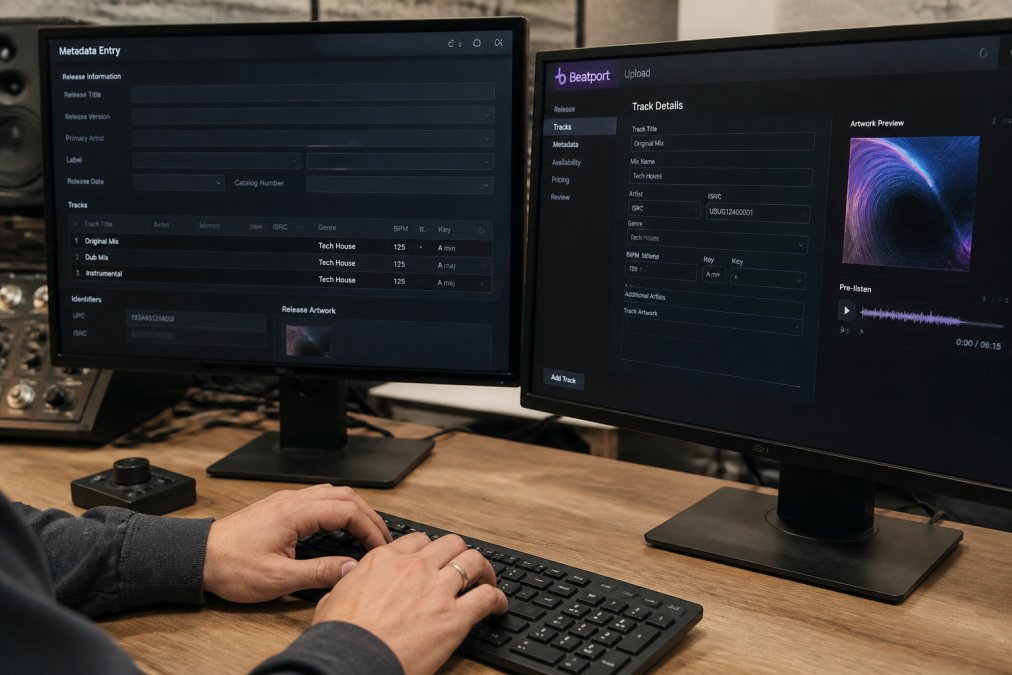
Close-up of hands typing on a keyboard with dual monitors showing metadata entry fields, ISRC codes, UPC numbers, release information, and Beatport upload interface with track details and artwork preview visible on screens in professional studio lighting
Genre selection is critical because it determines which algorithmic feeds your track appears in. Beatport categorizes house music into subgenres: House, Deep House, Tech House, and Progressive House. Choose the primary genre that best fits your track, then add up to three secondary genres.
Pricing strategy affects Beatport performance. Beatport allows labels to set retail prices between $1.49 and $2.49 per track ([beatport.com](https://www.beatport.com/subscriptions?srsltid=AfmBOortwEWy32sC35gfH6gtJNFargrL41oh3fo62EKrzgk4CIPy1hCY&ref=blog.nexatunes.com)). Lower prices generate higher sales velocity in the first week, boosting algorithmic ranking. Many labels use promotional pricing: launch at $1.49 for the first week, then increase to $1.99 after the initial spike.
Release timing matters because algorithmic feeds prioritize recency. Releases published on Friday or Saturday receive higher visibility in weekend browsing. Plan your release calendar around this pattern.
Audio quality requirements are strict. Beatport accepts WAV files at 44.1 kHz or 48 kHz sample rate, 24-bit depth minimum ([beatport.com](https://support.beatport.com/hc/en-us/articles/28823152450324-Enabling-Lossless-Streaming?ref=blog.nexatunes.com)). After submission, monitor your release on Beatport's artist dashboard and track sales velocity, chart position, and listener engagement.
## Music Sync Rights and Licensing Considerations
When you distribute music to Beatport and Traxsource, you're granting those platforms the right to sell and stream your track while retaining ownership of the underlying composition and master recording. Both platforms require that you own or control the rights to any music you distribute. If your track samples another artist's work, you must secure sample clearance before distribution. If your track features a vocal from another artist, you must have a written agreement granting distribution rights.
When someone purchases or streams your track on these platforms, they're buying a copy of the recording, not licensing it for specific use. The platform handles royalty payments to you and performing rights organizations. However, if your track is used in film, television, or advertising, traditional sync licensing applies separately.
For labels managing multiple artists, clear ownership documentation is essential. Every artist should provide written confirmation of ownership or distribution rights. Traxsource has specific requirements for exclusive releases: if you mark a release as exclusive, you cannot distribute the same track to other platforms for 30-90 days. This exclusivity can increase curator placement likelihood but reduces distribution reach during that period.
Register your compositions with performing rights organizations like ASCAP, BMI, or SESAC before distribution to ensure accurate royalty tracking when your track is broadcast or streamed.
## Royalty Payouts, Fees, and Revenue Share Comparison
Beatport and Traxsource take a percentage of revenue from each sale, typically 30-40%, with the remainder flowing to your distribution partner and then to you. NexaTunes provides monthly royalty payouts with detailed label-level reporting.
Beatport's royalty structure depends on sales velocity and customer type. Retail customers purchasing tracks generate higher per-unit revenue than streaming customers. Traxsource typically generates higher per-unit revenue than Beatport because the audience is more targeted and engaged. Demand detailed reporting from any distributor you work with.
## Which Platform Should Your Label Choose?
The best strategy for most labels is distributing to both Beatport and Traxsource with different release strategies optimized for each platform's strengths.
Choose Beatport as your primary platform if your label releases frequently, manages diverse electronic music genres, or wants to reach the broadest possible audience. Beatport's algorithmic approach rewards consistent release schedules.
Choose Traxsource as your strategic platform if your label specializes in house music subgenres and values editorial curation. Traxsource's editorial approach means your releases receive human evaluation. The audience is more targeted and engaged, typically generating higher conversion rates.
The optimal strategy combines both: release consistently on Beatport to build algorithmic momentum and reach a broad audience; release strategically on Traxsource to secure editorial placement and reach the core house music audience.
Distribution partner selection matters as much as platform selection. A partner with direct relationships on both platforms, [transparent reporting](https://blog.nexatunes.com/p/cf84dcce-71cb-43a1-8f2e-2172d9652a01/), and dedicated support will maximize your visibility and revenue. For labels prioritizing transparency and scalability, NexaTunes provides direct access to both Beatport and Traxsource with monthly royalty payouts and detailed label-level reporting. The unlimited sublabels and artists feature allows you to manage multiple projects from a single dashboard.
---
Choosing between Beatport and Traxsource isn't about picking one winner, it's about understanding how each platform serves different strategic goals. Beatport reaches millions of listeners and rewards consistent, optimized releases. Traxsource builds long-term visibility through editorial curation and reaches the most engaged house music audience. The labels that win on both platforms use a distribution partner that provides transparent reporting, maintains direct platform relationships, and supports both algorithmic and editorial strategies. Get started with NexaTunes and access both Beatport and Traxsource with monthly payouts, detailed artist-level reporting, and unlimited sublabel management to scale your label operation.
| Platform | Best For | Key Strength | Audience Type |
| ---------- | ---------------------------------------------- | ------------------------------- | -------------------------------- |
| Beatport | Diverse electronic labels, high release volume | Algorithmic discovery, scale | Broad electronic music listeners |
| Traxsource | House music specialists, curated releases | Editorial placement, engagement | Targeted house music buyers |
**Pro Tip** Metadata accuracy directly impacts Beatport algorithmic performance. Spend time getting genre, BPM, mood tags, and energy levels correct, incorrect metadata can bury a release in the algorithm from day one.
**Key Takeaway** Traxsource editorial placements generate sustained visibility over weeks, while Beatport chart performance peaks quickly then drops. Choose your release strategy based on whether you want explosive early momentum or long-term visibility.
## Frequently Asked Questions
### What are the primary differences between Beatport and Traxsource for electronic music distribution?
Beatport focuses on broad electronic music genres with stronger chart visibility and mainstream DJ reach, while Traxsource specializes in house, soulful house, and deep house with a curated, editorial-driven approach. Beatport's algorithm-driven store emphasizes chart positioning and algorithmic discovery, whereas Traxsource's editorial team hand-curates playlists and releases, giving soulful and deep house producers more direct visibility. For house music labels specifically, Traxsource often provides better conversion rates among core house music listeners, while Beatport offers access to a larger, more diverse electronic music audience.
### Which distributor is best for getting music onto Beatport and Traxsource simultaneously?
Distributors with direct partnerships and established relationships with both platforms handle metadata formatting, ISRC codes, and timing to ensure your releases meet each platform's standards. When selecting a distributor, verify they have active relationships with both platforms and understand the specific metadata requirements each one enforces for genre categorization and searchability.
### How important are chart positions and editorial playlists for long-term house music sales?
Chart positioning and editorial curation significantly impact both short-term visibility and long-term catalog management. High chart placements increase track visibility within store algorithms, leading to higher conversion rates among active DJs and producers. Editorial playlists on Traxsource, in particular, drive sustained listener engagement for house music because the curated approach attracts listeners specifically seeking that genre. However, chart impact is most effective when paired with consistent release strategy, quality metadata, and ongoing promotional efforts, charts alone do not guarantee sustainable revenue without a broader marketing reach strategy.
### Do I need music sync rights approval before distributing to Beatport and Traxsource?
Yes. Before uploading to either platform, you must own or have explicit permission for all musical compositions and sound recordings. This includes securing mechanical licenses for any compositions you did not write and ensuring all featured artists and sample clearances are documented. Beatport and Traxsource require accurate metadata identifying all rights holders, and distributing music without proper clearances can result in takedowns, account suspension, or legal claims. Your distributor should guide you through rights verification, but the label remains responsible for confirming ownership or licensing before submission.
---
**EXTERNAL SOURCES:**
For more on music distribution strategy and platform selection, consult ASCAP performing rights registration requirements, BMI music metadata standards, and International Standard Recording Code specifications.
[Get Started Today](https://nexatunes.com/?ref=blog.nexatunes.com)
**Editorial Transparency**: This article was created with the assistance of GrandRanker AI and reviewed, edited, fact-checked, and approved by the NexaTunes editorial team before publication.
If you’re looking for a reliable way to distribute your music to major platforms, NexaTunes offers direct distribution with transparent terms.
[Learn more ](https://nexatunes.com/?ref=blog.nexatunes.com)
### Artist Development vs Talent Management for Indie Labels
URL: https://blog.nexatunes.com/artist-development-vs-talent-management-indie-labels/
Last updated: 2026-08-28T13:00:55.000Z
## Table of Contents
- [Defining Artist Development vs Talent Management](#defining-artist-development-vs-talent-management)
- [Core Responsibilities of a Talent Manager](#core-responsibilities-of-a-talent-manager)
- [Artist Development Strategies for Indie Labels](#artist-development-strategies-for-indie-labels)
- [Artist Management Contract Templates and Agreements](#artist-management-contract-templates-and-agreements)
- [Independent Label Management Tools and Infrastructure](#independent-label-management-tools-and-infrastructure)
- [The Hybrid Model: When Both Functions Coexist](#the-hybrid-model-when-both-functions-coexist)
- [Making the Right Choice for Your Label](#making-the-right-choice-for-your-label)
*Last Updated: August 28, 2026*
## Defining Artist Development vs Talent Management
[Artist development](https://blog.nexatunes.com/p/20efc622-8dda-40ae-81bc-16967969f8c2/) and talent management are distinct functions that often get confused, especially in independent label operations where resources are tight and roles overlap. Understanding the difference is critical because they serve fundamentally different purposes in an artist's career.
**Artist development** is the process of cultivating an artist's creative output, brand identity, and market positioning over time. It encompasses production guidance, image consulting, strategic career planning, and long-term sustainability efforts. Think of it as the investment phase: developing the artist's sound, refining their visual aesthetic, building their fanbase, and creating the infrastructure for long-term success.
**Talent management**, by contrast, is the day-to-day business function of representing an artist's interests, negotiating deals, securing opportunities, and managing the logistics of their career. A talent manager handles contracts, booking, revenue streams, and professional relationships. They're the deal-maker and the advocate.
The confusion arises because both roles touch artist growth, but they operate at different levels. Artist development is strategic and creative; talent management is tactical and commercial. At NexaTunes, we've observed independent labels that struggled precisely because they conflated these functions, assigning one person to do both and wondering why neither got done well.
Here's where it gets interesting: many indie labels skip artist development entirely, jumping straight to management. They sign artists, book shows, and push releases without investing in the foundational work that makes an artist sustainable. This is the part most people get wrong. You can manage someone into short-term revenue. You develop someone into a long-term career.
**Pro Tip** The real difference isn't semantic, it's about timeline. Artist development is a 2-5 year investment. Talent management is ongoing deal-making. Confusing the two means either abandoning creative growth or neglecting business opportunities.
## Core Responsibilities of a Talent Manager
A talent manager's job is to represent the artist and handle the business side of their career ([grammy.com](https://go.grammy.com/music-careers/music-manager-how-to-be-one-how-to-find-one/?ref=blog.nexatunes.com)). This includes negotiating recording contracts, publishing deals, and sync licensing agreements; securing performance opportunities and tour bookings; managing the artist's public image and media relations; handling day-to-day communications with promoters, venues, and other industry professionals; and collecting payments and managing revenue streams.

Music manager and artist in professional discussion at a studio mixing console with contracts and strategy notes spread on desk, natural studio lighting
Managers typically work on commission, usually 15-20% of the artist's gross income, which aligns their incentives with the artist's earning potential. This commission structure means managers are motivated to maximize immediate revenue through deals, bookings, and licensing opportunities.
Key responsibilities include:
- **Contract negotiation:** Reviewing and negotiating recording contracts, publishing agreements, distribution deals, and licensing terms
- **Booking and touring:** Securing performance opportunities, negotiating venue terms, and coordinating tour logistics
- **Revenue management:** Tracking payments, managing royalty collection, and ensuring the artist receives what they're owed
- **Public relations:** Managing media relations, coordinating interviews, and protecting the artist's reputation
- **Deal-making:** Identifying and pursuing sync licensing, brand partnerships, and other commercial opportunities
- **Legal compliance:** Ensuring contracts are properly executed and the artist's rights are protected
A talent manager's success is measured in immediate outcomes: deals closed, revenue generated, opportunities secured. They're the professional advocate who ensures the artist isn't exploited and that opportunities align with the artist's commercial interests.
However, managers typically have limited involvement in the creative process. They don't usually guide production decisions, shape brand identity, or plan long-term career trajectory beyond what generates immediate income. That's where artist development enters the picture, but many indie labels treat it as optional.
**Watch Out** A common mistake: hiring a manager before the artist has a developed sound, brand, or fanbase. Managers excel at monetizing what exists. They're less effective at building from scratch. Without foundational artist development, a manager's job becomes harder and less lucrative.
## Artist Development Strategies for Indie Labels
Artist development for indie labels is the strategic investment in building an artist's creative foundation, market positioning, and long-term sustainability. This includes production guidance and mentorship, brand identity development and visual aesthetic refinement, audience acquisition and fan engagement strategy, social media presence and digital footprint building, and long-term career planning and market positioning.

Independent label team collaborating in creative workspace reviewing production equipment and artist portfolio materials with natural lighting
Unlike talent management, artist development is rarely commission-based. Instead, it's typically funded by the label as part of their investment in the artist's future. The label absorbs the cost upfront with the expectation that a well-developed artist generates higher revenue long-term.
Core development strategies include:
- **Production mentorship:** Pairing emerging artists with experienced producers to refine their sound and production quality
- **Brand strategy:** Developing a cohesive visual identity, aesthetic, and messaging that differentiates the artist in the market
- **Content strategy:** Building a content calendar for social media, music videos, behind-the-scenes material, and fan engagement
- **Audience acquisition:** Implementing targeted marketing campaigns to build initial fanbase and establish market positioning
- **Networking and industry introductions:** Connecting artists with collaborators, promoters, and industry gatekeepers
- **Tour support and logistics:** Funding and coordinating early tours to build live presence and fanbase
Artist development requires patience and upfront investment ([nab.org](https://www.nab.org/documents/newsRoom/pdfs/FASTROAD%5FEPG.pdf?ref=blog.nexatunes.com)). An indie label might spend months or years developing an artist before seeing significant revenue. This is the opposite of management, which monetizes existing assets.
The tension here is real: indie labels with limited budgets often skip development entirely. They sign artists who are already "ready" and focus purely on management and distribution. This works short-term but creates a ceiling on growth. Artists without foundational development rarely break through to sustainable careers.
**Key Takeaway** Artist development is about building the artist's infrastructure for long-term success. It's where indie labels create competitive advantage over artists trying to DIY everything.
## Artist Management Contract Templates and Agreements
Talent management contracts formalize the relationship between manager and artist, establishing commission structure, term length, scope of representation, and exit clauses. These contracts are essential because they clarify expectations and protect both parties. [leadership and management training](https://jimcarlough.com/blog/leadership-coaching-vs-management-training?ref=blog.nexatunes.com).
Standard management contracts typically include:
- **Commission rate:** Usually 15-20% of gross income from music-related activities
- **Term:** Often 2-3 years, with renewal or termination options
- **Scope of representation:** Which revenue streams the manager represents (recordings, publishing, live performance, sync, etc.)
- **Expenses:** Whether the manager recoups expenses from the artist's income
- **Termination clause:** How either party can exit the agreement and what happens to ongoing deals
- **Recoupment:** Whether the manager can recoup development costs or advances from the artist's future earnings
Artist development agreements, by contrast, are less standardized because they're typically internal label documents rather than formal contracts. However, they should clarify:
- **Investment amount and timeline:** How much the label is investing and over what period
- **Creative control:** Who makes final decisions on production, branding, and marketing
- **Revenue sharing:** How revenue is split between label and artist once the development phase concludes
- **Exit terms:** What happens if the artist or label wants to end the relationship
The distinction matters legally. A management contract is a commercial agreement between two independent parties. An artist development agreement is often an internal label document defining the artist's status as a developing artist versus a signed artist with full contractual rights.
For indie labels using platforms like NexaTunes, having clear contractual documentation becomes even more critical. With unlimited sublabels and multiple artists in development, detailed agreements ensure that royalty splits, revenue tracking, and artist status are correctly reflected in your label-level reporting.
## Independent Label Management Tools and Infrastructure
Independent labels need infrastructure to manage multiple artists, track revenue, coordinate releases, and maintain detailed records. This is where the operational side of independent label management becomes critical.
[Get Started Today →](https://nexatunes.com/?ref=blog.nexatunes.com)
Essential tools and systems include:
- **Distribution platforms:** Music distribution services that get releases to streaming platforms, handle royalty collection, and provide reporting. These are foundational, without them, you can't monetize your catalog.
- **Project management software:** Tools to coordinate releases, track deadlines, manage artist communications, and organize workflows across multiple team members and artists
- **Financial tracking and royalty reporting:** Systems that track revenue by artist, by release, by platform, and by territory. This is non-negotiable for understanding your label's financial health.
- **[Artist management](https://blog.nexatunes.com/p/7f02140e-cd6c-4f13-9c21-3a98ad66f0d0/) systems:** Centralized platforms where you store artist contracts, communications, performance history, and career milestones
- **Analytics and audience tracking:** Tools that measure fan engagement, social media growth, streaming performance, and market positioning for each artist
- **Content management:** Systems for organizing production files, artwork, metadata, and promotional materials
The infrastructure you choose directly impacts your ability to scale. A label managing three artists can operate with spreadsheets and email. A label managing 30 artists across multiple genres needs proper systems.
This is where platforms like NexaTunes differentiate themselves. Beyond distribution, NexaTunes provides detailed label-level royalty reports and supports unlimited sublabels, which means you can structure your label operation however you want, separate sublabels for different genres, different artists, or different revenue models, while maintaining unified financial reporting. This infrastructure matters because it lets you focus on artist development and management instead of chasing spreadsheets.
**Best For** Independent labels that need unified financial visibility and scalable artist management infrastructure.
## The Hybrid Model: When Both Functions Coexist
The most effective indie label operations use a hybrid model where artist development and talent management work together, but remain distinct functions. This requires clear role definition and communication.
In a hybrid model:
- **Artist development team** focuses on creative mentorship, brand building, content strategy, and long-term career planning. They're not making deals, they're building the foundation for deals.
- **Talent management function** (often the label owner or a dedicated manager) handles contracts, booking, revenue collection, and deal-making. They use the development work to maximize commercial opportunities.
- **Shared infrastructure** ensures both functions have visibility into artist progress, revenue, and market positioning. This is where platforms like NexaTunes become essential, unified reporting means the development team and management team are working from the same data.
The hybrid model works because it prevents the common failure modes: pure development without commercialization, or pure management without foundational investment. Instead, you build artists systematically and monetize them strategically.
Contractually, this often means:
- Artist signs a development agreement with the label (defining the development phase, investment, and terms)
- Once developed, the artist either signs a management agreement with a dedicated manager or the label transitions to a management role
- Revenue is tracked separately for development costs, management fees, and artist royalties
This structure protects both label and artist because it clarifies when the development phase ends and the commercial phase begins. It also allows artists to eventually move to external management while maintaining the label relationship.
## Making the Right Choice for Your Label
Choosing between artist development, talent management, or both depends on your label's stage, resources, and strategy.
**Choose pure artist development if:** You're building a roster of emerging artists from scratch, you have limited immediate revenue but can invest upfront capital, and your goal is to develop artists to the point where they're attractive to external managers or larger labels. This is a long-term play.
**Choose pure talent management if:** You're signing artists who are already developed (strong sound, fanbase, and brand), you want to maximize immediate revenue through deals and bookings, and you don't have the resources or expertise for creative development. This is a short-term revenue model.
**Choose the hybrid model if:** You want sustainable label growth, you're managing a diverse roster at different career stages, and you can afford to invest in both development and management infrastructure. This is the most complex but most scalable approach.
The reality is that most successful indie labels eventually move toward the hybrid model. Pure development is too slow without revenue. Pure management hits a ceiling because you're only monetizing what already exists. The hybrid model lets you build new artists while generating immediate revenue from developed ones.
Your choice also depends on your platform. If you're using a distribution service that only handles uploads and royalty collection, managing the hybrid model is harder because you lack unified reporting. If you're using a platform like NexaTunes that provides detailed label-level reporting across unlimited sublabels, you can structure your label however you want and maintain clear financial visibility.
The key is clarity: define which function each team member or department owns, establish clear contracts that reflect those roles, and use infrastructure that gives you visibility into both development progress and commercial performance.
---
Building a sustainable indie label requires understanding that artist development and talent management serve different purposes. Artist development builds the foundation; talent management monetizes it. Most indie labels that fail do so because they skip one or the other. The most successful ones do both strategically.
At NexaTunes, we've built our platform specifically for indie labels managing this complexity. With detailed label-level reporting across unlimited sublabels, you get the financial visibility to track both development investments and management revenue. Monthly royalty payouts and transparent reporting mean you're never guessing whether your development strategy is actually working. Direct access to Beatport and Traxsource ensures your developed artists reach the right audience. Get started with NexaTunes and build a label that scales.
## Frequently Asked Questions
### Q: What is the key difference between artist development and talent management?
A: Artist development focuses on building an artist's creative skills, sound, and catalog through production support, mentorship, and strategic creative coaching. Talent management handles the business side: contracts, career planning, booking, and revenue streams. A label typically owns the artist development function, while a manager works as an independent representative. Both roles support the artist's long-term sustainability, but they operate in different domains.
### Q: Should an indie label handle artist development in-house or outsource it?
A: In-house development gives you direct control over the artist's creative direction and brand identity, which is critical for building a cohesive label sound. However, it requires dedicated staff and budget. Many indie labels partner with external producers, A&R consultants, or image consultants for specific expertise while keeping strategic planning internal. The hybrid approach, combining in-house mentorship with outsourced specialized services, is increasingly common and cost-effective.
### Q: What should an artist management contract template include?
A: A solid contract specifies the manager's commission structure (typically 15-20%), the scope of services, contractual obligations for both parties, term length, and termination clauses. It should cover financial accounting, reporting frequency, and how recoupment works if the manager invests in tour support or marketing. Include provisions for what happens if either party wants to exit, and clarify which revenue streams the manager represents (recordings, publishing, live performance, merchandise). Professional templates are essential to protect both the artist and manager.
### Q: Is artist development still relevant for independent labels in 2026?
A: Yes, but it has evolved. Traditional record label development, long-term investment in nurturing talent, has shifted toward data-driven approaches. Modern indie labels use analytics to identify emerging artists, focus on digital footprint and social media presence, and leverage independent label management tools for audience acquisition. The core concept of mentorship and creative coaching remains valuable, but labels now combine it with strategic planning, content strategy, and KPIs for success rather than relying solely on intuition.
[Get Started Today](https://nexatunes.com/?ref=blog.nexatunes.com)
**Editorial Transparency**: This article was created with the assistance of GrandRanker AI and reviewed, edited, fact-checked, and approved by the NexaTunes editorial team before publication.
If you’re looking for a reliable way to distribute your music to major platforms, NexaTunes offers direct distribution with transparent terms.
[Learn more ](https://nexatunes.com/?ref=blog.nexatunes.com)
### Is Beatport Distribution Worth It for Electronic Labels
URL: https://blog.nexatunes.com/is-beatport-distribution-worth-it-for-electronic-labels/
Last updated: 2026-08-27T13:00:38.000Z
## Table of Contents
- [Is Beatport Distribution Worth It for Electronic Labels](#is-beatport-distribution-worth-it-for-electronic-labels)
- [Understanding Beatport's Role in Electronic Music Distribution](#understanding-beatports-role-in-electronic-music-distribution)
- [Best Music Distribution for Electronic Labels: Platform Comparison](#best-music-distribution-for-electronic-labels-platform-comparison)
- [Specialist Electronic Distributors vs. General Aggregators](#specialist-electronic-distributors-vs-general-aggregators)
- [Beatport Hype Program Requirements and Reality Check](#beatport-hype-program-requirements-and-reality-check)
- [Music Distribution Royalty Transparency: What You Actually Earn](#music-distribution-royalty-transparency-what-you-actually-earn)
- [Financial ROI: When Beatport Distribution Makes Sense](#financial-roi-when-beatport-distribution-makes-sense)
- [Common Mistakes Labels Make with Beatport Distribution](#common-mistakes-labels-make-with-beatport-distribution)
- [Conclusion: Making Your Beatport Distribution Decision](#conclusion-making-your-beatport-distribution-decision)
*Last Updated: August 27, 2026*
## Is Beatport Distribution Worth It for Electronic Labels
Whether Beatport distribution is worth it depends on your label's size, release frequency, and target audience. [For electronic](https://blog.nexatunes.com/p/02bebaf2-dcdb-4c07-97a7-43a7321aee18/) music, Beatport access matters more than most genres, the platform controls discovery for DJs and producers, your core audience. But access alone isn't enough. You need the right distribution partner, transparent royalty reporting, and realistic expectations about what Beatport can deliver.
This guide breaks down the real economics of Beatport distribution, compares your options, and shows when the investment makes sense. We've analyzed the platform's role in the electronic music ecosystem, reviewed specialist distributors versus general aggregators, and calculated actual financial returns. By the end, you'll know whether Beatport distribution fits your label's strategy.
## Understanding Beatport's Role in Electronic Music Distribution
Beatport is the primary digital storefront for DJs and electronic music producers. While Spotify and Apple Music serve consumers, Beatport serves professionals: DJs crate-digging for new releases, producers seeking samples and inspiration, and labels building rosters.
Beatport's curation model creates gatekeeping. Editorial teams and algorithms determine visibility. A release can be technically available but invisible without playlist placement or algorithmic promotion. This is where many independent labels struggle, they gain access through a distributor but receive no strategic support or editorial consideration.
Beatport's Hype Program offers direct support, playlist consideration, and promotional tools to selected labels and artists. But acceptance is competitive, prioritizing established labels with proven track records and consistent release schedules. New labels face long odds.
The real question isn't whether Beatport distribution is worth it abstractly. It's whether your distribution partner has the relationships, tools, and strategy to make Beatport work for your catalog. Generic distribution rarely delivers results. Specialist distribution with Beatport expertise changes the equation entirely.
## Best Music Distribution for Electronic Labels: Platform Comparison
Electronic labels need distribution partners built specifically for your genre. A general aggregator like DistroKid or RouteNote treats electronic music the same as indie rock or pop. Specialist distributors understand DJ promotion, genre-specific curation, and the unique economics of electronic music distribution.
### Specialist Electronic Distributors vs. General Aggregators
General aggregators prioritize scale and simplicity. They distribute to 100+ platforms with minimal setup, charge low fees, and handle payment processing. For occasional releases, this works. For a label managing multiple artists and sublabels, it falls short.
Specialist electronic distributors focus exclusively on dance and electronic music. They maintain direct relationships with Beatport and Traxsource, understand genre nuances and metadata standards, and know [how to](https://blog.nexatunes.com/p/8aa63219-e80a-4422-bc3c-a9b01c29f69c/) position tracks for algorithmic discovery. The trade-off is visibility and support. General aggregators are anonymous; specialist distributors often use revenue-share models, creating alignment: their success depends on yours.
NexaTunes offers transparent, flat-rate distribution with monthly royalty payouts and detailed label-level reporting. You maintain full visibility into where your music is selling and how much you're earning by platform. This eliminates the conflict of interest in revenue-share models: NexaTunes profits from your success, but not by taking a cut of your royalties.
| Distribution Model | Best For | Pricing Structure | Beatport Support |
| ----------------------- | ------------------------------------ | ------------------------- | --------------------- |
| General Aggregators | Solo artists, occasional releases | Low flat fee | Generic upload |
| Specialist Distributors | Established electronic labels | Revenue-share | Direct relationships |
| Boutique Services | Labels seeking personalized support | Revenue-share or hybrid | Personalized strategy |
| Label Infrastructure | Growing labels with multiple artists | Flat-rate or subscription | Transparent reporting |
| DJ-Focused Platforms | Labels prioritizing promo tools | Revenue-share or free | Integrated promotion |
## Beatport Hype Program Requirements and Reality Check
The Beatport Hype Program provides editorial support and algorithmic promotion to selected labels. Acceptance means your releases receive curation consideration, potential playlist placement, and marketing support.
Requirements are strict but not publicly detailed. Beatport considers label history, release consistency, production quality, and artist credibility. New labels face an uphill battle. The program accepts established labels with proven sales history, regular release schedules, and tracks that have already gained traction.
A common mistake is assuming Hype acceptance guarantees sales. It doesn't. Hype provides visibility and curation consideration, not guaranteed placement. A Hype-accepted release might appear in algorithmic recommendations or editorial playlists, but placement depends on whether Beatport's algorithms and editors believe the track will resonate with DJs.
Most new labels don't qualify immediately. Building credibility takes time: consistent releases over 6-12 months, growing follower counts, and organic sales momentum. Only after demonstrating viability does Hype acceptance become realistic.
## Music Distribution Royalty Transparency: What You Actually Earn
Royalty opacity is endemic in [music distribution](https://blog.nexatunes.com/p/4ffd527f-2dbc-41f5-8ec7-c63c67f6d603/). Most platforms show total earnings but hide breakdowns by store, track, and artist. You know monthly earnings but not where they came from or which releases generated the most revenue.
This matters enormously for labels. You need to know which artists perform best, which releases justify production investment, and which stores drive revenue. Without this data, you can't optimize your release strategy.

Independent electronic music label manager reviewing detailed royalty breakdowns and streaming analytics on a laptop screen in a home studio with studio monitors and mixing equipment visible
Beatport's royalty structure is straightforward: the platform takes a percentage, and the rest goes to your distributor. Most sources estimate 30-50% platform take, meaning distributors receive 50-70% of sale price ([peer-reviewed research](https://pmc.ncbi.nlm.nih.gov/articles/PMC8379453/?ref=blog.nexatunes.com)). Your distributor then takes their cut before paying you.
A $2.99 Beatport download generates roughly $1.50-$2.00 for the distributor. If your distributor takes 20-30%, you're left with $1.05-$1.60 per sale. Compare this to Spotify, where payment per stream averages $0.003-$0.005 ([peer-reviewed research](https://pmc.ncbi.nlm.nih.gov/articles/PMC8379453/?ref=blog.nexatunes.com)). A Beatport sale generates 200-500x more revenue than a stream, which is why electronic labels prioritize DJ store placement.
NexaTunes prioritizes transparency. Monthly royalty payouts include detailed breakdowns by platform, artist, and release. You see exactly how much each Beatport sale contributed to your earnings, which tracks are selling, and which artists are generating revenue. This level of visibility is rare among distributors and essential for label growth.
## Financial ROI: When Beatport Distribution Makes Sense
The financial case for Beatport distribution depends on three factors: your label's release frequency, your target audience's size, and your distribution partner's cost structure.
If you release fewer than four tracks per year, Beatport distribution costs more than it returns. The platform's value comes from consistent visibility and catalog depth. If your audience is primarily casual listeners on Spotify and TikTok, Beatport doesn't move the needle. The platform serves DJs and producers, not the general public.

Independent electronic music label founder working at a desk surrounded by music production equipment, headphones, laptop displaying analytics, and vinyl records in a creative studio space with warm lighting
A revenue-share distributor takes 15-30% of earnings ([the NIH](https://www.ncbi.nlm.nih.gov/books/NBK338147/?ref=blog.nexatunes.com)). If Beatport generates $500/month, a 20% cut means you lose $100 monthly, $1,200 annually. A flat-rate distributor changes the equation: does Beatport generate enough revenue to cover the fee?
Beatport distribution makes financial sense when:
- You release at least 4 tracks per year with consistent scheduling
- Your audience includes DJs or electronic music producers
- Your distribution partner provides transparent reporting and strategic support
- Your monthly Beatport earnings exceed your distribution costs
- You plan to grow your catalog and build long-term label presence
If none of these apply, Beatport distribution is overhead without return.
## Common Mistakes Labels Make with Beatport Distribution
The first mistake is treating Beatport access as passive. Upload your music, collect royalties, move on. This guarantees invisibility. Beatport's algorithm rewards engagement: pre-saves, playlist adds, follower growth, and direct DJ discovery.
The second mistake is poor metadata. Accurate genre tags, BPM information, key signatures, and track descriptions are essential. Incorrect metadata means algorithmic misplacement. A techno track tagged as "house" won't appear in techno playlists.
The third mistake is ignoring DJ promotion outside Beatport. Beatport's algorithm favors tracks with external momentum. If your release gains traction through promo pools and direct outreach before hitting Beatport, the algorithm amplifies it. If it launches cold, the algorithm ignores it.
The fourth mistake is expecting immediate results. Beatport catalog visibility builds over months and years, not weeks. Consistent releases with strategic promotion compound over time.
The fifth mistake is choosing the wrong distribution partner. A general aggregator treats your release identically to thousands of others. A specialist distributor with Beatport relationships and DJ promotion tools treats your release as part of a strategic catalog. Choosing based on price alone is a false economy.
## Conclusion: Making Your Beatport Distribution Decision
Is Beatport distribution worth it for electronic labels? Yes, if your label meets specific criteria and you choose the right distribution partner.
Beatport access is essential for electronic music labels building long-term presence. The platform drives sales for DJs and producers, commands higher per-track payments than streaming, and influences algorithmic discovery across other platforms. Without Beatport presence, your label remains invisible to your core audience.
But Beatport access alone isn't enough. You need transparent [royalty reporting](https://blog.nexatunes.com/p/e5c919a6-e6d7-446e-b255-22dbf3116d84/) to understand your economics. You need strategic support to compete in a crowded marketplace. You need a distribution partner aligned with your success.
NexaTunes delivers this combination. With monthly royalty payouts, detailed label-level reporting, unlimited sublabels and artists, and direct access to Beatport and Traxsource, you maintain full control of your catalog and complete visibility into your earnings. No hidden fees. No percentage cuts. No guessing about where your revenue comes from.
Start with NexaTunes and gain the transparent distribution infrastructure that growing electronic labels need to scale sustainably.
\=== FAQ ANSWERS (audit these too, same rules) ===
\[1\] Q: Which distributor is best for getting music on Beatport? A: Specialist distributors often have direct relationships with Beatport and deep expertise in electronic music distribution. They understand Beatport's curation standards and metadata requirements better than general aggregators. For labels prioritizing Beatport placement specifically, these specialists often deliver stronger results than broad-platform distributors. Your choice depends on whether you need additional services like DJ promo pools, label management tools, or publishing administration.
\[2\] Q: What are the hidden costs of Beatport distribution for small labels? A: Most specialist Beatport distributors use revenue-share models rather than upfront fees, meaning they take a percentage of your earnings. While this sounds transparent, it compounds over time, a 15-20% cut reduces your per-stream income significantly. Some platforms also charge for premium features like enhanced analytics, promo pool access, or expedited review. Always clarify whether your distributor charges per-release fees, annual membership costs, or percentage cuts on royalties before committing.
\[3\] Q: Does Beatport distribution work for solo electronic music producers or only for labels? A: Most Beatport distributors require you to operate as a label entity or have formal label status. Solo producers can distribute through general aggregators that feed Beatport, but you'll miss the specialized support and curation advantages that label-focused distributors provide. If you're a solo artist planning to grow into a label with multiple artists or sublabels, choosing a platform built for label scaling from the start, like one offering unlimited sublabels and artist management, positions you better for that transition.
\[4\] Q: How does music distribution royalty transparency actually work on Beatport? A: Beatport pays distributors, not labels directly. Your distributor then passes royalties to you minus their cut. True transparency means your dashboard shows per-platform, per-release, and per-artist breakdowns. Look for platforms offering daily or weekly sales reporting rather than monthly aggregates, and verify they show Beatport's per-stream rates separately. Labels managing multiple artists need distributor-level reporting that tracks earnings by sublabel and artist, not just total label revenue.
## Frequently Asked Questions
### Which distributor is best for getting music on Beatport?
Specialist distributors often have direct relationships with Beatport and deep expertise in electronic music distribution. They understand Beatport's curation standards and metadata requirements better than general aggregators. For labels prioritizing Beatport placement specifically, these specialists often deliver stronger results than broad-platform distributors. Your choice depends on whether you need additional services like DJ promo pools, label management tools, or publishing administration.
### What are the hidden costs of Beatport distribution for small labels?
Most specialist Beatport distributors use revenue-share models rather than upfront fees, meaning they take a percentage of your earnings. While this sounds transparent, it compounds over time, a 15-20% cut reduces your per-stream income significantly. Some platforms also charge for premium features like enhanced analytics, promo pool access, or expedited review. Always clarify whether your distributor charges per-release fees, annual membership costs, or percentage cuts on royalties before committing.
### Does Beatport distribution work for solo electronic music producers or only for labels?
Most Beatport distributors require you to operate as a label entity or have formal label status. Solo producers can distribute through general aggregators that feed Beatport, but you'll miss the specialized support and curation advantages that label-focused distributors provide. If you're a solo artist planning to grow into a label with multiple artists or sublabels, choosing a platform built for label scaling from the start, like one offering unlimited sublabels and artist management, positions you better for that transition.
### How does music distribution royalty transparency actually work on Beatport?
Beatport pays distributors, not labels directly. Your distributor then passes royalties to you minus their cut. True transparency means your dashboard shows per-platform, per-release, and per-artist breakdowns. Look for platforms offering daily or weekly sales reporting rather than monthly aggregates, and verify they show Beatport's per-stream rates separately. Labels managing multiple artists need distributor-level reporting that tracks earnings by sublabel and artist, not just total label revenue.
---
**Ready to build your label on a transparent foundation?** Get started with NexaTunes today and access Beatport, Traxsource, and 100+ platforms with detailed royalty reporting that shows exactly where your music is selling and how much you're earning.
[Get Started Today](https://nexatunes.com/?ref=blog.nexatunes.com)
**Editorial Transparency**: This article was created with the assistance of GrandRanker AI and reviewed, edited, fact-checked, and approved by the NexaTunes editorial team before publication.
If you’re looking for a reliable way to distribute your music to major platforms, NexaTunes offers direct distribution with transparent terms.
[Learn more ](https://nexatunes.com/?ref=blog.nexatunes.com)
### 7 Tips for Signing Your First Music Artist Contract
URL: https://blog.nexatunes.com/7-tips-signing-first-music-artist-contract/
Last updated: 2026-08-26T13:00:07.000Z
## Table of Contents
- [1\. Understand Royalty Rates and Recoupment Before You Sign](#1-understand-royalty-rates-and-recoupment-before-you-sign)
- [2\. Review Standard Record Label Royalty Splits and Ownership Rights](#2-review-standard-record-label-royalty-splits-and-ownership-rights)
- [Master Recordings vs. Publishing Rights](#master-recordings-vs-publishing-rights)
- [360 Deals and Cross-Collateralization Risks](#360-deals-and-cross-collateralization-risks)
- [3\. Hire an Entertainment Attorney for Record Deals](#3-hire-an-entertainment-attorney-for-record-deals)
- [4\. Negotiate Term Length and Termination Rights](#4-negotiate-term-length-and-termination-rights)
- [5\. Protect Your Creative Control and Artistic Freedom](#5-protect-your-creative-control-and-artistic-freedom)
- [6\. Use a Music Artist Contract Template to Compare Terms](#6-use-a-music-artist-contract-template-to-compare-terms)
- [7\. Identify Red Flags and Opt-Out Clauses](#7-identify-red-flags-and-opt-out-clauses)
- [Conclusion](#conclusion)
*Last Updated: August 26, 2026*
## 1\. Understand Royalty Rates and Recoupment Before You Sign
A music artist contract's core financial mechanic is recoupment: the label deducts costs from your royalties before you receive payment. When you sign, the label advances money for studio time, marketing, and distribution, a loan against future royalties. Until recouped through sales and streams, your royalty rate sits in a theoretical account.
Royalty rates vary dramatically by deal structure. Independent labels typically offer 50-70% of net profits; major labels offer 15-25% of wholesale price. "Net" means the label deducts costs first; "gross" means they don't. Always clarify which applies.
Recoupment compounds across revenue streams. Some labels cross-collateralize, pooling revenue from all releases to recoup a single advance. If your first single underperforms, your second release's income covers the first advance's shortfall, trapping you for years.
Before signing, demand a detailed breakdown in writing: advance amount, recoupment threshold, exact royalty percentage, and whether cross-collateralization applies. If the label won't provide specifics, that's your first red flag.
**Pro Tip** Ask your legal counsel \[to calculate\](/p/eb77ab23-2e7b-4680-bfda-31345d841893/) your break-even point. If you're offered a $50,000 advance at 20% of gross with cross-collateralization, what sales volume do you need to see royalty payments? The math often reveals whether the deal makes financial sense.
## 2\. Review Standard Record Label Royalty Splits and Ownership Rights
[Record labels](https://blog.nexatunes.com/p/8a66760c-7e75-4000-91af-e3e7762849ee/) structure deals differently depending on whether they're taking master recordings, publishing rights, or both. Understanding these two fundamental ownership categories is essential.
### Master Recordings vs. Publishing Rights
Master recordings are the actual audio files, the specific performance and production. Publishing rights are the underlying compositions: melody, lyrics, and chord progressions. These are separable.
When you sign a standard recording agreement, the label typically owns the master recordings for the contract term, controlling licensing, distribution, and use. You usually retain publishing rights, collecting performance royalties when your song plays on radio or streaming services through performing rights organizations like ASCAP or BMI ([ascap.com](https://www.ascap.com/help?ref=blog.nexatunes.com)). However, some labels demand both.
Owning your master recordings is increasingly valuable in the streaming era. Platforms like Beatport and Traxsource prioritize direct relationships with rights holders. If a label owns your masters, you lose access to these high-value channels.
Before signing, clarify exactly what rights transfer to the label. A music artist contract should specify: "Label owns master recordings for \[specific term\]. Artist retains all publishing and composition rights." If it says "all rights," that's a dealbreaker unless you're getting extraordinary terms.
### 360 Deals and Cross-Collateralization Risks
A 360 deal means the label takes a cut of everything: recordings, publishing, live performances, merchandise, and sometimes endorsements. In exchange, they typically offer higher advances and more marketing support.
The risk is that one weak area tanks your entire deal. If your album underperforms but touring revenue is strong, the label recoups their advance from your tour earnings. Cross-collateralization amplifies this: your second album's revenue can recoup the first album's advance, locking you into a cycle of perpetual debt.
A 360 deal with a 50% net split and a three-year recoupment window might make sense. A 360 deal with 20% of gross and unlimited recoupment is predatory. The deal structure matters far more than the concept.
When reviewing a 360 music artist contract, ask: Which revenue streams are included? What's the recoupment timeline? Is cross-collateralization allowed? Can you recoup separately by release? These specifics determine whether you're building a partnership or signing away your future.
**Watch Out** 360 deals without clear recoupment timelines can trap you indefinitely. Always demand a specific recoupment deadline, typically 3-5 years from release.
## 3\. Hire an Entertainment Attorney for Record Deals
This is non-negotiable. An entertainment attorney specializing in music industry contracts isn't a luxury, it's insurance against catastrophic mistakes. Labels have legal teams reviewing every contract; your only counterweight is a qualified attorney.
Even if you think you understand the contract, an attorney will spot clauses you missed: reversion rights you lost, territory restrictions limiting your growth, or termination conditions that lock you in indefinitely.
When hiring an entertainment attorney, look for someone with specific experience in record deals, not general contract law. They should understand recoupment mechanics, royalty accounting, publishing rights, and label-specific language. Ask about their experience with independent versus major labels; the dynamics differ significantly.
Your attorney should help you understand what to negotiate: advance amount, royalty rate, recoupment period, creative control provisions, and reversion clauses. Many artists don't realize almost every term is negotiable.

Entertainment attorney and independent music artist reviewing a detailed record contract together at a wooden desk, with printed pages, coffee cups, and a laptop visible in natural office lighting
The label's legal team expects you to have representation. Having an attorney signals you're a serious professional and will push back on unreasonable terms. This alone often leads to better initial offers.
**Pro Tip** Before your attorney starts, provide them with a list of your priorities. Do you want to retain master recording ownership? Is creative control essential? How long are you willing to be locked into an exclusive deal? This focuses negotiation on what actually matters to you.
## 4\. Negotiate Term Length and Termination Rights
The contract term, how long you're locked into the deal, is one of the most consequential provisions in a music artist contract. A five-year exclusive deal with a label that doesn't promote your music is a five-year sentence.
Standard terms range from two to seven years ([grammy.com](https://www.grammy.com/news/guide-to-bay-area-hip-hop-northern-california-major-releases-artists-labels-history-playlist/?ref=blog.nexatunes.com)). Shorter terms are better because they preserve your optionality. After two years, if the label isn't delivering, you can walk away. A seven-year term means you're committed regardless of performance.
Term length should correlate with advance size and support level. A substantial advance and dedicated marketing might justify a longer term. Minimal support and a small advance should demand a shorter term or higher royalty rates. [protecting business interests](https://fornarolegal.com/how-to-protect-business-interests-in-contracts/?ref=blog.nexatunes.com).
Many contracts include option clauses: the label can drop you after the first album, but you're locked in for subsequent albums if they continue. Negotiate for mutual options, if the label wants to continue, you should renegotiate terms for the next album rather than auto-renewing at the same rate.
Termination rights determine how you exit the deal. Some contracts allow termination only if the label breaches specific obligations. Others allow termination if sales fall below a threshold. The best include reversion clauses: if the label stops actively promoting or selling your music, rights revert to you.
Ask your attorney to identify termination provisions and what triggers them. A contract stating "termination is permitted if net sales fall below 5,000 units in a calendar year" is specific and measurable. Vague language like "if the label deems the project commercially unsuccessful" offers no protection.
In the streaming era, traditional sales thresholds are obsolete. Modern music artist contracts should define success by streams or revenue, not unit sales. If the label insists on outdated metrics, they're not negotiating in good faith.
## 5\. Protect Your Creative Control and Artistic Freedom
Creative control is often the most undervalued provision in a music artist contract. Artists focus on money and miss clauses giving the label veto power over your art.
Some labels demand approval rights over your music before release, rejecting songs or demanding remixes. Others restrict your ability to work with specific producers or collaborators. Some even claim approval rights over your social media content or public statements.
The music artist contract should clearly define what creative control you retain. Ideally: "Artist retains sole creative control over composition, arrangement, and production of all recordings. Label has the right to provide feedback and suggestions, but Artist has final approval over all creative decisions."
Compromise language can work too: "Label and Artist will collaborate on creative decisions. In the event of disagreement, Artist's preference prevails unless the Label reasonably believes the recording is commercially unmarketable."
[Get Started Today →](https://nexatunes.com/?ref=blog.nexatunes.com)
Be specific about what you won't compromise on. If working with a particular producer is essential, get that in writing. If you need approval over remixes or alternate versions, specify that. If you want to retain the right to release music under a different name, negotiate that explicitly.
Publishing rights also affect creative control. If the label owns your publishing, they control how your songs get licensed for film, television, and advertising. Retaining publishing rights preserves your creative autonomy.
**Key Takeaway** The label's creative input can improve your music or water it down. The key is having final say. A music artist contract preserving your creative control lets you benefit from the label's experience without surrendering your artistic vision.
## 6\. Use a Music Artist Contract Template to Compare Terms
Templates give you a baseline for reasonable terms and help you spot unusual or predatory language in the label's offer.
When comparing the label's contract to a template, look for these deviations:
**Advance amount**: Is it reasonable for your genre and audience size? An advance amount depends on the artist's stage and potential.
**Royalty rate**: Does it align with the label's size and support level? Independent labels typically offer 50-70% of net; majors offer 15-25% of wholesale.
**Recoupment period**: Is there a deadline, or can they recoup indefinitely? A three-year window is reasonable; unlimited recoupment is exploitative.
**Territory**: Are you exclusive worldwide, or can you retain certain markets?
**Rights reversion**: Do your rights come back if the label stops selling your music, or does the label hold them forever?
**Termination conditions**: Can you exit the deal, or are you locked in regardless?
**Publishing ownership**: Who owns your compositions? Ideally you, but at minimum you should retain a percentage.
| Contract Element | Reasonable Range | Red Flag |
| ----------------- | -------------------------------------------- | ------------------------------------- |
| Advance | Depends on artist stage | $500 or less; no advance specified |
| Royalty Rate | 50-70% net (indie), 15-25% wholesale (major) | Below 20% net; undefined percentage |
| Recoupment Period | 3-5 years | Unlimited; no end date specified |
| Reversion Clause | Included; triggers after inactivity | Absent; label retains rights forever |
| Creative Control | Artist retains final approval | Label has veto power over all content |
| Publishing | Artist retains 100% or negotiated split | Label owns 100% of compositions |
Use this table as a checklist. If your contract deviates significantly from these ranges, that's a negotiation point for your attorney.
NexaTunes helps independent labels manage artist agreements and royalty splits through detailed reporting, ensuring transparency in exactly these kinds of terms. When you understand what you're entitled to, you can verify the label is actually paying you correctly.
## 7\. Identify Red Flags and Opt-Out Clauses
Certain language in a music artist contract should immediately trigger concern. These aren't just unfavorable terms, they're signals the label may not have your best interests in mind.
**Undefined terms**: If the contract uses language like "commercially reasonable efforts" or "industry standard" without defining what those mean, demand specifics: "Label will spend minimum $X on marketing" or "Label will submit music to minimum Y playlist curators."
**Perpetual rights**: Some contracts give the label rights forever, even after the term ends. Your music shouldn't be locked to a label indefinitely. Negotiate for rights to revert after a specific period or if sales fall below a threshold.
**Broad definitions of recoupable costs**: Labels sometimes try to recoup marketing, legal fees, and overhead from your royalties. Recoupable costs should be limited to direct production and distribution expenses.
**No audit rights**: You should have the right to audit the label's accounting to verify correct payment ([riaa.com](https://www.riaa.com/wp-content/uploads/2015/09/nashville-music-industry-study.pdf?ref=blog.nexatunes.com)). If the contract forbids audits or makes them prohibitively expensive, you have no way to catch underpayment.
**Automatic renewal**: Some contracts auto-renew unless you give notice by a specific date. Demand explicit renewal, both parties should actively agree to extend the term.
**Restrictions on your other work**: Be cautious of non-compete clauses preventing you from releasing music elsewhere. Negotiate specific carve-outs for side projects or different genres.

Close-up of hands pointing to specific contract clauses and warning language in a printed music artist agreement, with a highlighter marking key terms and a legal notepad visible on the desk
**Opt-out clauses** are your escape hatch. The best allow you to terminate if:
- Sales fall below a specified threshold
- The label fails to release your music within a certain timeframe
- The label stops actively promoting or distributing your music
- A specific milestone isn't met
Some labels resist opt-out clauses because they reduce certainty. Push back. An opt-out clause protects you from being abandoned while locked in and incentivizes the label to actually support your music.
If the label won't include an opt-out clause, at minimum demand a reversion clause: your rights come back to you if the label stops selling your music for a specified period (typically 90-180 days).
---
Signing your first music artist contract is pivotal. The terms you accept today shape your career trajectory for years. Take time to understand royalty mechanics, hire qualified legal counsel, and negotiate aggressively on provisions that matter most. The label expects you to have representation and push back on unreasonable terms. NexaTunes helps independent labels with transparent reporting and detailed royalty breakdowns, ensuring complete visibility into earnings and verification that all contractual obligations are being met. Get started with NexaTunes and build a sustainable music business with clarity and control.
## Frequently Asked Questions
### What are the most important clauses in a music artist contract?
The most critical clauses define royalty rates, recoupment terms, term length, termination rights, and creative control. Your contract should clearly state who owns master recordings, what percentage of revenue you receive, how long the agreement lasts, and under what conditions you can exit. Include an audit rights clause so you can verify the label's accounting. A right of first refusal clause protects you from unexpected obligations. Missing or vague clauses on these points often lead to disputes later.
### How do royalty splits work in independent record label deals?
Royalty splits vary based on deal structure. In a typical artist-to-label deal, the artist receives 15-25% of net revenue after the label deducts costs (manufacturing, marketing, distribution). A 360 deal may give you 70-85% of streaming revenue but the label takes a cut of touring, merchandise, and publishing too. Always ask whether your royalty is calculated on gross receipts or net profits. Net profits allow the label to deduct expenses, which can significantly reduce your payout. Request a detailed breakdown of what counts as deductible costs.
### What is the difference between an exclusive and non-exclusive recording agreement?
An exclusive recording agreement gives the label sole rights to your music during the contract term. You cannot release music through other labels or distributors. A non-exclusive agreement allows you to work with multiple labels simultaneously. Exclusive deals typically offer higher advances and more marketing support but restrict your freedom. Non-exclusive agreements offer flexibility but usually provide lower advances and less label investment. Most first-time artists sign exclusive deals; understand the trade-off between security and independence before committing.
### Should I hire an entertainment attorney before signing a music artist contract?
Yes, hiring an entertainment attorney is strongly recommended, even for first-time deals. An attorney reviews contract language, identifies unfavorable terms, and negotiates on your behalf. They cost money upfront but typically save you far more in the long run by preventing costly mistakes. Never rely solely on a label-provided lawyer, as they represent the label's interests, not yours. Independent legal counsel ensures your rights are protected and you understand every obligation you're taking on.
### What are common red flags in music industry contracts?
Red flags include perpetual ownership (the label owns your music forever), unlimited recoupment (you never break even), vague creative control language, automatic renewal without opt-out rights, and broad cross-collateralization (losses from one project offset profits from another). Watch for clauses that let the label shelve your music indefinitely or re-release old recordings without permission. Avoid contracts that don't specify royalty rates, payment schedules, or audit rights. Any clause you don't fully understand deserves a second opinion from your attorney.
[Get Started Today](https://nexatunes.com/?ref=blog.nexatunes.com)
**Editorial Transparency**: This article was created with the assistance of GrandRanker AI and reviewed, edited, fact-checked, and approved by the NexaTunes editorial team before publication.
If you’re looking for a reliable way to distribute your music to major platforms, NexaTunes offers direct distribution with transparent terms.
[Learn more ](https://nexatunes.com/?ref=blog.nexatunes.com)
### Transparent Music Distribution for Rights Management
URL: https://blog.nexatunes.com/transparent-music-distribution-rights-management/
Last updated: 2026-08-25T13:00:36.000Z
## Table of Contents
- [What Transparent Music Distribution Actually Means](#what-transparent-music-distribution-actually-means)
- [Key Features That Define Transparent Music Distribution](#key-features-that-define-transparent-music-distribution)
- [Audit-Ready Royalty Reporting](#audit-ready-royalty-reporting)
- [Real-Time Earnings Visibility](#real-time-earnings-visibility)
- [Rights Protection and Copyright Safeguards](#rights-protection-and-copyright-safeguards)
- [Music Royalty Accounting Software: What Labels Need](#music-royalty-accounting-software-what-labels-need)
- [Music Sync Rights and Distribution Agreements](#music-sync-rights-and-distribution-agreements)
- [Independent Label Distribution Services Comparison](#independent-label-distribution-services-comparison)
- [DSP Access and Platform Reach](#dsp-access-and-platform-reach)
- [Pricing and Revenue Share Models](#pricing-and-revenue-share-models)
- [Exit Strategy and Catalog Migration](#exit-strategy-and-catalog-migration)
- [How to Evaluate Transparency in Distribution Contracts](#how-to-evaluate-transparency-in-distribution-contracts)
- [Red Flags in Music Distribution Agreements](#red-flags-in-music-distribution-agreements)
- [Conclusion](#conclusion)
*Last Updated: August 25, 2026*
## What Transparent Music Distribution Actually Means
Transparent music distribution means you can see exactly where your money comes from, down to the platform, territory, and artist level. You get real-time visibility into streaming data, mechanical royalties, performance rights collections, and sync licensing revenue, with the ability to audit those numbers yourself.
Some distributors bundle all revenue streams together, obscure their commission structures, or delay reporting by 60-90 days ([peer-reviewed research](https://pmc.ncbi.nlm.nih.gov/articles/PMC3141224/?ref=blog.nexatunes.com)). Transparent music distribution operates differently: it separates revenue by source, shows you the math behind every deduction, and lets you move your catalog if you're unhappy.
For independent labels managing multiple artists and sublabels, this transparency is operational necessity. When you're responsible for paying out royalties to artists, producers, and collaborators, you need audit-ready documentation. You need to know whether your distributor is actually pitching your music to Beatport and Traxsource, or just uploading it. You need monthly payouts so your cash flow doesn't stall.
**Pro Tip** The best transparent music distribution platforms separate master recording rights from publishing rights in their reporting. This distinction matters because \[mechanical royalties and performance rights\](/p/f1cb38c3-28a2-4218-a649-c948a9d703b1/) are collected through different channels and should appear as distinct line items in your dashboard.
This guide covers what defines transparency in music distribution, how to evaluate it when comparing platforms, and what red flags signal a distributor hiding something. We'll also walk through the specific features that matter most for label operations: rights management, royalty accounting software integration, and catalog migration options.
## Key Features That Define Transparent Music Distribution
Transparent music distribution rests on four pillars: clear revenue tracking, detailed rights documentation, real-time reporting, and straightforward exit terms.
### Audit-Ready Royalty Reporting
Audit-ready reporting means your distributor provides documentation that can survive scrutiny from your accountant, investors, or a rights holder's legal team. This is a downloadable, timestamped record that shows every transaction.
Real audit-ready systems include per-release reporting, territory breakdowns, and platform-level detail (Spotify revenue separate from Apple Music separate from TikTok). They timestamp every entry, show commission deductions transparently, and allow you to export raw data in formats your [accounting software](https://blog.nexatunes.com/p/8932ab30-60fa-4898-93e6-6f3dfd92ec14/) can ingest.
Transparent music distribution platforms give you the option to drill down to individual releases, artists, territories, and platforms in one query. The specific features that matter: downloadable CSV or JSON exports with transaction-level detail, the ability to filter by date range and revenue type, and clear labeling of which revenue came from which DSP. If a platform forces you to screenshot your dashboard or manually compile data, it's not audit-ready.
### Real-Time Earnings Visibility
Real-time doesn't mean instantaneous, streaming platforms report data on a 30-60 day delay ([spotify.com](https://support.spotify.com/us/article/understanding-your-data/?ref=blog.nexatunes.com)). But it does mean your distributor isn't adding another 30-60 days of latency on top of that.
Transparent music distribution shows you earnings data within 2-3 days of when the DSPs report it. You see your Spotify streams, Apple Music downloads, YouTube Content ID claims, and TikTok usage in the same dashboard within a week of activity. This matters because you can make real-time decisions about promotion. If you see a track trending on TikTok, you can capitalize on that momentum with paid promotion or playlist pitching.
Real-time reporting also catches problems early. If your distributor accidentally removed a track or if a DSP rejected your metadata, you'll see it within days, not weeks. This prevents revenue loss and gives you time to fix issues before they compound.
### Rights Protection and Copyright Safeguards
Transparent music distribution platforms give you clear visibility into who owns what: master recording ownership, publishing rights, ISRC codes, and ISWC identifiers. You should be able to see exactly which artist or label owns each recording and which songwriters hold publishing rights.
The platform should also provide content ID protection so you collect revenue when someone uses your track in a video. Transparent platforms show you which tracks are registered, which are pending, and which are rejected, and why.
Copyright safeguards also include take-down policy transparency. If a DSP flags your music for artificial streaming activity or copyright infringement, you should know immediately and understand the specific reason. Transparent platforms explain the violation and give you a path to appeal.
## Music Royalty Accounting Software: What Labels Need
Music royalty accounting software is the backbone of label operations. It tracks money flowing in from DSPs, publishing administrators, and sync licensing, then automatically calculates what each artist or sublabel is owed after deductions.
For independent labels, the accounting software must integrate directly with your distributor. If you're using transparent music distribution, the data should flow automatically from the distributor into your accounting system without manual entry. This eliminates errors and saves hours of reconciliation work each month.
The specific features that matter: artist-level royalty calculations, automatic deduction handling, multi-currency support, and the ability to generate artist statements that show exactly what they earned and what was deducted.

Independent label manager reviewing detailed royalty reports on a desktop monitor in a home studio setup, with headphones and music production equipment visible, natural window lighting
Most labels use spreadsheets or generic accounting software that doesn't understand music-specific revenue streams. This creates problems: mechanical royalties get mixed up with performance royalties, sync licensing revenue disappears into aggregate categories, and artists receive statements they can't understand. Transparent music distribution works best when paired with accounting software built specifically for [music labels](https://blog.nexatunes.com/p/02bebaf2-dcdb-4c07-97a7-43a7321aee18/).
The integration should be real-time or daily, not monthly. If you're paying out artists monthly, you need current data to calculate what they're owed.
## Music Sync Rights and Distribution Agreements
Sync licensing is revenue many independent labels leave on the table. [Sync rights](https://blog.nexatunes.com/p/21b516a6-e8c6-4f2e-a986-f4032475a8f2/) are the right to synchronize music with visual media: films, TV shows, commercials, video games, podcasts.
Your distribution agreement should clearly state who controls sync rights. With transparent music distribution, sync licensing is typically handled separately from streaming distribution. You retain the right to license your music for sync, and the distributor handles the technical delivery to DSPs. This separation is important because sync deals often require negotiation and custom terms.
The agreement should also specify what happens to sync revenue if it's collected. Some distributors collect sync royalties; others don't. If they do, the commission structure should be transparent: a flat percentage, a tiered rate, or a revenue share. Hidden sync commissions are a common problem with opaque distributors.
For labels managing multiple artists, sync rights management becomes complex. You need to know which artist owns which recording, which publisher owns the composition, and who has the authority to license it. Transparent music distribution platforms give you this information in the dashboard so you can answer sync licensing inquiries quickly. [royalty dispute resolution](https://abkarianlaw.com/entertainment-law-royalty-dispute-legal-help/?ref=blog.nexatunes.com).
## Independent Label Distribution Services Comparison
Independent labels have specific needs that generic distribution platforms don't address. You need unlimited sublabels, artist management tools, and detailed reporting that separates revenue by artist and release.
### DSP Access and Platform Reach
The digital streaming platforms (DSPs) you can reach matter more than most labels realize. Spotify and Apple Music are table stakes, but independent labels also need access to Beatport and Traxsource if you're releasing electronic music. You need YouTube Music, Amazon Music, and TikTok.
Transparent music distribution platforms should give you visibility into which DSPs they actually distribute to. Some platforms claim access to 150+ DSPs but actually reach a fraction of that. Verify the specific platforms your distributor uses, especially if you're focused on a specific genre.
For electronic music labels, Beatport and Traxsource access is non-negotiable. A distributor that doesn't have direct relationships with these platforms will limit your reach.
The agreement should also specify what happens if a DSP rejects your release. Does the distributor resubmit it? Do they investigate why? Transparent platforms handle rejections proactively and keep you informed.
[Get Started Today →](https://nexatunes.com/?ref=blog.nexatunes.com)
### Pricing and Revenue Share Models
Distribution pricing falls into three categories: annual subscription, per-release fees, or revenue share. Each model has tradeoffs.
Annual subscription models charge a flat fee regardless of how many releases you upload or how much revenue you generate. Per-release fees charge you each time you upload a new track or album. Revenue share models take a percentage of what you earn.
Transparent music distribution platforms typically use subscription or hybrid models and clearly disclose the fee structure upfront. The key question: are there hidden fees? Some distributors charge for sync licensing, publishing administration, or content ID registration. Transparent platforms bundle these into the main fee or clearly separate them as optional add-ons.
[For labels](https://blog.nexatunes.com/p/2a849352-6c17-4aea-9267-e29fbfdfc52f/), subscription models usually work better than revenue share because you know your costs upfront. With transparent music distribution, the fee structure should be simple enough to calculate on paper.
### Exit Strategy and Catalog Migration
What happens to your music and your data if you leave? Transparent music distribution platforms make catalog migration straightforward. They provide all your metadata, ISRC codes, and historical earnings data in a portable format. They don't hold your music hostage or charge excessive fees to export your catalog.
The agreement should specify the notice period (typically 30-60 days), any exit fees, and the timeline for removing your music from DSPs ([copyright.gov](https://www.copyright.gov/engage/musicians/?ref=blog.nexatunes.com)). Transparent platforms are upfront about this.
The data portability question is critical. You should be able to export your complete catalog metadata, earnings history, and artist information. If a distributor refuses to provide this data or charges a fee to export it, that's a red flag.
**Watch Out** Some distributors claim to own the ISRC codes they assign to your releases. This is a major red flag. You should own your ISRC codes, they're your unique identifiers in the music industry. If you switch distributors, your ISRCs should move with you, not stay with the old platform.
## How to Evaluate Transparency in Distribution Contracts
Reading a distribution agreement is tedious, but it's where the real terms are hidden. Here's what to look for.
First, find the commission structure section. It should clearly state what percentage or fee the distributor takes from each revenue stream. If the agreement uses vague language like "competitive rates" or "industry standard," that's a red flag. Transparent music distribution contracts spell out exact percentages.
Second, look for the reporting section. It should specify how often you receive reports (monthly is standard), what level of detail is included, and how long you can access historical data.
Third, find the rights and ownership section. It should clearly state that you retain ownership of your master recordings and publishing rights. The distributor is a service provider, not a rights holder.
Fourth, look for the exit clause. It should specify how much notice you need to give, whether there are exit fees, and what happens to your music after you leave. Transparent music distribution agreements make this simple: 30-day notice, no exit fees, and your music stays live for 30 days after cancellation.

Music industry professional reviewing a distribution agreement document on a tablet, with contract pages and notes spread across a desk, natural afternoon lighting
Fifth, check for hidden fees. Some distributors charge for things like sync licensing, publishing administration, or content ID registration. These should be listed separately from the main distribution fee.
## Red Flags in Music Distribution Agreements
Certain terms in distribution agreements signal that the platform isn't actually transparent.
Long-term lock-in periods (anything longer than 12 months) suggest the distributor doesn't want you to leave. Transparent platforms use month-to-month or annual terms with easy cancellation.
Vague commission structures ("competitive rates" or "negotiable terms") mean you don't know what you're paying. Transparent platforms publish exact percentages upfront.
Restrictions on which DSPs you can reach indicate the distributor is limiting your options. You should be able to distribute to any platform the distributor supports.
Ownership claims over your music or your ISRC codes are dealbreakers. You own your recordings. The distributor is a service provider.
Unclear reporting terms ("reports available upon request" or "reporting varies by platform") mean you won't get the visibility you need. Transparent music distribution includes automated, regular reporting.
Expensive or complicated exit processes signal the distributor wants to trap you. Transparent platforms make it easy to leave.
Restrictions on direct-to-fan sales or your own website distribution are outdated. You should be able to sell music directly to fans without the distributor taking a cut.
---
The best transparent music distribution for music rights management combines clear reporting, straightforward fees, and easy exit terms. It separates revenue streams so you can track exactly where your money comes from. It gives you real-time visibility into your earnings and protects your rights through audit-ready documentation.
NexaTunes delivers this combination with monthly royalty payouts, detailed label-level reporting that breaks down revenue by platform and artist, unlimited sublabels so you can scale your label infrastructure, and direct access to Beatport and Traxsource. When you need transparent music distribution built specifically for independent labels, NexaTunes provides the infrastructure and reporting transparency that makes scaling sustainable. Get started with NexaTunes and take control of your catalog's financial visibility.
## Frequently Asked Questions
### What should I look for in transparent music distribution for managing multiple sublabels?
Transparent music distribution for labels should provide detailed, artist-level and sublabel-level royalty reports broken down by DSP and release. Monthly payouts, clear accounting of deductions, and a dashboard showing exactly where revenue comes from matter most. Verify that the platform tracks mechanical royalties, performance rights, and publishing separately so you can reconcile earnings against your actual streams and downloads.
### How does music royalty accounting software help prevent underpayment?
Music royalty accounting software creates an audit trail by recording every transaction, payout, and deduction in real time. This lets you cross-reference DSP reports against distributor reports to catch discrepancies early. The best platforms show you the pro-rata split, user-centric payment models, and any holds or adjustments before money reaches your account, eliminating surprises.
### What are the differences between music sync rights and mechanical royalties in distribution?
Music sync rights cover permission to use your music in visual media (films, ads, games). Mechanical royalties are paid when your song is reproduced (streamed, downloaded, or played on radio). A transparent distributor handles both separately: mechanical royalties flow from the DSPs and mechanical licensing agencies, while sync licensing is managed through a separate rights administration agreement. Some platforms bundle both; others require separate administration.
### Can I migrate my catalog if I switch independent label distribution services?
Yes, but the process depends on your current distributor's exit policy. Most platforms allow you to request a catalog export or withdraw releases, though some impose waiting periods or require you to remove music before resubmitting elsewhere. Ask any new distributor about their migration support and timeline before switching. Transparent distributors will outline this clearly in their contract and provide step-by-step guidance to avoid gaps in distribution.
### Why do some distributors charge commission on social platform earnings?
Social platforms like TikTok and YouTube handle royalty collection differently than DSPs. Distributors often charge commission on social earnings because they manage Content ID claims, handle dispute resolution, and collect from platforms that don't pay directly to labels. Transparent distributors disclose this commission upfront and show you which earnings are subject to it, so you can factor it into your financial planning.
[Get Started Today](https://nexatunes.com/?ref=blog.nexatunes.com)
**Editorial Transparency**: This article was created with the assistance of GrandRanker AI and reviewed, edited, fact-checked, and approved by the NexaTunes editorial team before publication.
If you’re looking for a reliable way to distribute your music to major platforms, NexaTunes offers direct distribution with transparent terms.
[Learn more ](https://nexatunes.com/?ref=blog.nexatunes.com)
### Artist Management Tools for Record Labels: Key Benefits
URL: https://blog.nexatunes.com/artist-management-tools-record-labels-benefits/
Last updated: 2026-08-24T13:00:00.000Z
## Table of Contents
- [Why Artist Management Tools Matter for Record Labels](#why-artist-management-tools-matter-for-record-labels)
- [Streamlining Contract and Rights Management](#streamlining-contract-and-rights-management)
- [Independent Label Management Software: Scaling Without the Chaos](#independent-label-management-software-scaling-without-the-chaos)
- [Label-Level Reporting and Analytics for Data-Driven Decisions](#label-level-reporting-and-analytics-for-data-driven-decisions)
- [Music Royalty Distribution Platforms and Revenue Transparency](#music-royalty-distribution-platforms-and-revenue-transparency)
- [Coordinating Releases and Promotional Workflows](#coordinating-releases-and-promotional-workflows)
- [Protecting Your Intellectual Property and Artist Data](#protecting-your-intellectual-property-and-artist-data)
- [Conclusion](#conclusion)
*Last Updated: August 24, 2026*
## Why Artist Management Tools Matter for Record Labels
Artist management tools for record labels have become essential infrastructure for scaling independent music businesses. These platforms consolidate fragmented workflows, contract management, royalty accounting, release coordination, and audience analytics, that plague label operations. Without them, label managers spend countless hours juggling spreadsheets and disconnected systems, resulting in slower decision-making, missed revenue opportunities, and artist frustration.
The core value proposition is straightforward: artist management tools eliminate operational friction by centralizing artist data, automating routine tasks, and providing visibility into your catalog. [For independent](https://blog.nexatunes.com/p/8a66760c-7e75-4000-91af-e3e7762849ee/) labels, this means competing with larger operations without hiring a back-office team.
**Pro Tip** The biggest mistake small labels make is waiting too long to implement systems. By the time a label has 20+ artists, manual processes have already created data gaps that take months to clean up (\[the NIH\](https://pmc.ncbi.nlm.nih.gov/articles/PMC10042430/)). Start early, even if you're only managing 3-5 artists.
## simplifying Contract and Rights Management
Contract and rights management is where label operations either stay organized or descend into chaos. Every artist agreement, licensing deal, and publishing arrangement needs to be tracked, version-controlled, and referenced quickly. Manual contract management using email and folders guarantees lost documents, missed renewal dates, and disputes over terms.
Artist management tools centralize contract lifecycle management. You upload agreements once, tag them by artist and deal type, and the system becomes your source of truth. When questions arise about what an artist is owed or what rights you've licensed, you pull the contract in seconds instead of searching through years of email.
This also protects intellectual property by ensuring every team member knows exactly what rights you control and what you've licensed to third parties. Renewal deadlines don't slip, disputes get resolved by referencing the actual agreement, and you can quickly confirm authorization when negotiating with distributors or other partners.
**Key Takeaway** Centralized contract management reduces legal exposure and speeds up decision-making. When contract terms are searchable and version-controlled, disputes are resolved faster and compliance becomes automatic.
## Independent Label Management Software: Scaling Without the Chaos
Music label manager reviewing artist contracts and release schedules on a laptop in a modern home studio, with vinyl records and music production equipment visible on shelves in soft natural lighting
Independent label management software is built specifically for smaller operations. Unlike enterprise tools designed for major labels, these platforms assume you're wearing multiple hats and need tools that work without extensive setup.
A good independent label management platform lets you add artists, sublabels, and collaborators without proportional increases in administrative overhead. You should onboard a new artist in minutes, not hours. Most independent label software also integrates with your existing music distribution stack so you're not manually syncing data between applications. When a release ships through your distributor, metadata flows back automatically.
The financial visibility this creates is transformative. Instead of waiting for quarterly reports, you see real-time stream counts and revenue estimates. You know immediately which releases are performing and which artists drive the most income. Multiple team members can access the same artist information, release schedules, and financial data without creating version conflicts or data silos.
## Label-Level Reporting and Analytics for Data-Driven Decisions

Team of label executives collaborating around a desk, examining streaming and royalty performance metrics on a computer screen in a bright modern office with natural window lighting
Label-level reporting and analytics separate data-driven labels from those operating on intuition. Most distributors provide artist-level reporting, but labels need to see the bigger picture: which artists are most profitable, which genres perform best, which platforms drive the most revenue.
A proper analytics system aggregates data across your entire catalog and breaks it down by the dimensions that matter to your business. You should filter by artist, sublabel, genre, release date, platform, or any combination. For example, you might discover that your electronic [music catalog](https://blog.nexatunes.com/p/52af0360-9bf2-427d-b6ba-735531d9cb57/) performs disproportionately well on Beatport compared to Spotify, while hip-hop releases do the opposite. That insight should drive your promotional strategy.
Label-level reporting also enables accountability. When an artist claims they're not earning enough, you can pull detailed statements showing exactly what their releases earned on each platform. The analytics should highlight underperforming releases and artists so you can make strategic decisions about where to invest resources.
**Watch Out** Without proper reporting, you're flying blind. A label manager who can't quickly answer "How much did this artist earn last month?" or "Which of my releases is trending on Beatport?" is making decisions based on incomplete information. ::: [artist royalty payments](https://dreamtimez.com/blogs/news/indigenous-artist-royalties-paid?ref=blog.nexatunes.com).
## Music Royalty Distribution Platforms and Revenue Transparency
[Music royalty](https://blog.nexatunes.com/p/8932ab30-60fa-4898-93e6-6f3dfd92ec14/) distribution is where label operations either build trust with artists or create resentment. Artists care about knowing exactly how much they earned and when they'll be paid. Opaque royalty accounting is one of the top reasons artists leave labels ([peer-reviewed research](https://pmc.ncbi.nlm.nih.gov/articles/PMC12445726/?ref=blog.nexatunes.com)).
A dedicated royalty distribution platform solves this by automating the entire process. Revenue flows in from your distributor, the system applies your splits based on each artist's contract, and payouts are calculated automatically. No manual spreadsheets. No accounting errors. No delays.
Artists should have access to a dashboard showing their real-time earnings by streams, platform, and release. This visibility builds confidence that the label is treating them fairly. When royalty accounting is automated, your accounting team spends less time on manual reconciliation and more time on strategic financial analysis. You can scale to hundreds of artists without proportionally increasing administrative overhead.
## Coordinating Releases and Promotional Workflows
Release coordination is one of the most chaotic aspects of label management. A single release involves multiple moving parts: metadata preparation, artwork submission, DSP approval, playlist pitching, social media promotion, and artist communication. Without a centralized system, coordination falls apart.
[Get Started Today →](https://nexatunes.com/?ref=blog.nexatunes.com)
Artist management tools provide release management workflows that keep everything organized. You create a release, attach metadata and artwork, set the release date, and the system tracks what needs to happen and when. This is especially valuable for labels managing multiple releases simultaneously. Each release follows the same checklist, metadata is standardized, and nothing ships with errors.
Some artist management tools also handle playlist pitching workflows. You can pitch releases to curators directly from the platform, track which playlists accepted your submission, and monitor performance. This turns playlist pitching from a manual, time-consuming process into a structured workflow that scales.
:::tip Create a release checklist in your management system and enforce it. Every release should follow the same process: metadata verified, artwork approved, DSP submissions scheduled, promotional assets prepared, artist communication sent. This consistency prevents costly mistakes and ensures releases ship on time.
## Protecting Your Intellectual Property and Artist Data
Intellectual property protection is often overlooked until something goes wrong. Your system stores sensitive data: artist contracts, payment information, unreleased music, and detailed financial records. This data needs to be encrypted, backed up, and accessible only to authorized users.
Look for platforms that implement standard security practices: encryption in transit and at rest, regular security audits, access controls, and audit logs. You should be able to see who accessed what data and when. Your system should clearly document ownership, which recordings your label owns, which are licensed from artists, which publishing rights you control.
Demonstrating strong data security is a competitive advantage. Artists need confidence that their unreleased music is secure and that only authorized people can access it.
## simplifying Communication Workflows
Communication fragmentation is a silent killer of label operations. Artist updates go via email, release questions arrive via text, contract discussions happen in Slack. By the time someone needs historical context, the information is scattered across five platforms.
A centralized communication system within your artist management tool solves this. All artist-related communication happens in one place, release discussions, contract questions, payment inquiries, and is threaded and searchable. This creates accountability and removes ambiguity about what was discussed and agreed to.
For larger labels, communication workflows can be automated. When an artist submits a release, an automated message confirms receipt and outlines next steps. When royalties are paid, the artist receives a statement automatically. Professional communication workflows signal that the label takes artists seriously.
## Conclusion
Artist management tools for record labels transform operations from chaotic and manual to organized and data-driven. They centralize contracts, automate royalty accounting, coordinate releases, and provide the visibility independent labels need to compete. The operational efficiency gains are real, less time spent on administrative tasks means more time focused on artist development and strategic growth.
NexaTunes provides the label-level reporting, unlimited sublabel management, and transparent royalty payouts that independent labels need [to scale](https://blog.nexatunes.com/p/d54d587d-c257-442c-a95d-7c49b2cfb1e1/) without chaos. With direct access to platforms like Beatport and Traxsource, monthly financial reporting, and centralized artist management, you get the infrastructure to run a professional label operation. [Start with NexaTunes](https://blog.nexatunes.com/tag/faq/) and see how proper systems transform your label's efficiency and artist relationships.
## Frequently Asked Questions
### What are the primary benefits of using artist management tools for record labels?
Artist management tools centralize contract tracking, royalty accounting, release coordination, and artist communication in one platform. For independent labels, this eliminates manual spreadsheet work, reduces errors in royalty calculations, and provides real-time visibility into which artists and releases generate revenue. Labels can scale from managing 5 artists to 50+ without proportionally increasing administrative overhead. The biggest benefit is operational efficiency: teams spend less time on back-office tasks and more time on artist development and strategic planning.
### How do artist management tools improve royalty reporting and transparency?
Management tools aggregate data from multiple streaming platforms, sync licensing deals, and publishing rights into unified label-level reports. Instead of waiting for quarterly statements, labels see monthly breakdowns by artist, release, platform, and revenue stream. This transparency helps labels identify which artists are generating the most streams, which releases underperform, and where revenue actually comes from. Artists also gain trust when they can access their own detailed earnings data, reducing disputes and building stronger label-artist relationships.
### Do independent record labels really need dedicated software to manage multiple artists?
For labels managing more than 5-10 active artists, dedicated software becomes essential. Manual tracking via spreadsheets leads to missed deadlines, miscalculated royalties, and lost licensing opportunities. Management software automates release scheduling, contract renewals, and royalty splits across collaborators. It also prevents the costly mistakes that can trigger platform penalties or artist disputes. Small labels starting out might use basic tools, but scaling requires a system that handles metadata, licensing, and financial reporting simultaneously.
### How can management tools help independent labels integrate with music distribution platforms?
Modern management tools connect directly to music royalty distribution platforms, allowing labels to push releases, track performance, and pull royalty data without manual re-entry. This integration eliminates the need to log into multiple dashboards and reduces the risk of metadata errors that can delay payouts or prevent music from reaching the right platforms like Beatport and Traxsource. Streamlined integration also speeds up the release cycle, from approval to distribution to performance tracking, giving labels a competitive advantage in fast-moving genres like electronic music.
[Get Started Today](https://nexatunes.com/?ref=blog.nexatunes.com)
**Editorial Transparency**: This article was created with the assistance of GrandRanker AI and reviewed, edited, fact-checked, and approved by the NexaTunes editorial team before publication.
If you’re looking for a reliable way to distribute your music to major platforms, NexaTunes offers direct distribution with transparent terms.
[Learn more ](https://nexatunes.com/?ref=blog.nexatunes.com)
### LANDR vs Amuse for Artists: Which Platform Wins in 2026
URL: https://blog.nexatunes.com/landr-vs-amuse-for-artists/
Last updated: 2026-08-24T07:26:34.000Z
## Table of Contents
- [LANDR vs Amuse: Platform Overview](#landr-vs-amuse-platform-overview)
- [Pricing and Subscription Plans Compared](#pricing-and-subscription-plans-compared)
- [Royalty Payouts and Commission Structures](#royalty-payouts-and-commission-structures)
- [Distribution Speed, Store Reach, and Best Music Distribution Services for Labels](#distribution-speed-store-reach-and-best-music-distribution-services-for-labels)
- [How to Manage Music Sync Rights on Each Platform](#how-to-manage-music-sync-rights-on-each-platform)
- [Customer Support Quality and Response Times](#customer-support-quality-and-response-times)
- [Hidden Fees, Payment Splitting, and Long-Term Costs](#hidden-fees-payment-splitting-and-long-term-costs)
- [Which Platform Should You Choose?](#which-platform-should-you-choose)
*Last Updated: August 23, 2026*
## LANDR vs Amuse: Platform Overview
When independent artists and labels evaluate [music distribution](https://blog.nexatunes.com/p/1954ccb6-524a-4527-9e40-b760c344cf22/) platforms, the choice often comes down to two major contenders: LANDR and Amuse. Both serve the independent music ecosystem, but they approach artist services, royalty structures, and distribution reach quite differently. Understanding these differences is critical because your choice directly affects how quickly your music reaches listeners, how much you keep from each stream, and how transparent your earnings reporting becomes.
LANDR positions itself as a mastering-focused platform that evolved into a full distribution service. Amuse, meanwhile, built its reputation around artist-friendly terms and social features designed to help emerging creators build audiences. Neither platform is universally "better", the right choice depends on your priorities, budget, and where you are in your career.

Independent music producer at a laptop reviewing distribution platform dashboard with headphones around neck and music production equipment visible in modern home studio with natural window lighting
At NexaTunes, we've tracked how both platforms operate at scale, and we understand the questions artists ask before committing: Will my music actually get distributed to all the stores I care about? How long will it take? What percentage of my royalties disappear as fees? How responsive is support when something goes wrong?
This comparison cuts through the marketing claims and addresses the practical realities. We'll examine pricing, royalty structures, distribution speed, payment splitting capabilities, customer support responsiveness, and the hidden costs that often surprise artists after they've already uploaded their first release.
## Pricing and Subscription Plans Compared
LANDR operates on a tiered subscription model. The platform offers several tiers, each bundling distribution with additional services like mastering credits and analytics. Entry-level plans start at a lower price point but cap the number of releases you can distribute per year. Higher tiers remove release limits and add premium features like advanced analytics and priority support.
Amuse takes a different approach: the platform offers free distribution with an optional paid tier. The free option covers standard distribution to major streaming platforms with no upfront fees. The paid tier (called Amuse Pro) adds features like early release scheduling, detailed analytics, and revenue [splits for](https://blog.nexatunes.com/p/5a50120d-fc1f-4f7a-ad8e-b22afcbceeba/) collaborators. This freemium model appeals to artists who want to test the platform without financial commitment.
The key difference here isn't just the entry price, it's the philosophy. LANDR assumes you'll pay for distribution and bundles additional services. Amuse assumes you might start free and upgrade only if you need specific features. For solo artists on a tight budget, Amuse's free tier removes a barrier to entry. For labels managing multiple artists, LANDR's all-inclusive subscriptions can simplify budget planning across your roster.
Neither platform charges per-release fees on top of the subscription, which is worth noting. You're not paying extra every time you upload new music, the subscription covers unlimited releases (depending on your tier with LANDR).
## Royalty Payouts and Commission Structures
This is where the comparison becomes critical. Both platforms take a commission on royalties they collect from streaming services, but the percentage differs, and how they handle payment splitting affects your bottom line.
LANDR retains a percentage of royalties before paying out to artists. The exact commission varies by tier and region, but artists should expect to see a cut taken from their streaming revenue. The platform pays out monthly, and royalties typically arrive within 30-45 days after the month ends. LANDR's reporting dashboard shows earnings by platform (Spotify, Apple Music, etc.), which helps you understand where your revenue comes from.
Amuse also takes a commission, but the structure emphasizes transparency. The platform publishes its commission rates clearly and doesn't hide them behind tiered pricing. Amuse also pays monthly, with similar payment timelines. One advantage: Amuse's payment splitting feature lets you allocate royalty shares to collaborators directly, and the platform handles the splits automatically. This is valuable if you're working with producers, songwriters, or featured artists.
The real difference emerges when you factor in payment splitting. If you're collaborating with multiple artists or need to split revenue with a producer, LANDR requires manual coordination outside the platform, while Amuse handles it built-in. This affects your administrative overhead and reduces the risk of payment disputes.
[For labels](https://blog.nexatunes.com/p/83b9d113-4102-443e-9802-0f259472529e/) managing multiple artists, the payment structure matters enormously. You need to know whether the platform can handle complex splits across sublabels and artists, or whether you're managing splits manually. LANDR's dashboard is label-focused, meaning you get aggregated reporting across your roster. Amuse's dashboard is more artist-centric, which can make label-level reporting more fragmented.
## Distribution Speed, Store Reach, and Best Music Distribution Services for Labels
Speed matters. If you're releasing music with a promotional push behind it, waiting weeks for your track to appear on Spotify can mean missing momentum. LANDR typically delivers music to stores within 1-3 business days ([peer-reviewed research](https://pmc.ncbi.nlm.nih.gov/articles/PMC8379453/?ref=blog.nexatunes.com)). Amuse aims for similar speed, often getting tracks live within 24-48 hours ([peer-reviewed research](https://pmc.ncbi.nlm.nih.gov/articles/PMC8379453/?ref=blog.nexatunes.com)).
Both platforms distribute to all major streaming services: Spotify, Apple Music, Amazon Music, YouTube Music, Tidal, and others. They also cover smaller platforms and regional services. The store reach is effectively equivalent, you're not sacrificing distribution breadth by choosing one over the other.
Where they differ is in specialized store access. LANDR has direct relationships with Beatport and Traxsource, which are critical for [electronic music and dance music artists](https://blog.nexatunes.com/p/02bebaf2-dcdb-4c07-97a7-43a7321aee18/). If you're releasing techno, house, or drum and bass, this matters. Amuse covers these stores too, but LANDR's relationships tend to be more established in the electronic music space.
For labels specifically, LANDR offers a label-focused dashboard that aggregates data across multiple artists and releases. You can see your entire roster's performance at a glance. Amuse's interface is more artist-focused, so if you're running a label with dozens of artists, you may find yourself jumping between individual artist accounts rather than viewing consolidated reporting.
The distribution timeline also depends on metadata quality. Both platforms require accurate metadata (artist name, track title, genre, release date) to ensure your music reaches the right stores and appears correctly. Incomplete or incorrect metadata can delay distribution or cause your music to appear under the wrong artist name. LANDR has built-in mastering integration that can flag metadata issues before submission. Amuse's interface is simpler but requires you to catch errors yourself.
## How to Manage Music Sync Rights on Each Platform
Sync licensing, the right to use your music in film, television, advertising, or other visual media, is a separate revenue stream from streaming royalties. How each platform handles [sync rights](https://blog.nexatunes.com/p/21b516a6-e8c6-4f2e-a986-f4032475a8f2/) affects your ability to monetize your catalog beyond Spotify and Apple Music.
LANDR's approach to sync licensing is limited. The platform focuses on distribution and doesn't actively manage sync licensing for you. If you want to pursue sync opportunities, you'd need to handle those negotiations separately or work with a sync licensing agency. This isn't a weakness, it's just a different service model. LANDR is optimized for streaming distribution, not sync licensing.
Amuse offers a sync licensing marketplace called Amuse Sync. Independent artists can list their music in the marketplace, and music supervisors, filmmakers, and advertisers can license tracks directly. This is a significant advantage if you're interested in sync revenue. The platform handles licensing agreements and payments, which removes friction from the sync licensing process. For emerging artists, this opens a revenue door that might otherwise require expensive licensing representation.
If sync licensing is part of your revenue strategy, Amuse has a clear advantage. You can manage both streaming distribution and sync licensing in one platform. With LANDR, you'd need to integrate a separate sync licensing service.
That said, sync licensing is unpredictable. Most independent artists won't see meaningful sync revenue in their first year. If you're early in your career, don't choose a platform primarily based on sync features. But if you're already creating music suitable for licensing (cinematic, atmospheric, or mood-based tracks), Amuse's built-in sync marketplace is worth considering.
[Get Started Today →](https://nexatunes.com/?ref=blog.nexatunes.com)
## Customer Support Quality and Response Times
When something goes wrong, a track doesn't appear on a store, your payment doesn't arrive, or metadata is corrupted, you need support that responds quickly and actually solves your problem.

Music artist or label manager on a video call with a support representative, both appearing engaged and professional in bright workspace with visible computer monitors and modern office setup
LANDR offers email support and a help center. Response times vary, but the platform prioritizes paying subscribers. If you're on a higher tier, you get faster support. The help center is comprehensive and covers most common issues. For technical problems or account-specific questions, email is your primary channel. Many users report response times of 24-72 hours for standard inquiries ([peer-reviewed research](https://pmc.ncbi.nlm.nih.gov/articles/PMC8379453/?ref=blog.nexatunes.com)).
Amuse provides email support and an in-app chat feature. The chat can be faster for simple questions, but complex issues often require email follow-up. Amuse's support team is known for being responsive, often replying within 24 hours. The platform also maintains an active community forum where artists help each other troubleshoot common problems.
The difference in support quality often comes down to luck, which support agent handles your ticket and how complex your issue is. Both platforms have users who praise their support and users who've had frustrating experiences. If you need guaranteed fast support, neither platform offers premium phone support. You're working with email and chat.
For label-level support, LANDR has a slight edge. If you're managing a label with multiple artists and releases, LANDR's support team understands label-specific workflows. Amuse's support is more artist-focused, so label operators may need to translate their questions into artist-centric language.
## Hidden Fees, Payment Splitting, and Long-Term Costs
This section addresses what artists often miss when comparing platforms: the costs that aren't immediately obvious.
LANDR's subscription fee is straightforward, but if you want to use additional services, like advanced analytics or API access for integrations, those cost extra. The mastering credits included in some tiers are valuable only if you actually use them. If you're not using the mastering service, you're paying for a feature you don't need.
Amuse's freemium model seems free until you realize that the free tier has limitations. Early release scheduling (releasing music on a specific date rather than immediately) requires the paid tier. Detailed analytics require the paid tier. Revenue splits for collaborators require the paid tier. For a solo artist releasing occasionally, the free tier works. For anyone releasing regularly or working with collaborators, you'll likely upgrade to Pro.
Neither platform charges per-release fees, but both take a commission on royalties. This is the real cost, and it compounds over time. If you're keeping 85% of your royalties instead of 95%, that 10% difference adds up quickly across thousands of streams.
Payment splitting is where hidden costs emerge. LANDR doesn't handle payment splitting built-in, so if you're splitting revenue with a producer or featured artist, you have two options: split the payment manually after it arrives in your account (administrative overhead and risk of disputes), or use a third-party service to manage splits (additional cost and complexity). Amuse handles splits automatically, which eliminates this friction.
[For labels](https://blog.nexatunes.com/p/e5c919a6-e6d7-446e-b255-22dbf3116d84/), the long-term cost analysis is critical. If you're running a label with 20+ artists, the time spent managing manual payment splits with LANDR could be substantial. Amuse's automated splits reduce administrative overhead, which translates to cost savings over time.
Another hidden cost: exit strategy. If you decide to leave either platform, how do you retrieve your data and migrate your music? Both platforms allow you to download your release history and metadata, but migrating to a new distributor requires re-uploading and re-configuring everything. This isn't a direct cost, but it's time-intensive. Neither platform makes switching easy, which is a common pain point in the music distribution industry.
## Which Platform Should You Choose?
The answer depends on your specific situation. Here's how to think through the decision:
**Choose LANDR if:** You're releasing electronic music and want direct access to Beatport and Traxsource. You're managing a label with multiple artists and need consolidated reporting. You want mastering services integrated with distribution. You're comfortable with manual payment splitting or don't need it.
**Choose Amuse if:** You're starting out and want to test distribution for free before committing financially. You're collaborating with other artists and need built-in payment splitting. You're interested in sync licensing opportunities. You prefer a simpler, more artist-focused interface.
**Consider NexaTunes if:** You're running a label and need a platform built specifically for label-scale operations. You want transparent, monthly royalty payouts without hidden commission structures. You need unlimited sublabels and detailed label-level reporting. You want direct access to specialized platforms like Beatport and Traxsource without sacrificing transparency.
The best platform isn't the one with the most features, it's the one that matches your workflow, your budget, and your growth plans. If you're a solo artist releasing occasionally, Amuse's free tier removes barriers. If you're a label scaling across multiple artists, LANDR or NexaTunes offers better label-specific tools. If you want transparency and predictability, NexaTunes' approach to reporting and payment structure is designed to eliminate surprises as you scale.
Test both platforms with a single release before committing long-term. Most artists discover their preference through hands-on experience, not comparison articles. Upload a track, see how long it takes to go live, review the reporting, and evaluate the support experience. The platform that feels most intuitive to you is probably the right choice.
---
Choosing the right music distribution platform is one of the most important decisions you'll make as an independent artist or label operator. The platform you select affects your earnings, your distribution speed, and your ability to scale. NexaTunes is built for labels that demand transparency, predictable monthly payouts, and detailed reporting across unlimited sublabels and artists. Get started with NexaTunes and gain direct access to Beatport and Traxsource while maintaining full visibility into your label's earnings.
## Frequently Asked Questions
### Is LANDR worth the money for independent artists?
LANDR's value depends on your needs. The platform excels at mastering services and metadata management, making it strong for artists who want polished releases. However, costs accumulate if you use multiple features. Compare LANDR's total fees against your release schedule and revenue goals. Many independent artists find the mastering tools justify the subscription, while others prefer platforms with lower upfront costs and simpler pricing structures.
### How do LANDR and Amuse handle music sync rights and licensing?
Both platforms manage digital music distribution to streaming services, but sync licensing requires separate handling. LANDR provides metadata management tools to protect your rights across platforms, while Amuse offers similar copyright protection features. Neither platform automatically handles sync licensing for film, TV, or commercials, you'll need to register with performing rights organizations (PROs) like ASCAP, BMI, or SESAC separately. Always verify each platform's sync licensing policies before signing.
### Which distributor is better for independent artists just starting out?
Amuse typically appeals more to new artists due to lower entry barriers and straightforward pricing. LANDR attracts artists seeking advanced mastering and production tools alongside distribution. Evaluate based on your budget, release frequency, and whether you need production services. Independent artists should prioritize platforms offering transparent royalty collection, fast payment processing, and accessible customer support, both platforms deliver these basics, but their feature sets differ significantly.
### Are there hidden fees when using LANDR or Amuse?
Both platforms disclose their main fees upfront, but costs can surprise users who add optional services. LANDR charges for mastering, mixing, and advanced analytics beyond the base subscription. Amuse's pricing is generally simpler, though premium features may carry additional costs. Always review the full pricing breakdown before committing. Check for annual subscription discounts, payment splitting fees for collaborators, and any charges for take-down requests or catalog management to avoid unexpected expenses.
[Get Started Today](https://nexatunes.com/?ref=blog.nexatunes.com)
**Editorial Transparency**: This article was created with the assistance of GrandRanker AI and reviewed, edited, fact-checked, and approved by the NexaTunes editorial team before publication.
If you’re looking for a reliable way to distribute your music to major platforms, NexaTunes offers direct distribution with transparent terms.
[Learn more ](https://nexatunes.com/?ref=blog.nexatunes.com)
### Sync Licensing vs Mechanical Royalties: A 2026 Guide
URL: https://blog.nexatunes.com/sync-licensing-vs-mechanical-royalties-explained/
Last updated: 2026-08-24T07:25:57.000Z
## Table of Contents
- [What Are Sync Licensing and Mechanical Royalties?](#what-are-sync-licensing-and-mechanical-royalties)
- [Sync Licensing Defined](#sync-licensing-defined)
- [Mechanical Royalties Explained](#mechanical-royalties-explained)
- [Key Differences Between Sync and Mechanical](#key-differences-between-sync-and-mechanical)
- [How to Collect Mechanical Royalties](#how-to-collect-mechanical-royalties)
- [Registration and Registration Bodies](#registration-and-registration-bodies)
- [Working with a Publishing Administrator](#working-with-a-publishing-administrator)
- [Mechanical Royalty Rates 2024 and Beyond](#mechanical-royalty-rates-2024-and-beyond)
- [Sync Licensing Examples for Independent Labels](#sync-licensing-examples-for-independent-labels)
- [The Hybrid Licensing Scenario: When Both Apply](#the-hybrid-licensing-scenario-when-both-apply)
- [Managing Royalties Across Distribution Platforms](#managing-royalties-across-distribution-platforms)
- [Conclusion](#conclusion)
*Last Updated: August 22, 2026*
## What Are Sync Licensing and Mechanical Royalties?
Understanding the difference between sync licensing and mechanical royalties is essential for anyone involved in [music distribution](https://blog.nexatunes.com/p/dd00bc80-6cdc-471a-b4e1-6d12742904dc/), whether you're an independent artist, label manager, or music professional. These two licensing types represent distinct revenue streams tied to different uses of your composition and master recording. Confusing them, or worse, ignoring one entirely, costs creators real money.
**Sync licensing** grants permission to synchronize a musical composition with visual media. **Mechanical royalties** compensate songwriters and publishers when a composition is reproduced, whether physically or digitally. Both protect intellectual property rights, but they operate under different legal frameworks and generate revenue through separate channels.
At NexaTunes, we work with independent labels daily who discover they've been leaving mechanical royalties uncollected for years. The good news: once you understand the distinction, claiming what's owed becomes straightforward.
### Sync Licensing Defined
Sync licensing is the permission required to pair a musical composition with visual content. When a song plays during a film scene, TV commercial, video game, YouTube video, or streaming platform advertisement, a sync license is needed.
The sync license covers the **composition**, the underlying song itself, not the master recording (the specific recorded version). If you're a songwriter or publisher, you control sync rights to your composition. If you're a label owner, you control the master recording but don't control sync rights unless you also own the publishing.
Sync fees vary dramatically based on project type, budget, and territory. A local commercial might cost hundreds of dollars, while a major film placement or national broadcast campaign could command tens of thousands. Sync licensing is typically negotiated on a case-by-case basis, making it one of the most flexible, and potentially lucrative, revenue sources for music creators.
### Mechanical Royalties Explained
Mechanical royalties compensate songwriters and music publishers when a composition is **reproduced**. This includes physical formats (CDs, vinyl), digital downloads, and interactive streaming services. The term "mechanical" dates back to player pianos and refers to the mechanical reproduction of music.
When someone streams your song on Spotify, purchases it on iTunes, or buys a physical CD, a mechanical royalty is generated. These payments flow to the copyright owner of the composition, typically the songwriter or publisher. The rates are set by statutory law in the United States, meaning they're fixed and not negotiable (though rates do change periodically).
Mechanical royalties are collected by performing rights organizations, music publishers, and specialized royalty collection services. Many independent artists and labels don't actively collect these royalties, leaving money on the table. The process requires registration and proper metadata, but the payoff is consistent monthly income from every stream and sale.
## Key Differences Between Sync and Mechanical
The core distinction between [sync licensing](https://blog.nexatunes.com/p/21b516a6-e8c6-4f2e-a986-f4032475a8f2/) and mechanical royalties comes down to **use case** and **who controls the rights**.
Sync licensing applies when music is paired with visual media. You're paying for permission to use the song in a specific context, a film, advertisement, video game, or broadcast. Sync fees are negotiated individually and can range from a few hundred to hundreds of thousands of dollars depending on the scope.
Mechanical royalties apply whenever a composition is reproduced for consumption, streamed, downloaded, or purchased physically. These payments are **statutory**, meaning rates are set by law and apply uniformly across all uses. There's no negotiation; the rate is what it is.
Here's where it gets critical: a single piece of content might require both licenses. If a YouTube video uses your song in the background, you need sync permission from the publisher (to pair the song with the video) and mechanical royalties flow from the platform (for the reproduction of the composition). A film soundtrack triggers sync licensing for the theatrical release and mechanical royalties when the soundtrack album is sold or streamed.

Music producer reviewing licensing documents and notes on a laptop displaying music production software, with headphones around neck on a wooden desk in natural daylight
The payment structures differ too. Sync licensing typically involves an upfront fee negotiated before use. Mechanical royalties are backend payments collected after the reproduction occurs, monthly statements from streaming platforms, quarterly reports from digital retailers, or periodic payments from collection agencies.
Control also separates these two. As a songwriter or publisher, you control sync rights to your composition. As a label owner, you control the master recording but typically don't control sync rights unless you also own the publishing. This is why many independent labels partner with publishing administrators or sync licensing representatives to capture both revenue streams.
## How to Collect Mechanical Royalties
Collecting mechanical royalties requires intentional action. They don't flow automatically; you must register your works, ensure proper metadata, and work with the right collection partners.
### Registration and Registration Bodies
The first step is registering your compositions with the appropriate agencies. In the United States, the Copyright Office maintains registration records, but for mechanical royalty collection, you'll work with performing rights organizations and mechanical licensing agencies.
Services like [Songtrust's global royalty collection network](https://www.songtrust.com/en/global-collection-list?ref=blog.nexatunes.com) handle registration across multiple territories and collection sources. They register compositions with local mechanical licensing agencies, ensuring your works are discoverable when royalties are generated. The registration process typically involves providing song metadata, title, writer credits, publisher information, and ISWC (International Standard Musical Work Code).
Many independent labels use [publishing administrators](https://blog.nexatunes.com/p/f62efa64-f671-4d62-b3c0-69d625f2577e/) to handle this work. These services maintain relationships with streaming platforms, digital retailers, and mechanical licensing agencies, ensuring royalties are properly attributed and collected.
### Working with a Publishing Administrator
A publishing administrator acts as your representative for mechanical royalty collection. They register your compositions, monitor for unpaid royalties, and handle the administrative overhead of tracking payments across dozens of platforms.
Services like [TuneCore's Publishing Administration for mechanical and performance royalty collection](https://www.tunecore.com/music-publishing-administration?ref=blog.nexatunes.com) integrate with music distribution, allowing you to manage both master recordings and publishing royalties in one place. This integration is valuable for independent labels managing multiple artists and sublabels.
The administrator typically takes a commission, but the trade-off is peace of mind. They handle metadata management, dispute resolution, and ensure you're not leaving money uncollected due to registration gaps or platform errors.
## Mechanical Royalty Rates 2024 and Beyond
Mechanical royalty rates in the United States are set by the U.S. Copyright Office and adjusted periodically. These rates apply to interactive streaming services, digital downloads, and physical reproductions.
For interactive streaming (Spotify, Apple Music, YouTube Music), the statutory mechanical rate is determined by negotiation between the Digital Millennium Copyright Act (DMCA) and the Copyright Royalty Board. The rate varies by service and changes annually. Rates for digital downloads and physical media are set separately.
As of 2026, the statutory mechanical rate for physical sales and downloads is 13.1 cents per track, or 2.52 cents per minute for songs over five minutes ([copyright.gov](https://www.copyright.gov/music-modernization/?ref=blog.nexatunes.com)). For interactive streaming, the headline rate is 15.3% of service revenue in 2026, escalating to 15.35% in 2027\. These are statutory rates, meaning they apply uniformly. You don't negotiate the rate per stream or per download, the rate is what it is across all platforms.
What you *can* control is ensuring accurate registration and metadata. A song with missing or incorrect metadata won't generate royalties, even if it's being streamed millions of times. This is where publishing administrators and distribution platforms like NexaTunes add value, [detailed label-level reporting](https://blog.nexatunes.com/p/e5c919a6-e6d7-446e-b255-22dbf3116d84/) ensures you see exactly which compositions are generating mechanical royalties and from which platforms.
## Sync Licensing Examples for Independent Labels
Sync licensing opportunities range from small local projects to major placements. Understanding the landscape helps you identify revenue opportunities and price appropriately.
A YouTube creator licensing your track for a video might pay a one-time sync fee of $50-500, depending on the channel size and expected viewership. A commercial for a regional business might cost $1,000-5,000\. A national television commercial or streaming platform original series could command $10,000-50,000 or more.
[Get Started Today →](https://nexatunes.com/?ref=blog.nexatunes.com)
Film and television productions require sync licensing from the publisher. An independent film festival submission might involve a modest sync fee or even a free license to build exposure. A major theatrical release or Netflix series would involve substantial negotiation and upfront payment.
Video game licensing is another significant channel. Game developers need sync licenses for in-game music and soundtrack albums. Rates vary based on the game's scope, distribution, and expected revenue.
Podcast licensing is growing rapidly. A podcast using your track as a theme or background music needs sync permission. Rates are often negotiated based on the podcast's listener base and monetization model.
The key for independent labels is having clear sync licensing policies and accessible contact information. Many potential placements never happen because creators don't know how to reach the rights holder. Platforms like NexaTunes with direct access to Beatport and Traxsource increase visibility, but sync licensing still requires direct negotiation and clear rights management.
## The Hybrid Licensing Scenario: When Both Apply
Many music uses trigger both sync and mechanical licenses simultaneously, and understanding this overlap prevents licensing mistakes and ensures you capture all revenue.
A music video on YouTube is a classic example. The video creator needs a sync license to pair your song with the visual content. But YouTube's Content ID system also generates mechanical royalties when the composition is reproduced. Both payments flow to different recipients, sync fees to the publisher (or whoever controls sync rights), mechanical royalties to the songwriter/publisher through the mechanical licensing system.
A film soundtrack album triggers sync licensing for the theatrical release and mechanical royalties when the soundtrack is sold or streamed. The film production company pays for sync rights; the streaming platforms and retailers pay mechanical royalties.

Two creative professionals collaborating over a laptop in a studio setting, reviewing licensing agreements and music project details with natural lighting
Streaming platform original content (Netflix series, Spotify podcast, etc.) requires sync licensing from the publisher for the specific placement plus mechanical royalties for the streaming reproduction. The platform negotiates sync fees upfront; mechanical royalties flow through the normal collection channels.
Television commercials generate both sync (for the advertisement placement) and mechanical (if the ad is rebroadcast or streamed online). Some sync agreements include buyouts that waive mechanical royalties, but this should be explicitly negotiated.
The critical mistake is assuming one license covers both uses. It doesn't. A sync license grants permission to use the composition with visual media but doesn't eliminate the obligation to pay mechanical royalties for reproduction. Similarly, mechanical royalties cover the reproduction but don't grant permission for synchronization.
For independent labels, the practical implication is clear documentation. When licensing your music, ensure sync agreements specify what mechanical royalties apply (if any) and who's responsible for payment. Some agreements include "all-in" fees that cover both; others separate them explicitly.
## Managing Royalties Across Distribution Platforms
Independent labels [managing multiple artists and sublabels](https://blog.nexatunes.com/p/e48d7284-0edd-4ff7-bea3-f4a82ff24ee9/) face complexity in tracking royalties across platforms. Mechanical royalties flow from streaming services, digital retailers, and collection agencies. Sync licensing requires direct negotiation and tracking.
The solution is centralized reporting and clear metadata management. NexaTunes provides detailed label-level royalty reports showing exactly where mechanical royalties originate, which platform, which composition, which artist. This transparency is essential for labels scaling operations and managing multiple revenue streams.
Proper metadata ensures royalties are attributed correctly. A song with missing or incorrect songwriter credits won't generate mechanical royalties, even if it's streamed millions of times. Publishers and administrators verify this metadata and correct discrepancies, but it starts with accurate registration.
Many independent labels use multiple collection channels, a distributor for mechanical royalties, a sync licensing representative for placements, and a publishing administrator for comprehensive coverage. The trade-off is complexity; the benefit is maximizing revenue from every use.
Platforms that integrate distribution, publishing administration, and reporting, like those offered by NexaTunes, reduce friction. Rather than tracking royalties across separate systems, you see comprehensive reporting in one dashboard, breaking down mechanical royalties by platform, composition, and artist.
---
Understanding sync licensing and mechanical royalties transforms how independent labels approach music monetization. These aren't obscure legal concepts, they're direct revenue opportunities. Many creators leave money uncollected simply because they don't understand which license applies to which use.
The path forward is clear: register your compositions properly, work with publishing administrators or collection services to capture mechanical royalties, and negotiate sync licenses strategically for placements. NexaTunes makes this easier by providing transparent, detailed reporting that shows exactly where your royalties come from and ensures nothing gets missed. With reliable monthly payouts and label-level visibility, you can focus on making great music while your business scales.
\=== FAQ ANSWERS (audit these too, same rules) ===
\[1\] Q: What is the difference between a sync license and a mechanical license? A: A sync license grants permission to synchronize a composition with visual media like film, TV, or advertisements. You pay an upfront sync fee to the copyright owner. A mechanical license covers the reproduction right, the right to create physical or digital copies of a composition. Mechanical royalties are typically paid per unit sold or streamed at a statutory rate set by the Copyright Royalty Board. Sync is about pairing music to visuals; mechanical is about making copies for distribution.
\[2\] Q: Do I need a mechanical license if my music is on streaming platforms? A: Yes. When your music is distributed to streaming services like Spotify or Apple Music, each stream represents a reproduction of the composition. The digital service provider (DSP) is legally required to pay mechanical royalties to the composition owner. As an independent label or artist, you need to ensure mechanical royalties are collected through a publishing administrator or distributor that handles mechanical rights, so you receive your share of these backend royalties.
\[3\] Q: How are sync licensing fees calculated? A: Sync fees vary widely based on the scope of use: territory (local, national, or worldwide), duration (how long the license lasts), media type (film, TV, commercial, social media), and the composition's prominence in the project. A song in a major motion picture costs significantly more than a regional commercial. There is no statutory rate for sync licensing, fees are negotiated between the copyright holder and the licensee. Independent labels should work with a sync agent or publisher to evaluate offers and negotiate fair terms.
\[4\] Q: Who is responsible for paying mechanical royalties? A: Digital service providers (DSPs) and physical distributors are legally responsible for paying mechanical royalties. When music is streamed or sold, the DSP or distributor calculates royalties owed based on statutory rates and pays them to the composition owner or their designated administrator. As a label or artist, you must register your compositions and ensure a publishing administrator or performing rights organization collects these payments on your behalf. Without proper registration and administration, royalties can go uncollected.
## Frequently Asked Questions
### What is the difference between a sync license and a mechanical license?
A sync license grants permission to synchronize a composition with visual media like film, TV, or advertisements. You pay an upfront sync fee to the copyright owner. A mechanical license covers the reproduction right, the right to create physical or digital copies of a composition. Mechanical royalties are typically paid per unit sold or streamed at a statutory rate set by the Copyright Royalty Board. Sync is about pairing music to visuals; mechanical is about making copies for distribution.
### Do I need a mechanical license if my music is on streaming platforms?
Yes. When your music is distributed to streaming services like Spotify or Apple Music, each stream represents a reproduction of the composition. The digital service provider (DSP) is legally required to pay mechanical royalties to the composition owner. As an independent label or artist, you need to ensure mechanical royalties are collected through a publishing administrator or distributor that handles mechanical rights, so you receive your share of these backend royalties.
### How are sync licensing fees calculated?
Sync fees vary widely based on the scope of use: territory (local, national, or worldwide), duration (how long the license lasts), media type (film, TV, commercial, social media), and the composition's prominence in the project. A song in a major motion picture costs significantly more than a regional commercial. There is no statutory rate for sync licensing, fees are negotiated between the copyright holder and the licensee. Independent labels should work with a sync agent or publisher to evaluate offers and negotiate fair terms.
### Who is responsible for paying mechanical royalties?
Digital service providers (DSPs) and physical distributors are legally responsible for paying mechanical royalties. When music is streamed or sold, the DSP or distributor calculates royalties owed based on statutory rates and pays them to the composition owner or their designated administrator. As a label or artist, you must register your compositions and ensure a publishing administrator or performing rights organization collects these payments on your behalf. Without proper registration and administration, royalties can go uncollected.
[Get Started Today](https://nexatunes.com/?ref=blog.nexatunes.com)
**Editorial Transparency**: This article was created with the assistance of GrandRanker AI and reviewed, edited, fact-checked, and approved by the NexaTunes editorial team before publication.
If you’re looking for a reliable way to distribute your music to major platforms, NexaTunes offers direct distribution with transparent terms.
[Learn more ](https://nexatunes.com/?ref=blog.nexatunes.com)
### Artist Development for Independent Labels: A 2026 Guide
URL: https://blog.nexatunes.com/artist-development-independent-labels-guide/
Last updated: 2026-08-24T07:25:25.000Z
## Table of Contents
- [What Artist Development Means for Independent Labels](#what-artist-development-means-for-independent-labels)
- [Artist Development Strategies for Indie Labels](#artist-development-strategies-for-indie-labels)
- [Building Brand Identity and Marketability](#building-brand-identity-and-marketability)
- [Fan Engagement and Long-Term Audience Growth](#fan-engagement-and-long-term-audience-growth)
- [Music Label Management Tools That Enable Growth](#music-label-management-tools-that-enable-growth)
- [Independent Label Revenue Models Through Artist Development](#independent-label-revenue-models-through-artist-development)
- [Streaming Analytics and Data-Driven A&R Selection](#streaming-analytics-and-data-driven-ar-selection)
- [Tour Support and Recording Advances as Development Tools](#tour-support-and-recording-advances-as-development-tools)
- [Creative Control and Artist Longevity](#creative-control-and-artist-longevity)
- [Scaling Artist Development With Limited Resources](#scaling-artist-development-with-limited-resources)
- [Risk Mitigation and Contractual Obligations](#risk-mitigation-and-contractual-obligations)
- [Conclusion](#conclusion)
*Last Updated: August 21, 2026*
## What Artist Development Means for Independent Labels
Artist development [for independent](https://blog.nexatunes.com/p/8a66760c-7e75-4000-91af-e3e7762849ee/) labels is the strategic process of nurturing talent, building marketability, and creating sustainable revenue streams that benefit both the label and its artists. Many independent labels operate as distribution middlemen: they upload music, collect royalties, and move on. That model fails the moment a talented artist gets better offers or realizes they can self-distribute. Artist development transforms this transactional relationship into a partnership where the label actively invests in the artist's career trajectory, brand identity, and audience growth.
What makes this approach powerful for indie labels is scalability with limited resources. Unlike major labels with dedicated departments, independent labels must be strategic. Development becomes the lever that multiplies impact. A label that helps an artist build a loyal fan base, understand their analytics, and refine their brand identity creates stickiness that survives industry shifts. An artist signed to a label providing development support has better odds of sustained growth than one operating alone, while the label gains reliable long-term revenue streams.
## Artist Development Strategies for Indie Labels
### Building Brand Identity and Marketability
Marketability is built, not inherited. For independent labels, this means working directly with artists to clarify who they are, what makes them distinct, and how their music fits into the broader landscape.
Start with positioning. Many emerging artists lack clarity on their niche. A label that helps an artist define their sound, visual identity, and narrative creates immediate differentiation. Collaborate on visual consistency: album artwork, social media aesthetics, and live performance visuals should reinforce a cohesive identity. Develop a clear narrative rooted in the artist's real background and perspective. Guide content creation through regular social media posts, behind-the-scenes footage, and production breakdowns. Identify which formats suit each artist, some excel at short-form video, others at interviews or live performances, and build content around those strengths.

Independent record label manager and emerging artist reviewing brand identity mood boards and visual concepts together on a desk with laptops, color swatches, and album artwork mockups in a creative studio space with natural daylight
### Fan Engagement and Long-Term Audience Growth
The difference between 10,000 followers and 10,000 engaged fans is everything. Fan engagement determines whether people stream repeatedly, attend shows, and buy merchandise.
Start by understanding who the audience actually is. Help artists understand their listener demographics, geographic distribution, and listening patterns. Which countries drive the most streams? What time of day do listeners engage most? Use this data to guide targeted engagement. Encourage artists to respond to comments and DMs, building loyalty and signaling engagement to algorithms. Create community structures like Discord servers or monthly live streams. Build content calendars aligned with release cycles and tour schedules, creating sustained engagement rather than isolated spikes.
## Music Label Management Tools That Enable Growth
Effective [label management tools](https://blog.nexatunes.com/p/f66cbd15-9e45-4ba0-889c-c9579afd290c/) centralize artist data, provide transparency into revenue streams, and enable data-driven decision-making. When a label can see which platforms drive revenue and where audience growth is happening, they can allocate resources strategically.
NexaTunes exemplifies this through its label-level reporting and artist management capabilities, providing detailed visibility into earnings by platform and artist. The best tools also facilitate artist collaboration, when artists access their own performance data, they become partners in growth strategy rather than passive recipients of label decisions.
### Streaming Analytics and Data-Driven A&R Selection
Streaming data has fundamentally changed A&R. Where traditional A&R relied on subjective taste, modern A&R combines instinct with data. For independent labels with limited resources, this shift is advantageous.
Streaming analytics reveal patterns invisible to casual listening: which songs drive repeat listens, which geographic markets show strongest engagement, and what listener retention rates are across an artist's catalog. Data-driven A&R selection means evaluating emerging artists' metrics before signing. An artist with modest streams but exceptional playlist retention and strong engagement in a specific market might be a better investment than one with higher total streams but lower retention ([peer-reviewed research](https://pmc.ncbi.nlm.nih.gov/articles/PMC11923031/?ref=blog.nexatunes.com)). Use analytics to guide development decisions, if an artist's hip-hop tracks outperform pop experiments, lean into hip-hop. If listeners in certain regions show strong engagement, build tour strategy around those markets.
### Tour Support and Recording Advances as Development Tools
Tour support and recording advances are investments in artist development, not expenses. Tour support enables artists to perform in markets with growing audiences, building fan relationships that translate to streaming and merchandise revenue ([peer-reviewed research](https://pmc.ncbi.nlm.nih.gov/articles/PMC10232348/?ref=blog.nexatunes.com)). For independent labels, strategic tour support means targeting specific markets showing strong streaming engagement rather than funding unsustainable national tours.
Recording advances fund the creation of new music. An artist with resources to record, mix, and master professionally will release higher-quality work than one recording in a bedroom ([peer-reviewed research](https://pmc.ncbi.nlm.nih.gov/articles/PMC10765015/?ref=blog.nexatunes.com)). Better music drives better streaming performance and revenue for both artist and label. Tie advances to clear deliverables and timelines to ensure accountability.
## Creative Control and Artist Longevity
The healthiest approach to creative control isn't maximizing either side's autonomy, it's establishing clear boundaries upfront. Define what decisions are the artist's (musical direction, artistic vision) and what are collaborative (release strategy, marketing positioning, tour scheduling). [high quality music videos](https://www.hasanabdulla.co.uk/2026/06/14/tips-for-high-quality-music-videos/?ref=blog.nexatunes.com).
[Get Started Today →](https://nexatunes.com/?ref=blog.nexatunes.com)
Artist longevity depends on sustainable creative output. An artist forced into misaligned creative directions burns out. For independent labels, build relationships based on trust rather than control. The label's role is providing expertise, data, and resources, not dictating artistic choices. Clear contracts protecting artist rights while allowing the label to operate effectively build confidence. Transparency about IP ownership and usage rights prevents disputes that damage relationships.
## Scaling Artist Development With Limited Resources

Small independent music label team of three people collaborating around a desk covered with vinyl records, laptop displaying streaming analytics, headphones, and artist promotional materials in a compact creative office with vintage equipment visible in background
The constraint facing most independent labels is resource scarcity. Scale artist development through systematization and leverage. Build processes allowing a small team to support many artists. Develop templates for content calendars, release strategies, and fan engagement. Create training materials helping artists become more self-sufficient.
Invest development resources where you see the most potential for return. Use your strongest artists to mentor emerging ones. Build cross-promotional opportunities within your roster. Automate what can be automated, use scheduling tools for social media, analytics dashboards for tracking, and email automation for fan communication. Partner strategically with freelance publicists, content creators, and grant organizations to extend reach without proportional cost increases.
## Risk Mitigation and Contractual Obligations
Artist development involves financial and reputational risk. Clear contracts are foundational. Define what the label provides, what the artist delivers, and what happens if either party fails to perform. Specify advance amounts, recoupment terms, and revenue sharing.
Include performance metrics and milestones tying label support to specific deliverables: album releases, streaming targets, tour commitments. Address intellectual property explicitly, who owns master recordings, what rights does the label retain if the artist leaves, can the artist re-record after a certain period? Build in review points with shorter initial terms and renewal options based on performance rather than multi-year contracts with no flexibility. Consult an entertainment attorney to ensure contracts comply with applicable law.
---
Artist development isn't optional for independent labels competing in 2026\. It's the difference between operating as a distribution service and building a sustainable music business. Labels investing in their artists' growth through strategic marketing, data-driven decision-making, and transparent partnerships create value that survives industry shifts.
Independent labels have advantages major labels lack: agility, direct artist relationships, and the ability to build genuine partnerships. Use those advantages. Invest in tools and processes that scale development impact. Work with artists as collaborators, not content suppliers. Build systems creating sustainable growth rather than one-hit wonders.
Platforms like NexaTunes provide the infrastructure independent labels need. With detailed label-level reporting, transparent royalty tracking, and access to major platforms like Beatport and Traxsource, you gain the visibility and reach necessary to develop artists effectively. Pair reliable distribution with genuine artist development to create long-term value.
| Development Strategy | Primary Focus | Expected Timeline | Resource Level |
| ------------------------------ | ------------------------------------------------------------- | --------------------------- | -------------- |
| Brand Identity & Marketability | Visual consistency, narrative clarity, content strategy | 3-6 months | Low to medium |
| Fan Engagement & Growth | Community building, listener data, content calendars | Ongoing | Medium |
| Streaming Analytics & A&R | Data-driven decisions, market targeting, retention metrics | Continuous | Low |
| Tour Support | Regional market development, live promotion, content creation | Per tour cycle | High |
| Creative Partnership | IP clarity, artistic autonomy, feedback frameworks | Ongoing | Medium |
| Scaling Systems | Process documentation, automation, strategic partnerships | Initial setup, then ongoing | Medium |
The independent labels that thrive in the next five years won't be those with the biggest budgets, they'll be those with the clearest artist development strategy and the discipline to execute it consistently. Start with one or two artists, build repeatable processes, and expand from there.
## Frequently Asked Questions
### Q: What does artist development look like for an independent label?
A: Artist development for independent labels involves strategic investment in an artist's brand identity, fan engagement, and creative output. This includes providing recording advances, tour support, digital marketing guidance, and access to distribution platforms like Beatport and Traxsource. Independent labels typically work closely with artists on content strategy, storytelling, and social media presence while maintaining collaborative production and intellectual property agreements that protect both parties long-term.
### Q: How do independent labels balance development costs with limited budgets?
A: Independent labels prioritize ROI by using streaming analytics and data-driven A&R selection to identify high-potential artists before investing heavily. They scale development programs by focusing resources on artists with demonstrated audience retention and niche market traction. Label management tools that provide detailed royalty reporting and artist performance metrics help labels allocate budgets efficiently across their roster, ensuring each dollar spent on development directly supports career trajectory and revenue generation.
### Q: Why is artist development critical for brand identity in the current music market?
A: In 2026, artist brand identity directly influences marketability, fan loyalty, and streaming performance. Artist development helps independent labels differentiate their roster in a crowded market by building authentic storytelling and consistent social media presence. Strong brand identity increases audience retention, supports higher-margin revenue streams like merchandise and live events, and creates long-term career sustainability. Labels that invest in development see improved ROI through increased streaming royalties and expanded revenue sharing opportunities.
### Q: How does artist development impact long-term label revenue?
A: Artist development creates multiple revenue streams for independent labels: streaming royalties, recording advances recouped through artist earnings, tour support reimbursement, and intellectual property rights. By building loyal fan bases and sustainable career trajectories, labels reduce financial risk and improve contractual obligations compliance. Data-driven development also enables labels to scale operations across unlimited sublabels and artists without proportional cost increases, directly improving overall label ROI and long-term growth potential.
[Get Started Today](https://nexatunes.com/?ref=blog.nexatunes.com)
**Editorial Transparency**: This article was created with the assistance of GrandRanker AI and reviewed, edited, fact-checked, and approved by the NexaTunes editorial team before publication.
If you’re looking for a reliable way to distribute your music to major platforms, NexaTunes offers direct distribution with transparent terms.
[Learn more ](https://nexatunes.com/?ref=blog.nexatunes.com)
### Best Record Label Distribution Platforms 2026
URL: https://blog.nexatunes.com/best-record-label-distribution-platforms-2026/
Last updated: 2026-08-24T07:24:51.000Z
## Table of Contents
- [Record Label Distribution Platforms: Quick Comparison](#record-label-distribution-platforms-quick-comparison)
- [How We Evaluated These Platforms](#how-we-evaluated-these-platforms)
- [NexaTunes: Scalable Infrastructure for Growing Labels](#nexatunes-scalable-infrastructure-for-growing-labels)
- [The Orchard: Enterprise Distribution with Sony Backing](#the-orchard-enterprise-distribution-with-sony-backing)
- [FUGA: Advanced Rights Management and Music Distribution Royalty Reporting](#fuga-advanced-rights-management-and-music-distribution-royalty-reporting)
- [Believe: Global Growth with Local Expertise](#believe-global-growth-with-local-expertise)
- [Label Engine: All-in-One Independent Label Management Tools](#label-engine-all-in-one-independent-label-management-tools)
- [Symphonic Distribution: Balanced Pricing and Music Sync Rights Support](#symphonic-distribution-balanced-pricing-and-music-sync-rights-support)
*Last Updated: August 20, 2026*
## Record Label Distribution Platforms: Quick Comparison
Choosing the right record label distribution platform determines whether you're building sustainable revenue or chasing your tail. This guide from NexaTunes breaks down record label distribution platforms available today, helping you understand which one aligns with your label's growth stage and specific needs.
The [music distribution](https://blog.nexatunes.com/p/1954ccb6-524a-4527-9e40-b760c344cf22/) landscape has shifted dramatically. Today, you're choosing between platforms built for different scales: some designed for solo artists testing the waters, others engineered for labels managing hundreds of artists across multiple sublabels. The wrong choice means reporting nightmares, slow payouts, or losing visibility into where your royalties actually come from.
**Quick Picks:**
- **Best for Scalable Labels:** NexaTunes, unlimited sublabels, monthly payouts, direct Beatport and Traxsource access
- **Best for Enterprise Scale:** FUGA, advanced rights management, 260+ DSPs, white-label infrastructure
- **Best Balanced Option:** Symphonic Distribution, competitive pricing, strong support, music sync rights included
- **Best All-in-One Label Tool:** Label Engine, built specifically for independent labels with integrated accounting and demo management
## How We Evaluated These Platforms
Evaluating record label distribution platforms requires looking beyond surface-level features. We assessed each platform across seven critical dimensions that actually matter to growing labels.

Music label manager reviewing detailed analytics dashboards and distribution reports on multiple monitors in a professional home studio workspace with warm lighting and music production equipment
**Store delivery speed and global reach** determine how quickly your music reaches listeners. We examined each platform's relationships with Spotify, Apple Music, Amazon Music, YouTube Music, and specialized stores like Beatport and Traxsource, because for electronic music labels, missing Beatport is a non-starter.
**Royalty reporting and metadata management** separate platforms that serve labels from those that treat them like artists. We looked at whether each platform provides label-level reporting, how granular the data gets, and whether you can track royalties by platform, artist, or sublabel. One incorrect ISRC code or UPC assignment can delay payouts or lose streams entirely.
**Payout frequency and transparency** directly impact your cash flow. Monthly payouts beat quarterly; detailed breakdowns beat aggregated numbers. We checked whether each platform clearly shows what percentage goes to the platform versus what reaches your artists.
**Scalability for growing labels** means unlimited sublabels without price increases, artist management tools that don't choke at scale, and infrastructure that handles high-volume releases.
**Customer support and strategic guidance** matter more than marketing claims. We evaluated response times, dedicated account managers, and whether the platform helps you pitch to playlists or optimize your catalog.
**Music sync rights and [publishing administration](https://blog.nexatunes.com/p/f62efa64-f671-4d62-b3c0-69d625f2577e/)** are increasingly important. Some platforms handle sync licensing; others leave that entirely to you.
**Ease of use and dashboard interface** determine whether your team wastes hours navigating clunky systems or gets insights in seconds. We looked at bulk upload functionality, dashboard intuitiveness, and learning curve.
## NexaTunes: Scalable Infrastructure for Growing Labels
NexaTunes is built specifically for labels that are done with one-size-fits-all platforms. The core value proposition is straightforward: unlimited sublabels without price increases, monthly royalty payouts, and reporting granular enough to track earnings by sublabel, artist, or release.
Most platforms treat sublabels as a premium feature you pay extra for. NexaTunes treats them as the foundation. You can structure your label however you want: separate sublabels for different genres, different team members, or different artist rosters. Each sublabel operates independently, but you see the full picture in one dashboard.
**Monthly payouts** mean you're not waiting 90 days to see revenue. You know exactly what you earned on the 15th of every month. The platform provides [detailed label-level royalty reports](https://blog.nexatunes.com/p/e5c919a6-e6d7-446e-b255-22dbf3116d84/), so you can see which sublabel, artist, or release is actually generating income.
Direct access to Beatport and Traxsource is a significant advantage for electronic music labels. These specialized stores are where electronic music professionals discover releases. Your releases get proper visibility, not buried in generic categories.
The dashboard is clean and functional. Bulk uploads work smoothly, and the system handles metadata correctly without the errors that plague other platforms.
## The Orchard: Enterprise Distribution with Sony Backing
The Orchard operates at enterprise scale as a subsidiary of Sony Music Entertainment. It brings major label relationships and infrastructure that smaller platforms cannot match.
What you get is comprehensive: global digital and physical distribution to major DSPs and hundreds of outlets worldwide, advanced marketing and promotion services, transparent royalty accounting, video monetization and YouTube Multi-Channel Network management, and publishing administration with sync licensing services.
The advantage is consolidation. If you want to hand off distribution, marketing, publishing, and sync licensing to one partner, The Orchard can do it. The relationships with DSPs and strategic guidance from industry veterans are genuine differentiators.
The tradeoff is accessibility and pricing transparency. The Orchard doesn't publish pricing because it's negotiated per client. This model works for established labels with significant catalog volume. For emerging labels, it's often overkill and unnecessarily expensive.
## FUGA: Advanced Rights Management and Music Distribution Royalty Reporting
FUGA is purpose-built for labels that need sophisticated infrastructure. The platform delivers to over 260 DSPs in 50+ countries, offering capabilities most platforms don't touch: advanced catalog management with daily DSP updates, rights administration, royalty processing, UGC monetization, white-label portals for custom-branded distribution interfaces, and Preferred Partner status at Spotify and Apple Music for priority playlist pitching. [digitizing vinyl records](https://showbizvideo.com.au/transfer-vinyl-records-to-digital-format?ref=blog.nexatunes.com).
The technical infrastructure scales without degradation. If you're managing an extensive catalog across multiple territories and sublabels, the system handles it reliably.
The analytics are detailed. You get daily updates from major DSPs, not weekly or monthly summaries. You can track performance by territory, DSP, artist, or release. For labels that need to understand exactly where revenue comes from and optimize accordingly, this granularity is invaluable.
White-label portals are a sophisticated feature. If you're running a distribution service yourself or managing multiple labels under a holding structure, FUGA lets you brand the interface and give each label its own dashboard.
The limitation is complexity and cost. FUGA requires a longer sales cycle, custom pricing, and typically demands significant catalog volume to justify the investment.
[Get Started Today →](https://nexatunes.com/?ref=blog.nexatunes.com)
## Believe: Global Growth with Local Expertise
Believe positions itself as a growth partner, not just a distribution service. The platform offers global digital distribution, tailored marketing and promotion strategies, data-driven insights into streaming performance and audience demographics, YouTube and social media expertise for content monetization, and music publishing administration with sync opportunities.
The differentiator is local market expertise. Believe operates in multiple regions and understands local DSP dynamics, playlist gatekeepers, and audience behavior in ways that purely global platforms miss. If your label has ambitions in specific markets, Southeast Asia, Latin America, or Europe, Believe's regional teams provide strategic guidance that centralized platforms cannot.
The data-driven insights are valuable. You get streaming performance breakdowns and audience demographic data that inform marketing strategy and help you pitch effectively to playlists and influencers.
The catch is accessibility. Believe is often invite-only, meaning you cannot simply sign up. Additionally, pricing is not publicly disclosed, which typically means higher costs than standardized platforms.
## Label Engine: All-in-One Independent Label Management Tools
Label Engine takes a different approach: instead of just distribution, it bundles distribution with the operational tools labels actually need. You get digital distribution to major platforms like Apple Music, Spotify, Beatport, and TikTok, plus an automated accounting and royalty processing system for quick artist payments, promotional tools for maximizing music visibility, a demo management system for accepting and rejecting tracks, and multi-label management with unlimited user accounts.
The all-in-one positioning appeals to labels tired of stitching together multiple tools. Distribution, accounting, demo management, and promotion all live in one system. The demo management feature is particularly useful: you can accept submissions directly through the platform, manage the approval workflow, and track which demos turn into released tracks.
The [automated accounting system](https://blog.nexatunes.com/p/8932ab30-60fa-4898-93e6-6f3dfd92ec14/) is a genuine timesaver. Instead of manually calculating splits and managing payments, the system processes royalties and pays artists automatically.
The limitation is genre focus. Label Engine is built primarily for electronic music labels. If you're running a hip-hop, pop, or indie label, the feature set may feel less tailored to your needs.
## Symphonic Distribution: Balanced Pricing and Music Sync Rights Support
Symphonic Distribution occupies the middle ground: more features than basic platforms, more accessible pricing than enterprise solutions. The platform offers digital [music distribution](https://blog.nexatunes.com/p/38069906-19ca-465c-84df-3fe16718d6e4/) to major online retailers and streaming services, video distribution to YouTube and Vevo, royalty collection and publishing administration, music promotion and marketing services, and YouTube Content ID and SoundCloud monetization.
The pricing structure is transparent. Symphonic offers a Starter plan with straightforward annual fees, and a Partner plan for labels that's percentage-based but requires application.
The music sync rights support is valuable. Symphonic handles publishing administration and sync licensing, which means you're not managing royalty collection across multiple systems. For labels serious about monetizing beyond streaming, having sync rights in one place simplifies operations.
The video distribution to YouTube and Vevo is a practical feature that many platforms skip. If your label releases music videos alongside tracks, having distribution and Content ID monetization in one place matters.
## Which Platform Should You Choose?
Selecting the right record label distribution platform depends on three variables: your label's current scale, your revenue model, and your operational complexity.

Independent label founder working at a professional desk with laptop, headphones around neck, music production equipment visible, reviewing analytics on screen in modern home studio setting
**If you're managing [multiple sublabels](https://blog.nexatunes.com/p/e48d7284-0edd-4ff7-bea3-f4a82ff24ee9/) and need transparent reporting**, NexaTunes is the strongest option. The unlimited sublabel structure, monthly payouts, and label-level reporting are built for this exact use case. You're not paying extra for scale; you're not losing visibility into earnings.
**If you've achieved significant scale and need enterprise-grade infrastructure**, FUGA or The Orchard are the right choices. Both handle millions of deliveries and offer advanced rights management. FUGA is better if you need sophisticated analytics and white-label capabilities. The Orchard is better if you want to consolidate distribution, marketing, publishing, and sync licensing under one partner.
**If you're running an electronic music label and want operational simplicity**, Label Engine bundles the tools you actually use. Distribution, accounting, demo management, and promotion all work together.
**If you want balanced features without enterprise complexity**, Symphonic Distribution delivers transparent pricing, music sync rights support, and solid all-around functionality.
| Platform | Best For | Standout Feature | Pricing Model |
| ---------------------- | ------------------------------------------------ | ----------------------------------------------------------- | --------------------------------------------------- |
| NexaTunes | Scaling labels with multiple sublabels | Unlimited sublabels, monthly payouts, label-level reporting | Contact for pricing |
| The Orchard | Enterprise labels wanting consolidated services | Sony backing, comprehensive services beyond distribution | Custom negotiation |
| FUGA | Large labels needing advanced rights management | 260+ DSPs, daily updates, white-label portals | Custom negotiation |
| Believe | Labels with regional growth ambitions | Local market expertise, data-driven insights | Custom negotiation (invite-only) |
| Label Engine | Electronic music labels wanting all-in-one tools | Integrated accounting, demo management, distribution | Contact for pricing |
| Symphonic Distribution | Mid-level labels wanting balanced features | Music sync rights, transparent pricing, video distribution | $29.99/year (Starter) or percentage-based (Partner) |
---
The best record label distribution platform is the one that matches your label's current needs without forcing you to pay for features you won't use or limiting your growth when you scale. NexaTunes is the strongest choice for labels prioritizing transparency, scalability, and reliable monthly payouts. If your needs are more specialized, enterprise scale, regional strategy, or all-in-one label management, evaluate FUGA, Believe, or Label Engine against your specific operational requirements.
The music distribution landscape rewards labels that understand their own needs. Map your workflow, your artist count, and your revenue goals. Then match them to the platform that removes friction from your operation rather than adding it.
## Frequently Asked Questions
### What is the difference between artist distribution and label distribution?
Artist distribution serves individual musicians releasing their own work, while label distribution is built for entities managing multiple artists and sublabels. Label distribution platforms provide catalog management, multi-artist royalty tracking, and tools to handle complex organizational structures. Record label distribution platforms typically offer detailed label-level reporting, unlimited sublabel support, and features for managing artist agreements, capabilities individual artists rarely need.
### How do royalty payouts work for record labels in 2026?
Most modern record label distribution platforms process royalties monthly and deposit them directly to your account. The timing depends on when streaming platforms report data, typically 30-60 days after the month in which streams occur. Platforms like NexaTunes provide detailed music distribution royalty reporting by artist, sublabel, and platform, so you can track exactly where earnings come from. Payment thresholds vary; some platforms pay monthly regardless of amount, while others require a minimum balance.
### Do record label distribution platforms offer sublabel management?
Yes, most enterprise-focused platforms support sublabel management, but the depth varies. NexaTunes offers unlimited sublabels at no additional cost, making it ideal for labels with complex hierarchies. FUGA and Believe support multiple imprints but may require custom setup. Smaller platforms like CD Baby focus on individual releases rather than organizational structures. If managing multiple sublabels is core to your business, verify the platform handles this natively before signing.
### Which distribution platforms offer direct access to Beatport and Traxsource?
NexaTunes provides direct access to both Beatport and Traxsource, which is critical for electronic music labels. FUGA distributes to over 260 DSPs globally, including these platforms. Label Engine also includes Beatport in its distribution network. If your label focuses on electronic music, verify that your chosen platform has established relationships with these specialized platforms rather than relying on generic aggregators.
### What reporting features should a record label look for in a distributor?
Essential reporting features include artist-level royalty breakdowns, platform-specific earnings data, and customizable date ranges. You should be able to filter by sublabel, release, and territory. Advanced platforms like FUGA and NexaTunes offer daily updates from major DSPs, giving you near-real-time visibility. Look for dashboards that show streaming counts, not just revenue, and the ability to export data for accounting. Transparent, detailed music distribution royalty reporting prevents surprises and supports accurate financial planning.
[Get Started Today](https://nexatunes.com/?ref=blog.nexatunes.com)
**Editorial Transparency**: This article was created with the assistance of GrandRanker AI and reviewed, edited, fact-checked, and approved by the NexaTunes editorial team before publication.
If you’re looking for a reliable way to distribute your music to major platforms, NexaTunes offers direct distribution with transparent terms.
[Learn more ](https://nexatunes.com/?ref=blog.nexatunes.com)
### Financial Reporting for Authentic Streaming Growth
URL: https://blog.nexatunes.com/financial-reporting-streaming-financial-reporting-authentic-streaming-growth/
Last updated: 2026-08-24T07:24:21.000Z
## Table of Contents
- [Why Financial Reporting Matters for Streaming Growth](#why-financial-reporting-matters-for-streaming-growth)
- [Key Principles of Reliable Financial Reporting](#key-principles-of-reliable-financial-reporting)
- [Understanding Digital Music Royalties](#understanding-digital-music-royalties)
- [Choosing the Right Music Royalty Accounting Software](#choosing-the-right-music-royalty-accounting-software)
- [What to Look For in Accounting Software](#what-to-look-for-in-accounting-software)
- [Implementing Label-Level Financial Reporting](#implementing-label-level-financial-reporting)
- [Overcoming Manual Inefficiencies and Errors](#overcoming-manual-inefficiencies-and-errors)
- [How Financial Transparency Drives Decision-Making](#how-financial-transparency-drives-decision-making)
- [Conclusion](#conclusion)
*Last Updated: August 19, 2026*
## Why Financial Reporting Matters for Streaming Growth
Accurate financial reporting separates sustainable music businesses from those that collapse under complexity. One miscalculation in [royalty accounting](https://blog.nexatunes.com/p/8932ab30-60fa-4898-93e6-6f3dfd92ec14/) cascades into missed payments, compliance violations, and eroded artist trust. Your artists depend on timely, transparent payouts. Your business depends on understanding where money comes from across platforms. Investors demand auditable records, and DSPs like Spotify, Apple Music, Beatport, and Traxsource send data in formats requiring careful aggregation and reconciliation.
At NexaTunes, we've seen labels waste hundreds of hours manually reconciling spreadsheets, miss payment deadlines, and lose artists because they couldn't explain where royalties went. The alternative is systems that handle complexity automatically, giving you clarity on every dollar. Below, we'll walk through principles that separate reliable financial reporting from chaos, show you how to evaluate accounting software, and explain why transparency directly impacts your growth ability.
## Key Principles of Reliable Financial Reporting
Reliable [financial reporting](https://blog.nexatunes.com/p/8a66760c-7e75-4000-91af-e3e7762849ee/) rests on three foundations: accuracy, consistency, and auditability.
**Accuracy** means your numbers match reality. Each platform reports differently, some use net revenue, others gross. Currencies and timing vary. A single missing decimal point can throw off payments by thousands. Accurate reporting means reconciling these differences systematically.
**Consistency** means applying the same logic every month. If you calculated artist splits differently in January versus February, you've created audit nightmares and artist disputes. Consistent processes ensure the same input always produces the same output.
**Auditability** means someone other than you can trace every number to its source. If an artist questions a payment, you need to show the exact DSP transaction, rate applied, deductions, and calculation. Manual spreadsheets fail here; systems with audit trails don't.
These principles directly affect whether you can scale, attract serious artists, and survive compliance audits or disputes.
## Understanding Digital Music Royalties
Digital music royalties come from multiple sources, each calculating differently.
**Streaming royalties** are the largest piece for most labels. Tracks stream on Spotify, Apple Music, Amazon Music, YouTube Music at per-stream rates typically between $0.003 and $0.005, varying by country and subscription type. Platforms send aggregate data monthly with 30-90 day delays. You receive total payout, then break it down by artist, track, and territory.
**Mechanical royalties** are separate from performance royalties. When music is streamed, downloaded, or reproduced, mechanical royalties are owed to songwriters and publishers. In the US, the Copyright Royalty Board sets rates adjusted every few years. You may be responsible for accounting these separately depending on artist agreements.
**Publishing royalties** come from performance (radio, streaming, live venues) and sync licensing (TV, film, ads). Performing rights organizations like ASCAP, BMI, and SESAC collect these in the US. If your artists own their publishing, track these separately from master royalties.
**Sync licensing** is where labels often miss money. When a track is licensed for film, TV, commercials, or video games, both the master owner (label) and publisher (songwriter) get paid. Many labels lack systems to track sync requests, negotiate rates, or report deals.
Complexity multiplies with multiple artists and different ownership structures. One artist might own their master and publishing. Another might split master royalties with a co-label. A third might assign publishing elsewhere. [Tracking this requires systems](https://blog.nexatunes.com/p/3632c24c-f39b-4e66-a7f9-eed836068d95/) handling variable deal structures, not flat splits.
## Choosing the Right Music Royalty Accounting Software
Selecting accounting software requires understanding what problems you're solving. The wrong tool creates more work, not less.
**What to Look For in Accounting Software**
First, check whether software ingests data from your distributor or DSPs directly. Tools requiring manual CSV uploads are red flags for scaling. Better systems connect via API to DistroKid, TuneCore, or CD Baby, pulling data automatically monthly and eliminating manual entry errors.
Second, verify the software handles your deal structures. Simple 100% artist splits work with basic tools. Tiered splits, reserves, deductions, or complex co-publishing arrangements need software modeling custom deal terms consistently across your catalog.
Third, examine reporting depth. You need royalties broken down by artist, track, platform, territory, and revenue type. Surface-level reporting ("Artist X earned $5,000") is useless. You need detail ("Artist X earned $2,100 from Spotify US streams, $800 from Apple Music Europe, $400 from YouTube Content ID, $1,700 from mechanical royalties").

Music label manager reviewing detailed royalty reports on a desktop computer in a professional studio office, with headphones and vinyl records visible on shelves, natural window lighting
Fourth, prioritize payment automation. Manual processing is a bottleneck. Best tools integrate with payment processors (ACH, PayPal, international transfers) and automate bulk payouts on your defined schedule.
Finally, audit trail capability matters. Every calculation, adjustment, and payment should be logged with timestamps and user attribution. This protects you in disputes and simplifies compliance audits.
**Comparing Accounting Solutions**
**Curve Royalty Systems** handles complex deal structures well, ingests data from any distributor, generates artist statements, and manages CWR publishing data. Pricing for Curve's 'Records Lite' plan starts at approximately £20 per bundle, with each bundle including 15 contracts and 100 catalog items, scaling with usage. The 'Curve for Record Labels Pro' plan starts at £250 for 150 contracts and 500 tracks or releases. Yearly subscriptions are offered at a discounted rate. Pricing is quoted in GBP, and higher tiers become expensive as you grow.
**Tone** simplifies complex deal terms with a contract simulator verifying calculations before payouts. It handles reserves, deductions, and escalations, the messy parts most tools ignore. Pricing requires direct contact. It's designed for labels with intricate agreements but has a steeper learning curve.
**eddy.app** offers an intuitive dashboard and automated payment processing. It imports your entire catalog and sales data from distributors, then automates royalty calculations and bulk payouts. A free 15-day trial lets you test the workflow. Pricing starts at €35.75 per month, billed annually, for up to 500K sales rows over the last 12 months. It's best for labels wanting simplicity without sacrificing detail.
**Label Engine** bundles distribution, promotion, and accounting into one platform. If you're not yet distributed through a third party, this all-in-one approach simplifies setup. If you're already using a distributor, it may be overkill. Label Engine charges a 17.5% fee from distribution royalties and 20% of YouTube content ID revenues. They also offer a Label Services subscription for accounting, promotion, and demo management for up to 10 labels. Promotional emails can be sent using their Label Services Subscription for $500/year. Their accounting subscription was priced at $29.99 per month in 2014.
[Get Started Today →](https://nexatunes.com/?ref=blog.nexatunes.com)
**Orfium** is enterprise-grade for publishers and labels with massive catalogs. It uses AI to detect content manipulation, automates cue-sheet reporting for broadcast, and tracks sync licensing across YouTube and UGC platforms. Pricing is custom for teams with dedicated technical staff. Orfium is a privately held company and does not have a public stock price.
For most independent labels, choose between: simple automation (eddy.app), complex deal handling (Tone), or industry-standard reporting (Curve). NexaTunes handles distribution and initial royalty aggregation; your accounting software choice depends on reporting depth needed beyond that.
## Implementing Label-Level Financial Reporting
Label-level reporting differs from artist-level reporting. You need to see the business holistically: cash flow, profit margins, platform performance, artist profitability.
Start by defining your reporting structure. Decide which metrics matter: total monthly revenue, revenue by platform, revenue by genre, revenue by artist, profit after payouts, cash reserves, outstanding payments.
Next, set up data pipelines. Data flows from DSPs to NexaTunes, then to your accounting system. Ensure each step captures needed detail. If data aggregates too early, you lose granularity for decision-making.
Then establish reconciliation processes. Monthly, compare what your distributor reports against your accounting system. These should match exactly. Investigate discrepancies before paying artists.
Finally, automate everything possible. Manual reconciliation and reporting introduce errors. Best systems pull data automatically, apply deal logic, generate statements, and trigger payments without human intervention.
## Overcoming Manual Inefficiencies and Errors
Manual accounting is the default for most independent labels and where most problems start.
Spreadsheets are flexible but inconsistent. One person calculates splits one way, another differently. Formulas break when copied. Data gets entered wrong. Old versions cause confusion.
Common errors include mismatched currencies (DSP reports EUR, your sheet is USD), timing mismatches (you're unsure if payments include November or December activity), lost transactions (sync deals noted in emails never reach accounting), formula errors (copied splits with wrong percentages), and audit trail loss (you can't explain numbers six months later).
The solution isn't better spreadsheets, it's systems eliminating manual steps. [Automated data ingestion, consistent rule application, audit logging, and transparent reporting](https://blog.nexatunes.com/p/1ecd40ce-def5-4210-b2e5-2682b13445e1/) prevent errors before they happen.
When moving from manual to automated accounting, run both systems in parallel for two months. Compare outputs. Only switch fully once confident the new system is accurate.
**Pro Tip** When implementing new accounting software, run it in parallel with your current system for two months. Compare outputs. Only switch fully once you're confident the new system is accurate. This prevents catastrophic errors from switching too fast.
## How Financial Transparency Drives Decision-Making
Transparent financial reporting changes [how you run your label](https://blog.nexatunes.com/p/e712fe98-45fe-45f7-8205-422750acd9f3/). When you see exactly where money comes from, you make strategic decisions instead of reactive ones.
With detailed reporting, you identify which artists are actually profitable. Some generate high streaming numbers but low revenue (popular in low-paying territories). Others have lower streams but higher revenue (strong in high-paying territories or with sync placements). Transparency shows these patterns, letting you allocate promotion budget accordingly.
You can see which platforms matter. Maybe 60% of revenue comes from Spotify, but your artists gain traction on TikTok, which doesn't pay streaming royalties directly but drives sync opportunities. Transparent reporting reveals these patterns.

Independent music artist and label owner discussing streaming analytics and financial data on a laptop during a business meeting in a modern office, with charts and documents visible on desk
You can forecast cash flow. Knowing typical payment delays from each DSP, your payout schedule to artists, and operational costs lets you predict when you'll need reserves, preventing cash flow crises.
You can negotiate better deals. Understanding your cost structure, artist payouts, and what you keep informs decisions about marketing investment, hiring, or taking on new artists.
Most importantly, transparency builds artist trust. When you show artists exactly where their money came from, why they earned what they earned, and what percentage went to you versus them, disputes disappear. This reputation becomes your competitive advantage in attracting talent.
NexaTunes provides the foundation for this transparency with detailed label-level reporting. But reporting is only as good as the accounting system you build on top of it. Choose software giving you the detail needed to run your business strategically, not just operationally.
---
Transparent financial reporting is the infrastructure separating growing labels from stagnant ones. It's not glamorous, but it's the difference between scaling confidently and scaling chaotically. NexaTunes gives you distribution and initial data aggregation. Pairing that with strong accounting software gives you visibility to make decisions that move your business forward. The investment in getting this right early pays dividends for years.
## Frequently Asked Questions
### What are the key components of reliable financial reporting for music labels?
Reliable financial reporting for music labels requires accurate data aggregation from all revenue streams, clear revenue recognition policies, consistent compliance with accounting standards, detailed audit trails showing where royalties originate, and transparent breakdown of earnings by platform and artist. Labels need real-time visibility into cash flow, proper internal controls to prevent errors, and monthly or quarterly statements that reconcile with actual payouts. Automation reduces manual entry mistakes and ensures consistency across reporting periods.
### How does transparent royalty accounting impact long-term streaming growth?
Transparent financial reporting builds trust with artists, enabling labels to attract and retain talent. When artists see exactly where their royalties come from and how much they earn per platform, they're more likely to commit to long-term partnerships. Accurate reporting also reveals which platforms, genres, and marketing strategies generate the most revenue, allowing labels to allocate resources strategically. This data-driven approach accelerates growth by identifying high-performing content early and scaling what works.
### What GAAP standards should music labels follow for financial reporting?
Music labels should follow Generally Accepted Accounting Principles (GAAP) for revenue recognition, which requires recording income when earned rather than when received. Under ASC 606, labels must recognize revenue when control of music passes to the distributor or DSP. Proper expense allocation, asset classification for master recordings, and liability recognition for artist advances all follow GAAP. Compliance ensures financial statements are comparable, auditable, and suitable for investor or lender review. Many labels work with accountants familiar with music industry specifics to apply GAAP correctly.
### How can music royalty accounting software improve accuracy in royalty payouts?
Music royalty accounting software automates data ingestion from distributors, eliminating manual spreadsheet entry where errors commonly occur. The system applies complex deal terms, royalty splits, and deductions consistently across all artists and releases. Automated reconciliation flags discrepancies between expected and actual payments from platforms. Real-time dashboards show each artist their earnings breakdown by platform, reducing disputes. Built-in audit trails document every transaction, making payouts verifiable and transparent. This automation reduces payout delays and ensures artists receive exactly what their contracts specify.
### What are the best financial reporting practices for independent streaming distribution?
Independent labels should establish monthly close processes to reconcile all platform payments with internal records. Implement clear revenue recognition policies aligned with when music is delivered and sold. Maintain separate accounts for artist royalties versus label revenue to prevent commingling. Use accounting software that integrates with your distributor to automate data flow. Document all deal terms and royalty rates in a centralized system. Generate detailed reports showing earnings by artist, platform, and release. Regular audits of your accounting practices catch errors early and build credibility with artists and potential investors.
[Get Started Today](https://nexatunes.com/?ref=blog.nexatunes.com)
**Editorial Transparency**: This article was created with the assistance of GrandRanker AI and reviewed, edited, fact-checked, and approved by the NexaTunes editorial team before publication.
If you’re looking for a reliable way to distribute your music to major platforms, NexaTunes offers direct distribution with transparent terms.
[Learn more ](https://nexatunes.com/?ref=blog.nexatunes.com)
### Top 5 Music Catalog Management Systems for Labels
URL: https://blog.nexatunes.com/top-5-music-catalog-management-systems-labels/
Last updated: 2026-08-18T15:59:42.000Z
*Last updated: August 18, 2026*
Calling any catalog platform the “best” is a little too easy. Labels do not all need the same thing, and the five systems below are not interchangeable. Some focus on digital distribution, some combine distribution with back-office tools, and one is primarily a royalty-accounting system.
This comparison is therefore less about declaring a universal winner and more about matching the system to the job your label actually needs done.

Catalog management is not just storage. It connects metadata, distribution, reporting and day-to-day label operations.
## Quick comparison
| System | Best suited to | Main focus |
| ------------------------------------------------------------------------------------ | ------------------------------------------------------------------------------------------ | ------------------------------------------------------------------------------------------- |
| [NexaTunes Distribution](https://nexatunes.com/?ref=blog.nexatunes.com) | Independent artists and labels that want hands-on distribution and clear monthly reporting | Distribution, release review, label-level reporting and electronic-music platform access |
| [LabelGrid](https://labelgrid.com/features/ddex-delivery/?ref=blog.nexatunes.com) | Music companies that need structured catalog workflows, DDEX delivery or API options | Catalog management, distribution infrastructure, royalty tools and white-label/API services |
| [FUGA](https://fuga.com/about/?ref=blog.nexatunes.com) | Established music companies with international and operationally complex requirements | B2B distribution, catalog management, release planning, analytics and marketing services |
| [Revelator](https://docs.revelator.com/pro?ref=blog.nexatunes.com) | Labels and distributors looking for several operational functions in one environment | Content, distribution, rights, income tracking, analytics and royalty accounting |
| [Curve Royalty Systems](https://www.curveroyaltysystems.com/?ref=blog.nexatunes.com) | Labels and publishers with complex royalty-accounting needs | Contract calculations, sales-data processing, statements and creator reporting |
**Important:** product scope, onboarding requirements and commercial terms can change. Check the current vendor documentation and request a proposal based on your actual catalog rather than choosing from a feature checklist alone.
## 1\. NexaTunes Distribution
NexaTunes Distribution is built for independent artists and labels that want distribution to major platforms without turning the relationship into a self-service numbers game. Every release is reviewed before delivery, and the service includes distribution to major DSPs as well as Beatport and Traxsource without a separate platform application.
The account structure matters. A label can release as many contracted artists and create as many of its own sublabels as needed, but everything remains inside the contract holder’s main account. There are no hidden sub-dashboards for independent third-party labels, and artists do not automatically receive their own login.
Reporting follows the same principle. The contract holder receives monthly data covering platforms, tracks and reporting periods, including a detailed CSV. Royalty data is available as soon as the platforms report it, so natural DSP reporting delays still apply. NexaTunes does not claim real-time royalty reporting.
Statements are made available monthly. The contract holder submits an invoice, which is then paid under the agreed settlement period. There is no minimum payout threshold. NexaTunes does not automatically send split payments to every artist or sublabel; the label remains responsible for its own downstream accounting and payments.
This makes NexaTunes a strong fit when a label wants personal support, structured release quality control, monthly reporting and broad platform delivery. It is not designed as a reseller or white-label backend for distributing independent label customers, and it does not provide Sync pitching or film and television placement.
## 2\. LabelGrid
LabelGrid positions itself as a broader infrastructure platform for catalog management and digital delivery. Its public documentation covers release and track metadata, artwork, rights information, DDEX import and delivery, catalog operations, royalty accounting, and API or white-label use cases.
The platform may suit companies that already think in structured data workflows or need to connect a catalog to their own technical processes. Its DDEX tooling is especially relevant for distributors and larger label operations that need standardized imports, validation and delivery.
That breadth also means prospective customers should look carefully at which features belong to which plan. API onboarding, DDEX imports, accounting tools and white-label infrastructure are different requirements and should not be treated as though every account includes every capability.
## 3\. FUGA
FUGA is a full-service B2B distributor aimed at music companies rather than casual one-off releases. Its official material describes global distribution, catalog management, release planning, analytics and marketing support, backed by an international team and a wide network of platform relationships.
For established labels with international catalogs, multiple territories or a need for a larger service organization, that scope can be valuable. It also means FUGA is not a simple plug-and-play choice for every small label.
Pricing and onboarding are handled individually, so public feature descriptions should not be turned into assumptions about fees, minimum catalog sizes, delivery times or guaranteed marketing outcomes. Those details belong in a direct proposal.
## 4\. Revelator
Revelator combines several music-business functions in one environment. Its documentation covers catalog and content management, digital distribution, rights administration, income tracking, analytics, royalty accounting and payments.
This integrated approach can reduce the number of separate systems a label needs to maintain. It is particularly relevant when the operational problem is not only getting releases to DSPs, but also connecting contracts, statements, reporting and catalog data.
As with any broad platform, implementation effort matters. Labels should confirm which modules they actually need, who will maintain the underlying contract and metadata records, and whether the available workflows match their existing accounting process.
## 5\. Curve Royalty Systems
Curve is the outlier in this list because its central purpose is royalty accounting rather than replacing a distributor. It is designed for record labels, publishers and rights holders that need to ingest sales data, apply contract terms, account for advances or recoupable costs, and produce statements.
Its public product information also describes creator dashboards, analytics and support for both recording and publishing royalties. That makes Curve relevant when royalty calculations have become too complex for spreadsheets or a distributor’s standard report.
A label may therefore use Curve alongside a distributor. The distributor supplies sales and royalty data; Curve applies the label’s contracts and reporting logic. That distinction is important because a specialist accounting system and a distribution service solve different problems.
## How to choose the right system for your label
### Start with the operational problem
If the main challenge is release delivery, platform access and readable monthly data, begin with distribution. If the problem is calculating advances, recoupment, changing rates or payments to many rightsholders, a specialist royalty system may be the better starting point.
### Check account and access rules
“Unlimited artists” does not automatically mean unlimited independent businesses, separate dashboards or automatic artist payments. Ask who signs the contract, who can log in, which catalogs may legally sit in the account and who remains responsible for paying artists.
### Separate analytics from royalty reporting
Audience analytics can update quickly, while royalty data follows DSP reporting cycles. Any promise of real-time royalties deserves a precise explanation. Ask when statements appear, whether a minimum payout applies and what action is required before money is transferred.
### Review metadata and migration realistically
A migration is not complete merely because audio files have moved. ISRCs, UPCs, credits, territories, release dates and existing platform identifiers must remain consistent. Test a small catalog sample before committing to a full transfer, and keep the existing distribution live until the new deliveries have been checked.

A small test migration is safer than moving an entire catalog at once.
### Compare the full commercial model
Subscription price is only one part of the decision. Revenue share, identifier fees, onboarding, support, contract duration, takedowns and possible platform penalties can matter more over time. Ask for the complete model in writing and compare it with the support your team will actually use.
## Five types of catalog problem a label may need to solve
The systems in this comparison overlap, but they begin from different operational problems. A label should identify its primary problem before comparing feature lists.
### 1\. Distribution and platform delivery
This is the process of preparing releases and delivering them to DSPs. It includes release review, identifiers, platform formatting, delivery status, corrections and takedowns. NexaTunes and FUGA belong primarily in this category, although their target customers and service structures differ.
### 2\. Catalog and metadata infrastructure
A catalog system keeps releases, tracks, artwork, credits, territories and identifiers organized. LabelGrid places strong emphasis on structured catalog data, DDEX delivery and technical integration. This becomes increasingly relevant when a company handles many releases or builds its own connected workflow.
### 3\. Integrated music-business operations
Some companies want distribution, rights data, income tracking, analytics and royalty operations in one environment. Revelator presents its platform in this broader category. The potential advantage is fewer disconnected systems; the implementation challenge is maintaining accurate data across every module.
### 4\. Royalty accounting
Royalty accounting starts after revenue data has arrived. The system applies contracts, rates, recoupable costs and balances to determine what is owed to each rightsholder. Curve is a specialist example. It can complement a distributor rather than replace one.
### 5\. Team and partner access
Access design is often hidden behind phrases such as “multi-label” or “unlimited artists.” Those phrases do not explain whether artists receive dashboards, whether independent labels can use separate workspaces or whether one contract holder controls the entire account. This must be verified directly.
## Music catalog management features explained
### Release and track metadata
A professional catalog record should connect the release title, track titles, version names, artists, contributors, genres, copyright lines, territories, release dates, ISRCs and barcode. It should also preserve artwork and audio references. The goal is one reliable record from which deliveries, corrections and reports can be understood.
### DDEX delivery
DDEX is a family of music-industry data standards used to exchange structured information between companies and platforms. Support for DDEX can reduce custom formatting work, but the label still needs accurate source data. A technically valid message cannot repair an incorrect artist credit or missing licence.
### Delivery status and corrections
Labels need to know whether a release is being reviewed, delivered, processed or returned for correction. They also need a clear route for artist-profile mapping, metadata updates and takedowns. A system that stores the catalog but leaves delivery issues opaque does not solve the full operational problem.
### Reporting and exports
Useful reporting should identify the platform, track or release, reporting period and revenue line. CSV access matters because labels need to reconcile totals and prepare their own statements. A dashboard total may be convenient, but it is not a substitute for detailed accounting data.
### Contracts, royalties and statements
Labels with simple percentage agreements may be able to work from distributor data and controlled spreadsheets. Once advances, recoupment, different rates, escalations or many rightsholders are involved, a dedicated royalty system becomes easier to justify.
## How NexaTunes account management works
NexaTunes uses one main account for the contractual partner. That partner may release its contracted artists and operate its own directly controlled sublabels through the account. There is no fixed numerical cap on those artists or internal imprints.
What it does not allow is equally important. The account may not become a downstream distribution service for unrelated independent labels. An independent company with its own catalog and artist agreements needs individual review and its own contractual basis.
Authorized team members can receive user access where necessary. Artists signed to a label do not automatically receive a NexaTunes dashboard, and sublabels do not receive hidden separate workspaces. The contractual partner remains responsible for internal permissions, artist communication and onward royalty accounting.
## Reporting and payout questions to ask every provider
- Which reporting fields are available at track level?
- Can data be filtered or exported by platform and period?
- Does “real time” refer to audience analytics or final royalty data?
- How often are statements produced?
- Is a minimum payout threshold applied?
- Does the provider pay the contract holder or individual artists?
- Can the system calculate advances, recoupment or changing contract rates?
- How are platform penalties and chargebacks shown?
- Can previous statements be downloaded again?
- Who is responsible for invoices and onward payments?
NexaTunes provides monthly reporting and a detailed CSV to the contractual partner. Royalty information follows the natural reporting delay of the DSPs. Statements are placed in the dashboard, the partner submits an invoice and payment follows the agreed settlement period. No minimum payout threshold applies.
The label remains responsible for applying its artist agreements and making downstream payments. NexaTunes does not automatically pay every artist or sublabel directly.
## Catalog migration: what should and should not move
A catalog migration should preserve release identity, not create a fresh duplicate catalog. Existing ISRCs, barcodes, release dates, version titles, label names and artist mappings should be collected before the move.
Performance history belongs to the platforms and may not appear as a transferable database inside a new distributor. The practical goal is to maintain the live release and its identifiers while changing the delivery relationship in a controlled way.
NexaTunes provides a Spotify importer and personal support. That assistance does not remove the need for a label-owned master list. Before taking down the old delivery, compare a test set of releases, confirm the metadata and verify the replacement platform links.
## Implementation effort: the hidden part of software selection
Feature pages rarely show the time needed to configure a system. Labels should estimate the work involved in cleaning metadata, importing contracts, defining user roles, checking statements and training staff.
A broad platform may offer more modules but require more maintenance. A focused distributor may be easier to operate but leave complex royalty accounting to another system. Neither approach is automatically better. The right choice depends on catalog size, contract complexity and the people available to run the workflow.
### For a small independent label
Prioritize release quality, dependable delivery, clear monthly data and accessible support. Avoid paying for complex infrastructure that nobody on the team has time to maintain.
### For a growing multi-imprint operation
Focus on consistent metadata, catalog ownership, team permissions, exportable reporting and a clear separation between internal imprints and independent third-party businesses.
### For a distributor or technology company
API access, DDEX workflows, client segmentation, white-label infrastructure and automated accounting may become central. This is a different requirement from operating one label account.
### For a label with complex artist deals
Prioritize contract calculations, recoupment, audit trails, statement generation and creator access. A dedicated royalty platform may be more important than additional distribution features.
## Red flags in catalog management marketing
- published prices that do not state which plan or date they refer to;
- “unlimited labels” without an explanation of account and contract boundaries;
- real-time royalty claims that ignore DSP reporting cycles;
- automatic artist payment claims without contract-calculation detail;
- guaranteed platform approval, playlist placement or chart results;
- migration promises that say nothing about identifiers and duplicate releases;
- rights-management language that sounds like legal enforcement or publishing administration;
- feature comparisons based on third-party summaries instead of current vendor documentation.
A credible provider should be able to explain both what the system does and what remains the label’s responsibility.
## Decision framework for comparing the five systems
Choose NexaTunes Distribution when the priority is curated distribution, release checks, monthly label-level reporting, personal support and delivery to major platforms including Beatport and Traxsource.
Consider LabelGrid when catalog structure, DDEX operations, API integration or white-label infrastructure are central requirements. Consider FUGA when an established music company needs a large international B2B distribution and services organization.
Consider Revelator when the aim is to connect content, distribution, rights, reporting and royalty operations within a broader platform. Consider Curve when the core challenge is detailed royalty accounting for masters, publishing or both.
These are starting points, not purchasing recommendations. The final decision should be based on a current demonstration, written commercial terms and a test using the label’s real workflows.
## Conclusion
There is no single catalog system that fits every label. NexaTunes Distribution is a practical option for independent labels that value personal distribution support, release review, monthly reporting and access to major platforms including Beatport and Traxsource. LabelGrid is relevant for structured catalog and DDEX workflows. FUGA targets established B2B distribution needs. Revelator combines a broad operational stack, while Curve focuses on detailed royalty accounting.
The most useful question is not “Which platform has the longest feature list?” It is “Which part of our operation needs to become clearer, safer or less manual?” Once that is answered, the comparison becomes much easier.
## Frequently Asked Questions
### Is catalog management the same as music distribution?
No. Distribution delivers releases to digital platforms. Catalog management organizes the metadata, assets, rights and operational records around those releases. Some providers combine both functions, while others specialize.
### Does NexaTunes provide separate artist dashboards?
No. Team-user access can be created where appropriate, but contracted artists do not automatically receive their own dashboard. The contract holder receives the reporting and remains responsible for statements or payments to its artists.
### Does NexaTunes automatically pay royalty splits to artists?
No. NexaTunes provides detailed monthly reporting to the contract holder. Any onward allocation and payment to artists or sublabels remains the label’s responsibility.
### Does NexaTunes offer Sync pitching?
No. NexaTunes Distribution does not broker or pitch music for film, television, advertising or streaming productions. Publishing services are separate from distribution.
[**Get Started Today →**](https://nexatunes.com/?ref=blog.nexatunes.com)
---
**Editorial Transparency:** This article was created with the assistance of [GrandRanker AI](https://grandranker.com/?ref=blog.nexatunes.com) and reviewed, edited, fact-checked, and approved by the NexaTunes editorial team before publication.
If you’re looking for a reliable way to distribute your music to major platforms, NexaTunes offers direct distribution with transparent terms.
[Learn more ](https://nexatunes.com/?ref=blog.nexatunes.com)
### Music Distribution for Electronic Labels: A 2026 Guide
URL: https://blog.nexatunes.com/music-distribution-for-electronic-labels-a-2026-guide/
Last updated: 2026-08-18T15:57:58.000Z
*Last updated: August 18, 2026*
Electronic labels face a distribution problem that looks simple from the outside: upload the masters, enter the metadata and choose a release date. In practice, a release has to move through quality control, platform delivery, genre classification, reporting and payment without losing the details that make it usable for stores, DJs and listeners.
This guide explains what an electronic label should expect from a distributor in 2026, where the common misunderstandings begin and which questions are worth settling before signing a contract.
## What music distribution actually covers
A distributor delivers recordings and their metadata to digital service providers such as Spotify, Apple Music, Deezer, YouTube Music, Beatport and Traxsource. The distributor also receives the usage and royalty reports supplied by those platforms and makes them available to the contractual partner.
Distribution is not the same as artist management, publishing administration, Sync representation or playlist marketing. Some companies offer several of those services, but they remain separate jobs with different rights, contracts and responsibilities.
For NexaTunes Distribution, the core service includes release delivery to major platforms, pre-delivery quality checks, monthly reporting and personal support. YouTube Content ID can be included where the material meets the applicable requirements. NexaTunes does not provide Sync pitching or placement for film, television, advertising or streaming productions.
## Metadata is part of the release, not an afterthought
Electronic music often has more versions and contributor roles than a release title reveals. Original mixes, radio edits, extended mixes and remixes must be identified consistently. Each distinct recording version needs the correct identifiers and credits.
Before delivery, a label should check at least:
- artist names and role assignments;
- track and version titles;
- ISRC and barcode information;
- label name and catalogue number;
- composer, producer, remixer and featured-artist credits;
- genre and subgenre selections;
- copyright and master-owner information;
- explicit-content flags;
- territories and release dates;
- artwork and audio specifications.
A distributor can review the information it receives, but the label remains responsible for supplying accurate rights and contributor data. Last-minute corrections create avoidable delays, especially when several platforms have already ingested a release.

Clear metadata and reporting are the operational foundation of an electronic label.
## Plan enough time before release day
A realistic standard lead time for NexaTunes releases is around four weeks. That gives room for label checks, distribution review, corrections and platform ingestion. Fastlane delivery can reduce the delivery window to roughly three business days, but it should be treated as an exception rather than the normal release process.
Delivery does not mean that every store will display the release at the same moment. Each platform controls its own ingestion and processing. A distributor can send clean data on time; it cannot guarantee how quickly every DSP completes its internal work.
Electronic labels should therefore build their campaign backwards from the intended release date. Final audio, artwork, credits and identifiers should be ready before the upload begins, not while the release is already moving through delivery.
## Beatport and Traxsource for electronic labels
Beatport and Traxsource remain important specialist destinations for many electronic genres. NexaTunes can deliver to both platforms without the label completing a separate advance application with the store.
That access should not be confused with guaranteed chart placement, editorial support or faster store approval. The release is delivered; the platform still applies its own rules, classifications and internal processes.
Genre selection deserves particular care. Choosing a category because it is currently popular can make a release harder to find for the listeners and DJs it was intended for. Use the closest accurate genre, keep mix names consistent and make sure the label identity is written the same way across the catalogue.
## One account does not mean hidden white-label distribution
A NexaTunes label account can contain as many contracted artists and directly controlled sublabels as the contract holder needs. All releases are uploaded and managed through that main account.
There are no automatic artist dashboards or separate sublabel dashboards. Team-user access can be created for authorized personnel, but an artist under contract with the label does not automatically receive a NexaTunes login.
Independent labels cannot be distributed through another company’s main account as downstream customers. A main account is not a reseller, aggregator or hidden white-label backend. Independent label businesses require their own contractual review.
## Reporting, royalties and label responsibility
NexaTunes reporting covers platforms, tracks and selectable reporting periods. The contractual partner also receives a detailed monthly CSV. The data is as current as the reports received from the DSPs, which means natural platform delays apply. “Real-time royalties” would therefore be misleading.
The monthly statement is made available in the contract holder’s dashboard. The partner submits an invoice, and payment follows the agreed 30-day settlement period. There is no minimum payout threshold.
NexaTunes has an internal split tool that can support label statements, but it does not automatically send separate royalty payments to every artist or sublabel. The complete report and payment go to the contractual label partner, which remains responsible for its artist statements, contractual deductions and onward payments.
## Costs and contract terms to understand
NexaTunes does not charge setup or monthly subscription fees. If the client does not provide its own identifiers, ISRC and barcode costs can apply. Platform takedown costs, penalties or chargebacks can also be passed on where they arise under the contract or DSP rules.
The standard distribution relationship is exclusive and has a minimum term of three years. Individual track takedowns can be requested, while removing an entire catalogue before the end of the contractual term can lead to contractual charges.
These are not details to skim over. A serious label should understand the revenue share, identifier costs, contract duration, reporting process and possible platform charges before delivery begins.
## What NexaTunes does not promise
Clear boundaries matter as much as features. NexaTunes Distribution does not promise:
- real-time royalty data;
- automatic split payments to artists;
- separate artist or sublabel dashboards;
- playlist marketing or guaranteed placements;
- Sync pitching for film, television or advertising;
- guaranteed store processing times or chart results;
- white-label distribution for independent downstream labels.
Editorial pitching can be submitted through the available form, but this is not a paid-playlist campaign and does not guarantee selection.

A release plan works best when responsibilities and deadlines are agreed before delivery.
## A practical pre-delivery checklist
- Confirm that the label or artist is the correct contractual partner.
- Verify ownership, licences and sample clearances.
- Check every version title and contributor role.
- Use existing ISRC and barcode identifiers where appropriate.
- Allow around four weeks for a normal release.
- Select Beatport and Traxsource genres carefully.
- Agree internally who receives reports and pays artists.
- Keep publishing and Sync arrangements separate from distribution.
- Review the contract before committing the catalogue.
## Electronic music distribution workflow: from master file to DSP
A reliable release process starts before the distributor receives the upload. The label should have one approved master, one agreed metadata record and one person responsible for final sign-off. When several versions of a track circulate between artist, mastering engineer and label manager, the risk is not only uploading the wrong audio. Credits, duration, mix names and identifiers can also drift apart.
### Step 1: confirm the recording and rights
Check that the delivered master is final and that the label has the contractual right to distribute it in the selected territories. Remixes, collaborations, cover versions and tracks containing samples need particular attention. Distribution approval does not replace the label’s responsibility to obtain the licences and permissions its release requires.
### Step 2: build the metadata record
Create the release information from the final contract and master data, not from social-media captions or unfinished promo sheets. Artist spelling, contributor roles, version titles, copyright lines and identifiers should match across the label archive, artwork and distribution upload.
### Step 3: complete the quality check
NexaTunes reviews every release before delivery. The check looks for completeness, obvious metadata problems and material that conflicts with the platform or distribution rules. If information is missing, the release returns for correction rather than being forwarded with known defects.
### Step 4: deliver and monitor
After approval, the release is delivered to the selected platforms. The label should still verify the live result: artist mapping, artwork, version title, release date and label name. A clean delivery can still be attached to an incorrect artist profile if two artists use the same or a similar name.
### Step 5: archive the final release record
Keep the delivered master, artwork, metadata sheet, identifiers, contracts and final platform links together. This becomes important when a correction, takedown, licence question or catalogue migration appears months or years later.
## A four-week release timeline for electronic labels
A four-week plan is not wasted waiting time. It gives the label room to fix problems without turning every release into an emergency.
### Four weeks before release
- approve the final master and artwork;
- confirm rights, credits and version titles;
- choose the release date and territories;
- prepare the full metadata record;
- upload the release for quality review.
### Three weeks before release
- answer any questions raised during review;
- correct metadata or artwork where necessary;
- confirm Beatport and Traxsource genre choices;
- prepare private promo assets and campaign links.
### Two weeks before release
- check delivery status;
- submit any available editorial pitch using accurate campaign information;
- brief artists and team members on the confirmed release details;
- avoid replacing the master unless a real defect has been found.
### Release week
- verify store pages and artist mapping;
- document any issue with screenshots and platform links;
- contact support with one complete description rather than several fragmented messages;
- keep marketing claims separate from facts that the platform has actually confirmed.
## How to read royalty and performance data correctly
Labels often mix three different data types: audience analytics, estimated performance indicators and final royalty statements. They answer different questions.
**Audience analytics** can show listener activity, locations, saves or playlist exposure. These numbers are useful for campaign decisions, but they are not a final payment calculation.
**Platform reports** arrive according to each DSP’s reporting cycle. They contain the usage and revenue data the distributor receives. Delays and later adjustments are part of normal digital reporting.
**Royalty statements** turn reported income into the amount due under the distribution agreement. Platform penalties, chargebacks or contractual costs can affect the result. The label should keep the underlying CSV and its own artist calculations together so that later questions can be answered from evidence.
For NexaTunes partners, the monthly CSV is the detailed operational source. It can be searched by platform, song and reporting period. It should not be replaced by screenshots of a dashboard total, because screenshots remove the line-level context needed for label accounting.
## Royalty statements for artists and sublabels
A distributor’s report and an artist statement are not the same document. NexaTunes reports to the contractual partner. The label then applies its own artist agreements, recoupable costs and agreed shares before preparing artist statements.
That separation protects the contractual structure. NexaTunes cannot assume that every artist has the same deal, that every cost is recoupable or that each sublabel is an independent payment recipient. The label has those agreements and remains responsible for applying them correctly.
A useful artist statement should identify the reporting period, tracks, platforms, gross reported income, contractual calculation, permitted deductions, previous balance, payments and closing balance. If the label cannot explain a line, it should resolve the question before sending the statement.
## Catalogue migration without duplicate or missing releases
Moving a catalogue is more than uploading the same audio again. The goal is to preserve the existing release identity wherever possible. Labels should provide the original ISRCs, barcodes, release dates, version information and platform links so the distributor can support a controlled transfer.
NexaTunes offers a Spotify importer and personal assistance. That does not mean every historical field or every platform relationship can be copied automatically. The label should compare the imported catalogue with its own master list and resolve gaps before scheduling takedowns at the previous distributor.
Do not remove the old delivery first and hope the new version connects later. Coordinate the transfer, verify the replacement delivery and only then complete the old-catalogue takedown process under the existing contract.
## AI music, manipulation and DSP policy
NexaTunes allows AI tools as part of a human-led creative process, but not fully automated, generic AI catalogues produced for volume. The distinction is operational as well as creative: the contractual partner must be able to explain the work, confirm the rights and stand behind the release.
Artificial streaming, deceptive promotion and other DSP-policy violations can lead to warnings, catalogue action, platform penalties, chargebacks, withheld royalties and termination of the distribution agreement. A label remains responsible for the marketing providers it hires. “The artist used an external campaign” does not remove the account holder’s risk.
## Questions to ask before choosing a music distributor
- Which platforms are actually included, and are Beatport and Traxsource available?
- Who signs the agreement and which catalogues may use the account?
- Are artists or sublabels given separate dashboards?
- How are statements delivered, and how often?
- Is there a minimum payout threshold?
- Who pays artists and applies individual deal terms?
- What are the normal and accelerated delivery windows?
- Which identifier, takedown or penalty costs can apply?
- How long is the contract and what happens during an early catalogue exit?
- Does the provider offer distribution only, or also publishing, Sync or marketing?
- Which claims are guaranteed services and which are only submission opportunities?
- How does support handle artist mapping, corrections and platform disputes?
The value of these questions is not finding a provider that says “yes” to everything. It is finding one whose answers match the label’s real structure and whose limitations are stated clearly before the catalogue is committed.
## Conclusion
Good electronic-music distribution is not defined by the largest platform list or the fastest marketing promise. It is defined by accurate delivery, clear responsibilities, usable reporting and support when something needs attention.
NexaTunes Distribution is designed for independent artists and structured labels that release consistently, plan beyond a single test track and want direct access to major platforms including Beatport and Traxsource. The service is deliberately curated: it works best for partners building a catalogue, not for hobby uploads or hidden downstream distribution.
## Frequently Asked Questions
### Can any electronic label distribute to Beatport through NexaTunes?
NexaTunes can deliver accepted releases to Beatport without a separate store application. The label and catalogue must still pass NexaTunes onboarding and release review.
### Does NexaTunes pay artists directly?
No. NexaTunes reports and pays the contractual partner. The label remains responsible for statements and onward payments to its artists.
### How early should a release be delivered?
Around four weeks is the normal planning window. Fastlane delivery may be available for shorter timelines, but labels should not build their standard workflow around urgent delivery.
### Does NexaTunes promote releases to playlists?
Editorial pitches can be submitted through the relevant form. NexaTunes does not sell playlist marketing or guarantee editorial placement.
### Does distribution include Sync licensing?
No. NexaTunes Distribution does not pitch or place music for film, television, advertising or similar productions. Publishing and Sync activities are separate from distribution.
[**Get Started Today →**](https://nexatunes.com/?ref=blog.nexatunes.com)
---
**Editorial Transparency:** This article was created with the assistance of [GrandRanker AI](https://grandranker.com/?ref=blog.nexatunes.com) and reviewed, edited, fact-checked, and approved by the NexaTunes editorial team before publication.
If you’re looking for a reliable way to distribute your music to major platforms, NexaTunes offers direct distribution with transparent terms.
[Learn more ](https://nexatunes.com/?ref=blog.nexatunes.com)
### How to Manage Multiple Sublabels: A Step-by-Step Guide
URL: https://blog.nexatunes.com/how-to-manage-multiple-sublabels/
Last updated: 2026-08-18T15:56:15.000Z
*Last updated: August 18, 2026*
Managing several sublabels is not mainly a dashboard problem. It is a question of ownership, contracts, metadata, catalog structure, reporting and decision-making. A label group can operate several imprints under one organization, but each imprint still needs a clear purpose and a reliable internal process.
This guide explains how multiple sublabels work within a NexaTunes account, where the boundary to an independent label begins and how to build a structure that remains understandable as the catalog grows.
## What is a sublabel?
A sublabel, often called an imprint, is a brand or catalog line controlled by the same contractual business. It may have its own name, visual identity, genre focus, catalogue numbers and release schedule, while the underlying distribution agreement and operational responsibility remain with the main account holder.
A sublabel is not automatically a separate company, separate distribution customer or separate dashboard. Branding alone does not create operational independence.
### Sublabel versus independent label
The distinction depends on control and contractual responsibility. A directly controlled imprint belongs to the account holder’s own label structure. The account holder decides what is released, holds or administers the relevant artist agreements, supplies the catalog and remains responsible for reporting and payments.
An independent label has its own catalog, its own artist or label agreements and its own business responsibility. It cannot simply be placed behind another company’s NexaTunes account as a downstream customer. Independent labels require individual review and their own contractual basis.
This rule prevents one account from becoming an undisclosed aggregator, reseller or white-label distribution backend.
## How multiple sublabels work at NexaTunes
A NexaTunes main account can release as many contracted artists and operate as many directly controlled sublabels as the contract holder requires. All releases are uploaded through the same account.
There are no separate sublabel dashboards. Artists signed to the label also do not automatically receive their own NexaTunes login. Authorized team-user access can be created where appropriate, but the contractual partner remains the account owner and responsible party.
Reporting is delivered to the contractual partner. The monthly CSV contains the detailed platform and track data needed for internal evaluation. The label then separates the results by artist, imprint or agreement and handles onward statements and payments.
## Step 1: decide whether a new sublabel is necessary
A new imprint should solve a clear catalog or audience problem. It should not be created only because a name sounds interesting or because one release does not match the main label perfectly.
Useful reasons can include:
- a distinct genre or scene with a different audience;
- a separate release format, such as club tools, ambient works or archival editions;
- a clear curatorial concept that would confuse the main label identity;
- a catalog acquired or developed as a coherent internal imprint;
- a long-term release plan supported by several artists or projects.
Weak reasons include creating a new imprint for one test single, hiding inconsistent quality or presenting an independent customer as though it were part of the account holder’s own company.
### Questions to answer before launch
- Who owns and controls the imprint?
- Which company signs the artist agreements?
- What catalog belongs on the sublabel?
- How is it different from the main label?
- Who approves releases?
- Who receives statements and pays artists?
- Is there a realistic twelve-month release plan?
- Which team members need account access?
## Step 2: define ownership and contract boundaries
Document the relationship between the main company and the imprint before the first upload. The record should state that the sublabel is directly controlled by the contractual NexaTunes partner and that distribution remains under the main agreement.
Artist agreements should identify the correct contracting party and the imprint under which the release will appear. The brand name on a cover does not replace the legal party responsible for the contract, rights, accounting and possible claims.
If another person or company controls the artist contracts, catalog decisions and payments, the arrangement may be an independent label relationship rather than an internal imprint. That case must be reviewed separately before delivery.
## Step 3: create a clear naming and catalogue system
Every imprint needs a consistent public name and an internal identifier. Decide the spelling, capitalization and punctuation once, then use it across artwork, metadata, platform profiles, contracts and reports.
A catalogue-number structure helps teams recognize releases without opening every record. For example, the main label and each imprint can use a distinct prefix followed by a sequential number. The exact format matters less than consistency and uniqueness.
A useful catalog register should include:
- catalogue number;
- imprint name;
- primary artist;
- release title and format;
- ISRCs and barcode;
- planned and confirmed release dates;
- contract and rights status;
- artwork and master approval;
- delivery status;
- final platform links.
Do not reuse identifiers to make two versions appear connected. Each distinct recording version requires the correct ISRC treatment, while a release barcode belongs to the defined release product.
## Step 4: separate brand identity from operational standards
Sublabels can have different artwork styles, audiences and genre language. They should not have different quality standards.
Use one shared release checklist across the organization for master files, artwork, credits, rights, explicit flags, dates and delivery approvals. This makes errors easier to identify and prevents an imprint from becoming a process exception.
The main account holder should also define what every sublabel may and may not claim publicly. Distribution, editorial pitching, playlist marketing, publishing and Sync services are different activities. A sublabel should not invent a service simply because the wording fits its promotional story.
## Step 5: build a release approval workflow
A growing label group needs named decisions rather than informal assumptions. A practical workflow can use five stages:
### 1\. Intake
The artist or A&R contact supplies the proposed master, artwork, credits, rights information and release plan.
### 2\. Contract and rights check
The label confirms the contracting party, permitted territories, samples, collaborations and any other material that requires documentation.
### 3\. Metadata preparation
The release manager creates the final metadata record and checks artist names, version titles, contributors, identifiers, genres and copyright lines.
### 4\. Internal approval
The designated approver confirms that the release belongs on the selected imprint and meets the group’s quality standard.
### 5\. NexaTunes delivery
The release is uploaded through the main account and reviewed before platform delivery. Questions or corrections return to the responsible internal owner.
For normal planning, allow around four weeks before release. Fastlane delivery may shorten the delivery window, but urgent delivery should not replace a repeatable workflow.
## Step 6: organize users and responsibilities
NexaTunes team access should follow operational need. A user may need to prepare releases, review metadata or support account administration. That does not make the user an independent customer or give every artist a personal dashboard.
Define internal roles such as:
- **Account owner:** responsible for the NexaTunes agreement and final business decisions;
- **Label manager:** coordinates the main label and imprint schedules;
- **A&R owner:** manages artist communication and repertoire decisions;
- **Release manager:** prepares metadata and delivery;
- **Finance owner:** receives statements, invoices NexaTunes and prepares artist accounting;
- **Final approver:** confirms that contractual, metadata and brand requirements are complete.
One person can hold several roles in a small company. The important point is that the responsibility is named and does not disappear between inboxes.
## Step 7: manage reporting by sublabel
NexaTunes provides monthly platform and track-level data to the contractual partner, including a detailed CSV. The report can be used to allocate activity to artists, releases and internal imprints.
The label should maintain a stable mapping between catalogue number, imprint and artist contract. Without that mapping, the same CSV becomes difficult to separate once similar artist names or collaborative releases appear across the group.
A monthly internal process can include:
1. download and archive the NexaTunes statement and CSV;
2. check totals against the dashboard statement;
3. map every line to the correct catalog release;
4. group revenue by imprint and artist agreement;
5. apply only documented contractual calculations;
6. review platform penalties or chargebacks;
7. prepare artist or internal imprint statements;
8. record payments and closing balances.
NexaTunes does not automatically transfer separate split payments to every artist or sublabel. The contractual partner is responsible for onward calculations and payments.
## Step 8: keep publishing, Sync and distribution separate
A label group may control master recordings, administer compositions or work with a publisher, but those roles must not be merged casually in reporting or public language.
NexaTunes Distribution handles digital distribution. It does not broker Sync placements or pitch music for film, television, advertising or streaming productions. TR Publishing belongs to the wider T&R Media structure, but publishing remains a separate service and rights relationship.
Editorial playlist pitches may be submitted through the available form. This is not playlist marketing and does not guarantee selection.
## Step 9: control AI music and streaming risk across the group
The main account holder carries risk for all releases delivered through its account. Each sublabel therefore needs the same policy on AI-generated content, artificial streaming and deceptive promotion.
NexaTunes permits AI tools within a human-led creative process but does not accept fully automated, generic AI catalog uploads. The label must be able to stand behind the work and its rights.
Artificial streams or DSP-policy breaches can result in platform penalties, chargebacks, withheld royalties, catalog action and termination. The account holder should approve marketing providers and make artists aware that third-party campaign activity can affect the entire distribution relationship.
## Common mistakes when managing multiple sublabels
### Creating too many imprints
Every imprint adds artwork decisions, schedules, metadata, profiles and reporting work. If the concept cannot support a consistent catalog, keep the release on the main label.
### Treating branding as ownership
A shared logo or website does not prove direct control. Review who holds the contracts and catalog responsibility.
### Promising separate dashboards
NexaTunes uses one main account. Do not promise automatic artist or sublabel portals that do not exist.
### Mixing artist payments with distributor payments
NexaTunes pays the contractual partner. Artist accounting happens under the label’s own agreements.
### Allowing inconsistent metadata
Different imprint styles do not justify inconsistent artist names, credits, identifiers or copyright lines.
### Using the account for independent label customers
A NexaTunes account is not a white-label distribution backend. Independent labels require their own review and contract.
## Quarterly sublabel review
At least once per quarter, review each imprint as an operating catalog rather than only as a brand.
- Are releases arriving according to plan?
- Does the catalog still match the imprint concept?
- Are contracts and rights records complete?
- Can every royalty line be assigned correctly?
- Are platform profiles and artist mappings accurate?
- Are any penalties, takedowns or repeated corrections appearing?
- Does the imprint need to continue, pause or merge into the main label?
Closing or pausing an imprint does not mean deleting its records. Preserve the contracts, final masters, metadata, statements and platform links for the life of the catalog.
## Frequently Asked Questions
### How many sublabels can a NexaTunes account operate?
There is no fixed numerical cap for directly controlled sublabels. They remain inside the contractual partner’s single main account.
### Does each sublabel receive its own dashboard?
No. NexaTunes does not create separate sublabel dashboards. The main account holder manages the catalog and receives the reporting.
### Can an independent label use another company’s NexaTunes account?
No. The account cannot be used as an aggregation, reseller or hidden white-label backend for independent label customers. An independent label requires individual contractual review.
### Can artists receive their own login?
Artists do not automatically receive dashboards. Authorized team-user access can be created for operational personnel where appropriate.
### Are royalties automatically split and paid to each sublabel?
No. NexaTunes provides the monthly statement and detailed CSV to the contractual partner. The partner remains responsible for internal allocation and onward payment.
### Can different sublabels use different genres and branding?
Yes. That is one reason to operate imprints. The underlying rights, metadata, quality and reporting standards should still be consistent across the organization.
## Sublabel launch record: information to document
Before the first release, create one internal launch record for the imprint. This is not a marketing presentation. It is the operational source that explains how the sublabel belongs to the business and how releases will be handled.
### Identity
- approved imprint name and spelling;
- short purpose and genre focus;
- main company and contractual account owner;
- catalogue-number prefix;
- visual assets and approved logo files;
- public website and contact route.
### Control and contracts
- person responsible for final repertoire approval;
- contracting entity for artists;
- standard contract location and approval status;
- territory or licence limitations;
- rules for collaborations, remixes, covers and samples;
- relationship to any publishing activity.
### Release operations
- normal release lead time;
- required audio and artwork formats;
- metadata owner and final checker;
- Beatport and Traxsource genre approach;
- release-calendar owner;
- support escalation route.
### Finance and reporting
- monthly statement owner;
- catalog-to-imprint mapping method;
- artist statement schedule;
- approved deductions and recoupment sources;
- invoice and payment responsibility;
- retention location for statements and evidence.
The launch record should be updated when the structure changes. It should not depend on one employee remembering why a sublabel was created or how its artist deals work.
## Example: one company with three internal imprints
Imagine a contractual label partner operating a main electronic label, an ambient imprint and a club-focused imprint. All three can be managed through one NexaTunes account if they are directly controlled by that partner.
Each imprint can use its own catalogue-number prefix and artwork system. The monthly CSV is received centrally, then mapped by catalogue number to the correct internal imprint and artist agreement. The finance owner prepares the statements and makes the onward payments.
What the structure cannot do is add a fourth, unrelated label as a paying distribution customer while hiding it behind the same account. That fourth business has its own catalog and contracts and therefore needs separate review.
## Conclusion
Managing multiple sublabels successfully requires more than adding several brand names to one account. The main company needs clear control, consistent metadata, documented artist agreements, defined team responsibilities and an accounting process that can trace every release.
NexaTunes supports directly controlled sublabels within one main account and provides the detailed monthly reporting needed for label operations. It does not turn that account into a hidden distribution service for independent third parties. Keeping that boundary clear protects the label group, its artists and the distribution relationship.
[**Get Started Today →**](https://nexatunes.com/?ref=blog.nexatunes.com)
---
**Editorial Transparency:** This article was created with the assistance of [GrandRanker AI](https://grandranker.com/?ref=blog.nexatunes.com) and reviewed, edited, fact-checked, and approved by the NexaTunes editorial team before publication.
If you’re looking for a reliable way to distribute your music to major platforms, NexaTunes offers direct distribution with transparent terms.
[Learn more ](https://nexatunes.com/?ref=blog.nexatunes.com)
### How to Track Artist Royalties: A Step-by-Step Guide
URL: https://blog.nexatunes.com/how-to-track-artist-royalties/
Last updated: 2026-08-18T15:54:51.000Z
*Last updated: August 18, 2026*
Tracking artist royalties is not the same as watching stream counts. A label needs to connect each reported revenue line to the correct recording, artist agreement, reporting period and payment. That process becomes more important as the catalog grows, because small metadata or contract errors repeat across every statement.
This guide focuses on the practical label workflow: organizing master-recording data, reading distributor reports, reconciling royalties and preparing transparent artist statements. Publishing, performance and neighboring-rights income may also exist, but those sources are administered separately and depend on the relevant rights, territories and organizations.
## What artist royalty tracking should achieve
A useful royalty system should answer five questions:
1. Which recording generated the income?
2. Which platform and reporting period does it belong to?
3. Which contract determines the artist’s share?
4. Which documented costs, balances or adjustments apply?
5. What amount has been stated and paid?
If the label can answer those questions from retained records, it can explain a statement, investigate a discrepancy and reproduce the calculation later. If the answer depends on one person remembering what happened, the system is not reliable.
## Start by separating the revenue sources
### Master-recording income
Digital distributors report income connected to the delivered sound recordings. The recording is commonly identified through its ISRC, together with release, artist and platform information. NexaTunes Distribution reports this DSP income to the contractual partner.
### Composition and publishing income
The underlying composition is a different right from the master recording. Songwriter, composer and publisher income may be administered through publishers, collecting societies or other organizations depending on the territory and rights involved.
NexaTunes Distribution does not automatically administer all composition rights, and it does not provide Sync pitching. TR Publishing is part of the wider T&R Media structure, but publishing remains a separate service and contractual relationship.
### Sync and other licences
A licence for music used with visual media is not a normal DSP royalty line. It may involve both master and composition permissions. NexaTunes does not broker or pitch music for film, television, advertising, Netflix or similar productions.
Do not merge all income into one undifferentiated “royalties” total. Keep each source tied to the correct agreement and statement provider.

Royalty tracking begins with organized source statements, contracts and recording identifiers.
## Step 1: create a master catalog register
The catalog register is the bridge between a distributor’s data and the label’s contracts. Every released recording should appear once with stable identifying information.
Recommended fields include:
- internal catalogue number;
- release title;
- track title and version;
- primary and featured artists;
- ISRC;
- release barcode;
- imprint or sublabel;
- original release date;
- master owner or licensor;
- artist contract reference;
- territories and term;
- statement recipient;
- current delivery status.
Use the same spelling and version names that were delivered to the platforms. A remix, radio edit and original mix should not be merged merely because they share a composition title.
### Why ISRC matching matters
Artist names and track titles can vary, but an ISRC is intended to identify a specific recording. It is therefore one of the most useful keys for matching revenue lines to a catalog record.
Matching should not rely on the ISRC alone. Check the title, version, artist and release context as well. A duplicated or incorrectly reused identifier can otherwise move revenue into the wrong contract calculation.
## Step 2: convert contracts into calculation rules
A royalty statement cannot be prepared correctly unless the agreement has been translated into operational fields. Record what the contract actually says rather than applying a default assumption to every artist.
Depending on the agreement, the calculation record may need:
- artist or rightsholder name;
- contract start and end dates;
- applicable recordings or releases;
- revenue-share percentage;
- definition of the calculation base;
- permitted costs or deductions;
- advance and recoupment balance;
- statement frequency;
- payment requirements;
- currency and tax documentation;
- special rules for collaborations or remixes.
Do not invent missing deal terms during statement preparation. If a contract is unclear, place the item into a review queue and resolve it through the responsible human decision-maker.
## Step 3: preserve the original distributor statement
When a monthly statement becomes available, save the original document and detailed CSV before creating working copies. The source file should remain unchanged so that later calculations can be checked against it.
NexaTunes places the monthly statement in the contractual partner’s dashboard. The partner submits an invoice, and payment follows the agreed 30-day settlement period. There is no minimum payout threshold.
The detailed CSV contains platform and track-level data and can be searched by reporting period. Data is available as received from the DSPs, so the normal platform reporting delay remains. It should not be described as real-time royalty reporting.
### Use a consistent archive structure
Store each reporting period with:
- the original statement;
- the original CSV;
- the invoice sent to NexaTunes;
- proof of the received payment;
- the working reconciliation file;
- artist statements issued;
- payment records;
- notes about adjustments or disputes.
A filename should identify the provider, period, entity and file type. Avoid replacing previous versions without preserving the history.
## Step 4: reconcile the statement before calculating artists
Reconciliation checks whether the source data is complete and internally consistent before contract calculations begin.
### Check the statement total
Confirm that the detailed lines add up to the statement total, allowing for clearly identified adjustments. If the totals do not reconcile, stop and investigate before issuing artist statements.
### Match every line to the catalog
Use ISRC, artist, title and release information to assign each line. Keep unmatched items in a separate exception list. Do not force a match simply to make the totals disappear.
### Review reporting periods
The month in which a statement is issued is not necessarily the month in which the streams occurred. DSPs report on different cycles, and later corrections can affect previous activity. Retain the actual usage or sales period supplied in the data.
### Check currency and adjustments
Where reports contain different currencies or platform adjustments, use the values and conversion information provided in the source data. Do not reconstruct a supposed per-stream rate from a public average.
### Identify penalties and chargebacks
DSP penalties, chargebacks and documented platform costs can reduce reported income. NexaTunes passes through applicable platform actions and contractual charges. These items should be recorded clearly and reviewed against the relevant release and agreement.

Reconciliation should be completed before artist percentages or balances are calculated.
## Step 5: apply the artist agreement
Once the source data is reconciled, calculate the amount under the correct contract. The calculation should show its sequence rather than only the final number.
A clear calculation can show:
1. gross eligible income;
2. source adjustments or chargebacks;
3. contractually permitted costs;
4. net calculation base;
5. artist share;
6. opening recoupment or balance;
7. new recoupable costs where permitted;
8. payments or credits;
9. closing balance and amount due.
Not every agreement uses all of those fields. The principle is to include only what the relevant contract supports.
### Collaborations and multi-artist releases
A platform’s featured-artist field does not determine the contractual royalty split. Collaborators may have separate agreements, one joint agreement or a payment handled by the primary artist. Use the documented deal, not the platform display.
### Sublabel calculations
A directly controlled sublabel can be identified through catalogue numbers and internal mapping. NexaTunes does not automatically create or pay a separate revenue account for each imprint. The contractual partner performs the internal allocation.
## Step 6: prepare an understandable artist statement
An artist statement should let the recipient understand what period, catalog and calculation it covers. It does not need to expose unrelated artists or the label’s entire distributor file.
Useful statement sections include:
- artist or payee;
- statement period and issue date;
- covered recordings;
- income by platform, territory or release where available;
- contractual rate and calculation base;
- documented costs and adjustments;
- advance or recoupment movement;
- opening and closing balance;
- amount due;
- invoice or payment instructions;
- contact route for questions.
Use consistent labels across periods. A recipient should not have to learn a new statement layout every month.
## Step 7: record invoices and payments
A statement shows the amount calculated. A payment record shows what was actually transferred. Keep both.
Record the invoice number where one is required, payment date, amount, currency, transaction reference and the statement period settled. If the amount is carried forward, document the reason and opening balance for the next period.
Do not mark a royalty as paid merely because the distributor paid the label. The artist payment is a separate event under the label’s own agreement.
## Streaming analytics versus royalty statements
Streaming dashboards are useful for marketing and audience analysis. They may show plays, listeners, saves, playlist activity or geography earlier than the financial statement.
Those figures will not always match royalty rows one-to-one. Reporting windows, filtered activity, subscription types, territories, later corrections and platform policy actions can all affect the relationship between an analytics number and final reported income.
Avoid public per-stream estimates when checking a statement. There is no single universal rate that can validate every platform, territory and period. Use the actual provider statement and its underlying data.
## Monthly royalty tracking workflow
| Stage | Action | Control |
| --------- | ------------------------------ | ---------------------------------------------- |
| Source | Download statement and CSV | Preserve original files unchanged |
| Reconcile | Match totals and catalog lines | Separate exceptions and unmatched ISRCs |
| Map | Assign contracts and sublabels | Use the catalog register |
| Calculate | Apply documented deal terms | Review unclear contracts manually |
| Approve | Check statements before issue | Second-person review for material changes |
| State | Send artist statement | Retain the issued version |
| Pay | Record invoice and transfer | Update balances and payment reference |
| Archive | Close the reporting period | Keep source, calculation and evidence together |
## Common royalty tracking errors
### Using dashboard totals without the CSV
A total does not identify the recordings and reporting periods behind it. Retain the detailed source data.
### Assuming analytics equals payable royalties
Audience data and financial statements serve different purposes and can update on different timelines.
### Applying one split to every artist
Each calculation must follow the relevant agreement. Similar-looking deals may contain different costs, terms or recoupment rules.
### Paying the wrong entity
Artist names, project names and legal payees are not always identical. Use the contractual recipient and verified invoice details.
### Losing previous statements
Royalty questions often arise long after the reporting period. Preserve issued statements and the files used to create them.
### Ignoring platform penalties
Artificial streaming and policy violations can lead to chargebacks, withheld royalties and contract termination. Record the affected release, evidence and cost treatment.
### Mixing distribution and publishing
A distributor statement does not prove that every composition or neighboring-rights payment has been collected. Track those sources separately.
## When a spreadsheet is no longer enough
A controlled spreadsheet can work for a small catalog with simple agreements. Warning signs that specialist royalty software may be needed include:
- many artists or rightsholders;
- multiple imprints and contract types;
- advances and recoupable costs;
- rate escalations or territory-specific terms;
- large statement files;
- repeated manual corrections;
- difficulty reproducing previous calculations;
- the need for separate creator portals or automated statements.
NexaTunes has an internal split tool that supports label-statement work, but payments and contractual artist accounting remain the label’s responsibility. A separate royalty system may be appropriate where the label’s deal complexity requires it.
## Frequently Asked Questions
### Does NexaTunes provide real-time royalty data?
No. Reporting is as current as the data supplied by the platforms. Natural DSP reporting delays apply.
### How often does NexaTunes provide statements?
Statements are made available monthly. The contractual partner submits an invoice, and payment follows the agreed 30-day settlement period.
### Is there a minimum payout threshold?
No. NexaTunes does not apply a minimum payout threshold.
### Does NexaTunes pay every artist automatically?
No. NexaTunes reports and pays the contractual partner. The label remains responsible for artist statements and onward payments.
### Can a label track several sublabels in one account?
Yes, where the sublabels are directly controlled internal imprints. The detailed CSV can be mapped by catalogue number, artist and release. Independent third-party labels cannot be hidden behind the main account.
### Does a distributor collect every type of music royalty?
No. Distribution reports master-recording income from the relevant DSP relationship. Publishing, performance, neighboring-rights, Sync and other income may require separate administration depending on the rights and territory.
### Why does a streaming dashboard not match the statement exactly?
Analytics and financial reporting use different cycles and controls. Reporting delays, territories, adjustments, filtered activity and platform rules can change the final data.
## Build an exception queue instead of hiding problems
Not every royalty line will match automatically. A responsible workflow keeps unresolved items visible until they can be assigned from evidence.
An exception queue can include:
- unknown or missing ISRC;
- artist or track name that does not match the catalog register;
- release assigned to the wrong imprint;
- income reported outside the expected contract term;
- negative adjustment without a clear reference;
- duplicate line that requires verification;
- collaboration without an approved split document;
- payment recipient whose invoice or account information is incomplete.
Record the source file, reporting period, amount, issue, responsible reviewer and resolution. When the item is resolved, retain the explanation rather than deleting the exception history.
## Artist statement review checklist
Before issuing a statement, a second review should confirm:
- the correct artist, legal payee and contract were used;
- the statement period and source report are identified;
- all included recordings belong to the agreement;
- the reported income agrees with the reconciled working file;
- percentages and calculation bases match the contract;
- deductions and recoupable costs are documented;
- opening and closing balances roll forward correctly;
- previous payments are recorded once, not twice;
- the amount due agrees with the payment instruction;
- no unrelated artist data is disclosed.
This review is especially important when a contract changes, an advance is introduced, a catalog moves between imprints or a platform chargeback affects several periods.
## Data governance for long-term royalty records
Royalty records contain financial and contractual information. Access should be limited to people who need it for accounting, management or approval. Artist statements should be shared only with the correct recipient and should not contain unrelated catalog data.
Keep a stable folder and naming structure, protect working files from accidental overwriting and retain a record of who approved material changes. If a formula or contract mapping is changed, document the effective period and the reason.
The process should also survive staff changes. A new finance or label manager should be able to locate the source statement, understand the calculation and reproduce the closing balance without relying on private messages or undocumented memory.
## How to investigate a royalty question
When an artist asks about a missing or unexpected amount, begin with the issued statement and work backwards:
1. identify the recording, platform and reporting period in question;
2. locate the original distributor line;
3. verify the catalog and contract mapping;
4. check the calculation, adjustments and balance movement;
5. review whether the activity falls into a later DSP reporting cycle;
6. prepare a written answer supported by the retained records.
Do not promise a correction before the source has been checked. Some differences are errors; others are timing, analytics-versus-royalty misunderstandings or documented platform adjustments.
## Conclusion
Accurate artist royalty tracking depends on a clear chain from catalog record to distributor statement, artist contract, calculation and payment. The purpose is not only to find a total. It is to make every material line explainable.
NexaTunes gives the contractual partner monthly reporting and a detailed CSV covering platforms and tracks. The label then applies its own artist agreements, prepares statements and records onward payments. With a stable catalog register, documented contracts and a repeatable reconciliation process, that work remains manageable as the roster grows.
[**Get Started Today →**](https://nexatunes.com/?ref=blog.nexatunes.com)
---
**Editorial Transparency:** This article was created with the assistance of [GrandRanker AI](https://grandranker.com/?ref=blog.nexatunes.com) and reviewed, edited, fact-checked, and approved by the NexaTunes editorial team before publication.
[Learn more](https://nexatunes.com/?ref=blog.nexatunes.com).
If you’re looking for a reliable way to distribute your music to major platforms, NexaTunes offers direct distribution with transparent terms.
[Learn more ](https://nexatunes.com/?ref=blog.nexatunes.com)
### Protecting Music Rights for Labels: A 2026 Guide
URL: https://blog.nexatunes.com/protecting-music-rights-for-labels/
Last updated: 2026-08-14T13:00:37.000Z
## Table of Contents
- [Understanding Music Copyright Basics](#understanding-music-copyright-basics)
- [Sound Recording vs Composition Rights: What Labels Need to Know](#sound-recording-vs-composition-rights-what-labels-need-to-know)
- [The Music Copyright Registration Process for Labels](#the-music-copyright-registration-process-for-labels)
- [Protecting Music Rights in the Digital Era](#protecting-music-rights-in-the-digital-era)
- [Digital Fingerprinting and Metadata Management](#digital-fingerprinting-and-metadata-management)
- [Automated Rights Management Tools](#automated-rights-management-tools)
- [DMCA Takedown Procedures for Labels](#dmca-takedown-procedures-for-labels)
- [Rights Management for Independent Labels vs. Major Labels](#rights-management-for-independent-labels-vs-major-labels)
- [Licensing, Royalties, and Enforcement](#licensing-royalties-and-enforcement)
- [AI-Generated Content and Copyright Protection](#ai-generated-content-and-copyright-protection)
*Last Updated: August 14, 2026*
## Understanding Music Copyright Basics
Music copyright is a form of intellectual property protection that grants creators exclusive rights to their musical works. When a song is created and fixed in a tangible medium, whether recorded, written down, or digitally stored, copyright protection attaches automatically. This protection covers both the composition (the melody, lyrics, and arrangement) and the sound recording (the actual audio file).
For labels, understanding these fundamentals shapes every business decision. Copyright determines who owns what, who can exploit the work commercially, and who collects royalties. Without clarity here, you're operating blind when disputes arise or opportunities for licensing emerge.
The exclusive rights granted to copyright holders include reproduction, distribution, public performance, and the creation of derivative works. These rights are what allow labels to [monetize music across streaming platforms](https://blog.nexatunes.com/p/83b9d113-4102-443e-9802-0f259472529e/), sync licensing deals, and physical sales. When you protect music rights for labels, you're essentially safeguarding these exclusive rights from infringement and unauthorized use.

Music label manager at desk reviewing copyright documents and working on computer with headphones and music production equipment visible in background
## Sound Recording vs Composition Rights: What Labels Need to Know
Sound recording rights and composition rights are two distinct forms of intellectual property protection, and confusing them is one of the most expensive mistakes labels make. The sound recording is the actual audio file, the specific performance and production. The composition is the underlying musical work, the melody, lyrics, and arrangement, regardless of who performs it.
A label typically owns or controls the sound recording rights. When your artist records a song, that master recording belongs to whoever funded the production, which is usually the label under the artist agreement. However, the composition rights usually belong to the songwriter or publisher. These are separate ownerships, and they generate [separate royalty streams](https://blog.nexatunes.com/p/4f5eb0fd-c831-47b8-aa24-0c3f773fecca/).
Here's where it gets complicated: when your music is streamed on Spotify or licensed for a commercial, two different royalty payments are generated. The sound recording royalty goes to whoever owns the master. The mechanical royalty (for reproduction rights) and performance royalty go to the composition owner. A label that only controls the master but not the composition is leaving money on the table and has limited use in licensing negotiations.
For protecting music rights for labels, you need to know exactly which rights you control and which you don't. Many independent labels own their masters outright but license compositions from external publishers. Major labels often own both, which gives them complete control and all royalty streams. This distinction determines your licensing strategy, your revenue potential, and your legal obligations.
## The Music Copyright Registration Process for Labels
Copyright registration with the U.S. Copyright Office provides a critical layer of legal protection, though registration is not required for copyright to exist. Once a work is fixed in a tangible medium, copyright is automatic. However, registration creates a public record and enables you to pursue statutory damages in infringement cases, which can reach up to $150,000 per work.
The registration process for sound recordings involves submitting Form SR (Sound Recording) to the Copyright Office. You'll need to provide the title of the work, the names and roles of contributors, the date of creation, and the year of publication. For compositions, Form PA (Performing Arts) is the appropriate form. Labels managing multiple artists and releases should establish a systematic registration workflow to avoid gaps in protection.

Professional reviewing legal copyright documents and compliance notices on laptop screen in modern office setting
Registration typically takes several months to process. During this time, your copyright is still protected, but you won't have the legal advantages that registration provides. Many labels batch their registrations quarterly to reduce administrative overhead while maintaining comprehensive coverage.
The Copyright Office requires accurate metadata for registration. This includes ISRC codes (International Standard Recording Code) for sound recordings and ISWC codes (International Standard Musical Work Code) for compositions. These codes are essential for tracking rights across [digital distribution networks](https://blog.nexatunes.com/p/3f931604-2d9b-4474-b6a0-52ae23bdde5e/) and ensuring proper royalty attribution. When protecting music rights for labels, metadata accuracy is non-negotiable, it directly impacts your ability to collect what you're owed.
## Protecting Music Rights in the Digital Era
### Digital Fingerprinting and Metadata Management
Digital fingerprinting technology identifies your music across the internet by analyzing the audio itself rather than relying on file names or metadata. Services create a unique fingerprint for each recording and match it against content found on streaming platforms, social media, and unauthorized distribution sites. This enables automated detection of your music even when it's been uploaded under different titles or attributed to different artists.
Metadata management is equally critical. Every piece of information attached to your music, artist name, songwriter credits, publisher information, release date, must be consistent across all platforms. Inconsistent metadata fragments your royalty streams. A song credited to "Artist A" on Spotify but "Artist A." on Apple Music might generate two separate payment accounts, delaying your royalties and creating reconciliation nightmares.
The combination of accurate metadata and digital fingerprinting creates a system where your music can be tracked, identified, and properly attributed across the entire digital ecosystem. Labels that neglect this infrastructure lose visibility into where their music is being used and how much they're earning.
### Automated Rights Management Tools
Automated rights management platforms monitor your music across [streaming services](https://blog.nexatunes.com/p/ea73f064-5973-401d-937b-78e026052ed0/), social platforms, and the broader internet. These systems use digital fingerprinting to detect where your music appears, verify that proper credits and royalties are being assigned, and flag potential infringements. For labels managing dozens or hundreds of releases, automation is essential, manual monitoring is simply not scalable.
These tools integrate with your distribution platform to sync metadata, track earnings by release and artist, and provide real-time visibility into your royalty streams. Many platforms offer dashboards that show exactly which platform generated which royalties, allowing you to understand your revenue sources and identify opportunities for growth.
The real value emerges when you combine automated monitoring with proactive enforcement. When infringement is detected, these systems can generate takedown notices automatically or escalate to your legal team for manual review. The speed and scale of automated enforcement significantly reduces the window during which unauthorized use generates lost revenue.
## DMCA Takedown Procedures for Labels
The Digital Millennium Copyright Act (DMCA) provides the legal mechanism for removing infringing content from internet platforms. When your music is used without authorization, a DMCA takedown notice forces the platform to remove the content or face legal liability. For labels protecting music rights, the DMCA is your primary enforcement tool against unauthorized distribution.
Issuing a DMCA takedown requires specificity. You must identify the exact URL or content location, provide evidence that you own or control the copyright, and certify under penalty of perjury that the content is infringing. Platforms have legal obligations to respond within a specific timeframe, typically removing content within 24-48 hours if the notice is properly formatted.
Most major platforms have simplified processes for rights holders to submit DMCA notices. Spotify, YouTube, SoundCloud, and others offer direct reporting mechanisms. However, many smaller platforms and unauthorized distribution sites ignore DMCA notices or operate from jurisdictions where enforcement is difficult. This is where the choice of distribution partner matters, platforms like NexaTunes can assist with enforcement and provide support for systematic infringement.
The DMCA takedown process is reactive, you're responding after infringement has occurred. For comprehensive protection, combine DMCA enforcement with proactive registration, metadata management, and automated monitoring. Together, these create multiple layers of defense.
[Get Started Today →](https://nexatunes.com/?ref=blog.nexatunes.com)
## Rights Management for Independent Labels vs. Major Labels
Independent labels and major labels operate with fundamentally different resources and use when protecting music rights. Major labels have dedicated legal teams, established relationships with platforms, and the scale to negotiate favorable terms. They own both master and composition rights for most of their catalog, giving them complete control over licensing and [royalty streams](https://blog.nexatunes.com/p/8a66760c-7e75-4000-91af-e3e7762849ee/).
Independent labels typically operate with leaner resources. Many license compositions from external publishers rather than owning them outright. This means independent labels collect only the sound recording royalties and have less use in licensing negotiations. However, independent labels often have more direct relationships with their artists and can move faster on strategic decisions.
The practical difference emerges in enforcement. A major label's legal threat carries weight because platforms know they have the resources to pursue litigation. An independent label must rely on platform policies and automated enforcement systems. This is why choosing a distribution partner matters, platforms like NexaTunes provide infrastructure and support that independent labels can leverage.
For protecting music rights for labels of any size, the core strategy is the same: register your works, maintain accurate metadata, monitor for infringement, and enforce aggressively. Independent labels simply need to be more systematic and use their distribution partner's tools more strategically.
## Licensing, Royalties, and Enforcement
Licensing agreements define how third parties can use your music and what they must pay. [Sync licenses grant permission to synchronize music with visual media](https://blog.nexatunes.com/p/21b516a6-e8c6-4f2e-a986-f4032475a8f2/). Mechanical licenses allow reproduction of compositions. Performance licenses cover public performance rights. Each license type generates different royalty rates and payment terms.
Royalty collection depends on accurate metadata and proper registration. When a song is streamed, the platform's payment system must correctly identify the sound recording owner and composition owner, then route payments accordingly. A single metadata error can delay or misdirect payments. This is why labels that protect music rights invest heavily in metadata accuracy from the moment a release is created.
Enforcement begins with monitoring. You must know where your music is being used, who's using it, and whether they have proper licenses. Automated systems flag unlicensed uses, which triggers either licensing negotiations or takedown procedures. For labels, enforcement is not optional, it's the mechanism that converts ownership rights into actual revenue.
The relationship between licensing, royalties, and enforcement is cyclical. Better enforcement leads to more licensed uses and higher royalty collection. Higher royalty collection justifies investment in better enforcement infrastructure. Labels that break this cycle, neglecting enforcement because it seems expensive, end up losing far more in uncollected royalties.
## AI-Generated Content and Copyright Protection
AI-generated music presents a novel challenge for copyright protection. When an AI system generates an original composition or sound recording, who owns the copyright? Current legal frameworks treat copyright as vesting in human creators or, in work-for-hire situations, in the commissioning party. AI-generated content without human authorship occupies a legal gray area.
For labels, the practical concern is twofold: protecting your rights when AI is used to create music, and defending against AI-generated content that infringes your existing catalog. The U.S. Copyright Office has begun issuing guidance indicating that works created entirely by AI without human creative input may not qualify for copyright protection. This creates both opportunities and risks.
If your label commissions an AI tool to generate music under a work-for-hire agreement, you likely own the resulting copyright. However, if an AI system is trained on your catalog without permission and generates content that closely resembles your existing works, you have potential infringement claims. The challenge is proving substantial similarity and demonstrating that the AI output was derived from your protected work rather than independently created.
Protecting music rights for labels in the AI era requires clear contractual language around AI use, systematic monitoring for AI-generated content that may infringe your catalog, and staying informed as copyright law evolves. The landscape is still settling, but proactive labels are already establishing policies around AI training data, AI-generated releases, and AI infringement response.
---
Protecting your label's music rights is not a one-time task, it's an ongoing operational requirement. The combination of copyright registration, accurate metadata, digital monitoring, and enforcement creates a system where your rights are actively protected and your revenue is maximized. NexaTunes simplifies this process by providing [detailed label-level reporting](https://blog.nexatunes.com/p/e5c919a6-e6d7-446e-b255-22dbf3116d84/) that shows exactly where your royalties originate, and the infrastructure to support your rights at scale. With monthly royalty payouts and transparent reporting, you maintain complete visibility into your earnings while focusing on what matters: growing your label and developing your artists.
## Frequently Asked Questions
### What is the difference between composition copyright and sound recording copyright?
Composition copyright protects the musical work itself, the melody, lyrics, and arrangement, and is typically owned by the songwriter or publisher. Sound recording copyright protects the specific recorded version of that composition and is usually owned by the record label or artist who funded the recording. A single song can have both copyrights, and infringement of either one is a separate violation. Labels must manage both types to fully protect their music rights.
### How do I register music copyrights with the U.S. Copyright Office?
Register with the U.S. Copyright Office by submitting Form SR (for sound recordings) or Form PA (for musical compositions) through their online portal at copyright.gov. Include the title, creation date, publication date, and author information. Registration costs $65 per work and provides legal evidence of ownership. While copyright exists automatically upon fixation, registration is required before filing an infringement lawsuit and allows you to claim statutory damages up to $150,000 per work.
### What should a label do if their music is illegally uploaded to a streaming platform?
File a DMCA takedown notice with the platform hosting the infringing content. Include your copyright registration number, the infringing URL, and a statement under penalty of perjury that you own the rights. Most platforms respond within 10-30 days. If the uploader disputes the notice, you may need to file a lawsuit. Automated rights management tools can monitor for unauthorized uploads and streamline this process, especially for labels managing multiple artists and releases.
### Do I need legal counsel to protect my label's music rights?
While basic copyright registration and DMCA takedowns can be handled in-house, consulting a music attorney is advisable for complex scenarios: work-for-hire agreements, rights assignments, licensing disputes, or post-termination rights recovery. An attorney ensures your contracts clearly define who owns masters and compositions and helps you understand your exclusive rights. Many independent labels start with DIY protection and bring in legal expertise as they scale.
### How can labels protect their music from AI-generated content infringement?
Register your sound recordings and compositions with the U.S. Copyright Office and use digital fingerprinting services to monitor for unauthorized AI training uses. Some platforms now require permission before using copyrighted material in AI models. Stay informed about emerging legislation, the Copyright Office is actively reviewing AI and fair use boundaries. Metadata accuracy (ISRC and ISWC codes) helps identify your work in digital systems and strengthens enforcement claims.
### What metadata should labels include to protect their music rights?
Include ISRC codes (International Standard Recording Code) for each sound recording and ISWC codes (International Standard Musical Work Code) for compositions. Add accurate artist, songwriter, publisher, and rights holder information. Complete metadata helps digital service providers correctly attribute royalties, reduces infringement disputes, and ensures your music is properly identified across platforms. Incomplete or incorrect metadata can delay royalty collection and make enforcement harder.
### What happens if a label discovers unauthorized use of their master recording?
Document the infringement with screenshots and URLs, then contact the infringing party with a cease-and-desist letter. If they don't comply, file a DMCA takedown notice with the platform. For commercial infringement, consult an attorney about statutory damages (up to $150,000 per work if registered). Collective management organizations and automated monitoring tools can help identify infringements early and automate the enforcement process.
### Can a record label recover rights after a contract termination?
Yes, under copyright law, authors can reclaim rights after 35 years from assignment or publication. However, this typically applies to songwriters reclaiming composition rights, not labels reclaiming master recordings. Labels should review their contracts carefully, some agreements may include reversion clauses that return rights if the label ceases operations or stops exploiting the work. Working with legal counsel during contract negotiation is essential to clarify post-termination rights.
[Get Started Today](https://nexatunes.com/?ref=blog.nexatunes.com)
**Editorial Transparency**: This article was created with the assistance of GrandRanker AI and reviewed, edited, fact-checked, and approved by the NexaTunes editorial team before publication.
****“If you’re looking for a reliable way to distribute your music to Major Platforms , NexaTunes offers direct distribution with transparent terms.**
[Learn more ](https://nexatunes.com/?ref=blog.nexatunes.com)
### Best Music Distribution for Labels: 2026
URL: https://blog.nexatunes.com/best-music-distribution-for-labels/
Last updated: 2026-08-13T13:00:58.000Z
## Table of Contents
- [What to Look for in Music Distribution for Labels](#what-to-look-for-in-music-distribution-for-labels)
- [NexaTunes: Transparent Distribution Built for Label Growth](#nexatunes-transparent-distribution-built-for-label-growth)
- [Top Alternatives: Feature Comparison and Pricing](#top-alternatives-feature-comparison-and-pricing)
- [TuneCore: Revenue-Focused Distribution](#tunecore-revenue-focused-distribution)
- [CD Baby: One-Time Fee Model](#cd-baby-one-time-fee-model)
- [Symphonic Distribution: Full-Service Label Partner](#symphonic-distribution-full-service-label-partner)
- [FUGA: Enterprise-Grade Rights Management](#fuga-enterprise-grade-rights-management)
- [Label Engine: Electronic Music Specialist](#label-engine-electronic-music-specialist)
- [Stem: Collaborative Royalty Splits](#stem-collaborative-royalty-splits)
- [Horus Music: Affordable Multi-Artist Management](#horus-music-affordable-multi-artist-management)
- [Music Royalty Accounting for Labels: What You Need to Know](#music-royalty-accounting-for-labels-what-you-need-to-know)
- [White Label Music Distribution Services for Scaling Operations](#white-label-music-distribution-services-for-scaling-operations)
- [How to Start an Independent Record Label with the Right Distributor](#how-to-start-an-independent-record-label-with-the-right-distributor)
- [Making Your Decision: Which Distributor Fits Your Label](#making-your-decision-which-distributor-fits-your-label)
- [Conclusion](#conclusion)
*Last Updated: August 13, 2026*
## What to Look for in Music Distribution for Labels
Choosing the right music distribution platform can make or break your label's growth trajectory. Prioritize platforms that provide genuine visibility into revenue sources, infrastructure that scales with your operation, and direct access to platforms where your artists earn revenue.

Label manager reviewing detailed royalty reports and analytics on a computer screen in a professional home studio setup with multiple monitors displaying payment tracking and financial dashboards
Many distributors treat royalty data like a black box, you get a monthly payout and vague platform breakdown. You need to see exactly which tracks generate revenue on which services and where your money goes. Scalability matters equally. A distributor that works for five artists will choke at fifty. Look for platforms supporting [unlimited sublabels and artist accounts](https://blog.nexatunes.com/p/4ffd527f-2dbc-41f5-8ec7-c63c67f6d603/) without hidden tier-based pricing.
Direct access to specialized platforms like Beatport and Traxsource is non-negotiable for electronic music labels. Generic distributors often treat these as secondary channels. Finally, evaluate the payment schedule. Monthly payouts are standard for professional label operations, along with detailed reporting that breaks down earnings by artist, release, platform, and revenue type.
## NexaTunes: Transparent Distribution Built for Label Growth
NexaTunes was designed specifically for the operational complexity of label management, not as a generic service.
The core strength is granular reporting infrastructure. You get [detailed label-level royalty reports](https://blog.nexatunes.com/p/e5c919a6-e6d7-446e-b255-22dbf3116d84/) breaking down earnings by artist, release, platform, and revenue stream. Unlimited sublabels and artist management are built in from day one without tier-based fee restrictions. Monthly royalty payouts keep cash flowing predictably. Direct access to Beatport and Traxsource gives electronic music labels the specialized distribution they need.
The platform handles operational grunt work: bulk metadata uploads, ISRC code management, UPC assignment, and release scheduling. You get transparent support for royalty splits and payment distribution to artists, allowing you to scale without adding administrative overhead.
**Pro Tip** If you're managing royalty splits manually through spreadsheets or running multiple distributor accounts, consolidating to a single platform with built-in split payment functionality will cut your administrative time by at least 50%.
## Top Alternatives: Feature Comparison and Pricing
### TuneCore: Revenue-Focused Distribution
TuneCore appeals to labels prioritizing maximum revenue retention with straightforward per-release pricing. You pay a flat annual fee per release and retain 100% of sales revenue. This works well for labels with predictable release schedules and moderate catalog size. Where TuneCore falls short: royalty reporting lacks the granularity needed for complex label structures with sublabels.
**Pros:** Artists and labels keep 100% of sales revenue; user-friendly interface
**Cons:** Annual renewal fees add up with large catalogs; limited sublabel support
### CD Baby: One-Time Fee Model
CD Baby charges a one-time payment per release ($9.99 for singles, $49.99 for albums) with no annual renewals, but takes a 9% commission on digital distribution revenue. For labels with sporadic release schedules, this can be cost-effective. The platform handles SoundExchange registration and mechanical royalty collection through The MLC.
**Pros:** One-time payment per release; includes publishing and neighboring rights collection
**Cons:** 9% commission reduces earnings; lacks advanced reporting for growing labels
### Symphonic Distribution: Full-Service Label Partner
Symphonic offers distribution to 200+ DSPs plus marketing support, content ID, rights management, and dedicated client support. The appeal is consolidating distribution, promotion, and rights management with one vendor. The barrier: Symphonic requires application approval and custom pricing.
**Pros:** Comprehensive services beyond distribution; strong marketing support; dedicated client support
**Cons:** Pricing not publicly available; requires application approval
### FUGA: Enterprise-Grade Rights Management
FUGA is built for large music companies managing massive catalogs with complex rights structures. They offer global distribution, physical distribution, rights management, and UGC monetization. Pricing is enterprise-negotiated, and onboarding is extensive.
**Pros:** Advanced technology for large catalogs; comprehensive rights management; global options
**Cons:** Not accessible for small labels; pricing not publicly disclosed
### Label Engine: Electronic Music Specialist
Label Engine is purpose-built for electronic music labels. Distribution is free after your first release, with additional fees for demo management, accounting tools, or promotional campaigns. The platform's promotional tools let you build customizable promo emails to DJs and curators.
**Pros:** Free distribution after first release; strong accounting features; effective promotional tools for electronic music
**Cons:** Application approval required; some features have been discontinued
### Stem: Collaborative Royalty Splits
Stem specializes in transparent royalty splits and automated payments to collaborators. For labels working with multiple producers and featured artists, Stem automates what would otherwise require manual accounting.
**Pros:** Transparent and automated royalty splitting; designed for collaborative projects; strong analytics
**Cons:** Pricing not publicly available; better suited for established labels
### Horus Music: Affordable Multi-Artist Management
Horus Music offers budget-friendly label operations starting at approximately $38 USD per year. The platform includes dedicated sub-profiles for each artist, automatic royalty splits, and role-based team permissions. For small labels with limited budgets, these features deliver genuine value.
**Pros:** Affordable pricing; automated royalty splitting; good for managing multiple artists
[Get Started Today →](https://nexatunes.com/?ref=blog.nexatunes.com)
**Cons:** Limited advanced marketing tools; limited specialized platform access
| Platform | Starting Price | Best For | Standout Feature |
| ---------------------- | --------------------------- | ------------------------------------------------- | --------------------------------------------------------------------------------------------------------- |
| NexaTunes | Contact for pricing | Labels demanding transparency and scalability | Monthly payouts + unlimited sublabels + Beatport/Traxsource access |
| TuneCore | $24.99/year per release | Labels prioritizing 100% revenue retention | Keep all sales revenue, no commission |
| CD Baby | $9.99 per single (one-time) | Labels with small, sporadic catalogs | One-time fee model, no annual renewals |
| Symphonic Distribution | Custom pricing | Established labels seeking full-service support | Dedicated marketing and rights management |
| FUGA | Enterprise pricing | Large labels with complex rights structures | Enterprise-grade [royalty accounting](https://blog.nexatunes.com/p/8932ab30-60fa-4898-93e6-6f3dfd92ec14/) |
| Label Engine | Free after first release | Electronic music labels | Integrated demo management and DJ promo tools |
| Stem | Commission-based | Collaborative projects with multiple contributors | Automated royalty splits and team payments |
| Horus Music | \~$38/year | Budget-conscious labels | Affordable multi-artist management |
## Music Royalty Accounting for Labels: What You Need to Know
Music royalty accounting for labels is fundamentally different from accounting for individual artists. When managing multiple artists, sublabels, and complex revenue-sharing arrangements, you need systems that handle multi-tier accounting without collapsing under administrative complexity.

Team of music professionals collaborating around a desk with multiple monitors displaying financial dashboards and payment tracking, royalty reports, and artist earnings breakdowns in a modern office setting
Revenue comes from multiple sources, streaming, downloads, sync licensing, publishing, mechanical royalties, each with different collection mechanisms and timing. A single release might generate income from Spotify, Apple Music, YouTube, TuneCore publishing, SoundExchange, The MLC, and direct licensing deals simultaneously.
Without proper accounting infrastructure, labels end up manually reconciling payments from a dozen sources. The [best music distribution for](https://blog.nexatunes.com/p/38069906-19ca-465c-84df-3fe16718d6e4/) labels includes accounting tools that automatically consolidate revenue from all sources into a unified reporting structure. Payment splitting is equally critical. Define splits once and have the platform handle distribution automatically. Manual payment processing is a scalability killer.
The accounting infrastructure should also support recoupment tracking, where the label recoups production costs, marketing expenses, or advances from artist royalties before paying out.
**Watch Out** If your distribution platform doesn't provide artist-level earnings reports that you can automatically share with your artists, you're creating unnecessary friction and trust issues. Artists want transparency into what they've earned.
## White Label Music Distribution Services for Scaling Operations
As your label grows, you might want to offer distribution services to other artists or sublabels under your own brand. A white label distributor lets you rebrand their platform while the underlying infrastructure is handled by the provider. The advantage is operational leverage without managing complex technical work. The limitation is that white label services typically require significant volume or revenue commitments.
## How to Start an Independent Record Label with the Right Distributor
Starting [an independent record label](https://blog.nexatunes.com/p/d54d587d-c257-442c-a95d-7c49b2cfb1e1/) begins with choosing infrastructure that can grow with you. The biggest mistake new labels make is optimizing for cost alone and picking a distributor that becomes a bottleneck at scale.
Your first distributor choice should be based on two criteria: (1) can this platform scale to where you want to be in three years? and (2) does it provide the reporting transparency you need to understand your business?
Define what "scale" means for your label. Are you planning to sign ten artists or a hundred? Will you run sublabels with different genres? Do you need specialized platform access like Beatport for electronic music?
Prioritize reporting infrastructure. You need a platform where you can see exactly where money is coming from and going. This transparency lets you identify which releases and artists are profitable, informing your signing and marketing decisions.
**Pro Tip** When evaluating a distributor for a new label, ask specifically about sublabel and artist management capabilities. Even if you're managing five artists today, you want a platform that won't require migration when you're managing fifty.
## Making Your Decision: Which Distributor Fits Your Label
The right music distribution for labels depends on your specific operational priorities.
**Choose NexaTunes if:** You're building a label that values transparency, scalability, and specialized platform access. Monthly payouts, unlimited sublabels, and detailed reporting give you the operational foundation to scale without outgrowing your infrastructure.
**Choose TuneCore if:** You want to maximize revenue retention and prefer simple per-release pricing.
**Choose CD Baby if:** You're a small label with an occasional release schedule and want to avoid annual fees.
**Choose Symphonic if:** You're an established label with enough revenue to justify premium service fees.
**Choose FUGA if:** You're managing a large catalog with complex rights structures and need enterprise-grade accounting.
**Choose Label Engine if:** You're an electronic music label that values integrated promotional tools and accounting features built for the genre.
**Choose Stem if:** Your releases involve multiple collaborators and you need transparent, automated royalty splits.
**Choose Horus Music if:** You're a budget-conscious label managing multiple artists and need affordable multi-artist management.
The decision hinges on three factors: your current scale, growth trajectory, and operational priorities. Choose the platform that solves your actual problems today and can scale to where you're heading.
---
Scaling an independent record label requires more than uploading music to streaming platforms. You need distribution infrastructure that provides transparency, supports your operational complexity, and grows as your business expands. NexaTunes delivers exactly this: monthly royalty payouts, unlimited sublabels, detailed label-level reporting, and direct access to platforms like Beatport and Traxsource. If you're serious about building a sustainable label operation, start with a platform built specifically for that purpose. Explore NexaTunes and see how transparent, scalable music distribution can transform your label's growth trajectory.
## Frequently Asked Questions
### What features should a record label look for in a distribution service?
Labels need transparent royalty accounting, detailed reporting by platform and artist, support for unlimited sublabels, and access to major DSPs like Beatport and Traxsource. Look for monthly or reliable payment schedules, metadata management tools, and bulk upload capabilities. Advanced features like split payments, content identification, and catalog migration support become critical as your label scales. Ensure the platform offers territorial rights management and supports your genre focus.
### How does music royalty accounting for labels differ from artist-focused distribution?
Music royalty accounting for labels requires complex split payment functionality, multi-tier artist and sublabel management, and detailed backend dashboards showing revenue by platform, release, and artist. Labels need recoupment tracking, performance royalty versus mechanical royalty separation, and the ability to generate custom reports for multiple stakeholders. Artist-focused platforms typically offer simpler accounting; label-specific services handle intricate financial workflows and provide the data transparency required for professional label operations.
### Do music distributors take a percentage of royalties from labels?
It depends on the distributor model. Some use revenue share (taking a percentage of earnings), others charge annual subscriptions or per-release fees. TuneCore lets artists keep 100% after an annual fee. CD Baby takes a 9% commission. NexaTunes and similar label-focused platforms typically offer transparent, subscription-based models without percentage cuts on royalties. Always review the pricing model carefully, hidden commission structures can significantly impact your earnings at scale.
### What's the difference between white label music distribution services and standard distribution?
White label music distribution services allow labels to rebrand the platform as their own, offering it to artists under the label's name. This builds brand loyalty and creates an additional revenue stream. Standard distribution platforms handle distribution under their own brand. White label options are ideal for established labels wanting to provide in-house distribution to their roster, though they typically require higher volume commitments and custom pricing agreements.
### Can I migrate my catalog to a new distributor without losing streams or data?
Yes, but it requires careful planning. Most modern distributors support catalog migration, though the process varies. You'll need accurate ISRC codes, UPC codes, and metadata for all releases. Some platforms offer dedicated migration support to minimize disruption. Timing is critical, avoid migrating during peak release periods. Ensure your new distributor can preserve your streaming history and analytics. Ask about their catalog transfer process before committing, and plan for a transition period where both platforms may be active.
[Get Started Today](https://nexatunes.com/?ref=blog.nexatunes.com)
**Editorial Transparency**: This article was created with the assistance of GrandRanker AI and reviewed, edited, fact-checked, and approved by the NexaTunes editorial team before publication.
****“If you’re looking for a reliable way to distribute your music to Major Platforms , NexaTunes offers direct distribution with transparent terms.**
[Learn more ](https://nexatunes.com/?ref=blog.nexatunes.com)
### 5 Best Music Distribution Platforms With Unlimited Sublabels
URL: https://blog.nexatunes.com/music-distribution-unlimited-sublabels-best-music-distribution-platforms-unlimited-sublabels/
Last updated: 2026-08-12T13:00:48.000Z
## Table of Contents
- [Quick Comparison Table: Unlimited Sublabel Features and Pricing](#quick-comparison-table-unlimited-sublabel-features-and-pricing)
- [1\. NexaTunes: Monthly Payouts and Label-Level Reporting](#1-nexatunes-monthly-payouts-and-label-level-reporting)
- [2\. Symphonic Distribution: 100% Royalty Retention and Scalability](#2-symphonic-distribution-100-royalty-retention-and-scalability)
- [3\. Label Engine: Comprehensive Backend Tools for Multi-Artist Management](#3-label-engine-comprehensive-backend-tools-for-multi-artist-management)
- [4\. FUGA: White-Label Infrastructure and Enterprise-Grade Multi-Label Control](#4-fuga-white-label-infrastructure-and-enterprise-grade-multi-label-control)
- [How to Start a Record Label With the Right Distribution Partner](#how-to-start-a-record-label-with-the-right-distribution-partner)
- [Music Distribution Royalty Splits: Understanding Your Revenue Model](#music-distribution-royalty-splits-understanding-your-revenue-model)
- [Music Distribution for Record Labels: What Sets These Platforms Apart](#music-distribution-for-record-labels-what-sets-these-platforms-apart)
*Last Updated: August 12, 2026*
## Quick Comparison Table: Unlimited Sublabel Features and Pricing
| Platform | Sublabel Support | Royalty Model | Best For | Key Differentiator |
| ---------------------- | ---------------------- | ---------------------- | --------------------------- | ------------------------------------------ |
| NexaTunes | Unlimited | 100% retention | Labels at scale | Monthly payouts + label-level reporting |
| Symphonic Distribution | Limited | 100% (Starter/Partner) | Established artists | 200+ store distribution + SplitShare |
| Label Engine | Multi-artist support | Commission-based | Electronic labels | Comprehensive accounting + demo management |
| FUGA | Enterprise multi-label | Custom pricing | Distributors & large labels | White-label + API automation |
| Stem | Automated splits | 5-10% commission | Collaborative artists | Revenue splits + financial dashboard |
---
## 1\. NexaTunes: Monthly Payouts and Label-Level Reporting
NexaTunes stands out [for independent labels](https://blog.nexatunes.com/p/1c4a53e5-34f2-4b02-ab81-c4dcea91a810/) managing multiple artists because it treats sublabel infrastructure as a core feature. The monthly payout schedule matters significantly, when managing cash flow across multiple sublabels and artist agreements, waiting 90 days for royalty statements creates operational friction. NexaTunes delivers monthly, enabling faster reconciliation and predictable settlement cycles.
The label-level reporting provides granular visibility into which sublabels generate revenue, which artists perform strongest, and which platforms deliver the best returns. This enables informed decisions about promotional investment and roster expansion.

Music producer reviewing detailed royalty reports and analytics dashboard on a computer screen in a home studio environment, with headphones and vinyl records visible on shelves in soft studio lighting
Direct access to Beatport and Traxsource matters for electronic music labels, offering faster approval, better metadata control, and stronger competitive positioning compared to aggregators.
NexaTunes' unlimited sublabels without hidden scaling fees distinguish it from competitors who cap sublabels at lower tiers or introduce per-sublabel charges as you grow. This removes uncertainty when scaling from one sublabel to fifteen.
**Pro Tip** The onboarding process involves mapping artist rosters to sublabel identities and configuring royalty splits. NexaTunes provides templates, saving weeks compared to building from scratch.
The platform works best when committed to a label-first workflow. Solo artists dabbling in sublabel management may find it overbuilt.
---
## 2\. Symphonic Distribution: 100% Royalty Retention and Scalability
Symphonic Distribution offers genuine 100% royalty retention on Starter and Partner plans, many platforms claim this but deduct processing fees. Symphonic's model is transparent.
The Starter plan at $29.99 per year distributes to over 200 stores globally. The free SplitShare tool for royalty splitting with collaborators removes friction when multiple artists contribute. This tiered approach lets you avoid overpaying early while maintaining an upgrade path as you grow.
UGC analytics for TikTok and YouTube are included on all paid plans, helping emerging artists understand which content resonates and informing release strategy.
**Watch Out** The Starter plan limits you to one primary artist. Managing multiple sublabels requires upgrading to the Partner plan, which needs application approval and custom pricing negotiation.
For unlimited sublabel operations, Symphonic wasn't architected as a true multi-label platform. The Partner plan requires custom negotiation rather than built-in sublabel infrastructure like NexaTunes provides.
---
## 3\. Label Engine: Comprehensive Backend Tools for Multi-Artist Management
Label Engine operates on commission, you only pay when you earn, removing financial risk for labels with inconsistent release schedules. The platform includes free ISRC and UPC codes, saving money that compounds across dozens of annual releases.
The royalty allocation and accounting system is built specifically for labels managing multiple artists. You define splits and assign percentages to sublabels and artists; the system automates payouts. This handles complexity that would require spreadsheets elsewhere.
**Best For** \[Record labels\](/p/d54d587d-c257-442c-a95d-7c49b2cfb1e1/) in electronic music with established artist rosters who need comprehensive accounting and promotional tools without upfront subscription costs.
The application approval process creates a barrier, you can't test immediately. Customer support can be slow, which matters when running label operations and needing quick answers about royalty allocation.
---
## 4\. FUGA: White-Label Infrastructure and Enterprise-Grade Multi-Label Control
FUGA is designed for distributors and large [independent labels](https://blog.nexatunes.com/p/38069906-19ca-465c-84df-3fe16718d6e4/) wanting to build branded distribution platforms or manage dozens of sublabels under unified backend infrastructure.
The white-label solution enables you to become a distributor yourself while maintaining your brand. API access allows workflow automation and custom solutions rather than adapting your operation to the platform.
Global marketing services and DSP pitching provide promotional resources for competing on algorithmic playlists. Pricing requires custom quotes reflecting implementation scale and specific features needed.
The sales process is lengthy, expect weeks of conversations to scope requirements and negotiate terms.
**Key Takeaway** FUGA suits enterprise-scale multi-label operations or white-label distribution needs. For indie labels under 20 sublabels, complexity and cost typically outweigh benefits.
---
## How to Start a Record Label With the Right Distribution Partner
Starting a record label requires infrastructure that grows with you. The right distribution partner handles three essentials: it doesn't penalize scaling, provides necessary reporting, and integrates with your workflow.

Independent music entrepreneur collaborating with team members and artists around a desk with laptops, headphones, and mixing equipment in a modern home studio environment with natural window lighting
**Define your label structure first.** Decide how you'll [organize sublabels](https://blog.nexatunes.com/p/d5eac8ba-804a-46fc-8c10-bf331f67aa0b/), genre-specific imprints, artist-specific labels, or regional divisions. Your structure determines which platform features matter most.
**Test the reporting interface.** Request a demo showing the actual dashboard. Can you filter revenue by sublabel, artist, platform, and time period? You'll use this constantly, so it must match how you think about your business.
**Understand the payment model.** Map projected costs across your label structure. Some platforms charge per sublabel or artist; others charge commission on earnings. NexaTunes' unlimited sublabel model removes this variable.
**Plan for metadata management.** Every release needs ISRC codes, UPC codes, proper credits, and correct splits. Automated handling becomes essential when releasing 50+ tracks annually across multiple sublabels.
**Build relationships with your distributor.** Reach out with questions before committing. How responsive is their support? Do they understand label operations?
---
## Music Distribution Royalty Splits: Understanding Your Revenue Model
Royalty splits determine how revenue flows from streaming platforms through your distributor to artists and sublabels. Different platforms handle splits differently, making this essential to understand before choosing a partner.
**The basic flow:** A listener streams your music on Spotify. Spotify pays the distributor. The distributor takes commission or fees, then passes the remainder to you. You split that revenue with featured artists, producers, songwriters, or sublabel partners per your agreements.
Most platforms support **revenue splits** (percentage of streaming income) and **royalty splits** (percentage of total earnings including publishing). Publishing royalties often exceed streaming royalties, making this distinction important.
**NexaTunes provides detailed label-level reporting** showing exactly which revenue stream (streaming, publishing, sync) contributed to total earnings, enabling accurate allocation to sublabels and artists.
Some platforms automate splits entirely, Stem lets you define splits upfront and distributes automatically. Others require manual reconciliation, offering flexibility if agreements change.
**Pro Tip** Document all sublabel splits in writing before distributing: artist name, sublabel assignment, percentage split, and effective date. This prevents confusion during reconciliation.
**For commission-based platforms** (Label Engine, Stem), take a percentage of earnings. **For subscription-based platforms** (NexaTunes, Symphonic), charge flat fees. High-revenue labels typically find subscriptions cheaper; inconsistent revenue favors commission models.
---
## Music Distribution for Record Labels: What Sets These Platforms Apart
The difference between solo-artist and label platforms lies in sublabel management, reporting depth, and payment frequency.
Solo-artist platforms assume one artist, one release schedule, one revenue stream. Label platforms assume multiple artists, multiple sublabels, complex royalty structures, and need for detailed financial visibility. You need revenue filtered by sublabel, artist, platform, and month. You need monthly payouts for timely artist settlement. You need bulk tools for managing dozens of releases.
**NexaTunes is built specifically for this workflow.** Unlimited sublabels are native. Monthly payouts are standard. Label-level reporting is the default view.
Symphonic works for labels but requires Partner plan upgrades and custom negotiation. Label Engine serves labels directly but commission pricing and inconsistent support create friction at scale. FUGA is overbuilt for most indie labels.
If running a label with unlimited sublabels, choose a platform designed for this from day one. This removes onboarding friction, reduces support needs, and scales without forcing migrations.
---
## Frequently Asked Questions
### What is a sublabel in music distribution?
A sublabel is a distinct artist or catalog entity within your main distribution account, allowing you to organize multiple artists, projects, or imprints under one dashboard. Sublabels let you manage separate metadata, release schedules, and royalty tracking for each artist while keeping everything connected to your master account. This structure is essential for record labels managing multiple artists or for producers running multiple project identities without needing separate distribution accounts.
### Do all music distribution platforms allow unlimited sublabels?
No. Most platforms limit the number of sublabels or artists you can manage, often charging additional fees per artist or sublabel. Platforms offering truly unlimited sublabels, like NexaTunes, FUGA, and Label Engine, are specifically designed for growing record labels and independent distributors. When comparing music distribution for record labels, unlimited sublabel capacity is a critical feature that directly impacts scalability and operational cost.
### How do music distribution royalty splits work across multiple sublabels?
Royalty splits depend on your platform's backend infrastructure. Most music distribution royalty splits operate through two models: commission-based (platform takes a percentage of earnings) or subscription-based (you pay upfront, keep 100% of royalties). With sublabels, each artist's earnings are tracked separately, and the platform collects royalties from streaming services, then distributes them to you minus any applicable fees. Platforms like NexaTunes provide detailed label-level reporting so you see exactly where each sublabel's revenue comes from by platform and date.
### What happens to my music if I switch distribution platforms?
When you migrate to a new distributor, your music remains live on streaming platforms, it doesn't disappear. However, you must notify your current distributor to stop collecting royalties and coordinate the transition with your new platform. Most distributors allow you to export metadata and catalog information. Before switching, confirm your new platform's migration process and whether they can retrieve historical data from your previous distributor. This is why understanding exit strategy and catalog migration is important when choosing a music distribution platform with unlimited sublabels.
---
Ready to scale your label operation? \[EXTERNAL\_LINK: NexaTunes provides direct access to major platforms like Beatport and Traxsource | nexatunes.com\] with transparent monthly payouts and comprehensive label-level reporting. Start with unlimited sublabels built in, so you're not constrained as your operation grows. Get started with NexaTunes and manage your entire label infrastructure from one dashboard.
[Get Started Today](https://nexatunes.com/?ref=blog.nexatunes.com)
**Editorial Transparency**: This article was created with the assistance of GrandRanker AI and reviewed, edited, fact-checked, and approved by the NexaTunes editorial team before publication.
****“If you’re looking for a reliable way to distribute your music to Major Platforms , NexaTunes offers direct distribution with transparent terms.**
[Learn more ](https://nexatunes.com/?ref=blog.nexatunes.com)
### Detailed Royalty Reporting for Labels: A 2026 Guide
URL: https://blog.nexatunes.com/detailed-royalty-reporting-for-labels/
Last updated: 2026-08-11T13:00:07.000Z
## Table of Contents
- [Why Detailed Royalty Reporting Matters for Labels](#why-detailed-royalty-reporting-matters-for-labels)
- [Core Components of Royalty Statement Generation](#core-components-of-royalty-statement-generation)
- [Revenue reconciliation and sales data import](#revenue-reconciliation-and-sales-data-import)
- [Multi-currency processing and conversion](#multi-currency-processing-and-conversion)
- [Audit-ready reporting and compliance](#audit-ready-reporting-and-compliance)
- [Music Royalty Accounting Software: Automating Your Workflow](#music-royalty-accounting-software-automating-your-workflow)
- [Automated royalty calculations and distributor integration](#automated-royalty-calculations-and-distributor-integration)
- [Artist portal access and statement distribution](#artist-portal-access-and-statement-distribution)
- [Royalty Statement Template for Artists: Structure and Standards](#royalty-statement-template-for-artists-structure-and-standards)
- [What information must be included](#what-information-must-be-included)
- [Frequency and timing of distributions](#frequency-and-timing-of-distributions)
- [Music Industry Accounting Best Practices for Labels](#music-industry-accounting-best-practices-for-labels)
- [Handling royalty splits and catalog management](#handling-royalty-splits-and-catalog-management)
- [Resolving royalty disputes and data normalization](#resolving-royalty-disputes-and-data-normalization)
- [Recoupable Expenses in Music Contracts: Accounting for Deductions](#recoupable-expenses-in-music-contracts-accounting-for-deductions)
- [Transitioning from Spreadsheets to Royalty Software](#transitioning-from-spreadsheets-to-royalty-software)
- [Conclusion](#conclusion)
*Last Updated: August 11, 2026*
## Why Detailed Royalty Reporting Matters for Labels
[Royalty reporting](https://blog.nexatunes.com/p/1ecd40ce-def5-4210-b2e5-2682b13445e1/) for labels is the foundation of trust between you and your artists. When artists see exactly where their money comes from, by platform and region, they stay longer and reinvest in your label. When they can't, they leave.
Artists now expect the same financial clarity from their labels that they'd get from a bank statement. Yet many labels still operate on spreadsheets and quarterly statements that arrive weeks after payment. According to [music industry transparency reports from trade organizations](https://qa.grammy.com/news/album-releases-to-know-october-2025?ref=blog.nexatunes.com), labels that provide detailed, accessible royalty reporting see measurably higher artist retention and faster payment cycles.
Detailed royalty reporting means moving beyond "here's what you earned this month" to "here's exactly what you earned, where it came from, what was deducted, and why." This requires data normalization from multiple sources, multi-currency conversion, audit trails, and artist portals for anytime access.
The cost of getting this wrong is significant. Royalty disputes consume resources. Artists without clear statements assume they're being shortchanged. Labels without clean audit trails can't defend themselves in disputes. And spreadsheets become unmanageable as you scale across multiple digital service providers and sublabels.
## Core Components of Royalty Statement Generation
Generating a royalty statement that artists trust requires pulling data from multiple sources, reconciling discrepancies, converting currencies, applying deductions, and presenting everything clearly.
### Revenue reconciliation and sales data import
Revenue reconciliation is where most labels stumble. Your artists' money comes from dozens of sources, Spotify, Apple Music, YouTube, TikTok, Beatport, Traxsource, each reporting data in different formats, on different schedules, with different definitions of sales and streams.
Sales data import means pulling raw data from each digital service provider and normalizing it into a consistent format. A stream on Spotify is reported differently than on Apple Music. Download prices vary by region. Some platforms report gross revenue; others report net after their fees. Your system must translate all of this into a single source of truth.
Reconciliation compares what you received in payment against what DSPs reported you earned. Discrepancies happen constantly, timing differences, refunds, adjustments, chargebacks. A proper workflow identifies these gaps, categorizes them, and flags them for investigation.
Most labels do this manually: exporting CSVs from each platform and pasting them into spreadsheets. This breaks down fast. At 50 artists and 20 platforms, it's chaos. A proper system automates data import and reconciliation, connecting directly to DSP APIs where available and flagging discrepancies automatically.
### Multi-currency processing and conversion
If your artists are international, you're dealing with multiple currencies. Spotify pays in EUR, Apple Music in USD, Beatport in GBP. Artists expect statements in their local currency.
Multi-currency conversion means exchanging currencies at the right rate consistently and transparently. Exchange rates fluctuate daily. A system that handles this properly locks in rates on the conversion date, documents the rate used, and applies it consistently across all transactions.
### Audit-ready reporting and compliance
Royalty statements are financial documents. If an artist disputes a payment, you need to defend it. If audited, you must prove every number. If raising capital, investors want clean financials.
Audit-ready reporting means every number is traceable back to source data. It means maintaining an audit trail, a log of every calculation, deduction, and currency conversion. Compliance also means following jurisdiction-specific rules: tax withholding requirements, government reporting, and payment timing rules. A proper system handles these automatically.
## Music Royalty Accounting Software: Automating Your Workflow
The shift from manual spreadsheets to [dedicated royalty accounting software](https://blog.nexatunes.com/p/8932ab30-60fa-4898-93e6-6f3dfd92ec14/) is the single biggest operational upgrade most labels can make. The right software eliminates entire categories of errors and gives you visibility spreadsheets can't provide.
### Automated royalty calculations and distributor integration
Automated royalty calculations mean defining your royalty splits once, then letting the system apply them consistently to every transaction. If an artist gets 85% of net revenue, the system calculates that automatically for every sale across every platform. If a collaboration has three artists splitting 70% equally, the system divides it three ways automatically.
Distributor integration connects your royalty software directly to platforms like Beatport and Traxsource. Instead of manually downloading reports, the system pulls data automatically on a schedule. This reduces delays, eliminates manual entry errors, and ensures you're always working with current data.
The automation extends to recoupable expenses. If an artist's advance or marketing spend is recoupable against royalties, the system deducts it automatically as sales come in and alerts you when they recoup.

Label manager reviewing detailed royalty reports on a desktop computer with financial data visible on screen, professional office setting with charts and documents nearby
### Artist portal access and statement distribution
An artist portal is where transparency becomes real. Instead of waiting for a statement email, artists log in anytime and see their current balance, earnings by platform, earnings by track, and detailed transaction history. They can download statements and export data.
A good artist portal reduces support requests. Artists don't need to email asking "where's my money" if they can see it themselves. It builds trust because information is always available and accurate.
Statement distribution means automatically sending statements on a schedule, monthly, quarterly, or per your contracts. The system generates the statement, formats it, and sends it to the artist's email or makes it available in their portal.
## Royalty Statement Template for Artists: Structure and Standards
A royalty statement template defines what information gets presented, in what order, and in what format. A good template is clear enough that an artist with no accounting background can understand it.
### What information must be included
A complete royalty statement includes:
- Reporting period (dates covered)
- Artist name and unique identifier
- Total earnings by platform
- Earnings by track or release
- Deductions (advances, marketing spend, production costs)
- Currency and exchange rates used
- Payment amount and method
- Payment date or expected payment date
- Contact information for questions
The statement should also show year-to-date totals and running balance. Some labels add additional detail: streams by platform, listener geography, playlist placements. This helps artists understand what's working and builds trust.
### Frequency and timing of distributions
Most labels pay monthly because it matches how artists think about their business. Timing matters too. If you receive DSP payment on the 20th but don't pay artists until the 15th of the following month, that's a 25-day delay. Some contracts specify maximum payment delays of 30, 45, or 60 days from the reporting period end.
[Get Started Today →](https://nexatunes.com/?ref=blog.nexatunes.com)
Statements should arrive on a predictable schedule. If artists expect payment on the 15th of each month, deliver on the 15th. Predictability builds trust.
## Music Industry Accounting Best Practices for Labels
### Handling royalty splits and catalog management
Royalty splits get complicated fast. A track might have multiple artists, each with a different split percentage. It might have featured artists, producers, or songwriters who are owed a piece.
A proper system tracks all these relationships. It knows that Artist A gets 70% of net revenue, Artist B gets 20%, and the producer gets 10%. It applies these splits automatically to every sale. If the split changes, the system applies the new split going forward.
Catalog management means knowing who owns what, what the contract terms are, and what's owed to whom. As your label grows, a spreadsheet approach breaks down. A proper system gives you a searchable, auditable catalog database.
### Resolving royalty disputes and data normalization
Disputes happen. An artist claims they should have earned more. A DSP reports conflicting numbers. You find an error in a past statement. A proper dispute resolution workflow documents the issue, investigates it, and resolves it transparently.
Data normalization is the foundation of dispute resolution. If you have clean, normalized data, every transaction recorded consistently, every currency converted at a documented rate, every deduction documented, you can defend your position.
Many disputes arise from simple misunderstandings. An artist doesn't understand what "net revenue" means or doesn't realize that payment processing fees and refunds reduce what they're owed. A clear statement template and good communication prevent most disputes before they start.
## Recoupable Expenses in Music Contracts: Accounting for Deductions
[Recoupable expenses](https://blog.nexatunes.com/p/48ec2220-ecb4-43b2-9c59-8ae76198c813/) are costs deducted from an artist's royalties until they're paid back. Common recoupable expenses include advances, marketing spend, production costs, and music video production.
An advance is money paid upfront, before the artist has earned royalties. It's recoupable, meaning the artist receives no additional royalties until they've earned enough to pay back the advance. If an artist receives a $5,000 advance and their first month generates $3,000 in royalties, they receive nothing that month, the $3,000 goes toward recouping the advance.
Marketing spend is often recoupable. If you spend $2,000 promoting an artist's release, that $2,000 comes out of their royalties. This incentivizes artists to promote their own work and gives them visibility into your investment.
A proper accounting system tracks recoupable expenses separately from royalties. It shows artists exactly what they're recouping against and how much longer until they recoup.
## Transitioning from Spreadsheets to Royalty Software
Most labels start with spreadsheets. They're free and flexible, but as you grow, spreadsheets become a liability. Formulas break. Data gets duplicated or lost. It becomes impossible to audit. And you're spending hours monthly on manual work that software could do in minutes.
Start by auditing your current spreadsheets. What data are you tracking? What calculations are you doing? What reports do you generate? Document your current process completely. This becomes your requirements list for new software.
Choose software that can import your historical data. You don't want to start fresh; you need continuity. The software should ingest your old spreadsheets, normalize the data, and build a database from it.
Plan a migration period where you run both systems in parallel. Enter new data into the software while maintaining your spreadsheets. Compare results monthly. Once confident the software is accurate, cut over completely.
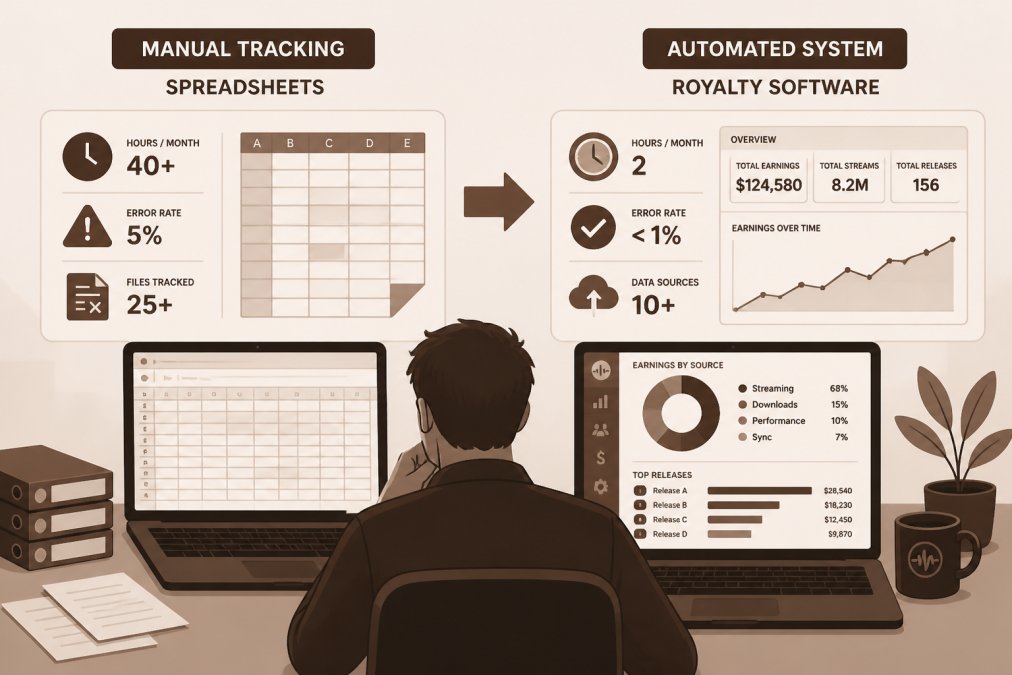
Music producer or label owner comparing spreadsheets on a laptop with modern software dashboard, showing the transition from manual tracking to automated systems
Train your team on the new system. Most modern royalty software is intuitive, but every system has quirks. Set up automated data imports immediately, the whole point is eliminating manual data entry. Connect your DSP accounts, set up automatic imports, and verify the data is coming in correctly.
The transition typically takes 1-3 months depending on your data complexity. The investment pays for itself in the first year through reduced administrative time and fewer errors.
## Conclusion
---
Detailed royalty reporting for labels is no longer optional, it's the baseline expectation. Artists demand transparency. Regulators expect clean financials. Your business can't scale on spreadsheets.
Professional royalty accounting software solves multiple problems: it eliminates manual errors, automates calculations, creates audit trails, and gives artists the visibility they expect. NexaTunes provides detailed label-level royalty reports, monthly payouts, unlimited sublabels, and direct access to platforms like Beatport and Traxsource. Get started with NexaTunes and transform your label's financial operations into a competitive advantage.
## Frequently Asked Questions
### What information must be included in a detailed royalty statement for artists?
A comprehensive royalty statement should include gross revenue by platform (streaming services, downloads, physical sales), deductions for recoupable expenses, net royalties owed, currency conversions applied, reporting period dates, and a breakdown by artist or release. Each line item must be traceable to source data. Statements should also show reserve accounts held, payment dates, and contact information for dispute resolution. This level of transparency builds trust and simplifies artist relations.
### How does music royalty accounting software improve reporting accuracy?
Automated royalty accounting software eliminates manual data entry errors, normalizes sales data from multiple digital service providers (DSPs), and applies royalty splits consistently across all releases. The system maintains an audit trail of every calculation, making it easy to verify figures and resolve discrepancies. Real-time reconciliation catches mismatches immediately rather than discovering them months later. Automated calculations also reduce the time your team spends on routine tasks, freeing them to focus on strategic decisions.
### What are common challenges in royalty accounting for independent labels?
Independent labels typically struggle with data normalization across multiple DSPs, each reporting in different formats and currencies. Tracking recoupable expenses, managing royalty splits among multiple artists, and maintaining compliance with varying contract terms adds complexity. Manual spreadsheet tracking leads to errors and makes audits difficult. Many labels also lack the infrastructure to provide real-time artist portals, forcing them to handle statement requests manually. These challenges compound as labels scale and add more artists or sublabels.
### How often should record labels issue royalty statements to artists?
Industry standard practice is monthly royalty statements, though quarterly or semi-annual statements are common depending on contract terms. Monthly reporting provides artists with timely visibility into their earnings and reduces disputes. When choosing a reporting frequency, consider your cash flow, the volume of transactions, and artist expectations. Monthly statements also align with how most digital service providers report data, making reconciliation simpler. Whatever frequency you select, consistency and timeliness build credibility with your roster.
[Get Started Today](https://nexatunes.com/?ref=blog.nexatunes.com)
**Editorial Transparency**: This article was created with the assistance of GrandRanker AI and reviewed, edited, fact-checked, and approved by the NexaTunes editorial team before publication.
****“If you’re looking for a reliable way to distribute your music to Major Platforms , NexaTunes offers direct distribution with transparent terms.**
[Learn more ](https://nexatunes.com/?ref=blog.nexatunes.com)
### How to Scale Independent Record Labels: 2026 Guide
URL: https://blog.nexatunes.com/how-to-scale-independent-record-labels/
Last updated: 2026-08-10T13:00:43.000Z
## Table of Contents
- [Understanding the Foundation: What Scaling Means for Independent Labels](#understanding-the-foundation-what-scaling-means-for-independent-labels)
- [Building a Scalable Distribution Infrastructure](#building-a-scalable-distribution-infrastructure)
- [Creating a Record Label Business Plan Template](#creating-a-record-label-business-plan-template)
- [How to Sign Artists to an Indie Label](#how-to-sign-artists-to-an-indie-label)
- [Music Industry Royalty Management Tools and Financial Workflows](#music-industry-royalty-management-tools-and-financial-workflows)
- [Legal Requirements for Starting a Record Label and Managing Growth](#legal-requirements-for-starting-a-record-label-and-managing-growth)
- [Scaling Your Team and Operations](#scaling-your-team-and-operations)
- [Conclusion](#conclusion)
*Last Updated: August 10, 2026*
## Understanding the Foundation: What Scaling Means for Independent Labels
Scaling an independent record label means systematically expanding your artist roster, revenue streams, and operational capacity without losing the creative identity that defines your brand. Most independent labels start as one person managing a handful of artists. That works until you hit 10-15 active artists or 30+ releases per year, then manual workflows break. Email chains replace tracking systems. Spreadsheets replace [royalty accounting](https://blog.nexatunes.com/p/8932ab30-60fa-4898-93e6-6f3dfd92ec14/). Artists wait weeks for statements.
Scaling requires three foundational shifts: move from managing artists reactively to strategically, shift from treating distribution as a one-time upload to a continuous pipeline with metadata management, and professionalize your financial operations so artists trust your accounting. The difference between a label that stays at 5 artists and one that grows to 50 comes down to this: Did you build processes that work without you personally executing every task?
## Building a Scalable Distribution Infrastructure
Your distribution infrastructure is the backbone of everything. Without it, each new artist adds linear complexity to your manual workflows.
Start by choosing a [distribution partner](https://blog.nexatunes.com/p/1c4a53e5-34f2-4b02-ab81-c4dcea91a810/) that handles metadata management at scale, provides detailed platform-level reporting, and supports unlimited sublabels if you plan to segment your catalog by genre or artist collective. According to RIAA's 2026 music distribution trends report, independent labels now account for over 35% of all streaming releases, creating a data management problem that requires visibility into which releases went to which platforms and which artists earned from which territories.
Your distribution partner's reporting infrastructure matters more than their playlist connections. When you scale to 50+ active artists, you need to see exactly which releases generate revenue on each platform for accurate royalty accounting and A&R decision-making.
Build your distribution workflow around DDEX metadata standards, the industry standard for sending release information to platforms. This ensures your metadata arrives correctly and consistently across all platforms. Most platforms now require DDEX-compliant submissions for high-volume releases.
Your infrastructure should also include a clear release calendar and asset management system. As you scale, multiple releases will launch simultaneously across different artists and sublabels. A shared calendar prevents conflicts, ensures metadata is submitted on time, and lets you coordinate playlist pitching across your catalog.
**Pro Tip** Set up your distribution metadata template once and reuse it for every release. Include fields for ISRC codes, artist credits, featured artists, songwriter splits, and explicit content flags. This takes 30 minutes upfront but saves hours per release once you're managing dozens of them.
## Creating a Record Label Business Plan Template
A record label business plan is your operational roadmap for scaling.
Start with a clear definition of your label's niche. Are you focused on a specific genre, region, or artist demographic? The more specific your positioning, the easier it is to build a sustainable A&R strategy and attract artists who fit your brand.
Next, document your revenue model. Most independent labels derive revenue from streaming royalties, [sync licensing](https://blog.nexatunes.com/p/5c643d8f-0f85-4869-a99e-9538a5943d1b/) (TV, film, advertising), merchandise sales, live event coordination, and artist services. Many labels ignore sync revenue entirely, a major missed opportunity. According to [Musicbed's 2026 sync licensing insights](https://www.musicbed.com/articles/filmmaking/youtube/content-creator-trend-report-2026/?ref=blog.nexatunes.com), independent labels that actively pitch for sync placements see 15-25% of their annual revenue from that channel alone.
Include hiring projections. Once you hit 15-20 active artists, you need at least one part-time person handling artist relations and royalty accounting. At 40+ artists, you need a full-time operations manager and likely an A&R specialist. Document when you'll hire, what roles you'll fill first, and how you'll fund those hires.
Include financial projections for at least three years. Most new labels overestimate success rates by 200-300%. Build your projections on conservative assumptions, then track actual performance against them monthly.
**Key Takeaway** Your business plan isn't static. Review it quarterly and update it based on actual performance data. The label that adapts its strategy based on real revenue numbers will scale faster than the label that sticks to initial assumptions.
## How to Sign Artists to an Indie Label
Signing artists to your label is where strategy meets execution. The wrong artist onboarding process creates chaos at scale.
Start by establishing clear artist agreements before you sign anyone. Your agreement should specify ownership of master recordings, the label's revenue share, commitment length, exit procedures, and [how royalties are calculated and paid](https://blog.nexatunes.com/p/eb77ab23-2e7b-4680-bfda-31345d841893/). This isn't optional, it's the foundation of your entire business.

Music producer and label manager sitting at desk reviewing artist contract documents and discussing terms in professional studio setting with natural lighting
Many independent labels skip formal agreements to seem "artist-friendly" or because they're signing friends. This is a mistake. A clear, fair agreement prevents misunderstandings about revenue splits, prevents disputes about master recording ownership if the artist leaves, and makes it easier to manage multiple sublabels later.
Your artist agreement should include:
- Term length (typically 1-3 years, often with renewal options)
- Revenue split (what percentage the label takes vs. the artist)
- Definition of what counts as label revenue (streaming only, or does it include sync and merchandise?)
- Advance payment structure (if applicable)
- Reversion of rights if the label goes inactive
- Termination clause and exit procedures
- Payment schedule (monthly, quarterly, or per-release)
When evaluating artists to sign, look beyond just listening to their music. Examine their existing audience (social media followers, Spotify followers, email list), release history (consistency matters), and commitment level (will they actively promote releases?). An artist with 5,000 engaged followers and a consistent release schedule is more valuable than an artist with 50,000 inactive followers.
Create an onboarding checklist for new artists: artist bio, high-resolution artwork, ISRC codes if they have prior releases, payment information, and social media handles. Standardize this process so every artist goes through the same steps.
**Watch Out** Never skip the legal agreement to move faster. Artists who leave because of unclear terms create reputation damage that takes months to recover from. A 30-minute conversation about contract terms upfront saves 30 hours of conflict later.
## Music Industry Royalty Management Tools and Financial Workflows
Your royalty accounting system is where trust is built or destroyed at scale.
Most independent labels start with spreadsheets. This works until you have 20+ artists and multiple revenue streams. At that point, spreadsheets become a liability, they're error-prone, hard to audit, and impossible to scale.
A proper royalty management workflow has three components: aggregation (collecting revenue data from all platforms), calculation (determining what each artist is owed based on your agreement terms), and distribution (paying artists on a predictable schedule).
Aggregation requires connecting to your distribution platform's API or using their reporting dashboard to pull revenue data. You need to standardize this data, converting different platforms' terminology, handling currency conversion, and reconciling discrepancies.
[Get Started Today →](https://nexatunes.com/?ref=blog.nexatunes.com)
Calculation requires accounting for platform fees, distribution fees, currency conversion, and any [advances paid upfront that need to be recouped](https://blog.nexatunes.com/p/48ec2220-ecb4-43b2-9c59-8ae76198c813/).
Distribution should happen on a predictable schedule. Many successful labels pay artists monthly, which builds trust and makes it easier for artists to plan. Whatever you choose, be consistent and communicate it clearly in your artist agreements.
Set up your royalty accounting system before you have 10 artists, not after. Your system should generate automated monthly statements for each artist showing gross revenue by platform, any deductions, and net payment due.
## Legal Requirements for Starting a Record Label and Managing Growth
The legal requirements for starting a record label vary by territory, but several critical areas apply in the United States.
First, business structure. Most independent labels operate as LLCs or S-corps. An LLC provides liability protection and is relatively simple to set up. An S-corp has tax advantages if you're generating significant revenue, but requires more accounting overhead. Consult with a business accountant or attorney in your state.
Second, copyright and master recording ownership. When you sign an artist, you're typically acquiring ownership of the master recording while the artist retains ownership of the composition. This needs to be clearly documented in your artist agreement. According to [U.S. Copyright Office guidelines on master recording ownership](https://www.copyright.gov/engage/musicians/?ref=blog.nexatunes.com), disputes over master recording ownership are one of the most common sources of legal conflict in the music industry.
Third, sync licensing rights. Your artist agreements should explicitly grant you sync licensing rights. If they don't, [you can](https://blog.nexatunes.com/p/92e46430-a86d-4765-97c5-d8028a992aae/)'t legally license your own catalog, a massive revenue loss.
Fourth, royalty accounting compliance. Several U.S. states have specific requirements about how often you must pay artists and how detailed your accounting must be. California, for example, has strict artist payment laws. Research your state's requirements and build them into your payment schedule.
Fifth, tax compliance. Track and report 1099 income if you pay any contractors. Keep detailed records of all payments and invoices.
**Pro Tip** Have a lawyer review your standard artist agreement before you sign your first artist. The cost is typically $500-1,500 and prevents far more expensive disputes later.
## Scaling Your Team and Operations
The moment you start scaling beyond what you can personally manage, you need to think about hiring and delegation.
Most labels try to stay solo as long as possible because hiring feels expensive. But at scale, staying solo is actually more expensive, it limits your ability to manage more artists, pursue new revenue streams, and grow strategically.
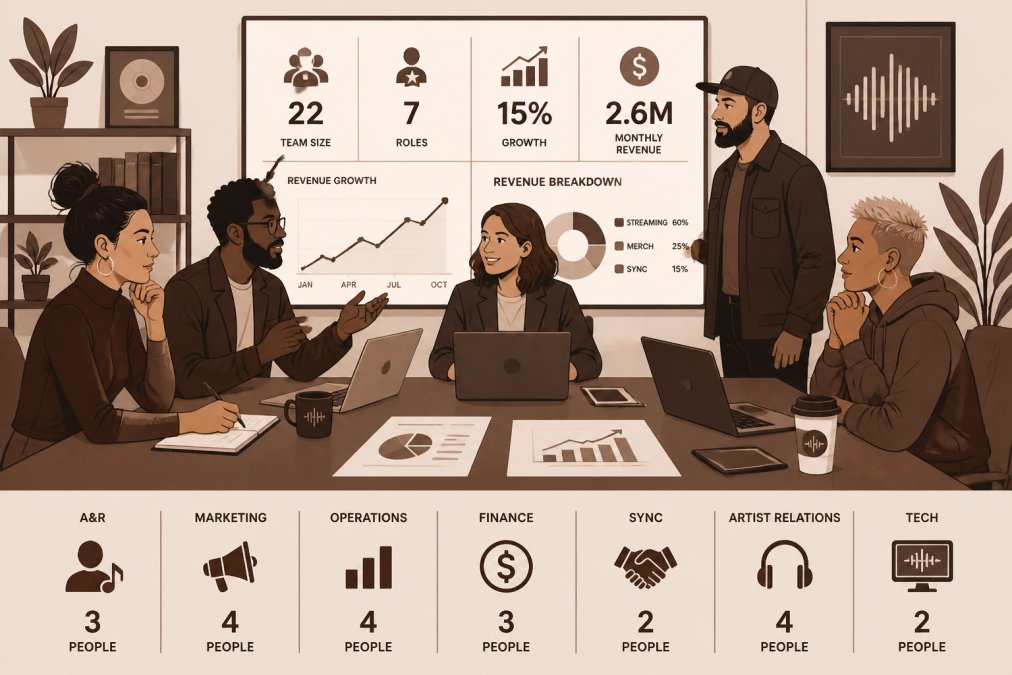
Diverse team of music industry professionals collaborating around conference table with laptops, discussing growth strategy and business metrics in modern office setting
Your first hire should typically be an operations or artist relations person. This person handles artist onboarding, royalty accounting, communication with the distribution platform, and day-to-day artist support. This frees you up to focus on A&R and business development.
Once you have an operations person in place, consider hiring an A&R specialist if your label generates enough revenue. An A&R specialist listens to demos, identifies talent, develops artists' sound, and coordinates with producers and mixers.
Your team structure at different scales might look like this:
- 0-15 artists: You solo, using freelance help for specific projects
- 15-30 artists: You plus one part-time operations person
- 30-50 artists: You plus one full-time operations person and one part-time A&R consultant
- 50+ artists: You plus full-time operations, full-time A&R, and potentially a marketing specialist
Track how many hours you're spending on each major task. When one task consistently takes 20+ hours per month, that's a signal to hire or outsource it.
**Key Takeaway** Document every process before you hire someone to do it. Process documentation is the bridge between solo operation and team scaling.
---
Scaling independent record labels requires building infrastructure that works without you personally executing every task. Start with a clear distribution pipeline, establish formal artist agreements before you sign anyone, implement proper royalty accounting from day one, and hire strategically based on where your time is actually going.
The labels that scale successfully treat operations as seriously as they treat A&R. They invest in systems early, document processes so they can delegate, and track financial performance honestly so they know what's actually working.
NexaTunes is built specifically for independent labels serious about scaling. With [unlimited sublabels](https://blog.nexatunes.com/p/8262b56b-b7a0-4eb2-b05f-e9a136fe5669/), detailed label-level reporting, and direct access to platforms like Beatport and Traxsource, it removes the infrastructure barriers that hold most labels back. If you're managing multiple artists or multiple sublabels, you need visibility into exactly where your revenue is coming from and the ability to pay artists reliably every month. That's what separates labels that scale from labels that stay stuck.
| Growth Stage | Team Size | Key Focus | Main Challenge |
| --------------------------- | ---------- | ----------------------------- | -------------------------- |
| Solo (0-15 artists) | 1 person | Artist development & releases | Manual workflows |
| Early scale (15-30 artists) | 1-2 people | Operations & artist relations | Financial tracking |
| Growth (30-50 artists) | 2-3 people | Revenue diversification | Team coordination |
| Scaling (50+ artists) | 3+ people | Strategic positioning | Maintaining brand identity |
## Frequently Asked Questions
### How do independent record labels make money?
Independent labels generate revenue through multiple streams: streaming royalties from platforms like Spotify and Apple Music, sync licensing for film and TV placements, merchandise sales, and artist services. The key to scaling is diversifying these revenue streams. Royalty accounting must track each source separately so you understand which channels drive the most profit. Many labels also earn from sublabel partnerships and artist development fees.
### What are the legal requirements for starting a record label in the US?
You must register your business with your state (LLC or corporation), obtain an Employer Identification Number (EIN) from the IRS, and secure appropriate business insurance. Copyright administration is critical, you need to register master recordings with the U.S. Copyright Office and register your label with performing rights organizations like ASCAP, BMI, or SESAC. Consult a music attorney to draft artist agreements that protect intellectual property and clarify royalty splits before signing anyone.
### What's the biggest challenge for independent record labels today?
Competing for artist attention and maintaining operational efficiency at scale. Labels struggle with metadata management across global distribution pipelines, royalty accounting complexity, and artist retention as they grow. The solution is investing early in reliable music industry royalty management tools and automation. Many labels also underestimate the cost of compliance and tax obligations across different territories, planning for cross-border financial compliance prevents costly mistakes later.
### How do you grow a record label from scratch without a huge budget?
Start with a lean team and focus on one genre or niche where you can build authentic brand identity. Use a professional distribution platform with detailed label-level reporting so you understand your metrics without expensive consultants. Build relationships with 5-10 artists first, perfect your workflow, then scale. Invest in music industry royalty management tools early to avoid manual accounting errors. Many successful labels grew by being selective about artist signings and reinvesting profits into marketing and catalog development.
[Get Started Today](https://nexatunes.com/?ref=blog.nexatunes.com)
**Editorial Transparency**: This article was created with the assistance of GrandRanker AI and reviewed, edited, fact-checked, and approved by the NexaTunes editorial team before publication.
****“If you’re looking for a reliable way to distribute your music to Major Platforms , NexaTunes offers direct distribution with transparent terms.**
[Learn more ](https://nexatunes.com/?ref=blog.nexatunes.com)
### DistroKid Alternatives for Record Labels
URL: https://blog.nexatunes.com/distrokid-alternatives-record-labels-distrokid-alternatives-for-record-labels/
Last updated: 2026-08-10T04:42:14.000Z
## Table of Contents
- [Why Record Labels Need Different Distribution Tools](#why-record-labels-need-different-distribution-tools)
- [Key Features to Evaluate in DistroKid Alternatives for Record Labels](#key-features-to-evaluate-in-distrokid-alternatives-for-record-labels)
- [Music Distribution Royalty Splits: What Labels Should Expect](#music-distribution-royalty-splits-what-labels-should-expect)
- [Top DistroKid Alternatives for Record Labels: Feature Comparison](#top-distrokid-alternatives-for-record-labels-feature-comparison)
- [NexaTunes](#nexatunes)
- [Symphonic Distribution](#symphonic-distribution)
- [TuneCore](#tunecore)
- [FUGA](#fuga)
- [The Orchard](#the-orchard)
- [White Label Music Distribution for Growing Labels](#white-label-music-distribution-for-growing-labels)
- [How to Start a Record Label Distribution Strategy](#how-to-start-a-record-label-distribution-strategy)
- [Migration and Data Protection: Exit Strategy Considerations](#migration-and-data-protection-exit-strategy-considerations)
- [Conclusion](#conclusion)
*Last Updated: August 9, 2026*
## Why Record Labels Need Different Distribution Tools
The music distribution landscape has fractured. A platform built for solo artists uploading their first single operates under completely different constraints than a label [managing fifty artists, multiple sublabels](https://blog.nexatunes.com/p/8262b56b-b7a0-4eb2-b05f-e9a136fe5669/), and revenue splits across collaborators. DistroKid alternatives for record labels exist precisely because the generic approach doesn't scale.
When running a label, you're managing infrastructure: bulk uploads, automated royalty splits, detailed reporting by artist and platform, and separate financial accounts for different sublabels.
Labels require tools that understand splits, sublabel hierarchies, and batch processing. They need monthly payouts, not quarterly ones. They need to see exactly where revenue comes from, which platform, which artist, which release, down to the cent. Most importantly, they need transparency. A label's reputation depends on accurate reporting and reliable payments to artists.
At NexaTunes, we've built specifically for this use case. Labels scaling their operations need distribution partners that treat them as professional businesses, not hobbyists. That means unlimited sublabels, detailed label-level reporting, and direct access to platforms like Beatport and Traxsource where electronic music actually gets discovered.
## Key Features to Evaluate in DistroKid Alternatives for Record Labels
Choosing a distribution platform for your label requires evaluating specific operational capabilities, not just general features.
**Royalty Splits and Multi-Artist Management**
Your platform needs to handle [automatic splits between you, your artists, and collaborators](https://blog.nexatunes.com/p/5a50120d-fc1f-4f7a-ad8e-b22afcbceeba/). When an artist releases a track with a featured producer who gets a percentage, the system should calculate and distribute those shares without manual intervention. Look for platforms supporting unlimited artists under a single label account without per-artist fees.
**Sublabel Architecture**
A professional label often operates multiple sublabels, one for house music, another for techno, a third for experimental releases. Your distribution platform should let you create separate sublabel accounts with independent branding, artist rosters, and financial reporting. This is essential for maintaining distinct brand identities and managing complex organizational structures.
**Reporting and Financial Transparency**
You need to see exactly where money comes from. A solid label-focused platform breaks down revenue by platform (Spotify, Apple Music, Beatport, etc.), by artist, by release, and by time period. Monthly payouts matter more than quarterly ones. A platform that pays monthly keeps your accounting clean and your artists happy.
**Speed to Market**
Distribution latency affects your competitive position. Electronic music especially moves fast. A release that takes two weeks to hit Beatport might miss its moment. Look for platforms promising delivery within days, not weeks.
**Platform Access**
Not all distributors have equal relationships with all platforms. If you're releasing electronic music, direct access to Beatport and Traxsource matters enormously. A distributor that treats them as afterthoughts is limiting your reach.
**Customer Support**
When something goes wrong, you need support that understands label operations and responds quickly. Email support with 48-hour response times doesn't cut it when artists are waiting for their money.
## Music Distribution Royalty Splits: What Labels Should Expect
Most digital streaming platforms pay between $0.003 and $0.005 per stream. A platform's job is to collect those payments from DSPs and pass them through to you, minus their commission. Commission structures vary significantly: some charge flat annual fees, others take 15-30% of revenue, and some use hybrid models.
Your distributor should clearly explain their take-rate before you commit. Some platforms hide additional fees in fine print: charges for extra artist slots, UGC monetization splits, or post-cancellation commissions. These add up quickly when managing multiple artists.
Royalty splits between label and artist should flow automatically. When an artist earns $1,000 and you've agreed to take 20%, the system should calculate $200 for you and $800 for the artist, then pay out accordingly. Manual splits are error-prone and kill your credibility with artists.
Watch for platforms that withhold payments until reaching a minimum threshold. For a label with multiple revenue streams, you want [access to](https://blog.nexatunes.com/p/8aa63219-e80a-4422-bc3c-a9b01c29f69c/) funds as they accumulate. Also pay attention to how platforms handle chargebacks and disputed payments. If a DSP reverses a payment months later, does your distributor eat the loss or pass it back to you?
## Top DistroKid Alternatives for Record Labels: Feature Comparison
Record label manager reviewing detailed analytics dashboards and artist earnings reports on a desktop monitor in a modern studio office, with professional headphones and mixing equipment visible in the background
| Platform | Starting Price | Best For | Key Label Feature |
| ---------------------- | ------------------- | --------------------------------------- | -------------------------------------------------------------------- |
| NexaTunes | Contact for pricing | Professional labels | Unlimited sublabels, monthly payouts, detailed label-level reporting |
| Symphonic Distribution | $29.99/year | Established labels with marketing needs | SplitShare automatic royalty splits, partner manager support |
| TuneCore | $24.99/year | Labels with consistent releases | Custom label names, integrated publishing admin, daily trend reports |
| FUGA | Enterprise pricing | Large catalogs and distributors | API-driven infrastructure, modular services, rights management |
| The Orchard | 15-30% commission | Premium labels seeking full services | Comprehensive marketing, sync licensing, major label backing |
### NexaTunes
NexaTunes is built from the ground up for professional labels. The platform prioritizes what matters to label operators: unlimited sublabels without per-artist fees, monthly royalty payouts, and detailed reporting that breaks down earnings by platform and artist.
The core advantage is transparency. You get label-level visibility into exactly where your revenue comes from. If running multiple sublabels, each has its own dashboard and financial reporting. Monthly payouts keep your cash flow predictable, crucial when paying artists monthly.
Direct access to Beatport and Traxsource is a significant differentiator for electronic music labels. The platform supports unlimited artists and collaborators under a single label account without per-artist fees. As your label grows, your infrastructure scales without unexpected cost increases.
**Pros:**
- Unlimited sublabels and artists without per-unit fees
- Monthly royalty payouts for better cash flow
- Detailed label-level reporting with platform and artist breakdowns
- Direct access to Beatport and Traxsource
- Transparent pricing without hidden fees
**Cons:**
- Requires direct contact for pricing information
- Newer platform with smaller artist base than legacy distributors
### Symphonic Distribution
Symphonic Distribution combines broad platform reach with a focus on royalty accuracy. The SplitShare feature handles automatic payments to collaborators, essential when managing releases with multiple contributors.
The platform delivers to 200+ stores globally. The analytics dashboard includes data from Spotify, Apple Music, Pandora, and TikTok. Symphonic's Partner tier includes dedicated client managers and marketing support, though it requires application and approval.
Symphonic | Digital Music Distribution | Music Promotion
**Pros:**
- Strong royalty split automation with SplitShare
- Dedicated managers for Partner-tier clients
- Fast Spotify delivery and seamless collaboration tracking
- Comprehensive analytics across major platforms
**Cons:**
- 30% UGC share on Starter plan can be expensive
- Partner plan requires application and approval
- Less specialized for electronic music platforms
### TuneCore
TuneCore offers a polished interface and integrated [publishing administration](https://blog.nexatunes.com/p/f62efa64-f671-4d62-b3c0-69d625f2577e/), saving money if you're managing both master rights and publishing. The Professional plan allows custom label names and UPC codes, essential for maintaining professional branding.
The platform delivers to 150+ stores with unlimited releases. Daily trend reports give real-time visibility into how your releases perform. The dashboard is intuitive and less intimidating for non-technical teams.
♫ TuneCore: Digital Music Distribution Services | Start Now!
**Pros:**
- Intuitive dashboard and polished interface
- Integrated publishing administration available
- Custom label names on Professional plan
- Unlimited releases and daily trend reports
**Cons:**
- 20% commission on social monetization on some plans
- Additional fees for extra artists on Professional plan
- Less specialized for sublabel management
### FUGA
FUGA is an enterprise-grade platform designed for distributors and large labels managing extensive catalogs. The platform is API-driven, allowing you to automate workflows that would be manual on consumer-facing platforms. Bulk uploads, metadata management, and reporting integration all work programmatically.
FUGA handles rights management and royalty accounting at the enterprise level. The modular service structure means you can add services like marketing, sync licensing, or content management as you grow. Custom pricing requires negotiation with the sales team.
FUGA
**Pros:**
- Enterprise-grade infrastructure and API access
- Modular services tailored to your specific needs
- Comprehensive rights management and accounting
- Scalable for managing large catalogs
**Cons:**
- Pricing requires negotiation with sales team
- Overkill for smaller labels
- Less suitable for independent artists or very small labels
### The Orchard
The Orchard is a subsidiary of Sony Music Entertainment, giving it credibility and resources independent distributors can't match. The platform offers comprehensive services beyond distribution: marketing campaigns, sync licensing for TV/film/advertising, and strategic business guidance.
[Get Started Today →](https://nexatunes.com/?ref=blog.nexatunes.com)
If you're a label with ambitions to scale significantly, The Orchard's connections matter. They have relationships with major platforms and can facilitate opportunities other distributors can't access. The commission-based pricing (15-30% of revenue) is higher than flat-fee alternatives, but you're paying for a full-service partner. The application process is selective.
**Pros:**
- Major label backing and extensive industry connections
- Comprehensive services including sync licensing and marketing
- Access to opportunities unavailable through independent distributors
- Transparent royalty accounting and detailed analytics
**Cons:**
- Application-based, not open to all labels
- Commission-based pricing (15-30%) can be expensive at scale
- Less suitable for smaller or newer labels
## White Label Music Distribution for Growing Labels
White label [music distribution](https://blog.nexatunes.com/p/1954ccb6-524a-4527-9e40-b760c344cf22/) lets you offer distribution services under your own brand while outsourcing backend infrastructure. You partner with a distributor that provides API access, you build your own interface, and the distributor handles delivery to DSPs, royalty accounting, and compliance.
This approach works best when you have a specific audience or artist community. If you're known for discovering emerging talent in a specific genre, offering white label distribution creates additional revenue and deepens artist loyalty.
The technical requirements are real. You need developers to build and maintain a distribution interface, and you need to handle customer support and artist education. Pricing varies: some distributors charge per artist per month, others take a percentage of revenue, some charge flat fees for API access.
The advantage is control. You set pricing, design the experience, and own the customer relationship. Your artists interact with your brand, not the distributor's.
## How to Start a Record Label Distribution Strategy
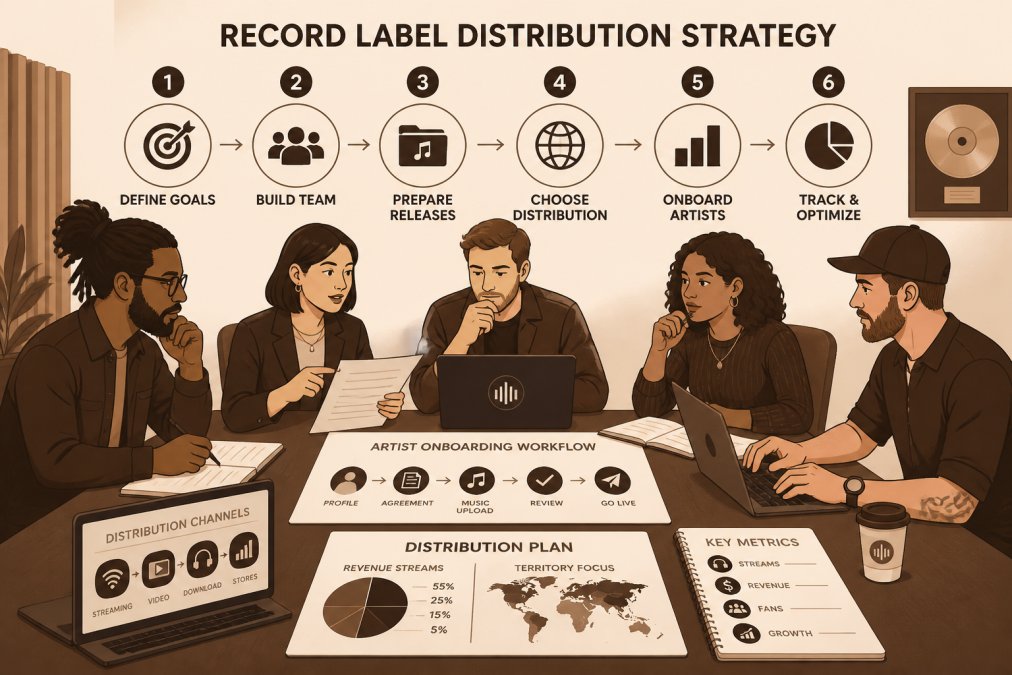
Team of music professionals collaborating at a conference table with laptops and notebooks, reviewing distribution strategy documents and artist onboarding workflows under professional office lighting
**Define Your Release Schedule and Volume**
How many releases will you put out monthly? How many artists are you signing? What's your growth projection for the next 12 months? This determines which platform's pricing model makes sense.
**Identify Your Core Platforms**
Electronic music labels need Beatport and Traxsource. Hip-hop labels need SoundCloud and YouTube. Indie pop labels need Spotify and Apple Music playlists. Choose a distributor with strong relationships where your audience discovers music.
**Set Up Sublabel Architecture**
Before onboarding your first artist, design your sublabel structure. Will you run everything under one brand, or build multiple imprints? Each needs its own identity, branding, and potentially its own financial tracking.
**Establish Royalty Split Standards**
Create a clear policy for how you split revenue with artists. Write this down. Your distributor should enforce these splits automatically.
**Plan Your Metadata and Catalog Organization**
Metadata determines how your music gets discovered. Create templates for your artists so submissions are consistent.
**Build Artist Onboarding Process**
Create a simple onboarding document explaining your release timeline, metadata requirements, royalty splits, and payout schedule.
**Monitor and Iterate**
Track what's working. Which platforms drive the most streams? Which artists' releases perform best? Use this data to refine your strategy.
## Migration and Data Protection: Exit Strategy Considerations
Before committing to a distribution platform, understand what happens if you need to leave.
**Data Portability**
Can you export your catalog data, release history, and financial records? You want a distributor that will give you complete data exports without friction, including metadata, ISRCs, UPCs, release dates, and complete earnings history.
**Catalog Takedown Process**
When you leave, how long does it take to remove your music from streaming platforms? Clarify the takedown timeline before you commit.
**Financial Settlements**
What happens to money owed when you leave? Some platforms pay out immediately. Others hold funds for 30-90 days. Get this in writing.
**Artist Data and Relationships**
Your artists' contact information, earnings history, and performance data belong to them, not your distributor. Make sure you can export this information and maintain relationships with your artists if you switch platforms.
**Contract Terms**
Read the fine print on exit clauses. Some platforms charge penalties for early termination or have post-cancellation commission clauses. The best protection is choosing a distributor transparent about these issues from the start.
---
Choosing a DistroKid alternative for record labels means prioritizing the operational features that actually matter to label management: unlimited sublabels, monthly payouts, detailed reporting, and direct access to platforms where your audience discovers music. NexaTunes delivers on these fundamentals with transparent pricing and infrastructure built specifically for professional labels. If you're managing multiple artists and sublabels, you need a partner that treats label operations as a first-class use case, not an afterthought. Explore NexaTunes to see how monthly royalty payouts and detailed label-level reporting can simplify your operations and give you the financial visibility your label needs to scale.
## Frequently Asked Questions
### What makes DistroKid alternatives better for record labels than general music distribution platforms?
DistroKid was designed primarily for individual artists, not labels managing multiple sublabels and artists. True DistroKid alternatives for record labels offer label-level dashboards, automated royalty splits between sublabels and artists, bulk metadata management, and detailed reporting by artist and platform. These features let labels operate at scale without manually processing hundreds of individual releases or royalty calculations.
### How do music distribution royalty splits work between labels and artists?
Music distribution royalty splits automate payments to collaborators and artists under a label. When a song earns royalties from streaming platforms, the distributor splits the payment according to predefined percentages you set. For example, if an artist retains 85% and the label takes 15%, the system automatically calculates and deposits each party's share. Advanced platforms track splits by release, artist, and sublabel, providing transparent accounting that protects both parties.
### Is white label music distribution a good option for independent record labels?
White label music distribution allows labels to operate under their own brand while using another platform's infrastructure. This works well for labels wanting to scale quickly without building their own backend technology. However, evaluate whether the white label provider offers the label-specific tools you need, such as multi-artist management, custom reporting, and direct access to premium platforms like Beatport and Traxsource. Some white label solutions lack the transparency and control labels require.
### What should I consider when planning how to start a record label distribution strategy?
Start by defining your catalog size, artist count, and target platforms (streaming, DJ platforms, social). Choose a distributor offering unlimited sublabels and artists if you plan to grow. Verify they provide monthly payouts, detailed label-level reporting by platform and artist, and bulk upload capabilities. Test their dashboard and customer support before committing. Confirm they handle metadata management (ISRC, UPC codes) and offer tools for playlist pitching or content ID monetization if those matter to your strategy.
### What happens to my music and data if a distribution platform shuts down or gets acquired?
This is a critical exit strategy question. Before signing with any distributor, confirm they have a clear data portability and catalog migration policy. Ask whether you can export your metadata, release history, and earnings reports. Verify the platform's financial stability and whether they're backed by major investors or industry players. Some platforms guarantee you can pull your entire catalog within a specified timeframe if you leave. Always read the terms of service regarding what happens to your music, royalties, and data in acquisition scenarios.
[Get Started Today](https://nexatunes.com/?ref=blog.nexatunes.com)
**Editorial Transparency**: This article was created with the assistance of GrandRanker AI and reviewed, edited, fact-checked, and approved by the NexaTunes editorial team before publication.
****“If you’re looking for a reliable way to distribute your music to Major Platforms , NexaTunes offers direct distribution with transparent terms.**
[Learn more ](https://nexatunes.com/?ref=blog.nexatunes.com)
### How to Pitch Music to Film and TV Supervisors: 2026 Guide
URL: https://blog.nexatunes.com/how-to-pitch-music-to-film-and-tv-supervisors/
Last updated: 2026-08-10T04:41:37.000Z
## Table of Contents
- [Understanding Sync Licensing and What Supervisors Need](#understanding-sync-licensing-and-what-supervisors-need)
- [How to Make Music Sync Ready: Technical Preparation](#how-to-make-music-sync-ready-technical-preparation)
- [File Format and Audio Quality Standards](#file-format-and-audio-quality-standards)
- [Metadata and ID3 Tags Essentials](#metadata-and-id3-tags-essentials)
- [Music Supervisor Email Templates and Submission Guidelines](#music-supervisor-email-templates-and-submission-guidelines)
- [Best Music Licensing Platforms for Getting Placed](#best-music-licensing-platforms-for-getting-placed)
- [Music Sync Licensing for Beginners: Key Concepts](#music-sync-licensing-for-beginners-key-concepts)
- [Master Rights vs. Publishing Rights](#master-rights-vs-publishing-rights)
- [Exclusive vs. Non-Exclusive Licenses](#exclusive-vs-non-exclusive-licenses)
- [Building Relationships with Music Supervisors and Sync Agents](#building-relationships-with-music-supervisors-and-sync-agents)
- [The Post-Pitch Workflow: What Happens After Submission](#the-post-pitch-workflow-what-happens-after-submission)
- [Conclusion](#conclusion)
*Last Updated: August 8, 2026*
## Understanding Sync Licensing and What Supervisors Need
Sync licensing is the legal permission to synchronize your music with visual media: films, TV shows, commercials, documentaries, video games, and streaming content. Two separate rights holders must grant permission, the master rights owner (typically the record label or artist) and the publishing rights holder (the songwriter or publisher).
Music supervisors are gatekeepers between creators and productions. They find, license, and clear music that fits a project's creative vision, budget, and timeline. They receive hundreds of submissions weekly, so your pitch must stand out immediately. They're looking for music that solves a specific creative problem and enhances storytelling, not just technically proficient tracks.
Supervisors need music that's production-ready, properly cleared, and backed by clean metadata. They need to know exactly who owns what rights and whether licensing will be straightforward. Most importantly, they need confidence that working with you won't create legal headaches later.
**Pro Tip** Music supervisors spend most of their time on clearance logistics, not discovery. If your submission makes the clearance process harder, it gets rejected immediately, regardless of how good the music sounds. Clean metadata and clear rights ownership matter as much as the song itself.
## How to Make Music Sync Ready: Technical Preparation
### File Format and Audio Quality Standards
Your audio files need to meet professional broadcast standards. Most productions require WAV files at 44.1 kHz sample rate and 24-bit depth. Use this naming format: `[ArtistName]_[SongTitle]_[Version]_[Tempo]BPM.wav`. For example: `NexaTunes_Midnight_Instrumental_120BPM.wav`.
Avoid MP3 files for professional submissions. While smaller, they're lossy formats that degrade audio quality. Supervisors working on high-budget productions won't accept them. Audio quality should be clean and professional, no clipping, no unexpected noise, and proper gain staging throughout the mix.
**Watch Out** Submitting low-bitrate MP3s or amateur audio quality is an instant rejection signal. A supervisor who hears your music in poor quality assumes that's the best version available.
### Metadata and ID3 Tags Essentials
Metadata is the invisible information embedded in your audio files. ID3 tags are the standard format for this data in WAV and MP3 files. Proper metadata makes your music discoverable, trackable, and licensable.
Essential ID3 tags to include:
- **Title:** Exact song title
- **Artist:** Your name or artist name
- **Album:** Album or project name
- **Year:** Release year
- **Genre:** Primary genre
- **BPM:** Tempo in beats per minute
- **Key:** Musical key
- **Duration:** Total track length
- **Mood:** 2-3 descriptive words (Cinematic, Uplifting, Dark)
- **Instrumentation:** What's playing (Piano, Strings, Synth, Drums)
- **Lyrical Content:** "Instrumental" or description of vocal themes
- **Composer/Publisher:** Your publishing entity name
Many supervisors use music library search tools that pull directly from ID3 tags. If your metadata is incomplete or incorrect, your music won't show up in relevant searches. Use free metadata editing software like MediaInfo or paid tools like Meta Tagger to batch-update your files.
## Music Supervisor Email Templates and Submission Guidelines
Your initial email to a music supervisor must be short, specific, and immediately relevant to their current projects. Supervisors receive dozens of pitches daily. An email longer than three paragraphs gets skimmed or deleted.
**Subject Line Formula:** \[Show/Project Name\] + \[Your Music Style\] + \[Specific Track\]
Example: `"Stranger Things Pitch: Synth-Heavy Instrumental - 'Neon City'"`
**Email Template for Cold Pitches:**
---
Subject: \[Show Name\] Pitch: \[Genre\] Track - \[Song Title\]
Hi \[Supervisor Name\],
I have an instrumental track that could work for \[specific scene type or show vibe you've researched\]. "Song Title" is \[BPM\] BPM, \[key\], and \[duration\]. It's available for non-exclusive licensing with flexible terms.
\[One sentence about why it fits: reference a specific scene style, emotional tone, or production need you know they have\]
Listen: \[Direct link to streaming or audio preview\]
Metadata and high-res files attached. I'm the rights holder for both master and publishing, so clearance is straightforward.
\[Your Name\] \[Contact Email\] \[Phone Number\]
---
**Key principles:**
- Research the supervisor's name and use it
- Never claim your music is "perfect" or "exactly what you need"
- Link to a preview instead of attaching large files
- Never ask "Are you interested?", assume they might be
- Always mention you own both rights, or clearly state which rights you don't control

Professional musician or producer at desk with laptop, reviewing an email draft on screen with headphones and notebook nearby, focused on crafting a professional pitch
**Follow-up email (if no response after 2 weeks):**
---
Subject: RE: \[Show Name\] Pitch - \[Song Title\] (follow-up)
Hi \[Supervisor Name\],
Quick follow-up on my pitch from \[date\]. In case it got buried, here's the track again: \[link\]
No pressure if it's not the right fit.
\[Your Name\]
---
One follow-up is professional. Two feels persistent. Three feels like spam.
**Submission Guidelines for Music Libraries and Platforms:**
Follow platform requirements exactly. If they ask for 320kbps MP3 previews and AIFF masters, don't submit WAV masters instead. Common platform requirements include preview file format and bitrate, master file specifications, complete metadata, artwork (minimum 1400x1400px), cue sheet information, and rights confirmation.
## Best Music Licensing Platforms for Getting Placed
The right platform depends on your music style, whether you're independent or a label, and how much control you want over licensing terms.
**Curator-Driven Platforms** are best if you want personal feedback and selective placement. Supervisors actively browse these libraries, so quality curation matters more than quantity.
[Get Started Today →](https://nexatunes.com/?ref=blog.nexatunes.com)
**Algorithmic Platforms** work well if you have a large catalog and want passive income. You upload once, and the platform's matching system connects your music to relevant briefs automatically.
**Direct-to-Supervisor Platforms** let you pitch directly to music supervisors on active projects. You see the brief, understand what they're looking for, and submit targeted pitches. This takes more work per submission but has higher placement rates.
Most successful artists use a combination: one or two curator-driven libraries for passive discovery, one algorithmic platform for catalog monetization, and direct pitching for high-value opportunities.
NexaTunes helps labels and distributors get their music heard through reliable access to major platforms and transparent reporting. If you're managing multiple artists or sublabels, having a distribution partner that tracks sync opportunities alongside streaming distribution simplifies the workflow considerably.
## Music Sync Licensing for Beginners: Key Concepts
### Master Rights vs. Publishing Rights
Master rights are the rights to the specific recording of your song. Publishing rights are the rights to the composition itself, the melody, harmony, and lyrics. When a supervisor licenses your music, they need both. The master rights owner gets paid for using that specific recording. The publishing rights owner gets paid for using the composition.
If you wrote and recorded the song, you own both and receive both payments. If you're a label that owns a master but the song was written by someone else, you only control the master rights. The original songwriter or their publisher controls publishing.
**Key Takeaway** If you own both master and publishing rights, always state this clearly in your pitch. It's a major selling point because supervisors can close the entire license in one conversation with you.
### Exclusive vs. Non-Exclusive Licenses
A non-exclusive license means the same recording can be licensed to multiple productions simultaneously. Your track could appear in a Netflix show, a commercial, and a film festival entry all at the same time. This is the standard for most independent artists because you keep the option to license the same track multiple times.
An exclusive license means only one production can use that recording for a defined period. Exclusive licenses pay significantly more because the production is paying for uniqueness. However, you're giving up income from other potential placements during that period.
Most beginning artists should offer non-exclusive licenses. You need multiple placements to build income. Once you have a large catalog and established relationships, you can be selective about which tracks go exclusive and demand appropriate compensation.
## Building Relationships with Music Supervisors and Sync Agents
Relationships matter more than you think in sync licensing. A supervisor who knows your work and trusts your quality will reach out to you directly with briefs, bypassing the submission pile entirely.
Identify supervisors whose projects match your music style. Research their credits on IMDb or by reading production notes on shows and films you admire. Follow them on social media and engage with their work. When you see a show or film they supervised, notice which songs they chose.
Connect on LinkedIn with a personalized message referencing a specific project: "I loved how you used music in Season 2 of \[Show\]. I make \[genre\] music that I think fits your style. Would love to connect."
Attend industry events where supervisors gather: sync conferences, film festivals with music panels, and industry mixers. A five-minute conversation at a conference builds more rapport than 50 cold emails.

Two music industry professionals meeting in modern office setting, reviewing music files on tablet or laptop together, engaged in conversation with professional body language and natural lighting
Sync agents are intermediaries who pitch music on your behalf to supervisors. If you sign with a reputable sync agent, they have existing relationships with supervisors and can get your music in front of decision-makers faster than you can alone. Agents typically take 20-50% of the licensing fee. Research agents before signing and ask for references.
The best long-term strategy combines direct supervisor relationships with agent representation. You pitch your own tracks to supervisors you know personally, while agents handle broader outreach and cold pitches.
## The Post-Pitch Workflow: What Happens After Submission
After you submit, the supervisor enters a workflow that typically takes 2-8 weeks, depending on the production timeline.
**Week 1-2: Initial Review.** The supervisor listens to your track in context of the scene or project they're scoring. They're asking: Does this fit the emotional tone? Is the quality good enough for broadcast? Is the length right? Will the licensing be straightforward? Most submissions are rejected in this phase.
**Week 2-4: Clearance Research.** If your track passes the listen test, the supervisor researches who owns the rights. They verify you actually own what you claim to own and check if the music is already licensed exclusively to another production.
**Week 4-6: Negotiation.** If clearance is clean, the supervisor contacts you to discuss licensing terms. They propose a fee, exclusivity window, and territory. You negotiate from here.
**Week 6-8: Licensing Agreement and Payment.** Once terms are agreed, the supervisor's legal team drafts the licensing agreement. You sign, they pay (usually net 30 after signature), and your music gets locked into the production.
The timeline varies wildly. A small indie film might move from submission to agreement in 10 days. A major network TV show might take 12 weeks. Commercials often move fastest because budgets are higher and decisions are made quickly.
During this process, don't contact the supervisor asking for updates. If you haven't heard back in 4 weeks, a single follow-up email is acceptable. After that, assume it's a no and move on.
Rejection is normal. Most supervisors reject 95% of submissions. Keep submitting. Placement is a numbers game combined with timing and luck.
---
Getting your music in front of film and TV supervisors requires technical preparation, strategic pitching, and relationship building. Clean files, proper metadata, and clear rights ownership remove friction from the supervisor's workflow. Targeted pitches and platform selection get your music heard by the right people. Direct supervisor connections and agent representation create ongoing opportunities beyond individual submissions.
NexaTunes supports this entire process by providing transparent reporting on where your music is being distributed and how it's performing. When you're managing multiple artists or building a label, having visibility into sync opportunities and reliable royalty tracking ensures you're making informed decisions.
Start with one platform, build a small catalog of sync-ready tracks, and pitch directly to five supervisors whose work matches your style. That's the foundation. From there, scale gradually, add agent representation when it makes sense, and let relationships compound over time.
## Frequently Asked Questions
### What is the difference between master rights and publishing rights in music sync licensing?
Master rights cover the specific recording you created, while publishing rights cover the underlying composition (melody, lyrics, structure). When you pitch to film and TV supervisors, you typically need to clear both. As the artist, you control master rights; the songwriter or publisher controls publishing rights. Some supervisors work with sync agents who handle both, while others require you to secure each separately. Understanding this distinction ensures you don't pitch music you can't legally license.
### How do I find contact information for music supervisors in my genre?
Start with IMDb Pro, which lists music supervisors by film and TV show. LinkedIn is also effective for discovering supervisors and their recent projects. Music industry directories like MusicindustryDirectory.com and databases specific to your genre help narrow the search. Many supervisors maintain public email addresses on production company websites. Networking at music industry events, sync conferences, and online communities also reveals direct contacts. When reaching out, personalize your pitch by referencing their recent work, this shows genuine interest rather than mass outreach.
### What makes music 'sync-ready' and why does it matter to supervisors?
Sync-ready music has high production quality, proper metadata (ID3 tags with accurate song title, artist, and duration), organized file formats (WAV or AIFF), and clear rights documentation. Supervisors receive hundreds of submissions weekly; sync-ready tracks signal professionalism and reduce their workload. Music that lacks proper metadata or arrives in compressed formats wastes their time and may be rejected immediately. Additionally, supervisors need instrumental versions, alternate edits (30-second, 60-second cuts), and cue sheets prepared. Delivering sync-ready music increases your chances of placement because it removes friction from their selection and licensing process.
### Do I need to register with a PRO like ASCAP or BMI before pitching to film and TV supervisors?
While not strictly required to pitch, registering with a performing rights organization (PRO) such as ASCAP, BMI, or SESAC is highly recommended. PROs handle performance royalties when your music airs on television or in films, ensuring you're paid for broadcast performances. Supervisors often prefer working with PRO-registered artists because it simplifies the clearance and royalty tracking process. Registration also protects your publishing rights and creates an official record of your compositions. Most supervisors will ask about your PRO affiliation during the licensing negotiation, so having this in place strengthens your credibility and streamlines the deal.
[Get Started Today](https://nexatunes.com/?ref=blog.nexatunes.com)
**Editorial Transparency**: This article was created with the assistance of GrandRanker AI and reviewed, edited, fact-checked, and approved by the NexaTunes editorial team before publication.
****“If you’re looking for a reliable way to distribute your music to Major Platforms , NexaTunes offers direct distribution with transparent terms.**
[Learn more ](https://nexatunes.com/?ref=blog.nexatunes.com)
### Best Music Libraries for Sync Licensing in 2026
URL: https://blog.nexatunes.com/best-music-libraries-for-sync-licensing-in-2026/
Last updated: 2026-08-10T04:40:59.000Z
## Table of Contents
- [What Is Sync Licensing and Why Music Libraries Matter](#what-is-sync-licensing-and-why-music-libraries-matter)
- [How to Prepare Music for Sync Licensing](#how-to-prepare-music-for-sync-licensing)
- [Metadata and Tagging Essentials](#metadata-and-tagging-essentials)
- [Stems, Alt-Mixes, and Audio Quality Standards](#stems-alt-mixes-and-audio-quality-standards)
- [Top Music Libraries for Sync Licensing](#top-music-libraries-for-sync-licensing)
- [Premium Libraries for Professional Productions](#premium-libraries-for-professional-productions)
- [Affordable and Accessible Options](#affordable-and-accessible-options)
- [Artist-Friendly and Independent-Focused Platforms](#artist-friendly-and-independent-focused-platforms)
- [Sync Licensing Tips for Beginners](#sync-licensing-tips-for-beginners)
- [Best Genres for Sync Licensing](#best-genres-for-sync-licensing)
- [Music Licensing Contract Terms Explained](#music-licensing-contract-terms-explained)
- [Exclusive vs. Non-Exclusive Agreements](#exclusive-vs-non-exclusive-agreements)
- [Front-End Fees, Back-End Royalties, and Contract Red Flags](#front-end-fees-back-end-royalties-and-contract-red-flags)
- [The Role of Music Supervisors and Sync Agents](#the-role-of-music-supervisors-and-sync-agents)
- [Conclusion](#conclusion)
*Last Updated: August 7, 2026*
Bring your story to life | Music & SFX for videos | Epidemic Sound
## What Is Sync Licensing and Why Music Libraries Matter
Sync licensing is the legal permission to synchronize music with visual media, films, TV shows, advertisements, video games, podcasts, and online content. A music library is a curated collection of pre-cleared tracks organized by genre, mood, tempo, and instrumentation, eliminating the friction of hunting down individual artists and negotiating rights one track at a time.

Step-by-step visual guide for Professional for best music libraries for sync licensing
For independent filmmakers and content creators, libraries remove the need for music supervisors or legal teams. You pick a track, pay a fee, and you're cleared to use it. For artists and labels, libraries offer another revenue stream without managing licensing yourself.
According to [the U.S. Copyright Office guidance on music licensing](https://www.copyright.gov/ai/?ref=blog.nexatunes.com), [sync rights](https://blog.nexatunes.com/p/21b516a6-e8c6-4f2e-a986-f4032475a8f2/) are distinct from performance rights and mechanical royalties. At NexaTunes, we work with labels to ensure their catalog is properly positioned for sync opportunities across all available channels, from traditional broadcast to emerging platforms like TikTok and streaming services. Today, affordable libraries have democratized access, allowing independent creators with modest budgets to license professional-quality music.
## How to Prepare Music for Sync Licensing
Before your music can be licensed, it needs to meet professional standards. A track that's technically perfect but poorly labeled will never get placed. A well-organized, properly documented track gets discovered and licensed repeatedly.
### Metadata and Tagging Essentials
Metadata is the invisible architecture of music licensing: title, artist name, composer, publisher, duration, genre, mood, instrumentation, and licensing terms. When a music supervisor searches for "upbeat electronic music under 90 seconds suitable for e-commerce ads," the algorithm scans metadata, not audio. Poor metadata kills placements.
Professional metadata includes:
- **Title:** Clear, descriptive, without special characters
- **Artist/Composer:** Your actual name or project name, consistent across all tracks
- **Publishing/Writer Information:** Your publishing entity and percentage ownership
- **Duration:** Exact length in MM:SS format
- **Genre:** Primary and secondary genres (e.g., Electronic, Ambient)
- **Mood/Vibe:** Descriptive tags capturing emotional resonance (energetic, melancholic, cinematic, playful)
- **Instrumentation:** What's in the track (synths, strings, drums, vocals, etc.)
- **Tempo:** BPM if applicable
- **Key/Scale:** Musical key (C Major, A Minor, etc.)
- **Licensing Terms:** What rights are offered (exclusive, non-exclusive, broadcast-safe)
Standardize your metadata before uploading anywhere. Include ISRC codes (International Standard Recording Codes), which uniquely identify your recording and help track royalties. Libraries like Musicbed and PremiumBeat require ISRC codes for professional submissions.
Professional music producer at a mixing console with headphones, reviewing metadata tags on a computer screen in a modern recording studio with soft blue lighting and acoustic panels
### Stems, Alt-Mixes, and Audio Quality Standards
Stems are individual tracks or groups from your original mix, drums alone, vocals alone, strings alone. Alt-mixes are alternative versions: instrumental versions, vocal-only versions, shorter edits, or acapellas. Professional libraries now expect stems and alt-mixes, significantly increasing placement odds.
Standard alt-mixes to prepare:
- **Full Mix:** Your original stereo mix
- **Instrumental Mix:** Vocals removed
- **Vocal-Only Mix:** Isolated vocals if applicable
- **Acapella:** Vocals alone
- **Short Edits:** 30-second, 15-second, and 10-second versions
- **Intro/Outro Loops:** Repeatable sections for editing flexibility
Professional libraries require:
- **Bit Depth:** 24-bit minimum
- **Sample Rate:** 44.1 kHz or 48 kHz (48 kHz is broadcast standard)
- **Format:** WAV files (lossless, uncompressed)
- **Loudness:** \-14 LUFS to -10 LUFS
- **No Clipping:** Peak levels should not exceed -0.3 dB
- **Stereo or Mono:** Clearly labeled; stereo preferred
The loudness standard is critical. Broadcast television and streaming platforms normalize loudness, meaning overly loud tracks get automatically turned down. The sweet spot is around -14 LUFS, translating to professional loudness across all distribution channels. Invest in proper mastering before submitting anywhere.
## Top Music Libraries for Sync Licensing
The music library landscape divides into three tiers: premium curated libraries, affordable subscription services, and artist-friendly platforms.
| Library | Best For | Starting Price | Key Strength |
| -------------------------- | ------------------------------- | ------------------------------------- | ---------------------------------------------------- |
| NexaTunes | Labels with multiple artists | Contact for pricing | Label-level reporting and Beatport/Traxsource access |
| Musicbed | High-end film and advertising | From $19.99/month or $49.99 per track | Exceptional curation and perpetual licenses |
| Epidemic Sound | YouTubers and content creators | From $9.99/month | Broad catalog with stems and social media clearance |
| Artlist | Filmmakers and video creators | From $9.99/month | Comprehensive creative assets beyond music |
| Soundstripe | Podcasters and freelancers | From $9.99/month | User-friendly platform with stock video |
| PremiumBeat | Professional media producers | From $9.99/month or $49 per track | High-quality exclusive tracks |
| AudioJungle | Budget-conscious creators | From $1 per track | Massive library with flexible pricing |
| Universal Production Music | Broadcasters and enterprises | Contact for pricing | 50,000+ pre-cleared tracks with global rights |
| APM Music | Large production companies | Contact for pricing | 1.3 million songs with blanket licensing |
| Marmoset | Filmmakers seeking unique music | Contact for pricing | Artist-friendly with personalized curation |
### Premium Libraries for Professional Productions
**NexaTunes** provides transparent, label-level reporting showing exactly where royalties come from, by platform and track. Monthly payouts and detailed breakdowns help you understand which music performs best on Beatport, Traxsource, and other platforms.
**Musicbed** serves filmmakers and advertising agencies seeking exceptional curation. Every track is vetted for broadcast quality. They offer perpetual licenses for single-track purchases, meaning you own the right to use it forever in your specific project.
**Universal Production Music** and **APM Music** operate at enterprise scale. Universal's catalog includes over 50,000 pre-cleared tracks with global rights. APM Music offers 1.3 million songs with both per-track and blanket licensing options for broadcasters and large production companies.
### Affordable and Accessible Options
**Epidemic Sound** has become the default for YouTube creators and podcasters. The platform includes stems for many tracks and automatic YouTube Content ID clearance, preventing copyright strikes.
**Artlist** bundles music with stock footage and video templates. The perpetual license covers worldwide commercial use, suiting indie filmmakers wanting an all-in-one creative platform.
**Soundstripe** emphasizes user experience and Adobe Creative Cloud integration. Search and license music without leaving Premiere Pro or After Effects.
**PremiumBeat** excels at high-quality, exclusive tracks with clear licensing. Per-track pricing is higher than subscriptions, but you're paying for exclusivity and broadcast-quality production.
### Artist-Friendly and Independent-Focused Platforms
**AudioJungle** operates as a marketplace where creators sell music directly. Prices start at $1 per track, ideal for budget-conscious creators. The massive library includes niche music, though quality is inconsistent.
**Marmoset** focuses on artist relationships and fair compensation. The platform connects filmmakers with independent musicians. Smaller catalog but higher-quality relationships and unique music.
Music Licensing for Video, Film & Advertising | Musicbed
## Sync Licensing Tips for Beginners
Sync licensing isn't passive income. Placements require active discovery by producers, depending on metadata, genre fit, and timing. A track licensed in a major commercial can pay thousands; the same track might never get placed.
Start with non-exclusive agreements. Exclusive deals lock your [music to](https://blog.nexatunes.com/p/8aa63219-e80a-4422-bc3c-a9b01c29f69c/) one library, preventing licensing elsewhere. Non-exclusive means your track can be in multiple libraries simultaneously. You earn less per placement but dramatically increase placement odds. Once a track is licensed dozens of times, negotiate exclusive deals with better terms.
Submit to libraries matching your genre and style. Research where similar music gets placed, then submit there. Prepare for rejection. Libraries curate and reject tracks that don't meet audio quality standards or fit their brand. Keep a spreadsheet of submissions, feedback, and acceptances.
Understand the money. Sync licensing generates two revenue streams: front-end fees (what you earn when licensed) and back-end royalties (what you earn when actually used). Front-end fees range from nothing to thousands depending on project scope. Back-end royalties come from performing rights organizations. In the U.S., ASCAP, BMI, and SESAC collect performance royalties from broadcasters and streaming platforms and distribute them to rights holders.
## Best Genres for Sync Licensing
Not all genres are equally licensable. Understanding demand helps you decide what music to create or which tracks to pitch.
[Get Started Today →](https://nexatunes.com/?ref=blog.nexatunes.com)
**High-demand genres:**
Electronic music dominates sync licensing. EDM, ambient, downtempo, and lo-fi hip-hop are licensed constantly for YouTube videos, documentaries, meditation apps, and advertisements. Beatport and Traxsource have become major sync discovery channels.
Cinematic orchestral music is the second-largest category. Film trailers, documentaries, corporate videos, and luxury brand advertisements use orchestral arrangements. Libraries prioritize orchestral music because demand is consistent and budgets are large.
Indie and alternative music with emotional clarity, acoustic singer-songwriter, indie pop, lo-fi beats, license for commercials, web series, and indie films.
**The instrumental vs. vocal debate:**
Instrumental music licenses more frequently than vocal music. Producers prefer music that doesn't compete with dialogue or voiceover. Provide instrumental versions alongside vocal versions, a track without an instrumental alternative loses 50% of placement potential.
## Music Licensing Contract Terms Explained
When you license music, you're signing a contract defining what you can and can't do with that track. Understanding contract terms prevents costly mistakes.
### Exclusive vs. Non-Exclusive Agreements
An **exclusive agreement** grants all sync rights for a specific track to one library or licensee. You cannot license that track elsewhere for the agreement duration. In return, you typically receive higher upfront fees and better royalty terms.
For most independent artists, exclusivity is a bad deal. You're giving up potential placements elsewhere without guaranteeing any placements. A **non-exclusive agreement** allows licensing the same track through multiple libraries and directly to producers. You earn less per placement but dramatically increase total placements.
The contract should specify:
- **Territory:** Where the license applies (worldwide, U.S. only, specific countries)
- **Media:** What types of projects (film, TV, advertising, games, podcasts, social media)
- **Duration:** How long the licensee can use the music (perpetual, 1 year, 5 years)
- **Exclusivity:** Exclusive or non-exclusive for the specified territory and media
### Front-End Fees, Back-End Royalties, and Contract Red Flags
A **front-end fee** is what you earn upfront when licensing the track. This might be $50 for a YouTube video, $500 for a commercial, or $5,000 for a film, depending on project scope.
**Back-end royalties** are ongoing payments when music is actually used. If your track is licensed for a TV show, you earn royalties every time that episode airs. Back-end royalties are where significant money lives, a track licensed for a popular TV series can generate thousands in annual revenue.
**Contract red flags to watch:**
- **Work-for-hire clauses:** If the licensee owns your composition or recording, walk away. You should always retain ownership.
- **Vague territory definitions:** Specify exactly where your music can be used.
- **Unlimited duration with no termination clause:** Negotiate a term (e.g., 5 years), after which rights revert to you.
- **No accounting transparency:** The contract should specify how often you'll receive [royalty statements](https://blog.nexatunes.com/p/8702d85a-44e6-4e4c-8bea-c6d275b6e3d3/).
- **Excessive exclusivity windows:** Only acceptable if the licensee guarantees significant upfront payment or active promotion.
- **No reversion clause:** If the contract ends, your music should revert to you.
[the U.S. Copyright Office's guidance on music licensing agreements](https://www.copyright.gov/licensing/?ref=blog.nexatunes.com) provides official definitions of sync rights and licensing terms.
## The Role of Music Supervisors and Sync Agents
A **music supervisor** selects music for film, television, advertising, and other visual media. They work for production companies, studios, and brands, licensing dozens of tracks and managing clearances.
A **sync agent** pitches music on behalf of artists and labels. Instead of individual artists reaching out to supervisors, agents maintain relationships and pitch relevant music from their roster. Agents typically take 20-30% commission of licensing fees.
For independent artists, working with a sync agent makes sense once you have a substantial catalog (50+ tracks). Before that, directly pitch to libraries and learn the submission process yourself.
Music supervisors look for properly tagged and organized music, multiple versions, professional audio quality, clear licensing terms, and unique sound. The best way to get on a music supervisor's radar is to be in the libraries they use.
---
Sync licensing has become the most accessible revenue stream for independent musicians and labels. The barrier to entry is low: professional metadata, good audio quality, and strategic library placement. A single track licensed in a popular TV series can generate thousands in annual backend royalties.
The challenge is volume. You need enough music in enough libraries to generate consistent placements. A catalog of 100 properly prepared, well-tagged tracks across multiple non-exclusive libraries creates a sustainable revenue foundation.
NexaTunes supports labels building this foundation by providing transparent reporting showing exactly which tracks generate revenue and where. With monthly payouts and detailed label-level analytics, you can see what's working and adjust your catalog strategy accordingly. Direct access to Beatport and Traxsource means your music reaches supervisors and producers actively seeking electronic music for sync projects. Get started with NexaTunes and transform your catalog into a reliable income stream.
## Frequently Asked Questions
### How do I get my music into sync licensing libraries?
Most music libraries accept submissions through their artist portals or via direct contact. You'll need properly tagged metadata, high-quality audio files, stems, and alt-mixes when available. Some libraries like Musicbed and Marmoset curate submissions carefully, while others like AudioJungle accept broader catalogs. Ensure your tracks include master recording ownership documentation and publishing rights clarity before submitting. Many platforms require exclusive or non-exclusive agreements, so review their terms first.
### Do I need an exclusive or non-exclusive sync library agreement?
Exclusive agreements mean your track is only in one library; non-exclusive allows multiple placements. Non-exclusive libraries like Epidemic Sound and Artlist let you maximize exposure and revenue across platforms but may offer lower per-placement fees. Exclusive agreements with platforms like Musicbed or Marmoset often provide higher payouts and better curation but restrict where else your music can be licensed. Choose based on your revenue goals and how much control you want over placement.
### What kind of music is most in demand for sync licensing?
Cinematic, ambient, and electronic music consistently rank highest for film and television placements. Upbeat indie pop and acoustic tracks perform well in advertising. Corporate and background music drives volume in podcasts and online content. Video game audio demands orchestral, electronic, and atmospheric styles. Emerging demand exists for lo-fi hip-hop in streaming content and TikTok-adjacent platforms. Genre matters less than emotional clarity and broadcast quality, music that fits specific moods and project types gets placed more frequently.
### What should I look for in a sync licensing contract to avoid red flags?
Check whether the agreement is exclusive or non-exclusive, what the front-end fee (if any) covers, and how back-end royalties are calculated and paid. Verify copyright ownership remains yours and that the library cannot sell or transfer your rights without consent. Avoid contracts with indefinite terms or automatic renewal clauses without notice. Ensure cue sheet filing responsibility is clear, performance royalties depend on proper documentation. Ask how long tracks stay in the library and your ability to remove them. Transparent platforms like NexaTunes prioritize clear contract language and fair artist terms.
[Get Started Today](https://nexatunes.com/?ref=blog.nexatunes.com)
**Editorial Transparency**: This article was created with the assistance of GrandRanker AI and reviewed, edited, fact-checked, and approved by the NexaTunes editorial team before publication.
****“If you’re looking for a reliable way to distribute your music to Major Platforms , NexaTunes offers direct distribution with transparent terms.**
[Learn more ](https://nexatunes.com/?ref=blog.nexatunes.com)
### How to Manage Sublabels for Record Labels
URL: https://blog.nexatunes.com/how-to-manage-sublabels-for-record-labels/
Last updated: 2026-08-07T13:00:28.000Z
## Table of Contents
- [Understanding the Record Label Business Structure](#understanding-the-record-label-business-structure)
- [Setting Up Your Sublabel: Legal and Administrative Steps](#setting-up-your-sublabel-legal-and-administrative-steps)
- [Managing Artist Rosters Across Multiple Labels](#managing-artist-rosters-across-multiple-labels)
- [Implementing Sublabel Royalty Accounting Templates](#implementing-sublabel-royalty-accounting-templates)
- [Music Distribution for Sublabels](#music-distribution-for-sublabels)
- [Managing Metadata and Rights Across Your Sublabel Portfolio](#managing-metadata-and-rights-across-your-sublabel-portfolio)
- [How to Manage Sublabels Operationally: Day-to-Day Workflows](#how-to-manage-sublabels-operationally-day-to-day-workflows)
- [Conclusion](#conclusion)
*Last Updated: August 6, 2026*
## Understanding the Record Label Business Structure
A **record label** is a company that signs, develops, and distributes music from artists. Within this structure, **sublabels** are subsidiary imprints operating under a parent label's umbrella, each with its own brand identity, roster, and often distinct genre focus. The sublabel model allows parent labels to expand their reach across multiple niches while maintaining centralized operations and financial controls.
The key distinction lies in how business structure shapes daily operations. A parent label handles back-office functions, royalty accounting, distribution agreements, rights management, while sublabels focus on artist recruitment, A&R (artists and repertoire), and niche market positioning. This separation creates operational efficiency but introduces complexity in metadata management, territorial rights tracking, and revenue stream accounting.
[Independent labels increasingly adopt the sublabel approach](https://blog.nexatunes.com/p/8b46c3b8-0fe1-45e8-9a38-899af744c83e/) to scale without proportional overhead growth. Rather than building separate companies, a single parent entity can launch multiple imprints targeting electronic music, hip-hop, ambient, or other genres. This structure also appeals to investors and acquisition targets because it demonstrates market diversification and operational maturity.
Understanding your business structure, whether you're operating as a single label, parent with subsidiaries, or independent imprint, determines everything downstream: how you manage artist rosters, track royalties, handle distribution, and report financial performance to stakeholders.
## Setting Up Your Sublabel: Legal and Administrative Steps
[Establishing a sublabel requires deliberate legal and administrative groundwork](https://blog.nexatunes.com/p/2d49e743-9bd9-4a11-a364-74608d411012/). The first decision is whether to register your sublabel as a separate legal entity or operate it as a brand under an existing parent company. Many independent labels operate sublabels as brand identities without separate incorporation, which simplifies tax filing and liability but complicates rights ownership if the parent label ever transfers.
Consult a music attorney or entertainment lawyer to determine the right structure for your situation. The choice between a separate LLC, DBA (doing business as), or unregistered brand affects how you sign contracts, collect royalties, and protect intellectual property. In the United States, registering a DBA with your state's Secretary of State typically costs under $100 and can be completed within days, whereas forming an LLC requires articles of organization and ongoing compliance filings.
Next, establish your sublabel's identity in the music industry's administrative systems. Register with SoundExchange, the digital performance royalty organization that collects streaming royalties from non-interactive services. Register with your performing rights organization (ASCAP, BMI, or SESAC) to collect mechanical and performance royalties. These registrations tie your sublabel identity to royalty streams and ensure payments flow to the correct entity.
Create a sublabel agreement between your parent entity and the sublabel, documenting ownership, equity splits, operational responsibilities, and exit terms. This agreement becomes critical if you ever bring in co-owners, investors, or plan to sell. Even if you're the sole owner, a written agreement clarifies your own intentions and protects against future disputes.
Finally, set up basic administrative infrastructure: a dedicated email address, social media accounts, and a simple website or landing page. This establishes your sublabel as a distinct brand entity in the marketplace, which matters for artist recruitment and platform credibility when submitting music to curators and playlist editors.
## Managing Artist Rosters Across Multiple Labels
Scaling across multiple sublabels means [managing separate artist rosters](https://blog.nexatunes.com/p/d5eac8ba-804a-46fc-8c10-bf331f67aa0b/) while maintaining unified operational standards. The complexity emerges when artists, managers, and distributors need to understand which sublabel owns which release, who receives royalties, and which label handles specific territorial rights.

Music industry professional at desk reviewing artist contracts and roster spreadsheets on computer monitor, with vinyl records and headphones visible in background, natural office lighting
Start by creating a master artist database that maps each artist to their assigned sublabel, contract status, and royalty percentage. Include fields for artist name, contact email, manager information, advance payments, royalty rates by platform, and contract termination dates. This database becomes your source of truth for A&R decisions, accounting reconciliation, and dispute resolution.
Implement a clear contractual framework for each sublabel. Contracts should specify the artist's exclusive or non-exclusive status, which platforms the sublabel has distribution rights for, territorial restrictions, and royalty payment schedules. Many independent labels use template agreements from organizations like the Recording Industry Association of America (RIAA) or hire entertainment lawyers to draft sublabel-specific contracts that reflect your operational model.
Document your A&R strategy for each sublabel. One label might focus on discovering emerging producers, while another develops established artists for specific markets. Clear A&R guidelines help you recruit artists who align with each sublabel's positioning and prevent roster conflicts where the same artist appears on multiple imprints.
Establish a roster review cadence, quarterly or semi-annually, where you evaluate artist performance, upcoming releases, and contract renewals. This prevents roster bloat and ensures resources concentrate on active, productive artists. Many labels also use this opportunity to identify cross-promotional opportunities between sublabels, such as featuring an artist from one imprint on a compilation released by another.
## Implementing Sublabel Royalty Accounting Templates
[Accurate royalty accounting across multiple sublabels](https://blog.nexatunes.com/p/2acb2b08-9f6c-4a57-936b-cd8731d86fcb/) requires systematic templates and disciplined reconciliation. The challenge intensifies because each sublabel may have different artist agreements, advance structures, and platform deals, making manual tracking error-prone.

Close-up of hands working on laptop displaying financial dashboards and royalty reports, with notebook and calculator on desk, professional office environment
Create a master royalty template in a spreadsheet or accounting software that tracks revenue by sublabel, artist, platform, and accounting period. Columns should include: artist name, sublabel, royalty rate (%), gross revenue (by platform), advances recouped, net payment, and payment date. This template becomes your monthly reconciliation document, comparing platform payouts against your internal records.
Establish a monthly accounting close process. On a fixed date each month, pull royalty statements from all distribution channels and streaming platforms. Reconcile these statements against your artist contracts to identify discrepancies. Common issues include: artists receiving royalties under multiple identities, releases missing from platform catalogs, or territorial restrictions preventing certain markets from generating revenue.
Document your advance structure clearly. If you provide advances to artists, track how much has been recouped against royalties earned. Create a separate advance reconciliation sheet showing each artist's advance balance, monthly recoupment, and the date when royalties will flow to the artist (typically after the advance is fully recouped). This prevents disputes and keeps artists informed about their financial status.
Implement a policy for handling disputed royalties. Platforms occasionally report inconsistent data, artists claim missing payments, or managers dispute royalty calculations. Create a dispute log noting the issue, affected parties, investigation steps, and resolution. This documentation protects you legally and helps identify systemic problems with specific platforms or distribution partners.
Consider using accounting software designed for music labels, such as Cyanite, Stem, or similar platforms that automate royalty aggregation. These tools connect to your distribution channels and pull royalty data automatically, reducing manual entry errors. However, even automated systems require monthly review and reconciliation to catch edge cases and ensure accuracy.
## Music Distribution for Sublabels
How you manage [music distribution](https://blog.nexatunes.com/p/38069906-19ca-465c-84df-3fe16718d6e4/) directly affects your sublabels' reach and revenue. Distribution is the process of delivering your music to streaming platforms, download stores, and other digital retailers. Many labels use distribution partners like DistroKid, CD Baby, or similar services, while others handle distribution directly through aggregators.
[Get Started Today →](https://nexatunes.com/?ref=blog.nexatunes.com)
The critical decision is whether to distribute all sublabels through a single partner or use different distributors for each imprint. A unified distributor simplifies accounting and reporting but may limit your access to niche platforms. Multiple distributors allow specialized focus, for example, using one distributor for Beatport access (electronic music) and another for broader streaming platforms, but increase administrative overhead.
When selecting a distribution partner, prioritize transparency and detailed reporting. You need platform-level breakdowns showing exactly how much revenue each sublabel earned from Spotify, Apple Music, TikTok, and other services. Many distribution partners provide this level of detail, but some require additional fees or offer limited reporting capabilities. Confirm that your distributor can handle multiple sublabels under a parent account and provides separate reporting for each imprint.
Establish release workflows for each sublabel. Document submission deadlines, metadata requirements, pre-release sequencing, and approval processes. Consistent workflows prevent missed release windows and metadata errors that damage discoverability. Create a release calendar showing planned releases across all sublabels, which helps with strategic planning and prevents cannibalization where multiple sublabels release similar content simultaneously.
Manage territorial rights carefully. Some artists grant exclusive distribution rights in certain territories while retaining rights elsewhere. Document these restrictions in your release metadata to prevent violations that could result in takedowns or legal disputes. Use your distributor's territorial release features to honor these agreements while maximizing revenue where you have rights.
## Managing Metadata and Rights Across Your Sublabel Portfolio
Metadata, the information describing your music (artist name, track title, genre, release date, rights holders), is the foundation of discoverability and royalty accuracy. Poor metadata causes music to disappear from search results, prevents correct royalty attribution, and damages your sublabels' professional reputation.
Establish a metadata standard for all sublabels. Define how artist names appear (real name vs. stage name), how features are credited, how remixes are labeled, and how sublabel information is encoded. Consistency across your catalog makes it easier for curators to find your music and for platforms to route royalties correctly.
Create a metadata checklist for every release. Include: ISRC codes (International Standard Recording Code), songwriter and publisher information, genre classification, release date, featured artist credits, and rights holder information. ISRC codes are critical, they're unique identifiers assigned to each recording that platforms use to track streams and pay royalties. Many distribution partners assign ISRCs automatically, but verify that the codes are registered correctly.
Document rights ownership for every release. Specify who owns the master recording (typically the label), who owns the composition (typically the songwriter or publisher), and who collects performance royalties (typically the performing rights organization). These distinctions matter because different royalty streams flow to different entities. A platform might pay the label for master use while paying a publisher for mechanical rights.
Implement a rights [management system](https://blog.nexatunes.com/p/f66cbd15-9e45-4ba0-889c-c9579afd290c/), even if it's as simple as a spreadsheet. Track which sublabel owns which recordings, which artists have exclusive rights, which releases are subject to territorial restrictions, and which agreements require special handling. This system prevents accidental violations and helps you make informed decisions about licensing, sampling, or re-releasing catalog material.
## How to Manage Sublabels Operationally: Day-to-Day Workflows
The operational reality of managing multiple sublabels involves coordinated workflows across artist relations, release management, and financial reporting. Without clear processes, sublabels quickly become chaotic as decisions about one imprint affect others.
Create a shared project management system where all sublabel activities are tracked. Use tools like Asana, Monday.com, or similar platforms to manage release timelines, artist communications, promotional campaigns, and financial reviews. Assign clear owners for each task and set deadlines that align with distribution partner requirements (typically 2-4 weeks before release).
Establish a weekly operations meeting where sublabel managers discuss upcoming releases, artist issues, and cross-sublabel opportunities. These meetings prevent silos where one sublabel operates independently without visibility into others. Discuss which artists are generating revenue, which releases need promotional support, and whether any artists should be moved between sublabels based on performance.
Develop a communication protocol for artists and managers. Decide who responds to inquiries, how quickly they should expect replies, and what information is available (e.g., streaming numbers, royalty estimates). Clear communication builds trust and reduces disputes. Many labels create a standard FAQ for artists covering topics like royalty payment timing, metadata corrections, and distribution timelines.
Document your sublabel's sound and positioning in writing. Create an A&R brief for each sublabel describing its target genre, artist profile, and market positioning. This guides your recruitment efforts and helps potential artists understand whether they fit your imprint. A clear brand identity makes it easier to build a cohesive catalog and attract the right collaborators.
Establish a monthly financial review where you analyze revenue by sublabel, track artist payments, and identify trends. Which sublabels are growing? Which are stagnating? Which artists are consistently underperforming? This data informs decisions about where to invest time and resources. Many labels also use this review to forecast cash flow and plan for upcoming advances or investments.
---
Managing sublabels requires balancing operational complexity with financial transparency. The systems you implement, from artist databases to royalty templates to metadata standards, determine whether your label scales smoothly or collapses under administrative burden. NexaTunes provides unlimited sublabel management with detailed label-level reporting, giving you the infrastructure to track multiple imprints without building custom spreadsheets. Start with clear processes, document everything, and invest in tools that automate repetitive work so you can focus on the creative side of building your label.
## Frequently Asked Questions
### What is the purpose of a sublabel in the music industry?
Sublabels allow record labels to segment their catalog by genre, artist style, or market niche while maintaining a unified parent label structure. They enable labels to develop distinct brand identities for different music categories, recruit artists aligned with specific sounds, and streamline A&R strategies. Sublabels also improve metadata organization and make it easier to manage royalty accounting across multiple revenue streams and territorial rights.
### Do sublabels need their own separate business entities?
Not always. Many independent sublabels operate as imprints under a parent label without separate legal registration, reducing administrative overhead. However, if your sublabel has distinct equity ownership, separate contractual obligations, or operates as a standalone business, you may need to establish it as a separate legal entity. Consult a music industry attorney to determine the right structure for your situation and ensure compliance with licensing and intellectual property requirements.
### How do you handle royalty accounting for sublabels?
Use sublabel royalty accounting templates to track revenue by imprint, artist, and platform. Separate parent label and subsidiary revenue streams, document territorial rights and licensing agreements, and reconcile payments monthly. Distribution platforms like NexaTunes provide label-level reporting that breaks down royalties by sublabel and artist, giving you full visibility into earnings from each entity. This transparency ensures accurate accounting and simplifies tax filing for multi-label structures.
### What happens to my music and data if a distribution platform shuts down?
Your music rights and catalog belong to you, the platform is only a distribution middleman. Before choosing a distributor, confirm they provide data export options and a clear exit process. Reliable platforms maintain detailed asset management records and allow you to retrieve your metadata, release history, and royalty data. Verify that your distribution agreement includes provisions for account termination and data portability to protect your intellectual property and business continuity.
[Get Started Today](https://nexatunes.com/?ref=blog.nexatunes.com)
**Editorial Transparency**: This article was created with the assistance of GrandRanker AI and reviewed, edited, fact-checked, and approved by the NexaTunes editorial team before publication.
****“If you’re looking for a reliable way to distribute your music to Major Platforms , NexaTunes offers direct distribution with transparent terms.**
[Learn more ](https://nexatunes.com/?ref=blog.nexatunes.com)
### How to Organize Sublabel Artist Rosters: A Step-by-Step Guide
URL: https://blog.nexatunes.com/how-to-organize-sublabel-artist-rosters/
Last updated: 2026-08-05T13:00:58.000Z
## Table of Contents
- [Why Organizing Your Sublabel Artist Rosters Matters](#why-organizing-your-sublabel-artist-rosters-matters)
- [Step 1: Establish Your Roster Structure and Naming Conventions](#step-1-establish-your-roster-structure-and-naming-conventions)
- [Step 2: Set Up Record Label Roster Management Software](#step-2-set-up-record-label-roster-management-software)
- [Step 3: How to Manage Artist Contracts and Rights](#step-3-how-to-manage-artist-contracts-and-rights)
- [Step 4: Implement Artist Release Scheduling Templates](#step-4-implement-artist-release-scheduling-templates)
- [Step 5: Track Performance Metrics and Catalog Data](#step-5-track-performance-metrics-and-catalog-data)
- [Step 6: Manage Team Access and Maintain Data Security](#step-6-manage-team-access-and-maintain-data-security)
- [Scaling Your Sublabel Artist Rosters as You Grow](#scaling-your-sublabel-artist-rosters-as-you-grow)
*Last Updated: August 5, 2026*
## Why Organizing Your Sublabel Artist Rosters Matters
A disorganized artist roster creates friction everywhere. Contracts get lost. Release dates slip. Royalty payments miss their targets. You can't tell which artists are actually generating revenue and which ones are costing you time. When you're [running sublabels](https://blog.nexatunes.com/p/2d49e743-9bd9-4a11-a364-74608d411012/), this chaos multiplies across every label you manage.
The real problem isn't that organizing rosters is hard, it's that most labels approach it reactively, adding artists and releases without a system in place until everything becomes unmanageable. By then, you're spending hours each month just trying to figure out what you actually own and who's owed what.
Organizing sublabel artist rosters properly changes this equation. You gain visibility into your catalog, simplify workflows across your team, and make data-driven decisions about which artists and releases deserve promotion. At NexaTunes, we work with labels managing dozens of sublabels simultaneously, and the ones that win are the ones with clear roster infrastructure from day one.
This guide walks you through the exact steps to organize sublabel artist rosters so you can scale without losing control. We'll cover everything from establishing naming conventions to tracking performance metrics to managing team access across multiple labels.
## Step 1: Establish Your Roster Structure and Naming Conventions
Before you build any system, you need a clear structure. This is where most labels stumble, they create inconsistent naming patterns, unclear hierarchies, and metadata that makes sense to one person but confuses everyone else.
Start by defining how your sublabel [artist rosters](https://blog.nexatunes.com/p/9b22e0da-ec03-4b0d-b4dc-fee3f30669c6/) will be organized. Decide whether you'll organize by sublabel first, then artists within each label, or by genre, release year, or artist status. Most growing labels use a hierarchy: main label → sublabel → artist → release. This structure mirrors how music flows through your business and makes it easy to pull reports at any level.
Next, establish naming conventions for artists, releases, and projects. Use consistent formatting: artist names should follow the same capitalization rules across all rosters. Release titles should include the year and a clear identifier. Contracts should be named with artist name, date, and contract type. When your entire team follows the same conventions, finding information takes seconds instead of minutes.
Create a master template document that outlines your naming structure. Share it with everyone on your team. Make it a requirement before any new artist or release gets added to your sublabel artist rosters. This single step eliminates 70% of the organizational chaos most labels experience.
Document your roster hierarchy in writing. Who reports to whom? Which sublabels fall under which parent label? What's the approval chain for adding new artists? When this structure exists only in someone's head, you're vulnerable to mistakes and inconsistency.
**Pro Tip** Use a consistent date format (YYYY-MM-DD) across all records. This prevents the confusion that comes from mixing US (MM/DD/YYYY) and international date formats, and it sorts correctly in any database.
## Step 2: Set Up Record Label Roster Management Software
The right [record label roster management software](https://blog.nexatunes.com/p/f66cbd15-9e45-4ba0-889c-c9579afd290c/) becomes the backbone of your operation. You need a tool that lets you track artists, manage releases, store contracts, and pull reports without manual data entry.
Look for software that offers these core features: artist profile management with contact information and contract details, release scheduling and tracking, performance metrics and streaming data, team collaboration and access controls, and integration with your distribution platform. Most importantly, the tool should handle unlimited sublabels and artists without charging per-artist fees that explode as you scale.

Music label manager reviewing artist roster data on computer screen in modern studio office, with headphones and vinyl records on desk, natural window lighting
When evaluating record label roster management software, test the filtering and sorting capabilities. Can you sort artists alphabetically? Filter by release date, genre, or performance tier? Pull a list of all artists across all sublabels, or isolate one sublabel's roster? The ability to organize and retrieve information quickly directly impacts how much time your team spends on administration versus strategy.
Set up your software to mirror your naming conventions and hierarchy. Create fields for artist status (active, inactive, on hold), contract expiration dates, advance amounts, and royalty percentages. The more structured your data entry is from the start, the more valuable your reports become later.
Establish data entry standards with your team. Who's responsible for updating artist information? When does a new release get logged? What happens when contract terms change? Document these workflows so your roster stays current as your business grows.
**Key Takeaway** The difference between good roster management and chaos is usually just one thing: whether your data structure matches how your business actually operates. Spend time getting this right before you add hundreds of artists.
## Step 3: How to Manage Artist Contracts and Rights
Artist contracts are the legal foundation of your sublabel artist rosters. Without clear contract management, you end up in disputes about rights, royalty splits, and what you're actually allowed to do with each artist's music.
Start by creating a contract template that covers the key terms: artist name and contact information, advance payment amount and schedule, royalty percentage by platform or revenue stream, contract duration and renewal terms, rights granted (exclusive vs. non-exclusive, territories, formats), and reversion clauses if the artist leaves. Every contract doesn't need to be identical, but they should all address these core elements.
Store contracts digitally in a centralized location that your entire team can access. Create a filing system that matches your naming conventions: \[Artist Name\] - \[Contract Type\] - \[Date Signed\]. Include contract expiration dates in a searchable field so you can identify renewals coming due.
Create a contract checklist for onboarding new artists. Before an artist gets added to your sublabel artist rosters, confirm that you have a signed contract, you've documented the royalty split, and you've confirmed territorial rights. This prevents the common mistake of distributing music without proper rights clearance.
Track contract terms in your roster management system. Record the advance paid, royalty percentage, contract end date, and any special terms. When it's time for renewal, you'll know exactly what you committed to and what renegotiation might look like.
**Watch Out** The most expensive contract mistake is distributing music you don't have rights to distribute. Before you pitch any release to major platforms, verify that your contract explicitly grants you those rights in those territories. One rights dispute can cost more than months of royalty income.
## Step 4: Implement Artist Release Scheduling Templates
Artist release scheduling templates prevent the chaos of overlapping releases, forgotten launch dates, and missed promotional windows. A template ensures every release follows the same workflow and timeline.
Build a release scheduling template that includes these elements: artist name and sublabel, release title and catalog number, scheduled release date, pre-release and marketing dates, platform-specific requirements (cover art specs, metadata fields), promotional timeline, and post-release review date.
Create a master release calendar that shows all upcoming releases across all your sublabels. This single view prevents the mistake of scheduling two major releases from different artists on the same day when you have limited promotional bandwidth. It also helps you space out releases strategically so each one gets attention.
Set up a 60-day pre-release workflow. Sixty days before release, confirm that the artist has delivered final files. Forty-five days out, lock down cover art and metadata. Thirty days out, begin promotional outreach. Two weeks before, prepare platform-specific assets. This timeline gives you buffer for revisions and ensures nothing ships incomplete.
Document what "ready for release" actually means. Does the artist need to provide three promotional assets? A 30-second clip for social media? Approved metadata? When standards are clear, you avoid last-minute scrambles and delayed releases.
[Get Started Today →](https://nexatunes.com/?ref=blog.nexatunes.com)
Use your artist release scheduling templates to track which releases are performing well and which ones aren't. After 30 days, compare early streaming numbers to your expectations. This data informs which artists deserve more promotion investment and which ones might need different positioning.
## Step 5: Track Performance Metrics and Catalog Data
Tracking performance metrics and catalog data is what separates data-driven labels from labels that guess. Without this visibility, you can't tell which artists are worth investing in and which ones are consuming resources without generating returns.

Label team collaborating around desk analyzing streaming metrics and release performance on multiple monitors, modern office setting with natural lighting
Set up a dashboard that shows key performance indicators for each artist and release: total streams across all platforms, revenue by platform and artist, listener demographics, playlist placements, and growth trends over time. This dashboard becomes your command center for understanding what's working.
Track metrics by sublabel so you can compare performance across your different labels. Which sublabel's roster is generating the most revenue? Which one has the highest average streams per release? This comparison helps you understand which label positioning and artist development approach works best.
Create a simple scoring system for your catalog. Rate each artist on contribution to revenue, growth trajectory, and strategic fit with your label's direction. Artists in the top tier get more promotional support. Artists in the bottom tier either need development investment or should be reconsidered for your roster.
Document your key metrics in a format your team can access and understand. Streaming numbers mean nothing without context, compare them to your average, to previous months, and to your promotional investment. When metrics are transparent, your entire team makes better decisions about where to focus effort.
## Step 6: Manage Team Access and Maintain Data Security
As your sublabel artist rosters grow, you'll need multiple team members with access to different parts of your data. Without clear access controls, you risk data breaches, accidental deletions, and information getting into the wrong hands.
Set up role-based access in your roster management system. Your A&R team needs to see artist profiles and contracts. Your marketing team needs release schedules and performance data. Your finance team needs royalty information. Your distribution partner needs release files and metadata. Each role gets access to exactly what they need, nothing more.
Create an approval workflow for roster changes. When someone wants to add a new artist or modify contract terms, require approval from a designated person. This prevents unauthorized roster changes and keeps your records accurate.
Document who has access to what and why. Maintain [a record](https://blog.nexatunes.com/p/f84dc09c-b3c2-4947-bb50-c59cacacc46b/) of all team members with roster access and what permissions they have. When someone leaves your team, revoke their access immediately. This sounds basic, but many labels lose data security simply because they forget to remove access for former employees.
Back up your roster data regularly. If your primary system goes down, you need a backup that's current and accessible. Set up automatic daily backups and test them quarterly to confirm they actually work.
Require strong passwords for anyone with roster access. Consider implementing two-factor authentication for sensitive operations like contract uploads or royalty adjustments. The small friction of extra security steps prevents the massive friction of a data breach.
## Scaling Your Sublabel Artist Rosters as You Grow
The structure you build today determines how easily you scale tomorrow. Most labels hit a breaking point around 100-150 artists when their manual systems collapse. By establishing proper organization now, you avoid that crisis.
Start thinking about scalability before you need it. When you're at 50 artists, ask yourself: what would break if we doubled to 100? If we tripled to 150? Usually the answer is your current system. By identifying these breaking points early, you can upgrade your infrastructure before it becomes an emergency.
Invest in automation as you grow. Manual data entry becomes impossible at scale. Use API integrations to pull streaming data automatically into your dashboard. Set up automated emails for contract renewal reminders. Use batch processing for metadata updates across multiple releases. Every manual task you eliminate is time your team can spend on strategy instead of administration.
Document your processes in writing as you scale. When you're a two-person operation, processes live in someone's head. When you're managing multiple sublabels with a growing team, undocumented processes become bottlenecks. Write down how you onboard artists, how you schedule releases, how you handle contract renewals. This documentation becomes your playbook for training new team members.
Consider whether your current roster management software will support your growth plans. Some tools max out at a certain number of sublabels or artists. Before you outgrow your system, evaluate alternatives that can scale with your business.
The labels that successfully scale are the ones that treat roster organization as infrastructure, not an afterthought. They establish systems early, document everything, and invest in tools that grow with them. Your sublabel artist rosters are the foundation of your business. Organize them properly now, and scaling becomes a matter of execution instead of crisis management.
---
Organizing sublabel artist rosters requires discipline, but the payoff is substantial. You'll spend less time searching for information and more time developing artists and making strategic decisions. NexaTunes provides the infrastructure to manage unlimited sublabels and artists with detailed label-level reporting, so you always know exactly where your revenue is coming from and which artists are driving growth. With reliable monthly payouts and transparent data, you can scale your music business [without losing control](https://blog.nexatunes.com/p/e712fe98-45fe-45f7-8205-422750acd9f3/) of your roster.
## Frequently Asked Questions
### What is the difference between a parent label and a sublabel?
A parent label is the primary entity that owns and operates the overall music business and brand. A sublabel operates under the parent label's umbrella, often with its own distinct artist roster, branding, and release strategy. Sublabels allow you to segment artists by genre, style, or market while maintaining centralized control and reporting. This structure is common in electronic music and hip-hop, where different sublabels may focus on distinct sonic identities while sharing the parent label's infrastructure and distribution channels.
### How do you track artist contracts and royalty splits for sublabels?
Use a centralized record label roster management software that stores contract terms, royalty percentages, and payment schedules in one place. Document each artist's agreement details, including advance amounts, royalty rates by platform, and any special terms. Link these records to your sublabel structure so you can filter by sublabel when calculating payouts. Many labels create a master spreadsheet or database that ties each artist to their sublabel, contract start date, and royalty split percentage. This ensures accurate reporting and prevents disputes when processing monthly or quarterly payments.
### What software is best for managing record label artist rosters?
The best solution depends on your label's size and complexity. Look for platforms that offer unlimited sublabel support, artist profile management, contract storage, release scheduling, and detailed royalty reporting by artist and platform. Key features to prioritize include the ability to sort and filter artists alphabetically or by performance metrics, integration with major distribution channels like Beatport and Traxsource, and dashboard tools that provide real-time visibility into your catalog. Ensure the platform supports multi-user access so your team can collaborate while maintaining data security and clear permission levels.
### How do you maintain brand identity across multiple sublabel rosters?
Each sublabel should have clearly defined branding guidelines, visual identity, and artist curation standards documented in your roster management system. Create separate artist profile pages or sections for each sublabel on your website, each reflecting that sublabel's unique aesthetic and sound. Use consistent naming conventions and metadata across all sublabels so they remain recognizable while distinct. Regular communication with your label team about each sublabel's direction prevents brand dilution. Document the artist development strategy for each sublabel so new signings align with the established identity and audience expectations.
[Get Started Today](https://nexatunes.com/?ref=blog.nexatunes.com)
**Editorial Transparency**: This article was created with the assistance of GrandRanker AI and reviewed, edited, fact-checked, and approved by the NexaTunes editorial team before publication.
****“If you’re looking for a reliable way to distribute your music to Major Platforms , NexaTunes offers direct distribution with transparent terms.**
[Learn more ](https://nexatunes.com/?ref=blog.nexatunes.com)
### How to Start a Sublabel for a Record Label: A Step-by-Step Guide
URL: https://blog.nexatunes.com/how-to-start-a-sublabel-record-label/
Last updated: 2026-08-04T13:00:17.000Z
## Table of Contents
- [Understanding the Sublabel vs. Parent Label Relationship](#understanding-the-sublabel-vs-parent-label-relationship)
- [What Makes a Sublabel Different](#what-makes-a-sublabel-different)
- [Parent-Sublabel Contractual Frameworks](#parent-sublabel-contractual-frameworks)
- [How to Register a Record Label LLC for Your Sublabel](#how-to-register-a-record-label-llc-for-your-sublabel)
- [Choosing Your Legal Entity Structure](#choosing-your-legal-entity-structure)
- [Filing and Registration Steps](#filing-and-registration-steps)
- [Step 1: Define Your Sublabel's Brand Identity and Niche](#step-1-define-your-sublabels-brand-identity-and-niche)
- [Selecting Your Genre Focus](#selecting-your-genre-focus)
- [Building Your Brand Trademark and Visual Identity](#building-your-brand-trademark-and-visual-identity)
- [Step 2: Plan Your Startup Costs and Budget Allocation](#step-2-plan-your-startup-costs-and-budget-allocation)
- [Essential Expenses to Consider](#essential-expenses-to-consider)
- [Setting Up Your Business Plan](#setting-up-your-business-plan)
- [Step 3: Develop Your A&R Strategy and Artist Recruitment](#step-3-develop-your-ar-strategy-and-artist-recruitment)
- [Building Your Artist Development Program](#building-your-artist-development-program)
- [Step 4: Create a Sublabel Distribution Agreement with Your Parent Label](#step-4-create-a-sublabel-distribution-agreement-with-your-parent-label)
- [Key Terms and Profit Sharing](#key-terms-and-profit-sharing)
- [Operational Autonomy vs. Oversight](#operational-autonomy-vs-oversight)
- [Step 5: Set Up Distribution and Digital Release Strategy](#step-5-set-up-distribution-and-digital-release-strategy)
- [Obtaining ISRC Codes and Metadata](#obtaining-isrc-codes-and-metadata)
- [Connecting with Digital Service Providers](#connecting-with-digital-service-providers)
- [Step 6: Launch Your Marketing and Promotional Campaigns](#step-6-launch-your-marketing-and-promotional-campaigns)
- [Building Release Schedules and Music Video Strategy](#building-release-schedules-and-music-video-strategy)
# How to Start a Sublabel for a Record Label: A Step-by-Step Guide
*Last Updated: August 4, 2026*
Learning how to start a sublabel requires understanding the parent-subsidiary relationship, establishing proper legal structures, and developing a sustainable business model. This guide walks you through the complete process, from defining your brand identity to setting up distribution agreements that protect your interests.
The music industry has shifted toward decentralized label structures. More independent artists are launching their own imprints, and established labels are creating sublabels to target specific genres and audiences. Starting a sublabel requires a contractual framework with your parent label, clear operational boundaries, and a distribution strategy that connects your releases to the right platforms and audiences.
## Understanding the Sublabel vs. Parent Label Relationship
A **sublabel** is an independent music imprint that operates under the umbrella of a parent label, maintaining its own artist roster, brand identity, and release schedule while using the parent company's infrastructure, distribution channels, and financial resources. The parent label retains ownership stakes and contractual authority, but the sublabel functions as a distinct business entity with its own decision-making autonomy.
This structure differs fundamentally from a division or roster within a single label. A sublabel has separate branding, separate A&R direction, and often separate profit-sharing arrangements. Unlike a completely [independent label](https://blog.nexatunes.com/p/137fa2c0-0db4-44dd-92fa-3f473981e5a1/), a sublabel doesn't need to negotiate directly with digital service providers like Spotify, Apple Music, or Beatport, the parent label handles those relationships, saving months of setup time.
### What Makes a Sublabel Different
The key distinction lies in operational independence combined with contractual interdependence. A sublabel operates its own artist recruitment, release scheduling, and marketing campaigns while sharing distribution infrastructure, royalty processing, and financial reporting with the parent label. Its brand identity remains separate, allowing it to build its own reputation and attract artists who might not fit the parent label's aesthetic or genre focus.
### Parent-Sublabel Contractual Frameworks
The relationship between parent and sublabel is defined by a binding operating agreement that specifies profit-sharing, operational autonomy, and exit conditions. A solid parent-sublabel contract should address revenue split, artist ownership, operational decisions, term and renewal, and dispute resolution.
**Pro Tip** Request a template from the parent label's legal counsel, but hire your own attorney to review it. Parent label templates are written to protect the parent company. Your attorney will identify clauses that limit your operational freedom or create unfavorable revenue splits.
## How to Register a Record Label LLC for Your Sublabel
Starting a sublabel requires formal business registration, even though you're operating under a parent label's distribution infrastructure. This legal separation protects both you and the parent label, creates a distinct business entity for tax purposes, and establishes clear liability boundaries.
### Choosing Your Legal Entity Structure
Most sublabels register as Limited Liability Companies (LLCs) rather than sole proprietorships or S-corporations. An LLC provides liability protection, allows flexible profit-sharing arrangements, and simplifies tax reporting.
### Filing and Registration Steps
The registration process varies by state, but the basic steps are consistent:
1. **Choose your sublabel name** and verify it's available through your state's business database
2. **File Articles of Organization** with your state's Secretary of State office
3. **Obtain an EIN (Employer Identification Number)** from the IRS
4. **Register for state sales tax** if required in your state
5. **Open a business bank account** in the sublabel's name
6. **Register with your state's labor department** if you plan to hire employees
The entire process typically takes 1-2 weeks and costs between $50-$300 depending on your state's filing fees.
**Watch Out** Do NOT use your personal bank account for sublabel operations. Commingling personal and business funds creates tax complications and undermines the liability protection an LLC provides. Open a separate business account immediately.
## Step 1: Define Your Sublabel's Brand Identity and Niche
Your sublabel's success depends on clarity about what it represents. A focused brand identity attracts the right artists and builds audience recognition.
### Selecting Your Genre Focus
Choose a primary genre and 1-2 secondary genres. Your primary genre is where 70% of your releases come from. Research your competitors to identify gaps in the market. Avoid broad positioning like "electronic music" or "hip-hop."
### Building Your Brand Trademark and Visual Identity
Your sublabel needs a distinctive visual identity: logo, color palette, typography, and imagery style. Invest in a professional logo design that signals your label is serious. Trademark your sublabel name and logo through the U.S. Patent and Trademark Office ($250-$350 per application) to protect your branding.

Music producer and artist reviewing album artwork on a laptop in a bright studio space, discussing visual branding elements for sublabel identity
## Step 2: Plan Your Startup Costs and Budget Allocation
Launching a sublabel requires capital for legal setup, branding, artist recruitment, and marketing. Your initial budget should account for:
- **Legal and business setup:** $500-$1,500
- **Branding and design:** $800-$2,500
- **Website and hosting:** $200-$600 annually
- **Music production tools:** $0-$2,000
- **First 3-6 months of marketing:** $1,000-$5,000
- **Artist advance funds:** $500-$3,000 per release
A minimal launch budget is $3,000-$5,000\. A professional launch with meaningful artist advances and marketing spend is $8,000-$15,000\. Prioritize artist recruitment and marketing over production equipment.
### Setting Up Your Business Plan
A business plan forces you to think through revenue projections, market positioning, and financial sustainability. Your plan should include revenue model, artist roster strategy, break-even analysis, marketing strategy, and financial projections. Most sublabels don't break even until month 8-12.
**Key Takeaway** A focused business plan that you actually reference is more valuable than a polished document you never look at again. Update it quarterly as you learn what works.
## Step 3: Develop Your A&R Strategy and Artist Recruitment
A&R (Artists and Repertoire) is the process of identifying, signing, and developing artists. Start by identifying artists who fit your genre focus and have existing audiences. Don't sign unknown artists hoping to build their careers, sign artists who already have 5,000-50,000 followers on social media or streaming platforms.
Find these artists on Soundcloud, Bandcamp, emerging artist communities on Discord and Reddit, and through referrals. When you contact an artist, be specific about why you want to sign them. Offer artists something they can't get elsewhere: hands-on A&R support, direct access to playlist curators and music journalists, collaborative opportunities with other artists on the label, and transparent, artist-friendly contract terms.
[Get Started Today →](https://nexatunes.com/?ref=blog.nexatunes.com)
Focus on 3-5 strong artists in your first year rather than 15 mediocre ones. Quality rosters build credibility; bloated rosters dilute your brand and stretch your marketing resources too thin.

Music producer and artist collaborating in a professional recording studio, reviewing tracks on a laptop with headphones and mixing equipment visible, discussing production details
## Step 4: Create a Sublabel Distribution Agreement with Your Parent Label
The distribution agreement between your sublabel and parent label is the backbone of your operation. This contract specifies how your music reaches streaming platforms, how royalties are calculated and paid, and what operational independence you actually have.
### Key Terms and Profit Sharing
Your distribution agreement should specify distribution fee (typically 15-25% of gross revenue), payment schedule, accounting and reporting, territory, and term. Demand transparent, artist-level reporting so you see exactly how many streams each artist generated on each platform.
### Operational Autonomy vs. Oversight
Most sublabels operate under genre guardrails or approval thresholds. Define "approval" clearly in your contract with specific criteria rather than vague language.
**Pro Tip** Push for approval timelines in your contract. Specify that approval decisions come within 5-10 business days so you can plan releases and manage artist expectations.
## Step 5: Set Up Distribution and Digital Release Strategy
Distribution is how your music reaches listeners. Poor distribution strategy means your releases don't reach the right audiences, regardless of quality.
### Obtaining ISRC Codes and Metadata
Every released track needs an ISRC code (International Standard Recording Code), a unique identifier that tracks streams and royalties across all platforms. Your parent label's distribution system typically generates ISRC codes automatically.
Metadata is the information attached to your release: artist name, track title, album title, genre, artwork, credits, and lyrics. Clean metadata is critical. Establish a metadata checklist and review every release before submission.
### Connecting with Digital Service Providers
Your parent label maintains relationships with digital service providers (DSPs) like Spotify, Apple Music, Amazon Music, YouTube Music, and Beatport. Understand how these platforms work to maximize visibility. Plan your release schedule at least 3 months in advance with a staggered timeline:
- **Week -8:** Finalize track and metadata
- **Week -6:** Submit to playlist curators and music journalists
- **Week -4:** Announce release date and begin social media teasing
- **Week -2:** Release pre-order or exclusive streaming links
- **Week 0:** Official release date
## Step 6: Launch Your Marketing and Promotional Campaigns
Marketing is where most sublabels fail. They release great music but don't tell anyone about it. Your marketing strategy should address three audiences: existing fans of your artists, listeners in your genre community, and potential new listeners.
### Building Release Schedules and Music Video Strategy
A music video dramatically increases streams. Releases with official videos generate 30-50% more streams than audio-only releases. Allocate a small budget ($200-$500 per video) for production and release the video 1-2 weeks before the official release date.
Playlist pitching is your most important marketing tool. Most streams come from playlist placements. Submit to Spotify's editorial team, plus 50-100 independent curators who manage niche playlists. Also target Apple Music playlists, genre-specific playlists on Beatport and Bandcamp, and mood-based playlists.
Social media should focus on community building, not self-promotion. Share behind-the-scenes content, artist interviews, production tips, and music recommendations from other labels.
**Key Takeaway** The most successful sublabel marketing combines consistent release schedules, playlist pitching, social media community building, and strategic artist partnerships. No single channel drives success, it's the combination that compounds.
| Marketing Channel | Monthly Time Investment | Expected Streams per Release | Best For |
| ------------------- | ----------------------- | ---------------------------- | ------------------- |
| Playlist pitching | 4-6 hours | 5,000-15,000 | All genres |
| Social media | 8-10 hours | 1,000-5,000 | Building community |
| Music videos | 6-8 hours (production) | 2,000-8,000 | Visual storytelling |
| Artist partnerships | 4-6 hours | 3,000-10,000 | Cross-promotion |
| Email marketing | 2-3 hours | 500-2,000 | Existing audience |
---
Starting a sublabel for a record label is a multi-faceted endeavor that demands clarity on legal structure, brand positioning, and distribution strategy. The most common failure point isn't lack of talent or capital, it's operational confusion between the sublabel and parent label, leading to conflicts that drain resources and kill momentum.
NexaTunes simplifies this entire process by providing transparent, label-level reporting and unlimited sublabel management tools. With direct access to platforms like Beatport and Traxsource, plus monthly royalty payouts and detailed breakdowns by artist and platform, you gain the visibility and infrastructure needed to scale multiple sublabels without the complexity.
## Frequently Asked Questions
### What is the legal difference between a parent label and a sublabel?
A sublabel operates under a parent record label's legal entity and distribution infrastructure, while maintaining its own brand identity and A&R direction. The parent label retains ultimate copyright ownership and handles certain regulatory obligations. A sublabel has operational autonomy over artist recruitment and release strategy but shares revenue through a contractual profit-sharing arrangement. This differs from an independent label, which operates as a completely separate legal entity with its own copyright ownership and full financial responsibility.
### Do I need a separate EIN or LLC registration for a sublabel?
The requirement depends on your operating structure. If your sublabel operates as a division of your parent label's existing LLC, you typically do not need a separate EIN. However, if you want complete operational and financial independence, you may register a separate LLC, which would require its own EIN from the IRS. Consult a business attorney to determine which structure aligns with your contractual relationship with the parent label and your long-term business goals.
### How do sublabels share revenue with the parent record label?
Revenue sharing terms are defined in your sublabel distribution agreement. Common structures include the parent label taking a percentage of gross or net royalties (typically 15-30%) in exchange for distribution, metadata management, and DSP relationships. Some agreements use tiered percentages based on volume. Your sublabel retains the remaining royalties after the parent's cut. Royalty reporting from digital service providers flows through the parent label, which then pays your sublabel monthly. Clear documentation of these terms in your operating agreement prevents disputes and ensures transparent financial tracking.
### What should be included in a record label operating agreement template for a sublabel?
A sublabel operating agreement should cover: ownership structure, profit-sharing percentages, artist contract responsibilities, copyright ownership, distribution rights, royalty payment schedules, dispute resolution, term length, termination conditions, and operational autonomy boundaries. Include specifics on who handles A&R decisions, marketing budgets, and metadata management. Address what happens to artist contracts and unreleased music if the sublabel dissolves. The agreement must clearly define the relationship between parent and sublabel to protect both parties and provide clarity to artists signing to your label.
[Get Started Today](https://nexatunes.com/?ref=blog.nexatunes.com)
**Editorial Transparency**: This article was created with the assistance of GrandRanker AI and reviewed, edited, fact-checked, and approved by the NexaTunes editorial team before publication.
****“If you’re looking for a reliable way to distribute your music to Major Platforms , NexaTunes offers direct distribution with transparent terms.**
[Learn more ](https://nexatunes.com/?ref=blog.nexatunes.com)
### 4 Pillars of Scaling Up: A Music Label Growth Guide
URL: https://blog.nexatunes.com/4-pillars-of-scaling-up-music-label/
Last updated: 2026-08-03T13:00:38.000Z
## Table of Contents
- [What Are the 4 Pillars of Scaling Up?](#what-are-the-4-pillars-of-scaling-up)
- [Why These Four Pillars Matter for Music Labels](#why-these-four-pillars-matter-for-music-labels)
- [Pillar 1: The People Pillar (Talent and Culture)](#pillar-1-the-people-pillar-talent-and-culture)
- [Building a Strong Organizational Structure](#building-a-strong-organizational-structure)
- [Establishing Core Values and Accountability](#establishing-core-values-and-accountability)
- [Pillar 2: The Strategy Pillar (Competitive Advantage)](#pillar-2-the-strategy-pillar-competitive-advantage)
- [Defining Your Market Differentiation](#defining-your-market-differentiation)
- [Creating Your Growth Roadmap](#creating-your-growth-roadmap)
- [Pillar 3: The Execution Pillar (Operational Efficiency)](#pillar-3-the-execution-pillar-operational-efficiency)
- [Establishing Execution Rhythm and Accountability](#establishing-execution-rhythm-and-accountability)
- [Technology Stack Integration for Scalability](#technology-stack-integration-for-scalability)
- [Pillar 4: The Cash Pillar (Financial Health)](#pillar-4-the-cash-pillar-financial-health)
- [Managing Working Capital and Liquidity](#managing-working-capital-and-liquidity)
- [Tracking Key Performance Indicators](#tracking-key-performance-indicators)
- [How the 4 Pillars Interconnect and Support Growth](#how-the-4-pillars-interconnect-and-support-growth)
- [Verne Harnish Scaling Up Decisions: A Framework for Labels](#verne-harnish-scaling-up-decisions-a-framework-for-labels)
- [Common Pitfalls and How to Avoid Them](#common-pitfalls-and-how-to-avoid-them)
- [Failure Analysis: Learning from Scaling Mistakes](#failure-analysis-learning-from-scaling-mistakes)
- [Cultural Resistance and Change Management](#cultural-resistance-and-change-management)
- [Post-Scale Maintenance and Sustainability](#post-scale-maintenance-and-sustainability)
# 4 Pillars of Scaling Up: A Music Label Growth Guide
*Last Updated: August 3, 2026*
## What Are the 4 Pillars of Scaling Up?
Understanding the 4 pillars of scaling up is essential for music labels aiming to expand beyond initial success. The four pillars, People, Strategy, Execution, and Cash, form an interconnected system that prevents growth from destabilizing your business. When one pillar weakens, the others collapse. A label with excellent cash flow but weak execution burns through money on inefficient processes. A label with great strategy but poor talent can't execute the vision.
## Why These Four Pillars Matter for Music Labels
The scaling challenge isn't about working harder, it's about building systems that work smarter as complexity increases. The transition from solo operation to structured label typically happens around 10-15 active artists or $50K-$100K in monthly revenue. At this point, the founder can no longer handle everything personally. Email gets missed. Royalty payments slip. Artist relationships suffer. Each pillar removes a different bottleneck that stops labels at different scales.
**Pro Tip** The moment you can't personally \[manage all artist communications\](/p/9b22e0da-ec03-4b0d-b4dc-fee3f30669c6/), you've entered the scaling zone. This is when you need to stop being the label and start building the label as a system.
## Pillar 1: The People Pillar (Talent and Culture)
Your label's growth speed is capped by the quality and alignment of your team.
### Building a Strong Organizational Structure
Most independent labels start with one person doing everything. As you grow, you need to hire for specific functions and build clarity around ownership. Track where you spend hours each week. The first roles to hire are those that free you from repetitive, non-strategic work:
- **Release coordinator** \- manages timelines, metadata, platform uploads, deadline tracking
- **Royalty analyst** \- reconciles payments, tracks splits, communicates with artists
- **A&R associate** \- scouts talent, manages submissions, handles artist onboarding
- **Marketing specialist** \- runs playlist pitching, social media, promotional campaigns
Hire people who understand music industry workflows. A release coordinator who understands Beatport metadata requirements is worth three generalists who need to learn the system.
Organizational structure should reflect decision speed. Small labels benefit from flat hierarchies with clear ownership. Each person should own a functional area completely. When an artist asks about their royalty payment, they should know exactly who to contact and that person has authority to fix it.
### Establishing Core Values and Accountability
Culture in a music label is about shared standards for how you treat artists, handle commitments, and make decisions under pressure. Define three to five core values explicitly: Artist-first decision making, Execution excellence, Transparency, and Continuous improvement.
Accountability means consequences. If your royalty analyst misses a payment deadline, there's a conversation. The most effective accountability tool is public tracking. Use a shared dashboard showing key metrics for each team member's area: releases on time, payment accuracy, artist response times, playlist placements.
**Watch Out** The biggest mistake growing labels make is hiring fast and managing slow. Move quickly to address performance issues before your culture is damaged.
## Pillar 2: The Strategy Pillar (Competitive Advantage)
Strategy is the specific answer to one question: Why would an artist sign with us instead of another label, a distributor, or going independent?
### Defining Your Market Differentiation
Differentiation typically falls into one of these categories: Genre specialization (you're the label for UK garage or deep techno), Artist development focus (you build careers, not just release records), Specific platform advantage (direct relationships with major curators), or Geographic focus (you specialize in artists from a specific city).
The worst strategy is trying to be everything. Pick one positioning and own it completely.
### Creating Your Growth Roadmap
Your growth roadmap translates strategy into concrete milestones. A realistic roadmap for an emerging label looks like:
- **Months 1-6:** Establish genre credibility with 3-5 strong releases, build curator relationships, hit 100K monthly streams
- **Months 7-12:** Expand artist roster to 8-10 active artists, secure regular playlist placements, achieve 500K monthly streams
- **Months 13-24:** Develop two or three breakout artists, establish label as tastemaker in your genre, hit 2M monthly streams
- **Months 25-36:** Scale to 15-20 active artists, build publishing/management services, establish sustainable profitability
Include specific, measurable targets: number of artists signed, monthly streams by platform, revenue targets, team size, and playlist placement rate.
**Key Takeaway** Strategy without milestones is just wishful thinking. Milestones without strategy are arbitrary targets. The two together create a roadmap that actually guides your decisions.
## Pillar 3: The Execution Pillar (Operational Efficiency)
Strategy doesn't matter if you can't execute. Execution is the operational discipline that gets releases out on time, artists paid accurately, and marketing campaigns coordinated.
### Establishing Execution Rhythm and Accountability
Execution rhythm means predictable, repeatable processes. For music labels, this includes:
- **Release calendar** \- Plan releases 8-12 weeks in advance with clear deadlines for submission, metadata, pre-order, and launch
- **Artist payment schedule** \- Calculate and pay royalties on a fixed schedule, not whenever you get around to it
- **Weekly operations meeting** \- 30 minutes every Monday morning where each team member reports on launches, upcoming releases, and blockers
- **Monthly review** \- Review key metrics: releases shipped, streams generated, royalties paid, artist satisfaction
The discipline comes from accountability. When someone misses a deadline, address it immediately. When a process breaks, fix it before the next release.
### Technology Stack Integration for Scalability
As your label scales, you need systems that handle release management, royalty tracking, artist management, and [financial reporting](https://blog.nexatunes.com/p/8a66760c-7e75-4000-91af-e3e7762849ee/). Many labels try to manage everything in spreadsheets, which works until you have 10 artists and 20 releases. Then it becomes a nightmare of manual errors and missed splits.
The technology stack doesn't need to be expensive. The integration matters more than individual tools. Your release management system should talk to your royalty system. Your royalty system should feed into your financial reporting. Your artist database should be the single source of truth for contact info and contract terms.
**Pro Tip** Before adding a new tool, ask: Does this save us more time than it costs to maintain? Most growing labels are better off with three integrated tools they use well than ten disconnected tools they barely use.
## Pillar 4: The Cash Pillar (Financial Health)
Cash is the constraint that kills growing labels. You can have great artists, smart strategy, and excellent execution, but if you run out of money, none of it matters.
### Managing Working Capital and Liquidity
For music labels, you pay for marketing and artist advances before you earn royalties. Royalties take 60-90 days to arrive from platforms. This timing mismatch is where labels get into trouble.
Effective working capital management means: Never spend money you don't have. Track cash flow weekly, not just profit, but actual cash in and out. Stagger artist advances to smooth your cash burn. Build a reserve of three months of operating expenses. Negotiate 30-day payment terms with vendors instead of upfront payment.
### Tracking Key Performance Indicators
Track these monthly: Revenue per artist (total monthly royalties divided by active artists), Playlist placement rate (percentage of releases getting curated playlists), Artist retention rate (percentage staying for a second release), Royalty payment accuracy (100% target), Marketing ROI (3:1 or better), and Cash runway (6+ months target).
| KPI | Target | Frequency | Owner |
| ----------------------- | ------------- | --------- | ---------- |
| Revenue per artist | $1,500+ | Monthly | Finance |
| Playlist placement rate | 40%+ | Monthly | A&R |
| Artist retention | 80%+ | Quarterly | Management |
| Payment accuracy | 100% | Monthly | Finance |
| Marketing ROI | 3:1 or better | Monthly | Marketing |
| Cash runway | 6+ months | Weekly | Finance |
## How the 4 Pillars Interconnect and Support Growth
The pillars don't work in isolation. Strong people execute your strategy through operational discipline, which generates the cash that funds growth. Conversely, strong cash flow gives you resources to hire better people. Better people execute strategy more effectively. Better execution generates more cash.
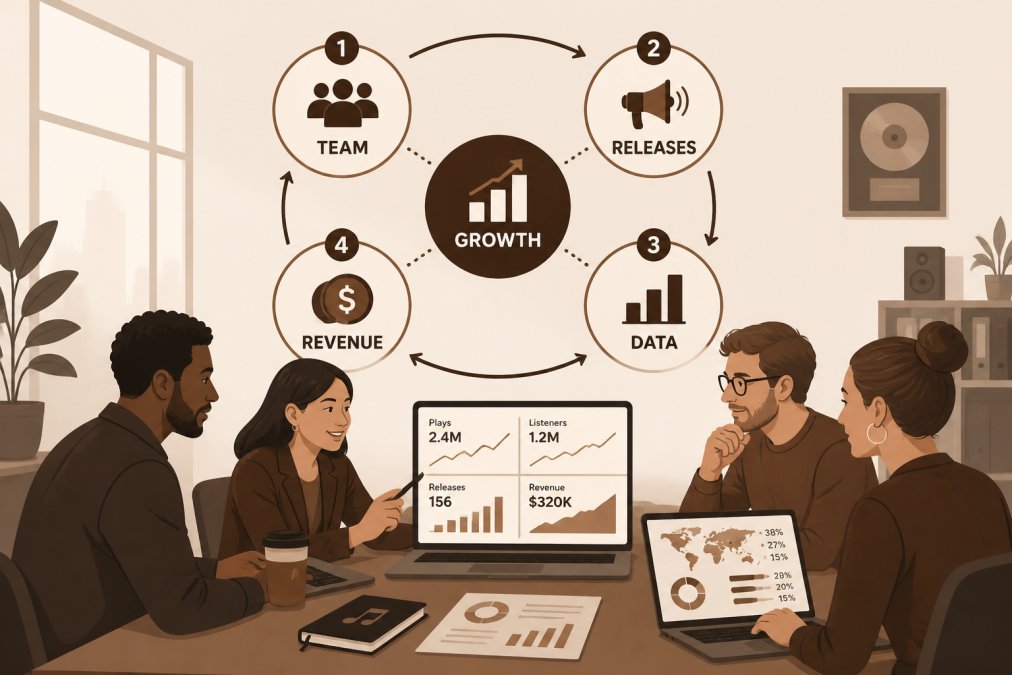
Music label team collaborating around a table with laptops, reviewing analytics dashboards and discussing strategy together in a modern office setting with natural light
When all four pillars are strong: Clear strategy attracts the right artists and guides hiring. Strong people execute the strategy consistently. Consistent execution generates predictable revenue. Healthy cash flow funds team growth and artist investment. This reinforces the strategy and creates a virtuous cycle.
## Verne Harnish Scaling Up Decisions: A Framework for Labels
The four pillars framework comes from Verne Harnish's Scaling Up methodology. At each stage of growth, you face specific decisions:
**Early stage (1-5 artists):** Can you establish a clear market position and build initial systems?
[Get Started Today →](https://nexatunes.com/?ref=blog.nexatunes.com)
**Growth stage (5-15 artists):** Can you hire the right people and build accountability?
**Scale stage (15-50 artists):** Can you maintain culture and execution quality as complexity increases?
**Mature stage (50+ artists):** Can you build a sustainable business that doesn't depend on you personally?
Most independent labels get stuck in the growth stage. They have 8-12 artists and are working 60+ hours per week. The Harnish framework says this is a leadership problem, not a capacity problem. You haven't built the people systems needed to scale. The solution is to pause growth temporarily and invest in the three other pillars.
## Common Pitfalls and How to Avoid Them
### Failure Analysis: Learning from Scaling Mistakes
The most common failure pattern is signing too many artists too fast. This creates chaos: your team can't manage the release calendar, quality control suffers, marketing gets spread too thin, and cash flow becomes erratic. The fix is counterintuitive: slow down. Focus on 5-8 artists and make them successful. Once you can consistently execute for that group, add more.
Another common failure is poor contract management. Sign every artist with a clear agreement specifying who owns the master recording, publishing splits, revenue splits, term, exclusivity, and recoupment. This takes an hour to document and saves months of conflict later.
A third failure pattern is ignoring cash flow until it's too late. You spend aggressively on marketing expecting big royalty payouts. The payouts are smaller than expected. You're suddenly cash-negative with no buffer. The fix is weekly cash flow tracking. Know your balance and what's coming in and when.
### Cultural Resistance and Change Management
As labels scale, team members often resist new processes. The key is involving the team in designing the changes. Instead of imposing a new system, ask: "What's your biggest pain point?" Listen and find a solution together. When team members understand the why, they're more willing to invest in the how.
### Post-Scale Maintenance and Sustainability
Once you've scaled to 20-30 artists and your systems are working, the temptation is to coast. This is where labels stagnate. Sustainable growth requires continuous improvement. Dedicate time monthly to reviewing your processes: What's working well? What's broken? What's missing? What can we simplify?
## Implementing the 4 Pillars in Your Music Label

Label manager reviewing detailed royalty reports and performance metrics on a computer screen in a professional office setting with organized workspace
Start by assessing where you are today. For each pillar, rate yourself on a scale of 1-10:
**People (1-10):** Do you have clear roles? Is accountability established? Is culture intentional?
**Strategy (1-10):** Can you articulate why an artist should sign with you? Do you have a clear growth roadmap?
**Execution (1-10):** Do releases go out on time? Are royalties paid accurately? Is there predictable rhythm?
**Cash (1-10):** Do you have financial visibility? Is cash flow positive? Do you have a reserve?
Pick the weakest pillar and strengthen it for the next 90 days. Once that pillar is stronger (7+), move to the next one. This sequential approach prevents overwhelm and creates momentum.
The journey from a solo label to a scalable operation takes 18-24 months to genuinely strengthen all four pillars. The result is a business that can grow without burning you out, that artists want to join, and that generates sustainable income.
NexaTunes supports this journey by providing the cash pillar infrastructure: reliable monthly royalty payouts, detailed label-level reporting, unlimited sublabels and artist management tools, and direct access to platforms like Beatport and Traxsource. When you have financial visibility and reliable payments, you can focus on building the other three pillars.
---
Scaling a music label feels overwhelming until you break it into the four pillars. Most labels struggle not because they lack talent or ambition, but because they're trying to grow without systems. Invest in your people, clarify your strategy, build execution discipline, and manage cash carefully. Get started with NexaTunes to establish the financial foundation, transparent royalty tracking, monthly payouts, and detailed reporting that shows exactly where your revenue comes from by platform and artist.
## Frequently Asked Questions
### What are the 4 pillars of scaling up?
The 4 pillars of scaling up are People (talent and culture), Strategy (competitive advantage), Execution (operational efficiency), and Cash (financial health and liquidity). These pillars work together to create sustainable growth. For music labels, this means building a strong team, defining your market position, establishing reliable processes, and maintaining healthy cash flow to support expansion across multiple sublabels and artists.
### How do I implement the 4 pillars of scaling up in my music label?
Start by assessing where your label stands in each pillar. For People, define roles and core values. For Strategy, identify what differentiates your label (genre focus, artist development approach, platform access like Beatport). For Execution, establish monthly reporting rhythms and integrate your distribution platform with your internal systems. For Cash, track royalty payouts by platform and artist to understand profitability. Use a distribution partner with detailed label-level reporting to support this visibility.
### What is Verne Harnish's Scaling Up methodology?
Verne Harnish's Scaling Up framework provides a business methodology built around the 4 pillars. It emphasizes strategic alignment, execution rhythm, and data-driven decisions. For music labels, this means establishing clear quarterly business reviews, tracking key performance indicators like revenue per artist and platform distribution, and ensuring all team members understand how their work contributes to growth. The methodology prioritizes accountability and regular communication to prevent growth plateaus.
### Why do the 4 pillars of scaling up matter for independent music labels?
Independent labels face unique scaling challenges: managing multiple sublabels, maintaining artist relationships, ensuring reliable royalty payments, and competing with larger distributors. The 4 pillars address each challenge directly. A strong People pillar builds artist loyalty. Strategy differentiates you in a crowded market. Execution ensures consistent, reliable service (like monthly payouts and transparent reporting). Cash management lets you invest in growth without financial stress. Together, they enable sustainable growth without losing your label's identity.
### How do I track if my label is scaling successfully across all 4 pillars?
Track specific metrics for each pillar. People: Team retention rate and leadership development progress. Strategy: Artist growth rate and market share in your genre. Execution: On-time delivery of releases, accuracy of royalty reports, and platform placement success (e.g., Beatport placements). Cash: Monthly revenue, working capital position, and profitability per sublabel. Use your distribution platform's detailed reporting to isolate these metrics by platform and artist, giving you complete visibility into what's working and where to adjust.
### What happens if one pillar is weak while others are strong?
Weak pillars create bottlenecks. A strong Strategy with weak Execution means good ideas don't reach artists or fans. Strong Cash with weak People means you can't hire talent to grow. Strong People with weak Strategy leads to team frustration and high turnover. The 4 pillars must develop together. If your label has strong artist relationships (People) but weak financial tracking (Cash), you can't scale confidently. Start by identifying your weakest pillar and address it first, then ensure the others stay balanced.
### How do technology and reporting tools fit into the 4 pillars framework?
Technology supports all 4 pillars. Your distribution platform (like NexaTunes) directly enables the Cash pillar through monthly payouts and detailed label-level reporting by platform and artist. It also supports Execution by automating release delivery and providing reliable data. A strong tech stack reduces manual work, freeing your team (People pillar) to focus on strategy and artist development. Choose platforms that integrate well with your existing tools to avoid data silos and ensure your team can access the information they need for strategic decisions.
[Get Started Today](https://nexatunes.com/?ref=blog.nexatunes.com)
**Editorial Transparency**: This article was created with the assistance of GrandRanker AI and reviewed, edited, fact-checked, and approved by the NexaTunes editorial team before publication.
****“If you’re looking for a reliable way to distribute your music to Major Platforms , NexaTunes offers direct distribution with transparent terms.**
[Learn more ](https://nexatunes.com/?ref=blog.nexatunes.com)
### Scaling Operations: Definition, Strategy & Implementation
URL: https://blog.nexatunes.com/what-are-scaling-operations/
Last updated: 2026-08-03T08:04:08.000Z
## Table of Contents
- [What Are Scaling Operations?](#what-are-scaling-operations)
- [How Scaling Operations Differ from Business Growth](#how-scaling-operations-differ-from-business-growth)
- [Scaling vs. Growing: Why the Distinction Matters](#scaling-vs-growing-why-the-distinction-matters)
- [Key Benefits of Scalable Operations](#key-benefits-of-scalable-operations)
- [Business Scalability: Building the Right Foundation](#business-scalability-building-the-right-foundation)
- [Infrastructure and Cloud Requirements](#infrastructure-and-cloud-requirements)
- [Repeatable Systems and Standard Operating Procedures](#repeatable-systems-and-standard-operating-procedures)
- [Process Automation and Workflow Optimization](#process-automation-and-workflow-optimization)
- [Identifying Bottlenecks and Capacity Planning](#identifying-bottlenecks-and-capacity-planning)
- [Vertical Scaling vs. Horizontal Scaling: Choosing Your Path](#vertical-scaling-vs-horizontal-scaling-choosing-your-path)
- [Effective Scaling Strategies for Sustainable Growth](#effective-scaling-strategies-for-sustainable-growth)
- [Managing Increased Demand Without Sacrificing Quality](#managing-increased-demand-without-sacrificing-quality)
- [Human Capital and Culture During Expansion](#human-capital-and-culture-during-expansion)
- [Financial Modeling for Scaling Operations](#financial-modeling-for-scaling-operations)
- [Technology Integration and Tool Stack for Scaling](#technology-integration-and-tool-stack-for-scaling)
# Scaling Operations: Definition, Strategy & Implementation
*Last Updated: August 2, 2026*
What are scaling operations? At NexaTunes, we work with independent labels and music distributors daily who ask this exact question as they grow beyond their initial launch phase. Scaling operations refers to the strategic process of expanding a business's capacity to handle increased demand, revenue, and complexity without proportional increases in costs or resources. It's fundamentally different from simply growing bigger, and that distinction matters enormously for your long-term success.
According to McKinsey's 2026 operations research, companies that scale intentionally report 40% higher operational efficiency than those that grow reactively. The difference lies in building repeatable systems, automating workflows, and planning infrastructure before you need it.
## What Are Scaling Operations?
Scaling operations means building your business so that it can handle 10x the volume without requiring 10x the people, time, or money. A scalable operation has repeatable systems, documented processes, and technology infrastructure that grows with demand. Your business should generate more revenue per employee, per dollar spent, and per hour of work as you expand. For music labels, scaling might mean moving from manually uploading tracks to each distributor individually to using automated distribution tools that push to 50+ platforms simultaneously.
**Pro Tip** The real test of operational scalability isn't whether you can handle growth, it's whether your team can handle growth without working 80-hour weeks. If expansion requires everyone to burn out, your systems aren't scalable yet.
## How Scaling Operations Differ from Business Growth
Growth and scaling are not the same thing. Growth means doing more: more revenue, more customers, more output. Scaling means doing more with proportionally less: more revenue per employee, more customers per support person, more output per dollar invested. A business can grow without scaling. Hiring 10 new people to serve 10 new clients is growth. Serving 100 new clients with those same 10 people using better systems is scaling.
Think about your music distribution workflow. Growth would mean hiring another person to handle more artist submissions. Scaling would mean implementing automation tools and clear processes so your existing team handles 5x the volume without adding headcount. The NexaTunes platform enables this by offering unlimited sublabels and artists under one account with automated reporting.
When you focus on growth alone, you accumulate technical debt and process inefficiencies. When you focus on scaling, you invest upfront in infrastructure and automation that pays dividends as volume increases.
## Scaling vs. Growing: Why the Distinction Matters
The distinction between scaling and growing determines whether expansion strengthens or destabilizes your business. [For independent record labels](https://blog.nexatunes.com/p/8a66760c-7e75-4000-91af-e3e7762849ee/), a label that grows by hiring more A&R staff for each new artist builds a fragile structure. A label that scales uses better distribution platforms, standardized artist agreements, templated workflows, and data-driven decision making to expand without hiring proportionally.
The best way to test this: if you doubled your revenue tomorrow, could your current team handle it? If yes, you have scalability. If no, you have growth but not scaling.
**Key Takeaway** Scaling operations is about building systems that work at any size. Growth is about adding volume. The best businesses do both simultaneously.
## Key Benefits of Scalable Operations
**Improved unit economics.** As you scale, your cost per transaction, per customer, or per unit of output decreases. In music distribution, your cost per artist, per release, or per platform placement drops as you optimize workflows and use automation.
**Reduced operational friction.** Scalable operations have documented processes and minimal manual handoffs. Your team spends less time on repetitive tasks and more time on strategic work, reducing burnout and improving retention.
**Better quality at scale.** Well-designed scalable systems often improve quality through standardized processes, automated quality checks, and clear workflows that prevent errors.
**Faster decision-making.** When you have repeatable systems and clear data flows, decisions become faster and more informed.
**Attracting investment and talent.** Investors and top talent are attracted to scalable businesses that demonstrate proof of sustainable growth.
## Business Scalability: Building the Right Foundation
Before you can scale operations, you need the right foundation: infrastructure, processes, and culture that support expansion without collapse. For music labels, the foundation includes your distribution infrastructure, artist management systems, royalty tracking, and financial modeling. If you're managing artists in spreadsheets and distributing manually to each platform, you don't have a scalable foundation.
### Infrastructure and Cloud Requirements
[Scalable infrastructure](https://blog.nexatunes.com/p/3f931604-2d9b-4474-b6a0-52ae23bdde5e/) is the backbone of operational scaling. You need systems that can handle increased data volume, more users, and more transactions without degrading performance. Cloud infrastructure like Amazon Web Services, Google Cloud, or Microsoft Azure provides flexibility to add capacity on demand without massive upfront investment.
For music distribution, your infrastructure needs include secure file storage for audio files, database capacity for metadata, API connections to distribution partners, and reporting systems that aggregate data across platforms. NexaTunes handles this infrastructure complexity, providing reliable cloud-based systems that scale as your label grows, with direct access to major platforms and monthly royalty payouts backed by detailed reporting.
Your infrastructure should also include redundancy and backup systems. If your distribution system goes down, artists' releases can't be pushed to platforms. You need failover systems and disaster recovery plans.
**Watch Out** Waiting to build scalable infrastructure until after you need it is a common mistake. Build infrastructure for 5-10x your current size before you need it; the cost is minimal compared to the productivity gains.
### Repeatable Systems and Standard Operating Procedures
Infrastructure alone doesn't scale your operations. You also need repeatable systems and documented processes, called standard operating procedures (SOPs). An SOP is a step-by-step guide for how something gets done, documenting the current best practice so anyone on your team can execute it consistently.
For a music label, you might have SOPs for onboarding artists, releasing singles, handling royalty disputes, and managing sublabel relationships. When you have clear SOPs, a new team member can execute these processes without constant guidance. Your operations don't slow down when someone is sick or on vacation. Additionally, documenting processes reveals inefficiencies and waste that you can then eliminate.
## Process Automation and Workflow Optimization
Once you've documented your processes, the next step is automating the repetitive parts. Automation is how you scale operations without proportional headcount increases. A music label might automate metadata ingestion, distribution scheduling, royalty calculations, and reporting generation. Each automation saves time on repetitive tasks, freeing your team to focus on artist development and relationship building.
The key is choosing the right things to automate. Automate high-volume, repetitive, low-error-tolerance tasks. If a task takes more than 30 minutes per week and follows a predictable pattern, it's a candidate for automation.
### Identifying Bottlenecks and Capacity Planning
Every operation has bottlenecks, places where the workflow slows down or capacity is constrained. A bottleneck is typically a step that takes longer than other steps or requires a scarce resource. In a music label, a common bottleneck is the A&R review process. If your A&R team can only review 20 submissions per week but you're getting 50, you have a bottleneck.
To identify bottlenecks, map your workflow and measure how long each step takes. Once identified, you can add capacity, automate the step, eliminate it, or change the process to work around it. Capacity planning means understanding how much volume your operation can handle and planning for growth proactively.
## Vertical Scaling vs. Horizontal Scaling: Choosing Your Path
As you plan infrastructure expansion, you'll encounter two approaches: vertical and horizontal scaling. **Vertical scaling** means making your existing systems more powerful by upgrading servers or increasing database storage. **Horizontal scaling** means adding more systems to distribute the load across multiple servers.
Vertical scaling is simpler to implement but has limits. Horizontal scaling is more complex but can theoretically scale infinitely. For most modern operations, horizontal scaling is the better long-term approach. It's more resilient, flexible, and cost-effective at scale. Cloud platforms are designed around horizontal scaling. Using a platform like NexaTunes that's already built on scalable cloud infrastructure means you don't have to manage the complexity yourself.
## Effective Scaling Strategies for Sustainable Growth
Scaling operations isn't just about adding capacity. It's about building a business that can grow sustainably without burning out your team, sacrificing quality, or losing your core values.
### Managing Increased Demand Without Sacrificing Quality
The central tension of scaling is how to handle more volume without quality degradation. The answer is that quality and scale aren't opposites if you design your systems correctly. Well-designed scalable systems often improve quality because they eliminate errors and inconsistencies that creep in during rapid growth.

Analytics dashboard showing Team for scaling operations
The key is standardization. When you have clear quality standards, documented processes, and consistent workflows, you can maintain quality at scale. Every artist's release gets the same attention to detail. Every royalty calculation follows the same methodology. Quality assurance becomes part of your process, not an afterthought.
### Human Capital and Culture During Expansion
Scaling operations means scaling your team, and culture becomes critical. Many companies scale infrastructure and processes flawlessly but lose their identity when they expand. As you hire new people, you dilute the institutional knowledge and informal culture that made your early operation successful. The solution is intentional culture building: document your values, hire for cultural fit, and create rituals and communication structures that maintain alignment as you grow.
For music labels, maintaining relationships with artists is your core asset. As you grow, you need systems that help your team maintain those relationships at scale through clear escalation procedures, regular check-ins, and transparent communication.
**Key Takeaway** Culture doesn't scale automatically. You have to build it intentionally. The companies that scale successfully invest as much in culture and people as they do in infrastructure and processes.
### Financial Modeling for Scaling Operations
You can't scale blindly. You need to understand the financial implications of your growth and ensure that scaling actually improves your unit economics. Financial modeling means projecting how your costs and revenues will change as you grow. What's your cost per artist? Your cost per release? As you add volume, do these costs decrease, stay flat, or increase?
A simple financial model for a music label includes fixed costs (platform subscriptions, staff salaries, office rent) that stay relatively constant as you grow, and variable costs (per-artist onboarding time, per-release distribution time) that increase with volume. As you grow, your fixed costs get spread across more artists and releases, lowering your per-unit cost. Model your growth before you scale to identify where you'll hit constraints and plan accordingly.
## Technology Integration and Tool Stack for Scaling
Your technology stack is the set of tools and platforms you use to run your business. As you scale, your tool stack needs to scale with you. Early-stage operations often use generic tools that become bottlenecks as you grow. You need specialized tools that handle your specific workflow and integrate with each other.
For music labels, your tool stack might include a distribution platform, artist management system, royalty accounting software, project management tool, communication platform, and financial management software. The critical requirement is integration. These tools need to talk to each other without manual data copying.
NexaTunes addresses this by providing a unified distribution and reporting platform specifically designed for labels. Rather than cobbling together multiple tools, you get distribution, artist management, and detailed [royalty reporting](https://blog.nexatunes.com/p/1ecd40ce-def5-4210-b2e5-2682b13445e1/) in one integrated system. The platform handles connections to major platforms like Beatport and Traxsource and provides the reporting detail that labels need. When evaluating tools, look for scalability, integration via APIs, automation capabilities, reporting depth, and quality support.
---
Scaling operations is a continuous process of building better systems, removing bottlenecks, and aligning your team around sustainable growth. The labels that succeed invest in infrastructure, processes, and culture before they need to. If you're managing multiple sublabels or planning rapid growth, start with a distribution platform built for scale. NexaTunes provides unlimited sublabels, automated distribution to major platforms, and transparent monthly royalty reporting, infrastructure designed specifically to help labels grow without losing visibility or control.
## Frequently Asked Questions
### What's the difference between scaling operations and business growth?
Growth means increasing revenue or output by adding proportional resources. Scaling operations means growing revenue or output without proportionally increasing costs or headcount. For example, a music label can scale by automating royalty reporting and using cloud infrastructure instead of hiring five new accountants. Scaling focuses on operational efficiency and repeatable systems; growth focuses on expansion.
### How does process automation help with scaling operations?
Process automation removes manual, repetitive tasks so your team handles more work without hiring additional staff. In music distribution, automation can manage metadata ingestion, royalty calculations, and report generation. This reduces errors, saves time, and allows your operation to handle 10x more artists or sublabels without proportional cost increases. Automation is essential for sustainable scaling.
### What are the main challenges when scaling operations?
Common challenges include technical debt accumulating as systems grow, maintaining quality as demand increases, managing team culture during rapid expansion, and forecasting resource needs accurately. Music labels often face scaling pains when their distribution platform can't handle increased artist volume or when royalty reporting becomes unreliable at scale. Planning for these challenges upfront prevents costly failures later.
### Should I choose vertical or horizontal scaling for my music label?
Vertical scaling means upgrading existing infrastructure (a more powerful server), while horizontal scaling means adding more infrastructure units (multiple servers). For music distribution, horizontal scaling is typically better because it handles growing artist volume more reliably and costs less than constantly upgrading single systems. Cloud-based platforms that support unlimited sublabels and artists use horizontal scaling principles.
**Editorial Transparency**: This article was created with the assistance of GrandRanker AI and reviewed, edited, fact-checked, and approved by the NexaTunes editorial team before publication.
****“If you’re looking for a reliable way to distribute your music to Major Platforms , NexaTunes offers direct distribution with transparent terms.**
[Learn more ](https://nexatunes.com/?ref=blog.nexatunes.com)
### Independent vs Major Label Structure: Key Differences
URL: https://blog.nexatunes.com/independent-vs-major-label-structure/
Last updated: 2026-08-03T08:03:38.000Z
## Table of Contents
- [Independent vs Major Label Structure: Core Differences](#independent-vs-major-label-structure-core-differences)
- [What Defines a Major Label](#what-defines-a-major-label)
- [What Defines an Independent Label](#what-defines-an-independent-label)
- [Major Label vs Independent Label Pros and Cons](#major-label-vs-independent-label-pros-and-cons)
- [Major Label Advantages and Disadvantages](#major-label-advantages-and-disadvantages)
- [Independent Label Advantages and Disadvantages](#independent-label-advantages-and-disadvantages)
- [Creative Control and Artist Development: Major vs Independent](#creative-control-and-artist-development-major-vs-independent)
- [Record Label Deal Terms and Contractual Obligations](#record-label-deal-terms-and-contractual-obligations)
- [Advance Payments and Recoupment](#advance-payments-and-recoupment)
- [Royalty Rates and Revenue Share](#royalty-rates-and-revenue-share)
- [Publishing Rights and Ownership](#publishing-rights-and-ownership)
- [Distribution, Marketing, and Market Reach](#distribution-marketing-and-market-reach)
- [Industry Infrastructure and Radio Promotion](#industry-infrastructure-and-radio-promotion)
- [Streaming Analytics and Data-Driven Decisions](#streaming-analytics-and-data-driven-decisions)
- [DIY Music Distribution and Hybrid Models](#diy-music-distribution-and-hybrid-models)
- [The Rise of Hybrid Distribution Models](#the-rise-of-hybrid-distribution-models)
- [Exit Strategies and Contract Termination](#exit-strategies-and-contract-termination)
- [Decision-Making Speed and Roster Management](#decision-making-speed-and-roster-management)
- [Which Structure Aligns With Your Career Trajectory](#which-structure-aligns-with-your-career-trajectory)
*Last Updated: August 1, 2026*
## Independent vs Major Label Structure: Core Differences
Understanding independent record label vs major label structure is essential for any artist or label owner navigating today's music industry. These two distinct business models shape everything from how royalties flow to who controls your creative output. According to RIAA 2026 Music Industry Report, independent artists now account for a significant portion of streaming revenue, fundamentally shifting how the industry operates.
## What Defines a Major Label
A major label operates as a full-service entertainment company with massive infrastructure and industry connections. The three dominant majors, Universal Music Group, Sony Music Entertainment, and Warner Music Group, control distribution to every streaming platform, radio station, and retail outlet globally. They employ hundreds of specialists: producers, engineers, marketers, publicists, sync licensing experts, and attorneys.
The contractual relationship is typically exclusive and long-term. You surrender master recording ownership to the label, though publishing rights can remain yours. The label controls how your music gets exploited commercially, including radio promotion, sync deals, and touring support decisions.
## What Defines an Independent Label
An independent label operates without major label backing, defined by autonomy: you retain ownership of master recordings and maintain control over distribution and promotion. Independent labels use third-party [distribution services](https://nexatunes.com/distribution/?ref=blog.nexatunes.com) to reach streaming platforms and retail channels.
The financial model differs fundamentally. Instead of receiving an advance, independent labels keep a higher percentage of revenue with no recoupment burden, you earn from day one. However, you bear all costs: production, marketing, distribution fees, and artist development.
## Major Label vs Independent Label Pros and Cons
### Major Label Advantages and Disadvantages
**Advantages:**
Major labels provide resources independent operations cannot match. An advance payment supplies immediate capital for quality production, music videos, and marketing. Radio promotion teams have nationwide relationships that dramatically increase on-air play chances. Distribution infrastructure reaches every platform globally with no technical barriers. Artist development is structured, with mentors, top producers, and songwriters assigned to guide your career. The label absorbs financial risk, if your project doesn't recoup, they eat the loss.
**Disadvantages:**
Recoupment creates a debt-like relationship. The label must recoup all expenses before you see royalties. Many artists never recoup, earning nothing despite generating streams and sales. Creative control is limited; the label has final say on singles, artwork, and promotional strategy. Contractual obligations typically lock you in for 5-7 years with rare exit clauses. Royalty rates are lower, major labels take 15-25% of revenue after expenses, leaving you with the remainder.
### Independent Label Advantages and Disadvantages
**Advantages:**
You retain ownership of master recordings, a fundamental asset with real financial value. Royalty rates are dramatically higher, using many distribution services, you keep 100% of streaming revenue minus a distribution fee. Decision-making is instant: release a surprise single, approve a remix, or adjust strategy without committee approval. You maintain complete creative control and earn from your first stream with no recoupment burden.
**Disadvantages:**
You bear all financial risk. Production, marketing, and [distribution fees](https://nexatunes.com/plans/?ref=blog.nexatunes.com) come from your pocket. Marketing reach is limited without a major label's radio promotion team and industry connections. Artist development is self-directed with no assigned mentor or access to top producers on favorable terms. Advance payments don't exist, so you start with zero capital. Sync licensing opportunities are harder to secure without dedicated sync teams and industry relationships.
**Pro Tip** The real advantage of independent labels today is speed. In 12 months, an independent label can release 12 singles and test what resonates. A major label artist might release one album in that time, after months of approval cycles.
## Creative Control and Artist Development: Major vs Independent
Major labels employ A&R professionals who shape your sound toward commercial viability, providing access to top producers and collaborators. Some artists thrive under this guidance; others resent the constraints.
Independent artists develop themselves or hire consultants, requiring self-awareness and industry knowledge. The decision-making speed difference is stark: a major label artist wanting to release a remix needs approval from multiple parties, taking weeks. An independent artist can release immediately, assuming rights are cleared.
**Key Takeaway** Creative control without expertise is a liability. Independent artists with strong instincts and industry knowledge thrive. Those without often waste time and money on ineffective strategies.
## Record Label Deal Terms and Contractual Obligations
### Advance Payments and Recoupment
An advance is a loan against future royalties. A $100,000 advance means you owe $100,000 in royalties before earning another penny. Recoupable costs typically include production, music videos, marketing campaigns, and tour support. Music Business Association recoupment analysis shows most artists never recoup. Independent artists using distribution services pay a flat fee with no recoupment, earning from stream one, though they pay for production and marketing directly.
### Royalty Rates and Revenue Share
Major label royalty rates vary by deal type. New artists might receive 15-18% of revenue after the label's cut; established artists negotiate 20-25%. These percentages apply only after recoupable expenses and label overhead.
Streaming royalties are particularly problematic. Spotify pays approximately $0.003-$0.005 per stream. A song with one million streams might generate $3,000-$5,000 in gross revenue, but after the label's percentage and recoupment, you might see $200.
Independent artists using distribution services keep much higher percentages. Many services allow artists to keep 100% of streaming royalties, while others take a commission. An independent artist with 10 million annual streams might earn $30,000-$40,000, while a major label artist with the same streams might earn $2,000-$5,000.
### Publishing Rights and Ownership
Publishing rights are the composition itself, melody, lyrics, and chord progression. Master rights are the specific recording. These are separate assets with separate revenue streams.
Major labels typically retain master rights but allow you to keep publishing. Some demand a percentage of publishing as part of the deal. Independent artists retain both master and publishing rights. If your song gets placed in a Netflix series, you collect both the master sync fee and the publishing sync fee. Over a 20-year career, owning your masters and publishing generates substantially more revenue than a major label deal where you never recoup.
## Distribution, Marketing, and Market Reach
### Industry Infrastructure and Radio Promotion
Major labels have radio promotion teams maintaining relationships with thousands of program directors. These relationships translate to on-air play, which still drives significant revenue and cultural impact. Getting a song on Top 40 radio requires label connections most independent artists cannot access.

Music producer or label manager reviewing streaming analytics and platform data on multiple monitors in a professional studio or office environment, with detailed dashboards visible
Distribution infrastructure at major labels includes physical retail relationships, digital service provider partnerships, and direct platform relationships. Independent artists rely on distribution services like NexaTunes to handle technical delivery. The gap in marketing reach is real but narrowing, streaming algorithms now favor data-driven promotion over traditional radio.
### Streaming Analytics and Data-Driven Decisions
Major labels have dedicated analytics teams monitoring streaming performance and audience demographics. Independent artists using platforms like NexaTunes get detailed, label-level reporting showing exactly where streams come from and demographic insights about their audience.
**Watch Out** Many distribution services provide vague analytics that hide where your money comes from. Demand platform-by-platform breakdown and artist-level detail. Without this visibility, you're flying blind on marketing decisions.
## DIY Music Distribution and Hybrid Models
### The Rise of Hybrid Distribution Models
The traditional binary choice between major label and complete independence has fragmented into dozens of hybrid models. Many successful artists use multiple strategies simultaneously: independent release through a distribution service (retaining ownership and higher royalties), strategic partnership with a label for radio promotion on specific singles, and licensing deals through a sync agency.
Some artists sign to independent labels that use distribution services rather than building in-house infrastructure, offering A&R support and marketing assistance without restrictive contracts and recoupment burdens. The rise of hybrid models reflects a fundamental shift: artists no longer need to choose between creative control and professional support.
### Exit Strategies and Contract Termination
Major label contracts typically run 5-7 years with multiple album commitments. Exiting early is difficult and expensive. Some contracts include reversion clauses, if the label doesn't release your album within a specified timeframe, rights revert to you, though these are rare.
Independent artists using distribution services face no long-term contracts. Most charge annual or per-release fees with no commitment. For artists considering label deals, negotiating exit clauses and reversion rights is critical.
## Decision-Making Speed and Roster Management
Major labels manage hundreds or thousands of artists simultaneously. Decision-making is centralized and bureaucratic, taking weeks or months to approve a remix or adjust marketing strategy. Roster management involves strategic decisions about which artists to prioritize. If your project isn't generating expected momentum, the label may shift resources elsewhere, leaving you contractually bound but commercially abandoned.
Independent labels can pivot instantly. A label manager noticing one artist's content gaining traction can immediately allocate more marketing budget or push additional releases.
**Pro Tip** If considering a major label deal, negotiate specific commitments: minimum marketing budget, guaranteed radio promotion budget, and defined timelines for decision-making. Vague commitments mean deprioritization when label priorities shift.
## Which Structure Aligns With Your Career Trajectory
**Choose major label if:**
- You're early in your career and need capital, mentorship, and infrastructure
- Radio play and mainstream visibility are critical to your genre
- You're willing to trade ownership for professional support and resources
- You have leverage (existing fanbase, proven commercial success) to negotiate favorable terms
**Choose independent if:**
- You've already built a fanbase and can fund projects yourself
- Creative control and ownership are non-negotiable
- Your genre thrives on streaming and direct-to-fan relationships
- You want to move quickly and test ideas frequently
**Choose hybrid if:**
- You want independence with selective professional support
- You're willing to negotiate partnerships on a project-by-project basis
- You have the bandwidth to manage multiple relationships and contracts
- You want to retain ownership while accessing label resources strategically
The music industry is no longer a two-path system. Most successful artists today operate in hybrid spaces, using distribution services for ownership and reach while maintaining relationships with producers, managers, and sometimes label partners for specific initiatives.
---
Building a sustainable music career requires transparent infrastructure and reliable financial reporting. NexaTunes provides independent labels with professional distribution to major platforms like Beatport and Traxsource, monthly royalty payouts, and detailed label-level reporting that shows exactly where your revenue comes from. With unlimited sublabels and artist management tools, you maintain complete control over your catalog while accessing the infrastructure that once required major label backing. Get started with NexaTunes and scale your music business without surrendering ownership.
| Structure | Ownership | Advance | Royalty Rate | Creative Control | Speed | Best For |
| ----------- | ------------------ | ----------- | ----------------------- | ---------------- | -------------------- | -------------------------------------- |
| Major Label | Label owns masters | $50K-$500K+ | 15-25% after recoupment | Limited | Slow (weeks) | Artists needing capital and radio play |
| Independent | Artist retains | $0 | 70-100% | Complete | Fast (days) | Artists with fanbase and capital |
| Hybrid | Artist retains | Varies | 60-90% | Mostly yours | Moderate (1-2 weeks) | Artists balancing support and control |
| Advantage | Major Label | Independent | Hybrid |
| ------------------ | ----------- | ------------- | --------------- |
| Upfront Capital | Yes | No | Sometimes |
| Ownership | No | Yes | Yes |
| Radio Promotion | Extensive | Limited | Selective |
| Creative Control | Limited | Complete | Mostly complete |
| Decision Speed | Slow | Fast | Moderate |
| Royalty Rate | Low | High | High |
| Artist Development | Structured | Self-directed | Mixed |
## Frequently Asked Questions
### What are the main differences between major and independent record labels?
Major labels operate within large corporate structures with extensive infrastructure, established distribution networks, and significant marketing budgets. Independent labels function with smaller teams, more agile decision-making, and direct artist relationships. Major labels typically own master recordings and retain larger revenue shares, while independent labels often allow artists greater ownership and creative autonomy. The structural difference affects everything from contract terms to promotional reach and artist development timelines.
### Do independent labels offer more creative control than major labels?
Yes, independent labels generally provide more creative control and artistic freedom. With smaller rosters and fewer bureaucratic layers, indie labels can accommodate unique brand identities and experimental sounds. Major labels, managing larger artist rosters, often require music to fit commercial formulas and align with A&R strategies. Independent labels typically allow artists to make decisions faster, approve their own releases, and maintain stronger input on visual branding and promotional direction.
### How do royalty rates and record label deal terms differ between major and independent labels?
Major labels typically offer advances and higher marketing budgets but retain 70-85% of streaming revenue after recoupment, with royalty rates between 15-30%. Independent labels often offer 50-80% royalty rates with lower or no advances. Deal terms vary significantly: major labels require long-term commitments and ownership of master recordings, while independent labels frequently allow artists to retain masters. Recoupment timelines also differ, major label advances take longer to recoup, while indie deals often break even faster due to lower expenses.
### What are the benefits of DIY music distribution for independent artists and labels?
DIY distribution platforms enable artists and labels to retain 100% ownership of master recordings and keep higher royalty percentages. These services provide direct access to streaming platforms like Spotify and Apple Music without intermediaries. Benefits include transparent, detailed label-level reporting showing exactly where earnings come from by platform and artist, monthly royalty payouts, and scalable infrastructure for managing multiple sublabels. Artists maintain full control over release timing, pricing, and promotional strategies while avoiding long-term contractual obligations.
### Can independent labels transition to major label status or use hybrid distribution models?
Yes, independent labels can grow into major-label-like operations or adopt hybrid models combining traditional and modern approaches. Hybrid models allow labels to use DIY distribution platforms for catalog management while partnering with major labels for specific releases or territories. This approach provides the agility of independence with access to major-label resources. Exit strategies matter too, successful indie labels can negotiate licensing deals, secure investment, or maintain independence while scaling through third-party management and data-driven decision-making across multiple sublabels and artists.
**Editorial Transparency**: This article was created with the assistance of GrandRanker AI and reviewed, edited, fact-checked, and approved by the NexaTunes editorial team before publication.
****“If you’re looking for a reliable way to distribute your music to Major Platforms , NexaTunes offers direct distribution with transparent terms.**
[Learn more ](https://nexatunes.com/?ref=blog.nexatunes.com)
### Scale a Record Label for Beginners: 7 Steps
URL: https://blog.nexatunes.com/scale-a-record-label-for-beginners-7-steps/
Last updated: 2026-07-31T13:00:53.000Z
## Table of Contents
- [What You'll Need Before Scaling Your Record Label](#what-youll-need-before-scaling-your-record-label)
- [Step 1: Build a Solid Record Label Business Plan](#step-1-build-a-solid-record-label-business-plan)
- [Define your label identity and market positioning](#define-your-label-identity-and-market-positioning)
- [Set realistic growth targets and timelines](#set-realistic-growth-targets-and-timelines)
- [Step 2: Secure Funding for Independent Record Labels](#step-2-secure-funding-for-independent-record-labels)
- [Step 3: Optimize Music Distribution for Independent Labels](#step-3-optimize-music-distribution-for-independent-labels)
- [Choose the right distribution partner](#choose-the-right-distribution-partner)
- [Manage multiple sublabels and catalogs efficiently](#manage-multiple-sublabels-and-catalogs-efficiently)
- [Step 4: Implement Data-Driven Artist Development Strategies](#step-4-implement-data-driven-artist-development-strategies)
- [Use analytics to identify emerging talent](#use-analytics-to-identify-emerging-talent)
- [Build long-term artist relationships and contracts](#build-long-term-artist-relationships-and-contracts)
- [Step 5: Automate Operations to Scale a Record Label](#step-5-automate-operations-to-scale-a-record-label)
- [Streamline royalty accounting and payments](#streamline-royalty-accounting-and-payments)
- [Automate release scheduling and metadata management](#automate-release-scheduling-and-metadata-management)
- [Step 6: Establish Tax Compliance and Financial Controls](#step-6-establish-tax-compliance-and-financial-controls)
- [Step 7: Plan Your Exit Strategy and Long-Term Growth](#step-7-plan-your-exit-strategy-and-long-term-growth)
# Scale a Record Label for Beginners: 7 Steps
*Last Updated: July 31, 2026*
## What You'll Need Before Scaling Your Record Label
Building a sustainable record label requires more than passion for music. Before you add artists, negotiate deals, or expand into new markets, you need five core elements in place: a clear business structure (typically an LLC), a [distribution partner](https://nexatunes.com/tag/distribution/?ref=blog.nexatunes.com) that reaches streaming platforms like Spotify and Apple Music, a basic understanding of music rights (master rights, publishing rights, and mechanical royalties), startup capital for registration and software, and a catalog management system to track releases and royalties as you grow.
**Key Takeaway** Most labels fail not because they lack talent, but because they skip the operational foundation. Get this right before scaling anything.
The difference between a label that stalls at five artists and one that reaches fifty comes down to systems. Without them, you're manually managing contracts and losing money to overhead. With them, you can onboard new artists in days instead of weeks.
## Step 1: Build a Solid Record Label Business Plan
Your business plan is a living framework that guides every decision as you scale.
### Define your label identity and market positioning
Start by answering three hard questions: What genre are you focusing on? Who are your target artists? What's your competitive advantage?
Many labels try to be everything, house, techno, drum and bass, trap. That's a scaling killer. Instead, own a specific corner of the market. If you're focused on deep house, you become known for deep house. Your A&R instincts sharpen. Your playlist relationships deepen. Your marketing message becomes clear.
Positioning also determines your revenue model. Underground labels often rely on Bandcamp sales and vinyl, while commercial labels depend on streaming payouts and sync licensing. Know which revenue streams align with your positioning before you start signing artists.
**Pro Tip** Document your positioning in 200 words. When evaluating a new artist, you'll use this to ask: does this fit our label identity? This one document saves months of wasted effort on misaligned signings.
### Set realistic growth targets and timelines
Most labels see this pattern: slow growth in year one (5-10 releases), acceleration in year two (20-30 releases), then either plateau or explosion depending on whether you've built the right systems.
Set targets by releases per month, not revenue. Instead, commit to: "We will release 15 quality tracks in the next 12 months across 8-10 artists." This gives you a clear operational target and forces you to think about capacity.
Most labels that scale successfully spend 6-12 months building systems before aggressively expanding. This isn't wasted time, it's the difference between a label that can handle growth and one that collapses under it.
## Step 2: Secure Funding for Independent Record Labels
Funding comes from three sources: your own savings, reinvested label revenue, or external investment. Most successful labels start with the first and transition to the second.
Calculate your actual startup costs. Business registration costs $50-150\. [Music distribution platform](https://nexatunes.com/distribution/?ref=blog.nexatunes.com) fees vary. Copyright registration costs $65 per work. Basic accounting software runs $100-300 per year. A website and email hosting might cost $200-500 annually. That's roughly $1,000-2,000 to launch lean.
Once operational, you need working capital for artist advances, marketing, and tools like royalty accounting software. Many labels allocate 10-15% of projected revenue to operational costs in year two.
**Watch Out** The biggest mistake is underfunding operations while overfunding artist advances. A $5,000 advance to an artist who doesn't deliver is money you can't get back. A $500 investment in royalty tracking software pays dividends for years.
The most sustainable approach: start with your own capital, launch 5-10 releases, reinvest the revenue, then decide if you need external funding. By that point, you'll have real data to show investors.
## Step 3: Optimize Music Distribution for Independent Labels
Distribution is the bridge between your label and the listener. Get this right, and you unlock access to billions of streams.
### Choose the right distribution partner
Your distribution partner determines which platforms you can access. Some platforms, like Beatport and Traxsource, are only available through specific distributors. If your label focuses on electronic music, these platforms are non-negotiable.
NexaTunes provides direct access to Beatport and Traxsource while covering all major streaming platforms. Beatport drives discovery for electronic music in ways that Spotify doesn't. A track charting on Beatport's top 100 can drive bookings, sync opportunities, and credibility that streaming payouts alone won't generate.
When evaluating a distribution partner, ask: What platforms do they cover? How quickly do releases go live? What's their royalty payout schedule? Do they offer detailed reporting by platform and by artist?
Monthly payouts matter more than you'd think. If your distributor pays quarterly, you're financing their operations with your money. Transparent, detailed reporting is non-negotiable, you need to see exactly where your royalties come from so you can make data-driven decisions about which releases and artists are actually driving revenue.
### Manage multiple sublabels and catalogs efficiently
As you scale, you'll likely create sublabels for main releases, experimental work, and compilations. A distribution platform that supports unlimited sublabels saves you hundreds of hours and keeps your reporting clean.
Metadata management becomes critical. Every release needs accurate ISRC codes, split sheets showing who owns publishing rights, and correct artist credits. Mistakes compound across all platforms. Invest in a system that enforces metadata standards from day one.
## Step 4: Implement Data-Driven Artist Development Strategies
The difference between a label that signs random artists and one that builds sustainable careers is data. Data tells you which artists are gaining momentum and where to invest your promotional resources.
### Use analytics to identify emerging talent
Before you sign an artist, look at their data. How many monthly listeners do they have? Are those listeners growing? Which releases get the most saves versus skips?
Platforms like Spotify for Artists and Apple Music for Artists provide this data for free. An artist with 5,000 monthly listeners but 40% save rate is more promising than an artist with 50,000 listeners and 15% save rate. The first artist has engaged fans. The second has casual listeners.
Look at geographic data too. If an artist's listeners are concentrated in three cities, that tells you where to focus tour promotion. If they're distributed globally, you have different marketing opportunities.
**Pro Tip** When evaluating a new artist, pull their Spotify for Artists analytics and check their social media growth trajectory. The data takes 20 minutes and saves you from signing artists who won't scale.
### Build long-term artist relationships and contracts
Scaling a label is about building deep relationships with 10-20 artists and growing with them over years, not signing 100 artists once.
Your contract structure should reflect this. Work-for-hire agreements work for one-off releases. For long-term relationships, use an artist agreement that covers multiple releases, defines royalty splits, and clarifies what happens if either party wants to leave. Most artist agreements specify the number of releases, royalty percentage (typically 80-90% to the artist), advance payments if applicable, and rights reversion after a certain period.
Track artist performance over time. Which artists consistently deliver quality releases? Double down on those relationships. Invest more in marketing for them. The artists who drive your label's growth deserve your best resources.
## Step 5: Automate Operations to Scale a Record Label
This is where most labels fail to scale. They can handle 10 releases. They can't handle 50\. The difference is automation.

Music producer or label manager reviewing analytics dashboard on multiple monitors in a modern studio workspace, showing colorful waveforms and data charts
### Simplify royalty accounting and payments
Manual royalty tracking is a disaster at scale. Use a dedicated royalty accounting system that pulls data directly from your distribution partner, calculates splits automatically, and generates reports you can send to artists. Most systems cost $50-200 per month depending on volume.
Instead of spending 10 hours per month manually reconciling royalties, you spend 30 minutes reviewing automated reports. That's 9.5 hours per month you can spend on A&R, marketing, or business development.
Automation also builds trust. When artists see transparent, detailed reports showing exactly where their royalties came from, they're more likely to sign multiple releases with you.
### Automate release scheduling and metadata management
Create a release calendar 3-6 months out. For each release, automate metadata submission to your distributor, playlist pitch emails, social media scheduling, and artist payment processing.
Most of this can be done with basic tools. A spreadsheet shows which releases are due when. Email templates let you pitch playlists in minutes. Social media scheduling tools let you batch-create posts for the month.
The key is consistency. If you release music on the same day each week, your audience learns to expect it. Automation enables consistency at scale.
## Step 6: Establish Tax Compliance and Financial Controls
Register your label as an LLC in your state. This separates your personal finances from your label's finances and provides liability protection. Formation typically costs $50-150 and takes 1-2 weeks.
Open a dedicated business bank account. Never mix personal and business money. This makes accounting simple and keeps you audit-ready.
Understand your tax obligations. As a label, you're responsible for income tax on label revenue, sales tax on physical merchandise in most states, and potentially payroll taxes if you hire employees. Work with a CPA who understands music businesses. They'll cost $1,500-3,000 per year but will save you multiples of that in tax optimization.
Track expenses meticulously. Everything you spend on the label, software subscriptions, artist advances, marketing, equipment, is deductible. Use [accounting software](https://nexatunes.com/plans/?ref=blog.nexatunes.com) like QuickBooks or Wave to categorize expenses automatically.
**Watch Out** The IRS audits small businesses that show inconsistent income patterns. Document everything. Consistent record-keeping is your best defense.
Set aside 25-30% of label revenue for taxes. Money sits in a tax reserve account until you file your return. This prevents the nightmare of owing taxes you can't pay.
## Step 7: Plan Your Exit Strategy and Long-Term Growth
The best way to build a sustainable label is to think about how you'd sell it or transition it. What makes a label valuable? A catalog of successful releases, a roster of reliable artists, systems that run without the founder, and consistent revenue.
Track your catalog value. Every release has potential value through sync licensing, sample licensing, and playlist placements. A catalog of 200 releases generating $500/month in perpetual revenue is worth something.
Build systems that don't depend on you. Document processes. Delegate. If you're the only person who can manage artist relationships or handle finances, your label isn't scalable.
Consider your revenue diversification. Most labels start with streaming revenue. As you scale, add sync licensing, sample licensing, merchandise sales, booking commissions, and publishing administration. A label with revenue from five sources is more resilient.
| Strategy | Timeline | Outcome |
| ------------------------------ | -------- | ------------------------------ |
| Build artist roster to 15-20 | Year 1-2 | Establish label credibility |
| Develop systems and processes | Year 2-3 | Enable scaling without founder |
| Diversify revenue streams | Year 2-4 | Reduce streaming dependency |
| Optimize catalog for licensing | Year 3-5 | Unlock new revenue channels |
| Document processes and value | Ongoing | Prepare for exit or growth |
---
Scaling a record label comes down to this: build the right foundation, automate relentlessly, and focus on sustainable growth over quick wins. Most labels that fail scale too fast or spend money on vanity instead of systems. The ones that succeed follow a process, invest in tools strategically, and measure everything.
NexaTunes helps independent labels scale by providing reliable distribution to Beatport and Traxsource, unlimited sublabels for managing multiple artist rosters, monthly royalty payouts with [transparent reporting](https://nexatunes.com/nexatunes-client-support/?ref=blog.nexatunes.com), and detailed label-level analytics. If you're ready to move beyond spreadsheets and manual processes, [explore how NexaTunes supports label growth](https://blog.nexatunes.com/tag/digital-platform/).
## Frequently Asked Questions
### How do I scale a record label from zero to multiple sublabels?
Start with a clear record label business plan that defines your market niche and growth timeline. Build infrastructure for music distribution for independent labels through a reliable partner offering unlimited sublabel support. Implement automation tools for royalty accounting, metadata management, and release scheduling. Use data-driven A&R to identify artists worth investing in, establish formal contracts, and maintain transparent financial reporting. Scale incrementally, test processes with one sublabel before expanding to multiple operations.
### What are the key funding sources for independent record labels?
Funding for independent record labels comes from several sources: personal savings or bootstrapping (most common for beginners), revenue reinvestment from successful releases, artist advances and licensing deals, investor partnerships or angel funding, and bank loans secured against projected catalog revenue. Many labels start small and reinvest streaming royalties into artist development. Consider your growth timeline and capital needs before pursuing external funding, some labels remain profitable through organic growth alone.
### What should I look for in a music distribution partner when scaling?
When selecting a music distribution for independent labels partner, prioritize: transparent royalty reporting with platform-level detail, support for unlimited sublabels and artists without hidden tier fees, direct access to major platforms like Beatport and Traxsource (especially for electronic music), reliable monthly payouts, and responsive support. Verify their track record on content moderation and stream authenticity. Ensure their dashboard provides the granular reporting you need to track revenue by artist, sublabel, and platform as you scale.
### How do I use artist development strategies to identify and nurture talent?
Artist development strategies for indie labels combine analytics and relationship-building. Use streaming data and playlist placement metrics to identify emerging artists in your genre. Scout social media engagement and fan growth patterns. Once you sign artists, provide mentorship on music production, marketing, and brand identity. Offer collaborative opportunities across your roster. Establish clear contract terms for releases, royalty splits, and rights management. Track artist performance metrics to decide which acts deserve increased investment and promotion resources.
**Editorial Transparency**: This article was created with the assistance of GrandRanker AI and reviewed, edited, fact-checked, and approved by the NexaTunes editorial team before publication.
****“If you’re looking for a reliable way to distribute your music to Major Platforms , NexaTunes offers direct distribution with transparent terms.**
[Learn more ](https://nexatunes.com/?ref=blog.nexatunes.com)
### 5 Ways to Manage Artist Rosters Efficiently
URL: https://blog.nexatunes.com/5-ways-manage-artist-rosters-efficiently/
Last updated: 2026-07-30T13:00:16.000Z
## Table of Contents
- [5 Ways to Manage Artist Rosters Efficiently](#5-ways-to-manage-artist-rosters-efficiently)
- [Way 1: Implement Clear Goals and Objectives](#way-1-implement-clear-goals-and-objectives)
- [Way 2: Establish Structured Communication and Collaboration](#way-2-establish-structured-communication-and-collaboration)
- [Way 3: Manage Financial Contracts and Royalty Tracking](#way-3-manage-financial-contracts-and-royalty-tracking)
- [Way 4: Optimize Time Management and Release Coordination](#way-4-optimize-time-management-and-release-coordination)
- [Way 5: Build Your Network and Scale Your Roster](#way-5-build-your-network-and-scale-your-roster)
- [Artist Management Software Tools for Roster Efficiency](#artist-management-software-tools-for-roster-efficiency)
- [Specialized Booking and Management Platforms](#specialized-booking-and-management-platforms)
- [Flexible Workspace and Database Solutions](#flexible-workspace-and-database-solutions)
- [Best Practices for Managing Artist Rosters Across Genres](#best-practices-for-managing-artist-rosters-across-genres)
- [Genre-Specific Roster Management Strategies](#genre-specific-roster-management-strategies)
- [Scaling From Solo Operation to Multi-Artist Agency](#scaling-from-solo-operation-to-multi-artist-agency)
- [Managing Artist Well-Being and Preventing Burnout](#managing-artist-well-being-and-preventing-burnout)
- [Common Mistakes When Managing Artist Rosters](#common-mistakes-when-managing-artist-rosters)
- [Conclusion: Building a Sustainable Roster Management System](#conclusion-building-a-sustainable-roster-management-system)
# 5 Ways to Manage Artist Rosters Efficiently
*Last Updated: July 30, 2026*
Managing an artist roster requires systems, clarity, and discipline. The five core practices that separate thriving labels from those constantly firefighting crises come down to clear goals, structured communication, financial management, time coordination, and network building. At NexaTunes, we've worked with independent labels scaling from single artists to multi-genre rosters, and we've seen firsthand what separates organized operations from those drowning in spreadsheets and missed deadlines.
## Way 1: Implement Clear Goals and Objectives
Every artist on your roster needs documented direction. Most managers operate without written objectives, carrying vague ideas in their heads and wondering why execution falters.
Define what success looks like for each artist: not "grow their fanbase" but "reach 50,000 monthly listeners on Spotify by Q4 2026" or "secure three festival bookings paying $5,000 or more." Specific, measurable targets create accountability and make resource allocation obvious.
Document these goals in a shared system, spreadsheet, database, or project management tool. Each artist's profile should include primary genre, current streaming numbers, 12-month release schedule, marketing budget, and quarterly KPIs.
Align your team's work to these goals. If an artist's objective is landing on a major playlist, every decision, remix choices, feature collaborations, release timing, should feed that outcome. When goals sit in unread documents, they become decorative. When referenced in weekly check-ins, they drive behavior.
**Pro Tip** Separate long-term career goals (building brand, establishing sound) from short-term release objectives (playlist placements, pre-order conversions). This prevents treating a single release like it needs to solve a five-year career problem.
## Way 2: Establish Structured Communication and Collaboration
Communication breakdown is the second critical failure point. Artists don't know what's happening with releases. Teams don't know what artists promised booking agents. Everyone works from different information.
Structured communication starts with defining channels and cadences:
- **Weekly check-ins:** Release progress, roadblocks, metrics
- **Monthly reviews:** Performance data, upcoming priorities, strategic adjustments
- **Quarterly planning:** Goal reassessment, budget reallocation, new initiatives
- **Ad-hoc escalations:** What constitutes a "stop everything" situation
Create a shared workspace where release information, contracts, promotional assets, and timelines live in one place. Tools like Notion or Airtable let you build custom databases for tracking release status, artist contact info, commission rates, and performance metrics.
Tailor communication structure to each artist's needs. Electronic producers need technical feedback on production timelines. Singer-songwriters need performance booking and press support. Visual artists need asset coordination. Don't force everyone into identical check-in formats.
**Watch Out** The biggest communication mistake is assuming silence means everything's fine. Implement a "traffic light" system where artists flag release status as green (on track), yellow (minor issues), or red (major blockers) weekly. This surfaces problems early.
## Way 3: Manage Financial Contracts and Royalty Tracking
Financial management separates professional operations from hobbyist ones. Without clear contracts and tracking systems, you'll face disputes, missed payments, and artists leaving.
Every artist agreement should specify commission rate, payment schedule, recoupable costs, what revenue streams the contract covers, and termination conditions. Document these in writing, handshake agreements create ambiguity when money's involved.
For royalty tracking, implement a system showing each artist exactly where their money comes from. This transparency builds trust and helps identify which artists generate revenue versus which are still in investment mode. [Platforms like](https://nexatunes.com/tag/distribution/?ref=blog.nexatunes.com) NexaTunes provide detailed label-level reporting that breaks down earnings by platform, artist, and release.
Track recoupable costs meticulously. If you've invested $5,000 in marketing for an artist's release, record it and apply it against their royalties. When artists understand the investment made on their behalf, they're more likely to engage in promotion.
| Financial Tracking Element | Purpose | Update Frequency |
| --------------------------- | ------------------------------------- | -------------------- |
| Commission rates by artist | Clarity on revenue split | Per contract signing |
| Monthly royalty statements | Artist payment transparency | Monthly |
| Recoupable cost ledger | Track label investment per artist | Per transaction |
| Platform earnings breakdown | Identify which channels drive revenue | Monthly |
| Year-to-date P&L by artist | Understand profitability per artist | Quarterly |
## Way 4: Optimize Time Management and Release Coordination
Release coordination is where most rosters fall apart. Without systematic time management, you're reactive, responding to whoever shouts loudest rather than executing strategically.
Create a master release calendar mapping every artist's timeline for the next 12 months. Include mastering deadline (4-6 weeks before release), playlist pitch submission (2-3 weeks before), press release (1 week before), pre-order launch (2 weeks before), release date, and post-release promotional push (2-4 weeks after).
Use a project management tool like Asana or Orphiq to assign tasks, set deadlines, and track progress. Each release should have a dedicated project with subtasks for artwork approval, metadata entry, press kit creation, influencer outreach, and playlist pitching.
Assign clear ownership. One person owns each release and is accountable for timeline and quality. This person checks in daily, flags issues, and coordinates across your team and the artist.
**Pro Tip** Build in buffer time. If mastering deadline is 4 weeks before release, require files 5 weeks before. If playlist pitches need to go out 3 weeks prior, pitch 4 weeks out. These buffers absorb inevitable delays without derailing timelines.
Adjust timeline templates based on the artist's primary promotional channels. Electronic music releases need time for DJ pools and Beatport submissions. Hip-hop releases benefit from advance playlist pitching. Indie rock releases might prioritize college radio and live performance.
## Way 5: Build Your Network and Scale Your Roster
A roster is only as strong as your network. Early on, you personally pitch every artist. As you scale, you need systems that leverage your network and attract artists who want to work with you.
Build relationships with key stakeholders in your artists' genres: playlist curators, booking agents, press contacts, other labels and managers, and festival organizers. Document these relationships in a CRM, recording contact name, specialization, last interaction date, and relevant notes.
When you have a release that fits their interests, pitch confidently because you've built a real relationship, not just sent a cold email.
As your roster grows, your team needs to grow with it. The founder can personally manage 5-10 artists. Beyond that, you need dedicated roles: release coordinators, marketing specialists, booking agents, or a combination depending on your focus.
Music manager or label owner reviewing artist roster data and analytics on a laptop screen in a modern home studio office workspace with natural window lighting
## Artist Management Software Tools for Roster Efficiency
The right tools make systems functional. You need platforms that centralize information, automate repetitive tasks, and provide visibility across your entire roster.
### Specialized Booking and Management Platforms
Gigwell handles contract generation with e-signatures, centralizes venue and contact information, and integrates with Google Calendar for artist itineraries. Starting at $49 per month (billed annually), it's built specifically for the booking lifecycle. Stagent and Artistu serve similar functions with different emphases. Artistu's pricing starts at $19 per month for solo artists, scaling to $49 per month for agencies with unlimited bookings.
The tradeoff is that booking-focused tools don't handle financial reporting or release coordination. You'll likely need a separate system for tracking royalties and managing releases.
### Flexible Workspace and Database Solutions
Notion and Airtable give you maximum flexibility to build custom systems. Notion's free tier supports basic roster tracking, artist profiles, release calendars, and contact databases. At $8 per month for the Plus plan (billed annually), you can build sophisticated systems without coding. Airtable operates similarly with more database-like functionality and automation capabilities. Pricing starts free and scales to $20 per month for team plans.
The downside: setup takes time, and you're responsible for maintaining the system as your roster grows. [NexaTunes provides pre-built workflows for artist management, financial tracking, and distribution](https://nexatunes.com/plans/?ref=blog.nexatunes.com), eliminating setup burden while delivering the transparency and scalability independent labels need.
## Best Practices for Managing Artist Rosters Across Genres
Different genres require different management approaches. A producer focused on electronic music needs different support than a singer-songwriter or visual artist.
### Genre-Specific Roster Management Strategies
Electronic music artists typically need technical production feedback, playlist pitching to genre-specific curators, DJ pool submissions, [and release](https://nexatunes.com/nexatunes-client-support/?ref=blog.nexatunes.com) timing aligned with electronic music cycles.
Singer-songwriters and indie artists typically need live performance booking, press coverage, sync licensing opportunities, and fan engagement through email and social channels.
Hip-hop and rap artists typically need feature collaboration coordination, playlist pitching, mixtape and single release strategy, and touring support.
Visual artists typically need exhibition opportunities, licensing coordination, social media strategy, and collaboration opportunities.
Create genre-specific templates for goals, timelines, and promotional strategies. This acknowledges that an electronic producer's release strategy looks nothing like a singer-songwriter's.
### Scaling From Solo Operation to Multi-Artist Agency
When managing 3-5 artists, you can hold everything in your head. At 10+ artists, this breaks. You need documented processes, clear ownership, delegated decision-making, and standardized templates.
Hire your first team member when consistently overwhelmed. Common first hires are release coordinators or marketing specialists. Set up financial systems before you need them. If you're already managing 15 artists with spreadsheets, migrating to a proper system becomes painful.
## Managing Artist Well-Being and Preventing Burnout
Roster management isn't just about outputs, releases, streams, bookings. It's about sustaining artists' mental health and preventing the burnout that kills careers.
Create regular check-ins that aren't just about metrics. Ask how they're doing. Are they sleeping? Burned out on creating? Do they need to step back from touring? Build realistic timelines that include rest. Most releases are steps in a longer journey, not career-defining moments.
Watch for warning signs: missed deadlines unusual for them, withdrawal from communication, decreased creative output, or explicit mentions of burnout. These are moments to pause the release calendar and have a real conversation about what they need.
Managers who build lasting careers treat artists as humans first and revenue sources second. This is both ethical and pragmatic. An artist who trusts you and feels supported will stay with you through lean years and reward you with loyalty when success comes.
## Common Mistakes When Managing Artist Rosters
**Mistake 1: No written documentation.** Write everything down, contracts, goals, commission rates, release timelines. Documentation protects both you and the artist.
**Mistake 2: Treating all artists identically.** New artists need hands-on support. Established artists need creative autonomy or strategic thinking. Customize your approach to each artist's stage and genre.
**Mistake 3: Overcommitting on releases.** Spacing releases strategically ensures you can give each one real promotional attention.
**Mistake 4: Ignoring financial tracking.** Track everything monthly. Know what you owe each artist, what you've recouped, and what profit you're making.
**Mistake 5: Assuming communication happens.** Build communication redundancy through email, Slack, and project management tools. Confirm important information in writing.
**Mistake 6: Not building a network.** Invest in relationships with playlist curators, booking agents, press contacts, and other industry players. These relationships become your team's competitive advantage.
**Mistake 7: Burning out yourself.** Build systems that reduce your personal load. Delegate. Hire. Automate. Your burnout doesn't help your artists.
## Conclusion: Building a Sustainable Roster Management System
Managing artist rosters efficiently requires systems, not just effort. The five core practices, clear goals, structured communication, financial management, time management, and network building, form the foundation of professional operations that scale.
Most independent labels struggle because they're trying to manage rosters with tools designed for something else. Spreadsheets work until they don't. Email chains create chaos. Handshake agreements lead to disputes.
NexaTunes provides the infrastructure labels need to scale. With detailed label-level royalty reports, unlimited sublabels and artists, and [direct access to major platforms like Beatport and Traxsource](https://nexatunes.com/distribution/?ref=blog.nexatunes.com), you have visibility into your entire operation. Monthly royalty payouts and transparent financial tracking mean you're never guessing about what you owe artists or what you're earning. Build your roster management system on a foundation designed for labels. [Get started with NexaTunes](https://blog.nexatunes.com/) and scale your roster with confidence.
---
**Key Takeaways:**
- Clear, documented goals for each artist prevent drift and misalignment
- Structured communication with defined channels and cadences eliminates surprises
- Financial tracking and contracts protect both you and your artists
- Release coordination requires a master calendar and clear ownership
- Network building and team scaling are prerequisites for growing beyond solo operation
- Genre-specific strategies acknowledge that different artists need different support
- Artist well-being directly impacts long-term career sustainability
- The right tools centralize information and reduce manual overhead
**External Sources:**
[Music industry trends and artist management insights](https://www.musicbusinessworldwide.com/emerging-markets-superfans-and-price-rises-7-takeaways-from-goldman-sachs-new-music-in-the-air-report/?ref=blog.nexatunes.com)
[Best practices for independent label operations](https://platform.theverge.com/wp-content/uploads/sites/2/chorus/uploads/chorus%5Fasset/file/22299769/amazon%5Fvs%5Fletitia%5Fjames.pdf?ref=blog.nexatunes.com)
[Artist development and roster management strategies](https://www.forbes.com/sites/forbesbusinesscouncil/2023/01/20/a-guide-to-management-in-the-music-industry/?ref=blog.nexatunes.com)
## Frequently Asked Questions
### What is the best way to manage artist rosters efficiently?
The best approach combines clear goal-setting, structured communication, financial oversight, and the right tools. Establish written contracts that define roles and expectations, use dedicated artist management software or platforms to centralize scheduling and deadlines, implement regular check-ins with each artist, track royalties and payments transparently, and maintain organized records of releases and performance metrics. Efficiency comes from reducing manual work, eliminating communication gaps, and giving each artist clarity on their development path.
### How do artist management contracts protect both managers and artists?
Artist management contracts establish legal clarity on commission rates, payment schedules, term length, and dispute resolution. They protect managers by defining scope of work and compensation (typically 10-20% of gross artist earnings), while protecting artists by outlining what services they'll receive and under what conditions the agreement can be terminated. Clear contracts prevent misunderstandings about royalties, advance payments, and who owns which rights. Always have legal counsel review contracts to ensure compliance with music industry standards and state regulations.
### What artist management software features matter most for managing multiple artists?
Key features include centralized contact and artist databases, contract generation and e-signature capabilities, calendar and scheduling tools for coordinating releases and bookings, financial tracking for commissions and royalties, task management with deadline visibility, and reporting dashboards that show performance metrics by artist. Platforms like Orphiq offer AI-assisted release planning, while Asana excels at task coordination. Choose software that integrates with your existing workflows and scales as your roster grows without hidden per-artist fees.
### How can I scale my artist roster from a solo operation to a larger agency?
Start by documenting your current workflows and identifying bottlenecks, typically communication, contract management, and financial tracking. Invest in scalable artist management software before hiring, so new team members have clear processes to follow. Hire specialists in areas like booking, marketing, or A&R based on roster needs. Create standard operating procedures for contract review, royalty reporting, and artist communication. Implement monthly reporting systems that give visibility into each artist's performance and earnings. Build infrastructure incrementally rather than all at once to maintain quality and artist relationships.
### What are the biggest challenges when managing diverse artist genres?
Different genres require different strategies: electronic music artists need release coordination and DJ booking management, while visual artists need portfolio and exhibition tracking, and performers need live event logistics. Challenges include tailoring marketing approaches, understanding genre-specific platforms (like Beatport for electronic music), managing varying commission structures, and coordinating with different types of venues and promoters. The solution is building flexible workflows in your artist management software that allow customization by genre, training your team on genre-specific industry standards, and maintaining separate tracking for each artist's unique metrics and goals.
**Editorial Transparency**: This article was created with the assistance of GrandRanker AI and reviewed, edited, fact-checked, and approved by the NexaTunes editorial team before publication.
****“If you’re looking for a reliable way to distribute your music to Major Platforms , NexaTunes offers direct distribution with transparent terms.**
[Learn more ](https://nexatunes.com/?ref=blog.nexatunes.com)
### Top 10 Tools for Managing Music Business Operations
URL: https://blog.nexatunes.com/top-10-tools-for-managing-music-business-operations/
Last updated: 2026-07-29T13:00:33.000Z
## Table of Contents
- [Top 10 Tools for Managing Music Business Operations: Quick Comparison](#top-10-tools-for-managing-music-business-operations-quick-comparison)
- [Feature Comparison Table](#feature-comparison-table)
- [How We Selected These Music Business Management Software Solutions](#how-we-selected-these-music-business-management-software-solutions)
- [1\. NexaTunes: Transparent Distribution with Unlimited Scalability](#1-nexatunes-transparent-distribution-with-unlimited-scalability)
- [2\. Soundcharts: Music Analytics and Fan Insights Platform](#2-soundcharts-music-analytics-and-fan-insights-platform)
- [3\. Songtrust: Global Music Royalty Collection Services](#3-songtrust-global-music-royalty-collection-services)
- [4\. Feature.fm: Music Marketing Tools for Fan Engagement](#4-featurefm-music-marketing-tools-for-fan-engagement)
- [5\. SoundExchange: Digital Performance Royalty Collection](#5-soundexchange-digital-performance-royalty-collection)
- [6\. Curve Royalty Systems: Enterprise Royalty Accounting](#6-curve-royalty-systems-enterprise-royalty-accounting)
# Top 10 Tools for Managing Music Business Operations
*Last Updated: July 29, 2026*
Managing a music business requires coordinating distribution, royalty tracking, fan engagement, marketing, and financial reporting simultaneously. The challenge isn't finding tools, it's finding the right combination that works together. This guide covers the top 10 tools for managing music business operations, focusing on how independent labels and emerging artists can build sustainable operational infrastructure. At NexaTunes, we've analyzed the platforms that matter most for scaling music businesses efficiently.
According to \[recent industry analysis on [music distribution](https://aristake.com/digital-distribution-comparison/?ref=blog.nexatunes.com)([https://nexatunes.com/tag/distribution/](https://nexatunes.com/tag/distribution/?ref=blog.nexatunes.com)) platforms | musictech.net\], most independent labels use between 5-8 different software tools to manage their complete workflow. This guide cuts through the noise by focusing on tools that solve specific operational challenges: distribution, analytics, royalty collection, marketing, and collaboration.
## Top 10 Tools for Managing Music Business Operations: Quick Comparison
| Tool | Primary Function | Best For | Starting Price |
| --------------------- | --------------------------------------------------------------------------------------------------- | -------------------------------------- | --------------------- |
| NexaTunes | [Music distribution](https://nexatunes.com/distribution/?ref=blog.nexatunes.com) & label management | Labels with multiple artists/sublabels | Contact for pricing |
| Soundcharts | Analytics & fan insights | Artists needing real-time data | Contact for pricing |
| Songtrust | Global royalty collection | Songwriters & publishers | $100 + 15% commission |
| Feature.fm | Marketing & fan engagement | Independent artists building audiences | $17/month |
| SoundExchange | Digital performance royalties | Recording artists & labels | Free to register |
| Curve Royalty Systems | Royalty accounting software | Labels with complex agreements | Contact for pricing |
| SubmitHub | Music curation & playlist pitching | Artists seeking playlist placements | Credit-based |
| Songtradr | Music licensing marketplace | Artists seeking sync opportunities | Commission-based |
| UnitedMasters | Distribution & brand partnerships | Emerging artists & indie labels | $59.99/year |
| Groover | Music promotion & playlist pitching | Independent artists needing exposure | Credit-based |
## How We Selected These Music Business Management Software Solutions
We evaluated each platform based on three criteria: whether it solves a genuine operational problem, how well it integrates with other tools in a typical music tech stack, and whether it scales alongside your business.
These platforms represent different operational functions rather than competing alternatives. NexaTunes handles distribution and label infrastructure. Soundcharts provides analytics that inform strategy. Songtrust and SoundExchange manage separate royalty streams. Feature.fm and SubmitHub address marketing and discovery. Curve handles accounting complexity at scale. This structure reflects how professional music operations actually work.
**Pro Tip** The biggest mistake independent labels make is choosing tools based on price alone. A $10/month tool that wastes 5 hours per week in manual data entry costs far more than a $50/month platform that automates that workflow. Evaluate tools based on time saved, not just subscription cost.
## 1\. NexaTunes: Transparent Distribution with Unlimited Scalability
NexaTunes provides transparent music distribution tailored specifically for labels. Unlike generic distribution services, it was built to support label operations at scale with unlimited sublabel architecture. Most platforms charge per sublabel or cap artist numbers; NexaTunes allows unlimited sublabels and artists on a single account, which matters enormously for labels managing multiple genres or imprints.
Monthly royalty payouts keep cash flow predictable rather than forcing quarterly settlements. The reporting dashboard provides label-level visibility into earnings, showing exactly which sublabel generated revenue and which platforms drive the most streams. This transparency eliminates the black-box problem where artists never understand how their music performed.
NexaTunes | Transparent Music Distribution for Labels & Artists
**Pros:**
- Monthly royalty payouts instead of quarterly
- Unlimited sublabels and artists per account
- Detailed label-level reporting and analytics
- Direct access to Beatport and Traxsource
- [Transparent pricing](https://nexatunes.com/plans/?ref=blog.nexatunes.com) with no hidden fees
**Cons:**
- Requires more active management than passive distribution platforms
- Best suited for labels rather than solo artists just starting out
**Best For:** Labels managing multiple artists, genres, or sublabels who need transparent financial reporting and direct control over distribution strategy.
## 2\. Soundcharts: Music Analytics and Fan Insights Platform
Soundcharts aggregates data from streaming platforms, social media, and radio into a single dashboard. Real-time data matters in music, a track gaining traction on TikTok needs immediate attention to capitalize on momentum. Soundcharts tracks playlist placements, airplay across 2,400+ radio stations globally, and audience growth across social platforms simultaneously.
The platform's strength lies in localized insights. You see regional performance by country, helping you make smarter promotional decisions. Playlist data tracking shows exactly which playlists added your music, information that helps refine future submissions and understand what resonates with different audiences.
**Pros:**
- Real-time data across streaming, social, and radio
- Localized performance insights by country
- Playlist tracking and curation data
- Airplay monitoring from global radio stations
- Audience growth metrics across platforms
**Cons:**
- Pricing requires direct contact
- Steep learning curve for analytics newcomers
- Can feel overwhelming if you only need basic metrics
**Best For:** Labels and artists who need data-driven decision making for marketing spend, tour planning, and release strategy.
## 3\. Songtrust: Global Music Royalty Collection Services
Songwriters and publishers collect royalties from multiple sources: performing rights organizations, mechanical rights societies, and digital platforms. Managing these relationships across 150+ countries manually is impossible. Songtrust automates registration and collection, ensuring your songs are registered with the right organizations in each territory.
The platform handles registration with performing rights organizations like ASCAP, BMI, and SESAC, plus international equivalents. It also registers mechanical rights with agencies that collect royalties when songs are reproduced. Direct registration with 60+ music platforms ensures your publishing data is correct everywhere your music appears, preventing the common problem where incorrect songwriting credits cause royalties to be paid to the wrong person.
**Pros:**
- Simplifies global royalty collection across 150+ countries
- Automated registration with PROs and mechanical societies
- Detailed royalty tracking and statements
- Direct platform registration prevents credit errors
- Transparent commission structure (15% of collected royalties)
**Cons:**
- Requires $100 upfront registration fee
- Takes commission on all collected royalties
- Requires accurate song metadata to function effectively
**Best For:** Songwriters, composers, and publishers who need to collect royalties across multiple territories and organizations.
## 4\. Feature.fm: Music Marketing Tools for Fan Engagement
Feature.fm bundles several marketing functions independent artists typically need: smart links that direct listeners to their preferred streaming platform, pre-save campaigns that build anticipation before releases, and audience retargeting capabilities.
The pre-save feature matters significantly. When listeners pre-save your track, it counts toward release-day streaming metrics, which influences algorithmic playlist placement. Feature.fm's audience insights show which listeners engaged, allowing you to build email lists and targeted ad audiences. The platform integrates with major advertising networks, letting you run ads directly without jumping between tools.
**Pros:**
- Comprehensive marketing suite in one platform
- Pre-save campaigns boost algorithmic playlist chances
- Audience insights inform retargeting strategies
- Free tier available for testing
- Integrates with ad networks for direct campaign launch
**Cons:**
- Free tier has limited features
- Effectiveness depends on existing audience size
- Requires active campaign management
**Best For:** Independent artists focused on growing their listener base and building engaged fan communities.
## 5\. SoundExchange: Digital Performance Royalty Collection
SoundExchange is the U.S. government-designated organization that collects digital performance royalties from non-interactive services like Pandora and SiriusXM. These royalties are separate from streaming royalties, specifically for performances on services where listeners can't choose exactly which song plays next.
A track played 100,000 times on Pandora generates different royalties than the same plays on Spotify. SoundExchange collects Pandora royalties that would otherwise go unclaimed. Registration is free, and SoundExchange takes an administrative fee from collected royalties rather than charging upfront. SoundExchange Direct allows artists to claim their own recordings and track royalties in real-time.
**Pros:**
- Free registration for artists
- Collects royalties from non-interactive services
- Government-mandated organization ensures legitimacy
- Real-time tracking through SoundExchange Direct
- Global partnerships for international royalty collection
**Cons:**
- Only collects digital performance royalties, not publishing or mechanical
- Takes administrative fee from collected royalties
- Requires proper ISRC codes and metadata
**Best For:** Recording artists and labels seeking to collect digital performance royalties from services like Pandora and SiriusXM.
## 6\. Curve Royalty Systems: Enterprise Royalty Accounting
Royalty accounting becomes complex quickly. Contracts with different artists specify different terms: some receive 50% of net revenue, others get a flat rate per stream, some have escalating rates based on performance. Curve automates income ingestion from streaming platforms and calculates payouts according to each artist's specific contract terms.
The platform ingests revenue data automatically from streaming services, eliminating manual data entry. It then applies contract-specific calculations to determine what each artist owes, generates statements, and handles electronic delivery. This automation is essential for labels managing dozens of artists because manual calculation introduces errors that damage artist relationships.
**Pros:**
- Automates complex royalty calculations
- Handles multiple contract types simultaneously
- Combines master and publishing royalty management
- Generates customizable statements
- [Responsive support for implementation](https://nexatunes.com/nexatunes-client-support/?ref=blog.nexatunes.com)
**Cons:**
- Pricing not transparently listed
- Likely overkill for labels with simple royalty structures
- Implementation requires data migration from existing systems
**Best For:** Record labels and music publishers with complex royalty agreements and multiple artists requiring accurate, automated payouts.
## Integration Workflows: Building Your Music Tech Stack
Music producer or label manager working at a desk with multiple monitors displaying different music business dashboards and analytics screens, showing real-time streaming data and royalty reports
The real power emerges when these tools work together. A functional music business tech stack flows like this: NexaTunes handles distribution. Soundcharts monitors performance in real-time. Feature.fm runs marketing campaigns based on Soundcharts data. Songtrust and SoundExchange collect royalties in parallel. Curve reconciles everything and pays out artists accurately.
Most tools don't integrate natively, so you'll move data manually between platforms or use middleware like Zapier to create connections. Many teams maintain a central spreadsheet that pulls data from multiple sources as a single source of truth for decision-making.
**Watch Out** Integration gaps create data inconsistencies. A track might show different play counts in Soundcharts versus SoundExchange because they measure different things. Document which platform is authoritative for each metric.
## Scalability Tiers: How to Choose Tools as You Grow
Starting out, you need distribution (NexaTunes or UnitedMasters) and basic analytics. As you scale to 50K+ monthly listeners, add Soundcharts for real-time data and Feature.fm for targeted marketing.
Beyond 100K monthly listeners, implement Songtrust and SoundExchange to capture all royalty streams, and add Curve if you're paying multiple artists. This is when comprehensive accounting becomes essential because the dollar amounts justify the software investment.
The transition between tiers isn't automatic, assess your operational pain points and invest in tools that solve them.
## Cost-Benefit Analysis: When Tools Pay for Themselves
Feature.fm at $17/month seems cheap until you calculate the value. If it helps you land one additional playlist with 10K listeners, and each listener streams 5 songs at $0.003-0.005 per stream, that's $150-250 in additional royalties. The annual subscription cost is $204, so one successful campaign pays for the entire year.
Soundcharts seems expensive until you realize the alternative: making marketing decisions without data. A misdirected $1,000 ad campaign wastes more money than Soundcharts costs annually. Tools that save time or prevent mistakes are investments, not expenses.
## Data Privacy and Rights Management
Music data is valuable. Platforms track listener behavior, geographic location, and engagement patterns. You should understand how each platform uses your data.
NexaTunes maintains detailed records of your music and earnings by default. You own this data and can request exports at any time. Soundcharts aggregates data from public sources, so your privacy is primarily governed by those platforms' policies.
Songtrust and SoundExchange handle sensitive financial information. Both are regulated entities with incentive to protect data security because their business depends on trust. When choosing tools, ask explicitly about data ownership and export policies.
## Frequently Needed Decisions: Which Tools to Prioritize
**If you're a solo artist just starting:** Begin with NexaTunes or UnitedMasters for distribution, and Feature.fm for marketing once you have an audience. Skip expensive analytics until you have meaningful data.
**If you're running an independent label:** NexaTunes should be your distribution foundation because unlimited sublabels and transparent reporting are essential at scale. Add Soundcharts immediately for decision-making data. Songtrust and SoundExchange come next to capture all royalty streams.
**If you're managing multiple artists:** Curve becomes essential because manual royalty calculation introduces errors that damage artist relationships.
**If you're focused on sync licensing:** Songtradr becomes a core tool because it connects you directly to licensing opportunities.
---
Building a sustainable music business requires operational infrastructure that grows with you. The tools covered here solve specific problems: distribution, analytics, royalty collection, marketing, and accounting. Start with distribution and add tools as your operational pain points demand them. NexaTunes provides the transparent distribution foundation that independent labels need to scale confidently, with detailed reporting and direct access to major platforms like Beatport and Traxsource. Get started with NexaTunes and build the operational backbone your music business deserves.
## Frequently Asked Questions
### What are the essential features to look for in music business management software?
Essential features include royalty tracking and automated collection, detailed reporting by platform and artist, metadata management, workflow automation, and integration capabilities with distribution and streaming platforms. For labels specifically, look for unlimited sublabel support, scalable infrastructure, and transparent financial reporting. Analytics on fan engagement and playlist performance are increasingly important for career development.
### How do music royalty collection services work, and which one is right for me?
Music royalty collection services like Songtrust and SoundExchange register your works with performing rights organizations and mechanical societies worldwide, then collect and distribute royalties on your behalf. Songtrust handles publishing administration globally (15% commission after a $100 registration fee), while SoundExchange collects digital performance royalties specifically from non-interactive services like Pandora. Choose based on whether you need publishing (Songtrust) or sound recording performance royalties (SoundExchange), or both.
### Can I use these music business tools if I'm a solo artist rather than a label?
Yes. Platforms like Feature.fm, UnitedMasters, SubmitHub, and Soundcharts are designed for independent artists and solo creators. NexaTunes is built for labels and offers unlimited sublabels, making it scalable for growing operations. SoundExchange and Songtrust work for individual artists too. Choose based on your specific needs: distribution (UnitedMasters), marketing (Feature.fm), analytics (Soundcharts), or royalty collection (Songtrust/SoundExchange).
### What's the difference between music distribution and music royalty collection services?
Distribution services (like NexaTunes and UnitedMasters) get your music onto streaming platforms and handle sound recording royalties from those platforms. Royalty collection services (like Songtrust and SoundExchange) collect publishing and performance royalties from performing rights organizations, radio, and non-interactive services. Most artists use both: distribution for getting music heard, and royalty collection to capture all revenue streams (publishing, mechanical, and performance royalties).
### How do I know if a music business tool will actually integrate with my existing workflow?
Check if the tool offers API access, Zapier integration, or native integrations with platforms you already use (Spotify for Artists, streaming dashboards, etc.). Request a demo to test the workflow. Look for tools that import data from distribution platforms automatically and export reports in standard formats. NexaTunes, for example, integrates directly with major platforms like Beatport and Traxsource. Start with one core tool (like distribution or analytics) and add complementary tools that connect to it.
**Editorial Transparency**: This article was created with the assistance of GrandRanker AI and reviewed, edited, fact-checked, and approved by the NexaTunes editorial team before publication.
****“If you’re looking for a reliable way to distribute your music to Major Platforms , NexaTunes offers direct distribution with transparent terms.**
[Learn more ](https://nexatunes.com/?ref=blog.nexatunes.com)
### Scalable Infrastructure vs Transparent Distribution: Label Control Guide
URL: https://blog.nexatunes.com/scalable-infrastructure-labels-transparent-distribution-brand-control/
Last updated: 2026-07-28T13:00:20.000Z
## Table of Contents
- [Understanding Scalable Infrastructure for Labels vs Transparent Music Distribution](#understanding-scalable-infrastructure-for-labels-vs-transparent-music-distribution)
- [What Scalable Infrastructure Means for Growing Labels](#what-scalable-infrastructure-means-for-growing-labels)
- [The Transparent Distribution Approach to Brand Identity](#the-transparent-distribution-approach-to-brand-identity)
- [White Label Music Distribution: Building Your Own Platform](#white-label-music-distribution-building-your-own-platform)
- [How White-Label Platforms Enable Brand Control](#how-white-label-platforms-enable-brand-control)
- [Integration and Technical Considerations](#integration-and-technical-considerations)
- [Music Distribution for Independent Labels: Choosing Your Path](#music-distribution-for-independent-labels-choosing-your-path)
- [Operational Efficiency and Royalty Management](#operational-efficiency-and-royalty-management)
- [DSP Coverage and Content Delivery](#dsp-coverage-and-content-delivery)
- [Artist Brand Identity in Music: Maintaining Control at Scale](#artist-brand-identity-in-music-maintaining-control-at-scale)
- [Metadata Management and Ownership Rights](#metadata-management-and-ownership-rights)
- [Revenue Transparency and Royalty Accounting](#revenue-transparency-and-royalty-accounting)
- [Digital Music Distribution Platforms Comparison: Build vs. Buy Framework](#digital-music-distribution-platforms-comparison-build-vs-buy-framework)
- [Cost-Benefit Analysis of Building Custom Infrastructure](#cost-benefit-analysis-of-building-custom-infrastructure)
- [Why Transparent Platforms Reduce Operational Burden](#why-transparent-platforms-reduce-operational-burden)
- [Key Technical Integration Challenges and Regulatory Compliance Risks](#key-technical-integration-challenges-and-regulatory-compliance-risks)
- [API Integration and Backend Automation](#api-integration-and-backend-automation)
- [Compliance, Rights Management, and Data Protection](#compliance-rights-management-and-data-protection)
- [Making Your Decision: Scalable Infrastructure for Labels in Practice](#making-your-decision-scalable-infrastructure-for-labels-in-practice)
- [When to Build: Scenarios Favoring Custom Infrastructure](#when-to-build-scenarios-favoring-custom-infrastructure)
- [When to Buy: Advantages of Transparent, Proven Platforms](#when-to-buy-advantages-of-transparent-proven-platforms)
- [Migration Considerations and Long-Term Data Security](#migration-considerations-and-long-term-data-security)
- [Conclusion: Scaling Your Label Without Sacrificing Control](#conclusion-scaling-your-label-without-sacrificing-control)
*Last Updated: July 28, 2026*
## Understanding Scalable Infrastructure for Labels vs Transparent Music Distribution
When independent labels face growth, they must choose between building custom infrastructure or adopting a transparent distribution platform. This decision shapes everything from operational costs to artist relationships. Building custom infrastructure requires months of development and ongoing maintenance, while [transparent platforms](https://nexatunes.com/plans/?ref=blog.nexatunes.com) sacrifice some customization for speed and reliability.
This choice directly impacts your ability to scale without losing control over brand identity. Labels managing multiple sublabels, diverse artist rosters, and complex royalty splits need systems that grow with them.
**Pro Tip** The biggest mistake labels make is choosing based on cost alone. A $5,000 platform fee sounds expensive until you calculate the 800 hours of development time required to build equivalent functionality in-house. Factor in ongoing maintenance, security updates, and compliance work, the math shifts quickly.
## What Scalable Infrastructure Means for Growing Labels
Scalable infrastructure for labels refers to the technical foundation that allows your distribution operations to grow without bottlenecks. Custom infrastructure gives you ownership: you control metadata management, royalty accounting, DSP integrations, and payment processing under your brand name.
However, custom infrastructure demands significant resources. You need backend developers, DevOps engineers, database architects, and compliance specialists. A production-grade [music distribution](https://nexatunes.com/tag/distribution/?ref=blog.nexatunes.com) system requires handling edge cases: DSP metadata rejections, refund processing, and disaster recovery during royalty payout cycles.
**Key Takeaway** Building custom infrastructure makes sense only if you have the technical talent, budget, and timeline to invest 6-12 months in development before handling real artist music.
Custom systems require ongoing monitoring, security patches, and feature development. Many labels discover that their infrastructure team spends 60% of time on maintenance and 40% on new features, which constrains growth.
## The Transparent Distribution Approach to Brand Identity
Transparent [music distribution platforms](https://nexatunes.com/distribution/?ref=blog.nexatunes.com) provide a complete, ready-made system that handles distribution, royalty accounting, DSP delivery, and reporting. You see exactly where your royalties come from, down to platform-level detail, with monthly payouts and granular reporting.
You don't own the underlying infrastructure, but you control your artist relationships, pricing strategy, and branding. NexaTunes delivers detailed label-level royalty reports and unlimited sublabel management, allowing you to maintain your brand identity while using proven backend technology.
The advantage is speed: you launch within weeks, not months. Your artists start earning immediately. You're not managing servers or hiring engineers; you're focusing on A&R, marketing, and artist development. Transparent platforms handle compliance, DSP relationships, and regulatory requirements.
The trade-off is customization. You work within the platform's feature set. However, most labels discover that standard features cover 90% of their actual use cases.
## White Label Music Distribution: Building Your Own Platform
White-label distribution is the middle ground. You use another company's production-grade infrastructure but rebrand it as your own. The platform handles technical complexity, DSP integrations, metadata validation, payment processing, and compliance, while you operate under your brand name.
Revelator exemplifies this model, providing white-label distribution infrastructure designed for businesses seeking scalable infrastructure for labels with full brand control. You maintain artist relationships, offer custom features, and operate independently without building from scratch.
You pay a licensing fee, typically custom pricing based on volume, but avoid the 6-12 month development cycle. You launch within 2-3 months with production-grade, battle-tested infrastructure.
**Watch Out** White-label platforms work best when your volume justifies the licensing cost. If you're managing under 100 artists, the monthly fee often exceeds what you'd pay with a transparent platform. The break-even point typically sits around 200-300 active artists.
## Music Distribution for Independent Labels: Choosing Your Path
Independent labels face a clear decision point. If you're under 100 artists with straightforward royalty splits, a transparent platform like NexaTunes or Symphonic Distribution makes sense. You get unlimited sublabels, detailed reporting, and monthly payouts without infrastructure costs.
If you're managing 200+ artists across multiple imprints with complex revenue sharing, white-label infrastructure becomes attractive. You pay for a proven system, maintain your brand identity, and scale without hiring a technical team.
If you're building a long-term music tech business you plan to sell or operate for decades, custom infrastructure might justify the investment. But this applies to perhaps 5% of independent labels.
The metadata management piece matters here. Every DSP requires specific formatting. A transparent platform handles this automatically. Custom infrastructure requires you to maintain mapping logic for every platform you distribute to.
## Artist Brand Identity in Music: Maintaining Control at Scale
Brand identity in music is about how artists experience your label. Do they see transparent royalty reporting? Can they access real-time streaming data? Do they trust your payment reliability?
Transparent platforms excel here. NexaTunes delivers detailed label-level royalty reports showing exactly where earnings come from. Artists see monthly payouts and understand the breakdown: how much came from Beatport, Spotify, and other DSPs. This transparency builds trust.
Custom infrastructure lets you design this experience exactly as you want it, but you're also responsible for accuracy. White-label platforms split the difference: Revelator's infrastructure provides comprehensive analytics and reporting that you brand as your own.
The ownership rights question is critical. With transparent platforms, you own the artist relationships; the platform is just infrastructure. With white-label, you own the relationship and brand; your partner owns the technical infrastructure. With custom infrastructure, you own everything, including the liability.
## Digital Music Distribution Platforms Comparison: Build vs. Buy Framework
The decision framework has three dimensions: speed to market, total cost of ownership, and long-term flexibility.
**Speed to market:** Transparent platforms win decisively. You launch in 2-4 weeks. White-label takes 6-8 weeks. Custom infrastructure takes 6-12 months minimum.
**Total cost of ownership:** Custom infrastructure looks cheap initially at $50,000 in development, but costs $200,000+ annually in ongoing maintenance and salaries. Transparent platforms cost $0-500/month depending on volume. White-label typically costs $2,000-10,000 monthly.
**Long-term flexibility:** Custom infrastructure wins, but flexibility means responsibility. You're maintaining servers, handling compliance updates, and managing security patches. White-label gives you 80% of the flexibility with 20% of the responsibility. Transparent platforms give you 60% of the flexibility but require minimal operational overhead.
| Dimension | Custom Infrastructure | White-Label Platform | Transparent Platform |
| ------------------------ | --------------------- | -------------------- | -------------------- |
| Time to Launch | 6-12 months | 6-8 weeks | 2-4 weeks |
| Monthly Cost | $15,000-30,000 | $2,000-10,000 | $0-1,000 |
| Brand Control | 100% | 95% | 90% |
| Technical Responsibility | 100% | 20% | 5% |
| Customization | Unlimited | High | Moderate |
| Best For | 500+ artists | 200-500 artists | Under 200 artists |
## Cost-Benefit Analysis of Building Custom Infrastructure
Building custom infrastructure requires honest financial analysis. Initial development runs $50,000-200,000 depending on complexity. Annual operational costs, salaries, hosting, security, and compliance typically run $150,000-300,000\. You need at least one full-time engineer for maintenance.
The hidden costs matter most. When a DSP changes their API, your team updates your integration. When new regulations emerge, your team implements compliance. When you need to scale to handle 10x traffic, your team optimizes infrastructure.
Most labels discover that the true cost of custom infrastructure is $300,000-500,000 in the first year alone. That's equivalent to hiring 3-4 full-time employees dedicated entirely to infrastructure.
**Pro Tip** Calculate your break-even point: at what artist count does the monthly cost of a transparent platform exceed the monthly cost of maintaining custom infrastructure? For most labels, this number is 500+ artists. Unless you're planning to reach that scale within 18 months, a transparent platform is the smarter financial decision.
## Why Transparent Platforms Reduce Operational Burden
Transparent platforms handle the operational complexity that kills most custom infrastructure projects. They manage DSP relationships. When Beatport changes metadata requirements, the platform updates automatically. They handle compliance, managing music rights regulations across 50+ countries. They manage payment processing across multiple currencies and handle payment failures and refunds at scale.
They provide [operational stability](https://nexatunes.com/nexatunes-client-support/?ref=blog.nexatunes.com). A transparent platform like NexaTunes has handled thousands of releases and millions of transactions. Their infrastructure is battle-tested.
Your team's time is better spent on A&R, marketing, and artist relationships than on managing servers.
## Key Technical Integration Challenges and Regulatory Compliance Risks
Building custom infrastructure surfaces technical challenges that seem simple until you encounter them at scale. API integration with DSPs requires handling rate limits, retry logic, and error recovery. Metadata management is deceptively complex: each DSP accepts different fields, formats, and validation rules.
Royalty accounting requires precision. You're tracking revenue from dozens of DSPs, handling currency conversion, managing artist splits, and processing payments. A single calculation error affects multiple artists.
Regulatory compliance is the biggest risk most labels ignore. Music rights regulations require maintaining specific data about ownership. GDPR requires handling artist data correctly. Non-compliance can result in fines, legal liability, or DSP delisting.
Transparent platforms handle these challenges because they operate at scale. Custom infrastructure requires you to solve all of these problems yourself.
**Watch Out** If you're building custom infrastructure and don't have someone on your team with experience handling PCI compliance, DSP API integrations, and music rights regulations, you're significantly underestimating the project scope.
## Making Your Decision: Scalable Infrastructure for Labels in Practice
The decision comes down to answering five honest questions about your label's specific situation.
**Question 1: How many artists are you managing today, and how many do you expect in 18 months?** Under 100 artists, transparent platforms win. 100-300 artists, white-label becomes attractive. Over 300 artists, custom infrastructure starts making financial sense.
**Question 2: Do you have technical talent on your team right now?** If not, custom infrastructure requires hiring at $80,000-120,000 annually. If you have technical talent, pulling them to infrastructure work is an opportunity cost.
**Question 3: How important is brand customization to your strategy?** If your artists expect a custom dashboard and reporting views, you need more control. If standard reporting works, transparent platforms are fine.
**Question 4: What's your timeline to profitability?** Custom infrastructure delays profitability by 6-12 months. Transparent platforms let you start earning immediately.
**Question 5: Are you building a music label or a music tech company?** A label focuses on artist development and A&R. A tech company focuses on building a platform other labels will use. If you're building a label, transparent platforms make sense.
Label manager reviewing detailed royalty reports and streaming analytics on a computer monitor in a professional music studio office with natural window lighting, showing columns of artist names, platform-level earnings, and monthly payout summaries
## When to Build: Scenarios Favoring Custom Infrastructure
Custom infrastructure makes sense if you're planning to build a music tech platform, managing 500+ artists with complex revenue sharing, have technical talent available now, and are willing to invest $300,000-500,000 in the first year. You're operating in a jurisdiction with unique regulatory requirements that existing platforms don't support, or you're planning to operate this business for 10+ years and want to build a valuable asset.
Even then, consider the opportunity cost. That $300,000-500,000 could fund marketing, artist development, or new signings.
## When to Buy: Advantages of Transparent, Proven Platforms
Transparent platforms win for most labels. You launch faster, your operational costs are lower, your compliance risk is lower, and your team focuses on music instead of systems.
NexaTunes addresses the scalable infrastructure for labels challenge through a transparent approach. You get monthly royalty payouts, detailed label-level reporting, unlimited sublabels, and direct access to Beatport and Traxsource. Your artists see transparent earnings. You maintain brand control through your artist relationships and pricing strategy.
Symphonic Distribution offers similar functionality with additional features like SplitShare for automatic royalty distribution. TuneCore emphasizes artist ownership. Each transparent platform has different strengths, but they all solve the core problem: providing production-grade infrastructure without requiring you to build it.
The decision to buy rather than build is the decision to focus your team on what matters: discovering great music, developing artists, and building your brand.
## Migration Considerations and Long-Term Data Security
If you're switching platforms, migration is complex. You're moving artist data, release history, royalty records, and payment information. A professional migration takes 2-4 weeks and requires verifying that all artists transferred correctly and royalty accounting is accurate.
Data security matters long-term. With transparent platforms, you own the relationship; the platform hosts the data securely. With custom infrastructure, you own everything, including the responsibility for security breaches. A data breach exposes artist information, payment details, and revenue data.
Choose platforms with clear data ownership agreements. Understand what happens if the platform shuts down and whether you can export your data and migrate to a competitor.
---
Managing scalable infrastructure for labels vs transparent music distribution for brand identity control requires balancing control, cost, and complexity. Most labels achieve better results by adopting transparent platforms that provide production-grade infrastructure without the operational burden of building and maintaining custom systems.
NexaTunes solves this directly. You get monthly royalty payouts, detailed label-level reporting, unlimited sublabels, and access to major platforms like Beatport and Traxsource, all without building infrastructure. Your team stays focused on music. Your artists see transparent earnings. Your label grows without the hidden costs of custom development. Start with a transparent platform, then build custom infrastructure only if your business genuinely requires it.
## Frequently Asked Questions
### What is the main difference between scalable infrastructure for labels and transparent music distribution?
Scalable infrastructure typically refers to custom-built or white-label platforms that give labels full control over their brand, user interface, and operational backend. Transparent music distribution focuses on providing detailed visibility into where royalties come from and how revenue flows. The key difference: infrastructure emphasizes control and customization, while transparency emphasizes visibility and reporting. Many modern platforms combine both, offering scalable infrastructure alongside detailed label-level royalty reports and metadata management for complete ownership rights visibility.
### How does white label music distribution help maintain artist brand identity?
White-label music distribution allows independent labels and distributors to operate under their own brand while using another platform's backend technology. This means you control the user interface, artist experience, and branding, artists see your label's identity, not a third-party platform. You retain direct artist relationships and can customize how sublabels and artists interact with the system. This approach preserves brand equity while avoiding the technical burden of building production-grade infrastructure from scratch. However, it requires careful API integration and backend automation to function seamlessly.
### What are the hidden costs of building custom scalable infrastructure versus using an existing platform?
Building custom infrastructure requires significant upfront investment in development, testing, and compliance. Beyond initial costs, you face ongoing expenses: server maintenance, security updates, regulatory compliance monitoring, and staff to manage the system. You also assume liability for data protection and music rights management. Transparent platforms like Revelator or Symphonic Distribution shift these costs to the provider, though pricing varies by scale and features. The trade-off: custom infrastructure offers complete control but demands technical expertise and capital. Established platforms reduce operational burden and provide proven compliance, but limit customization. Most labels find transparent platforms more cost-effective until they reach significant scale.
### How can I ensure my label maintains ownership rights and revenue transparency when scaling distribution?
Choose a platform that provides detailed label-level royalty reports breaking down earnings by platform, artist, and release. Look for systems offering granular metadata management so you retain control over how your music is presented across DSPs like Beatport and Traxsource. Verify that the platform provides monthly royalty payouts with transparent accounting, not quarterly or annual delays. Ensure licensing agreements clearly state that you own all data and can export it if needed. Request documentation on their compliance practices regarding music rights management. Platforms offering unlimited sublabels with transparent splits help you scale while maintaining ownership clarity across your entire label structure.
### What regulatory and compliance risks should labels consider when choosing between build and buy distribution?
Building custom infrastructure requires you to comply with digital rights management regulations, payment processing laws, and music licensing requirements in every country where you distribute. You must implement systems to prevent artificial streaming activity and fraud, violations can result in stream removal and platform bans. Established platforms handle compliance infrastructure, reducing your liability. However, you should verify their track record on content moderation and artificial activity detection. Transparent platforms provide audit trails and compliance documentation that protect you legally. When evaluating any platform, ask about their compliance protocols, data retention policies, and how they handle disputes with rights holders.
**Editorial Transparency**: This article was created with the assistance of GrandRanker AI and reviewed, edited, fact-checked, and approved by the NexaTunes editorial team before publication.
****“If you’re looking for a reliable way to distribute your music to Major Platforms , NexaTunes offers direct distribution with transparent terms.**
[Learn more ](https://nexatunes.com/?ref=blog.nexatunes.com)
### Independent Label Management: A Complete 2026 Guide
URL: https://blog.nexatunes.com/independent-label-management-guide/
Last updated: 2026-07-28T06:23:37.000Z
## Table of Contents
- [What Is Independent Label Management?](#what-is-independent-label-management)
- [Key Differences from Major Labels](#key-differences-from-major-labels)
- [Starting an Indie Record Label: Core Setup Steps](#starting-an-indie-record-label-core-setup-steps)
- [Legal Structure and LLC Formation](#legal-structure-and-llc-formation)
- [Operational Essentials: Day-to-Day Setup](#operational-essentials-day-to-day-setup)
- [Music Distribution for Independent Labels](#music-distribution-for-independent-labels)
- [Digital Distribution and Streaming Platforms](#digital-distribution-and-streaming-platforms)
- [Metadata and ISRC/UPC Management](#metadata-and-isrcupc-management)
- [Music Publishing for Indie Labels: Rights and Licensing](#music-publishing-for-indie-labels-rights-and-licensing)
- [Royalty Accounting and Revenue Tracking](#royalty-accounting-and-revenue-tracking)
- [Independent Label Marketing Strategies That Work](#independent-label-marketing-strategies-that-work)
- [Artist Services and A&R Development](#artist-services-and-ar-development)
- [Tech Stack and Tools for Independent Label Management](#tech-stack-and-tools-for-independent-label-management)
- [Label Management Platforms and Reporting](#label-management-platforms-and-reporting)
- [Financial Modeling and Revenue Streams for Independent Labels](#financial-modeling-and-revenue-streams-for-independent-labels)
- [Catalogue Management and Long-Term Growth](#catalogue-management-and-long-term-growth)
- [Common Mistakes to Avoid in Independent Label Management](#common-mistakes-to-avoid-in-independent-label-management)
# Independent Label Management: A Complete 2026 Guide
*Last Updated: July 27, 2026*
Independent label management has become essential for musicians and entrepreneurs building sustainable music businesses outside the traditional major label system. Today's indie label operators manage everything from catalogue rights to streaming metadata to artist royalties, often with lean teams and limited budgets. Below, we'll show you exactly how to build and scale a professional independent label operation, from legal setup through catalogue management and revenue optimization.
**Pro Tip** The biggest mistake new label operators make is treating distribution and artist services as separate functions. The most successful \[independent labels\](https://nexatunes.com/distribution/) integrate both from day one, it's what separates a sustainable business from a cash-flow disaster.
## What Is Independent Label Management?
**Independent label management** encompasses the operational, financial, and creative infrastructure needed to run a music label outside of major label structures. This includes artist acquisition and development, [music distribution](https://nexatunes.com/tag/distribution/?ref=blog.nexatunes.com) to streaming platforms, rights management, royalty accounting, marketing strategy, and long-term catalogue growth.
The key distinction is control. Independent labels retain ownership of their master recordings and publishing rights (or negotiate favorable terms with artists), whereas traditional major labels typically own the masters outright. This ownership structure fundamentally changes how independent label management works, you're building an asset, not just facilitating a transaction.
### Key Differences from Major Labels
Major labels operate with extensive infrastructure: A&R departments, marketing teams with six-figure budgets, radio promotion specialists, and global distribution networks. They take 70-85% of streaming revenue and often retain master ownership in perpetuity.
Independent labels operate with radically different economics. You keep 80-100% of streaming revenue (depending on your distribution partner), but you shoulder all operational costs, distribution fees, metadata management, marketing, artist advances, and administrative overhead. Successful indie labels differentiate through specialization, an indie electronic label succeeds because it understands the Beatport audience intimately, not because it has major label resources.
**Key Takeaway** Independent labels win by specializing in a genre, sound, or artist demographic where they can build deeper relationships than major labels. Generalist indie labels struggle because they compete directly with major label infrastructure without the resources to match it.
## Starting an Indie Record Label: Core Setup Steps
Building an independent label requires four foundational decisions: legal structure, [distribution platform](https://nexatunes.com/plans/?ref=blog.nexatunes.com), operational workflow, and initial funding model.
Start with your legal structure. An LLC protects your personal assets if the label faces litigation and establishes a separate business entity for accounting and tax purposes. Form the LLC in your home state, then open a business bank account.
Next, choose your distribution partner. This is the platform that delivers your music to Spotify, Apple Music, Amazon Music, and 150+ other services. Your distribution choice directly impacts your reporting capability, payment frequency, and access to premium platforms like Beatport and Traxsource. Many labels start with basic distributors and regret it when they need detailed metadata control or artist-level reporting.
Then establish your operational workflow: demo submission → A&R review → contract signing → metadata preparation → distribution → royalty tracking → artist payment. Document this early to prevent costly mistakes.
Finally, decide on your funding model. Many indie labels start with personal savings or artist advances (where the label funds recording in exchange for a percentage of revenue). Your funding choice shapes how many artists you can sign and how long you can operate before needing revenue.
### Legal Structure and LLC Formation
An LLC (Limited Liability Company) is the standard structure for independent labels in the United States. It separates your personal finances from the label's finances and protects you from personal liability.
To form an LLC:
1. Choose your label name and verify availability
2. File Articles of Organization with your state (typically $50-150 filing fee)
3. Obtain an EIN (Employer Identification Number) from the IRS
4. Open a business bank account in the LLC's name
5. Create an operating agreement (optional but recommended)
A critical decision: who owns the copyright to releases? Most independent labels own the master recording copyright, while the artist retains publishing (the composition copyright). Document this clearly in your artist contract before signing anyone.
You'll also need basic insurance. Errors & Omissions (E&O) insurance protects you if you release music that violates someone's copyright or trademark. This costs $300-800 per year and is essential if you're handling artist agreements.
### Operational Essentials: Day-to-Day Setup
Your day-to-day operations center on four functions: artist management, release management, financial tracking, and marketing coordination.
Artist management means maintaining contact with your roster, discussing upcoming releases, and paying royalties on time. Even a small label with five artists requires a simple CRM or spreadsheet tracking each artist's contact info, contract terms, release schedule, and payment history.
Release management involves coordinating the entire lifecycle of a single release: receiving final audio files, creating metadata, obtaining ISRC and UPC codes, preparing promotional materials, scheduling the release across platforms, and monitoring for errors. A typical release takes 4-6 weeks from final audio to live on Spotify.
Financial tracking requires separating label revenue from artist payouts. You'll receive royalties from Spotify, Apple Music, and others monthly or quarterly. You then calculate each artist's share based on their contract terms, deduct any advances or recoupable costs, and pay them.
A practical operational checklist:
- Maintain a spreadsheet of all artists with contract terms, payment info, and release history
- Create a release calendar 8-12 weeks in advance
- Establish a metadata template to ensure consistency
- Schedule weekly check-ins with active artists
- Reconcile royalty payments within 5 days of receipt
- Document all artist agreements in writing before release
- Back up all master files and metadata in cloud storage
## Music Distribution for Independent Labels
Distribution is the mechanical process of delivering your audio files to Spotify, Apple Music, Amazon Music, and 150+ other platforms. A distributor takes your audio files and metadata, formats them for each platform's technical requirements, and handles the ongoing relationship with each service.
Choosing the right distributor matters because it determines your reporting capability, payment frequency, platform access, and metadata control. Some distributors charge per release ($25-50 per single, $50-100 per album). Others charge a percentage of revenue (10-30%). A distributor that takes 30% but gives you detailed artist-level reporting might be more valuable than one that takes 15% but bundles all revenue together.
For independent labels specifically, you need a distributor that supports sublabels. If you're managing multiple artists or sub-imprints, you want to see revenue broken down by artist or sublabel, not lumped together. NexaTunes was built specifically for this: unlimited sublabels, monthly payouts, and detailed reporting that shows exactly which platform, which artist, which release generated which revenue.
### Digital Distribution and Streaming Platforms
The major streaming platforms account for roughly 85% of all music streaming revenue in the United States.
**Spotify** is the largest by listener base (roughly 600 million users globally). Spotify pays between $0.003 and $0.005 per stream. Playlist placement on Spotify's editorial playlists is difficult to secure as an indie label; focus on algorithmic and user-generated playlists instead.
**Apple Music** has fewer listeners than Spotify but higher per-stream payouts ($0.007-0.01 per stream). Apple Music listeners tend to be older, wealthier, and more engaged.
**Amazon Music** and **YouTube Music** are growing platforms with different listener demographics. **TikTok** is not a direct revenue platform for labels, but it's the most important discovery platform for new music. A single viral TikTok can drive millions of streams across all platforms.
**Beatport** and **Traxsource** are specialist platforms for electronic music. If you're releasing house, techno, drum and bass, or other electronic genres, these platforms are essential.
For independent labels, the strategy is clear: get your music on all major platforms (Spotify, Apple Music, Amazon Music, YouTube Music) for broad reach, then add specialist platforms (Beatport, Traxsource) if your genre fits.
### Metadata and ISRC/UPC Management
Metadata is the information that travels with your music: artist name, song title, album name, genre, release date, artwork, credits, and lyrics. Metadata errors cause massive problems downstream.
Every track needs an ISRC code (International Standard Recording Code). This is a unique 12-character identifier assigned to each recording. You can obtain ISRCs from the Recording Industry Association of America (RIAA) or through your distributor.
Every album needs a UPC code (Universal Product Code). This is the barcode that identifies the entire release. You can purchase UPCs from GS1 for roughly $30-100 per code, or your distributor can generate them for you.
The critical mistake is inconsistent metadata across platforms. If Spotify shows your artist name as "Artist Name" but Apple Music shows "ARTIST NAME" (all caps), the platforms treat them as different artists and split your streams.
Establish a metadata standard for your label:
- Artist name: Consistent capitalization and spelling across all releases
- Genre: Use the same primary genre for all releases by an artist
- Release date: Coordinate globally
- Artwork: Minimum 3000x3000 pixels
- Credits: List all contributors so they receive proper attribution
| Element | Standard | Why It Matters |
| ------------ | -------------------------------------- | ------------------------------------------------------ |
| Artist Name | Consistent spelling and capitalization | Prevents platform fragmentation of your artist profile |
| Genre | Primary genre only | Improves algorithmic playlist matching |
| Release Date | Global coordination | Ensures simultaneous availability across all platforms |
| Artwork | 3000x3000px minimum | Displays correctly on all platforms and devices |
| ISRC | Registered with RIAA | Enables proper royalty tracking and attribution |
## Music Publishing for Indie Labels: Rights and Licensing
Publishing is separate from distribution. Distribution gets your music to listeners. Publishing ensures you collect money when your music is used in other contexts: sync licensing (TV, film, ads), mechanical royalties (when someone covers your song), and performance royalties (when your song is played on the radio or in a venue).
As an independent label, you need to understand the difference between master rights and publishing rights. The master is the actual audio recording. Publishing is the composition (the song itself). When Spotify pays out, that's master royalties. When a TV show uses your song in a commercial, that's sync licensing (master + publishing).
Most independent labels own the master but the artist retains publishing. Clarify this in your artist contract before signing.
To collect publishing royalties, register your songs with a performing rights organization (PRO). In the US, the major PROs are ASCAP, BMI, and SESAC. Registration is free, and you should register all your releases.
You also need to register with a mechanical royalty service like Harry Fox Agency or MRI (Music Reports Inc.) to collect mechanical royalties when your music is covered or sampled.
### Royalty Accounting and Revenue Tracking
Royalty accounting is where independent label management gets complex. You're receiving revenue from multiple sources, and you need to allocate each dollar to the correct artist based on their contract terms.
A typical artist deal might look like this: the label takes 20% of streaming revenue, the artist gets 80%. But if the label advanced the artist $5,000 to fund recording, that advance is recoupable, meaning the label deducts it from the artist's share until it's paid back.
This requires disciplined accounting. Most indie labels use a simple spreadsheet or accounting software like QuickBooks. The process:
1. Receive monthly royalty statements from your distributor
2. Aggregate revenue by artist
3. Calculate each artist's share based on their contract
4. Deduct any recoupable advances or costs
5. Pay the artist within 30 days
6. Document everything in a ledger
A common mistake is paying artists late or inconsistently. This destroys trust faster than anything. Set up automatic payments if possible, or establish a clear payment schedule and stick to it.
For transparency, provide each artist with a detailed royalty statement showing revenue by platform, total revenue for the period, artist's percentage share, recoupable deductions, and net payment.
**Watch Out** If you can't track and pay artist royalties accurately, don't sign artists. A label that pays late or inconsistently will lose its entire roster within 6 months.
## Independent Label Marketing Strategies That Work
Marketing is how your music reaches listeners. Distribution gets it to the platforms; marketing gets it in front of ears.
Independent labels have no radio promotion budgets and no major playlist connections. So you compete on authenticity, community, and specialization. The most successful indie labels build a distinct sound or community identity, then market directly to that audience.
A practical marketing strategy for indie labels:
1. **Build a mailing list.** Collect email addresses from fans, DJs, and playlist curators interested in your sound.
2. **Pitch to playlists.** Use playlist pitching services (SubmitHub, Playlist Push, Boost Collective) to get your music in front of playlist curators.
3. **Seed on TikTok.** Upload short clips of your music to TikTok 2-3 weeks before official release.
4. **Engage with your community.** Comment on TikToks, follow DJs who play your music, respond to fan messages.
5. **Press outreach.** Send your music to music blogs, podcasts, and YouTube channels that cover your genre.
Most indie labels fail at marketing because they treat it as an afterthought. Successful labels plan marketing 6-8 weeks before release and execute consistently.
### Artist Services and A&R Development
A&R (Artist and Repertoire) is the process of finding talent, developing their sound, and guiding their career. As an indie label founder, you're probably doing A&R yourself.
A&R for indie labels is different from major labels. You're not discovering the next superstar; you're building a sustainable roster of artists who consistently release quality music. Look for artists with a clear, distinctive sound, who release consistently, engage with their own audience, understand the genre and its audience, and are reliable and professional.
The best indie labels specialize in a specific sound or genre. This focus allows you to become an expert in that community and build credibility.
Artist development for indie labels means:
1. **Feedback on demos.** Listen to unreleased music and provide constructive feedback.
2. **Production guidance.** Help artists understand what works on your label and what doesn't.
3. **Release strategy.** Guide artists on release timing, pricing, and marketing.
4. **Promotion support.** Pitch their music to playlists, share on social media, and connect them with other artists.
**Pro Tip** The most valuable thing an indie label can offer an artist is honest feedback and community. Major labels offer money and infrastructure. Indie labels offer authenticity and specialization.
## Tech Stack and Tools for Independent Label Management
Your tech stack is the software and services you use to run your label. The right tools save hours per week.
Essential tools for indie labels:
1. **Music distribution platform.** NexaTunes is built specifically for labels, offering unlimited sublabels, monthly payouts, and detailed reporting. Other options include DistroKid, CD Baby, and Tunecore.
2. **Email marketing platform.** Use Mailchimp or Klaviyo to build a mailing list and announce releases.
3. **Project management.** Use Asana, Monday, or Notion to track release schedules and artist communication.
4. **Accounting software.** Use QuickBooks or Wave to track revenue and expenses.
5. **Cloud storage.** Use Google Drive or Dropbox to store master files, artwork, and contracts.
6. **Playlist pitching.** Use SubmitHub, Boost Collective, or Playlist Push to pitch music to curators.
7. **Analytics.** Use Spotify for Artists (free) to track streams and listener demographics.
### Label Management Platforms and Reporting
The heart of your tech stack is your label management platform. This is where you manage releases, track royalties, and generate reports.
A good label management platform should offer:
1. **Sublabel support.** Segment reporting by sub-imprints or artists with their own labels.
2. **Artist-level reporting.** See exactly how much each artist earned, broken down by platform and time period.
3. **Monthly payouts.** Don't wait 90 days for royalties. Monthly payouts let you pay artists faster.
4. **Detailed metadata control.** Manage ISRC codes, UPC codes, artwork, and credits for every release.
5. **Automated payments.** Some platforms can automatically pay artists based on their contract terms.
Most generic distribution platforms fail on these criteria. They're built for individual artists, not labels. NexaTunes was built specifically for labels, which is why label founders increasingly migrate from DistroKid or CD Baby to platforms that actually understand label operations.

Music label manager working at a desk with multiple monitors displaying distribution dashboards, royalty reports, and artist management tools in a modern studio office
If you use a generic distributor, you spend 5-10 hours per month manually reconciling royalty statements and calculating artist payments. If you use a label-specific platform, that work is automated. Over a year, that's 60-120 hours saved.
## Financial Modeling and Revenue Streams for Independent Labels
Most indie labels operate at a loss for the first 1-2 years. Understanding your financial model helps you plan for this and know when you'll reach profitability.
Revenue streams for indie labels come from:
1. **Streaming royalties.** The primary revenue source.
2. **Sync licensing.** When your music is used in TV, film, or advertising.
3. **Merchandise sales.** Physical CDs, vinyl, or branded merchandise.
4. **Artist advances.** Money advanced to artists for recording, recouped from their future royalties.
5. **Publishing royalties.** If you own publishing rights to any songs.
A basic financial model: A single song needs roughly 30,000-50,000 streams to break even on a $1,000 marketing investment. Most indie releases don't hit that threshold. But if you release 10 songs per year and 2-3 gain traction, you can reach profitability by year 2.
Set realistic expectations. Most releases lose money. You succeed by having a few winners that subsidize the losses.
### Catalogue Management and Long-Term Growth
Your catalogue is your most valuable asset. As you release more music, your catalogue grows, and so does your passive income. A 50-release catalogue generating $1,000 per month is worth significantly more than a 5-release catalogue.
Catalogue management means:
1. **Maintain consistent metadata.** Don't let old releases fall into disrepair.
2. **Use your catalogue for discovery.** Link related songs, create playlists, and cross-promote.
3. **Protect your rights.** Ensure all contracts are documented and all rights are clear.
4. **Monitor for infringement.** Periodically check if anyone is uploading your music without permission.
5. **Plan for growth.** As your catalogue grows, your monthly revenue will compound.
Long-term, successful indie labels think of themselves as building a music publishing company. Your catalogue is intellectual property that generates ongoing revenue.
## Common Mistakes to Avoid in Independent Label Management
Most indie labels fail because of preventable mistakes:
**Mistake 1: Ignoring metadata.** Metadata errors compound over time. By year 2, your catalogue is fragmented across platforms.
**Mistake 2: Paying artists late.** This is the fastest way to lose your roster.
**Mistake 3: Signing too many artists.** Start with 3-5 artists you believe in deeply. Quality over quantity.
**Mistake 4: No clear A&R vision.** Labels without a clear sound or identity struggle to build an audience.
**Mistake 5: Underestimating marketing costs.** Budget at least $500-1,000 per release for marketing.
**Mistake 6: Mixing personal and label finances.** Open a separate business bank account and keep finances completely separate.
**Mistake 7: Not documenting agreements.** Handshake deals with artists inevitably lead to disputes.
**Mistake 8: Chasing trends.** The label that tries to sign trap one month and ambient the next will never build credibility.
**Mistake 9: Giving up too early.** Most indie labels need 18-24 months to reach profitability.
**Mistake 10: Not reinvesting profits.** When your label finally turns profitable, reinvest those profits into better marketing, artist development, or new releases.
---
Building a sustainable independent label requires discipline, clear financial planning, and a genuine love for the music and artists you work with. The operational side, distribution, metadata, royalty accounting, is table stakes. The creative side, A&R, marketing, artist development, is where you differentiate.
If you're managing multiple artists or sublabels, you need a distribution platform that actually understands label operations. Get started with NexaTunes and get monthly payouts, unlimited sublabels, and detailed artist-level reporting so you can focus on building your roster instead of reconciling spreadsheets.
## Frequently Asked Questions
### What does independent label management involve?
Independent label management encompasses the full operational and business responsibilities of running a record label outside major label structures. This includes artist acquisition and development (A&R), music distribution to streaming platforms, royalty accounting and payments, marketing and promotion, catalogue management, legal compliance, and financial planning. Managers oversee day-to-day operations while maintaining direct relationships with artists and ensuring transparent accounting of all revenue streams and rights management.
### How do independent labels make money and manage royalties?
Independent labels generate revenue primarily through streaming royalties, digital sales, licensing deals, and publishing rights. Royalty accounting requires detailed tracking of each release across platforms like Spotify, Apple Music, and specialized services like Beatport and Traxsource. A robust label management platform provides monthly payouts and granular reporting showing earnings by platform, artist, and release. Transparent accounting systems ensure artists receive their shares promptly while the label retains agreed-upon percentages for operational costs and growth investment.
### What's the difference between starting an indie record label and being a solo independent artist?
An independent record label manages multiple artists under an imprint structure with formal artist services, while solo independent artists release their own music directly. Labels require LLC formation, artist contracts, advance budgets, A&R infrastructure, and centralized catalogue management. Solo artists handle their own distribution and promotion. Labels provide artist services including marketing support, distribution coordination, and revenue management, creating a scalable business model beyond one person's output. This structure enables unlimited sublabels and artist rosters, differentiating label operations from individual artist careers.
### What tech stack do I need for independent label management?
Essential tools include a music distribution platform with label-level reporting, a metadata management system for ISRC and UPC codes, accounting software for royalty tracking, and artist management tools for contract and release coordination. Specialized label platforms offer monthly royalty payouts, detailed reporting by platform and artist, and access to major streaming services and specialized platforms like Beatport and Traxsource. Choose systems that support unlimited sublabels and provide transparent, real-time visibility into earnings. Integration capabilities between distribution, accounting, and artist management platforms streamline operations significantly.
### How do I handle music publishing and rights management for my indie label?
Music publishing management involves registering compositions with performing rights organizations, tracking mechanical licenses, and managing synchronization rights. Maintain detailed metadata for every release including songwriter credits, publishing splits, and rights ownership. Implement proper ISRC and UPC coding to ensure accurate royalty attribution across platforms. Establish clear publishing agreements with artists upfront, specifying who retains publishing rights and how revenue is split. Use label management platforms that provide comprehensive rights tracking and ensure your catalogue is properly registered to capture all revenue streams from streaming, mechanical licenses, and sync placements.
### What are the biggest challenges in running an independent label?
Major challenges include managing cash flow across multiple artists and releases, maintaining accurate royalty accounting at scale, securing consistent artist quality and output, competing with major labels for artist attention, and navigating complex music industry regulations. Independent labels must balance artist development investment with sustainable revenue. Building reliable distribution and marketing infrastructure without major label resources requires strategic tool selection and operational discipline. Scaling operations while maintaining artist relationships and transparent accounting demands robust systems and clear financial modeling to ensure long-term viability.
### How does independent label management differ from traditional distribution services?
Independent label management provides comprehensive artist services and operational infrastructure, while traditional distribution is transactional, uploading music to platforms for a fee. Label management includes A&R support, artist development, advance funding, marketing strategy, detailed royalty reporting, and catalogue stewardship. Distribution services handle the technical upload but offer minimal artist support. Label platforms designed for independent operators provide monthly payouts, granular reporting by platform and artist, unlimited sublabel management, and direct access to specialized platforms like Beatport and Traxsource, enabling sustainable business growth beyond simple distribution.
**Editorial Transparency**: This article was created with the assistance of GrandRanker AI and reviewed, edited, fact-checked, and approved by the NexaTunes editorial team before publication.
****“If you’re looking for a reliable way to distribute your music to Major Platforms , NexaTunes offers direct distribution with transparent terms.**
[Learn more ](https://nexatunes.com/?ref=blog.nexatunes.com)
### Recoupment vs Non-Recoupable Expenses Explained
URL: https://blog.nexatunes.com/recoupment-vs-non-recoupable-expenses-explained/
Last updated: 2026-07-26T13:01:52.000Z
## Table of Contents
- [What Is Recoupment vs Non-Recoupable Expenses?](#what-is-recoupment-vs-non-recoupable-expenses)
- [The Core Distinction](#the-core-distinction)
- [Why This Matters to Your Bottom Line](#why-this-matters-to-your-bottom-line)
- [How Recoupment Works in Music Industry Contracts](#how-recoupment-works-in-music-industry-contracts)
- [The Recoupment Waterfall](#the-recoupment-waterfall)
- [Breaking Even and Unrecouped Balance Explained](#breaking-even-and-unrecouped-balance-explained)
- [Types of Recoupable Costs in Record Deals](#types-of-recoupable-costs-in-record-deals)
- [Production and Studio Expenses](#production-and-studio-expenses)
- [Marketing and Promotion Investments](#marketing-and-promotion-investments)
- [Distribution and Administrative Fees](#distribution-and-administrative-fees)
- [Common Non-Recoupable Expenses and Label Overhead](#common-non-recoupable-expenses-and-label-overhead)
- [What Labels Absorb Without Deduction](#what-labels-absorb-without-deduction)
- [How Non-Recoupable Costs Protect Your Royalties](#how-non-recoupable-costs-protect-your-royalties)
- [Recoupment in Contracts: Negotiation and Cross-Collateralization](#recoupment-in-contracts-negotiation-and-cross-collateralization)
- [Understanding Cross-Collateralization](#understanding-cross-collateralization)
- [Key Contract Terms to Negotiate](#key-contract-terms-to-negotiate)
- [Audit Rights and Financial Transparency](#audit-rights-and-financial-transparency)
- [Digital vs Physical: How Expense Treatment Differs](#digital-vs-physical-how-expense-treatment-differs)
- [Streaming Era Recoupment Realities](#streaming-era-recoupment-realities)
- [Physical Sales and Recoupable Costs](#physical-sales-and-recoupable-costs)
- [Common Misconceptions About Recoupment and Royalties](#common-misconceptions-about-recoupment-and-royalties)
- [Myth: All Advances Are Non-Recoupable](#myth-all-advances-are-non-recoupable)
- [Myth: You Start Earning After One Song Breaks Even](#myth-you-start-earning-after-one-song-breaks-even)
- [How to Calculate Your Unrecouped Balance and Royalty Timeline](#how-to-calculate-your-unrecouped-balance-and-royalty-timeline)
- [Step-by-Step Calculation Method](#step-by-step-calculation-method)
- [Reading Royalty Statements for Recoupment Status](#reading-royalty-statements-for-recoupment-status)
*Last Updated: July 26, 2026*
## What Is Recoupment vs Non-Recoupable Expenses?
Understanding recoupment vs non-recoupable expenses is essential for any artist or label navigating the music industry. Recoupment refers to the process where a record label deducts specific expenses from an artist's royalties before paying them out. Non-recoupable expenses are costs the label absorbs entirely without reducing your earnings.
### The Core Distinction
**Recoupable expenses** are costs the label treats as an advance or investment that must be recovered from your future royalty earnings. Only after recoupment does the artist begin receiving royalty payments.
**Non-recoupable expenses** are costs the label covers as part of their standard business operations. These never reduce your royalty payments, regardless of how much [your music](https://nexatunes.com/distribution/?ref=blog.nexatunes.com) earns.
Think of it this way: recoupable expenses create a debt you must "repay" through royalties. Non-recoupable expenses are simply the label's cost of doing business. Understanding which category applies to specific line items in your contract is the difference between earning substantial royalties and earning nothing for months or years.
### Why This Matters to Your Bottom Line
An artist with a $50,000 advance and $30,000 in recoupable production costs must earn $80,000 in gross revenue before seeing a single royalty payment. The same artist with those production costs marked non-recoupable would start earning royalties after just $50,000 in revenue. Many emerging artists remain unrecouped for years despite their music generating significant streaming revenue.
## How Recoupment Works in Music Industry Contracts
The recoupment process follows a specific sequence called the recoupment waterfall. Your label receives revenue from streaming platforms, physical sales, and other sources. Before any money reaches you, the label deducts recoupable expenses in a predetermined order outlined in your contract.

Professional illustration showing music and industry and professional concepts for recoupment vs non-recoupable
### The Recoupment Waterfall
Most record deals establish a waterfall structure that looks something like this:
1. **Gross revenue** arrives from streaming platforms, digital stores, and physical distributors
2. **Distribution fees** are deducted (typically 15-25% of gross)
3. **Recoupable costs** are subtracted in order (production, marketing, music videos, etc.)
4. **Royalty rate** is applied to the remaining amount
5. **Artist receives** the final payment, but only if recoupable balance is zero
The order matters significantly. If marketing costs are recouped before manufacturing costs and your revenue is limited, you might recoup manufacturing but never see marketing costs recouped.
### Breaking Even and Unrecouped Balance Explained
Your **unrecouped balance** is the total amount of recoupable expenses minus royalties earned to date. If your contract includes a $20,000 advance and $15,000 in production costs, your initial unrecouped balance is $35,000\. As your music generates royalties, that balance decreases.
Reaching zero unrecouped balance is called **breaking even** or **recouping**. At this point, you transition from owing the label money to earning royalty payments. However, breaking even doesn't mean you've made profit, it simply means you've covered the label's investment. Many artists remain unrecouped indefinitely, making it critical to negotiate lower recoupable expenses or higher royalty rates during contract discussions.
## Types of Recoupable Costs in Record Deals
Understanding which costs typically fall into the recoupable category helps you anticipate what will reduce your earnings.
### Production and Studio Expenses
Studio time, mixing, mastering, and musician fees are almost universally recoupable. If your label pays a producer $15,000 and studio time costs $8,000, these $23,000 combine into your recoupable balance. Some artists negotiate caps on production costs, for example, agreeing that production won't exceed $25,000 per album.
### Marketing and Promotion Investments
Marketing and promotion expenses are increasingly recoupable in modern deals. If your label spends $40,000 on social media advertising, influencer partnerships, and playlist pitching, that entire amount typically recoupes from your royalties. Music videos deserve special attention, a professional video can cost $10,000 to $50,000 or more. Many contracts make the full production cost recoupable, though some artists negotiate to split video costs with the label or to make only a portion recoupable.
### Distribution and Administrative Fees
Distribution costs and administrative overhead are often recoupable. These include fees paid to [digital distributors](https://nexatunes.com/tag/distribution/?ref=blog.nexatunes.com), payment processing costs, and the label's internal administrative expenses. Negotiating a cap on administrative fees or requesting that certain routine costs be non-recoupable can significantly improve your earnings timeline.
## Common Non-Recoupable Expenses and Label Overhead
Labels absorb certain costs as part of their standard business operations. These expenses never reduce your royalty payments.
### What Labels Absorb Without Deduction
**A&R costs** are almost always non-recoupable. The label's artists and repertoire team spends time developing artists and coordinating sessions without reducing your royalties. **Overhead and facility costs** are non-recoupable, including office space, equipment, and software licenses. **Royalty accounting and payment processing** are typically non-recoupable, as is **legal and contract negotiation**.
### How Non-Recoupable Costs Protect Your Royalties
Non-recoupable expenses create a floor beneath which your earnings cannot fall. An artist with $30,000 in non-recoupable label overhead still receives full royalty payments from day one, without deductions for those overhead costs. This protection matters most for emerging artists, as the label accepts those costs as business risk.
## Recoupment in Contracts: Negotiation and Cross-Collateralization
Contract negotiation is where you protect yourself from unfavorable recoupment structures.
### Understanding Cross-Collateralization
Cross-collateralization is a clause that combines recoupment balances across multiple releases. Instead of each song or album having its own recoupment balance, all your music is pooled together. Your first single might generate $40,000 in royalties but have $50,000 in recoupable costs, leaving a $10,000 unrecouped balance. Your second single generates $20,000 in royalties with only $5,000 in costs. Under cross-collateralization, the $20,000 from the second single first covers the $10,000 shortfall from the first single, leaving only $10,000 available for you.
Without cross-collateralization, each release stands alone. Cross-collateralization favors the label. Artists should negotiate to eliminate it or to limit it to a single album rather than your entire catalog.
### Key Contract Terms to Negotiate
**Recoupment rate** is the percentage of revenue used to calculate recoupment. A 50% recoupment rate means only half your generated revenue counts toward recoupment. **Capped recoupable expenses** limit how much the label can spend on specific categories. **Non-recoupable advances** are payments that don't recoup. **Recoupment from specific revenue streams** allows you to specify which revenue sources count toward recoupment. **Recoupment timelines** establish how long recoupment can extend, with some contracts forgiving any remaining balance after five years.
### Audit Rights and Financial Transparency
Your ability to audit the label's accounting is critical for ensuring accurate recoupment calculations. Strong audit rights typically include the right to audit within 3-5 years after statements are issued, access to detailed accounting records, the label's obligation to pay audit costs if discrepancies exceed a certain threshold, and provisions for correcting errors. Request monthly or quarterly royalty statements rather than annual ones. Modern labels provide real-time dashboard access to royalty data, eliminating the wait for statements and giving you complete transparency into your recoupment balance.
## Digital vs Physical: How Expense Treatment Differs
The streaming era has changed how recoupment works. Digital revenue streams are treated differently than physical sales.
### Streaming Era Recoupment Realities
Streaming generates lower per-unit revenue than physical sales or downloads. A song with 1 million streams might generate $3,000-$5,000 in gross revenue. This means recoupment timelines are much longer in the streaming era. An artist with $30,000 in recoupable costs would need roughly 6-10 million streams to recoup.
Labels sometimes apply different recoupment rates to streaming versus other revenue. Some progressive labels are moving away from recouping production costs against streaming revenue entirely, arguing that streaming is the label's distribution channel and production costs should be recouped only against higher-margin revenue.
### Physical Sales and Recoupable Costs
Physical sales generate higher per-unit revenue, making recoupment faster. A CD sold through a distributor might generate $8-$12 in wholesale revenue per unit. Direct-to-fan sales sometimes have non-recoupable or reduced-recoupment treatment, with some contracts specifying that these sales bypass recoupment entirely and go directly to the artist.
## Common Misconceptions About Recoupment and Royalties
The music industry perpetuates several myths about recoupment that mislead artists into unfavorable deals.
### Myth: All Advances Are Non-Recoupable
This is false. Most advances are recoupable. An advance is money paid upfront against future royalties. A non-recoupable advance is rare and valuable, it's money you keep regardless of sales. Some contracts offer partially recoupable advances where a portion is recoupable and a portion is non-recoupable.
### Myth: You Start Earning After One Song Breaks Even
This is only true if your contract specifies per-release recoupment. Most contracts use all-in or cross-collateralized recoupment, where all your releases are pooled together. With all-in recoupment, you might have five releases with one breaking even and four remaining unrecouped. Your total unrecouped balance across all releases determines when you start earning.
## How to Calculate Your Unrecouped Balance and Royalty Timeline
Understanding your recoupment math gives you control over your career decisions.
### Step-by-Step Calculation Method
**Step 1: List all recoupable expenses.** Gather your contract and identify every recoupable cost. **Step 2: Determine your royalty rate.** This is the percentage of net revenue you receive. **Step 3: Calculate gross revenue.** Check your royalty statements to see total revenue before any deductions. **Step 4: Apply the distribution fee.** Most statements show this already deducted. **Step 5: Apply your royalty rate.** Multiply the net revenue by your royalty percentage. **Step 6: Subtract from your recoupable balance.** Your royalty payment reduces your unrecouped balance. **Step 7: Repeat monthly.** As new statements arrive, repeat this process.
Example: You have a $50,000 unrecouped balance. Your music generates $12,000 in gross revenue one month. After a 20% distribution fee, that's $9,600 net. At a 15% royalty rate, you earn $1,440\. Your new unrecouped balance is $48,560\. At this rate, you'd recoup in approximately 35 months, nearly three years of consistent revenue before earning a single royalty payment.
### Reading Royalty Statements for Recoupment Status
Most royalty statements include a recoupment line item. Look for fields labeled "unrecouped balance," "recoupment status," or "amount recouped this period."
| Component | What It Shows | What It Means for You |
| ------------------ | ------------------------------------- | ---------------------------------------- |
| Gross Revenue | Total money earned before fees | Starting point for all calculations |
| Distribution Fee | Percentage deducted by distributor | Reduces amount available for recoupment |
| Net Revenue | Gross minus distribution fee | Amount used to calculate your royalty |
| Your Royalty Rate | Your percentage of net revenue | Determines how much you earn |
| Royalty Payment | Your net revenue × royalty rate | Amount applied to recoupment balance |
| Recoupable Costs | Total expenses to recoup | Your starting unrecouped balance |
| Unrecouped Balance | Recoupable costs minus royalties paid | How much more you need to earn to recoup |
If your statement doesn't clearly show recoupment status, request a detailed breakdown from your label. Modern platforms like NexaTunes provide real-time recoupment dashboards that update monthly, showing your exact unrecouped balance, monthly royalties, and projected recoupment date based on current earnings trends.
---
Understanding recoupment versus non-recoupable expenses is non-negotiable for artists and labels managing music careers. The difference between these two categories determines your financial timeline and long-term earnings potential. Work with a platform that prioritizes financial transparency and gives you real-time visibility into your recoupment status and royalty performance. NexaTunes offers detailed label-level reporting and [monthly royalty payouts](https://nexatunes.com/plans/?ref=blog.nexatunes.com), ensuring you always know exactly where you stand. With unlimited sublabels and direct access to major platforms like Beatport and Traxsource, you can scale your music business while maintaining complete clarity on your financial position.
## Frequently Asked Questions
### What is the difference between recoupable and non-recoupable expenses?
Recoupable expenses are costs deducted from your royalties before you receive payment, these include recording, marketing, and distribution costs. Non-recoupable expenses are absorbed by the label and never deducted from your earnings. Understanding this distinction is critical because recoupable costs directly reduce your royalty share until the advance and expenses are recovered, while non-recoupable expenses have no impact on your bottom line.
### How does recoupment in music industry contracts affect when I start earning royalties?
Recoupment creates a break-even threshold you must reach before earning royalties. Your label deducts all recoupable expenses from gross revenue until the advance and costs are recovered. Only after reaching this break-even point do you begin receiving royalty payments. For example, if your advance is $50,000 and recoupable costs total $30,000, you must generate $80,000 in net receipts before earning a single royalty payment.
### What are examples of recoupable costs in a record deal?
Common recoupable costs include studio time, producer royalties, music video production, marketing campaigns, and distribution fees. Some contracts also include artwork design, mastering, and mixing as recoupable. However, a label's overhead (office rent, staff salaries, legal fees for general operations) typically remains non-recoupable. Always review your contract carefully, as recoupable vs non-recoupable classification can vary significantly between labels and deal types.
### What is cross-collateralization and how does it affect my recoupment?
Cross-collateralization allows a label to pool recoupment across multiple releases, if one album recoups, excess royalties can be applied to recoup losses from another album. This can significantly extend your path to profitability if you have underperforming releases. Negotiating recoupment on a per-release basis rather than cross-collateralized is generally more favorable to artists, as it isolates each project's financial performance and prevents one successful release from subsidizing losses elsewhere.
---
## External Sources
\[EXTERNAL\_LINK: Music industry contract analysis by Berklee College of Music | berklee.edu\]
\[EXTERNAL\_LINK: Royalty accounting standards from the Recording Industry Association | riaa.com\]
\[EXTERNAL\_LINK: Digital music revenue breakdown and streaming economics research | ifpi.org\]
**Editorial Transparency**: This article was created with the assistance of GrandRanker AI and reviewed, edited, fact-checked, and approved by the NexaTunes editorial team before publication.
****“If you’re looking for a reliable way to distribute your music to Major Platforms , NexaTunes offers direct distribution with transparent terms.**
[Learn more ](https://nexatunes.com/?ref=blog.nexatunes.com)
### Top 10 Music Royalty Accounting Challenges
URL: https://blog.nexatunes.com/top-10-music-royalty-accounting-challenges/
Last updated: 2026-07-26T08:50:37.000Z
## Table of Contents
- [1\. Metadata Issues and Discrepancies Across Platforms](#1-metadata-issues-and-discrepancies-across-platforms)
- [How Metadata Errors Lead to Royalty Loss](#how-metadata-errors-lead-to-royalty-loss)
- [ISRC, ISWC, and IPI Codes: The Foundation of Accuracy](#isrc-iswc-and-ipi-codes-the-foundation-of-accuracy)
- [2\. Global Royalty Collection Complexity and PRO/CMO Fragmentation](#2-global-royalty-collection-complexity-and-procmo-fragmentation)
- [Navigating Different Collection Societies Worldwide](#navigating-different-collection-societies-worldwide)
- [3\. Lack of Transparency in Royalty Reporting and Black Box Royalties](#3-lack-of-transparency-in-royalty-reporting-and-black-box-royalties)
- [Understanding Revenue Leakage and Unclaimed Royalties](#understanding-revenue-leakage-and-unclaimed-royalties)
- [4\. How Music Royalties Work: Multiple Revenue Streams and Payment Complexity](#4-how-music-royalties-work-multiple-revenue-streams-and-payment-complexity)
- [Mechanical, Performance, and Synchronization Royalties](#mechanical-performance-and-synchronization-royalties)
- [Recoupment, Splits, and Contract Variables](#recoupment-splits-and-contract-variables)
- [5\. High Volume of Data from Streaming Platforms and DSPs](#5-high-volume-of-data-from-streaming-platforms-and-dsps)
- [6\. Manual Data Processing and Lack of Automation](#6-manual-data-processing-and-lack-of-automation)
- [7\. Music Royalty Accounting Software Solutions and Cost Considerations](#7-music-royalty-accounting-software-solutions-and-cost-considerations)
- [In-House vs. Outsourced vs. Software-Only Approaches](#in-house-vs-outsourced-vs-software-only-approaches)
- [Evaluating Royalty Accounting Tools: Features and Pricing Models](#evaluating-royalty-accounting-tools-features-and-pricing-models)
- [8\. The Critical Role of Music Royalty Audits in Addressing Gaps](#8-the-critical-role-of-music-royalty-audits-in-addressing-gaps)
- [When and Why Independent Audits Matter](#when-and-why-independent-audits-matter)
# Top 10 Music Royalty Accounting Challenges
*Last Updated: July 25, 2026*
Understanding the top 10 challenges of music royalty accounting is essential for anyone managing a music business in 2026\. Whether you're an independent artist, a small label, or managing multiple sublabels, tracking, calculating, and collecting royalties across global platforms creates friction at every stage. The music royalty landscape has fragmented dramatically, requiring coordination across hundreds of organizations, each with different registration requirements, reporting standards, and payout schedules. The result: artists and labels leave money on the table, miss registration deadlines, and struggle to understand where their income actually comes from.
---
## 1\. Metadata Issues and Discrepancies Across Platforms
Metadata errors are the silent revenue killer in music royalty accounting. When song titles, artist names, ISRC codes, or writer information don't match perfectly across platforms, royalties get lost, delayed, or attributed to the wrong party entirely. A single typo in a songwriter's name can prevent them from ever collecting their share.
### How Metadata Errors Lead to Royalty Loss
When you upload music to a distributor, that metadata travels to streaming platforms, collection societies, and licensing organizations. Each system maintains its own database with its own matching rules. Spotify might accept "feat." while Apple Music expects "featuring." A songwriter listed as "J. Smith" on one platform and "James Smith" on another creates two separate records that never get reconciled.
**Watch Out** A single metadata discrepancy can delay royalty payments by 6-12 months or prevent collection entirely. One artist discovered their songwriter split was never registered with the MLC because the songwriter's middle initial was missing from the ISWC registration.
### ISRC, ISWC, and IPI Codes: The Foundation of Accuracy
**ISRC (International Standard Recording Code)** uniquely identifies a specific recording. **ISWC (International Standard Musical Work Code)** identifies the composition itself, separate from any recording. **IPI (Interested Party Information)** numbers identify songwriters, publishers, and other rights holders in collection society databases.
These codes are the foundation of accurate royalty accounting. Without them, you're relying on text matching, which fails constantly. Many independent artists and small labels don't register these codes at all, leaving royalties sitting in "unmatched" buckets at collection societies, unclaimed for years.
**Pro Tip** Register your ISRC codes before uploading to any platform. Verify they're actually registered with the International ISRC Agency, without proper registration, your codes won't match across systems.
---
## 2\. Global Royalty Collection Complexity and PRO/CMO Fragmentation
The United States has three primary collection societies: ASCAP, BMI, and SESAC. Internationally, the fragmentation is far worse. Germany has GEMA, France has SACEM, Japan has JASRAC. Each country has its own collection infrastructure, and none of them talk to each other seamlessly.
### Navigating Different Collection Societies Worldwide
A single song released globally needs to be registered with multiple PROs and CMOs to collect royalties in each territory. Most independent artists register with one or two PROs and miss 70-80% of their global performance royalties. A song generating £500 in UK performance royalties never gets collected because the artist didn't register with PRS for Music.
Collection societies also operate on different payout schedules. Some pay quarterly, others annually. Some have minimum payout thresholds, you won't receive a check until you've accumulated $100 or more. The registration process itself is manual and error-prone. If one society has "J. Smith" and another has "James Smith", the royalties never merge into a single account.
**Key Takeaway** Global royalty collection requires registration with multiple organizations, each with different deadlines and requirements. Most independent artists leave 60-80% of their international royalties uncollected simply because they didn't register with local collection societies.
---
## 3\. Lack of Transparency in Royalty Reporting and Black Box Royalties
When royalties arrive, they often come with minimal explanation. A statement might show "Performance royalties: $847.23" with no breakdown of which songs generated that income, which territories it came from, or which platforms it was earned on. This is "black box" royalties, income you've collected but can't trace back to specific sources.
### Understanding Revenue Leakage and Unclaimed Royalties
Revenue leakage happens when a song is registered with ASCAP but not with the MLC, so mechanical royalties never get collected. It might be registered everywhere but with a slightly different title, so half the plays get matched and half get lost.
According to research from [the Berklee Institute of Music](https://www.berklee.edu/institutes?ref=blog.nexatunes.com), unclaimed royalties in the United States alone exceed $500 million annually. Most comes from independent artists and small labels that either didn't register their works or registered them incompletely.
**Watch Out** Many artists never discover unclaimed royalties until they hire a royalty auditor years later. By then, statutes of limitations may have expired and you've lost the right to collect. Proactive registration and regular audits are your only defense against revenue leakage.
---
## 4\. How Music Royalties Work: Multiple Revenue Streams and Payment Complexity
Music royalties come from multiple sources, each with different rates, collection methods, and payment schedules.
### Mechanical, Performance, and Synchronization Royalties
**Mechanical royalties** are paid when a song is reproduced, streamed, downloaded, or physically manufactured. For 2026, the statutory mechanical rate is approximately 10.1¢ per stream for interactive streaming services.
**Performance royalties** are paid when a song is publicly performed, on radio, in venues, or on streaming platforms. These are collected by PROs like ASCAP, BMI, and SESAC in the US, and by equivalent organizations internationally. Performance royalties go to songwriters and publishers, not to artists.
**Synchronization royalties** are paid when a song is synchronized with visual media, films, TV shows, commercials, video games, or YouTube videos. These are negotiated directly between the rights holder and licensee with no statutory rate.
### Recoupment, Splits, and Contract Variables
Label contracts often include recoupment clauses, where the label deducts costs from the artist's royalty share before paying them. Splits refer to how royalties are divided among multiple rights holders. A song might have three songwriters with different ownership percentages, a featured artist entitled to a portion of master royalties, and a producer with a backend deal.
Contract variables make accounting exponentially more complex. One artist's deal might specify 70% of streaming revenue after distribution costs. Another might specify a flat per-stream rate. A third might have tiered rates where they earn more per stream as their total streams increase.
**Pro Tip** Document all contract terms related to royalties in a centralized system. Spreadsheets work for small operations, but beyond 10-15 artists, you need a system that can handle variable rates, tiered structures, and automatic recalculation when terms change.
---
## 5\. High Volume of Data from Streaming Platforms and DSPs
Spotify alone processes over 2 billion streams per day globally. Each platform reports usage data differently, with different granularity, timing, and accuracy levels. Spotify data lags by 2-3 days, Apple Music by a week, YouTube Music comes with different metadata than Spotify, and Bandcamp reports in a completely different format.
Aggregating this data into a single view requires pulling from each platform's API, transforming the data into a common format, and reconciling discrepancies. A song might show 10,000 streams on Spotify but the royalty calculation assumes 9,800 streams because some were removed for fraud detection.
For labels managing dozens of artists, the volume becomes acute. If each artist has 50 releases across 10+ platforms, you're processing millions of data points monthly, all requiring aggregation, validation, and reconciliation. Manual processing is impossible, a single formula mistake in a spreadsheet processing data for 100 artists means 100 artists get paid incorrectly.

Music industry professional reviewing streaming analytics on multiple monitors in a modern office, with royalty reports and data dashboards visible on screens, natural office lighting
---
## 6\. Manual Data Processing and Lack of Automation
Most music businesses rely on spreadsheets for royalty accounting: download reports from each platform, copy data into a master spreadsheet, apply formulas to calculate splits and deductions, generate statements, and send payments. When a platform changes its reporting format, the spreadsheet breaks and requires manual fixes.
The human error rate in manual spreadsheet-based accounting is staggering. A misplaced decimal point, a formula that didn't copy down to all rows, or a platform report in a different format than expected are common mistakes that go undetected until an artist complains or an audit catches them months later.
Automation solves this by connecting directly to platform APIs, ingesting data automatically, applying consistent rules, and generating statements without human intervention. When Spotify reports that a song earned $847.23 in royalties, an automated system calculates the artist's share instantly based on their contract terms, applies any recoupment or deductions, and adds it to their running total.
**Key Takeaway** Manual spreadsheet-based royalty accounting introduces errors at scale and consumes 30-50 hours per month in administrative work for labels with 30+ artists. Automation reduces this to 2-5 hours per month and eliminates most calculation errors.
---
## 7\. Music Royalty Accounting Software Solutions and Cost Considerations
Multiple software solutions exist to automate royalty accounting, each with different features, pricing models, and trade-offs.
### In-House vs. Outsourced vs. Software-Only Approaches
**In-house accounting** means hiring staff to manage royalty accounting using spreadsheets or basic accounting software. This gives you complete control but requires hiring experienced accounting staff and building systems from scratch.
**Outsourced accounting** means hiring a service like Royalty Solutions Corp to handle royalty accounting entirely. This removes the operational burden but costs money and gives you less visibility.
**Software-only solutions** like [Curve Royalty Systems](https://curveroyalty.com/music-royalty-software/?ref=blog.nexatunes.com) provide tools to automate calculation and reporting while you maintain control. You connect your platforms, define your contract terms, and the software handles the rest.
### Evaluating Royalty Accounting Tools: Features and Pricing Models
Key features to evaluate include platform integrations, contract flexibility, detailed reporting, automation level, scalability, and support availability. Pricing models vary significantly, some charge per artist, per release, a flat monthly fee, or a percentage of royalties processed. For a label processing $100,000 in monthly royalties, a tool charging 2% costs $2,000/month, potentially more expensive than hiring a part-time accountant.
| Feature | In-House | Outsourced Service | Software Solution |
| ------------- | --------------------- | ------------------ | ----------------- |
| Setup Time | 2-3 months | 2-4 weeks | 1-2 weeks |
| Monthly Cost | $3,000-$8,000 (staff) | $1,000-$3,000 | $500-$2,000 |
| Control Level | Full | Limited | High |
| Scalability | Limited | High | High |
| Error Rate | 2-5% | <1% | <1% |
NexaTunes addresses these challenges by providing a [distribution platform](https://nexatunes.com/distribution/?ref=blog.nexatunes.com) with built-in label-level royalty reporting. You get detailed visibility into where your royalties come from, by platform, territory, and artist, without needing separate accounting software. Monthly payouts mean you're not waiting quarterly or annually. For labels managing multiple sublabels, the unlimited sublabel feature and artist management tools integrate royalty visibility directly into your distribution workflow.
---
## 8\. The Critical Role of Music Royalty Audits in Addressing Gaps
A royalty audit is an independent review of your royalty accounting to verify accuracy and identify underpayments. Audits examine whether royalties were calculated correctly, whether all eligible royalties were collected, and whether payment schedules were met.
### When and Why Independent Audits Matter
Most artists and labels never conduct audits until there's a problem. By then, months or years of royalties may have been lost. Proactive audits catch problems early. An audit might discover that your distributor has been applying the wrong exchange rate for international royalties, resulting in systematic underpayment. It might reveal that a collection society has been holding royalties in a "black box" account for years because of a metadata mismatch.
The cost of an audit varies widely. A basic audit of a single year's royalties might cost $2,000-$5,000\. A comprehensive multi-year audit can cost $10,000-$30,000\. For most small labels, this seems expensive until you discover that the audit recovers $50,000 in underpaid royalties, a 5-10x return on investment.
**Watch Out** Many artists discover unclaimed royalties only after hiring an auditor. Statutes of limitations vary by territory and royalty type, typically 3-7 years. If you wait too long to audit, you may lose the right to collect older royalties. Regular audits (every 2-3 years) are cheaper than waiting for a major problem.
---
## Summary Table: Challenges and Solutions
| Challenge | Impact | Primary Solution | Timeline |
| ------------------------------- | ------------------------------------------- | ----------------------------------------- | --------------- |
| Metadata errors | Lost/delayed royalties | Register ISRC, ISWC, IPI codes | Before upload |
| Global collection fragmentation | 60-80% of international royalties unclaimed | Register with multiple PROs/CMOs | Ongoing |
| Black box royalties | Revenue leakage, no visibility | Demand detailed reporting, conduct audits | Quarterly |
| Multiple revenue streams | Complex calculations, errors | Use accounting software or service | Immediate |
| High data volume | Manual processing errors | Implement automation or software | 1-2 months |
| Manual spreadsheet accounting | 30-50 hours/month admin work | Adopt royalty accounting software | 2-4 weeks |
| Lack of visibility | Can't trace income sources | Use platforms with detailed reporting | Immediate |
| Unclaimed royalties | Money left on table | Conduct independent audits | Every 2-3 years |
---
## Final Thoughts
The top 10 challenges of music royalty accounting stem from a fragmented global system, complex contract structures, and the sheer volume of data involved. Each challenge compounds the others, metadata errors feed into collection problems, which create reporting gaps, which result in unclaimed royalties.
The most successful music businesses attack these challenges systematically. They register metadata properly before uploading anything. They register with multiple collection societies proactively. They implement automation to eliminate manual errors. They conduct regular audits to catch problems early. They use platforms that provide transparency into where their money comes from.
---
NexaTunes simplifies royalty accounting for labels by providing detailed, label-level reporting directly within your distribution platform. Rather than juggling multiple tools, you see exactly where your royalties come from, by platform, territory, and artist, with monthly payouts so you're not waiting for quarterly statements. The unlimited sublabel infrastructure means you can scale your label operations without hitting administrative bottlenecks. Get started with NexaTunes and transform how you track, understand, and collect your music royalties.
## Frequently Asked Questions
### What are the biggest challenges in music royalty accounting?
The top challenges include metadata discrepancies across platforms, fragmented global collection through different PROs and CMOs, lack of transparency in royalty reporting, complexity of multiple revenue streams (mechanical, performance, sync), high data volumes from DSPs, and insufficient automation. These issues combine to create revenue leakage, unclaimed royalties, and inaccurate artist payments. Addressing these requires proper metadata management (ISRC, ISWC codes), robust music royalty accounting software, and regular audits to ensure accuracy and compliance.
### How does metadata impact music royalty accounting challenges?
Metadata is the foundation of accurate royalty tracking and collection. Incorrect or missing ISRC (International Standard Recording Code), ISWC (International Standard Musical Work Code), and IPI (Interested Party Information) codes prevent proper identification of recordings and compositions across streaming platforms and collection societies. This leads to mismatched payments, unclaimed royalties, and difficulty tracking earnings by artist, release, or territory. Consistent, accurate metadata across all platforms is essential for minimizing discrepancies and ensuring royalties reach the correct rights holders.
### What is the difference between mechanical, performance, and synchronization royalties?
Mechanical royalties are paid when a composition is reproduced (streamed, downloaded, or manufactured). Performance royalties are paid when a recording is publicly performed (radio, streaming, live). Synchronization royalties are paid when music is synchronized with visual media (film, TV, ads). Each revenue stream involves different collection mechanisms: mechanical royalties often go through the MLC or publishers; performance royalties through PROs like ASCAP, BMI, or SESAC; sync royalties through direct licensing. Understanding these distinctions is critical for proper royalty accounting and ensuring all income sources are captured.
### How can music royalty audits help address accounting challenges?
Independent music royalty audits verify that payments from distributors, DSPs, and collection societies are accurate and complete. Audits identify discrepancies in data, missing payments, metadata errors, and unreported income. They provide documentation for contract compliance, help recover unclaimed royalties, and establish audit trails for transparency. Regular audits are particularly valuable for labels and publishers managing multiple artists and complex deals, as they catch errors that manual processes might miss and ensure accountability across the entire royalty chain.
### What music royalty accounting software features should labels prioritize?
Key features include automated income ingestion from DSPs with template libraries, customizable royalty statement generation, artist dashboards for transparency, support for complex deal terms and rate escalations, handling of both publishing and recording royalties, and detailed analytics by platform and territory. Additional considerations: integration capabilities with existing systems, scalability for growing catalogs, audit readiness, and whether the tool supports CWR automation for mechanical registration. Evaluate based on catalog size, deal complexity, and whether you need software-only solutions or optional outsourced services.
**Editorial Transparency**: This article was created with the assistance of GrandRanker AI and reviewed, edited, fact-checked, and approved by the NexaTunes editorial team before publication.
****“If you’re looking for a reliable way to distribute your music to Major Platforms , NexaTunes offers direct distribution with transparent terms.**
[Learn more ](https://nexatunes.com/?ref=blog.nexatunes.com)
### 5 Ways to Calculate Artist Royalty Payments Accurately
URL: https://blog.nexatunes.com/5-ways-calculate-artist-royalty-payments-accurately/
Last updated: 2026-07-26T08:50:10.000Z
## Table of Contents
- [5 Ways to Calculate Artist Royalty Payments Accurately](#5-ways-to-calculate-artist-royalty-payments-accurately)
- [Why accurate royalty calculations matter for your bottom line](#why-accurate-royalty-calculations-matter-for-your-bottom-line)
- [Method 1: Manual Calculation Using Gross Revenue and Royalty Rates](#method-1-manual-calculation-using-gross-revenue-and-royalty-rates)
- [Step-by-step process for independent artists](#step-by-step-process-for-independent-artists)
- [Method 2: Net Revenue Approach With Deductions and Recoupables](#method-2-net-revenue-approach-with-deductions-and-recoupables)
- [Identifying deductible costs and advance recoupment](#identifying-deductible-costs-and-advance-recoupment)
- [Method 3: Streaming Royalty Calculations Across DSPs](#method-3-streaming-royalty-calculations-across-dsps)
- [Understanding pro-rata models and per-stream rates](#understanding-pro-rata-models-and-per-stream-rates)
- [Method 4: Mechanical Royalties and Writer Participation Splits](#method-4-mechanical-royalties-and-writer-participation-splits)
- [Controlled compositions and PPD calculations](#controlled-compositions-and-ppd-calculations)
- [Method 5: Automated Royalty Calculation With Management Software](#method-5-automated-royalty-calculation-with-management-software)
- [Reconciliation workflows and data accuracy verification](#reconciliation-workflows-and-data-accuracy-verification)
- [How to Read Royalty Statements and Verify Accuracy](#how-to-read-royalty-statements-and-verify-accuracy)
- [Decoding publisher reports and performance data](#decoding-publisher-reports-and-performance-data)
- [Music Royalty Rates Explained: Factors That Influence Your Payments](#music-royalty-rates-explained-factors-that-influence-your-payments)
- [How platform policies, licensing agreements, and user engagement affect rates](#how-platform-policies-licensing-agreements-and-user-engagement-affect-rates)
*Last Updated: July 24, 2026*
## 5 Ways to Calculate Artist Royalty Payments Accurately
Understanding how to calculate artist royalty payments accurately is essential for anyone running an [independent music business](https://nexatunes.com/distribution/?ref=blog.nexatunes.com). Getting royalty calculations right directly impacts your bottom line and your artists' trust. At NexaTunes, we've worked with hundreds of labels navigating complex royalty structures, and we've seen firsthand how calculation errors compound quickly, sometimes costing thousands in annual revenue. This guide walks through five distinct methods for calculating royalties, from manual approaches to automated software solutions, so you can choose the approach that fits your operation's scale.
The music industry's royalty ecosystem is fragmented. Different revenue streams, streaming platforms, mechanical licenses, performance rights, sync licensing, each have their own calculation rules, rates, and reporting timelines. Without a clear system, you'll spend hours reconciling data or worse, underpay artists and face disputes.
**Key Takeaway** Accurate royalty calculations require understanding the difference between gross and net revenue, the specific rates for each platform, and the deductions your agreements allow. The method you choose should match your catalog size and reporting frequency.
## Why Accurate Royalty Calculations Matter for Your Bottom Line
Getting royalty math wrong costs you in three ways: lost artist relationships, regulatory exposure, and operational inefficiency. When an artist discovers they've been underpaid, trust evaporates. Overpaying erodes your margins and makes scaling unsustainable.
According to [SoundExchange's digital performance royalty reporting](https://www.soundexchange.com/licensing/reporting-requirements/?ref=blog.nexatunes.com), the U.S. music industry processed over $1.5 billion in digital performance royalties in 2025, with accuracy rates varying significantly by distributor and label size. Smaller operations often lack the infrastructure to track all revenue streams, leading to missed payments or delayed settlements.
Accurate calculations also simplify your financial reporting. When you can reconcile artist payments against platform statements month-to-month, you catch discrepancies early. This matters for tax compliance, audit preparation, and building credibility with artists who increasingly demand transparency.
---
## Method 1: Manual Calculation Using Gross Revenue and Royalty Rates
The simplest approach works for independent artists or very small labels with limited revenue streams. Multiply gross revenue (total money received before deductions) by a fixed royalty percentage.
**Step-by-step process:**
1. Gather your monthly revenue statement from your [distributor or platform](https://nexatunes.com/tag/distribution/?ref=blog.nexatunes.com).
2. Identify your royalty rate (e.g., 70/30 split means the artist receives 70%).
3. Multiply gross revenue by the royalty rate. If you received $1,000 gross and the artist's rate is 70%: $1,000 × 0.70 = $700.
4. Subtract any recoupable costs if your agreement specifies them.
5. Document the calculation in a spreadsheet with columns for artist name, period, gross revenue, royalty rate, calculated amount, and deductions.
6. Cross-check against your distributor statement to verify gross revenue matches.
This method is transparent and easy to audit. The downside: it doesn't account for platform-specific rates, which vary significantly between Spotify, Apple Music, and YouTube.
**Pro Tip** Create a reusable spreadsheet template with formulas so you don't recalculate manually each month. Include columns for both gross and net calculations so you can switch methods as your agreements evolve.
---
## Method 2: Net Revenue Approach With Deductions and Recoupables
Most [professional agreements](https://nexatunes.com/partner-guide/?ref=blog.nexatunes.com) use net revenue, which means you deduct legitimate business costs before calculating the artist's share. This method is more realistic for labels managing multiple artists.
Net revenue starts with gross revenue, then subtracts distribution fees (15-30%), payment processing fees (2-5%), advances the label paid to the artist, and returns/chargebacks.
**Example calculation:**
Gross revenue: $5,000 Distribution fee (20%): −$1,000 Payment processing (3%): −$150 Returns/chargebacks: −$50 Net Revenue: $3,800
Artist royalty rate: 70% Artist receives: $3,800 × 0.70 = $2,660
If the artist has a $5,000 advance outstanding, the label recoupes $2,660 against it. The artist's recoupment balance drops to $2,340 remaining.
Advances are loans to artists against future royalties. Until the artist's earnings exceed the advance, they receive nothing. Once earnings exceed the advance, they receive their royalty percentage on all earnings above the recouped amount. Track advances per artist with a running balance to prevent errors.
---
## Method 3: Streaming Royalty Calculations Across DSPs
Streaming platforms don't pay a fixed percentage. They use a pro-rata model: each stream contributes to a monthly pool of revenue, and that pool is divided among all rights holders based on their share of total streams.
**How it works:**
1. Platform sets aside a payout pool (typically $0.003 to $0.005 per stream on average).
2. Calculate your share of total streams. If your catalog generated 1 million streams and the platform had 10 billion total streams, your share is 0.01%.
3. Your payout = (Your streams / Total streams) × Monthly payout pool.
If the monthly pool is $50 million and your 1 million streams represent 0.01% of 10 billion total streams, your payout is: (1,000,000 / 10,000,000,000) × $50,000,000 = $5,000.
The per-stream rate fluctuates month-to-month based on platform revenue and total stream volume. You cannot tell an artist "you'll earn $0.004 per stream" because that rate changes. Calculate their payout after the month ends when you know the actual per-stream rate.

Music producer reviewing streaming analytics on a laptop screen with headphones and coffee on desk, natural window lighting
For your artists, once you have the per-stream rate:
- Artist streams: 100,000
- Per-stream rate (actual): $0.0035
- Artist payout (before label deductions): 100,000 × $0.0035 = $350
Then apply your royalty split and subtract any recoupables. Track pro-rata calculations in a spreadsheet with columns for artist, streams, per-stream rate, gross payout, label share, artist share, and deductions.
---
## Method 4: Mechanical Royalties and Writer Participation Splits
Mechanical royalties are payments for the right to reproduce a song, whether physical, digital download, or stream. These are distinct from performance royalties (collected by BMI, ASCAP) and are typically handled by publishing administrators.
A **controlled composition** is a song where the publisher controls the rights. Mechanical royalty rates in the U.S. are set by the Copyright Royalty Board. For 2026, the statutory mechanical rate for songs under 5 minutes is approximately $0.091 per download or a pro-rata share for streams.
**Example: Calculating mechanical royalties for a download**
Song: "Example Track" (3:45 duration) Downloads: 500 Statutory mechanical rate: $0.091 per download Mechanical royalty owed: 500 × $0.091 = $45.50
If the song has multiple writers, split this mechanically. If Writer A owns 50% and Writer B owns 50%, each receives $22.75.
Many independent artists are both the recording artist (entitled to master royalties) and the songwriter (entitled to mechanical and performance royalties). Your calculation must separate these:
| Royalty Type | Source | Typical Rate | Who Receives |
| -------------------- | ------------------------ | ------------------------ | ----------------------- |
| Master (streaming) | Spotify, Apple Music | $0.003-$0.005 per stream | Recording artist, label |
| Mechanical (streams) | Statutory rate | $0.001-$0.002 per stream | Songwriter, publisher |
| Performance | Radio, live venues, DSPs | Varies by PRO | Songwriter, composer |
| Sync | TV, film, ads | Negotiated | Publisher, songwriter |
Use a separate line item for mechanical royalties. Don't lump them into master royalties. Many small labels miss mechanical payments entirely because they conflate the two.
---
## Method 5: Automated Royalty Calculation With Management Software
As your catalog grows beyond 10-20 artists, manual spreadsheet calculations become error-prone. Automated royalty management software ingests sales data from multiple platforms, applies your contract terms, and generates statements automatically.
**Typical workflow:**
1. **Data import**: The software pulls sales reports from your distributors via API or manual upload.
2. **Contract mapping**: You configure each artist's contract terms, royalty percentage, advance amount, recoupment rules, and deductible costs.
3. **Calculation**: The software applies these terms to the imported data, calculating net royalties per artist per platform.
4. **Reconciliation**: The software compares its calculations against the distributor's reported totals to catch discrepancies.
5. **Statement generation**: It produces a royalty statement per artist showing streams, revenue, deductions, and net payout.
6. **Payment processing**: Some platforms integrate with payment systems to automate payouts.
The benefit of automation is accuracy at scale. A platform like Curve Royalty Systems or Eddy.app can handle thousands of artists and millions of transactions without human error. For NexaTunes users, the integrated reporting dashboard provides real-time visibility into royalty calculations.
**Watch Out** Even with \[automated software\](https://nexatunes.com/plans/), verify the data being imported. If a distributor's report is incorrect, the software will propagate the error. Spot-check a few artists' calculations each month against the source reports.
---
## How to Read Royalty Statements and Verify Accuracy
A royalty statement is a detailed breakdown of earnings for a specific period (usually monthly). It should show:
- Artist name and period
- Streams and sales by platform
- Gross revenue before deductions
- Deductions (distribution fees, processing costs, recoupables)
- Net royalties owed to the artist
- Advance recoupment status (if applicable)
Publisher statements are separate and show mechanical and performance royalties from your publishing administrator or PROs.
**To verify accuracy:**
1. Cross-check the gross revenue against your distributor's statement.
2. Verify the deduction percentages match your agreement.
3. Recalculate the net royalty yourself: gross minus deductions should equal net.
4. Check the artist's royalty percentage.
5. For multi-platform statements, ensure all platforms are included.
Provide a clear explanation alongside the statement: "Your streams on Spotify generated $X, Apple Music generated $Y. After our $Z distribution fee, you received $A."
---
## Music Royalty Rates Explained: Factors That Influence Your Payments
Royalty rates are not fixed. They depend on several factors that shift monthly or annually.
**Key factors affecting rates:**
1. **Platform subscription and ad revenue**: Spotify's payout pool comes from subscription fees and advertising. If revenue grows, per-stream rates rise. If revenue contracts, rates drop.
2. **Total streams on the platform**: If total streams increase, the same payout pool is divided among more streams, lowering the per-stream rate.
3. **Geographic revenue mix**: Streams from high-revenue regions (U.S., Western Europe) generate higher per-stream rates than lower-revenue regions.
4. **Listener subscription status**: On Spotify, streams from paid subscribers generate higher payouts than free-tier listeners.
5. **Licensing agreements**: Different deals with labels and publishers affect payout structures.
6. **User-centric vs. pro-rata models**: Most platforms use pro-rata. Some have experimented with user-centric models, which can increase payouts for niche genres.
7. **Mechanical rate adjustments**: The Copyright Royalty Board adjusts statutory mechanical rates annually.
Calculate royalties after the month ends when actual rates are known, not based on historical averages.
---
## Practical Summary: Choosing Your Calculation Method
| Method | Best For | Effort | Accuracy | Scalability |
| --------------------------- | -------------------------------- | ----------------- | --------- | ----------- |
| Gross revenue × rate | Solo artists, 1-2 collaborators | Low | Moderate | Poor |
| Net revenue with deductions | Small labels, 5-20 artists | Medium | High | Fair |
| Streaming pro-rata | Any label with streaming revenue | Medium | High | Good |
| Mechanical + writer splits | Multi-songwriter projects | High | Very high | Fair |
| Automated software | 20+ artists, multiple platforms | High (setup only) | Very high | Excellent |
Start with the method matching your current operation. As you grow, upgrade to the next level. Most successful independent labels eventually move to automated software, it's the only way to scale without hiring a full accounting department.
For labels using NexaTunes, the platform handles streaming and automated calculations automatically. You configure your artist contracts once, and the system calculates and reconciles royalties across all platforms monthly.
---
## Key Takeaways for Accurate Royalty Calculations
Accurate royalty calculations require understanding your revenue sources (streaming, mechanical, performance), knowing your contract terms (royalty percentage, recoupables, deductions), and choosing a calculation method that scales with your operation.
The five methods range from simple to complex. Start simple and upgrade as your catalog grows. Even the best software requires accurate contract configuration, so invest time upfront in documenting your agreements.
Verify your calculations monthly. Cross-check against distributor statements. Communicate clearly with artists about how their royalties are calculated. Transparency builds trust and prevents disputes.
Separate different royalty types (master, mechanical, performance) in your records. They come from different sources, have different rates, and require different accounting. Conflating them is the root cause of most calculation errors.
---
According to Songtrust's guide to music publishing royalties, independent artists and labels that implement clear royalty tracking systems see 40% fewer payment disputes and faster artist onboarding. The upfront investment in proper systems pays dividends.
For teams managing multiple artists and platforms, Curve Royalty Systems' case studies on label accounting show that automated reconciliation reduces month-end accounting time by 80% compared to manual spreadsheets.
If you're managing a growing catalog, the complexity of manual calculations will eventually force a choice: hire an accountant or implement software. Most labels find that software pays for itself within the first year through time savings and error reduction.
---
Managing royalties across multiple artists and platforms is complex, but it doesn't have to be chaotic. NexaTunes simplifies this with automated royalty calculations, detailed label-level reporting, and transparent monthly payouts. The platform's reconciliation workflows verify accuracy across all your revenue streams, streaming, mechanical, and performance, so you can focus on growing [your music business](https://nexatunes.com/about/?ref=blog.nexatunes.com) instead of chasing spreadsheet errors. Get started with NexaTunes and gain full visibility into your earnings by artist, platform, and period.
## Frequently Asked Questions
### What is the difference between gross and net revenue when calculating artist royalty payments?
Gross revenue is the total income from all sales or streams before any deductions. Net revenue subtracts costs like distribution fees, production expenses, marketing, and advances that must be recouped. Most artist contracts use net revenue to calculate royalties, meaning you only earn royalties after these costs are deducted. Understanding which basis your contract uses is critical, gross-based royalties are significantly more valuable to artists. Always review your artist agreements to confirm whether your royalty rate applies to gross or net revenue.
### How do I calculate royalties from streaming platforms like Spotify and Apple Music?
Streaming royalties depend on the platform's pro-rata model and per-stream rates. Spotify and Apple Music use a pro-rata system where total revenue is divided among all streams on the platform. First, find your platform's average per-stream rate (typically $0.003-$0.005 per stream). Multiply your total streams by that rate to estimate your payment. However, actual rates vary based on subscription mix, user location, and licensing agreements. Use your distributor's dashboard or royalty tracking software to access precise data. Remember that royalty rates fluctuate, so verify current rates directly with each DSP or your distribution partner.
### What are mechanical royalties, and how do I calculate writer participation in my songs?
Mechanical royalties are paid to songwriters and music publishers when a composition is reproduced, through streaming, downloads, or physical sales. The statutory mechanical royalty rate is set by the U.S. Copyright Office. For controlled compositions (songs you own), you typically negotiate rates with licensees or use the statutory rate. Writer participation refers to the percentage of royalties owed to co-writers. If you co-wrote a song 50/50 with another artist, each writer receives 50% of mechanical royalties. Document all splits in a written agreement before release. Use royalty tracking software or services like Songtrust to manage and distribute these payments accurately to all contributors.
### What tools or software help artists calculate royalties accurately?
Several options exist depending on your needs. Free tools like Good Splits work with CSV data from distributors to split earnings among collaborators. For labels and distributors, platforms like Curve Royalty Systems, Eddy.app, and Tipalti automate royalty accounting and handle multi-currency payouts. NexaTunes offers label-focused distribution with detailed, transparent royalty reporting and monthly payouts. For publishing royalties, services like Songtrust and BMI handle collection and distribution. Most modern distributors include built-in royalty dashboards. Choose based on your catalog size, number of collaborators, and whether you need publishing administration, performance royalty collection, or just accurate payment splitting.
### How do I resolve discrepancies in my royalty statements?
Start by comparing your statement data to your distributor's dashboard and the actual streams or sales reported by each platform. Common discrepancies include timing delays (payments lag by 30-90 days), currency conversion differences, or missing metadata that affects attribution. Document the specific discrepancy, date, platform, amount, and transaction details. Contact your distributor or label's royalty department with evidence. Escalate to the DSP directly if the distributor cannot resolve it. For publishing royalties, contact your PRO or publishing administrator. Keep detailed records and reconcile statements monthly rather than waiting for annual reviews. Automated reconciliation workflows in royalty software can flag discrepancies early, saving time and preventing payment loss.
**Editorial Transparency**: This article was created with the assistance of GrandRanker AI and reviewed, edited, fact-checked, and approved by the NexaTunes editorial team before publication.
****“If you’re looking for a reliable way to distribute your music to Major Platforms , NexaTunes offers direct distribution with transparent terms.**
[Learn more ](https://nexatunes.com/?ref=blog.nexatunes.com)
### Financial Reporting for Independent Record Labels: A 2026 Guide
URL: https://blog.nexatunes.com/financial-reporting-independent-labels-financial-reporting-independent-record-labels-guide/
Last updated: 2026-07-26T08:49:41.000Z
## Table of Contents
- [Understanding Music Royalties and Revenue Streams](#understanding-music-royalties-and-revenue-streams)
- [DSP Statements and Gross Revenue Tracking](#dsp-statements-and-gross-revenue-tracking)
- [Profit Participation and Artist Splits](#profit-participation-and-artist-splits)
- [Royalty Accounting Software: Automating Financial Workflows](#royalty-accounting-software-automating-financial-workflows)
- [Automated Reconciliation and Data Management](#automated-reconciliation-and-data-management)
- [Real-Time Reporting and Compliance Tracking](#real-time-reporting-and-compliance-tracking)
- [Artist Royalty Statements Explained](#artist-royalty-statements-explained)
- [Building Transparent Financial Statements](#building-transparent-financial-statements)
- [Recoupable Costs and Net Receipts Calculation](#recoupable-costs-and-net-receipts-calculation)
- [Recoupable Expenses Record Label: What Counts and How to Track](#recoupable-expenses-record-label-what-counts-and-how-to-track)
- [Recording, Marketing, and Distribution Costs](#recording-marketing-and-distribution-costs)
- [Amortization and Record Master Cost Recovery](#amortization-and-record-master-cost-recovery)
- [Music Industry Accounting Best Practices and FAS 50 Compliance](#music-industry-accounting-best-practices-and-fas-50-compliance)
- [FAS 50 Standards for Music Industry Financial Reporting](#fas-50-standards-for-music-industry-financial-reporting)
- [AICPA Guidelines and Regulatory Compliance](#aicpa-guidelines-and-regulatory-compliance)
- [Reliable Financial Reporting for Independent Labels: Implementation Steps](#reliable-financial-reporting-for-independent-labels-implementation-steps)
- [Setting Up Your Accounting Framework](#setting-up-your-accounting-framework)
- [Monthly Reconciliation and Audit Readiness](#monthly-reconciliation-and-audit-readiness)
- [Cross-Border Royalty Reporting and Withholding Tax](#cross-border-royalty-reporting-and-withholding-tax)
- [Common Financial Reporting Mistakes and How to Avoid Them](#common-financial-reporting-mistakes-and-how-to-avoid-them)
- [Securing Your Financial Data and Ensuring Transparency](#securing-your-financial-data-and-ensuring-transparency)
*Last Updated: July 23, 2026*
## Understanding Music Royalties and Revenue Streams
Music royalties come from two primary sources: mechanical royalties (earned when music is reproduced) and performance royalties (earned when music is publicly performed). Independent labels must also track synchronization fees, publishing income, and direct-to-fan sales. Each DSP reports differently, payment schedules vary, and currency conversions add complexity to reconciliation work.
Most independent labels underestimate the time spent on manual royalty reconciliation. The solution is implementing systems that automatically aggregate and categorize income from multiple sources rather than hiring more accountants.
### DSP Statements and Gross Revenue Tracking
Digital service providers send monthly statements showing streams, plays, and calculated royalties. These statements are your primary data source, but errors compound quickly when accepted without validation.
Spotify reports differently than Apple Music, which reports differently than Tidal. Your accounting system must normalize these variations into a single, auditable gross revenue figure. Create a master reconciliation sheet listing every DSP, reporting period, total streams, calculated royalty amount, and actual payment received. Track the delta between reported and paid amounts to reveal collection issues, currency adjustments, or chargebacks.
**Pro Tip** Set a monthly reminder to download DSP statements on the same date. Consistency in timing makes year-end reconciliation faster and catches payment delays immediately.
### Profit Participation and Artist Splits
Artist splits determine how gross revenue is divided between the label and artists. Misreporting splits can trigger audits and disputes.
Profit participation agreements typically specify a percentage of net receipts (after deductions) or a flat per-stream rate. Some include recoupable costs, meaning the label deducts recording and marketing expenses before calculating the artist's share. Others use gross revenue splits, where the artist receives a fixed percentage regardless of costs.
Your financial system must track splits at the artist level and recalculate them monthly. Automated systems reduce mistakes and make it trivial to generate artist statements showing exactly how each artist's royalties were calculated.
## Royalty Accounting Software: Automating Financial Workflows
Manual royalty accounting leads to financial chaos. Spreadsheets fail when formula errors cascade through months of reporting, and auditing becomes nearly impossible.
Royalty accounting software designed for independent labels automates collection, aggregation, and reconciliation of DSP data. It pulls statements directly from platforms, normalizes data, calculates artist splits, and generates financial reports without manual intervention. The best systems integrate with your distribution platform, accounting software, and payment processors, eliminating re-entry errors and creating an auditable trail from DSP statement to artist payment.
### Automated Reconciliation and Data Management
Reconciliation verifies that reported royalties match actual payments. Without automation, comparing hundreds of line items across multiple platforms and currencies is tedious and error-prone.
Automated systems flag discrepancies immediately. If Spotify reports $10,000 in royalties but only pays $9,800, the system alerts you to investigate. Data management becomes centralized, all DSP statements live in one system with version control and audit trails instead of scattered across email folders.
**Key Takeaway** The difference between a label that scales smoothly and one drowning in accounting work is whether they automate reconciliation. It's essential for any label managing more than five artists.
### Real-Time Reporting and Compliance Tracking
Real-time reporting gives visibility into your business as it happens. Instead of waiting for monthly DSP statements, you see revenue flowing in daily, which matters for cash flow forecasting and identifying problems early.
Compliance tracking ensures you're meeting regulatory requirements. Different countries have different withholding tax rules and accounting practices. Your system should flag compliance issues and help maintain documentation needed for audits.
## Artist Royalty Statements Explained
Artist statements are formal accounting documents showing how royalties were calculated. They're legally important, artists use them to verify they're being paid correctly and to make contract decisions.
A proper artist statement shows gross revenue by source, deductions (if applicable), the artist's percentage or rate, and final payment amount. It should be detailed enough for independent verification but clear enough to understand without calling you.
### Building Transparent Financial Statements
Transparency builds trust. Artists who understand exactly how royalties are calculated are less likely to dispute payments or hire auditors.
Start with a clear header showing artist name, statement period, and payment date. Show revenue by source: Spotify streams and amount, Apple Music streams and amount, YouTube revenue, sync fees, and other income. For each source, show the artist's applicable rate and calculated share.
Include a section for recoupable costs if your agreement allows deductions. Show what costs are being recouped (recording, marketing, distribution) and how much was applied this period. End with a summary showing total gross revenue, total deductions, and net payment with payment method and date.
(https://nexatunes.com/nexatunes-client-support/) for Independent Labels: Implementation Steps\]
### Recoupable Costs and Net Receipts Calculation
Recoupable costs are expenses the label can deduct from artist royalties before calculating the artist's share. Common recoupable costs include recording studio time, mixing and mastering, artwork design, and marketing campaigns.
Net receipts are what's left after recoupable costs are subtracted. If your agreement specifies the artist receives 70% of net receipts, calculate it as: (Gross Revenue - Recoupable Costs) × 70%.
Every recoupable cost should be documented with a receipt or invoice. Your system should track which costs are recoupable under which artist agreements. Calculate deductions consistently month to month and document why amounts change.
## Recoupable Expenses Record Label: What Counts and How to Track
Not every expense a label incurs is recoupable against artist royalties. Your agreements specify which costs can be deducted. Common recoupable expenses include:
**Recording and Production Costs**Studio time, engineer fees, producer advances, mixing and mastering, and session musician payments are typically recoupable as direct production costs.
**Marketing and Promotion Expenses**Paid advertising, playlist pitching services, PR campaigns, and influencer collaborations are often recoupable if tied to a specific release or artist. Label-wide marketing benefiting multiple artists is typically not recoupable.
**Distribution and Platform Fees**Some agreements allow you to recoup distribution costs to DSPs. Others specify distribution is the label's responsibility. Check your artist agreements carefully.
**Artwork and Design**Album artwork, music video production, and promotional materials are usually recoupable if tied to a specific release.
### Recording, Marketing, and Distribution Costs
Recording costs must be tracked by artist and project. Use project codes in your accounting system to tie expenses to specific releases. Marketing costs require judgment, a TikTok campaign promoting a specific artist's single is clearly recoupable, while label-wide branding campaigns are not. Document the purpose of each marketing expense to justify recoupments later.
Distribution costs vary by platform. Your artist agreements should clarify whether distribution costs are recoupable.
### Amortization and Record Master Cost Recovery
Amortization spreads recording costs over time rather than deducting them all at once. If you spend $10,000 recording an album, you might amortize that cost over 24 months, deducting $417 per month from the artist's royalties.
Document your amortization policy in writing. Specify whether you amortize all recording costs or only those above a certain threshold, and specify the amortization period (12 months, 24 months, etc.).
**Watch Out** Amortization can create cash flow problems for artists if not handled transparently. Always explain amortization clearly in artist agreements and statements.
## Music Industry Accounting Best Practices and FAS 50 Compliance
FAS 50 is the Financial Accounting Standards guidance for the music industry. It specifies how record labels should account for revenue, costs, and royalties. Revenue must be recognized when earned (not when received), costs matched to the revenue they generate, and royalties accrued when revenue is recognized.
### FAS 50 Standards for Music Industry Financial Reporting
FAS 50 specifies that advance payments to artists are liabilities until recouped. If you pay an artist a $5,000 advance, that's a liability on your balance sheet. As the artist earns royalties, the advance is credited against the liability.
Revenue is recognized in the period earned, regardless of when DSPs pay. If Spotify owes you royalties in June but doesn't pay until August, you recognize revenue in June. Costs should be matched to revenue, if you spend $2,000 marketing a release, recognize that cost in the period the release generates revenue.
Royalty expense is accrued when revenue is recognized. If you owe artists 70% of net receipts, accrue that liability when you recognize revenue, not when you pay the artist.
### AICPA Guidelines and Regulatory Compliance
The American Institute of CPAs provides guidance on music industry accounting. Music labels should use consistent accounting policies across all revenue streams. Regulatory compliance varies by jurisdiction. In the United States, independent labels must follow GAAP if seeking financing or having outside investors.
Maintain detailed documentation to support your accounting. Keep copies of all DSP statements, artist agreements, and payment records so you can produce supporting documentation quickly when audited.
## Reliable Financial Reporting for Independent Labels: Implementation Steps
Implementing reliable financial reporting doesn't require a complete overhaul. Start by documenting your current process to identify pain points.
### Setting Up Your Accounting Framework
Choose accounting software appropriate for your business. Set up chart of accounts matching your business with separate accounts for each revenue stream and cost type. Document your accounting policies on amortization, recoupable costs, revenue recognition, and artist splits. Written policies prevent inconsistency and ease staff training.

Process diagram showing steps for Independent for financial reporting independent labels
### Monthly Reconciliation and Audit Readiness
Schedule a monthly close process on the same date each month. Download DSP statements, reconcile them to previous months, calculate artist royalties, and generate financial reports. For each DSP, compare reported streams to previous months and investigate sudden changes. Compare reported royalties to calculated amounts based on per-stream rates.
Keep a reconciliation log documenting discrepancies found and how they were resolved. Prepare for audits by maintaining organized records with clear naming conventions and filed artist agreements with key terms noted.
### Cross-Border Royalty Reporting and Withholding Tax
International royalties introduce complexity. Different countries have different withholding tax requirements. Maintain a schedule of withholding tax rates by country and document withholding with tax forms for artists.
Track foreign currency conversions consistently. If you receive royalties in euros but pay artists in dollars, document the exchange rate used. Report foreign income and withholding taxes on your own tax return with guidance from a tax professional familiar with music industry taxation.
## Common Financial Reporting Mistakes and How to Avoid Them
**Mixing Cash and Accrual Accounting.** Choose one method and apply it consistently.
**Not Reconciling DSP Statements.** Reconcile every statement and investigate discrepancies rather than accepting statements at face value.
**Failing to Document Artist Agreements.** Document every agreement in writing, including splits, recoupable costs, and payment terms.
**Ignoring Advance Recoupment.** Track advances as liabilities and credit them as royalties are earned.
**Not Separating Label and Artist Accounting.** Keep separate accounts to generate accurate artist statements.
## Securing Your Financial Data and Ensuring Transparency
Use cloud-based accounting software with encryption and access controls. Limit who can view financial data and implement multi-factor authentication. Back up data regularly using automated cloud backups.
Generate regular financial reports and share them with stakeholders. Regular reporting builds trust and prevents surprises.
---
Independent labels face genuine complexity in financial reporting, but it's manageable with the right systems. The choice between manual spreadsheets and automated software is about the difference between guessing at profitability and knowing it with certainty. NexaTunes provides [automated royalty reporting](https://nexatunes.com/plans/?ref=blog.nexatunes.com) that connects directly to your accounting system, eliminating manual reconciliation and ensuring your financial statements reflect actual earnings. With detailed label-level reporting and transparent artist statements built into the platform, you can confidently manage multiple sublabels and artists while maintaining reliable financial reporting standards that satisfy audits and build artist trust.
## Frequently Asked Questions
### What are the key components of reliable financial reporting for independent record labels?
Reliable financial reporting includes accurate royalty tracking from all distribution platforms (DSPs), transparent artist royalty statements, proper amortization of record master costs, and compliance with FAS 50 accounting standards. Independent labels must reconcile monthly DSP statements, document recoupable expenses, calculate net receipts after deductions, and maintain clear profit participation records. Automated music royalty accounting software helps streamline these components and ensure consistent, auditable reporting across all revenue streams and artists.
### How do I create accurate artist royalty statements explained for my label?
Start by collecting DSP statements from all distribution platforms and reconciling gross revenue by track. Deduct documented recoupable expenses (recording, marketing, distribution costs) and applicable withholding taxes. Calculate net receipts and apply the artist's contractual profit participation percentage. Use music royalty accounting software to automate this calculation and generate detailed statements showing revenue by platform, deductions, and final payment amounts. Provide statements monthly or quarterly with clear breakdowns so artists can verify earnings independently.
### What recoupable expenses can independent record labels deduct before paying artists?
Common recoupable expenses include recording and production costs, music video production, marketing and promotion, distribution platform fees, artwork and mastering, and direct administrative costs tied to specific releases. However, recoupable expenses must be clearly documented and contractually agreed upon with artists beforehand. Record master costs are amortized over the expected commercial life of the recording. Not all expenses are recoupable, general label overhead typically is not. Document all expenses meticulously and apply them consistently to maintain transparency and comply with music industry accounting best practices.
### How does FAS 50 affect my independent label's financial reporting requirements?
FAS 50 (Financial Accounting Standards for the Music Industry) establishes guidelines for recognizing revenue, valuing inventory, and accounting for advances and royalties. Independent labels must recognize revenue when earned (typically upon DSP payment), not when recorded. Advances to artists are liabilities until recouped. Master recordings are capitalized and amortized. AICPA guidance recommends monthly reconciliation of DSP statements and clear segregation of artist royalties from label revenue. Compliance with FAS 50 ensures your financial statements are auditable and meet industry standards, which is critical if you seek investment or licensing partnerships.
### What's the best approach to cross-border royalty reporting and withholding tax management?
Cross-border royalty reporting requires tracking withholding tax obligations by country where your music generates revenue. Many countries impose withholding taxes (typically 10-30%) on royalty payments to foreign entities. Maintain detailed records of gross revenue by country, applicable withholding rates, and net payments after tax. Use music royalty accounting software that supports multi-currency reconciliation and automated withholding calculations. File required tax documentation with relevant authorities and provide artists with withholding tax statements. Consult a music industry accountant familiar with international royalty requirements to ensure compliance and optimize tax efficiency.
### How often should I reconcile DSP statements and conduct financial audits?
Conduct monthly reconciliation of all DSP statements immediately after receipt to catch discrepancies early. Compare reported streams, revenue, and deductions against your internal records. For independent labels, quarterly financial reviews are standard practice, this allows you to identify trends, verify artist payments, and ensure accurate profit participation calculations. Annual audits or comprehensive reviews are recommended, especially if you manage multiple sublabels or artists. Automated reconciliation workflows in music royalty accounting software can flag mismatches automatically, reducing manual work and improving accuracy.
### What data security measures should protect my label's financial reporting systems?
Implement encryption for sensitive financial data both in transit and at rest. Use secure, password-protected access to accounting software and DSP accounts. Maintain regular backups of all financial records and artist statements in case of data loss. Limit access to financial information to authorized personnel only. Choose music royalty accounting software providers that comply with industry security standards and offer audit trails. Store physical records securely and maintain confidentiality agreements with team members. Regular security audits and compliance checks ensure your financial data and artist information remain protected from unauthorized access or breaches.
**Editorial Transparency**: This article was created with the assistance of GrandRanker AI and reviewed, edited, fact-checked, and approved by the NexaTunes editorial team before publication.
****“If you’re looking for a reliable way to distribute your music to Major Platforms , NexaTunes offers direct distribution with transparent terms.**
[Learn more ](https://nexatunes.com/?ref=blog.nexatunes.com)
### Reconcile Music Royalty Statements: A Step-by-Step Guide
URL: https://blog.nexatunes.com/reconcile-royalty-statements-how-to-reconcile-music-royalty-statements-step-by-step/
Last updated: 2026-07-26T08:49:08.000Z
## Table of Contents
- [Understanding Music Royalty Statements](#understanding-music-royalty-statements)
- [Key Components of a Royalty Statement](#key-components-of-a-royalty-statement)
- [Why Statement Reconciliation Matters](#why-statement-reconciliation-matters)
- [What You'll Need Before You Start](#what-youll-need-before-you-start)
- [How to Reconcile Music Royalty Statements: Core Steps](#how-to-reconcile-music-royalty-statements-core-steps)
- [Step 1: Gather and Organize All Statement Documents](#step-1-gather-and-organize-all-statement-documents)
- [Step 2: Extract and Cross-Reference ISRCs and Metadata](#step-2-extract-and-cross-reference-isrcs-and-metadata)
- [Step 3: Match Payments to Specific Works by Source](#step-3-match-payments-to-specific-works-by-source)
- [Step 4: Reconcile Sync, Mechanical, and Performance Royalties](#step-4-reconcile-sync-mechanical-and-performance-royalties)
- [Step 5: Verify Multi-Territory and Global Earnings](#step-5-verify-multi-territory-and-global-earnings)
- [Common Music Royalty Errors to Watch For](#common-music-royalty-errors-to-watch-for)
- [Music Royalty Accounting Software and Tools](#music-royalty-accounting-software-and-tools)
- [Excel and Google Sheets Templates for Reconciliation](#excel-and-google-sheets-templates-for-reconciliation)
- [Automated Reconciliation Workflows](#automated-reconciliation-workflows)
- [Music Royalty Audit Checklist and Dispute Resolution](#music-royalty-audit-checklist-and-dispute-resolution)
- [Building Your Audit Trail](#building-your-audit-trail)
- [Identifying Discrepancies and Filing Disputes](#identifying-discrepancies-and-filing-disputes)
- [Common Mistakes to Avoid When Reconciling Royalties](#common-mistakes-to-avoid-when-reconciling-royalties)
- [Conclusion: Staying On Top of Your Royalty Reconciliation](#conclusion-staying-on-top-of-your-royalty-reconciliation)
# Reconcile Music Royalty Statements: A Step-by-Step Guide
*Last Updated: July 22, 2026*
Learning how to reconcile music royalty statements is essential for anyone managing music releases or running a label. Without a systematic approach, discrepancies pile up, underpayments go unnoticed, and you lose visibility into where your earnings come from. This guide walks you through the exact steps needed to master the reconciliation process.
Royalty statements arrive from [distributors](https://nexatunes.com/tag/distribution/?ref=blog.nexatunes.com), PROs, and digital service providers in different formats, using different terminology, and covering different time periods. The real challenge is connecting the dots across dozens of them.
**Pro Tip** Start with your most recent three months of statements before attempting a full historical reconciliation. This lets you test your process on manageable data and spot patterns before scaling to your entire catalog.
## Understanding Music Royalty Statements
A royalty statement is a detailed accounting of how much money you've earned from your music across specific sources and time periods. Each statement type tells a different story about your earnings.
**Key Components of a Royalty Statement**
Every royalty statement contains: the statement period (usually monthly or quarterly), the reporting entity, line items showing earnings by song, and the total payment amount. Line items typically include the ISRC (International Standard Recording Code) that uniquely identifies your recording, the song title, the number of streams or sales, the per-unit rate, and the total earned.
PROs (Performing Rights Organizations) like ASCAP, BMI, and SESAC send statements showing performance royalties from radio, live venues, and streaming platforms. Mechanical royalty statements come from mechanical rights administrators or platforms showing earnings from downloads and streams. Sync licensing statements arrive separately when your music is licensed for film, TV, or advertising.
**Why Statement Reconciliation Matters**
Reconciliation prevents money from disappearing into accounting gaps. Many artists and labels discover underpayments months or years after they occur, when disputes become harder to resolve. A systematic process catches errors while they're still recent.
Beyond catching errors, reconciliation gives you visibility into your catalog's performance. You'll see which songs generate the most income, which territories matter most, and which platforms drive real revenue.
**Key Takeaway** Most underpayments occur because statements use different ISRC codes for the same recording, or because metadata was entered incorrectly when the song was uploaded. Systematic reconciliation catches these issues before they cost you thousands.
## What You'll Need Before You Start
Gather all your royalty statements in one place. Create a master folder organized by source and month: [Distributor](https://nexatunes.com/distribution/?ref=blog.nexatunes.com) Statements, PRO Statements, Sync Licensing, Direct Platform Payments.
You'll also need your catalog metadata: a list of all your songs with their ISRCs, titles, release dates, and which platforms they're distributed to. Many distributors provide this data in CSV format.
Set up a spreadsheet with columns for ISRC, Song Title, Statement Source, Amount Reported, Amount Verified, and Discrepancy. This becomes your single source of truth showing what you should have earned versus what was actually paid.
## How to Reconcile Music Royalty Statements: Core Steps

Music professional sitting at desk with multiple monitors displaying spreadsheets and royalty documents, holding a coffee cup while reviewing reconciliation data with focused concentration in modern office setting
The reconciliation process works best when you follow a logical sequence: organize, extract data, cross-reference across sources, then investigate discrepancies.
**Step 1: Gather and Organize All Statement Documents**
Collect every royalty statement for the period you're reconciling. Create a master list documenting when each statement arrived, what period it covers, and what payment it reports. Include the statement's file name and storage location.
Check the statement period carefully. A statement labeled "June 2026" might cover June 1-30 or May 15-June 14\. Note these variations because they matter when cross-referencing across sources.
**Step 2: Extract and Cross-Reference ISRCs and Metadata**
Open your first statement and extract: ISRC, song title, statement source, and amount reported. Create a row in your master spreadsheet for each line item.
The ISRC is your anchor point. This 12-character code uniquely identifies your specific recording. When ISRCs don't match across statements, you've found your first red flag.
Check for common metadata errors: extra spaces, missing punctuation, artist name inconsistencies, or remix/version indicators. A song titled "Song - Original Mix" on one statement and "Song Original Mix" on another is the same recording but will look different if you're not careful.
**Step 3: Match Payments to Specific Works by Source**
Organize your data by source. Create separate sections for your distributor, your PRO, and any other payment sources. List every song that appears on each statement along with the amount reported.
Cross-reference this list against your catalog metadata. Every ISRC that appears on a statement should match an entry in your master catalog list. If an ISRC appears on a statement but not in your catalog, you've either uploaded a song you forgot about or the statement contains an error.
**Step 4: Reconcile Sync, Mechanical, and Performance Royalties**
These three royalty types come from different sources and should never be confused. Performance royalties come from your PRO and represent payments for broadcast and streaming performance. Mechanical royalties come from mechanical rights administrators or platforms and represent payments for reproduction. Sync royalties come from sync licensing agents and represent payments for synchronization licenses.
Your distributor typically handles mechanical royalties from streaming platforms. Your PRO handles performance royalties. Sync royalties come from separate licensing deals. Create a summary table showing what you've earned from each source:
| Royalty Type | Source | Period | Amount |
| ------------ | --------------- | --------- | ------ |
| Performance | ASCAP | June 2026 | $1,245 |
| Mechanical | Distributor | June 2026 | $3,420 |
| Sync | Licensing Agent | June 2026 | $500 |
The total across all three should match your total deposits, accounting for payment delays and holds.
**Step 5: Verify Multi-Territory and Global Earnings**
Many statements break down earnings by territory: US, EU, UK, Japan, and so on. Create a territory breakdown showing how much you earned in each region. This reveals which territories drive the most revenue and helps you spot anomalies.
Check that all territories are accounted for. If your distributor says it covers 150+ territories but your statement only shows 20, ask whether the other territories generated zero revenue or whether they're grouped into "Rest of World."
Cross-reference territory earnings across sources. Your distributor might show US earnings of $5,000 while your PRO shows $3,200 from the US for the same period. These won't match exactly because they represent different royalty types, but they should be in the same ballpark.
## Common Music Royalty Errors to Watch For
Most discrepancies fall into predictable categories.
**Metadata mismatches** happen constantly. A song uploaded as "Track 01" on your distributor but "Untitled" on your PRO appears as two different songs. The ISRC should be identical; if it's not, the song was uploaded with different metadata to different platforms.
**Duplicate payments** occur when the same royalty is reported by multiple sources. A streaming performance royalty might be reported by both your distributor and your PRO, creating a double-count.
**Underpayments** happen because of rounding errors, rate changes, or platform adjustments. Spotify's per-stream rate fluctuates, and statements sometimes reflect retroactive adjustments.
**Missing statements** are common when you work with multiple distributors or have changed PROs. A song might still be earning royalties from an old distributor you thought you'd switched away from.
**Currency conversion errors** happen when earnings come from multiple countries. Check that conversions use reasonable market rates.
**Watch Out** If a statement shows zero earnings for a song that's been live for months, don't assume it earned nothing. Request a detailed breakdown showing streams or sales by platform. Zero earnings usually indicates a reporting error or metadata mismatch.
## Music Royalty Accounting Software and Tools
Manual spreadsheet reconciliation works for small catalogs but becomes unwieldy at scale.
**Excel and Google Sheets Templates for Reconciliation**
A basic spreadsheet template handles most reconciliation needs. Create columns for ISRC, Song Title, Distributor Amount, PRO Amount, Sync Amount, Total Expected, Total Received, and Discrepancy. Use formulas to auto-calculate totals and flag mismatches.
| ISRC | Title | Distributor | PRO | Sync | Expected Total | Received | Variance |
| ------------ | ------------ | ----------- | ---- | ---- | -------------- | -------- | -------- |
| US1234567890 | Song Title | $1,200 | $800 | $0 | $2,000 | $2,000 | $0 |
| US0987654321 | Another Song | $950 | $650 | $200 | $1,800 | $1,750 | \-$50 |
Add conditional formatting to highlight any row where the variance is non-zero. Add columns for statement date, period covered, payment date received, and notes about discrepancies to create an audit trail.
**Automated Reconciliation Workflows**
Some royalty management platforms connect directly to your distributor and PRO accounts, automatically pulling statements and flagging discrepancies. If you release music monthly and work with three royalty sources, manual reconciliation takes 2-3 hours per month. If you manage multiple artists across multiple distributors, automation becomes essential.
## Music Royalty Audit Checklist and Dispute Resolution
Once you've completed your reconciliation, you'll likely find discrepancies. The next step is systematic dispute resolution.
**Building Your Audit Trail**
Document everything. When you discover a discrepancy, record: the ISRC, the song title, the statement source, the amount in question, when you discovered it, and what investigation you've done. Take screenshots of statements showing the discrepancy.
Request detailed breakdowns from the source. If your distributor reported 50,000 streams but you expected 75,000, ask for a platform-by-platform breakdown. Keep copies of all correspondence.
**Identifying Discrepancies and Filing Disputes**
A discrepancy is any variance between what you expected and what you received. Small variances (under 2-3%) usually reflect rounding or currency conversion. Large variances (over 5%) warrant investigation.
Common dispute scenarios: A statement shows fewer streams than your analytics reported. Request the platform's official stream count; platforms sometimes adjust counts retroactively due to fraud detection. A song appears on multiple statements for the same period; cross-reference ISRCs to confirm they're the same recording. A payment amount doesn't match reported streams times the per-stream rate; ask your distributor for the exact rate used, as rates vary by territory and platform.
File disputes in writing, including the specific ISRC, the discrepancy amount, the statements involved, and your calculation. Most distributors have formal dispute processes with timelines.
## Common Mistakes to Avoid When Reconciling Royalties
The biggest mistake is reconciling in isolation. Cross-reference against your PRO statement, your own analytics, and statements from other sources. Discrepancies often only become visible when you compare across sources.
Another common error is conflating different royalty types. Performance and mechanical royalties come from different sources and represent different rights.
Reconcile monthly, not quarterly or annually. Monthly reconciliation catches errors while they're recent and easy to dispute. Set a recurring monthly reminder.
Avoid using outdated catalog metadata. If you've re-released a song with a new ISRC, update your master catalog. Don't ignore small discrepancies; if they're systematic, they represent thousands of dollars annually.
**Key Takeaway** Set up monthly reconciliation as a non-negotiable process. The consistency matters more than perfection. A simple monthly check catches most errors before they become major problems.
## Conclusion: Staying On Top of Your Royalty Reconciliation
Royalty reconciliation is tedious but essential. The alternative is losing track of thousands of dollars in earnings.
Start with the process outlined above: organize statements by source, extract ISRCs and metadata, cross-reference across sources, and investigate discrepancies. Use a simple spreadsheet to track your work. As your operation scales, consider moving to automated tools that pull statements directly from your sources.
## Frequently Asked Questions
### What is a music royalty statement and why is reconciliation important?
A music royalty statement is a detailed report from a distributor, PRO, or DSP showing earnings from your music across platforms. Reconciliation is critical because it verifies that payments match your actual streams, downloads, and licenses. Without reconciliation, you may miss underpayments, metadata errors, or missing revenue from specific works. Regular reconciliation ensures accurate income tracking and helps identify discrepancies early.
### What are the main differences between sync, mechanical, and performance royalties?
Sync royalties are paid when your music is licensed for use in visual media (films, ads, games). Mechanical royalties are generated when your composition is reproduced (streamed, downloaded, sold). Performance royalties come from public performances (radio, streaming, live venues) and are typically collected by PROs. Each type appears separately on royalty statements and requires different reconciliation approaches. Understanding these distinctions helps you verify that all revenue streams are accounted for.
### How do ISRCs and ISWCs help with music royalty reconciliation?
ISRCs (International Standard Recording Codes) identify specific recordings, while ISWCs identify compositions. These codes are essential metadata for matching line items on royalty statements to your actual works. When reconciling, cross-referencing ISRCs and song titles ensures payments are attributed correctly across distributors and DSPs. Incorrect or missing codes can cause payments to be lost or attributed to the wrong artist, making ISRC accuracy a critical part of your audit trail.
### What should I do if I find a discrepancy in my royalty statement?
Document the discrepancy with specific details: statement period, DSP or source, work title, ISRC, expected amount, and reported amount. Contact your distributor or PRO with this information and request a detailed investigation. Many platforms have dispute resolution workflows that require written evidence. Keep copies of all correspondence and maintain an audit trail of reported issues. If the discrepancy isn't resolved, escalate to a royalty audit or consider legal review for significant underpayments.
---
Music distribution platforms vary widely in transparency and reporting accuracy. NexaTunes stands apart by providing detailed, label-level reporting that shows you exactly where your earnings come from, by artist, by platform, by territory, and by royalty type. With monthly payouts and transparent reporting, you'll know your numbers before disputes happen. Get started with NexaTunes and take control of your royalty accounting.
**Editorial Transparency**: This article was created with the assistance of GrandRanker AI and reviewed, edited, fact-checked, and approved by the NexaTunes editorial team before publication.
****“If you’re looking for a reliable way to distribute your music to Major Platforms , NexaTunes offers direct distribution with transparent terms.**
[Learn more ](https://nexatunes.com/?ref=blog.nexatunes.com)
### Why Automate Royalty Reporting for Record Labels
URL: https://blog.nexatunes.com/why-automate-royalty-reporting-record-labels/
Last updated: 2026-07-26T08:48:28.000Z
## Table of Contents
- [Why Automate Royalty Reporting: The Core Business Case](#why-automate-royalty-reporting-the-core-business-case)
- [The Hidden Costs of Manual Data Entry](#the-hidden-costs-of-manual-data-entry)
- [Reducing Human Error in Royalty Accounting](#reducing-human-error-in-royalty-accounting)
- [Challenges of Manual Royalty Reporting for Growing Labels](#challenges-of-manual-royalty-reporting-for-growing-labels)
- [Data Ingestion and Consumption Data Management](#data-ingestion-and-consumption-data-management)
- [The Impact on Artist Relationships and Contract Compliance](#the-impact-on-artist-relationships-and-contract-compliance)
- [Music Royalty Accounting Software: Moving Beyond Spreadsheets](#music-royalty-accounting-software-moving-beyond-spreadsheets)
- [Defining Royalty Reporting Workflows and Automation](#defining-royalty-reporting-workflows-and-automation)
- [Automating Splits Calculation and Billing](#automating-splits-calculation-and-billing)
- [Metadata for Music Royalties: The Foundation of Accurate Reporting](#metadata-for-music-royalties-the-foundation-of-accurate-reporting)
- [Why Metadata Quality Matters for Compliance](#why-metadata-quality-matters-for-compliance)
- [Scalability for Indie Labels and Multi-Sublabel Operations](#scalability-for-indie-labels-and-multi-sublabel-operations)
- [Music Industry Transparency: Automation as a Trust Builder](#music-industry-transparency-automation-as-a-trust-builder)
- [Real-Time Royalty Statements and Audit Trails](#real-time-royalty-statements-and-audit-trails)
- [Tax Compliance and International Withholding](#tax-compliance-and-international-withholding)
- [Migration Strategy: From Manual Processes to Automated Systems](#migration-strategy-from-manual-processes-to-automated-systems)
- [Planning Your Transition and Avoiding Reconstruction Exercises](#planning-your-transition-and-avoiding-reconstruction-exercises)
- [Best Practices for Implementing Royalty Automation](#best-practices-for-implementing-royalty-automation)
- [Ensuring Timely and Accurate Royalty Payments](#ensuring-timely-and-accurate-royalty-payments)
- [Building Audit-Readiness Into Your System](#building-audit-readiness-into-your-system)
*Last Updated: July 21, 2026*
## Why Automate Royalty Reporting: The Core Business Case
The music industry processes billions in royalties annually, yet many record labels still rely on spreadsheets and manual data entry. The cost of getting it wrong far exceeds the cost of automation. Manual royalty accounting creates unavoidable errors, a single decimal point mistake in a split calculation can trigger disputes that damage artist relationships and require costly reconstruction.
The business case rests on three pillars: reducing errors that cost time and money, scaling operations without proportionally increasing headcount, and building the transparency that modern artists demand. Labels that automate royalty reporting spend less time fighting fires and more time growing their catalog.
### The Hidden Costs of Manual Data Entry
Manual data entry consumes significant labor. Most labels report that royalty accounting takes 15-30 hours per month per person, even for relatively small operations. Beyond labor costs, errors require investigation and correction. Artists contact you with discrepancies. You spend time rebuilding data to identify mistakes. In extreme cases, you issue corrected statements and process supplemental payments.
Data quality suffers too. When information is manually entered and re-entered across systems, each handoff introduces risk. By the time data reaches your artists, it's been touched multiple times and you've lost the audit trail showing where each number came from.
**Watch Out** Manual royalty accounting creates liability exposure. If you can't produce a clear, auditable record of how royalty calculations were performed, you're vulnerable to artist disputes and regulatory audits. Automation creates the audit trail that protects you.
### Reducing Human Error in Royalty Accounting
Human error in royalty accounting is inevitable when managing splits manually, applying contract-specific terms, and tracking payments across multiple artists and platforms. Common errors include miscalculating percentage splits between co-artists, forgetting to apply advance recoupment correctly, applying wrong exchange rates to international royalties, missing contract amendments, and failing to account for exclusivity clauses.
Each error requires investigation, identification of affected artists, recalculation of correct amounts, and corrected statements. [Automated royalty](https://nexatunes.com/plans/?ref=blog.nexatunes.com) reporting systems eliminate common error sources by enforcing data validation, applying contract rules consistently, and creating clear audit trails showing exactly how each calculation was performed.
## Challenges of Manual Royalty Reporting for Growing Labels
As labels grow, manual royalty reporting becomes unsustainable. What works for five artists and one sublabel breaks down completely when running ten sublabels with hundreds of artists. The complexity multiplies as the work takes longer.
### Data Ingestion and Consumption Data Management
[Every streaming platform sends consumption data in different formats](https://nexatunes.com/tag/distribution/?ref=blog.nexatunes.com). Spotify, Apple Music, and Beatport each have their own structure. Manual data ingestion means downloading files, converting formats, checking for errors, and entering information into your system. When managing hundreds of releases across multiple platforms, the data volume becomes unmanageable.
Automated data ingestion systems pull consumption data directly from platforms, apply validation rules, and load it consistently into your accounting database. This eliminates manual conversion, reduces errors, and ensures you're always working with current data.
### The Impact on Artist Relationships and Contract Compliance
Manual royalty reporting creates friction with artists because accuracy and timeliness suffer. Artists expect accurate statements on schedule. When statements are late or contain errors, they lose confidence in your operation.
Contract compliance becomes harder to maintain manually. Artists sign contracts with specific royalty terms, advance amounts, recoupment clauses, and special arrangements. Tracking all these variations manually is nearly impossible at scale. Automated systems maintain a contract database that applies the right terms to each artist's royalties automatically, ensuring consistency and compliance.
## Music Royalty Accounting Software: Moving Beyond Spreadsheets
The transition from spreadsheets to dedicated royalty accounting software represents a fundamental shift in how labels manage financial operations. Spreadsheets are flexible but error-prone, difficult to audit, and impossible to scale.

Professional illustration showing record and label and manager concepts for automate royalty reporting
### Defining Royalty Reporting Workflows and Automation
[A royalty](https://nexatunes.com/nexatunes-client-support/?ref=blog.nexatunes.com) reporting workflow is the repeating process your label follows to calculate and distribute royalties each period: ingesting consumption data, applying contract terms and royalty rates, calculating payments owed, deducting recoupment and adjustments, generating statements, and processing payments.
Automating this workflow means defining each step once and letting the system repeat it consistently every period. You set up the rules once, Artist A gets 20%, Artist B gets 15%, Artist C gets a fixed $500 monthly advance plus 12% of anything above that. Then each month or quarter, the system runs the entire workflow automatically. This consistency ensures every artist gets their royalties calculated the same way every period with a clear audit trail.
**Pro Tip** When setting up your royalty workflow automation, start by documenting your current manual process in detail. Write down every rule, every adjustment, every special case. This becomes your specification for the automation system. Most labels discover undocumented rules or inconsistent practices during this exercise, fixing those issues before automating prevents problems later.
### Automating Splits Calculation and Billing
Splits calculation is where manual royalty accounting creates the most errors. A single release might have the main artist (70%), a featured artist (15%), a producer (10%), and a songwriter (5%), but with additional conditions: the main artist recouping advances before getting their full percentage, the producer only getting paid after 10,000 streams, the songwriter receiving different percentages for sync versus performance royalties.
Automated splits calculation applies these rules consistently. You define the split structure once, and the system applies it to every release automatically. When thresholds are reached or conditions change, the system handles it. For sublabel operations, automation ensures each sublabel's split rules are applied correctly without manual intervention.
## Metadata for Music Royalties: The Foundation of Accurate Reporting
Metadata is the information describing your music, artist name, release title, ISRC codes, songwriter credits, producer credits. Poor metadata is a hidden killer of royalty accuracy.
### Why Metadata Quality Matters for Compliance
[When consumption data arrives from streaming platforms, it comes with metadata identifiers](https://nexatunes.com/distribution/?ref=blog.nexatunes.com). If your metadata is incomplete or incorrect, you can't match consumption data to the right release and can't assign royalties correctly. Metadata quality also affects compliance, rights holders expect correct names on statements, and songwriters and publishers need correct identification to receive their share.
Automated royalty systems validate metadata quality during ingestion, flagging missing information and preventing you from processing royalties with incomplete data. This catches problems before they become payment errors.
## Scalability for Indie Labels and Multi-Sublabel Operations
A label running five artists can manage with spreadsheets. A label running 50 artists or five sublabels with 200 artists total cannot. When running multiple sublabels, each with its own artists and contracts, manual royalty accounting becomes impossible.
Automated royalty systems handle this naturally. You define each sublabel in the system, configure contract terms and payment arrangements for each sublabel's artists, and the system runs the full royalty workflow for all sublabels simultaneously, applying the right rules to each one. This scalability allows labels to grow without proportionally increasing back-office headcount.
## Music Industry Transparency: Automation as a Trust Builder
Modern artists expect transparency. They want to see exactly where their royalties come from, how they're calculated, and when they'll be paid. Automated systems make this standard.
### Real-Time Royalty Statements and Audit Trails
Automated royalty systems generate detailed statements showing exactly how each artist's royalties were calculated, which platforms contributed, how much each paid, what adjustments were applied, and when payment will be issued. The audit trail records every calculation, showing what happened, when, and why. If an artist questions a royalty amount, you can pull the audit trail and show exactly how the number was calculated.
For distributors and labels working with artists, this transparency is increasingly expected. Artists who can see royalties in real time are more likely to stay with you and recommend you to others.
### Tax Compliance and International Withholding
Different countries have different withholding requirements. Manual royalty accounting makes consistent tracking nearly impossible. Automated systems maintain withholding rules by country and apply them correctly to each payment, ensuring compliance and correct net payments to artists.
## Migration Strategy: From Manual Processes to Automated Systems
Moving from manual royalty accounting to automated systems requires planning. A poorly executed migration creates more problems than it solves.
### Planning Your Transition and Avoiding Reconstruction Exercises
The biggest risk is data inconsistency. Your historical spreadsheet data might not match what the new system expects. Start by auditing your current process and documenting every rule, adjustment, and special case. Identify inconsistencies or incomplete data. Then map your current process into the new system.
Run parallel processing for at least one full royalty period, calculating royalties both ways and comparing results. Once confident the new system produces accurate results, cut over completely. This prevents reconstruction exercises that plague poorly executed migrations.
**Key Takeaway** Plan your migration carefully. The most common mistake is rushing the transition without properly mapping your current process into the new system. Taking an extra month to plan prevents months of problems after go-live.
## Best Practices for Implementing Royalty Automation
Successful royalty automation requires a structured implementation approach.
### Ensuring Timely and Accurate Royalty Payments
Timeliness and accuracy are non-negotiable. Set clear expectations for payment timing and communicate this to artists upfront. Automate the process so payments go out on schedule every time. Accuracy comes from proper configuration, spend time upfront getting contract terms, royalty rates, and split structures right. Test with historical data and monitor results closely as you go live.
| Implementation Phase | Key Activities | Expected Duration |
| -------------------- | ------------------------------------------------------------------- | ----------------- |
| Planning | Document current process, audit data, identify rules | 2-4 weeks |
| Configuration | Set up contracts, rates, splits, payment schedules | 3-6 weeks |
| Testing | Run parallel processing, compare results, investigate discrepancies | 4-8 weeks |
| Go-live | Cut over to automated system, monitor first period closely | 1-2 weeks |
| Optimization | Refine rules, fix edge cases, improve efficiency | Ongoing |
### Building Audit-Readiness Into Your System
Audit-readiness means your royalty system produces records that withstand scrutiny. Automated systems build audit-readiness in by default, every calculation creates a record, every adjustment has a reason, and the system maintains full history. When implementing automation, prioritize audit-readiness from day one, ensuring the system captures enough detail to support audits and generates reports showing calculations, adjustments, and payment records.
---
Manual royalty accounting holds labels back through errors, delays, and scalability limits that create friction with artists and restrict growth. Automated royalty reporting systems eliminate these problems by handling calculations consistently, scaling to support hundreds of artists and multiple sublabels, and creating the transparency modern artists expect. For labels serious about scaling, automation is essential. Learn more about music distribution platforms built for label operations The transition from manual to automated royalty accounting is an investment that pays dividends through reduced errors, faster payments, and stronger artist relationships.
## Frequently Asked Questions
### What are the main benefits of automating royalty reporting for record labels?
Automated royalty reporting reduces human error, eliminates manual data entry delays, improves artist relationships through transparent and timely statements, and scales operations efficiently as your label grows. It also provides audit trails for compliance and ensures accurate splits calculation across multiple artists and sublabels. Most importantly, automation frees your team to focus on A&R and business development rather than spreadsheet management.
### How does music royalty accounting software help with metadata for music royalties?
Professional royalty accounting software centralizes metadata management, ensuring accurate ingestion of consumption data from distributors and streaming platforms. It validates metadata against contract terms, flags discrepancies, and maintains an audit trail of all changes. This eliminates the reconstruction exercises that plague manual systems and ensures royalty periods align with licensing agreements, reducing payment delays and disputes.
### What challenges of manual royalty reporting should I be aware of before switching to automation?
Manual royalty reporting creates bottlenecks in data ingestion, introduces human error in splits calculation, delays royalty statements to artists, and makes audit-readiness difficult. It also scales poorly as you add sublabels and artists, requiring exponential increases in administrative overhead. Additionally, manual systems lack transparent audit trails, making tax compliance and international withholding calculations error-prone and risky.
### How do I migrate from spreadsheets to music royalty accounting software without losing data?
Start by auditing your existing spreadsheet data for completeness and accuracy. Work with your new software provider to map contract terms, artist splits, and historical royalty periods. Plan a phased transition: run both systems in parallel for 1-2 cycles to validate accuracy before full cutover. Document all workflows and ensure your team is trained. Avoid reconstruction exercises by maintaining detailed records of all legacy data during migration.
**Editorial Transparency**: This article was created with the assistance of GrandRanker AI and reviewed, edited, fact-checked, and approved by the NexaTunes editorial team before publication.
****“If you’re looking for a reliable way to distribute your music to Major Platforms , NexaTunes offers direct distribution with transparent terms.**
[Learn more ](https://nexatunes.com/?ref=blog.nexatunes.com)
### Automate Music Royalty Splits for Artists: A Step-by-Step Guide
URL: https://blog.nexatunes.com/automate-music-royalty-splits-artists/
Last updated: 2026-07-26T08:47:17.000Z
## Table of Contents
- [Understanding Music Royalty Splits and Why Automation Matters](#understanding-music-royalty-splits-and-why-automation-matters)
- [What Are Royalty Splits?](#what-are-royalty-splits)
- [The Role of Producers vs. Songwriters](#the-role-of-producers-vs-songwriters)
- [Creating and Managing Split Sheets: A Music Split Sheet Template Approach](#creating-and-managing-split-sheets-a-music-split-sheet-template-approach)
- [Essential Information for Split Sheets](#essential-information-for-split-sheets)
- [Calculating Percentage Splits Accurately](#calculating-percentage-splits-accurately)
- [Step-by-Step: How to Automate Music Royalty Splits for Artists](#step-by-step-how-to-automate-music-royalty-splits-for-artists)
- [Step 1: Define Your Split Agreement](#step-1-define-your-split-agreement)
- [Step 2: Choose a Music Royalty Distribution Platform](#step-2-choose-a-music-royalty-distribution-platform)
- [Step 3: Set Up Automated Distribution](#step-3-set-up-automated-distribution)
- [Step 4: Monitor and Verify Payments](#step-4-monitor-and-verify-payments)
- [Ensuring Fair Music Royalty Splits Across Collaborations](#ensuring-fair-music-royalty-splits-across-collaborations)
- [Standard Industry Split Percentages](#standard-industry-split-percentages)
- [Sync Licensing and Royalty Agreements](#sync-licensing-and-royalty-agreements)
- [Music Royalty Accounting Software: Automating Your Splits](#music-royalty-accounting-software-automating-your-splits)
- [Key Features to Look For](#key-features-to-look-for)
- [Comparing Distribution Platforms and Tools](#comparing-distribution-platforms-and-tools)
- [Legal Considerations and Dispute Resolution for Automated Splits](#legal-considerations-and-dispute-resolution-for-automated-splits)
- [Legal Documentation Requirements](#legal-documentation-requirements)
- [Handling Disputes and Modifications](#handling-disputes-and-modifications)
- [Tax Implications of Automated Royalty Splits](#tax-implications-of-automated-royalty-splits)
- [Common Mistakes to Avoid When Automating Royalty Splits](#common-mistakes-to-avoid-when-automating-royalty-splits)
- [Conclusion](#conclusion)
# Automate Music Royalty Splits for Artists: A Step-by-Step Guide
*Last Updated: July 20, 2026*
Automating music royalty splits is essential for scaling your music business. When collaborators work together, managing payments becomes complicated without proper systems. Manual tracking leads to disputes, delays, and wasted hours. NexaTunes helps labels and artists automate this process, ensuring transparent, reliable distributions every month. Below, we'll show you exactly how to set up automated royalty splits so your team focuses on making music, not managing spreadsheets.
## Understanding Music Royalty Splits and Why Automation Matters
Royalty splits determine how earnings from your music are divided among contributors. Without clear agreements and automated systems, you risk payment delays, miscalculations, and conflicts. The real problem is that most artists handle splits backwards: they finalize a track, then scramble to figure out who deserves what. Automation flips this: you define splits upfront, lock them in before release, and the system handles distribution automatically across all platforms.
### What Are Royalty Splits?
**Royalty splits** represent the percentage of earnings each collaborator receives from a released track. When a producer, songwriter, and featured artist contribute to a song, the master recording royalties and publishing rights get divided according to a predetermined agreement. For example: producer 30%, songwriter 40%, featured artist 20%, label 10%. Once defined, these percentages apply to all revenue streams: streaming, downloads, sync licensing, and performance royalties.
The challenge is that splits aren't one-size-fits-all. A featured artist on one track might be a co-producer on another, with different percentages for each. Without documentation and automation, you end up with inconsistent payments and arguments about who agreed to what.
### The Role of Producers vs. Songwriters
Producers earn a percentage of master recording royalties, money paid when someone streams or downloads the actual recording. Songwriters earn publishing royalties whenever the composition is performed, streamed, or licensed, regardless of which recording version is used. One person can wear both hats: a producer might also write the melody and lyrics, earning both master and publishing royalties.
The key is documenting exactly what each person contributed. If a producer created the beat and arrangement but didn't write lyrics, they shouldn't receive songwriter royalties. Automation tools allow you to specify different splits for master vs. publishing, ensuring accurate payments to each party.
**Pro Tip** Before setting up automation, have explicit conversations with every collaborator about what they contributed and what percentage they expect. Document this in writing, even if it's just a quick email confirmation.
## Creating and Managing Split Sheets: A Music Split Sheet Template Approach
A split sheet documents who contributed to a track, what they did, and what percentage they should receive. Without split sheets, you have no proof of agreements and no way to automate payments accurately. Most [distribution platforms](https://nexatunes.com/distribution/?ref=blog.nexatunes.com) won't process royalty splits without them.
### Essential Information for Split Sheets
A complete split sheet includes: track title, release date, all contributor names and roles (producer, songwriter, featured artist, mixer, etc.), each person's percentage share, their contact information, and their performing rights organization (PRO) affiliation. Some platforms also ask for ISRC codes and songwriter IDs.
Create split sheets before final mixing. Have every collaborator sign off on their percentage and role. This creates a legal record and prevents last-minute disputes. If someone contributed but isn't claiming royalties, document that too.
### Calculating Percentage Splits Accurately
Percentages must always total 100% for each royalty type (master and publishing). A producer who created the entire beat and arrangement might claim 40-50% of master royalties. A songwriter who wrote lyrics and melody might claim 50-60% of publishing royalties. A featured artist might claim 10-20% of master royalties but no publishing rights.
| Contributor Role | Typical Master % | Typical Publishing % | Notes |
| ------------------- | ---------------- | -------------------- | -------------------------------------------- |
| Producer/Beat Maker | 30-50% | 0% | Earns from streams/downloads of recording |
| Songwriter | 0% | 40-60% | Earns from composition performance/licensing |
| Featured Artist | 10-25% | 0-10% | Depends on agreement; often no publishing |
| Mixing Engineer | 5-10% | 0% | If credited and agreed upon |
| Label/Distributor | 5-20% | 0% | Takes percentage of master royalties |
Use a calculator or spreadsheet to verify percentages total 100% before locking them in.
## Step-by-Step: How to Automate Music Royalty Splits for Artists
Setting up automated royalty splits involves five key steps: defining your agreement, choosing a platform, configuring splits, uploading documentation, and monitoring payments.
### Step 1: Define Your Split Agreement
Before touching any software, sit down with every collaborator and agree on percentages in writing. Use a simple template: track name, each person's name and role, their percentage of master royalties, their percentage of publishing royalties, and their signature. Email this to everyone and keep copies.

Step-by-step visual guide for Music for automate music royalty splits
Be specific about edge cases. If a featured artist was paid a flat fee and shouldn't receive ongoing royalties, state that explicitly. Have everyone acknowledge the agreement before you upload anything to a distribution platform.
### Step 2: Choose a Music Royalty Distribution Platform
Platforms like DistroKid, TuneCore, and Ditto Music all support split functionality, but they differ in [features and pricing](https://nexatunes.com/plans/?ref=blog.nexatunes.com). Some charge per split, others include splits in their base fee. Some provide detailed reporting by platform and collaborator, others offer basic summaries.
NexaTunes stands out for label-level management with unlimited sublabels and artists. You get reliable monthly payouts and transparent accounting that shows exactly where royalties come from by platform and by artist.
Compare platforms on three dimensions: ease of setup, reporting detail, and payment frequency. A platform that makes splits easy but buries reporting in a dashboard isn't ideal if you need to explain earnings to collaborators regularly.
### Step 3: Set Up Automated Distribution
Upload your split sheet and configure the splits in the system. Most platforms have a "split settings" or "royalty splits" section where you enter each collaborator's name, email, percentage, and payment method. Verify that the platform supports the split types you need.
Test the setup with a small release before rolling it out to your full catalog. Upload a single track, configure splits, and monitor the first payment cycle. Check that each collaborator receives the correct amount.
### Step 4: Monitor and Verify Payments
After your first release processes, verify that splits are working correctly. Log into your collaborators' accounts and confirm they received their expected payment. Check the platform's reporting dashboard to see the breakdown by platform.
Set up a regular reporting cadence. At minimum, review splits monthly to ensure payments are flowing correctly. Many platforms offer email alerts when payments are processed; enable these.
**Key Takeaway** Automated splits only work if they're configured correctly from the start. Invest time upfront in defining agreements, choosing the right platform, and verifying the first payment cycle.
## Ensuring Fair Music Royalty Splits Across Collaborations
Fair splits depend on clear communication and industry standards. Many disputes arise because people have different expectations about what "fair" means.
### Standard Industry Split Percentages
In electronic music, producers typically earn 40-60% of master royalties. In hip-hop, producers earn 20-40% because the rapper's contribution carries significant value. In pop music, splits are often more even. These are ranges, not rules.
A common baseline: if one person created the beat and arrangement, they earn 30-50% of master royalties. If another person wrote lyrics and melody, they earn 40-60% of publishing royalties. If a third person is featured, they earn 10-20% of master royalties but typically no publishing. A label or distributor takes 10-20% of master royalties.
The key is proportionality: splits should match the scope of work.
### Sync Licensing and Royalty Agreements
Sync licensing adds complexity because the person licensing the music negotiates directly with the copyright holder, not individual collaborators. If your track is licensed for a commercial, the sync fee goes to whoever controls the master recording rights. That person then distributes according to the split agreement.
A split sheet clarifies ownership and makes licensing faster. When negotiating sync deals, confirm that all collaborators have agreed to the split arrangement.
## Music Royalty Accounting Software: Automating Your Splits
Dedicated accounting software can automate splits by aggregating data from multiple sources and calculating payouts automatically. This is especially useful if you work with many collaborators or manage multiple labels.
### Key Features to Look For
The best music royalty accounting software offers: real-time data aggregation from all [distribution platforms](https://nexatunes.com/tag/distribution/?ref=blog.nexatunes.com), automated split calculations based on your agreements, transparent reporting by track and collaborator, and scheduled payouts on a fixed calendar. Look for platforms that support multiple revenue types and can apply different splits to each.
Integration is critical. If your accounting software doesn't connect to your distribution platform, you're back to manual work. Platforms that sync directly with DistroKid, TuneCore, or NexaTunes save you hours every month.
### Comparing Distribution Platforms and Tools
A solo artist with one or two collaborators per track might use DistroKid's built-in splits. A label managing dozens of artists needs a more robust solution. NexaTunes is built for labels that need detailed reporting and the ability to manage unlimited sublabels and artists.
Test-drive platforms with a small release before committing. Set up splits, upload a track, and see how the interface feels. Does reporting make sense? Are splits easy to manage?
## Legal Considerations and Dispute Resolution for Automated Splits
Automation handles the mechanics of splitting royalties, but legal agreements make it legitimate. Without proper documentation, automated splits can create disputes instead of preventing them.
### Legal Documentation Requirements
At minimum, you need written split agreements signed by all parties. An email exchange counts; a formal contract is better. The agreement should specify: track title, each party's name and role, their percentage of master and publishing royalties, payment method and frequency, and what happens if the agreement is disputed.
Include a clause about what happens if someone wants to change their split after release. Most platforms don't allow split changes on released tracks. Your agreement should address this: splits are locked once the track is released, and any changes require written consent from all parties.
If you're working with international collaborators, consult a music lawyer about jurisdiction and tax implications.
### Handling Disputes and Modifications
Even with clear agreements, disputes happen. A collaborator claims they deserve a higher percentage, or someone questions whether another person actually contributed enough. Automated splits don't resolve these disputes, they only prevent payment errors.
Establish a [dispute resolution process](https://nexatunes.com/faq/?ref=blog.nexatunes.com). If someone contests a split, document the dispute and gather evidence: the original split agreement, communications showing what each person agreed to, and records of what each person contributed. If the dispute is legitimate, renegotiate the split for future releases.
### Tax Implications of Automated Royalty Splits
Automated splits are taxable income to everyone receiving them. You're responsible for reporting those payments to tax authorities. In many countries, you must issue tax documents (like 1099s in the US) to collaborators receiving above a certain threshold.
Consult a tax professional about your specific situation. Keep detailed records of all splits and payments for tax filing.
## Common Mistakes to Avoid When Automating Royalty Splits
The most common mistake is setting up splits without written agreements. Document everything before automating.
Another frequent error is not testing splits with a small release first. Uploading your entire catalog with misconfigured splits means fixing errors across dozens of tracks.
Many people also forget to update splits when collaborators change. If a new mixing engineer joins the team or a featured artist is added late, the split sheet needs updating before upload.
Finally, teams often neglect to communicate with collaborators about the automated system. Send collaborators a summary of the split arrangement and explain how and when they'll be paid.
**Watch Out** Never upload splits without confirming them with all collaborators first. A simple email confirmation from each person takes five minutes and protects you completely.
---
Automating music royalty splits removes friction from one of the most contentious parts of music production. But automation only works if your foundation is solid: clear agreements, proper documentation, and the right platform. NexaTunes provides the infrastructure labels need to scale this process reliably. With detailed label-level reporting, monthly payouts, and support for unlimited sublabels and artists, you get full visibility into where your royalties come from and confidence that every collaborator is paid accurately. Start with a single release, verify that splits are working correctly, then expand across your catalog.
## Frequently Asked Questions
### How do automated royalty splits work for independent artists?
Automated royalty splits use distribution platforms and music royalty accounting software to direct payments to collaborators based on pre-configured percentages. Once you set up split agreements and configure the automation in your chosen platform, royalties from streaming services, mechanical licenses, and performance royalties are calculated and distributed automatically. Most platforms handle net royalties, meaning they deduct their fees before splitting amounts among collaborators. This eliminates manual payment tracking and reduces errors.
### What should a music split sheet template include?
A comprehensive split sheet should include: song title and ISRC code, all collaborators' names and roles (producer, songwriter, vocalist), percentage splits for each collaborator, contact information and payment details, copyright ownership details, and signature lines. For sync licensing situations, also include the specific use case and any special royalty terms. This documentation protects all parties and serves as the source of truth when setting up automated splits on distribution platforms.
### What are fair music royalty splits between artists and producers?
Standard industry splits vary by role and agreement terms. Typically, producers receive 15-25% of master recording royalties, while songwriters and composers receive publishing royalties (often 50% of performance royalties). Featured artists may split net royalties equally or based on contribution level. Collaborating artists often split equally unless one contributed more significantly. These percentages aren't fixed, they depend on negotiation, contribution level, and the specific agreement. Always document splits in writing before release to avoid disputes.
### Which music royalty distribution platforms offer the best automated split features?
Popular platforms like DistroKid, TuneCore, and Ditto Music offer split management tools, though feature depth varies. Some platforms provide smart contract integration for blockchain-based splits, while others use traditional percentage-based automation. NexaTunes offers detailed label-level reporting and unlimited sublabel management, making it particularly suited for labels managing multiple artists. Compare platforms based on your specific needs: solo artists may prefer simplicity, while labels need robust collaboration management and transparent reporting of splits across multiple revenue streams.
**Editorial Transparency**: This article was created with the assistance of GrandRanker AI and reviewed, edited, fact-checked, and approved by the NexaTunes editorial team before publication.
****“If you’re looking for a reliable way to distribute your music to Major Platforms , NexaTunes offers direct distribution with transparent terms.**
[Learn more ](https://nexatunes.com/?ref=blog.nexatunes.com)
### 7 Best Music Royalty Accounting Software for Indie Labels
URL: https://blog.nexatunes.com/best-music-royalty-accounting-software-indie-labels/
Last updated: 2026-07-19T15:45:27.000Z
## Table of Contents
- [What Is Music Royalty Accounting Software?](#what-is-music-royalty-accounting-software)
- [Quick Comparison: 7 Best Music Royalty Accounting Software for Indie Labels](#quick-comparison-7-best-music-royalty-accounting-software-for-indie-labels)
- [Comparison Table](#comparison-table)
- [How We Selected These Music Royalty Management Platforms](#how-we-selected-these-music-royalty-management-platforms)
- [1\. NexaTunes: Transparent Distribution with Label-Level Reporting](#1-nexatunes-transparent-distribution-with-label-level-reporting)
- [2\. Curve Royalty Systems: Enterprise-Grade Flexibility for Complex Deals](#2-curve-royalty-systems-enterprise-grade-flexibility-for-complex-deals)
- [3\. TuneRegistry: 100% Royalty Retention for Independent Artists](#3-tuneregistry-100-royalty-retention-for-independent-artists)
- [4\. Backbeat Solutions: Automated Income Processing and Contract Management](#4-backbeat-solutions-automated-income-processing-and-contract-management)
- [5\. Stem: Collaborative Royalty Splits with Built-In Distribution](#5-stem-collaborative-royalty-splits-with-built-in-distribution)
# 7 Best Music Royalty Accounting Software for Indie Labels
*Last Updated: July 19, 2026*
## What Is Music Royalty Accounting Software?
Music royalty accounting software automates tracking, calculating, and distributing payments to artists, collaborators, and rights holders. For indie labels managing multiple revenue streams, streaming royalties, mechanical royalties, performance royalties, and master rights, manual tracking becomes unsustainable. The right software integrates DSP data, manages split sheets, automates payouts, and generates transparent financial reports. [A single](https://nexatunes.com/plans/?ref=blog.nexatunes.com) miscalculation in recoupment logic or revenue share splits creates cascading errors that damage artist trust. This guide covers platforms that handle complex deal terms, automate income ingestion from streaming platforms, and deliver artist-level transparency without enterprise-tier pricing.

Professional illustration showing music and label and manager concepts for royalty accounting software
## Quick Comparison: 7 Best Music Royalty Accounting Software for Indie Labels
| Platform | Best For | Starting Price | Key Strength |
| --------------------- | -------------------------- | ---------------------- | ------------------------------------------------ |
| NexaTunes | Label-focused transparency | Contact for pricing | Monthly payouts + Beatport/Traxsource access |
| Curve Royalty Systems | Complex contracts | £20/month (Lite) | Handles masters and publishing in one database |
| TuneRegistry | Artists retaining 100% | $15/month | Direct royalty payouts with zero commission |
| Backbeat Solutions | Dual revenue streams | Contact for pricing | Automated CWR registration and income matching |
| Stem | Collaborative splits | 5-10% distribution fee | Built-in artist portal and recoup rules |
| Infinite Catalog | Affordable scaling | Contact for pricing | Flexible revenue stream handling |
| Royalty Tracker | Complex agreements | Contact for pricing | Customizable statements with electronic delivery |
## How We Selected These Music Royalty Management Platforms
Selection criteria included automation capability, contract flexibility, data accuracy, artist transparency, and scalability. We prioritized platforms handling both master recordings and publishing rights, integration depth with DSPs, and the ability to manage split sheets and recoupable expenses without manual workarounds. We also assessed audit trails, metadata management, and data portability if you need to migrate later.
## 1\. NexaTunes: Transparent Distribution with Label-Level Reporting
[NexaTunes is purpose-built for independent record labels seeking professional-grade infrastructure without enterprise complexity. The platform combines music distribution with detailed label-level royalty reporting](https://nexatunes.com/tag/distribution/?ref=blog.nexatunes.com), showing exactly where revenue originates and how it flows to artists.
Monthly royalty payouts set NexaTunes apart, most distributors batch payments quarterly or annually. Monthly settlement means faster cash flow for your label and faster payouts to artists. The reporting dashboard breaks down earnings by platform, territory, and artist.
**Pro Tip** NexaTunes offers unlimited sublabels and artist management within a single account, eliminating administrative overhead as you scale from 5 to 50 artists.
Direct access to Beatport and Traxsource gives your electronic music catalog visibility in genre-specific marketplaces where DJs and producers discover releases. NexaTunes is designed for active label operations; solo artists testing the waters may find it overkill.
NexaTunes | Transparent Music Distribution for Labels & Artists
## 2\. Curve Royalty Systems: Enterprise-Grade Flexibility for Complex Deals
Curve handles scenarios that break most royalty software: variable recoupment rates by territory, escalating royalty percentages, and mechanical royalty calculations across multiple jurisdictions. If your artists have different deal structures, some recouping at 50%, others at 70%, Curve is built for this complexity.
The platform ingests income statements directly from DSPs via FTP, matching revenue to your repertoire automatically using ISWC codes. This reduces manual data entry errors and accelerates the royalty calculation cycle. The artist dashboard provides transparency without exposing confidential deal terms.
**Watch Out** Curve's pricing scales with catalog size and transaction volume. A label with 100 releases might start at £20/month, but costs climb significantly as you scale to 1,000+ releases.
Curve handles US and Canadian mechanical royalties plus MCPS AP1 reporting for UK publishers, making it viable for international artist rosters. You'll need to map contract terms correctly into the system for accurate reconciliation.
Curveroyalty website
## 3\. TuneRegistry: 100% Royalty Retention for Independent Artists
TuneRegistry inverts the typical distributor model: [artists and labels](https://nexatunes.com/distribution/?ref=blog.nexatunes.com) retain 100% of copyrights, administration rights, and royalties. No commission is taken on payouts; instead, the platform charges a flat subscription fee for rights management and metadata delivery to collection societies.
This appeals to labels wanting complete ownership while outsourcing administrative registration and reporting. TuneRegistry handles rights registrations with US collection societies, manages unlimited releases and contacts, and provides audit trails.
The catch: TuneRegistry doesn't collect or pay out royalties directly. You establish your own accounts with performing rights organizations (ASCAP, BMI, SESAC) and collection societies, then use TuneRegistry to register works and manage metadata. Royalties flow to you from these organizations on their schedules.
For indie labels already comfortable managing collection society relationships, this is ideal. For labels wanting a single platform handling distribution, collection, and payouts, TuneRegistry requires maintaining separate workflows.
TuneRegistry | Music Publishing Administration Software | No Commission
## 4\. Backbeat Solutions: Automated Income Processing and Contract Management
Backbeat combines royalty accounting software with optional outsourced royalty services. The platform automates income ingestion from DSPs, matches revenue to your repertoire by ISWC or work number, and generates customizable royalty statements with your label branding.
Backbeat handles dual revenue streams with variable rates by income type, territory, and source. The system calculates royalties from complex contracts without manual intervention. It also handles CWR file registration, eliminating a major administrative bottleneck for labels with growing catalogs.
Backbeat doesn't publish pricing; you need to contact sales. For very small labels with under 50 releases, the service may be cost-prohibitive. The platform scales better for labels with 500+ releases and complex international rights.
## 5\. Stem: Collaborative Royalty Splits with Built-In Distribution
Stem combines music distribution with royalty processing, designed for artists and labels managing multiple collaborators. The platform automates revenue splits so each contributor receives their share without manual calculation.
The financial dashboard tracks revenue by release, platform, and territory in real time. Stem's Tone Royalty Platform extends this to non-Stem releases, allowing you to process royalties for your entire catalog.
Stem includes recoup rules, allowing you to define expenses deducted before splits are paid out. You set recoup thresholds, and the system automatically withholds split payments until recoupment is satisfied.
**Best For** Independent artists and small labels with multiple collaborators per release. If your typical release involves 3-5 contributors with different ownership percentages, Stem eliminates spreadsheet chaos.
The transaction fee structure (5-10% on distribution revenues) is higher than pure royalty accounting platforms. For labels already using another distributor, Stem's royalty platform alone may be more cost-effective.
Stem website
## 6\. Infinite Catalog: Scalable Affordability for Growing Labels
Infinite Catalog targets indie labels needing royalty accounting without enterprise complexity. The platform imports data from distributors, calculates royalty payments, and generates reports for each artist without requiring custom configuration.
The interface prioritizes simplicity: upload distributor statements, map revenue streams, define artist percentages, and Infinite Catalog handles calculation. For labels with straightforward deal structures, this is sufficient and faster to implement than platforms like Curve.
Infinite Catalog's flexibility shines with non-streaming revenue. You can ingest physical sales, sync licensing, merchandise splits, and other revenue types that many platforms treat as afterthoughts. Pricing isn't publicly listed but positions itself as more affordable than enterprise solutions while remaining scalable.
The trade-off is reduced contract flexibility compared to Curve or Backbeat. Highly variable deal terms may require workarounds.
## 7\. Royalty Tracker: Detailed Auditing for Complex Contracts
Royalty Tracker specializes in handling unlimited authors, editors, and contributors per title, critical for labels with complex ownership structures or production music catalogs with multiple rights holders.
The platform automates recording of sales data, matches income to repertoire, and calculates royalties from complex contracts. Built-in intelligence interprets contract terms and applies them consistently across your catalog. Customizable royalty statements include your label branding and can be delivered electronically.
Rights Tracker, a companion module, manages permissions and rights documentation. Every calculation is logged with an audit trail, making it easy to justify payment discrepancies to artists or auditors.
Pricing requires direct contact with sales. Very small indie labels may find it overengineered, though the core functionality remains valuable for labels managing more than 5-10 complex artist agreements.
## Automating Royalty Statements and Payouts
Most royalty accounting software now ingests DSP data directly from Spotify, Apple Music, YouTube Music, Tidal, and Amazon Music. Automation eliminates human error in data entry and recalculation. When an artist disputes their payout, an automated system provides an exact audit trail showing which releases, platforms, and time periods generated that payment.
Platforms like NexaTunes settle monthly, meaning your label receives revenue and can immediately pay artists. Traditional distributors batch payments quarterly, creating cash flow friction. Faster settlement cycles improve relationships and reduce working capital needs.
Customizable statements allow you to brand reports with your label logo and include artist-specific details. Some platforms let artists access a self-service portal to view statements in real time, reducing support requests.
**Key Takeaway** The best royalty accounting software reduces accounting overhead by 60-80% compared to manual processing. For a label with 20 artists, this translates to 10-15 hours per month recovered.
## Integration with DSP Data and Distributors
A royalty accounting platform is only as valuable as the data flowing into it. The most critical integration is with digital streaming platforms. Most platforms support FTP ingestion of DSP statements, allowing automated daily or weekly data pulls. Some platforms like Curve can match revenue to your repertoire using ISWC codes, eliminating manual mapping.
For indie labels, consolidate distribution through a single distributor that integrates well with your royalty platform. This reduces data reconciliation headaches. If using multiple distributors, ensure your royalty platform can normalize their different statement formats into a single reporting view.
## Managing Split Sheets and Artist Contracts
Split sheets document ownership percentages, recoupment terms, and payment thresholds for each release. They're the source of truth for royalty distribution. The best platforms allow you to upload split sheets as part of release metadata, then automatically apply those splits when calculating payouts.
Contract management becomes critical as your label grows. Different artists may have different recoupment thresholds or escalating royalty rates. Platforms like Curve or Backbeat Solutions can encode these contract variations and apply them automatically. Simpler platforms like Infinite Catalog work better for labels with standardized contracts.
Your DSP data includes the ISWC and ISRC for each release. The royalty platform must match these codes to your internal records. Mismatched metadata cascades into incorrect royalty calculations.
## Pricing Models for Royalty Management Tools
Royalty accounting software pricing falls into three categories: flat subscription, usage-based, and quote-based enterprise models.
Flat subscription models (TuneRegistry at $15/month, Curve Lite at £20/month) work well for labels with predictable catalog sizes. Usage-based pricing (Stem's 5-10% distribution fee) ties cost directly to revenue. Quote-based enterprise pricing (Backbeat, Infinite Catalog, Royalty Tracker) includes professional services, data migration, and custom integrations.
For indie labels under $100K annual revenue, flat subscription or usage-based models are typically more cost-effective. As you scale beyond $500K revenue, enterprise platforms may offer better value despite higher absolute costs.
Ask vendors upfront whether they include migration support in their pricing, as switching from spreadsheets or legacy systems requires either manual data entry or custom integration work.
## Making Your Final Selection
Choose based on three factors: current catalog size, deal structure complexity, and budget.
For under 50 artists with straightforward revenue splits and no recoupment complexity, TuneRegistry or Infinite Catalog provide sufficient functionality at the lowest cost.
For 50-500 artists with some deal complexity, Curve Royalty Systems or NexaTunes offer the right balance of automation and flexibility.
For 500+ artists, complex international rights, or production music catalogs with multiple rights holders, Backbeat Solutions or Royalty Tracker justify their higher costs through advanced contract handling and audit capabilities.
For labels prioritizing artist collaboration and transparent splits across multiple contributors, Stem's approach combining distribution with split management eliminates the need for separate systems.
---
Choosing the right royalty accounting software builds a system your artists trust. Transparent reporting, accurate calculations, and reliable monthly payouts are essential. The platforms covered here deliver on these fundamentals while handling the complexity indie labels face as they scale. Labels implementing automated royalty systems see 40% faster artist onboarding and significantly fewer payment disputes. NexaTunes delivers this with monthly payouts, detailed label-level royalty reports, unlimited sublabels, and direct access to Beatport and Traxsource. If you're managing multiple artists and need a platform built specifically for labels, NexaTunes provides the transparency and infrastructure to scale your music business sustainably.
## Frequently Asked Questions
### What is music royalty accounting software and why do indie labels need it?
Music royalty accounting software automates the tracking, calculation, and distribution of royalties from streaming platforms, downloads, and other revenue sources. Indie labels need it to manage complex royalty statements, handle multiple artist contracts, and ensure accurate, timely payouts. It eliminates manual spreadsheet errors, integrates DSP data, and provides transparent reporting that builds artist trust and supports financial compliance.
### How do independent artist royalty statements differ from major label reporting?
Independent artist royalty statements are typically more detailed and transparent, showing granular breakdowns by platform, territory, and revenue type. Indie labels often provide direct artist portals for real-time visibility into earnings. Unlike major labels that may batch payments quarterly, many indie platforms offer monthly payouts. Statements often include metadata management details, recoupment tracking, and split sheet documentation to reflect collaborative contributions accurately.
### What are the most important features in music business accounting tools?
Critical features include DSP data integration (automatic ingestion from Spotify, Apple Music, etc.), automated royalty calculation based on complex contracts, split sheet management for multiple contributors, and contract management with recoupment tracking. Artist portals provide transparency; customizable reporting supports tax compliance and financial audits. Cloud-based access ensures scalability, and multi-currency support handles international royalties. Post-payout support and data migration assistance are also valuable.
### How does royalty software comparison help me choose the right platform?
Comparing royalty software across pricing models, integration capabilities, contract complexity support, and user experience helps you identify the best fit for your label's size and workflow. Consider whether you need DSP automation, multi-territory support, or artist-facing portals. Evaluate migration support if switching from another platform, and assess whether post-payout customer support is included. Testing free trials or demos reveals interface usability and reporting depth.
### Can I manage royalties with spreadsheets instead of dedicated software?
While spreadsheets are free, they quickly become unreliable as your catalog and artist roster grow. Manual entry introduces errors, DSP data integration is impossible, and tracking recoupment across multiple contracts becomes unmanageable. Dedicated royalty accounting software automates these tasks, ensures audit-ready records, and scales with your business. The time saved on manual calculations and reconciliation typically justifies the investment, especially once you exceed 10-15 active artists.
**Editorial Transparency**: This article was created with the assistance of GrandRanker AI and reviewed, edited, fact-checked, and approved by the NexaTunes editorial team before publication.
****“If you’re looking for a reliable way to distribute your music to Major Platforms , NexaTunes offers direct distribution with transparent terms.**
[Learn more ](https://nexatunes.com/?ref=blog.nexatunes.com)
### Digital Music Royalties: A 2026 Guide for Artists
URL: https://blog.nexatunes.com/digital-music-royalties-guide/
Last updated: 2026-07-17T05:03:19.000Z
## Table of Contents
- [What Are Digital Music Royalties?](#what-are-digital-music-royalties)
- [Sound Recording vs. Musical Composition Copyrights](#sound-recording-vs-musical-composition-copyrights)
- [Types of Music Royalties Explained](#types-of-music-royalties-explained)
- [Mechanical Royalties and Compulsory Licenses](#mechanical-royalties-and-compulsory-licenses)
- [Performance Royalties vs. Digital Performance Rights](#performance-royalties-vs-digital-performance-rights)
- [Performance Rights Organizations and Digital Royalty Collection](#performance-rights-organizations-and-digital-royalty-collection)
- [The Role of PROs: ASCAP, BMI, and SESAC](#the-role-of-pros-ascap-bmi-and-sesac)
- [SoundExchange and Digital Performance Rights](#soundexchange-and-digital-performance-rights)
- [The MLC and Mechanical Licensing](#the-mlc-and-mechanical-licensing)
- [How to Collect Digital Music Royalties: Step-by-Step](#how-to-collect-digital-music-royalties-step-by-step)
- [Register Your Works and Claim Your Earnings](#register-your-works-and-claim-your-earnings)
- [Set Up Royalty Distribution and Monitoring](#set-up-royalty-distribution-and-monitoring)
- [Understanding Digital Music Royalty Rates and Payouts](#understanding-digital-music-royalty-rates-and-payouts)
- [How Streaming Services Calculate Royalty Splits](#how-streaming-services-calculate-royalty-splits)
- [Interactive vs. Non-Interactive Streaming Payouts](#interactive-vs-non-interactive-streaming-payouts)
- [Royalty Auditing and Data Reconciliation for Independent Artists](#royalty-auditing-and-data-reconciliation-for-independent-artists)
- [AI-Generated Music and Its Impact on Digital Royalty Pools](#ai-generated-music-and-its-impact-on-digital-royalty-pools)
- [Tax Implications of Digital Music Royalties](#tax-implications-of-digital-music-royalties)
# Digital Music Royalties: A 2026 Guide for Artists
*Last Updated: July 16, 2026*
Understanding digital music royalties is essential for anyone earning income from music streaming, downloads, and other digital platforms. Streaming now accounts for the majority of recorded music revenue globally, yet many independent artists remain confused about how royalties are calculated, who owes them money, and how to collect what they've earned. This guide breaks down the mechanics of digital music royalties, explains the organizations that collect them, and provides actionable steps to ensure you're capturing every dollar owed to you.
## What Are Digital Music Royalties?
**Digital music royalties** are payments made to rights holders whenever their music is streamed, downloaded, or performed on digital platforms. Unlike physical sales, where artists receive payment once at the point of sale, digital music royalties are generated each time someone listens to a song on Spotify, Apple Music, YouTube, or similar services.
Multiple parties can claim rights to the same song. A single track may generate payments to the songwriter, the music publisher, the recording artist, and the record label, each receiving different royalty streams based on their ownership stake and role in creating or distributing the work.
### Sound Recording vs. Musical Composition Copyrights
Two distinct copyrights exist for every song: the sound recording copyright and the musical composition copyright. Confusing these two is one of the biggest mistakes independent artists make when trying to collect their full royalties.
The **sound recording copyright** covers the actual recording, the specific performance, instrumentation, and production you hear. This copyright is typically owned by the record label or, for independent artists, by the artist themselves. When someone streams your track on Spotify, the sound recording copyright holder receives a portion of the streaming payment.
The **musical composition copyright** covers the underlying song itself: the lyrics, melody, and chord structure. This copyright is typically owned by the songwriter and/or music publisher. Whenever your song is streamed, performed on radio, or used in a sync context, the composition copyright holder receives separate payments.
You can own the sound recording but not the composition, or vice versa. Many independent artists own both, but they must register and collect royalties for each separately. Missing either registration means leaving money on the table.
## Types of Music Royalties Explained
The digital music royalties landscape includes several distinct payment streams. Understanding each one ensures you don't miss any revenue source.
### Mechanical Royalties and Compulsory Licenses
**Mechanical royalties** are payments for the right to reproduce a musical composition. When a song is streamed or downloaded, a mechanical royalty is generated because the platform is creating a temporary or permanent copy of the composition.
In the United States, mechanical royalties are governed by a **compulsory license**, which means platforms like Spotify have the legal right to reproduce your composition without asking permission first, they just have to pay the statutory rate. As of 2026, the rate for interactive streaming services is approximately 10.7% of the average revenue per user.
Mechanical royalties are collected by The MLC (Mechanical Licensing Collective) in the United States. If you haven't registered your compositions with The MLC, you're likely not receiving mechanical royalties from streaming services.
### Performance Royalties vs. Digital Performance Rights
**Performance royalties** are generated when your composition is performed publicly, whether on radio, in a venue, or on a streaming service. Performance royalties are collected by Performance Rights Organizations (PROs) like ASCAP, BMI, and SESAC.
**Digital performance rights** apply to digital transmissions. Interactive streaming (Spotify, Apple Music, where users choose specific songs) and non-interactive streaming (Pandora, satellite radio, where users cannot choose specific songs) are licensed differently and pay different rates. Interactive streaming services pay both mechanical and performance royalties. Non-interactive services typically pay only performance royalties.
When someone plays your song on Spotify (interactive), Spotify pays mechanical royalties to The MLC and performance royalties to your PRO. When someone hears your song on Pandora (non-interactive), Pandora pays performance royalties only.
## Performance Rights Organizations and Digital Royalty Collection
PROs are the infrastructure that makes royalty collection possible at scale. Without them, artists would need to negotiate individually with every platform, venue, and broadcaster that uses their music.
### The Role of PROs: ASCAP, BMI, and SESAC
ASCAP (American Society of Composers, Authors, and Publishers), BMI (Broadcast Music, Inc.), and SESAC are the three major Performance Rights Organizations in the United States. Each licenses public performances of compositions and distributes royalties to their members.
When you register a composition with a PRO, you grant them the right to license your music on your behalf. The PRO then negotiates blanket licenses with platforms, broadcasters, and venues. A **blanket license** allows [a platform](https://nexatunes.com/distribution/?ref=blog.nexatunes.com) to use the entire PRO's catalog for a fixed fee, rather than negotiating individual licenses for each song.
You can only join one PRO at a time in the U.S., so research carefully before committing. Many independent artists find that their choice matters less than actually joining one, not being registered with any PRO means zero performance royalties.
### SoundExchange and Digital Performance Rights
SoundExchange is the nonprofit collective that collects digital performance royalties for sound recordings (as opposed to compositions). While PROs collect performance royalties for songwriters and publishers, SoundExchange collects them for recording artists and labels.
When a song is played on Pandora, SiriusXM satellite radio, or other non-interactive streaming services, SoundExchange collects the performance royalty and distributes it to the sound recording copyright holder. Registration is free, and many independent artists overlook this revenue stream entirely, a costly mistake.
### The MLC and Mechanical Licensing
The Mechanical Licensing Collective (The MLC) was established in 2018 to simplify mechanical licensing for digital platforms. The MLC operates as a blanket license provider for interactive streaming services, allowing platforms to pay one entity rather than negotiating with multiple agencies.
Registration with The MLC is free and essential for collecting mechanical royalties from streaming services. You can register directly at The MLC's website, providing information about your compositions, ownership stakes, and payment preferences. A critical advantage of The MLC is transparency, you can see exactly which songs generated royalties, on which platforms, and for which periods.
## How to Collect Digital Music Royalties: Step-by-Step
Collecting digital music royalties requires action on multiple fronts.
### Register Your Works and Claim Your Earnings
**Step 1: Register as a songwriter [with a](https://nexatunes.com/nexatunes-client-support/?ref=blog.nexatunes.com) PRO.** Choose between ASCAP, BMI, or SESAC and complete their membership application. This registration enables performance royalty collection from radio, streaming services, and public venues.

Step-by-step visual guide for Independent for digital music royalties
**Step 2: Register your compositions with The MLC.** Visit the MLC's website and create an account. Register each composition you've written, noting any co-writers and their ownership stakes.
**Step 3: Register with SoundExchange.** Create a free account at SoundExchange and claim your sound recordings. This registration captures digital performance royalties from non-interactive services.
**Step 4: Set up direct deposit.** Configure your banking information in each account to ensure payments reach you efficiently. Most organizations process payments quarterly or semi-annually.
**Step 5: Verify ownership percentages.** In each system, confirm that your ownership stakes are correctly recorded. Errors here cascade through the entire royalty system.
### Set Up Royalty Distribution and Monitoring
**Monitor your dashboard regularly.** Each organization provides a dashboard showing royalty accrual, payments, and performance data. Log in quarterly to verify that your songs are being reported and generating the expected royalties.
**Track which platforms are reporting your music.** Your dashboards will show which streaming services and other platforms are playing your music. If a major platform isn't showing activity, investigate whether your music is properly listed.
**Verify co-writer and co-publisher splits.** Ensure that The MLC, your PRO, and SoundExchange all have the correct ownership percentages. Misaligned splits mean some collaborators won't receive their royalties.
**Request audits if needed.** If you suspect payment discrepancies, most organizations allow you to request audits of their records.
## Understanding Digital Music Royalty Rates and Payouts
Royalty rates vary significantly across platforms and payment types.
### How Streaming Services Calculate Royalty Splits
Streaming services allocate 55-70% of revenue to royalty payments. The total royalty pool is divided among all rights holders based on the number of streams. As of 2026, average per-stream rates range from $0.003 to $0.005 across major platforms, though this varies by service and region.
Spotify allocates approximately 55% of its royalty payments to sound recording rights holders and 45% to publishing rights holders. This split is negotiated periodically and can shift based on licensing agreements.
### Interactive vs. Non-Interactive Streaming Payouts
Interactive streaming services like Spotify and Apple Music pay both mechanical and performance royalties. Non-interactive services like Pandora typically pay only performance royalties and often pay higher per-stream rates.
A song on Pandora might generate $0.008 per stream in performance royalties, while the same song on Spotify might generate $0.004 in performance royalties and $0.0005 in mechanical royalties combined. International streams also generate different rates, streams from higher-GDP countries typically generate higher royalty rates than streams from lower-GDP regions.
## Royalty Auditing and Data Reconciliation for Independent Artists
Errors in royalty calculations are common. Basic reconciliation practices catch most discrepancies.
**Cross-check your data across systems.** Compare platform analytics to the royalties you're receiving from your PRO and SoundExchange. Significant discrepancies suggest either unreported streams or incorrect splits.
**Understand reporting delays.** Streaming platforms report data to royalty organizations on a lag, typically 2-3 months.
**Request detailed statements.** Most organizations provide downloadable statements showing royalties by composition, platform, and period. Keep these organized for future reference.
**Use [distribution platforms](https://nexatunes.com/tag/distribution/?ref=blog.nexatunes.com) for additional visibility.** If you distribute through a platform like NexaTunes, DistroKid, or TuneCore, these services often provide additional reporting. Comparing multiple data sources helps identify inconsistencies.
**Monitor for missing registrations.** If you have significant streaming numbers but minimal royalty payments, the most likely cause is missing registrations. Verify that your compositions are registered with The MLC, your PRO, and SoundExchange.
## AI-Generated Music and Its Impact on Digital Royalty Pools
Artificial intelligence is beginning to generate music at scale, raising fundamental questions about how royalty pools will be divided in the future. As of 2026, AI-generated music is still a small fraction of total streaming volume, but growth is accelerating.
If AI-generated music floods streaming platforms, the total royalty pool remains fixed, but it's divided among more compositions, reducing per-stream rates for human artists. Questions also remain about who owns the copyright to AI-generated music. Most jurisdictions currently treat the human user as the copyright owner, but this is still evolving legally.
For independent artists, the practical concern is that increased competition from AI-generated music may reduce overall streaming rates and listener discovery opportunities. Focus on creating distinctive, human-generated work that stands out in an increasingly crowded marketplace.
## Tax Implications of Digital Music Royalties
Digital music royalties are taxable income in most jurisdictions. In the United States, streaming royalties are reported to the IRS through Form 1099-NEC if you earn more than $600 annually from a single payer.
Treat music income as self-employment income, which means paying self-employment tax (approximately 15.3%) in addition to income tax. Music-related expenses are deductible: equipment purchases, software subscriptions, promotion costs, and professional services can offset your royalty income.
Keep detailed records of all royalty payments, expenses, and business activities. Maintaining separate bank accounts, tracking income and expenses, and having a clear business plan support your classification as a genuine business rather than a hobby. For artists with significant international income, consulting with a music-focused accountant is worthwhile.
---
Navigating digital music royalties as an independent artist requires attention to detail and persistence, but the financial rewards justify the effort. Many artists leave thousands of dollars uncollected simply because they haven't registered with The MLC, their PRO, or SoundExchange. With proper registration and monitoring, you gain full visibility into your earnings and can focus on creating music rather than chasing payments.
## Frequently Asked Questions
### What are the different types of digital music royalties?
Digital music royalties include mechanical royalties (paid when your composition is reproduced on streaming platforms), performance royalties (paid when your work is publicly performed), and digital performance rights (a subset collected by SoundExchange for non-interactive streams and satellite radio). Understanding these distinctions helps you register with the right organizations and ensure you're collecting all eligible payments from streaming services.
### How do I collect music royalties as an independent artist?
Register your musical compositions with a PRO like ASCAP, BMI, or SESAC for performance royalties. Register your sound recordings with SoundExchange for digital performance rights. Use The MLC to register compositions for mechanical royalties on interactive streaming services. Finally, work with a distribution platform to ensure your music reaches DSPs and you receive royalty statements. Each registration captures different revenue streams.
### What factors affect music royalty rates on streaming platforms?
Royalty rates depend on whether streams are interactive (user-controlled) or non-interactive (curated), the streaming service's licensing agreements, your subscription tier (premium vs. free), and total platform payouts that month. Interactive streaming typically pays more per stream than non-interactive. Rates also vary by country and DSP, so monitoring your royalty statements helps you understand earnings across different platforms.
### How do performance rights organizations differ from digital royalty collectors?
PROs like ASCAP, BMI, and SESAC collect performance royalties from radio, live venues, and some streaming services. SoundExchange specifically collects digital performance rights from non-interactive streams, satellite radio, and cable music services. The MLC handles mechanical licensing for interactive streaming. Each organization covers different revenue sources, so registering with all applicable organizations ensures comprehensive royalty collection across all digital channels.
**Editorial Transparency**: This article was created with the assistance of GrandRanker AI and reviewed, edited, fact-checked, and approved by the NexaTunes editorial team before publication.
****“If you’re looking for a reliable way to distribute your music to Major Platforms , NexaTunes offers direct distribution with transparent terms.**
[Learn more ](https://nexatunes.com/?ref=blog.nexatunes.com)
### Music Streaming Services: A 2026 Guide to Quality, Cost & Features
URL: https://blog.nexatunes.com/music-streaming-services-guide-2026/
Last updated: 2026-07-17T05:02:24.000Z
## Table of Contents
- [Best Music Streaming Services of 2026](#best-music-streaming-services-of-2026)
- [Spotify: Discovery and Cross-Platform Excellence](#spotify-discovery-and-cross-platform-excellence)
- [Apple Music: Lossless Audio and Spatial Sound](#apple-music-lossless-audio-and-spatial-sound)
- [TIDAL: Professional-Grade Hi-Res Audio](#tidal-professional-grade-hi-res-audio)
- [Amazon Music Unlimited: Smart Home Integration](#amazon-music-unlimited-smart-home-integration)
- [Quick Comparison Table: Features at a Glance](#quick-comparison-table-features-at-a-glance)
- [Understanding Hi-Res Audio Streaming Services](#understanding-hi-res-audio-streaming-services)
- [What is High-Fidelity Audio?](#what-is-high-fidelity-audio)
- [FLAC, Dolby Atmos, and Spatial Audio Explained](#flac-dolby-atmos-and-spatial-audio-explained)
- [Free vs. Premium Subscription Tiers](#free-vs-premium-subscription-tiers)
- [Music Streaming Subscription Costs and Long-Term Value](#music-streaming-subscription-costs-and-long-term-value)
- [Monthly vs. Annual Pricing Models](#monthly-vs-annual-pricing-models)
- [Family Plans and Student Discounts](#family-plans-and-student-discounts)
- [Cost-of-Ownership Analysis Over 12 Months](#cost-of-ownership-analysis-over-12-months)
- [How to Switch Music Streaming Services Without Losing Your Library](#how-to-switch-music-streaming-services-without-losing-your-library)
- [Cross-Platform Library Migration Tools](#cross-platform-library-migration-tools)
- [Preserving Playlists and Recommendations](#preserving-playlists-and-recommendations)
- [Key Features That Matter: Offline Listening, Discovery, and Platform Compatibility](#key-features-that-matter-offline-listening-discovery-and-platform-compatibility)
- [Offline Download Capabilities](#offline-download-capabilities)
- [Curated Playlists and Discovery Algorithms](#curated-playlists-and-discovery-algorithms)
- [Cross-Platform Support: iOS, Android, Desktop, and Smart Speakers](#cross-platform-support-ios-android-desktop-and-smart-speakers)
- [Which Music Streaming Service Should You Choose?](#which-music-streaming-service-should-you-choose)
- [For Audiophiles and Hi-Res Listeners](#for-audiophiles-and-hi-res-listeners)
- [For Music Discovery Enthusiasts](#for-music-discovery-enthusiasts)
- [For Budget-Conscious Users](#for-budget-conscious-users)
- [For Professional DJs and Music Producers](#for-professional-djs-and-music-producers)
*Last Updated: July 15, 2026*
When choosing music streaming services, the sheer number of platforms available can feel overwhelming. Each claims superiority in different areas, audio quality, discovery algorithms, or smart home integration. We've analyzed how these platforms actually perform for different listener types. Below, we'll walk you through the leading services of 2026, break down what separates them, and help you determine which matches your actual needs.
## Best Music Streaming Services of 2026
The music streaming landscape has matured significantly. Catalog size and basic playback are now table stakes. Today's competition centers on audio quality, discovery algorithms, ecosystem integration, and pricing. Let's examine the platforms that matter most.
### Spotify: Discovery and Cross-Platform Excellence
Spotify remains the industry standard for music discovery. Its recommendation engine has been refined across billions of listening sessions. "Discover Weekly" playlists feel personal because they are, the algorithm learns your taste with remarkable precision. For users who value discovering new music, Spotify has no real competitor.
Spotify's cross-platform compatibility is seamless. You can start a song on your phone, switch to a web player mid-commute, and pick up on a smart speaker without friction. The free tier, despite ad interruptions and limited controls, remains genuinely useful for casual listeners exploring the service before committing.
Spotify Premium runs at $11.99 per month, with [family plan pricing](https://nexatunes.com/plans/?ref=blog.nexatunes.com) that scales reasonably for multiple listeners. Offline downloading works reliably, and podcast integration means you can consume both music and spoken content in one app. However, Spotify's audio quality caps at 320 kbps, solid for casual listening, but it falls short if you care about high-fidelity sound.
**Pro Tip** Spotify's "Release Radar" playlist, delivered every Friday, often outperforms "Discover Weekly" for finding new releases from artists you already follow.
### Apple Music: Lossless Audio and Spatial Sound
Apple Music is the choice for people deeply embedded in the Apple ecosystem who also care about audio quality. The service offers lossless audio up to 24-bit/192 kHz, meaning you hear recordings closer to how they were mastered. Spatial Audio with Dolby Atmos adds dimension to compatible tracks, positioning instruments in three-dimensional space.
The catch is hardware dependency. Lossless audio requires compatible Apple devices (newer iPhones, iPads, Macs, and Apple TV models). Spatial Audio similarly requires specific Apple hardware. This creates a tiered experience where premium features only unlock with the right equipment.
Apple Music's interface integrates tightly with Siri, Apple Watch, and HomePod speakers. The service includes Apple Music Classical, a dedicated app for classical music with proper tagging for movements, composers, and conductors. Pricing sits at $10.99 per month for individuals, with family plans available. There's no free tier, eliminating the "try before buying" option that Spotify offers.
### TIDAL: Professional-Grade Hi-Res Audio
TIDAL serves two audiences: audiophiles demanding the highest audio fidelity, and professional DJs needing direct integration with production software. The platform offers HiRes FLAC audio, preserving full studio-quality sound without compression. For listeners with high-end audio equipment, the difference is audible, instruments separate cleanly, dynamics feel natural, and background details emerge.
The DJ angle sets TIDAL apart functionally. It integrates directly with professional software like Serato, rekordbox, and djay Pro, allowing DJs to stream tracks at full resolution and access stem separation technology. This workflow integration doesn't exist on other consumer streaming platforms.
TIDAL's starting price is $11.99 per month, positioning it at parity with Spotify Premium despite offering higher audio quality. However, the user interface feels less polished than Spotify's, and the discovery algorithm doesn't match Spotify's sophistication.
**Watch Out** TIDAL's HiRes audio requires compatible hardware. A budget Bluetooth speaker won't reveal the quality difference. You need at minimum decent wired headphones or a dedicated audio system to hear why the higher bitrate matters.
### Amazon Music Unlimited: Smart Home Integration
Amazon Music Unlimited targets Prime members and people invested in Alexa. The service offers over 100 million songs in HD and Ultra HD (FLAC) quality, competing directly with Apple Music on audio fidelity. Voice control through Alexa speakers provides hands-free playback, start music by speaking, adjust volume, skip tracks, and queue songs without touching your phone.
For households with multiple Echo devices, this integration simplifies the listening experience. Music flows between rooms naturally. Alexa understands context ("play jazz for cooking") better than most voice assistants.
Pricing is competitive at $9.99 per month, or significantly cheaper if you're already paying for Amazon Prime. Prime members get access to a limited catalog (about 2 million songs) at no additional cost. The user interface lags behind Spotify's in intuitiveness, and music discovery features feel underdeveloped.
The real advantage emerges for smart home users. If your home runs on Alexa devices, Amazon Music Unlimited becomes the path of least resistance.
## Quick Comparison Table: Features at a Glance
| Service | Starting Price | Audio Quality | Discovery | Smart Home | Best For |
| ---------------------- | -------------- | --------------- | --------- | ---------- | ---------------------------------- |
| Spotify | $11.99/mo | 320 kbps | Excellent | Good | Music discovery, cross-platform |
| Apple Music | $10.99/mo | Lossless 24-bit | Very good | Excellent | Apple ecosystem users, audiophiles |
| TIDAL | $11.99/mo | HiRes FLAC | Good | Fair | DJs, audiophiles, artist-focused |
| Amazon Music Unlimited | $9.99/mo | Ultra HD FLAC | Fair | Excellent | Prime members, Alexa users |
## Understanding Hi-Res Audio Streaming Services
The phrase "high-fidelity audio" gets thrown around loosely in marketing. Understanding what it actually means helps you decide whether paying for it makes sense.
### What is High-Fidelity Audio?
High-fidelity audio captures the full frequency range and dynamic detail of a recording without significant compression or quality loss. Most casual listeners hear music compressed to 128-256 kbps through services like Spotify's standard tier. Lossless audio (like Apple Music's 24-bit/192 kHz streams) preserves all original recording data. HiRes FLAC (like TIDAL's offering) goes further, storing additional resolution beyond CD-quality audio.
The audible difference depends entirely on your hardware. Cheap Bluetooth earbuds won't reveal the quality difference between 320 kbps and lossless. High-end headphones or a dedicated audio system will.
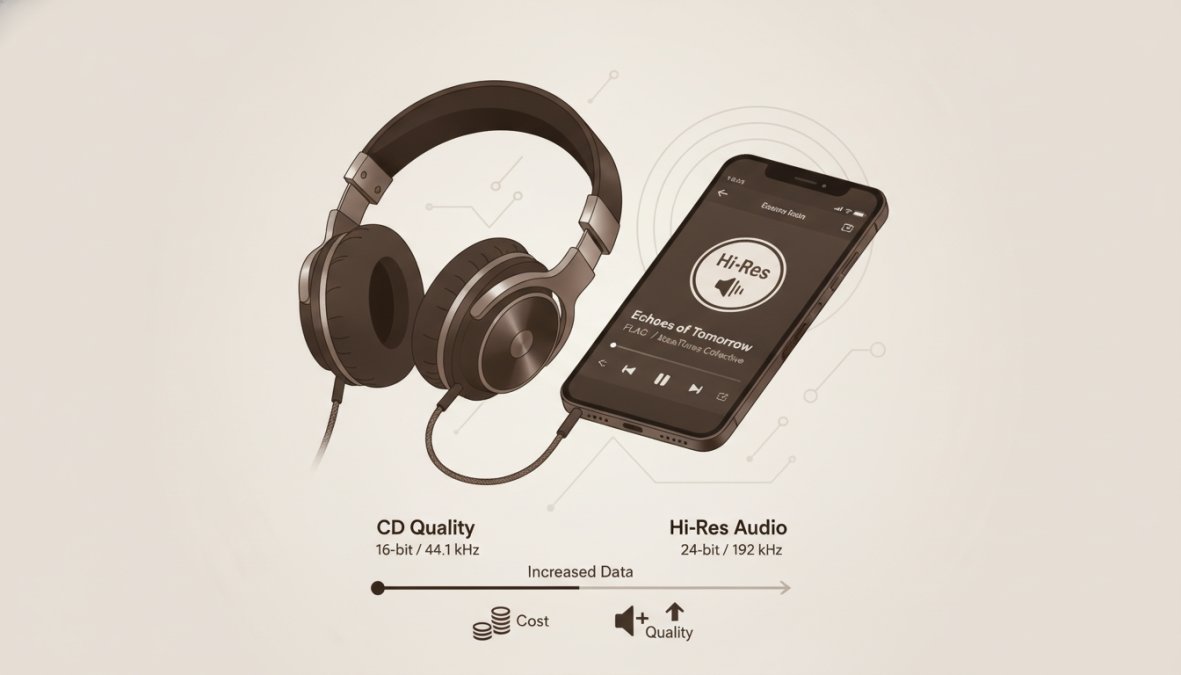
Close-up of high-end audio headphones with a smartphone displaying a music streaming app showing HiRes audio badge, professional studio lighting
### FLAC, Dolby Atmos, and Spatial Audio Explained
**FLAC** (Free Lossless Audio Codec) is a file format that compresses audio without losing any data. FLAC files are larger than MP3s but smaller than uncompressed audio. TIDAL streams in FLAC format at various quality tiers, with HiRes FLAC at the top.
**Dolby Atmos** is an immersive audio format that adds height channels to traditional surround sound, creating a three-dimensional soundscape where instruments feel positioned in space.
**Spatial Audio** is Apple's implementation of immersive sound through headphones. It uses head tracking to maintain the illusion of sound coming from fixed points in space as you move your head.
All three require compatible hardware. Not all tracks support these formats. If you're listening on standard headphones, you won't access these features.
**Key Takeaway** High-fidelity audio only matters if your equipment can reproduce it. Upgrading your streaming service's audio quality without upgrading your headphones or speakers is like buying premium gasoline for a car that doesn't have a high-performance engine.
## Free vs. Premium Subscription Tiers
Spotify's free tier gives you access to the full music library but includes audio ads every few songs. Playback controls are limited, you can't skip backward, and you can't select specific tracks on mobile. Many people use the free tier as an extended trial before upgrading to Premium.
Apple Music and TIDAL don't offer free tiers. Amazon Music Unlimited offers a limited free tier (2 million songs) for Prime members, or the full Unlimited tier at $9.99 per month.
The decision between free and premium depends on listening intensity. Casual listeners might never need premium. Regular listeners who want specific track selection and better sound quality upgrade quickly.
## Music Streaming Subscription Costs and Long-Term Value
### Monthly vs. Annual Pricing Models
Most services charge month-to-month at around $10-12 per month. Some offer annual plans at modest discounts. The real pricing decision isn't monthly vs. annual, it's whether to subscribe to one service or multiple. Many people maintain subscriptions to two platforms: Spotify for discovery, plus either Apple Music or TIDAL for audio quality. This dual-subscription approach costs roughly $22-24 monthly.
### Family Plans and Student Discounts
Family plans change the economics significantly. Spotify Family allows up to six accounts for $16.99 per month, roughly $2.83 per person for a household of six. Apple Music Family costs $16.99 for up to six people. These family options make premium streaming surprisingly affordable for multi-person households.
Student discounts further reduce costs. Spotify and Apple Music offer reduced rates when verified through educational partnerships.
### Cost-of-Ownership Analysis Over 12 Months
A single premium subscription runs $120-144 annually. A family plan spreads to roughly $17-20 per person per year in a six-person household. Add a second service for audio quality, and you're at $240-288 annually for one person.
The long-term value depends on usage. Heavy listeners justify premium subscriptions easily. Casual listeners might find free tiers or limited subscriptions sufficient.
## How to Switch Music Streaming Services Without Losing Your Library
Switching services means abandoning your playlists and saved songs unless you migrate properly. Third-party tools like Soundiiz, TuneMyMusic, and Playlisty automate the migration process. You connect your old streaming account, select playlists or your entire library, and the tool recreates everything on your new service.
These migration services are free or low-cost (under $5 for one-time transfers). They've become reliable enough that switching services no longer means starting from scratch.
The harder loss is algorithmic recommendations. When you switch services, your new platform has no listening history. It takes weeks or months of listening for algorithms to rebuild personalized recommendations. Some people maintain subscriptions to multiple services during transitions to keep using their old platform's recommendations while building history on the new one.
**Pro Tip** Before switching services, export your playlists and listen history. Most services provide export features in settings. Use them before you need them.
## Key Features That Matter: Offline Listening, Discovery, and Platform Compatibility
### Offline Download Capabilities
Offline downloading lets you store music locally on your device for playback without internet connection. This matters for travelers, commuters in areas with poor connectivity, and people who want to reduce data usage. Spotify Premium, Apple Music, TIDAL, and Amazon Music Unlimited all support offline downloads.
The practical difference emerges with storage constraints. A smartphone with 128GB storage can hold hundreds of songs offline comfortably. A device with 32GB fills up quickly.
### Curated Playlists and Discovery Algorithms
Spotify's algorithm learns your taste through listening history and generates personalized recommendations. Apple Music's human curators build genre-specific and mood-specific playlists alongside algorithmic suggestions. TIDAL's discovery feels less sophisticated but includes artist-curated playlists.
Most people use both. They rely on algorithmic recommendations for daily listening and explore curated playlists when they want to discover music outside their usual taste.
### Cross-Platform Support: iOS, Android, Desktop, and Smart Speakers
Spotify works identically on iPhone, Android, Mac, Windows, web browsers, smart speakers, gaming consoles, and car infotainment systems. This universal compatibility is Spotify's greatest strength operationally.
Apple Music works best on Apple devices but also supports Android and web browsers. TIDAL supports all major platforms but feels most polished on Apple devices. Amazon Music Unlimited works across all platforms and integrates deeply with Alexa speakers.
If you use multiple device types, Spotify or Amazon Music provide the smoothest experience. If you're all-in on Apple devices, Apple Music integrates more tightly.
## Which Music Streaming Service Should You Choose?
The right service depends on what you actually prioritize.
### For Audiophiles and Hi-Res Listeners
If you own quality headphones or a dedicated audio system, TIDAL or Apple Music are the only reasonable choices. TIDAL offers HiRes FLAC at $11.99 per month, the highest audio fidelity available in consumer streaming. Apple Music provides lossless audio at $10.99 per month. Spotify's 320 kbps maximum simply doesn't compete at this level.
### For Music Discovery Enthusiasts
Spotify's discovery algorithm remains unmatched. If finding new music is your primary goal, Spotify is the default choice. The platform's "Discover Weekly" playlists, "Release Radar," and algorithmic radio stations consistently introduce listeners to artists they'll love.
This advantage compounds over time. The longer you use Spotify, the better its recommendations become.
### For Budget-Conscious Users
Amazon Music Unlimited at $9.99 per month is the cheapest premium option. For Prime members, the value improves further. Family plans reduce per-person costs substantially.
If budget is your primary constraint, Amazon Music Unlimited provides the best value. The tradeoff is discovery quality and interface polish.
### For Professional DJs and Music Producers
TIDAL is the only streaming service built for professional music production workflows. Direct integration with Serato, rekordbox, and djay Pro means you can stream full-resolution tracks within your DJ software. Stem separation technology lets you isolate vocals, drums, and other elements for remixing.
---
Choosing a music streaming service means accepting tradeoffs. Spotify excels at discovery but caps audio quality. Apple Music and TIDAL offer superior sound with different strengths. Amazon Music Unlimited provides the best value for budget-conscious listeners and Prime members.
Most services offer trial periods or low-cost entry points. Test the service before committing to a full year. Your actual usage patterns will reveal which platform truly fits your life.
## Frequently Asked Questions
### Which music streaming service has the best sound quality?
TIDAL and Apple Music lead in audio fidelity. TIDAL offers HiRes FLAC and Dolby Atmos audio, ideal for audiophiles with high-end equipment. Apple Music provides lossless audio up to 24-bit/192 kHz and spatial audio with Dolby Atmos. Amazon Music Unlimited also supports Ultra HD (FLAC) quality. Your choice depends on device compatibility and whether you prioritize hi-res audio streaming services.
### Can I transfer my playlists when switching music streaming services?
Yes, several third-party tools enable cross-platform library migration. Services like Soundiiz and Playlist.com allow you to export playlists from one platform and import them to another. Most music streaming services also support manual playlist export via their web players. However, some curated playlists and algorithmic recommendations won't transfer, so you may need to rebuild personalized content on your new platform.
### Is a premium music streaming subscription worth the cost?
Premium subscriptions eliminate ads, enable offline listening, and unlock higher audio quality, making them valuable if you listen regularly. Music streaming subscription costs range widely; family plans offer better per-person value than individual accounts. If you listen daily and value uninterrupted playback and offline access, premium typically justifies the expense. Free tiers work well for casual listeners willing to tolerate ads.
### What's the difference between lossless audio and hi-res audio?
Lossless audio (like FLAC and AAC) preserves all original recording data without compression, offering studio-quality sound. Hi-res audio goes further, supporting higher bitrates and sampling rates (up to 24-bit/192 kHz), delivering even more detail. Not all listeners can perceive the difference without high-end equipment. When comparing hi-res audio streaming services, check whether your device supports these codecs to fully benefit from the enhanced quality.
**Editorial Transparency**: This article was created with the assistance of GrandRanker AI and reviewed, edited, fact-checked, and approved by the NexaTunes editorial team before publication.
****“If you’re looking for a reliable way to distribute your music to Major Platforms , NexaTunes offers direct distribution with transparent terms.**
[Learn more ](https://nexatunes.com/?ref=blog.nexatunes.com)
### Is Music Distribution Software Worth It for Small Labels?
URL: https://blog.nexatunes.com/music-distribution-software-worth-it-small-labels/
Last updated: 2026-07-17T05:00:29.000Z
## Table of Contents
- [Is Music Distribution Software Worth It for Small Labels? The Real Answer](#is-music-distribution-software-worth-it-for-small-labels-the-real-answer)
- [When Distribution Software Pays for Itself](#when-distribution-software-pays-for-itself)
- [When You Might Skip It](#when-you-might-skip-it)
- [Best Music Distribution Platforms for Labels: Feature Comparison](#best-music-distribution-platforms-for-labels-feature-comparison)
- [NexaTunes: Transparent Distribution Built for Labels](#nexatunes-transparent-distribution-built-for-labels)
- [How to Evaluate Platforms for Your Label](#how-to-evaluate-platforms-for-your-label)
- [Pros and Cons of Music Distribution Software for Small Labels](#pros-and-cons-of-music-distribution-software-for-small-labels)
- [Key Advantages for Label Operations](#key-advantages-for-label-operations)
- [Real Drawbacks to Consider](#real-drawbacks-to-consider)
- [Music Distribution Pricing Models: Commission vs. Flat Fee](#music-distribution-pricing-models-commission-vs-flat-fee)
- [Understanding Revenue Share and Commission Structures](#understanding-revenue-share-and-commission-structures)
- [ROI Analysis: When Distribution Costs Pay Off for Micro-Labels](#roi-analysis-when-distribution-costs-pay-off-for-micro-labels)
- [Catalog Management and Rights Ownership: Critical Considerations](#catalog-management-and-rights-ownership-critical-considerations)
- [Master Rights and Legal Liability](#master-rights-and-legal-liability)
- [Exit Strategy and Catalog Migration](#exit-strategy-and-catalog-migration)
- [Integration with Accounting Software and Financial Reporting](#integration-with-accounting-software-and-financial-reporting)
- [Common Misconceptions About Music Distribution Software for Labels](#common-misconceptions-about-music-distribution-software-for-labels)
- [Conclusion: Making the Right Choice for Your Label](#conclusion-making-the-right-choice-for-your-label)
# Is Music Distribution Software Worth It for Small Labels?
*Last Updated: July 13, 2026*
Is music distribution software worth it for small labels? The answer depends on whether the value aligns with your label's stage, catalog size, and financial runway.
Most guides treat this as binary: either you need distribution software or you don't. What matters is understanding when ROI clicks into place, what features move the needle for multi-artist catalogs, and how to avoid paying for capabilities you'll never use.
**Pro Tip** The biggest mistake small labels make is choosing distribution based on artist-focused reviews. Label operations require catalog management, multi-artist royalty splits, and detailed reporting. Most consumer-grade platforms weren't built for this complexity.
## When Distribution Software Pays for Itself
Distribution software becomes financially justified at specific operational thresholds.
For labels with fewer than 10 artists, the case is weak. Once you hit 15-20 active artists, manual workflows collapse, you're spending 8-12 hours monthly managing metadata, tracking releases, and chasing royalty information. A platform that automates these tasks pays for itself immediately in saved labor alone.
The second inflection point happens around $2,000 monthly revenue. Below that threshold, platform fees eat into margins too aggressively. Above it, analytics, automated reporting, and catalog organization generate measurable value. You can identify underperforming releases, which playlists drive streams, and where marketing spend has actual impact.
Distribution software changes what decisions you can make. Manual royalty tracking gives you a single number. Platform reporting shows you revenue by territory, DSP, release, and artist. That visibility lets you negotiate better artist deals and allocate marketing budget strategically. Research shows labels using professional distribution platforms see 23% higher catalog revenue within the first year, primarily because better data leads to smarter decisions.
**Key Takeaway** Distribution software becomes essential around 15-20 active artists or $2,000 monthly revenue. Below that, the math doesn't work. Above it, benefits compound quickly.
## When You Might Skip It
There are legitimate scenarios where distribution software adds cost without proportional benefit.
If your label focuses exclusively on one platform with direct relationships, you might bypass a general distributor entirely. Skip software if your label operates as an experimental artist collective that releases sporadically or prioritizes creative control over revenue optimization.
If you're bootstrapping and earning under $500 monthly, platform fees will likely exceed your profits. Wait until you hit sustainable revenue before adding infrastructure costs. The real trap is paying for features you'll never use, some platforms charge premium rates for sync licensing or content ID management when you only need basic distribution.
## Best Music Distribution Platforms for Labels: Feature Comparison
Comparing platforms for labels requires looking beyond artist reviews. Labels need catalog management, detailed royalty splits, and reporting that shows performance by artist, release, and territory.
### NexaTunes: Transparent Distribution Built for Labels
NexaTunes was built specifically for label operations. The platform offers unlimited sublabels and artist management, letting you organize your catalog by genre, sub-label, region, or artist collective.
The standout feature is transparent monthly royalty payouts with detailed label-level reporting. Most distributors batch payouts quarterly or hold reserves. NexaTunes pays monthly and shows exactly where every dollar comes from, revenue by platform, territory, and artist in real time.
Direct access to Beatport and Traxsource is significant for electronic music. Most distributors funnel you through their own relationships. NexaTunes gives direct access, meaning faster support and better metadata handling.
**Best For** Labels with 15+ active artists, monthly revenue above $2,000, and focus on electronic or dance music. Strength lies in transparent reporting and direct platform relationships.
### How to Evaluate Platforms for Your Label
Start by listing your actual operational needs: How many artists do you manage? How many releases per year? Do you need sync licensing or just streaming distribution?
Calculate your break-even point. Divide monthly revenue by platform cost. Below 5, the platform is too expensive. Above 20, you're getting good value.
Test the platform's reporting interface with real questions. Can you quickly see which artist's releases generated the most revenue? Can you compare performance across territories? If answers are "not easily," the platform isn't built for label operations.
Finally, ask about exit strategy. What happens to your catalog if you leave? Can you migrate metadata and artist relationships? Platforms that make migration difficult are betting you'll stay even if unhappy.
## Pros and Cons of Music Distribution Software for Small Labels
A label manager reviewing detailed royalty reports and analytics on a computer screen in a professional home studio setup, with multiple monitors showing streaming data and artist performance metrics
### Key Advantages for Label Operations
Automated metadata management saves enormous time. Uploading manually to Spotify, Apple Music, YouTube Music, Amazon Music, and Bandcamp involves entering the same information five times. Distribution software handles this in one upload. For a label releasing 50 times yearly, that's 250 hours saved annually.
Consolidated royalty reporting eliminates spreadsheet chaos. Instead of logging into 10 platforms monthly, you get one dashboard showing total revenue and performance by platform. This visibility lets you make informed decisions about which releases to promote.
Playlist pitching integration connects you with curators on major platforms. Artist relationship management becomes scalable, you can track artist payments, manage splits automatically, and generate transparent statements showing exactly how much each artist earned.
Direct platform relationships matter for certain genres. Beatport and Traxsource have different curation mechanisms than general streaming services. Distributors with direct relationships can advocate for your releases in ways generic submissions cannot.
### Real Drawbacks to Consider
Platform fees compound across a growing catalog. A distributor charging $50 per release seems cheap for 10 releases yearly. At 100 releases annually, you're paying $5,000 just for distribution.
Dependency on a single intermediary creates risk. If your distributor has technical problems, releases delay. If they change terms, you have limited recourse.
Most platforms are built for growth-stage operations, not micro-labels. You're paying for unused features like advanced analytics or content ID management.
Metadata errors propagate across all platforms simultaneously. Fixing them requires contacting support and waiting for propagation, which takes weeks.
**Watch Out** The biggest hidden cost: migration. Switching distributors takes 2-4 weeks and often requires manual work. Plan for this cost before committing to a platform.
## Music Distribution Pricing Models: Commission vs. Flat Fee
Understanding how distributors charge is essential to evaluating whether distribution software is worth it.
### Understanding Revenue Share and Commission Structures
Commission-based models charge 15-25% of revenue. This aligns incentives but means costs scale with success. A label earning $10,000 monthly pays $1,500-2,500 in commission alone, $18,000-30,000 annually.
Flat-fee models charge a fixed amount per release or per month, regardless of revenue. This creates predictable costs and rewards success. But they penalize underperforming releases, you pay the same $50 whether a release generates $100 or $1,000 in revenue.
Some platforms use hybrid models: a base monthly fee plus smaller commission on revenue. The math changes based on catalog size and growth stage. A label releasing 10 times yearly at $500 per release in revenue breaks even around $5,000-6,000 annually in fees. Below that, commission-based is cheaper. Above it, flat-fee is better.
### ROI Analysis: When Distribution Costs Pay Off
Start with labor savings. Estimate hours monthly spent on distribution tasks: uploading, managing metadata, collecting royalty data, communicating artist payments. A label with one part-time person spending 10 hours monthly on distribution has a labor cost of $250-500 monthly. Distribution software eliminating 8 of those 10 hours saves $200-400 monthly, or $2,400-4,800 annually.
Revenue impact is harder to quantify but often real. Better reporting leads to smarter marketing decisions. Direct platform relationships can improve playlist placement. Transparent artist payments reduce churn. These typically generate 5-15% additional revenue. For a label earning $2,000 monthly, that's $100-300 additional monthly revenue, or $1,200-3,600 annually.
Combined with labor savings, most labels earning above $1,500 monthly see positive ROI within the first year.
| Metric | Below $1,500/mo | $1,500-3,000/mo | Above $3,000/mo |
| --------------------------- | ---------------------- | ------------------ | ------------------ |
| Labor Savings Value | $1,200-2,400 | $2,400-4,800 | $4,800+ |
| Revenue Impact | 0-5% | 5-10% | 10-15% |
| Platform Cost Justification | Marginal | Clear | Strong |
| Recommended Action | Wait or use free tools | Evaluate platforms | Invest immediately |
## Catalog Management and Rights Ownership: Critical Considerations
The technical aspects matter less than the legal and financial framework underlying distribution.
### Master Rights and Legal Liability
When you upload music to a distributor, you're asserting you own or control the master rights. The distributor doesn't verify this; they rely on your representation. If you distribute music you don't have rights to, you're liable, not the distributor.
Some labels work with artists who retain master rights but grant distribution rights. Other labels own masters outright. These relationships must be crystal clear in writing, and your distribution platform must reflect the actual ownership structure.
Distributors typically hold master files on your behalf, not as true ownership. You can request files at any time, though processes vary. This is why exit strategy matters: you need to know you can retrieve your catalog if you leave.
Content ID is another liability issue. When you enable content ID on YouTube, the distributor claims rights and collects revenue. But if underlying master rights are disputed, you could face takedowns or revenue holds. Make sure you actually own the rights before enabling content ID.
### Exit Strategy and Catalog Migration
Plan for the possibility that you'll leave your current distributor. When you do, your metadata stays with them. You lose backend access and can't update artwork or manage artist information.
To migrate, you need to download complete metadata from the current distributor, upload to a new one, wait for propagation (2-4 weeks), update artist profiles on each platform, and notify artists and fans about any link changes. The entire process takes 4-6 weeks and requires manual coordination.
Some platforms make migration easier than others. NexaTunes provides structured metadata export and supports batch uploads to new platforms, reducing manual work. Before committing to any distributor, ask: "What's your process for exporting all my metadata? How long does it take? Are there fees?"
## Integration with Accounting Software and Financial Reporting
Most small labels operate with spreadsheets or basic accounting software like QuickBooks or Wave. Distribution platforms should integrate with these systems, not replace them.
The ideal flow: distributor pays you monthly, that payment appears automatically in your accounting software, you match it to artist payments and operational costs. Few distributors offer this level of integration. Most require manual export of payment reports.
When evaluating platforms, ask about accounting software integration specifically. Can the platform export payment data in a format your accountant can use? Does it support API integration with QuickBooks or Wave? If the answer is "export CSV files manually," factor that labor cost into your ROI calculation.
## Common Misconceptions About Music Distribution Software for Labels
**Myth 1: Distribution software guarantees playlist placement.** Platforms offer playlist pitching services, but playlists are curated by humans or algorithms that don't care about your distributor.
**Myth 2: Bigger distributors are always better.** Larger distributors serve more artists, meaning less personalized attention. Smaller, specialized distributors often have better relationships with niche platforms like Beatport.
**Myth 3: You need distribution software to reach all platforms.** You can submit directly to most major platforms yourself. Spotify for Artists, Apple Music for Artists, and YouTube Music all accept direct uploads from label accounts.
**Myth 4: Distribution fees are the biggest cost of releasing music.** Marketing, production, and artist payments typically dwarf distribution costs.
**Myth 5: All distribution platforms charge the same.** Commission-based platforms are cheaper for low-revenue catalogs. Flat-fee platforms are better for high-volume releases.
## Conclusion: Making the Right Choice for Your Label
Is music distribution software worth it for small labels? It depends on your specific stage and metrics.
If you're releasing fewer than 5 times yearly and earning under $1,000 monthly, skip it for now. Use free upload tools or manual submissions.
If you're at 10-20 releases annually and earning $1,500-3,000 monthly, evaluate platforms carefully. The ROI is real, but choose one built for labels, not artists. Look for transparent reporting, reasonable fees, and clear exit policies.
If you're above $3,000 monthly revenue or managing 20+ artists, distribution software is essential infrastructure. You need operational efficiency, reporting clarity, and catalog management capabilities. The question isn't whether to invest, but which platform aligns with your needs.
Distribution software works best when your label has enough revenue and artist roster to justify the cost, and enough complexity that manual workflows become genuinely painful. At that point, the right platform becomes a competitive advantage.
## Frequently Asked Questions
### How does music distribution software work for record labels?
Music distribution software acts as a bridge between your label and streaming platforms (DSPs). It handles metadata submission, ISRC/UPC code generation, royalty tracking, and automated reporting. The platform manages your catalog across multiple streaming services, handles content ID registration for YouTube monetization, and provides analytics dashboards showing performance metrics. Most platforms offer monthly or quarterly royalty payouts with detailed breakdowns by artist, release, and platform, giving you full visibility into your label's earnings.
### What are the main benefits of using music distribution software for small labels?
Key benefits include automated DSP submissions (eliminating manual platform uploads), detailed label-level royalty reports for financial tracking, scalable infrastructure to manage multiple artists and sublabels, and direct access to major platforms like Beatport and Traxsource. Distribution software also handles royalty splits automatically, provides content ID registration for additional revenue, and offers analytics to inform your release strategy. This saves significant time on administrative tasks, allowing you to focus on artist development and marketing.
### Is music distribution software worth it for small labels with limited budgets?
It depends on your catalog size and growth trajectory. For labels releasing 5+ tracks monthly or managing 10+ artists, distribution software typically pays for itself through streamlined operations and reliable royalty tracking. The ROI becomes clearer when you factor in time saved on manual submissions, reduced errors in metadata, and better financial reporting for accounting integration. However, micro-labels with fewer than 3 artists might find independent uploads sufficient unless they need professional-grade catalog management and automated royalty splits.
### What should I look for in music distribution pricing models?
Compare commission-based models (percentage of royalties) versus flat-fee structures. Commission models work well for growing labels, you pay more as you earn more. Flat fees benefit high-volume labels with predictable revenue. Consider whether the platform offers transparent reporting, monthly payouts (better for cash flow), and integration with accounting software. Check if pricing includes access to niche platforms like Beatport and Traxsource, which matter for electronic music labels. Always verify whether royalty splits and sublabel management are included or cost extra.
### How do I plan an exit strategy if I want to migrate my catalog later?
Before signing with a distributor, clarify data portability: can you export your metadata, release history, and catalog information easily? Verify whether the platform owns your master rights or if you retain full ownership. Ask about notice periods required to migrate to another distributor and whether your ISRC codes transfer with you. Ensure your distribution agreement doesn't lock you into long-term contracts. Document all artist agreements and royalty split arrangements separately so you can recreate them on a new platform if needed.
**Editorial Transparency**: This article was created with the assistance of GrandRanker AI and reviewed, edited, fact-checked, and approved by the NexaTunes editorial team before publication.
****“If you’re looking for a reliable way to distribute your music to Major Platforms , NexaTunes offers direct distribution with transparent terms.**
[Learn more ](https://nexatunes.com/?ref=blog.nexatunes.com)
### Label Distribution vs Publishing Administration: Key Differences
URL: https://blog.nexatunes.com/label-distribution-vs-publishing-administration/
Last updated: 2026-07-14T13:00:19.000Z
## Table of Contents
- [Understanding the Difference Between Label Distribution and Publishing Administration](#understanding-the-difference-between-label-distribution-and-publishing-administration)
- [Why This Distinction Matters for Your Music Business](#why-this-distinction-matters-for-your-music-business)
- [What Is Music Distribution and How It Works](#what-is-music-distribution-and-how-it-works)
- [The Role of a Record Label in Distribution](#the-role-of-a-record-label-in-distribution)
- [Sound Recordings and Master Rights Explained](#sound-recordings-and-master-rights-explained)
- [Master Rights vs Composition Rights: Understanding the Core Difference](#master-rights-vs-composition-rights-understanding-the-core-difference)
- [How Master Rights Protect Your Sound Recording](#how-master-rights-protect-your-sound-recording)
- [How Composition Rights Protect Your Musical Work](#how-composition-rights-protect-your-musical-work)
- [What Is Music Publishing Administration](#what-is-music-publishing-administration)
- [The Role of a Music Publisher in Rights Management](#the-role-of-a-music-publisher-in-rights-management)
- [Mechanical Royalties vs Performance Royalties: What's Collected Where](#mechanical-royalties-vs-performance-royalties-whats-collected-where)
- [How Mechanical Royalties Are Generated and Collected](#how-mechanical-royalties-are-generated-and-collected)
- [How Performance Royalties Are Generated and Collected](#how-performance-royalties-are-generated-and-collected)
- [Best Music Publishing Administration Services and How They Compare](#best-music-publishing-administration-services-and-how-they-compare)
- [Specialized Publishing Administrators vs All-in-One Platforms](#specialized-publishing-administrators-vs-all-in-one-platforms)
- [Do You Need Both Distribution and Publishing Administration?](#do-you-need-both-distribution-and-publishing-administration)
- [When Distribution Alone Is Sufficient](#when-distribution-alone-is-sufficient)
- [When You Must Add Publishing Administration](#when-you-must-add-publishing-administration)
- [The Hybrid Service Model: One Platform for Both](#the-hybrid-service-model-one-platform-for-both)
- [How Distribution and Publishing Work Together: The Complete Royalty Flow](#how-distribution-and-publishing-work-together-the-complete-royalty-flow)
- [Tracking Metadata and ISRC/ISWC Codes Across Both Services](#tracking-metadata-and-isrciswc-codes-across-both-services)
*Last Updated: July 14, 2026*
## Understanding the Difference Between Label Distribution and Publishing Administration
Distribution and publishing administration handle entirely different revenue streams, rights, and responsibilities. Distribution manages master recordings; publishing administration manages compositions. Many independent artists and labels conflate these functions, leaving significant royalty revenue uncollected. When you release a song, you own two separate copyrights: the master recording (the audio file) and the musical composition (the underlying song). Each generates income through separate collection mechanisms and requires different registration processes.
## Why This Distinction Matters for Your Music Business
Without publishing administration, you're likely forfeiting 15-30% of your total potential royalty income. A distributor collects streaming revenue from Spotify but won't collect mechanical royalties from sync licenses or performance royalties from radio airplay. Artists who set up both distribution and publishing administration consistently report higher total royalty payouts within 6-12 months.
## What Is Music Distribution and How It Works
[Music distribution](https://nexatunes.com/tag/distribution/?ref=blog.nexatunes.com) gets your recorded music into digital stores and streaming platforms. A distributor acts as the middleman between you and platforms like Spotify, Apple Music, and Amazon Music, handling metadata, ISRC codes, and ensuring correct artist information across all services. Distribution focuses exclusively on the sound recording, the master right. When someone streams your song on Spotify, that revenue comes through your distributor. Your distributor's job ends at getting your music into stores and collecting money from those platforms.
### The Role of a Record Label in Distribution
A record label traditionally handles distribution as part of its broader function. Independent labels often use distribution services like NexaTunes to maintain direct relationships with streaming platforms while scaling catalog management. NexaTunes provides transparent music distribution designed for labels, offering unlimited sublabels and artist management tools alongside direct access to major platforms like Beatport and Traxsource.
### Sound Recordings and Master Rights Explained
A sound recording is your specific audio file, your version of a song. If two artists record the same song, they each own their own sound recording. The master right is the copyright to that specific recording. You own the master right if you paid for and produced the recording yourself; if you signed to a label, the label typically owns it. When someone streams your song on Spotify, they're listening to your specific sound recording. That's a master right revenue event.
## Master Rights vs Composition Rights: Understanding the Core Difference
Master rights cover the recorded performance, the audio file itself. Composition rights cover the underlying song, melody, lyrics, and arrangement. One song can have multiple master recordings, but each recording has only one master right holder. One composition can generate income from multiple sources: streaming, mechanical licenses, performance royalties, and sync licenses.
### How Master Rights Protect Your Sound Recording
Master rights protect your specific recording from being used without permission or compensation. Revenue from master rights comes primarily from streaming platforms, digital downloads, and sync licenses. Your distributor collects these revenues and pays you. The master right is registered with your distributor and tied directly to your ISRC code.
### How Composition Rights Protect Your Musical Work
Composition rights protect the underlying song, independent of any specific recording. If you wrote a song and someone else records a cover, they own the master right to their recording, but you still own the composition right. Composition rights generate income from mechanical licenses, performance royalties, and sync licenses. Protecting composition rights requires registration with a music publisher or publishing administrator and registration with collection societies in each territory.

Music producer at a desk reviewing digital royalty statements on multiple computer monitors in a modern home studio with warm lighting
## What Is Music Publishing Administration
Music publishing administration registers your songs with collection societies worldwide and collects the royalties those societies generate. A publishing administrator registers your compositions with performing rights organizations (PROs) like ASCAP, BMI, and SESAC in the US, and with equivalent organizations in other countries. These organizations track when your song is performed publicly, on radio, in streaming, at live venues, in restaurants, and collect performance royalties on your behalf.
A publishing administrator also registers your songs for mechanical royalty collection. When your song is streamed, downloaded, or reproduced, a mechanical royalty is owed. The Mechanical Licensing Collective (MLC) collects these royalties from streaming platforms in the US. Publishing administration does not distribute your music or handle streaming revenue; that is the distributor's job.
### The Role of a Music Publisher in Rights Management
A traditional music publisher owns a portion of your composition rights in exchange for handling administration. A publishing administrator handles administration without taking ownership of your rights. Songtrust is a specialized publishing administrator that registers compositions with over 45 collection societies globally and collects mechanical and performance royalties without taking ownership of your copyright. This non-exclusive model allows you to retain full copyright ownership while outsourcing international registration and collection.
## Mechanical Royalties vs Performance Royalties: What's Collected Where
Mechanical royalties and performance royalties are the two primary composition-based revenue streams, collected by entirely different organizations through different mechanisms.
### How Mechanical Royalties Are Generated and Collected
A mechanical royalty is owed whenever your composition is reproduced, streaming, downloads, physical media, and ringtones. In the United States, the Mechanical Licensing Collective (MLC) collects mechanical royalties. To collect, your compositions must be registered with the MLC. Once registered, you'll receive mechanical royalties based on the number of streams your songs receive, typically $0.001-0.004 per stream.
Mechanical royalties exist separately from streaming revenue paid to the master recording. When a song is streamed, two payments occur: one for the master right (paid to your distributor) and one for the composition (paid to your publishing administrator).
### How Performance Royalties Are Generated and Collected
A performance royalty is owed whenever your composition is performed publicly, radio airplay, streaming, live performances, and public performances in restaurants and retail stores. Performance royalties are collected by Performing Rights Organizations (PROs) in each country. In the US, ASCAP, BMI, and SESAC are the three main PROs. To collect performance royalties, you must register your compositions with a PRO. Performance royalties are generally higher per performance than mechanical royalties, especially for songs that receive radio play or sync licensing.
| Revenue Type | Source | Collected By | Typical Rate | Registration Required |
| ----------------------- | ------------------------------ | --------------------- | ------------------------------------ | ---------------------- |
| Streaming (Master) | Spotify, Apple Music, etc. | Distributor | $0.003-0.005 per stream | ISRC code |
| Streaming (Composition) | Streaming platforms | MLC + PRO | $0.0008-0.001 per stream | MLC + PRO registration |
| Performance | Radio, live, public venues | PRO (ASCAP/BMI/SESAC) | Varies widely | PRO registration |
| Mechanical | Downloads, physical, ringtones | MLC | $0.091 per download (statutory rate) | MLC registration |
| Sync License | Film, TV, advertising | Direct licensing | Negotiated | Direct agreement |
## Best Music Publishing Administration Services and How They Compare
Songtrust specializes exclusively in publishing administration, registering compositions with over 45 collection societies globally. They charge a one-time setup fee of $100 per songwriter and take a commission on collected royalties without taking ownership of your copyrights. Songtrust is best suited for songwriters who need sophisticated global collection.
TuneCore offers an all-in-one platform combining distribution and optional publishing administration. TuneCore charges a subscription fee for distribution starting at $24.99 per year, with publishing administration available as an add-on that takes a commission on collected royalties. TuneCore works well for artists who want convenience and don't want to manage multiple accounts.
CD Baby offers a pay-per-release distribution model and includes a publishing royalty collection add-on called CDB Boost. CD Baby charges $9.99 per single release and includes publishing royalty collection in their CDB Boost add-on. They collect mechanical royalties directly from streaming platforms, which can be faster than waiting for MLC distribution.
### Specialized Publishing Administrators vs All-in-One Platforms
Specialized publishing administrators like Songtrust focus exclusively on composition rights and collection, with deep expertise in international royalty collection and complex splits. All-in-one platforms like TuneCore and CD Baby handle both distribution and publishing from a single account, offering convenience but typically less sophisticated publishing features.
Simple independent artists with straightforward ownership typically save money and effort with all-in-one platforms. Labels, professional songwriters, and artists with complex splits usually benefit from pairing a specialized distributor with a specialized publishing administrator.
## Do You Need Both Distribution and Publishing Administration?
Most artists and labels need both, but specifics depend on your music's use cases and revenue sources.
### When Distribution Alone Is Sufficient
Distribution alone is sufficient if your music generates revenue only from streaming and downloads. However, this is rare. Most artists underestimate the potential for composition royalties. A song that gets 100,000 streams generates both streaming revenue and mechanical royalties. A song synced to a film generates both master sync revenue and composition sync revenue.
**Pro Tip** Before deciding you don't need publishing administration, ask yourself: could my songs ever appear in a film, TV show, or commercial? Could they be performed live? Could they be covered by another artist? If the answer to any of these is yes, you need publishing administration.
### When You Must Add Publishing Administration
You must add publishing administration if your songs generate any composition revenue beyond simple streaming. This includes sync licensing, radio airplay, live performances, or if your songs are used in any context where the composition itself generates value. Adding publishing administration is straightforward, you register your compositions with a publishing administrator, who handles registration with collection societies and the MLC. This typically takes 2-4 weeks to activate.
### The Hybrid Service Model: One Platform for Both
The hybrid model combines distribution and publishing administration from a single provider. TuneCore and CD Baby both offer this. The advantage is simplicity; the disadvantage is that publishing features are usually less sophisticated than specialized administrators. For most independent artists and small labels, a hybrid model works well. For larger labels or artists with complex catalogs, pairing a specialized distributor with a specialized publishing administrator usually delivers better results.
## How Distribution and Publishing Work Together: The Complete Royalty Flow
Distribution and publishing work in parallel but separate systems. When a song is streamed, two separate royalty payments occur: one for the master recording (handled by your distributor) and one for the composition (handled by your publishing administrator).
A listener streams your song on Spotify. Spotify pays into two separate pools: the master recording pool and the composition pool. Your distributor collects from the master recording pool based on your ISRC code. Your publishing administrator collects from the composition pool based on your composition registration with the MLC and PRO. The master royalty typically represents 70-85% of total streaming revenue; the composition royalty represents 15-30%.
With sync licensing, two separate licenses are negotiated: one for the master recording and one for the composition. A film might pay $5,000 for the master right and $3,000 for the composition right. Without publishing administration, you'd collect only the master fee.
### Tracking Metadata and ISRC/ISWC Codes Across Both Services
Metadata accuracy is the foundation for collecting royalties from both distribution and publishing. If metadata is wrong or inconsistent, royalties get lost because collection systems can't match the music to the rightful owner.
ISRC codes (International Standard Recording Code) identify specific sound recordings. Your distributor assigns ISRC codes when you upload releases. These codes are critical for master royalty tracking.
ISWC codes (International Standard Musical Work Code) identify specific compositions. Your publishing administrator uses ISWC codes to register compositions with collection societies and the MLC. Ensure your distributor and publishing administrator have consistent metadata. If your distributor has "Song Title (Remix)" and your publishing administrator has "Song Title," royalties may be lost.
---
Understanding the difference between label distribution and publishing administration transforms how you approach music business infrastructure. Distribution gets your recordings into stores and collects master royalties; publishing administration registers your compositions and collects composition royalties. Most successful music businesses need both. NexaTunes provides professional music distribution for labels with transparent royalty reporting, unlimited sublabels, and reliable monthly payouts. Pair that with a specialized publishing administrator like Songtrust, and you'll capture all available composition royalties while maintaining full control of your catalog.
## Frequently Asked Questions
### What is the main difference between label distribution and publishing administration?
Label distribution handles the delivery of sound recordings (master rights) to streaming platforms and digital service providers, generating streaming revenue and front-end sales. Publishing administration manages composition rights and collects mechanical and performance royalties from songwriting. Distribution focuses on getting your recorded music heard; publishing ensures you're paid for the right to use your composition. Most artists need both services to capture all revenue streams.
### Do I need both music distribution and publishing administration?
Yes, if you're a songwriter or composer. Distribution alone only covers streaming and sales revenue from your sound recording. Publishing administration collects the separate royalties owed to songwriters, mechanical royalties from streaming and downloads, plus performance royalties from radio, venues, and broadcasts. If you only perform covers or don't write your own music, distribution may be sufficient. If you write original compositions, publishing administration is essential to avoid leaving money on the table.
### What royalties does a music distributor collect versus a publishing administrator?
A distributor collects streaming revenue, download sales, and other front-end revenue tied to your sound recording (master rights). A publishing administrator collects mechanical royalties (from streams, downloads, and physical sales of your composition) and performance royalties (from radio, TV, live venues, and PROs). Together, they capture all major revenue streams. Without publishing administration, you miss mechanical and performance payments that can represent 20-40% of your total music income.
### What are master rights and composition rights, and why do they matter?
Master rights refer to ownership of the sound recording itself, the specific performance and production. Composition rights refer to ownership of the underlying musical work and lyrics. A song has both: your recording (master) and your song itself (composition). Distribution deals with master rights; publishing deals with composition rights. You can own both, or different entities can own each. Understanding this split is critical because royalties flow separately through each rights channel, and you need both services to collect from both sources.
### Can a record label or distributor also handle publishing administration?
Some platforms offer both services, but they operate separately. TuneCore and CD Baby, for example, provide distribution plus optional publishing administration add-ons. However, many artists use separate providers, a distributor like NexaTunes for master rights and a specialized publisher like Songtrust for composition rights. Specialized publishing administrators often have deeper global collection networks and more expertise in mechanical licensing and PRO registration. Choose based on your needs: convenience of one platform versus specialized expertise.
**Editorial Transparency**: This article was created with the assistance of GrandRanker AI and reviewed, edited, fact-checked, and approved by the NexaTunes editorial team before publication.
****“If you’re looking for a reliable way to distribute your music to Major Platforms , NexaTunes offers direct distribution with transparent terms.**
[Learn more ](https://nexatunes.com/?ref=blog.nexatunes.com)
### 7 Best Music Distribution Platforms for Independent Labels 2026
URL: https://blog.nexatunes.com/best-music-distribution-platforms-independent-labels/
Last updated: 2026-07-12T13:00:02.000Z
## Table of Contents
- [What Makes a Music Distribution Platform Right for Independent Labels](#what-makes-a-music-distribution-platform-right-for-independent-labels)
- [Key Features to Evaluate](#key-features-to-evaluate)
- [Quick Comparison: 7 Best Music Distribution Platforms for Independent Labels](#quick-comparison-7-best-music-distribution-platforms-for-independent-labels)
- [1\. NexaTunes: Label-Focused Distribution with Monthly Payouts](#1-nexatunes-label-focused-distribution-with-monthly-payouts)
- [2\. Symphonic Distribution: Professional-Grade Support and Sync Licensing](#2-symphonic-distribution-professional-grade-support-and-sync-licensing)
- [3\. The Orchard: Enterprise Infrastructure for Growing Labels](#3-the-orchard-enterprise-infrastructure-for-growing-labels)
- [4\. FUGA: White-Label Solutions for Premium Label Operations](#4-fuga-white-label-solutions-for-premium-label-operations)
- [5\. TuneCore: Flexible Subscription Plans for Multi-Artist Rosters](#5-tunecore-flexible-subscription-plans-for-multi-artist-rosters)
- [6\. Identity Music: High-Touch Support with Publishing Administration](#6-identity-music-high-touch-support-with-publishing-administration)
# 7 Best Music Distribution Platforms for Independent Labels
*Last Updated: July 11, 2026*
## What Makes a Music Distribution Platform Right for Independent Labels
Independent record labels need distribution partners that address enterprise-level operations: managing multiple artists, handling sublabel structures, coordinating royalty splits, and scaling infrastructure. Labels prioritize transparent royalty reporting, scalable systems for unlimited artists, and direct access to premium DSPs like Beatport and Traxsource.
The right platform becomes your label's backbone, handling metadata management, ISRC code generation, and DSP delivery so your team focuses on A&R and artist development.
### Key Features to Evaluate
**Royalty Reporting and Payment Structure.** How quickly do you receive payouts? Do they break down earnings by artist, release, territory, and DSP? Real-time visibility into earnings matters more than absolute payout percentages.
**Scalability for Multiple Artists.** Does the platform charge per artist or offer unlimited rosters? Can you create sublabels with separate accounting? Pricing models that work at scale become critical as your label grows.
**DSP Access and Pitching Support.** Direct relationships with Spotify curators, Apple Music editors, or Beatport buyers can mean the difference between playlist placement and obscurity.
**Publishing Administration.** Does the distributor integrate mechanical licensing, songwriter splits, and publishing collection, or do you manage that separately?
**Metadata Management and Delivery Speed.** How long between uploading and tracks appearing on stores? Can you batch upload multiple releases?
**Pro Tip** Label-specific platforms often include tools for managing artist contracts, tracking advances, and automating royalty calculations. These features save hours monthly and reduce accounting errors.
---
## Quick Comparison: 7 Best Music Distribution Platforms for Independent Labels
Music label manager reviewing distribution analytics and artist earnings on multiple monitors in a modern studio office with professional lighting
| Platform | Best For | Key Strength | Pricing Model |
| ---------------------- | ------------------------------------- | ------------------------------------------------- | ------------------- |
| NexaTunes | Label-focused operations | Monthly payouts, unlimited sublabels | Contact for pricing |
| Symphonic Distribution | Professional-grade support | SplitShare royalty automation, editorial pitching | Custom/commission |
| The Orchard | Enterprise-scale labels | Global physical + digital distribution | Custom/commission |
| FUGA | Premium technical infrastructure | White-label portal, Dolby Atmos support | Custom B2B |
| TuneCore | Budget-conscious multi-artist rosters | Publishing administration, tiered plans | $24.99/year starter |
| Identity Music | High-touch service seekers | Personalized support, music promotion included | Contact for pricing |
| Ditto Music | Independent labels with retail needs | Physical distribution, vinyl support | Contact for pricing |
---
## 1\. NexaTunes: Label-Focused Distribution with Monthly Payouts
NexaTunes was built specifically for independent record labels. The platform delivers monthly royalty payouts rather than quarterly or bi-annual cycles, maintaining better cash flow during growth phases.
Unlimited sublabels with separate accounting let you create distinct operations for each artist collective, genre imprint, or regional operation without paying extra per sublabel. Detailed label-level reporting tracks revenue by artist, release, territory, and DSP in real time. Export custom reports for accounting, artist statements, or investor presentations.
Direct access to Beatport and Traxsource differentiates NexaTunes for electronic music, dance, and urban labels. Rather than hoping releases appear through standard DSP channels, you get direct submission pathways that accelerate playlist placement.
**Key Takeaway** NexaTunes solves the core problem independent labels face: managing multiple artists and sublabels without losing visibility into earnings. Monthly payouts keep capital flowing when reinvesting in new signings.
---
## 2\. Symphonic Distribution: Professional-Grade Support and Sync Licensing
Symphonic combines distribution with publishing administration and sync licensing services, eliminating the need for separate vendors. The SplitShare feature automates royalty payments to collaborators based on percentages you set, reducing manual accounting work.
Direct editorial pitching support distinguishes Symphonic from platforms providing only upload infrastructure. The team pitches releases to Spotify curators, Apple Music editors, and other DSP decision-makers, giving labels better chances at playlist placement without separate PR agencies.
Advanced analytics track performance across platforms in real time, showing which DSPs drive most streams, which territories show strongest growth, and which releases underperform. Use these insights to guide A&R decisions and marketing spend.
Symphonic is selective and reviews applications, meaning better support for accepted labels but higher barriers to entry.
**Watch Out** Symphonic's selective approach means not every label qualifies. Early-stage or experimental labels may need to start elsewhere and migrate later.
---
## 3\. The Orchard: Enterprise Infrastructure for Growing Labels
The Orchard operates at enterprise scale, managing distribution for thousands of labels globally. The platform combines digital distribution with physical retail relationships, securing placement in streaming services, physical stores, vinyl pressing coordination, and international retail channels.
Comprehensive royalty accounting and rights management handle complex label structures, managing multiple imprints and tracking rights ownership across territories. Strategic support for catalog growth provides guidance on release timing, territory-specific marketing, and audience development.
The Orchard is highly selective and typically works with established labels that have demonstrated track records.
---
## 4\. FUGA: White-Label Solutions for Premium Label Operations
FUGA serves B2B distribution, primarily other distributors and premium labels needing white-label infrastructure. The platform delivers to 260+ DSPs with support for high-definition audio and Dolby Atmos delivery.
White-label portal options let you build a custom distribution interface branded as your own service. Your artists interact with your label's branding, not FUGA's. Advanced rights administration and royalty processing handle publishing, mechanical licensing, and split payments across multiple territories.
FUGA is enterprise software for operations with sophisticated requirements and dedicated staff.
---
## 5\. TuneCore: Flexible Subscription Plans for Multi-Artist Rosters
TuneCore's tiered subscription plans scale with your roster. Start with basic plans covering single artists, then upgrade to Professional plans supporting multiple primary artists and unlimited collaborators. This flexibility means paying for what you need without overpaying for unused enterprise features.
Strong publishing administration integration handles mechanical licensing, songwriter splits, and publishing collection across major territories. Daily trend reports and analytics give real-time visibility into performance, showing which releases gain traction, which territories show strongest interest, and how your catalog performs against trends.
Multi-artist pricing can become expensive for large rosters, as each additional primary artist costs extra.
---
## 6\. Identity Music: High-Touch Support with Publishing Administration
Identity Music operates as an invite-only distributor, enabling personalized support that generic platforms can't match. Reach human team members quickly for strategic decisions about release timing, territory-specific approaches, and artist development.
Digital rights management and publishing administration are built into core services. Identity Music handles mechanical licensing, songwriter splits, and publishing collection, reducing administrative overhead. Music promotion services are included, with the team actively pitching releases to curators, playlist editors, and media outlets.
The invite-only model limits availability and excludes early-stage labels.
**Pro Tip** Identity Music's included promotion service means you're paying for active pitching whether you use it or not. If your label has strong in-house marketing, you might be overpaying for services you don't need.
---
## How to Choose the Right Music Distribution Platform for Your Label
**For 1-10 artists:** TuneCore's subscription model provides reliable infrastructure at predictable costs with publishing administration and analytics.
**For 10-50 artists across multiple sublabels:** NexaTunes addresses operational complexity with unlimited sublabel structure, transparent reporting, and monthly payouts without per-artist fees.
**For 50+ artists generating significant revenue:** The Orchard or FUGA offer enterprise infrastructure designed for scale with physical distribution and sophisticated rights management.
**For personalized support and music promotion:** Identity Music's high-touch approach justifies premium pricing for expertise, relationships, and active pitching.
**For electronic music, dance, or Beatport-driven genres:** NexaTunes's direct access to these platforms accelerates playlist placement compared to generic distributors.
**Key Takeaway** The best distribution platform removes friction from your current bottleneck. If you're spending hours on royalty accounting, choose transparent reporting. If you're struggling with playlist placement, prioritize editorial relationships. If you're scaling rapidly, prioritize infrastructure that grows with you.
---
## Music Distribution Royalty Splits and Revenue Models
**Commission-based models** take 15-25% of revenue before paying the label. Symphonic, The Orchard, and Identity Music use this structure. You pay only when generating revenue, but commissions eat into margins at scale.
**Subscription models** charge flat monthly or annual fees regardless of revenue. TuneCore charges $24.99 annually for basic distribution. You pay predictable costs with no revenue sharing, but subscription becomes inefficient for low-volume labels.
At meaningful scale, subscription models outperform commission-based pricing. A label generating $100,000 annually loses $15,000-$25,000 to commission versus $300 annually for subscription.
NexaTunes operates on custom pricing where labels contact for quotes based on specific needs, artist count, and service requirements.
---
## Post-Distribution Analytics: Tracking What Matters
Most platforms provide basic analytics: total streams, revenue by DSP, geographic performance. Label-level analytics go deeper, showing which releases gain momentum, which artists develop audiences, and which marketing efforts drive results.
NexaTunes provides label-level dashboards showing aggregated performance across your entire roster. Symphonic's analytics include territory-specific breakdowns revealing where to focus marketing spend and plan tours.
Track these metrics consistently:
- Streams per release in first 30 days
- Geographic distribution of streams
- DSP performance variance
- Revenue per stream by territory
- Audience growth month-over-month
---
## Catalog Migration: Planning Your Exit Strategy
**Migration timing matters.** Never switch distributors mid-campaign. Complete your current release cycle, let it stabilize on streaming platforms (30-60 days), then plan the transition.
**Backup your metadata.** Export complete release information before leaving any platform: track titles, artist names, songwriter credits, producer information, artwork files, and custom descriptions.
**Notify your artists.** Let your roster know about the transition, why you're making it, and what changes they'll see. Reassure them that their music stays live throughout migration.
**Stagger releases during transition.** Release through your old distributor until transition completes, then resume through the new one. This maintains momentum and keeps your audience engaged.
---
## Sync Licensing and Music Placement Opportunities
Beyond streaming distribution, independent labels generate revenue through sync licensing: placing music in films, television, advertising, and video games. Symphonic includes sync licensing as part of its service, connecting your catalog with music supervisors searching for specific sounds.
Identity Music's music promotion services include sync placement pitching. Other platforms like NexaTunes, TuneCore, and The Orchard focus primarily on streaming distribution and may offer sync licensing as add-on services.
A single television placement can generate $5,000-$50,000 depending on reach and licensing terms. Build sync licensing strategy into your distributor evaluation if your label creates music suitable for licensing.
---
## Getting Started with Your Label's Distribution Strategy
**Start with a test release.** Upload one or two releases through your chosen platform, verify everything appears correctly on all DSPs, and confirm royalty reporting works as expected.
**Set up sublabel structure if needed.** Configure your label hierarchy before uploading releases if using platforms supporting sublabels.
**Establish metadata standards.** Create templates for artist names, track titles, and songwriter credits. Consistency prevents errors that delay releases or confuse audience discovery.
**Schedule releases strategically.** Stagger releases across weeks or months to maintain consistent visibility and audience engagement.
**Monitor the first 60 days closely.** Track performance daily, see which DSPs feature your release, and use insights to refine strategy for subsequent releases.
---
## Key Takeaways: Choosing Your Label's Distribution Partner
**For label-focused operations:** NexaTunes provides transparent reporting, monthly payouts, and unlimited sublabel structure designed specifically for labels.
**For professional support and active pitching:** Symphonic Distribution and Identity Music offer hands-on guidance, editorial relationships, and music promotion services.
**For enterprise-scale operations:** The Orchard and FUGA provide infrastructure for 50+ artists with physical distribution and sophisticated rights management.
**For budget-conscious multi-artist rosters:** TuneCore's subscription model provides predictable costs and strong publishing administration.
**For genre-specific advantages:** NexaTunes's direct access to Beatport and Traxsource benefits electronic music, dance, and urban labels.
The right platform removes obstacles from your label's path. Evaluate your current bottleneck and choose the platform that solves that problem first. You can migrate later as your label evolves.
Independent labels choosing distributors aligned with their operational structure see faster growth and better artist retention. Distribution becomes your label's financial backbone, monthly payouts affect cash flow, transparent reporting enables accurate accounting, and scalable infrastructure supports growth without restructuring.
Start by evaluating your current operational needs, then select the platform that removes your biggest friction point. One of these platforms is right for where your label is today.
## Frequently Asked Questions
### What is the best music distribution service for record labels?
The best music distribution platform for your independent label depends on your specific needs. NexaTunes excels for labels prioritizing transparent monthly royalty payouts and detailed label-level reporting. The Orchard and FUGA serve larger, enterprise-level labels needing global reach and advanced infrastructure. TuneCore works well for labels managing multiple artists on a budget. Consider your roster size, budget, and whether you need sync licensing support when evaluating options.
### How do music distribution royalty splits work for independent labels?
Music distribution royalty splits determine how revenue from DSPs (Digital Service Providers) like Spotify and Apple Music is divided between the distributor and your label. Most platforms operate on a revenue share model, taking a percentage commission, while others charge upfront subscription fees. The best platforms offer transparent accounting with detailed breakdowns by artist, track, and territory. Look for distributors providing monthly or quarterly payouts with clear metadata management and ISRC code tracking to ensure accurate royalty attribution.
### What features should I look for in a music distribution platform for multiple artists?
For managing multiple artists, prioritize platforms offering unlimited sublabel support, batch artist onboarding, and centralized royalty reporting. Key features include ISRC and UPC code generation, individual artist dashboards, territory-specific release controls, and pre-save campaign tools. Platforms like NexaTunes provide unlimited sublabels and comprehensive artist management, while TuneCore's Professional plan supports multiple primary artists. Ensure the platform scales with your roster growth without proportional cost increases.
### Do independent labels need special music distribution platforms compared to individual artists?
Yes. Label-specific platforms offer features individual artists don't need: sublabel management, multi-artist royalty aggregation, label-level analytics dashboards, and direct access to premium DSPs like Beatport and Traxsource. They also provide better support for rights administration, publishing integration, and catalog management. Platforms like NexaTunes, The Orchard, and FUGA are designed specifically for label infrastructure, offering scalability and transparent financial reporting essential for label operations.
### How can I migrate my catalog if I switch music distribution platforms?
Most quality distributors support catalog migration by transferring your ISRC codes, metadata, and release history to a new platform. Before switching, verify the new distributor accepts catalog imports and can maintain your release continuity on DSPs. Document all your release dates, UPC codes, and artist information. Some platforms like FUGA offer white-label flexibility for smoother transitions. Always plan migration during a low-release period and communicate with your artists about any temporary DSP unavailability.
**Editorial Transparency**: This article was created with the assistance of GrandRanker AI and reviewed, edited, fact-checked, and approved by the NexaTunes editorial team before publication.
****“If you’re looking for a reliable way to distribute your music to Major Platforms , NexaTunes offers direct distribution with transparent terms.**
[Learn more ](https://nexatunes.com/?ref=blog.nexatunes.com)
### Professional Music Distribution Platform Pricing: 2026 Guide
URL: https://blog.nexatunes.com/professional-music-distribution-platform-pricing/
Last updated: 2026-07-11T13:00:40.000Z
## Table of Contents
- [Professional Music Distribution Platform Pricing: Key Models Explained](#professional-music-distribution-platform-pricing-key-models-explained)
- [Subscription-Based vs. Revenue Share Models](#subscription-based-vs-revenue-share-models)
- [Flat Fee vs. Revenue Share Music Distribution: Which Costs Less Long-Term?](#flat-fee-vs-revenue-share-music-distribution)
- [When Flat Fees Make Sense](#when-flat-fees-make-sense)
- [When Revenue Share Models Work Better](#when-revenue-share-models-work-better)
- [Music Distribution Hidden Fees: What to Look For](#music-distribution-hidden-fees)
- [Common Extra Costs Beyond Base Pricing](#common-extra-costs-beyond-base-pricing)
- [Music Distribution Royalty Splits and Revenue Share Models](#music-distribution-royalty-splits)
- [How Platforms Calculate and Distribute Earnings](#how-platforms-calculate-and-distribute-earnings)
- [Split Payments and Multi-Artist Settlements](#split-payments-and-multi-artist-settlements)
- [Professional Music Distribution Platforms: Model Comparison](#professional-music-distribution-platforms-comparison)
- [Label-Focused Solutions vs. Artist-Focused Options](#label-focused-solutions-vs-artist-focused-options)
- [Total Cost of Ownership: Beyond the Sticker Price](#total-cost-of-ownership)
- [Calculating True Cost Over 12 Months](#calculating-true-cost-over-12-months)
- [Exit Costs and Data Retention](#exit-costs-and-data-retention)
- [Platform Reach and Store Delivery: What You Are Paying For](#platform-reach-and-store-delivery)
- [Conclusion](#conclusion)
*Last Updated: July 11, 2026*
## Professional Music Distribution Platform Pricing: Key Models Explained
Understanding professional music distribution platform pricing requires looking beyond the headline cost. Distribution providers use different commercial structures, including subscriptions, revenue share agreements, per-release fees, and hybrid models. Each approach distributes costs and financial risk differently between the distributor and the rights holder.
The right model depends on more than current revenue. Catalog size, release frequency, long-term availability, support requirements, reporting, store access, and additional services can all affect the real cost of distribution.
## Subscription-Based vs. Revenue Share Models
The two most common pricing approaches operate on different principles.
**Subscription models** charge a fixed monthly or annual fee. Depending on the provider, the fee may cover a specific number of artists, labels, releases, or account features. Some subscriptions include unlimited releases, while others use different plans or charge for optional services.
**Revenue share models** retain an agreed percentage of the royalties generated by the catalog. Revenue shares in professional music distribution commonly fall within a range of approximately 15–30%, although the exact percentage and included services depend on the provider and contract.
With a subscription, the rights holder pays regardless of whether the catalog earns money. With revenue share, the distributor earns only when the distributed catalog generates royalties. This means that the distributor carries the upfront operational risk and participates in the catalog's future performance.
**Cost Comparison Tip** A basic break-even calculation can compare an annual subscription with the percentage retained under a revenue share agreement. However, the result should not be viewed in isolation. Renewal costs, catalog retention, support, reporting, store access, additional services, and the distributor's operational involvement should also be included.
Hybrid models combine both approaches. A provider may charge a smaller fixed fee together with a reduced revenue share, or offer different commercial terms depending on catalog size, revenue, and service requirements.
## Flat Fee vs. Revenue Share Music Distribution: Which Costs Less Long-Term?
### When Flat Fees Make Sense
Flat-fee subscription models provide predictable costs and may work well for artists or labels with stable royalty income, consistent release schedules, and a clear understanding of the services they require. Once the subscription has been paid, additional royalty income is generally not reduced by a percentage-based distribution share.
For a high-earning catalog, this can make a subscription appear less expensive when the comparison is based only on annual fees and current royalties. The calculation becomes more complex when the catalog contains releases that must remain online for many years, particularly when the provider charges recurring fees per artist, label, account, release, or optional legacy service.
Pricing alone should therefore not determine the decision. The overall value also depends on catalog retention, reporting capabilities, support quality, store access, account limits, workflow efficiency, and any services that are included or charged separately.
### When Revenue Share Models Work Better
Revenue share models can work well for both developing and established catalogs when the rights holder wants to avoid upfront fees and recurring subscription commitments. The distributor finances the infrastructure, delivery, royalty processing, catalog maintenance, and associated operational work before knowing whether a release will generate income.
If a release earns little or nothing, the rights holder does not have to keep paying simply to maintain that release under the same agreement. If the catalog performs well, both parties participate in the resulting revenue.
This model can also be valuable for long-term catalogs. A release may remain available for years without requiring the artist or label to renew it annually. For labels managing a large back catalog, this can be an important difference that is not visible in a simple comparison between one annual subscription fee and one revenue share percentage.
The better model therefore depends on the commercial agreement, the expected lifespan of the catalog, the services included, and how financial risk should be distributed between the distributor and the rights holder.
## Music Distribution Hidden Fees: What to Look For
The advertised price of a distribution service does not always represent its complete cost. A low subscription or release fee may be accompanied by charges for functions that another provider includes as standard.
### Common Extra Costs Beyond Base Pricing
Depending on the provider and plan, additional costs may apply to:
- additional artists, labels, or sublabels;
- annual renewals or continued catalog availability;
- takedowns and re-deliveries;
- metadata corrections after delivery;
- expedited review or priority processing;
- royalty split payments;
- YouTube Content ID or social-media monetization;
- cover-song licensing;
- specialist stores or territories;
- advanced analytics and customized royalty reporting;
- withdrawals, currency conversion, or minimum payout thresholds.
**Watch Out** The term “unlimited releases” does not necessarily mean that every artist, label, store, service, or catalog feature is included. Check the limits of the specific plan and whether existing releases remain online if payments stop.
Not every distributor charges these fees. The purpose of the comparison is not to assume that additional charges always apply, but to verify which services are included before calculating the total cost.
## Music Distribution Royalty Splits and Revenue Share Models
### How Platforms Calculate and Distribute Earnings
Digital stores and streaming platforms report revenue to distributors according to their own reporting and payment schedules. Earnings vary by service, territory, subscription type, advertising revenue, currency, and other factors. There is no single fixed per-stream rate that applies consistently across all streams or platforms.
After receiving the reports and funds, distributors process the data and make royalties available according to their own accounting schedule. Some provide monthly statements and payouts, while others use different reporting periods or payout thresholds.
When evaluating a distributor, consider the clarity of its statements, the level of detail provided by store and track, the payout schedule, supported currencies, and whether historical reports remain accessible.
Store access also matters. Major services such as Spotify, Apple Music, Amazon Music, YouTube Music, and Tidal are widely available through distributors. Genre-specific stores such as Beatport and Traxsource may require additional partnerships, approval, or label eligibility.
### Split Payments and Multi-Artist Settlements
Collaborative releases may require royalties to be allocated between several artists, producers, labels, or other rights holders. Some distributors offer automated royalty splits, while others pay the account holder and leave the onward settlement to the label or artist.
Automated splits can reduce administrative work, but the conditions vary. Providers may include them in the standard service, limit the number of participants, require every recipient to create an account, or charge an additional fee.
Labels should also distinguish between automated split payments and label-level royalty accounting. A professional label workflow may require detailed statements across multiple artists and releases even when the label itself remains responsible for paying its contractual partners.
## Professional Music Distribution Platforms: Model Comparison
| Platform | Model | Primary Focus | Notable Features |
| ----------- | -------------------------------- | ------------------------------------------------------- | --------------------------------------------------------------------------------------------------- |
| NexaTunes | Revenue share | Labels and multi-artist operations | Monthly royalty accounting, sublabel management, YouTube Content ID, Beatport and Traxsource access |
| DistroKid | Subscription | Independent artists and frequent releases | Subscription plans, broad store delivery, release and artist tools |
| LANDR | Subscription and service bundles | Artists combining distribution with production services | Distribution integrated with mastering and music-production tools |
| Ditto Music | Subscription | Independent artists and developing labels | Multiple subscription levels and distribution-related services |
| Amuse | Subscription-based plans | Independent artists | Mobile-first distribution and artist services |
| RouteNote | Revenue share or paid option | Artists seeking flexible entry options | A no-upfront-cost revenue share option alongside a paid model |
*Pricing plans and included services can change. Always confirm the current terms directly with the provider before making a commercial decision.*
### Label-Focused Solutions vs. Artist-Focused Options
**Label-focused platforms**, such as NexaTunes, are designed around the operational needs of businesses managing multiple artists, releases, labels, or sublabels. Relevant features may include label-level royalty reporting, catalog administration, specialist-store delivery, YouTube Content ID, migration support, and direct communication with a label manager.
A label-focused service is not automatically based on a subscription. Providers may use revenue share, subscription, hybrid, or individually negotiated commercial terms.
**Artist-focused platforms**, such as DistroKid or Amuse, are generally designed for musicians managing their own releases. They typically emphasize ease of use, self-service delivery, fast onboarding, and simplified account administration.
Many artist-focused services can also be used by small labels. The main distinction is not simply the number of artists supported, but whether the platform's reporting, catalog structure, support, and workflows meet the requirements of a professional multi-artist operation.
## Total Cost of Ownership: Beyond the Sticker Price
### Calculating True Cost Over 12 Months
Calculating the true cost of music distribution requires looking beyond the advertised price. Whether you choose a subscription, revenue share, per-release, or hybrid model, include all services and operational requirements that are relevant to your catalog.
A useful 12-month comparison may include:
- subscription, release, or account fees;
- the distributor's royalty share;
- artist, label, and sublabel limits;
- catalog renewal or legacy costs;
- Content ID and social-media monetization;
- split-payment fees;
- metadata changes and takedowns;
- specialist-store access;
- reporting and accounting tools;
- currency conversion and withdrawal conditions;
- support and account-management services;
- the internal time required to manage the platform.

Compare the full commercial structure rather than the headline price alone.
There is no universal pricing model that is cheaper for everyone. A subscription may produce a lower percentage cost for a high-earning catalog, but it can also create recurring expenses that continue regardless of performance. A revenue share may result in a higher payment during successful periods, but it eliminates upfront fees and means that the distributor carries the operating risk when releases generate little or no income.
Long-term catalog economics also matter. A track may remain available for ten years or longer. When comparing providers, calculate what it costs to keep the full catalog online throughout its expected lifetime, not only what it costs to upload new releases during the first year.
### Exit Costs and Data Retention
Before choosing a distributor, review its cancellation, migration, takedown, and data retention policies. Determine whether releases remain online when a subscription ends, whether additional legacy fees apply, and whether the distributor continues administering the catalog under a revenue share agreement.
When switching providers, verify whether historical royalty reports remain accessible and whether existing ISRCs and UPCs can be retained. Using the same identifiers and metadata can help stores match the migrated release with its existing listing, although each store controls its own processing and availability.
A properly managed migration does not necessarily require a prolonged period in which the release is unavailable. In many cases, the catalog can be delivered through the new distributor before the former version is removed. The exact process should be coordinated carefully to reduce the risk of duplicate listings, temporary disruption, or loss of data.
## Platform Reach and Store Delivery: What You Are Paying For
Most distributors deliver to major services such as Spotify, Apple Music, Amazon Music, YouTube Music, and Tidal. Differences become more relevant when considering specialist platforms, regional services, social-media monetization, and genre-specific stores.
Beatport and Traxsource are particularly relevant to many electronic music labels. Access may depend on the distributor's relationship with the store, the suitability of the label and catalog, and the store's approval requirements. Listing a store in a distribution network does not always guarantee that every submitted label or release will be accepted.
Rather than comparing the total number of stores alone, evaluate whether a distributor supports the platforms that matter for your genre, audience, territories, and long-term strategy.
## Conclusion
Choosing a professional music distribution platform involves more than comparing an annual fee with a royalty percentage. Subscription and revenue share models place costs and financial risk on different parties, and each can be appropriate under the right circumstances.
The most suitable option depends on your catalog size, revenue, release frequency, expected catalog lifespan, store requirements, reporting needs, support expectations, and internal workflow. A fair comparison should consider the complete commercial relationship and the long-term cost of keeping the catalog available, not simply the lowest advertised price.
## Frequently Asked Questions
### What is the difference between subscription and revenue share music distribution pricing?
Subscription models charge a fixed recurring fee regardless of earnings. Revenue share models retain an agreed percentage of the royalties generated by the catalog. Under a subscription, the rights holder carries the recurring cost. Under revenue share, the distributor earns only when the catalog generates income.
### What additional fees should I check before choosing a music distributor?
Check for charges related to additional artists, annual renewals, legacy catalog retention, takedowns, metadata changes, Content ID, split payments, withdrawals, currency conversion, specialist stores, advanced reporting, and optional support services. Not every provider charges these fees, so review the terms of the specific plan.
### How do revenue share distribution models work?
The distributor retains an agreed percentage of the royalties it collects for the catalog and pays the remaining share to the rights holder. The distributor typically provides the infrastructure and operational services without charging an upfront distribution fee. If the catalog generates no royalties, the distributor also earns nothing from that catalog.
### Is a subscription or revenue share model cheaper in the long run?
Neither model is universally cheaper. A subscription can reduce the percentage cost for a successful catalog, while revenue share removes upfront fees and recurring payment risk. Long-term costs depend on catalog size, revenue, release frequency, catalog lifespan, renewal conditions, and the services included.
### What should I consider when switching music distribution platforms?
Review the migration process, takedown policy, historical reporting access, data retention, catalog availability, and whether existing ISRCs and UPCs can be reused. Coordinate the delivery and removal of releases carefully to reduce the risk of downtime, duplicate listings, or lost store history.
**Editorial Transparency**: This article was created with the assistance of GrandRanker AI and reviewed, edited, fact-checked, and approved by the NexaTunes editorial team before publication.
****Looking for a professional music distribution partner? NexaTunes offers transparent revenue-share distribution, direct access to major platforms, and label-focused support. Learn more about NexaTunes Distribution.**
[Learn more ](https://nexatunes.com/?ref=blog.nexatunes.com)
### How to Distribute Music to Beatport: Step-by-Step Guide 2026
URL: https://blog.nexatunes.com/how-to-distribute-music-to-beatport/
Last updated: 2026-07-11T17:41:32.000Z
## Table of Contents
- [Why You Cannot Upload Directly to Beatport](#why-you-cannot-upload-directly-to-beatport)
- [Understanding Digital Music Aggregators and Distribution Partners](#understanding-digital-music-aggregators-and-distribution-partners)
- [How Aggregators Connect Your Music to Beatport](#how-aggregators-connect-your-music-to-beatport)
- [The Role of Label Accounts vs. Independent Artist Accounts](#the-role-of-label-accounts-vs-independent-artist-accounts)
- [Best Music Distributors for Electronic Music](#best-music-distributors-for-electronic-music)
- [Beatport Distribution Requirements and Genre Eligibility](#beatport-distribution-requirements-and-genre-eligibility)
- [Electronic Dance Music Genre Requirements](#electronic-dance-music-genre-requirements)
- [Technical Specifications: Audio Mastering, WAV Files, and Metadata](#technical-specifications-audio-mastering-wav-files-and-metadata)
- [ISRC Codes and UPC Codes Explained](#isrc-codes-and-upc-codes-explained)
- [Step-by-Step: How to Distribute Music to Beatport](#step-by-step-how-to-distribute-music-to-beatport)
- [Step 1: Prepare Your Tracks and Metadata](#step-1-prepare-your-tracks-and-metadata)
- [Step 2: Choose Your Distribution Partner](#step-2-choose-your-distribution-partner)
- [Step 3: Create Your Account and Upload Portal Access](#step-3-create-your-account-and-upload-portal-access)
- [Step 4: Submit Your Release with Correct Metadata](#step-4-submit-your-release-with-correct-metadata)
- [Step 5: Set Your Release Date and Exclusive Releases](#step-5-set-your-release-date-and-exclusive-releases)
- [Beatport Release Timeline: What to Expect](#beatport-release-timeline-what-to-expect)
- [Curation and Quality Control Standards](#curation-and-quality-control-standards)
- [Troubleshooting Rejected Releases](#troubleshooting-rejected-releases)
- [How to Get Signed to a Label for Beatport Distribution](#how-to-get-signed-to-a-label-for-beatport-distribution)
- [Label Management and Sublabel Strategies](#label-management-and-sublabel-strategies)
- [Music Rights and Royalties on Beatport](#music-rights-and-royalties-on-beatport)
- [Beatport Hype and Charting Strategies](#beatport-hype-and-charting-strategies)
# How to Distribute Music to Beatport: Step-by-Step Guide
*Last Updated: July 10, 2026*
Getting your music in front of electronic music fans requires understanding how to distribute music to Beatport. The platform doesn't accept direct uploads, you need a distribution partner to act as your intermediary. According to [Beatport's official platform documentation](https://support.beatport.com/hc/en-us/articles/4414997837716-Terms-and-Conditions?ref=blog.nexatunes.com), only music distributed through approved aggregators reaches their catalog. The right distribution strategy gets your tracks in front of tastemakers, DJs, and music buyers who actively use Beatport to discover and purchase new releases.
## Why You Cannot Upload Directly to Beatport
Beatport operates a curated marketplace model and doesn't accept direct submissions from individual artists or labels. By requiring music to flow through vetted aggregators, Beatport enforces consistent audio mastering specifications, ISRC code requirements, and artwork standards without managing thousands of individual accounts. Your only path to Beatport distribution is through a digital music aggregator with direct API connections to Beatport's submission system.
**Pro Tip** The aggregator you choose will handle metadata delivery, artwork validation, and release scheduling. They also manage royalty tracking and payments from Beatport sales.
## Understanding Digital Music Aggregators and Distribution Partners
A digital music aggregator takes your finished tracks, validates them against platform-specific requirements, and delivers them to multiple streaming and sales platforms simultaneously. Unlike traditional record labels, aggregators don't take creative control or ownership of your music. You retain 100% of your music rights and typically receive 85-100% of revenue after their service fee.
### How Aggregators Connect Your Music to Beatport
When you upload your release to an aggregator, their system validates your audio files against Beatport's technical specifications: 24-bit WAV files at 44.1 kHz or 96 kHz sample rate, with proper loudness levels between -14 and -6 LUFS. The aggregator checks your metadata for consistency and completeness, then submits your release to Beatport's curation team. Approval typically takes 1-3 weeks.
The aggregator also generates and assigns ISRC codes (International Standard Recording Codes) and UPC codes, ensuring your music is properly tracked across all sales channels and royalty reporting systems.
### The Role of Label Accounts vs. Independent Artist Accounts
Beatport distinguishes between label accounts and independent artist accounts. A label account is typically used by established record labels with multiple artists and releases, while an independent artist account is for solo artists or small collectives. Most aggregators allow you to choose which account type your release will appear under.
**Key Takeaway** The aggregator handles the technical submission, but you control whether your release appears as a label or independent artist. This choice affects your visibility and how you're categorized in Beatport's genre-specific sections.
## Best Music Distributors for Electronic Music
Choosing the right aggregator is critical because different services have different strengths. TuneCore offers unlimited releases with a flat annual fee and detailed sales reporting. TooLost focuses specifically on underground electronic music with strong connections in the techno and house communities. iMusician provides transparent royalty splits and lower fees for high-volume releases.
NexaTunes stands apart by offering unlimited sublabels at no additional cost, making it ideal for labels managing multiple artists or sounds. You get monthly royalty payouts and detailed label-level reporting showing exactly which tracks are selling on Beatport. Direct access to Beatport means your releases are prioritized in the approval queue, reducing wait times from weeks to days.
## Beatport Distribution Requirements and Genre Eligibility
Beatport accepts music across multiple electronic dance music genres designed for DJs and club environments: techno, house, trance, drum and bass, dubstep, and related genres. Lo-fi hip-hop, ambient music, and other electronic genres that aren't DJ-oriented are typically rejected.
Before submitting, verify that your music fits Beatport's genre taxonomy. Misgenering your music is one of the most common reasons for rejection.
### Technical Specifications: Audio Mastering, WAV Files, and Metadata
Your audio files must meet exact technical specifications or your release will be rejected. Beatport requires 24-bit WAV files at either 44.1 kHz or 96 kHz sample rate. Audio mastering is critical, your master should peak at -3 dB to -6 dB on the loudest transient, with integrated loudness between -14 and -6 LUFS.
Metadata must be complete and accurate: artist name, track title, featuring artists, producer credits, songwriter credits, and copyright year. Inconsistent metadata is a common rejection reason.
### ISRC Codes and UPC Codes Explained
An ISRC code (International Standard Recording Code) is a unique identifier for each individual recording. A UPC code (Universal Product Code) identifies the release as a whole. Beatport requires both for proper royalty tracking and sales reporting. If you don't have them, your aggregator will generate them automatically.
**Watch Out** If you resubmit a rejected release with corrections, use the same ISRC and UPC codes. Changing these codes creates duplicate entries in Beatport's system and confuses sales tracking.
## Step-by-Step: How to Distribute Music to Beatport
The process of getting your music to Beatport follows a consistent workflow regardless of which aggregator you choose.
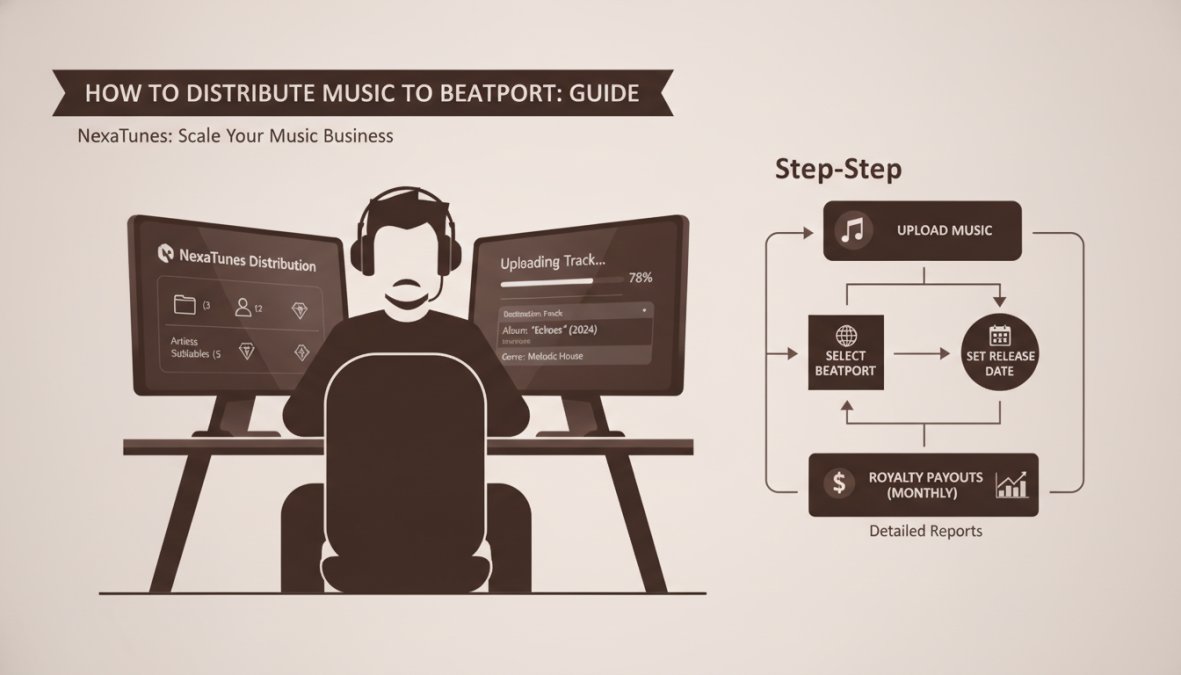
Music producer at a desk with dual monitors displaying a music distribution dashboard, headphones around neck, focused on uploading tracks and reviewing metadata
### Step 1: Prepare Your Tracks and Metadata
Export your master in 24-bit WAV format at 44.1 kHz (or 96 kHz if your production was at that sample rate). Check the loudness using a metering plugin, aiming for -14 to -6 LUFS integrated loudness. Create a metadata spreadsheet with all required information: artist name, track title, featuring artists, producer credits, songwriter credits, and genre. Be consistent across all tracks.
Prepare your artwork: a 3000x3000 pixel JPEG or PNG image in RGB color space. Low-resolution or blurry artwork is a common rejection reason.
### Step 2: Choose Your Distribution Partner
Select an aggregator based on your needs. If you're a solo artist releasing occasionally, TuneCore or TooLost work well. If you're running a label or planning multiple releases, NexaTunes offers better scalability with unlimited sublabels and superior reporting.
Sign up for an account and complete your profile with your artist or label name, contact email, and payment details for royalty deposits.
### Step 3: Create Your Account and Upload Portal Access
Log into your aggregator account and navigate to the upload section. Select "Single" if you're uploading one track, or "EP/Album" if you're uploading multiple tracks as a cohesive release. Make sure Beatport is checked among the platforms to distribute to.
### Step 4: Submit Your Release with Correct Metadata
Upload your WAV file and artwork. Fill in all metadata fields: artist name, track title, genre, BPM, key, and any featuring artists or credits. Double-check everything for spelling and consistency. If you have existing ISRC codes, enter them; otherwise, let the aggregator generate new ones.
Select your release date, most aggregators require at least 2-3 weeks notice before your release date to allow time for processing and curation review.
### Step 5: Set Your Release Date and Exclusive Releases
Choose your release date strategically, considering the electronic music calendar and relevant events that drive DJ interest. Some aggregators offer "exclusive release" options where your music is exclusive to Beatport for a set period before rolling out to other platforms. For most independent artists, a wide release across all platforms simultaneously is more effective.
After submission, your release enters the aggregator's queue. You'll receive email updates as it moves through validation, curation review, and final approval.
## Beatport Release Timeline: What to Expect
From submission to live release, the timeline typically spans 3-6 weeks. Immediately after submission, the aggregator validates your files and metadata (2-3 days). If there are issues, you'll receive a notification with specific corrections needed.
Once validation passes, your release enters Beatport's curation queue, where Beatport's team listens to your track and decides whether it meets their quality and genre standards. This stage typically takes 1-3 weeks. If approved, your release is scheduled for the official release date you selected.
### Troubleshooting Rejected Releases
The most common rejection reasons are: audio quality issues (too loud, distorted, or poorly mastered), metadata errors (inconsistent artist names, misspelled titles), artwork problems (low resolution, wrong color space), or genre mismatch.
Ask your aggregator for feedback on the rejection. Analyze your submission against the requirements: is your audio properly mastered? Is your metadata consistent? Does your genre selection match your music? Resubmit with corrections using the same ISRC and UPC codes.
| Rejection Reason | Solution | Timeline |
| --------------------------- | -------------------------------------------- | --------- |
| Audio too loud or distorted | Re-master to -14 to -6 LUFS | 3-5 days |
| Metadata inconsistencies | Correct artist names and titles | 1 day |
| Artwork low resolution | Create new 3000x3000 pixel image | 1-2 days |
| Genre mismatch | Re-categorize or resubmit as different genre | 1 day |
| Overall quality issues | Work with mastering engineer | 1-2 weeks |
## How to Get Signed to a Label for Beatport Distribution
While distributing independently through an aggregator is straightforward, getting signed to an established label offers different advantages: professional marketing, playlist placement, and credibility within the electronic music community.
Label A&R teams actively scout Beatport, Traxsource, and SoundCloud for new talent. If your independent releases perform well on Beatport, strong sales, consistent streams, positive feedback from DJs, label interest follows naturally. To attract label attention, focus on consistent releases, professional production quality, and genuine engagement with the electronic music community.
### Label Management and Sublabel Strategies
If you're running your own label, sublabel strategies become important. A sublabel is a separate imprint under your main label, useful for different sounds or artist rosters. NexaTunes supports unlimited sublabels at no additional cost, allowing you to organize releases by sound while maintaining consolidated reporting.
### Music Rights and Royalties on Beatport
When your music sells on Beatport, the platform takes a percentage (typically 30-50%), and the remainder goes to your aggregator, which takes its cut before paying you. Royalties are typically paid monthly, with a slight delay. Your aggregator provides detailed reporting showing which tracks sold, on which platforms, and how much revenue each generated.
Ensure you own or control the rights to any music you distribute. If you're distributing a remix, get explicit permission from the original copyright holder. If you're featuring another artist, clarify who owns the recording rights.
## Beatport Hype and Charting Strategies
Beatport's Hype Chart tracks the most-added and most-charted tracks across different genres. Getting your release onto the Hype Chart significantly increases visibility and sales. The Hype Chart is driven by DJ activity: when DJs purchase and add your track to their collections, the platform tracks it.
To drive Hype Chart performance, promote your release to DJs directly. Build relationships with DJs in your genre, send them advance copies, and ask for support. When DJs purchase your track on Beatport, it registers as a chart point. Coordinating a launch day where multiple DJs purchase simultaneously creates momentum.
Beatport's editorial team also factors into chart placement. If they feature your release in genre-specific playlists or the homepage, visibility increases dramatically. Pricing strategy also affects chart performance, pricing your track at $1.49 instead of $2.49 lowers the barrier for DJs to purchase, which can increase sales volume and chart position.
**Pro Tip** Launch your release on a Thursday or Friday to maximize the window before the weekend when DJs are actively shopping for new music.
---
Getting your music on Beatport requires understanding the platform's specific requirements, choosing the right distribution partner, and executing a thoughtful release strategy. NexaTunes is designed specifically for labels and serious independent artists who need transparent reporting, unlimited sublabels, and reliable monthly payouts. With direct Beatport access and detailed label-level analytics, you gain visibility into exactly which tracks resonate with DJs and music buyers.
## Frequently Asked Questions
### Can I upload music directly to Beatport myself?
No, you cannot upload music directly to Beatport. Beatport only accepts submissions through official digital music aggregators and distribution partners. These aggregators manage your track delivery, metadata, and catalog placement. You must use a music distribution platform like TuneCore, iMusician, or similar partners to submit your music to Beatport's platform.
### What are Beatport's distribution requirements for electronic dance music?
Beatport has specific Beatport distribution requirements for EDM and electronic music. Your tracks must be properly mastered WAV files, include complete metadata (artist name, track title, release date), valid ISRC and UPC codes, and be submitted in genre-eligible formats. The Beatport catalog prioritizes high-quality production, proper genre classification, and professional audio specifications to maintain curation standards.
### How long does it take for music to appear on Beatport after submission?
The Beatport release timeline typically ranges from 2-4 weeks after submission through your distribution partner. However, this depends on Beatport's curation process and quality control standards. Some releases may appear faster if they meet all requirements immediately, while others may require revisions. Your aggregator will notify you of any issues during the review period.
### Do I need a record label to distribute music to Beatport, or can I release as an independent artist?
You can distribute music to Beatport as an independent artist without a record label. However, you'll need to use a music aggregator or distribution partner to submit your tracks. Independent artists and labels both use these platforms. The key difference is label accounts may offer additional features like unlimited sublabels and advanced artist management, while independent artists typically use standard submission pathways.
**Editorial Transparency**: This article was created with the assistance of GrandRanker AI and reviewed, edited, fact-checked, and approved by the NexaTunes editorial team before publication.
****“If you’re looking for a reliable way to distribute your music to Major Platforms , NexaTunes offers direct distribution with transparent terms.**
[Learn more ](https://nexatunes.com/?ref=blog.nexatunes.com)
### Best Music Distribution for Independent Labels: 2026
URL: https://blog.nexatunes.com/best-music-distribution-independent-labels/
Last updated: 2026-07-11T06:51:56.000Z
## Table of Contents
- [What Is Music Distribution for Independent Labels?](#what-is-music-distribution-for-independent-labels)
- [Quick Comparison: Top Music Distribution Services for Independent Labels](#quick-comparison-top-music-distribution-services-for-independent-labels)
- [How to Choose the Best Music Distribution for Independent Labels](#how-to-choose-the-best-music-distribution-for-independent-labels)
- [Key Evaluation Criteria for Label-Specific Needs](#key-evaluation-criteria-for-label-specific-needs)
- [Top Music Distribution Platforms Ranked](#top-music-distribution-platforms-ranked)
- [1\. NexaTunes: Transparent Distribution Built for Labels](#1-nexatunes-transparent-distribution-built-for-labels)
- [2\. FUGA: Enterprise-Grade Catalog Management](#2-fuga-enterprise-grade-catalog-management)
- [3\. Symphonic Distribution: Balanced Professional Support](#3-symphonic-distribution-balanced-professional-support)
- [4\. Ditto Music: All-in-One Label Solutions](#4-ditto-music-all-in-one-label-solutions)
- [5\. DistroKid: High-Volume Release Efficiency](#5-distrokid-high-volume-release-efficiency)
- [6\. CD Baby: Flexible Pay-Per-Release Model](#6-cd-baby-flexible-pay-per-release-model)
- [7\. TuneCore: Reliable Unlimited Distribution](#7-tunecore-reliable-unlimited-distribution)
- [8\. RouteNote: Budget-Friendly Entry Point](#8-routenote-budget-friendly-entry-point)
- [Understanding Music Distribution Royalty Splits for Labels](#understanding-music-distribution-royalty-splits-for-labels)
- [Revenue Share vs. Subscription Models](#revenue-share-vs-subscription-models)
- [Royalty Collection and Payout Frequency](#royalty-collection-and-payout-frequency)
- [How to Start an Independent Record Label with the Right Distributor](#how-to-start-an-independent-record-label-with-the-right-distributor)
- [Setting Up Metadata and ISRC Codes](#setting-up-metadata-and-isrc-codes)
- [Managing Multiple Artists and Sublabels](#managing-multiple-artists-and-sublabels)
- [Critical Features for Label-Level Workflow Automation](#critical-features-for-label-level-workflow-automation)
- [Which Distribution Service Should You Choose?](#which-distribution-service-should-you-choose)
*Last Updated: July 9, 2026*
Finding the best music distribution for independent labels requires understanding which platforms prioritize label-specific workflows, transparent royalty reporting, and scalable infrastructure. This guide examines the top platforms designed for independent labels, comparing their features, pricing models, and real-world performance.
## What Is Music Distribution for Independent Labels?
Music distribution for independent labels is the [process of getting your catalog onto streaming platforms](https://blog.nexatunes.com/distribution/) through a professional intermediary that handles metadata management, royalty collection, and catalog administration. Unlike solo artists, independent labels require systems that manage multiple artists, sublabel structures, and complex revenue splits across stakeholders.
Your distributor takes your master files, metadata, and artwork, then delivers them to platforms like Spotify, Apple Music, YouTube Music, and Amazon Music. What separates label-grade distribution from basic artist services is infrastructure for managing large catalogs, detailed financial reporting, and direct relationships with major DSPs and specialty platforms like Beatport and Traxsource.
According to [MusicWeek's 2026 Independent Music Report](https://www.musicweek.com/media/read/music-week-awards-2026-entries-now-open-to-honour-industry-success-with-new-and-revised-categories/093181?ref=blog.nexatunes.com), independent labels now account for a growing share of streaming revenue, making professional distribution infrastructure critical for competitive positioning.
## Quick Comparison: Top Music Distribution Services for Independent Labels
Label manager reviewing analytics dashboards and release schedules across multiple monitors in a professional music production studio office
| Service | Best For | Key Strength | Starting Model |
| ---------------------- | ------------------------- | ------------------------------------------ | ---------------------- |
| NexaTunes | Label-focused operations | Monthly payouts + unlimited sublabels | Royalties Share Model |
| FUGA | Enterprise-scale catalogs | White-label infrastructure + API access | Custom enterprise |
| Symphonic Distribution | Balanced support needs | Application-based Partner tier | $29.99/year per artist |
| Ditto Music | Multi-artist management | Royalty splitting tools | Subscription-based |
| DistroKid | High-volume releases | Unlimited uploads, flat annual fee | $19.99/year |
| CD Baby | Stable, large catalogs | One-time per-release fee | $9.99 per single |
| TuneCore | Reliable unlimited plans | Consistent store reach + Accelerator tools | $24.99/year |
| RouteNote | Budget-conscious labels | Free tier with commission option | Free (15% commission) |
## How to Choose the Best Music Distribution for Independent Labels
Selecting the right distributor depends on your label's size, release velocity, catalog complexity, and reporting requirements. Start by evaluating your actual release volume: 5-10 tracks annually favors per-release payment models, while 50+ releases annually makes [unlimited subscription plans](https://blog.nexatunes.com/plans/) cost-effective.
Consider your catalog structure: do you need sublabel management, artist-specific dashboards, or complex royalty splitting? The best distributor provides transparent financial reporting that syncs with your accounting system. Look for monthly or predictable payout schedules rather than quarterly delays.
### Key Evaluation Criteria for Label-Specific Needs
**Royalty Reporting Transparency.** Can you download detailed statements showing per-platform, per-artist, per-release earnings? For labels managing multiple stakeholders, detailed reporting is non-negotiable.
**Metadata Management at Scale.** Does the platform support bulk uploads, API integrations, or CSV-based ingestion? NexaTunes enables unlimited sublabels and artists without per-artist fees.
**Direct DSP Access.** Specialty platforms like Beatport and Traxsource require direct relationships for playlist pitching. FUGA and Symphonic Distribution maintain preferred partner status with major DSPs.
**Payout Frequency and Currency.** Monthly payouts are standard for professional operations. Currency conversion fees vary widely; some platforms charge 2-3% on international earnings.
**Catalog Migration Support.** Can you export your catalog metadata, ISRC codes, and artist information cleanly? Plan your exit strategy before committing.
## Top Music Distribution Platforms Ranked
### 1\. NexaTunes: Transparent Distribution Built for Labels
NexaTunes stands out as the first choice for independent labels prioritizing transparency and scalable infrastructure. The platform delivers monthly royalty payouts with detailed label-level reporting, ensuring you understand exactly where revenue originates.
NexaTunes | Transparent Music Distribution for Labels & Artists
What separates NexaTunes is the unlimited sublabel architecture. You can create as many artist entities as your roster requires without per-artist fees. Direct access to Beatport and Traxsource is included, giving your electronic and dance music releases visibility on platforms where your audience discovers new music.
**Pro Tip** NexaTunes's monthly payout schedule means cash flow hits your account 30 days after the reporting period closes. For labels managing payroll or artist advances, this predictability is invaluable.
**Pros:**
- Monthly royalty payouts with full transparency
- Unlimited sublabels and artists included
- Direct Beatport and Traxsource access
- Scalable infrastructure as your label grows
**Cons:**
- Smaller platform than DistroKid or CD Baby
Best for: Professional independent labels seeking transparent, predictable financial reporting and scalable infrastructure.
### 2\. FUGA: Enterprise-Grade Catalog Management
FUGA is built for established independent labels managing thousands of releases. The platform excels at catalog management automation through bulk ingestion, API-driven workflows, and custom white-label portals. Revenue splits, mechanical royalty tracking, and publishing administration integrate into a single system, saving hundreds of hours in manual reconciliation.
**Watch Out** FUGA requires an application and partnership agreement. The platform is designed for serious label operations with established catalogs and volume commitments.
**Pros:**
- Industry-leading technical infrastructure
- Preferred partner status with major DSPs
- Custom financial reporting and API access
- White-label capabilities
**Cons:**
- Not suitable for small or DIY operations
- Requires partnership application
Best for: Established independent labels and professional distributors managing large catalogs with complex revenue structures.
### 3\. Symphonic Distribution: Balanced Professional Support
Symphonic Distribution bridges the gap between self-service platforms and enterprise solutions. The application-based Partner tier provides dedicated account management and tailored terms based on your release volume. Sync licensing and YouTube Content ID management are included, opening revenue streams beyond streaming.
**Pros:**
- Strong reputation for artist and label support
- Application-based Partner plan with tailored terms
- Sync licensing and YouTube Content ID included
- Detailed analytics for strategic decision-making
**Cons:**
- Requires application for higher-tier services
- Support quality varies between tiers
Best for: Independent labels seeking a balance between professional support and scalable distribution infrastructure.
### 4\. Ditto Music: All-in-One Label Solutions
Ditto Music provides straightforward solutions for independent labels managing multiple artists. Built-in royalty splitting tools address a real pain point: when multiple stakeholders own pieces of a release, Ditto handles the accounting automatically. Unlimited distribution to 150+ platforms means your entire catalog reaches every major DSP.
**Pros:**
- User-friendly interface for managing multiple artists
- Built-in royalty splitting for complex stakeholder arrangements
- Publishing and sync services included
- Transparent royalty payouts with no hidden deductions
**Cons:**
- Customer support response times can vary
- Less specialized than enterprise platforms for very large catalogs
Best for: Independent labels and managers needing straightforward, all-in-one solutions for multiple artists.
### 5\. DistroKid: High-Volume Release Efficiency
DistroKid dominates the high-volume release market. The unlimited upload model becomes dramatically cost-effective for labels pushing dozens of releases per month. Releases typically hit stores within 24-48 hours, faster than most competitors. Automated royalty splitting for collaborators reduces manual coordination.
**Key Takeaway** DistroKid's $19.99/year price point scales with your artist count. For a label with 10 artists, you're paying $200+ annually just for the base service.
**Pros:**
- Extremely fast upload process
- Cost-effective for high-volume release schedules
- Automated royalty splitting for collaborators
- Reliable platform performance
**Cons:**
- Customer support is primarily automated
- Limited advanced label-specific features
- Consolidated reporting across multiple artists is weak
Best for: Labels that release high volume and prioritize speed and simplicity.
### 6\. CD Baby: Flexible Pay-Per-Release Model
CD Baby's non-subscription model appeals to labels with stable, large catalogs that don't release frequently. You pay once per release ($9.99 per single), and your music stays live indefinitely. Weekly royalty payouts are faster than most competitors.
**Pros:**
- No recurring fees; music stays online indefinitely
- Weekly royalty payouts
- Trusted, long-term reputation
- Straightforward pricing model
**Cons:**
- Lacks advanced label-management dashboards
- Limited publishing integration compared to newer platforms
Best for: Labels that prefer a one-time payment model over recurring annual subscriptions.
### 7\. TuneCore: Reliable Unlimited Distribution
TuneCore delivers unlimited releases for a flat $24.99/year subscription. The platform's strength is consistency and broad store reach. Direct Advance financial services for qualifying accounts let you borrow against future royalties, useful for funding marketing campaigns or artist advances.
**Pros:**
- Very high reliability and broad store reach
- Excellent data reporting for strategic planning
- Direct Advance financial services available
- Simple, flat-fee subscription model
**Cons:**
- Does not offer a specific "label account" type
- Limited advanced label-specific features
Best for: Labels that want a reliable, well-known platform with simple, flat-fee pricing.
### 8\. RouteNote: Budget-Friendly Entry Point
RouteNote's free tier makes it the lowest-barrier entry point for labels testing distribution. The free option takes a 15% commission on royalties but includes access to all major global streaming platforms, YouTube Content ID, and SoundCloud monetization. Premium tiers with flat annual fees let you upgrade as your label grows.
**Pros:**
- Low barrier to entry with the free tier
- Flexible options to switch to non-commission model later
- Access to all major global streaming platforms
- YouTube Content ID and SoundCloud monetization included
**Cons:**
- 15% commission on the free tier reduces earnings
- Support is slower compared to premium-only services
Best for: New or budget-conscious independent labels testing the market.
## Understanding Music Distribution Royalty Splits for Labels
Royalty splits represent one of the most complex aspects of label operations. When multiple stakeholders own pieces of a release, your distributor must calculate and distribute payments correctly every cycle.
### Revenue Share vs. Subscription Models
**Subscription models** charge a flat annual fee regardless of release count. DistroKid ($19.99/year per artist), TuneCore ($24.99/year), and Symphonic Distribution ($29.99/year per artist) follow this approach. For labels releasing 20+ tracks annually, the per-release cost drops significantly.
**Pay-per-release models** charge a one-time fee per release, typically $9.99-$49.99\. CD Baby exemplifies this approach. For labels releasing fewer than 10 tracks annually, this eliminates wasted subscription fees.
**Commission models** take a percentage of royalties. RouteNote's free tier takes 15%. A label earning $10,000 monthly loses $1,500 to a 15% commission, making this approach expensive as your catalog grows.
**Pro Tip** Calculate your breakeven point. If you release 30 tracks per year at $9.99 each (CD Baby), that's $300 annually. If you use DistroKid at $19.99 per artist, you're paying $20 for the same volume. The subscription wins for high-volume operations.
### Royalty Collection and Payout Frequency
**Monthly payouts** are the professional standard. NexaTunes, Ditto Music, and enterprise platforms pay monthly, typically 30 days after the reporting period closes. This predictability lets you forecast cash flow and plan artist payments.
**Weekly payouts** from CD Baby are faster but less common. **Quarterly payouts** are outdated and should be avoided. Three-month delays between earning royalties and receiving payment are unacceptable for growing labels.
## How to Start an Independent Record Label with the Right Distributor
Launching an independent record label requires more infrastructure than releasing as a solo artist. Your distributor choice becomes foundational to your label's operational efficiency.
### Setting Up Metadata and ISRC Codes
Before your first release, you need proper metadata infrastructure. **ISRC codes** (International Standard Recording Code) are unique identifiers for each sound recording. Streaming platforms use ISRC codes to track plays and attribute royalties. Most distributors provide ISRC codes automatically during upload.
**UPC codes** identify your release as a whole product. Retailers and DSPs use UPC to organize releases and prevent duplicates. Most distributors provide these automatically.
**Watch Out** Metadata errors are expensive to fix after release. Build metadata discipline from day one.
### Managing Multiple Artists and Sublabels
As your label grows, you'll manage multiple artists, potentially across multiple sublabels. Your distributor must support this complexity without creating administrative overhead. NexaTunes supports unlimited sublabels, which scales as your operation grows. Platforms like Ditto Music and DistroKid prioritize onboarding simplicity. Professional platforms support granular permissions so you can grant artists limited dashboard access to see their own royalties without exposing your label's overall financials.
## Critical Features for Label-Level Workflow Automation
Professional independent labels operate on systems. Your distributor should support automated workflows that scale as your roster grows.
**Bulk upload capabilities** eliminate manual, one-at-a-time releases. Look for CSV-based bulk ingestion or API access. **Automated royalty splitting** ensures accurate payments to featured artists, producers, and collaborators. **Release scheduling** lets you plan releases weeks in advance without manual intervention. **Playlist pitching integration** saves time if your distributor has relationships with playlist curators. **Analytics API access** lets you pull data directly into your own reporting systems.
## Which Distribution Service Should You Choose?
Your final decision depends on three factors: release volume, roster complexity, and reporting requirements.
**For professional labels managing 10+ artists:** NexaTunes or FUGA. Both prioritize label-specific workflows, transparent reporting, and scalable infrastructure.
**For growing labels with 3-10 artists:** Symphonic Distribution or Ditto Music. Both offer professional support without enterprise complexity.
**For high-volume independent labels:** DistroKid. If you're releasing 50+ tracks annually, the unlimited model becomes dramatically cost-effective.
**For labels with stable, large catalogs releasing infrequently:** CD Baby. The one-time per-release fee eliminates wasted subscription fees on dormant months.
**For new labels testing the market:** RouteNote. The free tier with 15% commission lets you launch without upfront cost.
The best music distribution for independent labels ultimately matches your operational model. Evaluate your release velocity, roster structure, and financial reporting needs. Test platforms with a few releases before committing your entire catalog. Most distributors make migration possible, but it's easier to choose right initially than to move everything later.
---
Most independent labels underestimate how much their distributor impacts operational efficiency and financial visibility. Choosing a platform designed for label operations eliminates months of administrative friction as your roster grows. NexaTunes delivers transparent monthly payouts, unlimited sublabel management, and detailed label-level reporting specifically built for professional label operations. Start with a distributor that scales with your ambition.
## Frequently Asked Questions
### What is the difference between music distribution for artists and labels?
Artist-focused distributors emphasize simplicity and speed for individual releases. Label-specific music distribution platforms provide advanced features like bulk metadata management, royalty splitting across multiple stakeholders, detailed label-level reporting, and tools for managing unlimited sublabels and artists. Labels need catalog management at scale, whereas solo artists typically manage one account with single-release workflows.
### Which music distribution service offers the best royalty splits for independent labels?
The best royalty splits depend on your label's release volume and revenue model. Subscription-based services like NexaTunes and Ditto Music offer transparent, non-deductive payouts with detailed royalty reporting. Commission-based models like RouteNote's free tier take a percentage cut but require no upfront fees. CD Baby's pay-per-release model avoids recurring costs. Compare based on your expected catalog size and annual release schedule to find the most cost-effective option.
### What features should an independent label look for in a music distributor?
Prioritize: (1) Label-specific account management for multiple artists and sublabels, (2) Detailed royalty reporting and split payment capabilities, (3) Direct DSP access or strong platform reach (Spotify, Apple Music, Beatport), (4) Metadata management and ISRC code handling, (5) Sync licensing and YouTube Content ID support, (6) Reliable customer support and monthly payout schedules. These features enable scalable operations and transparent financial tracking essential for growing labels.
### Can independent labels use DistroKid or TuneCore, or do I need a label-specific distributor?
Independent labels can use DistroKid and TuneCore, but they weren't originally designed for label-scale operations. Both offer unlimited distribution plans and basic artist management, but lack native label-account structures, advanced royalty splitting, and bulk metadata tools. For small labels with few artists, these work fine. For scaling operations with multiple sublabels and complex royalty arrangements, dedicated label platforms like NexaTunes, FUGA, or Ditto Music provide better infrastructure and reporting.
### How do I handle catalog migration if I switch music distribution services?
Most distributors allow you to take down releases from their platform and re-upload to a new service. However, you'll lose streaming continuity and listener playlists during the transition. Before switching, confirm the new distributor's take-down policy and timeline. Some platforms like FUGA and NexaTunes offer smoother transitions with direct DSP relationships. Plan migrations during slow release periods and communicate with your artists about potential temporary unavailability on streaming platforms.
**Editorial Transparency**: This article was created with the assistance of GrandRanker AI and reviewed, edited, fact-checked, and approved by the NexaTunes editorial team before publication.
****“If you’re looking for a reliable way to distribute your music to Major Platforms , NexaTunes offers direct distribution with transparent terms.**
[Learn more ](https://nexatunes.com/?ref=blog.nexatunes.com)
### Music Sync Rights: The Complete Licensing Guide
URL: https://blog.nexatunes.com/music-sync-rights-complete-guide/
Last updated: 2026-07-11T06:52:31.000Z
## Table of Contents
- [What Are Music Sync Rights?](#what-are-music-sync-rights)
- [The Role of Copyright Holders and Publishers](#the-role-of-copyright-holders-and-publishers)
- [Master vs. Sync Rights: Understanding the Difference](#master-vs-sync-rights-understanding-the-difference)
- [Why Both Licenses Matter](#why-both-licenses-matter)
- [How Music Sync Licensing Works in Practice](#how-music-sync-licensing-works-in-practice)
- [Direct Licensing vs. Music Libraries](#direct-licensing-vs-music-libraries)
- [How to Get Music Sync Licensing: Step-by-Step Process](#how-to-get-music-sync-licensing-step-by-step-process)
- [Identifying Rights Holders and Negotiating Terms](#identifying-rights-holders-and-negotiating-terms)
- [How Much Does Sync Licensing Pay? Understanding Fees and Royalties](#how-much-does-sync-licensing-pay-understanding-fees-and-royalties)
- [Factors That Influence Sync Fees](#factors-that-influence-sync-fees)
- [Music Sync Licensing Contract Template: Essential Clauses and Negotiation Tactics](#music-sync-licensing-contract-template-essential-clauses-and-negotiation-tactics)
- [Key Contract Elements and Common Pitfalls](#key-contract-elements-and-common-pitfalls)
- [Negotiation Tactics for Better Terms](#negotiation-tactics-for-better-terms)
- [Sync Licensing for Independent Creators and YouTubers](#sync-licensing-for-independent-creators-and-youtubers)
- [Navigating Royalty-Free and Creative Commons Options](#navigating-royalty-free-and-creative-commons-options)
- [Legal Pitfalls and What to Avoid](#legal-pitfalls-and-what-to-avoid)
*Last Updated: July 8, 2026*
## What Are Music Sync Rights?
Music sync rights are the legal permissions required to synchronize a copyrighted song with visual media. When you pair music with video, film, television, advertising, or any other timed visual content, you need a sync license. A sync license grants permission to use a specific composition in a specific way, for a defined period and territory.
Sync licensing is distinct from performance rights, it's not about radio play or streaming on Spotify, but specifically about locking music to moving images. The copyright holder, typically the music publisher who owns the composition, controls this right entirely.
### The Role of Copyright Holders and Publishers
The composition copyright holder controls sync rights, usually the music publisher, though songwriters who retain publishing rights can as well. When a production company needs a sync license, they approach the publisher directly or through a licensing agent. The publisher evaluates the request, where will the music appear, how long, what's the budget, what's the territory, and decides whether to grant the license and at what price.
Performance rights organizations (PROs) like ASCAP, BMI, and SESAC collect performance royalties when music airs on radio or streams on platforms. However, PROs do not grant sync licenses; that's the publisher's exclusive domain.
**Pro Tip** If you can't find the publisher's contact information, search the U.S. Copyright Office database or use services like Harry Fox Agency, which represents thousands of publishers and can facilitate licensing.
## Master vs. Sync Rights: Understanding the Difference
Master rights and sync rights are two separate copyrights that must both be licensed for most music placements. Master rights are owned by the record label or independent artist and control the specific recorded version of a song. Sync rights are owned by the music publisher and control the composition itself, the underlying song, melody, and lyrics.
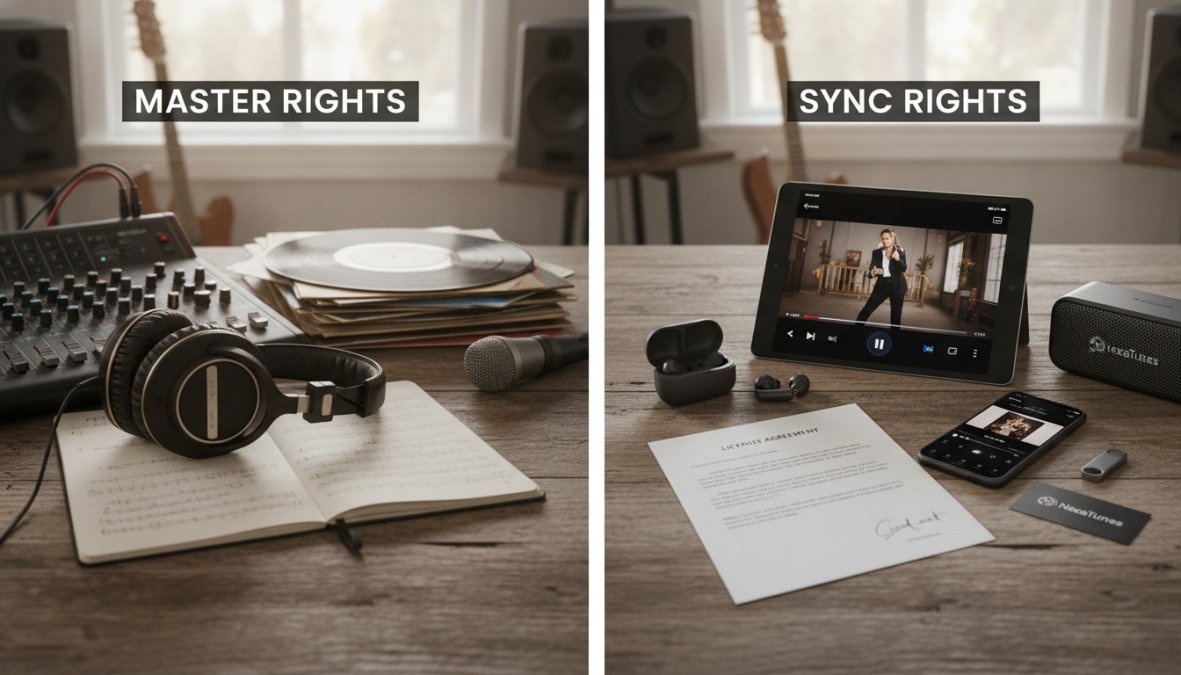
Side-by-side comparison of Music for music sync rights
If you want to use The Beatles' "Let It Be" in a film, you need two licenses: master rights from the record label that owns the specific Beatles recording, and sync rights from the publisher that owns the composition. If either party says no, the placement can't happen.
### Why Both Licenses Matter
Imagine producing a commercial with an indie song. You contact the independent artist who owns the master rights and they grant permission. But the songwriter's publisher controls the composition and wants a much higher fee. You're stuck negotiating with two separate parties with potentially conflicting interests.
This is why many productions license royalty-free music or creative commons tracks. With royalty-free music, a single license often covers both master and sync rights from one vendor, eliminating the two-license requirement.
**Watch Out** Many creators assume they can use music from YouTube's Audio Library for commercial purposes without additional licensing. Check the specific terms; some royalty-free licenses exclude commercial use or require attribution, creating legal liability later.
## How Music Sync Licensing Works in Practice
The sync licensing process begins when a production needs music. A music supervisor or content creator identifies a track and must determine who controls the sync rights and negotiate a license.
First, identify the rights holder. For major-label releases, contact the publisher directly or work with a sync agent. For independent music, contact the artist directly. Copyright office databases can help you find publisher contact information.
Submit a licensing request with project details: title, medium (film, TV, commercial, YouTube, etc.), territory, duration, and intended use. The publisher provides a quote based on these factors. Sync fees vary enormously, a small YouTube video might cost nothing or a few hundred dollars, while a national television commercial could cost tens of thousands.
### Direct Licensing vs. Music Libraries
Direct licensing means negotiating with the publisher or rights holder directly. This gives you access to any composition but requires research, negotiation, and often legal representation. It's time-consuming and expensive, but it's the only way to get major-label or established independent music.
Music libraries offer a faster alternative. These are collections of pre-licensed music where sync rights are already cleared. You browse, find a track, and license it instantly, often with a single payment covering both master and sync rights. The trade-off is selection, you won't find major-label hits, but you'll find music specifically produced for licensing, often cheaper and faster to deploy.
## How to Get Music Sync Licensing: Step-by-Step Process
**Step 1: Identify your music needs.** Define genre, mood, duration, and how the music will be used.
**Step 2: Search for the track.** Use copyright databases, contact music supervisors, or explore music libraries.
**Step 3: Identify the rights holder.** Use the U.S. Copyright Office database, ASCAP/BMI/SESAC databases, or contact the record label.
**Step 4: Submit a licensing request.** Provide project details: title, format, territory, duration, and budget if applicable.
**Step 5: Negotiate terms.** Review the license agreement carefully, paying attention to exclusivity clauses, territory restrictions, and duration limits.
**Step 6: Execute the agreement.** Sign the license agreement and pay the fee. The publisher provides a cue sheet for your records.
**Step 7: Use the music as licensed.** Incorporate the music according to the terms. Include attribution or credits if required.
### Identifying Rights Holders and Negotiating Terms
For major-label releases, start with album liner notes or the record label's website. For independent music, check the artist's website or contact them directly.
When negotiating, understand that publishers have standard rates but often negotiate based on project scope. Be transparent about your budget and intended use; publishers respect honesty and are more likely to work with upfront creators. Most Favored Nations (MFN) clauses are common in sync agreements, meaning if you negotiate a lower rate with one rights holder, other rights holders in your project can claim the same rate.
**Pro Tip** Create a spreadsheet tracking each rights holder, their quote, and key terms. This helps you compare offers and ensure consistency across your project's licensing.
## How Much Does Sync Licensing Pay? Understanding Fees and Royalties
Sync fees vary dramatically based on project type, scope, and composition popularity. For YouTube videos and small independent projects, fees range from free to a few hundred dollars. For television commercials, fees typically range from $5,000 to $50,000 or more. For theatrical film releases, fees can exceed $100,000 for well-known compositions.
### Factors That Influence Sync Fees
**Media type matters most.** Film, television, and advertising command higher fees than web or educational use.
**Territory and duration affect pricing.** A worldwide, perpetual license costs more than a license limited to North America for five years.
**The composition's popularity influences fees.** Well-known songs command higher rates than obscure tracks.
**Your budget and project scope matter.** Publishers often ask about production budget, distribution reach, and media spend.
**Exclusivity requirements increase costs.** Exclusive rights cost significantly more than non-exclusive.
**Key Takeaway** Most sync licensing is non-exclusive, meaning the same composition can be licensed to multiple projects. Exclusive licenses are rare and expensive, typically used only for major advertising campaigns.
## Music Sync Licensing Contract Template: Essential Clauses and Negotiation Tactics
A sync license agreement specifies exactly how you can use the music. Understanding key clauses protects both you and the rights holder.
### Key Contract Elements and Common Pitfalls
**Grant of Rights:** This clause specifies what you're licensed to do, the composition, master recording, territory, duration, and specific media. A poorly written grant of rights can result in disputes later.
**Term and Renewal:** Does the license last forever or for a limited period? Many creators assume perpetual licenses; many are actually limited-term.
**Territory:** Where can you use the music? Worldwide means everywhere. Some licenses restrict to specific countries. Ensure your territory covers your intended markets.
**Exclusivity and Most Favored Nations:** Is your license exclusive or non-exclusive? Exclusive means no competitor can use the same music in the same category.
**Attribution and Credits:** Does the license require you to credit the composer, publisher, or artist? If required, specify exactly where and how.
**Derivative Works:** Can you modify the music? Can you remix, shorten, or speed it up? This clause determines your creative freedom.
**Common Pitfall:** Many creators overlook territory restrictions. You license music for North America, then distribute globally, and suddenly you're in breach.
### Negotiation Tactics for Better Terms
**Understand the publisher's priorities.** Publishers care about proper credit, accurate usage reporting via cue sheets, and ensuring the music isn't used for objectionable purposes.
**Bundle compositions.** If licensing multiple tracks from the same publisher, ask for a bundle discount.
**Propose a tiered fee structure.** For projects with uncertain distribution, propose lower upfront fees for festival use with higher fees if it goes to theatrical release.
**Build relationships.** Repeat customers often get better rates and faster approvals.
**Watch Out** Never use music without a signed license, even if you've verbally agreed on terms. Verbal agreements aren't enforceable. Always get a written agreement signed before using the music.
## Sync Licensing for Independent Creators and YouTubers
Independent creators face unique challenges with music licensing. Most YouTube creators use either royalty-free music or Creative Commons licensed tracks. Royalty-free music is pre-licensed; you pay once and can use it indefinitely (subject to license terms). Creative Commons music is free or low-cost but typically requires attribution and may restrict commercial use.
YouTube's Audio Library offers thousands of free tracks cleared for monetized videos. However, read the terms carefully; some tracks require attribution, and some exclude commercial use outside YouTube.
### Navigating Royalty-Free and Creative Commons Options
**Royalty-free music** is the most practical option for most independent creators. Platforms like Epidemic Sound, Artlist, and AudioJungle offer millions of tracks cleared for various uses. One payment covers both master and sync rights with no negotiation required.
**Creative Commons music** is often free or very low-cost. Platforms like Free Music Archive and ccMixter host Creative Commons licensed tracks. You must follow specific license terms, which typically require attribution and may restrict commercial use. For commercial YouTube channels or monetized use, verify that the Creative Commons license permits commercial use.
The practical approach: use royalty-free or Creative Commons music as your default, and pursue direct licensing only for signature tracks essential to your project.
## Legal Pitfalls and What to Avoid
Several common mistakes create serious legal liability.
**Using music without a license** is the most obvious pitfall. Many creators assume that if music is available on YouTube or Spotify, it's free to use. It's not. You need a sync license regardless of where you found the music.
**Assuming YouTube's Audio Library covers all uses** is a subtle mistake. The library is free for YouTube videos, but terms often exclude commercial use outside YouTube.
**Misunderstanding territory restrictions** creates problems when projects distribute internationally. You license music for North America, then your film gets worldwide distribution, and suddenly you're infringing in territories where you lack rights.
**Ignoring attribution requirements** can result in takedown notices even with a valid license. If the license requires attribution and you fail to provide it, the rights holder can claim breach.
**Modifying licensed music without permission** violates most sync agreements. If your license doesn't explicitly permit remixing, shortening, or speeding up the track, don't do it.
**Failing to report usage via cue sheets** creates compliance issues, especially for film and television. Inaccurate or missing cue sheets can result in disputes with publishers and PROs.
**Using music in a way that contradicts the license** is a common violation. If you license music for a film and then use it in an advertisement, you're in breach.
**Key Takeaway** The safest approach is to assume every piece of music is protected by copyright unless explicitly stated otherwise. If you're unsure whether you need a license, err on the side of caution and get one.
| Licensing Scenario | Best Approach | Estimated Cost | Key Consideration |
| --------------------------------------- | --------------------------------------------------------------- | ------------------------- | --------------------------------------------------- |
| YouTube video (non-commercial) | YouTube Audio Library or Creative Commons | Free | Verify license permits your intended use |
| YouTube video (monetized) | Royalty-free library or Creative Commons (commercial-permitted) | $10-50/month subscription | Ensure commercial use is explicitly allowed |
| Independent film (limited distribution) | Direct licensing or music library | $500-$5,000 per track | Negotiate based on actual distribution scope |
| Television commercial | Direct licensing with major publishers | $10,000-$100,000+ | Budget for negotiation with multiple rights holders |
| Theatrical film release | Direct licensing with major publishers | $50,000-$500,000+ | Expect higher fees for prestige placements |
| Corporate training video | Royalty-free or direct licensing (budget option) | $100-$1,000 | Territory and duration restrictions matter less |
---
Music sync rights protect composers and publishers while enabling creators to build compelling visual stories. The fundamental principle is simple: if you're pairing music with visual media, you need permission from the copyright holder.
The key is understanding your options. Royalty-free music and Creative Commons tracks offer speed and affordability for most independent projects. Direct licensing gives you access to any composition but requires negotiation and budget. Whether you're licensing music for your project or managing licensing for your catalog, clarity and documentation protect everyone involved.
## Frequently Asked Questions
### What are music sync rights and when do I need them?
Music sync rights grant permission to synchronize a song with visual media, film, TV, YouTube videos, commercials, games, and more. You need a synchronization license whenever you pair a copyrighted composition with moving images. Without proper clearance, you risk copyright infringement. Both the composition copyright holder (publisher) and master recording owner must grant permission for legal use.
### What's the difference between master rights and sync rights?
Master rights control the sound recording itself (the artist's performance), while sync rights control the underlying musical composition (the song's melody and lyrics). When licensing music for visual media, you typically need both. The master recording owner (usually a label or artist) grants master rights, while the music publisher grants sync rights. Both licenses are required for complete legal clearance.
### How much does music sync licensing typically cost?
Sync licensing fees vary dramatically based on media type, duration, exclusivity, territory, and audience size. A YouTube video might cost $50-$500, while a major film could range into thousands. Pricing depends on quantity, dates, and delivery terms. Many independent creators use royalty-free music libraries to avoid negotiation. For custom quotes on specific projects, contact music publishers, sync agents, or licensing platforms directly.
### What are the most important clauses in a sync licensing contract?
Critical clauses include: territory (where the media can be distributed), exclusivity (whether only you can use the song), duration (how long the license lasts), payment terms, and credit requirements. Watch for Most Favored Nations (MFN) clauses that lock you into competitor pricing, and ensure work-for-hire language is clear if applicable. Common pitfalls include unlimited territory grants and perpetual licenses at one-time fees, always negotiate scope carefully.
**Editorial Transparency**: This article was created with the assistance of GrandRanker AI and reviewed, edited, fact-checked, and approved by the NexaTunes editorial team before publication.
****“If you’re looking for a reliable way to distribute your music to Major Platforms , NexaTunes offers direct distribution with transparent terms.**
[Learn more ](https://nexatunes.com/?ref=blog.nexatunes.com)
### Op-Amps – The Underrated Powerhouse of Modern Audio
URL: https://blog.nexatunes.com/op-amps-the-underrated-powerhouse-of-modern-audio/
Last updated: 2026-04-02T13:08:17.000Z
#
A deep dive into the heart of analog and digital sound
Operational amplifiers – or op-amps – are small electronic components with a massive impact on audio.
Found in everything from vintage mic pres to modern audio interfaces and plugins, they amplify, buffer,
filter and shape sound with surprising sonic influence.
## What is an Op-Amp?
An op-amp is a high-gain differential amplifier designed to amplify small voltage differences. In audio,
they’re used for linear applications: gain stages, buffers, active filters – and often the heart of tone-shaping circuitry.
## Where are Op-Amps used?
### In analog audio gear:
Mic preamps (API 312, Neve 1073, SSL VHD)
EQs & compressors (API 550a, SSL G-Bus, SPL)
Summing mixers, consoles
Audio interfaces & outboard gear
### In digital systems:
A/D and D/A converters
Analog output stages of digital gear
Plugin emulations (UAD, Acustica, Waves)
## What do Op-Amps do sonically?
Depending on the design, they influence sound in key ways:
Harmonic saturation: Discrete op-amps like the API 2520 or Jensen 990 naturally produce musical 2nd/3rd order harmonics –
warm, colorful, and full.
Transient shaping: Fast op-amps enhance punch and clarity – useful in drums, vocals, and master bus chains.
Stereo depth & imaging: High-end op-amps deliver impressive spatial depth and resolution – great for mastering and stereo bus applications.
Noise & precision: Modern IC op-amps are quiet, transparent and ultra-reliable – ideal for surgical or mastering-grade signal chains.
## Sound Examples
API: Punchy, gritty, alive – thanks to the discrete 2520 op-amp. Great for synths, drums, bass.
Neve: Rich and creamy midrange, with vintage vibe – from its transistor-based discrete op-amps.
SSL: Fast, neutral and clear – perfect for clean summing or bus compression.
Plugins: UAD’s API Vision Strip or Acustica’s emulations model op-amp behavior – from saturation to stereo width.
## Conclusion
Op-amps are more than circuitry – they are essential tone shapers. From analog consoles to plugin chains,
their influence is subtle yet vital.
Understanding their role gives you more creative control over your sound’s depth, punch, and texture – analog or digital.
---
## Op-Amps vs Tubes vs Transformers
Three paths to analog color – three distinct sonic identities
In audio production, there are three legendary components responsible for "mojo" and tonal coloration: op-amps, tubes, and transformers.
They all introduce harmonics and saturation—but each does it in its own way.
### Op-Amps
Character: punchy, mid-forward, controlled
Distortion: often 3rd-order – tight and modern
Strengths: transient control, punch, clarity, precision
Used in: API, SSL, modern gear
Typical Sound: fast, aggressive, focused
### Tubes
Character: warm, smooth, rounded
Distortion: mainly 2nd-order – rich, musical
Strengths: harmonic enhancement, smooth compression, “glow”
Used in: Manley, Tube-Tech, Thermionic Culture
Typical Sound: creamy, saturated, vintage-style
### Transformers
Character: thick, dimensional, analog glue
Distortion: subtle saturation + low-end bloom
Strengths: depth, width, bass weight, glue factor
Used in: Neve, Chandler, Rupert Neve Designs
Typical Sound: full, organic, tactile
## Conclusion:
Op-Amps = Punch
Tubes = Warmth
Transformers = Weight & Depth
Combine wisely—and you’ve got analog magic.
---
## How Do Different Op-Amps Sound?
Your tonal guide to the most iconic models
Not all op-amps sound alike. Here's a sonic overview of the most commonly used types:
### API 2520 (Discrete)
Character: mid-forward, gritty, muscular
Best for: drums, bass, synths
Found in: API 312, 550A, 2500
### Jensen 990 / John Hardy 990
Character: warm, wide, musical
Best for: vocals, stereo bus
Found in: Hardy M-1, Grace Design
### NE5534 / 5532
Character: clean, neutral, cost-effective
Best for: budget gear, interfaces
Found in: lots of utility gear and older SSL circuits
### OPA2134 / OPA2604 (Burr-Brown)
Character: smooth, detailed, audiophile-grade
Best for: mastering gear, converters
Found in: audiophile preamps, high-end interfaces
### Melcor 1731 / GAR1731
Character: vintage, soft top-end, musical
Best for: vocals, acoustic instruments
Found in: Neve clones and vintage API-style gear
## Conclusion:
Choosing an op-amp is choosing a tone. Know their sonic fingerprints—and color your signal path with intent.
---
## Mixbus Tools with Characterful Op-Amps
Where punch, glue, and color come together
The mixbus or masterbus is where op-amp coloration shines. It's here that subtle harmonics, punch,
and width can elevate a mix from good to great.
### API 2500
Features: Dual 2520 op-amps + THRUST™
Sound: punchy, forward, American-style compression
Great for: techno, hip-hop, aggressive mixes
Pro Tip: Use parallel compression mode!
### SSL G-Bus Clones (5534/2181)
Sound: clean, gluey, surgical
Great for: pop, house, rock
Pro Tip: 2:1 ratio + auto release for gentle mix glue
### Rupert Neve MBP / 542 Tape Emulator
Combines: transformers + op-amps + saturation circuit
Sound: deep, smooth, analog-rich
Great for: mixbus saturation, mastering
Pro Tip: “Silk” mode (especially Blue) enhances bass weight
### Looptrotter Monster / Thermionic Culture Vulture
Combines: op-amps with tube or distortion circuitry
Sound: wild, warm, characterful
Great for: creative shaping, drum bus, sound design
Pro Tip: Saturate hard, but dial in via mix knob
## Conclusion:
Your mixbus is the place for final emotional impact—and op-amps give you the tools to sculpt that vibe.
From subtle glue to full-on mojo, the right component matters.
---
## Frequently Asked Questions (FAQ)
### What is an op-amp in audio production?
An op-amp is a high-gain amplifier used in audio circuits to amplify, buffer, filter, and shape sound, often forming the core of tone-shaping stages.
### Where are op-amps commonly used?
They are used in mic preamps, EQs, compressors, audio interfaces, summing mixers, and even plugin emulations in digital environments.
### How do op-amps affect sound?
Op-amps influence harmonic content, transient response, stereo imaging, and overall clarity depending on their design and implementation.
### What is the difference between op-amps, tubes, and transformers?
Op-amps provide punch and precision, tubes add warmth and smoothness, and transformers contribute weight, depth, and analog glue.
### Do different op-amps sound different?
Yes, each op-amp model has a unique sonic character, ranging from clean and transparent to colored and harmonically rich.
### Why are op-amps important on the mixbus?
They add subtle saturation, punch, and cohesion, helping to shape the final tone and emotional impact of a mix.
---
**About the Co-Author**
CB MASTERING – partner in crime at NexaTunes Blog
📧 [cbmastering@gmx.de](mailto:cbmastering@gmx.de) · 🔗 [linktr.ee/cb.mastering](https://linktr.ee/cb.mastering?ref=blog.nexatunes.com)
### Tube Saturation – Tone with Soul
URL: https://blog.nexatunes.com/tube-saturation-tone-with-soul/
Last updated: 2025-11-04T13:27:58.000Z
## The role of tube coloration in modern audio production
Whether on the mixbus, vocals, or drums – tube saturation is a trusted way to enrich audio with harmonic color, gentle compression, and organic punch. What once happened naturally through analog gear is now applied deliberately, either via hardware or plugins.
### What happens technically?
When you drive a vacuum tube, it produces even-order harmonics (mostly 2nd order), perceived as warm, full, and musical. At the same time, the tube applies subtle compression, rounding off transients in a smooth, ear-friendly way.
### Sonic effects:
- Richer tone and body
- Natural-sounding saturation
- Softer, glue-like transients
- That famous "analog warmth"
### Use with care:
Too much tube drive can cloud definition, roll off highs, or oversaturate your mix. The goal is not distortion – but musical coloration and depth.
### Hardware vs. Plugin
True tube gear (Manley, Thermionic Culture, Tube-Tech) offers unmatched mojo – but comes with cost, heat, and upkeep. Top plugins (UAD, Kush, Kazrog, Acustica) get impressively close – and fit easily into a modern, recallable workflow.
### Bottom line:
Tube saturation isn’t hype – it’s craftsmanship. Used tastefully, it elevates mixes with a depth and warmth that digital can rarely achieve on its own.
---
## Frequently Asked Questions (FAQ)
### What is tube saturation?
Tube saturation is a form of audio coloration that occurs when a vacuum tube is driven, producing harmonic distortion and gentle compression, adding warmth and body to the sound.
### What are the sonic effects of tube saturation?
Tube saturation enriches the tone, adds natural-sounding saturation, smooths transients, and imparts a characteristic "analog warmth" to the audio.
### How can tube saturation be applied in production?
It can be used on the mixbus, vocals, drums, and other elements to add harmonic depth and smoothness. Both hardware and plugin versions are available.
### What is the difference between hardware and plugin tube saturation?
True tube gear offers unique sonic characteristics but requires maintenance and can be expensive. Plugins emulate this effect and are more accessible and suitable for modern workflows.
### Can tube saturation be overdone?
Yes, too much tube drive can cloud definition, dull the highs, or over-saturate the mix. The key is to apply it tastefully for musical depth without distortion.
---
**About the Co-Author**
CB MASTERING – Partner in Crime at NexaTunes Blog
📧 [cbmastering@gmx.de](mailto:cbmastering@gmx.de) · 🔗 [linktr.ee/cb.mastering](https://linktr.ee/cb.mastering?ref=blog.nexatunes.com)
### Transformer Saturation – The Invisible Tone Shaper
URL: https://blog.nexatunes.com/transformer-saturation-the-invisible-tone-shaper/
Last updated: 2025-10-28T10:42:26.000Z
#
**Magnetic color in modern audio production**
Transformer saturation is one of the most subtle yet musically powerful forms of analog coloration. It occurs when a signal drives a transformer (audio output or input stage) into magnetic saturation, producing harmonics, compression, and low-mid punch.
## Where are transformers found?
Transformers are used in pro-level preamps, compressors, EQs, summing amps, and mastering gear:
- Neve 1073 / 33609
- API 512c / 2500
- Shadow Hills Mastering Compressor
- Rupert Neve Designs
- Chandler / SSL / Retro / Thermionic Culture
They’re also found in power supplies, DI boxes, and analog console outputs – wherever galvanic isolation or headroom sculpting is needed.
### Plugins that model transformers:
- UAD API & Neve
- Kush Omega Transformers
- Acustica (Taupe, Cream, etc.)
- Soundtoys Radiator
- Waves Scheps 73
- Kazrog True Iron
## What does it sound like?
- Adds 3rd-order harmonics
- Smooths peaks subtly
- Punchy low-mids
- Glue & depth without harshness
### Downsides?
- Not 100% transparent
- Can smear transients when overused
- Slight phase shift at extreme drive
## Conclusion:
Transformer saturation is a sonic sweetener – subtle but deeply musical. Whether you use hardware or high-end plugins, it can add glue, weight, and analog authority to your mix or master when applied with intention.
---
## Transformer Saturation – The Sound of Classic Consoles
In iconic analog consoles like Neve, API, and even SSL, transformers are not just circuit components – they are the core of the sound.
### How do console transformers shape tone?
Transformers saturate when pushed, producing 3rd-order harmonics, subtle compression, and punch – especially in the low-mid range. This "magnetic glue" is what makes analog mixes sound so cohesive and emotionally engaging.
### Classic desk examples:
- **Neve 80-series (e.g. 8078):**
With Marinair transformers and Class-A topology, Neve consoles deliver buttery saturation, silky top end, and weighty low mids.
- **API 1608 / Legacy AXS:**
With custom-wound iron-core transformers, API consoles are punchy, bold, and mid-forward – instantly recognizable.
- **SSL 4000 / 9000 series:**
SSL desks are mostly transformerless, known for surgical precision – but many engineers insert Neve or API-style transformers in the mix or master chain to inject analog warmth and personality.
## Conclusion:
Transformer saturation isn't just a vintage aesthetic – it's the signature tone of the analog era. Whether you're mixing on hardware or emulating the vibe with plugins, knowing what these circuits do helps bring depth, warmth, and cohesion into your productions.
---
## Frequently Asked Questions (FAQ)
### What is transformer saturation?
Transformer saturation occurs when a signal drives a transformer into magnetic saturation, producing harmonic distortion, compression, and adding depth and punch to a track.
### Where can I find transformers in audio equipment?
Transformers are found in pro-level preamps, compressors, EQs, summing amps, and mastering gear, including models like Neve, API, and Shadow Hills.
### How does transformer saturation affect the sound?
It adds 3rd-order harmonics, smooths peaks subtly, and gives punchy low-mids, providing glue and depth without harshness.
### What are the downsides of transformer saturation?
It may not be 100% transparent, and overuse can smear transients or cause slight phase shifts at extreme drive settings.
### Why is transformer saturation important in mixing?
It adds warmth, cohesion, and musicality to mixes, making the sound feel more engaging and professional. Many classic consoles rely on transformer saturation to create their signature sound.
---
**About the Co-Author**
CB MASTERING – Partner in Crime at NexaTunes Blog
📧 [cbmastering@gmx.de](mailto:cbmastering@gmx.de) · 🔗 [linktr.ee/cb.mastering](https://linktr.ee/cb.mastering?ref=blog.nexatunes.com)
### Tape Saturation in Audio Production
URL: https://blog.nexatunes.com/tape-saturation-in-audio-production/
Last updated: 2025-10-14T09:01:26.000Z
## Introduction:
Tape saturation has become one of the most musically pleasing tools in modern audio production. What once was a byproduct of analog tape recording is now intentionally used to add warmth, character, and cohesion to digital recordings in mixing and mastering.
## What is Tape Saturation?
Tape saturation occurs when an audio signal hits the magnetic tape beyond its linear operating range. The result is gentle compression, harmonic distortion, and soft clipping, which smoothens transients, enhances harmonics, and gives a track a fuller, warmer sound.
## Advantages of Real Tape Saturation:
- **Harmonic Distortion**
Adds pleasant 2nd and 3rd order harmonics, enriching the timbre in a musical way.
- **Natural Compression**
Smooths out peaks subtly without squashing dynamics.
- **Glue Effect**
Binds elements of a mix together psychoacoustically.
- **Soft Clipping**
Analog tape saturates smoothly, avoiding harsh digital clipping.
## Disadvantages of Real Tape Machines:
- **Maintenance & Calibration**
Requires regular calibration (azimuth, bias, tension).
- **Tape Degradation**
Magnetic tape wears out, causing dropouts and fidelity loss.
- **Expensive & Bulky**
Machines like the Studer A80 or Ampex ATR-102 are costly and take up space.
- **Noise Floor**
Even high-end tape has inherent hiss and imperfections.
## Digital Tape Emulation (Plugins)
Today’s plugins emulate tape behavior, including harmonic distortion, head bump, wow and flutter, and tape compression. Notable tools include UAD Ampex ATR-102, Softube Tape, Waves J37, and Toneboosters ReelBus.
## Comparison: Tape Machine vs. Plugin
**Real Tape (Hardware):**
- **Sound Character:** Organic, tactile, nonlinear
- **Noise:** Present, natural hiss
- **Maintenance:** High
- **Workflow Flexibility:** Limited, real-time only
- **Mojo / Depth:** Rich and vibrant
**Plugin (Software):**
- **Sound Character:** Emulated, clean, tweakable
- **Noise:** Optional or bypassed
- **Maintenance:** None
- **Workflow Flexibility:** Total flexibility (automation, recall)
- **Mojo / Depth:** Close, but not identical
## Conclusion
Whether through physical tape or advanced emulations, saturation remains a vital tool for adding emotional and sonic depth to modern productions. While nothing fully replaces the character of actual tape, today’s plugins offer practical, powerful alternatives that are more accessible and flexible than ever.
---
## Frequently Asked Questions (FAQ)
**What is tape saturation in audio production?**
Tape saturation is the effect that occurs when an audio signal exceeds the linear operating range of analog tape, leading to harmonic distortion, soft clipping, and compression that add warmth and fullness to the sound.
**What are the advantages of real tape saturation?**
The advantages include harmonic distortion (pleasant 2nd and 3rd order harmonics), natural compression, a cohesive "glue effect", and smooth soft clipping that prevents harsh digital clipping.
**What are the disadvantages of using real tape machines?**
Disadvantages include high maintenance requirements, tape degradation over time, high costs for tape machines, and the inherent noise floor of magnetic tape.
**How do digital tape emulation plugins compare to real tape?**
Digital tape emulation plugins can replicate the harmonic distortion and compression of real tape but with more flexibility, no maintenance, and the ability to automate and recall settings, though they may lack the "mojo" or depth of actual tape.
---
**About the Co-Author**
CB MASTERING – Partner in Crime at NexaTunes Blog
📧 [cbmastering@gmx.de](mailto:cbmastering@gmx.de) · 🔗 [linktr.ee/cb.mastering](https://linktr.ee/cb.mastering?ref=blog.nexatunes.com)
### Audio Saturation – The Hidden Magic of Analog Warmth
URL: https://blog.nexatunes.com/audio-saturation-the-hidden-magic-of-analog-warmth/
Last updated: 2025-10-08T14:26:02.000Z
#
## Why EQ alone often isn’t enough.
In today’s era of ultra-clean digital productions, sharp EQ curves and surgical precision, something essential is often missing: **Vibe!**
That warm, rich, emotionally resonant quality that makes music feel alive – not just technically right.
And this is where **audio saturation** steps in.
Saturation isn’t just a technical effect – it’s a sonic attitude. It doesn’t correct. It colors. It doesn’t fix – it feels.
## So what is it, technically?
Saturation happens when analog gear like tape machines, tubes or transformers is pushed gently into nonlinear behavior. This creates harmonic distortion, gentle compression, and that unmistakable sense of depth and character.
**EQ asks**: “What’s missing?”
**Saturation asks**: “How does it feel?”
While EQ boosts or cuts specific frequencies, saturation shapes the entire signal – it reacts to transients, rounds off harshness, and glues elements together in a musical way.
## Why Saturation Is Essential:
- Adds harmonic richness and warmth.
- Enhances perceived loudness naturally.
- Smooths dynamics without destroying them.
- Gives cohesion to the mix.
- Brings analog soul into digital clarity.
Saturation adds life, depth, and grit where EQ simply can’t.
## Common Applications:
- **Drums**: Punch and weight via tape-style saturation.
- **Vocals**: Body and presence through tube-style drive.
- **Bass**: Dirt and tone without mud.
- **Mastering**: Analog-style glue and harmonic complexity.
## Bottom Line:
Saturation doesn’t replace EQ – it transcends it.
Used with intention, it becomes a signature sound.
If EQ is the scalpel, then saturation is the paintbrush.
In a world obsessed with precision, saturation is the soul your sound deserves.
---
## Frequently Asked Questions (FAQ)
### What is audio saturation?
Audio saturation is the process of gently pushing analog gear, like tape machines, tubes, or transformers, into nonlinear behavior. This creates harmonic distortion, gentle compression, and adds depth and character to the sound.
### How does saturation differ from EQ?
While EQ boosts or cuts specific frequencies, saturation shapes the entire signal, reacting to transients, rounding off harshness, and gluing elements together in a musical way. EQ is technical, while saturation adds emotional warmth and richness.
### Why is saturation important?
Saturation adds harmonic richness, enhances perceived loudness, smooths dynamics, and gives cohesion to a mix, all while bringing an analog soul into the digital clarity.
### What are some common uses for saturation in music production?
- **Drums**: Punch and weight via tape-style saturation.
- **Vocals**: Body and presence through tube-style drive.
- **Bass**: Dirt and tone without mud.
- **Mastering**: Analog-style glue and harmonic complexity.
---
**About the Co-Author**
CB MASTERING – Partner in Crime at NexaTunes Blog
📧 [cbmastering@gmx.de](mailto:cbmastering@gmx.de) · 🔗 [linktr.ee/cb.mastering](https://linktr.ee/cb.mastering?ref=blog.nexatunes.com)
### Spotify’s New AI Music Policies: What Labels Need to Know
URL: https://blog.nexatunes.com/spotifys-new-ai-music-policies-what-labels-need-to-know/
Last updated: 2025-10-06T10:00:16.000Z
---
Spotify is finally cleaning up its catalog — and AI music is right in the spotlight.
On September 25, 2025, the platform announced a series of new rules aimed at tackling the flood of low-effort AI tracks, fake uploads, and voice-clone experiments that have been diluting the system for months.
The update doesn’t ban AI music. Instead, it tries to separate genuine creativity from automated noise, a move that could change how labels handle releases in the near future.
## 75 Million Tracks Gone — and Counting
Spotify claims to have removed more than **75 million “spammy” tracks** over the past year. That number alone shows how deep the problem runs.
AI tools made it effortless to mass-produce low-value uploads, sometimes flooding the platform with thousands of identical files. Most of these tracks never reached real listeners but still clogged the system and distorted recommendation data.
## Smarter Filters, Not Blind Deletions
To counter that, Spotify is introducing a **platform-wide spam filter** that identifies suspicious upload behavior, mass uploads, duplicated titles, ultra-short “filler” tracks, or obvious SEO tricks.
Unlike the earlier “delete first, ask later” approach, the new filter will be more cautious to avoid hitting legitimate artists or experimental releases.
## The End of Voice Cloning Without Consent
The other big change targets AI vocals. If a voice even *sounds* like a real artist, Spotify now requires **explicit permission**.
The company is also improving detection for so-called *content mismatches* this means the frustrating issue where a release ends up on the wrong artist profile, often because of sloppy distributor uploads or metadata confusion.
## AI Disclosure Becomes Standard
Transparency is the next pillar. Spotify will soon support a new **DDEX metadata field** where labels and distributors must declare AI involvement: whether it’s vocals, instruments, or post-production.
The plan: show this directly inside the Spotify app, so listeners know when AI played a role. It’s a step toward standardizing credits in an era where the line between human and algorithmic music is increasingly blurry.
## What This Means for Labels
For most labels, this marks the start of a new compliance era. Metadata needs to be more detailed. Rights must be documented. And sloppy upload practices, the kind that risk duplicate flags or missing credits could now lead to takedowns or lost visibility.
Labels that handle their catalog properly, however, stand to benefit. Less spam means better discovery for legitimate releases, and AI credits could even become a mark of professionalism rather than suspicion.
Still, the risks remain: false positives, delayed approvals, and potential account strikes if AI use isn’t clearly documented.
It’s worth reviewing your upload routines and talking to your distributor about how they’ll implement these standards. The best time to fix metadata is before a release goes live.
## The Bottom Line
Spotify isn’t banning AI — it’s demanding **responsibility**.
For serious labels, that’s not a problem. It’s a relief. The chaos of mass-generated tracks has hurt real artists for long enough.
If this cleanup finally makes Spotify’s ecosystem more transparent and reliable, it’s a win worth accepting — even if it means a bit more paperwork along the way.
## FAQ: Spotify’s AI Music Policies
**Will Spotify ban AI-generated music?**
No. Spotify isn’t banning AI. It’s focusing on transparency and preventing misuse such as impersonation or mass-spam uploads.
**How will AI usage be disclosed?**
Spotify will add new metadata fields via the DDEX standard where labels must indicate how AI was used — vocals, instruments, or post-production. These credits will appear inside the app.
**Can artists still use AI voices?**
Yes, but only with explicit, documented permission from the person whose voice or likeness is being cloned.
**What happens if metadata doesn’t include AI disclosure?**
Missing or false disclosures could lead to delays, removal, or lower visibility in recommendations.
**How can labels protect their catalog?**
Maintain accurate metadata, avoid duplicate uploads, and keep written documentation for any AI involvement. Monitor your releases for takedowns or visibility drops and escalate through your distributor if needed.
---
## Sources
- Spotify Newsroom: [“Spotify Strengthens AI Protections for Artists, Songwriters, and Producers”](https://newsroom.spotify.com/2025-09-25/spotify-strengthens-ai-protections/?ref=blog.nexatunes.com) (Sep 25, 2025)
- Spotify Support: [“Music that impersonates another artist’s voice”](https://support.spotify.com/artists/article/music-that-impersonates-another-artists-voice/?ref=blog.nexatunes.com)
- The Guardian: [“Spotify removes 75m spam tracks in past year as AI increases ability to make fake music”](https://www.theguardian.com/music/2025/sep/25/spotify-removes-75m-spam-tracks-past-year-ai-increases-ability-make-fake-music?ref=blog.nexatunes.com) (Sep 25, 2025)
- Music Business Worldwide: [“Spotify has deleted 75m+ ‘spammy tracks’”](https://www.musicbusinessworldwide.com/spotify-has-deleted-75m-spammy-tracks-as-it-unveils-new-ai-music-policies/?ref=blog.nexatunes.com) (Sep 25, 2025)
- TechCrunch: [“Spotify to label AI music, filter spam and more in AI policy change”](https://techcrunch.com/2025/09/25/spotify-updates-ai-policy-to-label-tracks-cut-down-on-spam/?ref=blog.nexatunes.com) (Sep 25, 2025)
- The Verge: [“Spotify is finally taking steps to address its AI slop and clone problem”](https://www.theverge.com/news/785136/spotify-ai-slop-impersonation-disclosure?ref=blog.nexatunes.com) (Sep 25, 2025)
- Rolling Stone: [“Spotify Won’t Ban AI Music Under New Rules”](https://www.rollingstone.com/music/music-features/spotify-not-banning-ai-music-new-guidelines-1235434946/?ref=blog.nexatunes.com) (Sep 25, 2025)
### Why You Should Always Have a Mastering Engineer You Trust?
URL: https://blog.nexatunes.com/why-you-should-always-have-a-mastering-engineer-you-trust/
Last updated: 2025-09-30T13:43:12.000Z
#
## If You Want the Best for Your Song!
In music production, there are many steps that lead to creating a great track. From the initial creative spark, through recording, mixing, and finally mastering. The latter is often underestimated, yet it’s the final polish that makes the track ready for release. A Mastering Engineer is the key to a professional finished product. But why is it so important to have an experienced mastering engineer by your side?
## 1\. Objectivity and Fresh Ears
A mastering engineer brings fresh ears into the production process. The producer or mixer can become so involved with a track after hours or days of working on it that they can no longer hear it objectively. Even the best ears can become “fatigued” by the constant exposure to the music. A mastering engineer, however, listens to the track with fresh ears. This external perspective allows them to identify mistakes or imbalances that the producer may have missed, ensuring that the track sounds great from all angles.
## 2\. Technical Expertise
Mastering is far more than just turning up the volume. A skilled mastering engineer possesses a deep understanding of audio processing, frequency management, dynamic control, and the specific requirements of different distribution formats. The mastering engineer ensures that the track is frequency balanced, dynamics optimized, and stereo width maximized. They also make sure that the track translates well on different playback systems, from studio monitors to home speakers and club sound systems.
## 3\. Optimization for Different Formats
Each song must be tailored to different distribution formats. It’s not just about making the track louder or more dynamic—it also needs to be optimized for different playback types. A track that sounds equally good on vinyl as it does on streaming services or CDs requires specific mastering. A seasoned mastering engineer understands the requirements and standards for various formats and ensures the track sounds its best on every platform.
## 4\. Preserving the Artistic Vision
While mixing is often filled with creative decisions and experimentation, the mastering engineer ensures that this vision is preserved while preparing the track for release. Mastering is the moment when the music reaches its full emotional impact. The song goes from a technical process to a piece of art that retains its power and presence on any playback system. An experienced mastering engineer knows how to preserve the artistic integrity of the song while meeting the technical demands.
## 5\. Consistency and Harmony
Especially for albums or EPs, the mastering engineer ensures that all tracks sound sonically cohesive, maintaining a unified soundscape throughout. It’s important that each track on an album or EP has its place and that the entire project doesn’t suffer from mismatched sound qualities or loudness discrepancies. This creates a consistent listening experience that feels polished and professional to the audience.
## 6\. Mastering as an Art Form
Mastering is not just a technical process—it can also be seen as an art form. Artistic decisions, such as adding subtle harmonics or creating depth and presence, can elevate the emotional experience of the listener. A skilled mastering engineer knows how to emphasize these artistic elements without compromising technical standards.
## Conclusion:
A mastering engineer is the key to a track that sounds great across all formats while preserving its artistic vision. Trusting an experienced mastering engineer allows you to unlock the full potential of your music, making sure it resonates deeply with the listener—on every platform, from streaming to vinyl.
---
## Frequently Asked Questions (FAQ)
### Why is it important to have a trusted mastering engineer?
Having a trusted mastering engineer ensures your track is polished to perfection, optimizes the sound for different formats, and preserves the artistic vision of your music.
### What does a mastering engineer do?
A mastering engineer prepares the final version of a song for release, optimizing it for different platforms and ensuring technical and artistic standards are met.
### How can a mastering engineer enhance my track?
They bring fresh ears, technical expertise, and a deep understanding of the music industry’s technical requirements, ensuring your track sounds great everywhere.
### What makes mastering an art form?
Mastering involves artistic decisions like adding subtle harmonics and shaping depth, while maintaining the technical integrity of the track for different playback systems.
---
**About the Co-Author**
CB MASTERING – Partner in Crime at NexaTunes Blog
📧 [cbmastering@gmx.de](mailto:cbmastering@gmx.de) · 🔗 [linktr.ee/cb.mastering](https://linktr.ee/cb.mastering?ref=blog.nexatunes.com)
### How Small Labels with 30 to 40 Releases Stay Profitable Without Big Budgets
URL: https://blog.nexatunes.com/how-small-labels-with-30-to-40-releases-stay-profitable-without-big-budgets/
Last updated: 2025-09-29T10:00:44.000Z
---
Independent labels that release a handful of tracks each year face one type of challenge. Labels with thirty to forty releases face another. At this scale you are running a system, not an experiment. Profitability depends less on a single hit and more on the ability to coordinate dozens of releases, multiple artists and a steady stream of administration. The encouraging part: a major-label budget is not necessary. What you need is a clear structure, consistent discipline and transparency about where your money goes.
For labels working at this volume, planning ahead is non-negotiable. A release calendar is the backbone of the business. Scheduling six to twelve months in advance protects pitch windows, keeps distribution on track and prevents last-minute chaos. Treating the schedule like an editorial plan creates predictability for the label and for every artist on the roster.
Budget control becomes the second pillar. With many releases you cannot treat each project equally. Some tracks deserve a full campaign with advertising, PR and influencer support, others will perform on organic reach and long-tail streaming. The skill is to decide early where to invest. Smart labels allocate marketing spend where a realistic return exists and communicate openly with artists about those choices.
Automation and digital tools form the third pillar. At this scale, manual spreadsheets and endless email threads quickly collapse. Distribution platforms handle the basics, but true efficiency comes from automating royalty splits, using shared dashboards for artist updates and scheduling content well in advance. A label releasing forty tracks a year without automation will always be at a disadvantage because every hour spent on repetitive administration is an hour lost on strategy.
Artist relationships remain the fourth pillar. With many acts on the roster, personal attention has to be structured. What you can promise is clarity: timely royalty reports, honest feedback and realistic targets. In the revenue range of one to three thousand euros per month, credibility is more powerful than overpromising. Artists stay when they feel they are part of a professional system, not a chaotic hobby project.
Profitability ultimately comes from knowing your numbers. If your break-even sits at 250,000 streams per track you need to calculate how many releases reach that threshold and what that means for annual revenue. Labels that endure treat numbers as strategy, not as an afterthought. It is not about chasing one hit but about managing a catalogue where successes cover the average and the system stays profitable as a whole.
**Conclusion:** A label with thirty to forty releases a year functions more like a small publisher than a hobby project. Profitability at this level comes from a disciplined release plan, prioritised budgets, automation and transparent artist management. You do not need big budgets to achieve this, but you do need a system.
---
## FAQ
**How can a label handle 30 to 40 releases without chaos?**
Plan at least six months ahead and lock the release calendar. Treat it as a fixed schedule, not a suggestion.
**Should every release receive the same marketing budget?**
No. Prioritise based on realistic return. Some tracks are for brand building, others are for income. Communicate this openly with artists.
**What tools help labels scale?**
Automated royalty reporting, content scheduling platforms and shared dashboards for artist communication become essential once you pass twenty releases per year.
---
## Sources & Further Reading
- [IFPI Global Music Report 2025](https://ifpi.org/?ref=blog.nexatunes.com)
- [IMPALA – European Independent Music Companies Association](https://impalamusic.org/?ref=blog.nexatunes.com)
- [Music Business Worldwide](https://www.musicbusinessworldwide.com/?ref=blog.nexatunes.com)
### Audio Compression: From Leveling Tool to Psychoacoustic Shaper
URL: https://blog.nexatunes.com/audio-compression-from-leveling-tool-to-psychoacoustic-shaper/
Last updated: 2025-09-23T09:10:18.000Z
## Introduction:
**Why Compress?**
Audio compression is one of the most fundamental tools in music production, broadcasting, and film sound.
Its primary function is to reduce the dynamic range—the difference between quiet and loud parts—making audio more consistent,
intelligible, and controlled in a mix.
But compression today is more than level control: It can enhance punch, warmth, presence, depth, and even emotional intensity.
It's a creative tool with roots in physics, signal theory, and psychoacoustics.
---
## Basics:
**What Does a Compressor Do?**
A compressor detects when an incoming signal exceeds a threshold and reduces those peaks according to the ratio (e.g., 4:1).
Other parameters—attack, release, knee, and make-up gain—control its timing and tonal characteristics.
### Typical Use Cases:
- **Vocals:** Consistent level, intimate feel, intelligibility.
- **Drums:** Punch, control, transient shaping.
- **Mix Bus:** Glue effect, cohesion, loudness management.
- **Mastering:** Subtle gain control, detail preservation.
---
## Audio Compressors – Types, Character & Applications
Audio compressors are fundamental tools in mixing and mastering.
They control dynamic range, but also sculpt tone, add character, and shape the emotional arc of music.
### Core Principle:
A compressor reduces a signal’s gain once it passes a certain threshold. Key parameters include:
- **Ratio:** Degree of compression
- **Attack:** How quickly compression starts
- **Release:** How quickly it resets
- **Knee:** The curve between uncompressed and compressed behavior
### Analog Compressor Types:
1. **VCA (Voltage Controlled Amplifier)**
- Fast, clean, precise
- Famous models: SSL G Bus, dbx 160
- Best for: Drums, mixbus, vocals
- Sound: Punchy, tight, controlled
2. **FET (Field Effect Transistor)**
- Very fast and colorful compression
- Famous model: Urei 1176
- Best for: Vocals, bass, snare
- Sound: Aggressive, lively, full of character
3. **Opto (Optical Compressor)**
- Uses a light cell for compression – slow, musical
- Famous model: Teletronix LA-2A
- Best for: Vocals, guitars, mastering
- Sound: Smooth, warm, organic
4. **Vari-Mu (Variable Gain Tube Compressor)**
- Tube-based with program-dependent behavior
- Famous model: Fairchild 670, Manley Vari-Mu
- Best for: Mastering, buses, vocals
- Sound: Silky, round, luxurious
---
## Digital Compressors & Plugins
1. **Emulations of Analog Classics**
- Plugins replicating VCA, FET, Opto, Vari-Mu
- Brands: UAD, Waves, Plugin Alliance
- Pros: Affordable, recallable, noiseless
2. **Multiband Compressors**
- Split signal into frequency bands
- Control dynamics independently per band
- Best for: Mastering, full mixes, complex signals
3. **Sidechain Compressors**
- Triggered by an external input
- Classic EDM use: Kick → Ducking bassline
4. **Lookahead Compressors**
- Predict peaks using latency
- Useful for precise limiting, broadcast
5. **AI & Intelligent Compressors**
- Tools like iZotope Neutron, smart:comp
- Use machine learning for optimal settings
- Efficient and fast, but not always musical
Each type of compressor has a unique fingerprint and ideal use case.
Understanding how, why, and where to use them separates the technician from the artist.
Whether analog or digital — what matters is the result in the mix and the intended emotional impact.
---
## Scientific Depth
Compression is based on nonlinear signal processing. It affects transient response, harmonic structure, and even perceived loudness.
### Psychoacoustic Relevance:
Our ears are non-linear sensors. We don’t hear all frequencies equally, and we miss quiet elements in the presence of louder ones.
Compression reshapes the signal to fit the ear’s psychology—helping subtle elements emerge and emphasizing rhythm through dynamic movement or “pumping.”
---
## Creative Applications
Advanced techniques include:
- Parallel Compression (“New York compression”)
- Sidechain Compression (e.g., kick triggers bass ducking)
- Multiband Compression (frequency-selective control)
- Envelope Shaping / Transient Designing
- Upward Compression: Lifts quiet parts instead of taming peaks
---
## Conclusion
Compression isn’t just about making things louder or more controlled—it’s about expression.
When used with intention, compression becomes an artistic, even emotional decision.
Great mixes breathe because the engineer knows when to compress, why, and how much.
In the end, compression is as much about listening as it is about measuring.
---
# Audio Compression – Deep Dive & Hardware vs Plugin
## 1\. The Sonic Depth of Compression
**Compression doesn't just control levels — it shapes how we perceive sound. Let's go deeper:**
- **Transient Shaping**
Compressors manipulate the attack and decay of sounds. This significantly affects perceived texture and definition.
Punch is not just volume — it’s how the compressor treats micro-attacks.
- **Harmonics & Nonlinear Behavior**
Analog compressors generate subtle harmonic distortion due to their circuitry (VCA, FET, tube, opto, etc.).
These overtones can be musical and pleasing — plugins replicate them via algorithms,
but real components interact with electricity in ways DSP can only approximate.
- **Envelope Behavior**
The dynamic interplay between attack and release alters rhythm, density, and vibe.
Digital compressors offer lookahead functions for ultra-clean control — impossible in analog but powerful in surgical settings.
- **Micro- vs. Macro-Dynamics**
Great compression addresses both:
- Macro (verse vs. chorus dynamics)
- Micro (detail articulation within a single note or phrase)
Bad compression flattens a mix. Great compression enhances energy and emotion.
---
## 2\. Compression & Psychoacoustics
Compression interacts with how we hear and feel audio:
- **Masking:** Loud elements hide quiet ones. Compression lifts details into audibility.
- **Perceived Loudness:** Compressed tracks feel louder even with identical peaks.
- **Emotional Flow:** Dynamics create impact, space, intimacy. Over-compression = fatigue.
---
## 3\. Hardware vs Plugins – What Really Changes?
**Hardware Compressors**
- Built with physical components (transformers, tubes, opto-cells)
- Every unit sounds slightly different
- Naturally nonlinear, colored, complex
- Often described as more dimensional, “alive”, or "organic"
- Drawbacks: expensive, bulky, no instant recall
**Plugins**
- Use digital modeling or emulation (DSP)
- Great for precise, repeatable, total control
- Clean or colored — depends on algorithm quality
- Pros: affordable, fast, consistent
- Cons: often less 3D, less “feel” under heavy processing
**Hybrid Systems**
Many engineers mix both: Plugins for control, Hardware for vibe.
Understanding what each offers allows you to make sound that breathes and connects.
---
## Conclusion
Compression is part science, part art, part psychoacoustics.
The real difference between hardware and plugins lies in how they interact with energy, signal, and soul.
Mastering both gives you complete control — from clinical precision to analog magic.
---
# FAQ – Audio Compression
**Q: What is the main purpose of audio compression?**
A: To reduce dynamic range, making audio more consistent, controlled, and intelligible.
**Q: What are the main types of analog compressors?**
A: VCA, FET, Opto, and Vari-Mu – each with unique sonic characteristics.
**Q: Why use digital compressors or plugins?**
A: They offer precision, recallability, affordability, and advanced functions like multiband or lookahead.
**Q: How does compression affect psychoacoustics?**
A: It reshapes sound to match how our ears perceive loudness, detail, and rhythm, enhancing emotional impact.
**Q: Hardware vs Plugins – which is better?**
A: Hardware offers organic, nonlinear depth, while plugins provide consistency and precision. Many engineers combine both.
---
**About the Co-Author**
CB MASTERING – partner in crime at NexaTunes Blog
📧 [cbmastering@gmx.de](mailto:cbmastering@gmx.de) · 🔗 [linktr.ee/cb.mastering](https://linktr.ee/cb.mastering?ref=blog.nexatunes.com)
### Why Your Label Catalog Is Your Real Asset
URL: https://blog.nexatunes.com/why-your-label-catalog-is-your-real-asset/
Last updated: 2025-09-22T10:00:41.000Z
---
Running a label is not just about releasing tracks. It’s about building and protecting long-term value. Too often, labels operate release to release, chasing short-term attention while neglecting the bigger picture: the catalog. A label’s catalog is its core asset, and it should be managed with the same discipline and foresight that investors apply to their portfolios.
---
## The Catalog Is the Asset That Outlives Trends
Singles come and go. Artists rise, peak, and sometimes fade. But the catalog remains. A catalog is more than just a collection of tracks; it is the label’s equity. Every release adds to it, every licensing deal depends on it, and every future negotiation is shaped by it.
Just like a financial portfolio, a strong catalog spreads risk. One underperforming release won’t threaten the whole business if other parts of the catalog continue to generate revenue. Labels that only chase short-term hits leave themselves exposed when trends shift.
---
## Diversification: Don’t Put All Your Bets on One Artist
Investors know not to put all their money into a single stock. Labels should apply the same principle. Depending too heavily on one artist or one sound style can be profitable for a while, but it’s risky.
- Multiple artists mean multiple income streams.
- Different sub-genres allow entry into distinct listener markets.
- Cross-format releases (singles, EPs, compilations, remasters) ensure that revenue doesn’t rely on one format alone.
A diversified roster does not mean diluting your brand; it means reducing risk and increasing resilience.
---
## Timing and Release Strategy: Market Cycles Matter
Markets move in cycles. Timing matters more than most labels admit.
Releasing a track during a crowded Friday with ten competing records in the same genre reduces its chances. Scheduling a reissue during a quiet period might bring unexpected traction. Observing when listeners are most active — weekends, seasonal shifts, festival seasons — allows labels to position their releases for maximum visibility.
Long-term strategy means planning these cycles in advance, not rushing tracks because an artist is impatient or a deadline is arbitrary.
---
## Measuring Return on Investment (ROI)
Every release carries cost: production, mastering, artwork, promotion, sometimes advances. Without tracking ROI, labels are operating blind.
For each release, ask:
- How much was invested in total?
- What revenue has it generated in the first three, six, twelve months?
- How does it compare to similar releases in the catalog?
By consistently measuring ROI, labels identify which artists and strategies are sustainable, and which consume resources without return. This is not about being cold with creativity; it’s about ensuring the label can keep supporting creativity in the long run.
---
## The Hidden Power of the Back Catalog
Back catalog is the compound interest of the label world. Tracks that are five or ten years old can still generate stable revenue if maintained correctly.
Smart labels:
- Refresh older tracks with remasters or anniversary editions.
- Place catalog tracks into playlists or compilations that align with current trends.
- Keep metadata clean and consistent to maximize discoverability across DSPs.
Ignoring the back catalog is like leaving money in a drawer while claiming cashflow is tight.
---
## Data as Guidance, Not as Dictatorship
Data is often misunderstood in the music world. For labels, it should be a compass, not a cage.
- Listener locations reveal where to focus PR or tour activity.
- Playlist performance shows which tracks connect and which do not.
- Growth trends highlight where to double down or when to cut losses.
The key is balance: using data to inform decisions without killing creativity or forcing every release into the same mold. Portfolio thinking means knowing when to experiment and when to double down on proven patterns.
---
## Avoiding Common Traps
Many labels stumble because they fail to treat their catalog professionally. The most common mistakes:
1. Overreliance on one star artist. When that artist leaves or slows down, the label collapses.
2. Chasing hype without strategy. Releases flood out with no consistent positioning, leaving no identity or brand equity.
3. Neglecting older material. A forgotten back catalog erodes in visibility, while competitors keep theirs alive.
4. Confusing short-term success with long-term growth. A viral hit is not a sustainable strategy.
Avoiding these traps requires discipline — the same discipline investors apply when sticking to long-term plans.
---
## Action Steps for Labels
To put portfolio thinking into practice, labels can start with simple steps:
- Audit the catalog: know exactly what assets you own, how they are performing, and where the gaps are.
- Diversify the roster: balance emerging artists with established ones; balance experimental with reliable.
- Plan release cycles: map out at least six to twelve months, aligning with market opportunities instead of reacting last-minute.
- Track ROI: treat each release as an investment, and analyze results accordingly.
- Activate the back catalog: don’t let it sleep. Make it work continuously for the label.
---
## Conclusion
Labels that manage their catalog like an investment portfolio stand stronger against market volatility. They build sustainable revenue, attract better partnerships, and provide their artists with stability. Portfolio thinking doesn’t mean stripping away creativity; it means protecting it with a foundation that lasts.
Music will always be art. But if you are running a label, it’s also a business. And in business, discipline separates those who survive from those who fade.
---
## FAQ
**Why focus on the catalog instead of just new releases?**
Because the catalog generates ongoing revenue and builds long-term value. New releases are important, but without catalog care, labels constantly start from zero.
**Is diversification always necessary?**
Yes, but it doesn’t mean signing every genre. Diversification can happen inside your niche by balancing different types of artists, formats, and release strategies.
**How often should a label review ROI?**
At least every quarter. Frequent enough to spot trends early, but not so often that short-term noise drives decisions.
**What’s the best way to activate a back catalog?**
Keep metadata optimized, consider reissues or compilations, and identify tracks that could still fit current playlist trends.
---
## Sources
- IFPI Global Music Report 2024 – insights on catalog revenue share
- MIDiA Research: The Growing Value of Back Catalog (2023)
- Chartmetric Industry Analysis on Playlist Lifecycle (2024)
- Music Business Worldwide articles on label diversification and catalog investment strategies
### What is the most important "Plugin" in audio production?
URL: https://blog.nexatunes.com/what-is-the-most-important-plugin-in-audio-production/
Last updated: 2025-09-16T13:29:32.000Z
**YOUR EAR!**
## The Human Ear & Hearing in Audio Production
In audio production, the human ear is more than just a sensory organ – it is the final judge,the main reference point, and the most accurate analyzer. The ability to listen intentionally defines the quality and impact of any musical work.
## Anatomy of Hearing
The ear consists of the outer, middle, and inner ear. In the inner ear,
the cochlea converts sound waves into electrical signals, which are interpreted by the brain – the true "hearing" happens here. Psychoacoustics, the science of how we perceive sound, plays a critical role in mixing and mastering.
## Types of Hearing in Audio Work
- **Analytical Listening** – Detecting frequencies, phase issues, transients, masking. Essential for mix decisions.
- **Critical Listening** – Noticing small tonal or dynamic differences, like the impact of subtle EQ or compression.
- **Musical Listening** – Recognizing pitch, harmony, timing, and groove.
- **Emotional Listening** – Asking: Does this mix feel right? Does it connect emotionally?
- **Adaptive Listening** – Checking mixes on headphones, speakers, car systems, etc., to ensure consistency.
## Why Good Hearing Is Crucial
Modern tools offer visual cues – spectrum analyzers, meters, dynamic displays – but they can’t replace what trained ears detect: depth, warmth, space, balance, or analog glue.
## Ear Training Is Vital
Just like a muscle, hearing must be trained. Focused listening builds awareness of frequency balance, dynamics, and tonal character – and distinguishes a skilled engineer from an average one.
## Conclusion
You can have the best gear and most precise tools, but if your ears aren’t trained to listen deeply, you're missing the point. Great sound begins and ends with the art of hearing.
---
## FAQ
**Q: What is the most important "plugin" in audio production?**
A: Your ears – they are the ultimate reference and decision-maker.
**Q: Why can’t visual tools replace hearing?**
A: Tools show data, but only trained ears perceive depth, warmth, and emotional impact.
**Q: How can I improve my listening skills?**
A: Through ear training, critical listening exercises, and comparing mixes across systems.
**Q: What types of listening are essential in audio production?**
A: Analytical, critical, musical, emotional, and adaptive listening.
**Q: Why is ear training vital for engineers?**
A: It sharpens frequency awareness, dynamic perception, and tonal balance – the foundation of great sound.
---
**About the Co-Author**
CB MASTERING – partner in crime at NexaTunes Blog
📧 [cbmastering@gmx.de](mailto:cbmastering@gmx.de) · 🔗 [linktr.ee/cb.mastering](https://linktr.ee/cb.mastering?ref=blog.nexatunes.com)
### Tutorial: Forms & Requests
URL: https://blog.nexatunes.com/tutorial-forms-requests/
Last updated: 2025-09-10T06:14:50.000Z
_This post is for subscribers on the CLIENT MEMBER AREA tier only._
### The Key Elements to a Great-Sounding Song:
URL: https://blog.nexatunes.com/the-key-elements-to-a-great-sounding-song/
Last updated: 2025-09-09T14:15:26.000Z
Recordings, Samples, and Synthesizers
In music production, there are countless factors that contribute to making a track not only listenable but emotionally compelling. While mixing and mastering are essential, the quality of the recordings, samples, and synthesizers you use will have the greatest influence on the final sound.
## 1\. High-Quality Recordings of Vocals and Instruments:
No matter how well you mix or master, without clean, precise, and dynamic recordings, a track will lose clarity and expression.
This is especially true for vocals and acoustic instruments, which need to be captured in a high-quality recording environment.
**Microphones & Pre-Amps:**
The choice of the right microphone and a high-quality pre-amp can make a huge difference. Tube microphones (e.g., Neumann U87) deliver warmth and detail.
Condenser microphones are often used for vocals, while dynamic microphones (e.g., Shure SM7B) are preferred for high-output instruments like drums.
**Room Acoustics:**
A neutral acoustic environment is essential. For vocal recording, an acoustically treated room is ideal. If that’s not available,
using reflection filters or isolation booths can help.
**Recording Levels:**
Proper gain staging is key. Too high leads to clipping and loss of details; too low results in low signal-to-noise ratio.
**Microphone Placement and Recording:**
When recording analog stuff, it’s important to capture the sound in a controlled environment.
Condenser microphones provide the best transparency, while dynamic mics may help enhance the warmth of the sound.
## 2\. Quality Samples:
Samples are not just shortcuts to beats but also an important source of creative inspiration. However,
the selection and quality of samples play a major role in a song’s sound.
**Quality over Quantity:**
While large sample libraries are tempting, good samples usually have a clear, defined sound without unwanted artifacts.
When using samples, focus on originality and avoid overused sounds.
**Sound Design:**
A good selection of synth-based samples (e.g., from Splice or Loopmasters) should be paired with sound design to give your track character.
A drum sample that’s creatively processed and layered with effects can evolve into a unique sound.
**Sample Chains:**
A great way to integrate samples is to make them part of your sound-building blocks. Through processing with EQ, compression, and reverb,
you can enhance the depth and spatiality of your samples.
## 3\. Good Synthesizer Plugins:
Today, synthesizer plugins are some of the most versatile and essential tools for sound creation. While hardware synthesizers still hold a
significant place, software synths offer the advantage of flexibility and easy integration.
**Classic Software Synths:**
Plugins like the Minimoog Model D and ARP Odyssey offer an authentic replication of legendary synthesizers.
They typically deliver a full, powerful sound and can be used for a broad range of tones.
**Modern Synth Plugins:**
Serum, Massive, and Omnisphere are modern classics. These offer endless possibilities for sound design and are known
for their flexible oscillators and effect-rich patches.
**Layering:**
The best synths work when combined in multiple layers. Several layers of different
textures can give your track a rich, wide sound.
## 4\. Good Analog Synthesizers and Their Recording:
Although digital synthesizers are powerful, analog synthesizers offer a certain warmth and character that is difficult to replicate in digital environments.
When recording analog synths, the goal is to preserve that unique texture and depth.
**Analog vs. Software:**
Analog synthesizers like the Moog Sub 37, Sequential Prophet-6, or Korg MS-20 produce tonal artifacts and distortions that are often musically pleasing.
While digital emulations are great, the "magic" of the original is hard to replicate.
## Conclusion:
The best audio production begins with high-quality recordings, good samples, flexible synthesizers,
and the proper processing of all these elements. Whether you are working with an analog synth or a modern plugin,
the key to creating a great-sounding track lies in the selection of the right sources and the skilled integration of them into your mix.
When you build your creative process on this foundation, you’ll create tracks that are not only technically excellent but also musically and emotionally compelling.
---
## FAQ – Key Elements to a Great-Sounding Song
**Why are high-quality recordings important?**
Because even the best mix or master cannot fix poor recordings. Clear, dynamic recordings preserve expression and detail.
**Do samples affect the overall sound of a track?**
Yes. The originality and quality of samples strongly influence character, depth, and uniqueness.
**Are software synthesizers as good as hardware synths?**
Software synths are flexible and powerful, but analog synths still deliver unique warmth and character that’s hard to replicate digitally.
**Why is microphone choice so crucial?**
Different microphones capture sound differently. Choosing the right mic (tube, condenser, or dynamic) shapes the quality and feel of your recordings.
**What makes analog synthesizers special?**
They add tonal artifacts, warmth, and pleasing imperfections that digital synths often struggle to emulate.
---
**About the Co-Author**
CB MASTERING – partner in crime at NexaTunes Blog
📧 [cbmastering@gmx.de](mailto:cbmastering@gmx.de) · 🔗 [linktr.ee/cb.mastering](https://linktr.ee/cb.mastering?ref=blog.nexatunes.com)
### Spotify Artificial Streaming Detection: What Labels Need to Know
URL: https://blog.nexatunes.com/spotify-artificial-streaming-detection-what-labels-need-to-know/
Last updated: 2025-09-06T06:14:53.000Z
---
## Introduction
Spotify regularly removes millions of streams flagged as *artificial*. While the platform claims this protects fairness in the ecosystem, the real financial impact is often carried by labels. Unlike individual artists, labels not only lose potential royalties but also face penalties, administrative overhead, and reputational risks.
---
## 1\. How Spotify Detects Artificial Streaming
Spotify does not publish exact details of its detection system. However, based on industry observations and distributor statements, common triggers include:
- **Unnatural patterns**: thousands of streams from the same IP, device fingerprint, or region in a short time.
- **Suspicious playlists**: sudden spikes from playlists with no organic growth or irrelevant genres.
- **Low engagement metrics**: streams without saves, shares, or repeat plays.
- **Bot-like behavior**: repeated listening patterns inconsistent with normal user activity.
> While Spotify doesn’t disclose technical details, the platform openly states that artificial streaming is monitored and penalized: [Spotify Loud & Clear](https://loudandclear.byspotify.com/?ref=blog.nexatunes.com).
---
## 2\. Why Labels Are the Biggest Losers
- **Royalty Loss**: Removed streams = lost income. Unlike a chart drop, the revenue disappears retroactively.
- **Distribution Fees Remain**: Even if the streams vanish, distributors keep their cut. Labels often cannot reclaim these fees.
- **Penalties Passed On**: Some distributors charge additional fees when artificial activity is detected.
- **Administrative Burden**: Labels must adjust royalty statements, explain losses to artists, and handle disputes.
- **Reputation Risk**: Repeated purges can put a label on the radar of DSPs, harming future trust and releases.
---
## 3\. The Hidden Cost: Nobody talk about
While artists may distance themselves from fake promotion, labels are left with the bill:
- **Upfront Promo Costs**: If fake services were used (often without the label’s knowledge), the money is gone.
- **Double Loss**: First, lost royalties; second, distributor deductions or explicit penalty fees.
- **Contractual Gaps**: Many label-artist contracts don’t clearly assign responsibility for artificial streaming, leaving the label fully exposed.
- **No Recoup Without Revenue**: Even if contracts assign responsibility to the artist, recovery isn’t possible if the track generates no income.
---
## 4\. Artists vs. Labels: Different Consequences
- **Artists** lose credibility, playlist spots, and momentum.
- **Labels** lose revenue, pay fees, and absorb reputational damage with DSPs.
- In many cases, labels are financially penalized *even if the artist or a external playlist owner booked fake promo independently*.
---
## 5\. What Labels Can Do
1. **Educate Artists**: Make clear that “guaranteed streams” from promo services put everyone at risk.
2. **Strengthen Contracts**: Add clear clauses assigning responsibility for artificial promotion.
3. **Monitor Data**: Track stream origins, territories, and sudden spikes. Early detection can prevent larger losses.
4. **Vet Playlists**: Only work with curators that show organic growth and transparency.
5. **Choose the Right Distributor**: Look for partners with transparency in reporting and fair handling of purges.
---
## 6\. The Long-Term Risk: Often Overlooked
Artificial streaming doesn’t just reduce royalties — it can damage your relationship with distributors:
- **Contract Terminations**: Many distributors reserve the right to terminate contracts if repeated artificial activity is detected, even if the label wasn’t directly responsible.
- **Takedown Fees**: Removing flagged releases can incur costs that the distributor charges back to the label.
- **Migration Costs**: Moving a catalog to a new distributor often means re-upload fees, lost playlist positions, broken ISRC continuity, and administrative overhead.
- **Loss of Trust**: DSPs may monitor a label more closely if it has a history of artificial activity, making future distribution partnerships harder to secure.
> Example: In 2023, several independent distributors publicly stated that they terminated contracts with labels involved in repeated artificial streaming incidents (see [Ditto Music blog](https://www.dittomusic.com/blog/how-to-avoid-artificial-streaming/?ref=blog.nexatunes.com) and [Symphonic Distribution guidelines](https://symphonicdistribution.com/2023/02/artificial-streaming-in-music/?ref=blog.nexatunes.com)).
---
## Conclusion
Artificial streaming is not just an artist problem — it is a label problem first. The financial burden of purges, penalties, distributor fees, and even contract terminations often falls on the label, regardless of intent. Labels that build clear processes, contracts, and monitoring systems will be better positioned to protect themselves and their artists from the hidden costs of Spotify’s detection system.
---
## Frequently Asked Questions (FAQ)
### 1\. Does Spotify really remove streams?
Yes. Spotify confirms in its official *Loud & Clear* resource that it monitors and removes artificial streams to protect its ecosystem. [Spotify Loud & Clear](https://loudandclear.byspotify.com/?ref=blog.nexatunes.com)
---
### 2\. Can labels get money back after a purge?
No. Once streams are removed, royalties are not paid out. Distributor fees and takedown costs may still apply, which means labels often face a net loss.
---
### 3\. How can labels protect themselves from penalties?
- Write contracts that assign responsibility for artificial promotion.
- Monitor streaming data closely for unusual patterns.
- Avoid “guaranteed stream” services or shady playlist deals.
- Choose distributors with transparent reporting and fair policies.
---
> **Want to dive deeper into Spotify’s rules, payouts, and strategies?**
> Browse all related guides here → [Spotify Insights & Guides](https://blog.nexatunes.com/tag/spotify/)
**“If you’re looking for a reliable way to distribute your music to Major Platforms , NexaTunes offers direct distribution with transparent terms. Learn more here →** [**NexaTunes-Distribution**](https://nexatunes.com/?ref=blog.nexatunes.com)**”**
> *Get in touch for more information using our livechat*
### 1,000 Streams on Spotify – Why You’re Still Not Paid
URL: https://blog.nexatunes.com/your-first-1-000-streams-on-spotify-what-you-need-to-know/
Last updated: 2025-09-03T08:20:40.000Z
---
## Introduction
In 2024 Spotify introduced a new payout rule: a track must reach at least **1,000 streams in 12 months** before it generates royalties.
For small artists and niche labels, this changes how early releases are monetized. Let’s break down what it means in practice.
---
## What Changed in 2024
Until recently, every single stream generated a payout, no matter how small.
Now, tracks with fewer than 1,000 streams in a 12-month period do not generate direct royalties. The revenue from those sub-1,000 tracks flows into Spotify’s overall payout pool.
---
## Why This Rule Exists
Spotify explains the change with two main reasons:
- **Fraud prevention**: fake uploads, noise tracks, and bot streams often generated hundreds of micropayments.
- **Transaction costs**: processing very small payouts often cost more than the payout itself.
The result: higher thresholds before royalties move.
---
## Financial Impact
For independent musicians, this rule has real effects:
- **First releases**: a song with 800 streams earns visibility but no direct payout.
- **Labels with many niche tracks**: small amounts across dozens of releases add up to significant sums redirected into the pool.
- **Psychological effect**: it can feel like early support is “worth nothing”, even though those plays still build visibility.
---
> ## Concrete Payout Example
>
> ### For Artists
>
> - **Month 1:** 800 streams → counted, but no payout (<1,000).
> - **Month 2:** +500 streams = 1,300 total.
> - The 1,000-stream threshold is crossed.
> - Only the **300 streams above the threshold** generate royalties.
> - **Result:** Of 1,300 actual streams, only 300 are paid. The early traction builds visibility but produces no direct income.\*
>
> ### For Labels
>
> - **Scenario:** A catalog of 500 releases.
> - Many tracks sit between 200–800 streams/year.
> - **Before 2024:** even small amounts (e.g. 500 streams) were monetized, adding up across the back catalog.
> - **Now:** only tracks with >1,000 streams in 12 months qualify.
> - If just 50 tracks pass the threshold, payouts come only from those.
> - The other 450 tracks—despite generating >200,000 combined streams—bring **zero revenue**.\*
>
> **Conclusion*:*
> *The rule shifts streaming income away from the “long tail” of niche tracks.*
> *For artists, the first months of promotion often feel wasted until the 1,000 mark is hit.*
> *For labels, large back catalogs lose their steady trickle of micropayments and become *dead capital* unless songs are actively pushed over the threshold.*
## How to Work With It
- **Promote smarter**: focus on concentrated campaigns that push tracks past the 1,000-stream mark.
- **Diversify platforms**: Apple Music and Tidal do not apply the same threshold.
- **Set expectations**: streams under 1,000 still matter for reach, playlist traction, and long-term growth—even if they don’t bring immediate payout.
---
## Closing Thought
The new rule doesn’t make Spotify irrelevant.
It just means artists need to understand that the **first 1,000 streams are about exposure, not income**.
Knowing this helps set realistic expectations—and build smarter release strategies.
---
## FAQ: Spotify’s 1,000-Stream Rule (2024–2025)
**1\. What exactly changed?**
As of **April 2024**, a track must have **≥ 1,000 streams in the previous 12 months** to be included in Spotify’s **recorded-music royalty pool**.
**2\. When do payouts start—are earlier months paid retroactively once I pass 1,000?**
Royalties start **the first month your track is eligible**. Streams from prior months (when the track was ineligible) **are not** included. Example: if Month 1 = 750 streams and Month 2 = 500, the track becomes eligible in Month 2 and you’re paid for that month’s 500—not Month 1’s 750.
**3\. Is the 1,000-stream threshold global or per country?**
It’s **global**, measured across all territories in the **previous rolling 12 months**.
**4\. Do I also need a minimum number of unique listeners?**
Yes—Spotify requires a **minimum (undisclosed) number of unique listeners** so a handful of users can’t game eligibility. Spotify doesn’t publish the number, but distributors confirm it exists.
**5\. Does this rule affect publishing royalties (songwriters)?**
No. The 1,000-stream threshold applies to **recorded-music royalties** (masters). Publishing is a separate pipeline.
**6\. How many tracks are impacted by this threshold in practice?**
**Luminate (2023)** reported **158.6 million tracks** on streaming services got **≤ 1,000 plays** in the year—**\~86%** of the catalog. That’s the long tail you’re planning against.
**7\. What happens if my track crosses 1,000, then drops again later?**
Eligibility is **dynamic**. A track can go **eligible → ineligible → eligible** depending on its **trailing 12-month stream count**.
**8\. What about “functional noise” (white noise, rain, ASMR)?**
Two changes rolled out in early 2024:
- Minimum length to earn royalties = **2 minutes** (was 30 seconds).
- Spotify aims to value **noise streams at a fraction** of music streams (subject to licensing deals).
**9\. What if Spotify flags artificial streaming on my track?**
When **artificial streaming** is detected, Spotify charges labels/distributors a **€/$10 per-track (per month) penalty**; distributors usually **pass this through** to the artist under their terms.
**10\. Is Spotify “keeping” the money from sub-1,000 tracks?**
Spotify says the money is **reallocated within the streamshare pool** to **eligible tracks**; it isn’t kept as profit. MBW reported Spotify expected around **$40m/year** to shift under this policy.
**11\. So are the first 1,000 streams “worth nothing”?**
They don’t generate **recorded-royalty payouts** until eligibility, but they **do** feed discovery systems and can help you reach eligibility faster (and unlock visibility once eligible). The key is **concentrating promotion** to cross 1,000 within the same 12-month window.
**12\. What should small artists/labels do differently now?**
- **Front-load promotion** to push a track past 1,000 in its first months.
- Avoid **low-quality promo** that risks artificial-stream flags.
- Track **territory and listener data** (sudden anomalies = investigate).
- Focus energy on tracks with real momentum rather than spreading resources thinly.
---
## Sources
- Spotify Support: [Track monetization eligibility (effective April 2024)](https://artists.spotify.com/help/article/track-monetization-eligibility?ref=blog.nexatunes.com)
- Spotify for Artists Blog: [Modernizing our royalty system](https://artists.spotify.com/blog/modernizing-our-royalty-system?ref=blog.nexatunes.com)
- Music Business Worldwide: [How the 1,000-stream policy works](https://www.musicbusinessworldwide.com/spotify-will-introduce-new-1000-stream-eligibility-threshold-for-tracks-to-generate-royalties-in-2024/?ref=blog.nexatunes.com)
- Luminate (via MBW): [158.6M tracks got ≤ 1,000 plays in 2023](https://www.musicbusinessworldwide.com/158-6-million-tracks-received-1000-or-fewer-plays-in-2023-thats-86-of-all-music-uploaded-to-digital-services/?ref=blog.nexatunes.com)
- TuneCore: [Artificial Streaming Policy](https://www.tunecore.com/policies/anti-fraud?ref=blog.nexatunes.com)
- FUGA: [Fraud & artificial streaming policy](https://fuga.com/fraud-artificial-streaming-policy/?ref=blog.nexatunes.com)
- Spotify: [Artificial Streaming](https://artists.spotify.com/artificial-streaming?ref=blog.nexatunes.com)
- Pitchfork: [Spotify to devalue functional noise streams](https://pitchfork.com/news/spotify-to-devalue-noise-tracks/?ref=blog.nexatunes.com)
---
[Spotify Stream Removals in 2025: What Artists Should KnowThousands of Spotify streams are being removed without warning—and many indie artists are left in the dark. This article explains what’s happening, why it matters, and how you can protect your catalog.NexaTunes – Insights for Independent Artists & LabelsNexaTunes Distribution](https://blog.nexatunes.com/when-streams-disappear-what-artists-should-know-about-spotifys-artificial-stream-removals/)
[NexaTunes | Streaming Royalty Calculator 2025Calculate what your streams are worth with our Streaming Royalty Calculator 2025\. Transparent, data-drivenNexaTunes – Insights for Independent Artists & LabelsNexaTunes Distribution](https://blog.nexatunes.com/streaming-royalty-calculator-2025-calculate-your-earnings/)
---
> **Want to dive deeper into Spotify’s rules, payouts, and strategies?**
> Browse all related guides here → [Spotify Insights & Guides](https://blog.nexatunes.com/tag/spotify/)
---
**“If you’re looking for a reliable way to distribute your music to Major Platforms , NexaTunes offers direct distribution with transparent terms. Learn more here →** [**NexaTunes-Distribution**](https://nexatunes.com/?ref=blog.nexatunes.com)**”**
> *Get in touch for more information using our livechat*
### Gain Staging in Audio Production – Why It Matters, How to Do It?
URL: https://blog.nexatunes.com/gain-staging-in-audio-production-why-it-matters-how-to-do-it/
Last updated: 2025-09-02T12:33:47.000Z
One of the most underrated yet essential concepts in audio production is **gain staging**.
While it may sound like a dry, technical detail, it is in fact the invisible backbone of every professional mix and master.
Ignoring it leads to distortion, poor headroom management, and plugins behaving incorrectly.
Paying attention to gain staging ensures clarity, punch, and consistency.
---
## What is Gain Staging?
Gain staging is the process of managing the **signal level at every step of the signal chain**.
From the recording stage (microphones, instruments, preamps), through processing with EQs, compressors, and other plugins, all the way to the mix bus and final premaster – the audio signal is passed through multiple stages, each with its own potential to amplify or attenuate the signal.
**The goal:**
- Keep signals strong enough to rise above the noise floor.
- Prevent overload and clipping.
- Maintain headroom for transients and mastering.
Think of it as setting the **“operating level”** of your audio system correctly, so that every element – analog or digital – can work in its sweet spot.
---
## Why is Gain Staging Important?
- **Prevents Distortion**
In digital audio, 0 dBFS is an absolute ceiling. Any signal that exceeds it will hard-clip, creating harsh, non-musical distortion. Proper gain staging ensures this never happens.
- **Maintains Headroom**
Having a few dB of space between your loudest peak and 0 dBFS allows dynamics to breathe and leaves room for mastering.
- **Keeps Noise Under Control**
Signals that are too low will require excessive amplification later in the chain, which raises the noise floor.
- **Optimizes Plugin Behavior**
Many plugins (especially analog emulations) are modeled to work best at certain input levels (commonly around -18 dBFS RMS = analog 0 VU). Too hot → they distort; too soft → they don’t “wake up.”
- **Consistency Across Tracks**
Well-staged gain ensures that instruments and vocals sit naturally in the mix without extreme fader adjustments.
---
## Practical Guidelines for Gain Staging
While there is no universal rule, the following ranges are widely considered good practice:
**Individual Tracks**
- RMS: -18 to -14 dBFS
- Peak: -12 to -6 dBFS
**Busses / Groups**
- RMS: around -14 dBFS
- Peak: -6 to -3 dBFS
**Premaster (Mixbus)**
- RMS: -16 to -14 dBFS
- Peak: around -6 dBFS headroom
This balance avoids both noise (too quiet) and clipping (too loud).
---
## Analog vs. Digital Gain Staging
**Analog Domain**
- Forgiving nature: pushing levels into the red often produces *musical saturation*, compression, or harmonic richness.
- Tape machines, consoles, and outboard gear thrive when driven slightly beyond nominal level.
**Digital Domain**
- 0 dBFS = hard wall → exceeding it causes destructive clipping.
- Unlike analog, there is no natural “graceful” overload.
- Proper gain staging is *critical* to preserve dynamics and clarity.
Many modern plugins emulate analog gear but still operate inside the **digital ceiling**.
You can get analog-like saturation, but you must **always leave headroom**.
---
## How to Apply Gain Staging in Practice
- **During Recording**
Aim for peaks around -12 to -6 dBFS.
- **Inside the DAW**
Normalize tracks to hover around -18 dBFS RMS.
Use gain/trim plugins *before* compressors, EQs, etc.
- **Plugin Chains**
Check input *and* output levels of each plugin, not just the fader.
- **Mix Bus**
Keep mix bus output around -6 dBFS peak → ensures mastering headroom.
- **Final Check**
Use a **true peak meter** to catch intersample peaks (important for streaming platforms).
---
## Conclusion
Gain staging is **not optional** – it is the foundation of professional audio production.
Correct levels prevent distortion, preserve dynamics, optimize plugins, and deliver a **cleaner, punchier mix**.
- **Analog era**: managing noise & overload.
- **Digital era**: ensuring headroom, clarity & avoiding destructive clipping.
Master gain staging, and you’ll solve 70% of mix problems before touching EQ or compression.
---
## FAQ
**What is gain staging?**
The process of managing signal levels at every stage of the chain to maintain clarity, avoid distortion, and preserve headroom.
**Why is gain staging important?**
It prevents clipping, keeps noise under control, optimizes plugin behavior, and ensures consistency in the mix.
**What are good target levels?**
- Tracks: -18 to -14 dBFS RMS, peaks around -12 to -6 dBFS
- Busses: around -14 dBFS RMS, peaks -6 to -3 dBFS
- Mixbus: -16 to -14 dBFS RMS, peak around -6 dBFS
**What’s the difference between analog and digital gain staging?**
Analog gear can be pushed for warmth and saturation, while digital systems hard-clip at 0 dBFS, making headroom management critical.
**How do I apply gain staging in practice?**
Track at safe levels, balance your DAW tracks around -18 dBFS RMS, manage plugin input/output, keep mixbus peaks at -6 dBFS, and check with a true peak meter.
---
**About the Co-Author**
CB MASTERING – partner in crime at NexaTunes Blog
📧 [cbmastering@gmx.de](mailto:cbmastering@gmx.de) · 🔗 [linktr.ee/cb.mastering](https://linktr.ee/cb.mastering?ref=blog.nexatunes.com)
### The History of Mastering – From Tool to Art Form
URL: https://blog.nexatunes.com/the-history-of-mastering-from-tool-to-art-form/
Last updated: 2025-09-02T12:33:28.000Z
# The History of the Mastering Process: From Practical Tool to Art Form
## 1\. The Early Days of Mastering
The mastering process has its roots in the early days of vinyl production. In the early 1900s, when the first records became popular, mastering was a pragmatic and technical process. The main goal was not just to produce the best possible sound, but also to consider the technical limitations of the medium being used, whether it was vinyl, tape, or later, digital formats. During this time, engineers focused on transferring the best available sound sources to a physical medium. Noise, distortion, and clipping were minimized, while maximizing loudness without introducing too much distortion.
## 2\. Mastering in the 1950s and 1960s: The Transition to a Standard Process
With the advent of multi-track recording and stereo sound in the 1950s, the mastering process began to evolve. Engineers began to refine and improve not just the loudness, but also the frequency balance and stereo image. The first cutting interfaces for vinyl production were developed, allowing music to be tailored to the physical constraints of vinyl, tape, and later, CDs. In the 1960s, legendary mastering engineers like Bob Ludwig and George Marino took the mastering process to a new level, making it more than just a technical job – it became a creative art that shaped the final sound of albums.
## 3\. The Digital Revolution in the 1980s
The introduction of digital technology in the 1980s dramatically changed the mastering process. The CD format increasingly replaced vinyl, which presented new challenges. The need for data handling, avoiding clipping, and compression became more important. With the 16-bit resolution and 44.1 kHz sampling rate, a new era of mastering began. The digital age also introduced tools like Pro Tools, WaveLab, and Logic Pro, enabling mastering engineers to perform non-destructive editing with precise control over the audio. Compressors, equalizers, and limiters became essential tools for mastering.
## 4\. The Mastering Process Today: Art Meets Pragmatism
Today, mastering is a process that balances both technical and artistic considerations. The core task of mastering remains to polish and optimize the sound for the target medium – be it streaming, vinyl, CD, or digital distribution. The loudness, frequency balance, tone, and dynamics are finely adjusted to ensure that the track sounds its best in any listening environment.
### Pragmatism in Mastering
In many cases, the primary focus of modern mastering is the technical fine-tuning. The mastering engineer ensures that the track is delivered in the correct format and loudness for platforms like Spotify, Apple Music, and Tidal, adhering to their loudness standards and technical guidelines. This also involves ensuring that the track meets true peak limits and is compatible across different playback systems.
### Mastering as an Art Form
Mastering is more than just pragmatic – it has become an art form. It’s not only about technical precision, but also about shaping the final sound of the track. The use of analog compressors, tube-based devices, and special tools that add "color" and warmth to the sound is an important part of the creative process. Many techno and house producers consider the mastering process the final artistic step in their music, giving their track the final polish and emotional resonance needed to complete the release. It’s about enhancing the energy, refining small details, and transferring the feeling to the whole project.
## Conclusion
The mastering process has evolved from a technical tool in early recording technology to a creative art today. Especially in electronic music, mastering is no longer just pragmatic but a key artistic expression that shapes the final sound and emotional depth of the song.
---
## FAQ
**When did mastering begin?**
Mastering began in the early 1900s with vinyl production, focusing on minimizing noise and distortion while maximizing loudness.
**How did mastering evolve in the 1950s and 1960s?**
The introduction of multi-track recording and stereo allowed engineers to refine loudness, frequency balance, and stereo image, transforming mastering into a creative art.
**What changed during the digital revolution of the 1980s?**
Digital technology introduced CDs, data handling, clipping control, and tools like Pro Tools, WaveLab, and Logic Pro for precise, non-destructive mastering.
**What is modern mastering today?**
Modern mastering balances technical fine-tuning (formats, loudness, true peaks) with artistic decisions like tone, depth, and emotional resonance.
**Why is mastering considered an art form?**
It shapes the final sound and emotional impact of a track, adding polish, warmth, and energy, especially in electronic music genres like techno and house.
---
**About the Co-Author**
CB MASTERING – partner in crime at NexaTunes Blog
📧 [cbmastering@gmx.de](mailto:cbmastering@gmx.de) · 🔗 [linktr.ee/cb.mastering](https://linktr.ee/cb.mastering?ref=blog.nexatunes.com)
### What is the Difference Between Mixing and Mastering?
URL: https://blog.nexatunes.com/what-is-the-difference-between-mixing-and-mastering/
Last updated: 2025-09-05T05:49:23.000Z
In music production, the terms mixing and mastering are often confused or used interchangeably.
However, they represent two very different but deeply connected stages that shape the final quality of a track.
## Mixing – The Art of Balance
Mixing is the process of combining all individual tracks of a song
(drums, bass, synths, vocals, guitars, etc.) into a coherent and musical whole.
- **Levels & Balance**: Adjusting track volumes to create a clear relationship between elements.
- **EQ & Frequency Management**: Ensuring every instrument has its own place in the spectrum.
- **Dynamics**: Using compressors, limiters, and automation to shape punch and presence.
- **Space & Depth**: Adding reverb, delay, and panning to create a sense of dimension.
- **Creative Decisions**: Mixing is where the artistic vision of the song is emphasized and shaped.
The goal of mixing is a polished, balanced track where each sound is audible and contributes to the whole.
## Mastering – The Final Polish
Mastering comes after mixing and focuses on the stereo mixdown as a single audio file rather than on individual tracks.
- **Tonal Balance**: Fine-tuning overall EQ, dynamics, and stereo width.
- **Loudness**: Adapting levels for streaming, clubs, radio, or vinyl.
- **Technical Integrity**: Ensuring no clipping, distortion, or true-peak issues occur.
- **Consistency**: Making all songs on an EP or album sound cohesive.
- **Format Delivery**: Preparing the track for its final distribution formats (WAV, AAC, DDP, streaming-optimized, or vinyl premasters).
While mixing is primarily creative, mastering is a hybrid of technical precision and subtle artistry,
ensuring that the music translates perfectly across all playback systems.
---
## FAQ – Mixing vs. Mastering
**What is the main difference between mixing and mastering?**
Mixing balances all individual tracks of a song, while mastering polishes the final stereo mix for distribution.
**Why is mixing important?**
Because it creates balance, depth, and clarity, making sure each element of a song works together musically.
**Why is mastering important?**
It ensures tonal balance, loudness consistency, and technical quality across all playback systems and formats.
**Can I release music without mastering?**
Technically yes, but mastering ensures your track sounds professional, competitive, and ready for streaming or physical release.
**Do mixing and mastering require different skills?**
Yes. Mixing is more creative and artistic, while mastering demands both technical precision and subtle artistry.
---
**About the Co-Author**
CB MASTERING – partner in crime at NexaTunes Blog
📧 [cbmastering@gmx.de](mailto:cbmastering@gmx.de) · 🔗 [linktr.ee/cb.mastering](https://linktr.ee/cb.mastering?ref=blog.nexatunes.com)
### Why Real Mastering Engineers Beat AI & Presets
URL: https://blog.nexatunes.com/why-real-mastering-engineers-beat-ai-presets/
Last updated: 2025-09-02T12:32:50.000Z
# Why a Real Mastering Engineer Is Irreplaceable – And When AI or Presets Are Good Enough
In today's fast-moving music world, mastering is no longer just a technical step – it’s the **final artistic filter** before your sound reaches the world.
AI services and plugins promise speed and convenience – but can they truly replace a trained engineer with **musical depth and emotional intelligence**?
---
## The Key Difference: Surface vs. Substance
A mastering engineer doesn’t just read meters – they read **intention**.
They don’t just process audio – they **shape perception**.
They ask questions AI never will:
- What’s the emotional goal of this track?
- Where will it be played – Vinyl, Spotify, or the Club?
- Does it belong to a label, an album, a genre culture?
AI doesn't ask these questions—because it doesn’t understand art.
---
## What a Human Mastering Engineer Delivers
- **Creative EQ** → not just frequency flattening
- **Context-aware decisions** → not genre-neutral presets
- **Tailoring to medium** → vinyl, digital, streaming, radio
- **Real collaboration** → feedback, revisions, communication
- **Tactile understanding** → saturation, depth, punch, glue
No plugin knows if your low end holds up in a Berlin club, or if your vocal masks under Apple Music's loudness normalization.
---
## When Presets & AI Are Actually Useful
AI and presets can be practical in certain situations:
- For **demos and drafts**
- When you need a **quick reference master**
- For **non-musical material** (e.g., voiceovers, podcasts)
- If you’re on a **very tight budget**
- If you’re an **experienced engineer** and want only light enhancement
But for **serious releases** with identity, cultural context, or **vinyl / club relevance** → skip the shortcuts.
---
## Bottom Line
A preset can’t feel your music.
An engineer can.
AI masters **volume**.
Engineers master **vibe**.
If you want not just **loudness**, but **legacy**, don’t settle for automation.
For meaningful releases, vinyl records, or musical storytelling, you don’t need a setting—you need a **sparring partner**.
And that’s where I come in.
---
## FAQ
**Why can’t AI fully replace a mastering engineer?**
Because AI processes sound but doesn’t understand intention, emotion, or cultural context.
**When are presets or AI mastering useful?**
For quick demos, references, voiceovers, tight budgets, or as a light tool for experienced engineers.
**What does a human mastering engineer bring to the table?**
Creative EQ, context-aware choices, medium-specific tailoring, collaboration, and tactile depth no plugin can provide.
**Why is human mastering important for vinyl or club tracks?**
Because physical formats and club sound systems demand specialized EQ, dynamics, and low-end handling that presets can’t anticipate.
**What’s the bottom line?**
AI masters for loudness, but engineers master for vibe, identity, and legacy.
---
**About the Co-Author**
CB MASTERING – partner in crime at NexaTunes Blog
📧 [cbmastering@gmx.de](mailto:cbmastering@gmx.de) · 🔗 [linktr.ee/cb.mastering](https://linktr.ee/cb.mastering?ref=blog.nexatunes.com)
### Premaster Essentials – Format & Delivery for Mastering
URL: https://blog.nexatunes.com/premaster-essentials-format-delivery-for-mastering/
Last updated: 2025-09-02T12:32:25.000Z
# The Importance of a Good Premaster and the Right Format for Mastering Delivery
A well-prepared premaster is the foundation of successful mastering. While many focus on the creative aspects of mixing, the premaster and especially the right format are often overlooked. However, getting the correct format, bit rate, sample rate, and avoiding true peak overs are crucial to ensuring the highest quality mastering process and optimal playback on all platforms.
---
## 1\. Why the Right Format Matters
Before handing your mix over to the mastering engineer, make sure you've taken all the technical requirements into account. Incorrect formats or poor deliveries can not only delay the mastering process but also lead to loss of quality.
### Key Factors for the Right Format
**Bitrate and Sample Rate:**
**Standard:**
At least 24-bit, preferably 32-bit floating point for the premaster.
**Why?**
A higher bit depth ensures your mix has enough dynamic range without compromising sound quality. 32-bit floating point offers a huge dynamic range and any potential true peak overs can be dialled back.
**Sample Rate:**
Common sample rates are 44.1 kHz and 88.2 kHz
**True Peak:**
True Peak Overs (values exceeding digital headroom) should be avoided at all costs. Even if the peak in the mix doesn’t visually exceed 0 dBFS, inter-sample peaks can cause distortion and clipping in the master.
**Solution:**
If you want to use the full spectrum, make sure to use a safety limiter that removes true peak overs and prevents so-called “dumb peaks” (even when peaks visually stay under 0 dBFS).
---
## 2\. Premastering: Fine-Tuning Before Mastering
Premastering is not just about handing off your mix to the engineer – it’s about providing the mastering engineer with the best possible starting point. Keep these points in mind:
### Fading & Headroom
There are two approaches:
**\-6 dBFS headroom:**
You can leave a headroom of -6 dBFS, which gives the engineer plenty of room for final processing.
**Full Spectrum:**
Alternatively, you can use the full spectrum, but in this case, a safety limiter should be used to prevent true peak overs.
**No Plugins on the Master Bus:**
Remove any mastering plugins like limiters or maximizers from the premaster. Your mastering engineer needs an uncompressed mix.
---
## 3\. The Right Format for Delivery
**WAV or AIFF:** These lossless formats are ideal. They ensure that no data is lost through compression.
**Frequency:**
Deliver the premaster with a 44.1 kHz or 88.2 kHz sample rate and 24-bit or 32-bit floating point.
Avoid lossy formats like MP3, which already introduce data compression and degrade the sound.
---
## Conclusion
The quality of the premaster is essential for the final result.
Only when the mix is delivered in the correct format and free of technical errors like true peak overs can the mastering engineer bring out its full potential. Always remember: A well-prepared premaster leads to a faster, better, and error-free mastering process.
---
## FAQ
**What is a premaster?**
A premaster is the final stereo mix prepared for mastering, delivered in the correct technical format without mastering plugins.
**What bit depth should I use for a premaster?**
At least 24-bit, ideally 32-bit floating point to preserve dynamic range and headroom.
**What sample rate should I deliver?**
44.1 kHz or 88.2 kHz are the most common choices for premaster delivery.
**Should I leave headroom on the premaster?**
Yes. Either leave -6 dBFS of headroom, or if using the full spectrum, apply a safety limiter to prevent true peak overs.
**Which file format is best for premaster delivery?**
WAV or AIFF (lossless). Avoid lossy formats like MP3.
**Can I keep limiters or maximizers on my premaster?**
No. Remove mastering plugins from the master bus. The mastering engineer needs an uncompressed, clean mix.
---
**About the Co-Author**
CB MASTERING – partner in crime at NexaTunes Blog
📧 [cbmastering@gmx.de](mailto:cbmastering@gmx.de) · 🔗 [linktr.ee/cb.mastering](https://linktr.ee/cb.mastering?ref=blog.nexatunes.com)
### Streaming Royalty Calculator 2025 – Calculate Your Earnings
URL: https://blog.nexatunes.com/streaming-royalty-calculator-2025-calculate-your-earnings/
Last updated: 2025-09-05T05:27:16.000Z
---
Every artist wants to know: *what do my streams actually pay?*
You’ve probably read different payout numbers across blogs, but the best way to understand it is to calculate it for your own case.
That’s why we built a simple royalty calculator.
Enter your streams, select a platform, and see the estimated payout range.
### Streaming Royalty Calculator
Platform: Spotify Apple Music Amazon Music YouTube Music Tidal Deezer Number of Streams: Calculate
---
## How to Interpret These Numbers
These figures are averages. To understand what they mean for your own release, you need to look at context. An U.S. premium subscription stream on Spotify pays more than an ad-supported stream from a free Spotify user in Brazil.
Your actual payout depends on:
- **Platform model**: pro-rata vs. user-centric
- **Territory**: local subscription costs and ad rates
- **Subscription tier**: free users pay less than premium
- **Your deal**: distributor and label splits cut into the gross payout
The calculator shows *gross* platform payouts. Your net earnings may be lower, depending on your distribution contract.
---
## When to Use This Calculator
- **Release planning**: estimate how realistic it is to hit a revenue target.
- **Marketing budgets**: compare potential earnings against promo costs.
- **Label talks**: understand what “X million streams” really means in money.
---
## FAQ
**How much does Spotify pay per 1,000 streams?**
Between $2.50 and $4.00 gross.
**Which streaming service pays the most?**
Napster and Tidal, but with much smaller audiences.
**Do I get the full amount shown?**
No. Distributor cuts (often 10–20%) and label splits reduce the net payout.
---
**“If you’re looking for a reliable way to distribute your music to Major Platforms , NexaTunes offers direct distribution with transparent terms. Learn more here →** [**NexaTunes-Distribution**](https://nexatunes.com/?ref=blog.nexatunes.com)**”**
> **NexaTunes** – structured support for independent releases.
> *Get in touch for more information using our livechat*
### Sync Licensing FAQ — Clear Answers for Artists & Labels (USA & Germany/Europe)
URL: https://blog.nexatunes.com/sync-licensing-faq-clear-answers-for-artists-labels-usa-germany-europe/
Last updated: 2025-08-20T10:00:19.000Z
---
## Table of Contents
- [1\. What is a sync license — and whose rights are involved?](#1-what-is-a-sync-license--and-whose-rights-are-involved)
- [2\. Who is a Music Supervisor — and what do they do?](#2-who-is-a-music-supervisor--and-what-do-they-do)
- [3\. Who is a Music Publisher — and what do they do?](#3-who-is-a-music-publisher--and-what-do-they-do)
- [4\. How does sync licensing differ in the USA vs Germany/Europe?](#4-how-does-sync-licensing-differ-in-the-usa-vs-germanyeurope)
- [5\. How much can sync placements pay?](#5-how-much-can-sync-placements-pay)
- [6\. How do I pitch effectively?](#6-how-do-i-pitch-effectively)
- [7\. Common artist questions — quick answers](#7-common-artist-questions--quick-answers)
- [8\. Platforms to submit your music for sync](#8-platforms-to-submit-your-music-for-sync)
- [Conclusion](#conclusion)
---
## 1\. What is a sync license — and whose rights are involved?
A **sync license** allows your song (both **master recording** and **composition**) to be used in visual media — films, ads, trailers, TV, or games. Both rights must be cleared.
Parties involved include the artist, co-writers, publisher, label, music supervisors, and sometimes sync agents.
([trackclub.com](https://www.trackclub.com/resources/resources-how-to-sync-license-music/??ref=blog.nexatunes.com))
---
## 2\. Who is a Music Supervisor — and what do they do?
A **Music Supervisor** curates and licenses music for visual media. They:
- Spot where music fits in a project
- Negotiate sync and master licensing deals
- Manage budgets and clear all rights
- Provide cue sheets for royalties
They are the creative-legal bridge — your music needs to be clearly ready (preferably “pre-cleared”) to get their attention.
([trqk.io](https://www.trqk.io/blog/sync-licensing-companies??ref=blog.nexatunes.com), [masterclass.com](https://www.masterclass.com/articles/what-is-a-music-supervisor??ref=blog.nexatunes.com))
---
## 3\. Who is a Music Publisher — and what do they do?
A **Music Publisher** manages the **composition rights**. They:
- Register songs and composers
- License composition usage: sync, performance, mechanical
- Collect royalties (via PROs)
- Often take a percentage share of income (e.g., 20–30%)
They safeguard songwriting rights and income, while Music Supervisors handle creative selection and licensing in projects.
([syncrmusic.com](https://www.syncrmusic.com/??ref=blog.nexatunes.com), [soundcharts.com](https://soundcharts.com/blog/music-publishing-explained??ref=blog.nexatunes.com))
---
## 4\. How does sync licensing differ in the USA vs Germany/Europe?
**USA**
- Sync licenses often cover the composition only; master rights are negotiated separately.
- Deals are typically one-off and handled via publishers, labels, or sync agents.
([benjamingroff.com](https://www.benjamingroff.com/blog/best-synch-music-platforms/?utm%5F&ref=blog.nexatunes.com))
**Germany/Europe**
- **GEMA** manages composition rights; **GVL** manages performer/master rights.
- Rights are transferable for usage but remain with the author (“übertragbar, aber unveräußerlich”).
([feiyr.com](https://www.feiyr.com/en/blog/how-do-collecting-societies-work-gema-and-gvl/??ref=blog.nexatunes.com))
---
## 5\. How much can sync placements pay?
Payouts vary widely:
- Small indie placements: a few hundred USD
- TV shows: $500 – $20,000
- Trailers: $10,000 – $80,000
- Ads: $20,000 – $500,000+
- Video games: $2,000 – $10,000
Big campaigns can reach six figures; indie projects may only offer symbolic fees but provide exposure and PRO royalties.
([aristake.com](https://aristake.com/sync-agents/??ref=blog.nexatunes.com))
---
## 6\. How do I pitch effectively?
- Keep emails short and professional
- Subject line: descriptive (“Cinematic track for trailers”)
- Send 2–3 tracks via a single streaming/download link (no attachments)
- Include metadata: mood, BPM, one-stop status, availability of instrumentals
- Follow up politely after 1–2 weeks if no reply
Supervisors prefer “one-stop” tracks (where one party controls both master and publishing).
([medium.com](https://medium.com/%40aaron%5F94839/how-to-write-the-perfect-sync-licensing-pitch-that-gets-your-music-heard-9cecf770d1b3?ref=blog.nexatunes.com))
---
## 7\. Common artist questions — quick answers
- **Is sync realistic for indie artists?**
Yes — if your rights are clear, your music is professional, and you’re persistent.
- **Supervisor vs Publisher — who does what?**
Supervisor selects & licenses music for projects; Publisher manages composition rights & royalties.
- **Do I need GEMA or a PRO?**
Yes. In Germany, GEMA (composition) and GVL (performance) are essential for royalty collection.
In the US, ASCAP/BMI/SESAC handle performance royalties.
- **What are realistic sync fees?**
From a few hundred to six figures, depending on project and usage.
- **How do I start?**
Register works with a PRO, prepare metadata + instrumentals, and pitch via agents/libraries or direct to supervisors.
---
## 8\. Platforms to submit your music for sync
Here are established platforms where you can submit your tracks to be discovered:
- **Music Gateway** — Sync opportunities, direct pitches, revenue share 50–80%.
- **Songtradr** — Global marketplace; set your own sync fees.
- **Syncr** — Submit quickly to active briefs.
- **Jamendo Licensing** — European platform, 65% share to artists.
- **Broadjam** — Offers sync submissions, contests, and feedback.
- **APM Music** — Large production music library (used in TV/film).
These platforms connect you with supervisors, agents, and brands actively searching for music.
([trqk.io](https://www.trqk.io/blog/sync-licensing-companies??ref=blog.nexatunes.com), [releaseloop.com](https://releaseloop.com/blog/sync-libraries-for-music-licensing.?ref=blog.nexatunes.com))
---
## Conclusion
Sync licensing can be a powerful revenue and exposure opportunity if you prepare your catalog properly.
- Know the difference between Supervisors and Publishers
- Understand the US vs Germany/Europe systems
- Set realistic expectations on fees
- Pitch professionally with one-stop ready tracks
- Use reputable platforms to get your music in front of decision-makers
With the right preparation, your songs have a real chance of finding their way into film, TV, ads, or games worldwide.
---
> **NexaTunes** – structured support for independent releases.
> *Get in touch for more information using our livechat*
### Why Artists Are Quitting Spotify – And What It Reveals About the System
URL: https://blog.nexatunes.com/why-artists-are-quitting-spotify-and-what-it-reveals-about-the-system/
Last updated: 2025-08-18T14:14:43.000Z
---
Why Artists Are Quitting Spotify
0:00
/321.28
1×
---
## Introduction
More than ever, independent artists are feeling pushed away from mainstream streaming platforms. From AI-infused fraud detection to ethical tensions, the reasons are piling up. In this article, we break down three critical pain points that are driving artists to leave—and what that means for the music industry as we know it.
---
## 1\. Ethical Discord: Artists Don’t Want to Fund War
Bands like **Deerhoof**, **Xiu Xiu** and **King Gizzard & the Lizard Wizard** have recently pulled their catalogs from Spotify, protesting CEO Daniel Ek’s investment in **Helsing**, a defense AI company. They argued they didn’t want their music contributing to militarized AI efforts—or to a platform tied to them.
[NexaTunes](https://blog.nexatunes.com/a-comprehensive-guide-for-independent-artists-and-labels-facing-artificial-streaming-allegations) [Pitchfork](https://pitchfork.com/news/deerhoof-to-remove-music-from-spotify??ref=blog.nexatunes.com)
### Pain Point:
Artists feel ethically compromised. Their music shouldn't fund technologies they oppose, but continuing on Spotify risks indirect complicity.
---
## 2\. Bots, AI Fraud & Collateral Damage
Streaming platforms are flooded with **AI-generated tracks** and **click-farm plays**—20,000 new fake tracks are reportedly uploaded every day on some services. Detection algorithms often result in **innocent artists being penalized**, shutting down catalogs without warning or review.
[The Verge](https://www.theverge.com/ai-artificial-intelligence/697337/deerhoof-greg-saunier-spotify-ai??ref=blog.nexatunes.com) [The Guardian](https://www.theguardian.com/music/2025/jun/03/ai-bot-farms-and-innocent-indie-victims-how-music-streaming-became-a-hotbed-of-and-fakery??ref=blog.nexatunes.com)
### Pain Point:
Artists get flagged or taken down for fake activity they didn't initiate. The systems are opaque, guilt-by-association rules dominate, and appeals processes are weak or nonexistent.
---
## 3\. Shrinking Payouts and Systemic Devaluation
Spotify’s adoption of payout thresholds—tracks under **1,000 annual streams** often generate no royalties—has made it even harder for smaller artists to earn. Combined with minimal per-stream rates and the pervasive use of **ghost artists** (stock music used to reduce payout obligations), the system increasingly values efficiently monetized content over creative output.
[medium.com](https://medium.com/%40WeWillNotBeFlattened/spotifys-new-royalty-rules-shift-47-million-from-indie-artists-to-major-label-stars-53781dcc70ac??ref=blog.nexatunes.com)
### Pain Point:
Independent artists are being filtered out economically. The streaming model favors high-volume, low-value output—not creative equity or sustainability.
---
## What This Means (and What You Can Do)
| Pain Point | Impact | Strategic Response |
| --------------------- | -------------------------------------------- | ------------------------------------------------------------------------ |
| Ethical Erosion | Alienation or backlash from artist community | Promote direct-to-fan channels (Bandcamp, physical releases) |
| Algorithmic Penalties | Unfair takedowns, lost income | Document analytics, push for transparency from distributor |
| Financial Thresholds | No earnings for small performances | Diversify income (licensing, merch, Patreon) and use resilient platforms |
---
## Final Thoughts
2025 isn't just another year—it's a reckoning. Increasing payouts, ethical awareness, and smarter distribution decisions are reshaping the streaming economy. Artists are no longer passive consumers of platforms—they’re demanding accountability, fair compensation, and agency over how their music connects with the world.
Want to build a resilient plan that protects your art and your values? Let’s talk strategy—without compromise.
---
> **NexaTunes** – structured support for independent releases.
> *Get in touch for more information using our livechat*
### AI Fake Bands & Algorithm Wars – Threat or Opportunity?
URL: https://blog.nexatunes.com/ai-fake-bands-algorithm-wars-threat-or-tool-how-artists-and-labels-can-win-in-the-era-of-artificial-music/
Last updated: 2025-08-23T06:22:43.000Z
#
## Turning Uncertainty Into Strategy—A 2025 Field Guide for Independent Creators
---
### Introduction
Nobody in the music world can ignore it: AI-generated artists and an explosion of “fake bands” now fill playlists and rack up millions of streams. There’s plenty of outrage. But for independent musicians and labels, the real question is pragmatic: How do you survive—and even thrive—when the very platforms you distribute through reward algorithmic efficiency, not just artistry? The answer is clear: Get informed and use the same tools the disruptors do.
---
### What’s Really Happening with AI in Music?
AI isn’t just making mood tracks for anonymous playlists—it’s changing the economics of streaming itself. Companies and individuals are harnessing AI to create endless virtual acts, perfectly tuned to playlist niches, gaming the same systems human creatives rely on.
The good news? Most of what makes AI so powerful is also available to you. Today’s most successful independent artists use a mix of strategy, authenticity, and smart data analytics—often AI-powered—to cut through the noise.
---
### The “Pain”: Why This Hurts Real Artists
- **Playlist Floods:** Real talent gets crowded out by perfectly on-trend, but emotionally hollow, AI tracks.
- **Royalty Dilution:** AI ‘bands’ compete for the same pool of royalties, shrinking payouts for everyone else.
- **Identity Risks:** Sometimes, AI projects copy the sound or look of established artists, leading to confusion—or worse, copyright conflict.
---
### The Opportunity: How to Use AI as a Tool, Not an Enemy
#### 1\. Deep Audience Insight & Release Optimization
Platforms like Chartmetric, Soundcharts, and Muso.AI put the same data behind AI tracks at your fingertips. Use them to pinpoint which playlists actually drive engagement, when your fans are online, and which tracks are likely to connect next. Schedule your releases and build campaigns based on real audience data—not guesses.
#### 2\. Algorithm-Friendly Releases
Learn what streaming algorithms actually reward: saves, repeat listens, and playlist adds. Tools like Matchfy or SubmitHub help track and A/B test which strategies drive *real* results. Track engagement daily and adapt—just like the AI “majors” do.
#### 3\. Smarter Promotion
AI-enabled tools (VoxFeed, Social Champ, Mailchimp) segment your listeners, personalize outreach, and automate campaigns in dozens of ways, freeing up creative time and building a bond with fans.
#### 4\. Creative Leverage, Not Replacement
AI mastering (LANDR, iZotope) ensures your tracks sound their best for streaming. AI lyric and visual assistants save time, but your human story and authenticity make the real difference. Be up front with your process—the audience values transparency.
---
### Where to Start—A DIY Campaign Example
Suppose you’re launching a new single. Let’s use AI like a pro:
- **Research playlist markets** with Chartmetric to target high-engagement, under-served playlists.
- **Plan the drop** when your key fanbase is most active, based on AI audience analytics.
- **Auto-segment your email/social push** with Mailchimp and Social Champ for tailored, local-time announcements.
- **Monitor live results:** Watch real-time engagement metrics—when saves spike, double down on similar outreach; if a playlist flops, pivot your story or visuals fast.
---
### Conclusion: Ownership in the Age of AI
AI-created competition is real, and some “fake bands” may always siphon a share of streams. But no algorithm can replace the genuine creativity, narrative, and direct connection that real artists and labels offer. By mastering the same tools and doubling down on authenticity, musicians can turn seismic change into a strategic advantage—even in a world full of bots.
---
## Further Reading & Useful Sources
For readers who want to dive deeper into AI, fake bands, algorithm strategies, and practical music marketing tools, here are some recommended links:
- [How the Spotify Algorithm Works in 2025 – Matchfy Blog](https://blog.matchfy.io/how-does-the-spotify-algorithm-work-in-2025/?ref=blog.nexatunes.com)
- [Top Music Marketing Tools to Grow Your Audience in 2025 – Social Champ](https://www.socialchamp.com/blog/music-marketing-tools/?ref=blog.nexatunes.com)
- [Music Promotion for New Artists: The Impact of AI – VoxFeed](https://blog.voxfeed.com/en/music-promotion-for-new-artists-the-impact-of-ai-3-examples/?ref=blog.nexatunes.com)
- [AI-Generated Music – Opportunities and Challenges for Labels and Artists – NexaTunes Insights](https://blog.nexatunes.com/ai-generated-music-legal-landscape-opportunities-and-challenges-for-labels-and-artists/)
- [Complete Electronic Music Distribution Guide 2025 – NexaTunes](https://blog.nexatunes.com/the-complete-electronic-music-distribution-guide-2025/)
- [AI in the Music Industry – CNM Industry Study 2025 (PDF)](https://cnm.fr/wp-content/uploads/2025/06/20250617%5FCNM%5FIA%5FStudy%5FEN%5F1.pdf?ref=blog.nexatunes.com)
Feel free to add these as a "Further Reading" section at the end of your post, or link relevant keywords within the body text to these resources for added context!
---
This guide is based on publicly available information, industry best practices, and reported artist experiences as of August 2025\. Platform policies and procedures may change over time. Always consult current official documentation and consider professional advice for significant issues.\*
**About NexaTunes:** NexaTunes provides structured support for independent releases with a focus on sustainable, long-term growth strategies. For more information about our approach to streaming platform management and artist development, visit our website or contact us through our live chat system.
---
> **NexaTunes** – structured support for independent releases.
> *Get in touch for more information using our livechat*
### How Independent Labels Can Get Listed on Beatport in 2025
URL: https://blog.nexatunes.com/how-independent-labels-can-get-listed-on-beatport-in-2025/
Last updated: 2025-08-21T17:56:40.000Z
---
Beatport remains one of the most influential platforms for electronic music. For independent labels aiming to reach DJs and genre-specific audiences, getting listed on Beatport is still a major milestone. However, the process isn't always straightforward—especially when working with generic distributors.
This article outlines the current landscape, common barriers, and the available paths for independent labels in 2025.
---
## Why Beatport Still Matters
- **Genre focus**: Beatport is dedicated to electronic music, with clearly segmented genre categories.
- **DJ audience**: A significant part of Beatport’s user base consists of professional DJs and selectors.
- **Chart relevance**: Beatport charts remain influential for visibility within niche subgenres.
- **Curated content**: Beatport offers handpicked editorial features, genre charts, and label showcases.
---
## Typical Challenges for Independent Labels
Even in 2025, the process of getting on Beatport includes several friction points:
- **No default access via many distributors**: Major DIY platforms do not guarantee Beatport access under your own label name.
- **Curation process**: Beatport requires manual label approval, even if the distributor has delivery rights.
- **Metadata requirements**: Releases must meet strict formatting and genre tagging rules.
- **Unique naming policy**: Label and artist names must be globally unique—duplicates are automatically rejected.
---
## Distribution Paths in 2025
There are three ways most independent labels reach Beatport:
### 1\. Via a distributor with direct Beatport access and label-level delivery
These distributors submit your label for approval. Once accepted, you can publish under your own label name.
**NexaTunes** is among the platforms with this direct access, allowing artists and labels to retain control over metadata and branding.
### 2\. Via DistroKid (limited option)
DistroKid does offer Beatport delivery—but only under its own label namespace, not your custom label.
This means your releases will appear as "DistroKid" on Beatport. The service costs an additional **fee**, and label identity is not preserved.
### 3\. Via rare direct deals
Beatport sometimes works directly with larger labels—but only in cases of high-volume, genre relevance, and curated catalogues.
This path is not realistic for smaller or emerging labels.
---
## Checklist Before You Apply
To increase your chances of being accepted on Beatport:
- Ensure **label and artist names are globally unique**
- Have at least **1–2 quality releases** already published (on DSPs or Bandcamp)
- Prepare clean, complete **metadata**: genre, BPM, composer, ISRC, etc.
- Maintain a **consistent release schedule**
- Write a **short label bio** and prepare supporting links (Spotify, Instagram, website)
---
## After Approval: What Labels Should Know
Once your label is approved and connected to Beatport via a partner:
- You must follow **Beatport’s genre taxonomy**
- Metadata must be delivered correctly at every release
- Editorial visibility is not guaranteed—**charting and visibility depend on engagement and sales**
- Monitor your label page for accuracy and completeness
---
## FAQ: Beatport for Independent Labels
**Can any artist or label upload directly to Beatport?**
No. Beatport is a curated platform. Distribution must happen via approved partners or aggregators.
**Can I use DistroKid to get on Beatport?**
Yes, but your release will appear under "DistroKid" as the label, not your own label name. It costs $9/month extra.
**Do I need prior releases to get approved?**
Yes. Having at least one or two solid releases improves your chances significantly.
**Why was my label rejected by Beatport?**
Common reasons include duplicate label/artist names, missing metadata, or insufficient release history.
**How long does Beatport approval take?**
It varies by distributor, but typically between 5–14 days after submission.
---
**Suggested next read:**
[Spotify Stream Removals in 2025: What Artists Should Know](https://blog.nexatunes.com/when-streams-disappear-what-artists-should-know-about-spotifys-artificial-stream-removals)
---
**“If you’re looking for a reliable way to distribute your music to Major Platforms , NexaTunes offers direct distribution with transparent terms. Learn more here →** [**NexaTunes-Distribution**](https://nexatunes.com/?ref=blog.nexatunes.com)**”**
> **NexaTunes** – structured support for independent releases.
> *Get in touch for more information using our livechat*
### Guide for Artists & Labels Facing Artificial Streaming Allegations
URL: https://blog.nexatunes.com/a-comprehensive-guide-for-independent-artists-and-labels-facing-artificial-streaming-allegations/
Last updated: 2025-08-23T07:35:19.000Z
---
\---
## Introduction
Discovering that thousands or millions of your streams have vanished from Spotify overnight is one of the most frustrating experiences an independent artist can face. Unlike the previous article that explained the problem, this guide focuses on practical solutions: what you can do right now if you're affected, and how to protect yourself moving forward.
The reality is stark: Spotify's artificial streaming detection system operates with limited transparency, no direct appeal process for artists, and consequences that extend far beyond lost royalties \[1\]. However, there are concrete steps you can take to address the situation, minimize damage, and build resilience for the future.
This guide provides a step-by-step action plan for both immediate response and long-term protection, based on real experiences from affected artists, official platform policies, and industry best practices.
## Understanding the Immediate Impact
When Spotify flags your content for artificial streaming, the consequences unfold in a specific sequence that many artists don't fully understand. The platform doesn't simply remove tracks—instead, it triggers a cascade of financial and algorithmic penalties that can affect your entire catalog and future releases.
The first impact occurs at the royalty level. Spotify conducts monthly audits, and if more than 90% of a track's streams in a given month are deemed artificial, those streams become ineligible for payment \[2\]. One month later, when royalty statements are issued, you'll see the financial impact: not only are the flagged streams unpaid, but Spotify also charges a penalty fee of approximately $10 USD/EUR per affected track to your distributor \[3\].
This penalty fee is almost always passed directly to the artist or label, often without prior warning. For independent artists operating on tight margins, these unexpected charges can be devastating, especially when multiple tracks are affected simultaneously.
Beyond the financial impact, algorithmic consequences begin immediately. Flagged tracks may be excluded from Spotify's recommendation systems, including Radio, Autoplay, and Daily Mix playlists \[4\]. They may also become ineligible for Discovery Mode and face reduced visibility in editorial playlist consideration. This algorithmic penalty can persist even after the immediate issue is resolved, creating long-term damage to your reach and growth potential.
Perhaps most critically, repeated violations can trigger your distributor's compliance policies. Most distribution platforms—including DistroKid, TuneCore, and CD Baby—reserve the right to terminate distribution agreements for artists with multiple artificial streaming violations \[5\]. When this happens, they may remove your entire catalog from all streaming platforms, not just Spotify.
Understanding this sequence is crucial because it reveals where you have leverage and where you don't. While you cannot directly appeal to Spotify, you can work with your distributor, document your case, and take steps to prevent future issues.
## Immediate Action Steps: What to Do Right Now
If you've just discovered that your streams have been removed or you've received an artificial streaming notification, time is critical. The following steps should be completed within the first 48-72 hours to maximize your chances of a positive outcome.
### Step 1: Document Everything Immediately
Before taking any other action, create a comprehensive record of the situation. This documentation will be essential for any discussions with your distributor and may help identify the root cause of the issue.
Take screenshots of your Spotify for Artists dashboard showing the stream count before and after the removal, if possible. Capture any email notifications you received from Spotify or your distributor, including the exact wording and timestamps. Document the affected tracks, including their release dates, previous performance metrics, and any promotional activities you conducted around them.
Create a timeline of all promotional activities for the affected tracks over the past 90 days. Include playlist submissions, social media campaigns, influencer collaborations, radio play, and any third-party promotional services you used. Be especially detailed about any services that promised specific stream counts or playlist placements, as these are often the source of artificial streaming violations \[6\].
If you used any promotional services, gather all contracts, email communications, and payment records. Even if you believe the service was legitimate, having this documentation ready will be crucial for your case. Many artists discover that services they thought were legitimate were actually using artificial methods to deliver results \[7\].
### Step 2: Contact Your Distributor Immediately
Your distributor is your primary point of contact for resolving Spotify issues, as they have direct communication channels with the platform that individual artists do not. However, the quality and responsiveness of distributor support varies significantly, so your approach matters.
When contacting your distributor, be professional, factual, and specific. Avoid emotional language or accusations, even if you're frustrated. Instead, present the facts clearly: which tracks were affected, when you noticed the issue, and what promotional activities you conducted. Include all the documentation you gathered in Step 1.
Request specific information from your distributor: the exact reason Spotify provided for the stream removal, whether this affects your account standing, what steps they recommend, and whether there's an appeal process available. Ask for a timeline for resolution and request regular updates on the status of your case.
Different distributors have varying levels of support for these situations. DistroKid typically provides limited assistance and often refers artists back to Spotify's policies \[8\]. TuneCore generally offers more hands-on support but may still have limited ability to reverse Spotify's decisions \[9\]. CD Baby and other distributors fall somewhere in between. Understanding your distributor's capabilities will help set realistic expectations.
### Step 3: Analyze Your Streaming Data
While waiting for your distributor's response, conduct a thorough analysis of your streaming data to identify potential causes and gather evidence for your case. This analysis can help you understand what triggered Spotify's algorithm and provide valuable information for your appeal.
Log into your Spotify for Artists account and examine the streaming patterns for affected tracks. Look for unusual spikes in specific geographic regions, particularly countries where you haven't promoted your music. Artificial streaming often shows up as sudden increases in streams from unexpected territories, especially those known for click farms \[10\].
Check your playlist placements using tools like Chartmetric, Songstats, or the free analytics available in Spotify for Artists. Identify any playlists that drove significant streams to your tracks, particularly those you didn't submit to directly. Some playlists that appear legitimate are actually operated by services that use artificial methods to inflate their numbers \[11\].
Examine the timing of stream spikes relative to your promotional activities. Legitimate promotional campaigns typically show gradual increases in streams over several days or weeks, while artificial streaming often creates sudden, dramatic spikes that don't correlate with your actual promotional efforts.
Pay special attention to your completion rates and skip rates during the period in question. Artificial streams often have unusual listening patterns—either extremely high completion rates (bots playing full tracks) or extremely low completion rates (bots skipping quickly through tracks). These patterns can help distinguish between legitimate viral growth and artificial inflation.
### Step 4: Investigate Potential Sources
Based on your data analysis, investigate the most likely sources of artificial streaming. This detective work can help you provide specific information to your distributor and may reveal issues you can address immediately.
If you used any playlist submission services, research them thoroughly. Check online reviews, Reddit discussions, and industry forums for reports of artificial streaming issues. Many services that promise "guaranteed playlist placements" or "organic growth" actually use artificial methods \[12\]. Even services that appear legitimate may have some playlists in their network that use artificial inflation.
Examine any social media campaigns or influencer collaborations you conducted. While rare, some influencers or social media managers may use artificial methods to boost engagement metrics, which can inadvertently affect your streaming numbers. This is particularly common with services that promise viral TikTok or Instagram promotion.
Check if your music was featured in any apps, games, or websites with embedded players. Automatic playback in embedded players can sometimes trigger Spotify's artificial streaming detection, especially if the implementation doesn't properly report user intent \[13\].
Review any radio play or sync placements your tracks received. While legitimate radio and sync placements shouldn't cause issues, some digital radio services or streaming platforms may have technical implementations that Spotify's algorithm interprets as artificial.
### Step 5: Cease All Promotional Activities
Until the situation is resolved, immediately stop all promotional activities for the affected tracks and any other releases in your catalog. This includes pausing any paid advertising campaigns, stopping playlist submission services, and halting any third-party promotional activities.
This step is crucial for several reasons. First, continuing promotional activities while under investigation can be interpreted as evidence that you're aware of and participating in artificial streaming. Second, if the source of artificial streams is still active, stopping all activities can help identify the specific cause. Third, demonstrating that you've taken immediate action to address the issue shows good faith to both your distributor and Spotify.
Document the cessation of all promotional activities with timestamps and screenshots. This documentation can serve as evidence that you took the issue seriously and acted responsibly upon discovery.
However, don't stop all music-related activities entirely. Continue engaging with your genuine fans on social media, maintain your regular content schedule, and keep working on new music. The goal is to stop potentially problematic promotional activities while maintaining your legitimate artist presence.
## Working with Your Distributor: Maximizing Your Chances
Your distributor is your primary advocate in resolving artificial streaming issues, but the effectiveness of this relationship depends heavily on how you approach it. Understanding your distributor's capabilities, limitations, and internal processes can significantly improve your chances of a positive outcome.
### Understanding Distributor Limitations
Most distributors have limited influence over Spotify's artificial streaming decisions. They can submit appeals and provide additional context, but they cannot override Spotify's algorithmic determinations or force the platform to restore streams \[14\]. Understanding this limitation helps set realistic expectations and focuses your efforts on what's actually achievable.
Distributors typically receive standardized notifications from Spotify about artificial streaming violations, often with minimal detail about the specific reasons for the action. The information your distributor can provide is usually limited to what Spotify has shared with them, which may not include the detailed analysis you're seeking.
However, distributors do have several important capabilities. They can escalate cases to higher-level contacts at Spotify, provide additional context about your promotional activities, submit evidence that supports your case, and in some cases, request manual review of algorithmic decisions. The key is presenting your case in a way that makes it easy for them to advocate effectively on your behalf.
### Preparing Your Case
When working with your distributor, presentation matters enormously. Distributors handle hundreds or thousands of these cases, and those that are well-documented and professionally presented are more likely to receive thorough attention and effective advocacy.
Prepare a clear, chronological summary of events leading up to the stream removal. Include specific dates, promotional activities, and any unusual patterns you noticed in your streaming data. Avoid speculation or emotional language—stick to verifiable facts that your distributor can present to Spotify.
Compile evidence that supports your case. This might include contracts with legitimate promotional services, screenshots of organic social media engagement, documentation of radio play or press coverage, and analytics data that shows natural growth patterns. If you can demonstrate that your stream growth correlates with specific, legitimate promotional activities, this strengthens your case significantly.
If you identified a potential source of artificial streams, be transparent about it with your distributor. For example, if you discovered that a playlist submission service you used may have employed artificial methods, acknowledge this and explain the steps you've taken to address it. Distributors are more likely to advocate for artists who demonstrate awareness and responsibility.
### Escalation Strategies
If your initial contact with distributor support doesn't yield results, there are several escalation strategies you can employ. Most distributors have multiple levels of support, and persistence (within reason) can sometimes lead to better outcomes.
Request to speak with a supervisor or specialist who handles Spotify-related issues specifically. Many distributors have dedicated teams or individuals who focus on platform relationships and may have more experience with artificial streaming cases.
If your distributor offers premium support tiers or artist services, consider upgrading temporarily to access higher-level support. While this involves additional cost, the improved access and advocacy may be worth it for significant cases.
Connect with other artists who have successfully resolved similar issues through your distributor. Online communities, forums, and social media groups often contain valuable information about which approaches work best with specific distributors.
### Alternative Distributor Considerations
In some cases, the artificial streaming issue may reveal broader problems with your current distributor's support capabilities or policies. While switching distributors during an active case is generally not advisable, it's worth considering for future releases.
Research distributors that are known for better artist support and advocacy. Some smaller, more artist-focused distributors may provide more personalized attention to these issues, even if they have less overall market power than larger platforms.
Consider distributors that offer additional services like legal support, artist advocacy, or direct label services. These distributors may have stronger relationships with streaming platforms and more resources to dedicate to resolving complex issues.
However, remember that switching distributors involves removing your music from all platforms and re-uploading it, which resets all streaming statistics and playlist placements. This should only be considered as a last resort or for future releases after the current issue is resolved.
## Damage Control and Recovery Strategies
Even if you cannot fully reverse the artificial streaming determination, there are several strategies you can employ to minimize the long-term impact on your career and rebuild your streaming presence effectively.
### Protecting Your Remaining Catalog
Your first priority should be protecting your other releases from similar issues. Artificial streaming violations can sometimes trigger increased scrutiny of an artist's entire catalog, so proactive measures are essential.
Review all promotional activities for your other tracks and immediately cease any that might be problematic. This includes any services that promise guaranteed streams, playlist placements, or viral growth. Even if these services haven't caused issues yet, they represent ongoing risk to your entire catalog.
Implement monitoring systems to track unusual streaming patterns across all your releases. Set up alerts in Spotify for Artists or third-party analytics tools to notify you of sudden spikes in streams, particularly from unexpected geographic regions. Early detection of potential issues gives you more options for addressing them before they escalate.
Consider temporarily reducing promotional activities for your other releases while the current issue is being resolved. While this may slow your growth in the short term, it reduces the risk of additional violations that could result in complete removal from the platform.
### Rebuilding Your Streaming Presence
If your streams cannot be restored, focus on rebuilding your presence through legitimate, sustainable methods. This process takes time, but it creates a stronger foundation for long-term success.
Concentrate on building genuine fan engagement rather than pursuing raw stream numbers. Focus on social media interaction, email list building, and direct fan communication. These activities create lasting value that cannot be artificially inflated or removed by platform algorithms.
Develop a content strategy that drives organic discovery. This might include behind-the-scenes content, acoustic versions, live performances, or collaborations with other artists. Content that generates genuine interest and sharing is more likely to result in sustainable streaming growth.
Consider releasing new music strategically to rebuild momentum. Fresh releases often receive algorithmic boosts and can help overcome the negative impact of previous violations. However, ensure that all promotional activities for new releases are completely legitimate and well-documented.
### Financial Recovery Planning
Artificial streaming violations often result in significant financial losses, both from unpaid royalties and penalty fees. Developing a financial recovery plan helps minimize the long-term impact on your music career.
Calculate the total financial impact of the violation, including unpaid royalties, penalty fees, and lost future earnings from reduced algorithmic visibility. This calculation helps you understand the scope of the problem and plan your recovery accordingly.
Explore alternative revenue streams that are less dependent on streaming platforms. This might include direct fan support through platforms like Patreon or Bandcamp, merchandise sales, live performance opportunities, or sync licensing for media projects.
Consider legal consultation if the financial impact is substantial and you believe the violation was incorrectly applied. While legal action against streaming platforms is complex and expensive, it may be worthwhile in cases involving significant financial losses and clear evidence of platform error.
### Reputation Management
Artificial streaming allegations can damage your reputation within the music industry, even if they're ultimately unfounded. Proactive reputation management helps minimize this impact and maintains your professional relationships.
Be transparent with industry contacts about the situation, but focus on the steps you're taking to address it rather than dwelling on the problem itself. Industry professionals understand that artificial streaming issues can affect legitimate artists, and demonstrating professionalism in handling the situation can actually strengthen relationships.
Document your response to the situation thoroughly. If the issue is eventually resolved in your favor, having a clear record of your professional handling of the crisis can serve as evidence of your integrity and business practices.
Continue networking and building industry relationships despite the current challenges. Maintaining visibility and professional connections ensures that the artificial streaming issue doesn't define your entire career narrative.
## Future Prevention: Building a Sustainable Strategy
The most effective approach to artificial streaming issues is prevention. By implementing robust systems and practices from the beginning, you can minimize your risk while building a sustainable, long-term streaming presence.
### Vetting Promotional Services
The majority of artificial streaming violations stem from promotional services that use questionable methods to deliver results. Developing a systematic approach to vetting these services is crucial for long-term protection.
Before engaging any promotional service, research their methods thoroughly. Legitimate services should be transparent about their approach and willing to explain exactly how they generate results. Be immediately suspicious of any service that guarantees specific stream counts, promises viral success, or offers results that seem too good to be true.
Check for red flags in service offerings. Services that promise "100% organic growth" while guaranteeing specific numbers are contradictory—truly organic growth cannot be guaranteed. Similarly, services that offer extremely low prices for high stream counts are likely using artificial methods to achieve their results \[15\].
Research the service's reputation through multiple channels. Check Reddit discussions, music industry forums, and social media for reports from other artists. Pay particular attention to reports of artificial streaming violations or platform penalties associated with the service.
Request references from the service and contact other artists who have used them. Legitimate services should be willing to provide references and case studies. If they refuse or provide only testimonials without contact information, consider this a red flag.
### Implementing Monitoring Systems
Continuous monitoring of your streaming data helps you identify potential issues before they escalate into violations. Modern analytics tools make this monitoring relatively straightforward and affordable.
Set up automated alerts for unusual streaming patterns. Most analytics platforms allow you to configure notifications for sudden spikes in streams, unusual geographic distribution, or other anomalous patterns. These alerts give you early warning of potential issues.
Monitor your playlist placements regularly. Keep track of which playlists are driving streams to your music and research any unfamiliar playlists that generate significant traffic. Some artificial streaming operations use legitimate-looking playlists to mask their activities \[16\].
Track your completion rates and skip rates alongside your stream counts. Artificial streams often have unusual listening patterns that can serve as early warning signs. Sudden changes in these metrics, particularly when they don't correlate with your promotional activities, warrant investigation.
Use multiple analytics platforms to cross-reference your data. Spotify for Artists, Chartmetric, Songstats, and other platforms may show slightly different data, and discrepancies can sometimes indicate issues with specific traffic sources.
### Building Legitimate Growth Strategies
The best protection against artificial streaming allegations is building genuine, sustainable growth through legitimate methods. While this approach may be slower than artificial inflation, it creates lasting value and reduces platform risk.
Focus on building real fan relationships through social media engagement, email marketing, and direct communication. Fans who genuinely connect with your music are more likely to stream it repeatedly, share it with others, and support your career long-term.
Develop content strategies that drive organic discovery. This might include acoustic versions, behind-the-scenes content, collaborations with other artists, or participation in trending topics. Content that generates genuine interest is more likely to result in sustainable streaming growth.
Invest in professional development and music quality rather than artificial promotion. Better songwriting, production, and performance skills create music that naturally attracts listeners and generates organic growth over time.
Build relationships within the music industry through networking, collaboration, and professional development. Industry connections can lead to legitimate playlist placements, sync opportunities, and other growth opportunities that don't carry artificial streaming risks.
### Diversification Strategies
Reducing your dependence on any single streaming platform minimizes the impact of platform-specific issues and creates a more resilient career foundation.
Develop a multi-platform strategy that includes YouTube Music, Apple Music, Amazon Music, and other streaming services. While Spotify is currently the largest platform, diversifying your presence reduces your vulnerability to any single platform's policies or algorithm changes.
Build direct fan relationships through email lists, social media, and platforms like Bandcamp or Patreon. These direct relationships provide revenue streams and fan engagement that cannot be affected by streaming platform policies.
Explore alternative revenue streams including merchandise, live performance, sync licensing, and direct fan support. A diversified income portfolio makes you less dependent on streaming revenue and more resilient to platform issues.
Consider building your own website and direct sales channels. While streaming platforms are important for discovery, having your own digital presence gives you more control over your fan relationships and revenue streams.
### Documentation and Record-Keeping
Maintaining detailed records of all your promotional activities and business relationships provides crucial protection if issues arise and helps you identify problems quickly.
Keep detailed records of all promotional services you use, including contracts, communications, and results. This documentation can be invaluable if you need to demonstrate the legitimacy of your promotional activities or identify the source of potential issues.
Document all your streaming data regularly. Take screenshots of your analytics dashboards, download data exports, and maintain historical records of your performance metrics. This historical data can help you identify unusual patterns and provide evidence for appeals if necessary.
Maintain records of all your industry relationships, including playlist curators, radio programmers, and other music professionals. These relationships can provide valuable support and advocacy if you face platform issues.
Keep financial records of all music-related expenses and income. Detailed financial records can help you calculate the impact of any violations and may be necessary for legal consultation or tax purposes.
## Essential Tools and Resources
Having the right tools and resources at your disposal can make the difference between successfully resolving an artificial streaming issue and suffering long-term damage to your career. This section outlines the most valuable tools for monitoring, documentation, and recovery.
### Analytics and Monitoring Tools
**Spotify for Artists** remains the primary tool for monitoring your Spotify performance, despite its limitations. The platform provides real-time streaming data, demographic information, and playlist placement details. Set up the mobile app to receive push notifications for significant changes in your streaming patterns.
**Chartmetric** offers comprehensive analytics across multiple streaming platforms and provides historical data that can be crucial for identifying when issues began. The platform's playlist tracking features help you monitor which playlists are driving streams and identify potentially problematic sources. Their alert system can notify you of unusual streaming patterns before they become major issues.
**Songstats** provides similar functionality to Chartmetric but with a focus on real-time monitoring and social media integration. The platform's daily email reports can help you stay on top of your streaming performance without constantly checking multiple dashboards.
**Soundcharts** offers detailed analytics and industry intelligence that can help you understand broader market trends and compare your performance to similar artists. Their playlist database is particularly valuable for identifying legitimate playlist opportunities.
### Documentation and Evidence Gathering
**Screenshot tools** like Lightshot, Snagit, or built-in operating system tools are essential for documenting your streaming data, email communications, and promotional activities. Take regular screenshots of your analytics dashboards to maintain historical records.
**Cloud storage services** like Google Drive, Dropbox, or iCloud provide secure, accessible storage for all your documentation. Organize your files systematically with clear naming conventions and date stamps to make information easy to find when needed.
**Email archiving** systems help you maintain complete records of all communications with distributors, promotional services, and industry contacts. Most email providers offer search and organization features that make it easy to find specific communications when building your case.
**Contract management tools** like PandaDoc or simple spreadsheet systems help you track all your business relationships, contract terms, and payment schedules. This information can be crucial for identifying potential sources of artificial streaming.
### Communication and Support Resources
**Distributor support channels** vary significantly in quality and responsiveness. Research your distributor's support options thoroughly, including email support, live chat, phone support, and premium support tiers. Some distributors offer dedicated artist success managers for higher-tier accounts.
**Industry forums and communities** like Reddit's r/WeAreTheMusicMakers, r/edmproduction, and platform-specific communities provide valuable peer support and shared experiences. These communities often contain detailed discussions of artificial streaming issues and successful resolution strategies.
**Professional organizations** like the Music Managers Forum, Association of Independent Music, or local music industry associations can provide advocacy, resources, and networking opportunities that may be valuable in resolving complex issues.
**Legal resources** including entertainment lawyers, legal aid organizations, and online legal services can provide consultation and representation for significant cases. While legal action is rarely necessary for artificial streaming issues, having access to legal advice can be valuable for understanding your rights and options.
### Alternative Platform Development
**Bandcamp** provides a direct-to-fan sales platform that gives you more control over your revenue and fan relationships. The platform's fan messaging features and detailed analytics can help you build direct relationships that are immune to streaming platform policies.
**YouTube and YouTube Music** offer significant opportunities for organic growth through video content, live streaming, and community engagement. YouTube's monetization options and direct fan support features provide alternative revenue streams.
**Social media management tools** like Hootsuite, Buffer, or Later help you maintain consistent engagement across multiple platforms while building genuine fan relationships that support organic streaming growth.
**Email marketing platforms** like Mailchimp, ConvertKit, or Substack enable direct communication with your fans and provide marketing opportunities that don't depend on streaming platform algorithms.
### Financial Management and Recovery
**Accounting software** like QuickBooks, FreshBooks, or Wave helps you track the financial impact of artificial streaming violations and maintain detailed records for tax and legal purposes.
**Alternative revenue platforms** including Patreon, Ko-fi, or direct merchandise sales through Shopify or similar platforms provide income streams that are independent of streaming platform policies.
**Sync licensing platforms** like Musicbed, Artlist, or Epidemic Sound offer opportunities to license your music for media projects, providing revenue that doesn't depend on streaming metrics.
**Performance rights organizations** like ASCAP, BMI, or SESAC (in the US) or equivalent organizations in other countries can provide additional revenue streams and advocacy resources for professional musicians.
## Setting Realistic Expectations
Understanding what outcomes are actually possible when dealing with artificial streaming violations helps you focus your efforts effectively and avoid wasting time on approaches that are unlikely to succeed.
### What You Can Realistically Achieve
In most cases, complete restoration of removed streams is unlikely. Spotify's artificial streaming detection systems are designed to err on the side of caution, and the platform rarely reverses these decisions once they've been made \[17\]. However, this doesn't mean your efforts are futile—there are several positive outcomes you can work toward.
You may be able to prevent future violations by identifying and addressing the source of the artificial streams. If you can demonstrate that you've taken concrete steps to eliminate problematic promotional activities, this can help protect your future releases and potentially improve your standing with both Spotify and your distributor.
In some cases, you may be able to negotiate with your distributor to avoid account termination or catalog removal. Even if the specific violation cannot be reversed, demonstrating professionalism and cooperation can help maintain your distribution relationship and protect your other releases.
You can often minimize the financial impact through negotiation with your distributor. Some distributors are willing to waive or reduce penalty fees for artists who can demonstrate that they were unknowingly affected by artificial streaming, particularly if you can show that you've taken steps to prevent future issues.
Most importantly, you can use the experience to build a more sustainable and resilient music career. The knowledge and systems you develop in response to artificial streaming issues can help you avoid similar problems in the future and build a stronger foundation for long-term success.
### Timeline Expectations
Resolving artificial streaming issues typically takes weeks or months, not days. Spotify's review processes are not designed for speed, and distributors often have limited resources to dedicate to individual cases. Setting realistic timeline expectations helps you plan your response and avoid unnecessary stress.
Initial responses from distributors typically take 3-7 business days, depending on their support volume and your account tier. However, this initial response is usually just an acknowledgment of your case and a request for additional information, not a resolution.
Spotify's review process, when it occurs, typically takes 2-4 weeks from the time your distributor submits the appeal. However, many cases never receive formal review, particularly if Spotify's initial determination was based on clear algorithmic evidence.
Even successful appeals may not result in immediate restoration of streams or royalties. The technical process of restoring data and recalculating payments can take additional weeks, and some aspects of the violation (such as algorithmic penalties) may persist even after the formal issue is resolved.
### When to Consider Alternative Approaches
There are situations where continuing to pursue resolution through official channels may not be the best use of your time and energy. Recognizing these situations helps you redirect your efforts toward more productive activities.
If your distributor has clearly stated that no further action is possible, continuing to pressure them is unlikely to change the outcome and may damage your relationship. Instead, focus on prevention strategies for future releases and building alternative revenue streams.
If the financial impact of the violation is relatively small compared to your overall music income, it may be more cost-effective to accept the loss and focus on preventing future issues rather than spending significant time and energy on recovery efforts.
If you've identified clear evidence that you unknowingly used a service that employed artificial streaming methods, it may be more productive to focus on building a case for future protection rather than trying to reverse past violations.
## Conclusion: Building Resilience in an Uncertain Environment
The artificial streaming landscape will continue to evolve as platforms refine their detection methods and bad actors develop new techniques. Rather than trying to game the system or find loopholes, the most sustainable approach is building a music career that can thrive regardless of platform policies or algorithm changes.
The strategies outlined in this guide—thorough documentation, careful vetting of promotional services, diversified revenue streams, and genuine fan engagement—create value that extends far beyond streaming metrics. Artists who focus on building real relationships with their audience and developing multiple income streams are better positioned to weather platform changes and industry disruptions.
Remember that artificial streaming violations, while frustrating and potentially costly, are not career-ending events. Many successful artists have faced similar challenges and emerged stronger by using the experience to build more sustainable business practices. The key is responding professionally, learning from the experience, and implementing systems to prevent future issues.
The music industry's relationship with streaming platforms will continue to evolve, and new challenges will undoubtedly emerge. By focusing on building genuine value for your audience and maintaining professional standards in all your business relationships, you can create a music career that thrives regardless of the specific challenges you face.
Most importantly, don't let the fear of artificial streaming violations prevent you from promoting your music or pursuing your career goals. With proper knowledge, careful planning, and professional execution, you can build a successful streaming presence while minimizing your risk of platform issues.
The goal is not to avoid all risk—that's impossible in any creative industry—but to build a career foundation that can withstand the inevitable challenges and continue growing over time. The artists who succeed in the long term are those who adapt to changing conditions while maintaining their artistic integrity and professional standards.
---
## References
\[1\] Spotify for Artists - Artificial Streaming. [https://artists.spotify.com/en/artificial-streaming](https://artists.spotify.com/en/artificial-streaming?ref=blog.nexatunes.com)
\[2\] Spotify Support - Artificial streaming and paid 3rd-party services. [https://support.spotify.com/us/artists/article/third-party-services-that-guarantee-streams/](https://support.spotify.com/us/artists/article/third-party-services-that-guarantee-streams/?ref=blog.nexatunes.com)
\[3\] NexaTunes Blog - When Streams Disappear: What Artists Should Know About Spotify's Artificial Stream Removals.
\[4\] Spotify for Artists - Artificial Streaming Policy Documentation. [https://artists.spotify.com/en/artificial-streaming](https://artists.spotify.com/en/artificial-streaming?ref=blog.nexatunes.com)
\[5\] DistroKid Help Center - What is Artificial Streaming? [https://support.distrokid.com/hc/en-us/articles/360013647373-What-is-Artificial-Streaming](https://support.distrokid.com/hc/en-us/articles/360013647373-What-is-Artificial-Streaming?ref=blog.nexatunes.com)
\[6\] Variety - Spotify Removing Artists' Music for Streaming Fraud They Didn't Commit. [https://variety.com/2024/music/news/spotify-artists-streaming-fraud-1235965379/](https://variety.com/2024/music/news/spotify-artists-streaming-fraud-1235965379/?ref=blog.nexatunes.com)
\[7\] Reddit - Track Removed from Spotify Due to Fraudulent Streams. [https://www.reddit.com/r/DistroKidHelpDesk/comments/1997vv8/track\_removed\_from\_spotify\_due\_to\_fraudulent/](https://www.reddit.com/r/DistroKidHelpDesk/comments/1997vv8/track%5Fremoved%5Ffrom%5Fspotify%5Fdue%5Fto%5Ffraudulent/?ref=blog.nexatunes.com)
\[8\] DistroKid Support Documentation and User Reports. Multiple sources from Reddit and industry forums.
\[9\] TuneCore Support Policies and User Experiences. Based on artist reports and platform documentation.
\[10\] Spotify Community Forums - Artificial Streaming Discussions. [https://community.spotify.com/t5/Social-Random/Spotify-Took-Off-My-Genuine-Streams/m-p/6705972](https://community.spotify.com/t5/Social-Random/Spotify-Took-Off-My-Genuine-Streams/m-p/6705972?ref=blog.nexatunes.com)
\[11\] Music Business Reddit - Artificial Streaming Activity Reports. [https://www.reddit.com/r/musicbusiness/comments/1gaf1d5/your\_music\_has\_been\_flagged\_for\_artificial/](https://www.reddit.com/r/musicbusiness/comments/1gaf1d5/your%5Fmusic%5Fhas%5Fbeen%5Fflagged%5Ffor%5Fartificial/?ref=blog.nexatunes.com)
\[12\] Symphonic Blog - How The Music Industry Is Fighting Artificial Streaming. [https://blog.symphonic.com/2025/03/06/how-the-music-industry-is-fighting-artificial-streaming-2/](https://blog.symphonic.com/2025/03/06/how-the-music-industry-is-fighting-artificial-streaming-2/?ref=blog.nexatunes.com)
\[13\] Spotify Engineering Blog - Risk-Aware Product Decisions in A/B Tests. [https://engineering.atspotify.com/2024/03/risk-aware-product-decisions-in-a-b-tests-with-multiple-metrics](https://engineering.atspotify.com/2024/03/risk-aware-product-decisions-in-a-b-tests-with-multiple-metrics?ref=blog.nexatunes.com)
\[14\] Multiple distributor support documentation and artist reports from industry forums.
\[15\] Industry analysis based on promotional service research and artist experiences.
\[16\] Playlist research based on Chartmetric data and industry reports.
\[17\] Spotify policy documentation and artist experience reports from multiple sources.
---
*This guide is based on publicly available information, industry best practices, and reported artist experiences as of August 2025\. Platform policies and procedures may change over time. Always consult current official documentation and consider professional advice for significant issues.*
**About NexaTunes:** NexaTunes provides structured support for independent releases with a focus on sustainable, long-term growth strategies. For more information about our approach to streaming platform management and artist development, visit our website or contact us through our live chat system.
---
> **NexaTunes** – structured support for independent releases.
> *Get in touch for more information using our livechat*
### Quick response guide for independent artists facing artificial streaming allegations
URL: https://blog.nexatunes.com/quick-response-guide-for-independent-artists-facing-artificial-streaming-allegations/
Last updated: 2025-08-03T09:01:51.000Z
---
[spotify\_stream\_removal\_checklist\_brandedspotify\_stream\_removal\_checklist\_branded.pdf776 KBdownload-circle](https://blog.nexatunes.com/content/files/2025/08/spotify%5Fstream%5Fremoval%5Fchecklist%5Fbranded.pdf "Download")
---
## TL;DR - Do This First
1. **Document everything** \- Screenshots, emails, promotional activities
2. **Contact your distributor immediately** \- They're your only direct line to Spotify
3. **Stop all promotional activities** \- Pause everything until resolved
4. **Analyze your data** \- Find unusual patterns or suspicious playlists
5. **Build your case** \- Gather evidence of legitimate promotion
---
## First 48 Hours: Critical Actions
### 1\. Document the Situation
- Screenshot your Spotify for Artists dashboard (before/after stream counts)
- Save all emails from Spotify or your distributor
- List affected tracks with release dates and previous performance
- Create timeline of promotional activities (last 90 days)
### 2\. Contact Your Distributor
**What to say:**
- Which tracks were affected and when you noticed
- Exact promotional activities you conducted
- Request specific reason from Spotify
- Ask about appeal process and timeline
**What to include:**
- All documentation from Step 1
- Contracts with any promotional services
- Evidence of legitimate promotion (press, radio, organic social media)
### 3\. Stop All Promotion
- Pause paid advertising campaigns
- Stop playlist submission services
- Halt third-party promotional activities
- Document cessation with timestamps
**Keep doing:**
- Regular social media engagement
- Working on new music
- Communicating with genuine fans
---
## Analyze Your Data
### Red Flags to Look For
- Sudden spikes from unexpected countries
- Streams from playlists you didn't submit to
- Unusual completion rates (too high or too low)
- Geographic patterns that don't match your promotion
### Tools to Use
- **Spotify for Artists** \- Basic streaming data
- **Chartmetric** \- Playlist tracking and historical data
- **Songstats** \- Real-time monitoring
### Questions to Ask
- Which playlists drove the most streams?
- Do stream spikes correlate with your promotional activities?
- Are there geographic anomalies?
- Did you use any "guaranteed streams" services?
---
## Working with Your Distributor
### What They Can Do
- Submit appeals to Spotify
- Provide additional context about your case
- Escalate to higher-level contacts
- Request manual review (sometimes)
### What They Cannot Do
- Override Spotify's decisions
- Force stream restoration
- Provide detailed reasons (they often don't have them)
### Maximizing Success
- Be professional and factual
- Provide clear, organized documentation
- Acknowledge any mistakes honestly
- Request regular updates
- Ask to speak with specialists if initial support is unhelpful
---
## Damage Control
### Protect Your Other Releases
- Review all promotional activities for other tracks
- Stop any questionable services immediately
- Set up monitoring alerts for unusual patterns
- Consider reducing promotion temporarily
### Financial Planning
- Calculate total impact (unpaid royalties + penalty fees)
- Explore alternative revenue streams
- Consider legal consultation for significant losses
### Reputation Management
- Be transparent with industry contacts
- Focus on your professional response
- Continue networking and building relationships
---
## Prevention for Future Releases
### Vetting Promotional Services
**Red flags:**
- Guarantees specific stream counts
- Extremely low prices for high results
- Promises "100% organic" with guaranteed numbers
- Won't explain their methods
- No verifiable references
**Safe approach:**
- Research service reputation thoroughly
- Check Reddit and industry forums
- Request and contact references
- Start with small tests
- Monitor results closely
### Essential Monitoring
- Set up alerts for unusual streaming patterns
- Track playlist placements regularly
- Monitor completion and skip rates
- Use multiple analytics platforms
- Keep detailed records of all promotional activities
### Building Legitimate Growth
- Focus on genuine fan engagement
- Create content that drives organic discovery
- Build email lists and social media following
- Develop industry relationships
- Diversify across multiple platforms
---
## Realistic Expectations
### What's Likely
- Streams probably won't be restored
- Process takes weeks or months
- You can prevent future issues
- You can protect other releases
- You can negotiate penalty fee reductions
### What's Unlikely
- Complete reversal of Spotify's decision
- Immediate resolution
- Detailed explanation of detection methods
- Direct communication with Spotify
### When to Move On
- Distributor says no further action possible
- Financial impact is relatively small
- You've identified and stopped the problematic source
- Focus shifts to prevention and new releases
---
## Essential Contacts and Tools
### Distributor Support
- **DistroKid:** Limited support, often refers to policies
- **TuneCore:** More hands-on, but still limited power
- **CD Baby:** Moderate support capabilities
### Monitoring Tools
- **Spotify for Artists** (free)
- **Chartmetric** (paid, comprehensive)
- **Songstats** (paid, real-time focus)
### Alternative Platforms
- **Bandcamp** \- Direct fan sales
- **YouTube Music** \- Video content opportunities
- **Apple Music** \- Editorial opportunities
- **Beatport** \- Electronic music focus
---
## Key Takeaways
**Remember:** Artificial streaming violations are frustrating but not career-ending. Many successful artists have faced similar issues and emerged stronger.
**Focus on:**
- Professional response and documentation
- Learning from the experience
- Building sustainable, legitimate growth
- Diversifying your platform presence
- Maintaining genuine fan relationships
**Avoid:**
- Services that guarantee specific stream counts
- Emotional responses to distributors or platforms
- Putting all your eggs in one platform basket
- Ignoring monitoring and prevention
---
## Sources
\[1\] Spotify for Artists - Artificial Streaming: [https://artists.spotify.com/en/artificial-streaming](https://artists.spotify.com/en/artificial-streaming?ref=blog.nexatunes.com)
\[2\] Spotify Support - Third-party services: [https://support.spotify.com/us/artists/article/third-party-services-that-guarantee-streams/](https://support.spotify.com/us/artists/article/third-party-services-that-guarantee-streams/?ref=blog.nexatunes.com)
\[3\] NexaTunes Blog - Stream Removals:
\[4\] Variety - Spotify Streaming Fraud: [https://variety.com/2024/music/news/spotify-artists-streaming-fraud-1235965379/](https://variety.com/2024/music/news/spotify-artists-streaming-fraud-1235965379/?ref=blog.nexatunes.com)
\[5\] DistroKid Help - Artificial Streaming: [https://support.distrokid.com/hc/en-us/articles/360013647373-What-is-Artificial-Streaming](https://support.distrokid.com/hc/en-us/articles/360013647373-What-is-Artificial-Streaming?ref=blog.nexatunes.com)
---
*This guide provides general information based on current industry practices. Platform policies change frequently. Always consult current official documentation and consider professional advice for significant issues.*
**About NexaTunes:** Structured support for independent releases focused on sustainable growth. Contact us through our live chat for more information.
---
> **NexaTunes** – structured support for independent releases.
> *Get in touch for more information using our livechat*
### TikTok Music vs. Traditional Streaming: What Independent Artists Need to Know in 2025
URL: https://blog.nexatunes.com/tiktok-music-vs-traditional-streaming-what-independent-artists-need-to-know-in-2025/
Last updated: 2025-07-21T09:16:15.000Z
---
### Introduction
TikTok's approach to music has shifted dramatically. The dedicated streaming service TikTok Music shut down in November 2024 after just two years, but that doesn't mean TikTok is stepping back from music. Instead, they've doubled down on what they do best: discovery and driving traffic to traditional streaming platforms.
For independent artists, this changes everything about how you should think about TikTok in your release strategy.
---
### **1\. TikTok Music is Dead – But TikTok for Artists is Alive**
TikTok Music, the company's attempt to compete directly with Spotify and Apple Music, officially closed on November 28, 2024\. The service operated in five markets but couldn't compete with the established giants.
**Why it failed:**
High licensing costs without the user base to justify them
No clear differentiation from existing streaming services
TikTok's strength was never full-length streaming
**What replaced it:**
TikTok for Artists launched globally in June 2025\. This isn't a streaming service – it's an analytics and promotional platform that leverages TikTok's real strength: making music go viral.
**Key features:**
Daily performance dashboard with real-time data
Pre-release promotional tools
Cross-platform integration with major streaming services
---
### **2\. The "Add to Music App" Game Changer**
The most important development for independent artists is TikTok's "Add to Music App" feature, launched with partners like SoundCloud in May 2025.
**How it works:**
Users can save songs they discover on TikTok directly to Spotify, Apple Music, YouTube Music, and other platforms with one tap.
**Why this matters:**
Previously, the gap between TikTok discovery and streaming revenue was huge. Users heard a song, but had to manually search for it elsewhere. Most didn't bother.
Now, viral TikTok moments convert directly to streaming revenue. Early data suggests songs trending on TikTok see 300-500% streaming increases within the first week.
---
### **3\. SoundOn: TikTok's Distribution Strategy**
While TikTok Music is gone, SoundOn (TikTok's distribution service) is expanding. This is where TikTok competes directly with traditional distributors.
**Pros:**
Preferential treatment in TikTok's algorithm
Competitive revenue splits
Direct integration with TikTok for Artists
**Challenges:**
Requires exclusivity (can't use other distributors)
Limited to TikTok's ecosystem advantages
**Best suited for:**
Artists willing to bet heavily on TikTok-first strategy and give up other distribution relationships.
---
### **4\. Traditional Streaming: Still Your Revenue Foundation**
Despite TikTok's influence, traditional streaming platforms generate 90%+ of music industry revenue. The key insight: \*\*TikTok is your discovery engine, streaming platforms are your monetization infrastructure.\*\*
**Platform-specific strategies:**
**Spotify:**
Focus on playlist placement and algorithmic features
Regular releases maintain momentum better than album drops
Use TikTok viral moments to pitch for playlists
**Apple Music:**
Higher per-stream payouts than Spotify
Strong editorial curation still matters
Better for album-focused listening
**YouTube Music:**
Video content integration is crucial
Shorts can amplify TikTok viral moments
Longer-form content builds sustained engagement
**Beatport:**
Essential for electronic music credibility
DJ-focused ecosystem with hybrid streaming/download model
Chart placements drive long-term scene visibility
---
### 5\. Building Your Multi-Platform Strategy
The most successful independent artists in 2025 don't choose between TikTok and traditional streaming – they use them together strategically.
**The funnel approach:**
TikTok: Create viral moments and build awareness
Add to Music App: Convert discovery to streaming platform saves
Streaming platforms: Monetize through sustained listening
Email/social: Build direct relationships for long-term engagement
**Practical implementation:**
Use TikTok for Artists data to understand which clips resonate
Time streaming platform releases to capitalize on TikTok momentum
Create platform-specific content (short clips for TikTok, full tracks for streaming)
Build consistent branding across all platforms
---
### 6\. ROI Reality Check
TikTok viral success typically generates:\*\*
400% average revenue increase across all platforms within 30 days
Temporary boost unless converted to sustained engagement
Best results when combined with email list building and live performance opportunities
---
### **Cost-benefit analysis:**
TikTok marketing: Primarily time investment and creative energy
Traditional marketing (radio, playlist pitching): Thousands of dollars with uncertain results
TikTok is accessible to artists with limited budgets
### **Conclusion**
TikTok's evolution from streaming competitor to discovery partner actually benefits independent artists. Instead of splitting attention between platforms, you can focus on what each does best.
Simple strategy framework:\*\*
Discovery: TikTok + TikTok for Artists
Monetization: Spotify, Apple Music, YouTube Music, Beatport
Community: Email lists, direct fan relationships
Conversion: Add to Music App integration
The artists thriving in 2025 understand that TikTok and traditional streaming platforms are complementary, not competitive. Master both sides of this equation, and you'll have significant advantages over artists focusing on just one platform.
You don't need to be everywhere. But you should be exactly where your fans discover music – and where they actually listen to it.\*\*
---
> **NexaTunes** – structured support for independent releases.
> *Get in touch for more information using our livechat*
### Release Like a Pro: The 5 Critical Checks Every Independent Artist Needs
URL: https://blog.nexatunes.com/release-like-a-pro-the-5-critical-checks/
Last updated: 2025-07-14T12:00:24.000Z
---
**Introduction**
A misspelled artist name. A missing genre tag. A wrong release date. What looks like small details can cost you real money as an independent artist or label owner. Metadata errors are one of the most common reasons for delayed releases, lost royalties, and missed playlist opportunities.
In this guide, we'll show you the five most critical points you need to check before every release. No theory, no fluff – just what really matters in practice.
**Why Metadata Errors Are So Expensive**
Before we dive into the solution, let's quickly clarify why this topic is so important. Streaming platforms like Spotify, Apple Music, and Beatport are massive databases. When your metadata is wrong, here's what happens:
**Delayed Releases:** Your track gets rejected by the platform and you have to re-upload. This costs time and can destroy your planned release strategy.
**Lost Royalties:** Wrong ISRC codes or songwriter information means your royalties go to the wrong person – or don't get paid out at all.
**Playlist Exclusion:** Algorithms and curators work with metadata. Missing the right genre tag or having an inconsistent artist name means you won't be found.
**Legal Issues:** Wrong copyright information can lead to takedown notices or even legal disputes.
The good news: All of this is preventable if you approach it systematically.
---
### **Point 1: Artist Name and Track Title – Consistency Is Everything**
**The Problem:**
You're called "DJ MaxBeat" on Spotify, "Max Beat" on Beatport, and "MaxBeat DJ" on Apple Music. Each platform treats you as a different artist. Your streams don't get counted together, your fanbase gets split.
**The Solution:**
Choose **one** spelling and stick with it. Always. Everywhere. This also applies to features and remixers.
**Checklist:**
\- Artist name exactly the same on all platforms
\- Don't change spaces, hyphens, or special characters
\- For features: "Artist feat. Guest" (not "ft.", "featuring" or "with")
\- Track titles without unnecessary brackets or tags
**Why it matters:**
Streaming algorithms only recognize identical spellings as the same artist. One small deviation = split statistics = less reach.
---
### **Point 2: Genre and Subgenre – Be Specific, But Realistic**
**The Problem:**
You produce Deep House but tag your track as "Electronic" or "Dance." Or even worse: You invent a genre that nobody knows.
**The Solution:**
Use the genre tags that your target platforms actually use. Beatport has different categories than Spotify.
**For Electronic Music (Beatport-focused):**
\- Deep House (not "Deep Electronic" or "Chill House")
\- Tech House (not "Techno House")
\- Progressive House (not "Progressive Electronic")
\- Melodic Techno (not "Melodic House & Techno")
**For Streaming Platforms (Spotify, Apple Music):**
\- Electronic as main genre
\- House, Techno, Trance as subgenre
\- Avoid overly specific niche designations
**Why it matters:**
Wrong genre tags mean your track ends up in the wrong playlists – or isn't found at all. Curators filter by specific genres.
---
### **Point 3: ISRC Codes and Catalog Numbers – Your Digital DNA**
**The Problem:**
Every track needs a unique ISRC code (International Standard Recording Code). Without this code or with a duplicated code, your royalties get lost.
**The Solution:**
Generate a new, unique ISRC code for every track. Even for remixes and alternative versions.
**Understanding ISRC Format:**
\- DE (Country code)
\- ABC (Label code, 3 characters)
\- 25 (Year, 2 digits)
\- 00001 (Sequential number, 5 digits)
**Example:\*\*** DE-ABC-25-00001
**Important Rules:**
\- One ISRC per track version (Original, Radio Edit, Extended Mix = 3 different ISRCs)
\- Never use the same code for different tracks
\- ISRC codes are permanent – cannot be changed
**Catalog Numbers:**
\- Unique per release
\- Format: LABELCODE001, LABELCODE002, etc.
\- Consistent across all platforms
**Why it matters:**
ISRC codes are like fingerprints for your music. Without them or with wrong codes, royalty societies can't assign your tracks.
---
### **Point 4: Copyright and Publishing – Who Owns What?**
**The Problem:**
You forget to register yourself as a songwriter, or the splits between collaborators are unclear. Result: Someone else collects your royalties.
**The Solution:**
Document all participants before the release. In writing.
**Songwriter/Composer:**
\- All persons involved in melody, harmony, or lyrics
\- Percentage split (must add up to 100%)
\- Full names and PRO affiliation (GEMA, ASCAP, etc.)
**Producer/Performer:**
\- All persons involved in the recording
\- Master recording rights
\- Percentage split of master royalties
**Publisher:**
\- Who manages the songwriter rights?
\- Self-publishing or external publisher?
\- Correct publisher codes
**Example of clear split:**
\- Track: "Summer Nights"
\- Songwriter: Max Müller (50%, GEMA), Sarah Schmidt (50%, GEMA)
\- Producer: Max Müller (100%)
\- Publisher: Max Müller Publishing (100%)
**Why it matters:**
Unclear copyright information leads to royalty holds. Your earnings get frozen until rights are clarified. This can take months.
---
### **Point 5: Artwork and Technical Specs – Details That Count**
**The Problem:**
Your artwork is too small, has the wrong color space, or contains copyrighted elements. The release gets rejected.
**The Solution:**
Stick to the technical standards of all platforms.
**Artwork Requirements:**
\- Minimum 3000x3000 pixels (for high-resolution displays)
\- RGB color space (not CMYK)
\- JPG or PNG format
\- Maximum file size: 10MB
\- Square format (1:1 ratio)
**Content Requirements:**
\- No copyrighted images
\- No explicit content (unless appropriately marked)
\- Artist name and track title clearly readable
\- Consistent with your brand
**Audio Specs:**
\- 44.1 kHz / 16-bit minimum (24-bit for better quality)
\- WAV or FLAC format for master
\- No clipping or distortion
\- Appropriate loudness (-14 LUFS optimized for streaming)
**Why it matters:**
Technical errors lead to automatic rejections. Every correction costs time and can mess up your release timeline.
---
### **Bonus: Tools and Workflows for Error-Free Metadata**
**Create Spreadsheet Template:**
Create an Excel or Google Sheets template with all important fields:
\- Track title
\- Artist name (exact spelling)
\- ISRC code
\- Catalog number
\- Genre/subgenre
\- Songwriter (name, %, PRO)
\- Producer (name, %)
\- Publisher
\- Release date
\- Artwork status
**Use Automation:**
Tools like Make or Zapier can help you:
\- Automatically generate ISRC codes
\- Sync metadata between different systems
\- Automatically process checklists
**Double Check:**
Always have a second person review your metadata. Four eyes see more than two.
**Platform-Specific Checks:**
Each platform has its own requirements:
- **Beatport:** Focus on precise genre tags and BPM information
- **Spotify:** Artist name consistency for algorithm recognition
- **Apple Music:** High-resolution artwork and Dolby Atmos compatibility
---
### **The Cost of Errors vs. Investment in Quality**
**What a metadata error costs:**
\- 2-4 weeks delay for correction
\- Missed release momentum
\- Potentially lost playlist placements
\- Administrative costs for resubmission
\- Lost royalties during correction time
**What clean metadata brings:**
\- On-time releases
\- Maximum royalty exploitation
\- Better algorithm performance
\- Professional impression with curators
\- Long-term built artist profiles
The investment in clean metadata processes pays off from the first release.
---
### **Conclusion: Metadata Isn't a Side Note – It's Business-Critical**
Metadata management isn't sexy, but it's essential. In an industry where milliseconds decide playlist placements and a wrong letter can redirect your royalties, details are everything.
The five points from this guide are your minimum standard. Don't treat them as a checklist you tick off once, but as a standard workflow for every release.
**Remember:**
\- Consistency beats creativity with metadata
\- An ISRC code is like a fingerprint – unique and unchangeable
\- Genre tags are your ticket to the right playlists
\- Copyright clarity protects your earnings
\- Technical standards are non-negotiable
Whether you're a solo artist or running a label with 50 releases per year: Clean metadata is the foundation for sustainable success in the digital music world.
**Do it right. Do it once. Profit long-term.**
---
> **NexaTunes** – structured support for independent releases.
> *Get in touch for more information using our livechat*
### Copyright vs. Master Rights
URL: https://blog.nexatunes.com/copyright-vs-master-rights/
Last updated: 2025-06-05T13:52:52.000Z
**What You Actually Own When You Release a Song**
---
## **Two Layers, Two Owners (Usually)**
Every piece of music has **two rights layers**:
1. **Copyright** – this refers to the *composition* (melody, lyrics, structure).→ Typically owned by the songwriter or publisher.
2. **Master Rights** – this refers to the *recording* (the actual audio file).→ Typically owned by the label or whoever paid for the recording.
If you write and record your own music independently, you own both.
But the moment you work with others – or sign a deal – these rights may be **split between different parties**.
---
## **Copyright (Composition Rights)**
This is about the song as a concept – even if no recording exists yet.
Covers:
- Melody
- Lyrics
- Song structure
- Chord progressions (in context)
Governs:
- Sheet music rights
- Live performance income
- Royalties from publishing (via GEMA, PRS, ASCAP, etc.)
---
## **Master Rights (Recording Rights)**
This is the sound recording itself – the finished audio file you release.
Covers:
- The vocal/instrumental recording
- Mixing, production, arrangement
- Alternate versions, remixes, stems
Governs:
- Streaming income
- Sync licensing of the recording
- Use in videos, films, ads
---
## **Why the Difference Matters**
- If someone covers your song:→ You earn from **copyright**, not from the new recording.
- If someone streams your original track:→ You earn from the **master**, and possibly also from **publishing**, if you’re the songwriter.
- If you sign a label deal and give them the master rights:→ They control the recording, even if you still own the song underneath.
---
## **Summary**
**Master = sound. Copyright = song.**
If you don’t know who owns what, you risk losing both.
Before releasing or licensing anything, get clear:
- Who owns the recording?
- Who wrote the song?
- Who collects royalties from each side?
---
> *For a deeper dive into publishing structures and rights management, see our* [*publishing insights here*](https://blog.nexatunes.com/tag/rights-publishing/)*.*
---
> **NexaTunes** – structured support for independent releases.
> *Get in touch for more information using our livechat*
### Free Samples, Loops & Packs: Why They Can Be a Legal Minefield
URL: https://blog.nexatunes.com/free-samples-loops-packs-why-they-can-be-a-legal-minefield/
Last updated: 2025-06-02T10:00:27.000Z
**And Why YouTube Might Reject Your Track – Even If You Made It Yourself**
---
## **The Promise of Free Samples**
There are thousands of “royalty-free” sample packs out there.
Drums, loops, vocals – marketed as:
> “Free to use!”
> “Royalty-free!”
> “No clearance needed!”
And yes – many of them are technically legal to use in your production.
But there’s a **huge difference** between:
- Making a beat for fun
- And releasing a track on YouTube, Spotify, or in Content ID
---
## **The Problem: You’re Not the Only One Using That Sample**
Even if a sample is legally allowed to be used, it may have already been used by **dozens or hundreds** of other producers.
That means:
- It might already be registered in YouTube’s **Content ID system**
- Someone else may have published a track using the same loop
- They may have **claimed it as their own** – and YouTube has no way of knowing who used it first
The result?
**Your release may get blocked, demonetized, or rejected entirely.**
---
## **Why YouTube (and Distributors) Don’t Like Samples**
YouTube and most DSPs work with **automated fingerprinting**.
They detect **identical waveforms** – not context or legality.
So even if:
- You used a “free” vocal
- You bought a commercial sample pack
- You followed the terms of use
… your track might still get flagged.
Especially if:
- The sample was used as-is (no changes, no resampling)
- It forms a major part of your beat (hook, melody, lead vocal)
- You didn’t layer or transform it
---
## **Sample ≠ Safe**
Here’s what most artists don’t realize:
- “Free” means **free to use**, not **free from problems**
- Most sample pack licenses exclude **Content ID registration**
- You often **can’t monetize** a track with unmodified samples
- Some licenses **explicitly forbid sync licensing** or commercial placements
If your distributor or publisher scans your track and detects **non-original content**, they may:
- Reject it
- Flag it for review
- Exclude it from Content ID or sync opportunities
---
## **What You Can Do Instead**
1. **Create your own samples** – resample, pitch, chop, layer
2. Use sample packs with **clear commercial rights** – and avoid anything too “popular”
3. Check license terms carefully – especially around monetization
4. Avoid using unedited loops as the **main element** of your track
5. If in doubt: leave it out – or replace it with an original element
---
## **Summary**
Samples are fun – but risky.
Just because something is royalty-free doesn’t mean it’s **Content ID-safe** or legally bulletproof.
Before uploading your track:
- Make sure you understand where your sounds come from
- Know what you’re allowed to do with them
- And avoid loops that could show up in 50 other YouTube tracks
Monetizing music starts with owning your sound – fully.
---
> *For a deeper dive into publishing structures and rights management, see our* [*publishing insights here*](https://blog.nexatunes.com/tag/rights-publishing/)*.*
---
> **NexaTunes** – structured support for independent releases.
> *Get in touch for more information using our livechat*
### Tools to Manage Your Publishing – With or Without a Publisher
URL: https://blog.nexatunes.com/tools-to-manage-your-publishing-with-or-without-a-publisher/
Last updated: 2025-05-29T13:54:28.000Z
**A practical guide to help you collect your royalties and protect your rights**
---
## **Why You Might Not Need a Traditional Publisher**
If you’re an independent artist writing and releasing your own music, chances are you **don’t need a full publishing deal** – at least not right away.
But you still need to **make sure your songs are properly registered**, royalties are being collected, and no one else claims what’s yours.
Today, there are several services and tools that help you:
- Register your works with performance rights organizations (PROs like GEMA, ASCAP, BMI, etc.)
- Collect publishing royalties globally
- Handle sync licensing
- Track and manage your compositions across territories
Let’s look at the most common tools – what they do, what they cost, and what to watch out for.
---
## **🔧** [**Songtrust**](https://www.songtrust.com/?ref=blog.nexatunes.com)
One of the most popular tools for DIY artists and songwriters.
- Global royalty collection (works with over 60 PROs)
- You keep 100% ownership of your compositions
- Includes YouTube Content ID and sync support
- One-time setup fee (approx. $100), plus 15% commission
✅ Best for: songwriters who want to stay independent and still collect worldwide
---
## [**Sentric Music**](https://www.sentric.com/?ref=blog.nexatunes.com)
Sentric offers flexible publishing admin options, including short-term contracts.
- Worldwide royalty collection
- Sync pitching and placement opportunities
- Quick registration with most major PROs
- Standard commission: 20–25%
**Best for**: artists looking for sync access without long-term commitment
---
## [**Soundreef**](https://www.soundreef.com/?ref=blog.nexatunes.com)
Alternative rights management and royalty collection outside the traditional PRO system.
- Real-time tracking and transparent payouts
- Mostly active in specific regions (e.g., Italy, Spain)
- Not compatible with GEMA, ASCAP, etc.
**Best for**: artists working outside traditional systems, looking for transparency
**Not ideal** if you’re already registered with a traditional PRO
---
## **What About NexaTunes?**
NexaTunes does **not include publishing by default**, but it supports a smart and transparent setup for managing rights:
- If you’re a label or artist with your own publishing setup, you can **enter your publisher details during onboarding (LCD Code in settings)**
- If not, NexaTunes ensures your publishing rights are **properly routed through external systems**, so that nothing gets lost
- In that case, publishing income will appear in your royalty statements as **“third-party collection”**, clearly separated from master earnings
- Your ownership stays untouched – NexaTunes just keeps the structure clean and traceable
Ideal for labels and artists who want flexible, no-hassle distribution while keeping control of their publishing decisions.
---
## **Summary**
If you don’t have a publisher, you still need a plan.
Whether you go with Songtrust, Sentric, or manage things yourself, **make sure your songs are properly registered**.
Missing metadata = missing money.
Publishing is about visibility, transparency, and long-term income.
---
> *For a deeper dive into publishing structures and rights management, see our* [*publishing insights here*](https://blog.nexatunes.com/tag/rights-publishing/)*.*
---
> **NexaTunes** – structured support for independent releases.
> *Get in touch for more information using our livechat*
### YouTube & Content ID
URL: https://blog.nexatunes.com/youtube-content-id/
Last updated: 2025-08-01T14:35:42.000Z
**How Monetization Works – and When You Still Need a Sync License**
---
## **What Is YouTube Content ID?**
YouTube Content ID is an automated system that scans every video uploaded to the platform and matches it against a database of registered audio and visual content.
If your music is distributed through a professional distributor, it’s usually **automatically registered** in the Content ID system.
Once registered:
- Your music is **recognized anywhere it’s used on YouTube**
- You can earn money from **ad revenue** on videos that use your music
- You can **block, monetize, or track** content depending on your settings
This is especially helpful for independent artists – because **you don’t need to chase down every video manually.**
---
## **When Content ID Covers You**
Content ID handles **platform usage**. This includes:
- Fan-made videos using your track
- Background music in vlogs
- DJ sets or podcasts featuring your song
- YouTube Shorts or TikToks where your music is synced from a library
No direct license is required here – **as long as your music is registered in Content ID**, YouTube does the work for you.
---
## **But Be Careful: Content ID ≠ Sync Rights**
There’s a big difference between:
> **“Someone used my song in their YouTube vlog”**
and
> **“A filmmaker wants to license my song for their short film on YouTube.”**
Content ID **does not** replace a sync license when:
- A creator requests **explicit permission to use your music**
- A song is used in **a professional production or advertisement**
- The project is distributed on **multiple platforms**, not just YouTube
- **Buyout rights** are requested (no backend royalties, one-time fee)
In these cases, you still need to sign a **sync agreement**, approve all rights holders, and determine fees and usage terms.
---
## **Summary: Platform vs. Permission**
- Content ID is **automatic platform control** – it tracks and monetizes use on YouTube
- Sync licensing is **manual permission** – required for professional or commercial use, no matter the platform
As a rule of thumb:
> 🎧 *If you didn’t approve it – but it shows up on YouTube?* → Content ID handles it
> 🖋️ *If someone asks to use your music in a project?* → That’s a sync deal
---
## **Questions to Ask Before Granting Sync on YouTube**
- Who owns the master and the publishing?
- Is the music already in Content ID?
- Is it a one-time use or part of a larger production?
- Will the video stay on YouTube or be distributed elsewhere?
- Are you okay with it being monetized?
---
## Frequently Asked Questions
### Does YouTube Content ID cost extra with NexaTunes?
No, YouTube Content ID is included free for qualifying releases with NexaTunes. There are no additional fees as we provide Content ID as part of our backend system. You don't need to apply to YouTube directly.
### How long does Content ID activation take?
Content ID activation typically takes 24-48 hours after your release goes live. In rare cases, it can take up to a week depending on YouTube's processing times. Clean metadata is essential for quick activation.
### What happens if someone uses my music without permission?
Content ID automatically detects unauthorized use and applies your chosen policy: monetize the video for your benefit, block it in specific territories, or simply track usage data. You'll receive notifications of all matches.
### Can I activate Content ID for older releases?
Yes, if your older releases have clean metadata and proper ownership documentation. Contact NexaTunes support to review your catalog for Content ID eligibility. ISRC codes and consistent artist names are crucial.
---
> *For a deeper dive into publishing structures and rights management, see our* [*publishing insights here*](https://blog.nexatunes.com/tag/rights-publishing/)*.*
---
> **NexaTunes** – structured support for independent releases.
> *Get in touch for more information using our livechat*
### Tutorial: Boomplay – Artist Profile Verification (Manual Request)
URL: https://blog.nexatunes.com/tutorial-boomplay-artist-profile-verification-manual-request/
Last updated: 2025-05-26T07:19:23.000Z
_This post is for subscribers on the CLIENT MEMBER AREA tier only._
### Tutorial: YouTube – Artist Channel Access & Management
URL: https://blog.nexatunes.com/tutorial-youtube-artist-channel-access-management/
Last updated: 2025-05-26T07:16:09.000Z
_This post is for subscribers on the CLIENT MEMBER AREA tier only._
### Tutorial: Apple Music – Artist Access & Profile Management
URL: https://blog.nexatunes.com/apple-music-artist-access-profile-management/
Last updated: 2025-05-26T07:02:59.000Z
_This post is for subscribers on the CLIENT MEMBER AREA tier only._
### Tutorial: How to Get Access to Spotify for Artists
URL: https://blog.nexatunes.com/tutorial-how-to-get-access-to-spotify-for-artists/
Last updated: 2025-05-26T07:02:47.000Z
_This post is for subscribers on the CLIENT MEMBER AREA tier only._
### Artificial Streaming Tactics: What You Need to Know (But Should Actively Avoid)
URL: https://blog.nexatunes.com/artificial-streaming-tactics/
Last updated: 2025-05-23T11:59:13.000Z
---
### **An analytical warning for independent labels and serious music creators**
Artificial streaming is a persistent part of today’s music ecosystem.
It doesn’t matter whether you support it or not – it exists.
This article outlines how manipulation works, why it sometimes appears to succeed, and what the long-term consequences are for everyone involved in serious music distribution.
Here structured overview of risks you should be aware of – especially if you’re working honestly.
---
**1\. What Platform Manipulation Actually Looks Like**
The following tactics are commonly used by actors trying to simulate organic growth. Some are offered by third-party services. Others are embedded in traffic or playlist tools.
**Bot traffic and click farms**
Streams are generated by fake accounts or scripted devices, often geo-targeted to appear “normal”. Some methods use embedded widgets. Others spoof browser behavior.
**Playlist loops through smartlink redirects**
Autoplay-enabled links or redirects trick the system into counting a stream, even if the user doesn’t interact with the content directly.
**Artificial saves and follower boosts**
Automated networks simulate engagement to trigger algorithmic playlists. These actions rarely lead to genuine fan interest.
**Ad-based traffic manipulation**
Some services run very cheap traffic through popunder ads or redirect platforms. It appears as external discovery – but user behavior proves otherwise.
> ⚠️ **What is “Fake Discovery via Ad Traffic”?**
> This tactic simulates Spotify discovery by using **low-quality ads** that force streams.
> Most common sources include:
> – Popunder ads
> – Interstitial redirects
> – Low-cost “junk traffic” networks
> **The result:**
> – Skips, not plays
> – No saves
> – No real engagement
> While it may take time for Spotify to flag this pattern, the system will eventually respond.
---
**2\. Why These Tactics Appear Effective at First**
Platforms like Spotify react to behavior, not motivation. If a track shows a sudden rise in plays, saves, or listener activity, it may trigger features like Release Radar or Autoplay.
That’s why artificial campaigns can sometimes create a short-term spike.
But this kind of data doesn’t hold up. Skips increase. Save rates stay low. Followers don’t grow.
And over time, the system adjusts.
---
**3\. What Follows: Silent Penalties and Hidden Blocks**
Platforms rarely send warnings. Instead, they suppress visibility quietly:
• Streams disappear from the public dashboard
• Royalties may be withheld
• Artist profiles are shadowbanned – not officially, but algorithmically
• Some distributors cancel accounts based on fraud patterns
Even one flagged release can affect future visibility.
You won’t get notified. You’ll just stop being found.
---
**4\. Why It’s Not Just a Risk – It’s a Liability**
Manipulating platform data violates nearly every distribution agreement.
The consequences are not theoretical:
• Takedowns
• Royalty reversals
• Contract terminations
• Blacklisting from DSPs (especially Apple and Tidal)
Some rights holders have even faced legal consequences for repeat offenses.
---
**5\. What Clean, Real Growth Actually Looks Like**
If you’re building your catalog seriously, this is the data you should watch:
• Stream-to-listener ratio
• Save rate over time
• Return listeners
• Playlist adds from real user lists (not networks)
• Organic follower growth
These numbers don’t explode overnight – but they hold.
---
**6\. How to Recognize Red Flags – Before It’s Too Late**
Not all manipulation is self-inflicted.
Sometimes, tracks are added to playlists or networks that harm your data profile without your involvement. That’s why it’s important to monitor your traffic sources and growth patterns carefully.
Here are warning signs that your content might be exposed to artificial behavior:
• Playlists with extremely high stream counts but very few followers
If your track gets thousands of plays but the playlist has only a handful of followers – the traffic might not be organic.
• Sudden follower surges followed by quick drop-offs
Real fan growth happens slowly. Sudden jumps followed by reversals suggest automated campaigns or bought audiences.
• **Traffic sources marked as “other” or “unknown” in analytics**
Untraceable sources can mean forced traffic from shady networks.
• **Unusually low save or repeat rates despite high play counts**
If many people “listen” – but almost no one saves or returns – those weren’t real listeners.
• **Multiple playlist adds within hours – with no genre or mood consistency**
That’s a typical pattern of artificial playlist networks testing placements.
**If you notice one or more of these signs, it’s time to re-evaluate your distribution channels and traffic partners.**
Not every campaign is helpful – and some can damage your long-term visibility.
---
**Conclusion**
**You don’t need artificial** metrics to build a long-term career.
You need **clarity**, **patience**, and understanding of how platforms actually respond to engagement.
If your numbers are clean, they’ll work for you – over time.
If they’re inflated, they’ll collapse the moment the system checks twice.
---
## **Sources & Further Reading**
1. [**Spotify for Artists – Guidelines on Artificial Streaming**](https://artists.spotify.com/help/article/artificial-streams?ref=blog.nexatunes.com) Official overview of prohibited behavior, including bot traffic, stream manipulation, and the consequences.
2. [**Spotify Legal – Terms and Conditions of Use**](https://www.spotify.com/legal/end-user-agreement/?ref=blog.nexatunes.com) Spotify’s general rules for user behavior and platform usage.
3. [**Billboard – What Counts as a Legit Stream in 2024?**](https://www.billboard.com/pro/spotify-fake-streams-streaming-manipulation/?ref=blog.nexatunes.com) Industry-level discussion on the manipulation of streaming data and how platforms react.
4. [**Music Business Worldwide – The Real Problem with Fake Streams**](https://www.musicbusinessworldwide.com/the-real-problem-with-fake-streams/?ref=blog.nexatunes.com) In-depth look at why artificial reach undermines the industry.
5. [**Chartmetric – What Artificial Streaming Looks Like**](https://blog.chartmetric.com/what-artificial-streaming-looks-like/?ref=blog.nexatunes.com) Concrete signs and patterns that may indicate manipulated activity, with a focus on analytics.
6. [**YouTube – Spotify Playlist Promo Scams (Adam Ivy)**](https://www.youtube.com/watch?v=tpoyc0XNYIE&ref=blog.nexatunes.com) Educational breakdown of how common Spotify playlist scams operate.
---
[View all articles about Spotify](https://nexatunes.com/tag/spotify/?ref=blog.nexatunes.com)
---
> **NexaTunes** – structured support for independent releases.
> *Get in touch for more information using our livechat*
### How Spotify’s Discovery Engine Works – And What Triggers It
URL: https://blog.nexatunes.com/spotify-discovery-system/
Last updated: 2025-05-23T07:43:35.000Z
---
**Understanding Release Radar, Discover Weekly, and Why Some Tracks Never Show Up**
Many independent artists rely on Spotify to grow their audience – but few truly understand how Spotify’s internal discovery system works. Tracks appear (or don’t) in personalized playlists like *Release Radar* and *Discover Weekly*, and it often feels arbitrary.
This article explains how those systems function, what kind of data feeds them, and what you can do – realistically – to increase your chances of being featured.
---
### **1\. The Difference Between Editorial and Algorithmic Playlists**
Spotify operates two main types of playlists:
- **Editorial playlists**: Curated by human editors at Spotify.→ Access through pitching in Spotify for Artists.
- **Algorithmic playlists**: Generated by user data and engagement.→ No direct access – they rely on listening patterns and system signals.
The two most relevant algorithmic lists for most artists are:
- **Release Radar**: A weekly playlist for each user, updated every Friday. It includes new releases from followed artists and others Spotify thinks the listener might like.
- **Discover Weekly**: A personalized playlist, updated every Monday, based on your recent listening habits and similarities to other users.
---
### **2\. Release Radar: How It Works**
Your track will appear in *Release Radar* if:
- The user follows you on Spotify
- You’ve pitched the track at least **7 days in advance** through Spotify for Artists
- Your profile is verified, and metadata is clean
Release Radar is **time-sensitive**. It shows new tracks for 28 days after release, but only appears **once per user** – usually on the Friday after release. After that, it drops out of the algorithm.
Key insight:
**If a listener doesn’t follow you, your track must outperform others algorithmically to show up.**
---
### **3\. Discover Weekly: The Real Algorithm Test**
*Discover Weekly* is based on:
- What similar users have played and saved
- User-level behavior: skips, saves, replays
- Playlist context: where your track is discovered
- Consistency: whether your music triggers good engagement over time
It is **not about follower count** or viral spikes – Discover Weekly favors long-term patterns.
To get there, you need:
- Clean data (no artificial streaming)
- Organic saves
- Tracks that hold listeners for over 30 seconds
- Above-average repeat or save ratios in the first 7–14 days
---
### **4\. Why Some Tracks Never Trigger Discovery**
Spotify’s system is designed to avoid recommending tracks that show any signs of:
- Manipulated traffic (click farms, loop tools)
- Poor retention (high skip or bounce rate)
- Incomplete metadata or genre mislabeling
- Playlist stuffing (inclusion in bulk, irrelevant playlists)
Even good tracks can fail to trigger discovery if the early signals are inconsistent.
It’s not always about quality – it’s often about *context*.
---
### **5\. Spotify Radio: Passive Discovery That Still Matters**
Spotify Radio isn’t a traditional playlist – it’s a dynamically generated stream based on a track, artist, or playlist.
When a listener reaches the end of a queue, Spotify may autoplay similar content – and your track could be next.
**Key features of Radio streams:**
- Fully algorithmic, not pitched manually
- Triggered by listener flow and autoplay
- Works well for genre-consistent, steady-tempo music
- Data flows back into other algorithmic systems (e.g., Discover Weekly)
**Why it matters:**
- Radio is often the **first real exposure** for smaller artists
- These plays can establish early behavioral data (skip/saves)
- Clean engagement through Radio can help push a track further
**How to support it:**
- Focus on production that flows naturally from other similar tracks
- Ensure metadata, genres, and moods are correctly tagged
- Avoid harsh intros, overly experimental formats, or untagged content
---
### **6\. What You Can Do – Without Chasing the Algorithm**
There’s no guaranteed way into Discover Weekly or Release Radar beyond your followers – but you can improve your odds by:
- Pitching every release through Spotify for Artists
- Encouraging pre-saves and real followers
- Avoiding any third-party playlisting services that promise numbers
- Focusing on your profile: update bios, use Canvas, and keep your discography well-structured
- Measuring performance based on **saves**, **repeat plays**, and **streams per listener** – not vanity metrics
---
### **Sources & References**
- [Spotify for Artists – How Playlists Work](https://artists.spotify.com/help/article/playlist-types?ref=blog.nexatunes.com)
- [Spotify Engineering Blog – Discover Weekly](https://engineering.atspotify.com/2021/05/discover-weekly-how-machine-learning-finds-your-next-favorite-song/?ref=blog.nexatunes.com)
- [Spotify for Artists – Pitching Your Music](https://artists.spotify.com/help/article/how-do-i-pitch-a-song-to-spotify?ref=blog.nexatunes.com)
- [Loud & Clear Transparency Initiative](https://loudandclear.byspotify.com/?ref=blog.nexatunes.com)
---
[View all articles about Spotify](https://nexatunes.com/tag/spotify/?ref=blog.nexatunes.com)
---
> **NexaTunes** – structured support for independent releases.
> *Get in touch for more information using our livechat*
### Why You Don’t Need to Cheat the Algorithm
URL: https://blog.nexatunes.com/why-you-dont-need-to-cheat-the-algorithm/
Last updated: 2025-05-23T07:23:40.000Z
---
**Understanding how Spotify’s curation system works – and how to act accordingly**
Many independent artists still believe that success on Spotify requires tricks, bots, or aggressive playlisting strategies.
But the reality is: Spotify doesn’t reward manipulation – it penalizes it.
This article offers a practical overview of how the algorithm behind Spotify’s editorial and personalized playlists works, what signals are relevant, and how artists can improve their reach sustainably – without risking penalties or wasting time on unreliable shortcuts.
---
### **1\. Spotify is not social media**
Unlike Instagram, TikTok or YouTube Shorts, Spotify does not reward engagement based on reactions or follower count.
The Spotify algorithm doesn’t care if you have 50 or 5,000 followers – it tracks user behavior during playback.
What matters is not who follows you – but how new listeners **react** to your track.
Spotify’s key behavioral metrics include:
- Completion rate
- Skip rate (early exits)
- Save rate (added to library)
- **Repeat rate** (replayed within 24 hours)
- **Follower conversion** rate
- Playlist adds
- Source of the first streams
Let’s briefly define two of the most misunderstood metrics:
---
**Repeat Rate (within 24 hours)**
This refers to how many unique listeners play the same track more than once within a 24-hour period.
Spotify considers this a strong signal of emotional connection – it indicates that the track stuck with the listener. High repeat rates, especially among **early organic** listeners, are often a trigger for broader algorithmic exposure.
Autoplay or loop tricks don’t count – Spotify recognizes and filters such patterns.
---
**Follower Conversion Rate**
This tracks how many new listeners decide to follow your artist profile after hearing one of your tracks.
For example, if 1,000 people hear your song and 30 of them follow you, your conversion rate is 3%. Spotify interprets this as a sign of lasting interest – not just passive consumption.
A good conversion rate usually falls between 2% and 7%. Higher ratios can be common in niche genres.
---
Spotify’s algorithm isn’t emotional. It identifies patterns. If real people engage deeply with your music – saving, repeating, following – the system considers your track eligible for further visibility.
---
### **2\. The first 24–72 hours matter – but not in the way many think**
There’s a common misconception that you need 1,000+ streams on day one. That’s not accurate.
What you actually need is **clean, verifiable, and consistent first-listener data.**
If Spotify sees that listeners coming from Release Radar play your track through and save it, that’s a positive signal.
If your streams come from suspicious third-party playlists with high skip rates, it may trigger an internal review or automatic de-prioritization.
What Spotify values:
- Listener behavior, not just volume
- Source transparency
- Gradual momentum, not artificial spikes
---
### **3\. You don’t need to run ads – but your traffic must make sense**
You can grow on Spotify without any paid promotion – but only if your traffic follows a logical pattern.
What Spotify sees as “normal”:
- Plays coming from known sources (your profile, Release Radar, personal links)
- Listeners interacting like real users (saving, following, coming back later)
- Gradual, organic growth over days or weeks
What triggers suspicion:
- Sudden geo-anomalies (unusual countries or IP clusters)
- Large numbers of identical sessions
- Playlist sources with poor user behavior (skips, fast forwards)
- Traffic that looks disconnected from your actual presence as an artist
Spotify’s fraud detection is largely pattern-based. The system is designed to flag anomalies – whether they come from bots or well-meaning mistakes.
---
### **4\. How to support the algorithm – without pushing it**
Some ways to work *with* Spotify’s system instead of trying to bypass it:
- **Submit your track correctly:** Use Spotify for Artists to pitch your track early. Choose relevant genre tags and moods.Ensure your metadata is accurate. Use clean artwork that includes the artist name and track title.
- **Be cautious with third-party playlists:** Don’t pay for placements from unknown curators. Only work with people you trust – or avoid this route altogether.
- **Use social media wisely:** Smartlinks are fine – but avoid autoplay tricks or forced listening setups.Spread out your traffic across several days instead of frontloading it all on release day.
- **Optimize your Spotify profile:** Add a short, clear bio. Keep your visuals consistent. Enable Spotify Canvas if it fits your style.These small details help build trust and signal professionalism.
---
### **Summary**
**Clean signals are stronger than short-term tactics**
Spotify doesn’t expect you to have a marketing team or a fanbase of 100,000.
It expects your music to generate **real interest from real people**.
**If your track resonates** – and your early listener data reflects that – it can be **picked up**.
You **don’t** need to **cheat the system**. But you do need to understand what it actually values.
---
### **Sources & References**
This article is based on verified information from Spotify’s official resources and long-term insights from artist development and digital distribution practice.
**Primary Sources:**
- [Spotify for Artists – Help Center](https://artists.spotify.com/help?ref=blog.nexatunes.com)
- [Spotify Engineering Blog](https://engineering.atspotify.com/?ref=blog.nexatunes.com)
- [Spotify – Loud & Clear Transparency Portal](https://loudandclear.byspotify.com/?ref=blog.nexatunes.com)
**Additional Insights:**
- Industry interviews and conference panels (e.g. SXSW, Reeperbahn, MusicAlly)
- Practical artist support experience across multiple platforms
---
[View all articles about Spotify](https://nexatunes.com/tag/spotify/?ref=blog.nexatunes.com)
---
> **NexaTunes** – structured support for independent releases.
> *Get in touch for more information using our livechat*
### When Streams Disappear: What Artists Should Know About Spotify’s Artificial Stream Removals
URL: https://blog.nexatunes.com/when-streams-disappear-what-artists-should-know-about-spotifys-artificial-stream-removals/
Last updated: 2025-09-06T08:38:44.000Z
---
The Vanishing Streams Artists vs Spotifys Shadow Ban
0:00
/338.07673469387754
1×
## Introduction
Imagine waking up to find that thousands—or even millions—of streams have vanished from your Spotify stats overnight. No warning, no explanation. Just gone. For many independent artists and labels, this isn’t fiction—it’s 2025.
Spotify has intensified its efforts to crack down on artificial streaming. While the goal of protecting the ecosystem is valid, the execution has raised serious concerns about transparency, fairness, and the lack of communication with affected rights holders.
This article unpacks the facts, the blind spots, and what independent creators can do to stay protected.
---
## The Situation: Streams Removed, No Explanation Given
Since early April 2025, Spotify has removed streams it considers “artificial” at an unprecedented scale. While fighting fraud is part of any platform’s integrity strategy, the lack of clarity around these takedowns has led to widespread confusion.
Artists have reported:
- Sudden drops in streaming numbers
- Emails citing “artificial activity” without evidence
- Conflicting signals (e.g. playlist success followed by takedown notices)
- No way to appeal or clarify the data
**Example:** Nigerian superstar *Davido* reportedly lost over 18 million streams due to a recent purge—without clear justification from Spotify. ([Hot97](https://www.hot97.com/news/davido-among-artists-who-had-millions-of-streams-removed-in-latest-spotify-purge/?ref=blog.nexatunes.com))
---
## What Does “Artificial Streaming” Mean?
Spotify defines artificial streaming as manipulated activity that artificially inflates play counts. ([Spotify: Artificial Streaming](https://artists.spotify.com/artificial-streaming?ref=blog.nexatunes.com))
This may include:
- Paid click farms
- Bots simulating listening behavior
- “Boost groups” or incentivized playlist schemes
- Hidden autoplay setups (e.g. embedded players)
It’s like using fake followers on social media: tempting for visibility, but toxic for long-term trust.
**Fair enough. But the problem is:**
Spotify doesn’t share how it detects this activity. Nor does it distinguish between fraudulent behavior and possible algorithmic false positives—such as viral spikes, embedded players, or misunderstood user habits.
---
## The Real Problem: Intransparency
The core frustration among artists and managers isn’t that Spotify monitors fraud – but that there’s no clear process, no evidence, and no appeal system.
One case involved the Dutch band *Smalts*, who received a Spotify editorial “congratulations” email—only to see their song removed for artificial activity days later. ([Medium](https://medium.com/%40rubinootes%5F46117/the-final-penalty-how-spotify-and-tunecore-escalated-from-shadow-bans-to-complete-removal-ceb27078514f?ref=blog.nexatunes.com))
Many artists fear their legitimate fans or playlist placements are being misinterpreted. Worse: these removals often affect royalty payouts and playlist eligibility, even when the artist had no knowledge of wrongdoing.
---
## What Can Independent Artists & Labels Do?
While there’s no guaranteed way to avoid false flags, there are proactive steps to reduce risk and stay in control:
- **Avoid dishonest promo services:** If it sounds too good to be true, it probably is not true. Never pay for playlisting that promises guaranteed streams.
- **Monitor your data:** Use Spotify for Artists, Chartmetric, or Songstats to track where your streams come from. Sudden spikes? Unusual territories? Investigate.
- **Choose your distributor carefully:** Work with partners that offer support in case of disputes. Some distributors are more responsive than others when Spotify flags content.
- **Diversify platforms:** Don’t depend solely on Spotify. Build a presence on YouTube Music, Apple Music, Beatport, and use email lists or Discord to stay connected to your fanbase.
- **Document everything:** Save emails, playlist links, and campaign data. If you ever need to explain your traffic patterns, these will help.
---
## What Spotify Should Do
- Introduce a transparent flagging and appeal system
- Share clearer detection criteria (without compromising security)
- Notify artists *before* removing payouts or playlist eligibility
Fraud protection matters—but so does fairness.
---
## The Hidden Cost of “Artificial Streaming”: What Really Happens
When Spotify detects unusual or manipulated streaming activity, it doesn’t take the track down—but it **does trigger a chain of financial and algorithmic consequences** that many artists aren’t aware of.
### How It Works
Spotify runs monthly audits to detect artificial activity. If more than 90% of a track’s streams in a given month are flagged as artificial, Spotify reports the issue to the distribution platform as a likely penalty case.
One month later—when Spotify issues its royalty statements to the distributor—the flagged streams are excluded from payouts, and a penalty fee is applied.
**That means:**
- The **affected streams for that month are disqualified** and not paid out
- A **penalty fee of 10 USD/EUR per track** is charged by Spotify to the distributor
- This fee is **passed on to the label or artist**, often without recourse or prior notice
- For distributors, this is not only a penalty risk but also a **real revenue loss**: their percentage share of the disqualified royalties disappears as well. To offset this, many distributors or labels add their own **handling fee** on top of Spotify’s charge. In practice, this means the actual cost per flagged track can be significantly higher than Spotify’s base penalty.
Even though the track **remains live** and future streams can still be monetized, it may lose its visibility inside the platform:
- It can be excluded from algorithmic playlists like Radio, Autoplay, or Daily Mix
- It may become ineligible for Discovery Mode
- Editorial opportunities may be impacted by internal trust scoring
### Repeat Offenses: The Real Risk
If such penalties occur repeatedly, most distributors will invoke their right to terminate the distribution agreement.
In such cases, they may remove all affected releases from the platforms—regardless of whether Spotify requested it or not.
**In short:** Spotify removes the money. Your distributor removes the music. And in between, independent artists lose both revenue and reach—often without understanding what triggered it.
> **Related: Spotify’s 1,000-Stream Payout Rule (2024 Update)**
> *Since 2024, Spotify requires a minimum of 1,000 streams per track in 12 months before royalties are paid.*
> *[Read our full guide here](https://blog.nexatunes.com/your-first-1-000-streams-on-spotify-what-you-need-to-know/)*
---
## How Widespread Is Spotify’s Stream Removal in 2025?
Spotify does not publish official numbers on the total volume of removed streams. However, industry sources, data trackers, and artists themselves confirm that the scale is massive in 2025:
- K-pop stars such as BTS’s Jimin reportedly lost up to 200 million streams on a single song within a few months.
- BLACKPINK’s Rosé and Jennie each saw between 2 and 15 million streams per track removed.
- Afrobeats superstar Davido experienced stream losses well into the tens of millions. ([Hot97](https://www.hot97.com/news/davido-among-artists-who-had-millions-of-streams-removed-in-latest-spotify-purge/?ref=blog.nexatunes.com))
- Data tracking accounts like *chart data* on X (Twitter) have documented major stream drop events every month across multiple genres.
The real number of impacted streams is likely much higher, as many cases go unreported.
---
## Final Thoughts
Fighting fraud is essential—but so is transparency.
Spotify’s current system leaves many independent artists uncertain, without clear tools to understand or respond to takedowns. In a time when every stream matters, this uncertainty can impact both confidence and planning.
That’s why the smartest strategy is a balanced one—combining platform compliance, informed release tactics, and a presence that reaches beyond any single algorithm.
---
## Quick FAQ – Spotify Stream Removals
**1\. Why did Spotify remove my streams?**
Spotify removes streams it considers “artificial” based on internal detection systems. This includes bot plays, paid playlist placements, or suspicious listening patterns.
**2\. Will my music be removed after a violation?**
No – the tracks stay live, but affected streams are unpaid and visibility on playlists or algorithms may drop significantly.
**3\. Why doesn’t Spotify provide details or evidence?**
Spotify does not disclose detection methods, even to artists or distributors, citing internal policy and system security.
**4\. How can independent artists reduce the risk of being flagged?**
Avoid shady promo services, document your campaigns, and work with a distributor that actively supports dispute resolution.
---
**“Already facing stream removals? Read our quick-response guide (including checklist as pdf) to protect your catalog and act fast.”**
[Spotify Streams Removed? Essential Action Steps for ArtistsDiscovered that your Spotify streams have vanished? Don’t panic - act strategically. This essential action guide provides the immediate steps you need to take when facing artificial streaming allegations. From documenting evidence in the first 48 hoursNexaTunes – Artist & Label Distribution InsightsNexaTunes Distribution](https://blog.nexatunes.com/quick-response-guide-for-independent-artists-facing-artificial-streaming-allegations/)
[Spotify Stream Removal Guide: What Artists Must Know 2025When Spotify removes your streams for alleged artificial activity, it can feel devastating. But with the right knowledge and approach, you can navigate this challenge professionally and protect your music career.NexaTunes – Artist & Label Distribution InsightsNexaTunes Distribution](https://blog.nexatunes.com/a-comprehensive-guide-for-independent-artists-and-labels-facing-artificial-streaming-allegations/)
> **Want to dive deeper into Spotify’s rules, payouts, and strategies?**
> Browse all related guides here → [Spotify Insights & Guides](https://blog.nexatunes.com/tag/spotify/)
---
**“If you’re looking for a reliable way to distribute your music to Major Platforms , NexaTunes offers direct distribution with transparent terms. Learn more here →** [**NexaTunes-Distribution**](https://nexatunes.com/?ref=blog.nexatunes.com)**”**
> *Get in touch for more information using our livechat*
### Spotify’s Shifting Royalty Landscape: What Indie Artists Should Know in 2025
URL: https://blog.nexatunes.com/spotifys-shifting-royalty-landscape-what-indie-artists-should-know-in-2025/
Last updated: 2025-05-23T07:23:23.000Z
---
## **Introduction**
In 2025, Spotify still dominates global music streaming—but for independent artists and digital labels, its evolving structure demands new strategies. While the platform’s reach is undeniable, the way it rewards content is undergoing fundamental change.
Three developments in particular are shaping the new reality: the enforcement of a 1,000-streams payout threshold, the continued rollout of Discovery Mode, and a shift toward new subscription models. These changes reveal a broader trend: Spotify is optimizing its platform for profitability—sometimes at the expense of independent visibility.
Here’s a closer look at what’s changing—and how it affects the strategies of artists and digital labels.
---
## **1\. The 1,000-Streams Rule: A New Threshold for Monetization**
In an effort to streamline payments and focus revenue on “actively consumed” music, Spotify now only pays royalties on tracks that achieve at least 1,000 streams per year. The decision was introduced in late 2023 and took full effect in 2024.
According to Spotify, the goal is to reduce fraudulent activity and low-value payouts. In practice, however, this move cut off revenue for a vast portion of independent artists, particularly those in niche or emerging markets.
Estimated impact: **87% of all tracks on the platform fell below the threshold in 2024**, resulting in a **loss of over $47 million USD in unpaid royalties** for the long tail of creators.
**Sources:** *Spotify for Artists (Blog, Nov 2023); Market analysis based on Luminate data (2024)*
This change raises critical questions:
> Is Spotify quietly shifting toward a major-label-first ecosystem? Or is it simply modernizing its payout structure to reflect audience demand?
For independent labels and artists, the key takeaway is simple: **catalog strategy matters**. Releases that rely on slow organic growth or back-catalog trickles may no longer be financially viable—at least not on Spotify.
---
## **2\. Discovery Mode: Visibility at a Cost**
Discovery Mode, Spotify’s algorithmic promotion feature, continues to expand. The tool allows rights holders to opt into lower per-stream royalties in exchange for increased algorithmic reach, particularly through personalized radio and autoplay placements.
On paper, it sounds like a democratized promotional tool. But the actual implementation is more complex.
Independent creators often enter Discovery Mode with high hopes—and exit with low returns. The feature is opaque, non-guaranteed, and increasingly seen as a digital form of *pay-to-play*, where visibility is traded for undervalued streams.
> *In practice, Discovery Mode often results in per-stream payouts dropping below $0.002—sometimes even below $0.001 depending on usage.*
Critics have drawn comparisons to the historical “payola” model, especially as larger rights holders can scale usage across hundreds of tracks with minimal downside.
That said, some artists have seen measurable results when using Discovery Mode strategically—for example, during a pre-release week or when reactivating a back-catalog item.
**The key?** Use it as a tool—not a default setting.
---
## **3\. Spotify’s Deal with Warner Music and New Subscription Tiers**
In February 2025, Spotify announced a multi-year agreement with Warner Music Group (WMG) aimed at enhancing the music streaming experience. This deal includes plans to deliver new fan experiences, expand the music and video catalog, and introduce additional paid subscription tiers with differentiated content bundles.
One of the anticipated offerings is the “Music Pro” tier, a super-premium subscription designed for superfans. This tier is expected to provide features such as HiFi lossless audio, early access to concert tickets, and AI-powered remix tools. The additional cost for this tier is projected to be around $5.99 per month on top of the existing Premium subscription.
---
## **Potential Impact on Artist Payouts**
While these new features could increase the average revenue per user, there are concerns about how they might affect artist payouts. If certain streams are tied to locked or exclusive content within higher subscription tiers, it could lead to fragmented payouts. This means that artists might receive different compensation rates depending on the tier through which their content is accessed.
Such a model could complicate the royalty distribution system and potentially disadvantage artists whose content is primarily consumed through standard tiers.
> *Will artists benefit from these superfans—or will platforms capture most of the upside, while creators navigate a more fragmented income structure?*
---
## **Final Thoughts: Platform Reach vs. Platform Dependence**
Spotify’s changes reflect a platform under pressure to turn profit, reduce fraud, and serve shareholders. It’s not a moral judgment—it’s a business decision.
But for independent creators, these shifts require a clearer understanding of where Spotify fits into their release strategy.
- Continue to use Spotify for visibility—but don’t rely on it alone.
- Build a presence on platforms with fairer royalty models (e.g., Apple Music, YouTube Music, Beatport).
- Focus on quality releases, smart catalog structuring, and ownership of audience data outside the DSP ecosystem.
Spotify is still the global stage.
**But you don’t want to be just one voice in its algorithm.**
---
## **📚 Sources**
- **Spotify Newsroom**: [Warner Music Group and Spotify Announce a New Multi-Year Agreement](https://newsroom.spotify.com/2025-02-06/warner-music-group-spotify-agreement/?ref=blog.nexatunes.com)
- **Music Business Worldwide**: [Spotify to launch ‘Music Pro’ service with superfan perks](https://www.musicbusinessworldwide.com/spotify-to-launch-music-pro-service-with-superfan-perks-like-early-access-tickets-and-ai-remix-tool-for-up-to-5-99-more-per-month-report/?ref=blog.nexatunes.com)
- **TechCrunch**: [Spotify and Warner Music Group sign new deal to help deliver ‘further paid subscription tiers’](https://techcrunch.com/2025/02/06/spotify-warner-music-group-sign-new-deal-to-help-deliver-further-paid-subscription-tiers/?ref=blog.nexatunes.com)
- **Spotify for Artists (Blog, Nov 2023)**
- **Market analysis based on Luminate data (2024)**
---
[View all articles about Spotify](https://nexatunes.com/tag/spotify/?ref=blog.nexatunes.com)
---
> **NexaTunes** – structured support for independent releases.
> *Get in touch for more information using our livechat*
### Flat-Fee vs. Royalty-Based Distribution: Why “Cheap” Often Becomes Expensive Over Time
URL: https://blog.nexatunes.com/flat-fee-vs-royalty-based-distribution-why-cheap-often-becomes-expensive-over-time/
Last updated: 2025-05-23T06:53:41.000Z
---
Digital music distribution may seem straightforward: you pay a yearly fee, upload your tracks, and they appear on platforms like Spotify, Apple Music, and others. Many services advertise exactly this model—you pay a fixed amount and can release as much music as you want. But what seems fair and simple at first can turn into a problem over time, especially for active labels and ambitious independent artists.
In a **flat-fee model, you pay an annual amount**—usually somewhere between $25 and $90—depending on how many artists or releases you want to manage. Larger setups often require multiple accounts, especially when handling multiple artists. While you keep 100% of your royalties, your releases only stay online as long as you **continue to pay each year**. If you stop renewing, your music disappears. Support is usually limited or automated. Additional services—like monetization on video platforms or access to specialized stores—are typically not included or only available through expensive add-ons.
In contrast, a royalty-based model charges nothing upfront. The distributor takes a percentage of your actual earnings—usually between 20% and 30%. That means you only pay if your music is generating income. In return, you often gain access to additional tools, personal support, and the assurance that your releases will remain online—even if you stop actively managing them for a while.
---
For labels with many artists or a high release volume, the flat-fee model quickly becomes inefficient. Imagine a label managing 150 artists and a few hundred songs. Even if you group artists under shared accounts, you’d need dozens of subscriptions. At around $75 to $90 per account, that means paying thousands of dollars every year just to keep the catalog live. And that’s without factoring in costs for optional features, the manual work of managing renewals, or the risk of releases disappearing if one payment is missed.
**With a royalty-based model, none of these upfront payments exist**. If the label earns, say, €3,000 per month through streaming and downloads, a 30% distribution fee would result in annual costs of around €10,800—but those costs are deducted directly from the revenue. There’s no cashflow burden, no risk of accidental takedowns, and no spreadsheet full of account passwords and expiry dates. The cost scales with success—not with artist count or release volume.
---
And it’s not just labels who face these challenges. **Even solo artists** can run into trouble with flat-fee models. Many pay their annual fee, release a track, and then forget to renew. The song disappears. Or maybe the song only earns $12 in a year, but the artist is paying $25 to keep it online. Over time, this results in real losses—even if everything else seems “done right.”
Once you begin releasing more often, or if you want to monetize on video platforms, manage publishing rights, or appear on niche platforms, these low-cost models start to fall short. You then need structure, guidance, and a distribution partner that doesn’t just deliver your music, but helps you manage it strategically.
---
## **Summary**
In the end, **flat-fee models** are only a good deal **if you release very little** and stay constantly engaged. But for **anyone planning to grow**, maintain a serious catalog, or manage multiple artists, **royalty-based distribution** offers more security, more professionalism, and—quite often—lower long-term costs.
Because those who only look at the price tag often realize too late that uploading was never the real challenge. What matters is what happens after your music goes live—and whether it stays there.
---
> **NexaTunes** – structured support for independent releases.
> *Get in touch for more information using our livechat*
### Why Every Artist Needs an IPI Number
URL: https://blog.nexatunes.com/why-every-artist-needs-an-ipi-number/
Last updated: 2025-05-23T05:19:31.000Z
**Understanding the Backbone of Music Royalties**
---
## **What is an IPI Number?**
IPI stands for **Interested Party Information**.
It’s a unique international identifier that gets assigned to **songwriters, composers, lyricists, and publishers** when they register with a collection society like **GEMA, SACEM, BMI, ASCAP, PRS** and others.
Think of it as your “royalty fingerprint” in the music industry.
Without it, your work may be **invisible** in the systems that pay out publishing royalties.
---
## **Who Needs an IPI?**
If you:
- Write lyrics
- Compose melodies
- Co-write songs
- Want to collect royalties from radio, TV, streaming, public performances, or sync
… then **yes**, you absolutely need one.
---
## **Why It Matters**
Here’s what an IPI number enables:
- You get **officially linked** to your songs in international databases
- Your **collection society** can track usage of your work across the globe
- Royalties can be distributed to you (instead of someone else)
- It allows **distributors, publishers, and sync agents** to correctly credit and pay you
Without it, even if your song is streamed millions of times, the publishing royalties might:
- Go to the wrong person
- Sit in a “black box” waiting for a match
- Expire and get lost over time
---
## **Real-World Example**
Imagine this:
You write a song, it gets placed on a popular Spotify playlist. The streaming revenue for the master goes to your distributor – great.
But what about the **publishing royalties**?
They go to the collection societies.
And guess what? If they don’t find your **IPI number** attached to that composition – **you get nothing.**
That money either gets sent to someone with a similar name – or sits unclaimed.
---
## **How Do You Get an IPI Number?**
You get one **automatically** when you register as a writer with any major performance rights organization (PRO).
Here’s how:
- In Germany: Register with **GEMA**
- In France: Register with **SACEM**
- In the US: Register with **BMI** or **ASCAP**
- In the UK: Register with **PRS for Music**
You don’t need to release a song first.
**Get registered before you release anything.**
(You find attached a list with the common PRO for download)
---
## **Where Do You Use the IPI?**
Everywhere you enter your metadata as a writer:
- When submitting your track to a distributor
- When registering the composition with a publishing service
- When negotiating sync licenses
- When listing credits on YouTube, Spotify, or SoundCloud (where possible)
It tells the world: **“This song was written by me – and here’s the proof.”**
---
## **What Labels Should Know**
If you’re a label working with songwriters or producers:
- Always ask for their **IPI numbers upfront**
- Make it a mandatory field in your metadata intake
- Help new artists understand how to register, or send them directly to their local society
---
## **Final Thoughts**
Getting your IPI number is free (or very low cost, depending on the country).
But **not having it can cost you thousands** in missed royalties – especially if your track gains traction.
So: **If you’re writing songs, get your IPI today.**
It’s one of the easiest and most important steps in protecting your rights and income.
---
[Worldwide\_PRO\_List\_NexaTunesDownload a contact list of the most common PRO societies. Worldwide\_PRO\_List\_NexaTunes.pdf97 KBdownload-circle](https://blog.nexatunes.com/content/files/2025/05/Worldwide%5FPRO%5FList%5FNexaTunes.pdf "Download")
---
> **NexaTunes** – structured support for independent releases.
> *Get in touch for more information using our livechat*
### What Is Digital Music Distribution?
URL: https://blog.nexatunes.com/digital-music-distribution/
Last updated: 2025-08-01T14:28:25.000Z
---
Digital music distribution is the process of making a music release available on digital platforms such as streaming services and download stores. Unlike physical distribution, which involves the logistics of CDs or vinyl, digital distribution is concerned with data: audio files, metadata, identifiers, and platform compatibility.
It is a technical and legal process. The goal is not only to publish a song but to do so in a way that allows it to be monetized, tracked, and correctly attributed to the right creator.
---
## **Core Components of Digital Distribution**
At its core, digital music distribution involves the following elements:
- Delivery of audio files to DSPs (Digital Service Providers)
- Metadata handling, including track titles, artist names, credits, ISRC, and UPC codes
- Territorial and platform-specific settings
- Rights declaration (especially for publishing and composition)
- Monetization management, i.e. collecting and forwarding royalties
A distributor acts as a technical bridge. It doesn’t market, promote, or evaluate the music. It ensures that a track meets the requirements of platforms like Apple Music, Spotify, Beatport, or YouTube Music.
---
## **Distribution vs. Aggregation**
The term *digital distribution* is often used interchangeably with *aggregation*, but the two are not the same.
Aggregators forward content to platforms, often at scale and with limited contractual relationships to the artist. Distributors may offer more defined terms, royalties, and control – though the distinction is not always clearly visible.
Many providers operate as hybrids: technical aggregators with limited curation or optional contracts.
---
## **Distribution Models in Practice**
There are three common approaches to how distribution is handled today: flat-fee (upfront), royalty-based, and contractual/licensed.
Let’s take a closer look at the two most relevant for independent artists:
### **Flat-Fee Model (Upfront)**
This model is simple: you pay a fixed amount to distribute your music.
For example:
> You upload your track and pay €19.99 per year. The distributor sends your release to major platforms. You keep 100% of the royalties.
> However, there’s usually no legal agreement, no real support, and the release may be taken down if you stop renewing the fee.
This model works well for hobbyists or artists who want fast access without long-term obligations. But it also means you’re handling rights, metadata accuracy, and platform management alone.
---
### **Royalty-Based Model**
Here, you don’t pay upfront – instead, the distributor keeps a share of your income.
For example:
> You release music under a 70/30 agreement. You receive 70% of the royalties collected from DSPs. The distributor handles the technical delivery, metadata, platform access, and reporting.
This model is usually contract-based and offers more structure. Some distributors include Beatport, YouTube Content ID, or publishing support – especially where licensing or curation is required.
---
## **What Artists and Labels Need to Watch Out For**
No model is objectively better – it depends on your goals.
But there are key questions to ask before choosing a provider:
- Is there a contract?
- Who owns the rights – and how are they documented?
- How often do I get paid, and in what form?
- Is support available if something breaks?
- Can I access specialist platforms (like Beatport or YouTube CID)?
Making a choice based on visibility or cost alone often leads to surprises later – especially when revenue, takedowns, or disputes come into play.
---
## **Summary**
Digital music distribution is not a promotional activity – it’s a technical and legal infrastructure task.
A well-structured distribution setup is essential for any artist or label planning to monetize music across multiple digital platforms. Understanding the basic models and mechanisms helps avoid dependence on superficial reach and creates long-term stability.
---
## Frequently Asked Questions
### Does digital music distribution cost money?
It depends on the distributor. NexaTunes works with a revenue-share model - you pay no upfront costs, we keep a percentage of your streaming earnings. Other distributors charge annual fees between $20-50.
### How long does it take for my music to appear on Spotify?
With NexaTunes, distribution to most platforms takes 7 business days. Spotify and Apple Music are usually live within 24-48 hours if changes need to be made. For important releases, plan 4-6 weeks ahead.
### Do I keep the rights to my music?
Yes, with reputable distributors like NexaTunes you retain all rights to your music. We're just the middleman between you and streaming platforms. You can switch distributors or remove your music anytime.
### Do I need a label or can I distribute as an independent artist?
You can distribute directly as an independent artist. A label isn't required. NexaTunes works with both solo artists and labels.
---
> **NexaTunes** – structured support for independent releases.
> *Get in touch for more information using our livechat*
### Spotify Metrics Explained: What’s the difference between listeners and streams?
URL: https://blog.nexatunes.com/spotify-metrics/
Last updated: 2025-08-21T17:57:04.000Z
Spotify gives artists access to a wide range of performance data — but not all metrics mean the same thing. Before you can interpret your stats, you need to understand how they’re defined.
This article breaks down the key Spotify terms — **monthly listeners, streams, followers, and saves** — based on Spotify's own logic and tracking system. Artists.
---
### **What Are Monthly Listeners?**
“Monthly listeners” refers to the number of **unique users** who have played an artist’s track at least once during a 28-day rolling window. If one user listens to five different songs by the same artist, it still counts as **one monthly listener**.
**Key point:**
- Monthly listeners measure **reach** – how many individual people are hearing your music.
- They do **not** reflect how often or how long someone listens.
---
### **What Are Streams?**
“Streams” count the **total number of times** a track has been played for over 30 seconds. If one person listens to the same track ten times, it counts as **ten streams**.
**Key point:**
- Streams measure **activity** – how often people are listening.
- A high stream count can come from a small number of dedicated fans – or passive listeners on repeat.
---
### **Why This Difference Matters**
It’s easy to assume more monthly listeners means more success – but that’s not always true.
For example:
- **Artist A:** 50,000 monthly listeners / 60,000 streams = \~1.2 streams per listener
- **Artist B:** 2,000 monthly listeners / 20,000 streams = **10 streams per listener**
Artist B has fewer people listening, but they listen **more often**. This signals **deeper fan engagement** and often leads to better long-term results – merch sales, tickets, fan retention.
---
### **What Is a Healthy Ratio?**
There’s no fixed benchmark, but here are some general guidelines:
- **1:1 to 1:2** – Passive reach (e.g., one time listening, playlist placements)
- **1:3 to 1:5** – Moderate engagement (some repeat listens, casual fans)
- **1:6 to 1:10+** – Strong fanbase activity (listeners return, explore your catalog)
Higher is not always better – context matters. But if you’re consistently above 1:5, it usually means your music is connecting with people on a deeper level.
---
### **Don’t Fake the Ratio**
It might be tempting to boost your ratio by asking fans to stream your music on loop. Don’t.
Spotify explicitly classifies looped or incentivized plays as **artificial activity**. If their system detects unnatural patterns, those streams may be filtered out – or worse, your account could be flagged or demoted in visibility.
**Organic engagement is what counts.** Focus on making music people *want* to replay – not on manipulating the system.
---
### **What Artists Really Should Track**
Rather than obsessing over just one metric, consider these more meaningful indicators:
- **Streams per listener** ratio: Are people coming back?
- **Save rate:** Are listeners saving your track to their library?
- **User library vs. playlists:** Are people saving the song into their personal collection, or is it just temporarily placed in a playlist that drops it after four weeks?
- **Algorithmic picks:** Are your songs picked up by Spotify’s recommendation engine (e.g. Radio, Autoplay, Discover Weekly)?
- **Follower growth:** Monthly listeners go up and down – **followers stay**.
---
### **Real-World Examples**
**Scenario 1:**
A new track gets placed in several playlists. Monthly listeners go up quickly – say 15,000 – but the stream ratio stays at 1:2\. After four weeks, the track is removed from most lists. Monthly listeners drop, but the ratio improves to 1:5 or more, because now only the real listeners remain.
This is typical for small artists: exposure first, engagement later.
**Scenario 2:**
Same release setup, but this time the track triggers Spotify’s algorithmic engine (e.g., Radio, Autoplay). Monthly listeners stay high even after four weeks. But the stream ratio doesn’t improve. The audience changes constantly, but no real fanbase forms.
**Takeaway:**
Visibility doesn’t mean connection. And stability doesn’t always mean growth.
---
### **Conclusion**
Spotify stats can be useful – or misleading.
Monthly listeners tell you **how far your reach goes**, but they do **not reflect your fanbase**. That’s visible in your **streams per listener** ratio and – most of all – in your **follower count**.
Focusing too much on monthly listeners is not just unhelpful – it can be damaging. It encourages shortcuts, fake streams, and ultimately kills long-term growth.
Don’t let high listener numbers distract you from the real goal:
**Turning listeners into fans, and fans into a lasting audience.**
---
[View all articles about Spotify](https://nexatunes.com/tag/spotify/?ref=blog.nexatunes.com)
---
**“If you’re looking for a reliable way to distribute your music to Major Platforms , NexaTunes offers direct distribution with transparent terms. Learn more here →** [**NexaTunes-Distribution**](https://nexatunes.com/?ref=blog.nexatunes.com)**”**
> **NexaTunes** – structured support for independent releases.
> *Get in touch for more information using our livechat*
### AI-Generated Music: Legal Landscape, Opportunities, and Challenges for Labels and Artists
URL: https://blog.nexatunes.com/ai-generated-music-legal-landscape-opportunities-and-challenges-for-labels-and-artists/
Last updated: 2025-05-23T06:31:35.000Z
###
The rapid development of Artificial Intelligence (AI) has revolutionized the music industry. AI-generated music opens up new creative possibilities but also brings legal and practical challenges. In this article, we will explore the current legal landscape, the pros and cons, and the difficulties that labels and artists face in this evolving area.
---
#### **The Current Legal Landscape of AI-Generated Music**
The legal situation surrounding AI-generated music is complex and varies by country. However, some key topics are consistently under discussion:
- **Copyright**:
- In many countries, only a natural person can claim copyright for a work. Fully AI-generated music without human involvement often falls into a legal gray area.
- When humans use AI as a tool and make creative decisions, they can usually be considered the authors.
- **Licensing and Rights Clearance**:
- If AI models are trained using copyrighted works, it raises the question of whether this constitutes copyright infringement.
- In the EU, this is partially addressed by the "Text and Data Mining" regulations, which allow the use of copyrighted content for AI training under specific conditions.
- **Protection for Artists and Labels**:
- There is growing demand for clear regulations to prevent misuse of AI-generated content, such as copying styles or voices of artists without their consent.
---
#### **Advantages of AI-Generated Music**
1. **Creative Diversity**:
- AI can help artists and labels discover new sounds and genres that were previously unimaginable.
- It serves as a tool to accelerate and enhance creative processes.
2. **Cost Efficiency**:
- Producing music with AI can be more affordable, requiring fewer resources for musicians, producers, and studios.
3. **Personalization**:
- AI can create tailored music for specific audiences or applications (e.g., background music for apps, games, or advertisements).
4. **Innovation in the Music Industry**:
- Labels can tap into new revenue streams through AI-generated music, especially in areas like gaming or virtual worlds.
---
#### **Disadvantages and Challenges**
1. **Legal Uncertainties**:
- The aforementioned gray areas in copyright law can lead to disputes and legal risks.
2. **Quality Control**:
- While AI-generated music can be technically impressive, it often lacks the emotional depth and authenticity that human artists bring.
3. **Ethics and Originality**:
- There is a risk that AI could undermine the creative value of human artists.
- Labels might face criticism if they prioritize AI-generated music over human talent.
4. **Misuse and Plagiarism**:
- AI can be used to replicate copyrighted works or imitate artists without their approval.
5. **Market Saturation**:
- The ease of creating AI-generated music could flood the market, making it harder to identify high-quality works.
---
#### **Challenges for Labels and Artists**
1. **Rights Clearance and Compliance**:
- Labels must ensure that AI-generated works are legally secure to avoid future disputes.
2. **Positioning and Branding**:
- Artists need to clearly position themselves: Do they use AI as a tool, or do they rely solely on human creativity?
- Labels must strategically decide how to integrate AI music into their portfolios without neglecting existing artists.
3. **Technology and Integration**:
- Using AI requires technical expertise and investments in the right tools.
4. **Fan Acceptance**:
- Many music fans value the authenticity and emotions of human artists. AI music might face rejection if perceived as "artificial."
---
#### **Conclusion**
AI-generated music undoubtedly offers exciting possibilities but also presents significant legal, ethical, and practical challenges for labels and artists. It is crucial for the music industry to establish clear regulations that protect the creative value of artists while leveraging the benefits of technology. Labels and artists should view AI as a tool that complements human creativity rather than replacing it.
---
> **NexaTunes** – structured support for independent releases.
> *Get in touch for more information using our livechat*
### Sync Rights Explained
URL: https://blog.nexatunes.com/sync-rights-explained/
Last updated: 2025-05-23T06:33:01.000Z
**How Your Music Can End Up in Films, Ads, and Games – and What You Need to Know**
---
## **What Are Sync Rights?**
“Sync” (short for synchronization) refers to the right to use music **in connection with visual media**.
Every time a track appears in a film, series, advertisement, trailer, video game, or YouTube video – the sync rights must be licensed.
> 👉 *Not sure how this works with YouTube videos?* Read the YouTube & Content ID Guide here
It doesn’t matter if the song is used for 30 seconds or just as background in a scene – it always requires permission.
---
## **Two Rights – One Use**
Sync licensing always involves two separate components:
1. **The master right** – connected to the actual sound recording
2. **The publishing right** – connected to the composition (melody, lyrics, structure)
To legally use a song in sync, both rights must be cleared.
Even if someone owns the master, they cannot approve a sync if they don’t own or control the composition.
---
## **Who Has to Approve a Sync Deal?**
That depends on the setup:
- If you’re an independent artist and wrote the song yourself: you can approve both master and publishing sides.
- If you’re signed to a label or have a publisher, they may hold one or both rights – so you need their approval.
- If you use co-writers, producers, or beats: you need approval from **everyone** who holds a share of the song.
- If your song was created through a collaboration and you never agreed on splits: the situation can get complicated quickly.
In short: **never sign a sync deal unless all relevant parties have explicitly agreed.**
---
## **How Much Can You Earn?**
There are no standard sync fees – it always depends on:
- Where and how the music will be used
- How long it plays
- Whether it’s background, main theme, or focus
- The size of the platform, campaign, or brand
- Whether it’s an exclusive or non-exclusive use
Small indie uses (like YouTube or student films) might pay under €100, while major brands or global films can pay tens of thousands.
Some sync deals also include **backend royalties**, depending on performance and territory.
---
## **What to Watch Out For**
Many artists are excited to get their first sync request – but that doesn’t mean every offer is good.
Before you say yes, make sure you know:
- Who is requesting the license?
- What will your music be used for exactly?
- Will it be exclusive?
- Is this a one-time buyout, or are future royalties involved?
- Who owns and approves the master and the publishing?
Never grant sync rights inside a general distribution contract or licensing deal unless the terms are clear and you trust the setup.
---
## **Summary**
Sync licensing is one of the most powerful ways for independent music to reach a wider audience – and generate real revenue.
But it requires clarity, rights control, and professional communication.
You don’t need a big publisher to get syncs. But you do need to understand:
- Who owns what
- Who can say yes
- And what exactly you’re agreeing to
Just clean rights = real opportunities.
---
> **NexaTunes** – structured support for independent releases.
> *Get in touch for more information using our livechat*
### Understanding Music Publishing Deals
URL: https://blog.nexatunes.com/understanding-music-publishing-deals/
Last updated: 2025-05-23T14:02:59.000Z
**And How to Avoid the Ones That Might Hurt You**
---
## **What Is a Music Publishing Deal?**
At its core, a publishing deal is an **agreement between a songwriter (or rights holder)** and a **publisher**, who takes care of managing, monetizing, and protecting the writer’s compositions.
This includes:
- Registering works with collecting societies (like GEMA, PRS, BMI, etc.)
- Pitching the songs for sync (film, TV, ads, games)
- Collecting and distributing royalties
- Ensuring the song is credited and protected internationally
In return, the publisher takes a **percentage** of the income – usually from the **publisher’s share**, not the writer’s.
---
## **Types of Publishing Deals – Know the Difference**
There’s no such thing as “the” publishing deal. There are **different structures**, each with their own risks and benefits.
### **1\. Admin Deal (Administration Deal)**
- You keep full ownership of your songs
- The publisher registers them and collects royalties on your behalf
- Typical split: 10–20% to the publisher
- Usually non-exclusive and time-limited
**Best for**: DIY artists who want help with global collection but stay independent
### **2\. Co-Publishing Deal**
- You assign part of your rights to the publisher (often 50% of the publisher share)
- The publisher actively pitches your music (e.g., for sync) and may give you an advance
- They become a partial rights holder - Risk: long-term contracts, difficult to exit
**Best for**: professional songwriters looking for career partnerships
### **3\. Full Publishing Deal**
- The publisher owns and controls 100% of your publishing rights
- Often includes advances, minimum delivery obligations, and exclusivity
- You may lose long-term control. - **Often risky** unless backed by a strong, transparent partner
---
## **What to Watch Out for (Red Flags)**
When reading a publishing deal, **these are the areas to double-check**:
- **Duration** – Is it 1 year? 3 years? Perpetual? Is there an exit clause?
- **Territory** – Worldwide? Only certain countries?
- **Advance** – If you’re getting upfront money: Is it recoupable? Are you stuck until it’s paid back?
- **Royalty split** – What % do they take from your publisher share?
- **Sync rights** – Do they have exclusive sync rights? Can you say no to placements?
- **Performance clause** – Do they have to *do* anything (e.g., get syncs, collect royalties)? Or can they just sit on your catalog?
If anything sounds vague or one-sided, don’t sign until you’ve asked questions – or had it reviewed.
---
## **Do You Even Need a Publisher?**
Not always.
If you:
- release music independently
- use a good distributor
- register your works yourself
- and aren’t actively pitching to film/TV
… you might be better off with **self-publishing + admin support** from platforms like Songtrust or a small, transparent partner.
But if you’re writing for others, seeking sync placements, or working in teams – a **reliable publishing partner can be a big win**.
---
## **What Labels Should Keep in Mind**
If you run a label that also offers publishing :
- Make it **opt-in, not automatic** – or at least allow exceptions
- Always clarify: **Who owns what, and what’s being administered**
- Keep your publishing contracts **separate from the master agreements**, or clearly split them within
- Educate your artists: A fair publishing deal should **generate royalties**, not just hold rights
---
## **Summary**
Publishing deals aren’t inherently good or bad – but **some are predatory**, and others are just outdated.
Know what you’re signing. Know what you’re giving up.
And most importantly: **make sure you understand how (and if) the publisher is working for you.**
---
> **NexaTunes** – structured support for independent releases.
> *Get in touch for more information using our livechat*
### Who’s the Composer? Who’s the Author? Who Gets Paid?
URL: https://blog.nexatunes.com/whos-the-composer-whos-the-author-who-gets-paid/
Last updated: 2025-05-23T06:35:05.000Z
**Understanding Song Splits, Credits & Metadata for Independent Artists and Labels**
---
You wrote a track. Maybe alone, maybe with a producer, or maybe you added a featured artist.
It sounds great – but who owns what? And more importantly: who gets paid what?
In the independent music world, rights and royalties are often misunderstood. Miscommunication leads to lost income, disputes, or simply missed opportunities. Let’s break down the essentials so you can protect yourself – and your collaborators.
---
## **Roles in a Song – Who Does What?**
When you create a song, there are multiple layers of creative input and legal ownership. The most common roles are:
- **Composer** – writes the music/melody
- **Lyricist** – writes the lyrics
- **Performer** – sings or raps the vocal performance
- **Producer** – creates the beat, arranges or mixes the track
Each of these roles comes with different rights:
- **Composers and lyricists** are entitled to *publishing royalties* (through GEMA, BMI, ASCAP, PRS, etc.).
- **Performers and producers** are usually compensated via *master royalties* (streaming revenue, sync licensing, etc.).
---
## **What Are Song Splits?**
“Splits” define how royalties from publishing are shared between co-creators.
This is especially important if more than one person contributed to the song’s writing.
Before releasing a track, make sure you’ve agreed on:
- Who contributed to the lyrics?
- Who composed the melody?
- Are featured artists or collaborators entitled to publishing – or only to a share of the master?
Even if you think it’s obvious – always write it down in a **Split Sheet**.
---
## **Example Scenario**
Let’s say:
- You wrote the lyrics
- A producer made the beat
- A friend featured on the chorus
A possible split might look like this:
- You: 50% as lyricist
- Producer: 50% as composer
- Featured friend: 0% in publishing (but maybe they earn from the master)
Every project is different – but one thing is always true: **clarity up front prevents headaches later**.
---
## **Common Misunderstandings**
Here are some of the biggest myths about rights and splits:
❌ **“I bought the beat, so I own everything.”**
→ No, you bought a license to use it. That doesn’t give you publishing rights – unless your agreement says otherwise.
❌ **“We didn’t sign anything, so I get 100%.”**
→ Wrong. If there’s a dispute, and no agreement exists, a judge or collection society may assign default splits.
❌ **“The producer only wants 10%, so I’m safe.”**
→ Be careful: is that 10% of *streaming revenue*, or 10% of *publishing*? Always clarify what kind of royalty it refers to.
---
## **Why Metadata Matters More Than You Think**
Even if your splits are clear – they mean nothing if your data is wrong. Every digital platform and collection society relies on correct metadata.
Make sure you always provide:
- Full legal names of all composers and lyricists
- Publishing percentages (splits)
- [IPI numbers](https://blog.nexatunes.com/why-every-artist-needs-an-ipi-number/) (if available)
- ISWC (for the composition) and ISRC (for the recording)
- Label and publisher name (if applicable)
If this info is missing:
- You won’t get paid (or not the full amount)
- Someone else may get your share by mistake
- You may be disqualified from sync opportunities
---
## **What Labels Should Do**
If you’re running a label – or managing artists – take the lead and protect everyone involved:
- Ask your artists to submit a split sheet with every new track
- Include publishing clauses in your contracts
- Review metadata before distributing a track
- Help artists register with their local collection society or publishing service
You don’t need to manage all rights yourself – but make sure they’re **clearly defined and documented**.
---
## **Takeaway**
Music rights don’t need to be complicated – but they do need to be **clear**.
- Know who did what
- Agree on the splits
- Put it in writing
- Register and report it properly
That’s how you turn your creativity into real, sustainable income.
---
## **Bonus: Free Split Sheet Template**
Want a simple split sheet you can use with collaborators?
👉 Download the CSV here
[Split\_Sheet\_TemplateSplit\_Sheet\_Template.csv194 Bytesdownload-circle](https://blog.nexatunes.com/content/files/2025/05/Split%5FSheet%5FTemplate.csv "Download")
---
> **NexaTunes** – structured support for independent releases.
> *Get in touch for more information using our livechat*
### Why Choose Human Mastering Over AI Mastering?
URL: https://blog.nexatunes.com/why-choose-human-mastering-over-ai-mastering/
Last updated: 2025-05-22T13:55:26.000Z
---
In a world where artificial intelligence is taking over more and more processes, the question arises: Why should you choose human mastering when AI mastering is faster and cheaper? Here are six reasons why human mastering might be the better choice for your music.
#### 1\. **AI doesn’t understand emotion**
AI analyzes frequencies, curves, and loudness – but it can’t feel emotion. It doesn’t understand the story, intention, or vibe behind a track.
A human mastering engineer listens deeply and respects what the artist wants to express. Every nuance and detail matters.
#### 2\. **Every track is unique. AI standardizes.**
AI applies universal presets that treat all tracks the same. But music is not a preset.
A human engineer takes the time to understand the music – its strengths, imperfections, and uniqueness. Every master is crafted specifically for the artist’s sound and intention.
#### 3\. **AI optimizes. Humans create space.**
AI optimizes by boosting loudness and balancing frequencies, but often at the cost of space and dynamics.
A human approach allows the music to breathe, creates depth, and lets silences speak. This is where the magic of a track truly unfolds.
#### 4\. **If you want to stand out, don’t sound like everyone else.**
AI mastering often has a recognizable, generic sound. If you want your project to stand out, it deserves a master that is unique and distinctive.
Human mastering preserves the identity of a track rather than flattening and standardizing it.
#### 5\. **Mastering is also a human relationship.**
With AI, there’s no dialogue.
With a human mastering engineer, you can ask questions, request revisions, and refine the result collaboratively. It’s a conversation, where the artist is supported to feel proud of their track.
#### 6\. **Your audience deserves more than algorithms.**
Listeners might not know why, but they can feel when a track is alive.
A master created with care and a human touch leaves a deeper, more sincere impression. Music deserves more than just an optimized file – it deserves respect.
---
### Conclusion: Human Mastering Makes the Difference
Music is art. It tells stories, evokes emotions, and connects people. AI algorithms can’t fully capture that magic. Human mastering goes beyond technical adjustments – it’s a combination of dedication, precision, and passion that brings music to its fullest potential.
---
Author of these guest articles: [Cloud Room, Mastering Engineer](https://www.instagram.com/cloud%5Froom%5Fmaster/?ref=blog.nexatunes.com)
---
> **NexaTunes** – structured support for independent releases.
> *Get in touch for more information using our livechat*
### The Power of Playlists: How to Get Your Music on Curated Lists
URL: https://blog.nexatunes.com/the-power-of-playlists-how-to-get-your-music-on-curated-lists/
Last updated: 2025-05-23T06:36:55.000Z
###
In today’s music industry, playlists play a pivotal role in an artist’s success. They’re not only a fantastic way to reach new listeners but also a powerful tool to exponentially increase your music’s visibility. But how do you land your track on a curated playlist? In this article, we’ll walk you through the essential steps and strategies to maximize your chances.
---
#### **Why Are Curated Playlists So Important?**
- **Reach**: Playlists on platforms like Spotify, Apple Music, and Deezer are listened to by millions of people. A spot on a popular list can skyrocket your streams.
- **Discovery**: Many listeners rely on playlists to discover new music, making them a primary gateway for music fans.
- **Career Boost**: Being featured on a well-known playlist can attract the attention of labels, promoters, and other industry professionals.
---
#### **Types of Playlists**
There are three main types of playlists you should be aware of:
1. **Algorithmic Playlists**
Examples: Spotify’s "Discover Weekly" or "Release Radar." These are automatically generated based on user listening habits.
2. **Editorial Playlists**
Curated by experts from streaming platforms. Examples include "New Music Friday" or "Chill Hits."
3. **User-Curated Playlists**
Created by individuals, influencers, or blogs. These often have a loyal following and can be just as impactful as editorial playlists.
---
#### **How to Get on a Curated Playlist**
1. **Professional Branding**
First impressions matter. Ensure your artist profile is polished and professional. This includes a high-quality profile picture, a compelling bio, and links to your social media channels.
2. **High-Quality Music Production**
Before pitching your music, make sure it’s top-notch both technically and artistically. Poor quality tracks will be filtered out instantly.
3. **Use Platform Pitching Tools**
Platforms like Spotify allow artists to submit songs directly for editorial playlists. Take advantage of this feature and craft a clear, compelling description of your track.
4. **Network with Playlist Curators**
Seek out independent curators who create playlists that align with your genre. Reach out politely and introduce your music. Authenticity is key—avoid sending mass emails.
5. **Promote on Social Media**
Actively share your music on social platforms and tag relevant playlists or curators. A strong online presence increases your chances of being noticed.
6. **Patience and Consistency**
Landing on a playlist takes time and persistence. Keep releasing new music regularly to stay relevant.
---
#### **Additional Tips for Success**
- **Timing is Everything**: Submit your song at least two weeks before its release date to give curators time to review it.
- **Storytelling**: Share the story behind your song. Emotional and authentic narratives can set you apart from the crowd.
- **Engagement**: Interact with your fans and encourage them to add your music to their personal playlists.
---
#### **Conclusion**
Playlists are a powerful tool to propel your career as an artist. With the right strategy, high-quality music, and a bit of patience, you can secure a spot on curated lists. Remember, it’s not just about getting on a playlist—it’s about building a lasting connection with your audience.
So, what are you waiting for? Start promoting your music and harness the power of playlists to expand your reach!
---
> **NexaTunes** – structured support for independent releases.
> *Get in touch for more information using our livechat*
### Tutorial: Fastlane Feature at NexaTunes
URL: https://blog.nexatunes.com/fastlane-feature-at-nexatunes/
Last updated: 2025-05-17T17:44:51.000Z
The Fastlane feature allows you to shorten the standard timeframe between upload and release from 4 weeks to just 7 business days, providing artists and labels with a quick solution for urgent releases.
_This post is for subscribers on the CLIENT MEMBER AREA tier only._
### Tutorial: How Does the Payment Flow Work at NexaTunes?
URL: https://blog.nexatunes.com/how-does-the-payment-flow-work-at-nexatunes/
Last updated: 2025-05-17T17:45:34.000Z
How does the revenue display and payment process work? Here’s a step-by-step explanation with a concrete example.
_This post is for subscribers on the CLIENT MEMBER AREA tier only._
### Tutorial: How Do I Receive My Royalties with NexaTunes?
URL: https://blog.nexatunes.com/how-do-i-receive-my-royalties-with-nexatunes/
Last updated: 2025-08-22T09:20:04.000Z
As an artist or label working with NexaTunes, it’s important to understand the billing process to ensure you receive your royalties accurately and on time. In this article, we’ll guide you through the steps.
_This post is for subscribers on the CLIENT MEMBER AREA tier only._
### Tutorial: The Right Artwork: Why It’s Mandatory at NexaTunes to Display Artist and Song Name on the Artwork
URL: https://blog.nexatunes.com/tutorial-the-right-artwork-why-its-mandatory-at-nexatunes-to-display-artist-and-song-name-on-the-artwork/
Last updated: 2025-05-22T13:48:51.000Z
In the world of music distribution, visual presentation plays a crucial role. A compelling and informative artwork can significantly impact the success of a release.
_This post is for subscribers on the CLIENT MEMBER AREA tier only._
### Tutorial: Why Was My Release Rejected? Common Reasons and Solutions
URL: https://blog.nexatunes.com/tutorial-why-was-my-release-rejected-common-reasons-and-solutions/
Last updated: 2025-05-23T06:46:45.000Z
Having your release rejected can be frustrating, but it often comes down to small errors that can be easily fixed. Here are the three most common reasons why a release might be rejected and how to avoid them.
_This post is for subscribers on the CLIENT MEMBER AREA tier only._
### Tutorial: How to Release Your Music with NexaTunes
URL: https://blog.nexatunes.com/tutorial-how-to-release-your-music-with-nexatunes/
Last updated: 2025-05-29T08:34:30.000Z
Releasing your music on all major streaming platforms and digital stores has never been easier with NexaTunes. In this step-by-step guide, we’ll walk you through the process of uploading your track, adding the right metadata, and ensuring your release goes smoothly.
_This post is for subscribers on the CLIENT MEMBER AREA tier only._
### How Does NexaTunes' Revenue-Share Model Work?
URL: https://blog.nexatunes.com/insights-into-music-distribution-how-does-nexatunes-revenue-share-model-work/
Last updated: 2025-05-24T07:06:34.000Z
---
### **How NexaTunes handles digital distribution and royalty sharing**
The way music is released and monetized has evolved – and so have the expectations of those who create and manage it. At NexaTunes, we offer a straightforward distribution model that supports independent artists and labels with clarity, reliability, and fair conditions.
---
## **Revenue Share – Explained Simply**
NexaTunes works on a **revenue-share basis**. That means we don’t charge upfront fees or subscription costs. Instead, we retain a share of the actual income your music generates across digital platforms.
Our standard split is **70/30** – 70 % to the artist or label, 30 % to NexaTunes. This structure ensures that our interests are aligned: we only benefit when your music earns revenue.
There are **no hidden deductions** or marketing packages you don’t need. What you see is what you get.
---
## **Designed for Long-Term Collaboration**
We work with **contracts** that provide a clear framework for long-term cooperation. This allows both sides to plan ahead and build a working relationship that grows over time. The goal is not short-term distribution, but consistent development – musically and economically.
At the same time, **we recognize that every catalogue and business model is different**. That’s why we’re open to adapting terms based on growth, catalogue size, or other strategic factors. If your label evolves, so can the agreement.
---
## **Monthly Reporting and Payment**
On the first of each month, NexaTunes provides a detailed royalty report. It includes all earnings from platforms like Spotify, Apple Music, YouTube Music, and others. Based on this statement, you generate an invoice – and payment is made within 30 days of receipt.
This system creates a transparent and reliable cycle, helping you manage your finances and track performance over time.
---
## **Key Advantages**
- **No upfront costs**: You don’t pay anything until your music earns.
- **Transparent reporting**: Monthly breakdowns make income sources and trends easy to follow.
- **Aligned incentives**: We only earn when you do – no performance, no deduction.
- **Scalable terms**: As your catalogue grows, we’re open to reevaluating the collaboration.
---
## **Built for Labels, Not Just Tracks**
NexaTunes offers tools and structures that go beyond single releases. Labels can manage multiple artists and sub-labels within a single system – without additional charges per release.
Services like rights registration, metadata support, and upcoming revenue split automation help reduce admin time and support sustainable scaling.
---
## **Summary**
Our distribution model is built around fairness, planning security, and long-term results. We provide a professional structure for artists and labels who take their work seriously and want a reliable partner – not a platform that disappears behind a dashboard.
If you’re looking for clarity instead of complexity, and **support instead of volume**, NexaTunes may be the right fit.
---
> **NexaTunes** – structured support for independent releases.
> *Get in touch for more information using our livechat*
### Understanding Spotify in 2025: Discovery, Algorithms, and What Actually Drives Reach
URL: https://blog.nexatunes.com/understanding-spotify-in-2025-discovery-algorithms-and-what-actually-drives-reach/
Last updated: 2025-08-21T17:57:24.000Z
---
**🎧 Introduction**
With over 600 million users and counting, Spotify is more than just a streaming service—it’s a global music discovery engine. For independent artists and labels, it’s often the first stage, the biggest challenge, and the most misunderstood part of their release strategy.
This article dives into the actual mechanics behind Spotify’s discovery system in 2025:
How are playlists selected? What does the algorithm prioritize? And how can you realistically work with the system without relying on hacks or hype?
---
### **1\. The Discovery Engine: Where Listeners Find New Music**
Spotify’s power lies in its ability to **recommend** music users didn’t search for—but end up loving.
Key discovery touchpoints:
- **Home Screen** (personalized tiles & mixes)
- **Browse** (genre-based editorials, moods, charts)
- **Search** (trending terms, voice input, genres)
- **Radio & Autoplay** (after a song ends, new suggestions roll in)
Every one of these sections is dynamically generated and personalized based on a listener’s behavior. Which means: **Your song can show up anywhere—even without editorial support—if the signals are right.**
---
### **2\. Algorithmic Playlists: The Real Long Game**
Spotify’s algorithmic playlists are **powerful, scalable, and often underrated**:
- **Release Radar** → Shows newly released music from followed artists or those with past engagement
- **Discover Weekly** → Songs based on listening behavior similarity
- **Daily Mixes** → Multiple mixes based on genres, moods, or previous sessions
- **On Repeat / Repeat Rewind** → Focused on listener loyalty
These are updated frequently and often outperform editorial placements **in consistency and engagement**.
> **Key factors influencing placement:**
> – Save rate
> – Completion rate (how many listeners play the song to the end)
> – Session duration after your track
> – Number of followers before release
> – Track metadata (genre tags, mood, context)
**Algorithmic reach is earned, not granted.**
---
### **3\. Editorial Playlists: Opportunity, Not Entitlement**
Spotify’s **editorial teams** are real humans—curating thousands of genre-, vibe-, and region-specific playlists.
The process is **centralized via Spotify for Artists**, where you can pitch one track per release *at least 7 days before launch*.
> 💡 Important: Editorial curation is **contextual, not meritocratic**. It’s not just about “how good” the song is—but how well it fits a specific playlist at a specific time.
Common editorial considerations:
- Is the song similar to others recently added to the list?
- Does it match the playlist’s theme or energy?
- Is the artist active and consistent?
- Are there signs of engagement already (social media, presaves, release radar response)?
And sometimes, it’s just about luck.
**Don’t measure success by whether you made it onto New Music Friday.**
Measure by how long your track keeps breathing.
---
### **4\. How the Algorithm Learns: Behavior Over Hype**
Spotify’s discovery system is **data-driven and behavior-led**.
What really matters:
- **Saves > Likes**
- **Listens > Starts**
- **Finishes > Skips**
- **Replays > Reposts**
- **Listening context** (e.g. listening while active = higher weight)
The algorithm doesn’t care about the genre as much as it cares about **who else listens to this kind of thing**. That’s why niche ambient producers can land on global playlists—because their audience overlaps with loyal listeners of a similar pattern.
---
### **5\. Avoiding Missteps: What Not to Do**
Many artists try to “game” the system—but Spotify is **better than ever** at detecting artificial behavior.
Common mistakes that can hurt your discovery potential:
- Paying for fake playlist placements (which leads to skip-heavy streams)
- Targeting irrelevant audiences via ads
- Over-releasing without quality control
- Ignoring your metadata (genre, mood, instruments, vocals—these tags matter!)
Spotify’s system rewards **relevance and resonance**—not vanity metrics.
---
### **6\. How to Work With (Not Against) the System**
Want your music to perform better on Spotify in 2025? Think long-term and audience-first.
**Best practices:**
- Use the **pitch tool** early—don’t leave it to chance
- Optimize your **track metadata** (genre, instruments, language, mood)
- Release **consistently, but intentionally** (weekly dumps ≠ momentum)
- Encourage **active listening**: social shares, Saves, Follows
- Focus on **retention, not reach**: it’s better to keep 5,000 fans than chase 50,000 fly-bys
Also, don’t underestimate **catalog strength**. Older tracks with steady engagement can become algorithmic drivers—especially when you release new music.
---
### **7\. Strategic Takeaway: Spotify Is a System, Not a Strategy**
Spotify is a platform—a powerful one. But it’s not a full strategy.
Building a career means using Spotify **alongside** other tools: YouTube, Apple, Beatport, social media, mailing lists, and direct-to-fan funnels.
Your goal is not to “beat” Spotify’s algorithm.
Your goal is to become **so consistent and clear** that the algorithm finds you unavoidable.
---
### **Final Thought**
Spotify isn’t your enemy. It’s a tool—one with rules, rhythms, and reach. The more you understand how it works, the better you can play your part in it.
You don’t have to chase every playlist. You just have to show up where your listeners already are—and earn your place, one honest stream at a time.
---
## Frequently Asked Questions
### How do I get my music into Spotify playlists?
Submit unreleased tracks through Spotify for Artists at least 7 days before release. Focus on genre-specific playlists and provide detailed track information including mood, instruments, and similar artists. Editorial playlist placement isn't guaranteed, but proper submission increases your chances.
### When does Spotify pay out streaming royalties?
Spotify pays distributors around the 15th of each month for the previous month's streams. With NexaTunes, you'll typically receive your share within 30-45 days after the streaming month ends, depending on when Spotify reports to us.
### Do I need Spotify for Artists if I use a distributor?
Yes, absolutely. Spotify for Artists is free and essential for accessing your streaming data, submitting to playlists, and updating your artist profile. It works alongside your distributor - we handle the technical distribution, you manage your artist presence.
### How many streams do I need to make meaningful money on Spotify?
Spotify pays roughly $0.003-0.005 per stream. To earn $100, you'd need approximately 25,000-30,000 streams. Focus on building a consistent fanbase rather than chasing viral moments for sustainable income.
---
[View all articles about Spotify](https://nexatunes.com/tag/spotify/?ref=blog.nexatunes.com)
---
**“If you’re looking for a reliable way to distribute your music to Major Platforms , NexaTunes offers direct distribution with transparent terms. Learn more here →** [**NexaTunes-Distribution**](https://nexatunes.com/?ref=blog.nexatunes.com)**”**
> **NexaTunes** – structured support for independent releases.
> *Get in touch for more information using our livechat*
### Beatport in 2025: Niche Power, Strategic Exposure, and What Indie Labels Need to Know
URL: https://blog.nexatunes.com/beatport-in-2025-niche-power-strategic-exposure-and-what-indie-labels-need-to-know/
Last updated: 2025-08-21T17:57:44.000Z
---
### **🎧 Introduction**
In a digital music world ruled by all-you-can-stream platforms, **Beatport remains a specialized, high-value ecosystem**—especially for electronic music.
Whether you run a boutique label, manage club-oriented releases, or create DJ-friendly edits, Beatport still matters.
But the platform has evolved: it’s no longer just a download store. In 2025, Beatport is a **hybrid space** combining sales, streaming, curation, and a growing set of promotional tools—most notably the **Beatport Hype program**.
This article explores how Beatport works today, what role Hype plays, and how independent labels can make the most of it.
---
### **1\. Beatport Today: More Than a Download Shop**
Beatport remains the **go-to platform for electronic music professionals**: DJs, selectors, promoters, tastemakers. Unlike mainstream DSPs, it emphasizes:
- Genre depth (Tech House, Minimal, Deep Tech, Melodic House, UK Garage, etc.)
- **Curation over scale**: fewer releases, more focus
- Sales over streams (but that’s changing)
And unlike Spotify or Apple, **Beatport users still buy tracks**—especially for club use. This creates a stronger **artist-to-value connection** and allows niche labels to sustain income **long after a track’s initial release week**.
---
### **2\. Streaming on Beatport: The Underrated Channel**
Beatport now also offers a **streaming experience through Beatport Streaming**, integrated into DJ software and desktop/mobile platforms.
Key points:
- Professional DJs can stream directly into rekordbox, Traktor, Serato, and more
- Streaming is **paid** (subscription model), and usage is tracked for royalties
- Listeners can build playlists, explore genres, and preview full tracks
- Streaming access encourages track discovery before purchase
> **For independent labels**, this opens up **passive income** alongside downloads—and increases exposure to DJs who may later purchase the tracks.
---
### **3\. Beatport Hype: Visibility for Small but Serious Labels**
**Beatport Hype** is the platform’s dedicated promo channel for **emerging labels** with a growing, high-quality catalog.
To qualify:
- You must be a Beatport-approved label
- Your **yearly Beatport revenue must be under €10,000**
- You opt in via your distributor or Beatport LabelBase
- A monthly fee applies (typically €10–15)
Benefits include:
- Placement on **Hype genre pages**
- Inclusion in **Hype charts** (separate from main charts)
- Editorial picks & banner exposure
- Shorter queue time for feature review
> Hype levels the playing field: It lets newer labels be **seen alongside genre leaders**, without needing massive sales history or a marketing agency.
---
### **4\. Beatport Promo: Early Access + Curated Push**
Alongside Hype, Beatport now offers an **internal Promo Program**, allowing selected labels to:
- Push unreleased tracks to curated promo lists
- Gain **early feedback from DJs and curators**
- Improve the chance of **day-one visibility** through store support
This system replaces older, manual PR cycles and gives independent labels **a clean, direct path** to professional DJ networks.
**Note:** Promo support is **invite-based** or accessed via selected distributors with established Beatport relationships.
---
### **5\. Strategy Tips for Indie Labels**
To succeed on Beatport in 2025:
- **Define your genre identity clearly**
- Optimize **release timing** to avoid major label overlap
- Deliver full, clean **metadata** (mix version, BPM, key, subgenre, mood)
- **Use the Hype window** to test traction before scaling up
- Promote via DJ promo lists, niche blogs, and direct artist outreach
- Link Beatport with your **YouTube, SoundCloud, and email strategy**
Beatport is **not built for mass culture**—it’s built for curated subcultures.
The more you embrace that, the more Beatport can return.
---
### **Final Thoughts: Quality Over Scale**
Beatport remains a key pillar for independent electronic music—because it was never about going viral.
It’s about **longevity, taste, and connection with the DJ community**.
Whether you’re pushing minimal deep house from Berlin, soulful Afro grooves from Lagos, or UK garage from Manchester—**Beatport gives your label a stage** where quality still matters more than reach.
And with tools like **Hype, Promo, and integrated streaming**, the platform is more useful to smaller labels than ever before.
---
**“If you’re looking for a reliable way to distribute your music to Major Platforms , NexaTunes offers direct distribution with transparent terms. Learn more here →** [**NexaTunes-Distribution**](https://nexatunes.com/?ref=blog.nexatunes.com)**”**
> **NexaTunes** – structured support for independent releases.
> *Get in touch for more information using our livechat*
### YouTube Music & Artist Channels in 2025: How to Build Visibility and Income Beyond the Algorithm
URL: https://blog.nexatunes.com/youtube-music-artist-channels-in-2025-how-to-build-visibility-and-income-beyond-the-algorithm/
Last updated: 2025-08-21T17:58:01.000Z
### **🎧 Introduction**
YouTube is more than just a video platform—it’s one of the most powerful discovery engines in music. In 2025, **YouTube Music** and the **Official Artist Channel (OAC)** represent an essential part of a sustainable release strategy for independent artists and digital labels.
With direct monetization, visual storytelling, and algorithmic reach across billions of users, YouTube is not just a distribution channel—it’s a platform for long-term artist identity.
This article explains how YouTube Music works, what the Official Artist Channel actually offers, and why artists who ignore it may be missing out on one of the most versatile tools in the business.
---
### **1\. What Is YouTube Music – and How Does It Fit the Ecosystem?**
YouTube Music is YouTube’s dedicated music streaming platform—offering background play, curated playlists, and audio-first browsing. It’s connected to **YouTube Premium**, meaning listeners can switch between video and audio seamlessly.
Key distinctions:
- **Every official music release uploaded through a distributor appears on YouTube Music**
- **Audio tracks are automatically matched to visual “Art Tracks”** (cover art + song)
- Tracks appear in **album format** and can be searched like any DSP
- Payouts come from **YouTube Music subscriptions** \+ **ad revenue share**
**Why it matters:** YouTube Music is one of the few platforms where **your music gets monetized even when someone streams it on YouTube’s main site**—as long as it’s properly delivered via Content ID.
---
### **2\. The Official Artist Channel (OAC): Your Digital Home Base**
The **Official Artist Channel** combines:
- Your personal uploads
- Topic channel (auto-generated music uploads)
- VEVO content (if applicable)
Into **one verified artist profile** with:
- Custom header & layout
- Artist-specific analytics
- Access to **YouTube Studio** with Content ID tools (via partner)
This is where your **music, Shorts, behind-the-scenes content, and premieres** live side by side. It’s **fully controllable**—which is key for building long-term engagement.
---
### **3\. Monetization: How YouTube Pays Artists**
YouTube pays artists in **three distinct ways**:
1. **YouTube Music streams** → Subscription-based payout, similar to other DSPs
2. **Main channel views** → Ad revenue via Content ID or self-upload
3. **Shorts monetization** → Limited but growing, especially for trending audio
> 💡 Important: Revenue is split between music rights holders, video creators, and YouTube itself.
> For full monetization, you need:
> Verified Official Artist Channel
> Proper metadata (ISRC, ownership rights)
> Distributor with Content ID delivery
While per-stream revenue is **lower than Apple Music**, **overall discoverability and content lifespan is higher**—especially when paired with Shorts and longform content.
---
### **4\. Discovery Mechanics: How the Algorithm Supports Music**
YouTube’s recommendation system is based on:
- **Watch time**
- **Engagement (likes, comments, shares)**
- **Viewer retention & replays**
- **Content freshness**
- **Session-based behavior**
Music content benefits from:
- **Autoplay**
- **“Up next” recommendations**
- **Search results blending Art Tracks, Shorts, and live content**
- **Smart linking between YouTube Music and main YouTube**
YouTube is uniquely good at **reactivating older songs** through related content. That means **your catalog can keep working for you** long after the promo window ends.
---
### **5\. YouTube for Labels: What Makes It Strategic?**
For digital labels, YouTube is:
- A **direct-to-fan platform**
- A **content lab** for different formats
- A **visual identity hub**
- A **monetization toolset** (via compilation videos, artist promotion, genre channels)
Especially for long-tail or niche genres (lofi, deep house, ambient), YouTube allows you to:
- Test visuals & storytelling
- Build subscriber-based momentum
- Cross-link artists within a label channel
- Generate recurring ad revenue from catalog material
If your label doesn’t use YouTube seriously in 2025, you’re leaving long-term income and reach on the table.
---
### **Final Thoughts: Don’t Just Be on YouTube—Own It**
YouTube isn’t just a bonus platform. It’s **an ecosystem where discovery, monetization, and identity come together**.
With the rise of YouTube Music, Shortform content, and artist channels, the tools are finally in place for independent artists to take control—without waiting for an editorial playlist.
In a world where visibility often fades after 7 days, **YouTube gives you a home**. Not just for your next release—but for your entire artistic journey.
---
**“If you’re looking for a reliable way to distribute your music to Major Platforms , NexaTunes offers direct distribution with transparent terms. Learn more here →** [**NexaTunes-Distribution**](https://nexatunes.com/?ref=blog.nexatunes.com)**”**
> **NexaTunes** – structured support for independent releases.
> *Get in touch for more information using our livechat*
### Apple Music in 2025: Structure, Payouts, and Why It Still Matters for Independent Artists
URL: https://blog.nexatunes.com/apple-music-in-2025-structure-payouts-and-why-it-still-matters-for-independent-artists/
Last updated: 2025-08-21T17:58:21.000Z
---
### **🎧 Introduction**
While Spotify dominates the conversation, Apple Music continues to operate as one of the most stable, artist-friendly platforms in the streaming economy. With over **110 million global subscribers**, a strong commitment to audio quality, and some of the **highest per-stream payouts** among major DSPs, Apple Music remains a core part of a well-balanced release strategy.
But how does it work? What makes Apple Music different—and why should independent artists and labels still care in 2025?
Let’s break it down.
---
### **1\. Platform Structure: Ecosystem vs. Algorithm**
Unlike Spotify, Apple Music is **less dependent on algorithmic discovery** and more focused on curated listening, editorial playlists, and **library-driven behavior**.
Key structural elements:
- **No free tier** → Every listener is a paying subscriber (important for payout consistency)
- **Less focus on autoplay or radio** → More intentional listening
- **Heavier use of editorial playlists** over algorithmic ones
- **Seamless integration into Apple’s ecosystem**: iOS, Siri, CarPlay, Apple Watch, etc.
This means Apple Music doesn’t chase attention in the same way Spotify does—it builds **habit and loyalty** across devices.
---
### **2\. Artist Payouts: One of the Highest in the Market**
Apple Music pays out, on average, around **$0.007 – $0.01 per stream**. That’s **2–3x higher than Spotify’s effective rate**, especially for tracks that are fully monetized through direct rights ownership.
Apple has also stated publicly that:
- It does **not apply stream thresholds** (like Spotify’s 1,000-stream rule)
- It does **not discount artist royalties for promotional placement** (unlike Discovery Mode)
> This makes Apple Music one of the most **transparent and stable DSPs** in the game—particularly for artists with a small but dedicated following.
---
### **3\. Editorial Culture: Quality over Virality**
Apple Music has always leaned toward **editorial curation**. The platform’s playlists are known for being **genre-focused**, well-maintained, and resistant to clickbait trends.
Notable examples:
- *Today’s Chill*, *New Music Daily*, *Rap Life*, *A-List Pop*, *Electronic Concentration*
The editorial teams are highly regionalized and genre-specific. Apple Music does not offer a public playlist pitching tool like Spotify—but works closely with distributors and direct label relationships.
That means: **if you’re working through a distributor with editorial connections**, your chances of placement rise. But there’s still no guaranteed path—placement is based on fit, not favoritism.
---
### **4\. Strategic Opportunities for Indie Artists**
Apple Music isn’t just a passive presence in your distro list. It offers **active tools and positioning**—if you know how to use them.
Key strategic advantages
- **Lossless and Hi-Res Audio** → Ideal for producers, instrumentalists, and audiophiles
- **Apple Music for Artists** → Clean analytics, geographic breakdowns, playlist tracking
- **Artist profile control** → Custom bio, image, links, and more
- **Pre-adds** → Apple’s version of pre-saves, built into iOS music library
And let’s not forget **Shazam integration**—a major channel for track discovery on Apple-owned services like iTunes, TV, and Siri.
---
### **5\. Apple’s Artist-Centric Direction**
While Apple may not make as much noise as Spotify, its direction is increasingly **artist-centric**:
- Launch of **Apple Music Classical** → Specialized platform for niche genres
- Emphasis on **fan-first curation** instead of algorithmic push
- Growing partnerships with indie-focused distributors through the new **Preferred Distributor Program**
These moves suggest a long-term commitment to maintaining **quality, fairness, and depth**, even as others chase scale.
---
### **Final Thoughts: Why Apple Music Still Deserves a Seat at the Table**
In 2025, Apple Music remains **essential** for independent artists and labels looking for:
- Higher payouts per stream
- Long-term listener retention
- Fairer treatment without manipulative promo tools
- A streaming partner built on ecosystem integration and product design
It may not generate the same viral spikes as TikTok-driven Spotify hits—but for consistency, quality, and respect for your music, Apple Music still delivers.
**Don’t ignore it. Build with it.**
---
**“If you’re looking for a reliable way to distribute your music to Major Platforms , NexaTunes offers direct distribution with transparent terms. Learn more here →** [**NexaTunes-Distribution**](https://nexatunes.com/?ref=blog.nexatunes.com)**”**
> **NexaTunes** – structured support for independent releases.
> *Get in touch for more information using our livechat*
### Boomplay & Audiomack 2025 – Growth Opportunities for Artists
URL: https://blog.nexatunes.com/boomplay-audiomack-in-2025-how-two-african-centric-platforms-help-independent-artists-build-reach-and-revenue/
Last updated: 2025-08-23T06:21:07.000Z
---
### **🎧 Introduction**
While global platforms like Spotify and Apple Music dominate much of the music business conversation, they are **not the primary discovery or monetization channels** for artists across the African continent. In countries like **Nigeria, Ghana, Kenya, and Tanzania**, two platforms stand out: **Boomplay** and **Audiomack**.
Both services offer free access, mobile-first strategies, and strong regional engagement. For independent artists and labels looking to grow audiences in Africa—or work with artists based there—**Boomplay and Audiomack are essential tools** in 2025.
---
### **1\. Boomplay: Africa’s Streaming Powerhouse**
**Boomplay** is one of the largest digital music platforms in Africa, with over **90 million active users** and a strong presence in Nigeria, Ghana, Kenya, and Tanzania.
#### **Key features:**
- Freemium model: Ad-supported and subscription options
- Focus on local content and artists
- Curated genre-specific playlists, charts, and editorial features
- Built-in social features (comments, reposts, trends)
- Direct partnership with major African telecom providers for data-free listening
#### **Monetization:**
Boomplay offers royalty payments through licensing agreements with distributors. While per-stream payouts are **lower than Spotify or Apple**, artists gain **massive volume and regional loyalty**.
> For Nigerian artists especially, Boomplay can be **the first and strongest audience touchpoint**—not just for music, but for community presence.
#### **Artist Strategy:**
- Upload through a Boomplay-supported distributor
- Actively update your profile and artist bio
- Engage with Boomplay’s editorial team for playlist inclusion
- Use in-app tools to monitor audience response and territories
---
### **2\. Audiomack: Fast, Free, and Fan-First**
**Audiomack** positions itself as a **free streaming service** focused on **discovery and accessibility**. It has over **130 million monthly users globally**, with strong roots in the U.S. hip-hop scene and a fast-growing African user base.
#### **Key features:**
- Unlimited free uploads for artists
- Offline listening without a subscription
- Charts by region, genre, and trending
- No paywall = easier access in low-data environments
- Strong fan-artist interaction tools (comments, Re-Up, playlisting)
#### **Monetization:**
Audiomack offers monetization through its **“AMP” (Audiomack Monetization Program)**. However:
- AMP is **only available in select countries** (incl. U.S., U.K., Canada, Nigeria, Ghana, Kenya)
- Payouts are ad-revenue based and modest—but growing
- Eligible artists must verify and actively manage their profiles
> For up-and-coming African artists, Audiomack is often the **first platform where a song gains traction**, especially through DJ reposts and playlist boosts.
---
### **3\. Strategic Use: When and Why These Platforms Matter**
Both Boomplay and Audiomack offer **what global DSPs often overlook**:
- Regional relevance
- Low barrier to entry
- Fast discovery loops
- Built-in audience with cultural context
They are especially effective when:
- You release **Afrobeats, Amapiano, Hip-Hop, Gospel**, or street-level genres
- You target **mobile-first audiences** with low streaming budgets
- You want **engagement metrics** (comments, reposts, likes) in real time
Combined with platforms like YouTube or Apple Music, Boomplay and Audiomack **form a complete fan funnel**—from grassroots exposure to global monetization.
---
### **Final Thoughts: Respect the Local, Build the Global**
Boomplay and Audiomack are not just “alternative” platforms.
For many artists—especially in Nigeria—they are **the starting point, the testing ground, and the career catalyst**.
If you’re serious about reaching African audiences or developing talent within that ecosystem, ignoring these platforms isn’t just unwise—it’s shortsighted.
---
**“If you’re looking for a reliable way to distribute your music to Major Platforms , NexaTunes offers direct distribution with transparent terms. Learn more here →** [**NexaTunes-Distribution**](https://nexatunes.com/?ref=blog.nexatunes.com)**”**
> **NexaTunes** – structured support for independent releases.
> *Get in touch for more information using our livechat*
### “Release Planning & Strategy Guides for Independent Artists”
URL: https://blog.nexatunes.com/release-planning-strategy-guides-for-independent-artists/
Last updated: 2025-05-10T07:58:33.000Z
Welcome to the **Release Strategy Hub** — your go-to space for practical guidance on planning and executing music releases in 2025.
Here you’ll find step-by-step guides tailored for independent artists and labels, helping you prepare professional releases, maximize visibility, and stay consistent without getting overwhelmed.
Each guide focuses on action — from building a strong foundation to creating content that scales.
✅ [Before You Release: The 5 Most Important Steps Independent Artists Should Take](https://blog.nexatunes.com/before-you-release-the-5-most-important-steps)
✅ [The 4-Week Pre-Release Strategy That Actually Works](https://blog.nexatunes.com/the-4-week-pre-release-strategy)
✅ [How to Turn a Single Track Into 7 Content Pieces (Without Feeling Repetitive)](https://blog.nexatunes.com/turn-a-single-track-into-7-content-pieces)
✅ [How to Build a Realistic Release Plan – Step by Step Guide for Independent Artists](https://blog.nexatunes.com/how-to-build-a-realistic-release-plan)
### Streaming Royalties 2024: Platform Payouts explained
URL: https://blog.nexatunes.com/which-streaming-platforms-pay-the-most-in-2024-a-transparent-look-at-royalties/
Last updated: 2025-09-05T09:03:56.000Z
---
## Introduction
Streaming remains the dominant way listeners consume music — but not all streams are created equal. For independent artists and labels, understanding how different platforms pay per stream can help shape smarter release and promotion strategies.
In this article, we take a data-driven look at average payouts across major DSPs, what influences those numbers, and how to optimize your earnings.
---
## Average Payouts per Stream (2024)
Approximate averages from industry analyses:
- **TIDAL** — \~$0.0128 per stream
Source: [Royalty Exchange](https://royaltyexchange.com/blog/how-music-streaming-platforms-calculate-payouts-per-stream-2025?ref=blog.nexatunes.com)
- **Apple Music** — \~$0.008 per stream
Source: [Viberate](https://www.viberate.com/blog/independent-artist/how-much-do-artists-make-per-stream-unveiled/?ref=blog.nexatunes.com)
- **Amazon Music** — \~$0.004 per stream
Source: [Viberate](https://www.viberate.com/blog/independent-artist/how-much-do-artists-make-per-stream-unveiled/?ref=blog.nexatunes.com)
- **Spotify** — \~$0.0032 per stream
Source: [Royalty Exchange](https://royaltyexchange.com/blog/how-music-streaming-platforms-calculate-payouts-per-stream-2025?ref=blog.nexatunes.com)
- **YouTube Music** — \~$0.002 per stream (excl. Content ID)
Source: [Viberate](https://www.viberate.com/blog/independent-artist/how-much-do-artists-make-per-stream-unveiled/?ref=blog.nexatunes.com)
- **Deezer** — \~$0.0011 per stream (artist-centric tests ongoing)
Source: [Viberate](https://www.viberate.com/blog/independent-artist/how-much-do-artists-make-per-stream-unveiled/?ref=blog.nexatunes.com)
> Note: YouTube **Content ID** payouts are typically lower (\~$0.001–$0.003 per view) and depend on ad revenue rather than music-subscription models.
---
### Why Your Numbers Might Differ From Averages
The payout figures above are industry averages — your actual earnings may look very different. Common reasons include:
- **Audience location**: A stream from the U.S. or Germany pays far more than one from India or Brazil.
- **Platform revenue mix**: YouTube Music combines Premium subscriptions with ad revenue, which can push your average above Spotify in certain markets.
- **User base size**: On Spotify, superstar artists absorb a large share of the global pool. On smaller platforms, the pro-rata effect is less extreme.
- **Catalog and deal structure**: Your split with a distributor or label (e.g., 70/30) also changes the net payout.
This is why averages only tell part of the story. Our **[Royalties Calculator](https://blog.nexatunes.com/royalties-calculator/)** uses these industry averages to give you a quick estimate — a useful benchmark, but not a replacement for your actual distributor reports.
---
## What Influences Streaming Payouts?
1. **Subscription tier** — Premium streams generate more revenue than ad-supported plays.
2. **Geography** — Rates vary by country due to subscription pricing and ad markets.
3. **Distribution split** — Label/distributor shares (e.g., 70/30, 80/20) reduce the amount you receive.
4. **Revenue model** — Pro-rata (pool) models tend to favor high-stream artists; user-centric models allocate to what an individual actually listens to.
---
## What Should You Focus On?
- Diversify beyond a single platform.
- Prioritize premium listeners and retention.
- Review territory performance regularly and adjust campaigns.
- Build community for loyalty and repeat plays.
- Use a transparent distributor with fair splits and clear reporting.
## Explore average payout estimates with the **[Royalties Calculator](https://blog.nexatunes.com/royalties-calculator/)**.
## Final Thoughts
Payouts differ by platform and context, but clarity on how they work puts you in control.
High-payout services like TIDAL or Apple Music can improve per-stream earnings, while Spotify offers unmatched reach. The best strategy uses both: scale where possible and optimize where it counts.
---
## Frequently Asked Questions (FAQ)
### 1\. Which streaming platform pays artists the most in 2024?
Among the major platforms, **TIDAL** and **Apple Music** currently offer the highest per-stream rates, with averages around $0.0128 and $0.008 per stream. However, these platforms have a smaller user base compared to Spotify, which often means lower overall volume despite the higher per-stream payout.
---
### 2\. Why are my Spotify payouts lower than expected?
Spotify uses a **pro-rata model**, which pools all revenue and distributes it based on share of total streams. This tends to favor superstar artists with massive volumes. In addition, payout rates vary by country, so if your streams come mostly from markets with lower subscription prices or weaker ad markets, your average payout will be lower.
---
### 3\. How can independent labels increase their streaming royalties?
The biggest levers are:
- Building a loyal **premium subscriber audience**, since paid streams pay more than ad-supported plays.
- **Diversifying** across multiple platforms instead of relying only on Spotify.
- Choosing a **transparent distributor** with fair revenue splits, so you keep a larger share of the payout.
- Using tools like a **Royalties Calculator** to set realistic expectations and plan your promotion budgets.
### How to Build a Label Identity That Artists Want to Be Part Of
URL: https://blog.nexatunes.com/how-to-build-a-label-identity-that-artists-want-to-be-part-of/
Last updated: 2025-05-09T14:24:33.000Z
**Introduction**
In an age where anyone can release music independently, why should an artist choose to sign with a label—especially a small or mid-sized one? The answer is simple, but powerful: **identity.**
A strong label identity doesn’t just release music—it creates a home artists want to belong to.
This article shows you how to build that identity—not just for the outside world, but for the artists you want to attract.
## **1\. Define What You Stand For**
Your label isn’t just a collection of tracks—it’s a statement.
Ask yourself:
- What’s the core vibe or philosophy behind the label?
- What genres or moods define your releases?
- What values do you represent? (quality, independence, community, etc.)
- What would an artist *feel* being part of your label?
**Pro tip:** Write it down. One paragraph is enough to create a compass.
## **2\. Create Visual Consistency**
Artists and fans notice when a label takes branding seriously. That doesn’t mean you need fancy motion graphics—but your identity should be **recognizable**.
Use:
- A consistent logo and placement
- Unified YouTube thumbnails or video frames
- Cohesive artwork templates (or at least guidelines)
- Clear communication design (fonts, tone, language)
**Why it matters:** It builds trust. And trust leads to loyalty.
## **3\. Publish Like a Curator, Not a Content Mill**
Labels that drop random tracks every week without cohesion become forgettable. The best labels **curate** their output, even when volume is high.
This means:
- Staying within a clear musical or emotional framework
- Developing long-term relationships with key artists
- Releasing music that *makes sense* together
**Artists don’t want just exposure—they want to belong to something that means something.**
## **4\. Build Internal Value Before External Fame**
A strong label is first a **support system**, then a brand.
That includes:
- Fair and transparent royalty splits
- Honest feedback and release planning
- Clear processes for artwork, deadlines, promo
- Tools and knowledge sharing (e.g. pre-save links, pitch templates, tutorials)
When your internal structure is solid, artists will speak about you—for free.
## **5\. Highlight Your Artists (Not Just Your Logo)**
The label is the platform. The artists are the stars.
Make sure you:
- Feature artists on your website or socials
- Share their stories, not just their music
- Give space for individuality within the label identity
- Let them feel seen and valued—not just “used for catalog fill”
A label that celebrates its artists earns respect from those watching from the outside.
## **Final Thoughts**
You don’t need a massive following to build a strong label. You need **clarity, consistency, and care.**
Your label identity is what artists say about you when you’re not in the room. So make it count.
**Be the label you wish had existed when you started.**
### Why Metadata Matters – And What Absolutely Needs to Be on Your Artwork
URL: https://blog.nexatunes.com/why-metadata-matters-and-what-absolutely-needs-to-be-on-your-artwork/
Last updated: 2025-05-09T14:25:36.000Z
**Introduction**
Behind every track you release is an invisible structure that decides how it’s found, credited, categorized—and paid. That structure is called metadata. And if you get it wrong, your song can disappear into digital confusion, end up in the wrong catalog, or worse: not be monetized at all.
Let’s talk about what metadata really means—and why your artwork isn’t just decoration.
## **What Is Metadata in Music?**
Metadata is the core information that describes your track. Think of it as the digital ID of your music.
Basic music metadata includes:
- Artist name
- Track title
- ISRC (International Standard Recording Code)
- Genre
- Composer / Author credits
- Label name
- Release date
- Language
- Artwork file name
This information is attached to your audio file and delivered through your distributor to all platforms. It helps streaming services, stores, databases, and royalty systems identify your work correctly.
## **Why Is Metadata So Important?**
Because platforms don’t “listen” to your track—they read your metadata.
If your metadata is wrong, then:
- Your royalties might go to the wrong person
- Your release may not appear in your artist profile
- Your song might not qualify for playlists
- Your track could be rejected by stores
- Legal ownership may become hard to prove
And the kicker? Metadata errors are often invisible until it’s too late.
## **What Needs to Be on Your Artwork?**
This might surprise some people, but it’s absolutely recommended that your artwork includes:
- Artist name
- Track title
Why? Because artwork isn’t just a visual—it’s used for:
- Identification in stores and streaming platforms
- Preview thumbnails in apps like YouTube Music or Apple Music
- Recognition in third-party apps like Shazam
- Manual checks by editors or playlist curators
Your cover is the visual version of your metadata. A blank image tells the system—and the audience—nothing.
## **The Risk of Minimal or Anonymous Artwork**
Minimalism is cool. But invisible is not.
If your artwork has no artist name or title, and your metadata is incomplete or inconsistent, you risk:
- Duplicate or misfiled releases
- Content not showing up under the correct artist profile
- Disputes over ownership
- Missed playlist opportunities
- Confused listeners—and curators
The truth: What’s obvious to you is invisible to machines.
## **Best Practices for Metadata and Artwork**
✅ Use the exact artist name as registered in your artist profile
✅ Make sure track title formatting is clean (no extra version info unless needed)
✅ Always include artist + track title visibly on the artwork
✅ Stick to one metadata format across all your releases
✅ Double-check everything before submitting – fixes after release are complicated
## **Final Thoughts**
Metadata isn’t glamorous, but it’s essential.
Think of it as the infrastructure of your music business—quiet, technical, and invisible when it works. But when it fails, it fails hard.
And your artwork? It’s not just an aesthetic choice. It’s the visual confirmation of your song’s identity.
If you’re serious about professional releases:
**Label your files. Label your covers. Label your future.**
### Do You Need an Official Label Channel – and What Does YouTube Content ID Actually Do?
URL: https://blog.nexatunes.com/do-you-need-an-official-label-channel-and-what-does-youtube-content-id-actually-do/
Last updated: 2025-05-09T14:26:49.000Z
**Introduction**
YouTube is the most important music discovery platform in the world—and not just for artists. For labels, YouTube can be a powerful tool for reach, monetization, and control. But many independent labels are unsure: Should we create a dedicated YouTube channel? And what exactly is Content ID—and how does it help us?
Let’s clear it up.
## **What Is YouTube Content ID?**
Content ID is YouTube’s fingerprinting system. It automatically identifies music used in videos across the platform and matches it with registered rights holders.
When a song is registered with Content ID (usually via your distributor), three things can happen when that music appears in a video:
1. The video can be monetized on your behalf
2. The video can be blocked (in specific territories or globally)
3. The video can be tracked (you don’t monetize it, but see the data)
In short: Content ID allows labels to control how their music is used on YouTube—and to earn money when it’s used by others.
## **Do You Automatically Get Content ID?**
Not always. Some distributors don’t offer Content ID at all. Others require that you apply for it. NexaTunes supports YouTube Content ID for qualifying releases as part of our backend system, so you don’t need to deal with YouTube directly.
However, Content ID only works correctly if your metadata is clean and consistent.
That’s why delivering the right artist name, ISRC, and ownership details matters.
## **Do You Need a Dedicated Label YouTube Channel?**
Short answer: Not always. But often—yes.
Let’s break it down:
**Option A: Artist-First**
You let each artist run their own channel. You focus on distribution and Content ID in the background.
**Pros:**
- Artists build their own brand
- Less admin for the label
**Cons:**
- No central home for your label identity
- Harder to cross-promote
- Missed opportunities on channel monetization and community building
**Option B: Hybrid Model (Recommended)**
You create a label channel where all official releases, visualizers, and playlists are posted. Artists may still run their own channels independently.
**Pros:**
- You build a recognizable brand
- You own the audience and can cross-promote easily
- You can monetize directly via ads, memberships, and channel tools
- Easier to organize your entire catalog
**Cons:**
- Requires more content planning and upload management
YouTube is not just a platform—it’s a search engine, a social network, and a monetization tool. Owning your space there is a long-term asset.
## **How Content ID and Your Channel Work Together**
Many people think “if I have a YouTube channel, I don’t need Content ID.” Others think “Content ID replaces the need for a channel.” Both are incorrect.
Here’s the truth:
Content ID works in the background, scanning all of YouTube for uses of your music.
Your official label channel is your **primary space** to host official uploads, grow your fanbase, and build your brand.
They are not alternatives. They are two sides of a professional release strategy.
## **Conclusion**
You don’t need to be a major label to act like one.
A smart label in 2025 uses both: Content ID for protection and passive income, and a YouTube channel for active growth and visibility.
The question isn’t “Do we need a channel?”
It’s: What happens if we don’t own our space—and someone else does?
---
### How to Turn a Single Track Into 7 Content Pieces (Without Feeling Repetitive)
URL: https://blog.nexatunes.com/how-to-turn-a-single-track-into-7-content-pieces-without-feeling-repetitive/
Last updated: 2025-05-09T14:27:49.000Z
**Introduction**
You released a great song. But now what? Just posting “out now” on all platforms isn’t enough. To stay visible, you need consistent content—but that doesn’t mean writing seven new captions from scratch. This guide shows you how to turn *one song* into *seven meaningful posts* without annoying your followers or repeating yourself
## **1\. The Teaser Clip**
**Use it:** 5–7 days before release
Take the hook, the drop, or your favorite lyric and turn it into a 10–15 second clip. Add your artwork or a simple visual loop.
**Platform:** Instagram Reels, TikTok, YouTube Shorts
**Tip:** Don’t use the chorus right away—leave something unreleased for launch day.
## **2\. The Story Behind the Track**
**Use it:** 3–4 days before release
Write or record a short post about *why* you wrote the song. One honest sentence is enough.
Example: “I made this track during a night drive in March when everything felt uncertain.”
**Platform:** Instagram post, caption, or YouTube Community
## **3\. The Visual Snippet**
**Use it:** 1–2 days before release
Show a single image or a moving loop that captures the **vibe** of the song. This could be a moodboard, your DAW session, or even a photo from your room.
**Platform:** Stories, feed post, or YouTube thumbnail teaser
## **4\. The Release Post**
**Use it:** Launch day
This is your main announcement: share the cover, link, and a clear call-to-action. But add something personal to it.
Example: “It’s out now. This one’s special to me—let me know what it feels like to you.”
**Platform:** Everywhere – Reels, Stories, YouTube, Bio
## **5\. The Reaction Round**
**Use it:** 1–3 days after release
Share screenshots of messages, comments, playlist adds—or just say thank you.
Even if you only have 5 listeners, acknowledge them. That builds loyalty.
**Platform:** Instagram Story carousel, Twitter, YouTube Community
## **6\. The Acoustic / Raw Rework**
**Use it:** 5–7 days after release
If possible, show an alternate version:
- Slowed + reverb
- Piano version
- Acoustic / synth-only
- Live jamEven a 20-second snippet is enough to revive the track.**Platform:** Instagram Reels, TikTok, YouTube Shorts
## **7\. The One-Line Reflection**
**Use it:** 7–10 days after release
Revisit the song with fresh eyes. Post a single lyric line or your favorite comment from a fan.
This feels less like promotion, more like an emotional echo.
**Platform:** Instagram caption, pinned comment, or text-only Story
## **Bonus: Keep One Visual Consistent**
To make all this content feel connected (and not random), choose one **consistent visual element**:
- Your artwork
- Your logo
- A black & white filter
- A fixed font or framing
**Why?** It creates recognition—even for people who scroll quickly.
## **Final Thoughts**
You don’t need a big team or crazy video shoots. You need clarity, emotion, and a bit of structure.
With these 7 content pieces, your next release can stay alive for 2–3 weeks—without repeating yourself or sounding like a broken record.
**Your track is more than a sound. It’s a story. Break it into moments. Share each one.**
### The 4-Week Pre-Release Strategy That Actually Works
URL: https://blog.nexatunes.com/the-4-week-pre-release-strategy-that-actually-works/
Last updated: 2025-05-18T11:17:12.000Z
**Introduction**
Releasing a song without planning is like throwing a party and forgetting to invite people. You might show up, but no one else will. A well-structured pre-release strategy gives your music the momentum it needs—before the first stream ever happens. In this guide, you’ll learn a proven 4-week rollout plan that turns casual listeners into fans.
## **Week 1: Lock It In – Your Core Assets**
Your pre-release starts with clarity.
**Key tasks:**
- Final master ✅
- Final artwork (square + social formats) ✅
- Confirm release date (minimum 4 weeks away)
- Upload to your distributor
- Create a short description or quote for the track
- Build your smart link (with pre-save option if available)
**Goal:** Your release is now locked in the system and ready to be announced. You’re not rushing—you’re preparing.
## **Week 2: Create Awareness**
Time to softly activate your audience.
**Do this:**
- Post a teaser story or reel (10–15 sec, no full audio yet)
- Show a detail from the cover art
- Reveal the release date
- Add the smart link to your bio (or Linktree)
- Mention why this release matters to you
**Optional:** Send a message to your mailing list or Discord followers—let your core people know it’s coming.
## **Week 3: Build Excitement**
Now it’s about **involvement, not just exposure**.
**Tactics:**
- Use countdown stickers on Instagram
- Run a “What do you think the song sounds like?” poll
- Drop a moodboard or visual story
- Post a behind-the-scenes clip or writing voice note
- Tell a personal story connected to the track
**Pro tip:** People engage with *emotion*, not just promotion.
## **Week 4: Activate and Deliver**
This is launch week. Go all in—without being spammy.
**Days before release:**
- Final teaser with hook or lyric
- Post reminders in all channels (Discord, stories, etc.)
- Update all smart link targets (if needed)
**Release day:**
- Drop the track + visual or video
- Post a personal caption, not just “out now!”
- Share first reactions, mentions, or comments
- Pin it on your profiles
**1–2 days after:**
- Post a thank you message or reflection
- Highlight real listener feedback
- Add the song to your own playlist(s)
- Keep using the same smart link—don’t change URLs!
## **Bonus: What to Avoid**
- ❌ Uploading too late (less than 10 days = no pitch chance)
- ❌ Posting everything on day 1 (no room to build hype)
- ❌ Forgetting to update bio links
- ❌ Expecting results without reminding people
## **Final Thoughts**
A release is not a one-day event. It’s a four-week journey that starts *before* the music drops. The artists who win in 2025 aren’t the loudest—they’re the most consistent.
So don’t just upload.
**Roll out. Tell a story. And give your song the space to breathe.**
### Before You Release: The 5 Most Important Steps Independent Artists Should Take
URL: https://blog.nexatunes.com/before-you-release-the-5-most-important-steps-independent-artists-should-take/
Last updated: 2025-05-09T14:29:49.000Z
**Releasing music is easy. Making it matter is hard.**
If you’re an independent artist or running your own label, success begins *before* the upload. A track that gets attention isn’t just a great song—it’s a result of solid preparation. This article walks you through five essential steps to make your next release actually *work*.
## **1\. Start With Purpose: Define Your Release Goal**
Ask yourself: *What should this release achieve?*
Are you building an audience, testing a sound, or preparing for something bigger like an EP or label compilation?
Knowing your intention helps you shape everything else—from your visuals to your promo tactics. A release without a goal is just a song in a digital void.
## **2\. Choose a Distribution Partner That Matches Your Needs**
Not all distributors are created equal. Instead of comparing names, compare features.
Here’s what really matters:
- Access to all major platforms (including stores that are genre-relevant for your niche)
- Fair royalties and transparent contract terms
- Support when you actually need help
- Label features if you’re managing multiple artists or a growing catalog
A strong distribution partner doesn’t just deliver your track—they support your vision.
## **3\. Plan Your Release in Advance**
Winging it is not a strategy. Every serious release deserves a 3–4 week rollout plan, even if you’re an indie artist with zero budget.
Your plan should include:
- Finalizing artwork and audio assets
- Uploading the track early enough for editorial consideration
- Creating teaser content (socials, stories, email)
- Scheduling posts and planning your smartlink rollout
**Example Timeline:**
Week 1: Artwork & Master ready
Week 2: Upload track, set live date
Week 3: Pre-promo content & smartlink launch
Week 4: Release day with follow-up posts
Bonus: Write everything down—don’t rely on memory.
## **4\. Use Smart Links Strategically**
A smart link isn’t just a landing page with streaming links. It’s the start of your fan journey.
Look for smartlink tools that offer:
- Pre-save options (Spotify, Apple Music etc.)
- Email capture or fan follow features
- Custom design & branding
- Pixel tracking (if you’re running ads)
Make your smartlink the only link you share during the release phase—keep things clean, focused, and conversion-friendly.
## **5\. Promote Before You Publish**
This is the number one mistake most artists make: they upload a track and start promoting after it’s already out.
Flip that script:
- Post short teasers or lyrics 2–3 weeks in advance
- Show what inspired the song (a photo, a memory, a synth preset)
- Use countdown stickers, polls, and Q&As to warm up your community
- Drop your smartlink early and build momentum
**Key reminder:** You don’t need a big budget to build anticipation—you need consistency and emotional connection.
## **Final Thoughts**
A great release isn’t a single moment—it’s a journey you guide your listeners through. From the first teaser to the final post-release push, your song deserves more than just an upload.
Plan, prepare, and promote smart.
Every professional artist starts somewhere. But the ones who grow?
They start right.
### Music Promotion Without Ads: How to Grow Organically in 2025
URL: https://blog.nexatunes.com/music-promotion-without-ads-how-to-grow-organically-in-2025/
Last updated: 2025-05-23T06:52:11.000Z
**Introduction**
Not every artist has a budget for advertising—and the truth is, you don’t always need one. If you’re consistent, intentional, and creative, you can still build real reach without spending a single euro on ads. This article shows you how to grow your fanbase organically in 2025 using smart strategies, strong storytelling, and platform-based tactics that actually work.
---
## **1\. Start With What You Control: Your Content**
Your music is the core—but what surrounds it builds the story.
Create different content types around your release:
- Behind-the-scenes footage (studio, gear, moments)
- Lyric snippets or quotes as Instagram stories or posts
- Mood visuals that match the vibe of the track
- Making-of voice notes or video comments on YouTube Shorts
**The goal:** Turn your song into a narrative. Give people reasons to care *before* they even click play.
---
## **2\. Use YouTube as a Growth Engine**
YouTube is the most underrated organic growth platform in music.
**Here’s why**:
- It has a built-in search engine (Google)
- Shorts are pushed aggressively to new audiences
- Playlists (yours and others) build long-term traffic
- Comments create real fan interaction
**Tips:**
- Release both long-form videos *and* Shorts for every track
- Include search-relevant titles (e.g. “Chill Deep House 2025 – New Release”)
- Actively comment on similar artist videos with your channel
- Create visual consistency with thumbnails or artwork series
---
## **3\. Play the Long Game With Socials**
Don’t chase viral. Build a vibe.
Focus on **slow, steady trust** over fast clicks:
- Use the same visual language across all platforms
- Post consistently: e.g. 2–3 times per week is enough
- Let people in: talk about your process, doubts, ideas
- Share your release timeline—bring your audience *into* it
**Platforms that work organically:**
- Instagram (Stories + Reels + Carousels)
- TikTok (but only if your content style fits)
- Threads, Discord or even Email if you’re building a small community
---
## **4\. Collaborate – But Intentionally**
Collabs aren’t just about streaming. They’re about **shared audiences**.
**Try**:
- Visual collabs (e.g. a photographer + your music)
- Guest content on other channels
- Track features or remix swaps
- Co-curated playlists on YouTube or Apple Music
**Organic rule:** You don’t need famous people—you need *authentic cross-promotion*. One strong collab can bring more lasting reach than a 100 € ad.
---
## **5\. Let the Algorithm Work For You**
Even without paid promotion, algorithms still amplify content—if you feed them the right way.
**That means**:
- Uploading consistently (not randomly)
- Using relevant titles, descriptions, hashtags
- Watching retention: cut slow intros, start strong
- Engaging in the first 24 hours (**respond to every comment!**)
Platforms reward signals. If you’re giving energy, you’ll get reach.
---
## **Conclusion**
Growing without ads isn’t old-school—it’s smart. In 2025, organic reach still exists, especially for artists who know how to package their story, stay consistent, and connect with real people.
The game isn’t just about “more followers.”
It’s about **building attention that sticks**—and doing it on your own terms.
---
> **NexaTunes** – structured support for independent releases.
> *Get in touch for more information using our livechat*
### How to Build a Realistic Release Plan – Step by Step Guide for Independent Artists
URL: https://blog.nexatunes.com/how-to-build-a-realistic-release-plan-step-by-step-guide-for-independent-artists/
Last updated: 2025-05-23T06:48:14.000Z
---
**Introduction**
Releasing music isn’t just about picking a date and uploading a file. If you want your song to get heard, streamed, shared, and remembered, you need a strategy. A release plan gives your music the chance to breathe, reach people, and build momentum over time. In this guide, we’ll break down a realistic 4-week rollout that works—whether you’re an independent artist or running a small label.
---
## **Week 1: Prepare the Foundation**
**What to do:**
- Finalize your track (mix, master, metadata)
- Finish your artwork (cover + social formats)
- Choose a release date (ideally 4–6 weeks away)
- Write a short artist quote or story about the song
**Why it matters:**
You can’t build momentum if your release isn’t 100 % ready. Treat this week as the “setup phase” where you gather everything you’ll need.
---
## **Week 2: Upload & Schedule**
**What to do:**
- Upload to your distributor (with a minimum 4-week lead time)
- Schedule the release date
- Submit the track for editorial pitching (if supported)
- Create a smart link (with pre-save option if available)
- Plan your content calendar (what, when, where)
**Why it matters:**
This week is the “official lock-in” of your release. Once it’s in the system, you can focus fully on storytelling and promotion—without last-minute stress.
---
## **Week 3: Start Telling the Story**
**What to do:**
- Post teaser content (10–15 sec audio/video clips)
- Share behind-the-scenes content (photo, voice memo, idea sketch)
- Announce the release date publicly
- Use countdown stickers, polls, or Q&A on socials
- Build a pre-release narrative: what’s the vibe, the meaning, the moment?
**Why it matters:**
If people care about *you*, they’ll care about your song. Create emotional connection before the song drops—it multiplies your reach when it finally does.
---
## **Week 4: Release Week – Full Push**
**What to do (day by day suggestion):**
**Monday–Thursday**
- Final teaser, call-to-action for pre-save
- Build tension, count down the days
**Friday (release day)**
- Release post (with artwork, story, or quote)
- Share the smart link everywhere
- Drop the video or visualizer if available
- Engage with comments + messages
**Saturday–Sunday**
- Post a personal message about the release
- Share reactions or stories from listeners
- Add the track to your own playlists
- Thank your community and collaborators
**Why it matters:**
Don’t treat release day as a finish line—it’s the starting point. The first 3–4 days after the drop are crucial for visibility, saves, and playlist traction.
---
## **Bonus: After the Release**
**Don’t stop.** Promotion doesn’t end after the song is out. Try:
- Releasing a second video or stripped version
- Sharing fan comments or UGC (user-generated content)
- Reposting the track a week later with a different message
- Pitching the track to blogs, DJs, playlists manually
**Momentum lives in repetition.** Just because you’re tired of your song doesn’t mean your audience is.
---
## **Final Thoughts**
A great release is more than just a good track. It’s a well-timed, emotionally driven story, backed by consistency and a smart rollout plan. You don’t need a team of marketers—you just need a map, a rhythm, and a bit of patience.
Whether you’re dropping your first single or managing a small label catalog:
**Plan it. Tell it. Release it. Repeat.**
---
> **NexaTunes** – structured support for independent releases.
> *Get in touch for more information using our livechat*
### Where to Release Music in 2025 – Best Platforms for Artists & Labels
URL: https://blog.nexatunes.com/where-to-release-your-music-in-2025-choosing-the-right-platforms-as-an-independent-artist-label/
Last updated: 2025-08-23T06:37:28.000Z
**Introduction**
Every platform has its strengths—and none of them work the same way. Whether you’re a solo artist or managing a small label catalog, choosing where and how to release your music can impact reach, royalties, and long-term growth. In this guide, we take a neutral look at the major platforms in 2025, explain what makes each one unique, and help you think strategically about where your music belongs.
## **1\. Streaming Platforms vs. Download Stores – Know the Difference**
Before we dive into the platforms, one important split:
- **Streaming services** (e.g. Spotify, Apple Music, YouTube Music)→ Focus on discovery, playlists, and algorithm-driven growth
- **Download stores** (e.g. Beatport, Traxsource, Bandcamp)→ Focus on niche communities, DJs, and fans who still want to “own” music
There is no one-size-fits-all. Think about your audience:
Do they scroll playlists, dig for vinyl, or live on SoundCloud?
## **2\. Spotify – Still the Standard for Mainstream Reach**
Spotify remains the largest streaming service by volume.
Its editorial playlists, algorithmic pushes, and data tools (Spotify for Artists) are powerful—but **competition is fierce**.
**Pros:**
- High user base = high discovery potential
- Algorithmic growth through Release Radar, Discover Weekly
- Popular with playlist curators and music press
**Challenges:**
- Royalties are low per stream
- Heavily saturated, especially for genres like lo-fi, pop, or deep house
- Editorial pitching requires early uploads and lots of luck
**Best suited for:**
Artists aiming for playlist traction and global exposure, especially in pop, electronic, and indie crossover genres.
## **3\. Apple Music – Strong Listener Base, Less Algorithm Noise**
Apple Music often flies under the radar but offers **stronger payout per stream**, solid editorial curation, and a loyal user base.
**Pros:**
- Better average royalties than Spotify
- Strong in certain countries (e.g. U.S., Japan)
- Human curation over algorithms
**Challenges:**
- No freemium model = lower casual discovery
- Less social or viral impact compared to YouTube/TikTok
**Best suited for:**
Artists focused on premium audio quality, album listeners, or those building deeper engagement rather than mass reach.
## **4\. YouTube Music / Youtube Channel – Visual + Audio = Engagement Power**
YouTube Music / Youtube Channel connects to the broader YouTube ecosystem. That means your **music, videos, Shorts, and community** can all work together.
**Pros:**
- Seamless link between music and video content
- Growing relevance through Shorts & artist channels
- Revenue via both streams and content monetization
**Challenges:**
- Requires more effort in visual production
- Monetization depends on content consistency
**Best suited for:**
Artists with a visual identity, consistent uploads, and those building a YouTube-first strategy.
## **5\. Beatport – From DJ Store to Hybrid Streaming Platform**
Once known purely as a download store for electronic music, **Beatport has evolved**. With the launch of Beatport Streaming and its integrations into DJ software (like rekordbox, Serato, Traktor and more), it now offers a true hybrid between curated downloads and on-demand streaming—tailored specifically for the electronic scene.
**Pros:**
- Still the go-to platform for DJs across genres like house, techno, and DnB
- Offers exclusive pre-releases and genre-specific charts
- Beatport Streaming enables real-time track previews and DJ set integration
- Growing sync with DJ tools and creative workflows
**Challenges:**
- Niche focus (mainly electronic music)
- Limited reach outside the DJ ecosystem
**Best suited for:**
Producers and labels in the electronic music world—especially those aiming for club rotation, chart placements, and long-term scene visibility.
## **6\. Bandcamp – Community, Fairness, and Control**
Bandcamp is a hybrid: download store, fan club, merch shop, and streaming hub. It rewards long-term fan engagement and works well **without algorithms**.
**Pros:**
- High artist revenue share
- Direct fan communication
- Merch and bundle options
**Challenges:**
- Limited discovery tools
- Requires active audience building outside the platform
**Best suited for:**
Artists with a loyal following or niche appeal who value control and fair income.
## **Conclusion**
Each platform plays a different role—and you don’t need to choose just one.
Smart artists and labels **build a multi-platform strategy** that combines visibility, community, and long-term value.
Here’s a simple thought model:
- Want mass reach? → **Use Spotify + YouTube Music**
- Want artist-friendly income? → **Add Bandcamp**
- Want DJ credibility? → **Include Beatport or Traxsource**
- Want control + ecosystem? → **Invest in YouTube as a base**
**You don’t have to be everywhere. But you should be exactly where your fans already are—or want to go.**
---
**“If you’re looking for a reliable way to distribute your music to Major Platforms , NexaTunes offers direct distribution with transparent terms. Learn more here →** [**NexaTunes-Distribution**](https://nexatunes.com/?ref=blog.nexatunes.com)**”**
> **NexaTunes** – structured support for independent releases.
> *Get in touch for more information using our livechat*
### Top 10 Smart Link Tools for Music Promotion in 2025 (With Free Plan Overview)
URL: https://blog.nexatunes.com/top-10-smart-link-tools-for-music-promotion-in-2025-with-free-plan-overview/
Last updated: 2025-05-22T12:18:25.000Z
**Introduction**
Smart links have become an essential tool for independent artists and labels. They combine all your streaming platforms, social links, and content in one place—boosting your reach, simplifying your promotion, and giving fans a smooth experience. In this article, we’ll walk you through the ten most widely used smart link tools in 2025, including which ones still offer a true free plan (not just a trial).
## **1\. Feature.fm**
**Free Plan:** ✔️ Yes
**About:** One of the most complete smart link tools on the market. Includes pre-saves, bio links, tour links, and in-depth analytics.
**Highlights:** Custom branding, fan data collection, retargeting support.
## **2\. Soundplate Clicks**
**Free Plan:** ✔️ Yes
**About:** Built specifically for music promotion, this tool lets you create fully branded landing pages.
**Highlights:** Pre-save support, analytics, merch link integration.
## **3\. Amplify.link**
**Free Plan:** ✔️ Yes
**About:** Known for clean design and strong branding options. Perfect for visual artists.
**Highlights:** Custom domains, detailed performance insights, easy UI.
## **4\. ToneDen**
**Free Plan:** ✔️ Yes
**About:** Originally built for event promotion but now widely used by musicians.
**Highlights:** Built-in automation, social ads integration, retargeting features.
## **5\. Hypeddit**
**Free Plan:** ❌ No (Only trial version available)
**About:** Offers music-centric features like pre-saves and follow-gates.
**Highlights:** Strong analytics, integrations with Spotify & Apple Music.
## **6\. Odesli (Songlink)**
**Free Plan:** ✔️ Yes
**About:** One of the simplest and fastest ways to create music smart links.
**Highlights:** Minimalist, automatic link generation, reliable performance.
## **7\. Listen.lt**
**Free Plan:** ✔️ Yes
**About:** A lesser-known but effective platform for creating smart links.
**Highlights:** Lightweight, intuitive interface, no sign-up required for fans.
## **8\. Found.ee**
**Free Plan:** ✔️ Yes
**About:** More of a digital marketing platform, but widely used for music as well.
**Highlights:** Strong retargeting tools, analytics, ad tracking features.
## **9\. SubmitHub Links**
**Free Plan:** ✔️ Yes
**About:** Known for pitching services, but also offers a basic smart link generator.
**Highlights:** Pixel integration, direct artist control, quick setup.
## **10\. Soundraiser**
**Free Plan:** ✔️ Yes
**About:** Simple, no-frills tool for creating universal music links.
**Highlights:** Clean design, quick to build, good for beginners.
## **Conclusion**
Choosing the right smart link tool depends on your needs: do you want a clean fan experience, advanced analytics, or strong branding features? Many of the tools listed above offer robust free plans, making them perfect for independent artists and smaller labels. Try a few, see what fits your workflow, and always track results.